EmmanuelFR ´ENOD,EmmanuelMAITRE,AntoineROUSSEAU,St´ephanieSALMONandMarcelaSZOPOSEditors
STUDY OF PHYSICS-BASED PRECONDITIONING WITH HIGH-ORDER
GALERKIN DISCRETIZATION FOR HYPERBOLIC WAVE PROBLEMS
Cl´
ementine Court`
es
1, Emmanuel Franck
2, Philippe Helluy
2and Herbert
Oberlin
3Abstract. In this article, we detail the construction of a physics-based preconditioner. The Schur decomposition is the key point of the method which is tested on two hyperbolic systems : acoustic wave equations and shallow water equations without source term. Some conserved properties between preconditoner and initial operator are discussed, especially the propagation speeds of a plane wave.
R´esum´e. Dans cet article, nous d´etaillons la construction d’un pr´econditioneur bas´e sur la physique sous-jacente des ´equations consid´er´ees. La d´ecomposition de Schur est le point cl´e de la m´ethode, qui sera test´ee sur deux syst`emes hyperboliques : les ´equations des ondes acoustiques et les ´equations de Saint Venant sans terme source. Nous ´etudions certaines propri´et´es conserv´ees entre le pr´econditioneur et l’op´erateur initial, notamment les vitesses de propagation d’une onde plane.
Introduction
Hyperbolic systems are able to model complex physics through nonlinear conservation laws. However, de-scribing complex physical phenomena can be difficult, since those problems prove to be strongly multi-scaled. A good example is the passive advection of pollutant in a river or coastal areas. The flow is modeled by the shallow water equations :
∂
th+∇ ·(hu) = 0, (1a)
∂t(hu) +∇ ·(hu⊗u) +∇p=−gh∇b, (1b)
withgthe gravitational constant,hthe height of the fluid,pits pressure (defined byp=gh22) anduits velocity. This hyperbolic system, first obtained by [11], governs morphodynamics flows caused by the movement of a fluid in contact with the bottom topographyb. It can be derived from the Navier-Stokes equation as proved by Gerbeau and Perthame in [15].
A third equation is considered to take into account the passive transport of the pollutant :
∂tc+u· ∇c=s, (2)
with c the concentration of the pollutant and s the source term. Without source term in (1b), we recognize Euler isentropic equations coupled to transport of suspended matter such as volcanic dust during an eruption
1 LMO, Universit´e Paris Sud, Orsay, France
2 INRIA Nancy Grand-Est and IRMA Strasbourg, TONUS Team, France
3 Max-Planck-Institut f¨ur Plasmaphysik, Boltzmannstraße 2D-85748 Garching, Germany
c
EDP Sciences, SMAI 2017
or radioactive particles during a nuclear accident.
In one dimension, the system (1)-(2) is hyperbolic with the three eigenvaluesu+√g h,u−√g h(for Saint-Venant system) and u (for the transport equation), see [1]. If u << √g h (small Froude number), the characteristic time for flow and pollutant transfert are very different and two time scales have to be considered. The time step for pollutant is determined thanks to the Courant-Friedrichs-Lewy condition (|u|+√g h)∆t≤∆xwhereas gravity waves’ speeds are√gh. Arises then new layers of numerical complications, which are usually dealt with using implicit schemes : for instance, solving implicitly the Saint-Venant part may be a good option.
Sediment transport problem is a second example of a multi-scale problem, and may be described by the shallow water system coupled to Exner equation, as explained in [16] or [18]. In this system, the topologyb of shallow water equations (1) is described by Exner equation
∂tb+ζ∇ ·q= 0, (3)
with q=q(u) the sediment flux and ζ a constant which depends on the sediment coefficient porosity. Again, gravity waves’ whose speeds are√gh and sedimentation behaviors range on different time-scales, which leads Bilanceriet al in [3] to design an implicit time-advancing scheme.
Main purposeTo take into account the ill-conditioning of the system, we aim to study the efficiency of a preconditioned implicit algorithm for hyperbolic systems with Continuous Galerkin high-order method proposed in [7], [9], [8] and to understand the difficulties associated. In this paper, we focus the study of this method on two simpler models than the complete morphodynamics system (1). The first one corresponds to the so-called acoustic wave equations (4) and models the propagation through a material medium of acoustic waves
∂
tp+c∇ ·u= 0, ∂tu+c∇p= 0,
(4)
wherepstands for the pressure,uthe velocity and cthe sound speed. The second one is composed of shallow water equations without source term.
(
∂th+∇ ·(hu) = 0,
∂t(hu) +∇ ·(hu⊗u) +∇p= 0.
(5)
Numerical problemImplicit schemes make use of the inversion of a linear system through iterative solvers (exact solvers being too greedy for 2D or 3D problems). However, waves’ speeds may correspond to different scales (for example slow and fast MHD waves) which make the ratio between the smallest eigenvalue of the implicit matrix and the biggest one blow up. Moreover, one of the waves’ speeds may converge to zero and so, for large time step, the state may be close to the stationary one : discrete model has thus eigenvalues near zero (e.g. in low Mach or low Froude number regime). To explain the second case, we propose to use the wave acoustic equation (closed to the shallow water or Euler equations in the low Mach or low Froude regime) for a large time step. The implicit system obtained can be written
p+1
∇ ·u=p0,
u+1
∇p=u0,
(6)
with a small parameter which corresponds to large time step or large sound velocity. When is small, the limit model is given by
∇ ·u= 0,
For this limit system, with standard boundary conditions, there is generally no unique solution. One of the problems is that, whenis small, the full system tends to a system which doesn’t have uniqueness of the solution. Consequently, the condition number increases whentends to zero. This non-uniqueness problem can be highly amplified by a non adapted space discretization. To illustrate, we consider the hydrostatic mode for the wave problem which corresponds to a stationary solution having a constant pressure and a zero velocity. Its existence is due to the fact that the pressure is determined within an arbitrary constant of integration associated with the solution of the continuous system. For the continuous mathematical problem, the hydrostatic mode is the only one present. However, this may not be the case in the discretized problem. For example, additional numerical modes may occur when the velocity field and the pressure are not discretized in the good function spaces. These spurious pressure modes correspond to stationary but non constant (in space) pressures associated with zero velocities. For this family of spurious modes, the discrete pressure belongs to the null space of the discrete gradient operator and solution uniqueness is lost since any multiple of a spurious mode can be added to any solution of the discrete equations and still satisfy them (this problem is explained in [6]). A way of addressing this problem is to use the compatible finite element spaces given by the Inf-Sup estimation. In this paper we apply our preconditioner to a standard continuous Galerkin discretization, which does not satisfy the inf-sup condition. Of course it could also be applied to a smarter space discretization and then would give even better results. To address the problem (6), we propose the same guidelines as those used in compressible resistive magnetohydrodynamics model (MHD) in order to derive a physics-based preconditioner (outlined first in [9]). The idea is to find a problem which approximates the solution of (6) for a given but for which the implicit operator has a condition number independent ofand is easy to solve with classical solvers as multi-grids. Using this approximate problem as a preconditioning, we normally obtain at the end an efficient solver. Moreover, for lot of applications, it is interesting to use high-order spatial method which captures some fine scales. It is known that high-order methods generate ill-conditioned matrices (see, for example, the Table 5.2 in [2]). This is why, implicit scheme often works hand-in-hand with efficient preconditioners because of the ill-conditioning of the multi-scaled (or stiff-) hyperbolic systems with high-order representation.
Outline At the beginning, we gather results on acoustic wave equations (4) in Section 1. Describing the continuous study model and its propagation wave velocities should be the goal of Subsection 1.1, whereas Subsection 1.2 condenses time and spatial discretization (i.e.theθ-scheme and continuous Galerkin method). A significant proportion of the first section is devoted to the study of the physics-based preconditioner : Subsections 1.3 and 1.4. Eventually, numerical results are summarized in Subsection 1.5. Shallow water equations (5) is the topic of Section 2. Subsection 2.1 consists in studying standard equations before a linearization and its discretization (Subsection 2.3). Last but not least, Subsections 2.4, 2.5 and 2.6 collect all results on wave propagation for the Schur complement. Subsection 2.7 gathers numerical results for shallow water equations.
1.
Acoustic wave equations
In this section, acoustic wave equations (4) are considered in 2D : the velocityuis defined in both directions (i.e.u= (u1, u2)). A feature of those equations is that the Schur complement may be computed either on the
velocity or on the pressure, which leads to exhibit two possible preconditioners. Both will be studied in this section.
1.1.
Study model for wave equations
Boundary conditionsWe propose to add some admissible boundary conditions to acoustic wave equations (4). Three admissible boundary conditions are available :
• case (a) : u·n≡0on∂Ω withnthe unit normal vector at the boundary, • case (b) : p≡0 on∂Ω,
• case (c) : p−u·n=p0−u0·non∂Ω.
Proposition 1.1. For all the boundary conditions proposed, the wave model admits a unique solution.
Proof. To prove the uniqueness, we compute the energy estimate associated with the model. We multiply the first equation of system (4) byp, the second one byuand add both equations to obtain
1 2∂t
Z
Ω
p2+u·u
dx=−
Z
Ω
c∇ ·(pu)dx=−
Z ∂Ω
cpu·ndσ,
and so is the energy conserved in the cases (a) or (b). For the third case, the previous equation may be rewritten in the following form
1 2∂t
Z
Ω
p2+u·u
dx=−c 4
Z ∂Ω
(p+u·n)2dσ+c 4
Z ∂Ω
(p−u·n)2dσ≤ c 4
Z ∂Ω
(p0−u0·n)2dσ. (8)
We consider two solutions (p1,u1) and (p2,u2) with the same initial data and the same boundary conditions
and denotep=p1−p2andu=u1−u2. Those variables satisfy the same system (4) with boundary conditions
equal to zero. Using the previous energy estimate, we obtain that
1 2∂t
Z
Ω
p2+u·udx≤0.
Since initial energy vanishes, the energy vanishes for all time. Consequently the solution is unique.
Remark 1.2. The existence of a solution is based on the Hille-Yosida theorem [5].
Remark 1.3. The classical boundary conditions consist in imposing a matrix system on ∂Ω and the aim of this remark is to rewrite boundary conditions in this standard form. Let us define V = (p, u1, u2)t to rewrite
acoustic wave equations (4) on a classical hyperbolic form
∂tV +
0 c 0
c 0 0
0 0 0
| {z }
=:A1
∂xV +
0 0 c
0 0 0
c 0 0
| {z }
=:A2
∂yV = 0. (9)
According to [4, 10], the suitable boundary conditions are equivalent to the following relation
B
p u
=B
p0
u0
, on∂Ω, (10)
where the matrixBis chosen such that, for any exterior unit normal vectorn= (n1, n2), the matrix
1
2(n1A1+n2A2) +B
must be non negative, withA1andA2defined in the generic hyperbolic form (9). By adapting computations of
[4,10] to our current problem, the corresponding boundary conditions matrix is defined such asB=−P D−P−1,
whereD− is the non positive part of the diagonal matrix which appears in the diagonalization ofn1A1+n2A2
and P the basis change matrix (i.e.n1A1+n2A2 =P D−P−1+P D+P−1). A straightforward computation
gives
B= 1 2
c −cn1 −cn2
−cn1 cn21 cn1n2
−cn2 cn1n2 cn22
and thus, combining definition of Band Condition (10) leads to
B
p u
=1 2
c(p−u·n) −n1c(p−u·n)
−n2c(p−u·n)
=
1 2c(p
0−u0·n)
1 −n1
−n2
.
We recognize the third condition (case (c)) : p−u·n=p0−u0·non∂Ω. For case (a) and (b) the boundary
conditions matrixBis given by
Bu =
0 0 0
0 cn2
1 cn1n2
0 cn1n2 cn22
and Bp=
1 0 0
0 0 0
0 0 0
.
Propagation velocities : eigenvalues, Riemann invariants and advection equationsThe propaga-tion velocities correspond to advecpropaga-tion velocities for Riemann invariants.
Definition 1.4 (Plane wave). A generic plane wave is defined by
V(t,x) =V0f(k·x−ωt), (11)
withk= (k1, k2),x= (x, y) andV0 a vector independent oftandx.
The idea is to consider the solution of (9) as a plane wave, which leads to the generic system
A(k, ω)V0= 0, (12)
whereV0= p0, u0 1, u02
t
.A condition to have a non-trivial solution is for the kernel ofA(k, ω) to be non-trivial. Having both an eigenvalue equals to zero (which leads to the dispersion relation) and the associated eigenvectors (which leads to the Riemann invariants) ensures a non-trivial kernel.
Proposition 1.5. The Riemann invariants are 0,−k2, k1
t
, 1, k1
||k||, k2
||k|| t
and 1,− k1
||k||,− k2
||k|| t
, traveling
respectively with a null velocity, a velocity equals toc||k|| and a velocity equals to−c||k||.
Before proving Proposition 1.5, we fix the convention for the space-time Fourier transform of a functionv
F(v)(ω,k) =
Z
R3
v(t,x)ei(k·x−ωt)dxdt, ∀(k, ω)∈R2×R.
Proof. From system (4), we apply the Fourier transform in space and time to obtain Awave(k, ω)F(V) = 0
(equation equivalent to the generic equation (12)) with
Awave(k, ω) =
iω −ic k1 −ic k2
−ic k1 iω 0
−ic k2 0 iω
.
and the corresponding spectrum
σ(Awave) =
iω, i(ω−c||k||), i(ω+c||k||) .
The plane wave is not equal to zero if Ker(Awave)6={0}. Canceling one of the previous eigenvalues leads to the
following dispersion relations
ω= 0, ω=c||k||, ω=−c||k||
Dispersion relations Riemann invariants (canceling the eigenvalue) (basis vector of the eigenspace)
ω= 0 Ker(Awave) = Span
0 −k2
k1
ω=c||k|| Ker(Awave) = Span
1
k1
||k|| k2
||k||
ω=−c||k|| Ker(Awave) = Span
1 − k1
||k||
− k2
||k||
Table 1. [Acoustic wave equations] Dispersion relations and Riemann invariants for the
acous-tic wave model
Remark 1.6. Instead of using the Fourier transform, we could have studied directly the jacobian matrix. However, this method will not work for a second order operator (Subsection 1.4). In order to simplify the comparison, we have chosen to use the same proof for any operator.
1.2.
Time and spatial discretization
Time discretization In low Mach number regime for instance, we would like to define time step ∆t such as |u|∆t ∼∆xwhich implies c∆t >> ∆x. This is why, the classical explicit scheme for this problem is not adapted for large sound speed because of the restriction on the time step ∆t for this scheme. Indeed, the time step is constrained by this velocity. Therefore, using an implicit scheme (and more generally aθ-scheme) is an interesting way to circumvent the problem.
Let us define ∆t (resp. ∆x) the constant time step (resp. the uniform size mesh) and pn (resp. un) the pressure (resp. the velocity) at timetn=n∆t. The selectedθ-scheme together with the discretized boundary conditions write as follows, withθ∈[0,1],
pn+1+θ c∆t∇ ·un+1=pn−(1−θ)c∆t∇ ·un, in Ω,
un+1+θ c∆t∇pn+1=un−(1−θ)c∆t∇pn, in Ω,
un+1·n≡0 orpn+1≡0 orpn+1−un+1·n=p0−u0·n, on∂Ω.
(13)
Remark 1.7. A good choice ofθenables us to bypass the problem of a too restrictive CFL condition. Namely, the Crank-Nicholson scheme (associated toθ= 1
2) is unconditionally-stable and of second-order.
Continuous Galerkin scheme and spatial discretization This paragraph is devoted to the spatial discretization used : the Continuous Galerkin scheme, which is based on a polynomial approximation of the weak formulation of the equations.
Let us take two test functions νp, νu = (νu1, νu2), smooth enough to obtain weak form of the problem by multiplying each equation of (13) by the corresponding test function and performing integrations by part. Eventually, the weak form yields
Z
Ω
pn+1νp−c θ∆t Z
Ω
un+1· ∇νp− Z
∂Ω
(un+1·n)νp
=
Z
Ω
pnνp+ (1−θ)c∆t Z
Ω
un· ∇νp− Z
∂Ω
(un·n)νp
,
Z
Ω
un+1·νu−c θ∆t Z
Ω
pn+1∇ ·νu− Z
∂Ω
(νu·n)pn+1
=
Z
Ω
un·νu+ (1−θ)c∆t Z
Ω
pn∇ ·νu− Z
∂Ω
(νu·n)pn
To this weak formulation, we join the boundary term associated with the matrix B. Since we are enforcing these boundaries through penalization, we multiply this term by a large coefficient 1
ε.
Let us define the spatial degree of freedomj as Gauss-Lobatto grid point xj (i.e.the endpoints of the spatial
interval are included in the set of{xj}j∈J1,JK). We denote Φj the associated basis function. The approximate
pressure decomposes on this basis thanks topn=PJj=1pnjΦj(x), and the same holds true for the velocity. To
simplify the notations, we denote pn
∆ the vector of sizeJ defined by pn∆= (pn1, ..., pnJ) and so does the same for
un∆= (un1,∆, un2,∆). Lastly, test functions are defined such as νp =νu1 =νu2 = Φi, for i∈J1, JK,to obtain the following matrix system, JacV∆n+1=BV
n
∆+Bondary Conditions, given by
M 0 θ(D1+Bp(n1))
0 M θ(D2+Bp(n2))
θ(D1+Bu(n1)) θ(D2+Bu(n2)) M
+ 1
B∆
un+1 1,∆ un2,+1∆ pn∆+1
=
M 0 −(1−θ)(D1+Bp(n1))
0 M −(1−θ)(D2+Bp(n2))
−(1−θ)(D1+Bu(n1)) −(1−θ)(D2+Bu(n2)) M
un1,∆ un
2,∆ pn∆
+ 1
B∆
u01,∆ u0
2,∆ p0∆
(14)
with the matrices’ definitions : M the mass matrixMi,j = R
ΩΦiΦj, (D1)i,j =−c∆t R
ΩΦj∂xΦi
, (D2)i,j =
−c∆t R
ΩΦj∂yΦi
, (Bp(nk))i,j=c∆t R
∂ΩΦiΦjnk
and (Bu(nk))i,j=c∆t R
∂ΩnkΦiΦj
andBh=
Bkh1k2
k1,k2
withBkh1k2
i,j= R
∂ΩBk1,k2ΦiΦj.
Remark 1.8. Using Gauss-Lobatto points is an appropriate choice to simplify computations, because it converts the mass matrix to a diagonal matrix, easy to invert. Moreover, Gauss-Lobatto quadrature rule is accurate for polynomials up to degree 2J−1 ( however the integration is not exact for these polynomial), whereJ is the number of grid points [12].
1.3.
Preconditioning for the wave equation
According to the inf-sup condition for Friedrichs’ systems [13, 14], the time-discrete variational formula-tion of the wave equaformula-tion is well-posed for u in H(div,Ω) and p in H1(Ω). The space H(div,Ω) stands for
v∈L2(Ω), such that∇ ·v∈L2(Ω) . The well-posedness ensures the existence and the uniqueness of the solution and thus the jacobian matrix inversion. However, in practice, this uniqueness may be lost for ∆t and ∆xasymptotically large, but we will not go into details.
In this subsection,instead of inverting directly the jacobian matrix Jac in equation (14), we plan on
con-structing a preconditioning for the acoustic wave equations (4). The main idea here is to treat the stiffness of our problem by designing a preconditioner using a simplified form of the equations. We adjust the guidelines used by Chacon for the resistive MHD model [7] : we design a diffusive operator which is time-consistent with a second order hyperbolic operator. According to Chacon’s terminology, those operator will be called ”parabolic”. This new parabolic equation provides us with the preconditioner and can be solved easily with multi-grid methods or preconditioning conjugate gradient [7]. As explained earlier, this preconditioner may be determined for the pressure or for the velocity.
Schur complement on the pressureTo find relative parabolic form of the equations, we start off from a semi-discrete scheme (Equation (13)) summarized in the compact form
D2 L
U D1
un+1
pn+1
=
Ru Rp
, in Ω, (15)
with D1 =I1, D2 =
I1 0
0 I1
, U =θ c∆t∇ ·I2, L =θ c∆t∇I1 and
Ru Rp
=
un−(1−θ)c∆t∇pn pn−(1−θ)c∆t∇ ·un
.
In the previous equation, Id stands for thed×d-identity matrix. We have denoted ∇I1=
∂x ∂y
the gradient
operator, ∆I1=∂x2+∂
2
y the Laplacien operator and∇ ·I2=tr
∂x 0
0 ∂y
the divergence operator (withtrthe
trace of the matrix).
Let us first focus on the first system (15). The so-called Schur block decomposition applies and the previous matrix system turns into
I2 0
UD−21 I1
D2 0
0 Pp,schur
I2 D−21L
0 I1
un+1
pn+1
=
Ru Rp
,
where
Pp,schur =D1−UD−21L=I1−c2θ2∆t2∆I1 (17)
stands for the so-called Schur complement on the pressure. Solving the system (15) with this decomposition is equivalent to the following algorithm
(Pressure algorithm)
Predictor : D2u∗=Ru,
Potential evolution : Pp,schurpn+1=−Uu∗+Rp,
Corrector : D2un+1=D2u∗−Lpn+1.
Now it is necessary to add boundary conditions for each operator. Using the second equation of (4) we obtain that ∂t(u·n) =−c(∇p·n)
• case (a) : u·n≡0on∂Ω : Dirichlet boundary condition (u·n) = 0 onD2and homogeneous Neumann
(∇pn+1·n) = 0 forP
p,schur,
• case (b) : p≡0 on∂Ω : no boundary condition onD2and homogeneous Dirichlet forPp,schur,
• case (c) : p−u·n=g on∂Ω with g constant in time : Dirichlet boundary condition (u∗·n) =pn−g
(prediction) and (un+1·n) =pn+1−g (correction) and Robin boundary condition
c∆t(∇pn+1·n) +pn+1=pn forPp,schur.
Remark 1.9. By splitting the second equation of the semi-discrete scheme (13), we recover the same result as Schur’s theory
u∗−un
∆t =−(1−θ)c∇p n,
pn+1−pn
∆t +c θ∇ ·u
n+1=−(1−θ)c∇ ·un,
un+1−u∗
∆t +c θ∇p
n+1= 0.
(18)
Plugging the third equation into the second one provides
u∗=un−∆t(1−θ)c∇pn,
pn+1− ∆t2c2θ2∆pn+1=−c∆t θ∇ ·u∗+pn− ∆t(1−θ)c∇ ·un, un+1=u∗−c∆t θ∇pn+1,
which is exactly the (Pressure algorithm).
Equation (13) turns into
D1 U
L D2
pn+1
un+1
=
Rp
Ru
, in Ω,
un+1·n≡0 orpn+1≡0 orpn+1−un+1·n=p0−u0·n, on∂Ω,
whereD1,D2,L,U,RuandRpare introduced in Equation (15). Applying Schur theory enables the following
equation to be derived
I1 0
LD−11 I2
D1 0
0 Pu,schur
I1 D1−1U
0 I2
pn+1
un+1
=
Ru Rp
.
The operator
Pu,schur=D2−LD−11U =I2−c2θ2∆t2∇(∇ ·I2) (19)
corresponds to the Schur complement on the velocity and leads to the following algorithm
(Velocity algorithm)
Predictor : D1p∗=Rp, in Ω,
Propagation step : Pu,schurun+1=−Lp∗+Ru, in Ω,
Corrector : D1pn+1=D1p∗−Uun+1, in Ω.
As previously, for the Schur complement on the pressure, we need to write the boundary conditions for each operator. Using the first equation of (4) we obtain that∂tp=−c∇ ·u,
• case (a) : u·n≡0on∂Ω : no boundary condition forD1, homogeneous Dirichlet boundary condition
(u·n) = 0 forPu,schur,
• case (b) : p≡0 on∂Ω : homogeneous Dirichlet forD1 and homogenous Neumann boundary condition
∇ ·u= 0 forPu,schur,
• case (c) : p−u·n=g on∂Ω with g constant in time : Dirichlet boundary conditionp∗ =un·n+g
(prediction) andpn+1= (un+1·n) +g (correction) and Robin boundary condition
c∆t(∇ ·un+1) + (un+1·n) = (un·n) forPu,schur.
Remark 1.10. Without any Schur complement, splitting the time discretization (13) with respect to
p∗=pn−(1−θ)c∆t∇ ·un, in Ω,
un+1+θ c∆t∇pn+1=un−(1−θ)c∆t∇pn, in Ω,
pn+1+θ c∆t∇ ·un+1=p∗, in Ω,
and plugging the third equation in the second one brings the same velocity algorithm
p∗=pn−(1−θ)c∆t∇ ·un, in Ω, un+1−θ2c2∆t2∇ ∇ ·un+1
=−θ c∆t∇p∗+un−(1−θ)c∆t∇pn, in Ω, pn+1 =p∗−θ c∆t∇ ·un+1, in Ω.
1.4.
Plane wave study for the different preconditioners
Dispersion relations Kernel for velocity-preconditioner Kernel for pressure-preconditioner
ω= 0 Ker(Au) = Span 1 0 0 , 0 −k2
k1
Ker(Ap) = Span 0 k1 k2 , 0 −k2
k1
ω=c||k|| Ker(Au) = Span 1 k1
||k|| k2
||k||
Ker(Ap) = Span 1 k1
||k|| k2
||k||
ω=−c||k|| Ker(Au) = Span 1 − k1
||k||
− k2
||k||
Ker(Ap) = Span 1 − k1
||k||
− k2
||k||
Table 2. [Acoustic wave equations] Dispersion relations and Riemann invariants for the
velocity- and the pressure-preconditioner
provided they have the same dispersion relations and the same associated kernel. We propose to compare the wave model to the two preconditioners in the homogeneous case. The preconditioners based on Schur complement on the pressure and Schur complement on the velocity are consistent with the two following models when the time step ∆tis small
(
∂tp+c∇ ·u= 0,
∂ttu−c2∇(∇ ·u) = 0,
and
(
∂ttp−c2∆p= 0,
∂tu+c∇p= 0.
(20)
Proposition 1.11. The models (20) associated with the preconditioners have exactly the same propagation properties as the wave operator. They both are spectrally equivalent.
Proof. Once again, we apply the space-and time-Fourier transform to the two preconditioners. We obtain Equation (12) with
Au=
iω −ik1c −ik2c
0 −ω2+c2k2
1 c2k1k2
0 c2k
1k2 −ω2+c2k22
, Ap=
−w2+c2(k2
1+k22) 0 0
−ik1c iw 0
−ik2c 0 iw
.
The spectrum of the matrices are given by
σ(Au) =iω,−ω2,−ω2+c2||k||2 , σ(Ap) =iω, iω,−ω2+c2||k||2
and so are the dispersion relations (same for the two models) and the corresponding kernels summarized in Table 2. The dispersion relations are exactly the same as those of the wave operator. The kernel associated with the velocity preconditioner has an additional constant pressure solution, which corresponds to the basis vector (1,0,0)t in the eigenspace associated to ω = 0. However, this additional solution is killed by the boundary conditions when we impose the pressure at the boundary for the equation∂tp+c∇ ·u= 0. Following the same
line of thought, the kernel associated with the pressure preconditioner has an additional solution too which corresponds to the basis vector (0, k1, k2)
t
in the eigenspace associated to ω = 0. However, this additional solution is killed by the boundary conditions when we impose the normal velocity at the boundary in the equation∂tu+c∇p= 0.
1.5.
Numerical results
First of all, we propose to compare the classical GMRES method with and without preconditioning for the two physics-based preconditioners. Our test case consists in studying the following solution of the wave equations on Ω = [0,1]2
p(t, x, y) =−2√2πsin(2√2πc t) cos(2πx) cos(2πy),
u1(t, x, y) = 2πcos(2
√
2πc t) sin(2πx) cos(2πy),
u2(t, x, y) = 2πcos(2
√
2πc t) cos(2πx) sin(2πy).
For the comparison, we choose the following parameters : a tolerance of the GMRES method of 10−9 and 5
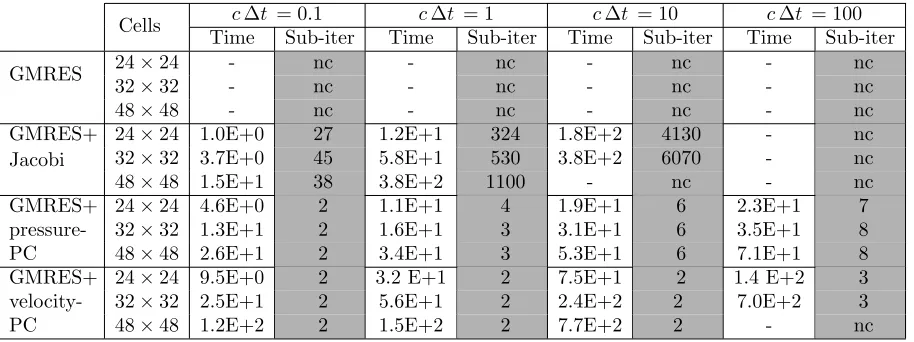
time iterations to compute the implicit problem. The results are gathered in Table 3. For each time iteration (i.e.iteration to compute variables attn+1 from variables at timetn), we compare the average number of
sub-iterations (grey columns of Table 3). Other columns correspond to the average time for each time iteration. Those results are computed for high order polynomial method in space. Indeed, for small order polynomial method in space (and so, few Gauss-Lobatto points), the classical preconditioners of the GMRES method (e.g Jacobi) are sufficient. Contrariwise, the method developed here is suitable for large and not-sparse jacobian matrices, which result from high order polynomial methods. For this reason, we consider the 4-order in the following test (Table 3).
Firstly, we remark that the GMRES method is not able to solve this problem: an additional preconditioning
Cells c∆t = 0.1 c∆t = 1 c∆t = 10 c∆t = 100
Time Sub-iter Time Sub-iter Time Sub-iter Time Sub-iter
GMRES 24×24 - nc - nc - nc - nc
32×32 - nc - nc - nc - nc
48×48 - nc - nc - nc - nc
GMRES+ Jacobi
24×24 1.0E+0 27 1.2E+1 324 1.8E+2 4130 - nc
32×32 3.7E+0 45 5.8E+1 530 3.8E+2 6070 - nc
48×48 1.5E+1 38 3.8E+2 1100 - nc - nc
GMRES+ pressure-PC
24×24 4.6E+0 2 1.1E+1 4 1.9E+1 6 2.3E+1 7
32×32 1.3E+1 2 1.6E+1 3 3.1E+1 6 3.5E+1 8
48×48 2.6E+1 2 3.4E+1 3 5.3E+1 6 7.1E+1 8
GMRES+ velocity-PC
24×24 9.5E+0 2 3.2 E+1 2 7.5E+1 2 1.4 E+2 3
32×32 2.5E+1 2 5.6E+1 2 2.4E+2 2 7.0E+2 3
48×48 1.2E+2 2 1.5E+2 2 7.7E+2 2 - nc
Table 3. Average sub-iterations number to converge, in one time iteration, and average time
for one time iteration. When the method fails to converge, we note ”nc” in the iteration column.
is clearly needed. The bad-conditonin can be explained by the high order discretization and the hyperbolic structure. Secondly, for the most complex problems (which correspond to large c∆t and fine spatial grids), the physics-based preconditioners are able to treat the test with a better efficiency than the classical Jacobi preconditioning.
Let us now compare both of the two physics-based preconditioners (PC). We observe that both physics-based PC converge quickly (the velocity-PC begin a little bit quicker than the pressure-PC) but the pressure-PC is more efficient in time than the velocity-PC. There are two reasons to explain this difference :
both advection matrices, and consequently, the cost between the two methods will be the same in this case.
• For largec∆t, the big additional cost and the non-convergence in one test for the velocity-PC come from the conditioning of the Schur complement. For the pressure-PC, the Schur complement writesPp,schur=
I1−c2∆t2∆I1 and this operator is coercive. Whenc∆t >>1, the limit operator is also coercive and
well-conditioned. For the velocity-PC, the Schur complement isPu,schur=I2−c2∆t2∇(∇ ·I2) and this
operator is also coercive. But whenc∆t >>1, the limit operator is not coercive and it is ill-conditioned. Indeed, the kernel of −∇(∇ ·I2) contains all the curl-free vector fields and the plane wave analysis
(Subsection 1.4) shows that the limit operator is a multi-scale operator with two propagation velocities 0<<|c∆t|, which leads to an ill-conditioning. In short, the additional cost or non-convergence come from the large time necessary to invert the Schur complement inside the velocity-PC. Nevertheless, this problem can be solved by finding a good algebraic PC for this operator (multi-grid methods, approximation based on the scale separation etc.)
Remark 1.12. Remarks about the implementation and the method
• The method depends on the compatibility of the boundary conditions between the Schur complement and the model. It is necessary to write correctly the boundary conditions on the sub model. The implementation is also important : if the boundary conditions are imposed weakly, the method is less efficient.
• The high-order Lagrangian polynomial matrices with Gauss-Lobatto points are not that ill-conditioned. The method has already been extensively tested, using a different code and discretization. It shows that the results with classical preconditioners like Jacobi are still worth.
• The implementation is clearly not optimal (Matrix storage, linkage with the libraries ”Paralution” used etc) and after optimizing the implementation and finding the good solver for each sub-step, better results can be obtained.
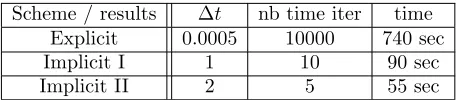
Secondly, we propose to compare explicit and implicit methods for long time computation. We consider the same test case with the final timeTf = 10 and the results are detailed in Table 4. The sound-speedcis set to
1, the mesh to 32×32, the polynomials are degree three and the explicit scheme is time-order two.
Scheme / results ∆t nb time iter time
Explicit 0.0005 10000 740 sec
Implicit I 1 10 90 sec
Implicit II 2 5 55 sec
Table 4. We use GMRES+velocity-PC for the implicit method. The time in the third column is the total time of the simulation. The explicit time step is maximal to have stability.
2.
Shallow Water equations
The second studied system (5) is a simplification of shallow water+Exner system (1) which describes the movement of the flow between a free surface of an incompressible fluid and the topography of the ground, in an area where vertical dimension is neglected with respect to the horizontal scale. Equations (5) becomes in non-conservation form
∂th+∇ ·(hu) = 0, (21a)
h∂tu+h(u· ∇)u+∇ gh2
2
= 0. (21b)
2.1.
Standard equations
Boundary conditions We propose to add some admissible boundary conditions to shallow water model (21). We consider the simple caseu·n≡0on∂Ω withnthe unit normal vector at the boundary.
Dissipation of the total energyShallow water equations (5) (without topography source term) together with those homogeneous boundary conditions conserve energy, as epitomized in the following proposition.
Proposition 2.1. The total energy, defined by E=RΩhh||u2||2 +pidx,is conserved by homogeneous boundary conditions.
Proof. The proof of D.D.Schnack in [17] about Ideal MHD is adapted here to non-conservative form of shallow
water equations (21). Applying a dot product byuto Equation (21b), multiplying Equation (21a) by ||u2||2, we obtain
∂t
h||u||
2
2
+hu·(u· ∇)u+u· ∇p+||u||
2
2 ∇ ·(hu) = 0,
∂t
h||u||
2
2
+∇ ·
hu||u||
2
2
+u· ∇p= 0.
Afterwards, let us deal with the termu· ∇p. We multiply Equation (21a) byghand noticing that the pressure isp=gh22 appear
∂t
gh2
2
+u· ∇
gh2
2
+gh2∇ ·u= 0,
thus
∂tp+u· ∇p+ 2p∇ ·u= 0.
Adding this equation to the equation on the kinetic energy, we obtain
∂t
h||u||
2
2 +p
+∇ ·
hu||u||
2
2
+ 2∇ ·(pu) = 0.
Now we integrate and apply the flux-divergence theorem to obtain
∂t Z
Ω
h||u||
2
2 +p
dx=−
Z ∂Ω
h||u||
2
2 + 2p
(u·n)dσ=−
Z ∂Ω
r p
2g||u||
2+ 2p
(u·n)dσ.
The considered boundary conditions allow to obtain the energy conservation.
2.2.
Riemann invariants and propagation
We perform the same weft as the one followed in Section 1 and compute the wave velocities of the original problem (5) to compare it with wave velocities of preconditioner in Subsections 2.5 and 2.6. We first linearize non conservative shallow water equations (21) around constant state (hn,un) to obtain
(
∂tδh+hn∇ ·δu+un· ∇δh= 0,
hn∂tδu+hn(un· ∇)δu+ghn∇δh= 0.
(22)
Proposition 2.2. The Riemann invariants for linearized shallow water equations are (0,−k2, k1)
t , √
ghn, g k1
||k||, g k2
||k|| t
and√ghn,−g k1
||k||,−g k2
||k|| t
, traveling with respectively the velocity k·un, the velocity
Dispersion relations Riemann invariants (canceling the eignevalues) (basis vectors of the eigenspaces)
ω=k·un Ker(A
sh) = Span
0 −k2
k1
ω=k·un+√ghn||k|| Ker(A
sh) = Span
√
ghn g k1
||k||
g k2
||k||
ω=k·un−√ghn||k|| Ker(A
sh) = Span
√
ghn
−g k1
||k||
−g k2
||k||
Table 5. [Shallow water equations] Dispersion relations and Riemann invariants for the
shal-low water model
Remark 2.3. The sound velocity c for the acoustic wave equations is replaced by the surface wave velocity √
ghn.
Proof. Applying the space-and time-Fourier transform to the linearized shallow water equations (22), we obtain the equation (12) with V0= (F(δh),F(δu1),F(δu2))
t
and
Ash =
iω−ik·un −ihnk1 −ihnk2
−ighnk1 ihn(ω−k·un) 0
−ighnk2 0 ihn(ω−k·un)
.
After calculating the eigenvalues and the corresponding eigenvectors, we summarize the results in Table 5.
2.3.
Discretization and linearization
Time discretization The same notation as in Subsection 1.2 are kept : ∆t for time step, ∆x for size mesh, un and hn always stand for velocity and height at time tn =n∆t. As explained in Introduction, time
multi-scales cohabit for shallow water equations (5) and create several difficulties. For instance, the simulation timeT, given by the sedimentation behavior, must be much greater than the time step ∆t. Thus, to take into account problems due to those time multi-scales, the following semi-discrete θ-scheme is computed with the boundary conditions andθ∈[0,1]
hn+1−hn
∆t +θ∇ · h
n+1un+1
+ (1−θ)∇ ·(hnun) = 0, in Ω,
hnu
n+1−un
∆t +θh
n+1 un+1
· ∇
un+1+ (1−θ)hn(un· ∇)un+θ ghn+1∇hn+1+ (1−θ)ghn∇hn= 0, in Ω,
un+1·n≡0, on∂Ω,
which can be rewritten in the form
G
hn+1
un+1
=E
hn
un
, in Ω,
B
hn+1
un+1
with
G:
h u
7→
h+θ∆t∇ ·(hu)
hnu+θ∆t h(u· ∇)u+θ∆t hg∇h
and
E:
h u
7→
h−(1−θ) ∆t∇ ·(hu)
hu−(1−θ) ∆t h(u· ∇)u−(1−θ) ∆t hg∇h
.
In order to design a preconditioner, we would like to follow the same method as in Section 1 i.e. using the Schur theory. Hence, the studied system needs to be a matrix system for Schur complement to be computed. A linearization of equations is then necessary to introduce the associated linearized matrix system.
LinearizationNeglecting the second order terms yields the linearized system
G
hn
un
+Jacn
G
δhn+1
δun+1
=E
hn
un
whereJacnG is the Jacobian matrix ofGat timenandδh
n+1 (resp. δun+1) stands for the difference hn+1−hn
(resp. un+1−un). The Jacobian matrix is decomposed in four blocs
JacnG =
D1 U
L D2
with an advection term forhn
D1=I1+θ∆t∇ ·(unI1),
an advection-convection term forun
D2=hnI2+θ∆t hn(un· ∇)I2+θ∆t hn
∂xun1 ∂yun1
∂xun2 ∂yun2
I2
and some coupling terms
U =θ∆t∇ ·(hnI2), L=θ g∆t∇(hnI1) +θ∆t I1(un· ∇)un.
In the previous relationsIdstands for thed×d-Identity matrix. Here, the operatorsU andLare a generalization
of those defined in the acoustic wave equation (Equation (15)). Hence, the linearized semi-discrete system becomes
D1 U
L D2
δhn+1
δun+1
=
−∆t∇ ·(hnun)
−∆t hn(un· ∇)un− ∆t ghn∇hn
. (23)
2.4.
Preconditioning for the shallow water equations
As for the wave equations, we propose in this subsection to write the preconditioner based on the Schur complement on the velocity. We focalize our study on the case where the Schur complement is computed on the velocity because this is the most interesting case where we want to extend the method to more complicate fluid model (Euler equation, MHD). Indeed for more complex models, the coupling between all the equations is ensured by the velocity equation. The Schur complement allows to simplify some terms. When we apply the Schur complement to the velocity we obtain a ”parabolization” of the coupling terms (in Chacon’s terminology) which are the stiff terms in the equation. The algorithm which is deduced writes
(Velocity preconditioner)
Predictor : D1δh∗=−∆t∇ ·(hnun), in Ω,
Propagation : Puδun+1=−Lδh∗−∆t hn(un· ∇)un− ∆t ghn∇hn, in Ω,
whereD1andD2 are introduced in (23) and with
Pu =D2−LD−11U,
the Schur complement on the velocity. We introduce the boundary conditions for each operator : no boundary condition for D1 and Dirichlet boundary conditionu·n= 0 forPu.
Remark 2.4. As denoted for the acoustic wave equations, using a splitting operator instead of the Schur theory produces the same result. In deed, splitting Equations (23) in the following form
D1δh∗=−∆t∇(hnun),
Lδhn+1+D2δun+1=−∆t hn(un· ∇)un− ∆t ghn∇hn,
D1δhn+1−D1δh∗+U δun+1= 0.
and injecting the third equation in the second one gives the same algorithm.
Remark 2.5. The Schur complementPu requests the inversion of the advection termD1. Some
approxima-tions have to be found to compute easily this invert while keeping physics-based characteristics such as wave propagation speeds close to those of the initial operator. In the two following subsections, we suggest two ap-proximations to computePu, adapted from magnetohydrodynamics in [7] : the first approximation is especially
for the low Froude number whereas the second one is more general. The following hypothesis is assumed throughout the two next subsections
(H1) (hn,un) are constants.
Remark 2.6. The hypothesis (H1) is a classical hypothesis used frequently in studies of physic waves. In deed,
the overall model would be too difficult to analyse. However, our preconditioners can operate without (H1) and
that restriction is only needed in Fourier analysis (Subsections 2.5 and 2.6).
2.5.
Schur complement for small flow approximation (low Froude number)
In this section, we propose to design a Schur complement in the low Froude number case by adapting the results of [7]. The small flow regime corresponds to the low Froude numberFr<<1 where the Froude number
corresponds to the Mach number (ratio between acoustic and advection phenomena) and is equal to
Fr=
un·k
√
ghn||k||.
Assuming the flow is small means that the characteristic speed of the fluid is smaller than the gravity waves’ speed. Moreover, we impose the time step to be of the same order than the gravity waves’ speed, which leads to (with a rescaling with respect to gravity waves) ∆t∼√g hn=O(1) and to the approximation
(H2) D1≈I1.
Remark 2.7. The aim of our study is to design a preconditioner for any Froude number. We begin with the small flow approximation because of the simplicity of the Schur inversion in this case. However, we do not apply all simplifications linked to this approximation : only those indispensable for the Schur inversion are made in order to anticipate the study of any Froude number case.
The previous hypothesis (H2) makes the operator LD1−1U which appears in Pu to be easier to compute.
Thanks to the relation
and the choiceδh=U δu=θ∆t∇ ·(hnδu), this operator becomes
LU(δu) = (θ∆t(un· ∇)un) (θ∆t∇ ·(hnδu)) +θ2∆t2g∇(hn∇ ·(hnδu)). (24)
Eventually,Pu is approximated by
Pulowδu=hnδu+θ∆t hn(un· ∇)δu+θ∆t hn(δu· ∇)un
−(θ∆t(un· ∇)un) (θ∆t∇ ·(hnδu))
| {z }
advection term (A)
−θ2∆t2g∇(hn∇ ·(hnδu)). (25)
Proposition 2.8. Assume thatun is constant (hypothesis (H
1)), then the low flow approximate Schur
com-plement has propagation properties very close to those of the initial shallow water operator. For a low Froude number, they both are spectrally equivalent.
Proof. When the time step tends to zero, the low Froude number preconditioner (25) is consistent with the following model
(
∂tδh+hn∇ ·δu+un· ∇δh= 0,
hn∂ttδun+hn(un· ∇)∂tδu−g(hn)
2
∇(∇ ·δu) = 0.
Thanks to space-and time-Fourier transform, the matrix of Equation (12) is
Alowu (k, ω) =
i(ω−k·un) −ihnk
1 −ihnk2
0 −hnω(ω−un·k) +g(hn)2
k2
1 g(hn)
2
k1k2
0 g(hn)2k1k2 −hnω(ω−k·un) +g(hn) 2
k22 .
Imposing one of the eigenvalues to be equal to zero and thus the corresponding eigenspace to be equal to the kernel enables us to compute the propagation properties (cf Table 6, where the dispersion relations and the
Riemann invariants are computed with respect to the Froude number Fr.)
To conclude, the propagation speeds for the models corresponding to the low Froude number preconditioner are close to the propagation speeds of the shallow water if and only if the Froude number is small. Moreover, the kernel associated with the dispersion relations are close to the results given by the shallow water model only in the small Froude regime. Therefore, as expected, the models corresponding to the preconditioners have the same propagation properties as the full model only in the small Froude regime.
Remark 2.9. For a Froude number asymptotically small (u =0), we recognise the accoustic wave equation withc=√g h.
2.6.
Schur complement for arbitrary flow approximation (any Froude number)
In this subsection, we compute an approximation of the Schur complement Pu proposed in [8] valid for an
arbitrary Froude numberi.e.without any hypothesis on the flow. Since hypothesis (H2) is not required, an other
method to compute easily the invert ofD1has to be found.
Computation of the Schur complement for any flow The idea is to construct an operatorMsuch that
UM ≈D1U, to obtain accordingly the following approximation
Puany flow = (D2M −LU)M−1.
Therefore,δuis in the kernel of Pany flow
u if and only if there existsδu∗such that (
(D2M −LU)δu∗= 0,
Dispersion relations Riemann invariants
ω=un·k Ker Alowu
= Span 1 0 0 , 0 −k2
k1
ω= un2·k+
q
(un·k)2
4 +ghn||k||2 Ker A
low u = Span √ ghn √ g
−un·k 2 +
q
(un·k)2
4 +ghn||k||2
√ hn
k1
||k||2
√ g
−un·k 2 +
q
(un·k)2
4 +ghn||k||2
√ hn
k2
||k||2
=un·k+√ghn||k||
1 +
q F2
r
4 + 1− 1 +
Fr 2 = Span √ ghn g q F2 r
4 + 1−
Fr
2
k1
||k||
g q
F2 r
4 + 1−
Fr
2
k2
||k||
ω= un2·k−
q
(un·k)2
4 +ghn||k||2 Ker A
low u = Span √ ghn − √ g
un·k 2 +
q
(un·k)2
4 +ghn||k||2
√ hn
k1
||k||2
−
√ g
un·k 2 +
q
(un·k)2
4 +ghn||k||2
√ hn
k2
||k||2
=un·k−√ghn||k||
1 +
q F2
r
4 + 1− 1−
Fr 2 = Span √ ghn −g q F2 r
4 + 1 +
Fr
2
k1
||k||
−g q
F2 r
4 + 1 +
Fr
2
k2
||k||
Table 6. [Shallow water equations] Dispersion relations and Riemann invariants for low Froude number velocity-preconditioner without advection terms
The previous system prevents us from computing the invert ofM. Let us define
M=I2+θ∆t
un hn (∇ ·(h
nI
2)), (26)
to obtainD1U δu=UMδu. Definition (26) of the operatorMleads to
D2Mδu=hnδu+θ∆t[hnun· ∇δu+hn(δu· ∇un) +un∇ ·(hnδu)]
+θ2∆t2
(un· ∇un)∇ ·(hnδu) +hnun· ∇
un hn∇ ·(h
nδu)
The approximate Schur complementPany flow
u is given by the operator D2M, theLU low Froude operator (24)
:
Puany flowδu∗=h n
δu∗+θ∆t [hnun· ∇δu∗+hn(δu∗· ∇un) +un∇ ·(hnδu∗)]
+θ2∆t2
hnun· ∇
un hn∇ ·(h
nδu∗)
−g∇(hn∇ ·(hnδu∗))
,
δu=δu∗+θ∆tu n
hn (∇ ·(h n
Study of the wave propagation associated to Pany flow u
Proposition 2.10. Assuming un and hn constant (Hypothesis(H1)) then the Schur operator and the shallow
water model have the same wave propagation properties.
Proof. The arbitrary Froude number preconditioner when the time step tends to zero is consistent with the following model
(∂
t(δh) +hn∇ ·δu+un· ∇δh= 0,
hn∂ttδu∗+hn(∇ ·∂tδu∗)un+hn(un· ∇)∂tδu∗+hnun(un· ∇) (∇ ·δu∗)−g(hn)
2
∇∇ ·δu∗= 0, (27)
with the following relation, which results from the operatorM
∂ttδu=∂ttδu∗+un∇ ·∂tδu∗.
System (27) leads to Equation (12) with the matrix
Aδu∗=
i(ω−k·un) −ik
1hn −ik2hn
0 hn(un1k1−ω) (ω−k·un) +g(hn) 2
k12 hnun1k2(ω−k·un) +g(hn) 2
k1k2
0 hnun
2k1(ω−k·un) +g(hn) 2
k1k2 hn(un2k2−ω) (ω−k·un) +g(hn) 2
k2 2
,
and the operatorMbecomes due to the Fourier transform,−ω2F(δu) =
−ω2
I2+ω
un
1k1 un1k2
un2k1 un2k2
F(δu∗),
thusF(δu∗) =
ω−k2un2
ω−k·un
k2un1
ω−k·un
k1un2
ω−k·un
ω−k1un1
ω−k·un
!
F(δu).Hence, it becomes with the three unknowns (F(δh),F(δu1),F(δu2))
t
F(δh)
F(δu∗1) F(δu∗2)
=
1 0 0
0 ω−k2un2
ω−k·un
k2un1
ω−k·un 0 k1un2
ω−k·un
ω−k1un1
ω−k·un
| {z }
=AM
F(δh)
F(δu1)
F(δu2)
.
Then, Equation (12) for the unknownsδuwrites with the matrix
Aany flowu =Aδu∗AM=
i(ω−k·un) −ik1hnω
ω−k·un −
ik2hnω
ω−k·un 0 −hnω(ω−un·k) +g(hn)2k12ω
ω−un·k
g(hn)2k1k2ω
ω−un·k 0 g(hn)2k1k2ω
ω−un·k −h
nω(ω−k·un) +g(hn)2k22ω ω−un·k
and the associated eigenvalues and eigenspaces are synthesized in Table 7, which concludes the proof.
2.7.
Numerical results
In this subsection, hypothesis (H1) is no longer applied. As previously for the linear case (Subsection 1.5),
our first numerical test is a comparison for different time steps between our method and the classical GMRES method with and without Jacobi preconditioner. In addition, we propose to study the effect of the Froude number on the results. We consider the following solution on Ω = [0,1]2
h(t, x, y) = 1.0 +x2(1−x2)y2(1−y2),
u1(t, x, y) =αx(1−x)(1−2y) +sin(2πx) sin(2πy),
Dispersion relations Riemann invariants
ω=un·k Ker Aany flow
u
= Span
1 0 0
,
0 −k2
k1
ω=un·k+√ghn||k|| Ker Aany flow
u
= Span
k·un ||k|| +
√
ghn g k1
||k||
g k2
||k||
ω=un·k−√ghn||k|| Ker Aany flow
u
= Span
−k·un ||k|| +
√
ghn
−g k1
||k||
−g k2
||k||
Table 7. [Shallow water equations] Dispersion relations and Riemann invariants for arbitrary
Froude number velocity-preconditioner
which satisfies u·n = 0 at the boundary and corresponds to a steady state when = 0 of shallow water equations with source terms. The coefficient αallows to reduce the Froude number andenables us to study the perturbation ( = 10−5) of a steady state in low Froude regime (α = 10−5). The parameters used in
Subsection 1.5 are chosen : a tolerance of the GMRES method of 10−9 and 5 time iterations to compute the
implicit problem. Eventually, the gravity waves’ speedc=√ghverifiesc=O(1). We compare two time steps ∆t= 0.1 and ∆t = 1. The results are gathered in Table 8 and correspond to the expected outcomes. Indeed,
Cells ∆t= 0.1 ∆t= 1
Time Sub-iter Time Sub-iter
GMRES 24×24 - nc - nc
32×32 - nc - nc
48×48 - nc - nc
GMRES Jacobi
24×24 1.2E+1 255 - nc
32×32 6.8E+1 720 - nc
48×48 - nc - nc
GMRES Low Froude
24×24 3.1E+1 3 3.9E+2 5
32×32 9.1E+1 3 1.0E+3 5
48×48 4.4E+2 3 4.5E+3 5
Table 8. Number of sub-iterations to converge in one time iteration and CPU time by time
iteration for different solvers and different time steps.
the method is efficient in the low Froude regime and converges with few iterations even when the classical Jacobi preconditioner is ineffective. As for the linear case, a large part of the CPU cost comes from solving the Schur complement. Indeed, when ∆t is large and the acoustic outweighs (i.e. in low Froude regime), the dominant operator in the Schur complement is −θ2∆t2g∇(hn∇ ·(hnδu)) which is not coercive and admit two scales associated with 0 and c =√hng. Finding a method to treat efficiently this operator is clearly an important
question.
Froude Number Fr=O(1−5) Fr=O(10−3) Fr=O(10−2) Fr=O(10−1) Fr=O(1) Fr=O(10)
Low Froude PC 5 5 5 6 23 nc
Any Froude PC 5 5 5 6 20 nc
Table 9. Number of iterations for the convergence of the GMRES + low-Froude preconditioner.
number is close to one. These results correspond to assumptions used to construct the Schur complement and match the conclusions obtained with the plane waves’ study. They justify also the new method proposed in [8] if the Froude number is around one or larger (this method does not converge for a Froude number around 10). A less expected result is that the Any-Froude preconditioner is not better for Froude number close to one. These results are compatible with the previous result on the propagation property of the any Froude preconditioner. Indeed the wave velocities are good but not the eigenvectors.
Conclusion
In this paper, we have studied the ”physics-based” preconditioning methods for hyperbolic systems. This method approximates the Jacobian matrix by a suitable succession of simpler problems and as expected, this technique is efficient if we have a relevant algorithm to solve each sub-systems (which are purely advection-diffusion operators). The approximation between the preconditioner and the model comes from the approxima-tion of the physics (in the nonlinear case) and a time splitting.
We have aimed to analyze the physical approximation by a study based on plane waves. This study allows to verify formally if the preconditioning has the same propagation properties that the model and if it is not the case, we have computed an estimation of the error of the wave velocities. This analysis would be used to find how to correct or to simplify the operators of the preconditioning method for more complex physical models. Additionally, we have shown three difficulties. Firstly, as expected the classical method is valid only in the Low-Mach (low Froude) regime. The plane wave study shows that the correction proposed in [8] allows to solve partially the problem. The second problem comes from the velocity Schur complement which is non coercive in the high time step limit. Consequently, it will be interesting to find a way to split the two scale linked to the two velocity waves 0 and±cand to solve each scale. This problem is not detailed in the previous works. Thirdly, we have noticed that the implementation of the boundary conditions is important since when we impose weakly the boundary conditions the results are worse. We assume that imposing by penalization the boundary conditions allows to reduce the time splitting errors.
In the future, it will be interesting to extend the method to the shallow water + Exner model and also use the preconditioner with compatible finit element spaces. The compatible spaces given the Inf-Sup theory allows to avoid the spurious pressure mods and allow to design good preconditioning for the Schur operator (the good space to work and design preconditioning is the H(div) space).
Acknowledgements
The authors would like to thank all the supervisors for their continuous support, especially E. Franck. They also acknowledge all the organizers of the CEMRACS’15.
References
[1] E. Audusse, and M-O. Bristeau. Transport of pollutant in shallow water, a two time steps kinetic method.ESAIM: M2AN, 37(2):389–416, 2003.
[2] I. Babuska, M. Griebel, and J. Pitk¨aranta. The problem of selecting the shape functions for a p-type finite element. Research Report BN-1090, November 1988.
[4] F. Bourdel, P.A. Mazet, and P. Helluy. Resolution of the non-stationary or harmonic Maxwell equations by a discontinuous finite element method. Application to an E.M.I. (electromagnetic impulse) case. In Proceedings of the 10th international conference on computing methods in applied sciences and engineering, pages 405–422, 1992.
[5] H. Brezis.Functional Analysis, Sobolev Spaces and Partial Differential Equations. Universitext. Springer New York, 2011. [6] F. Brezzi and M. Fortin.Mixed and Hybrid Finite Element Methods. Springer Verlag, New York, 1991.
[7] L. Chac´on. An optimal, parallel, fully implicit Newton-Krylov solver for three dimensional viscoresistive magnetohydrodynam-ics.Phys. Plasmas, 15:056103, 2008.
[8] L. Chac´on. Scalable parallel implicit solvers for 3D magnetohydrodynamics.Journal of Physics: Conference Series, 125:012041, 2008.
[9] L. Chac´on, and D.A. Knoll. A 2D high-ß Hall MHD implicit nonlinear solver.J. Comput. Phys., 188(2):573–592, 2003. [10] A. Crestetto.Optimisation de m´ethodes num´eriques pour la physique des plasmas. Application aux faisceaux de particules
charg´ees. PhD thesis, University of Strasbourg, 2012.
[11] A.J-C. de Saint-Venant. Th´eorie du mouvement non-permanent des eaux, avec application aux crues des rivi`eres et `a l’introduction des mar´ees dans leur lit.C.R. Acad. Sci. Paris, Section M´ecanique, 73:147–154, 1871.
[12] M. Durufl´e, P. Grob, and P. Joly. Influence of Gauss and Gauss-Lobatto quadrature rules on the accuracy of a quadrilateral finite element method in the time domain.Num. Methods Part. Diff. Eq., 25(3):526–551, 2009.
[13] A. Ern, and J-L. Guermond. Theory and Practice of Finite Elements. Applied Mathematical Sciences. Springer New York, 2004.
[14] A. Ern, and J-L. Guermond. Discontinuous Galerkin methods for Friedrichs’ systems. I. General theory. SIAM J. Numer. Anal., 44(2):753–778, 2006.
[15] J.F. Gerbeau, and B. Perthame. Derivation of viscous Saint-Venant system for laminar shallow water; Numerical validation.
Discrete Contin. Dynam. Systems, 1:89–102, 2001.
[16] A.J. Grass. Sediments transport by waves and currents. Technical Report No. FL29, SERC London Cent. Mar. Technol., 1981. [17] D.D. Schnack.Lectures in Magnetohydrodynamics : With an Appendix on Extended MHD. Lect. Notes Phys. 780 (Springer,
Berlin Heidelberg), 2009.