Engineering Application Research of the Wet Processing
Produced Buton Rock Modified Asphalt in Anhui Province,
China
Miaomiao Tian
*, Jing Chen, Yafei Li, Jin Yan
China Academy of Transportation Sciences, Ministry of Transport, P.R.C. 240 Hui Xin Li, Chaoyang District, Beijing, China.
* Corresponding author: Miaomiao Tian. Tel.: 86-13552932389; email: [email protected]. Manuscript submitted June 5, 2019; accepted August 11, 2019.
doi: 10.17706/ijmse.2019.7.3.52-58.
Abstract: The Buton rock modified asphalt has the similar high temperature performance with the SBS modified asphalt, but the price is much less than the SBS asphalt. Moreover, it can be highly integrated with asphalt without polymerization, and has been considered as a green road construction materials. Wet processing technique has been chosen to produce the Buton rock modified asphalt, compare with the traditional dry processing technique, natural rock modified asphalt is much more easier to fuse with asphalt, and the performance of the mixture could be much stable. With the application of the wet processing Buton rock modified asphalt in Anhui Province, China, the mix design method and road performance has been tested and researched, and the tests results could meet the requirements of the national specification.
Key words: Buton rock modified asphalt, wet processing technique, asphalt mixture, mix design, road performance test.
1.
Introduction
Rock asphalt is a kind of asphalt that formed from petroleum flowing into rock cracks after billions of years with the combined action of heat, pressure, oxidation, catalyst and bacteria. The rock asphalt materials have high quality road service capacity, especially in the performance of high temperature stability, water resistance and durability [1], [2]. Its performance is seemed to be similar as the SBS modified asphalt, but with a very competitive cost which is nearly half of the SBS asphalt. Moreover, the rock asphalt is a kind of nature materials, it has high degree of fusion with asphalt and does not require chemical processing, thus, it could be regarded as a kind of pavement material with the advantages of green-construction, energy-saving, and environmentally friendly.
Dry process rock asphalt has been used many years in China, because of the restriction of inadequate fusion with the asphalt mixture in the short time, the performance has been adversely affected to some extent. Comparatively, wet process has advantages in easily quality control and stable performance, which is much more suitable for engineering application. Therefore, adopt wet process technique could be an important approach to boost the application of the rock asphalt [4], [5].
To test the performance of the wet process Buton rock asphalt, the test road was constructed in Anhui province, China. The pavement type was AC-13 (expressed as B.R.A.-13 in this paper to indicate the material), designed by the standard of the national road level two. The mix design and road performance has been researched and analyzed in this paper.
2.
Mix Design of the Wet Process Rock Asphalt Mixture
2.1.
Raw Materials
A test road has been conducted in Anhui province. The coarse and fine aggregates used were both limestone from the local site, which respectively sized (10~15) mm, (5~10) mm, (3~5) mm, (0~3)mm. Performance test results of the aggregates are shown in Table 1. The aggregates were all meet the requirements of the specification [6],[7].
Table 1. Testing Results of Aggregates
Item Aggregate size (mm) 10~15 5~10 3~5 0~3 Mineral powder
Apparent relative density 2.756 2.734 2.724 2.586 2.686 Dry surface relative density 2.732 2.704 2.688 / / Gross volume relative density 2.718 2.687 2.667 / /
Water absorption (%) 0.51 0.65 0.79 / /
Needle flake content (%) / / / / /
Crushing value (%) / / / / /
Content <0.075mm (%) 0.5 0.4 1.2 6.1 /
Sand equivalent (%) / / / / /
The 90# asphalt was used, and the technical requirements and testing results of the 90# asphalt are shown in Table 2. The asphalt was meet the requirements of the specification [6], [7].
Table 2. Technical Requirements and Testing Results of the 90# Asphalt
Item Unit Test result Requirement
Needle penetration (25℃, 5s, 100g) 0.1mm 68 60~80
Softening point (R&B) ℃ 47.5 ≥46
Ductility (15℃) cm >100 ≥100
Relative density (25℃) / 1.010 Actual measurement
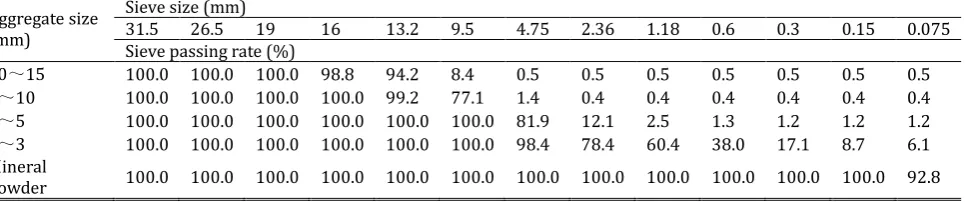
Table 3. Test Results of Aggregate Sieving Aggregate size
(mm)
Sieve size (mm)
31.5 26.5 19 16 13.2 9.5 4.75 2.36 1.18 0.6 0.3 0.15 0.075
Sieve passing rate (%)
10~15 100.0 100.0 100.0 98.8 94.2 8.4 0.5 0.5 0.5 0.5 0.5 0.5 0.5 5~10 100.0 100.0 100.0 100.0 99.2 77.1 1.4 0.4 0.4 0.4 0.4 0.4 0.4 3~5 100.0 100.0 100.0 100.0 100.0 100.0 81.9 12.1 2.5 1.3 1.2 1.2 1.2 0~3 100.0 100.0 100.0 100.0 100.0 100.0 98.4 78.4 60.4 38.0 17.1 8.7 6.1 Mineral
powder 100.0 100.0 100.0 100.0 100.0 100.0 100.0 100.0 100.0 100.0 100.0 100.0 92.8
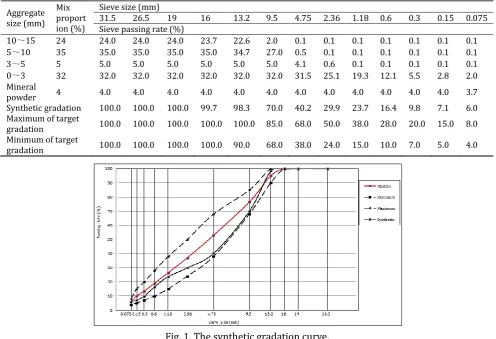
According to the national Standard Test Methods, sieving the aggregates by water washing method [6], the sieving results are shown in Table 3. Mixing the aggregates, the gradation results are shown in Table 4, and the gradation curve is shown in Fig. 1.
To guarantee the better performance of high temperature stability and fatigue resistance of the asphalt pavement, reducing the phenomenon of early stage water damage caused by excessive porosity, in the process of mix design in this paper, the void volume (VV) was pre-designed to be 4.5%.
Table 4. B.R.A.-13 Aggregate Proportion and Synthetic Gradation Aggregate
size (mm) Mix proport ion (%)
Sieve size (mm)
31.5 26.5 19 16 13.2 9.5 4.75 2.36 1.18 0.6 0.3 0.15 0.075
Sieve passing rate (%)
10~15 24 24.0 24.0 24.0 23.7 22.6 2.0 0.1 0.1 0.1 0.1 0.1 0.1 0.1 5~10 35 35.0 35.0 35.0 35.0 34.7 27.0 0.5 0.1 0.1 0.1 0.1 0.1 0.1 3~5 5 5.0 5.0 5.0 5.0 5.0 5.0 4.1 0.6 0.1 0.1 0.1 0.1 0.1 0~3 32 32.0 32.0 32.0 32.0 32.0 32.0 31.5 25.1 19.3 12.1 5.5 2.8 2.0 Mineral
powder 4 4.0 4.0 4.0 4.0 4.0 4.0 4.0 4.0 4.0 4.0 4.0 4.0 3.7 Synthetic gradation 100.0 100.0 100.0 99.7 98.3 70.0 40.2 29.9 23.7 16.4 9.8 7.1 6.0 Maximum of target
gradation 100.0 100.0 100.0 100.0 100.0 85.0 68.0 50.0 38.0 28.0 20.0 15.0 8.0
Minimum of target
gradation 100.0 100.0 100.0 100.0 90.0 68.0 38.0 24.0 15.0 10.0 7.0 5.0 4.0
Fig. 1. The synthetic gradation curve.
Table 5. Results of the Marshall Tests Asphalt aggregate
ratio (%) Maximum theoretical relative density Gross volume relative density VV (%) VMA (%) VFA (%) MS (kN) FL (mm)
4.4 2.570 2.393 6.9 14.4 53.2 9.6 2.6
4.8 2.534 2.397 5.4 14.5 64.0 10.8 2.8
5.2 2.505 2.412 3.7 14.2 74.9 12.6 3.5
5.6 2.478 2.404 3.0 14.4 78.5 11.9 2.7
6.0 2.456 2.404 2.1 14.3 85.0 12.3 2.7
2.3.
Determination of the Optimum Asphalt Aggregate Ratio
According to the national Standard Test Methods, compact the Marshall specimen 75 times for each side [6], the target designing void volume was 4.5%, other indicators has all met the technical requirements in the national specification [7].
All specimen were individually mixed and compacted. The Marshall test results and technical requirements has been shown in Table 5. The maximum theoretical relative density of the mixture was tested by the actual measurement method.
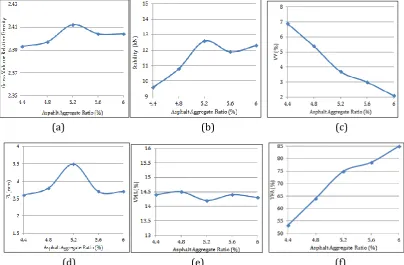
According to Marshall test and calculation results, respectively draw the relationship curves between gross volume relative density, stability (MS), void volume (VV), flow value (FL), voids in mineral aggregate (VMA), voids filled with asphalt (VFA) and asphalt aggregate ratio. The curves are shown in Fig. 2.
(a) (b) (c)
(d) (e) (f)
Fig. 2 (a)~(f). Relationship curves between gross volume relative density, stability (MS), void volume (VV), flow value (FL), voids in mineral aggregate (VMA), voids filled with asphalt (VFA) and asphalt aggregate
ratio.
According to the results in Table 5, Fig. 2, and the calculation method of the asphalt aggregate ratio from the national specification [6], [7], as the target void volume corresponded the asphalt aggregate ratio was
a3=5.0%, then OAC1=5.2%. According to the relationship curve between the VV and the asphalt aggregate ratio, the relationship curve between the VFA and the asphalt aggregate ratio, it could be seen that OACmin=5.2%, OACmax=5.3%, then OAC2=5.2%. The optimum asphalt aggregate ratio was finally determined as the median of OAC1 and OAC2, and could calculated as 5.2%.
Conduct the Marshall test to the specimen under the optimum asphalt aggregate ratio, all indicators has met the requirements of the standard, the test results are shown in Table 6.
Table 6. Marshall Test Results under the Optimum Asphalt Aggregate Ratio Asphalt
aggregate ratio (%)
Maximum theoretical relative density
Gross volume
relative density VV (%) VMA (%) VFA (%) MS (kN) FL (mm)
5.2 2.505 2.412 3.7 14.2 74.9 12.6 3.5
Technical requirement 3~6 ≥14.0 65~75 ≥8.0 1.5~4
3.
Road Performance Tests of the Wet Process Buton Rock Asphalt Mixture
national specification, the test results are shown from Table 7 to Table 9.
3.1.
High Temperature Performance
Evaluation high temperature performance by dynamic stability test,the test results are shown in Table 7.
Table 7. Results of the Rutting Test
Type of mixture Asphalt aggregate ratio (%) Test results of dynamic stability (times/mm) Technical requirement (times/mm)
Wet process
B.R.A.-13 5.2
1 2 3 Average
≥2800
3299 3158 3500 3319
3.2.
Water Stability Performance
Evaluation of water stability by freeze-thaw splitting test and immersion Marshall test, the test results are shown in Table 8 and Table 9.
Table 8. Results of the Freeze-thaw Splitting Test
Type of mixture
Asphalt aggregate ratio (%)
Splitting strength before freezing and thawing (MPa)
Splitting strength after freezing and thawing (MPa) Residual strength ratio (%) Technical requirement (%)
Wet process B.R.A.-13 5.2 0.915 0.783 85.6 ≥80
Table 9. Results of the Immersion Marshall Test
Type of mixture Asphalt aggregate ratio (%)
Stability of specimens immersed in water for 30min (kN)
Stability of specimens immersed in water for 48h (kN) Residual stability (%) Technical requirement (%)
Wet process B.R.A.-13 5.2 10.81 9.84 91.0 ≥85
4.
Conclusion
(1) According to the mix design, the aggregate gradation was (10~15)mm: (5~10)mm: (3~5)mm: (0~
3)mm: Mineral powder = 24:35:5:32:4. The optimum asphalt aggregate ratio was 5.2%.
(2) The test results of dynamic stability, residual strength ratio of freeze-thaw splitting and residual stability of immersed Marshall of the wet process B.R.A. have all met the requirements of the national specification. Besides, the dynamic stability test results was similar to the SBS modified asphalt mixture which was considered to be around 4000 times/mm according to the engineering experience, which was much highly better than the basic asphalt mixture. It indicated that the wet process B.R.A. could improve the high temperature performance of the asphalt pavement and has met the research purpose of this paper.
(3) In order to prevent segregation of the mixture during construction, the grading of raw materials should be strictly controlled when paving. Meanwhile, strengthened compaction was suggested during construction, to ensure the compaction degree of the asphalt pavement layer.
References
[1] Hao, X. H., Wang, Y. M., Zhang, A. Q. (2017). Performance analysis and modification mechanism research of the rock modified asphalt. Journal of Chinese and Foreign Highway,37(3), 205-207.
[2] Zhong, K., Yang, X., Luo, S. (2017). Performance evaluation of petroleum bitumen binders and mixtures modified by natural rock asphalt from Xinjiang China. Construction and Building Materials, (154), 623-631.
modified asphalt and asphalt mixture. Road Machinery & Construction Mechanization,29(2), 22-26. [4] Huang, W. T., Xu, G. Y. (2012). Experimental study on road performance of bitumen rock asphalt
mixture. Journal of South China University of Technology: Natural Science, (2), 18-19.
[5] Zhou, F. Q., Zhou, B. G., Li, B. G., et al. (2006). Application study of rock asphalt modified asphalt.
Highway, (12), 140-142.
[6] Ministry of Transport of the People's Republic of China. Standard Test Methods of Bitumen and Bituminous Mixture for Highway Engineering. JTG E20-2011. 2011.
[7] Ministry of Transport of the People's Republic of China. Technical Specification for Highway Asphalt Pavement Construction. JTG F40-2004. 2004.
Miaomiao Tian was born in Liaoning in June 1982. She obtained the Msc degree of civil engineering from the University of Nottingham, UK in 2007.
She is now working as an associate researcher at the Engineering Technology & Materials Research Center of the China Academy of Transportation Sciences, Ministry of Transport, in Beijing, China. Currently, her research focuses on (1) application research of the wet processing Buton rock modified asphalt; (2) design and construction technology of the SMC (styreneic methyl copolymers) normal temperature modified asphalt mixture. She has published a monograph, many papers and achieved several patents mainly on environmentally friendly pavement building materials and other aspects. Selected publications are: (1) Wu X.H., Tian M.M., Yan J. (2017). Determining method for mixing and compaction temperature of modified asphalt mixture.
Key Engineering Materials, (744), 83-86. (2) Tian M.M., Guo C.Y., Yan J. (2017). Mix design method of the SMC
normal temperature modified asphalt mixture. Key Engineering Materials, (744), 185-189.
Ms. Tian has been awarded the first prize in road science and technology from the China Highway & Transportation Society (Rank 3rd in 2016), and two times of the second prize in road science and technology from the China Highway & Transportation Society (Rank 2nd in 2015, 4th in 2013, respectively).
Jing Chen was born in Jiangsu in June 1974. He obtained the Msc degree of road, urban road and airport engineering from the Research Institute of Highway, Ministry of Transport, Beijing, China in 1998.
He is now working as a researcher and deputy director at the Engineering Technology & Materials Research Center of the China Academy of Transportation Sciences, Ministry of Transport, in Beijing, China. His work mainly focuses on technical guidance and quality management of research and application on new and smart road engineering materials. He has published many papers and participated in the compilation of many industry specifications, which are: (1) Ministry of Transport of the People's Republic of China. Technical Specification for Highway Asphalt Pavement Construction. JTG F40-2004. 2004; (2) Ministry of Transport of the People's Republic of China. Standard Test Methods of Bitumen and Bituminous Mixture for Highway Engineering. JTG E20-2005. 2005, etc.
Yafei Li was born in Shanxi in September 1986. He obtained the Msc degree of highway and railway engineering from Changan University, Xian, China in 2012.
He is now works as an assistant research fellow at the Engineering Technology & Materials Research Center of the China Academy of Transportation Sciences, Ministry of Transport, in Beijing, China. His work mainly focuses on the research and application of the Buton rock asphalt and asphalt mixture.
He has published many papers and achieved several patents on the aspects of green road construction materials.
Mr. Li has been awarded the first prize in Road Science and Technology from the China Highway & Transportation Society (Rank 10th in 2016).
Jin Yan was born in Anhui in September 1987. She obtained the Msc degree of highway and bridge engineering from East China Jiaotong University, Nanchang, China in 2012.
She is now works as an engineer at the Engineering Technology & Materials Research Center of the China Academy of Transportation Sciences, Ministry of Transport, in Beijing, China. Her work mainly focuses on the research and application of the multi-functional modified asphalt and asphalt mixture.
She has published many papers and achieved several patents on the aspects of asphalt and asphalt mixture.