*
Corresponding Author:[email protected]
1Department of Electrical Engineering, Islamshahr branch, Islamic Azad University, Islamshahr, Iran
LMI-based Congestion Control Algorithms for a Delayed
Network
Shoorangiz Shams Shamsabad Farahani
1,*and Siavash Fakhimi Derakhshan
21 Department of Electrical Engineering, Islamshahr branch, Islamic Azad University, Islamshahr, Iran
2
Adaptive System Department, Institute of Information Theory and Automation of the Czech Academy of Science
1
[email protected], 2 [email protected]
In this paper buffer dynamic modeling for wireless sensor networks (WSNs) as a highly nonlinear system is accomplished in discrete time and the overall model is gained by blending subsystems obtained based on delay. Based on queue utilization and channel estimation algorithm, congestion is detected and a suitable rate is selected by an adaptive back-off interval selection. In this paper, a new approach is proposed for controller synthesis of our system based on non-quadratic Lyapunov functions, and a controller is designed to stabilize each subsystem. The controller synthesis results are expressed as a set of Linear Matrix Inequalities (LMIs). Moreover, the performance is considered and decay rate is guaranteed. Finally, a set of new LMI-based congestion control schemes (LCC) is obtained for WSNs.The closed-loop systems are globally asymptotically stable(GAS) in case of delay changes resulted from queue size changes. The simulation results using MATLAB and OPNET simulator confirm the effectiveness of our proposed schemes.
Article Info
Keywords:
Congestion control,Controller synthesis, Linear matrix inequality (LMI),
Non-quadratic Lyapunov stability, Wireless sensor networks (WSNs). Article History:
Received 2018-05-08 Accepted 2018-11-22
I. INTRODUCTION
Congestion control has emerged as a major issue in communication networks especially with the growing need of bandwidth, load, size and connectivity of these networks. The aforementioned fact has necessitated the design and utilization of networks including more efficient congestion control algorithms, especially for WSNs that play a dominant role in recent technologies [1]. Congestion of packets at the outgoing queues in routers causes low reliability of networks and performance degradation. Recently, a great number of schemes are proposed to address congestion control problem [2]-[15].
It should be highlighted that fading is very probable in WSNs which renders bandwidth reduction ending in queue length increase and consequently delay increase. In this case, satisfactory performance is gained only if the resultant closed-loop systems are stable, otherwise performance degradation is achieved ending in system instability. Fading
is considered in decentralized predictive congestion control (DPCC) [5] and Robust Decentralized Adaptive Nonquadratic Congestion Control Scheme (RDANQCC) [15].
Finite transmission speeds and traffic congestion renders delay in networks. So, delay is one of the most important metrics for performance evaluation in WSNs. In [8], network modeling is accomplished by a nonlinear fluid flow model where delay is considered. Afterwards, congestion control in WSNs based on sliding mode learning control is studied. In [9] the congestion control in local WSNs by the use of time-delay compensators is presented. In [10] a congestion control in WSNs based on triangle module fusion operator is addressed where the ratio of queue waiting time and queue delay is considered as the retention rate which is used to detect congestion. In [11] a congestion control algorithm in WSNs is established which copes with time-varying network parameters and large delays. In [15] a congestion controller which is robust to delay changes is designed. Also, in order to consider delay in our system, in [15], buffer dynamic modeling for WSNs is accomplished in discrete time, different subsystems are
International Journal of Industrial Electronics, Control and Optimization .
© 2019 IECO
…
92
achieved based on delay, and the overall model is gained by blending them. It is worth mentioning that unlike [5] where the buffer occupancy error and control effort are only considered at time instances n and n−1, respectively, in [15], they are considered at different time instances.
Stability analysis and controller synthesis of systems have been comprehensively addressed during the last years. In this regard, Lyapunov-based approaches are of special concern [16]-[18]. It should
be highlighted that there have been a few attempts to imply non-quadratic Lyapunov functions for controller synthesis in WSNs in a will to reduce the conservativeness of the common quadratic Lyapunov functions. Stability analysis and controller synthesis can be accomplished using LMIs. In [12] congestion control for communication networks is studied with random parameter jumps where the controller synthesis is accomplished by LMIs. In [12], the round-trip time delay, the link capacity, and the transmission control protocol (TCP) session number are considered random finite state Markov process. In [13] the congestion control issue for linearized TCP/AQM network is addressed using LMIs where an input constraint is considered in the controller design. In [14] a distributed estimation and congestion control method is established for a sensor-network-based system where LMIs are used to formulate the controllers stabilizing the system despite observation errors in the controlled output, and minimize the communication noise effect in the observation error. In [15] RDANQCC is presented as a congestion control scheme where iterative linear matrix inequalities (ILMIs) are used to solve the control problem.
In this paper, buffer dynamic modeling for WSNs is accomplished in discrete time, different subsystems are achieved based on delay, and the overall model is gained by blending them. Also, unlike [5], the buffer occupancy error and control effort are considered at different time instances. In this paper, a new approach is presented for controller synthesis of our proposed system based on non-quadratic Lyapunov functions. Unlike [15] where a controller is obtained to stabilize the whole system, in the current study, a controller is designed for each subsystem, and the overall controller for our proposed system is achieved by blending them. Also, unlike [15] where the results of controller synthesis are presented in terms of ILMIs, in this paper, LMIs are used for controller synthesis which are numerically feasible using commercially available software. Finally, our congestion control strategies are presented for WSNs based on these approaches, and in case of delay changes resulted from queue size changes, the closed-loop systems are GAS. Moreover, unlike [5],[15], performance is considered and decay rate is guaranteed. The reminder of this article is as follows: First, some preliminaries are stated. Next, we address the main results, followed by our approach performance which is assessed through simulation results, and finally we conclude our study.
II. PRELIMINARIES
In this section, the buffer occupancy changes at a node, the adaptive and predictive controller in [5], our proposed model [15] and the controller synthesis results in RDANQCC are briefly presented.
Notations: Through this paper , , n, n m
N ℜ ℜ ℜ× denote sets of natural numbers, real numbers, n component real vectors and n m× real matrices, respectively.
A. Buffer occupancy changes at a node
Based on [5], buffer occupancy changes at the th a node in terms of outgoing and incoming traffic is given as:
1
( 1) [ ( ) ( ) ( ( )) ( )] (1)
a c a a a a
q n+ =sat q n +Tu n −f u + n +d n
Wheresatcis the saturation function showing the behavior
of finite-size queue,q na( ) is the th
a node buffer occupancy at time instantn, T is the measurement interval,u na( ) is
the rate of regulated incoming traffic, fa( )⋅ is a dictated
outgoing traffic by node located at the next hop which is disturbed by channel variations andd n( ) is the traffic
disturbance which is unknown. In order to estimate the outgoing traffic, it is essential to calculate and propagate
( )
a
u n as a feedback to the ( 1)th a− node.
Consideringqad as the desired buffer occupancy at the
th
a node, the buffer occupancy error eba( )n =q na( )−qad
is as follows:
1
( 1) [ ( ) ( ) ( ( )) ( )] (2)
ba c ba a a a
e n+ =Sat e n +Tu n −f u + n +d n
B. The adaptive and predictive controller in DPCC The adaptive and predictive controller in [5] is as follows:
1
ˆ ( ( )) ( 1) ( )
( ) a a bv ba (3)
a c
f u n e n
u n Sat
T
κ
+
+ −
=
Whereκbvis the gain parameter and ˆ (f ua a+1( ))n is the
estimate of f ua( a+1( ))n . The error of buffer occupancy at
time instantn+1is:
1
( 1) [ ( ) ( ( )) ( )] (4)
ba c bv ba a a
e n+ =Sat k e n +f u% + n +d n
Wheref u%a( a+1( ))n = f ua( a+1( ))n −f uˆa( a+1( ))n is the
estimation error of the outgoing traffic. Also, the traffic estimate and the node actual rate are detailed in [5].
Remark1- Since our scheme is decentralized, model formulation and controller synthesis results are presented for each node. So, for the sake of simplicity,the index
" "
a
which is used to show the
a
th node is omitted in our scheme.C. The proposed system
{ }
11
( 1) ( )( ( ) ( ))
( ) 1, ( ) 0,1 (5)
r
j j j
j
r
j j
j
x n n A x n B u n
n n β β β = = + = + = ∈
∑
∑
Where[
]
( ) ( ) ( 1) ... ( ) ( 1) ... ( ) ( )T z
b b b
x n=e n e n− e n o− u n− u n p− s n ∈ℜ
includes buffer occupancy errors e n ob( − ) (Equ. 2),
regulated incoming traffic rate (control effort) u n( −p) at
different time instances and the integrator
0
( ) ( )
n
b m
S n e m
=
=
∑
∈ℜ . Alsoo p
,
∈
N
are the statenumber where
o
+
1
andp
are the number of buffer occupancy error and control effort states, respectively,{
1 2 ...}
z z
j r
A ∈ A A A ∈ ℜ× and
{
1 2 ...}
z z
j r
B B B B ×
∈ ∈ ℜ are known constant
matrices for system description showing the th j
subsystem, z∈N is the number of state variables, r∈N
is the number of subsystems obtained due to queue size increase which renders delay increase in system and finally
( )
j n
β indicates the subsystem chosen considering delay
(
1
( ) 1
r j j n β = =
∑
and βj( )n can be either 0 or 1).D. The controller synthesis results in RDANQCC
The controller synthesis result in RDANQCC is as follows:
Theorem1[15] - System (5) with u n( )=kx n( ) as the control effort is GAS if there exists a set of symmetric positive definite (PD) matrices Pi andPm for every
, ,
i j m
∈
L
(L={
1 2 ... r}
) such that (6) is satisfied:1
( )
0 (6)
( )
T
m j j
j j i
P A B k
A B k P−
+
>
+
In the subsequent sections, controller synthesis and the simulation results will be addressed in details.
III. MAIN RESULTS
In this paper, non-quadratic Lyapunov functions are utilized for controller synthesis of our system. Also, a controller is designed for each subsystem and afterwards, a combination of these controllers is used that guarantee system stability. The controller synthesis results are expressed as a set of LMIs which are numerically feasible with commercially available software and unlike [5], performance is considered and decay rate is guaranteed.
Lemma 1 [19]: If matrices Cm and Sm have appropriate dimensions and Smis (PD), then
1 (7)
T T
m m m m m m
C S C− ≥C +C −S
By defining the control signal as
1
1 1
( ) [
(
) ] ( )
(8)
r r
j j j j
j j
u n
β
N
β
P
−x n
= =
=
∑
∑
The following result is obtained:
Theorem2: System (5) with the control signal defined in (8) is GAS if
i) There exists a set of symmetric positive definite
matrices Pj∈ ℜz z× and matrices Nj∈ ℜ1×zfor every
,
i j
∈
L
andL
=
{
1 2 ...
r
}
such that the following LMIs (9) are satisfied:
1
(A Pj j +B Nj j) (T Pi− )(A Pj j +B Nj j)−Pj <0 (9)
Or equivalently ii) There exists a set of symmetric positive definite
matrices Pj z z×
∈ ℜ and the matrices Nj 1×z ∈ ℜ for
every
i j
,
∈
L
such that the following LMIs (10) are satisfied:( )
0 (10)
( )
T
j j j j j
j j j j i
P A P B N
A P B N P
+
>
+
Moreover, the controller gains are given by:
1 (11)
j j j
F =N P∗−
Where the following notation is adopted for simplicity:
1
(
)
(12)
r
j j j
j
P
∗β
P
=
=
∑
Proof: Consider the following Lyapunov function candidate:
1
( ( )) T ( ) j ( ) (13)
V x n =x n P∗− x n
The difference function is given as:
* 1 * 1
( ( 1)) ( ( ))
( 1) ( ( 1)) ( 1) ( )( ( )) ( ) (14)
T T
j j
V V x n V x n
x n P n − x n x n P n − x n
∆ = + −
= + + + −
Based on system Equation (5) and the control signal (8), we have:
1
1
(
1)
( )(
) ( )
(15)
r
j j j j j
j
x n
β
n A
B N P
−x n
=
+ =
∑
+
Since
1
( ) 1
r j j n
β
= =∑
andβ
j∈
{ }
0,1
, we have1
(
1) (
j j j j) ( )
(16)
x n
A B N P x n
−+ =
+
Substituting (16) in (14) yields:
1 1
1 1
1 1
1 1
( )( ) ( )( ) ( ) ( ) ( )
( )[( ) ( )( ) ] ( ) (17)
T T T
j j j j i j j j j j
T T
j j j j i j j j j j
V x n A B N P P A B N P x n x n P x n
V x n A B N P P A B N P P x n
− − − − − − − − ∆ = + + − ∆ = + + −
Pre-and post-factorization (17) by
P
jT−
and its transpose,
International Journal of Industrial Electronics, Control and Optimization .
© 2019 IECO
…
94
1
1 1
( ) [( ) ( )
( ) ] ( ) (18)
T T T
j j j j j i
T
j j j j j j j j
V x n P A P B N P
A P B N P P P P x n
− −
− −
∆ = +
+ −
In order to prove that the proposed system (16) is GAS, it suffices to show that the following inequalityis satisfied:
1
( ) (T )( ) 0 (19)
j j j j i j j j j j
A P B N P− A P B N P
+ + − <
So, the claimed stability result of condition (i) is established.
Via the Schur complement Lemma [20], (19) can be rewritten as:
( )
0 (20)
( )
T
j j j j j
j j j j i
P A P B N
A P B N P
+
>
+
So, condition (ii) is also satisfied and the closed-loop control system (16) is GAS. Moreover, the controller gains can be easily obtained by (11) and the proof is completed. In the subsequent Theorem, performance is considered and decay rate is guaranteed.
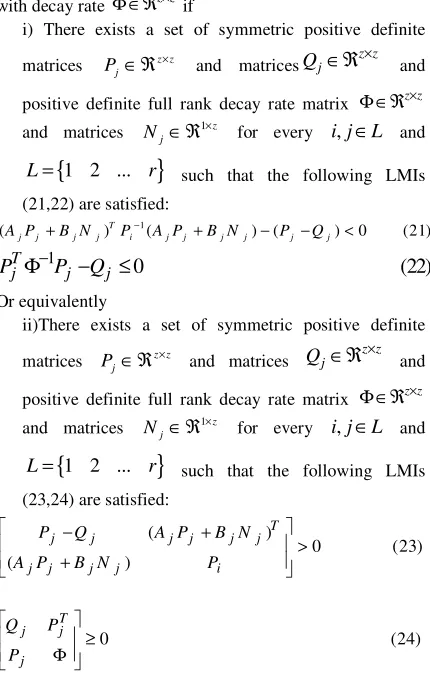
Theorem3: The closed-loop control system (16) is GAS with decay rate Φ ∈ℜz z× if
i) There exists a set of symmetric positive definite
matrices Pj z z ×
∈ ℜ and matrices
Q
j z z×
∈ℜ
andpositive definite full rank decay rate matrix Φ ∈ℜz z×
and matrices Nj∈ ℜ1×z for every
i j
,
∈
L
and{
1 2 ...
}
L
=
r
such that the following LMIs(21,22) are satisfied: 1
( )T ( ) ( ) 0 (21)
j j j j i j j j j j j
A P +B N P− A P +B N − P −Q <
1
0
(22)
T
j j j
P
Φ
−P
−
Q
≤
Or equivalently
ii)There exists a set of symmetric positive definite
matrices Pj∈ ℜz z× and matrices
Q
j z z×
∈ℜ
andpositive definite full rank decay rate matrix Φ∈ℜz z× and matrices Nj∈ ℜ1×z for every
i j
,
∈
L
and{
1 2 ...
}
L
=
r
such that the following LMIs(23,24) are satisfied:
( )
0 (23)
( )
T
j j j j j j
j j j j i
P Q A P B N
A P B N P
− +
>
+ 0 (24) T j j j Q P P ≥ Φ
Moreover, the control gains are given by (11) and the
control signal can be rewritten as (8).
Proof: Consider the Lyapunov function candidate which is defined in (13),
1
( ( )) T( ) j ( )
V x n =x n P∗−x n
In order to prove that the proposed system (16) is GAS, it suffices to show that the following inequalityis satisfied.
So:
1
( ( 1)) ( ( )) T( )[ jT j j ] ( ) (25)
V V x n V x n x n P− Q P− x n
∆ = + − < −
Substituting (16) in (25), yields:
1 1 1
1 1
( )[( ) ( )( )
] ( ) ( )[ ] ( ) (26)
T T
j j j j i j j j j
T T
j j j j
V x n A B N P P A B N P
P x n x n P Q P x n
− − −
− − −
∆ = + +
− < −
Pre-and post-factorization (26) by
P
jT−
and its transpose,
respectively, lead to:
1
1 1
( ) [( ) ( )( )
] ( ) ( )[ ] ( ) (27)
T
T T
j j j j j i j j j j
T T
j j j j j
x n P A P B N P A P B N
P P x n x n P Q P x n
− −
− − −
+ +
− < −
Which in turn implies that:
1
(A Pj j+B Nj j) (T Pi−)(A Pj j+B Nj j) (−Pj−Qj) 0 (28)<
Thus, the stability result (21) is established. Via the Schur complement Lemma, (28) is equal to:
( )
0 (29)
( )
T
j j j j j j
j j j j i
P Q A P B N
A P B N P
− +
>
+
So, the corresponding equivalent condition (23) is also satisfied.
The following inequality guarantees the performance with the decay rate
Φ
:1 1
(30)
T
j j j
P Q P− − ≥ Φ−
In fact, pre-and post-multiplying
P
Tj and its transpose,respectively, lead to:
1
0 (31)
T
j j j
P Φ−P −Q ≤
Via the Schur complement Lemma, we have:
0 (32) T j j j Q P P ≥
Φ
So, conditions (22) and (24) are also established and the proof is completed.
Figure 1 depicts our proposed control scheme. Buffer occupancy and outgoing rate are used in the controller design and the resultant closed-loop systems are GAS in case of queue length changes and the consequent delay changes.
Fig. 1. Our proposed control scheme
IV. PERFORMANCE ANALYSIS
that it can support multiple modulation rates. Then, the mean outgoing estimation error, the sent traffic and the queue length mean error in LCC schemes, RDANQCC and DPCC are presented. Afterwards, the performance of LCC schemes, RDANQCC and DPCC is analyzed using OPNET simulator [21] and compared in case of queue size, load, delay and throughput.
A. Performance Analysis using MATLAB
In this subsection, first LCC performance is evaluated against DPCC. In our simulations o and p are both
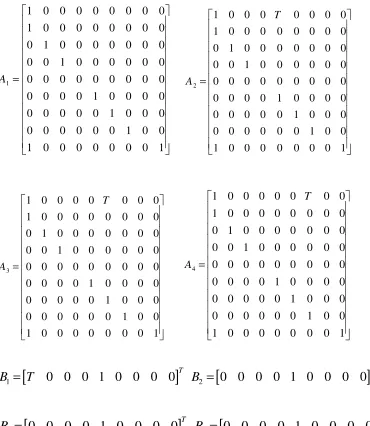
considered 4 and z is 9 andr are 4. It is straight forward to achieve the subsequent subsystems if delay is considered 0, 1, 2 or 3. Then, different subsystems based on delay are chosen as (A B1, 1),(A B2, 2 ), (A B3, 3 ), (A B4, 4 ):
1
1 0 0 0 0 0 0 0 0 1 0 0 0 0 0 0 0 0 0 1 0 0 0 0 0 0 0 0 0 1 0 0 0 0 0 0 0 0 0 0 0 0 0 0 0 0 0 0 0 1 0 0 0 0 0 0 0 0 0 1 0 0 0 0 0 0 0 0 0 1 0 0 1 0 0 0 0 0 0 0 1
A
=
2
1 0 0 0 0 0 0 0 1 0 0 0 0 0 0 0 0 0 1 0 0 0 0 0 0 0 0 0 1 0 0 0 0 0 0 0 0 0 0 0 0 0 0 0 0 0 0 0 1 0 0 0 0 0 0 0 0 0 1 0 0 0 0 0 0 0 0 0 1 0 0 1 0 0 0 0 0 0 0 1
T
A
=
3
1 0 0 0 0 0 0 0 1 0 0 0 0 0 0 0 0 0 1 0 0 0 0 0 0 0 0 0 1 0 0 0 0 0 0 0 0 0 0 0 0 0 0 0 0 0 0 0 1 0 0 0 0 0 0 0 0 0 1 0 0 0 0 0 0 0 0 0 1 0 0 1 0 0 0 0 0 0 0 1
T
A
=
4
1 0 0 0 0 0 0 0 1 0 0 0 0 0 0 0 0 0 1 0 0 0 0 0 0 0 0 0 1 0 0 0 0 0 0 0 0 0 0 0 0 0 0 0 0 0 0 0 1 0 0 0 0 0 0 0 0 0 1 0 0 0 0 0 0 0 0 0 1 0 0 1 0 0 0 0 0 0 0 1
T
A
=
[ ]
1 0 0 0 1 0 0 0 0
T
B=T 2 [0 0 0 0 1 0 0 0 0]
T
B=
[ ]
3 0 0 0 0 1 0 0 0 0
T
B= 4 [0 0 0 0 1 0 0 0 0]
T
B =
Also, the ideal and maximum queue lengths are considered as 20 and 50 packets, respectively, and the controller parameters are kbv=0.6 and 0.7and
λ
=0.001.Figures 2 and 3 show the changes of queue size in DPCC and LCC considering kbv =0.6 andkbv =0.7. It is clear
that kbv=0.7 ends in poor performance in DPCC. As
stated in preliminaries subsection B,kbv is a key factor in
DPCC controller which directly affects the performance of system. The control effort is shown in Fig. 4. Finally, Table I compares the performance in LCC schemes, RDANQCC and DPCC.
Fig. 2. Queue length in LCC and DPCC withkbv=0.6
Fig. 3. Queue length in LCC and DPCC withkbv=0.7
Fig. 4. Control effort of LCC and DPCC
TABE I. The sent traffic, mean outgoing estimation error and mean queue length error in LCC schemes, RDANQCC
and DPCC
Mean {Queue
size error}2
Mean
{Queue
size error}
Mean
{Outdoing
estimation
error}
Sent traffic
DPCC 53.77587 1.533551 3.2074 19920.98 RDANQCC 17.15475 1.350184 0.3790 20009.91 LCC 12.87633 1.138422 0.1733 20044.42 LCC with
guaranteed decay rate
14.73304 1.235762 0.2238 20037.29
International Journal of Industrial Electronics, Control and Optimization .
© 2019 IECO
…
96
considered in our model, buffer dynamic modeling for WSNs is accomplished in discrete time, different subsystems are gained based on delay and the overall model is obtained by blending them. Also, unlike DPCC, our closed-loop systems are GAS in case of delay changes. From Table I, it can be easily found that LCC schemes have better performance comparing with RDANQCC, since in the former each subsystem is stabilized by a controller, however a single controller is used to stabilize the whole system in the latter. Also, LCC renders better performance comparing with LCC with guaranteed decay rate. So, it can be concluded that LCCoutperforms LCC with guaranteed decay rate, RDANQCC and DPCC.
B. Performance Analysis using OPNET simulator Now in order to verify and evaluate our schemes against DPCC, OPNET simulator is used. The tree topology is used for sensor networks with clusters at leaf nodes to generate traffic. The traffic is then forwarded to base station which is at the tree root. A 2Mbps channel with shadowing and path-loss is considered. The packet size and the queue limit are considered 512 and 50 packets, respectively. All nodes generate traffic exceeding the channel capacity which renders congestion. Also, it is assumed that nodes are static and have random placement and kbv=0.6 is set for DPCC.
Table II presents the simulation parameters.
TABLE II. The Simulation parameters
Traffic generation parameters On state time (sec) Off state time (sec)
Constant (100) Constant (0.1) Packet generation arguments
Inter-arrival time (sec) Packet size (bytes)
Exponential (0.01) Constant (512)
Traffic type of service Best effort
Wireless LAN
Desired queue size Min Baud rate (bits/sec)
20 2000000
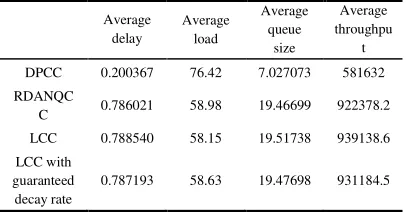
Table III presents the average delay, load, queue size and throughput in LCC schemes, RDANQCC and DPCC. It can be seen that LCC schemes and RDANQCC render better performance comparing with DPCC. Also, LCC schemes have better performance comparing with RDANQCC. Also, LCC renders better performance comparing with LCC with guaranteed decay rate. So, LCC outperforms LCC with guaranteed decay rate, RDANQCC and DPCC.
TABLE III. Average performance metrics in LCC schemes, RDANQCC and DPCC
Average delay
Average load
Average queue
size
Average throughpu
t
DPCC 0.200367 76.42 7.027073 581632
RDANQC
C 0.786021 58.98 19.46699 922378.2
LCC
0.788540 58.15 19.51738 939138.6
LCC with guaranteed decay rate
0.787193 58.63 19.47698 931184.5
So, the simulations using MATLAB and OPNET simulator show the superior performance of LCC comparing with LCC with guaranteed decay rate, RDANQCC and DPCC.
V. CONCLUSION
This paper deals with buffer dynamic modeling of WSNs in discrete time considering delay.
For controller synthesis, a new approach is proposed based on non-quadratic Lyapunov functions and a controller is designed to stabilize each subsystem. Also, performance is considered and decay rate is guaranteed. Finally, a set of novel LMI-based congestion control schemes (LCC) is derived for WSNs and the resultant closed-loop systems are GAS in case of queue length changes and the consequent delay changes. The simulation results using MATLAB and OPNET simulator confirm that LCC schemes outperform RDANQCC and DPCC. Future work will include improving the proposed congestion control schemes to enlarge the stability region which renders conservativeness reduction and better performance.
ACKNOWLEDGMENT
The authors gratefully acknowledge the financial and other support of this research, provided by the Islamic Azad university Islamshahr branch, Islamshahr, Iran.
REFERENCES
[1] M. Sudip, W. Isaac, M. Subhas Chandra, Guide to Wireless Sensor Networks, Computer Communication and Network Series. Springer, London, 2009.
[2] C. Y. Wan, S.B. Eisenman and A.T. Campbell, “CODA: congestion detection and avoidance in sensor networks,” inProc. ACM SenSys’03, pp.266–279,2003.
[3] S. Mahdizadeh Aghdam, M. Khansari, H. R.Rabiee, M. Salehi, “WCCP: A congestion control protocol for wireless multimedia communication in sensor networks,” Ad Hoc Networks, Vol. 13, Part B, pp. 516-534, 2014. [4] J. J. Justus, A. Chandra Sekar, “Congestion control in
wireless sensor network using hybrid epidermic and DAIPaS approach,” in Proc. International Conference on Inventive Computation Technologies (ICICT),2016. [5] M. Zawodniok and S. Jagannathan, “Predictive Congestion
Control Protocol for Wireless Sensor Networks,” IEEE Transactions on Wireless Communications, Vol. 6, No.11,pp.3955-3963, 2007.
[6] M.A. Kafi, J. Ben-Othman, A. Ouadjaout, M. Bagaa, N. Badache, “REFIACC: Reliable, efficient, fair and interference-aware congestion control protocol for wireless sensor networks,” Computer Communications, Vol. 101, pp.1-11,2017.
[7] K. Singh, K. Singh, L. H. Son, A. Aziz, “Congestion Control in Wireless Sensor Networks by Hybrid Multi-Objective Optimization Algorithm,” Computer Networks,Vol.138, pp.90-107, 2018.
[9]P.M. Hsu, C.L. Lin, “Congestion control for local wireless sensor network using time-delay compensator,” In International Power Electronics Conference (ECCE ASIA), 2010.
[10] Y. Sun, X. Mi, L. Tang, “Congestion control based on Triangle module fusion operator in wireless sensor networks,” In 9th international conference on fuzzy systems and knowledge discovery, 2012.
[11] T. Yifang , Z. Dafu, “Avoiding congestion using RBF-GM controller for wireless sensor network,” In 4th International Conference on Computer Science & Education, 2009.
[12] A. H. Abolmasoumi, M. Azadegan, H.R. Momeni, “Congestion control for the communication networks with random parameter jumps,” In Chinese Control and Decision Conference (CCDC),2011.
[13] H. Han, C.X. Chen, “Congestion Control for TCP/AQM Network Using LMI Approach,” In Fourth International Conference on Innovative Computing, Information and Control (ICICIC),2009.
[14]P.Millan, L.Orihuela, C.Vivas, F.R.Rubio, D.V.Dimarogonas, K.H.Johansson, “Sensor-network-based robust distributed control and estimation,” Control Engineering Practice, Vol. 21, No. 9, pp. 1238-1249, 2013.
[15] S.S.S. Farahani, M.R. Jahed -Motlagh, M.A. Nekoui, S.V. Azhari, “Robust decentralized adaptive nonquadratic congestion control algorithm for a class of delayed networks,” Nonlinear Dynamics, Vol.73, No.4, pp. 2291–2311,2013.
[16] W. Assawinchaichote, S.K. Nguang and P. Shi, “H-infinity output feedback control design for uncertain fuzzy singularly perturbed systems: An LMI approach,” Automatica, Vol. 40, No.12,pp.2147–2152, 2004. [17] G. Feng, C.L. Chen, D. Sun, X.P. Guan, “H-infinity
controller synthesis of fuzzy dynamic systems based on piecewise Lyapunov functions and bilinear matrix inequalities,” IEEE Transactions on Fuzzy Systems, Vol. 13, No.1,pp.94–103, 2005.
[18] T.M. Guerra and L. Vermeiren, “LMI-based relaxed non-quadratic stabilization conditions for nonlinear systems in the Takagi–Sugeno’s form”, Automatica, Vol. 40, No.5,pp.823–829, 2004.
[19] L.A. Mozelli, R.M. Palhares, “Less Conservative H∞
Fuzzy Control for Discrete-Time Takagi-Sugeno Systems,” Hindawi Publ. Corp. Mat. Prob. in Eng. 2011. [20] S. Boyd, L.E. Ghaoui, E. Feron and V. Balakrishnan, Linear Matrix Inequalities in System and Control Theory, Vol.15, Philadelphia, PA, SIAM, 1994. [21] S.H. Ghwanmeh, A.R. Al-Zoubidi, “Wireless Network
Performance Optimization Using Opnet Modeler,” Journal of Information Technology, Vol. 5, No.1,pp. 18-24, 2006
Shoorangiz Shams Shamsabad Farahani
was born in Tehran, Iran. She received her B.S., M.S. and the Ph.D. degrees in Electrical engineering in 2001, 2005 and 2013, respectively. In 2007, she joined Islamic Azad University, Islamshahr branch, Islamshahr, Iran, and she is an Assistant Professor in the department of electrical engineering. Her current research interests include switching systems, wireless sensor networks, complex systems, stability analysis, fuzzy control, robust control and nonlinear control. She has supervised and co-supervised several graduate students in these areas.
International Journal of Industrial Electronics, Control and Optimization .
© 2019 IECO
….
IECO