Adaptive Rule-Base Influence Function
Mechanism for Cultural Algorithm
Vahid Seydi Ghomsheh1, Mohamad Teshnehlab2, Mehdi Aliyari Shoordeli3
Received (2015-01-31) Accepted (2015-03-12)
Abstract - This study proposes a modified version of cultural algorithms (CAs) which benefits from rule-based system for influence function. This rule-based system selects and applies the suitable knowledge source according to the distribution of the solutions. This is important to use appropriate influence function to apply to a specific individual, regarding to its role in the search process. This rule based system is optimized using Genetic Algorithm (GA). The proposed modified CA algorithm is compared with several other optimization algorithms including GA, particle swarm optimization (PSO), especially standard version of cultural algorithm. The obtained results demonstrate that the proposed modification enhances the performance of the CA in terms of global optimality.
Keywords - Cultural Algorithm (CA), global optimization, knowledge Sources, rule-based system.
1. INTRODUCTION
O
ptimization is an important issue in different scientific applications. Many researches dedicated to algorithms that can be used to find an optimal solution for different applications.Intelligence optimizations which are generally
classified as, evolutionary computations
techniques like Genetic Algorithm, evolutionary strategy, and evolutionary programming, and swarm intelligence algorithms like particle swarm intelligence algorithm and ant colony optimization, etc are powerful tools for solving optimization problems [1]-[4]. Similar to particle swarm optimization and Ant algorithm in which members share their experiences, cultural algorithms (CAs) try to model social intelligence based on natural cultural evolution to solve the optimization problems [5]-[6][13].
When facing an engineering optimization problem with extensive domain knowledge that cannot be easily integrated into the population level, the CA is a preferred optimization method. In order to study the performance of CA, this algorithm is applied to a number of benchmark optimization problems [7] as well as a number
of diverse application areas. For example the efficacy of a variant of CA is tested on Loney’s
solenoid design which is an electromagnetic engineering problem [8]. In addition, in [9] authors applied the CA to the problem of optimizing the design of a Pressure Vessel which is a benchmark engineering design problem to evaluate the performance of particle swarm. CA is also applied to some other engineering applications such as prediction by functional link-based neural fuzzy network [10], optimizing the tension/ compression of a spring weight [11]
1- Faculty of Computer Engineering, Artificial Intelligence
Department, Islamic Azad University, Science and Research Branch, Tehran, Iran ([email protected]).
2- Faculty of Electrical Engineering, Control Department,
K. N. Toosi University of Tech., Tehran, 19697, Iran ([email protected]).
3- Faculty of the Department of Mechatronics, K. N. Toosi
and modeling the evolution of agriculture [12]. Three major components of CA are population
space, belief space and a protocol that defines
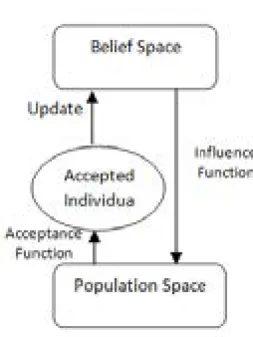
the relationship between the population and the belief space. Population space can be modeled based on any population-based computing models such as genetic algorithm, evolutionary programming and particle swarm optimization method [10]. The belief space which is made up of a set of knowledge sources is used to guide the population towards the optimal solution. By taking the feedback from the population, the belief space is updated. This mutual interaction between population and belief space continues until the stop criteria of the algorithm is visited. The mentioned protocol consists of acceptance
function and influence function. Acceptance
function determines which individuals are to
impact the belief space, while influence function
which encode the beliefs, evolutes the individuals. An intelligent optimization algorithm should be able to use the information obtained from the search process in the state space in order to determine an appropriate role for the individuals. By determination, we mean that, when an individual is better to explore, exploit or jumping out of the locals. In CAs, each of the knowledge
sources, cause different roles for individuals, and
while the next individual position is determined
based on one of the influence functions of
knowledge sources, it is of a great importance to be able to choose the appropriate knowledge source.
The algorithm proposed for selecting the knowledge sources in cultural algorithms so far are based on the roulette wheel mechanism. In that mechanism, the likelihood of using one of the knowledge sources is based on size of the area under the wheel and the area for a knowledge source is adjusted by the predator based upon the performance of those individuals that are
influenced [9].
In this study, we try to select the appropriate knowledge source to update the positions of individuals by using a rule-based system and evolutionary state estimation (ESE) factor proposed by Zhi-Hui Zhan [13]. The ESE factor presents the distribution of the individuals in the search space. Using the obtained information from the behavior of the individuals and a rule based system determines which knowledge source should be selected. The most important feature of this rule-based table is that it is updated
using the feedback gained from the search space. This update mechanism continues until the rule-based system learns the features of behavior of individuals in the search space and is parallel to the search mechanism. The simulation results show that convergence of the update of rule-base is faster than the search mechanism. In other
words, this rule based finds its optimal values
before the search process ends. As soon as the rule-based converges to its optimal state, the update process stops and the search mechanism
uses the optimized rule-based to find the optimal
solution. The update algorithm for the rule base is based on GA and is presented in details in section 3.
The proposed cultural algorithm is evaluated on six unimodal and multimodal benchmark functions. The algorithm is compared with several other optimization algorithms such as previous version of CA, PSO and GA. The obtained results
show that CA which benefits from a rule-based
system outperforms these algorithms in terms of global optimality. In section 2 the components of CA are reviewed. Section 3 presents the optimization procedure of rule based system in details. In section 4 we experimentally compare the proposed algorithm with existing CA and various optimization algorithms using a set of benchmark functions. Discussions and further investigation on the proposed method are made
in this section. Finally conclusion points are
pointed out in section 5.
2. CULTURAL ALGORITHM OVERVIEW
In this section, we describe the traditional CA. The key idea behind CAs is to store and update the problem solving knowledge with the feedback from the population and guide the search using this knowledge [13]. The components of CA are the population space, the belief space, the
acceptance function, and the influence function.
These major components of CA are depicted in
Figure 1. The CA framework
A. The belief space
The experience of individuals are used and stored in information repository called belief space. These experiences can be used by other individuals. In other words, the members of the population share their experiences in the belief space and the knowledge is extracted from
these experiences. The benefit of CA over other
evolutionary algorithms is that other than sharing
the information with offspring the information is
shared with other members of the group. Cultural Algorithms employ a set of knowledge sources which are characterized by their appearance in the
problem solving process. Reynold [9] identified five basic categories of Knowledge. Each of which are added in different time to achieve a
various problem solving capabilities [7], [15,
16]. These five knowledge sources are normative
knowledge, situational knowledge, domain knowledge, history knowledge and topographical knowledge. The range of acceptable behaviors in each generation is represented by normative knowledge [7]. Situational knowledge keeps exemplars of successful solutions. Relationships and interactions between the objects in the domain are kept in the domain knowledge source [15]. Temporal and special patterns of behavior are stored in history and topographical knowledge sources respectively [15], [16]. Any cultural knowledge can be expressed as some
combination of the five [9].
B. The population space
The population space consists of a set of possible solutions to the problem, and can be modeled using any population-based approach. The population model used here is a simple
evolutionary algorithm where each individual is a vector of real-valued variables. In each generation individuals are evolved by using evolutionary
operators of a specific knowledge source. In
CA, only mutation is used while recombination is taken place in the Belief Space as a result of the updating process. Each knowledge source
specifies a different mutation operator. It is also possible to define a mutation operator with the combination of several different knowledge
sources.
C. The Acceptance Function
The acceptance function determines which individuals and their behaviors can impact the belief space knowledge. The number of individuals which impact the belief space can range between 1% and 100% of the population size, based on the selected criteria.
D. Influence function
Individuals can be mutated by the influence function. The influence function is composed of methods which each method belong to a specific knowledge source. These methods define the
mutation operator in the population space. The strategies proposed to select the proper
influence functions for the CAs so far are based
on the roulette wheel by adjusting the wheel area
assigned to each type of influence function. In the first stage roulette wheel is divided into equal spaces by different types of influence
function. Each area in the roulette wheel is
updated using the fitness obtained by the
individuals which mutated by the corresponding
influence function. A specific influence function
is used with the probability computed by the area of the roulette wheel. The division of the roulette wheel is updated based upon performance of
the influence function. The performance of an influence function is defined as follow:
𝑎𝑎𝑎𝑎𝑎𝑎𝑖𝑖=∑ 𝑓𝑓𝑗𝑗(𝑥𝑥) 𝑘𝑘 𝑗𝑗=1
𝑘𝑘
(1)
where k is the number of individuals generated
by the influence function i; f i(x) is the fitness
value of the individual i. Next, division of roulette
wheel for each influence operator is adjusted by
the average performance computed for all the
𝑝𝑝𝑖𝑖=∑𝑎𝑎𝑎𝑎𝑟𝑟𝑎𝑎𝑎𝑎𝑟𝑟𝑖𝑖
𝑗𝑗 𝑛𝑛 𝑗𝑗=1
(2)
where pi is the probability of the influence
operator i and n is the number of influence
operators.
3. Rule Base Influence function
In this section we introduce the proposed
adaptive rule-based system for influence
function. As mentioned earlier, in the CA the next position of individuals are determined
based on the influence functions regarding to
the knowledge sources, we mean that in CA,
each of the knowledge sources, cause different
roles for individuals and it is important to choose the suitable roles for individuals based on the information obtained from the search process. This section presents the ESE approach with a
fuzzy classification proposed by Zhi-Hui Zhan
[13] which extracts the information of search process. Then, we discuss how the ESE approach can be applied to rule-based system to determine
the appropriate influence function in CA and
how this rule-based system can be updated by obtained feedback of individuals.
A. The ESE approach
The way in which individuals are scattered in the space in called evolutionary state [13].
As an example at the early stage of the CA process individuals are typically scattered in a diverse manner by the topographical knowledge, therefore the evolutionary state is dispersive wherein the role of individuals are exploratory.
While the individuals are being evolutes the population distribution dynamically varies. Now if one can extract information of these distributions of the individuals, then this
information can be effectively uses to guide individuals by designating the suitable influence
function. The notation of evolutionary states and
clustering analysis method was first proposed in
[17-18].
The first phase of the evolutionary state
estimation is the calculation of the average distance of each particle with respect to all other particles. Estimation of the states can be arranged
as the following steps:
Step 1: Calculate the mean Euclidean distance of each particle with respect to other particles:
𝑑𝑑𝑖𝑖=𝑁𝑁 −11 � ���𝑥𝑥𝑖𝑖𝑘𝑘− 𝑥𝑥𝑗𝑗𝑘𝑘�2 𝐷𝐷
𝑘𝑘=1 𝑁𝑁
𝑗𝑗=1,𝑗𝑗≠1
(3)
where N and D are the population size and the number of dimensions, respectively.
Step 2: Calculate the “evolutionary factor” as follow:
𝑓𝑓= 𝑑𝑑0− 𝑑𝑑𝑚𝑚𝑚𝑚𝑚𝑚
𝑑𝑑𝑚𝑚𝑚𝑚𝑚𝑚− 𝑑𝑑𝑚𝑚𝑚𝑚𝑚𝑚 ∈[0.1]
(4)
where d0 is Euclidean distance of the overall best, dmin , dmax are the minimum and maximum distance among all particles.
B. the rule based system for influence function
In section we introduce how the rule-base
system can be determine the type of influence
function regarding to evolutionary factor f .in
order to classification the evolutionary factor f ,
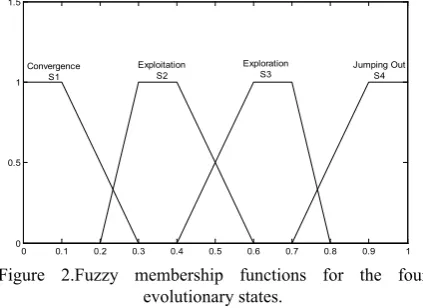
Four fuzzy sets s1, s2, s3, s4 are defined in [0,
1], where represent exploration, exploitation, convergence, and jumping out states, respectively.
The membership functions are shown in Fig. 2.
The mathematical formulations for fuzzy sets to determine membership value of in fuzzy sets and more details are in [13].
0 0.1 0.2 0.3 0.4 0.5 0.6 0.7 0.8 0.9 1
0 0.5 1 1.5
Convergence S1
Exploitation S2
Exploration
S3 Jumping OutS4
Figure 2.Fuzzy membership functions for the four
evolutionary states.
on member ship function is activated or two membership functions are activated. When two memberships will be activated at the same time, the decision-making rule base involves both the
pervious state (PS) and the “change of state”
(COS) variables in a 2-D table as seen in Table 1.
For example one of the rules (bolded cells) in this table is as follow:
IF “COS” IS “s1-s2” AND “PS” IS “S3” THEN,
KNOWLEDGE SOURCE IS “x7“,
Table.1. rule base table based on a chromosome in GA.in the case when two membership function activated.
PS
S4 x4 x8 x12
S3 x3 x7 x11
S2 x2 x6 x10
S1 x1 x5 x9
S1-S2 S2-S3 S3-S4
COS
When only one membership function is
activated, the “change of state” converts to “current state estimation” and the rule table is simplified as Table 2.
Table 2. Rule base table based on a chromosome in GA.in the case when one membership function activated.
Knowledge source x13 x14 x15 x16
CSE S1 S2 S3 S4
For instance the bolded cell in the Table 2 represents the following rule:
IF “CSE” IS “s1” THEN, KNOWLEDGE
SOURCE IS “x13“,
where
x
i1
≤ ≤
i
16
can be one of fiveknowledge source.
In order to optimize the rule-base system, binary Genetic Algorithm is employed. The phenotype of a chromosome is represented as
follows:
16
x
...
3
x
2
x
1
x
where
x
i∈
{
N S D H T
, , , ,
}
.At first, the populations of the chromosomes
are generated using binary random values. The next and important step is how to evaluate the
chromosomes. There exists a rule table which
determines knowledge source in influence
function of CA which corresponds to each
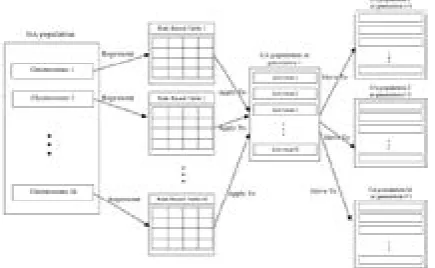
chromosome in GA. Figure 3 illustrate that,
each chromosome represents a rule table which creates its corresponding generation in CA. Hence for each chromosome in GA, there exists
a different offspring population and the number of offspring groups are is the same as the number
of chromosomes in GA.
Figure 3 .the block diagram of proposed algorithm
The best individual in each different group of offspring is a representative of corresponding group and its fitness is assigned to chromosome in GA. Now that the fitness of each chromosome is calculated, it is possible to find the best table of rules and based on calculated fitness the GA
can evolutes one generation ahead. The best
table of the rules based is used as influence
function guide to update the population of CA for one generation. This update procedure of GA is iterated until the algorithm is converged. The algorithm is said to be converged if in tGA consecutive number of generations, the best rule-base remains unchanged. When the GA is converged, it is stopped and the CA will be updated using the best rule base found. The Pseudo code of the described algorithm can be
briefly presented as follows.
1. Initialize PCA ، PGA randomly ( is population of CA and PGA is population of GA).
2. Iterate the following steps until the GA will be converge.
a. Sort the PCA based on fitness function.
space.
c. Calculate the evolutionary factor f.
d. for i=1 to | PGA | (all chromosome in PGA ) iterate the following steps:
i. Determine type of knowledge source
as influence function by the rule based
table corresponding to its chromosome (i-th
chromosome).
ii. The population of t CA
P is mutated by the
specific influence function and generate 1 i
t CA
P
+where is generation counter and i denote to i-th
offspring of t CA P .
iii. Calculate the fitness function of all
individuals in 1 i
t CA
P
+ .iv. Find the best fitness function in 1 i
t CA
P
+ and assigned it to current chromosome (chromosomei) in
P
GA as fitness value.e. Corresponding to best chromosome in
P
GA, select the t 1CA
P + as next generation of
CA
P
.f. Perform the crossover, mutation and selection operators
P
GA on and the chromosomesevolutes for one generation.
g. Iterate the following steps until the stop criteria is visited
i. Sort the based on fitness function.
ii. Select individuals from PCA considering to the acceptance function and update the belief space.
iii. Calculate the evolutionary factor f.
iv. Determine the influence function by the
achieved optimal rule based table and mutate the individuals in
P
CA.4. Experimental Result
In this section, the proposed algorithm is tested on a number of benchmark functions, and the obtained results are compared with the standard version of CA and well-known optimization methods such as particle swarm optimization (PSO) [23]-[25], genetic algorithms (GA) [26-28].
We have chosen six test functions which are widely used in the nonlinear global optimization literature [20-22]. The function names, formulas,
range of variables and the global optima are listed in Table 3. These benchmark functions have a
wide variety of different landscapes and present a significant challenge to optimization methods. The Sphere, Schwefel’s 2.21, and Quadric Noise
are unimodal functions. Rastrigin, Ackley, and
Griewank are difficult multimodal functions
and their number of local optima increases exponentially with the problem dimension.
In the simulations, the optimization of the rule-based table by the GA is performed in parallel to the CA algorithm until the rule based convergences to its optimal value. While we set the max generations to 500, in practice rule-based table usually converges in less than 200 generations. After convergence of the rule-based table, its optimization process is stopped and CA continues the search process. In the simulations, the dimensions of the benchmark functions are set to 5 and the population size in both CA and GA are set to 10.
Table 4 demonstrates the resulting optimized
rule-based tables for difference benchmarks. In
the Table 4, N, S, D, H, T are CA knowledge sources which are normative, situational, domain, history and topographical respectively are used
by influence function.
For the conditions when only one membership
function is activated, the following rule-based table is obtained.
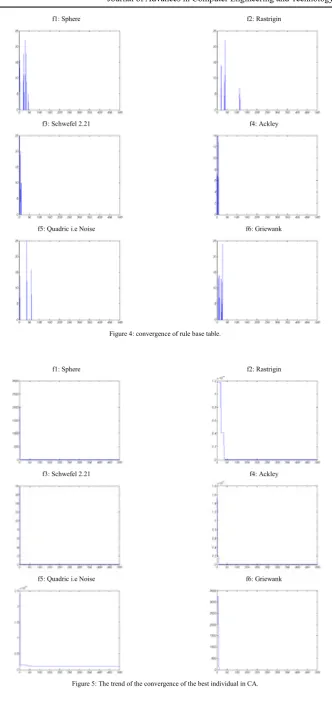
In order to show the convergence of the rule-based in each generation, the absolute value of
the difference between the best ruled-based
table of the current generation and the previous generation is computed. The convergences of the
ruled-based tables are shown in Fig. 4. As can be seen from the figure, in the subfigures relating
to f1, f3, f4and f6 the error converges before 50
generations, but in the subfigure relating to f2 this number is 117 and f5 converges in 62 generations.
In order to compute the convergence of the rule
based, the following assignments are considered:
N=1, S=2, D=3, H=4, T=5.
Figure 5 depicts the convergence process
of the best individual in each generation. The simulation results of the comparison between
F1: Sphere
PS
S4 D D H
S3 H N S
S2 T H N
S1 N H S
S1-S2 S2-S3 S3-S4 COS
F2: Schwefel 2.21
PS
S4 T H D
S3 S H T
S2 S D D
S1 H N S
S1-S2 S2-S3 S3-S4 COS
F3: Quadric i.e Noise
PS
S4 D S H
S3 H H H
S2 S H D
S1 S S D
S1-S2 S2-S3 S3-S4 COS
F4: Rastrigin
PS
S4 H D N
S3 T T T
S2 S S H
S1 N H T
S1-S2 S2-S3 S3-S4 COS
F5: Ackley
PS
S4 N D T
S3 N H D
S2 H D N
S1 H S D
S1-S2 S2-S3 S3-S4 COS
F6: Griewank
PS
S4 H N H
S3 S S N
S2 S S N
S1 S H H
S1-S2 S2-S3 S3-S4 COS
Table 4. Rule base table for six benchmark function.
Sphere
KLG T S H S CSE S1 S2 S3 S4
Schwefel 2.21
KLG S S T D CSE S1 S2 S3 S4
Quadric i.e Noise
KLG H S H H CSE S1 S2 S3 S4
Rastrigin
KLG S T H S CSE S1 S2 S3 S4
Ackley
KLG S S T T CSE S1 S2 S3 S4
Griewank
KLG T N D H CSE S1 S2 S3 S4
Table 5. Rule base table for six benchmark function (one membership function activated).
Table 6. The Comparison of the results of the optimizations of six different test functions obtained by proposed CA, CA, PSO and GA. The dimension of the functions is set to 5 and the simulations are repeated for 15 times.
Algorithm Proposed CA CA PSO GA
f1
Best 8.03E-07 7.11E-06 0.032255 0.001423
Average 3.31E-06 5.07E-05 274.0826 0.015141
STD 5. 61E-05 4.56E-05 407.2212 0.010216
f2
Best 0.000125 0.003641 2.127886 0.03354
Average 0.059203 0.050537 12.32818 0.099375
STD 0.070476 0.084336 10.30336 0.041735
f3
Best 8.09E-05 0.000214 0.004779 0.000136
Average 0.000906 0.00154 0.0587 0.00185
STD 0.000733 0.001077 0.093555 0.001511
f4
Best 0.00017 0.00868 3.98124 0.00039
Average 0.00128 2.729888 14.02944 0.004877
STD 0.005792 2.352015 6.5129 0.00422
f5
Best 0.004678 0.00869 2.276672 0.007101
Average 0.017419 0.099689 7.307761 0.024232
STD 0.031176 0.113161 4.51294 0.01357
f6
Best 0.065999 0.409445 0.196867 0.086692
Average 0.11139 8.30541 1.269178 0.138902
f1: Sphere f2: Rastrigin
f3: Schwefel 2.21 f4: Ackley
f5: Quadric i.e Noise f6: Griewank
Figure 4: convergence of rule base table.
f1: Sphere f2: Rastrigin
f3: Schwefel 2.21 f4: Ackley
f5: Quadric i.e Noise f6: Griewank
dimensions are given in Table 6. This table illustrates the results of 15 independent runs of each algorithm in terms of the best, mean and overall SD of the solutions. Boldface in the table 6 indicates the best result among those obtained by all contenders. As can be seen from the table, the proposed algorithm outperforms other studied algorithms including GA, PSO and CA.
5. CONCLUSION
In this study, a modified version of CA is introduced and tested. The proposed modified version of CA benefits from a rule-based system in its influence function. The use of the adaptive rule-based system in the influence function of
CA makes it possible to update the position of individuals by means of experiences obtained during the optimization process. The adaptation capability makes it possible for the optimization process to identify the optimization environment
and makes the moves in a more effective way.
In order to optimize the values of the rule-based system used in the proposed algorithm, Genetic Algorithm is utilized. Based on the fact that whether the optimization process is fully within
one state or it is in a transition state, different rule is activated. This is the first time this rule-based system is employed to the CA influence
function. Moreover, this rule-based system is not dependent upon any expert knowledge and is achieved during the optimization based on the requirement of the optimization environment. This is another major contribution of the current algorithm over what can be seen in the literature.
In order to show the efficacy and superior
performance of the proposed algorithm, it is compared with three other well-known optimization methods namely GA, PSO, and existing version of CA using several unimodal and multimodal optimization problems. The obtained results show that the proposed CA can successfully jump out of the local minima of all unimodal and multimodal functions and surpasses all the other algorithms.
REFERENCES
[1] D. E. Goldberg, “Genetic algorithms in search, optimization, and machine learning”. Reading, MA:
Addison-Wesley, 1989.
[2] Fogel, D. B. “Evolving Artificial Intelligence. “ Ph. D. Thesis, San Diego, CA: University of California.1992
[3] J. Kennedy and R.C. Eberhart, “Particle swarm optimization,” in Proceeding of the IEEE International
Conference on Neural Networks, Perth, Australia, IEEE Service Center, pp. 12–13, 1995.
[4] M. Dorigo, V. Maniezzo, and A. Colorni, “Ant system: Optimization by a colony of cooperating agents,” in
IEEE Transactions on Systems, Man, and Cybernetics, vol. 26, no. 1, pp 29–41, 1996.
[5] R.G. Reynolds, “An introduction to cultural algorithms,”
in Proceedings of the 3rd Annual Conference
on Evolutionary Programming, World Scientific
Publishing, pp 131–139, 1994.
[6] R.G. Reynolds, “On modeling the evolution of Hunter-Gatherer decision-making systems,” in Geographical
Analysis, vol. 10, no. 1, pp 31–46, 1978.
[7] C. Chung and R.G. Reynolds, “CAEP: An
evolution-based tool for real-valued function optimization
using cultural algorithms,” in International Journal on Artificial Intelligence Tools, vol. 7, no. 3, pp. 239–291,
1998.
[8] L.S Coelho, P. Alotto,“Electromagnetic Optimization
Using a Cultural Self-Organizing Migrating Algorithm
Approach Based on Normative Knowledge”, in IEEE
Transactions on Magnetics, vol. 45, no. 3, pp 1446-1449, 2009.
[9] R.G. Reynolds, M. Ali, “computing with social fabric
The Evolution of Social Intelligence within a Cultural
Framework”,In IEEE computational intelligence
magazine, 2008
[10] C.J. Lin, C.H. Chen, C.T. Lin,“A Hybrid of Cooperative
Particle Swarm Optimization and Cultural Algorithm
for Neural Fuzzy Networks and Its Prediction Applications”, in IEEE Transactions on Systems, Man,
and Cybernetics —part C, vol. 39, no. 1, pp 55-68,2009 [11] R. G. Reynolds, B. Peng, “Cultural Algorithms:
Modeling of How Cultures Learn to Solve Problems” ,in
Proceedings of the 16th IEEE International Conference
on Tools with Artificial Intelligence (ICTAI), 2004
[12] R.G. Reynolds, “An adaptive computer model of plant
collection and early agriculture in the eastern valley
of Oaxaca,” in Guila Naquitz: Archaic Foraging and Early Agriculture in Oaxaca, Mexico, K. V. Flannery
Ed, Academic Press, pp. 439–500.
[13] R.Iacoban, R. G. Reynolds, J. Brewste, “Cultural swarms: modeling the impact of culture on social interaction and problem solving,” Proc IEEE Swarm
Intelligence Symposiu, Indianapolis,MI, USA, PP. 205-211,2003
[14] Zhi-Hui Zhan, Jun Zhang, Yun Li, and Henry Shu-Hung Chung, “Adaptive Particle Swarm Optimization,”
IEEE Transaction on SYSTEMS, MAN, AND
CYBERNETICS—PART B: CYBERNETICS, VOL.
39, NO. 6, DECEMBER 2009
[15] R.G. Reynolds and S.M. Saleem, “The impact of environmental dynamics on cultural emergence,” in Perspectives on Adaptions in Natural and Artificial
evolutionary computation to solve nonlinear constraint
optimization problems: a cultural algorithm approach,”
in Proceeding of the 1999 Congress on Evolutionary Computation, pp. 1672–1678, 1999.
[17] J. Zhang, H. S.-H. Chung, and W.-L. Lo,
“Clustering-based adaptive crossover and mutation probabilities for
genetic algorithms,” IEEE Trans. Evol. Comput., vol.
11, no. 3, pp. 326–335, Jun. 2007.
[18] Z. H. Zhan, J. Xiao, J. Zhang, and W. N. Chen, “Adaptive control of acceleration coefficients for particle swarm optimization based on clustering analysis,” in Proc.
IEEE Congr. Evol. Comput., Singapore, Sep. 2007, pp. 3276–3282.
[19] J.-S. R. Jang, C.-T. Sun, and E. Mizutani, Neuro-Fuzzy and Soft Computing. Englewood Cliffs, NJ:
Prentice-Hall, 1997.
[20] J. J. Liang, A. K. Qin, P. N. Suganthan, and S. Baskar, “Comprehensive learning particle swarm optimizer for global optimization of multimodal functions,” IEEE
Trans. Evol. Comput., vol. 10, no. 3, pp. 281–295, Jun. 2006.
[21] X. Yao, Y. Liu, and G. M. Lin, “Evolutionary programming made faster,” IEEE Trans. Evol.
Comput., vol. 3, no. 2, pp. 82–102, Jul. 1999.
[22] N. Shafiabady, M. Teshnehlab and M. A. Nekoui “Some Applications of S.T. (Shafiabady-Teshnehlab) Evolutionary Optimization Algorithm”, International
Journal of Innovative Computing, Information and
Control (IJICIC), Vol 8, no 2, Feb 2012.
[23] G. Onwubolu and B. Babu, “New Optimization Techniques in Engineering, ” Berlin, Germany:
Springer-Verlag, 2004.
[24] R. Eberhart, Y. Shi, and J. Kennedy, “Swarm Intelligence, ” San Mateo,CA: Morgan Kaufmann,
2001.
[25] Alireza Alfi ,“Particle Swarm Optimization Algorithm
with Dynamic Inertia Weight for Online Parameter
Identification Applied to Lorenz Chaotic System” ”, International Journal of Innovative Computing, Information and Control (IJICIC), Vol 8, no 2, Feb
2012.
[26] T. Back, “Evolutionary Algorithms in Theory and Practice,” Oxford,U.K.: Oxford Univ. Press, 1996.
[27] Z. Michalewicz, “Genetic Algorithms +Data Structures = Evolution Programs,” New York: Springer, 1992.
[28] D. Goldberg, “Genetic Algorithms in Search, Optimization, and Machine,” Learning. Reading, MA: