Journal of Computing and Security
A Novel Solution for Author Attribution Problem in Anonymous
Farahnaz Rezaeian Zadeh
a,∗
Shohreh Ajoudanian
baDepartment of Electronic, Computer and Information Technology engineering, Foolad Institute of Technology, Fooladshahr,
Isfahan 8491663763, Iran.
bDepartment of Computer Engineering, Najafabad Branch, Islamic Azad University, Najafabad, Isfahan, Iran.
A R T I C L E I N F O.
Article history:
Received:30 January 2014
Revised:11 October 2014
Accepted:08 November 2014
Published Online:27 February 2015
Keywords:
Anonymous, Cybercriminals, Authorship Identification, Writeprint, Frequent Pattern, Similarity Measure.
A B S T R A C T
Due to increasing criminal activities by anonymous E-mails in the cyber world, it is a challenging task to extract beneficial knowledge from E-mail systems. This problem in cyber world attracts many researchers in cyber-crime domain. Recent studies in this area concentrate on traditional classification approaches such as Decision Tree and Support Vector Machines (SVM). These approaches are employed to identify the author. The main goal of these researches is increasing the accuracy of identification, but the quality of evidence is ignored and also it is hard to be traced. So, in this paper, we propose a new approach based on data mining methods for improving the quality of evidence which leads to boost the accuracy of identification. We use writeprints as the evidence and extract them from each E-mail of individuals. The next step for author identification, is matching the writeprints with anonymous E-mails by applying Earth Mover Distance (EMD) criterion to identify the plausible author. In addition to high accuracy, EMD can help cybercrime investigators in making decision about anonymous intruder. Experiments with real data in both English and Persian languages, demonstrate the proposed approach can effectively identify the author and capture strong evidence to prove the identification.
c
2014 JComSec. All rights reserved.
1
Introduction
Nowadays, e-mail is a common way for textual commu-nications on the web environment. Every day, millions of business letters, financial transactions and friend-ship messages are exchanged through e-mail systems. So the criminal activities incident by means of e-mail shouldn’t be ignored [1]. Some examples of these ma-licious activities are spamming, phishing, threatening,
∗ Corresponding author.
Email addresses:[email protected](F. Rezaeian
Zadeh),[email protected](Sh. Ajoudanian)
ISSN: 2322-4460 c2014 JComSec. All rights reserved.
e-mail bombing and racial vilification. E-mail is also used as a safe channel for some groups of terrorists and criminals to contact each other. The criminals do their suspicious activities with an unknown identity, for example in phishing they attempt to acquire sen-sitive information such as usernames, passwords, and credit card details (and sometimes, indirectly money) by masquerading as a trustworthy entity in an elec-tronic communication.
about its origin. The Second attribute is the capability of e-mail for transferring executive files, hyperlinks, trojan horses and scripts. The last attribute is avail-ability of internet and e-mail services in public places which makes anonymous problem more complicated. In recent years, several approaches have been used to prevent the abuse of this communication channel, but these methods are neither enough nor satisfactory. The criminal analysis of the e-mail by considering the authorship attribute can be useful for identifying the guilty author who is the owner of illegal e-mails.
The problem of authorship attribution in cyber-crime domain can be defined as follows: An investiga-tor wants to determine the author of an anonymous e-mailϕamong a set of suspect S={S1,. . . ,Sn}. In other
word, the problem is finding a plausible author from a group of suspected authors and also gathering firm evidence to confirm real culprit identity. In forensic science each person is distinguished by his/her finger-print; this can be extended to the cybercrime world to reveal the anonymous guilty from his/her writing style. An investigator who works on cyber-forensic records could extract the writing style (writeprint) of each suspect from his/her e-mails and apply it to identify the real author. Note that there is no claim for uniqueness of a writeprint among all people as fin-gerprint, but we prove this solitary through a group of suspected authors.
The writeprint of an individual is the combinations of the features that repeat frequently in his/her writ-ten e-mails. The attributes that usually are used in this context are lexical, syntactical and structural fea-tures. The real author can be recognized by matching a writeprint with malicious e-mails. A writeprint is valuable in cyber forensic context as it can provide firm evidence to prove and support the identification results. There are several surveys in this context which focus on stylistic and structural features separately [1– 3] while a few of them have studied the combination of the features to form a writeprint.
The techniques that have been widely used for au-thor attribution problem can be divided in two main categories. The similarity based approach use some metric to measure the difference between two doc-uments. An author whom his documents have the most similarity with the target document is known as the plausible author. The main contributions in the similarity-based approach are related to design the best presentation for document feature, the strategy for dimensionality reduction of the feature space and the selection of a similarity measure. Some of the most popular measures used in this context includes Bur-rows’s Delta [4] and Delta [5], which most of these techniques suffer from the processing time. The
simi-larity measure called Erath’ Mover Distances (EMD) [12]. This measure has been successfully used in a large number of similarity search settings including image retrieval [12,13], transportation problem [14], document retrieval [15] and many more. EMD also has many applications in Machine Vision [16]. By re-lying on our survey; this is the first use of EMD in the authorship attribution context which EMD presents good results in determining the similarity and identi-fying the anonymous author. The proposed approach can help the cyber forensic investigators to have an accurate analysis of results and also to trace the evi-dence (writeprint).
The rest of this paper is organized as follows. In Section 2 the proposed approach is described. The experimental results to evaluate the proposed algo-rithm are discussed in Section3. Concluding result is presented in Section4.
2
Proposed Algorithm
In this section, we first present authorship attribution problem. A set of stylometric attributes is then de-scribed based on lexical, structural, content specific features. Finally, the proposed algorithm is introduced in two phases involved extracting writeprints and pat-tern matching in order to identify the real author.
2.1 Authorship attribution problem
Let S={s1,. . . ,sn}be a set of the suspected author
of malicious e-mailϕ. For each authorsiconsidersm
messages asEi={e1,. . . ,em}. The main objective of
the authorship attribution problem is to find the most plausible authorSpwhich has the maximum
similar-ity with the patterns belonging to malicious e-mailϕ. In other words, a collection of e-mails inϕis matched withϕ, if they share similar patterns of vocabulary usage, structural and stylometric features. A set of sty-lometric features which extracted for each suspected author is called writeprint and is used to present ev-idence in the criminal courts. These writeprints are generated from the frequent featuresFPirepeated in
the e-mails contained inEi and then the pattern ofϕ
is matched with all writeprints using EMD similarity measure.
2.2 Stylometric features
Written patterns of each individual can be defined with word usage, word arrangement, misspelling and grammatical mistakes. Chen and Abbasi widely inves-tigated on the structural and stylistic features [14,17]. In this study by surveying the previous works, we choose a set of stylometric features which are proper
and also most effective for forensic analysis of anony-mous e-mail. These features have been mostly applied to English text, but for the first time in this paper, we use these features in Persian language, by adopting them to be applicable in this language. The stylomet-ric features chosen for solving authorship attribution problem, are grouped into three categories: lexical, structural and content specific features. The details of these features are described as following:
Lexical features are divided into alphabetic based and word based characteristic. Alphabetic based fea-tures contain frequency of individual alphabet (includ-ing English and Persian alphabets), number of alpha-bets appearing in each word, the incident rate of capi-tal and small alphabets (just for English language) and the number of alphabets in each sentence. The most significant word based features include the count of the words in a sentence and distribution of word length. The features are considered for syntactic attributes including function words (auxiliary verb, preposition, conjunction, and pronoun). These features are defined separately for each language. The other feature used as syntactic attributes is punctuations which has the effective role in authorship attribution. Structural fea-tures are used to evaluate the layout of written texts include the average of the paragraph’s length, num-ber of paragraphs, present/absence of greeting and the position of them. The last feature is referred to content specific attribute which contains a collection of keywords in a certain context and it may be dif-ferent for each person in various domains (friendly, official, academic and etc.) Zheng et.al [2] applied eleven keywords in cybercrime taxonomy for author-ship attribution domain and this paper has followed this taxonomy.
2.3 Writeprint extraction
In order to extract writeprint of each individual, we need to detect stylometric features in each e-mailei
and then normalize and discretize them in order to present them in vector form. After that we apply fre-quent pattern mining algorithm and filter common pattern to obtain a unique writeprint for each author
Sifrom their e-mail set (ei). In following, the details
of writeprint extraction process is described in three phases: feature discretization, frequent pattern extrac-tion, unique pattern extraction.
2.3.1 Feature discretization
LetEibe a set of e-mails written by suspected author
Si∈ {S1,. . . ,Sm}. At first, the stylometric features
process is applied to each feature value and then the values are discretized in a certain interval. For ex-ample, these intervals can be [0.00-0.25], [0.25-0.50], [0.50-0.75], [0.75-1.00]. Each interval is called a fea-ture item. The normalized feafea-ture frequency is then matched with these intervals. Then assign value 1 to the feature item if the interval contains the normal-ized feature frequency; otherwise assign value 0. The most common techniques used for discretization in-clude Equal-width, Equal frequency and Clustering Based Discretization. The proper technique for dis-cretization of values based upon the feature attribute and values distribution in author attribution prob-lem is cluster based methods. The effectiveness of this method was proved by comprehensive experiments which were done for the values with these specifica-tions [18–20]. In this problem Attribute Distribution Clustering Orthogonality (ADCO) measure is chosen which cluster the features based on the information distribution and density [20]. The main reason for choosing this measure is the power of ADCO to pre-pare efficient data and prevent removing or ignoring essential values to construct an accurate writeprint. An example of discretizing feature is described as fol-lows:
Suppose that A ,B andC are the three features which are extracted from 5 e-mails. The value of feature items are normalized in [0 1] range. Then By applying the discretization methods the follow-ing results are obtained for each feature:Ais divided into 4 feature item A1=[0.00-0.25], A2=[0.25-0.50], A3=[0.75-0.50],A4=[0.75-1.00];B contains 2 feature
itemsB1=[0.00-0.66],B2=[0.66-1]; the feature items
forC are C1=[0.00-0.75],C2=[0.75-1.00]. After the
intervals are calculated, it is the time for determin-ing the feature values fori included in each e-mail
Ei, for example these value for 1 corresponds to
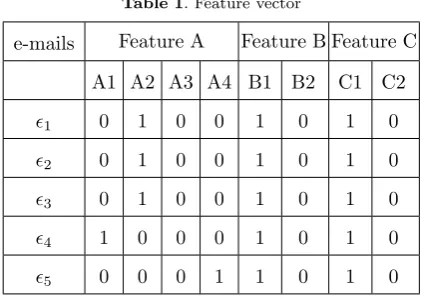
A=0.34,B=0.12,C=0.50 and its vector is presented by<0,1,0,0,1,0,0,1,0>(Table 1). Note that, another vector is required to save the real values of each feature item for using in pattern matching phase.
2.3.2 Frequent pattern extraction
Written pattern of a set of e-mails Ei (written by
author Ei) is a combination of feature items which
frequently occur inSi. In order to accurately detect
and model frequent pattern used approach presented by Agrawal et.al [11]. In following, by means of an ex-ample, describe the details of frequent pattern mining algorithm which used for pattern extraction.
Suppose that each e-mail inEi is defined by a
set of feature items and U={f1,. . . ,fm}and⊆U. an
e-mail contains a feature itemfi if the numerical
feature value of the e-mailfalls within the interval
offi. For example e-mail1is a collection of feature
items which are presented by1=A2, B1, C1 as shown in the Table1.
Table 1. Feature vector
e-mails Feature A Feature B Feature C A1 A2 A3 A4 B1 B2 C1 C2
1 0 1 0 0 1 0 1 0
2 0 1 0 0 1 0 1 0
3 0 1 0 0 1 0 1 0
4 1 0 0 0 1 0 1 0
5 0 0 0 1 1 0 1 0
LetF⊆U be a pattern which contains a set of fea-ture items. Each e-mail patterncontainsF, ifF⊆. A pattern containingk feature items, is called a k -pattern. The support value for patternF is defined by the percentage of e-mails which contain pattern
F. The patternF is considered as a frequent pattern, if and only if the support value forF is greater than or equal to minimum threshold support (MTS). The value of MTS is defined by the user based upon the needs of the problem.
Frequent pattern definition: Suppose thatEiis
a collection of e-mails written by suspected authorSi
andsupport(F|Ei)represents the percent of e-mail in
Eiwhich contain the patternF(F⊆U). The patternF
is a frequent pattern, ifsupport(F⊆Ei)≥min sup
. MST (min sup) is a real value in range of [0, 1]. Therefore, the stylistic pattern for suspected author
Siis composed of a set of frequent pattern presented
byf pi=F1, . . . ,Fk.
The popular Data Mining algorithms used for ob-taining frequent pattern include Apriori [21], FP-growth [22] and ECLAT. In this paper, the process of frequent pattern mining is done by Apriori algo-rithm. The performance of the Apriori algorithm for detecting frequent pattern is proven by comprehensive survey which is done in this context [8–10].
Apriori is a level-wise iterative search base algorithm which uses a frequentk-pattern to explore frequent (k+1)pattern [23]. In order to apply Apriori algorithm, at first all frequent 1-pattern is detected through a set ofEi and then by means of the output constructed
in this level, the frequent 2-patterns are explored. This process is continued until frequentk-patterns are detected.
Definition of Apriori algorithm:00All nonempty
as a frequent pattern, ifsupport(F0 |Ei)≤min sup.
This property refers to thatfiwould never be a
fre-quent pattern if it was added to infrefre-quent patternF0. Therefore, it isn’t required to generate (k+1)pattern from k-pattern F0 because it is considered as an infrequent pattern.
2.3.3 Generate writeprint
When extracting frequent pattern, several suspected authors may share common patterns which violate uniqueness of the pattern. So to create unique patterns which are called the writeprints for each individual, we need to remove common patterns.
Writeprint definition: WriteprintW Pi is a
col-lection of patterns in which each pattern Fsatisfies the MST condition, i.e.support(F|Ei)≤min sup,
support(F| Ej)≤min sup and no pairs of author’s
writeprints share the same patterns (i6=j). The model of writeprintW Pifor authorSi can be formulated as
W Pi ⊆F Pi,W Pi∩W Pj = ∅ifj≤n, 1≤i andj≤n.
F Piindicates all of the frequent patterns for authorSi.
SoW Pican be defined as a unique writeprint which
is extracted from a set of e-mailEifor authorSi.
2.4 Identifying anonymous author
In order to accomplish the last phase of author attribu-tion problem, the algorithm compares the writeprints of each individual with the pattern of the malicious e-mailϕ(which is sent to the victim). So in this phase, the degree of similarity between captured evidence and the pattern ofϕis detected and then the last decision about the most plausible author is made. Note that to apply EMD, we use the real values of feature items included in writeprint. In the following, we describe EMD measure to calculate the similarity of patterns.
2.4.1 Calculate similarity of different pat-terns
Two different patterns are compared using EMD to de-termine the degree of similarity between them. EMD is a distance measure which can compare the pat-terns with various frequencies. In fact, EMD calculates the minimum cost required to transform one pattern to the other. Let W P[SΥ]={(µf p1,Σf p1,ωf p1),. . .,
(µf ps,Σf ps,ωf ps)}be a collection withsfrequent
pat-terns where(µf pi, Σf pi andωf pi)indicate mean,
co-variance and weight of the frequent patterns involved in writeprintW P[SΥ] for suspected authorSΥ. Sim-ilarly, let Pϕ={(µp1,Σp1,ωp1), . . . , (µf pt ,Σpt,ωpt)}
be the property ofit patterns in the malicious e-mail
Pϕ. Suppose thatdf pi, pj) is the distance between
pat-ternf pi in writeprint andpjwhich is the pattern of
malicious mailPϕ and is calculate by the following
equation:
df pi, pj =
Pf p
i
P
pj
+
Pp
j
P
f pi
+ (µf pi+µpj) 2
·
1
Pf p
i
+P1
pj
(1)
where ff pi, pj represents the flow between f pi and pj. This flow indicates the cost of moving probability
mass (analogous to piles of earth) from one pattern to another. In proposed approach the flow is calculated based on equation (2).
ff pi, pj =
1
sup(f pi|ϕ)• sup(pj|W P[Sγ])
(2)
sup(f pi|ϕ) determines the support degree of pattern
f pi in malicious e-mail ϕ). The support degree of
patternpj in proportion to the writeprint W P[SΥ]
is calculated bysup(pj|W P[Sγ]). The distance
mea-sure between patterns and the cost of transformation obtained by EMD simplify the process of computing the similarity degree. If the distance between patterns which is shown bydfpi, pj, defines the neighborhood
of the feature values andffpi, pj indicates the cost of
transformation with regard to the concept of MST, EMD measure can be calculated based upon these two parameters. A low degree of support value shows the higher cost of transformation which leads to lower similarity between patterns. The EMD measure is calculated by the following equation:
EM D(W P[Sγ] , Pϕ) =
Ps
i=1
Pt
j=1df pi, pjff pi, pj ff pi, pj
(3)
3
Experimental Evaluation
In this section, we conduct an experimental study to evaluate the accuracy of proposed method, prove the uniqueness of the writeprint, show the strength of detected evidence to support the result and analysis the efficiency of the evidence to present in the forensic court. Since the proposed method consists of two main phases in two different contexts (data mining and pattern matching), we decided to implement the approach by means of Mweka Tool. This GUI runs the Weka classifiers and displays the results in MATLAB. This tool facilitates the use of data mining algorithm in proposed approach with pattern matching method. In the following, we apply the proposed method in English and Persian languages in two sections.
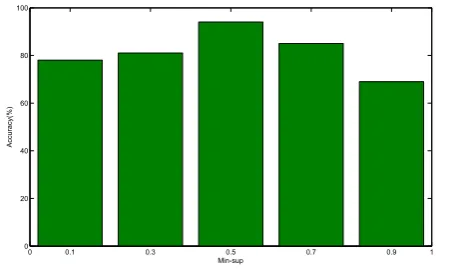
0 0.1 0.3 0.5 0.7 0.9 1 0
20 40 60 80 100
Min-sup
Accuracy(
%)
Figure 1. Accuracy of proposed method across various min sup (m=15, n=10)
3.1 English Language
In order to design the experiments, we usedme-mails fornemployees which were randomly selected from the Enron e-mail Dataset. These n employees are considered as suspected authors in this problem which is denoted by S= {S1, . . . , Sn}. For each suspected
authorSi,m e-mailsEi={e1, . . . ,em}were selected,
from 1\3 is applied for testing and 2\3 is allocated for learning. LetE={E1, . . . ,En}be a set of e-mails
belonging ton suspected author.
In order to analysis the influence of MST, the pro-posed algorithm is examined with different values for min sup. As shown in Figure1, the accuracy of pro-posed method is kept robust for variousmin sup. The number of authors selected for this assessment is 10 and the number of e-mails for each author is 15 (i.e., a total of 150 e-mails).
Since this domain is in infancy, there aren’t too many algorithms which are applied for this context. In order to show the efficiency of the proposed method in contrast to the other algorithms, we choose an approach which is closer to our proposed method and also have a good performance in compare to the other methods such as END [24], J48 [6], RBFNetwork [25], NaiveBays [26] and BaysNet [27]. This algorithm is called AuthorMiner algorithm which is applied in [8]. This algorithm is considered as one of the few methods which use data mining technique to solve author attribution problem in cyber-forensic domain. As shown in Figure2, the accuracy of proposed method is higher than the AuthorMiner for different number of suspected authors. As shown in Figure2, by increasing the number suspected authors, the accuracy of the proposed method doesn’t have considerable reduction. The influence of various number of the authors in accuracy, demonstrate the stability of the proposed algorithm, since the degree of accuracy reduction is only 19% by increasing the number of authors to 16. In the cyber forensic domain the efficient data will have more effect on the quality of evidence as well
4 8 12 16 0
20 40 60 80 100
Number of suspects
Accuracy(
%)
AuthorMiner Proposed method
Figure 2. Comparison of proposed method with AuthorMiner
Algorithm [6] (m=15).
2 3 4 5 6 0
10 20 30 40 50 60 70 80 90 100
No. of discretization interval
Accuracy (
%)
Equal-width discretization Equal-frequency discretization Clustering-based discretization
Figure 3. Accuracy of different discretization method in proposed algorithm
as accuracy of identification. One of the important phases which could prepare the suitable data is the dis-cretization process and determining the disjoint point for clustering data. As depicted in Figure 3, three kinds of discretization methods are compared. The clustering based method, which used the ADCO mea-sure for clustering data, presents the higher accuracy than Equal-width and Equal frequency discretization based algorithm.
Table 2. Similarity degree of patterns
E1 E2 E3 E4 E5 E6 E7 E8 E9 E10
W P1 0.20 0.64 0.74 0.59 0.75 0.67 0.86 0.64 0.77 0.74
W P2 0.680.170.69 0.75 0.81 0.59 0.65 0.76 0.74 0.56
W P3 0.74 0.75 0.210.83 0.69 0.55 0.78 0.83 0.84 0.69
W P4 0.89 0.87 0.750.19 0.73 0.61 0.65 0.61 0.62 0.73
W P5 0.59 0.68 0.78 0.74 0.150.57 0.73 0.76 0.70 0.68
W P6 0.85 0.89 0.57 0.91 0.78 0.220.79 0.84 0.72 0.85
W P7 0.87 0.65 0.65 0.71 0.84 0.670.23 0.90 0.79 0.83
W P8 0.79 0.64 0.78 0.64 0.71 0.58 0.81 0.140.74 0.86
W P9 0.67 0.76 0.89 0.81 0.63 0.61 0.75 0.780.20 0.73
W P10 0.78 0.84 0.74 0.64 0.77 0.68 0.81 0.62 0.690.24
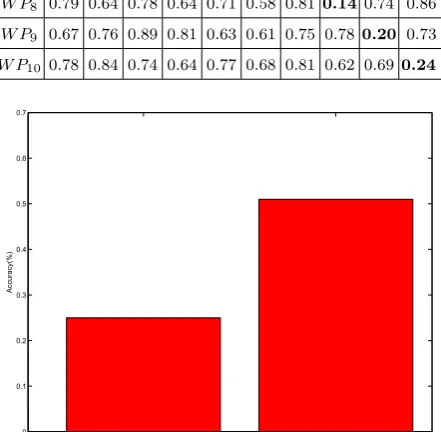
Normal Scenario Extreme Scenario 0
0.1 0.2 0.3 0.4 0.5 0.6 0.7
Accuracy(
%)
Figure 4. The error rate for Normal (m=40,n =100) and
extreme (m=10,n=100) scenario
facilitate the decision making for investigator to de-tect the most plausible author and present a clear view of the captured evidence with all property by trac-ing desired evidence. Therefore, we can conclude that the proposed approach reflects a good performance in cyber forensic in order to identify the anonymous author with strong evidence.
In order to evaluate the proposed method in an extreme scenario, consider too many authors with a limited number of sample e-mails for each of them. In this scenario, we want to show how the accuracy is affected by means of the error rate of the author attribution. Although in this situation the probability of generating the write-prints with high similarity is increased, but this method is accurate enough to deal with this challenge. As shown in Figure 4, in extreme scenario the increasing of the error rate is not considerable in contrast to the normal scenario. Therefore, the proposed method can provide reliable attribution when the enough e-mails of the suspects aren’t available.
4 8 12 16 0
20 40 60 80 100
Number of suspects
Accuracy(
%)
Proposed method with English data Proposed method with Persian data
Figure 5. Accuracy of the proposed method in Persian and English Languages
The total runtime is dominated by the first phase for writeprint extraction process and the whole process is also done in less than 10 minutes.
3.2 Persian Language
To evaluate the proposed algorithm in Persian lan-guage, we adopt the stylometric feature based on this language and use personal mail to test it. These e-mails contain semi-official content such as the e-e-mails that have been sent to the professor. The framework of these experiments is designed like English (as men-tioned in previous section). By comparing the accu-racy of proposed algorithm in Persian and English language it is shown that the accuracy of identifica-tion in Persian is lower than in English but it’s not so considerable (Figure5). The experimental results in Persian language reflectgoodefficiency of proposed algorithm. It is required to analysis the specialized features that is related to Persian language since the features which is used in this paper is the same as En-glish and we only adopt them to be usable in Persian language. The total runtime for Persian language is less than 14 minutes.
4
Conclusion
second phase is pattern matching by EMD measure. This measure is applied to identify the most plausible author who has a writeprint with highest similarity with the pattern of malicious e-mail. The EMD mea-sure calculates the distance between two patterns in order to determine the similarity degree. This method provides the flexibility to detect distinction between similar patterns and reduces the errors in identifying the most plausible author.
The experimental results show the satisfactory per-formance in (terms of accuracy and the quality) of proposed algorithm with real life data. The proposed algorithm is evaluated various aspects such as accu-racy in contrast to the other algorithms, accuaccu-racy of the different number of suspected authors and accu-racy of the algorithm with variousmin sup .The re-sults of the experiments demonstrate the stability and robustness of this method. By conducting the exper-iments in English and Persian language, the results indicate the higher accuracy of algorithm in English language and also a good result for Persian language as it is the first attempt for this language. We hope to improve the current shortcoming in this language in the future. To detect effective features for generat-ing high quality Persian writeprints, a comprehensive study regarding stylometric features is required.
The information provided by this approach help cybercrime investigators to make decision based on the strong and traceable evidence. Since these processes for finding beneficial information couldn’t be done manually, the application of these methods creates a new chance for detecting intruders in cyber world and smoothes the challenges to solve anonymity problem.
References
[1] Gui-fa Teng, Mao-sheng Lai, Jian-Bin Ma, and Ying Li. E-mail authorship mining based on svm for computer forensic. InMachine Learning and Cybernetics, 2004. Proceedings of 2004 Interna-tional Conference on, volume 2, pages 1204–1207. IEEE, 2004.
[2] Rong Zheng, Jiexun Li, Hsinchun Chen, and Zan Huang. A framework for authorship identification of online messages: Writing-style features and classification techniques.Journal of the American Society for Information Science and Technology, 57(3):378–393, 2006.
[3] Olivier De Vel. Mining e-mail authorship. InProc. Workshop on Text Mining, ACM International Conference on Knowledge Discovery and Data Mining (KDD2000), 2000.
[4] Shlomo Argamon. Interpreting burrows’s delta: Geometric and probabilistic foundations.
Lit-erary and Linguistic Computing, 23(2):131–147, 2008.
[5] John Burrows. delta: A measure of stylistic dif-ference and a guide to likely authorship.Literary and Linguistic Computing, 17(3):267–287, 2002. [6] J. Ross Quinlan. Induction of decision trees.
Machine learning, 1(1):81–106, 1986.
[7] Colin Campbell and Yiming Ying. Learning with support vector machines. Synthesis Lectures on Artificial Intelligence and Machine Learning, 5 (1):1–95, 2011.
[8] Farkhund Iqbal, Rachid Hadjidj, Benjamin Fung, and Mourad Debbabi. A novel approach of mining write-prints for authorship attribution in e-mail forensics. digital investigation, 5:S42–S51, 2008. [9] Farkhund Iqbal, Hamad Binsalleeh, Benjamin Fung, and Mourad Debbabi. Mining writeprints from anonymous e-mails for forensic investigation. digital investigation, 7(1):56–64, 2010.
[10] Farkhund Iqbal, Hamad Binsalleeh, Benjamin Fung, and Mourad Debbabi. A unified data min-ing solution for authorship analysis in anonymous textual communications. Information Sciences, 231:98–112, 2013.
[11] Rakesh Agrawal, Tomasz Imieli´nski, and Arun Swami. Mining association rules between sets of items in large databases. InACM SIGMOD Record, volume 22, pages 207–216. ACM, 1993. [12] Yossi Rubner, Carlo Tomasi, and Leonidas J
Guibas. The earth mover’s distance as a met-ric for image retrieval. International Journal of Computer Vision, 40(2):99–121, 2000.
[13] Yossi Rubner, Leonidas J Guibas, and Carlo Tomasi. The earth movers distance, multi-dimensional scaling, and color-based image re-trieval. In Proceedings of the ARPA image un-derstanding workshop, pages 661–668, 1997. [14] Frank L Hitchcock. The distribution of a product
from several sources to numerous localities. J. Math. Phys, 20(2):224–230, 1941.
[15] Xiaojun Wan. A novel document similarity mea-sure based on earth movers distance.Information Sciences, 177(18):3718–3730, 2007.
[16] Beth Logan and Ariel Salomon. Music similarity function based on signal analysis, 2001.
[17] Ahmed Abbasi and Hsinchun Chen. Writeprints: A stylometric approach to identity-level identi-fication and similarity detection in cyberspace. ACM Transactions on Information Systems (TOIS), 26(2):7, 2008.
[18] Ankit Gupta, Kishan G Mehrotra, and Chilukuri Mohan. A clustering-based discretization for su-pervised learning. Statistics & probability letters, 80(9):816–824, 2010.
based on discretization. In Intelligent Human-Machine Systems and Cybernetics (IHMSC), 2013 5th International Conference on, volume 1, pages 245–249. IEEE, 2013.
[20] Eric Bae, James Bailey, and Guozhu Dong. A clustering comparison measure using density pro-files and its application to the discovery of alter-nate clusterings. Data Mining and Knowledge Discovery, 21(3):427–471, 2010.
[21] Christian Borgelt and Rudolf Kruse. Induction of association rules: Apriori implementation. In Compstat, pages 395–400. Springer, 2002. [22] Jian Pei. Pattern-growth methods for frequent
pattern mining. PhD thesis, Citeseer, 2002. [23] Mehmed Kantardzic. Data mining: concepts,
models, methods, and algorithms. John Wiley & Sons, 2011.
[24] Eibe Frank and Stefan Kramer. Ensembles of nested dichotomies for multi-class problems. In Proceedings of the twenty-first international con-ference on Machine learning, page 39. ACM, 2004. [25] Martin Dietrich Buhmann, Martin Dietrich Buh-mann, and Martin Dietrich Buhmann. Radial basis functions: theory and implementations, vol-ume 5. Cambridge university press Cambridge, 2003.
[26] Stephen E Robertson and K Sparck Jones. Rele-vance weighting of search terms. Journal of the American Society for Information science, 27(3): 129–146, 1976.
[27] Judea Pearl. Bayesian netwcrks: A model cf self-activated memory for evidential reasoning. 1985.
Farahnaz Rezaeian Zadeh received her B.Sc degree in software engineering from the Hakim Sabzevari University in 2010, with the thesis of Design and Implementation of E-Voting System. She received her M.Sc de-gree in Information Technology (IT) Engineer-ing from the Foolad Institute of Technology, Foolad shahr, Esfahan, Iran in 2014 with the thesis of Multi objective Optimization Model For Deployment Configuration of Service Based Application In Cloud Platform”. She has already authored more than 10 international conference papers.