Erdal Kaysoydu
1, A, B, D, Sulhattin Arslan
1, A, C, F, G, Gürsel Yıldız
2, A–C,
Ferhan Candan
3, A, GFactors Related to Microalbuminuria
in Patients with Chronic Obstructive Pulmonary Disease
1 Department of Chest Disease, Faculty of Medicine, Cumhuriyet University, Turkey2 Department of Nephrology, Atatürk State Hospital, Turkey
3 Department of Nephrology, Faculty of Medicine, Cumhuriyet University, Turkey
A – research concept and design; B – collection and/or assembly of data; C – data analysis and interpretation;
D – writing the article; E – critical revision of the article; F – final approval of article; G – other
Abstract
Background. Chronic obstructive pulmonary disease (COPD) is characterized by inhaled particles and gases induc-ing chronic inflammation of the airways accompanied by a not fully reversible airflow limitation. Systemic inflam-mation has an important role in the pathogenesis of COPD. In parallel, several comorbidites can be observed. Microalbuminuria is related to endothelial dysfunction. Microalbuminuria was increased in exacerbation periods of COPD.
Objectives. The aim of the study was evaluate to the presence of microalbuminuria (MA) in patients with chronic obstructive pulmonary disease (COPD) and its relationship to inflammation, arterial blood gas parameters and 24-hour ambulatory blood pressure alterations.
Material and Methods. Seventy COPD patients and 40 healthy volunteers were enrolled in the study. 24-h ambula-tory blood pressure monitoring (ABPM) results, including pressure and pulse rates of the subjects were recorded and the cases were classified as “dipper” if a normal fall of more than 10% in blood pressure was observed at night and “non-dipper” if not. Routine renal function tests were performed, C-reactive protein (CRP) values were exam-ined and urine samples were obtaexam-ined to scrutinize the presence of MA. Patients were allocated into two groups, those with and without MA. The spirometry and arterial blood gas results of the patients were recorded.
Results. The urinary albumin creatinin ratio (64.8 ± 91.8), CRP (21 ± 14.8), nocturnal systolic and diastolic blood pressure (118 ± 14 and 72 ± 10), nocturnal and diurnal pulse (87 ± 17 and 90 ± 14), nocturnal pulse pressure (49 ± 11), mean pulse (89 ± 15), mean pulse pressure (48 ± 10) and the number of non-dipper subjects (65) were found significantly higher in the COPD group than in the control group (10.6 ± 6, 5.4 ± 2.4, 105 ± 6 and 68 ± 7, 70 ± 10 and 78 ± 11, 42 ± 1, 75± 11, 42 ± 7 and 5, respectively); (p < 0.001, < 0.001, < 0.001 and 0.041, < 0.001 a nd < 0.001, < 0.001, < 0.001, < 0.001 and < 0.001, respectively). Nocturnal pulse (89 ± 17) and CRP (23.5 ± 14.8) were found to be significantly higher in COPD patients with MA than in COPD patients without MA (78 ± 8 and 8.8 ± 6.3, respectively); (p = 0.021 and < 0.001, respectively).
Conclusions. The facts that CRP, a systemic inflammation marker, and mean nocturnal pulse pressure values were significantly higher in the group with MA among COPD patients, and that ambulatory blood pressure values did not differ between COPD patients with and without MA, suggest both a possible role of inflammation in MA development in COPD patients and a relationship between MA and increased heart rate (Adv Clin Exp Med 2014, 23, 5, 749–755).
Key words: COPD, arterial blood gas, inflammation, microalbuminuria, non-dipper.
Adv Clin Exp Med 2014, 23, 5, 749–755 ISSN 1899–5276
ORIGINAL PAPERS
© Copyright by Wroclaw Medical University
Chronic obstructive pulmonary disease (COPD), a common preventable and treatable disease, is characterized by persistent airflow limitation that is usually progressive and associated with an enhanced chronic inflammatory response in the airways and
the lungs to noxious particles or gases. Airway ob-struction is chronic and progressive [1–2].
a derivative of these cytokines, are important mark-ers of systemic inflammation [3–4].
Cardiovascular disease is a major cause of mor-tality in COPD, particularly in patients with mild to moderate severity [5]. Microalbuminuria (MA) is a sensitive marker of cardiovascular risk [6]. A re-cent study has shown an association between low-er FEV1 and emphysema sevlow-erity with endothelial dysfunction [7]. Microalbuminuria is considered to be related to endothelial dysfunction [8]. Mi-croalbuminuria was observed to increase in exac-erbation periods of COPD and this was suggested to be related with increased glomerular filtration and consequent protein leakage due to increased hypoxemia during COPD episodes [9–11].
Blood pressure (BP) normally changes with cir-cadian rhythm. According to ambulatory blood pressure monitoring (ABPM) data, BP reaches the highest level in the morning, gradually declines dur-ing the day and stays at the lowest levels durdur-ing the night [12]. In ABPM, a 10% or more decline in noc-turnal blood pressure value compared to diurnal val-ue was defined as “dipper” and a decline less than 10% was defined as “non-dipper” [13]. Cerebrovas-cular disease, left ventricle hypertrophy, cardiovascu-lar mortality, morbidity and related renal disorders (MA, reduced creatinine clearance) were observed more frequently in non-dipper patients [14–16]. The absence of a normal fall in blood pressure dur-ing the night (non-dippdur-ing) has been examined pre-viously in normotensive diabetic subjects and was found to be correlated with MA [17, 18]. As far as we know, non-dipping has not previously been stud-ied in COPD patients with or without MA.
The aim of our study was to investigate the presence of MA in patients with COPD, which is a systemic inflammatory disease, and its rela-tionship to inflammation, hypoxia and nocturnal blood pressure alterations.
Methods
Study Design and Patients
The approval of the local ethics committee was obtained before the study. A total of 110 individ-uals were enrolled in the study, including 70 who were diagnosed with COPD according to spirome-try results and GOLD (Global Initiative for Chron-ic Obstructive Lung Disease) criteria 3 and who were treated at the Department of Pulmonology of our hospital, and 40 non-smoking healthy con-trols. The patients were in stage III or IV of COPD according to GOLD criteria and were receiving similar armamentarium of drugs for their disease. None of the patients were active smokers.
Exclusion criteria were as follows: history of hypertension, symptoms or diagnosis of sleep ap-nea, angina pectoris, myocardial infarction, ST-T alterations on electrocardiography suggestive for ischemic heart disease, left bundLe branch block, arrhythmia, obesity (body mass index > 30 kg/m2),
renal disease, hyperthermia, permanent posture dis-order, diabetes mellitus/hyperglycemia, glucosuria, hematuria and urinary tract infection findings.
Data Collecting
Detailed medical histories and physical exami-nation finding of all the patients were recorded.
Age, gender, BMI, history of smoking, CRP, blood urea nitrogen (BUN), creatinine (Cre), MA in spot urine, ABPM, arterial blood gases (ABG) and spirometry results of the patients and the con-trol group were recorded. The measurements of the patients were performed while they were hos-pitalized and receiving appropriate treatment for COPD, including oxygen through nasal cannula (2 L/min). Blood samples were obtained for bio-chemical parameters (Beckman Coulter device) and CRP (with a nephelometric method using an Image device). Spot mid-stream urine was col-lected in the morning from the patients who had not done heavy exercise in the last 48 h. The lev-els of albumin and creatinine were studied from the urine specimens using an immunoturbidi-metric method. A urine albumin/creatinine ratio (UACR) between 0–20 mg/g for men, 0–30 mg/g for women was accepted as normoalbuminuria and UACR > 20 mg/g for men and UACR > 30 mg/g for women was accepted as microalbuminuria.
COPD patients were allocated into 2 groups, those with and without MA. Oxygen adminis-tration was interrupted for 30 min before col-lecting arterial blood samples and 2 mL of blood was obtained from a radial artery into a heparized injector when the oxygen percent of the in-haled oxygen (FiO2) was 21% (at room air).
Statistical Analysis
The data from our study was entered into a SPSS (Statistical Package for Social Sciences) 14.0 package program. For the assessment of the data, a significance test of the difference between two mean values in independent samples, a t-test and
a Mann-Whitney U test were used. A chi-square
test was used to investigate the inter-group dif-ferences for quantitative data. A p level of < 0.05 was accepted as statistically significant. The data is shown as mean ± standard deviation, number of individuals and percent.
Results
Forty-six (65.7%) of the patients and 23 (57.5%) of the control group were males. A significant dif-ference was not detected between the patients and
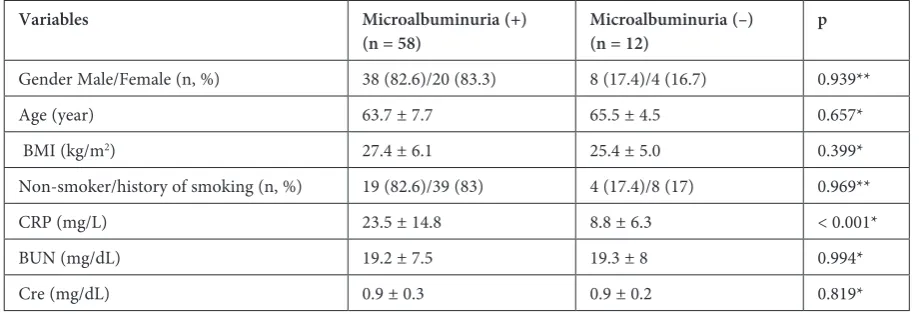
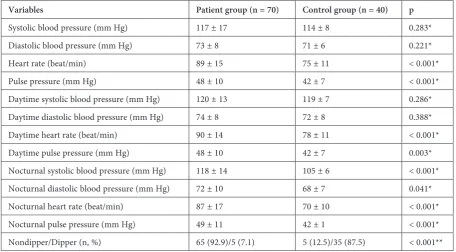
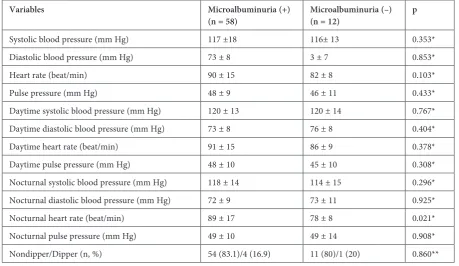
the control group in terms of age, gender and BMI. CRP value (p < 0.001) and mean MA value (p < 0.001) were found to be statistically significant-ly higher in COPD patients. Laboratory and demo-graphic characteristics of the patients and the con-trol group are given in Table 1. While a significant difference was not found between the demograph-ic characteristdemograph-ics of the patients with and without MA, the mean CRP value was found to be signifi-cantly higher in patients with MA (p < 0.001) (Ta-ble 2). A statistically significant difference was not found between the patients with and without MA in terms of spirometric and ABG parameters (Ta-ble 3). The mean and daytime SBP and DBP values, other than the parameters of ABPM, were signifi-cantly higher in the COPD patients (Table 4). The comparison between the patients with and without MA is given in Table 5. The mean nocturnal pulse rate was found to be significantly higher in the pa-tients with MA (p = 0.021).
Table 1. Demographic and laboratory characteristics of patients and the control group
Variables Patient group (n = 70) Control group (n = 40) p
Gender (Male/Female n, %) 46 (65.7)/24 (34.3) 23 (57.5)/17 (42.5) 0.396**
Age (year) 64.1 ±7.2 62.0 ± 10.1 0.267
Non-smoker/history of smoking (n, %) 23 (32.9)/47 (67.1) 11 (27.5)/29 (72.5) 0.294**
BMI (kg/m2) 27.7 ± 5.9 27.8 ± 4 0.450*
CRP (mg/L) 21 ± 14.8 5.4 ± 2.4 < 0.001*
BUN (mg/dL) 19.3 ± 7.5 17.7 ± 7.4 0.286*
Cre (mg/dL) 0.9 ± 0.2 1.0 ± 0.2 0.224*
UACR (mg/g) 64.8 ± 91.8 10.6 ± 6.2 < 0.001*
Data expressed as mean ± standard deviation and n, %. * Independent Samples t test, ** c2 test,
BMI – body mass index; BUN – blood urea nitrogen, Cre – creatinin; CRP – C-reactive protein; UACR – urinary albumin to creatinine ratio.
Table 2. Demographic and laboratory properties of patients with and without microalbuminuria
Variables Microalbuminuria (+)
(n = 58) Microalbuminuria (–) (n = 12) p
Gender Male/Female (n, %) 38 (82.6)/20 (83.3) 8 (17.4)/4 (16.7) 0.939**
Age (year) 63.7 ± 7.7 65.5 ± 4.5 0.657*
BMI (kg/m2) 27.4 ± 6.1 25.4 ± 5.0 0.399*
Non-smoker/history of smoking (n, %) 19 (82.6)/39 (83) 4 (17.4)/8 (17) 0.969**
CRP (mg/L) 23.5 ± 14.8 8.8 ± 6.3 < 0.001*
BUN (mg/dL) 19.2 ± 7.5 19.3 ± 8 0.994*
Cre (mg/dL) 0.9 ± 0.3 0.9 ± 0.2 0.819*
Data expressed as mean ± standard deviation and n, %. * Mann-Whitney U test, ** c2 test,
Discussion
COPD is a multi-component disease in which structural and functional changes are seen in the lungs and extrapulmonary organs [19]. Therefore, systemic involvement in COPD patients should certainly be considered. Some of the few studies investigating the relationship between gender and MA in COPD showed a higher frequency of MA in males, some found the opposite, and some found no difference in terms of gender [19, 20]. In our study, we did not find a significant relationship be-tween MA and gender.
A significant relationship was also not detected between MA and age in most of the studies [9, 20]. Mean age in our study was similar to that in the mentioned studies and a significant relationship was not found between age and MA.
It has been suggested that MA could be high in smokers due to endothelial dysfunction second-ary to increased hypoxic stimulation in endothelial cells [21]. Some studies have detected a significant relationship between smoking history and MA in COPD patients while another showed no such re-lationship [11, 16]. In our study, a significant rela-tionship was not found between MA and a history
Table 3. Pulmonary function tests and arterial blood gas parameters of patients with and without microalbuminuria
Variables Microalbuminuria (+) (n = 58) Microalbuminuria (–) (n = 12) p
FEV1 (L) 0.9 ± 0.4 0.9 ± 0.6 0.657*
FVC (L) 1.6 ± 0.8 1.71 ± 0.6 0.726*
FEV1/FVC 53.1 ± 13.4 53.1 ± 12.7 0.895*
Respiratory failure, (n, %) 41 (70.7) 7 (58.3) 0.401**
PaCO2 (mm Hg) 43.4 ± 9.2 40.9 ± 6.3 0.399*
PaO2 (mm Hg) 54.8 ± 9.1 56.6 ± 10 0.601*
SaO2 (%) 86.8 ± 5.5 87.4 ± 6 0.845*
HCO₃ (mmol/L) 27.6 ± 5.1 25.6 ± 3.9 0.189*
Data expressed as mean ± standard deviation and n, %. * Mann-Whitney U test, ** c2 test,
ABG – arterial blood gas analysis; FEV1 – forced expiratory volume in one second; FVC – forced vital capacity; HCO₃ – bicarbonate; PaO2 – partial arterial oxygen pressure; PaCO2 – partial arterial carbon dioxide pressure;
SaO2 – arterial oxygen saturation.
Table 4. Hemodynamic parameters in the patient and control groups
Variables Patient group (n = 70) Control group (n = 40) p
Systolic blood pressure (mm Hg) 117 ± 17 114 ± 8 0.283* Diastolic blood pressure (mm Hg) 73 ± 8 71 ± 6 0.221* Heart rate (beat/min) 89 ± 15 75 ± 11 < 0.001* Pulse pressure (mm Hg) 48 ± 10 42 ± 7 < 0.001* Daytime systolic blood pressure (mm Hg) 120 ± 13 119 ± 7 0.286* Daytime diastolic blood pressure (mm Hg) 74 ± 8 72 ± 8 0.388* Daytime heart rate (beat/min) 90 ± 14 78 ± 11 < 0.001* Daytime pulse pressure (mm Hg) 48 ± 10 42 ± 7 0.003* Nocturnal systolic blood pressure (mm Hg) 118 ± 14 105 ± 6 < 0.001* Nocturnal diastolic blood pressure (mm Hg) 72 ± 10 68 ± 7 0.041* Nocturnal heart rate (beat/min) 87 ± 17 70 ± 10 < 0.001* Nocturnal pulse pressure (mm Hg) 49 ± 11 42 ± 1 < 0.001* Nondipper/Dipper (n, %) 65 (92.9)/5 (7.1) 5 (12.5)/35 (87.5) < 0.001**
of smoking. BMI decreases in severe COPD pa-tients. Mortality and morbidity increase in the cas-es where BMI decreascas-es, the patients are elderly and especially hypoxic [22]. While a relationship was detected between urinary albumin excretion rate and obesity in a limited number of studies carried out in COPD patients and in the general popula-tion, a significant relationship could not be found in some other studies as in ours [20, 21, 23, 24]. CRP is an acute phase protein synthesized in re-sponse to tissue injury and/or inflammation. In previous studies, it was thought that MA could be related to CRP, which is an inflammatory marker of endothelial dysfunction [5, 21, 23, 25, 26]. In the study by Stuveling et al. that was carried out with a study group without hypertension and diabetes and that investigated whether CRP changed the re-lationship between blood pressure and microalbu-minuria, a significant relationship was detected be-tween MA and CRP and it was concluded that MA elevation was correlated with inflammation [21]. In our study, MA level was found significantly high-er in the patient group in which CRP was high. We detected a relationship between elevated MA level and elevated CRP indicating inflammation. In previous studies, patients with COPD and MA were reported to be more hypoxemic and hyper-capnic [27, 28]. It is known that COPD is associat-ed with increasassociat-ed atrial natriuretic peptide release and increased glomerular size, facilitating glomer-ular filtration and ultimately protein leakage [9].
While Komurcuoglu et al. found a negative cor-relation between MA detected in COPD patients and PaO2 and SaO2 levels, they did not detect a
sig-nificant relationship between MA and pH and Pa-CO2 levels. In that study, they suggested that the
reason for MA development could be increased glomerular filtration due to increased hypoxemia and consequently developing protein leakage [9]. In a recent study, patients with COPD and MA were found to be more hypoxemic and hypercap-nic compared to those with only MA, PaO2 was found to be lower in the COPD group and a sig-nificant relationship was found between MA lev-el and PaO2 and PaCO2 [20]. As a result of this study, the relationship between MA and hypoxia was suggested to be possibly related to endotheli-al dysfunction in COPD. It was suggested that the number of endothelial cells increases secondari-ly to hypoxic stimulation, leading to V/P dispro-portion [28]. Nonetheless, it was stated that not all subjects with hypoxemia developed MA and other, possibly genetic, factors were suggested [20].
A significant relationship was not found be-tween MA elevation and FEV1, FVC, FEV1/FVC in the studies investigating the relationship be-tween pulmonary functions and MA in COPD pa-tients [9, 20]. As a result of these studies, it was concluded that MA is not related to the degree of airway obstruction. Similarly in our study, a signif-icant difference was not found between MA and spirometric parameters. MA was not previously
Table 5. Hemodynamic parameters of patients with and without microalbuminuria
Variables Microalbuminuria (+)
(n = 58) Microalbuminuria (–) (n = 12) p
Systolic blood pressure (mm Hg) 117 ±18 116± 13 0.353* Diastolic blood pressure (mm Hg) 73 ± 8 3 ± 7 0.853*
Heart rate (beat/min) 90 ± 15 82 ± 8 0.103*
Pulse pressure (mm Hg) 48 ± 9 46 ± 11 0.433*
Daytime systolic blood pressure (mm Hg) 120 ± 13 120 ± 14 0.767* Daytime diastolic blood pressure (mm Hg) 73 ± 8 76 ± 8 0.404* Daytime heart rate (beat/min) 91 ± 15 86 ± 9 0.378* Daytime pulse pressure (mm Hg) 48 ± 10 45 ± 10 0.308* Nocturnal systolic blood pressure (mm Hg) 118 ± 14 114 ± 15 0.296* Nocturnal diastolic blood pressure (mm Hg) 72 ± 9 73 ± 11 0.925* Nocturnal heart rate (beat/min) 89 ± 17 78 ± 8 0.021* Nocturnal pulse pressure (mm Hg) 49 ± 10 49 ± 14 0.908* Nondipper/Dipper (n, %) 54 (83.1)/4 (16.9) 11 (80)/1 (20) 0.860**
studied in COPD patients without hypertension. Most of the studies reported that MA frequency was greater in hypertensive cases whose ABPM pattern was non-dipper [21, 29, 30]. In those stud-ies, the likelihood of MA among the subjects with increased mean arterial pressure was found to be higher in those with higher CRP levels and this finding was suggested to be related to endothelial dysfunction secondary to inflammation. A signif-icant relationship was also detected between ele-vated pulse pressure and MA in the studies inves-tigating the relationship between MA and blood pressure [31–33]. In a study carried out with hy-pertensive patients who did not receive antihy-pertensive treatment, an increased MA ratio was shown to be related to elevated nocturnal systol-ic, nocturnal diastolic and mean diastolic blood pressures [32]. Clinical studies have indicated that resting tachycardia and bradycardia were associ-ated with increased cardiovascular disease risk. It was suggested that a resting heart rate increase was more closely associated with mortality than a de-creased heart rate. There are a limited number of studies investigating the relationship between MA and blood pressure values in COPD patients. Of them, in the study by Casanova et al., a relationship was found only between MA and systolic blood pressure [20]. In our study, a significant difference was not found between MA and ABPM in terms
of both dipper/non-dipper classification and oth-er parametoth-ers of ABPM. Most of the studies woth-ere carried out with hypertensive patients whereas hy-pertension was not present in the patients or con-trol group in our study. In addition, increased noc-turnal heart rate and CRP levels in patients with MA supported the opinion that MA and impaired heart rate variability could arise from inflamma-tion leading to endothelial dysfuncinflamma-tion as suggest-ed in some of the studies. In our study, including normotensive COPD patients, lack of an examina-tion for pulmonary hypertension may be consid-ered a limitation.
In conclusion, the urinary albumin creatinin ratio was found significantly higher in the COPD patient than in the control group. Increased CRP level and nocturnal heart rate in MA with COPD patients, ABPM parameters such as mean daytime and nocturnal heart rate, pulse pressure, nocturnal systolic and diastolic blood pressure and nondip-per pattern were higher in the patient group com-pared to the control group.
In view of the fact that there was a significant-ly higher CRP level and nocturnal heart rate in MA patients with COPD, this situation suggests inflam-mation and inflaminflam-mation-induced endothelial dysfunction may be associated with MA develop-ment in COPD. Possible causative relations be-tween these parameters warrant further research.
References
[1] The Global Strategy for Diagnosis, Management and Prevention of COPD (updated 2013), the Pocket Guide (updated 2013). Available at: http://www.goldcopd.org.
[2] Hogg JC, Chu F, Utokaparch S, Woods R, Elliott WM, Buzatu L, Cherniack RM, Rogers RM, Sciurba FC, Coxson HO, Paré PD: The nature of small airway obstruction in chronic obstructive pulmonary disease. N Engl J Med 2004, 350, 2645–2653.
[3] Dahl M, Vestbo J, Lange P, Bojesen SE, Tybjaerg-Hansen A, Nordestgaard BG: Creactive protein as a predictor of prognosis in chronic obstructive pulmonary disease. Am J Respir Crit Care Med 2007, 175, 250–255.
[4] de Torres JP, Cordoba-Lanus E, López-Aguilar C, Muros de Fuentes M, Montejo de Garcini A, Aguirre-Jaime A, Celli BR, Casanova C: C-reactive protein levels and clinically important predictive outcomes in stable COPD patients. Eur Respir J 2006, 27, 902–907.
[5] Sin DD, Anthonisen NR, Soriano JB, Agusti AG: Mortality in COPD: role of comorbidities. Eur Respir J 2006, 28, 1245–1257.
[6] Diercks GF, Van Boven AJ, Hillege JL, de Jong PE, Rouleau JL, van Gilst WH: The importance of microalbu-minuria as a cardiovascular risk indicator: a review. Can J Cardiol 2002, 18, 525–535.
[7] Barr RG, Mesia-Vela S, Austin JH, Basner RC, Keller BM, Reeves AP, Shimbo D, Stevenson L: Impaired flow-mediated dilation is associated with low pulmonary function and emphysema in ex-smokers: the Emphysema and Cancer Action Project (EMCAP) Study. Am J Respir Crit Care Med 2007, 15, 176, 1200–1207.
[8] Ibsen H, Olsen MH, Wachtell K, Borch-Johnsen K, Lindholm LH, Mogensen CE, Dahlöf B, Devereux RB, de Faire U, Fyhrquist F, Julius S, Kjeldsen SE, Lederballe-Pedersen O, Nieminen MS, Omvik P, Oparil S, Wan Y:
Reduction in albuminuria translates to reduction in cardiovascular events in hypertensive patients. Hypertension 2005, 45, 198–202.
[9] Komurcuoglu A, Kalenci S, Kalenci D, Komurcuoglu B, Tibet G: Microalbuminuria in chronic obstructive pul-monary disease. Monaldi Arch Chest Dis 2003, 59, 269–272.
[10] Cogo A, Ciaccia A, Legorini C, Grimaldi A, Milani G: Proteinuria in COPD patients with and without respiratory failure. Chest 2003, 123, 652–653.
[11] Polatli M, Cakir A, Cildag O, Bolaman AZ, Yenisey C, Yenicerioglu Y: Microalbuminuria, von Willebrand factor and fibrinogen levels as markers of the severity in COPD exacerbation. J Thromb Thrombolysis 2008, 26, 97–102.
[13] Fujii T, Uzu T, Nishimura M, Takeji M, Kuroda S, Nakamura S, Inenaga T, Kimura G: Circadian rhythm of natriuresis is disturbed in nondipper type of essential hypertension. Am J Kidney Dis 1999, 33, 29–35.
[14] Ohkubo T, Imai Y, Tsuji I, Nagai K, Watanabe N, Minami N, Kato J, Kikuchi N, Nishiyama A, Aihara A, Sekino M, Satoh H, Hisamichi S: Relation between nocturnal decline in blood pressure and mortality. The Ohasama Study. Am J Hypertens 1997, 10, 1201–1207.
[15] Fagard RH, Van Den Broeke C, De Cort P: Prognostic significance of blood pressure measured in the office, at home and during ambulatory monitoring in older patients in general practice. J Hum Hypertens 2005, 19, 801–807.
[16] Metoki H, Ohkubo T, Kikuya M, Asayama K, Obara T, Hashimoto J, Totsune K, Hoshi H, Satoh H, Imai Y:
Prognostic significance for stroke of a morning pressor surge and a nocturnal blood pressure decline: the Ohasama study. Hypertension 2006, 47, 149–154.
[17] Equiluz-Bruck S, Schnack C, Kopp HP, Scherntaner G: Nondipping of nocturnal blood pressure is related to urinary albumin excretion rate in patients with type 2 diabetes mellitus. Am J Hypertens 1996, 9, 1139–1143.
[18] Inaba M, Negishi K, Takahashi M, Serizawa N, Maruno Y, Takahashi K, Katayama S: Increased night:day blood pressure ratio in microalbuminuric normotensive NIDDM patients. Diabetes Res Clin Pract 1998, 40, 161–166.
[19] Agusti AG: COPD, a multicomponent disease: implications for management. Respir Med 2005, 99, 670–682.
[20] Casanova C, de Torres JP, Navarro J, Aguirre-Jaíme A, Toledo P, Cordoba E, Baz R, Celli BR: Microalbuminuria and hypoxemia in patients with chronic obstructive pulmonary disease. Am J Respir Crit Care Med 2010, 182, 1004–1010.
[21] Stuveling EM, Bakker SJ, Hillege HL, Burgerhof JG, de Jong PE, Gans RO, de Zeeuw D; PREVEND Study Group: C reactive protein modifies the relationship between blood pressure and microalbuminuria. Hypertension 2004, 43, 791–796.
[22] Phelps DT, Ferro TJ, Higgins PJ, Shankar R, Parker DM, Johnson A: TNF-alpha induces peroxynitrite-mediated depletion of lung endothelial glutathione via protein kinase C. Am J Physiol 1995, 269, 551–559.
[23] Forsblom CM, Groop PH, Ekstrand A, Tötterman KJ, Sane T, Saloranta C, Groop L: Predictors of progression from normoalbuminuria to microalbuminuria in NIDDM. Diabetes Care 1998, 21,1932–1938.
[24] Thoenes M, Reil JC, Khan BV, Bramlage P, Volpe M, Kirch W, Böhm M: Abdominal obesity is associated with microalbuminuria and an elevated cardiovascular risk profile in patients with hypertension. Vasc Health Risk Manag 2009, 5, 577–585.
[25] Lieb W, Mayer B, Stritzke J, Doering A, Hense HW, Loewel H, Erdmann J, Schunkert H: Association of low-grade urinary albumin excretion with left ventricular hypertrophy in the general population: the MONICA/KORA Augsburg Echocardiographic Substudy. Nephrol Dial Transplant 2006, 21, 2780–2787.
[26] Arnlöv J, Evans JC, Meigs JB, Wang TJ, Fox CS, Levy D, Benjamin EJ, D’Agostino RB, Vasan RS: Low-grade albuminuria and incidence of cardiovascular disease events in nonhypertensive and nondiabetic individuals: the Framingham Heart Study. Circulation 2005, 112, 969–975.
[27] Stewart AG, Bardsley PA, Baudouin SV, Waterhouse JC, Thompson JS, Morice AH, Howard P: Changes in atrial natriuretic peptide concentrations during intravenous saline infusion in hypoxic cor pulmonale. Thorax 1991, 46, 829–834.
[28] Peinado VI, Pizarro S, Barbera JA: Pulmonary vascular involvement in COPD. Chest 2008, 134, 808–814.
[29] Stamm AM, Meinerz G, Silva JC: Systemic hypertension and microalbuminuria. Arq Bras Cardiol 2007, 89, 415–420.
[30] Deferrari G, Pontremoli R: Microalbuminuria, hypertension and cardiovascular risk. Cardiologia 1994, 39, 159–162.
[31] Farasat SM, Valdes C, Shetty V, Muller DC, Egan JM, Metter EJ, Ferrucci L, Najjar SS: Is longitudinal pulse pres-sure a better predictor of 24-hour urinary albumin excretion than other indices of blood prespres-sure? Hypertension 2010, 55, 415–421.
[32] Wang Y, Hu Y, Li Y, Li H, Chu S, Zhu D, Gao P: Association of renal function with the ambulatory arterial stiff-ness index and pulse pressure in hypertensive patients. Hypertens Res 2012, 35, 201–206.
[33] Kozan O, Ozcan EE, Sancaktar O, Kabakcı G: The prevalence of microalbuminuria and relevant cardiovascular risk factors in Turkish hypertensive patients. Arch Turk Soc Cardiol 2011, 39, 635–645.
Address for correspondence:
Gürsel Yildiz
Department of Nephrology Atatürk State Hospital Zonguldak
Turkey
Tel: + 90 372 400 01 83 E-mail: [email protected]
Conflict of interest: None declared