Privacy Law
Volume 6
Issue 3
Computer/Law Journal - Winter 1986
Article 6
Winter 1986
Third-Party Computer Leases: The Effect of the
Lessor's Bankruptcy, 6 Computer L.J. 573 (1986)
Charles S. Cohen
Follow this and additional works at:
http://repository.jmls.edu/jitpl
Part of the
Bankruptcy Law Commons
,
Computer Law Commons
,
Contracts Commons
,
Internet Law Commons
,
Privacy Law Commons
, and the
Science and Technology Law Commons
http://repository.jmls.edu/jitpl/vol6/iss3/6
This Comments is brought to you for free and open access by The John Marshall Institutional Repository. It has been accepted for inclusion in The John Marshall Journal of Information Technology & Privacy Law by an authorized administrator of The John Marshall Institutional Repository.
Recommended Citation
EFFECT OF THE LESSOR'S
BANKRUPTCY*
Large computer systems are typically acquired through third-party leasing arrangements because they are expensive. In this type of ar-rangement, one party borrows money from a lender to purchase a com-puter, and then leases the computer to a third party. The lease contains a clause that creates an unconditional obligation on the part of the lessee to make the rental payments. In the rare situation where the owner of the computer goes bankrupt,1 the trustee in bankruptcy may be able to reject the lease and regain possession of the computer. This leaves the lessee without the computer, but still obligated to make the lease payments. This Note analyzes whether the trustee can reject the lease, and if so, what remedies are available to the lessee.
I. THE LEASING TRANSACTION
The typical third-party computer leasing transaction involves five participants: (1) the owner/lessor; (2) the lender; (3) the leasing com-pany; (4) the manufacturer; and (5) the user/lessee. The user/lessee first selects a computer from the manufacturer and arranges for deliv-ery of the system (see figure 1). The user/lessee then selects a leasing company, enters into a lease, and assigns the leasing company the right to purchase and take delivery of the computer. The leasing company then enters into a purchase agreement with the manufacturer.
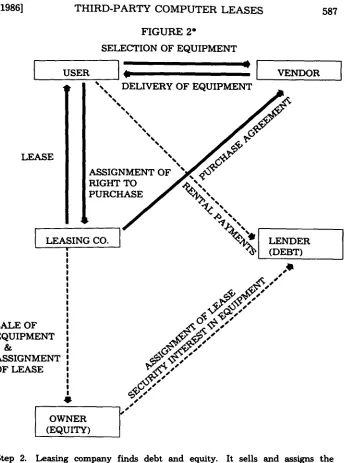
The leasing company finds an owner/lessor and a lender. The leas-ing company then sells the computer and assigns the lease to the owner/lessor (see figure 2). The lender advances a non-recourse loan to the owner/lessor based on the present value of the user/lessee's rental payments. In return, the owner/lessor further assigns the right to re-ceive the rental payments and grants a security interest in the computer to the lender (see figure 3). The loan is combined with the owner/les-sor's share of the purchase price and is used to pay the manufacturer.
* National Fourth Place, Second Annual Computer Law Writing Competition.
1. In most bankruptcy cases involving leases, the bankrupt party is the lessee, not
The equipment is then installed, and the lease commences with the user/lessee making rental payments directly to the lender.
For the purposes of this Note, a third-party leasing arrangement contains two important clauses: (1) a "hell or high water" clause;2 and (2) an expectation of assignment clause.3 The "hell or high water" clause creates an unconditional obligation on the part of the user/lessee to make the rental payments. The expectation of assignment clause states that the user/lessee acknowledges and understands that the leas-ing company entered into the lease in anticipation of beleas-ing able to sell and assign its interests in the lease. The expectation of assignment clause is important because the user/lessee has no right to determine the ultimate purchaser or assignee of the lease. Consequently, the user/ lessee should be aware of the ramifications of the sale and assignment of the lease to a company in poor financial condition.
This Note assumes: (1) a typical third-party leasing arrangement; (2) the owner/lessor subsequently files for bankruptcy; and (3) a trustee in bankruptcy is appointed.
II. REJECTION OF THE LEASE
Upon filing for bankruptcy under the Bankruptcy Reform Act of
1978,4 the trustee in bankruptcy5 can, subject to the court's approval, as-sume or reject any unexpired lease of the debtor.6 Rejection of an unexpired lease pursuant to section 365(a) is statutorily construed as a breach, which relates back to the date immediately preceding the filing
2. A typical "hell or high water" clause states:
Net Lease. Lessor and Lessee acknowledge and agree that each Equipment
Schedule constitutes a net lease and shall be absolute and unconditional and shall not be subject to any abatement, reduction, set-off, defense, counterclaim, inter-ruption, deferment or recoupment for any reason whatsoever, and that such pay-ments shall be and continue to be payable in all events.
3. A typical expectation of assignment clause states in pertinent part:
Assignment by Lessor. Lessee acknowledges and understands that the
terms and conditions of each Equipment Schedule have been fixed by Lessor in anticipation of its ability to sell and assign its interest or grant a security interest under each Equipment Schedule and the Equipment listed therein in whole or in part to a security assignee (the "Secured Party") for the purpose of securing a loan to the Lessor.
4. Pub. L. No. 95-598, 92 Stat. 2549 (current version at 11 U.S.C. §§ 101-1330 (1982 & Supp. II 1985)).
5. When the petition for bankruptcy is filed under Chapter 11, the
debtor-in-posses-sion has all of the powers of a trustee. In re Marina Enterprises, Inc., 14 Bankr. 327 (Bankr. S.D. Fla. 1981); 11 U.S.C. § 1107(a) (Supp. II 1985).
of the bankruptcy petition.7 In other words, even though rejection of the lease occurs after the bankruptcy petition is filed, the claim for damages asserted against the estate is treated as that of a pre-petition creditor. The claim is, therefore, administered through the bankruptcy proceeding and receives the same priority afforded other unsecured claims.8 The Bankruptcy Code provides no guidance concerning the standards to be applied by a court in evaluating rejection of an unexpired lease. As a result of the uncertainty, two standards have evolved, the burdensome test and the business judgment test.
Under the burdensome test, an unexpired lease can be rejected only when continued performance under the lease will result in an ac-tual loss to the estate.9 To reject the lease, the trustee must demon-strate that the lease will not generate a profit.10
The business judgment test, in contrast, provides the trustee with much more flexibility. To reject a lease under this test, the trustee need only demonstrate that rejection of the unexpired lease will benefit the estate." The business judgment rule allows rejection of a lease, even though the lease is profitable or generally beneficial to the estate, if it can be replaced by a more attractive arrangement.
The trustee is afforded the power to reject unexpired leases in or-der to augment the estate of the debtor.12 For this purpose, there seems to be no difference between an obligation that consumes cash, and thus creates a net loss to the estate, and an obligation that undervalues an asset, and thus does not return the largest profit possible. Like an un-profitable lease, the latter will also cause a net reduction in cash to pay the creditors. As a result, it is not surprising that the great weight of modern authority has rejected the more restrictive burdensome test in
7. NLRB v. Bildisco & Bildisco, 104 S. Ct. 1188, 1198 (1984); 11 U.S.C. § 502(g) (1982). Section 502(g) states:
A claim arising from the rejection, under section 365 of this title or under a plan
under chapter 9, 11, or 13 of this title, of an executory contract or unexpired lease
of the debtor that has not been assumed shall be determined, and shall be al-lowed under subsection (a), (b), or (c) of this section or disalal-lowed under
subsec-tion (d) or (e) of this secsubsec-tion, the same as if such claim had arisen before the date of filing the petition.
8. NLRB v. Bildisco & Bildisco, 104 S. Ct. 1188 (1984). See 11 U.S.C. §§ 502(g), 507 (1982 & Supp. II 1985).
9. See American Brake Shoe & Foundry Co. v. New York Rys. Co., 278 F. 842, 843
(S.D.N.Y. 1922); In re Vidicom Systems, Inc., 2 BANKR. CT. DEC. (CCR) 2 (Bankr. S.D.N.Y. 1975). See also Dushane v. Beall, 161 U.S. 513, 515 (1896).
10. See In re Chicago Rapid Transit Co., 129 F.2d 1, 7 (7th Cir. 1942).
11. In re Minges, 602 F.2d 38, 43 (2d Cir. 1979); Local Joint Executive Bd., AFL-CIO
v. Hotel Circle, Inc., 419 F. Supp. 778, 786-87 (S.D. Cal. 1976), affd, 613 F.2d 210 (9th Cir.
1980); In re Stable Mews Assocs., Inc., 41 Bankr. 594, 596-97 (Bankr. S.D.N.Y. 1984).
12. Krasnowiecki, The Impact of the New Bankruptcy Reform Act on Real Estate
favor of the business judgment test.13 Virtually all of the bankruptcy court decisions have applied the business judgment test.1 4
The Supreme Court has addressed this issue twice. In Group of
In-stitutional Investors v. Chicago, Milwaukee, St. Paul & Pacific Railroad
Co.,15 the Court rejected the burdensome test, although not expressly, by approving rejection of a lease under which the debtor received a "net financial benefit." The Court concluded that "the question whether a lease should be rejected and, if not, on what terms it should be assumed
is one of business judgment.'16
In the recent case of National Labor Relations Board v. Bildisco &
Bildisco,'17 the Supreme Court apparently adopted the business
judg-ment test, terming that standard "traditional."'8
III. APPLICATION OF THE BUSINESS JUDGMENT TEST
When applying the business judgment test, the primary issue the bankruptcy court must decide is whether rejection of the lease will ben-efit the general unsecured creditors. A flexible standard such as the business judgment test is required because the trustee, and ultimately the court, must exercise their discretion in the interest of all who dealt with the debtor.19
The case of In re Global International Airways20 dealt with the debtor's motion to assume the lease of an airplane. Using the business judgment test, the court denied the debtor's motion even though the leasing arrangement had the potential to be very profitable. The court
13. See, e.g., Group of Institutional Investors v. Chicago, M., St. P. & Pac. R.R. Co., 318 U.S. 523, 550 (1943); In re Minges, 602 F.2d 38, 43 (2d Cir. 1979); In re Tilco, Inc., 558 F.2d 1369, 1372-73 (10th Cir. 1977).
14. E.g., In re Chi-Feng Huang, 23 Bankr. 798, 800 (Bankr. 9th Cir. 1982); In re Stable Mews Assocs., Inc., 41 Bankr. 594, 596-97 (Bankr. S.D.N.Y. 1984); In re Hawaii Dimen-sions, Inc., 39 Bankr. 606, 607 (Bankr. D. Hawaii 1984); In re Global Int'l Airways, 35 Bankr. 881, 886 (Bankr. W.D. Mo. 1983); In re Petur U.S.A. Instrument Co., 35 Bankr. 561, 563 (Bankr. W.D. Wash. 1983); In re National Sugar Ref. Co., 26 Bankr. 765, 767 (Bankr. S.D.N.Y. 1983); In re Myklebust, 26 Bankr. 582, 584 (Bankr. W.D. Mo. 1983); In re Silver, 26 Bankr. 526, 529 (Bankr. E.D. Pa. 1983); In re O.P.M. Leasing Servs., Inc., 23 Bankr. 104, 118 (Bankr. S.D.N.Y. 1982); In re Lafayette Radio Elecs. Corp., 8 Bankr. 528, 533 (Bankr. E.D.N.Y. 1981); In re J.H. Land & Cattle Co., 8 Bankr. 237, 239 (Bankr. W.D. Okla. 1981).
15. 318 U.S. 523 (1943). 16. Id. at 550.
17. 104 S. Ct. 1188 (1984).
18. Id. at 1195. This case, however, concerned the issue of whether a stricter standard than the business judgment test should be applied in rejecting a collective bargaining agreement.
19. In re Minges, 602 F.2d 38, 43 (2d Cir. 1979); In re Chi-Feng Huang, 23 Bankr. 798, 801 (Bankr. 9th Cir. 1982); In re Stable Mews Assocs., Inc., 41 Bankr. 594, 596 (Bankr. S.D.N.Y. 1984).
stated that because of the speculative nature of the potential profit, sound business judgment would not permit the assumption of the lease. The court also noted that the debtor's obligations could be met, although less profitably, without that particular aircraft.21
The business judgment test is applicable to motions to reject as well as motions to assume leases. A typical case in which the bankruptcy court should allow rejection of an unexpired lease is when the fair mar-ket value of the property has increased, and thus rejection of the lease will allow the trustee to rerent the property at a higher rate. If the fair market value of the property has decreased, the trustee should assume the lease because the property cannot be rerented at a higher rate.22
In In re O.P.M. Leasing Services, Inc.,23 the property's fair market value was greater than its rental price. That case involved a third-party leasing arrangement for computer equipment. Revlon, the user/lessee, and O.P.M., the owner/lessor, entered into a lease which stated that if O.P.M. failed to make certain prescribed maintenance payments, Rev-lon could exercise an option to extend the lease for sixty months at one dollar per month (the "Dollar Option"). When O.P.M. failed to make the payments, Revlon attempted to enforce the Dollar Option for the sixty months. O.P.M. subsequently filed for bankruptcy. The court re-fused to honor the option, stating that it was an unenforceable liqui-dated damages clause.
The court then assumed arguendo that the Dollar Option was en-forceable and continued its analysis, applying the business judgment test to determine whether the trustee could reject the Dollar Option as an unexpired lease. At the time of the suit, both parties agreed that the computer equipment subject to the Dollar Option was worth approxi-mately $100 thousand, and that it would be virtually worthless at the end of the sixty month Dollar Option period. Relying on the fact that the lessor would only receive a total of sixty dollars during the option period, the court upheld the trustee's rejection of the option and stated, "[r]ejection of this lease will clearly benefit the estate as it will enable the Trustee to rerent the equipment at a reasonable rate, one far ex-ceeding the de minimis consideration contemplated by the Dollar Option."24
In conclusion, there are two obvious instances in which a lease should be rejected: (1) if the business agreement is too speculative; or (2) if the property can be rerented at a higher rate, either because the
21. Id. at 886-88. See also In re Myklebust, 26 Bankr. 582 (Bankr. W.D. Wis. 1983).
22. See In re Stable Mews Assocs., Inc., 35 Bankr. 603 (Bankr. S.D.N.Y. 1983); In re O.P.M. Leasing Servs., Inc., 23 Bankr. 104 (Bankr. S.D.N.Y. 1982).
fair rental value has increased, or because the original rental price is be-low the fair rental value.
In a typical third-party computer leasing arrangement the user/ lessee enters into a lease which contains a "hell or high water" clause, and the owner/lessor assigns the right to receive the unconditional lease payments to a lender. If the owner/lessor of the computer subsequently goes bankrupt, and the trustee wants to reject the lease, the situation may become very complicated. To reject the lease, the trustee must demonstrate that the rejection will satisfy the business judgment test.
The debtor is not receiving rental payments, having previously as-signed them to the lender. If the debtor rerents the computer, the total assets of the debtor's estate will appear to increase, thus satisfying the business judgment test. One important consideration that this simplis-tic analysis overlooks is that the bankruptcy court must determine that rejection of the lease would benefit the general unsecured creditors of
the estate.2 5
In a typical third-party leasing arrangement, the general unsecured creditors will not benefit from rejection of the lease. If the lease is re-jected and the computer is removed from the user/lessee's premises, the user/lessee has a cause of action for breach of contract.26 The debtor will be liable for money damages equal to the amount necessary to put the user/lessee in the same position as if the contract had been per-formed.27 Because the user/lessee has a duty to mitigate its damages, it will probably have to lease another comparable computer. Then the user/lessee must make two lease payments, one for the original com-puter and one for the comcom-puter it leases to mitigate damages.28 The minimum amount of damages will be the amount of the lease payments on the second computer.29 Because the second computer is likely to be
25. In re Minges, 602 F.2d 38 (2d Cir. 1979); In re Chi-Feng Huang, 23 Bankr. 798 (Bankr. 9th Cir. 1982); In re Stable Mews Assocs., Inc., 41 Bankr. 594 (Bankr. S.D.N.Y. 1984).
26. 11 U.S.C. § 365(a) (Supp. II 1985).
27. E. FARNSWORTH, CONTRACTS § 12.1 (1982).
28. If the user/lessee no longer needs the computer, it would only be making one pay-ment, but this payment would be for a computer no longer in its possession.
29. This figure is the absolute minimum amount of damages. The owner/lessee is also liable for other damages caused by the breach so long as they arise naturally from the breach. Hadley v. Baxendale, 9 Ex. 341, 156 Eng. Rep. 145 (1854). These damages could include the cost of changing from the old computer to a new one, the cost of modifying existing software and data to make it compatible with the new computer, expenses due to problems which arise after the computers are switched, and possibly lost profits. The
owner/lessor may argue that these additional damages are not recoverable because they were not within the contemplation of the parties at the time the parties entered into the
comparable to the original computer, the second lease payments made by the user/lessee should equal the amount the debtor will receive for rerenting the original computer. Even though the debtor's estate will receive a payment from a new user/lessee, it will have an equal liability to the original user/lessee. The net effect is that the estate acts as a conduit for these payments.30 If special damages are awarded, the value of the estate decreases in an amount equal to the amount of the special damages.
Rejection of an unexpired computer lease will not provide a net in-crease to the debtor's estate and, in fact, rejection may cause a net de-crease. As a result, rejection will not provide any benefit to the general unsecured creditors, and thus does not pass the business judgment test. Therefore, based on the business judgment test, a bankruptcy court should not approve the trustee's rejection of the computer lease.
Another reason the bankruptcy court should not approve the trustee's rejection of a computer lease is that bankruptcy proceedings are equitable in nature.31 The bankruptcy court, in the exercise of its equitable jurisdiction, has not only the power, but the duty, to see that injustice or unfairness is not done.32 As a result, equity demands that a bankruptcy court deny any attempt to reject a computer lease.
The case of In re Petur U.S.A. Instrument Co.33 illustrates this point. In Petur, the debtor moved to reject an executory contract and the court denied the motion on several grounds. First, the court quoted the Ninth Circuit Bankruptcy Appellate Panel, which stated: "It is proper for the court to refuse to authorize rejection of a lease or execu-tory contract where the party whose contract is to be rejected would be damaged disproportionately to any benefit to be derived by the general creditors of the estate . . . -34 The Petur court balanced the fact that rejection of the executory contract would cause damages in excess of $2 million and ruin a profitable business against the fact that the debtor would receive a potential profit of $200 thousand to $280 thousand per year. The court concluded that rejection of the contract was improper because the damages caused by the rejection "would [have been] grossly disproportionate to any benefit derived by the general creditors. 3 5
30. This occurs when the only damages suffered by the lessee are the second rental
payments. See supra note 29.
31. Bank of Marin v. England, 385 U.S. 99 (1966) (equitable principles govern the ex-ercise of bankruptcy jurisdiction); 1 COLLIER ON BANKRUPTCY I 3.01[5][b][ii] (15th ed. Supp. 1984).
32. See Pepper v. Litton, 308 U.S. 295, 303 (1939). 33. 35 Bankr. 561 (Bankr. W.D. Wash. 1983).
34. Id. at 563 (quoting In re Chi-Feng Huang, 23 Bankr. 798, 801 (Bankr. 9th Cir. 1982)).
The court then analyzed the rejection considering only the destruc-tion of the business. Counsel for the debtor argued that harm to non-debtors was irrelevant, and cited a number of cases in support of that proposition.36 The court distinguished those cases by concluding: "here we are not only dealing with harm resulting from a mere disappoint-ment of legitimate expectations. Rather we are dealing with the actual ruination of an otherwise profitable, successful and ongoing business.
Equity will not permit such a result.'37
It is possible that the user/lessee's business revolves around its computer. The computer may run an entire manufacturing plant, keep track of all billing and payroll, assist a staff of design engineers, and perform numerous other jobs. If the user/lessee is unable to replace the original computer immediately, these essential functions cease. In a matter of days or possibly hours, a very profitable company could be ru-ined. Even if the computer can be replaced, there is no guarantee that the change would be trouble-free. Some data or software may have to be modified before the new computer will work properly. Delay in dis-covering problems with the new computer may be as harmful as being unable to replace the original computer. Therefore, even if rejection of the lease satisfies the business judgment test, the rejection should not be approved based on equitable principles.
IV. ASSUMING REJECTION-WHAT REMEDIES ARE AVAILABLE?
If a bankruptcy court allows the trustee to reject the unexpired lease, the user/lessee has a serious problem. The owner/lessor will take the computer back, but because of the unconditional promise to pay (the "hell or high water" clause), the user/lessee remains obligated to make the rental payments unless it can assert a defense.38
The first issue to determine is whether this unconditional promise
36. In re Select-A-Seat Corp., 625 F.2d 290 (9th Cir. 1980); In re Chi-Feng Huang, 23 Bankr. 798 (Bankr. 9th Cir. 1982); In re Fashion Two Twenty, Inc., 16 Bankr. 784 (Bankr. N.D. Ohio 1982).
37. Petur, 35 Bankr. at 564 (emphasis added). But see Borman's, Inc. v. Allied Super-markets, Inc., 706 F.2d 187 (6th Cir.), cert. denied, 104 S. Ct. 263 (1983); In re Hawaii Dimensions, Inc., 39 Bankr. 606 (Bankr. D. Hawaii 1984). These cases held that the hard-ship on other parties due to rejection is not a factor to be weighed in determining whether
to approve rejection. Neither case, however, involved the actual ruination of a profitable, successful, and ongoing business.
to pay rent is enforceable. Under the principle of freedom of contract, "parties are free to make any agreements they wish, and courts will en-force them without passing on their substance. '39
"[I]t is a well-settled principle that 'parties to a contract are given broad latitude within which to fashion their own remedies for breach of contract.... It follows that contractual limitations upon remedies are generally to be enforced unless unconscionable.' ",40 Courts have con-sistently enforced unconditional payment clauses despite a default by the party seeking to enforce the clause, and have ruled that uncondi-tional payment clauses entitle the lessor or its assignee to summary
judgment as a matter of law.4 1
It may seem inequitable to prohibit the user/lessee from reducing its payments even though it has a legitimate claim against the owner/ lessor. Under almost all circumstances, however, the user/lessee may recover on its claim by bringing a lawsuit against the owner/lessor. Only when the user/lessee directly pays the owner/lessor's assignee, and the owner/lessor is bankrupt, will the user/lessee fail to recover on its claim. When the user/lessee cannot recover, it seems only fair that public policy should outweigh the freedom to contract, and a court should refuse to enforce the unconditional promise to make payments.
A defense to a "hell or high water" clause can be raised by showing
the Equipment Schedules and require the turnover of the equipment. Such a rejection merely constitutes a breach of the lease." Id. at 1006 n.16.
This conclusion is inconsistent with the rationale of the business judgment test. The goal of the test is to benefit the debtor's unsecured creditors by increasing the value of the debtor's estate. The business judgment test allows the trustee to reject a lease when the property can be rerented at a higher rate. If, as the O.P.M. court stated, the debtor is not entitled to possession upon rejection, the trustee will not be able to rerent the property, and the objective of the business judgment test will not be met.
The O.P.M. court may have been applying 11 U.S.C. § 365(h)(1) (Supp. II 1985), which allows a lessee of real property to remain in possession if the lease is rejected. If the court was applying § 365(h)(1), however, its analysis was flawed because computer equip-ment is personal property, not real property. See infra notes 55-58 and accompanying text.
39. FARNSWORTH, supra note 27, § 5.1 (footnote omitted).
40. In re O.P.M. Leasing Servs., Inc., 21 Bankr. 993, 1006 (Bankr. S.D.N.Y. 1982) (foot-note omitted) (quoting Wilson Trading Corp. v. David Ferguson, Ltd., 23 N.Y.2d 398, 404, 244 N.E.2d 685, 687, 297 N.Y.S.2d 108, 111-12 (1968)).
41. Dixie Groceries, Inc. v. Albany Business Mach., Inc., 156 Ga. App. 36, 274 S.E.2d 81 (1980); National Equip. Rental, Ltd. v. J & I Carting, Inc., 73 A.D.2d 666, 423 N.Y.S.2d 205
that the clause, or possibly the entire lease, is unconscionable. Illinois courts apply the Uniform Commercial Code provision42 to determine the unconscionability of equipment leases.43 Section 2-302 provides that if the court finds as a matter of law that a contract or any clause thereof was unconscionable at the time the contract was made, the court can re-fuse to enforce the contract or the clause, or limit the application of the clause.44 Furthermore, if the contract or clause is claimed to be or ap-pears to the court to be unconscionable, the parties may submit evi-dence on the commercial setting, purpose, and effect to aid the court in
that determination.45 "The . . .test is whether, in light of the general
commercial background and the commercial needs of the particular trade or case, the clauses involved are so one-sided as to be unconsciona-ble under the circumstances existing at the time of the making of the contract."46
In another opinion concerning the O.P.M. case,47 the court dealt with the question of the enforceability of a "hell or high water" clause in a computer lease. The court stated:
["hell or high water"] clauses are essential to the equipment leasing
in-dustry. To deny their effect.., would seriously chill business in this industry because it is by means of these clauses that a prospective fi-nancer-assignee of rental payments is guaranteed meaningful security for his outright loan to the lessor.48
In light of the needs of the leasing industry, the typical "hell or high water" clause cannot be held unconscionable.
Defenses based on the consequences of rejection of the lease would appear to be preempted by the Bankruptcy Code because Congress
pro-vided a specific remedy for rejection of leases.4 9 The case of In re LHD
Realty Corp.5 0 dealt with the issue of preemption, however, it was con-cerned with the question whether the trustee had any remedies beyond those expressed in the Bankruptcy Code.
LHD Realty was the lessor of a piece of real estate. Upon filing for bankruptcy, the trustee had the option of assuming or rejecting the
42. U.C.C. § 2-302 (1978). See, e.g. Walter E. Heller & Co. v. Convalescent Home of the First Church of Deliverance, 49 Ill. App. 3d 213, 365 N.E.2d 1285 (1979).
43. Computer leases are typically considered equipment leases. See Patriot Gen. Life Ins. Co. v. CFC Inv. Co., 11 Mass. App. Ct. 857, 420 N.E.2d 918 (1981); Burroughs Corp. v. Century Steel, Inc., 99 Nev. 464, 664 P.2d 354 (1983).
44. U.C.C. § 2-302(1) (1978). 45. Id. § 2-302(2).
46. U.C.C. § 2-302 comment 1 (1978).
47. In re O.P.M. Leasing Servs., Inc., 21 Bankr. 993 (Bankr. S.D.N.Y. 1982).
48. Id. at 1007. See CONTINO, supra note 41, at 87. See generally B. FRITCH & A. REIT-MAN, EQUIPMENT LEASING-LEVERAGED LEASING (2d ed. 1980).
lease.5 1 When the trustee rejected the lease, the user/lessee had the op-tion of treating the lease as terminated, or remaining in possession of the real estate for the remainder of the term.52 The trustee argued that in addition to the alternatives set forth in the Bankruptcy Code, the doctrine of commercial impracticability was available, and that the facts of the case demanded termination or modification of the lease. The trustee was apparently motivated by the desire to guarantee that the lessee would not remain in possession.5 3 The court stated that Congress intended to make section 365 the debtor's exclusive remedy when deal-ing with an unexpired lease. The court stated: "In the name of equity the court cannot disregard the plain language of § 365 and the mandate
of Congress embodied therein. The court finds, therefore, that the doc-trine of commercial impracticability is not available to LHD as a means of terminating or modifying its lease with Metropolitan."54 Thus, the
LHD court believed that Congress limited the trustee's alternatives to
those expressed in the Bankruptcy Code.
Similar reasoning must also apply to the user/lessee's remedies. It seems that Congress intended to limit the remedies available to a user/ lessee to those expressed in the Bankruptcy Code if the lease is re-jected. Congress did not mention any type of property in either section
365(a)55 or section 502(g).56 However, in section 365(h), Congress ex-pressly provided that a lessee of real property may remain in possession of the property if the lease is rejected.5 7 Therefore, it appears that Con-gress intended to limit the right to remain in possession exclusively to lessees of real property. Computer equipment is classified as personal property.58 Thus, the user/lessee of computer equipment is limited to
51. 11 U.S.C. § 365(a) (Supp. II 1985).
52. Id. § 365(h)(1). That subsection states in pertinent part:
If the trustee rejects an unexpired lease of real property of the debtor under which the debtor is the lessor,... the lessee . . .under such lease... may treat such lease .. .as terminated by such rejection .... or, in the alternative, the lessee ... may remain in possession ... for the balance of such term and for any renewal or extension of such term that is enforceable by such lessee ...under
applicable nonbankruptcy law.
Note that this subsection was amended to include both timeshare plans and unexpired leases of real property. Bankruptcy Amendments and Federal Judgeship Act of 1984, Pub. L. No. 98-353, § 402, 98 Stat. 333, 367. However, it still does not include leases of per-sonal property.
53. The trustee could not guarantee the debtor would regain possession because
§ 365(h)(1) gives the lessee of real property the option of remaining in possession or treat-ing the lease as terminated. 11 U.S.C. § 365(h)(1) (Supp. II 1985).
54. LHD Realty, 20 Bankr. at 719.
55. 11 U.S.C. § 365(a) (Supp. II 1985).
56. Id. § 502(g) (1982).
57. Id. § 365(h)(1) (Supp. II 1985).
Wil-those remedies set forth in section 502 and may not retain possession of the computer.
What happens if the court approves rejection of the lease and al-lows the user/lessee to stop making the payments? Because the lender advanced the owner/lessee most of the money to purchase the computer in exchange for a security interest in the computer, the lender has a purchase money security interest ("pmsi") in the computer.59 Since the lender has a pmsi in the computer,60 it has priority over the machine as against all unsecured61 and secured creditors, including secured credi-tors with a security interest in the same computer.62
Once the user/lessee stops making the payments under the "hell or high water" clause, the lease contract is breached. The lender can take possession of the computer unless the parties otherwise agree.63 The lender, however, most likely prefers payment to possession of the com-puter. The lender could take possession of the computer and rent it to someone else, but the new rental price will not be as high as the previ-ous price because the lender is now leasing a used computer. The value of a used computer is less than the value of a new one due to rapid de-preciation caused by technical obsolescence.
Rather than lease the computer to another party, the lender should lease the computer back to the original user/lessee. The user/lessee has been using the computer since the beginning of the lease term, and can easily enter into a lease directly with the lender under the same terms as the original lease. Even though the computer has depreciated, which means the user/lessee could lease a comparable computer for a lower price, the user/lessee may wish to avoid spending the time and money associated with the changeover by keeping the old computer. Both the lender and the user/lessee will benefit by entering into an agreement similar to the original lease.
If a court approves rejection of a computer lease, the most equitable
remedy available is for the court to reform the lease by deleting the les-sor. The lease would then be between the lender and the user/lessee under the original terms. The user/lessee would retain possession of the computer, the lender would still receive its rental payments, and the owner/lessor would be eliminated from the deal. The court should so reform the contract because it achieves the same result as if the court allowed the lessee to stop making the lease payments.
liam A. Straub, Inc. v. City of St. Louis, 506 S.W.2d 377 (Mo. 1974); Gate City Say. & Loan
Ass'n v. International Business Mach. Corp., 213 N.W.2d 888 (N.D. 1973).
59. U.C.C. § 9-107 (1978).
60. Assuming that the security interest has been properly perfected. 61. U.C.C. § 9-201 (1978).
If the court approves rejection of the lease, but will not take any action to end the user/lessee's unconditional obligation to make the rental payments, the user/lessee can only pursue the leasing company. The user/lessee had no control concerning the assignee of the lease under the expectation of assignment clause. The leasing company may have been negligent if it sold the computer and assigned the lease to a company in poor financial condition. The leasing company may also be liable based on the original contract. Although the leasing company as-signed its rights under the lease to the owner/lessor, it may still have some obligations to the user/lessee. The answer is unclear, however, because of the nature of third-party leasing arrangements.64
The best solution is to plan ahead. Inclusion of an express clause in the original lease stating that the leasing company's obligations do not end upon its assignment of the lease and sale of the computer to the owner/lessor can solve the problems associated with the bankruptcy of the owner/lessor in a third-party leasing arrangement.
CONCLUSION
If the owner/lessor of a computer goes bankrupt, the court should not approve rejection of the lease by the trustee. Rejection of the lease will not satisfy the business judgment test because it will not benefit the general unsecured creditors of the estate. If a court approves rejec-tion, the user/lessee can attempt to break the unconditional obligation to make rental payments, but will probably fail. Congress has limited the user/lessee to the remedy provided in the Bankruptcy Code, an ac-tion for breach of contract. This remedy places the user/lessee in the same position as the other unsecured creditors. Therefore, depending on the debtor's financial condition, the remedy for breach may not be worth much.
The most effective remedy for the user/lessee is to have the court use its equitable powers to reform the original lease. The user/lessee and the lender would receive their expectation interests of the original bargain. The debtor's creditors would not lose anything because with-out the reformation, the debtor's estate would be subject to a claim for breach of contract. This claim would be approximately equal to the amount that would be received by rerenting the computer. Finally, the user/lessee may also have a cause of action against the leasing company.
Charles S. Cohen
Cicago-Kent College of Law
FIGURE 1*
SELECTION OF EQUIPMENT
USER--- VENDOR
DELIVERY OF EQUIPMENT
-4
*I£
LEASE ' ASSIGNMENT OF < "
RIGHT TO '
PURCHASE
IS/
LEASING CO. j
Step 1. User selects equipment and arranges for delivery. User selects leasing company and enters into lease. User assigns right to purchase to leasing company, and leasing company enters into purchase agreement with vendor.
FIGURE 2*
SELECTION OF EQUIPMENT
USERI D VENDOR
%% DELIVERY OF EQUIPMENT
LEASE
RIGHT TO PURCHASE
SLEASINGCO
SALE OF EQUIPMENT
&
ASSIGNMENT OF LEASE
OWNER (EQUITY)
Step 2. Leasing company finds debt and equity. It sells and assigns the equipment and lease to equity owner. Owner in turn further assigns the lease, and grants a security interest in the equipment, to a financial institution. The equipment is installed, and the lease commences with the user making rental payments directly to the lender.
FIGURE 3*
SELECTION OF EQUIPMENT
USER D E Q VENDOR
DELIVERY OF EQUIPMENT
LOAN PROCEEDS &
EQUITY PROCEEDS
Step 3. Lender advances a non-recourse loan to the owner based on the present value of the user's rental payments. The loan proceeds together with the equity portion of the purchase price are used to pay the vendor. At the end of the user lease, the loan and lender's lien are extinguished and the equipment is remarketed.
This figure has been reprinted with the permission of Jerome J. Roberts of the law firm of Berman, Roberts & Kelly, Chicago, Illinois.
LEASE
SALE OF EQUIPMENT
&
ASSIGNMENT