Cite as
Pitułaj A, Rajba B, Andrzejewska B, Kiejna A, Dominiak M. Psychometric validation of Corah’s Dental Anxiety Scale in the Polish population. Adv Clin Exp Med. 2020;29(1):45–49. doi:10.17219/acem/111818
DOI
10.17219/acem/111818
Copyright
© 2020 by Wroclaw Medical University This is an article distributed under the terms of the Creative Commons Attribution 3.0 Unported (CC BY 3.0) (https://creativecommons.org/licenses/by/3.0/)
Address for correspondence
Artur Pitułaj
E-mail: [email protected]
Funding sources
None declared
Conflict of interest
None declared
Received on February 16, 2019 Reviewed on March 31, 2019 Accepted on August 18, 2019
Published online on January 17, 2020
Abstract
Background. Corah’s Dental Anxiety Scale (DAS) is one of the most popular psychological scales used for diagnosing odontophobia worldwide. Despite being used by Polish researchers, it has never been validated in the Polish population. Also, there are no similar tools that could be used by dentists for screening. Objectives. The aim of this study was to validate and present the psychometric properties of the Dental Anxiety Scale adapted to Polish. The scale is a self-assessment tool designed to measure odontophobia and dental anxiety.
Material and methods. The sample consisted of 162 adults. The adaptation to Polish of the DAS scale included a back-translation and a think-aloud study. The validation procedure incorporated 3 basic methods to be applied in the reliability analysis – the test-retest method, the statistical properties analysis of test items as well as a factor analysis. The general result of the responders was also compared to the anxiety-trait STAI scale and the neuroticism scale form IPIP-BMF-20.
Results. The Cronbach’s α was 0.9. The solution obtained in the exploratory factor analysis was a one-factor model, explaining 76.24% of the variance of responses. The test-retest gave a strong correlation (rho = 0.69, p < 0.001). The correlations between the DAS score, the anxiety-trait STAI score and the neuroticism scale form IPIP-BMF-20 were moderate, as expected. The percent of responders with odontophobia and intense dental anxiety was almost similar to the results of other studies.
Conclusions. The psychometric characteristics of the Polish adaptation of the DAS scale are similar to those reported in the original version. The results allow us to recommend the method for scientific research and patient screening. However, further analyses are necessary to assess if the scores indicating odontophobia and dental anxiety are similar in Poland and in the USA.
Key words: dental anxiety, odontophobia, psychology
Psychometric validation of Corah’s Dental Anxiety Scale
in the Polish population
Artur Pitułaj
1,A,B,D, Beata Rajba
2,B–D, Beata Andrzejewska
2,B,C, Andrzej Kiejna
2,A,E,F, Marzena Dominiak
1,E,F1 Dental Surgery Department, Wroclaw Medical University, Poland
2 Psychology Research Unit for Public Health, University of Lower Silesia, Wrocław, Poland
A – research concept and design; B – collection and/or assembly of data; C – data analysis and interpretation; D – writing the article; E – critical revision of the article; F – final approval of the article
Introduction
The ability to both psychologically and physically adapt to the surrounding, ever-changing world is a prerequisite for the survival of every species. One of the main defense mechanisms against threats is escape, which in the psy-chological sphere is reflected by the feeling of anxiety and fear. Properly functioning neurological centers of anxiety fulfill the evolutionary protective function and enable the individual to react adequately in order to avoid danger.1
Anxiety is defined as an unpleasant emotional state and is a physiological reaction to a stimulus being a potential threat. It accompanies every human being almost from the moment of birth. Fear, on the other hand, is a fully con-scious reaction to danger, promoting the cautious behavior of the individual.2 Excessive fear may paralyze and interfere
with the rational thought processes, and in the long-term it may intensify or become an independent etiological fac-tor of many different somatic diseases, such as cardiovas-cular disorders or diabetes.3,4
A particular type of anxiety disorder is phobia. Its main symptom is the persistent fear of specific situations, phe-nomena or objects, leading to their avoidance at all costs. The stimuli that induce pathological anxiety reactions are in this case situations or objects that even in the pa-tient’s own opinion do not pose a threat, and people af-fected by the phobia are aware of the irrationality of their feelings.5 These anxiety disorders are a significant social
problem and have even been included as a disease entity in the International Statistical Classification of Diseases and Related Health Problems ICD-10.6
Odontophobia is one of the most common phobic dis-orders and may affect up to 20% of the population, but the results depend to a large extent on the questionnaire used.7,8 Corah’s Dental Anxiety Scale (DAS) usually shows
slightly lower results than other psychological tools. Odon-tophobia is defined as an irrational and difficult to control fear of visiting a dentist, which is often the effect of past ex-periences, especially from childhood, a time when the phy-sician had no possibility of providing total pain control. This fear is sometimes so strong that despite the existence of disturbing oral complaints associated with negligence in the dentition, patients postpone going to the dentist.9
Dental fear consists of 3 components: fear of pain, of injury to the body and of the unknown. Physiological, behavioral and psychological methods are used to assess the anxiety of dental patients. Physiological methods are based on the as-sessment of measurable and observable reactions of the body to stress stimuli. They include the following: measurement of the blood pressure, heart rate assessment, changes in mus-cle tone, perspiration, and reduction of salivation. Behavioral methods refer to the use of behavioral scales that use subjec-tive doctor’s opinion about changes in the patient’s behavior and are mainly used in children. Psychological methods are based on the analysis of special self-assessment question-naires, elaborated by the psychologists.10
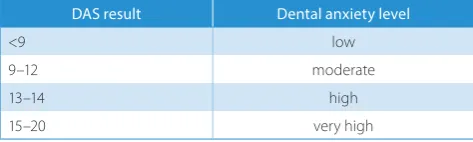
One of the most popular psychological tools used to assess the level of dental anxiety is DAS, created by Corah in 1969. It is a simple questionnaire consisting of 4 items, each contain-ing 5 possible answers. Each answer has an assigned numeric value (1–5). The sum of the values assigned for each response is the result of the test and can vary from 4 to 20 points. A score of 17–20 points indicates odontophobia (Table 1).
Despite its creation in 1969 and the existence of slight modifications, usually enriching the original test with 1 additional question, it is still one of the most frequent tools used to analyze the level of dental anxiety and is applicable worldwide.11–14 In the studies of the Polish population, DAS
was used numerous times at the turn of the 20th and 21st
cen-turies, yet it has never been validated, only translated.15–21
The aim of this study is to present the psychometric prop-erties of the Polish adaptation of the Corah’s DAS. By vali-dation we mean measuring the accuracy and reliability of the method.22 In the case of DAS, it was impossible
to de-termine its validity by comparing it with other methods examining the severity of dental anxiety, as it is the first tool of this type in Poland. In order to estimate the accu-racy of the scale, it was decided that it should be combined with the anxiety-trait subscale of the State-Trait Anxiety Inventory (STAI) questionnaire, where anxiety is under-stood as a permanent personality attribute, as well as with the neuroticism subscale from the International Personal-ity Item Pool-Big Five Markers-20 (IPIP-BFM-20) ques-tionnaire based on Big Five personality theory.23–25 Both
tools have excellent psychometric properties. Neuroticism, as well as its cortical aspect, the tendency to react with fear,26 are predictors of anxiety in the situation of a visit
to the dentist, although the correlation is weak.27 It was
assumed that the percentage of people with odontophobia and severe anxiety according to the original scale would help us gauge the accuracy of the Polish adaptation. The re-liability of the tool was examined by calculating Cron-bach’s α, as well as using the test–retest method.
Description and psychometric
characteristics of the original scale
The DAS by Norman L. Corah is a simple tool, perfectly suited to screening dental anxiety and odontophobia in den-tal patients who require special treatment and special at-tention from their dentist.28,29 The questionnaire consists
of 4 items describing successively situations related to dental Table 1. The relationship between the DAS test result and the patient’s level of anxiety according to Corah29
DAS result Dental anxiety level
<9 low
9–12 moderate
13–14 high
treatment: appointment at the dentist the next day, waiting in the dentist’s waiting room, waiting on a dental chair for drilling, and finally a rich description of waiting for tooth scraping near the gums during the removal of tartar. For each item, the subject has to respond using a five point scale.
The original validation studies performed on the student population showed that the scale is characterized by a high reliability ratio – Kuder–Richardson coefficient was 0.86, although due to the fact that the scale is not dichotomous, it would be more appropriate to calculate Cronbach’s α.30
The correlation between the first result and the retest after about 3 months was 0.82, which indicates a high stability of results over time. In addition, because fear of the dentist is met with considerable understanding and social accep-tance, the respondents did not show a tendency to provide insincere answers.
Material and methods
The language validation procedure was carried out in accordance with the guidelines described in the litera-ture.31 Because the author of the DAS scale, N.L. Corah,
died in 2001, we first obtained the official written per-mission of the publisher. Then, the instructions and test items were translated into English, leading to the devel-opment of the initial language version of the DAS scale, which was then subjected to the retranslation procedure. The language version created this way has been checked and corrected by experts fluent in English and with ex-pert knowledge – psychologists and linguists. The scale obtained satisfactory results of Gunning’s fog index. The 4 items were translated into Polish as follows:
1. If you had to go to the dentist tomorrow, how would you feel about it?
2. When you are waiting in the dentist’s office for your turn in the chair, how do you feel?
3. When you are in the dentist’s chair waiting while she/he gets her/his drill ready to begin working on your teeth, how do you feel?
4. You are in the dentist’s chair to have your teeth cleaned. While you are waiting and the dentist is getting out the instruments which she/he will use to scrape your teeth around the gums, how do you feel?
For the 1st question, the Polish adaptation of the scale
of answers looks as follows:
a) I would look forward to it as a reasonably enjoyable experience.
b) I wouldn’t care one way or the other. c) I would be a little uneasy about it.
d) I would be afraid that it would be unpleasant and painful.
e) I would be very frightened of what the dentist might do. For the remaining 3 test items, the response scale, also 5-level, describes the feelings of a person using dental services:
a) relaxed, b) a little uneasy, c) tense,
d) anxious,
e) so anxious that I sometimes break out in a sweat or almost feel physically sick.
After considering experts’ comments, an experimental version of the scale was created, which was used in a think-aloud pilot study conducted among 23 psychology students.32
These persons informed the investigators how they under-stand individual test items, and the researchers checked the compatibility of the interpretation with the original meaning of the items. This allowed for the official approval of the Polish language version of the questionnaire and for it to be subjected to a psychometric assessment process.
Results
One hundred sixty-two students participated in the study of the validation procedure. The specificity and number of participants is similar to the one in the original scale. Both the Bartlett sphericity test (χ2 = 387,738, degrees
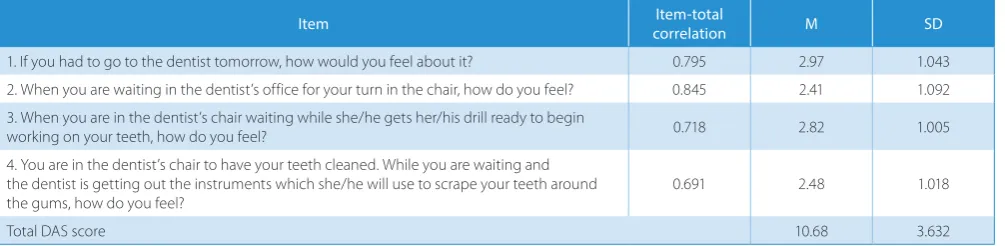
of freedom (df) = 6, p < 0.001) and the Kaiser–Meyer–Olkin test (0.828) indicate the adequacy of analyzing the matrix for the existence of common factors, and thus mean that the sample number and diversity are adequate. Then, an analysis of the discriminative power of the questionnaire items was carried out. The results are presented in Table 2.
The discriminatory power of the analyzed items is sat-isfactory – the discrimination factor of all 4 significantly exceeds 0.2. In order to verify the internal structure, an ex-ploratory factor analysis was carried out, which showed that all the items are loading 1 strong factor, explaining 76.24% of the responses variance.
In the Polish adaptation of the DAS, the Cronbach’s α re-liability coefficient was 0.898, which is a very good result for a scale of only 4 items and shows that it is a reliable tool that can successfully be used for screening the level of den-tal anxiety. To determine the absolute stability coefficient of the tool, 47 students were examined twice at an inter-val of 2 months. The correlation of the obtained results was 0.69 (p < 0.001), which indicates satisfactory stability of the scale over time. To determine the validity of the tool, the results of 32 subjects on the DAS scale were compared with the scale of anxiety as a trait of the STAI questionnaire and with the neuroticism scale of the IPIP-BFM-20 ques-tionnaire. As expected, the result was moderate in both cases – rho = 0.314 and rho = 0.38, respectively (p < 0.05).
Discussion
to determine its psychometric characteristics. In the sam-ple collected during the validation of the DAS-PL scale, 5.9% of the responders reached a score of 17 points and higher, allowing for odontophobia diagnosis, and another 18.7% obtained the result between 15 and 17 points, allow-ing us to suspect quite intense anxiety. This result is almost similar to the one obtained in the study of the Łódz re-gion population, in which, however, another non-validated method was used.33 It is also similar to the results achieved
in other studies with the original version of the DAS scale and its adaptations, which is another premise of its validity.
Numerous studies of the level of dental anxiety and odontophobia with the use of tools that have only been translated without a full cultural adaptation and validation procedure indicate the urgent need for such a tool. It will also be useful in the dental practice as a quick and easy screening tool. The use of such scales is recommended as the golden standard for treatment,34 and for example
in the UK, they are used by about 20% of dentists, surpris-ingly men more often than women.35
Conclusions
On the basis of all the analyzed psychometric characteris-tics, it can be concluded that the Polish adaptation of the DAS scale does not deviate significantly from the original one and that it has good psychometric properties. However, it has not yet been normalized. The adopted values of 15–17 points for high anxiety and 17–20 points for odontophobia have been established on the basis of American population studies; however, a similar percentage of people with odontophobia and intense anxiety in the Polish sample indicate that they are probably adequate. We can, therefore, recommend us-ing the DAS scale with the awareness of its limitations for screening in dental offices and for scientific research.
ORCID iDs
Artur Pitułaj https://orcid.org/0000-0002-9025-2628 Beata Rajba https://orcid.org/0000-0002-3945-1568 Beata Andrzejewska https://orcid.org/0000-0003-0526-2408 Andrzej Kiejna https://orcid.org/0000-0002-3708-3853 Marzena Dominiak https://orcid.org/0000-0001-8943-0549
References
1. LeDoux JE. Evolution of human emotion: A view through fear. Prog Brain Res. 2012;195:431–442.
2. Gruz E, Jaczewski M, Juzala P. Analysis of anxiety level, factors modu-lating it and the stereotype of dentist in case of patients undergoing dental surgical treatment [in Polish]. Dent Med Probl. 2006;43(300): 415–420.
3. Smith KJ, Béland M, Clyde M, et al. Association of diabetes with anx-iety: A systematic review and meta-analysis. J Psychosom Res. 2013; 74(2):89–99.
4. Roest A, de Jonge P, Lim C, et al. Fear and distress disorders as pre-dictors of heart disease: A temporal perspective. J Psychosom Res. 2017;96:67–75.
5. Bilikiewicz A, Pużyński S, Wciórka J, Rybakowski J. Psychiatria. Vol. 2. Wrocław, Poland: Urban & Partner; 2003.
6. ICD-10. V rozdział. Klasyfikacja zaburzeń psychicznych i zaburzeń zacho-wania w ICD. Opisy kliniczne i wskazówki diagnostyczne. Warszawa, Poland: Uniwersyteckie Wydawnictwo Medyczne „Vesalius”; 2000. 7. Amila Z, Jasmin H, Edina H, Muhamed A, Elmedin B. Evaluation of
dental fear and anxiety in displaced persons in Bosnia and Herze-govina. Acta Stomatol Croat. 2018;52(2):140–147.
8. Mahdi RIA, Aljabry AS. Attitude and practice of dentists towards management of dental fear and anxiety in public dental hospitals in Sudan. IOSR-JDMS. 2017;16(8):51–60.
9. Kaczmarek U, Grzesiak I, Kowalczyk-Zając M, Bader-Orłowska D. The level of dental anxiety and the dental status in 18-year-olds [in Polish].
Czas Stomatol. 2008;61:81–87.
10. Kaczmarek U, Kanaffa-Kilijańska U, Frydecka D. Methods of evalua-tion of dental anxiety in children and adolescents [in Polish]. Dent Med Probl. 2010;47(1):97–100.
11. Coolidge T, Konstantinos NA, Dimitris E, et al. Psychometric proper-ties of Greek versions of Modified Corah Dental Anxiety Scale (MDAS) and the Dental Fear Survey (DFS). BMC Oral Health. 2008;8:29. 12. Yuan S, Freeman R, Lahti S, et al. Some psychometric properties
of the Chinese version of the Modified Dental Anxiety Scale with cross validation. Health Qual Life Outcomes. 2008;6:22.
13. Javadinejad S, Farajzadegan Z, Madahain M. Iranian version of a face version of the Modified Child Dental Anxiety Scale: Transcultural adaptation and reliability analysis. J Res Med Sci. 2011;16(7):872–877. 14. Bahammam MA, Hassan MH. Validity and reliability of an Arabic ver-sion of the modified dental anxiety scale in Saudi adults. Saudi Med J. 2014;35(11):1384–1389.
15. Olszewska I, Żarow M, Gofrom B., Paczyńska P. Analiza stopnia lęku pacjentów przed leczeniem stomatologicznym. Magazyn Stomat. 2000;10(7–8):58–62.
16. Kobierska A, Sobaniec H, Gołębiewska M, Józefowicz W. Lęk przed leczeniem stomatologicznym – analiza w aspekcie płci, wieku i śro-dowiska badanych. Prot Stomat. 1995;45:341–350.
17. Kobierska A. Stres w gabinecie stomatologicznym. Czas Stomat. 1995; 43:526–531.
18. Kobierska A. Lęk przed leczeniem stomatologicznym – analiza związ-ku ze stanem uzębienia. Prot Stomat. 1996;46:229–232.
19. Sporniak-Tutak K. Ocena lęku u pacjentów przed zabiegami stoma-tologicznymi. Czas Stomat. 1995;48:396–400.
Table 2. Discrimination rate of test items (n = 162)
Item correlationItem-total M SD
1. If you had to go to the dentist tomorrow, how would you feel about it? 0.795 2.97 1.043
2. When you are waiting in the dentist’s office for your turn in the chair, how do you feel? 0.845 2.41 1.092
3. When you are in the dentist’s chair waiting while she/he gets her/his drill ready to begin
working on your teeth, how do you feel? 0.718 2.82 1.005
4. You are in the dentist’s chair to have your teeth cleaned. While you are waiting and the dentist is getting out the instruments which she/he will use to scrape your teeth around
the gums, how do you feel? 0.691 2.48 1.018
Total DAS score 10.68 3.632
20. Kamprowska B, Sokalski J. Psychologiczne uwarunkowania reak-cji pacjenta na zabiegi w gabinecie stomatologicznym. Poz Stomat. 1999;26:127–131.
21. Kalinowski T. Poziom lęku pacjentów podejmujących leczenie sto-matologiczne. Magazyn Stomat. 2001;11(5):52–59.
22. Brzeziński J. Metodologia badań psychologicznych. Warszawa, Poland: PWN; 2012.
23. Spielberger ChD, Gorusach, Lushene RE, The State-Trait Anxiety Inven-tory (STAI) Test Manual for Form X. Palo Alto, CA: Consulting Psycholo-gists Press; 1970.
24. Wrześniewski K, Matusik D, Sosnowski T. Inwentarz stanu i cechy lęku STAI: polska adaptacja STAI: podręcznik. Warszawa, Poland: Pracow-nia Testów Psychologicznych Polskiego Towarzystwa Psychologicz-nego; 2002.
25. Skimina E, Strus W, Topolewska E, Rowiński T, Cieciuch J. The short IPIP-BFM-20 questionnaire for measuring the Big Five. Annals of Psy-chology. 2014;17(2):285–402.
26. Eysenck MW, Byrne A. Anxiety and susceptibility to distraction. Pers Individ Dif. 1992;13(7):793–798.
27. Jumana K, Mahmoud K, Khaled Q, Firas AM. Personality and oral health. J Contemp Dent Pract. 2009;10(6):1–16.
28. Corah NL. Development of a dental anxiety scale. J Dent Res. 1969; 48(4):596.
29. Corah NL, Gale EN, Illig SJ. Assessment of a dental anxiety scale. J Am Dent Assoc. 1978;97(5):816–819.
30. Hornowska E. Testy psychologiczne: teoria i praktyka. Warszawa, Poland: Scholar, 2007.
31. Beaton DE, Bombardier C, Guillemin F, Ferraz MB. Guidelines for the process of cross-cultural adaptation of self-report measures. Spine (Phila Pa 1976). 2000;25(24):3186–3191.
32. Van Someren MW, Barnard YF, Sandberg JA. The Think Aloud Method: A Practical Guide to Modelling Cognitive Processes. London, UK: Aca-demic Press; 1994.
33. Sopińska K, Olszewska N, Bołtacz-Rzepkowska E. The effect of den-tal anxiety on the denof den-tal status of adult patients in the Lodz region [in Polish]. Dent Med Probl. 2017;26(1):73–78.
34. Falco E, Manani G, Zanette G. The relevance of hypnosis and behav-ioural techniques in dentistry. Contemp Hypn Integr Ther. 2013;29(4): 332–351.