This is an open access journal, and articles are distributed under the terms of the Creative Commons Attribution-Non Commercial-ShareAlike 4.0 License, which allows others to remix, tweak, and build upon the work non-commercially, as long as appropriate credit is given and the new creations are licensed under the identical terms.
© 2019 Journal of Advanced Pharmacy Education & Research | Published by SPER Publication
80
The colorimetric method for determination of total Alkaloids
and Flavonoids content in Indonesian black nightshade
(
Solanum nigrum
L.)
Nyi Mekar Saptarini
1*, Irma Erika Herawati
21 Department of Pharmaceutical Analysis and Medicinal Chemistry, Faculty of Pharmacy, Universitas Padjadjaran, Jl Raya Bandung Sumedang Km 21, West Java, Indonesia,
45363. 2 Departement of Pharmacy, Faculty of Mathematic and Natural Sciences, Al Ghifari University, Jl Cisaranten Kulon 140, West Java, Indonesia, 40293.
Correspondence:
Nyi Mekar Saptarini. Jl Raya Bandung Sumedang km 21 Jatinangor, West Java, Indonesia, 45363. Email: [email protected]
ABSTRACT
Plant standardization requires determination of the total content of various classes of secondary metabolites, due to dosage determination in the preparation. Black nightshade (Solanum nigrum L.) is one of the ethomedicines in Indonesian society. The purpose of this study was to determine the total alkaloids and flavonoids content in leaf, fruit, and stem of black nightshade and to determine the effect of acidified solvent in the alkaloids and flavonoids extraction. The novelty of this study was black nightshade from West Java, Indonesia. The colorimetric method was conducted to determinate total alkaloids content using thiourea and aluminum chloride to determinate total flavonoids content. The total alkaloids content was 0.256-0.389 mg/g in fruit, 0.066-0.159 mg/g in leaf, and 0.144-0.283 mg/g in stem. Total flavonoids content was 0.420-0.582 mg/g in fruit, 0.492-0.556 mg/g in leaf, and 0.240-0.372 mg/g in stem. Fruit has highest total alkaloids content and leaf has highest total flavonoids content. Acidified solvents were increasing the alkaloid and flavonoid extraction by 120.7-240.9% and 108.9-155.0%, respectively.
Keywords: acidified solvent, colored complex, thiourea, aluminum chloride
Introduction
Plant standardization requires determination of the total content of various classes of secondary metabolites. Alkaloids and flavonoids have biochemical properties and therapeutic efficacy. Determination of total alkaloids and flavonoids contents in plants is important to determine the dosage of plants in the preparation. [1] Colorimetric methods for alkaloids and
flavonoids are reliable, accurate, and time-saving compared to chromatographic methods, which require advanced instrument and expertise, and are time-consuming, and expensive. [2]
Colorimetric methods are simple, rapid, and efficient methods for the routine determination of total alkaloids and flavonoids content. The amount of bismuth is estimated after alkaloids precipitation with Dragendorff reagent; bismuth forms a yellow complex with thiuourea. [3, 4] Flavonoids form yellow-green
complex with aluminum chloride. [2]
Black nightshade (Solanum nigrum L.) is ethomedicine for Indonesian society. The fruit is antiseptic, anti-inflammatory, antidisentric, antimalarial, and ulcerogenic. The seed is used for the gonorrhea and dysuria treatment. The fruit is used as antipyretic and stomach ailment treatment, while the bud is used as skin treatment. Flower and leaf are used as antipyretic and alcohol antidote. The leaf is used as anthelmintic, joint and ear treatment. [5] The purpose of this study was to determine the
total alkaloids and flavonoids content in leaf, fruit, and stem of black nightshade and to determine the effect of acidified solvent
Access this article online
Website: www.japer.in E-ISSN: 2249-3379
How to cite this article: Nyi Mekar Saptarini, Irma Erika Herawati. The colorimetric method for determination of total Alkaloids and Flavonoids content in Indonesian black nightshade (Solanum nigrum L.). J Adv Pharm Edu Res 2019;9(3):80-84.
Journal of Advanced Pharmacy Education & Research | Jul-Sep 2019 | Vol 9 | Issue3 81 in the alkaloids and flavonoids extraction. The novelty of this
study was black nightshade from West Java, Indonesia.
Materials and Methods
Materials
Black nightshade (3-4 months old) plants were collected from Sindang Village, Garut Regency, West Java, Indonesia. The plant was identified in Plant Taxonomy Laboratory, Biology Department, Universitas Padjadjaran, with No. 769/HB/06/2014.
All chemicals were of analytical grade (Merck), i.e. thiourea, bismuth nitrate pentahydrate, potassium iodide, methanol, hydrochloric acid, disodium sulfide, mercury chloride, and nitric acid. Papaverine was purchased from Sigma Aldrich.
Determination of Loss on Drying
A 5 g simplicia was dried on 105°C at atmospheric pressure for 5 h, then weighed. Drying and weighing were continued until a constant weight. [6]
Extract Preparation
5 g of simplicia was extracted with 10 mL of various solvents, i.e. 96% ethanol and acidified ethanol (2, 4, and 6%) at 40° C for 60 min in reflux apparatus. Extracts were filtered, then re-extracted with the same solvent. All extracts were transferred to a 25 mL of volumetric flask and diluted with the same solvent.
Determination of Total Alkaloids Content
Preparation of bismuth nitrate calibration curve
1 mL of 2 mg/mL bismuth nitrate solution was added to 5 mL of 3% thiourea solution. The absorbance value was measured at 440-460 nm. Each of five various bismuth nitrate concentrations were added to 5 mL of 3% thiourea solution in a 10 mL of volumetric flask. The absorbance was measured at the maximum wavelength against thiourea solution as blank. [1]
Validation of analytical method
Each of 5 mL of various concentrations of papaverine solution (pH 2-2.5) was reacted with 2 mL of Dragendorff reagent. The precipitate was centrifuged and washed with 96% ethanol. The precipitate was reacted with 2 mL of disodium disulfide to form blackish brown compound, then centrifuged. The precipitate was dissolved in 2 mL of concentrated nitric acid and diluted with aquadest in a 10 mL of volumetric flask, then 1 mL of solution was pipetted and added to 5 mL of 3% thiourea solution. Absorbance was measured at the maximum wavelength against blank containing nitric acid and thiourea. The amount of bismuth was calculated by multiplying the absorbance with the factor, taking a suitable dilution factor into consideration. The factor is obtained from the calibration curve, which is a constant for different concentrations. The results were used to determine recovery, quantification limits, and detection limits. [1]
Determination of total alkaloids content
Determination of total alkaloids content of 5 mL extract was carried out with the same procedure as papaverine. [1]
Determination of Total Flavonoids Content
1 mL of 1% rutin solution was added to 2 mL of 5% AlCl3
solution in a 10 mL of volumetric flask. Absorbance was measured 300-450 nm against AlCl3 solution as blank.
Determination of total flavonoids content of 1 mL extract was carried out with the same procedure as rutin at maximum wavelength. Total flavonoids content was calculated with the below formula: [2]
TFC = 𝐴 𝑥 𝐷𝐹
𝐴1𝑐𝑚1% 𝑥 (𝑤 − 𝑙𝑑)
Where, TFC = total flavonoids content, A = absorbance, DF = dilution factor, 𝐴1𝑐𝑚1% = specific absorption for rutin-AlCl3
complex (259.4), w = mass of sample (g), and ld = loss on drying.
Statistical Analysis
Data were shown in mean ± standard deviation (SD). Data were analyzed statistically using the one-way ANOVA to determine the significancy effect of acidified solvent in extraction alkaloids and flavonoids.
Results and Discussion
Determination of Loss on Drying
Loss on drying was 94.88% for fruits, 93.97% for leaves, and 91.24% for stem. The values were high, due to simplicia was the fresh part of the plant. Loss on drying must be determined, due to the effect of the simplicia weight and calculation on the total flavonoids content.
Extract Preparation
Methanol is better solvent to dissolve secondary metabolites, but ethanol was chosen as an extraction solvent, because methanol is more toxic than ethanol. [7] Heating in reflux
extraction increase solvent diffusion, that will increase the alkaloids and flavonoids extraction from simplicia. [8] All
extracts were light green color with the characteristic odor of black nightshade.
Determination of Total Alkaloids Content
The nitrogen atoms in alkaloid bind to heavy metal atoms in Dragendorff reagents (KBiI4) to form ionic bonds in complex
compounds (BiI3) (Alk•HI) which precipitate. [3] The nitric acid
medium causes tiourea {(H2N)2C=S} and bismuth form a
yellow bismuth complex {Bi[CS(NH2)3]}(NO3)3. The
maximum wavelength of bismuth nitrate-thiourea complex was 460 nm, i.e. the blue wavelength (450-495 nm) as complementary or transmitted color. [9] The medium pH must
be maintained; high acidic medium will re-dissolve the precipitated complex. Disodium sulfide will release bismuth from alkaloid complexes. [10] 3% thiourea solution was used,
82 Journal of Advanced Pharmacy Education & Research | Jul-Sep 2019 | Vol 9 | Issue3
h. Higher concentration of thiourea solution forms thiourea precipitates. [1]
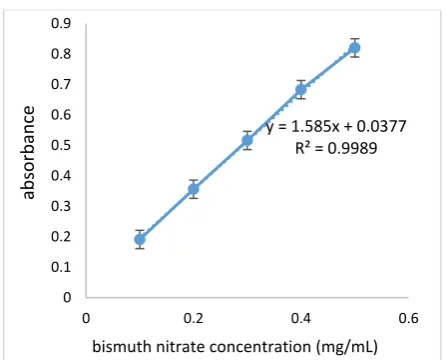
Fig. 1. Calibration curve of bismuth nitrate-thiourea complex
(n = 3)
The calibration curve of bismuth nitrate concentration and absorbance obeyed Lambert-Beer’s law in the concentration
range of 0,1-0,5 mg/mL and linear, with coefficient correlation of 0.9989 (Fig. 1). The bismuth nitrate-thiourea complex was 1:1, so the amount of bismuth nitrate corresponds to the amount of alkaloids, which was calculated by multiplying absorbance with factor. The accuracy was determined from recovery, i.e. 99.60 ± 0.25%, which met the requirements. [11]
Limit quantification was 0.102 mg/mL and limit detection was 0.034 mg/mL.
Fig. 2. Graph of total alkaloids content (mg/g) in black
nightshade (n = 3).
Table 1: Total alkaloids content (mg/g) in black nightshade in various solvents.
Plant part
Total alkaloid content (mg/g) in mixed solvent (96% ethanol:HCl)
100:0 98:2 96:4 94:6
Fruit 0.256 ± 0.019 0.389 ± 0.012 0.357 ± 0.021 0.309 ± 0.012
Leaf 0.066 ± 0.005 0.159 ± 0.002 0.136 ± 0.004 0.097 ± 0.005
Stem 0.144 ± 0.005 0.283 ± 0.004 0.225 ± 0.007 0.164 ± 0.009
The total alkaloids contents were varied in the various part of black nightshade and the highest content was in the fruit (Table 1). Alkaloids of Solanum species are in the form of water-soluble salts of sugar, i.e. glycoalkaloids, rather than as free bases that are not water soluble. [12] Acidified ethanols increased the total
alkaloids content, i.e. 120.7-151.9% for fruit, 147.0-240.9% for leaf, and 138.9-196.5% for stem (Fig. 2). The highest total alkaloids content was achieved with 2% acidified ethanol. Our prediction was that, acid increases the ethanol polarity, and glycoalkaloids reach the highest solubility in 2% acidified ethanol. Statistical analysis showed a significant difference due to various solvents (p value = 0.00129).
Glycoalkaloids synthesis is affected by temperature, daylight exposure, physical wounding, [13] climate, growth conditions,
and storage conditions. [14] Fruits’ total alkaloids content in
this study (0.256 ± 0.019 mg/g) was lower than other study (0.3 mg/g), [15] due to differences in growth location and the
analytical method. Fruits of black nightshade were collected from two different locations in Indonesia (in this study from Garut, while in other study from Bogor). Garut has a tropical climate (Am), while Bogor has a tropical rainforest climate (Af) according to Köppen climate classification. Bogor is more humid and rainy than Garut. [16] Bogor and Garut have an
average temperature of 23.1 °C and 26.3 °C, and relative humidity of 80.3% and 83.8%, respectively. [17] The analytical
method in this study was colorimetric method, while in the other study was gravimetric method of ethyl acetate fraction. Colorimetric method is more accurate, because Dragendorff reagent reacts with alkaloids specifically, while ethyl acetate fraction contains alkaloids and secondary metabolites which have the same polarity as ethyl acetate.
Determination of Total Flavonoids Content
The maximum wavelength of the flavonoid-AlCl3 complex was
412 nm, i.e. the violet wavelength (380-450 nm) as complementary or transmitted color. [9] Total flavonoids
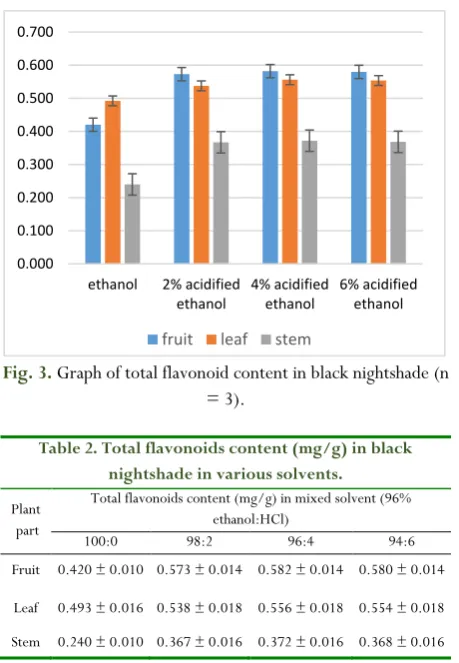
content was varied in the various part of black nightshade and the highest content was in the leaf (Table 2). Acidified ethanols increased the total flavonoids content, i.e. 136.2-138.1% for fruit, 108.9-113.0% for leaf, and 153.3-155.0% for stem (Fig. 3). It was the flavonoids O-glycosides form, which can be hydrolyzed by acid. The flavonoids contented in the sample, the polyphenol structure, the concentration of AlCl3 solutions, and
the reaction time affected the flavonoid-AlCl3 complex
formation. [18] The highest total flavonoids content was achieved
with 4% acidified ethanol. Our prediction was that, the acid increases the ethanol polarity, and flavonoids reach the highest solubility in 4% acidified ethanol. Statistical analysis showed a significant difference due to the acidified solvent (p value = 0.00185).
y = 1.585x + 0.0377 R² = 0.9989
0 0.1 0.2 0.3 0.4 0.5 0.6 0.7 0.8 0.9
0 0.2 0.4 0.6
absorbanc
e
bismuth nitrate concentration (mg/mL)
0 0.05 0.1 0.15 0.2 0.25 0.3 0.35 0.4 0.45
ethanol 2% acidified ethanol
4% acidified ethanol
6% acidified ethanol
Journal of Advanced Pharmacy Education & Research | Jul-Sep 2019 | Vol 9 | Issue3 83
Fig. 3. Graph of total flavonoid content in black nightshade (n
= 3).
Table 2. Total flavonoids content (mg/g) in black nightshade in various solvents.
Plant part
Total flavonoids content (mg/g) in mixed solvent (96% ethanol:HCl)
100:0 98:2 96:4 94:6
Fruit 0.420 ± 0.010 0.573 ± 0.014 0.582 ± 0.014 0.580 ± 0.014
Leaf 0.493 ± 0.016 0.538 ± 0.018 0.556 ± 0.018 0.554 ± 0.018
Stem 0.240 ± 0.010 0.367 ± 0.016 0.372 ± 0.016 0.368 ± 0.016
Total leaf flavonoids content (0.493 ± 0.016 mg/g) was lower than study by Kwinana-Mandindi (13.30 ± 0.08 mg/g), [19] due
to the difference in the growth location and the used simplicia. This study used the wet simplicia which was collected from Garut District (Indonesia) with ethanol as a solvent, while the Kwinana-Mandindi’s study used dry simplicia collected from various sites of the Amathole District in South Africa with methanol as a solvent. Flavonoids were phenolic compounds; their content depends on the cultivation techniques, growing conditions, plant types, ripening processes, and storage conditions. South Africa is a more suitable growth location for black nightshade. Dry simplicia gave higher flavonoids content, due to low water content, which increased flavonoids hydrolysis by the solvent. Extraction methods and the solvent polarity affect the phenolic content. [20] The dielectric constant of
methanol (1.66) is lower than ethanol (1.69), [21], so more
flavonoids are extracted in methanol.
Conclusion
Fruit has highest total alkaloids content and leaf has highest total flavonoids content. Acidified solvents increased the alkaloid and flavonoid extraction by 120.7-240.9% and 108.9-155.0%, respectively.
Acknowledgements
The authors thank to Intan Tarwiyatuljannah and Krisyan Nuruha for technical assistance.
Conflict of Interests
There are no conflicts of interest.
References
1. Sreevidya N, Mehrotra S. Spectrophotometric Method for Estimation of Alkaloids Precipitable with
Dragendorff’s Reagent in Plant Materials. J AOAC Int, 2003:86 (6): 1124-27.
2. Chang C, Yang M, Wen H, Chern J. Estimation of total flavonoid content in propolis by two complementary colorimetric methods. J Food Drug Anal. 2002; 10:178-82.
3. Francois M, Blanc LG. Comt Rend. 1922; 175:273-74. 4. Evans WC. Trease and Evans Pharmacognosy, 15th ed.
Edinburgh, UK: WB Saunders; 2002.
5. Edmonds JM, Chweya JA. Black nightshades. Solanum nigrum L. and related species. Rome, Italy: Institute of Plant Genetics and Crop Plant Research; 1997. 6. The United States Pharmacopeial Convention. US
Pharmacopeia. Rockville, MD: US Pharmacopeia; 2008.
7. Fiedler E, Grossmann G, Kersebohm DB, Weiss G, Witte C. Ullmann's Encyclopedia of Industrial Chemistry. Ullmann's Encyclopedia of Industrial Chemistry. Weinheim: Wiley-VCH; 2005.
8. Cheok CY, Salman HA, Sulaiman R. Extraction and quantification of saponins: A review. Food Res Int, 2014; 5:16-40.
9. Christian GD, Dasgupta PK, Schug KA. Analytical chemistry. 7th ed.USA: John Wiley & Sons; 2014. 10. Petkov PA. Sb Tr Visshiya Med Inst IP. Plovdiv. 1965;
17:23-31.
11. ICH. Validation of analytical procedures: text and methodology Q2(R1). In: Guideline ICH Harmonized Tripartite, ed. International Conference on Harmonisation of Technical Requirements for registration of pharmaceuticals for human use. Geneva; 2005.
12. Ziegler J, Facchini PJ. Alkaloid biosynthesis: Metabolism and trafficking, Annu Rev Plant Biol, 2008; 59: 735-69.
13. McCue KF, Allen PV, Shepherd LVT, Blake A, Rockhold DR, Novy RG, Stewart D, Davies HV, Belknap WR. Manipulation and compensation of steroidal glycoalkaloid biosynthesis in potatoes. Acta Hort, 2007; 745:343-50.
14. Kodamatani H, Saito K, Niina N, Yamazaki S, Tanaka Y. Simple and sensitive method for determination of glycoalkaloids in potato tubers by high-performance liquid chromatography with chemiluminescence detection, J Chromatogr A. 2005; 1100(1):26–31. 15. Putriantari M, Santosa E. Growh and alkaloids levels of
leunca (Solanum americanum Miller) of different nitrogen application. J Hort Indonesia. 2014; 5(3):175-82.
16. Climate data for cities worldwide; [cited April 24th 2019]. Available at: https://en.climate-data.org/ 0.000
0.100 0.200 0.300 0.400 0.500 0.600 0.700
ethanol 2% acidified ethanol
4% acidified ethanol
6% acidified ethanol
84 Journal of Advanced Pharmacy Education & Research | Jul-Sep 2019 | Vol 9 | Issue3
17. Browse 41,997 cities worldwide; [cited April 24th 2019]. Available from: https://www.weatherbase.com/
18. Petry RD, Ortega GG, Silva WB. Flavonoid content assay: influence of the reagent concentration and reaction time on the spectrophotometric behavior of the aluminium chloride- flavonoid complex. Pharmazie, 2001; 56(6):465-70
19. Kwinana-Mandindi T. Phytochemical and antioxidant composition of selected local wild plants in South
Africa: Consideration of Alternative Nutrients for Health Promotion. 5th Intern Conference on Biomed Eng Tech, 2015; 81(17): 96-102.
20. Naczk M, Shahidi F. Phenolics in cereals, fruits and vegetables: Occurence, extraction and analysis. J Pharm Biomed Anal, 2006; 41:1523-42.