What is
ephemera: theory & politics in organization
?
ephemera is an independent journal, founded in 2001. ephemera provides its content free of charge, and charges its readers only with free thought.
theory
ephemera encourages contributions that explicitly engage with theoretical and conceptual understandings of organizational issues, organizational processes and organizational life. This does not preclude empirical studies or commentaries on contemporary issues, but such contributions consider how theory and practice intersect in these cases. We especially publish articles that apply or develop theoretical insights that are not part of the established canon of organization studies. ephemera counters the current hegemonization of social theory and operates at the borders of organization studies in that it continuously seeks to question what organization studies is and what it can become.
politics
ephemera encourages the amplification of the political problematics of organization within academic debate, which today is being actively de-politized by the current organization of thought within and without universities and business schools. We welcome papers that engage the political in a variety of ways as required by the organizational forms being interrogated in a given instance.
organization
ephemera 17(4), Nov 2017
Whither emergence?
Ekaterina Chertkovskaya, Christian
Garmann Johnsen and Konstantin
Stoborod
Published by the ephemera editorial collective: Bent Meier Sørensen, Bernadette Loacker, Birke Otto, Christian Garmann Johnsen, Christos Giotitsas, Ekaterina Chertkovskaya, Emil Husted, Helen Delaney, Justine Grønbæk Pors, Katie Sullivan, Kenneth Weir, Konstantin Stoborod, Lena Olaison, Márton Rácz, Martyna Śliwa, Matthew Allen, Nick Butler, Ozan Nadir Alakavuklar, Randi Heinrichs, Rowland Curtis, Sara Louise Muhr, Stephen Dunne.
First published for free online at www.ephemerajournal.org and in print in association with MayFlyBooks (www.mayflybooks.org) in 2017.
ISSN (Online) 1473-2866 ISSN (Print) 2052-1499
ISBN (Print) 978-1-906948-39-9
Table of Contents
Editorial
Hosting emergence with hospitality 733-749
Ekaterina Chertkovskaya, Christian Garmann Johnsen and Konstantin Stoborod
Articles
Becoming a commoner: The commons as sites for affective socio-nature
encounters and co-becomings 751-776
Neera Singh
A pre-individual perspective to organizational action 777-799
Nicolas Bencherki
Street level tinkering in the times of ‘Make in India’ 801-817
Maitrayee Deka
Perverse particles, entangled monsters and psychedelic pilgrimages:
Emergence as an onto-epistemology of not-knowing 819-839
Bayo Akomolafe and Alnoor Ladha
Notes
A chronology of fragments: Struggling to write a story alternative to the
grand narrative of emerging economies 841-847
Matilda Dahl
Market fundamentalism in the age of ‘haute finance’: The enclosing of
policy space in ‘emerging’ India 849-865
The rise of stagnancy and emergent possibilities for young radicals:
Deleuze and the perils of idolatry 867-876
Andrei Botez and Joel Hietanen
Political art without words: Art’s threat of emergence, and its capture
within signification and commodification 877-894
Autonomous Artists Anonymous
Play
Leviathan lives: A short play about hierarchy and cooperation 895-905 Brian Showalter Matlock
Comic
Killer jellyfish rock Rio 907-918
Eileen Laurie
Reviews
Art at the margins of contemporary democracies 919-924
Beata Sirowy
Resistance in vulnerability
with an eye to the vulnerability of power 925-931
Marco Checchi
No future. Utopia now! 933-936
ISSN 1473-2866 (Online) ISSN 2052-1499 (Print) www.ephemerajournal.org volume 17(4): 733-749
Hosting emergence with hospitality
Ekaterina Chertkovskaya, Christian Garmann Johnsen and Konstantin
Stoborod
Introduction
This special issue follows from the location of our 2015 conference, which took place in Moscow, the capital of a country that is often referred to as ‘emerging’. What does it mean to be ‘emerging’, we thought, and (how) can this concept be mobilised to mean something else? When we speak of an ‘emerging’ country/market/economy, ‘emerging’ – a politically correct version of what was previously called ‘lesser developed’ – refers to an entity that has supposedly opened its doors to growth-oriented capitalism and is catching up with the ‘developed’ countries of this world. In our view, this conception of ‘emergence’ is problematic in at least two ways.
First, it creates divisions by maintaining a hierarchy of ‘developed’ and ‘emerging’ countries, in which the latter are positioned as lagging behind. Regardless of whether these are mainstream business magazines or critical left-wing journals, such divisions are constantly reproduced: developed – developing, core – periphery, First World – (ex-)Second/Third World, North – South, West – East. There are, of course, geopolitical and cultural differences that have implications for analysing certain areas separately (e.g. Alcadipani et al., 2012; Gorbach and Salamanyuk, 2014), as well as for epistemologies to do this from, without succumbing to the global coloniality of knowledge (Ibarra-Colado, 2006; Castro-Gómez, 2007; Tlostanova, 2012). However, ‘the “West” – that damned word! – names this disjunction’ (Badiou, 2008: 60), suggesting that the path the ‘developed’ countries have taken is the only possible option for humanity.
ephemera: theory & politics in organization 17(4): 733-749
‘multiple crisis’ rooted in the capitalist system itself (Brand and Wissen, 2012), the ‘vanguard’ countries have lost sight of their telos. The recent US elections and the Brexit referendum, as well as the rise of the far right in Europe and the US are all harbingers of a dramatic change in the perspective. Alongside this, the ultimate goal of capitalist growth is becoming increasingly unclear. Vitality is being squeezed out of human lives, while austerity, precarity (Standing, 2011) and inequality (Piketty, 2014) are increasingly on offer. The countries that have stepped onto the path of ‘emergence’ by adopting some form of neoliberalism are not necessarily in bloom either (e.g. Dale, 2011).Furthermore, it is no secret that such emergence takes place at the expense of certain localities and groups of people (Escobar, 1995; Badiou, 2008).
Ironically, one crucial concern is whether there are any alternatives to the world that has ‘emerged’ in this way. With its publication on the 100-year anniversary of the Russian Revolution, this special issue offers an occasion for reflection. This remarkable event created room for radical alternatives and progressive change to arise, such as the Soviet environmentalism of the 1920s (Gare, 1993) and the implementation of women’s rights in the Soviet Union, including equal pay and abortion rights, much earlier than in the ‘Western’ countries. At the same time, with growth dominating the economic and social agenda, combined with authoritarianism, it ‘emerged’ into a social, economic and environmental disaster. As such, even though ‘anti-emergence’ seems to be the only response to ‘emergence’ in terms of capitalism and economic growth, we do not want to dismiss the word itself. Instead, we argue that a different understanding of the notion of ‘emergence’ can help us to (re-)imagine alternatives and open a myriad of mutually enriching ways of thinking – the focus of this issue.
The rest of this editorial unfolds as follows. First, we outline the different conceptualisations of the notion of emergence. Second, based on the approach adopted in this special issue, we follow Derrida in offering to rethink emergence with hospitality. Third, we ponder over the contributions that have come out of adopting this approach in practice and the contradictions of the process. Finally, we outline the contributions.
Emergence without politics?
is what we invited this issue’s contributors to do. We did so without suggesting a focus on certain streams of literature or research traditions, thereby staying true to the openness that the etymology of the word entails. However, we are well aware that some conceptual literature has dealt with emergence in the fields of philosophy, sociology, and, indeed, organisation studies. In this section, we offer an overview of the term in light of the earlier literature and argue that, although insightful as a philosophical concept, it lacks engagement with politics.
The British ethologist and psychologist Conwy Lloyd Morgan initially coined the concept in 1923, although it can be traced to earlier philosophers like Leibniz and Shelling (Gare, 2002). Emergence has been conceptualised through either a diachronic or a synchronic understanding. A diachronic understanding of emergence refers to the appearance or development of a phenomenon, while a synchronic understanding focuses on the relationship between the properties and powers of the whole and its parts (Elder-Vass, 2005). Thus, in the ‘emerging’ economies/markets/countries discourse, a diachronic emergence takes place, with countries that were not previously part of the global market entering it, i.e. establishing market-oriented systems and experiencing fast economic growth via economic liberalisation (Hoskisson et al., 2009). However, it is emergence in the synchronic sense that has received most attention in the conceptual literature (Elder-Vass, 2005; Sawyer, 2001).
In the conceptual discussion of synchronic emergence, a key question is whether the whole can be explained solely by its parts. Is the whole larger or different from its parts? Alternatively, is the whole simply the sum of the individual components? ‘Individual emergentists’ maintain that society is nothing but the collection of individuals. This position is mostly defended by economists as well as some sociologists, including F.A. von Hayek, one of the ‘founding fathers’ of neoliberalism, who argued that higher-level social phenomena emerged from individual actions (see Sawyer, 2001). This understanding of emergence resonates with the ‘emerging market economies’ discourse in which the individualist ethos is complementary to economic liberalisation. The calculable and elsewhere-tested recipes that are forced upon ‘emerging’ entities often do not work. Moreover, they exclude ideas, practices and people not seen as fitting into these recipes, thereby testifying to a complete disregard for specific contexts.
ephemera: theory & politics in organization 17(4): 733-749
contingent and not fully explainable by the group’s components. For him, emergence is a collective phenomenon. In their own unique ways, the contributions to this issue offer different approaches to exploring emergence beyond an individualistic mode of reasoning.
Emergence has also been connected to questions of organisation (e.g. Lissack, 1999*). Elder-Vass (2005) argues that organisation is actually central to emergence, as it brings the ‘more than’ into the mere collection of elements, allowing emergence to take place. Relatedly, Sawyer (2006) stresses the self-organised character of emergence, which he refers to as organising without the organiser, as seen in a flock of birds flying in a V-shape or an orchestra not necessarily in need of a conductor to perform. Although readers of ephemera will immediately connect such self-organisation to political questions of organisation (e.g. Bell, 2014; Stoborod and Swann, 2014), this connection is manifestly lacking in most conceptual discussions of emergence. Indeed, it is surprising that ‘emergence’ is mostly used in descriptive and somewhat rigid ways, even in explicitly critical strands of thought.
This point echoes Protevi (2006), who notes that scholars have been too preoccupied with the synchronic understanding of emergence. In contrast, he uses Deleuze and Guattari’s philosophy to zoom in on a diachronic understanding, and he speaks of emergence as the ‘novelty’ that is located outside of the existing system. For usthe point here is not to call for a prioritisation of understanding emergence in the diachronic sense. As noted earlier, diachronic emergence might as well denote a shift to capitalism, as experienced by ‘emerging economies’. However, the connection of emergence to going outside the existing system resonates with us and, in fact, points to where our interest in the concept lies. This connection can be found in some scholarship, where emergence has been mainly associated with going outside the dominant systems of thought. It has helped highlight the inseparability of the physical and the mental, of nature and society, and of nature and culture – in other words, it has been used to problematise the many schisms by which today’s societies, as well as sciences, are divided, and recognise the wholeness of the world (e.g. Gare, 2002; Pueyo, 2014).
Gunnarsson (2013) pushes this discussion even further and uses the concept of emergence to understand nature and culture as inseparable, but without one being subsumed by the other (see also Soper, 1995; Malm, forthcoming). In so doing, she not only critiques the tendency to conflate nature and culture when arguing for their connection, but also voices the ambition for feminist research to
*
understand the political and, consequently, drive social change (see Gunnarsson, 2013: 18). The attempt to mobilise the notion of emergence to address the problems and possible transformations of our troubled world is exactly what unites the contributions to this issue. However, to be able to unpack the various views on emergence driven by these intentions, the concept needs to be met with ‘hospitality’. Hence, we must remain open to new understandings of emergence and think creatively about how it can be conceptualised. Next, we explore the very possibility of remaining open by drawing on Derrida’s discussion of hospitality.
Rethinking emergence with hospitality
With the intention of moving organisation studies toward a new location, we hosted the 2015 ephemera conference in Moscow. The aim was to explore different understandings of emergence. This issue, which stems from the Moscow conference, uses the concept of emergence to explore alternative politics, epistemologies and ontologies. By virtue of casting our eyes on these issues, we are, in fact, going back to the genesis of ephemera. The original vision for the journal, as stated in its very first editorial, was to ‘produce a space for the articulation of alternative models of critique’ insofar as critique ‘challenges orthodoxies, questions power relations, [and] disrupts the normal’ (Böhm et al., 2001: 4, original italics). To achieve this goal, Steffen Böhm, Campbell Jones and Chris Land – the journal’s founders – hoped that ephemera would facilitate a dialogue that would ‘interrupt and erupt’ (ibid.) by creating a space for critical discussion around organisation. For us, emergence is linked to attempts to explore alternative terrains for engaging in various practices, obtaining knowledge, organising politics and understanding the world around us.
ephemera: theory & politics in organization 17(4): 733-749
No one is more aware of this ‘aporia’ or ‘self-engendered paradox’ (Norris, 2002: 49) than Jacques Derrida. In his discussion of hospitality – the event of receiving the arrivant or the guest – Derrida makes the following argument:
The absolute arrivant must not be merely an invited guest, someone I’m prepared to welcome, whom I have the ability to welcome. It must be someone whose unexpected, unforeseeable arrival, whose visitation—and here I’m opposing visitation to invitation—is such an irruption that I’m not prepared to receive the person. I must not even be prepared to receive the person, for there to be genuine hospitality: not only have no prior notice of the arrival but no prior definition of the newcomer, and no way of asking, as is done at a border, “Name? Nationality? Place of origin? Purpose of visit? Will you be working here?” The absolute guest [hôte] is this arrivant for whom there is not even a horizon of expectation, who bursts onto my horizon of expectations when I am not even prepared to receive the one who I’ll be receiving. That’s hospitality. Hospitality is not merely receiving that which we are able to receive. (Derrida, 2007a: 451)
Here, Derrida reflects upon the impossibility of remaining open to the other. If our horizon of expectation has certain preconfigured expectations of who the guest will be, or what he or she will say or do, then no genuine hospitality can take place, as we are only able to recognise the guest on the basis of those expectations. Hence, we are neither open to what the other represents nor able to receive the unexpected. For this reason, genuine hospitality, according to Derrida, can only take place when we are confronted with someone whom we are unprepared to receive. Derrida further remarks:
The arrival of the arrivant will constitute an event only if I’m not capable of receiving him or her, only if I receive the coming of the newcomer precisely when I’m not capable of doing so. (2007a: 451)
In other words, it is only on the basis of a fundamental impossibility that hospitality can take place. It is important to emphasise that the fact that Derrida considers the event impossible does not imply that it never takes place. Quite the contrary, the event does occur, perhaps more often than we think. The main point is that, in the words of Derrida, ‘I cannot say the event in theoretical terms and I cannot pre-dict it either’ (ibid.: 452). Genuine hospitality manifests itself when we least expect it – when our preconceived beliefs are challenged or when we are confronted with something that transcends our current expectation horizon. What, then, are the necessary conditions for this to happen? How can we, as scholars, allow new insights to enter our field? How can we, paradoxically, remain open so that the event can take place?
convention’ (2007b: 1). Moreover, invention ‘inserts a disorder into the peaceful ordering of things’ (ibid.). At the same time, Derrida notes that in order for an invention to be acknowledged as new, it has to be ‘evaluated, recognized, and legitimized by someone else’ (ibid.: 5). Any new insights must comply with expectations about what is considered original, unique and inventive. Herein lies a paradox. On the one hand, any invention has to transcend established social conventions in order to avoid merely repeating the old. On the other hand, any invention has to appeal to the established order insofar as it is recognised as inventive. In other words, an invention has to simultaneously transcend and conform to a system of conventions. In turn, any attempt to invent the new must confront a paradox: the new is possible insofar as it is impossible.
This paradox is embedded in the academic discourse in which we partake. Although we strive for innovative research, we remain within an academic tradition that operates on the basis of conventions for what is considered, for example, ‘excellent’, ‘relevant’ or ‘impactful’ (Butler and Spoelstra, 2012; see also the recent special issue on ‘The labour of academia’, Butler et al., 2017). Any discourse, especially the academic one, remains governed by rather rigid conventions that deem certain utterances appropriate and others inappropriate. These are fundamental assumptions about what is right and wrong, true and false, rational and irrational – de facto, what is acceptable and what is not. This is particularly evident in the literature on, for instance, emerging economies. Paradoxically, having confronted truly unforeseen and complex phenomena (like post-colonial independent India or post-Soviet neoliberally reformed Russia), the respective fields of inquiry came up with nothing better than measuring them against the yardstick of ‘developed’ countries – that is, with the West. This was an outcome of operating within what Derrida terms the ‘binary oppositions’ that govern our thinking.
ephemera: theory & politics in organization 17(4): 733-749
In line with Derrida, we posit that our task in not only this special issue but also the field of organisation studies and academia in general is to ‘destabiliz[e] foreclusionary structures’ (Derrida, 2007b: 45). This allows for the release of new modes of experience and new ways of looking at the world – in short, that which is yet to come. The challenge is driving a wedge between the oppositions that inevitably define the field. This is not a dialectical pursuit of arriving at synthesis. Quite the opposite – we must learn to live with aporias. On the one hand, the understanding of emergence that we offer here is about openness, undecidedness and multiple potentialities. On the other, for this understanding to assume a comfortable position within organisation studies, it has to be brushed against what we know to be conventions of the discipline. To put it differently, we face the impossible task of being a good host to emergence.
On the possibility of being a good host
The self-engendered paradox that Derrida identifies is common for both scientific and social-scientific epistemologies. Yet, while the paradox is somewhat accounted for in such fields as quantum physics, the social sciences, including organisation studies, lack a coping strategy. The radical twist that we dare to introduce here is to let emergence, so to speak, host itself. Indeed, when offering his metaphorical language of hospitality, Derrida makes it tempting to further indulge in musing with it. One cannot help but notice that the setup to which Derrida alludes in his analogy is very specific, arguably of a petit bourgeois kind. Imagine, instead, that you have a guest who does not expect much and brings their own booze, and that you do not suffer from any philistine qualms. That is the kind of guest we expected when wondering ‘Whither emergence?’.
In the case of apolitical deployment of the concept of ‘emergence’, we witness a conspicuous inability to challenge ‘the peaceful order of things’ and a rather ardent desire to subject emergent phenomena to the conventional framework of knowing and interpreting. How does this issue allow us to think and act differently? It is not straightforward, but not impossible. The key is to allow emergence to navigate between the Scylla of reproduction of convention and the Charybdis of putting anything under the banner of new and innovative. This implies that we have been guided by the following less metaphorical considerations.
earlier by thinking beyond the dualisms between developed and developing, core and periphery, First World and (ex-)Second/Third World, North and South, and West and East. In this way, the issue is performative. This being noted, the marker of ‘emergence’ inevitably opens up spatial contexts to non-Western areas of interests. Albeit some scholars might not be domiciled in these respective geographies, which highlights the futility of any attempt to demarcate between ‘here’ and ‘there’. As a result, when we task ourselves with creating the basis for new ways of thinking about emergence, it is vital to avoid traps of exotifying, romanticising or othering. Although this special issue covers contexts that are conventionally referred to as ‘emerging’, we insist on engaging with them as parts that make up a whole.
A more explicit approach to becoming a good host that would satisfy Derrida’s criteria for genuine hospitality to some extent would be to adhere to an ‘open-door’ policy. Contributions could channel through, but we would not know their take on emergence. ephemera has always been open to submissions that are ‘experimental modes of representation’. Yet, it is important to remain aware of the challenge of thinking beyond established formats and conventions. In preparing this issue, while keeping the doors open and remaining open to surprises, we witnessed apprehensions of the theme of emergence that made themselves comfortable within the offered space: a play, a comic and unconventional polemic. At the same time, it is crucial that openness is not confined to a particular special issue.
A final consideration relates to making decisions, which cannot be avoided. Merely succumbing to an ‘anything goes’ approach would risk devaluing all knowledge claims. This would also undermine Derrida’s requirement for validation of innovative disruptive knowledge. Thus, although this is considered commonplace, we urge scholars who are ready to take part in our pursuit of ‘genuine hospitality’ to be truly self-reflective about the degree to which the field of enquiry is really open. In addition, despite the openness and multiple possibilities that the etymology of the word ‘emergence’ suggests, it is not simply a useful philosophical concept that helps clarify positions within critical research – it is also a political commitment. This is a thread and intention common to the contributions to this issue.
Overview of the contributions
ephemera: theory & politics in organization 17(4): 733-749
order. Instead, we are going to waltz between them, as they rather naturally share topics relevant for conversation, like good guests would at a drinks reception.
We move first to the buzz of legitimate discontent over the totalising liberal conceptions of ‘emergence’. The article by Maitrayee Deka takes us geographically to the ‘I’ in a praised BRICS quintet and goes straight to the heart of the problem with economistic grand narratives of emergence, which always overlook the finer details. On the basis of her rich fieldwork material gathered from the ‘labyrinth like bazaars’ of Delhi, the author critically evaluates the nature and impact of the ‘Make in India’ programme. This top-down governmental programme designed to bolster India’s manufacturing sector and attract foreign investments completely disregarded the knowledge and skills of the actors in the informal economy, who nurtured an ethos of turning obstacles inherent to Indian economy and society into opportunities. This was achieved through what Deka calls practices of ‘tinkering’ or ‘improvisation’ – the sort of grass-roots ingenuity reflective of a much more heterogeneous social world than the state pundits were willing to recognise. Their vision, instead, was that of an imposing lion (the logo of the ‘Make in India’ programme) that safeguards formalisation of the economy according to a particular imperative of neoliberal globalisation.
Srivatsan Lakshminarayan picks up on those zoological obsessions of policymakers and explains that roaring tigers, lions, confident elephants and other beasts are ways to package up a country and sell it on the global financial market. By providing a detailed analysis of macroeconomic policies, the ins and outs of ‘haute finance’ and various mediated discourses of growth and competitiveness, this contribution tackles the core mechanics of ruthless international competition. The main observation here is that in the post-reform India (and by no means it should be treated as a unique and isolated case) all the powerful actors are paddling a very narrow and instrumentally economic understanding of what constitutes emergence. By employing the work of Karl Polanyi for his critical analysis, Lakshminarayan warns that such parochialism sweeps through the diversity and humanness of collective histories and geographies and results in ‘the non-reflexive advancement of performative growth over its subjective and substantial alternatives’.
telling the stories of catching up with the developed world that any attempt to escape them is bound to face difficulties.
The grand narratives of growth and emergence that Deka and Lakshminarayan bring to our attention are extremely strong. In fact, they are so strong that they tend to become omnipresent, making it very difficult to build narratives that are not centred around them, regardless of whether those narratives aim to praise or critique. This is demonstrated in Matilda Dahl’s contribution, which zooms in on the phenomenon of M-pesa mobile money in Kenya – a way to exchange money using mobile phones that existed even before Swish. Dahl experienced the technology first-hand while working in one of the mobile money booths, where she engaged with people within and around M-pesa. However, she does not wish to offer insights into the business’s success nor provide a counter-narrative to it. Instead, she tells a different story, a story that is difficult to tell due to predefined ways of thinking and writing. In telling this story, she shares her thoughts and frustrations, but actively chooses not to make a knowledge claim, thereby leaving the story incomplete. This allows for the story to unfold in readers’ minds in a myriad of ways. This introspective piece, which is infused with personal affect, testifies to the difficulties anyone willing to escape a well-rehearsed emergence narrative would encounter.
If emergence is to be taken outside the existing system, as we invited our contributors to do, then one would have to go beyond traditional tropes and conventional focal points. In this regard, Dahl’s rejection of making a point about emergence may be seen as creating a crack that might open up the concept to other understandings. Bayo Akomolafe and Alnoor Ladha, in their piece, focus on precisely this crack and conceptualise emergence as the ‘onto-epistemology of not-knowing’. In their provocative (by academic standards) article, the authors take inspiration from a wide range of sources, including popular culture, psychedelics, quantum physics and, notably, the work of Karen Barad. They reject the linear and calculable understanding of emergence as catching up in terms of economic growth via economic liberation. More importantly, they reject pre-conceived recipes for social change, suggesting that ‘knowing’ and claiming to know inevitably close off some potentialities and, consequently, emergence. Instead, they ‘reimagine emergence as a radical indeterminacy that unsettles the grounds upon which the exclusionary discourse/practices of neoliberal expansionism as emergence are built’.
ephemera: theory & politics in organization 17(4): 733-749 our eyes to and make sense of existing phenomena that may help to engender a better world.
Neera Singhbrings to our attention the community forestry initiatives in Odisha, India, where affects, emotions and subjectivities shape up the practices of commoning. Being key to forest protection, they make commons a lot more than just an organisational form. She argues for thinking of the commons as ‘affective socio-nature relations’ and practices of commoning as a means of nurturing this relationship. Thus, if we open our eyes, it is actually possible to see manifestations of emergence that are already happening. Emergence, in Singh’s study, can be found in the ‘lived practices of dwelling in the environment and making it home’, with human beings, too, being seen as ‘emergent rather than fixed and immutable’.
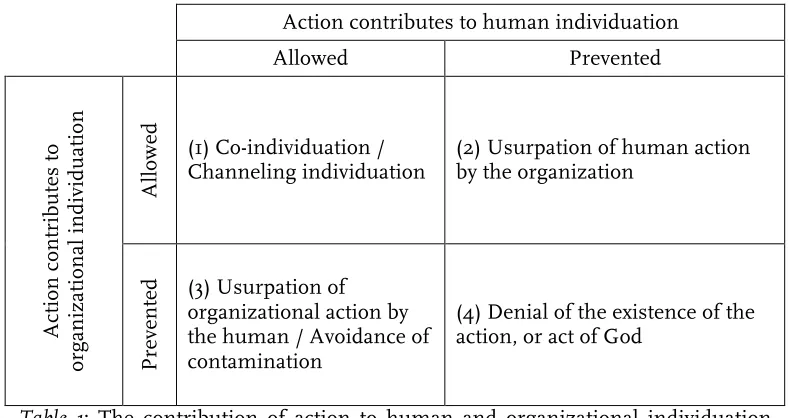
Without undermining affect’s potential to bring social transformation of the kind that many readers of ephemera would like to see, it is important to remember that affect can also be used to pursue capitalist goals or certain organisational agendas (see Karppi et al., 2016). This is highlighted in Nicolas Bencherki’s piece (this issue), which examines the case of military wives, and how their self-organising attempts are either discouraged or inevitably claimed by the military organisation depending on how they fit with the organisation’s image. The military is by no means an alternative organisation that threatens capitalist emergence. However, this example should stimulate thinking about any groups or organisations positioning themselves as alternative or anti-capitalist – regardless of whether they are collectives, cooperatives or commons. Even organisations with the ‘best intentions’ tend to put organisational interests at the fore by, for example, sanctioning open critique or appropriating individual actions for organisational ends. Such subordination of people makes even politically just alternatives problematic and is far from encouraging of social transformation.
The contributors to this issue have different takes on emergence, and trying to pinpoint the ‘right’ one is not our task. This openness, we suggest, hints in the direction of active politics. This can be best demonstrated by art, as art does not necessarily posit where or what the ‘truth’ is, but creates affect and invites people to think and feel. This issue offers a whole set of contributions devoted to art and artistic interventions, highlighting the centrality of art in imagining and acting for a different world. However, the art world itself is not without problems, with precarity, marketisation and, as Autonomous Artists Anonymous vividly demonstrate, the vicious circles of signification and commodification at the forefront from an early point in one’s life as an artist. According to this collective, even explicit political statements on art always run the risk of being captured within them, feeding into capitalism’s value creation. Emergence instead arises from the engagement with art itself and is seen as ‘new forms, sensations and affects which operate outside and beyond signification and cognition, and which can provoke change, within us, between us and in how we live together, in and of the world’. As such, there is hope in art’s radical potential via the refusal to commodify it or the affects it creates. This has clear political implications without screaming about politics.
We think this is exactly what the artistic contributions to this special issue do. In order to avoid overburdening them with our interpretations and in line with the understanding of emergence in this issue, we keep their descriptions brief. Brian Showalter Matlock’s play on hierarchy and cooperation brings together thinkers and strands of thought from different times in dialogues on these themes or the lack thereof. Eileen Laurie’s comic takes us to an academic conference in Rio (what an emergent destination!), with climate change happening in the background and jellyfish paying a visit. Both the play and the comic drive our attention toward particular themes – hierarchy and cooperation, and climate change – and are political in this sense. However, they do not point fingers in overly obvious ways, leaving the space for thinking and imagination, as well as emotional and affective responses from the readers.
ephemera: theory & politics in organization 17(4): 733-749
This poses a fundamental challenge for those who choose to draw inspiration from Deleuze’s philosophy in their own scholarship, as one can only remain loyal to Deleuze’s legacy by betraying it. These authors emphasise that thinking requires violence, and that without this violence new thought cannot emerge.
This point resonates with us. We are willing to open up the concept of emergence and host its different interpretations while also trying to think and make our voices heard. Violence has certainly been committed, but it is up to our readers to decide whether the sacrifice was worthwhile.
This special issue is rounded off by reviews of recent books that have been carefully tailored to the subject of the issue. They offer additional forays into a multifaceted understanding of emergence and augment the view presented in the issue’s original contributions. Think of them as a book stall that you happen to notice while leaving a post-conference discussion.
Beata Sirowy’s review of Santiago Zabala’s Why only art can save us is another contribution highlighting art’s key importance for social change. Drawing on Heidegger’s thought and, to some extent, on critical social theory, it argues that art can foster a return to Being, which is currently dominated by technology and instrumental rationality. This Being would be in a non-reductionist perception of the world and human existence. Empty aestheticisation of art will not awaken it, but there is much more hope in art that creates a sense of emergency and an awareness that a different world is possible.
Marco Checchi reviews Vulnerability in resistance – an edited volume that is comprised of a series of essays that engage with the interplay between vulnerability and resistance. Those essays take us to a variety of geographical and political contexts. Departing from and being largely indebted to the work of Judith Butler, the contributions in this book make various attempts at rethinking the nature of vulnerability and its occurrences on a diverse political landscape. The book, as Checchi hints, can propel further reflections on what possibilities for resistance can be created and spotted once we realise that power is vulnerable too.
wholeheartedly willing to solidarise with, is that utopia is a collective practice of creating new forms of affect in the prefigurative present.
references
Alcadipani, R., F. Rafi-Khan, E. Gantman and S. Nkomo (eds.) (2012) ‘Southern voices in management and organization knowledge’, Organization, 19(2): 131-143.
Badiou, A. (2008) The meaning of Sarkozy. London: Verso.
Bell, D.M. (2014) ‘Improvisation as anarchist organisation’, ephemera, 14(4): 1009-1030.
Böhm, S., C. Jones and C. Land (2001) ‘Castles made of sand’, ephemera, 1(1): 1-11.
Brand, U. and M. Wissen (2012) ‘Global environmental politics and the imperial mode of living: Articulations of state-capital relations in the multiple crisis’, Globalizations, 9(4): 547-560.
Butler, N. and S. Spoelstra (2012) ‘Your excellency’, Organization, 19(6): 891-903.
Butler, N., H. Delaney and M. Śliwa (eds.) (2017) ‘The labour of academia’, ephemera, 17(3).
Castro-Gómez, S. (2007) ‘The missing chapter of Empire: Postmodern reorganization of coloniality and post-Fordist capitalism’, Cultural Studies, 21(2/3): 428-448.
Cooper, R. (1986) ‘Organization/Disorganization’, Social Science Information, 25(2): 299-335.
Dale, G. (ed.) (2011) First the transition, then the crash: Eastern Europe in the 2000s. London: Pluto Press.
Derrida, J. (2007a) ‘A certain impossibility of saying the event’, Critical Inquiry, 33(winter): 441-461.
Derrida, J. (2007b) Psyche – Inventions of the other, Volume I. Stanford: Stanford University Press.
Elder-Vass, D. (2005) ‘For emergence: Refining Archer’s account of social structure’, Journal for the Theory of Social Behaviour, 37(1): 25-44.
Escobar, A. (1995) Encountering development: The making and unmaking of the Third World. Princeton: Princeton University Press.
ephemera: theory & politics in organization 17(4): 733-749
Gare, A. (2002) ‘Process philosophy and the emergent theory of mind: Whitehead, Lloyd Morgan and Schelling’, Concrescence, 3: 1-12.
Gorbach, D. and T. Salamanyuk (eds.) (2014) ‘Second World’, Spilne, 7. [Горбач, Д. і Т. Саламанюк (ред.) (2014) ‘Другийсвіт’, Спiльне, 7.]
Gunnarsson, L. (2013) ‘The naturalistic turn in feminist theory: A Marxist-realist contribution’, Feminist Theory, 14(1): 3-19.
Hoskisson, R.E., L. Eden, C.M. Lau and M. Wright (2010) ‘Strategy in emerging economies’, Academy of Management Journal, 43(3): 249-267.
Ibarra-Colado, E. (2006) ‘Organization studies and epistemic coloniality in Latin America: Thinking otherness from the margins’, Organization: 13(4): 463-488.
Karppi, T., L. Kähkönen, M. Mannevuo, M. Pajala and T. Sihvonen (eds.) (2016) ‘Affective capitalism’, ephemera, 16(4).
Lissack, M. (1999) ‘Editor’s note’, Emergence, 1(1).
[https://journal.emergentpublications.com/article/vol1-iss1-1-ed/]
Malm, A. (forthcoming) The progress of this storm: Nature and society in a warming world. London: Verso.
Norris, C. (2002) Deconstruction: Theory and practice. London & New York: Routledge.
Oxford dictionary (online) ‘Emergence’.
[http://www.oxforddictionaries.com/definition/english/emergence]
Piketty, T. (2014) Capital in the twenty-first century. Cambridge, MA: Harvard University Press.
Protevi, J. (2006) ‘Deleuze, Guattari and emergence’, Paragraph, 29(2): 19-39.
Pueyo, S. (2014) ‘Ecological econophysics for degrowth’, Sustainability, 6: 3431-3483.
Sawyer, R.K. (2001) ‘Emergence in sociology: Contemporary philosophy of mind and some implications for sociological theory’, American Journal of Sociology, 107(3), 551-585.
Sawyer, R.K. (2006) ‘Group creativity: Music performance and collaboration’, Psychology of Music, 34(2): 148-165.
Soper, K. (1995) What is nature? Oxford: Blackwell.
Stoborod, K. and T. Swann (eds.) (2014) ‘Management, business, anarchism’, ephemera, 14(4).
Tlostanova, M. (2012) ‘Postsocialist ≠ postcolonial? On post-Soviet imaginary and global coloniality’, Journal of Postcolonial Writing, 48(2): 130-142.
the editors
Ekaterina Chertkovskaya is a member of the editorial collective of ephemera. Email: [email protected]
Christian Garmann Johnsen is a member of the editorial collective of ephemera. Email: [email protected]
the author(s) 2017 ISSN 1473-2866 (Online) ISSN 2052-1499 (Print) www.ephemerajournal.org volume 17(4): 751-776
Becoming a commoner: The commons as sites
for affective socio-nature encounters and
co-becomings
Neera Singh
abstract
This paper draws attention to the somewhat neglected domains of affects, emotions, and subjectivity in the study of the commons. The paper argues that a focus on affective and communicative relations among humans and between humans and more-than-humans can enrich our understanding of the practices of commoning and the processes of becoming
a commoner. Using the case of community forestry initiatives in Odisha, India, it illustrates how rural people become commoners through the embodied practices of caring for the forests as a shared common. The paper uses this empirical example and conceptual resources from affect theory and relational ontology to think about the commons as affective socio-nature entanglements and as a nurturing ground for subjectivity. It discusses the implications of attention on the commons and the practices of commoning for enabling the emergence of other-than-capitalist subjectivities.
Introduction
leads to ‘ruin for all’. This caricature does not take into account the possibility that the shepherd might grieve the loss of his green valley when it degrades, or that grief might galvanize him into action to avert the tragedy. The affective and communicative relations between the pasture and the shepherd and amongst the shepherds and their power to bring both the commoner and the commons into being remain invisible in this picture.1
Scholars working on common pool resources have extensively critiqued Hardin’s prediction of the tragedy.2 Elinor Ostrom’s landmark work has been especially influential in showing that local communities can self-organize and craft institutions to avert this tragedy (see especially Ostrom, 1990; Ostrom and Gardener, 1993) and that private property or state authorities are not the only means by which to solve common pool resource problems. While common pool resources (CPR) work in the Ostrom tradition seeks an alternative to the powerful and reductive narratives derived from liberal and neoliberal economic theory, it tends to reproduce the very defining features of these narratives (Bresnihan, 2016). Working with the same methodological individualist assumptions of neoliberal economic theory that it critiques, it assumes that without proper rules, incentives, and sanctions, individuals will degrade and ultimately destroy common resources (Bresnihan, 2016; Cleaver, 2007). It thus pays insufficient attention to alternative conceptions of rationality and to humans as ‘thinking-feeling’ empathetic beings. This paper draws attention to this neglect and argues that attention on affective and communicative relations between the commons and the commoners can lead to more robust theorizing about the commons, and also possibly help in bringing together divergent ways of thinking about the commons.
The uses of the term commons, as McCarthy (2009: 498) points out, are manifold, and the term can be thought of as a ‘keyword’ in Raymond Williams’ sense of the word. While CPR theorists predominantly focus on small-scale natural resources as shared commons, autonomous Marxists talk about ‘the common’ in the singular as a principle of organizing production and as the shared commonwealth of humanity. As enclosure of the commons intensifies, and all realms of life are increasingly commodified, the calls for reclaiming commons or inventing new commons are growing strong. These calls are coming from diverse sources that do not necessarily share similar theoretical foundations (McCarthy, 2006). On the
1
Peter Linebaugh (2010) observes Hardin’s ‘rational’ herdsman is likely to be a selfish or lonely herdsman. He says that in history, the commons have mostly been governed, and the greedy shepherd is likely to be punished by some community governance system.
2
Neera Singh Becoming a commoner
one hand, there are activists involved in struggles to ‘reclaim’ the historically enclosed commons, or reassert local rights over land, forests, and water bodies as part of the struggles against extractive capitalism; on the other hand, there are emerging practices of creating new commons, especially in the global North in spheres such as open-source software, urban gardens, and the reclamation of cities. Traditionally, CPR theory has engaged with shared natural resources, such as forests, land, and water bodies that need collectively respected rules to manage them. It has expanded its ambit to include non-material social and cultural resources such as information and intellectual property or even shared culture itself as the ‘new commons’ (for a review see Hess, 2012). In contrast to the work of CPR scholars, a growing number of commons activists suggest that diverse commoning projects represent ‘an alternative form of production in the make’ (Caffentzis and Federici, 2014: i95) and are reminders that ‘alternative social relations are entirely thinkable’ (McCarthy 2005: 16). Summing up this perspective, Federici and Caffentzis (2014) emphasize that the commons are not only the practices for sharing in an egalitarian manner the resources we produce but are also a commitment to the fostering of common interest in every aspect of our lives and political work. These activists advocate thinking about commoning as a set of generative practices that support sustenance and enhancement of life (Linebaugh, 2008; Bollier, 2014; Bollier and Helfrich, 2014).
As the Austrian philosopher Ivan Illich, in his brief but powerful essay titled ‘Silence is a common’ (1983), reminded us that the process of ‘enclosure of the commons’ was not merely a physical takeover of the commons by the lords in eighteenth century England, but signified a shift in the attitudes of society towards the environment. This shift entailed seeing the environment as a resource to be exploited for human needs instead of as a commons to be cherished, shared, and nourished through practices of care (Illich, 1983). Resisting this dominant shift, indigenous peoples and other locally-rooted cultures around the world have often continued to view the common(s) as a source of sustenance of life that needs to be nurtured with relations of care3 (Kimmerer, 2013; Sullivan, 2009; and many others). ‘Thinking and feeling with the Earth4’ (Escobar, 2016), these cultures
3
Instead of essentializing indigenous cultures, I am following scholars like Escobar and Ingold who emphasize how indigenous onto-epistemologies emerge from lived practices of dwelling in the environmental and making it home.
4
often embrace a stance of deep interdependence and a sense of ‘being-in-common’ with the rest of the world. This perspective underpins countless examples of place-based movements and resistance against extractive industries around the world. For example, Mapuche activists protesting petroleum extraction from Vaca Nuerta in Argentina assert, ‘Our territories are not “resources” but lives that make the Ixofijmogen5 of which we are part, not its owners’ (cited by de la Cadena, 2015a). This perspective is also reflected in the work of feminist scholars (Shiva, 1988; Mies & Bennholdt-Thomsen 1999; Federici, 2011; Gibson-Graham, 2011) and the recent work of anthropologists (de la Cadena 2015b; Tsing 2010) who emphasize on the need to nurture the commons through an ethics of care.
The calls for commoning emanating from this tradition highlight the revolutionary potential of the commons in anti-capitalist struggles (Caffentzis and Federici, 2014; de Angelis, 2013); the commons’ capacity to perform counter-hegemonic common(s) senses (Garcia Lopez et al., 2017); and the need to include more-than-humans in our thinking about the commons’ community (Breshninan, 2016). Building on this work, I emphasize the need to conceptualize and nurture the commons as a site for becoming a commoner. I argue that the commons can be conceptualized as a site of affective nature encounters or as affective socio-nature relations that can foster subjectivities of ‘being in common’ with others. I emphasize that thinking in terms of affective relations and the work that commons do (other than producing goods or resources) provides a helpful way of bringing together diverse ways of thinking about the commons.
The paper engages a critical question of our times, which is how to transform our ways of being human and relating to the rest of the world. Felix Guattari (1995: 119-20) once eloquently said that one of the most pressing questions of our times is ‘how do we change mentalities, how do we reinvent social practices that would give back to humanity – if it ever had it – a sense of responsibility, not only for its own survival, but equally for the future of all life on the planet?’ I bring attention to the potential of the commons and practices of commoning to nurture this sense of responsibility by posing the following questions: What are the conditions that foster affective relations between the commons and commoners? How do people become commoners and imbibe norms that foster other-regarding behavior and support collective action to govern the commons?
With the affective turn, Western social sciences and humanities are embracing perspectives that are remarkably similar to indigenous ontologies. Using
5
Neera Singh Becoming a commoner
conceptual resources offered by affect theory and relational ontology in conjunction with my empirical work with forest communities in Odisha, India, I argue that we need to think of the commons as ‘affective socio-nature relations’ and practices of commoning as a means of nurturing this relationship. I argue that a focus on affects and affective relationality helps to transcend the dualism of subject and object, the commons and the commoners, and encourages us to think instead of the commons and commoners as co-constituted through intersubjective communication and affective relations. Doing so helps us to envision alternate ways of valuing nature and to see the commons as a site for fostering subjectivities of being commoners.
I begin with a brief description of the empirical context of my work which, to use Guattari’s imaginary here, is for me the ‘force to think with’. In subsequent sections, I discuss theoretical resources on affects, affective relationality, and subjectivity and how they lead to different ways of conceptualizing human and human-nature relationality. These two theoretical sections are followed by a discussion of how these conceptual resources help us to think about the production of the commons and commoners through affective socio-nature relations. I conclude with a discussion on practical implications of using theories of affect to think about transformations in environmental behavior and subjectivities.
Collective action to conserve forests in Odisha, India
Odisha’s case of collective action to conserve forests is the empirical context that informs my work and the theoretical arguments in this paper. My engagement with community forestry initiatives in Odisha spans more than twenty-five years and the theoretical arguments in the paper emerge from this long engagement. The state of Odisha lies on the eastern coast of India. It is one of the poorest provinces in the country as per the traditional economic parameters of assessing poverty. Almost 80 percent of the state’s population is rural and depends on subsistence agriculture. Forests play an important role in the rural subsistence economy and have been the site of acute contestations following their enclosure by the colonial state.
continued with the colonial forest governance framework and forests were charted into the nation-building project. Various state governments prioritized commercial extraction of timber and pulp for paper industries over local needs. By the late 1970s and early 1980s, the effects of extensive commercial timber extraction combined with unrestricted local use had started becoming visible. Many villages started experiencing serious shortages of supply of wood and forest products due to degradation of forests. In some cases, villagers narrated that the forests had become so degraded and the wood so scarce that they had begun digging out the roots of trees to use as fuel. In one village, people recounted the frustration they experienced when they could not find wood for a cremation pyre for a homeless man. When confronted with such dire situations, villagers realized that they needed to do something before it was too late. Triggered by such experiences, many villages decided to devise rules and undertake patrolling measures to protect their local state-owned forests. By the 1990s several thousand villages were actively protecting neighboring forests through community-based arrangements. It is estimated that as many as 10,000 villages in Odisha have elaborate community-based forest governance arrangements (for descriptions and details of such governance arrangements see Human and Pattanaik, 2000; Kant et al., 1991; Singh, 2002).
These collective arrangements to conserve forests emerged in the absence of formal rights over forests6 and without any financial incentives to trigger conservation. They are typical examples of collective actions documented by scholars working on the commons in the Ostrom tradition. They demonstrate how local residents, or the commoners, do not stand as silent spectators in the face of an unfolding ‘tragedy’ but rather devise rules to self-govern and avert the tragedy through a ‘bottoms-up crafting of institutions’ (cf. Haller et al., 2016). In many of these conservation initiatives, people have borne enormous personal costs to protect forests. In the district of Nayagarh, for example, several villages made the decision to give up goat rearing for many years to help the forest regenerate by alleviating grazing pressure. Though not a common occurrence, there have been several instances where villagers on patrolling duty have been murdered by small-time timber mafia, and individuals have often guarded forests at considerable risk to their own lives. While Ostrom’s design principles for collective action explain how collective action is sustained and institutions endure over time, institutional approaches do not offer good explanations about what drives people to protect forests, often risking their own lives, or what fosters the intimate relationship that
6
Neera Singh Becoming a commoner
underpins such actions.7 As I have discussed elsewhere in greater detail (Singh, 2013, 2015), villagers in Odisha have forged intimate relations with forests in the process of taking care of them.
Through their embodied caring labour, local residents have not only grown forests but also their sense of community and ‘being-in-common’ with the rest of nature and with each other. In the process, they have cultivated new subjectivities of being forest caregivers (Singh, 2013). The villagers use a local system for sharing forest patrolling labour, called thengapalli, in which a walking stick is passed around signaling a household’s turn to contribute labour for forest patrolling. Partaking in thengapalli provides an opportunity for villagers to enter into an embodied relationship with the forest. Usually two to four people go to the forest daily for thengapalli. In Dengajhari village in Nayagarh, where I recently undertook a participatory videography project, women described to me how their daily patrolling work is made into an event of joyful sociality. One woman described it thus,
Someone takes salt, someone dry fish, and someone mango kernel. …We all sit together and eat. We watch (keep a vigil on the forest) till evening and then return home.
Another added,
We tell our children, ‘come, let us go to the forest. Fruits or roots whatever we will get, we will eat. We will have a feast’. The children accompany us happily. We cook and eat inside the forest and return home in the evening.
The daily patrolling trips thus provide opportunities for affective sociality in which intimate knowledge and ways of relating to nature emerge (Raffles, 2002), and the forests become sites of constituting social relations (cf. Gururani, 2002). Through the daily patrolling trips for thengapalli, villagers come to know the forest intimately and learn to respond affectively to its needs for care. Women often gather a variety of berries, dig tubers and root vegetables, and gather greens for cooking while on patrolling duty in the forest, while at the same time looking out for any instances of fresh cutting of trees in the forest. These everyday actions and performances (cf. Garcia Lopez et al., 2017) foster or reinforce affective relations. In view of the material dependence on the forest, local villagers had strong affective ties to begin with, and active care of the forest as a cherished common further strengthened these affective ties. People began to care for the forest – including the trees, plants, and the wildlife that returned to the forest as it regenerated – in the same way as intimate social relations are developed, by spending time together
7
and paying attention to each other. Anthropologist Tim Ingold (2000: 47) argues that hunter-gatherers in widely separate parts of the world view forests as parents, and he suggests that ‘to speak of the forest as a parent is not to model object relations in terms of primary intersubjectivity, but to recognize that at root, the constitutive quality of intimate relations with non-human and human components of the environment is one and the same’. Similarly, anthropologist Nurit Bird-David illustrates that the Nayaka in South India develop intimate relations with the forest ‘by spending time with them’ and by investing in the relation the same ‘care, feeling and attention’ (1992: 29-30) that they do in social relations. Through thengapalli, the labour of patrolling and taking care of the forests is dispersed, and the opportunity to develop an affective relationship with the forest through active attention is shared broadly within the community. In my research, I have found that when villagers delegate patrolling responsibilities to a hired watchman, they have fewer opportunities to develop affective relations with the forest, which dramatically diminishes their overall enthusiasm for the forest. Even though other activities, such as visiting the forest to gather wood or other forest produce, offer opportunities for an embodied connection, thengapalli offers a different attunement to the forest due to the labour invested in its care. This resonates with Norton et al.’s (2012) findings about the so-called IKEA effect, which suggests that people love what they create, especially when their labour leads to successful completion of tasks. Still, more systematic research is needed to understand the processes and conditions that lead to affective relations between people and forests.
Understanding the conditions that lead to these affective relations and foster environmental subjectivities is of central importance for fostering care of the commons. In the following sections, I elaborate the conceptual ideas about affect and affective relationality followed by a discussion about subjectivity and discuss how attention on affects and subjectivity helps think about fostering the subjectivity of being a commoner.
Affect and affective relationality
Neera Singh Becoming a commoner
affected, and the relationship between these two powers (Hardt, 2007). Affect is different from emotions as conventionally understood and denotes a relational force that flows between bodies and which enhances or diminishes their power of acting (Deleuze and Guattari, 1988). To affect and be affected is to be open to the world and to the possibility of being transformed through this engagement with the material world.
Affect is a pre-cognitive and transpersonal intensity that flows through and defines bodies – where bodies are not limited to human bodies. Initially nameless and potentially ‘unruly’, relational affects often consolidate and manifest as emotions and emotion episodes are themselves specific affective dynamics, temporarily stabilized by patterns of reflection and narration (Slaby et al., 2016). To fully capture the entirety of human experience, it is important to focus on the interrelated domains of feelings, emotions, and affects, and to recognize that they are a necessary accompaniment of cognition and rationality (instead of an impediment to it).8 Also, attention on affect does not mean an inversion of Descartes’ proposition ‘I think, therefore I am’ into ‘I feel, therefore I am’. Rather, it compels appreciation that thinking and feeling are inseparable. And the ‘I’ that appears as stable and fully formed is relationally entangled in the processes of becoming. Thus a more appropriate proposition might be ‘I feel, think, and relate and therefore I become’. And this becoming is necessarily a process of ‘becoming with’ the many others with whom we share this planet (Haraway, 2008). This perspective is echoed in indigenous thought and activism around the world, for example in this assertion by an Indigenous Elder in Guatemala, ‘I am the land that thinks’ (Desjarlais, 2014), or in Escobar (2016)’s examples of ‘Epistemologies of the South’ in which many different ways of understanding the world emerge from ‘Thinking and feeling with the Earth’.
Scholars associated with the affective turn have pointed out that Spinozian philosophy and his theory of affects inspires ecological thinking (Bennett, 2009; Smith, 2012) and enables a ‘dialectics of the positive’ (Ruddick, 2010) given its emphasis on relations, possibilities, and emergences. Spinoza’s conception of conatus as a striving of all bodies to continue to exist and enhance the scope of their existence further supports an ecological perspective that decenters humans. Instead of the striving for utility maximization that dominates economic imagination, Spinoza offers conatus, that is, a striving for associations that enhance our capacity to act and give us joy (Read, 2015). Spinozian theories about affect and conatus support a relational ontological perspective that shifts attention
8
from essences or totalities to relations, emergence, and co-becomings. In this ontological perspective, humans and ‘human nature’ are seen as emergent rather than fixed and immutable.
Challenging the conception of humans as homo economicus, a Spinozian perspective suggests that we are not only hardwired to maximize utility but are also driven by the desire to care, give, and be valued as givers. Questioning the homo economicus model of humans is, of course, not new. Starting with Amartya Sen’s (1977) essay titled ‘The Rational Fools’, the rational economic actor has been challenged in diverse disciplines, and alternate conceptions of humans have gained ground. In evolutionary biology, for example, Jeremy Rifkin’s work (2009) shows that cooperation and empathy are important evolutionary traits, and Frans de Waal (2010) further elaborates that humans are not the only species capable of displaying empathy and a preference for fairness and justice (also see Brosnan and de Waal, 2003). In the field of behavioral economics, a large body of literature establishes that emotions and the subconscious realm play an important role in human decision-making (Norton et al., 2011) and that we are often ‘predictably irrational’ (Ariely, 2008). Neuroscientist Antonio Damasio’s work (1999, 2003) shows that emotions and rationality are intermeshed and that our ability to make decisions relies on and mobilizes our ability to feel. Furthermore, thinking and feeling happens not only in our brains but is also connected to embodied ways of being and negotiating our way through the environment. Neuroscience is thus confirming what Spinoza intuited more than three centuries ago and expressed in the form of his theory of mind and body parallelism.
Neera Singh Becoming a commoner
Subjectivity and the commons
Philosophers and activists alike have highlighted that the current ecological crisis demands us to rethink our modes of being human (Plumwood, 2007; Klein, 2015). As feminist eco-philosopher Val Plumwood (2007: 1, cited in Roelvink, 2013) puts it:
If our species does not survive the ecological crisis, it will probably be due to our failure…to work out new ways to live with the earth, to rework ourselves…We will go onwards in a different mode of humanity, or not at all.
Reinventing a different mode of being human is thus one of the most critical challenges of our time, which compels attention to the conditions of subjectivity formation.
Subjectivity, which can be broadly understood as ‘ways of perceiving, understanding, and relating to the world’ (Read, 2011) or ‘one’s sense of what it means and feels like to exist within a specific place, time, or set of relationships’ (Morales & Harris, 2014: 706), has been an important concept of academic research since the 1960s. But in nature-society studies, the issue of subjectivities has been relatively neglected (Morales and Harris, 2014). This is changing, however, with an increasing realization that the crisis of the environment is connected fundamentally to human ways of being and relating to the world.
Some of the recent works in nature-society studies on the issue of subjectivity include Arun Agarwal’s deployment of the Foucauldian notion of governmentality to understand how subjects develop disciplinary environmentality (Agrawal, 2005); Andrea Nightingale’s work on the role of emotions in the production of subjectivity (Nightingale, 2011); and Robert Fletcher’s elaboration of Foucault’s different modalities of governmentalities to understand neoliberal conservation (Fletcher, 2010). While there is growing body of work by feminist political ecologists and science and technology studies scholars (Latour, 2004; Nightingale, 2013; Sultana, 2011; Whatmore, 1997) that shows that subjectivities emerge from engagement with the world, ‘the subject’ of Western social sciences as a stand-alone actor is yet to be dethroned. In my earlier work (Singh, 2013), I have critiqued the emphasis in governmentality-inspired approaches on the making of the subject and invited attention instead on the processes of becoming and the emergence of collective subjectivities through affective relations and immersion in one’s total (social and biophysical) environment (also see Milton, 2002; Ingold, 2000).