Anale. Seria Informatică. Vol. IX fasc. 1 – 2011 Annals. Computer Science Series. 9th Tome 1st Fasc. – 2011
S
S
i
i
m
m
u
u
l
l
a
a
t
t
i
i
o
o
n
n
B
B
a
a
s
s
e
e
d
d
C
C
o
o
m
m
p
p
a
a
r
r
i
i
s
s
o
o
n
n
o
o
f
f
o
o
n
n
-
-
D
D
e
e
m
m
a
a
n
n
d
d
R
R
o
o
u
u
t
t
i
i
n
n
g
g
P
P
r
r
o
o
t
t
o
o
c
c
o
o
l
l
s
s
f
f
o
o
r
r
M
M
o
o
b
b
i
i
l
l
e
e
A
A
d
d
-
-
h
h
o
o
c
c
N
N
e
e
t
t
w
w
o
o
r
r
k
k
H
H..BBaakkhhtt
TAITEC Manchester College, United Kingdom
ABSTRACT. Routing in mobile ad-hoc network is a challenging issue. Good numbers of solutions were reported in the available literature. Most of the proposed solutions can be classified into one of two types, i.e. tables driven and on-demand protocols.
Ad-hoc On-Demand Distance Vector Routing (AODV) and Mobile Ad-hoc On-Demand Data Delivery Protocol (MAODDP) belong to on-demand types. Both protocols establish route on demand with the exception that MAODDP establish the route and transfer the data simultaneously one after the other. This paper presents an evaluation study of their performance against each other in a simulation environment. In total five different experiments using various mobility models were conducted. Results showed that MAODDP performed well with a higher data delivery and less memory consumption rate then AODV.
KEYWORDS: MAODDP; AODV; SWANS; Routing Protocols; On-Demand Routing
Introduction
Mobile Ad-hoc On-Demand Data Delivery Protocol (MAODDP) is a pure on-demand protocol and Ad-hoc On-Demand Distance Vector Routing (AODV) is a combination of table driven and on-demand protocols. Both of these protocols are compared in [SS07] where MAODDP [GH07, Bak0] performed better then AODV [PR**]. This paper is an effort to further examined their suitability in a different simulation environment.
Anale. Seria Informatică. Vol. IX fasc. 1 – 2011 Annals. Computer Science Series. 9th Tome 1st Fasc. – 2011
types. In AODV the route needs to be established before the data transfer takes place while MAODDP establishes route and deliver data one after the other.
MAODDP and AODV share several similar features. Examples include support to unicast and multicast routing, security and power saving mechanisms. Based on these protocol specifications various theoretical conclusions could be drawn. It is expected that MAODDP might consume less bandwidth than AODV in the absence of periodic updates.
Likewise, MAODDP and AODV allow mobile nodes to be in the sleep mode at random intervals of time. In case of AODV this time interval could decrease due to the additional requirement of update packets. This further explains improved performance of the MAODDP power saving might consume less bandwidth than AODV in the absence of periodic updates. Likewise, MAODDP and AODV allow mobile nodes to be in the sleep mode at random intervals of time. In case of AODV this time interval could decrease due to the additional requirement of update packets. This further explains improved performance of the MAODDP power saving mechanism over AODV. MAODDP could offer faster data transmission than AODV as nodes do not wait for the establishment of the route before data transfer.
Rest of this paper is organized as follows. In this section brief introduction of each of these schemes is presented, section 1 described, evaluated protocols, section 2 discussed simulation environment results and observations while conclusions and future work are presented in section 3.
1. Protocols Studied
AODV and MAODDP follows different mode of operations. In particular, MAODDP introduces slightly newer concept then other on-demand protocols. In this section a brief introduction to both of these schemes is presented.
1.1. AODV
Anale. Seria Informatică. Vol. IX fasc. 1 – 2011 Annals. Computer Science Series. 9th Tome 1st Fasc. – 2011
numbers and periodic beacons from DSDV. The main feature of AODV is quick response to link breakage in an active route.
AODV builds routes using a route request and route reply query cycle. For destination source nodes with no prior information it broadcasts a route request (RREQ) packet. Nodes receiving RREQ update their information and set up backward pointers to the source node. In addition to the source node’s IP address, current sequence number and broadcast ID, RREQ also contains the most recent sequence number of the destination of which the source node is aware.
A node receiving the RREQ may send a route reply RREP in two situations, if it is the destination or if it has a route to the destination with corresponding sequence number greater then or equal to that contained in the RREQ. If this is the case it unicasts a RREP back to the source. Otherwise, it rebroadcasts the RREQ. When the source node receives the RREP it begins to forward data packets to the destination. If the source later receives a RREP containing a greater sequence number or same sequence number with a smaller hop count it can update its routing information. The source can then use this route for that destination. AODV defines route discovery, route maintenance and route error messages. AODV uses ‘hello’ messages to check the status of neighbouring nodes. If a node in AODV fails to send ‘hello’ message within the prescribed time limit it will be considered an inactive node and the link will be considered as broken.
1.2. MAODDP
MAODDP [GH05] offers self starting; loop free routing among various hosts of a mobile ad-hoc network. The key feature of MAODDP is the route establishment and data delivery one after the other [BMA02]. MAODDP requires no periodic updates of any kind at any level within the network. MAODDP enables mobile nodes to identify route breakage or expired routes so that such routes could be marked as invalid using the route error message.
Anale. Seria Informatică. Vol. IX fasc. 1 – 2011 Annals. Computer Science Series. 9th Tome 1st Fasc. – 2011
The hop-counter inside the ‘joining message’ assists mobile nodes to locate their next-hop neighbours and the distance between two nodes in the mobile ad-hoc network. The hop-counter value increases as it reaches another node in the network.
Data gathered through the “Joining message” if needed could also be used to transmit information from one node to the other node as long as the route is valid. However for destinations where the source node finds either no route or an expired route, it broadcasts a route query and data delivery packet (RQDD). From the application point of view MAODDP regards the RQDD packet as a part of its route query and data delivery process.
The Acknowledge message (ACK) and the route error message are some of the messages types MAODDP defines. In MAODDP an acknowledge message serves two purposes i.e. an indication of successful data delivery and for updating routing tables. Route maintenance in MAODDP is achieved through route error (RER) messages very similar to some other [AG01, RT99] of mobile ad-hoc network.
The route error (RER) message is used to track down different expired, broken or routes. MAODDP uses a combination of message broadcast ID and sequence number to avoid message looping. These broadcasts ID along with node sequence numbers are used to determine validity of the received packet.
2. Simulation Environment
This section presents details of simulation experiments. Some of the key factors in evaluation are message activities and memory saved by each of these schemes. Message activities in terms of Route Replies and Acknowledge (ACK) messages are particularly important. Route Replies in AODV are generated if a route could be formed for a broadcast route request (RREQ). MAODDP generated ACK as a sign of successful route establishment and data delivery to the destination.
Anale. Seria Informatică. Vol. IX fasc. 1 – 2011 Annals. Computer Science Series. 9th Tome 1st Fasc. – 2011
In set-up 1, nodes were placed in a fixed grid area type of 30x30 and in set-up two; nodes were placed randomly in a fixed field range of 500x500. Start, ending and resolution times were chosen as 10 seconds, 800 seconds and 60 seconds respectively. Resolution time defines the time where the simulation ends after nodes stop sending message. All the possible mobility parameters were used. For the first and second set of experiments static and random mobility pattern were used respectively and for the last three sets following mobility models were used.
Random Walk: In Random Walk Mobility model mobile nodes moves in turn. Random Way Point: Random Way Point model is an extension of the random walk model. In this model each node at the beginning of its turn first moves to a new position selected at random in the unit square. Teleport Model: This was another model which was used in some of the simulation experiments. Packet loss for most of the experiments defined as default. Adding packet loss to the simulation does not really test any thing new, since the simulation already have packet loss without specifying it.
2.1. Results and Observations
Anale. Seria Informatică. Vol. IX fasc. 1 – 2011 Annals. Computer Science Series. 9th Tome 1st Fasc. – 2011
Message Activities (1)
0
5000
10000
15000
20000
0
500 100
0
Num ber of Nodes
B
ro
a
d
c
a
s
te
d
P
a
c
k
e
ts
MAODDP
RQDD
Sent
AODV
RREQ Sent
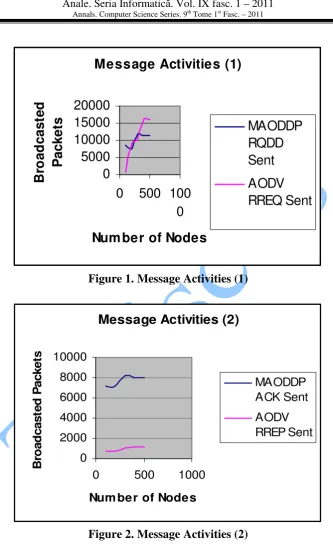
Figure 1. Message Activities (1)
Message Activities (2)
0 2000 4000 6000 8000 10000
0 500 1000
Num ber of Nodes
B ro a d c a s te d P a c k e ts MAODDP ACK Sent AODV RREP Sent
Anale. Seria Informatică. Vol. IX fasc. 1 – 2011 Annals. Computer Science Series. 9th Tome 1st Fasc. – 2011
Route Added
0 500 1000 1500
0 500 1000
Num ber of Nodes
R
o
u
te
A
d
d
e
d
MAODDP Routes Added
AODV Route Added
Figure 3. Routes Added
Mem ory Saved
0 2E+09 4E+09 6E+09 8E+09 1E+10
0 500 1000
Num ber of Nodes
M
e
m
o
ry
S
a
v
e
d
MAODDP Saved Memory
AODV Saved Memory
Figure 4. Memory Saved
Anale. Seria Informatică. Vol. IX fasc. 1 – 2011 Annals. Computer Science Series. 9th Tome 1st Fasc. – 2011
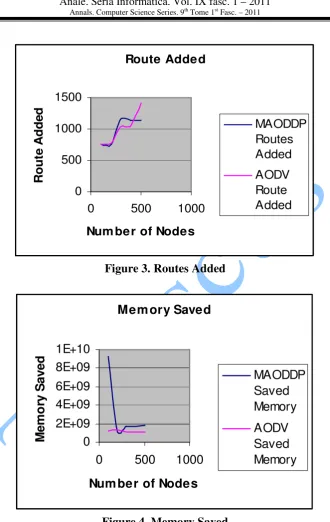
RREQ. However, it showed weak performance in terms of generating route replies. MAODDP broadcast almost 9 times more ACK’s to the source than RREP of AODV. No changes were observed in route formation capability of AODV and MAODDP. AODV showed a significant improvement in conserving memory. Results showed that AODV saved 1.26 times more memory than MAODDP.
Each of these protocols was monitored using three mobility models. In the third set of experiments the random walk mobility model was used to generate movements for mobile hosts. MAODDP produced better results than AODV in all of the output parameters. MAODDP broadcast 1.16 more RQDD with 7.61 times more ACK’s in comparison with RREQ and RREP of AODV respectively. Likewise 1.18 times more routes were added by MAODDP and 1.53 times more memory were conserved in comparison with AODV.
The random way point is an extension of the random walk model and was used in the forth set of experiments. AODV performed better with 1.40 more RREQ’s broadcasted than MAODDP. However, MAODDP outclassed AODV with 7 times more ACK’s issued than RREP’s of AODV. MAODDP also added 1.07 more routes than AODV and saved 1.54 more available memory than AODV. Under the teleport model, AODV produced better results both for broadcasting RREQ and the number of routes that were added. AODV broadcast 1.40 times more RREQ’s than RQDD of MAODDP and added 1.24 times more routes than MAODDP. MAODDP outclassed AODV in terms of generating ACK messages and in conserving available memory.
Conclusions
This paper presents a simulation based comparison of MAODDP and AODV. Both MAODDP and AODV follow a different operational pattern therefore it is interesting to monitor their performance in different simulation environment. MAODDP showed better performance in most of the observed factors then AODV. This further extends earlier comparison of these protocols as mentioned in the previously reported literature.
Anale. Seria Informatică. Vol. IX fasc. 1 – 2011 Annals. Computer Science Series. 9th Tome 1st Fasc. – 2011
References
[AG01] I. D. Aron, S. K. S. Gupta - On the Scalability of On-Demand Routing Protocols for Mobile Ad-hoc Networks: An Analytical
Study. Journal of Interconnection Networks, January, 2001.
[Bak10] H. Bakht - Mobile Ad-hoc on-Demand Data Delivery Protocol
(MAODDP), IETF draft, November 2010.
[BMA02] H. Bakht, M. Merabti, R. Askwith - Mobile Ad-hoc On
Demand Data Delivery Protocol , 3rd Annual Post-Graduate
Symposium on the Convergence of Telecommunications, Networking and Broadcasting, 2002.
[GH05] R. L. Gilaberte, L. P. Herrero - Routing Protocols in Mobile
Ad-Hoc Networks, Communication Systems and Networks,
2005.
[GH07] R. L. Gilaberte, L. P. Herrero - A Secure Routing Protocol for
Ad hoc Networks Based on Trust, International Conference on
Networking and Services (ICNS '07), June 2007.
[JMB01] David B. Johnson, David A. Maltz, Josh Broch - DSR: The Dynamic Source Routing Protocol for Multi-Hop Wireless Ad
Hoc Networks, Ad Hoc Networking, 2001.
[KMK03] S. Kannan, John E. Mellor, D. D. Kouvatsos - Investigation of
routing in DSDV, 4th Annual Post-Graduate Symposium on the
Convergence of Telecommunications, Networking and Broadcasting, Liverpool UK, 2003.
[PR**] C. E. Perkins, E. M. Royer - Ad-hoc On- Demand Distance
Vector Routing, 2nd IEEE Workshop on Mobile Computing
Systems and Applications.
[RT99] E. Royer, C. Toh - A Review of Current Routing Protocols for
Ad-Hoc Mobile Wireless Networks, IEEE Personal
Anale. Seria Informatică. Vol. IX fasc. 1 – 2011 Annals. Computer Science Series. 9th Tome 1st Fasc. – 2011
[SS07] M. Saleemand, M.A. Sheikh - An Empirical Analysis of Ad hoc Routing Protocols for Hybrid Wireless Sensor Networks,
International Conference on Electrical Engineering, ICEE '07, 2007.
[SWA**] SWANS - Java in Simulation Time / Scalable Wireless Ad hoc