Http://www.ijetmr.com©International Journal of Engineering Technologies and Management Research [101]
THE EFFECT OF MANAGING RISK PROCESS IN CONSTRUCTION
PROJECTS
Khanm Noori Kaka HamaAttar *1
*1 Business Management, College of Administration and Economics, University of Sulaimani,
Kurdistan, Iraq
Abstract:
The aim of this study is to get a better understanding for the effect of the set of the risks in the construction projects, in addition to how mitigating these risks in those projects. Indeed risks are frequently playing the same rules, but the nature of project defines the specific risks of the project. The first step in process of risks assessment is identification them. Once risk identification is complete, risk analysis is used to identify the likelihood the risks that have been identified will happen. Thus by using evidence from other research in the area, this study showed the impact of the set of the stages in the risk management process in the construction projects, which were discussed in greater detail in the theoretical aspect of the current study. The findings of the study were revealed the fact that the comprehension of risk and its management has the direct effect of understanding specific issues that involve to the project. In addition to that, the integration of a risk management process at each stage of its stages in construction projects must be oriented to the progress of the project and permeate all areas, functions and processes of the project. In this regard, the most successful project managers maintain open lines of communication throughout their organizations to stay in touch with constituent’s needs.
Keywords: Maturity Stage; Deformation; Young Coconut; Creep-Recovery.
Cite This Article: Khanm Noori Kaka HamaAttar. (2018). “THE EFFECT OF MANAGING
RISK PROCESS IN CONSTRUCTION PROJECTS.” International Journal of Engineering
Technologies and Management Research, 5(4), 101-114. DOI: 10.29121/ijetmr.v5.i4.2018.214.
1. Introduction
Managing Risk is something that is more frequently associated with bridge building, mechanical engineering, or actuarial science in projects. However, one of the critical aspects of good construction projects planning and management is risk management process in those projects systematically (Raftery, 2003; Loose more & Raftery, 2006). One way of defining risk is that risk is a problem that has not happened yet. Nevertheless, this may be a bit simplistic, it does get to the core of the issue a project manager faces: What are the problems I might encounter while performing this project and how do I avoid them? (Cervone, 2006).
Http://www.ijetmr.com©International Journal of Engineering Technologies and Management Research [102] attention it warrants (Kerzner, 2013). This does not necessarily mean that the project manager does not consider the issues related to risk, but rather that often project managers only perform a superficial examination of the issues related to risk and then add a margin for risk. This technique, known as using a WAG does not work (Nelson, 2013). The reason is simple: the likelihood a WAG will be significantly underestimated is as equal as the likelihood it will be a valid overestimation (Cervone, 2006).
However, construction project managers often resort to these techniques because the risks in projects are outside of their immediate control (Harris &McCaffer, 2013; Nicholas &Steyn, 2017). Therefore, because a project manager may feel somewhat helpless in dealing with the risk, they approach the issue with a guess figuring it is better than doing nothing at all (Newbold, 1998). This is misguided because all risks can be effectively addressed in one of the several ways. Risk can be (Cervone, 2006): (1) reduced or eliminated by including problem remediation activities into the project plan; (2) transferred to other activities or other responsible parties; (3) absorbed or pooled by simply planning for them; (4) avoided by putting quality control practices and procedures into place.
Among these techniques, some are implemented more easily and less costly than others. For instance, it is easier and less costly to avoid risks in the first place, rather than trying to repair or address problems once they occur. Not surprisingly, when good project managers think about risk management process, they focus on mitigating risk within the project as a whole (Bannerman, 2008; Smith et al., 2009; Thamhain, 2013).
2. Literature Review
Uncertainty is both a reality and great challenge for most projects (Schwalbe, 2015). The presence of risk creates surprises throughout the project life cycle, affecting everything from technical feasibility to cost, market timing, financial performance, and strategic objectives (Loch et al., 2008). Yet, to succeed in today's ultra-competitive environment, management must deal with these risks effectively despite these difficulties (Rose, 2007; Patilet al., 2012). This concerns executives, and it is not surprising that leaders in virtually all organizations, from commerce to government, spend much of their time and effort dealing with risk-related issues. Examples trace back to ancient times that include huge infrastructure projects (Chan, 2012; Thamhain, 2013). Thus, in the light of the preceding overview, the current study tackled the main stages of the managing risk process that can have a clear effect on managing for construction projects.
2.1.The Managing Risk Process
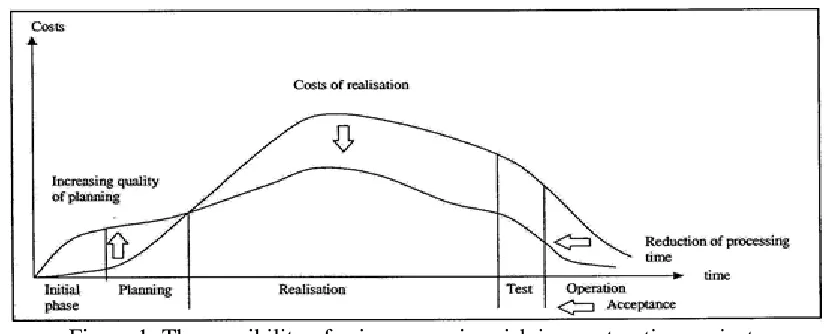
Http://www.ijetmr.com©International Journal of Engineering Technologies and Management Research [103] Figure 1:The possibility of using managing risk in construction projects
Source: Schieg (2006)
The risk potential analysis of a project states to what extent project risks influence the risk situation of the enterprise. Risk potential should be estimated without a detailed consideration of the individual risks at as little expense as possible (Vyas&Raol, 2017). Depending on the assessment of the risk potential, the risk management process is set in motion (Nocco&Stulz 2006; De Bakker et al., 2010). Managing risk process comprises the integration of basic principles of risk policy, the establishment of a risk-consciousness as well as the organizational integration. It is an impetus for the risk management and is responsible for the control of risks in full knowledge of the current risk situation (Schieg, 2006; McManus, 2012). Through the managing risk process, transparency increases, many problems can be avoided from the outset through proactive action, the project can be prepared for unavoidable problems. Through this, the consequences can be mitigated, and the project manager retains the control over the project (Richardson et al., 2009; Sparrow, 2011; Vyas&Raol, 2017). Thus, the risk management process consists of stages represented in Figure 2 that have a direct impact on successful construction project management, which will be discussed in the following paragraphs.
Figure 2: Stages of the managing risk process
Http://www.ijetmr.com©International Journal of Engineering Technologies and Management Research [104] Risks that are not recognized also cannot be assessed and dealt with. Nevertheless, a complete coverage of the risks is impossible. Therefore, the task of the managing risk process is to cover the essential risks as completely as possible. Risk identification must, therefore, be carried in a way that is both forward-looking and in line with the progress of the project, since before the start of the project, not all risks are completely recognizable and during the project implementation further risks may emerge (Reason, 2016). In principle, creative and guided methods are distinguished. The first type offers the possibility also to discover new kinds of risk. Guided methods use such as checklists for identifying risks, with the aid of which the conceivable types of risk are checked (Schieg, 2006). In projects, in especially the following risks occur, which are broken down according to risk types (Merna& Al-Thani, 2011; Pritchard & PMP 2014):
2.1.1.1.Quality Risks
1) Defect in interim results
2) Lacking application of project methods 3) Too few controls / tests
2.1.1.2.Personnel Risks
1) Lack of skills
2) Disagreements in the team
2.1.1.3.Cost Risks
1) Planning changes
2) Complicated project conditions 3) Customer fails to pay
2.1.1.4.Set Date / Deadline Risks
1) No handover in good time
2) The project end is delayed
2.1.1.5.Risks of Strategic Decisions
1) Failure to recognize chances
2) Lack of ability to consistently use chances
2.1.1.6.External Risks
1) Natural occurrences 2) Political changes 3) Changes in society
4) A shift in the market / new markets
5) Legal developments
Http://www.ijetmr.com©International Journal of Engineering Technologies and Management Research [105] 7) Technological changes
2.1.2.Stage 2 Analyzing Risks
The objective of this stage is to describe the risk situation as completely and precisely as possible and to prioritize the risks. For this, the identified risks are investigated with regard to the probability of their occurrence and the effect on the project. In the first place, a portfolio and a risk costs assessment respectively serves for classification purposes. Criteria must be found, on the basis of which individual risks can be assessed and compared with one another (Smith et al., 2009). A risk must always be described as a damage or loss-entailing event to which a particular value can be allocated. From this, damage or loss assessed in terms of costs and the probability of occurrence, a value for the risk can be calculated (Schieg, 2010; Wackermann, 2010). According to Schieg (2006), the methods of risk assessment are for example:
I. Error, Possibility and Influence Analysis
This is a largely formalized analytical method for the systematic coverage of all possible errors and for the estimation of the risks associated with these. In this, within a team, possible potential errors are determined with the aid of a standard error, possibility and influence analysis form, the consequences are investigated and the causes are established and assessed. Next, the causes of errors are systematically assessed in terms of the probability of their occurrence, the significance for the customer and the probability of their being discovered. Finally, suitable measures are commenced.
II. Risk Portfolio
In the risk portfolio risks are ordered according to the amount of damage or loss and the probability of their occurrence. Accordingly, the effects of the project and the need to take action are evaluated.
III. Risk Team Analysis
The risk evaluation is carried out by the project manager in the context of project control. For the risk team analysis, risks are determined and analyzed according to types and indicators for the occurrence of risk are worked out. From this, possible measures are elaborated and represented and persons responsible for the risk monitoring and notification are determined.
2.1.3.Stage 3 Assessing Risks
Http://www.ijetmr.com©International Journal of Engineering Technologies and Management Research [106]
I. Key Performance Indicators
Key performance indicators cover quantitatively measurable circumstances and thus create a basis for comparison. They are preferably consulted for risk assessment if a large number of data and figures must be compared. For the key performance indicators, threshold values from which a risk warning exists are determined. Typical key performance indicators in the real estate sector are average operating costs, average rent, and vacancy rate or average interest on outside capital (Schieg, 2006).
II. Qualitative Assessment
If no objective data is available, risks must still be quantifiable and made estimable. One method is qualitative estimation and weighting. In this, risks are assessed subjectively according to the probability of their occurrence and the amount of damage or loss.
III. Probable Maximum Loss
The procedure of quantitative risk determination primarily aims at estimating the probabilities of dangerous occurrences within a risk scenario. In the evaluation of the risk of major damage or loss, for instance, the maximum damage or loss possible or probable is determined (Chang, 2000).
IV. ABC Analysis
The ABC analysis is based on the recognition that frequently a relatively small number of factors make up the largest share of a whole. The goal of the analysis is, therefore, to find out what factors make up the largest part of the project value and in which therefore a greater planning and control expenditure is justified.
V. Risk Map
The risk map illustrates the risk profile of an enterprise. It is referred to as risk landscape, risk map or risk matrix (McNeil et al., 2015). In a risk map, it can be read with what priority the risks should be approached. In this, the risks that cannot be borne, which could endanger the continued existence of the enterprise, are prioritized. The risk classification in a risk matrix thus enables a differentiated consideration of two classification criteria: (1) the probability of occurrence (2) expected value (Schieg, 2006).
2.1.4.Stage 4 Controlling Risks
Http://www.ijetmr.com©International Journal of Engineering Technologies and Management Research [107] according to Schieg (2006) who pointed out that the strategies of controlling risk are as the following:
• Avoidance
• Reduction
• Passing on the risk
• Bearing the risk by oneself
2.1.5.Stage 5 Monitoring Risks
The monitoring of risks is the continuous operative control of the effectiveness of the risk control measures. The goal of risk management process is not to eliminate risks completely from the project. The monitoring of the risk helps guarantee that the risk position of the project corresponds to the risk situation strived for (Loosemore&Raftery, 2006; Schieg, 2006; Sadgrove, 2016).
This task is supported instrumentally through analyses of variances. The internal control process is part of the monitoring of the risk. The continuous monitoring of the early indicators and the repeated risk verification are carried out by the persons responsible in each case, no later than the respective milestone deadlines (Adams & Sheridan, 2008). A precondition for this is that a reporting and meeting structure in the organisation and for the project is stipulated. Besides the pursuit of the risk status and the progress of the measures, new additional risks must be included. Risks that have occurred must be documented with the relevant amount of damage or loss; critical situations of the managerial staff must be reported (Kenett&Raanan, 2011; Meeset al., 2016).
2.1.6.Stage 6 Controlling Goals
In this stage, after the recognition, analysis and assessment of risks, measures for controlling goals must be taken. The control process may be broken down into following sub-processes: (1) determination of the target value (2) determination of the actual value (3) target/actual comparison (4) an analysis of variances (Schieg, 2006). As a permanent process, in the context of the monitoring, the risk identification, analysis, and controlling are checked to find out whether the risk control is implemented in due form. In the event of variances between the actual risk situation and the risk situation strived for, steps must be commenced to specify the causes. Based on these recognitions, the risk strategy must then be adapted or revised. Consequently, by monitoring the risk it is guaranteed that standards set of risk management process are taken into account (Moraru, 2012; Rausand, 2013).
3. Managing Risk in Progress of Project
Responsibility for carrying out the chance and managing risk is borne by the project manager. The duty of the project management in the event of risk identification is to discover any emerging risks of a construction project and include these in a risk catalogue (Smith et al., 2009). For this, in practice, risk checklists that have been drawn up based on empirical values from comparable construction projects serve as ordinary auxiliary means. In the project control area, in particular, the following should be mentioned (Schiegh, 2006):
1) Plan of services
Http://www.ijetmr.com©International Journal of Engineering Technologies and Management Research [108] 3) Pursuance of costs
4) Quality assurance 5) Analysis of contracts
In order to encourage the willingness to adopt risk management process in the construction industry, standard risk checklists should be drawn up, with the help of which the project manager is only required to “tick off” the standard risks occurring. A quick instruction for project managers and teams that is easy to implement should result, which makes it possible to deal more easily with project risks (Schiegh, 2006; Cleden, 2011). The necessity to install a risk management process as early as possible results from the fact that risk potentials exist, at least in a rudimentary form, already before or at the start of the project and are recognizable; however, their effects and damage only come to light in the subsequent progress of the project (Raftery, 2003). For this reason, the risk management process should be established and integrated into the entire project system as a permanent (sub-) task of the project management. In this, the identification, analysis and assessment of risks must in each case be geared to the entire project and to special aspects of the individual project phases (Meredith & Mantel Jr, 2011). Generally, the progress of a project can be divided up into three phases (Schiegh, 2006): (1) Start-up phase (2) Manage phase (3) Close phase.
In this, typical risks occur in the corresponding phases. They must be integrated into the risk management process in order to prevent the progress of the project from being disturbed (Reason, 2016). For dealing with chances and risks in projects, the following principles apply (Wieczorek, 2012; Lundgren &McMakin, 2013): (1) Responsibility for carrying out the chance and risk management is borne by the project manager. (2) Only taking risks that one can influence oneself. (3) Avoiding or safeguarding against risks that are influenced by others (customers, subcontractors). (4) As far as possible, passing on risks taken. (5) The consideration of chances and risks is a part of the project reporting.
In the following, with the aid of specific questions characteristic of the individual phases, it is shown where the tasks of risk management process integrated into the progress of the project lie. Some questions are stated as examples, in which the type and scope of the questions can be expanded and supplemented at will. In this, the project breakdown carried out summarizes the project phases of the scope of services of project management (Del Cano & de la Cruz, 2002), which was developed for project management by the AHO commission of experts in three phases (Schiegh, 2006).
3.1.Tasks of the Managing Risk Process
Start-Up Phase (Project Preparation; Planning)
The start-up phase corresponds to project steps 1 and 2 from the scope of services of the project control (section 204 AHO2) (Schiegh, 2006). In the start-up phase, the focus of managing risk above all is on the check of the contractual and general circumstances of the project environment. The task of risk management process is to recognize possible risks that can disturb the actual progress of the project (Makombo, 2012). In this site, risk management process should investigate the following typical questions for identifying potential risks (Stoneburneret al, 2002):
Http://www.ijetmr.com©International Journal of Engineering Technologies and Management Research [109] 2) Are the project goals clearly defined?
3) Are there specific contractual features? 4) Is a concept of use available?
5) Do gaps in services exist in the contracts?
6) Have the set dates/deadlines for the application for subsidies been complied with? 7) Have the future planners, advisers and consultants been selected and commissioned?
The scope of services of the project control comprises for certain partial services, such as e.g. the creation of a user needs the programme, already comprises an analysis and assessment of the risks associated with this (Schiegh, 2006).
Manage phase (preparation of the implementation and implementation)
The task of the managing risk process in the individual implementation phases of the project are characterized by the objective content of the project progress. In principle, during the project implementation, it is essentially a question of observing known risks from the start-up phase and their changes (Yeo &Ren, 2009). The effect of the measures taken to deal with risk must be assessed and additional risks must be analyzed regularly and in a results-oriented way. For the manage phase, the following risk questions are characteristic (Schiegh, 2006):
1) Does the principal comply with its duties to collaborate?
2) Will the principal accept the entire project without serious defects? 3) Are all resources available as planned?
Close phase (project completion)
The project end is reached upon the performance of the service and the handover (acceptance) of the structure to the principal (like real estate developer). It becomes particularly critical if the principal refuses to accept the completed solution because the project result is not in accordance with its objectives (Schiegh, 2006). The managing risk process can help avoid such “failures” by pursuing the questions in the close phase (Mosey, 2009; PMP, 2011): (1) Is the contractually owed service “capable of being accepted”? (2) Were the contractual contents and undertakings fulfilled? (3) Is a complete project documentation (records of meetings, correspondence, released project documentation etc.)?. For the further development of the managing risk process, it is important that stock is taken of the reflection on the progress of the project. In this, relevant questions are: (1) What identified risks have occurred? (2) What problems that have actually occurred in the progress of the project were not identified as risks and why not? (Loch et al., 2011; McNeil et al., 2015).
3.2.Risks in Personnel Sector
Http://www.ijetmr.com©International Journal of Engineering Technologies and Management Research [110] four areas: (1) Bottleneck risk field (2) Departure risk field (3) Adaptation risk field (4) Motivation risk field (Schiegh, 2006). They will be discussed briefly in the next section.
3.2.1.Bottleneck Risk Field
This is a matter of identifying in good time in what areas future top performers will be absent in the future. In this, the following questions stand in the foreground: (1) What are the key qualifications for the future? (2) How will the quantitative need for employees change in the future? (3) How do the qualitative requirements made of the employees change due to new scopes of service or technologies? (4) Are strategically important staff positions safeguarded?
3.2.2.Departure Risk Field
Departures of top performers generally constitute a high-risk potential, in particular in long-term projects in which the project manager is the confidante of the real estate developer (Allen, 2014). The main reasons why employees leave an enterprise are (1) new challenges (2) more responsibility for decisions (3) better professional prospects with regard to career development (4) good future perspectives of the new enterprise (Sveiby, 1997; Ward, 2016). The following factors reduce the risk of departure and should therefore be taken into account by the business management (Schiegh, 2006): (1) good business climate (2) favourable outline conditions for employee development (3) extensive non-material incentives on the part of the enterprise (4) remuneration structures adequate for the performance (50 suitable organizational structures (6) marked allocation of power potentials.
3.2.3.Adaptation Risk Field
Falsely qualified employees constitute adaptation risks. Should leaves of absence be avoided, as a precaution requalification or new qualifications are necessary (Schiegh, 2006). In construction projects here ongoing further training courses of the employees are necessary with regard to technological and legal changes. In construction project management changed scopes of service must be taken into account through a greater consolidation of services in the implementation of construction work (Chapman & Ward, 2003).
3.2.4.Motivation Risk Field
Http://www.ijetmr.com©International Journal of Engineering Technologies and Management Research [111]
4. Conclusions
Considering the facts that risk management process has an impact on project‟s goals in the form of quality, time and cost, it should be an open and conscious process through all phases of the project. Thus, the aim of the current paper came to examine the effect of the set of the stages related to risk management process at projects performance within the construction sector. This is to gain an understanding and a clear knowledge about the extent of the effect of these stages if managed properly in the success of construction projects management with minimal risk.
For this purpose and by using evidence from other research in the area; the overall conclusion was that, according to project actors, risk management process is strongly linked to the performance of the project in terms of quality, time and budget or cost. Thus, the effective managing risk process must permeate all areas, functions and processes of the project. Therefore, the aim must be to negotiate risks, assess these or even make these marketable and reduce them emphatically. In this, a decisive factor in its success is, in the end, the interaction of all elements represented. A risk and control culture borne and experienced by all parties involved in the project has the effect of a connecting bracket that can safeguard the effectiveness of the structural and organizational measures of managing risk; the main key to this is the parties involved in risk management process. Effective managing risk process requires commitment and also the risk-conscious behaviour of each individual. The motivation as well as the interplay of the parties involved in the project in the end determines the quality of the work and thereby the project success. However, in each project, residual risks remain. This means that it remains a strategic decision on whether these risks have been taken and can be borne if they occur.
References
[1] Adams, D. B., & Sheridan, A. D. (2008). Specifying the risks to animal welfare associated with livestock slaughter without induced insensibility. Animal Welfare Branch, Australian Government Department of Agriculture, Fisheries and Forestry, 1-55.
[2] Allen, G. (2014). Leadership practices for innovation in high-technology organisations (Doctoral dissertation).
[3] Bannerman, P. L. (2008). Risk and risk management in software projects: A reassessment. Journal of Systems and Software, 81(12), 2118-2133.
[4] Britzelmaier, B., Häberle, M., &Landwehr, M. (2015). Risk management in German small and medium–sized enterprises. International Journal of Entrepreneurship and Small Business, 24(4), 548-571.
[5] Buertey, J. I. T., Abeere-Inga, F., &Kumi, T. A. (2012). Practical application of risk management techniques in infrastructural delivery: a case study of Ghanaian construction industry. Journal of Construction Project Management and Innovation, 2(1), 225-244.
[6] Cervone, H. F. (2006). Project risk management. OCLC Systems & Services: International digital library perspectives, 22(4), 256-262.
[7] Chan, T. C. (2012). Implementation of risk management in medical device companies: A survey analysis of current practices. University of Southern California.
[8] Chang, S. E., Shinozuka, M., & Moore, J. E. (2000). Probabilistic earthquake scenarios: extending risk analysis methodologies to spatially distributed systems. Earthquake Spectra, 16(3), 557-572. [9] Chapman, C., & Ward, S. (2003). Project risk management: processes, techniques, and insights.
Wiley.
Http://www.ijetmr.com©International Journal of Engineering Technologies and Management Research [112]
[11] De Bakker, K., Boonstra, A., &Wortmann, H. (2010). Does risk management contribute to IT project success? A meta-analysis of empirical evidence. International Journal of Project Management, 28(5), 493-503.
[12] Del Cano, A., & de la Cruz, M. P. (2002).Integrated methodology for project risk management. Journal of Construction Engineering and Management, 128(6), 473-485.
[13] Harris, F., &McCaffer, R. (2013). Modern construction management.John Wiley & Sons.
[14] Helmus, F. P. (2008). Process plant design: project management from inquiry to acceptance. John Wiley & Sons.
[15] Holmqvist, M., &Maravelias, C. (2010). Managing healthy organizations: Worksite health promotion and the new self-management paradigm. Routledge.
[16] Kenett, R. S., &Raanan, Y. (Eds.). (2011). Operational Risk Management: a practical approach to intelligent data analysis(Vol. 106). John Wiley & Sons.
[17] Kerzner, H. (2013). Project management: a systems approach to planning, scheduling, and controlling. John Wiley & Sons.
[18] Loch, C. H., DeMeyer, A., &Pich, M. (2011). Managing the unknown: A new approach to managing high uncertainty and risk in projects.John Wiley & Sons.
[19] Loch, C. H., Solt, M. E., & Bailey, E. M. (2008).Diagnosing unforeseeable uncertainty in a new venture. Journal of product innovation management, 25(1), 28-46.
[20] Loosemore, M., &Raftery, J. (2006). Risk management in projects.Taylor & Francis.
[21] Lundgren, R. E., &McMakin, A. H. (2013). Risk communication: A handbook for communicating environmental, safety, and health risks. John Wiley & Sons.
[22] Makombo, H. M. (2012). The risk management framework for organisations dealing with construction project management in South Africa.
[23] McManus, J. (2012). Risk management in software development projects.Routledge.
[24] McMichael, P. (2011). Development and Social Change: A Global Perspective: A Global Perspective. Sage Publications.
[25] McNeil, A. J., Frey, R., &Embrechts, P. (2015). Quantitative risk management: Concepts, techniques and tools. Princeton university press.
[26] Mees, H., Suykens, C. B. R., Beyers, J. C., Crabbé, A., Delvaux, B., &Deketelaere, K. (2016). Analysing and evaluating flood risk governance in Belgium: dealing with flood risks in an urbanised and institutionally complex country. STAR-FLOOD Consortium.
[27] Meredith, J. R., & Mantel Jr, S. J. (2011). Project management: a managerial approach. John Wiley & Sons.
[28] Merna, T., & Al-Thani, F. F. (2011). Corporate risk management.John Wiley & Sons. [29] Millot, P. (Ed.). (2014). Risk Management in Life Critical Systems.John Wiley & Sons.
[30] Moraru, R. I. (2012). Current trends and future developments in occupational health and safety risk management. In Risk Management for the Future-Theory and Cases.InTech.
[31] Mosey, D. (2009). Early contractor involvement in building procurement: contracts, partnering and project management. John Wiley & Sons.
[32] Nelson, M. (2013). The development of tropical lands: Policy issues in Latin America. Routledge. [33] Newbold, R. C. (1998). Project management in the fast lane: applying the theory of constraints.
CRC Press.
[34] Nicholas, J. M., &Steyn, H. (2017). Project management for engineering, business and technology. Taylor & Francis.
[35] Nocco, B. W., &Stulz, R. M. (2006). Enterprise risk management: Theory and practice. Journal of Applied Corporate Finance, 18(4), 8-20.
[36] Patil, R., Grantham, K., & Steele, D. (2012). Business risk in early design: A business risk assessment approach. Engineering Management Journal, 24(1), 35-46.
Http://www.ijetmr.com©International Journal of Engineering Technologies and Management Research [113]
[38] PMP, L. R. (2011). Improving your project management skills.AMACOM Div American Mgmt Assn.
[39] Pritchard, C. L., & PMP, P. R. (2014). Risk management: concepts and guidance. CRC Press. [40] Raftery, J. (2003). Risk analysis in project management.Routledge.
[41] Rausand, M. (2013). Risk assessment: theory, methods, and applications (Vol. 115). John Wiley & Sons.
[42] Reason, J. (2016). Managing the risks of organizational accidents.Routledge.
[43] Richardson, K., Steffen, W., Schellnhuber, H. J., Alcamo, J., Barker, T., Kammen, D. M., ...& Stern, N. (2009). Climate change-global risks, challenges & decisions: synthesis report. Museum Tusculanum.
[44] Rose, K. H. (2007). Linking project management to business strategy.
[45] Sadgrove, K. (2016). The complete guide to business risk management.Routledge.
[46] Schieg, M. (2006).Risk management in construction project management. Journal of Business Economics and Management, 7(2), 77-83.
[47] Schieg, M. W. (2010). Multiple Criteria Analysis Of Construction Project Management (Doctoral dissertation, Vilnius Gediminas Technical University).
[48] Schwalbe, K. (2015). Information technology project management.Cengage Learning.
[49] Smith, N. J., Merna, T., &Jobling, P. (2009). Managing risk: in construction projects. John Wiley & Sons.
[50] Sparrow, M. K. (2011). The regulatory craft: controlling risks, solving problems, and managing compliance. Brookings Institution Press.
[51] Stoneburner, G., Goguen, A. Y., &Feringa, A. (2002).Sp 800-30.risk management guide for information technology systems.
[52] Sveiby, K. E. (1997). The new organizational wealth: Managing & measuring knowledge-based assets. Berrett-Koehler Publishers.
[53] Thamhain, H. (2013). Managing risks in complex projects. Project Management Journal, 44(2), 20-35.
[54] Vyas, N. D., &Raol, J. D. (2017). Risk Management of Housing Projects. Imperial Journal of Interdisciplinary Research (IJIR), 3(2), 1788- 1793.
[55] Wackermann, F. (2010). Individual Risk and Innovative Behavior: A Neo-Schumpeterian Agent-Based Analysis.
[56] Ward, J. (2016). Keeping the family business healthy: How to plan for continuing growth, profitability, and family leadership.Springer.
[57] Wargborn, C. (2008). Managing motivation in organizations. Why employee relationship management matters (Doctoral dissertation).
[58] Wieczorek, M., Naujoks, U., & Bartlett, B. (Eds.). (2012). Business continuity: it risk management for international corporations. Springer Science & Business Media.
[59] Winch, G. M. (2010). Managing construction projects.John Wiley & Sons.
[60] Yeo, K. T., &Ren, Y. (2009).Risk management capability maturity model for complex product systems (CoPS) projects. Systems Engineering, 12(4), 275-294.
[61] Zeng, J., An, M., & Smith, N. J. (2007). Application of a fuzzy based decision making methodology to construction project risk assessment. International journal of project management, 25(6), 589-600.
[62] Zou, P. X., Zhang, G., & Wang, J. (2007). Understanding the key risks in construction projects in China. International Journal of Project Management, 25(6), 601-614.
*Corresponding author.