COPD stands for complex obstructive
pulmonary disease
Sarah Houben-Wilke
1,8, Ingrid M. Augustin
2,8, Jan H. Vercoulen
3,
Dirk van Ranst
4, Eline bij de Vaate
5, Johan B. Wempe
6, Martijn A. Spruit
2,7,
Emiel F.M. Wouters
2,7and Frits M.E. Franssen
2,7Affiliations:1Dutch Lung Centers, Horn, The Netherlands.2CIRO+, Horn, The Netherlands.3Radboud University Medical Center, Nijmegen, The Netherlands. 4Revant, Breda, The Netherlands. 5Merem, Hilversum, The Netherlands. 6University Medical Center Groningen, Groningen, The Netherlands. 7Dept of Respiratory Medicine, Maastricht University Medical Center, Maastricht, The Netherlands. 8Both authors contributed equally.
Correspondence: Sarah Houben-Wilke, CIRO+, Hornerheide 1, 6085 NM, Horn, The Netherlands. E-mail: [email protected]
@ERSpublications
Dynamic and holistic approaches are needed to ensure personalised medicine and value-based healthcarehttp://ow.ly/iawH30jGFSU
Cite this article as:Houben-Wilke S, Augustin IM, Vercoulen JH,et al. COPD stands for complex obstructive pulmonary disease.Eur Respir Rev2018; 27: 180027 [https://doi.org/10.1183/16000617.0027-2018].
ABSTRACT Chronic obstructive pulmonary disease (COPD) has extensively been reported as a complex disease affecting patients’health beyond the lungs with a variety of intra- and extrapulmonary components and considerable variability between individuals. This review discusses the assessment of this complexity and underlines the importance of transdisciplinary management programmes addressing the physical, emotional and social health of the individual patient.
COPD management is challenging and requires advanced, sophisticated strategies meeting the patient’s individual needs. Due to the heterogeneity and complexity of the disease leading to non-linear and consequently poorly predictable treatment responses, multidimensional patient profiling is crucial to identify the right COPD patient for the right treatment. Current methods are often restricted to general, well-known and commonly used assessments neglecting potentially relevant (interactions between) individual, unique “traits” to finally ensure personalised treatment. Dynamic, personalised and holistic approaches are needed to tackle this multifaceted disease and to ensure personalised medicine and value-based healthcare.
Introduction
Chronic obstructive pulmonary disease (COPD) has extensively been reported as a complex disease affecting patients’ health beyond the lungs with a variety of intra- and extrapulmonary components and considerable variability between individuals [1–6]. Unfortunately, current reductionist approaches of COPD often ignore this complexity and heterogeneity [7, 8].
The complexity of COPD has already been highlighted, for instance by FREYand SUKI [8] who critically
reviewed reductionist approaches “whereby researchers isolated and identified specific mechanisms from the complex web of interacting subsystems”and suggested a multidimensional, complex systems approach also considering the unpredictable nature of COPD. During recent years, multidimensional assessment of COPD has been increasingly studied as well as (trying to be) incorporated in clinical practice [9–11]. Unfortunately, methods are often restricted to general, well-known and commonly used assessments, which
Copyright ©ERS 2018. ERR articles are open access and distributed under the terms of the Creative Commons Attribution Non-Commercial Licence 4.0.
Provenance: Submitted article, peer reviewed.
Received: March 16 2018 | Accepted: April 16 2018
https://doi.org/10.1183/16000617.0027-2018 Eur Respir Rev 2018; 27: 180027
are easily performed, interpretable and comparable between individuals or groups (e.g.questionnaires) but which neglect potentially relevant (interactions between) individual, unique “traits” (i.e. underlying explanatory mechanisms) to finally ensure personalised treatment.
Looking back
Given our increasing understanding of COPD as a heterogeneous and complex disease, it is important to accentuate that, in this context “complex” means that COPD has a number of intrapulmonary and extrapulmonary components whose dynamic interactions over time are not linear, whereas
“heterogeneous” indicates that not all of these components are present in all individuals at any given time-point [12]. An overview of methods assessing and involving this heterogeneity and complexity will be discussed below and are illustrated in table 1.
Global Initiative for Chronic Obstructive Lung Disease
To honour the 20th anniversary of the Global Initiative for Chronic Obstructive Lung Disease (GOLD), RODRIGUEZ-ROISONet al.[13] recently summarised the key differences of the major revisions of the GOLD
documents (2001–2017) clearly demonstrating a shift from a solely spirometric staging system to a more extensive classification.
The 2006 GOLD statement classified COPD patients into four groups (GOLD stages I to IV), exclusively based on the degree of airflow limitation [22]. Since this parameter is only poorly to moderately associated with disease activity, progression and prognosis, the 2011 GOLD strategy started classifying patients into four new groups (GOLD groups A to D) based on the combination of the degree of airflow limitation and the number of exacerbations and the severity of symptoms [23]. The latest 2017 GOLD strategy separated spirometric assessment from symptoms and risk evaluation aiming to facilitate tailored treatment to the needs of the individual patient and proposed patients’symptoms and exacerbation history alone to assign patients to ABCD categories [9]. However, exacerbation history as a decisive parameter has not been validated; a recent study showed that exacerbation frequency is highly variable over time, while the frequent exacerbator phenotype (two or more exacerbations every year) was the most uncommon one [24]. Extrinsic factors might further impact exacerbation occurrence making these events difficult to predict [24]. Furthermore, variations may occur in the pathophysiology of exacerbations over time in an individual patient, which is a currently unexplored topic and adds to the complexity of COPD. Finally, the choice of symptom measure and/or cut-off point used impacts the classification of patients with COPD into GOLD A/C or B/D groups which can result in misclassification and, consequently, different treatment recommendations [25].
Multidimensional indices
During the past decade, multidimensional indices including medical, pathophysiological, symptomatic and/or psychological parameters have been developed as screening instruments [11, 15] or prognostic markers for COPD [10]. Prognostic performance of multidimensional indices providing composite scores (e.g.the BODE (body mass index, airflow obstruction, dyspnoea and exercise) index [14]) is moderate to good, but it is still unknown if they improve COPD disease management or patients’health [10]. Another example of providing a more detailed patient profile is the Nijmegen Clinical Screening Instrument which is an empirically composed battery of existing instruments providing a detailed picture of 21 dimensions of an individual patient’s integrated health status and thus guides individualised treatment [15, 26]. It has been suggested that, on the one hand, multidimensional indices might be useful in grouping patients in terms of clinically relevant outcomes; and on the other hand, it is also possible that by grouping patients this way distinct features of the disease might be grouped, blurring the heterogeneity and understanding of the disease [27]. Indeed, it has been suggested that prognostic indices cannot identify or substitute groups or phenotypes since patients sharing a similar prognosis based on a single score might not be considered as belonging to the same phenotype [28]. As further clarified, they are not risk factors or phenotypes but useful measures of disease severity to establish prognosis [29].
Phenotypes
A phenotype has been defined as“a single or combination of disease attributes that describe differences between individuals with COPD as they relate to clinically meaningful outcomes (symptoms, exacerbations, response to therapy, rate of disease progression, or death)”[27].
In the 1960’s, the terms “blue bloater” and “pink puffer” came up to describe patients with chronic bronchitis and emphysema, respectively [30], marking the very beginning of phenotyping COPD. Commonly used phenotypes are often based on pulmonary disease characteristics like the presence of emphysema, chronic bronchitis, overlap asthma-COPD and/or (in)frequent exacerbations [31]. MIRZAand
TABLE 1Overview of strategies to classify, assess or group patients with chronic obstructive pulmonary disease (COPD)
Goal Advantages Shortcomings Heterogeneity Complexity
GOLD Classification of COPD based on the degree of airflow obstruction (up to 2011), in combination with symptoms/ exacerbations (2011– 2017), or symptoms/ exacerbations only (2017)
From an FEV1centric view to a more extensive approach and a more prominent role of symptoms/individual measures [13]
Parameters assessing COPD severity still very limited; ignoring variability and unpredictability of symptoms/exacerbations/ hospitalisations; proposed cut-off points for symptom measures mostly expert driven
Separation of airflow limitation
from clinical parameters (GOLD 2017) [9] clarifies what is being evaluated and ranked and might facilitate more precise treatment
Not addressed
Multidimensional indices
Prognostic indices to predict survival; screening instruments
As prognostic markers: useful in grouping patients in terms of clinically relevant outcomes [14]; as a screening instrument: multidimensional assessment of COPD [11, 15]
Identification of substitute groups or phenotypes only by selected variables included in the respective index; consist of a limited number of variables; have not been developed to guide future treatment [16]
Multidimensional
assessment, including, for example, medical, pathophysiological, symptomatic [14] and/or psychological [15] parameters
Not addressed
Phenotypes Grouping patients based on certain
characteristics
From“blue bloater”and“pink puffer”to complex cluster analyses identifying existing and novel phenotypes
Cluster analyses only moderate reproducibility, clinical application disputable [17], considerable overlap between phenotypes for some specific attributes
As a screening instrument: differentiating between individuals by assessing/ clustering various characteristics
Not addressed
COPD control panel
Assessment of different elements of the disease
Assessing at least three dimensions (severity, activity and impact), can be customised to the need of the patient [18]
Unclear which characteristics should exactly be assessed, which methods, cut-off points,etc. should be used
Multidimensional
assessment; might serve as a“clinical decision support system”(by selecting/classifying patients)
Not addressed
Treatable traits Label-free, precision medicine approach
COPD management based on individual treatable characteristics (intra- and extrapulmonary treatable traits, treatable behaviour/ lifestyles (including patients’environment)) [19]
Separate assessment of treatable traits results in fragmented treatment; frequency of assessment and
inter-relationships between traits unknown
Assessing heterogeneity by individual unique traits
Not addressed
Pulmonary rehabilitation
Personalised, holistic approach of treatable traits
Comprehensive intervention based on a thorough assessment taking into account the combination and interaction between the (treatment of) individual treatable traits [20]
Applicability in routine clinical practice (dependent on
organisational structure, facilities, workforce, funding,etc.) is challenging; poor referral and compliance; not all traits are always addressed (yet); mostly non-pharmacological generic interventions
Assessing heterogeneity by individual unique traits
Assessment of complex interactions of physical, psychological, social and environmental factors by dedicated, transdisciplinary teams being able to respond flexibly as well as accept unpredictability and non-linear outcomes [21]
GOLD: Global initiative for chronic Obstructive Lung Disease; FEV1: forced expiratory volume in 1 s.
and added the upper lobe-predominant emphysema phenotype, rapid decliner phenotype, comorbid COPD phenotype, physical frailty phenotype and emotional frailty phenotype with the purpose of guiding personalised and effective care.
Using phenotypes to classify and/or screen patients might be an interesting alternative to currently used criteria for recruiting patients in clinical trials [28] and might help optimising (non)pharmacological integrated treatment [33], but the application into routine clinical practice and to facilitate personalised medicine is questionable since phenotypes still group patients and therefore potentially ignore individual characteristics. Indeed, the same clinical phenotype could result from different endotypes [34].
Clustering patients
Cluster analysis has been defined as a group of analysis techniques that aim to organise information so that heterogeneous subjects can be classified into homogeneous subgroups (i.e.clusters) which may further identify novel phenotypes [35]. To identify phenotypes, clinical features, imaging, pulmonary function, exercise tests, biomarkers and comorbidities may be used [28].
However, the current understanding of phenotypes might be biased since there is a significant heterogeneity in the selection of subjects and statistical methods used, as well as a lack of information about different COPD populations (including women, never-smokers and those with mild disease) which challenges the clinical application of the defined phenotypes [28, 36]. Indeed, a recent study assessing the reproducibility of COPD clustering subtypes concluded that identical clustering analyses across multiple COPD cohorts showed modest reproducibility [17]. Furthermore, it is known that subtypes ( phenotypes) might change over time [37], underlining the need for continuous evaluation of a given phenotype. Finally, a systematic review showed that the number of phenotypes ranged from two to five [36], which seems rather limited for personalised approaches. Nonetheless, phenotyping and/or clustering patients might be a useful screening procedure differentiating between individuals; further validation of statistical clustering techniques is needed to refine and elaborate (existing) clusters.
The COPD control panel
AGUSTIand MACNEE[18] suggested to use a “control panel” including at least three dimensions (severity,
activity and impact) to assess different elements of the disease (in a single patient at a given time-point) to visualise the complexity of COPD and to move COPD management towards personalised medicine. These three modules containing biological and clinical variables can provide complementary and relevant information for the proper management of the individual patient. It can be customised to the needs of the patient and the available resources (e.g. rural versus urban healthcare centres and primary versus
specialised care) [38]. The “control panel” may further serve as a clinical decision support system [39]. However, which treatable clinical characteristics should exactly be assessed and which methods and cut-off points should be used has not yet been formally validated. Furthermore, a control panel does not reveal any complex interactions, possibly resulting in fragmented treatment [7].
Treatable traits
Based on the control panel, the appellation“treatable traits”has recently been introduced which refers to a
“label-free, precision medicine approach to the diagnosis and management of chronic airway diseases”[19], while precision medicine is defined as“treatments targeted to the needs of individual patients on the basis of genetic, biomarker, phenotypic, or psychosocial characteristics that distinguish a given patient from other patients with similar clinical presentations”[40].
outcomes and reassessment of treatable traits during follow-up, including readjustment of treatment as well as new outcome assessment, are essential.
In summary, the multidimensional approaches illustrated above are assessing the heterogeneity of the disease, rather than tackling the complexity of the disease. One tool can neither guarantee a personalised approach nor provide a patient profile enabling individualised treatment [42]. A control panel or treatable traits approach is largely driven by disease characteristics, resulting in fragmented treatment of identified traits [7]; a list of variables does not reveal complex interactions consequently leading to patient-tailored treatment.
Looking forward
Complex goals need complex solutions [43]. Personalised medicine or treatment strategies require personalised assessment including pulmonary and extrapulmonary as well as personal, social and environmental factors. As shown by a factor analysis including 16 demographic and clinical characteristics (i.e.age, body mass index, pre-bronchodilator forced expiratory volume in 1 s (FEV1), pre-bronchodilator FEV1/forced vital capacity or FEV1/vital capacity, FEV1reversibility, St Georges’Respiratory Questionnaire total score, months since first COPD symptoms, systolic and diastolic blood pressure, pulse, morning peak expiratory flow (PEF), PEF variability, scores of breathlessness, cough, sleep disturbance and reliever use), six factors of characteristics explained∼60% of COPD heterogeneity [44], resulting in 40% which still remained unexplained. Other relevant characteristics (e.g. functional performance, personal or social factors and biomarkers) are missing in this analysis and might explain part of the remaining variance. Thus personalised and holistic approaches are needed to facilitate a full understanding of (the impact of ) the disease.
Towards personalised and holistic approaches
When personalisation is viewed as “tailoring medicine to patient preferences, further work is needed regarding: revealed preferences, e.g. treatment (non)adherence; stated preferences,e.g. risk interpretation and attitude; consideration of heterogeneity in preferences; and the appropriate framework to incorporate non-health benefits”[45]. Personalised approaches require holistic approaches; an integrated, all-embracing understanding of the disease, since COPD is the end result of a complex set of interactions between the environment, the genetic background of the individual and biological networks [38]. Indeed,
“personalised medicine must consider human beings as composed of and operating within multiple interacting and self-adjusting systems where illness arises from the dynamic interaction within and between these systems”[7].
Below, we will discuss three examples of complex interactions of (and within) disease characteristics demonstrating the (underlying mechanisms of ) individual, unique“traits”.
Example 1: functional status
Patients with COPD report a variety of problematic activities in daily life [46, 47] of which walking is most frequently reported [46]. Field-based walking tests are the most commonly used and reported tests. However, these tests are a quantitative identification of the patient’s walking abilities rather than a qualitative description of the individual’s performance. Generally, these tests do not consider problems or inconveniences patients perceive during the particular activity. Research has shown that patients with COPD are at increased risk for frailty [48], have an impaired balance [49] and an altered gait pattern compared to controls [50, 51]. Thus, understanding the individual’s limitations would enhance the possibilities for a personalised approach,e.g.sophisticated gait analyses.
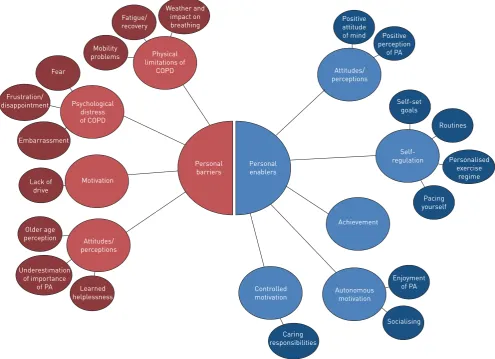
Alternatively, for instance, the Canadian Occupational Performance Measure (COPM) might be used to assess functional performance [20]. The COPM is an individualised scale assessing patients’ problematic activities of daily life. Patients have to rate the perceived performance as well as satisfaction for relevant problematic activities [52], which may provide a better understanding of the individual physical limitations as well as abilities. A qualitative study revealed social barriers (lack of time, overprotective family members) and enablers (social support) and a variety of personal barriers and enablers (figure 1) that limit and encourage, respectively, participation in physical activity in patients with COPD. The authors conclude that “it is important to understand the patient-specific social cognitive influences on physical activity participation”which might consequently facilitate individually tailored management planning [53]. This study clearly demonstrates the necessity to detect and understand underlying individual factors to finally enable personalised medicine and respond to the individual patient’s needs.
Example 2: patients’social network
As already illustrated in figure 1, patients’physical activity can be affected by their social network [53],i.e.
by their resident loved ones. Indeed, patients with an active loved one are also more active themselves [54].
https://doi.org/10.1183/16000617.0027-2018 5
A recent study demonstrated that structural support (e.g. living status, having a partner, having a caregiver) is associated with higher levels of physical activity and greater participation in pulmonary rehabilitation in patients with COPD while higher functional support was associated with, for instance, lower odds of smoking [55]. Furthermore, patients with more perceived social support experienced fewer depressive symptoms through the use of problem-oriented coping strategies [56]. Thus, the patients’home environment plays an important role in the process of disease management emphasising the need to include it as a relevant part for treatment strategies [57]. However, the process of informal caregiving is complex [58]. For instance, partners were often not able to identify patients’most important problematic activities [59] and are often current smokers and have (undiagnosed) morbidities [60]. Unfortunately, caregivers often feel unsupported and are often overlooked as important members of the interdisciplinary treatment team [61]. Thus, patients, caregivers, healthcare providers and society are all engaged in managing life with COPD [62], emphasising the need for holistic models considering patient’s family and social context [63].
Example 3: patient-reported outcomes
Facilitating personalised disease management requires the assessment of individual parameters, as outlined above. Patient-Reported Outcome (PRO) is“any report of the status of a patient’s health condition that comes directly from the patient, without interpretation of the patient’s response by a clinician or anyone else”[64]. The importance of PRO’s in clinical practice as well as research will substantially increase in the coming years [65].
Linking to example 2, patients with more perceived social support experienced fewer depressive symptoms [56]. Anxiety and depression have been identified as one of the most important COPD-related comorbidities [66]. However, anxiety and depression are most commonly assessed and consequently most commonly
Weather and impact on breathing
Physical limitations of
COPD
Psychological distress of COPD
Attitudes/ perceptions
Controlled motivation
Autonomous motivation Achievement
Self-regulation Attitudes/
perceptions Positive attitude
of mind Positive perception
of PA
Self-set goals
Routines
Pacing yourself
Personalised exercise
regime Motivation
Fatigue/ recovery
Mobility problems
Fear
Embarrassment Frustration/ disappointment
Lack of drive
Underestimation of importance
of PA Older age perception
Learned helplessness
Personal barriers
Personal enablers
Enjoyment of PA
Socialising
Caring responsibilities
reported (to define psychological impairment) raising the interest and need to assess other underlying mechanisms or individual psychological factors which may play a central role in COPD management. For instance, patients with symptoms of anxiety and depression reported a lower use of active confronting coping (i.e. actively seeking information, solutions and/or support) [67]. A qualitative study revealed that patients are struggling with acceptance of their disease which even precludes patients from progress during their pulmonary rehabilitation programme [68]. Indeed, acceptance of the disease is associated with behaviour change [26]. Furthermore, acceptance of the diagnoses and limitations, having a realistic disease understanding and developing a rational response to the disease are ways of enabling taking control [69]. Another considerable outcome is emotional intelligence,i.e.the capacity to understand and manage personal thoughts and feelings, as well as to positively influence interpersonal communication and social well-being, which has been shown to be associated with self-management abilities and health status [70].
Furthermore, health status measurement has previously been described as an essential process which is
“no more‘soft’or‘touchy-feely’than any well taken clinical history”[71], supporting health status as an increasingly important PRO in the assessment of COPD [9]. Indeed, health status has been shown to be associated with exacerbations, hospitalisations and dying [72]. Also fatigue has been shown to be associated with hospitalisation risk [73]. Although fatigue is a common and important symptom in patients with COPD [74, 75], it is often assessed related to exercise testing. Furthermore, it is still underdiagnosed and consequently undertreated [76]. As it has been described as a “central driver of functional disability, to the same extent as dyspnoea”[77] (linking to example 1), recent studies emphasise the importance of assessing fatigue as a separate outcome [77, 78].
The patient’s (unbiased) experiences and expectations about the patient’s own life, values and preferences play a central role in healthcare, since they are the ones living with the disease and are ultimately responsible for their lives. Indeed, as suggested by a Dutch report, key concepts of future healthcare are encouraging patients’ functionality and independency, adaptability and flexibility as well as control, autonomy and self-management [79]. Thus, Patient Reported Experience Measurements assessing the beneficial values for the patient are becoming relevant outcome parameters [80]. Indeed, rating and understanding patients’ satisfaction and interpreting their feedback (co-creation) provides important insights and outcomes to finally improve healthcare services [81].
The non-linear and consequently poorly predictable treatment responses caused by the disease [3] further support the dynamic interactions as demonstrated above. SPRUITet al. [3] demonstrated that responses to
regular outcomes in patients with COPD completing pulmonary rehabilitation are differential and concluded that “choosing only one or two outcomes as key performance indicators seem to ignore the clinical complexity of rehabilitating patients with COPD”. It is not about severity but complexity of the disease.
Pulmonary rehabilitation
Pulmonary rehabilitation has been defined as a“comprehensive intervention based on a thorough patient assessment followed by patient-tailored therapies which include, but are not limited to, exercise training, education, behaviour change, designed to improve the physical and psychological condition of people with chronic respiratory disease and to promote the long-term adherence to health-enhancing behaviours”[20]. The overall goal of pulmonary rehabilitation is“to return the patient to the highest possible capacity and to contribute to achieve the individual’s maximum level of independence and functioning in the community”[21]. Pulmonary rehabilitation, suggested as a future cornerstone of COPD management [82], provides an appropriate setting tackling the complexity outlined above by offering a personalised, holistic approach which was initially discussed more than 40 years ago. In 1974, the American College of Chest Physicians defined pulmonary rehabilitation as an individually tailored, multidisciplinary programme through accurate diagnosis, therapy, emotional support and education [83]. In 1994, the National Institute of Health defined pulmonary rehabilitation as a multidimensional continuum of services for the patient and family supplied by an integrated team of specialists in complementary disciplines [84].
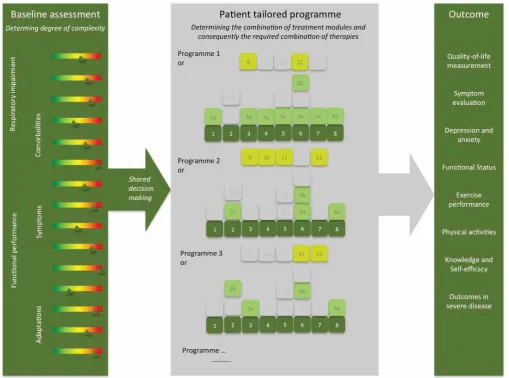
Pulmonary rehabilitation is a dynamic, individualised, integrated intervention requiring the full range of (medical) expertise, technical skills and specialised facilities addressing carefully identified treatable traits. It is offered by a dedicated team which works within, as well as across, disciplines to realise the individual goals of the unique patient. Figure 2 demonstrates the core process of pulmonary rehabilitation. Appropriate patient selection and an integrated assessment is crucial for successful treatment. Careful identification of treatable traits and treatment goals must form the start of every pulmonary rehabilitation programme. Based on the degree of complexity, a modular treatment programme is composed. Each individualised programme is followed by an outcome measurement of the different domains as described [21].
https://doi.org/10.1183/16000617.0027-2018 7
Focus: the unique patient
Pulmonary rehabilitation emphasises and relies on the central role of the patient [21]. Especially in chronic diseases, the patient, as a specialist of his own life [85], is an important member of the treatment team: it is not about curing, it is about life-long caring and learning to live with the disease, handling symptoms and accepting limitations. Indeed, enhancing self-management and empowering patients as well as achieving the individual’s maximum level of independence are important goals of pulmonary rehabilitation [20, 21, 86]. Self-management, as also included in the definition of health [87], supports the concept of “positive health” [88], emphasising possibilities instead of limitations. We need to qualify patients’abilities instead of quantify their harm.
Healthcare providers involved in the management of COPD must be encouraged to target the unique needs and abilities reflecting the individual complexity of every patient (consequently) stimulating anticipation [42] and to consider the patient’s social/home environment [89]. In future, and to enhance self-management, healthcare providers are expected to be competent coaches and advisors with compassion and humanity as key elements in their daily work [80].
In pulmonary rehabilitation, tailored treatment goals are composed not only in collaboration with other professionals but, probably even more importantly, in discussion with the patient [21]. Shared decision making as “an approach where clinicians and patients share the best available evidence when faced with the task of making decisions, and where patients are supported to consider options, to achieve informed preferences”plays a crucial role in personalised treatment approaches. Due to the visual presentation of
the results to the health professional as well as the patient, the Nijmegen Clinical Screening Instrument might support the process of shared decision making [26].
Furthermore, a recent study showed that patients were not willing to accept the burden of treatments where they perceived minimal benefit [90], demonstrating the importance of clear information about benefits and impact of a given treatment. Indeed, in case of complex adaptive systems, a small change can have a large effect in behaviour [91]. Importantly, patients’behaviour is partly determined by unique and adaptive responses to environmental stimuli [91] underlining the importance of creating a safe and realistic environment for disease management strategies.
Yet, there are also some relevant limitations. Pulmonary rehabilitation is mostly a non-pharmacological generic intervention underlining the necessity to integrate medicine and pulmonary rehabilitation by, for instance, implementing optimal treatment of comorbidities in relevant subgroups, applying noninvasive ventilation during exercise training in patients with hyperinflation and exercise-induced desaturation, using anabolic steroids in the treatment of cachexia and/or combining pulmonary rehabilitation with lung volume reduction intervention in eligible patients. Thus, pulmonary rehabilitation is a dynamic, individualised, integrated intervention tackling respiratory and non-respiratory treatable traits. This concept of pulmonary rehabilitation is far away from the eroded approach of pulmonary rehabilitation described in some guidelines, limiting pulmonary rehabilitation to exercise training and self-management instructions [92, 93].
Conclusion
COPD management is challenging and requires advanced, sophisticated strategies meeting the patient’s individual needs. Due to the heterogeneity and complexity of the disease leading to non-linear and consequently poorly predictable treatment responses, multidimensional patient profiling is crucial to identify the right COPD patient for the right treatment [3]. Transdisciplinary management programmes realising real benefits by integrating concepts of adaptive systems need to address the physical, emotional and social condition of the individual patient [94]. Dynamic, personalised and holistic approaches, i.e.
pulmonary rehabilitation, are needed to tackle the multifaceted disease starting from the patient’s perspective to finally ensuring personalised medicine and value-based healthcare:“to cope with escalating complexity in healthcare, it is necessary to abandon linear models, accept unpredictability, respect autonomy and creativity, and to respond flexibly to emerging patterns and opportunities”[21].
Author contributions: Conception and design: all authors. Drafting of the manuscript: S. Houben-Wilke, I.M. Augustin and E.F.M. Wouters. Drafting the manuscript for important intellectual content: all authors. All authors critically revised the article and gave final approval of this version to be published.
Conflict of interest: M.A. Spruit reports personal fees from AstraZeneca, Boehringer Ingelheim, GSK and Novartis, outside the submitted work. E.F.M Wouters has received fees for board membership from Nycomed and Boehringer, and has received grants from AstraZeneca and GSK. He has also received payment for lectures (including service on speakers bureaus) from AstraZeneca, GSK, Novartis and Chiesi. F.M.E. Franssen reports personal fees from AstraZeneca, Chiesi, Novartis, Boehringer Ingelheim, GlaxoSmithKline and TEVA, outside the submitted work.
References
1 Agusti A, Calverley PM, Celli B,et al.Characterisation of COPD heterogeneity in the ECLIPSE cohort.Respir Res 2010; 11: 122.
2 Duffy S, Weir M, Criner GJ. The complex challenge of chronic obstructive pulmonary disease.Lancet Respir Med 2015; 3: 917–919.
3 Spruit MA, Augustin IM, Vanfleteren LE, et al. Differential response to pulmonary rehabilitation in COPD: multidimensional profiling.Eur Respir J2015; 46: 1625–1635.
4 Vanfleteren LE, Spruit MA, Groenen M, et al. Clusters of comorbidities based on validated objective measurements and systemic inflammation in patients with chronic obstructive pulmonary disease.Am J Respir Crit Care Med2013; 187: 728–735.
5 Divo MJ, Casanova C, Marin JM,et al.COPD comorbidities network.Eur Respir J2015; 46: 640–650.
6 Agusti A. Phenotypes and disease characterization in chronic obstructive pulmonary disease. Toward the extinction of phenotypes?Ann Am Thorac Soc2013; 10: Suppl, S125–S130.
7 Wouters EF, Wouters BB, Augustin IM,et al.Personalized medicine and chronic obstructive pulmonary disease. Curr Opin Pulm Med2017; 23: 241–246.
8 Frey U, Suki B. Complexity of chronic asthma and chronic obstructive pulmonary disease: implications for risk assessment, and disease progression and control.Lancet2008; 372: 1088–1099.
9 Vogelmeier CF, Criner GJ, Martinez FJ,et al.Global Strategy for the Diagnosis, Management, and Prevention of Chronic Obstructive Lung Disease 2017 Report: GOLD Executive Summary.Am J Respir Crit Care Med2017; 195: 557–582.
10 Dijk WD, Bemt L, Haak-Rongen S,et al.Multidimensional prognostic indices for use in COPD patient care. A systematic review.Respir Res2011; 12: 151.
https://doi.org/10.1183/16000617.0027-2018 9
11 Slok AH, in’t Veen JC, Chavannes NH, et al. Development of the assessment of burden of COPD tool: an integrated tool to measure the burden of COPD.NPJ Prim Care Respir Med2014; 24: 14021.
12 Agusti A. The path to personalised medicine in COPD.Thorax2014; 69: 857–864.
13 Rodriguez-Roisin R, Rabe KF, Vestbo J,et al.Global Initiative for Chronic Obstructive Lung Disease (GOLD) 20th Anniversary: a brief history of time.Eur Respir J2017; 50: 1700671.
14 Celli BR, Cote CG, Marin JM,et al.The body-mass index, airflow obstruction, dyspnea, and exercise capacity index in chronic obstructive pulmonary disease.N Engl J Med2004; 350: 1005–1012.
15 Peters JB, Daudey L, Heijdra YF,et al. Development of a battery of instruments for detailed measurement of health status in patients with COPD in routine care: the Nijmegen Clinical Screening Instrument.Qual Life Res 2009; 18: 901–912.
16 Puhan MA, Garcia-Aymerich J, Frey M,et al.Expansion of the prognostic assessment of patients with chronic obstructive pulmonary disease: the updated BODE index and the ADO index.Lancet2009; 374: 704–711. 17 Castaldi PJ, Benet M, Petersen H,et al.Do COPD subtypes really exist? COPD heterogeneity and clustering in 10
independent cohorts.Thorax2017; 72: 998–1006.
18 Agusti A, MacNee W. The COPD control panel: towards personalised medicine in COPD. Thorax 2013; 68: 687–690.
19 Agusti A, Bel E, Thomas M,et al.Treatable traits: toward precision medicine of chronic airway diseases. Eur Respir J2016; 47: 410–419.
20 Spruit MA, Singh SJ, Garvey C, et al. An official American Thoracic Society/European Respiratory Society statement: key concepts and advances in pulmonary rehabilitation.Am J Respir Crit Care Med2013; 188: e13–e64. 21 Augustin IM, Wouters EFM. Process of pulmonary rehabilitation and program organization.J Card Pulm Rehabil
2017; 1: 109.
22 Rabe KF, Hurd S, Anzueto A,et al.Global strategy for the diagnosis, management, and prevention of chronic obstructive pulmonary disease: GOLD executive summary.Am J Respir Crit Care Med2007; 176: 532–555. 23 Vestbo J, Hurd SS, Agusti AG,et al.Global strategy for the diagnosis, management, and prevention of chronic
obstructive pulmonary disease: GOLD executive summary.Am J Respir Crit Care Med2013; 187: 347–365. 24 Han MK, Quibrera PM, Carretta EE, et al. Frequency of exacerbations in patients with chronic obstructive
pulmonary disease: an analysis of the SPIROMICS cohort.Lancet Respir Med2017; 5: 619–626.
25 Smid DE, Franssen FME, Gonik M,et al.Redefining cut-points for high symptom burden of the global initiative for chronic obstructive lung disease classification in 18,577 patients with chronic obstructive pulmonary disease. J Am Med Dir Assoc2017; 18: 1097.
26 Vercoulen JH. A simple method to enable patient-tailored treatment and to motivate the patient to change behaviour.Chron Respir Dis2012; 9: 259–268.
27 Han MK, Agusti A, Calverley PM,et al.Chronic obstructive pulmonary disease phenotypes: the future of COPD. Am J Respir Crit Care Med2010; 182: 598–604.
28 Burgel PR, Paillasseur JL, Roche N. Identification of clinical phenotypes using cluster analyses in COPD patients with multiple comorbidities.Biomed Res Int2014; 2014: 420134.
29 Agusti A, Celli B. Avoiding confusion in COPD: from risk factors to phenotypes to measures of disease characterisation.Eur Respir J2011; 38: 749–751.
30 Blue bloater: pink puffer.Br Med J1968; 2: 677.
31 Cosio BG, Soriano JB, Lopez-Campos JL,et al.Distribution and outcomes of a phenotype-based approach to guide COPD management: results from the CHAIN cohort.PloS one2016; 11: e0160770.
32 Mirza S, Benzo R. Chronic obstructive pulmonary disease phenotypes: implications for care.Mayo Clinic2017; 92: 1104–1112.
33 Peters JB, Boer LM, Molema J, et al. Integral health status-based cluster analysis in moderate-severe COPD patients identifies three clinical phenotypes: relevant for treatment as usual and pulmonary rehabilitation.Int J Behav Med2017; 24: 571–583.
34 Woodruff PG, Agusti A, Roche N,et al. Current concepts in targeting chronic obstructive pulmonary disease pharmacotherapy: making progress towards personalised management.Lancet2015; 385: 1789–1798.
35 Wardlaw AJ, Silverman M, Siva R,et al. Multi-dimensional phenotyping: towards a new taxonomy for airway disease.Clin Exp Allergy2005; 35: 1254–1262.
36 Pinto LM, Alghamdi M, Benedetti A, et al. Derivation and validation of clinical phenotypes for COPD: a systematic review.Respir Res2015; 16: 50.
37 Esteban C, Arostegui I, Aburto M,et al.Chronic obstructive pulmonary disease subtypes. transitions over time. PloS one2016; 11: e0161710.
38 Agusti A, Gea J, Faner R. Biomarkers, the control panel and personalized COPD medicine.Respirology2016; 21: 24–33. 39 Agusti A, Anto JM, Auffray C,et al.Personalized respiratory medicine: exploring the horizon, addressing the issues. Summary of a BRN-AJRCCM workshop held in Barcelona on June 12, 2014.Am J Respir Crit Care Med 2015; 191: 391–401.
40 Jameson JL, Longo DL. Precision medicine–personalized, problematic, and promising.N Engl J Med2015; 372: 2229–2234.
41 Lange P, Halpin DM, O’Donnell DE,et al.Diagnosis, assessment, and phenotyping of COPD: beyond FEV(1).Int J Chron obstruct Pulm Dis2016; 11: 3–12.
42 Houben-Wilke S, Franssen FM, Kok I,et al. Assessment of Burden of COPD (ABC) tool: perceptionversus evidence.Eur Respir J2017; 49: 1602382.
43 Willson A. The problem with eliminating“low-value care”.BMJ Qual Saf2015; 24: 611–614.
44 Postma DS, Anzueto AR, Jenkins C,et al.Factor analysis in predominantly severe COPD: identification of disease heterogeneity by easily measurable characteristics.Respir Med2013; 107: 1939–1947.
45 Rogowski W, Payne K, Schnell-Inderst P, et al. Concepts of “personalization” in personalized medicine: implications for economic evaluation.PharmacoEconomics2015; 33: 49–59.
46 Annegarn J, Meijer K, Passos VL,et al.Problematic activities of daily life are weakly associated with clinical characteristics in COPD.J Am Med Dir Assoc2012; 13: 284–290.
48 Lahousse L, Ziere G, Verlinden VJ, et al. Risk of frailty in elderly with COPD: a population-based study. J Gerontol A Biol Sci Med Sci2016; 71: 689–695.
49 Crisan AF, Oancea C, Timar B,et al.Balance impairment in patients with COPD.PloS one2015; 10: e0120573. 50 Annegarn J, Spruit MA, Savelberg HH,et al.Differences in walking pattern during 6-min walk test between
patients with COPD and healthy subjects.PloS one2012; 7: e37329.
51 Lahousse L, Verlinden VJ, van der Geest JN,et al.Gait patterns in COPD: the Rotterdam Study.Eur Respir J 2015; 46: 88–95.
52 Dedding C, Cardol M, Eyssen IC, et al. Validity of the Canadian occupational performance measure: a client-centred outcome measurement.Clin Rehabil2004; 18: 660–667.
53 Kosteli MC, Heneghan NR, Roskell C,et al.Barriers and enablers of physical activity engagement for patients with COPD in primary care.Int J Chron Obstruct Pulm Dis2017; 12: 1019–1031.
54 Mesquita R, Nakken N, Janssen DJA,et al.Activity levels and exercise motivation in patients with COPD and their resident loved ones.Chest2017; 151: 1028–1038.
55 Chen Z, Fan VS, Belza B,et al.Association between social support and self-care behaviors in adults with chronic obstructive pulmonary disease.Ann Am Thorac Soc2017; 14: 1419–1427.
56 Lee H, Yoon JY, Kim I,et al.The effects of personal resources and coping strategies on depression and anxiety in patients with chronic obstructive pulmonary disease.Heart Lung2013; 42: 473–479.
57 Nakken N, Janssen DJ, van den Bogaart EH,et al.Informal caregivers of patients with COPD: home sweet home? Eur Respir Rev2015; 24: 498–504.
58 Gabriel R, Figueiredo D, Jacome C,et al.Day-to-day living with severe chronic obstructive pulmonary disease: towards a family-based approach to the illness impacts.Psychol Health2014; 29: 967–983.
59 Nakken N, Janssen DJ, van den Bogaart EH,et al.Patientversusproxy-reported problematic activities of daily life in patients with COPD.Respirology2017; 22: 307–314.
60 Nakken N, Spruit MA, van den Bogaart EH,et al.Health status and morbidities in resident relatives of patients with COPD.J Am Med Dir Assoc2016; 17: 276 e271–278.
61 Aasbo G, Rugkasa J, Solbraekke KN,et al.Negotiating the care-giving role: family members’experience during critical exacerbation of COPD in Norway.Health Soc Care Community2017; 25: 612–620.
62 Fotokian Z, Mohammadi Shahboulaghi F, Fallahi-Khoshknab M,et al.The empowerment of elderly patients with chronic obstructive pulmonary disease: managing life with the disease.PloS one2017; 12: e0174028.
63 Greenhalgh T. Patient and public involvement in chronic illness: beyond the expert patient.BMJ2009; 338: b49. 64 US Food and Drug Administration. Guidance for industry patient-reported outcome measures: use in medical
product development to support labeling claims. December 2009. www.fda.gov/downloads/Drugs/GuidanceCompliance RegulatoryInformation/Guidances/UCM193282.pdf
65 Ekstrom M, Sundh J, Larsson K. Patient reported outcome measures in chronic obstructive pulmonary disease: which to use?Expert Rev Respir Med2016; 10: 351–362.
66 Vanfleteren L, Spruit MA, Wouters EFM,et al.Management of chronic obstructive pulmonary disease beyond the lungs.Lancet Respir Med2016; 4: 911–924.
67 Stoilkova A, Wouters EF, Spruit MA, et al.The relationship between coping styles and clinical outcomes in patients with COPD entering pulmonary rehabilitation.COPD2013; 10: 316–323.
68 Meis JJ, Bosma CB, Spruit MA,et al.A qualitative assessment of COPD patients’experiences of pulmonary rehabilitation and guidance by healthcare professionals.Respir Med2014; 108: 500–510.
69 Brien SB, Lewith GT, Thomas M. Patient coping strategies in COPD across disease severity and quality of life: a qualitative study.NPJ Prim Care Respir Med2016; 26: 16051.
70 Benzo RP, Kirsch JL, Dulohery MM,et al.Emotional intelligence: a novel outcome associated with wellbeing and self-management in chronic obstructive pulmonary disease.Ann Am Thorac Soc2016; 13: 10–16.
71 Jones PW. Health status measurement in chronic obstructive pulmonary disease.Thorax2001; 56: 880–887. 72 Wilke S, Jones PW, Mullerova H,et al.One-year change in health status and subsequent outcomes in COPD.
Thorax2015; 70: 420–425.
73 Paddison JS, Effing TW, Quinn S,et al.Fatigue in COPD: association with functional status and hospitalisations. Eur Respir J2013; 41: 565–570.
74 Peters JB, Heijdra YF, Daudey L,et al.Course of normal and abnormal fatigue in patients with chronic obstructive pulmonary disease, and its relationship with domains of health status.Patient Educ Couns2011; 85: 281–285. 75 Todt K, Skargren E, Kentson M,et al.Experience of fatigue, and its relationship to physical capacity and disease
severity in men and women with COPD.Int J Chron Obstruct Pulm Dis2014; 9: 17–25.
76 Antoniu SA, Ungureanu D. Measuring fatigue as a symptom in COPD: from descriptors and questionnaires to the importance of the problem.Chron Respir Dis2015; 12: 179–188.
77 Al-Shair K, Kolsum U, Singh D,et al.The Effect of fatigue and fatigue intensity on exercise tolerance in moderate COPD.Lung2016; 194: 889–895.
78 Kentson M, Todt K, Skargren E,et al.Factors associated with experience of fatigue, and functional limitations due to fatigue in patients with stable COPD.Ther Adv Respir Dis2016; 10: 410–424.
79 Kaljouw M, van Vliet K. Naar nieuwe zorg en zorgberoepen: de contouren [Towards new care and care professions: the contours]. www.rijksoverheid.nl/…/naar-nieuwe-zorg-en-zorgberoepen-de-contouren.pdf Date last updated: April 10, 2015; date last accessed: September 26, 2015.
80 Federatie Medisch Specialisten. Visiedocument: Medisch Specialist 2025: ambitie, vertrouwen, samenwerken. 2017. www.demedischspecialist.nl/sites/default/files/Visiedocument%20Medisch%20Specialist%202025-DEF.pdf Date last accessed: March 29, 2017.
81 Zhang L, Tong H, Demirel HO,et al.A practical model of value co-creation in healthcare service. Procedia Manufacturing2015; 3: 200–2007.
82 Steiner MC, Roberts CM. Pulmonary rehabilitation: the next steps.Lancet Respir Med2016; 4: 172–173.
83 Hodgkin JE, Farrell MJ, Gibson SR,et al. American Thoracic Society. Medical Section of the American Lung Association. Pulmonary rehabilitation.Am Rev Respir Dis1981; 124: 663–666.
84 Fishman AP. Pulmonary rehabilitation research.Am J Respir Crit Care Med1994; 149: 825–833.
85 Houben-Wilke S, Augustin IM, Wouters BB, et al. The patient with a complex chronic respiratory disease: a specialist of his own life?Expert Rev Respir Med2017; 11: 919–924.
https://doi.org/10.1183/16000617.0027-2018 11
86 Holland AE, Spruit MA, Troosters T,et al.An official European Respiratory Society/American Thoracic Society technical standard: field walking tests in chronic respiratory disease.Eur Respir J2014; 44: 1428–1446.
87 Huber M, Knottnerus JA, Green L,et al.How should we define health?BMJ2011; 343: d4163.
88 Huber M, van Vliet M, Giezenberg M,et al.Towards a“patient-centred”operationalisation of the new dynamic concept of health: a mixed methods study.BMJ Open2016; 6: e010091.
89 Elwyn G, Laitner S, Coulter A,et al.Implementing shared decision making in the NHS.BMJ2010; 341: c5146. 90 Harb N, Foster JM, Dobler CC. Patient-perceived treatment burden of chronic obstructive pulmonary disease.Int
J Chron Obstruct Pulm Dis2017; 12: 1641–1652.
91 Wilson T, Holt T, Greenhalgh T. Complexity science: complexity and clinical care.BMJ2001; 323: 685–688. 92 Alison JA, McKeough ZJ, Johnston K,et al.Australian and New Zealand Pulmonary Rehabilitation Guidelines.
Respirology2017; 22: 800–819.
93 National Institute for Health and Care Excellence. Chronic obstructive pulmonary disease in adults. https://www. nice.org.uk/guidance/qs10/resources/chronic-obstructive-pulmonary-disease-in-adults-pdf-2098478592709 Date last updated: February 2016; date last accessed: November 2017.