Vol. 3, No. 1, 2013, 56-66
ISSN: 2279-087X (P), 2279-0888(online) Published on 20 May 2013
www.researchmathsci.org
56
Annals of
Irregular Interval–Valued Fuzzy Graphs
Madhumangal Pal 1 and Hossein Rashmanlou 2
1
Department of Applied Mathematics with Oceanology and Computer Programming Vidyasagar University, Midnapore-721102, India
Email: [email protected]
2
Department of Mathematics, University of Mazandaran, Babolsar, Iran Email: [email protected]
Received 6 December 2012; accepted 22 April 2013
Abstract. In this paper, we define irregular interval-valued fuzzy graphs and their
various classifications. Size of regular interval-valued fuzzy graphs is derived. The relation between highly and neighbourly irregular interval-valued fuzzy graphs are established. Some basic theorems related to the stated graphs have also been presented.
Keywords: Interval-valued fuzzy graphs, irregular interval-valued fuzzy graphs, totally irregular interval-valued fuzzy graph
AMS Mathematics Subject Classification (2010): 05C72
1. Introduction
Presently, science and technology is featured with complex processes and phenomena for which complete information is not always available. For such cases, mathematical models are developed to handle various types of systems containing elements of uncertainty. A large number of these models are based on an extension of the ordinary set theory, namely, fuzzy sets. In 1965, Zadeh [31] introduced the notion of fuzzy subset of a set as a method of presenting uncertainty. The fuzzy systems have been used with success in last years, in problems that involve the approximate reasoning. It has become a vast research area in different disciplines including medical and life science, management sciences, social sciences, engineering, statistics, graph theory, artificial intelligence, signal processing, multi agent systems, pattern recognition, robotics, computer networks, expert systems, decision making, etc.
are widely studied and used, we describe briefly the work of Gorzalczany on approximate reasoning [8-9], Roy and Biswas on medical diagnosis [20], Turksen on multivalued logic [25] and Mendel on intelligent control [10]. In 2011, Akram [1] introduced the concept of interval-valued fuzzy graphs and defined different operations on it.
Interval- valued fuzzy graph theory is now growing and expanding its applications. The theoretical development in this area is discussed here.
1.1. Review of literature
After Rosenfeld [19], fuzzy graph theory is increased with a large number of branches. Mathew and Sunitha [11] described the types of arcs in a fuzzy graph. Nagoorgani and Malarvizhi [14] established the isomorphism properties of strong fuzzy graphs. Nagoorgani and Vadivel [15] established relations between the parameters of independent domination and irredundance in fuzzy graphs. Nair and Cheng [17] defined cliques and fuzzy cliques in fuzzy graphs. Nair [18] established the definition of perfect and precisely perfect fuzzy graphs. Akram [2] defined different operations on bipolar fuzzy graphs. Strong bipolar fuzzy graphs were also introduced here. He also introduced regular bipolar fuzzy graphs [4]. Samanta and Pal introduced fuzzy tolerance graphs [21], fuzzy threshold graphs [23], fuzzy competition graphs [22] and bipolar fuzzy hypergraph [24]. Akram and Davvaz discussed the properties of strong intuitionistic fuzzy graphs [3]. Talebi and Rashmanlou [26] studied isomorphism on interval-valued fuzzy graph. Likewise, they defined isomorphism on vague graphs [27]. A very few algorithms have also been designed to solve problems on fuzzy graphs [32,33,34].
2. Preliminaries
A fuzzy set A on a set X is characterized by a mapping m: X → [0, 1], called the membership function.
A fuzzy set is denoted as A = (X, m). A fuzzy graph [19]
ξ
=(V,σ
,µ
) is a non-empty set V together with a pair of functionsσ
:V →[0, 1] andµ
:V×V →[0, 1] such that for all u, v ∈V ,µ
(u,v)≤σ
(u)∧σ
(v) (here x∧y denotes the minimum of x and y). Partial fuzzy subgraphξ
′=(V,τ
,v) ofξ
is such thatτ
(v)≤σ
(v) for all v∈V and) , ( ) ,
(u v ≤V u v
µ
for all u,v∈V. Fuzzy subgraph [12]ξ
′′=(P,σ
′,µ
′) ofξ
is such that P⊆V,σ
′(u)=σ
(u) for all u∈P ,µ
′(u,v)=µ
(u,v) for all u,v∈P.A fuzzy graph is complete [13] if
µ
(u,v)=σ
(u)∧σ
(v) for all u,v∈V . The degree of vertex u is∑
∈
=
ξ
µ
) , (
) , ( )
(
v u
v u u
d . The minimum degree of
ξ
isδ
(ξ
)=∧{
d(u)|u∈V}
.The maximum degree of
ξ
is ∆(ξ
)=∨{
d(u)|u∈V}
. The total degree [13] of a vertex Vu∈ is td(u)=d(u)+
σ
(u). A fuzzy graphξ
=(V,σ
,µ
) is said to be regular [13] if kv
58
A fuzzy graph is said to be totally irregular, if there is a vertex which is adjacent to vertices with distinct total degrees. If every two adjacent vertices have distinct total degrees of a fuzzy graph then it is called neighbourly total irregular [16]. A fuzzy graph is called highly irregular [16] if every vertex of G is adjacent to vertices with distinct degrees. The complement [12] of fuzzy graph
ξ
=(V,σ
,µ
) is the fuzzy graph) , ,
(
σ
µ
ξ
= V ′ ′ whereσ
′(u)=σ
(u) for all u∈V and
∧
> =
′
.
), ( ) (
0, ) , ( if 0 ) , (
otherwise v
u
v u v
u
σ
σ
µ
µ
Let X be a nonempty set. An interval-valued fuzzy set A in V is defined by
{
x x V}
A= ( ,[
µ
A−(x),µ
A+(x)]): ∈ , whereµ
A−( x) andµ
A+( x) are fuzzy subsets ofVsuch that
µ
A−(x) ≤µ
A+(x) for all x∈V.For any two interval-valued fuzzy sets A=[
µ
A−(x),µ
A+(x)] and] , [ B (x) B (x)
B=
µ
−µ
+ in V we have:• AUB=
{
(x,max(µ
A−(x),µ
B−(x)),max(µ
A+(x),µ
B+(x))):x∈V}
, • AIB={
(x,min(µ
A−(x),µ
B−(x)),min(µ
A+(x),µ
B+(x))):x∈V}
.If G∗ =(V,E) is a graph, then by an interval-valued fuzzy relation B on a set E we mean an interval - valued fuzzy set such that.
µ
B−(xy)≤min(
µ
A−(x) ,µ
A−(y))
,
µ
B+(xy)≤min(
µ
A+(x),µ
A+(y))
for all xy∈E.By an interval - valued fuzzy graph of a graph G∗ =(V,E) we mean a pair G=(A,B), where A=[
µ
A− ,µ
A+] is an interval-valued fuzzy set on V and B=[µ
B− ,µ
B+] is aninterval-valued fuzzy relation on E.
The graph G is called complete interval-valued fuzzy graph if
(
( ), ( ))
min )
(xy A x A y
B+ =
µ
+µ
+µ
andµ
B−(xy)=min(
µ
A−(x) ,µ
A−(y))
for all x,y∈V .An interval-valued fuzzy graph G=(A,B) of a given graph G* =(V,E)is called an interval-valued strong fuzzy graph if
(
( ) , ( ))
min )
(xy A x A y
B− =
µ
−µ
−µ
andµ
B+(xy)=min(
µ
A+(x),µ
A+(y))
for all xy∈E.The complement of a strong interval-valued fuzzy graph G is G =(A,B) where
)] ( , ) (
[ x x
A=
µ
A−µ
A+ is an interval-valued fuzzy set on V and B =[µ
B− ,µ
B+] is aninterval-valued fuzzy set on E⊆V ×V such that
(1) V =V,
(3)
µ
B−(xy)= = ∧ > − − − − . 0 ) ( If ) ( ) ( , 0 ) ( If 0 xy y x xy B A A Bµ
µ
µ
µ
(4)
µ
B+(xy)= = ∧ > + + + + . 0 ) ( If ) ( ) ( , 0 ) ( If 0 xy y x xy B A A Bµ
µ
µ
µ
Definition 1[1]. Let G=(A,B) be an interval-valued fuzzy graph where
] ,
[ − +
= A A
A
µ
µ
and B=[µ
B−,µ
B+] be two interval-valued fuzzy sets on a non-empty finite set V and E⊆V×V respectively. The graph G is called complete interval-valued fuzzy graph ifµ
B−(xy)=min(
µ
A−(x),µ
A−(y))
and
µ
B+(xy)=min(
µ
A+(x),µ
A+(y))
for all x,y∈V.Definition 2. Let G=(A,B) be an interval-valued fuzzy graph where A=[
µ
A− ,µ
A+] and B=[µ
B− ,µ
B+] be two interval - valued fuzzy sets on a non- empty finite set V andV V
E⊆ × respectively. The total degree of a vertex u∈V is denoted by td(u) and defined as td(u)=[td+(u),td−(u)] where
) ( ) ( )
(u uv u
td B A
E uv + + + =
∑
∈ +µ
µ
, td (u) B (uv) A (u)
E uv − − + =
∑
∈ −µ
µ
.If the total degrees of all vertices of an interval-valued fuzzy graph are equal, then the graph is said to be totally regular interval-valued fuzzy graph.
3. Some definitions related to interval-valued fuzzy graphs
The degree of a vertex of an interval-valued fuzzy graph is defined below.
Definition 3. Let G=(A, B) be an interval-valued fuzzy graph where A=[
µ
A− ,µ
A+] and B=[µ
B− ,µ
B+] be two interval-valued fuzzy sets on a non-empty finite set V andV V
E⊆ × respectively. The positive degree of a vertex u∈G is
∑
∈ + + = E uv B uv ud ( )
µ
( ). Similarly, negative degree of a vertex u∈G is∑
∈ − − = E uv B uv ud ( )
µ
( ). The degree of a vertex u is d(u)=[d−(u),d+(u)].60
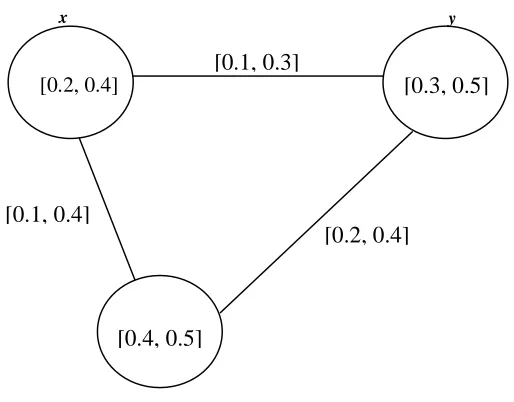
Example 1. We consider an interval-valued fuzzy graph show here. We have
2 . 0 1 . 0 1 . 0 )
( = + =
−
x
d , d+(x)=0.3+0.4=0.7. So, d(x)=(0.2 ,0.7). Similarly, d(y)=(0.3, 0.7) and d(z)=(0.3,0.8).
Figure 1: An example of interval-valued fuzzy graph
The order and size of an interval-valued fuzzy graph are important terms. They are defined below.
Definition 4. Let G=(A ,B) be an interval-valued fuzzy graph where A=[
µ
A− ,µ
A+] and =[ − , +]B B
B
µ
µ
be two interval-valued fuzzy sets on a non-empty finite set V and VV
E⊆ × respectively. The order of G is denoted by O(G) and is defined by )]
( , ) ( [ )
(G O G O G
O = − + where
∑
∈ −
−
=
V u A
u G
O ( )
µ
( ) and∑
∈ +
+
=
V u A
u G
O ( )
µ
( ).Definition 5. Let G=(A, B) be an interval-valued fuzzy graph where A=[
µ
A− ,µ
A+] and B=[µ
B− ,µ
B+] be two interval-valued fuzzy sets on a non-empty finite set V andE respectively. The size of G is defined by S(G)=[S−(G),S+(G)] where
∑
≠ ∈ −−
=
v u
E uv
B uv
G S
) ( )
(
µ
and∑
≠ ∈ +
+
=
v u
E uv
B uv
G S
) ( )
(
µ
.Example 2. For the interval-valued fuzzy graph of Figure 1,O(G)=(0.9, 1.4) and )
1 . 1 , 4 . 0 ( ) (G =
S .
[0.4, 0.5]
[0.2, 0.4] [0.3, 0.5]
[0.2, 0.4] [0.1, 0.3]
[0.1, 0.4]
z
Definition 6. Let G=(A, B) be an interval-valued fuzzy graph where A=[
µ
A− ,µ
A+] and B=[µ
B− ,µ
B+] be two interval-valued fuzzy sets on a non-empty finite set V andV V
E⊆ × respectively. The underlying crisp graph of G is the crisp graph )
, (V E
G′= ′ ′ where V′={v|
µ
A+(v)>0 andµ
A−(v)>0} and }0 ) ( and 0 ) ( | ) , (
{ > >
=
′ u v + uv − uv
E
µ
Bµ
B .Definition 7. An interval-valued fuzzy graph is said to be connected if it’s underlying
crisp graph is connected.
Theorem 1. Let G be a regular interval-valued fuzzy graph where induced crisp graph G’ is an even cycle. Then G is regular interval-valued fuzzy graph if and only if either
µ
B+or
µ
B− is constant functions or alternate edges have same positive membership values andnegative membership values.
Proof. Let G=(A, B) be a regular interval-valued fuzzy graph where A=[
µ
A− ,µ
A+] and B=[µ
B− ,µ
B+] be two interval-valued fuzzy sets on a non-empty finite set V andV V
E⊆ × respectively and underlying crisp graph G′ of G be an even cycle. If either
−
B
µ
orµ
B+ is constant function or alternate edges have same positive and negativemembership values, then G is a regular interval-valued fuzzy graph. Conversely, suppose G is a [k1,k2]-regular interval-valued fuzzy graph. Let e1 , e2, … en be the edges of
G′ in order. As
− =
+
even. is i if
odd, is i if )
(
1 1 1
c k c ei
B
µ
− =
−
even. is i if
odd, is i if )
(
2 2 2
c k c ei B
µ
If c1=k1−c1, then
µ
B+is constant. If c1≠k1−c1, then alternate edges have samepositive and negative membership values. Similarly, for
µ
B−. Hence the result.Theorem 2. The size of a (k1,k2)-regular interval-valued fuzzy graph is ) 2 , 2 (Pk1 Pk2
where P=V .
Proof. Let G=(A, B) be an interval-valued fuzzy graph where A=[
µ
A− ,µ
A+] and ],
[ − +
= B B
B
µ
µ
be two interval-valued fuzzy sets on a non-empty finite set V andV V
E⊆ × respectively. The size of G is
=
∑
∑
≠ ≠
+ −
v u
B v
u
B uv uv
G
62
Now,
∑
∑
∑
∈ ∈ ∈ = = + − E uv B E uv B V v G S uv uv v
d( ) 2[
µ
( ) ,µ
( )] 2 ( ).Thus, 2 ( )
∑
( ), . .2 ( ) [∑
1 ,∑
2].∈ ∈
∈
= =
V v vV V v k k G S e i v d G S
This gives 2S(G)=[Pk1,Pk2]. Hence the result.
Theorem 3. If G is [k,k′]-totally regular interval-valued fuzzy graph, then
] P , k [ ) ( ) (
2S G +OG = P k′ where P=V .
Proof. Let G=(A, B) be an interval-valued fuzzy graph where
∑
∑
≠ ≠ + − v u B v uB (uv) ,
µ
(uv)µ
be two interval-valued fuzzy sets on a non-empty finite set Vand V×V respectively. Since G is a [k,k′]-totally regular interval-valued fuzzy graph.
So k=td+(v)=d+(v)+
µ
A+(v) and k′=td−(v)=d−(v)+µ
A−(v) for all v∈V.Therefore
∑
∑
∑
∈ ∈ ∈ + + + = Vv vV
A V v v v d
k ( )
µ
( ) and∑
∑
∑
∈ ∈ ∈ − − + = ′ V
v vV
A V v v v d
k ( )
µ
( ).) ( 2S G
Pk = + and Pk′=2S−(G). So
) ( ) ( )) ( ) ( (
2 S G S G O G O G
k P
Pk+ ′= + + − + + + − . Hence 2S(G)+O(G)=[Pk,Pk′].
4. Irregular interval-valued fuzzy graphs
Irregular interval-valued fuzzy graphs are important as regular interval-valued fuzzy graphs. We now define it.
Definition 8. Let G=(A, B) be an interval-valued fuzzy graph where A=[
µ
A− ,µ
A+] and B=[µ
B− ,µ
B+] be two interval-valued fuzzy sets on a non-empty finite set V andV V
E⊆ × respectively. G is said to be irregular interval-valued fuzzy graph if there exists a vertex which is adjacent to a vertex with distinct degrees.
Example 3. Let G=(A, B) be an interval - valued fuzzy graph where A=[
µ
A− ,µ
A+] and B=[µ
B− ,µ
B+] be two interval-valued fuzzy sets on a non-empty finite set V andV V
E⊆ × respectively, where V =
{
v1,v2,v3,v4}
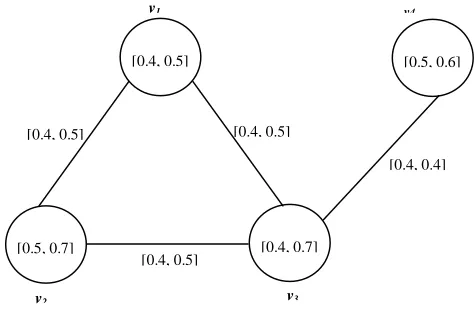
. ] 1 , 8 . 0 [ ) (v1 =d , d(v2)=[0.8 ,1] , d(v3)=[1.2,1.4] , d(v4)=[0.4 ,0].
Here d(V2)≠d(V3). So this graph is an example of irregular interval-valued fuzzy graph, show in Figure 2.
Definition 9. Let G be a connected interval-valued fuzzy graph. Then G is called
neighbourly irregular interval-valued fuzzy graph if for every two adjacent vertices of G have distinct degrees.
Figure 2: An example of irregular interval-valued fuzzy graph.
Definition 10. Let G=(A, B) be an interval-valued fuzzy graph where ]
,
[ − +
= A A
A
µ
µ
and B=[µ
B− ,µ
B+] be two interval-valued fuzzy sets on a non-empty finite set V and E⊆V×V respectively. G is said to be totally irregular interval-valued fuzzy graph if there exists a vertex which is adjacent to a vertex with distinct total degrees.Definition 11. Let G be a connected interval-valued fuzzy graph. Then G is called highly
irregular interval-valued fuzzy graph if every vertex of G is adjacent to vertices with distinct degrees.
Example 4. Let G=(A ,B) be an interval-valued fuzzy graph where A=[
µ
A− ,µ
A+] and B=[µ
B− ,µ
B+]be two interval-valued fuzzy sets on a non-empty finite set V andV V
E⊆ × respectively, where V =
{
v1,v2,v3,v4}
.v1 =[0.4,0.5], v2 =[0.5,0.6], ]5 . 0 , 4 . 0 [
3 =
v ,v4 =[0.4,0.4],
µ
B−(v1v2)=0.3,µ
B+(v1v2)=0.4,µ
B−(v2v3)=0.2,4 . 0 ) ( 2 3 = + v v
B
µ
,µ
B−(v3v4)=0.3,µ
B+(v3v4)=0.4,µ
B−(v2v4)=0.2,4 . 0 ) ( 2 4 = + v v
B
µ
.So we have d(v1)=[0.3,0.4],d(v2)=[0.8,1.2], d(v3)=[0.5 ,0.8],
]) 8 . 0 , 5 . 0 [ ) (v4 =
d . Here the interval-valued fuzzy graph is highly irregular but not neighbourly irregular as d(v3)=d(v4).
[0.4, 0.5]
v1
[0.5, 0.7]
[0.4, 0.7]
[0.5, 0.6]
[0.4, 0.5] [0.4, 0.5]
[0.4, 0.5]
[0.4, 0.4]
v3
v2
64
Theorem 4. Let G be an valued fuzzy graph. Then G is highly irregular
interval-valued fuzzy graph and neighbourly irregular interval-interval-valued fuzzy graph if and only if the degrees of all vertices of G are distinct.
Proof. Let G=(A, B) be an interval-valued fuzzy graph where A=[
µ
A− ,µ
A+] and ],
[ − +
= B B
B
µ
µ
be two interval-valued fuzzy sets on a non-empty finite set V and V×Vrespectively. Let V =
{
v1,v2,...,vn}
. We assume that G is highly irregular and neighbourly irregular interval-valued fuzzy graphs. Let the adjacent vertices of u1 ben
u u
u2, 3,..., with degrees [ 2 , 2],[ 3 , 3 ],...,[ , ]
+ − +
− + −
n n k
k k
k k
k respectively. As G is
highly and neighbourly irregular, d(u1)≠d(u2)≠d(u3)≠...≠d(un). So it is obvious that all vertices are of distinct degrees.
Conversely, assume that the degrees of all vertices of G are distinct. This means that every two adjacent vertices have distinct degrees and to every vertex the adjacent vertices have distinct degrees. Hence, G is neighbourly irregular and highly irregular interval-valued fuzzy graphs.
Theorem 5. Let G be an interval-valued fuzzy graph. If G is neighbourly irregular and
−
A
µ
,µ
A+ are constant functions, then G is a neighbourly total irregular interval-valuedfuzzy graph.
Proof. Let G=(A, B) be an interval-valued fuzzy graph where A=[
µ
A− ,µ
A+] and ],
[ − +
= B B
B
µ
µ
be two interval-valued fuzzy sets on a non-empty finite set V and VV
E⊆ × respectively.
Assume that G is a neighbourly irregular interval-valued fuzzy graph, i.e. the degrees of every two adjacent vertices are distinct. Consider two adjacent vertices u1 and
2
u with distinct degrees [k1−,k1+] and [k2−,k2+] respectively. Also let,
µ
A−(u)=c1,2
) (u c
A+ =
µ
for all u∈V where c1,c2∈[ ]
0,1 are constants. Therefore, ], [
] ) ( , ) ( [ )
(u1 d u1 c1 d u1 c2 k1 c1 k1 c2
td = − + + + = − + + +
] ,
[ ] ) ( , ) ( [ )
(u2 d u2 c1 d u2 c2 k2 c1 k2 c2
td = − + + + = − + + + . Clearly, td(u1)≠td(u2). Therefore for any two adjacent vertices u1 and u2 with distinct degrees, it’s total degrees
are also distinct, provided
µ
A−,µ
A+ are constant functions. The above argument is truefor every pair of adjacent vertices in G.
5. Conclusions
irregular interval-valued fuzzy graphs, neighbourly irregular, totally and highly irregular interval-valued fuzzy graphs. Some relations about the defined graphs have been proved.
REFERENCES
1. M. Akram and W. A. Dudec, Interval-valued fuzzy graphs, Computers and Mathematics with Applications, 61 (2011), 289-299.
2. M. Akram, Bipolar fuzzy graphs, Information Sciences, 181 (2011), 5548–5564. 3. M. Akram and B. Davvaz, Strong intuitionistic fuzzy graphs, Filomat, 26(1) (2012),
177–196.
4. M. Akram and W.A. Dudek, Regular bipolar fuzzy graphs, Neural Computing and Applications (2011).
5. K. R. Bhutani and A. Battou, On M-Strong fuzzy graphs, Information Sciences, 155 (1-2), 103-109, (2003).
6. K. R. Bhutani and A. Rosenfeld, Strong arcs in fuzzy graphs, Information Sciences, 152 (2003), 319-322.
7. K. R. Bhutani, J. Mordeson and A. Rosenfeld, On degrees of end nodes and cut nodes in fuzzy graphs, Iranian Journal of Fuzzy Systems, 1(1) (2004), 57 -64.
8. M. B. Gorzalczany, A method of inference in approximate reasoning based on interval-valued fuzzy sets, Fuzzy Sets and Systems, 21 (1987), 1-17.
9. M. B. Gorzalczany, An interval-valued fuzzy inference method some basic properties, Fuzzy Sets and Systems, 31 (1989), 243-251.
10. J. M. Mendel, Uncertain Rule-Based Fuzzy Logic Systems: Introduction and New Directions, Prentice-Hall, Upper Saddle River, New Jersey, (2001).
11. S. Mathew and M. S. Sunitha, Types of arcs in a fuzzy graph, Information Sciences, 179 (2009), 1760-1768.
12. J. N. Mordeson and P. S. Nair, Fuzzy Graphs and Hypergraphs, Physical Verlag, (2000).
13. A. Nagoorgani and K. Radha, On regular fuzzy graphs, Journal of Physical Sciences, 12 (2008), 33-40.
14. A. Nagoorgani and J. Malarvizhi, Isomorphism properties of strong fuzzy graphs, Intern.Journal of Algorithms, Computing and Mathematics, 2(1) (2009), 39-47. 15. A. Nagoorgani and P. Vadivel, Relations between the parameters of independent
domination and irredundance in fuzzy graph, International Journal of Algorithms, Computing and Mathematics, 2(1) (2009), 15-19.
16. A. Nagoorgani and A. Latha, On irregular fuzzy graphs, Applied Mathematical Sciences, 6(11) (2012), 517 - 523.
17. P. S. Nair and S. C. Cheng, Cliques and fuzzy cliques in fuzzy graphs, IFSA world congress and 20th NAFIPS International Conference, 4 (2001), 2277-2280.
18. P. S. Nair, Perfect and precisely perfect fuzzy graphs, Fuzzy Information Processing Society, (2008) 19-22.
19. A. Rosenfeld, Fuzzy graphs, in: L. A. Zadeh, K. S. Fu, M. Shimura (Eds), Fuzzy Sets and Their Applications, Academic Press, New York, 77-95, (1975).
66
21. S. Samanta and M.Pal, Fuzzy tolerance graphs, International Journal of Latest Trends in Mathematics, 1(2) (2011), 57-67.
22. S. Samanta and M. Pal, Fuzzy k-competition graphs and p-competition fuzzy graphs, to appear in Fuzzy Information and Engineering.
23. S. Samanta and M. Pal, Fuzzy threshold graphs, CIIT International Journal of Fuzzy Systems, 3 (12) (2011), 360-364.
24. S. Samanta and M. Pal, Bipolar fuzzy hypergraphs, International Journal of Fuzzy Logic Systems, 2(1) (2012), 17-28.
25. I. B. Turksen, Interval valued fuzzy sets based on normal forms, Fuzzy Sets and Systems, 20 (1986), 191-210.
26. A. A.Talebi and H. Rashmanlou, Isomorphism on interval-valued fuzzy graphs, to appear in Annals of Fuzzy Mathematics and Informatics.
27. A. A.Talebi, H. Rashmanlou and N. Mehdipoor, Isomorphism on vague graphs, to appear in Annals of Fuzzy Mathematics and Informatics.
28. Hossein Rashmanlou and Young Bae Jun, Complete interval-valued fuzzy graphs, to appear in Annals of Fuzzy Mathematics and Informatics.
29. A. A. Talebi, Hossein Rashmanlou and Bijan Davvaz, Some properties of interval-valued fuzzy graphs, Submitted.
30. L. A. Zadeh, The concept of a linguistic and application to approximate reasoning I, Information Sciences, 8 (1975), 199–249.
31. L. A. Zadeh, Fuzzy sets, Information and Control, 8 (1965), 338-353.
32. Sk. Md. Abu Nayeem and M.Pal, Shortest path problem on a network with imprecise edge weight, Fuzzy Optimization and Decision Making, 4 (2005) 293-312.
33. Sk. Md. Abu Nayeem and M.Pal, The p-center problem on fuzzy networks and reduction of cost, Iranian Journal of Fuzzy Systems, 5(1) (2008) 1-26. 34. Sk. Md. Abu Nayeem and M.Pal, PERT on a network with imprecise edge
weights, The Journal of Fuzzy Mathematics, 16(4) (2008) 853-874.