Volume 2
Issue 2 Reimagining Internationalization: Critical Dialogues on Global Dimensions of Education
Article 3
2015
Faculty Internationalization Priorities
Faculty Internationalization Priorities
John R. Criswell II
University of Missouri, [email protected]
Hao Zhu
University of Missouri, [email protected]
Follow this and additional works at: https://preserve.lehigh.edu/fire
Part of the Educational Leadership Commons, Higher Education Commons, Higher Education and Teaching Commons, and the International and Comparative Education Commons
Recommended Citation Recommended Citation
Criswell, J. R., & Zhu, H. (2015). Faculty Internationalization Priorities. FIRE: Forum for International Research in Education, 2(2). http://dx.doi.org/10.18275/fire201502021037
Abstract Abstract
The internationalization of higher education has been the subject of a substantial body of research. However, few studies have examined how faculty members, significant implementers of
internationalization, think about internationalization priorities. This article presents the results of a questionnaire which was sent to faculty members at three institutions of higher education, two in the United States and one in Canada. Three-hundred and seventy-five faculty members responded to an open ended question asking how they would prioritize international initiatives at their institution. These
comments were coded and categorized based on patterns that emerged from the data. Additionally, the top five topics were examined more in depth to reveal faculty rationale for each. Two findings emerged from this study. First, respondents overwhelmingly support internationalization. Second, they expect the institution to shoulder the burden for the implementation of institutional directives. These findings inform institutional internationalization administrators.
Keywords Keywords
International Education, International Programs, Organizational Change, Organizational Objectives, Faculty Development, Qualitative Study
FACULTY INTERNATIONALIZATION PRIORITIES
John R. Criswell II
1University of Missouri, USA
Hao Zhu
2University of Missouri, USA
Introduction
It is no secret that internationalization within higher education is becoming increasingly important. The degree to which higher education has embraced the goals of internationalization is so prevalent that “it would be difficult to find a college or university today that is not making some effort to internationalize” (Green & Shoenberg, 2006, p. 1). In recent years internationalization has been identified as a significant change driver by higher education institutions and is expected to increase in importance in the next five years (Sursock & Smidt, 2010). The prominence of internationalization is reflected in institutional mission statements where “most major universities have mission statements containing references to internationalization” (Andreasen, 2003). Furthermore, those campuses that are involved in internationalization often tout their international credentials, often by noting how many international students are enrolled and where they are from. These trends are not unfounded. According to Institute of International Education (2012), international student enrollment in the U.S. has continued to grow year after year almost without fail. However, while international student enrollment has been a success story, it is only one manifestation of internationalization.
Internationalization is very broad, with programs that focus on international student enrollment, study abroad, faculty exchange, and many more, less visible forms of international engagement. Motivations for internationalization are numerous and can include economic, political, and sociocultural. Stakeholders from within the institution (administration, faculty, staff, and students) and outside of the institution (politicians, other institutions, and community) have their own priorities and directions. In this din of disparate voices, it is often overlooked that internationalization policies often generate additional work for faculty members (Russo & Osborne, 2004). Interestingly, little is known about faculty member priorities with respect to internationalization.
FIRE-Forum for International Research in Education
The objectives of this qualitative, descriptive study are to examine faculty members’ priorities with respect to internationalization. The data was collected during the validation of the Faculty Internationalization Perceptions Survey (FIPS) (Criswell, 2014), which was developed to measure faculty member perceptions of support for internationalization. In particular, this study will look at how the faculty members at three higher education institutions, two in the United States and one in Canada, would prioritize future efforts to internationalize their institutions. For the purpose of this study, the question that will guide this research is, “What are faculty members’ institutional priorities regarding internationalization?”
Literature Review
This study will focus on the concept of internationalization at institutions of higher learning. In particular it will focus on how faculty members understand the internationalization environment, the barriers that they face even when they want to engage in internationalization activities, and how they would prioritize them.
Internationalization
Higher education has had an international characteristic since the Middle Ages (Altbach & Teichler, 2001). However, “international activities of universities dramatically expanded in volume, scope, and complexity” in the era after the Second World War (Altbach & Knight, 2007, p. 290). Altbach and Knight also note that “internationalism will remain a central force in higher education” (p. 303), an assertion that is backed up by the American Council on Education (2012), stating that “93 percent of doctoral institutions, 84 percent of master’s institutions, 78 percent of baccalaureate institutions, and approximately 50 percent of associate institutions and special focus institutions” (p. 6) are internationally engaged. Furthermore, a survey of 31 members of the Association of International Education Administrators (AIEA) stated that 71 percent reported having written internationalization plans (Childress, 2009).
Internationalization can take many forms including international recruitment of students and faculty, study abroad programs and student exchanges, faculty directed programs, development of institutional partnerships, international research and research collaboration, curricular changes to include international contexts, and many more. In this vein, Knight defines internationalization very broadly as “the process of integrating an international, intercultural or global dimension into the purpose, functions or delivery of post-secondary education” (Knight, 2004). Within the context of this definition, administrators, faculty members, and staff all have a role to play. The primary push for internationalization initiatives appears to come from institutional leaders, although academic departments hold the real power to engage or not (Stohl, 2007). However, in some cases, faculty members are expected to do the lion’s share of the work (Russo & Osborne, 2004), with little or no benefit to them (Saiya & Hayward, 2003).
Faculty Internationalization. The role of faculty members has changed significantly over the years, “moving from teaching, to service, and then research, reflecting shifting priorities both within the academy and beyond” (Boyer, 1990, xi). Within this dynamic environment, faculty members are often caught between competing priorities (Boyer, 1990), internationalization being just one of them.
FIRE-Forum for International Research in Education
a high degree of commitment (Altbach & Lewis, 1996). Additionally, there are several documented international activities in which faculty members engage. For instance, international teaching or research (Altbach & Lewis, 1996; Finklestein, 2009; Schiefelbein, 1996); time spent reviewing international publications or publishing in non-native languages (Altbach & Lewis, 1996); memberships in international professional organizations (Postiglione, 1996); and attendance at international conferences (Knight, 2004; Lee, 1996); to name a few.
Despite these various ways that faculty members can and do engage, “not all faculty members consider international research, teaching, and creative work to be central to their individual academic mission and professional success and therefore have no reason to engage” (Dewey & Duff, 2009, p. 497). Compounding the indifference by faculty members to internationalization is the issue of resources. While it is true that institutions as a whole are rhetorically very supportive of internationalization, they do not provide material support (Engberg & Green, 2002). This leaves faculty members who do want to engage doing so with their own resources, in concert with their own interests, and without regard for institutional priorities (Saiya & Hayward, 2003). Because of this lack of material support, international initiatives are often seen by faculty members as additional work with little or no benefit (Lebeau, 2010).
There are things that can be done at the institutional level to encourage faculty members to engage in the international context. In particular, Stohl (2007) identifies that appropriate reward structures, including salary and tenure, can be critical motivators for faculty engagement. Saiya and Hayward (2003) have noted that “colleges and universities did not offer faculty much incentive to internationalize their courses or participate in other internationally oriented activities” (p. 15). Additionally, “tenure requirements that reward international activities remain rare, and internationalization oriented workshops for faculty have recently become less available” (American Council on Education, 2012, p. 24) over time.
The mixed messages that institutions present, as well as a lack of incentives to engage in internationalization, provide faculty members with little or no reason to participate. It is interesting none-the-less that despite the somewhat bleak picture that has been presented above, the “academic profession expresses a high degree of commitment to internationalization” (Altbach & Lewis, 1996).
Barriers to Internationalization.
The primary rationale cited for not engaging in institutional priorities is lack of financing (Engberg & Green, 2002). This is particularly true of internationalization which can be very expensive in terms of travel and overseas work (Dewey & Duff, 2009). Furthermore, the financial constraints felt by many higher education institutions impact the ability to fund new international initiatives. Because of this faculty members characterize internationalization as “yet another undervalued, unfunded initiative” (Bond, 2003, p. 9). Beyond the financial limitations, several recent studies have examined other significant barriers that exist when it comes to faculty member participation in internationalization (Andreasen, 2003; Childress, 2009; Dewey & Duff, 2009).
FIRE-Forum for International Research in Education
family (Andreasen, 2003), mismatch between academic calendars (Dewey & Duff, 2009), lack of financial stability (Andreasen, 2003), compliance with additional institutional research board requirements (Dewey & Duff, 2009), lack of clarity regarding internationalization initiatives (Friesen, 2013), and finding temporary replacements for faculty members who are traveling abroad (Childress, 2009).
Not all faculty members want to engage in the international context. However, for those who do want to engage, the barriers are “very real and can and do act as deterrents to international participation” (Andreasen, 2003, p. 68). While faced with both a lack of incentives and significant barriers, it is interesting to note that faculty members are mostly positive about internationalization (Altbach & Lewis, 1996). Institutions have certain priorities with respect to internationalization, one of which is faculty member engagement. However, much of the impetus for internationalization appears to come from the institution with little regard to how it will actually impact faculty members. As a result, there appears to be a significant misalignment between internationalization as seen by the institution and internationalization as seen by faculty members. This research focuses on the ways that faculty members would prioritize efforts to internationalize the campus.
Methodology
Data for this study were collected as part of the Faculty Internationalization Perceptions Survey (FIPS) survey which is a web based research instrument. The FIPS survey was developed so that researchers in the field of international education research would have a tool to measure faculty perceptions of support for internationalization. During development of the FIPS instrument, an additional open ended question was asked of participants at three higher education institutions. The question simply asked, “What should be your institution's next steps with regard to internationalization?” This question allowed faculty members to provide a more complete narrative such that they could express their specific priorities for internationalization at their institution. Additionally, there were no limitations set on the length of the open-ended responses, which resulted in some answers that were very brief, only a couple of words, and others that were extensive, up to several hundred words.
The survey was sent to the members of the faculty at three different institutions of higher education, two in the U.S. and one in Canada, in the fall of 2013. The participants identified for this study were all faculty members from the earliest stages of their careers to those who had retired. A total of 3,535 faculty members were sent invitations to take the survey. These were broken down as follows: 2,149 invitations were sent to University of Missouri faculty, 1,287 were sent to University of Saskatchewan faculty, and 99 were sent to Westminster College faculty. These institutions were selected primarily because they were convenient, but also because they represented different institutional types within the same region of the world.
FIRE-Forum for International Research in Education
University of Saskatchewan. The University of Saskatchewan (USask) is a large research university located in Saskatoon, Saskatchewan, a city in the Canadian Prairie Provinces. USask was established by the Provencal legislature in 1907 as a public institution. As of 2013, USask had a student population of 21,044 (Student Headcount and Demographics, 2014), of which 3,115 were graduate students. Within this population 2,324 (11%) were international students. Like MU, USask has a dedicated international center that supports a variety of different programs. For instance, it provides support for international students coming to Canada to study and domestic students who desire to study abroad, as well as a global connections center. It has a much higher proportion of international students than MU. However, it appears more limited than MU with respect to support for international scholars.
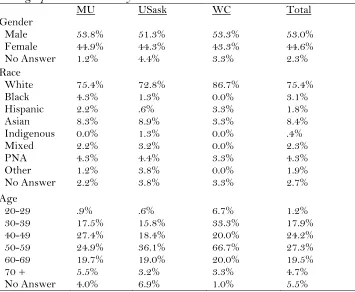
Table 1
Demographic Data Summary
MU USask WC Total
Gender Male Female No Answer 53.8% 44.9% 1.2% 51.3% 44.3% 4.4% 53.3% 43.3% 3.3% 53.0% 44.6% 2.3% Race White Black Hispanic Asian Indigenous Mixed PNA Other No Answer 75.4% 4.3% 2.2% 8.3% 0.0% 2.2% 4.3% 1.2% 2.2% 72.8% 1.3% .6% 8.9% 1.3% 3.2% 4.4% 3.8% 3.8% 86.7% 0.0% 3.3% 3.3% 0.0% 0.0% 3.3% 0.0% 3.3% 75.4% 3.1% 1.8% 8.4% .4% 2.3% 4.3% 1.9% 2.7% Age 20-29 30-39 40-49 50-59 60-69 70 + No Answer .9% 17.5% 27.4% 24.9% 19.7% 5.5% 4.0% .6% 15.8% 18.4% 36.1% 19.0% 3.2% 6.9% 6.7% 33.3% 20.0% 66.7% 20.0% 3.3% 1.0% 1.2% 17.9% 24.2% 27.3% 19.5% 4.7% 5.5%
FIRE-Forum for International Research in Education
Additionally, the National Churchill Museum and the Churchill Institute, with its Center for Engaging the World, provide WC with a well-known reputation for international engagement.
Demographics
The survey was available for fifteen days at each institution and reminders were sent out periodically to encourage participation. After the surveys were closed, and data purged of responses that were incomplete, it was determined that 512 faculty members had responded to the survey. Of those, 366 answered the open-ended question, which asked faculty members to provide information about what they think future directions for internationalization should be on their campuses. During the conduct of this research, additional questions were asked of participants to collect demographic and professional characteristics (see Table 1). The majority of participants identified as Male (53.8%) followed by Female (44.9%). The average participant ages ranged from 24 to 89 with a mean age of 50.95 and a standard deviation of 11.88. The racial makeup of participants were: White (75.4%); Black (3.1%); Hispanic (1.8%); Asian (8.4%), Indigenous (.4%), with 8.9% reporting Other, Mixed, or did not answer.
Regarding professional attributes, in particular rank, 3.5% of faculty identified themselves as adjunct, 2.7% as lecturers, 25.9% assistant professors, 27.5% associate professors, 32.6% full professors, with “Other” making up 5.8%. With respect to the types of courses faculty members taught, 29.8% reported teaching natural science, 7.8% hard science, 17.2% humanities, and 39% social sciences. A more detailed exploration of the professional attributes across institutions can be found in Table 2.
Table 2
Professional Attributes Summary
MU USask WC Total
Rank Adjunct Lecturer Assistant Prof Associate Prof Full Prof Other No Answer 4.0% 2.8% 25.8% 26.8% 31.7% 7.7% 1.2% 1.3% 3.2% 22.3% 31.6% 36.7% 2.5% 2.5% 10.0% 0.0% 46.7% 13.3% 23.3% 3.3% 3.3% 3.5% 2.7% 25.9% 27.5% 32.7% 5.8% 1.8% Course Content Natural Sciences Hard Sciences Humanities Social Sciences No Answer 25.2% 9.2% 19.4% 40.3% 5.8% 41.8% 5.1% 10.1% 35.4% 7.6% 16.7% 6.7% 30.0% 43.3% 3.3% 29.8% 7.8% 17.2% 39.0% 6.2%
As noted previously, internationalization is complex and faculty members’ understandings of what constitutes internationalization may differ significantly. To ensure that everyone was operating from the same basic understanding, a definition was provided from the works of Jane Knight (2004) who stated that internationalization is “the process of integrating an international, intercultural or global dimension into the purpose, functions or delivery of post-secondary education.”
FIRE-Forum for International Research in Education
an understanding of the content; third, the creation of categories or themes within the data; fourth, identifying overlapping codes; and fifth, revision and refinement in order to identify additional categories, or to combine similar categories.
In order to comply with these steps, the following process was undertaken. First, the data responses from the three institutions were combined into a single table with a column to identify the institution. Second, the response text was then closely reviewed to gain a broad understanding of the response content. Third, a set of raw codes was developed based on thematic similarities between data segments. In particular, many faculty members provided several priorities within a single response. Fourth, codes were examined to identify similarities and overlap and, where possible, codes that were very similar were combined. Fifth, the final codes were established and results compiled.
Table 3
Emergent Codes
1. General opinions on international efforts. Assume that if someone makes a suggestion in one of these other categories they want the campus to:
a. DM: Do More b. DE: Doing Enough c. DT: Doing Too much d. DK: Don’t Know 2. Curriculum
a. CURINT: Curriculum Integration of International knowledge. Adding to or changing the curriculum to be more international.
b. CURPRO: Academic programs for students such as study abroad, foreign language, etc.
3. Faculty Support
a. FACDEV: Faculty
development/training in
internationalization.
b. FACSUP: Staff to support teaching of international students, grant writing, etc.
c. FACOPP: Faculty opportunities for international experiences
d. FACFUN: Faculty Funding for international research, teaching, presentations (including international). e. FACREW: Faculty rewards/incentives
for internationalization; e.g. tenure, merit.
f. FACREC: Recruiting International faculty
4. Campus culture
a. CULCHA: Change culture, attitudes or values re: internationalization of the campus.
b. CULCOM: Develop Cultural Competence
5. Student Support
a. STUDEV: Student
development/training in
internationalization.
b. STUSUP: Support to adjust to their new environment, general support. c. STUOPP: Student opportunities for
international experiences
d. STUFUN: Student funding for international research, teaching
e. STUREC: Recruiting International Students
6. Leadership
a. CAMVIS: Develop and communicate clear vision, perspective, and priorities.
b. CAMPOL: Campus policies based on strategic planning, goals, implementation, evaluation, not just feel good or symbolic.
c. CAMSUP: Staffing support for partnerships, grants, study abroad, Information.
FIRE-Forum for International Research in Education
Within qualitative research, establishing trustworthiness is very important (Shenton, 2004). A common criticism that is often leveled against qualitative research has to do with participant selection bias. However, in the case of this research effort, the information was drawn from the full faculty at each institution, thus eliminating the specter of research bias in the selection of participants. This does not mitigate questions of self-selection bias on the part of faculty members. Another way that trustworthiness was enhanced was through peer scrutiny of the data. In particular two researchers examined the data responses independently. Afterward, a review of the data was conducted and any discrepancies in interpretation were discussed and resolved. The final results were then merged into a single harmonized set of codes (see Table 3).
Findings
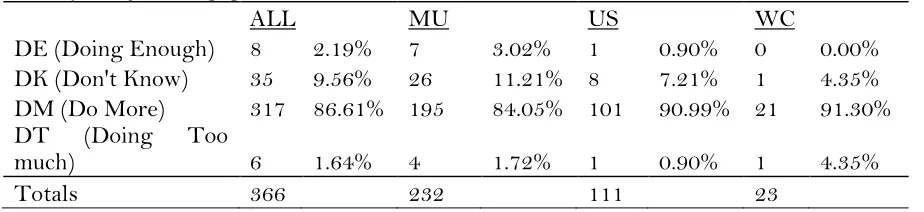
The findings of one of the quantitative aspects of the survey indicate that responding faculty members are very supportive of internationalization as a whole (Table 4). In particular, 86.61% indicated that the institution should do more, 9.5% responded that they did not know, 2% suggested that the institution is already doing enough, and 1.6% thought that the institution was doing too much. These findings corroborate very general assertions from Altbach and Lewis (1996) that the “academic profession expresses a high degree of commitment to internationalization” (p. 38).
Beyond questions of support, faculty members provided very detailed qualitative feedback regarding what they think internationalization priorities should be on their campus. Through the use of inductive coding, documented above, nineteen codes were developed that captured similar responses from faculty members. These codes were then grouped more broadly in terms of campus wide leadership, campus culture, faculty support, student support, and curriculum (Table 3). The results of the analysis of the coded data can be found in Table 5.
Major Themes of Findings. The following findings concentrate on the areas of funding, opportunity, support, visions, and student programs. The findings are presented in the order that they were ranked according to Table 5. Although there were nineteen coded categories, only the first five will be covered, as they make up over 60% of the total faculty responses. These five codes include: faculty funding for international research, teaching, presentations (including international); faculty opportunities for international experiences; staffing support for partnerships, grants, study abroad, and information; develop and communicate clear vision, perspective, and priorities; and academic programs for students such as study abroad, foreign language, and the like.
Table 4
Faculty Beliefs on Engagement in Institutional Internationalization
ALL MU US WC
DE (Doing Enough) 8 2.19% 7 3.02% 1 0.90% 0 0.00%
DK (Don't Know) 35 9.56% 26 11.21% 8 7.21% 1 4.35%
DM (Do More) 317 86.61% 195 84.05% 101 90.99% 21 91.30% DT (Doing Too
much) 6 1.64% 4 1.72% 1 0.90% 1 4.35%
FIRE-Forum for International Research in Education
Just Lip-Service
One of the key complaints that surfaced regularly had to do with the difference between the stated institutional priorities regarding internationalization and the actual support that faculty members received. Faculty members expressed this in several ways. Some faculty members described the institutional encouragement to internationalize the campus as little more than “rhetoric.” In particular, one suggested that the institution should “build programs to match the rhetoric” while another noted that the institution should be “finding and putting money behind the rhetoric.” Others expressed the same sentiments by noting that the institution is merely engaged in “lip service” or “symbolic gestures.” In this context, some faculty members see internationalization as little more than a “buzzword.” Many of these sentiments are summed up by a University of Missouri faculty member who stated that “those of us who actually pursue international activities have come to think that our campus administration is more interested in appearing international than they are [in] financially supporting international activity.”
The separation between institutional directive and institutional support is not a new notion. As stated previously, Engberg and Green (2002) found that institutions are more rhetorically supportive than financially. This places faculty members in an untenable position where they are, in the words of a University of Missouri professor, asked to “do things that we are not supported to carry out.”
Table 5 Coded Results
ALL MU USask WC
FACFUN 113 23.30% 70 23.49% 31 20.13% 12 36.36%
FACOPP 62 12.78% 37 12.42% 20 12.99% 5 15.15%
CAMSUP 55 11.34% 33 11.07% 20 12.99% 2 6.06%
CAMVIS 39 8.04% 23 7.72% 15 9.74% 1 3.03%
CURPRO 31 6.39% 21 7.05% 8 5.19% 2 6.06%
FACREW 31 6.39% 21 7.05% 9 5.84% 1 3.03%
CAMPOL 27 5.57% 17 5.70% 8 5.19% 2 6.06%
STUREC 26 5.36% 13 4.36% 12 7.79% 1 3.03%
CURINT 19 3.92% 11 3.69% 5 3.25% 3 9.09%
FACREC 17 3.51% 12 4.03% 4 2.60% 1 3.03%
STUFUN 15 3.09% 9 3.02% 5 3.25% 1 3.03%
FACDEV 13 2.68% 8 2.68% 5 3.25% 0 0.00%
CULCHA 10 2.06% 6 2.01% 3 1.95% 1 3.03%
CAMEQU 8 1.65% 6 2.01% 2 1.30% 0 0.00%
STUSUP 7 1.44% 2 0.67% 4 2.60% 1 3.03%
FACSUP 5 1.03% 2 0.67% 3 1.95% 0 0.00%
CULCOM 3 0.62% 3 1.01% 0 0.00% 0 0.00%
STUOPP 3 0.62% 3 1.01% 0 0.00% 0 0.00%
STUDEV 1 0.21% 1 0.34% 0 0.00% 0 0.00%
FIRE-Forum for International Research in Education
Another issue that was also voiced by faculty members had to do with differences between institutions at a department level. Faculty members recognize that departments are an important player when it comes to internationalization. However, they also charge that when institutional leaders express support for internationalization, they actually limit that support to a favored subset of disciplines based on personal connections. To this assertion, one faculty member stated that the institutions should “make international opportunities equally available to all faculty, based on their experience instead of their relationship with the people in charge of international programs.” Other faculty members pointed out that the “lion’s share” of international funding goes to the sciences and called for a more equitable distribution across the university. As one MU faculty member summarized, “There is a big gap between the Chancellor's office, which encourages international efforts, and specific colleges such as A&S that provide lip service but lack international leadership and funding.”
With this in mind, many of the findings in this study document perceptions that, despite calls from the institution to internationalize the campus, there is a general lack of tangible institutional support.
Funding (FACFUN). The most commonly expressed topic that faculty members identified is that “funding is a major limitation” when engaging in the international context. This is not a surprise given Engberg and Green’s (2002) similar findings, although this research offers a much more nuanced picture of how faculty members view funding issues. To some degree this is because different faculty members view funding insufficiency differently, depending on their particular role within the institution. For instance, some faculty members valued institutional funding for international research while others valued institutional funding for teaching abroad. Regardless of what programs faculty members valued, they were very consistent in voicing their concerns about funding limitations.
For some faculty members, institutional sources of funding and support are not accessible. In particular, research faculty need not apply because, in the words of one research faculty member at the University of Missouri, “many of the campus opportunities are only for tenured or tenure track faculty.” As a result of these kinds of restrictions, other classes of faculty members such as adjunct, teaching, and retired faculty may also find that funding is not available. Those faculty who qualify to access institutional sources of funding often found that there was a quagmire of rules that one must wade through. For instance, a few faculty members pointed out that policies regarding access to funding were vague and suggested that policies needed to be clarified. For those intrepid faculty members who do manage to jump through the hoops necessary to get funding, they often found that the amount of the award is inadequate in light of the expenses, particularly with respect to travel. While several faculty members pointed out this discrepancy, one from MU summed up his particular experience by noting that:
Faculty are permitted to apply for funding for international conferences only once every two years, for an award amount not to exceed $1,500. At this point in time, between airfare, ground transport, registration fees, and room and board, traveling to and participating in an international conference costs about $3,000+ (airfare alone to my last conference, in Paris, was nearly $1,500).
Because of this discrepancy between cost and expenditure, many faculty members either pay for their expenses out of pocket, or they simply forgo any efforts to engage in institutional efforts to internationalize.
FIRE-Forum for International Research in Education
institutions that promote internationalization should “put their money where their mouth is,” or more tactfully, “financial support needs to follow any mission statement.” While many faculty members spoke of funding only in the most general terms, others were much more specific. A few faculty members, less than 10, commented that funding is needed to host international conferences, build or seed collaborative efforts, and train faculty members on ways to create a more internationalized campus. However, the topics that generated the most comments included making travel funds more easily accessible and, because of the expensive nature of international travel, to increase funding to match real world expenses.
Another issue that received frequent comments was increasing funding for faculty members to teach internationally. In this context, faculty members complained about the costs of travel and the costs of setting up temporary residence in another country, as well as general expenses incurred abroad. Additionally, there were several complaints about the lack of support from institutional staff to smooth the process of international teaching. The most commented on topic, more than 20, was financing for international research. In particular, faculty members stated that institutions should work with faculty members to create new collaborative research partnerships, support established partnerships, and provide grants to faculty members to pursue international research.
Opportunity (FACOPP). The next major theme that has emerged from the survey is with regard to the opportunities presented to faculty members for engaging in internationalization. It is no surprise that the theme Opportunity is closely intertwined with the previous theme Funding, as most opportunities cannot be created without the adequate support of finances and resources.
This research suggests that faculty members would like to see several different kinds of opportunities, from general ones (such as forging international relationships between institutions and providing faculty members with international experiences) to more specific opportunities (such as international research projects in particular fields and teaching opportunities in foreign countries). Regarding the comments that suggested forms of opportunities, more than 45 faculty members expressed the importance of having international opportunities to collaborate on teaching and research with foreign countries. A number of faculty members pointed out that universities need to connect better with Western Europe, Brazil, China, India, South Korea, and Japan, and even to extend collaborative ties to “countries that are not on university’s priority list.”
About 58 of the 62 faculty participants (95%) who identified opportunities as an important theme in their comments suggested it would be beneficial if more opportunities be given to current university faculty members so they can teach, research, and learn outside the U.S. Among them, 47 faculty members hoped that the administration would go beyond rhetoric and conduct “concrete steps to facilitate and support broader faculty engagement in international collaborations.” A number of MU faculty members specifically pointed out that universities are expected to examine ways to support faculty in seeking opportunities for international research or teaching and should not leave it to individual faculty members to create international opportunities on their own.
FIRE-Forum for International Research in Education
Additionally, a faculty member at MU pointed out that national security concerns may play a role in restricting research collaboration.
Support (CAMSUP). The third major theme that faculty members identified was Institutional Support for internationalization. Although it could be argued that financial support is a form of institutional support, in this case the definition will be drawn more narrowly. Support in this case refers to the institution having an infrastructure in place that promotes internationalization and that faculty members can tap into in their efforts to internationalize.
For the most part, faculty members who did mention issues of support were in favor of expanding the institution’s role. However, there were a few faculty members who decried that the support already in place was too expansive already. As one MU faculty member explained, “With regard to international activity, there are no next steps necessary. The University provides adequate, if not excessive, support.” This faculty member then went on to draw comparisons between international and domestic students and how the university essentially coddles international students at the expense of domestic students.
The majority of faculty members who discussed institutional support did so by first explaining that engaging in the process of internationalization is not an easy task. Several explained that internationalization is a “burden” that actually discourages faculty members from participating. In this vein faculty members described their experiences with internationalization as “a headache” where institutions provide little or no support. However, even if they do provide support, it is difficult to access. One USask faculty member stated, “You wouldn’t believe the work I had to put into to find what resources were already out there.”
In this context, the largest number of faculty members that addressed institutional support either stated in very general terms that “there needs to be more support” or decried that available support as essentially invisible. With respect to the invisibility, a faculty member from the USask provided an interesting point on the lack of awareness of the international office by stating that the institution should “create an international affairs office” or if it already existed, to promote the office and the kinds of support it can offer. Other faculty members echoed the same marketing sentiment by indicating that the institution should be more proactive in advertising the resources that they do have available. For instance, a faculty member from MU stated that the institution should “market the idea of internationalization since the benefits are currently unknown or not well understood to many students, faculty, and staff across campus.”
Although many faculty members identified problems with information availability and marketing, many more had very specific ideas about how to enhance support for internationalization. For the most part their suggestions were focused on ways in which support could reduce the more discouraging aspects of international engagement. For example, faculty-led study abroad programs were a topic that several faculty members suggested was in need of additional support. Faculty members identified the administrative red tape that needed to be overcome and suggested that better administrative support could free them up from having to “use their own personal money to book hotels for students, or to pay for stuff, because people in accounting are too hard headed to deal with anything slightly outside the box.” Another faculty member indicated that it was actually the international center that was a problem, as it made faculty-led programs more expensive through the charging of “exorbitant fees.”
FIRE-Forum for International Research in Education
partnerships in the Middle East is important. Many Gulf countries are seeking higher education resources and partnerships with U.S. universities and ours should be in the mix.” While another speaking on the same topic noted that institutional support should focus on “establishing and maintaining organizational and individual contacts.” Finally, several other suggestions were mentioned. For instance, faculty members stated that institutional support for course development, infrastructure, grant writing, and research could go a long way toward creating a supportive institution.
Vision (CAMVIS). The fourth major theme that emerged from the survey data is identified as Vision, which refers to the vision, perspectives, and priorities that need to be developed for faculty members by university authorities. In this theme, much emphasis has been placed on the responsibility of leadership in carrying out clear and effective communication of internationalization.
The majority of the faculty members who identified Vision as a major theme agreed that the first step is for the university leaders is to develop clear goals, policies, and common visions on internationalization, or to raise the awareness of existing opportunities and support mechanisms. For instance, one USask faculty member stated he would appreciate a clear discussion of internationalization “on the extent to which it should be pursued, where it should be pursued, and for what purpose.” In fact, a great portion of the comments are strikingly similar in that very little opinion was provided. This is a result of a general unawareness of faculty members regarding current internationalization policies, which in turn leads to comments indicating that they “therefore cannot comment on this.”
Next, faculty members also believe it is important that the university leaders continue to advocate, promote, and encourage faculty members to engage in internationalization. To achieve this goal, university leaders are not only expected to carry out strategic plans but are also expected to establish an effective reward mechanism that offers incentives for faculty members to engage in internationalization. One MU faculty member commented that even though there has been constant talk about internationalization from high-level school leadership, he gets “no rewards or even recognition for internationalization” in his department. Overall, there was a common voice among the faculty members who support and engage in internationalization that “there needs to be raises, rewards, and incentives for faculty to internationalize.”
Student Programs (CURPRO). Up to this point, most of the topics have focused on either faculty members or infrastructure that supports faculty members in the process of making a campus more international. However, faculty members understand the importance of creating programs that support students to become more international as well. In this context, faculty members identified three basic areas that need attention: study abroad, foreign language programs, and international student support.
FIRE-Forum for International Research in Education
believe that their institutions needs to do more to promote these programs, while working to find less expensive alternatives to traditional programs.
The second issue that faculty members identified was international student support. In particular they identified that international students struggle with the language and the culture and more needs to be done to fully integrate them into the campus community. To do this, faculty members have suggested that international students should be more heavily vetted to ensure that their language and reading skills are up to date prior to their arrival on campus. Additionally, they think that resources should be provided to international students prior to their arrival on campus in the form of “online courses” to help them with their English language and their communication skills and to help them to connect with peers.
The last item faculty members identified was foreign language programs. They identified the importance of these programs. Several echoed that “promoting second language skills is crucial if we wish to prepare graduate students for work that engages other cultures” or that “language learning is an essential component of internationalization, and by neglecting it, we are putting future generations at risk in the global economy.”
While faculty members generally understand the importance of language learning programs, they take aim at the institution for either cutting them or offering poor quality programs. For instance, one USask faculty member bluntly stated that, “if they [foreign language programs] are suffering from low enrolments, the best course of action is to look at ways to promote higher enrolments, not to cut the programs.” Additionally, faculty members lament the poor quality or very limited programs. One USask faculty member described the impossibility of learning a language in “classes that are so massive that they are worthless.” Also, they note that important languages are not offered. A few faculty members echoed the following statement by an MU professor: “You cannot possibly claim to have an international campus where study of Asian and African languages and cultures are virtually unknown. No Arabic. The only Chinese language courses are taught in the German department.”
In general, the faculty members have identified the importance of programs meant to internationalize the student body. However, they also looked at the current infrastructure for developing internationally-minded students and found it to be quite lacking. One faculty member speaking about study abroad programs stated that “what we currently have is joke.”
Recommendations
The study participants offered many suggestions that they thought would enhance internationalization. After examining hundreds of recommendations by faculty members, it is the view of the researchers that the following critical issues should be addressed at an institutional level. Specifically, institutional leaders:
Need to do a better job explaining the policies and goals regarding internationalization.
Be more proactive in promoting existing programs and opportunities to faculty members.
Work with faculty members to identify sources of external funding for international teaching, research, and service.
Review institutional policies and structures to streamline access to institutional funding and resources.
FIRE-Forum for International Research in Education
Expand eligibility to access institutional funding to other than tenured or tenure track faculty.
Seek out and build robust institutional partnerships, especially with institutions in parts of the world that are underrepresented, that promote cross-institutional teaching, research, and service opportunities.
Review ways that fees charged for faculty-led programs can actually be an impediment to internationalization efforts.
Promote student study abroad programs and work to make them more affordable.
Provide resources for incoming international students to become more proficient regarding language and culture.
Reverse the decline of foreign language programs by promoting them more vigorously and working to increase their quality.
These recommendations would have wide ranging impact on efforts to internationalize the campus. Faculty members have a broad understanding of what constitutes internationalization. At the very least, they point out major pain points between institutional goals and the ability of faculty members to fulfill them. One aspect of examining faculty feedback regarding internationalization is that administrators can see that faculty members are very thoughtful, as a whole, about internationalization. Additionally, by aligning institutional and faculty goals more closely and enlisting faculty members to that effort, the possibility of creating a truly internationalized campus will be enhanced significantly.
Conclusion
This study was undertaken from the perspective of faculty members out of an interest in their priorities regarding engagement in internationalization. The data included 485 specific priorities from 366 respondents across three institutions, two in the United States and one in Canada. Inductive coding of the responses provided valuable insights into understanding the ways in which faculty members believe that their respective universities should work to support engagement in the international context. This is important, as the goals of internationalization are institutional goals expressed through policy, resources, and rhetoric.
Overall, faculty members expressed a great deal of support for internationalization, not only for themselves, but the student body as well. This is evident by the number of responses that expressed a more expansive role for the institution. This study suggests that the underlying reasons that faculty members do not engage in the international context is not because of a lack of desire but due to a lack of resources and support. The solution to the problem of international engagement by the faculty does not just lie in acquiescing to the priorities that faculty members have outlined, or simply ignoring them and continuing down the same dysfunctional path. Rather, all would be better served through a robust conversation between institutional leaders and faculty members and a willingness of both to negotiate a solution.
FIRE-Forum for International Research in Education
generalizable findings. Further, given how faculty priorities constitute an important part in the overall internationalization climate of an institution, this study suggests a need for more in-depth case studies that explore and compare the faculty internationalization status quo of specific institutions so as to learn from each other and make recommendations to higher education administrators.
This study is significant in that it provides institutional leaders with information about how faculty members, who are important resources for internationalization on campus, would like to see internationalization supported and prioritized. If institutional leaders can align the institution’s priorities more closely with faculty priorities, then a more effective atmosphere for internationalization may likely result.
References
Altbach, P. G., & Knight, J. (2007). The internationalization of higher education: Motivations and realities. Journal of Studies in International Education, 11(3-4), 290-305.
Altbach, P. G., & Lewis, L. S. (1996). The academic profession in international perspective. In P. G. Altbach (Ed.), The international academic profession: Portraits of fourteen countries (pp. 3-48). Princeton, New Jersey: The Carnegie Foundation for the Advancement of Teaching. Altbach, P. G., & Teichler, U. (2001). Internationalization and Exchanges in a Globalized
University. Journal of Studies in International Education, 5(1), 5-25. Retrieved from http://jsi.sagepub.com/content/5/1/5.abstract
American Council on Education. (2012). Mapping internationalization on U.S. campuses : 2012 edition (pp. 1–23). Washington, DC: American Council on Education.
Andreasen, R. (2003). Barriers to international involvement. Journal of International Agricultural and Extension Education, 10(3), 65–69.
Bond, S. (2003). Untapped resources: Internationalization of the curriculum and classroom experience. Canadian Bureau for International Education Research, 7, 1-15.
Boyer, E. (1990). Scholarship reconsidered, priorities of the professoriate. New York, NY: The Carnegie Foundation for the Advancement of Teaching.
Childress, L. K. (2009). Planning for internationalization by investing in faculty. Journal of International & Global Studies, 1(1), 30–49.
Criswell, J. (2014). Faculty International Perceptions Survey: Development and initial validation. Unpublished Dissertation, University of Missouri.
Dewey, P., & Duff, S. (2009). Reason before passion: Faculty views on internationalization in higher education. Higher Education, 58(4), 491–504.
Engberg, D., & Green, M. (2002). Promising practices: Spotlighting excellence in comprehensive internationalization. Washington, D.C: American Council on Education.
Fall 2013 Enrollment Summary, (2013). Retrieved on April 27, 2014 from
http://registrar.missouri.edu/statistics/fall-2013/Fall-2013-Enrollment-Summary-combined.pdf.
Finkelstein, M. J., Walker, E., & Chen, R. (2009). The Internationalization of the American Faculty: where are we, what drives or deters us?. The Changing Academic Profession Over 1992-2007: International, Comparative, and Quantitative Perspectives (p. 113).
Friesen, R. (2013). Faculty member engagement in Canadian university internationalization A consideration of understanding, motivations and rationales. Journal of Studies in International Education, 17(3), 209-227.
FIRE-Forum for International Research in Education
Institute of International Education.(2012). Opendoors 2012 fast facts. Retrieved from http://www.iie.org/opendoors
Knight, J. (2004). Internationalization remodeled: Definition, approaches, and rationales. Journal of Studies in International Education, 8(1), 5-31.
Lebeau, L. G. (2010). The international mobility of the American faculty: Scope and challenges. Journal of the Indiana University Student Personnel Association, 41–47.
Lee, S. (1996). The Academic Profession in Korea. In P. G. Altbach (Ed.), The international academic profession: Portraits of fourteen countries (pp. 97-148). Princeton, New Jersey: The Carnegie Foundation for the Advancement of Teaching.
MU Facts, (2014). Retrieved on April 27, 2014 from
https://uminfopoint.umsystem.edu/media/president/Facts-2014.pdf.
Postiglione, G. (1996). The Future of the Hong Kong Academic Profession in a Period of Profound Change. In P. G. Altbach (Ed.), The international academic profession: Portraits of fourteen countries (pp. 191-227). Princeton, New Jersey: The Carnegie Foundation for the Advancement of Teaching.
Russo, S. L., & Osborne, L. A. (2004). The globally competent student. Retrieved from: http://www.aplu.org/NetCommunity/Document.Doc?id=41
Sanderson, G. (2007). A Foundation for the Internationalisation of the Academic Self. Journal of Studies in International Education, 12(3), 276-307.
Saiya, L., & Hayward, F. M. (2003). Mapping internationalization on U.S. campuses. Washington, DC: American Council on Education.
Schiefelbein, E. (1996). The Chilean Academic Profession: Six Policy Issues. In P. G. Altbach (Ed.), The international academic profession: Portraits of fourteen countries (pp. 281-306). Princeton, New Jersey: The Carnegie Foundation for the Advancement of Teaching.
Shenton, A. K. (2004). Strategies for ensuring trustworthiness in qualitative research projects. Education for Information, 22(2), 63-75.
Stohl, M. (2007). We have met the enemy and he is us: The role of the faculty in the internationalization of higher education in the coming decade. Journal of Studies in International Education, 11(3-4), 359–372.
Student Headcount and Demographics, (2014).Retrieved on April 27, 2014 from http://www.usask.ca/isa/statistics/students/headcount-demographics.php.
Sursock, A., & Smidt, H. (2010). Trends 2010: A decade of change in European higher education. Brussels: European University Association.
Thomas, D. R. (2006). A general inductive approach for analyzing qualitative evaluation data. American Journal of Evaluation, 27(2), 237-246.
About the Authors
John Criswell has his doctorate in Education Leadership and Policy Analysis from the University of Missouri – Columbia. John is interested in exploring topics in international and comparative education as well as the utilization of technology in educational contexts.
FIRE-Forum for International Research in Education