IJPAR |Vol.7 | Issue 3 | July - Sep -2018 Journal Home page: www.ijpar.com
Research article Open Access
Analytical method development and validation for the estimation of
ursodiol in bulk and pharmaceutical formulation by RP-HPLC
Lakshmi kanth M*
1, Raj Kamal B
21
Research Scholar, Mewar University, Chittorgarh, Rajasthan, India.
2Research Supervisor, Mewar University, Chittorgarh, Rajasthan, India.
*Corresponding Author:M. Lakshmi kanth
Email:kanth,[email protected]
ABSTRACT
The present work is aimed at developing and validating an accurate, precise and rapid high -pressure liquid chromatography method (HPLC) for the estimation of ursodiol in bulk and pharmaceutical formulation. The separation was achieved using RP C-18 XTerra Column (25 cm x 4.6 mmx5 µm) and mobile phase comprising of methanol: acetonitrile: phosphoric acid (60:20:20 v/v). The flow rate maintained at 0.8 ml/min with a minimal run time of 7 minutes. The retention time of ursodiol was found to be 3.085 minutes. T his method is linear over the range of 2-24 μg/ml with a recovery of 99.54%.The regression equation is 54219.86x + 7662.85 with regression coefficient of 0.999. Validation parameters such as specificity, linearity, precision, accuracy, robustness, limit of detection (LOD) and limit of quantitation (LOQ) were evaluated for the method according to the International Conference on Harmonization (ICH) Q2 R1 guidelines. The method fulfilled the requirements for reliability and feasibility for application to the q uantitative analysis of ursodiol in bulk and pharmaceutical dosage forms.
Keywords:
Ursodiol, Biliary Cholangitis, Robustness, LOD, LOQINTRODUCTION
Ursodiol is a naturally occurring bile acid that is used to dissolve cholesterol gall stones and to treat cholestatic forms of liver diseases including primary biliary cirrhosis. Ursodiol has been linked to rare instances of transient and mild serum aminotransferase elevations during therapy and to rare instances of jaundice and worsening of liver disease in patients with preexisting cirrhosis
[1-5].Ursodiol is used to dissolve certain types of gallstones to prevent gallstones from forming in obese patients who are losing weight rapidly and to treat a certain type of liver disease (primary biliary cirrhosis). It is also used to treat many other hepatobiliary disorders [5-8].
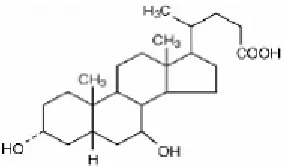
The chemical name of ursodiol is (4R)-4-
[(3R,5S,7S,8R,9S,10S,13R,14S,17R)-3,7-
2,3,4,5,6,7,8,9,11,12,14,15,16,17-tetradecahydro-1H-cyclopenta[a]phenanthren-17-yl] pentanoic
acid(C24H40O4). Ursodiol has a molecular weight of
392.56 g/mol. (Figure1)
Figure 1: Structure of ursodiol
Literature review reveals that few analytical methods have been reported for the determination of Ursodiol which includes High performance
liquid chromatography and Liquid
chromatography-Mass spectroscopy [9-15]. The present study was aimed to develop a novel, simple, economic and validated RP-HPLC method for the estimation of Ursodiol in bulk and pharmaceutical dosage form according to ICH guidelines [16].
MATERIALS AND METHODS:
Materials
Ursodiol bulk drug was kindly provided as gift sample by Hetero Drugs, Hyderabad, India. HPLC grade of Methanol and Acetonitrile purchased from Merck Specialities Private Limited, India. Analytical grade ortho phosphoric acid purchased from Rankem Ltd., India. Udoxyl 150 mg Tablet is obtained from a local pharmacy.
Instruments
Quantitative HPLC was performed on liquid Chromatography, Waters separation 2996, PDA detector module equipped with automatic injector with injection volume 20 µl, and 2693 pump. The HPLC system was equipped with Empower Software. An RP C-18 XTerra(R) column (250x4.6 mm i.d; particle size 5 μm) was used.PG Instruments T60 with special bandwidth of 2mm and 10mm and matched quartz was be used for UV measurements. Semi-micro analytical balance (India), an Ultrasonic bath sonicator (Frontline FS 4, Mumbai, India), Digital pH meter (Systronics model 802) and whatmann filter paper No. 41 (Whatmann International Ltd., England) were used in the study.
Chromatographic parameters
Column : A RP C-18 XTerra (R) column (250x4.6 mm, 5 μ)
Flow rate : 0.8 ml/min Run time : 7 minutes Temperature : Ambient Injection volume : 20 μl Detection wavelength : 254 nm Retention time : 3.085 minutes
Preparation of standard drug solution
Weigh accurately and transfer 100mg of Ursodiol working standard into a 200 ml volumetric flask. Add 70ml of diluent and sonicate to dissolve. Dilute to volume with diluent and mix.
Preparation of sample solution
A sample of the powdered tablets, equivalent to 2mg of the active ingredient, was mixed with 30 ml of diluent in 100 ml volumetric flask. The mixture was allowed to stand for 1 hr with intermittent sonication to ensure complete solubility of the drug, and then filtered through a 0.45 μm membrane filter, followed by adding diluent up to 100 ml to obtain a stock solution of 200 µg/ml.
Mobile phase preparation
Transfer 1ml of ortho phosphoric acid (85%) into 1000ml volumetric flask containing about 300 ml of water, dilute to volume with water and mix well.
Wave length selection
Prepared 10 µg/ml concentration of ursodiol in the mobile phase and scanned by using the UV double beam spectrometer within the wavelength region of 200-400 nm. The maximum absorption observed at 254nm.
RESULTS AND DISCUSSION
The HPLC method was validated according to the International Conference on Harmonization (ICH) guidelines (2005). The following characteristics were considered for validation: system suitability, linearity, accuracy, precision, LOD, LOQ and robustness.
System suitability
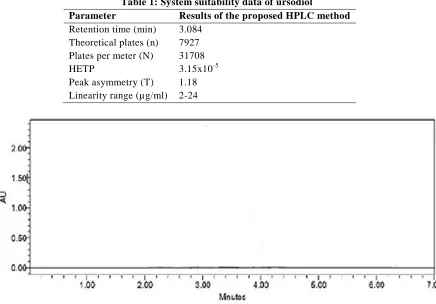
Analytical system performance before and/or during the analysis was evaluated by system suitability test. System suitability test are an integral part of method development and are performed to evaluate the behaviour of the chromatographic system such as area, retention time, Resolution, plate number and tailing factor. The system suitability data for ursodiol evaluated from standard chromatogram shows that the retention time for ursodiol drug was 3.084min. Theoretical plates was found to be 7927(Figure 2, Figure 3 and Figure 4). The obtained results were agreed with ICH guidelines. The results were mentioned in the Table 1.
Table 1: System suitability data of ursodiol
Parameter Results of the proposed HPLC method
Retention time (min) 3.084 Theoretical plates (n) 7927 Plates per meter (N) 31708
HETP 3.15x10⁻⁵
Peak asymmetry (T) 1.18 Linearity range (µg/ml) 2-24
Figure 3: Optimized chromatogram of ursodiol
Figure 4: Standard chromatogram of ursodiol
Precision
The precision of the method was ascertained separately from the peak area obtained by actual determination of 6 replicas of a fixed amount of drug and formulation. The HPLC systems was set up the described chromatographic conditions
mentioned as above and follow the system to equilibrate, and then injected the 20µg/ml concentration of ursodiol standard 6 times and recorded the response (peak area). The precision was repeated with the formulated sample of same concentration (Table 2)
Table 2: Precision data of ursodiol Injection
#
Name of the drug& conc. (20µg/ml).
Retention time in min. Peak Area
1 Ursodiol 3.086 1074007
2 Ursodiol 3.087 1074298
3 Ursodiol 3.083 1074748
4 Ursodiol 3.084 1070962
5 Ursodiol 3.084 1071315
6 Ursodiol 3.090 1073136
Mean 3.085 1073077.738
SD 0.0025 1595.506
% RSD. 0.083 0.1
U
r
so
d
io
l-3
.0
8
4
U
r
so
d
io
l-3
.0
8
Linearity
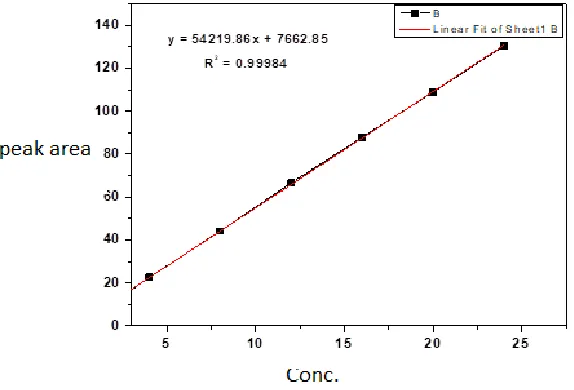
The linearity of an analytical procedure is its ability (within a given range) to obtain test results that are directly proportional to the concentration of the analyte in the sample. A value of correlation coefficient (r2)> 0.998 is considered as the evidence of an acceptable of the data to the regression line.
Aliquots of standard ursodiol stock solution were taken in different 10 ml volumetric flasks and
diluted up to the mark with the mobile phase such that the final concentrations are in the range of 2-24 μg/ml (Table 3). Each of these drug solutions was injected three times into the column, and the peak areas and retention times were recorded. Evaluation was performed with PDA detector at 254 nm and a Calibration graph was obtained by plotting peak area (Y axis) versus concentration (X axis) of ursodiol (Figure 5).
Figure 5: Linearity graph of ursodiol
Table 3: Standard calibration values of ursodiol Concentration of drug (µg/ml) Peak Area
2 109229
4 226017
8 441659
12 666479
16 879210
20 1088950
24 1305004
Recovery Studies
Recovery studies were conducted by analyzing pharmaceutical formulation in the first instance for the active ingredient in the concentration of 80% of the working standard (contains16 µg/ml of ursodiol); 100% of the working standard solution (contains 20 µg/ml of ursodiol) and 120% of the working standard solution (contains 24 µg/ml of ursodiol) by the proposed method (Table 4). Each concentration was injected 3 times and the peak
area was recorded. Known amounts of pure drug was then added to each 3 previously analyzed formulation and the total amount of the drug was once again determined by the proposed method (each concentration was again injected 3 times) after keeping the active ingredient concentration within the linearity limits (Table 5).
Table 4: Recovery data of ursodiol Drug concentration Mean ±SD 80%( 16 µg/ml) 98.85±0.52 100%(20µg/ml) 100.52±0.65 120%(24µg/ml) 99.26±0.78
Mean recovery 99.54
Table 5: Optical & Regression Characteristics of HPLC method
Parameter Results of proposed HPLC
Method Detection wavelength (nm) 254 Linearity range (µg/ml) 2-24 Regression Equation (y=mx + c) Slope (m)
54219.86
Standard deviation on slope (Sm) 3159.00
Intercept (c) 7662.85
Correlation coefficient 0.9998
Limits of detection (LOD) and limit of
quantification (LOQ)
The limit of detection was evaluated by serial dilutions of ursodiol stock solution in order to obtain signal to noise ratio of 3:1 as per ICH guidelines. By using the signal-to-noise method, the peak-to-peak noise around the analyte retention time is measured, and subsequently, the concentration of the analyte that would yield a signal equal to certain value of noise to signal ratio is estimated and signal-to-noise ratio of 3 is used for estimating LOD. This method is commonly applied to analytical methods that exhibit baseline noise. The LOD for ursodiol were found to be 0.01µg/ml respectively.
(DL) = 3.3 × σ / S or LOD = Signal/Noise
Units: (µg/ml) The limit of detection was evaluated by serial dilutions of ursodiol stock solution in order to obtain signal to noise ratio of 10:1 as per ICH guidelines. By using the signal-to-noise method the peak-to-peak noise around the analyte retention time is measured, and subsequently, the
concentration of the analyte that would a signal equal to certain value of noise to signal ratio is estimated and signal to-noise ratio of 10 is used for estimating LOQ. This method is commonly applied to analytical methods that exhibit baseline noise. The LOQ for ursodiol were found to be 0.03µg/ml respectively.
(DL) = 3.3 × σ / S or LOD = Signal/Noise
Units: (µg/ml)
Robustness
The robustness of an analytical procedure is a measure of its capacity to remain unaffected by small, but deliberate variations in method parameters and provides an indication of its reliability during normal usage. The evaluation of robustness was based on the percent recovery and RSD values obtained using different parameters for flow rate, column temperature and using a similar column. The method is robust concerning these alterations in chromatographic parameters for 20 µg/ml concentration of ursodiol. (Table 6)
Table 6: Robustness data of ursodiol
Change in original method Percentage Recovery ±RSD
None* 99.70±0.46
Flow rate 1.0 ml/min 99.89±0.34
Column temperature 400C 99.68±0.48
A fast, simple and reliable HPLC method for estimation of ursodiol has been developed and validated according to the ICH guidelines. A satisfactory separation and good peak symmetry for ursodiol were obtained with a mobile phase containing a mixture methanol: acetonitrile: phosphoric acid (60:20:20 v/v) was delivered at a flow rate of 0.8ml/min to get better reproducibility and repeatability. Quantification was achieved with PDA detection at 254 nm based on peak area. The retention time of ursodiol was found to be 3.085 min. The analytical procedure has a
chromatographic run time of 7 min, which allows analyzing a large number of samples in a short period of time. This method is linear over concentration range of 2-24μg/ml. The accuracy, precession and system suitability values are within the acceptable limit of ±15%. The method fulfilled the requirements to be considered a reliable and feasible method, including specificity, linearity, precision, accuracy, robustness, LOD and LOQ. The obtained results suggest that this method can be used for the routine analysis of ursodiol drug in the pharmaceuticals.
REFERENCES
[1]. Bell GD, Dowling RH, Whitney B, Sutor D. The value of radiology in predicting gallstone type when selecting patients for medical treatment. Gut. 16, 1975, 359 -364.
[2]. Bouchier, IAD: The medical treatment of gallstones. Annu Res 31, 1980, 59-77. [3]. Dowling R, Cholelithiasis: medical treatment. Clin Gastroenterol.12, 1983, 125 -178.
[4]. Bergmann K, Epple-Gutsfeld M, Leiss O. Differences in the effects of chenodeoxycholic acid and ursodeoxycholic acid on biliary lipid secretion and bile acid synthesis in patients with gallstones. Gastroenterology.87, 1984, 136-143.
[5]. Leuschner U, Leuschner M, Hubner K. Gallstone dissolution with patients with chronic active hepatitis. Gastroenterology.80, 1981, 1208-1209.
[6]. Leuschner U, Kurtz W. Treatment of primary biliary cirrhosis and cholestatic disorders with ursodeoxycholic acid. Lancet.11, 1987, 508.
[7]. Ward A, Brogden R, Reel R, Speight T, Avery G. Ursodeoxycholic acid: A review of its pharmacological properties and therapeutic efficacy. Drugs. 27(2), 1984, 95-131.
[8]. Parquet M, Metrman E, Ralzman A, Rambaud J,Berthaux N, Infante R. Bioavailability, gastrointestinal transit, solubilization and fecal excretion of ursodeoxycholic acid in man. Eur J Clin Invest. 15 (4),1985, 171-178.
[9]. Peepliwal A, Bonde C, Bothara K.A validated RP-HPLC method for quantitative determination of related impurities of ursodeoxycholic acid (API) by refractive index detection. J Pharm Biomed Anal. 54(4), 2011, 845-9.
[10]. Cary E, Darcie D. Stability of Oral Suspensions of Ursodiol Made from Tablets. Am J Health Syst Pharm. 59(4),2002, 361-363.
[11]. Soni V, Parminder K , Saini G , Gagan S, Dhawan R. Analytical Method Development and Validation for the Estimation of Ursodeoxycholic Acid using RP-HPLC. J Pharm Res. 9(1), 2015, 46-53.
[12]. Mukherjee J, Pal T. Development and validation of RP -HPLC method to determine ursodeoxycholic acid in pharmaceutical dosage forms. Int J Pharm Sci Res. 2(1), 2011, 73 -78.
[13]. Ganesan M, Nanjundan S,Viswanathan S,Uma G.Liquid Chromatography/Tandem Mass Spectrometry for the Simultaneous Determination of Ursodiol and its Major Metabolites, Tauroursodeoxycholic Acid and Glycoursodeoxycholic Acid in Human Plasma. E- J Chem. 9(3), 2012, 1605-1612.
[14]. Anil Kumar.T. Development and validation of RP-LC-UV method for determination of ursodeoxycholic acid in drug substance and drug product. J Global Trends Pharm Sci. 7(3), 2016, 3429 - 3435.
[15]. Giunchedi P,Scalia S,Maggi L,Conte U. Ursodeoxycholic acid: improvement of dissolution behaviour and its HPLC determination. Int J Pharm. 130, 1996, 41-47.