Spring 2004
Two Alternatives to the Internal Combustion
Engine
Michael Kundert
College of DuPageFollow this and additional works at:
http://dc.cod.edu/essai
This Selection is brought to you for free and open access by the College Publications at DigitalCommons@COD. It has been accepted for inclusion in ESSAI by an authorized administrator of DigitalCommons@COD. For more information, please [email protected].
Recommended Citation
Two Alternatives to the Internal Combustion Engine
by Michael Kundert
(English 198)
The Assignment: This report will be a synthesis and analysis of the facts and opinions presented by the authors of at least eight (8) of your sources. Develop a project that you can actually use after this class ends; look for a topic directly related to your work place that your own company could use.
Abstract
he days of the internal combustion engine appear to be coming to a close. The number of
industrialized nations, especially in Asia, has increased dramatically, and with it an increase in the number of people able to afford automobiles. As automobile production and sales skyrockets, the problems of air pollution and global warming have become even more critical than ever. The internal combustion engine is one of the major contributors to these problems.
T
In addition, the supply of oil is likely to decrease dramatically during the next decades. Since the 1800’s, when it first began to find use, it is estimated that almost a third of it has been recovered and used. As industrialization has increased, the demand for more of it grows, at a rate of about 2% per year.
Eventually, production will peak as the halfway point in the supply is reached. At that point oil (and by extension gasoline) will become ever more expensive.
Both the pollution problem and the oil shortage require new ways of powering our automobiles. One possible solution is to replace the conventional internal combustion engine with a combination of an electric motor assisting a smaller, more fuel efficient internal combustion engine. Automobiles with this combination are called hybrid-electric vehicles. Currently, only Toyota and Honda sell such vehicles in the United States, and the two companies have different design philosophies in regard to how to best use the electric motor/gasoline engine combination.
Another possible replacement for the internal combustion engine is an electric motor powered by hydrogen fuel cells. Such a fuel cell combines hydrogen and oxygen to create an electrical current to run the motor. The fuel cell is still in its early stages of development, and so has many questions associated with its possible future use. These questions include how to store hydrogen fuel on an automobile, as well as how to make it and distribute it. Some forms of hydrogen production add greenhouse gasses to the atmosphere. Others, such as electrolysis, are not yet economically feasible. However, if these questions can be resolved, it promises to be an outstanding source of energy.
At this point in time however, it seems that the large scale production of hydrogen fuel cell vehicles is still many years, and probably even decades, away. The hybrid-electric vehicle appears to be one of the most viable stop gap solutions for the present.
Introduction
But what will replace the conventional internal combustion engine? Two possibilities are the hybrid-electric engine and the hydrogen powered fuel cell. Automobiles with hybrid-electric engines are already available on a limited basis, while vehicles powered by hydrogen fuel cells are still years away.
The purpose of this report is to give the reader a background on why alternatives to the
conventional internal combustion engine are necessary, and to explain how hybrid-electric and hydrogen fuel cell powered vehicles operate, along with some of their drawbacks. In addition it will provide
information on how each of the major automakers is responding to the challenge of producing new engine designs.
An Increasing Global Demand for Automobiles
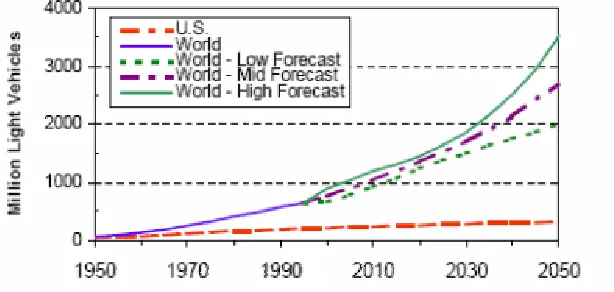
The demand for automobiles is growing. Currently, in the United States alone, over 200 million vehicles are registered. Worldwide the level reaches approximately 700 million (Mcauley 2003). As more and more of the world becomes industrialized, this total is expected to increase three to five times over the next fifty years, as shown by the graph in figure one.
Figure 1. World Light Vehicle Population
Source: Future U.S. Highway Energy Use: A Fifty Year Perspective
One of the largest potential markets for new automobiles and light trucks is China. Ranked fourth in vehicle sales (behind the United States, Japan, and Germany), it is the world’s fastest growing market, having increased sales by 40% (up to 3.2 million vehicles) in 2002. Currently in China, the ownership rate for light vehicles is approximately 8.5 people per 1000. However, this is expected to increase
dramatically over the next few decades. According to Douglass Odgen, Director of the China Sustainable Energy Program, “Projections show that China could surpass the total number of cars in the U.S. by 2030.”
At this point, the ability of the Chinese to manufacture cars of their own design is limited. According to a report in the online magazine China Business Weekly, the majority of automobiles produced in the country are foreign models. And, while government policy is to increase the number of vehicles designed and manufactured in China, that total is not expected to get above 50 % until around 2010.
Nor is the current automobile boom limited to China. In India, the world’s other most populous nation, production and sales are also dramatically increasing (Society of Indian Automobile
The Problem of Pollution
Along with all those automobiles comes increased air pollution. On average, a car powered by a conventional internal combustion engine, produces up to 5 tons of carbon dioxide (CO2) per year. This is
one of the “greenhouse gasses” which are believed to be a cause of global warming. According to scientists, at the current rate of CO2 production, the average temperature will rise from 2-6o F by 2100,
causing a vast potential for flooding, due to the melting polar icecaps (Motavelli 2001, 44).
While the automobile is not the sole contributor to increased CO2 levels, it is one of the largest,
accounting for approximately 14% of the world, and 33% of the United States’ total. In addition, there are other polluting byproducts from burning gasoline in the automobile’s internal combustion engine. These include 80% of the nation’s total of carbon monoxide, 50% of nitrous oxides, and 40% of volatile organic compounds, all of which are ingredients of smog (Mcauley 2003, 5415). As more automobiles are produced and driven, the amount of greenhouse gases and pollutants they create will have to be addressed.
There are two ways to do this. The first way is to make automobile engines more fuel efficient, so they burn less gasoline or diesel fuel. In the United States, since 1975 the federal government has
mandated corporate average fuel economy (C.A.F.E.) standards for automobiles and light trucks. C.A.F.E. standards apply separately to each American automobile manufacturer. For a manufacturer’s line of automobiles, the average fuel economy of the entire fleet produced must be at least 27.5 miles per gallon. For light trucks (which include vans and sport utility vehicles) the standard is 20.7 miles per gallon. For each 0.1 miles per gallon that the manufacturer’s average falls below these levels, there is a five dollar fine, multiplied by the number of vehicles in that class that the manufacturer produces for that model year. If the manufacturer exceeds the standard, it can take a credit which can be applied to
shortfalls in three previous or later years.
The second means of controlling automobile pollution is for governments to set standards for the amount of emissions exiting the automobile’s exhaust pipe. The state of California has been instrumental in attempting this. As California has approximately one fifth of the population of the United States, and accounts for ten percent of its vehicle sales, automakers must take its standards into account.
The state regulatory body which sets these standards is the California Air Resources Board. It is made up of five elected officials, five technical experts and one full time chairman, all of whom are appointed by the state’s governor.
One of its mandates has been to require that automobile manufacturers who sell cars in the state create a percentage of Zero Emission Vehicles (which are essentially battery powered cars) and Partial Zero-Emission Vehicles (which have tailpipe emissions cleaner than 90% of the rest of the 2003
production year.) While the automobile makers fight this board at every opportunity, it has, in addition to decreasing pollution, forced automakers into building cars getting better gas mileage.
The Looming Oil Shortage
The world’s transportation is almost entirely dependent upon oil, using nearly 40% of the 75 million barrels that are consumed each day. The Energy Information Administration (E.I.A.) predicts the amount of oil used will increase between 1.1% and 2.7% each year until 2020. The twin problems become: How much oil do we have left, and at what point will oil production peak?
Figure 2. Estimated World Oil Capacity
Source: Future U.S. Energy Use: A Fifty Year Perspective
One factor which must be considered when pumping oil out of wells is that the maximum rate of extraction for each field versus the remaining oil in that field takes the shape of a bell curve. This means that the rate increases up to the point where half of the oil has been extracted (about the time when all the wells have been sunk, but before their output begins to taper off.) After that it begins to decrease, and the remaining oil becomes more difficult and expensive to obtain
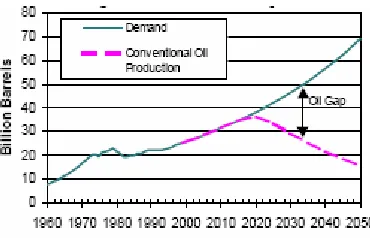
It is believed that that peak of production has not yet been reached. However, depending upon which analyst is correct, it is believed likely to occur sometime between 2010 and 2037. After that demand will outstrip supply. Figure three shows a possible scenario developed for the U.S. Department of Energy, which assumes a continued annual growth in demand for oil of 2%, combined with a peak of production in 2020. It assumes that production remains stable, even though much of the world’s oil reserves are in the Middle East, an area of notorious political instability.
Figure 3. Projected Future Demand: Oil versus Production
Source: Future U.S. Highway Energy Use: A Fifty Year Perspective
As the graph shows, there is a projected oil gap which appears after the production peak. This gap will need to be filled somehow. One way is to make synthetic oil out of other fossil substances such as tar sands, heavy oil, and oil shale. Converting these substances to usable fuel however, is expensive and would cause even more air pollution and greenhouse gasses.
The Hybrid-Electric Automobile
From the standpoint of solving the problems of air pollution and an impending oil shortage, the most fuel efficient vehicle would be one that did not use any kind of petroleum product at all. Such vehicles exist today in the form of electrically powered automobiles. These cars get their motive power by means of electrical motors supplied by batteries. Though they often have good acceleration and a top speed that allows them to drive in any kind of traffic, they have a limited range, generally no more than 200 miles.
At that point, there is the problem of recharging the batteries. This can be a lengthy process, and is one of the main reasons why electrical vehicles have not become popular.
Hybrid-electric vehicles however, are a different story. The reasoning behind a hybrid electric vehicle is to use both an electrical motor and a gasoline or diesel engine to provide the power to propel an automobile more efficiently and economically than a gasoline or diesel engine could by itself.
On a conventional automobile, light truck, or sport utility vehicle, the gasoline or diesel engine does all the work of driving the transmission and thus propelling the vehicle. A basic fact about gasoline and diesel engines is that smaller, less powerful engines get better gas mileage than larger more powerful ones do. The reason is that the larger engine has a heavier block, and larger and heavier components, such as pistons, rods, camshafts and other moving parts. The engine must do more work just to move itself. Since the larger engine also has larger cylinders, it uses more fuel for combustion. And, of course, a larger engine is also likely to have more cylinders.
In addition, in all cases, gasoline and diesel engines are at their most fuel efficient and economical when operating at a steady speed. Most driving is done at steady speeds, which normally require less than 20 horsepower to push the car through the air, overcome friction due to the car’s transmission and brake system, and to provide power to run its electrical system.
However, most automobile engines are capable of up to several hundred horsepower. This extra power is needed for those relatively short periods of acceleration, whether due to starting from a standing stop or the need to change speeds because of changing traffic conditions. The hybrid-electric car is designed to provide this extra power by adding the power of an electrical motor to that of the gasoline or diesel engine.
In theory, hybrid-electric vehicles come in two basic types, called “series” and “parallel.”
(Though, in reality, there are no strictly “series” hybrids available at this time.) Both types have an engine (either gasoline or diesel), an electric motor, and batteries. A series-hybrid also has an electrical
generator.
Series-Hybrids
In a series-hybrid, the transmission is operated solely by the electric motor, which is able to accelerate the vehicle efficiently or to drive it at a constant speed. The motor in turn would be powered by the car’s battery pack. Without a means to recharge the batteries, they would soon be exhausted, probably within two hundred miles. This, however, is where the gasoline engine and generator come in. The generator, which is run by the gasoline engine, keeps the batteries charged. If the batteries don’t need charging, the engine does not run, and gasoline is not used.
Parallel-Hybrids
additional power, in case the car needs to quickly accelerate, or to switch functions to act as a generator to recharge the batteries. The car’s computer determines which function the electric motor serves.
The second type of parallel-hybrid is also called a “mild” hybrid. In this type, the gasoline engine does most of the work and the electric motor does not take as active a role as in a full parallel hybrid. Instead, the electric motor is used to give the modest gasoline engine an assist when rapid acceleration is needed. It also allows the engine to turn off when the car is stationary (for instance, at a stoplight), acting as a starter when the driver is ready to start moving again. In this case, however, it only acts to restart the gasoline engine. It does not actually start the car moving itself.
Currently, there are three hybrid-electric automobile models for sale in the United States. Two of them are from Honda: the Insight and a variation of the Civic. The third is the Toyota Prius.
The Insight and Civic are mild parallel hybrids. In each of them, the electric motor is used to augment the car’s small gasoline engine when accelerating from a stop or for quick bursts of acceleration at higher speeds. The Insight is particularly remarkable for being extremely light weight (approximately 1900 lbs.), which is also a factor in its ability to get approximately 60 miles per gallon of gas.
Unfortunately, it is only able to carry one passenger, and it has a maximum payload of 365 lbs.
The Toyota Prius has elements of both Parallel and Series full hybrids. When it starts moving, it does so by using its electric motor only. At the nominal cruising speed the gasoline engine kicks in, running in a very narrow speed range while supplying energy both to the transmission and a generator, which is used to charge the car’s batteries. This is done by means of a device called a power splitter, which allows the gasoline engine, generator and electric motor to work together to propel the car and charge the batteries (Nice 2004).
The chief advantage of these three hybrid-electric cars is that they all get very good gas mileage. The Prius is rated at 60 miles per gallon in the city and 55 miles per gallon at highway speeds. The Civic and Insight are rated at 46 and 60 miles per gallon in the city and 51 and 66 miles per gallon on the highway respectively. All three cars also emit very low percentages of pollutants and greenhouse gasses.
Their disadvantages are that they cost more than a conventional automobile of the same size would cost. The Civic hybrid for instance is $2000 to $3000 more expensive than a standard Civic (Associated Press 2004). Also, they are more mechanically complicated than most cars with internal combustion engines.
They also still need gasoline to operate, and so are still dependent on oil. They do however help to delay the inevitable, while helping to prevent environmental pollution. But at best they are a stopgap solution. What is really needed is a source of energy based on fuels other than oil.
Hydrogen Fuel Cells
One such possible source of energy is hydrogen. It, along with oxygen, could be used to generate electricity in a fuel cell. Figure four shows a generic Proton Exchange Membrane (PEM) fuel cell
Figure 4. Proton Exchange Membrane (PEM) Fuel Cell Connected to a DC Motor
In the diagram, hydrogen gas (H) is introduced into the channels in the anode. A catalyst (usually made of platinum) inside the channels causes the hydrogen to lose its electrons (e-), and form positive
ions (H+). The positive hydrogen ions are able to migrate through the proton exchange membrane to the
cathode, where they combine with oxygen (O2) introduced into oxygen channels of the cathode. In the
meantime, the electrons which the hydrogen had lost in the anode travel through the electric conductor where they operate the DC electric motor (which powers the transmission on the automobile.). The electrons then complete their circuit by traveling back to the cathode where they recombine with the hydrogen and oxygen to create water (Nice 2000). The actual chemical reactions are:
At the anode: 2H2 → 4H+ + 4e
At the cathode: O2 + 4H+ + 4 e- → 2H2O
The total reaction is: 2H2 + O2 → 2H2O
In theory, this should be a pollution free source of power, with water as its only byproduct.
Fuel Cells in Automobiles
Currently fuel cell technology is in its infancy, and there are still many issues to solve. For instance, a typical fuel cell, such as the one shown in figure four, would supply one volt of DC electricity. An average car powered by hydrogen would need a lot more than that. For instance, Ford Motor
Company currently has an experimental fuel cell vehicle adapted from its Focus model. It has three stacks each of 400 PEM cells, making a total of 1200 fuel cells per vehicle.
Then there is the question of how the car is to carry its fuel. While it could get oxygen from the air, hydrogen is a different matter. While plentiful, it does not occur naturally by itself, but is instead combined with other elements, particularly water and fossil fuels. When released from these elements it floats away. At this point, there are three means of storing it. The first is in pressurized tanks. The tanks,
DC Electric Motor
Hydrogen channels
Oxygen channels
Annode Electron flow
Cathode Proton exchange
membrane
Electric conductor Electric conductor
however, must be pressurized up to 5000 lbs per square inch, in order to give the car enough hydrogen gas to travel about 200 miles (Monasterky 2003).
Another possible solution is to use a substance that can store hydrogen gas and release it slowly. Such substances are called hydrides. When their hydrogen is depleted, more of the gas can be recombined with it.
A third possible means of solving the fuel problem is to use a fossil fuel such as liquid methanol (CH3O) in the fuel tank, and to remove the hydrogen from it by means of a process known as
“reforming.”
In “reforming,” a combination of water and liquid methanol is vaporized and then added to a heated chamber with a catalyst. Once in the chamber, the water vapor breaks down to hydrogen and oxygen molecules, while the methanol breaks down into hydrogen and carbon monoxide. The carbon monoxide then combines with the loose oxygen molecules to form carbon dioxide. This process has the advantage of producing hydrogen without resulting in carbon monoxide, a known pollutant. Its
disadvantage is that the carbon dioxide that it also produces is a suspected greenhouse gas (Nice 2000).
Production and Distribution of Hydrogen
The issue of how to produce and distribute hydrogen is probably the greatest obstacle to the widespread production of fuel cell vehicles. While a hydrogen fuel cell by itself is a highly efficient producer of energy, the difficulty and costs of producing it out of anything other than fossil fuels are great. And, of course, the by-products from using fossil fuels are usually pollutants or carbon dioxide.
There are possible solutions to these problems however. One would be to get hydrogen from water. This can be done by a process known as electrolysis, in which a direct electrical current is passed through water. An example of this on a small scale is shown in figure five. Using this technique, the water breaks down into hydrogen and oxygen gas molecules, which float up out of the water and can be captured for later use. The problem with obtaining hydrogen in this fashion is that it must be performed on a large scale, with a lot of electricity. Most electricity generated in the United States (68%) is generated by fossil fuel plants, which defeats the purpose of using hydrogen.
However, as renewable sources of energy, such as hydroelectric, geothermal, wind and solar power are developed, electrolysis will become a more attractive option.
Hydrogen Oxygen
Water Annode
DC Electrical source
Figure 5. Electrolysis
Source: Scientific American Magazine
Distribution of hydrogen is another problem, since it is not commercially available to the extent that would support a fleet of fuel cell vehicles. One possible means that has been suggested, is to use the grid of natural gas pipelines to distribute natural gas to regular service stations. The natural gas could then be reformed at each station to extract hydrogen from that chemical. A General Motors study says that by installing hydrogen pumps in most urban areas and along major highways, up to 70% of Americans would have access to it. The projected cost of such a plan has been estimated at 10 to 15 billion dollars (Economist 2003).
The future of hydrogen power and the fuel cell is far from clear however, at least as far as the automobile is concerned. At this point, there are two many “if”s to be certain that it will ever be
economically feasible. To quote Marshall Miller, a research engineer at the University of California who is adapting vehicles to run on fuel cells: “All of us say that this is the future of transportation technology. But the bottom line is, it’s really uncertain whether this will start to take off in 10 to 15 years or in 30 to 40 years. And anyone who says they know is kidding themselves.”
Hybrids and Fuel Cells: Who’s Doing What?
Change has come hard to the big three automakers in the United States, and they have been reluctant to part with the conventional internal combustion engine. Currently, the American automaker most interested in developing hybrids is Ford Motor Company, which is coming out with a hybrid version of the Escape, a compact SUV later this year. They also plan to introduce a full-hybrid version of the Furtura, a sedan which is due to go on sale in the fall of 2005.
General Motors and Daimler Chrysler’s philosophies are apparently more attuned to developing hydrogen fuel cell and diesel powered vehicles. To quote General Motors Vice Chairman Donald Lutz: “I do not view hybrids as the future transportation solution” (Welch 2004). Nevertheless, Daimler Chrysler plans to begin selling a mild-hybrid diesel-electric Ram pickup truck, and G.M. plans on introducing a full-hybrid sedan and two SUV’s in 2007.
Honda, which introduced the first hybrid into the United States, is continuing along the path of developing mild hybrids. Currently, they sell the Insight and the Civic worldwide, and this year they will be selling a mild-hybrid version of the Accord.
Toyota, at this point, is the probably the leader in hybrid design. In addition to selling the full-hybrid Pius worldwide, and six smaller full-hybrids in Japan, they are planning on exporting two full-full-hybrid SUV’s to the United States this fall as well as starting to develop a full hybrid truck.
Hydrogen fuel cell powered vehicles are still in the development phase. Currently, there are eight companies with prototypes, including Toyota (which has eight of them in the United States).
One of the more interesting developments in the area of fuel cell vehicles is a joint program involving the Department of Energy, BP Amoco, and Ford Motor Company, in which Ford intends to operate 30 hydrogen vehicles in three cities, Orlando, Detroit, and Sacramento. In order to give them some place to get hydrogen, BP Amoco has begun to set up hydrogen fueling stations in each of those cities.
Conclusion
efficient system has become essential.
At this point, it seems that the hybrid-electric car would be the best solution for the short term. However, in the long run, a complete replacement of automobiles powered by fossil fuels seems
necessary. While the hydrogen fuel cell seems to represent a possible long term solution, it is not the only one, and not necessarily the best. In many ways the situation at the beginning of the twenty-first century resembles that at the beginning of the twentieth. At that time too, different technologies, like electric batteries and steam power, battled for control of the automobile market. It took years then to finally come to a decision, as it probably will take years again. Only time will tell.
Works Cited
Associated Press. “Hybrid Vehicles Gain Popularity Among Americans.” Wall StreetJournal: (April 22,
2004): (Eastern Edition): D4.
Birky, Alicia et al. “Future U.S. Highway Energy Use: A Fifty Year Perspective.” (May 3, 2001), Draft of
a Report Written for the U.S. Department of Energy.
Brain, Marshall. “How the Hydrogen Economy Works.” How Stuff Works: (May 5, 2004):
<http://people.howstuffworks.com/hydrogen-economy.htm/>.
Brown, Stuart F. “Dude, Where’s My Hybrid?” Fortune: (April 28, 2003): 112-117.
________. “China’s Tailpipe Tally” E Magazine: (Nov/Dec 2002): 13:16-17.
Coy, Peter. “The Trouble With Gushing Oil Demand.” Business Week: (April 26, 2004): 44-45.
________. “A New Kind of Gas Station” Economist: (December 6, 2003): 59.
Fairly, Peter. “Hybrids Rising Sun.” Technology Review: (April 2004): 36-42.
Guyer, Lillie. ”$2.50 a Gallon Gas? Not a Problem” Advertising Age: (April 14, 2003): pS-6.
Holmes, Robert and Jones, Nicola. “Power Struggle: Brace Yourself for the End of Cheap Oil” New Scientist: (August 2, 2003): 8-11.
Kerwin, Kathleen. “Detroit is Missing the Boat.” Business Week: (October 27, 2003): 44-47.
Monasterky, Richard. “Running on Fumes.” Chronicle of Higher Education: (October 10, 2003): (A14).
Nice, Karim. “How Hybrid Cars Work.” How Stuff Works: (May 4, 2004):
<http://auto.howstuffworks.com/hybrid-car.htm/>.
Nice, Karim. “How Fuel Cells Work.” How Stuff Works: (2000)
<http://science.howstuffworks.com/fuel-cell.htm/>.
Mcauley, John W. “Global Sustainability and Key Needs in Future Automotive Design.” Environmental
Science & Technology: (December 1, 2003): 5414-5417.
Motavalli, Jim. Forward Drive. New York: Sierra Club Books, 2001.
Motavalli, Jim. “Driving Clean.” E Magazine: The Environmental Magazine,(Jan/Feb 2004): 23-25.
Service, Robert F. “New Fuel Cell is the Coolest of All.” Science Now: (June 16, 2000): 2
_______. “Passenger Vehicle Sales in Top Gear” Society of Indian Automobile Manufacturers (June 9, 2004): <http://siamindia.com/media/coverage/viewcoveragehead. aspx?id=36>
Wald, Matthew L. “Questions About a Hydrogen Economy.” Scientific American: (May 2004): 66-74.
Welch, David. “Gentlemen, Start Your Hybrids.” Business Week: (April 26, 2004) 45-46.
Zhengzheng. China Business Weekly: (June 17, 2003):