Journal of Patient-Centered
Journal of Patient-Centered
Research and Reviews
Research and Reviews
Volume 5
Issue 4 -- Patient Self-Management Article 3
10-29-2018
Implementing Community-Created Self-Management Support
Implementing Community-Created Self-Management Support
Tools in Primary Care Practices: Multimethod Analysis From the
Tools in Primary Care Practices: Multimethod Analysis From the
INSTTEPP Study
INSTTEPP Study
Douglas H. Fernald Matthew J. Simpson Donald E. Nease Jr. David L. Hahn
Amanda E. Hoffmann LeAnn C. Michaels Lyle J. Fagnan Jeanette M. Daly Barcey T. Levy
Follow this and additional works at: https://aurora.org/jpcrr
Part of the Community Health and Preventive Medicine Commons, Diseases Commons, Health Services Research Commons, and the Primary Care Commons
Recommended Citation Recommended Citation
Fernald DH, Simpson MJ, Nease DE Jr, Hahn DL, Hoffmann AE, Michaels LC, Fagnan LJ, Daly JM, Levy BT. Implementing community-created self-management support tools in primary care practices: multimethod analysis from the INSTTEPP study. J Patient Cent Res Rev. 2018;5:267-75. doi: 10.17294/2330-0698.1634
Douglas H. Fernald, MA,1 Matthew J. Simpson, MD,1 Donald E. Nease, Jr., MD,1 David L. Hahn, MD,2
Amanda E. Hoffmann, MPH,2 LeAnn C. Michaels, BS,3 Lyle J. Fagnan, MD,3 Jeanette M. Daly, PhD, RN,4
Barcey T. Levy, MD, PhD4
1Department of Family Medicine, University of Colorado School of Medicine, Aurora, CO; 2Department of Family Medicine and Community Health, University of Wisconsin School of Medicine and Public Health, Madison, WI; 3Department of Family Medicine, Oregon Health & Science University, Portland, OR; 4Department of Family Medicine, University of Iowa, Iowa City, IA
ORIGINAL RESEARCH
Implementing Community-Created Self-Management
Support Tools in Primary Care Practices: Multimethod
Analysis From the INSTTEPP Study
O
ne-half of Americans are projected to be living with at least one chronic condition before 2020.1 For that reason, the health care systemmust work toward reducing the burden on primary care for disease management by facilitating the development of activated, informed patients who are
proficient in self-management skills.
Self-management support (SMS) helps enable people
to manage their conditions day-to-day. SMS is defined
as the efforts of the health care team to promote patient engagement in behaviors that positively impact their
Purpose With one-half of Americans projected to be living with at least one chronic condition before 2020, enhancing patient self-management support (SMS) may improve health-related behaviors and clinical outcomes. Routine SMS implementation in primary care settings is difficult. Little is known about the practice conditions required for successful implementation of SMS tools.
Methods Four primary care practice-based research networks (PBRNs) recruited 16 practices to participate in a boot camp translation process to adapt patient-centered SMS tools. Boot camp translation sessions were held over a 2-month period with 2 patients, a clinician, and a care manager from each practice. Qualitative case comparison and qualitative comparative analysis were used to examine practice conditions needed to implement SMS tools. The Consolidated Framework for Implementation Research guided data collection and analysis.
Results Four different practice conditions affected the implementation of new SMS tools: functional practice organization; system that enables innovation and change; presence of a visible, activated champion; and synergy and alignment of SMS changes with other work. Qualitative comparative analysis suggested that it was necessary to have an enabling system, a visible champion, and synergy for a practice to at least minimally implement the SMS tools. Sufficiency testing, however, failed to show robust consistency to satisfactorily explain conditions required to implement new SMS tools.
Conclusions To implement tailored self-management support tools relatively rapidly, the minimum necessary conditions include a system that enables innovation and change, presence of a visible champion, and alignment of SMS changes with other work; yet, these alone are insufficient to ensure successful implementation. (J Patient Cent Res Rev. 2018;5:267-275.)
Keywords self-management support; primary care; patient participation; chronic conditions; practice-based research network; qualitative analysis
Correspondence: Douglas H. Fernald, MA, University of Colorado School of Medicine,
illness.2 A portfolio of different SMS tools and techniques
exists that can assist patients in becoming more active participants in illness management, transforming the patient-caregiver relationship into a collaborative partnership.3 Collaborative partnership represents a significant cultural shift in health management, and clinicians and staff may lack confidence introducing
and promoting SMS. SMS is a key component of patient-centered medical homes, yet it is least often implemented in the area of disease management because it is challenging to integrate into usual care.4,5
The Agency for Healthcare Research and Quality (AHRQ) maintains a library of SMS evidence, resources, and tools.6 AHRQ sought to improve the
practical application of this library in frontline primary care practices. The burden of chronic illness calls for team-based primary care working in partnership with activated, informed patients. Few patients have
proficient self-management skills, lacking knowledge and confidence. Primary care practices are dedicating
more resources to care coordination, identifying and training care managers within the practice to help manage an increasingly complex panel of patients.
The Implementing Networks’ Self-management Tools
Through Engaging Patients and Practices (INSTTEPP)
study aimed to assist small to medium-sized primary care practices that were beginning to perform care
management. A modified boot camp translation
(BCT) model was used by primary care
practice-based research networks (PBRNs) to facilitate SMS tool design, refinement, and implementation. BCT is a
community-based participatory approach that engages community members in a process that translates evidence-based medical care into locally relevant and culturally appropriate language and constructs.7,8
The main purpose of the INSTTEPP study was to use
the BCT method to choose from or adapt AHRQ’s SMS toolkit for relevant patient- and practice-centered tools, then test selected tool implementation in 16
practices across 4 PBRNs. Main outcomes assessed
the impact on patient activation, clinician support for patient activation, and patient self-reported health and process of care.9-12 Patients in the study practices showed significant improvements in ratings of their
health and in their perceptions of the processes of care provided by their practices.13
While patient- and practice-level outcomes are essential steps to establish the evidence, it is also important to develop the evidence for how to implement successful SMS tools.14,15 This manuscript describes the results
of the multimethod qualitative assessment of critical implementation conditions and factors for SMS tools.
METHODS
INSTTEPP was an 18-month long, AHRQ-funded trial conducted in 4 U.S.-based PBRNs: the State Networks of Colorado Ambulatory Practices and Partners (SNOCAP), Oregon Rural Practice-based Research
Network, Iowa Research Network, and Wisconsin Research and Education Network. A total of 16 primary
care practices (4 from each PBRN) participated in this
project. There were 9 rural, 4 urban, and 3 suburban practices, with a range of 6 to 126 total clinicians and
staff (mean: 35.5 clinicians and staff). Each PBRN
conducted a BCT consisting of a minimum of 8 patients, 4 clinicians, 4 care managers, and the local
PBRN’s research team. Because INSTTEPP focused
on translating SMS tools for implementation in primary care practices, we explicitly recruited clinicians and primary care team members (along with patients), seeking equal representation and participation from practice staff, clinicians, and patients.
A stepped-wedge study design16 meant that BCT was
sequentially rolled out in a randomized order across
the 4 PBRNs between March and September of 2014.
Each practice participated in the BCT implementation
for 2 months. The INSTTEPP BCTs included an
all-day, in-person kickoff retreat, followed by 3 conference calls over a 2-month period. The Colorado Multiple Institutional Review Board was the IRB of record —
accepting oversight for the participating PBRNs and
practices — and approved this study.
The multimethod qualitative approach to assess BCT implementation relied on the Consolidated Framework for Implementation Research (CFIR)14 to guide
qualitative data collection. CFIR consists of 5 major
domains: intervention characteristics, outer setting,
(fsQCA) to identify conditions/sets important for successful implementation.17-19 Qualitative comparative
analysis (QCA) maintains complexity in the analytical process and allows for multiple pathways to achieve the outcome.17 Because of the expected diversity in
BCT processes and practice types, we anticipated diversity in the conditions necessary to achieve the outcome of implementing SMS tools.
Observations and Interviews
On-site interviews and guided observations were
conducted by each network’s PBRN coordinator in each
of the 16 practices after the initial BCT kickoff retreat and
at the conclusion of the BCT process. The first site visit
included a 1-hour meeting, attended by each practice’s care manager/health coach (who also attended the BCT kickoff) and a clinician, with focus on discussion of the actual plans for implementation of the SMS toolkit and
a description of current office processes for patients with
diabetes or other chronic illnesses. A follow-up on-site or telephone interview was conducted (also with the care manager/health coach and clinician) within 4 weeks of the conclusion of the BCT implementation period to assess SMS tool implementation efforts and to discuss
what was working and potential modification(s) of the
practice’s implementations.
The interview guide included questions to elicit information about practices that aligned with the major
CFIR domains. For example: “What is the planning
process your practice will use to implement the SMS
library/toolkit?” “What do you think about the evidence
or reasons supporting the use of the SMS library
and toolkit?” “What external policies or incentives encourage the selection and use of this toolkit?” “How
ready is your practice for the implementation of this
toolkit?” and “How easily was the toolkit adapted
to meet your practice’s needs?” To minimize burden on practices’ time, we divided open-ended questions related to the CFIR constructs across the baseline and follow-up interviews.
Master’s- or PhD-trained researchers in each PBRN
collected the observation and interview data. The lead
qualitative analyst (D.H.F.) from the SNOCAP PBRN
met with each data collector to review the purpose of observations and interviews, discuss the CFIR framework, and discuss interview and observation guide and data collection procedures. For the
Master’s-level researchers, the lead analyst attended the baseline observations and interviews in-person to assist with data collection as needed. In addition to notes maintained by the interviewers, interviews were audio-recorded and then transcribed for analysis.
Qualitative Data Analysis
Qualitative data (interview transcripts and observation notes) were analyzed by two members of the
Colorado research team (M.S., D.H.F.) using a case-ordered matrix approach. Data were first segmented
into 5 CFIR domains — inner setting, outer setting, process, intervention characteristics, and individual
characteristics — to begin synthesizing specifics
about conditions affecting implementation in this set
of practices. Data from each of the 16 practices were
then added in summary form to the case-based matrix and reviewed by the Colorado research team for framework inconsistencies, negative cases, and other data questions. The data were re-reviewed and the case matrix was updated as needed. The case matrix was
then sent to each of the PBRN’s study team for review and clarification and then for revisions as needed. Study teams comprised each local PBRN principal
investigator and research coordinators who helped collect interview and observation data, plus the overall principal investigator and the qualitative data analysts.
Qualitative Comparative Analysis and fsQCA
QCA is a method to analyze case-oriented data which recognizes that different paths or conditions may lead to the same or similar outcomes. QCA is based on set theory, using the strength of membership of each case’s particular group of conditions in sets
that are defined by the investigators. For example, a
set could be how fully a practice embraces quality improvement. A practice that has fully embraced quality improvement is fully in that set while a practice that has rejected quality improvement is not at all in that set. Another practice may have partially embraced quality improvement and is partially in the set. The level of set membership is based on analysis of the qualitative data. QCA analyzes each
case or practice’s membership in each set, identifies necessary and sufficient conditions for a particular
Sets are the conditions — analogous to variables (eg, a large, medium, or small practice) — into which each case is assigned membership.
Fuzzy-set QCA refers to the calibration step in which each case (a practice in this analysis) is scored as fully (1.0), partially (>0.0 and <1.0), or not at all (0.0) a member of a set. A membership score of 0.5 indicates ambiguous membership in a set.17,20 Necessity analysis
tests for conditions that must be present all or most of
the time for the outcome to occur. Sufficiency analysis
assesses which conditions, when present, ensure that the outcome occurs all or almost all of the time.
Set Identification and Calibration
The study teams from the 4 PBRNs met in person over
2 half-days to 1) review the case matrix analysis,
and 2) discuss and define key conditions, derived
from the qualitative data analysis, that likely affected implementation and adoption of BCT-developed SMS
tools. After the in-person meeting, each PBRN study team received the set definitions and instructions for
assigning membership scores (from 0.0 [ie, not at all a member] to 1.0 [ie, a full member]) to each practice for each condition, including the outcome condition, based on their further review of the qualitative data and the matrix analysis reviewed at the in-person meeting. After preliminary truth table analysis (a matrix of all possible combinations of conditions, including membership in the outcome set), each team was asked to recalibrate their membership assignments to help clarify membership scores, if possible, based on the data available for each of the
conditions defined, especially for those that were
ambiguous (ie, membership score of 0.5). Seven (of
96 possible) scores were modified in this recalibration
step. All membership scores were combined into a
single spreadsheet for review and clarification before
beginning analysis. In the analysis, each practice is considered a case. Kirq software (Version 2.1.12, Christopher Reichert and Claude Rubinson, Houston, TX) was used for all fsQCA analyses.
RESULTS
Matrix Analysis ("Traditional" Qualitative Method): Summary of Each CFIR Domain
When organized within the CFIR major domains, the qualitative analysis yielded variation across practices —
including within networks — in their relative strengths and threats to implementing a new SMS tool adapted by their community of patients, clinicians, and staff.
Inner Setting (Culture, Readiness, Implementation Climate, Structural Characteristics, Communication):
Among the strengths observed in many of the practices were collaborative practice environments and teams, team-based approaches and care techniques, supportive practice leadership, existing processes for some SMS techniques, and the relatively high priority of delivering more SMS to their patients. However, in most practices, threats to implementation of a new SMS tool included busy clinicians and staff, concurrent initiatives already in progress, and competing priorities encroaching on staff ability to try out new tools and techniques. Among a few practices, there appeared to be relatively low readiness to implement a new SMS tool.
Outer Setting (Patient Needs, Health System,
Peer Pressure, External Policies/Incentives): Few
practices appeared to enjoy supporting characteristics external to their clinic. Several practices noted there was some alignment with other priorities and incentive programs (such as health plan incentives or
patient-centered medical home [PCMH] recognition) coming
from outside the practice. Yet, system pressures or constraints and lack of congruence with other initiatives
and system priorities, such as PCMH recognition and “meaningful use” compliance, endangered attempts
to fully implement SMS tools. For example, one practice’s implementation was severely hampered because the SMS tool did not carry the approval of the larger health care system, which was required prior to any local adoption of clinic materials.
Process (Planning, Engaging, Executing, Reflecting/
Evaluating): How practices implemented new care
processes varied considerably. Some practices appeared to have well-established, standardized vetting and testing processes for new care processes. In one health system, a single practice site was
designated as the “test site” for trying new processes
and working out implementation issues before spreading to other sites in the system. In the context of
INSTTEPP, some practices focused implementation
on a pilot population — patients with a particular
team, or patients seen by a specific care team member
(eg, one particular clinician, health coach). Most
practices benefited from a management structure that
did not interfere or hinder attempts by individual practices to test new ideas or processes. In most practices, existing quality improvement committees or recent experience with change processes supported implementation efforts for SMS. In contrast, there were several practices that appeared to lack formal systematic processes for implementing new ideas or faced system approval barriers that threatened momentum for changes.
Intervention Characteristics (Source, Evidence Strength, Advantage, Adaptability, Trialability,
Complexity, Design Quality, Cost): Implementation
of the SMS tools was variable; there were few observational or interview data about the characteristics of tool implementation itself. However, clinicians and staff offered strong opinions about their general
preferences for new interventions: low costs (eg,
printing in black and white vs color), integration with
electronic health record, and “must work alongside what’s already in place” (ie, existing workflows).
Several clinicians commented that they often gave higher consideration to interventions that had been validated and were shown to be reliable in primary care
experience as compared to hard scientific evidence of efficacy. The BCT process results are consistent with
this preference for SMS tools that are simple and can
be tailored to specific populations or communities.21
Individual Characteristics (Intervention Knowledge/
Beliefs, Self-Efficacy, Stage of Change, Organizational Identification): Observational findings in some clinics
pointed to individuals who helped to promote the use of SMS. These key agents included one clinician with a strong interest in SMS, multiple physicians expressing openness and readiness to trying something new, and an activated health coach and nurse care manager who sought additional information and tools on their own.
fsQCA Analysis (Qualitative and Quantitative)
Grounded in the data and summary results above, the in-person study team meeting and QCA data discussion resulted in 5 key conditions (sets) that likely affected implementation and adoption of BCT-developed SMS
tools (Table 1):
A. Functional practice organization. B. System enables innovation and change.
C. Presence of a visible, activated champion. D. Synergy and alignment of SMS changes with
other work.
E. Patient push.
The group defined the outcome condition as “implementation of the BCT-developed SMS tool.” To
be a full member of the outcome set, a practice had to
have: “fully implemented a new or substantially new
SMS tool that emerged from or was derived from the BCT process. A fully implemented SMS tool is used
routinely for a population of patients.” The “patient
push” condition was dropped from the analysis because
there were too few data available across all PBRNs to adequately describe and calibrate, with confidence,
both the condition and set membership among their participating practices.
A. Functional practice organization: A functional practice can manage chaos, prioritize competing demands or projects, is realistic in what it aims to accomplish, has internal alignment among staff/providers or high “groupness.”
B. System enables innovation and change: The system or other known external influences for a practice may stifle a practice’s ability or willingness to innovate, transform, or test important changes around SMS.
C. Presence of a visible, activated champion: A champion (physician or health coach/nurse manager) for changes around SMS can be identified and named, can act with some autonomy, and is a dynamic change agent in a practice.
D. Synergy and alignment of SMS changes with other work: The SMS changes practices are making or attempting to make are relevant, fit with other practice goals, and help “connect the dots” to the bigger picture for practice goals.
E. Patient push: There is energy and interest among patients in the practice that are pushing the practice to make changes around SMS.
Outcome Set. Implementation of an SMS tool: The practice fully implemented a new or substantially new SMS tool that emerged from or was derived from the boot camp translation process. A fully implemented SMS tool is used routinely for a population of patients.
Table 1. QCA Set Descriptions
Exploratory Analysis With Truth Tables
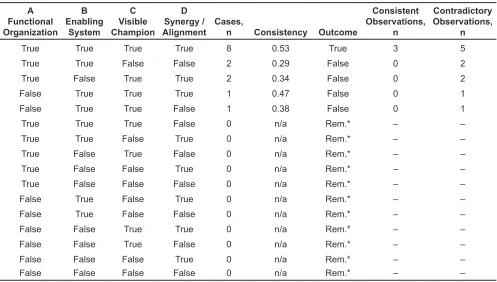
Initial exploration of the data using fsQCA examined all of the possible combinations of conditions across all of the cases. The resulting truth table (Table 2) showed that there was just 1 combination of conditions (or pathway) to the outcome of implementing the SMS tool in a practice. Three of 16 cases had the combination of all 4 conditions and also were in the outcome set (ie, consistent observations); 5 cases had the same combination of conditions but were not in the outcome set (ie, inconsistent or contradictory observations).
The consistency was relatively low (0.53), and there were 5 contradictory observations. Consistency below 0.80 suggests that the combination of conditions does not lead to outcome often enough to be considered a
robust finding. After considering the relatively short project timeline, we defined a less restrictive outcome by recalibrating the outcome to a crisp set (0 or 1) “of
implementing the SMS tool at least minimally” (1.0)
versus “not at all implemented” (0.0). The resulting truth
table (Table 3) was the same, but with just 2 contradictory cases and a higher consistency score (0.68). We
A Functional Organization
B Enabling
System
C Visible Champion
D Synergy /
Alignment Cases, n Consistency Outcome
Consistent Observations,
n
Contradictory Observations,
n
True True True True 8 0.53 True 3 5
True True False False 2 0.29 False 0 2
True False True True 2 0.34 False 0 2
False True True True 1 0.47 False 0 1
False True True False 1 0.38 False 0 1
True True True False 0 n/a Rem.* – –
True True False True 0 n/a Rem.* – –
True False True False 0 n/a Rem.* – –
True False False True 0 n/a Rem.* – –
True False False False 0 n/a Rem.* – –
False True False True 0 n/a Rem.* – –
False True False False 0 n/a Rem.* – –
False False True True 0 n/a Rem.* – –
False False True False 0 n/a Rem.* – –
False False False True 0 n/a Rem.* – –
False False False False 0 n/a Rem.* – –
Table 2. Initial Truth Table of All Possible Configurations
*Rem., logical remainders represent logically possible configurations but do not appear in the data.
A Functional Organization
B Enabling
System
C Visible Champion
D Synergy /
Alignment Cases, n Consistency Outcome
Consistent Observations,
n
Contradictory Observations,
n
True True True True 8 0.68 True 6 2
True True False False 2 0.29 False 0 2
True False True True 2 0.34 False 0 2
False True True True 1 0.47 False 0 1
False True True False 1 0.38 False 0 1
Table 3. Truth Table With Recalibrated Outcome Set*
attempted to resolve the contradictory cases through recalibration based on our knowledge of the cases;
however, the available case data were insufficient to
enable resolving the contradictions.
Necessity Analysis: Necessity analysis tests for
conditions that must be present for the outcome to occur. The initial necessity test used the dichotomous outcome with consistency threshold of 0.80 and coverage threshold of 0.50. There were 3 separate terms of single
conditions necessary for the outcome to occur: B. Enabling system (consistency: 0.86, coverage:
0.56).
C. Visible champion (consistency: 0.86, coverage:
0.56).
D. Synergy (consistency: 0.89, coverage: 0.55).
In other words, when a practice was able to implement the SMS tools at least minimally, the presence of an enabling system or a visible champion or
synergy was necessary for the outcome to occur. An
“AND’ed” combination of the 3 conditions together (ie, enabling system AND visible champion AND
synergy) yielded slightly higher coverage of cases (0.65) with slightly lower consistency (0.81). While these appeared to be necessary conditions, they may not be sufficient to ensure that the outcome occurs.
Sufficiency Analysis: Sufficiency analysis assesses
which conditions, when present, ensure that the outcome occurs all or almost all of the time. Truth tables were reduced to a complex solution, including the 3 necessary conditions from necessity analysis
plus the “functional organization” condition. The sufficiency analysis was performed with a consistency
threshold of 0.80 and a proportion threshold of 1.00,
which resulted in a single “pathway” or configuration of conditions (consistency: 0.68, coverage: 0.76): functional organization AND enabling system AND visible champion AND synergy.
The presence of a functional organization, an enabling system, a visible champion, and synergy led to the outcome. These conditions were needed in combination to be able to implement at least some degree of the BCT-developed SMS tools. The relatively low consistency score (0.68) and the contradictory observations suggest that this
combination does not lead to outcome often enough to fully explain the conditions needed to reliably achieve SMS implementation.
DISCUSSION
This multimethod qualitative assessment elaborated important supporting elements from the CFIR for implementing newly adapted, community-created SMS tools in primary care. Among the strengths supporting implementation were collaborative teams and team-based care, supportive practice leadership, a supportive system, established change and improvement processes, and integration within
existing clinic workflows. Unfortunately, there were
observed threats to implementation, including lack of systematic processes for implementing new ideas, system approval barriers, lack of congruence with
other initiatives and system priorities, and insufficient
staff or time to implement new tools.
The QCA extended the qualitative thematic analysis by identifying and assessing which combinations of supportive implementation conditions might lead to at least minimal implementation of SMS tools. Yet, the analysis suggests that presence of an enabling system, a visible and active champion, and synergy with existing
priorities, while necessary, were insufficient to fully
describe how primary care practices can effectively implement their newly created SMS tools.
For primary care practices that want to successfully implement new SMS tools, our analysis pointed to logical necessary conditions, which corroborate previously reported evidence for successfully making practice improvements,22-24 such as change alignment with clinical priorities, influence of the larger system,
and motivation of key practice members. However, our results indicate that there are unexamined or unknown conditions that may more fully explain how
SMS tool implementation happens. Sufficient time
may be one of those conditions, but we were unable to evaluate this. Our results also suggest that the tools should be low cost, integrate with the electronic health record, have system approval, be tailorable to each
practice, and “work alongside” rather than against
may be required. Allowing more time for SMS tool implementation and additional data collection may
have identified additional conditions required for
successful implementation.
Study Limitations
One potential limitation is that a quantitative assessment of tool implementation or clinic readiness was not performed. Our observation window for implementation (about 9–12 weeks for most
INSTTEPP PBRNs) was likely unrealistic given
the short timeline from SMS tool adaptation using the BCT process, distribution to the practices, and getting the tool into the change process. While our
data generated sufficient conditions for this analysis,
there may be other pathways with other conditions
that we did not identify. Pertaining to this analysis, 2
contradictory cases were removed from the analysis because we were unable to resolve the contradiction. These 2 cases both had relatively high membership scores (0.60–1.0) in all 4 of the necessary conditions; however, both had very low membership scores in the
outcome condition (0.0). Primary care practices are
complex systems;26,27 there is likely another condition (and likely another pathway or configuration) that we did not define that explains their failure to implement
SMS tools at least minimally or that measurements of the conditions were not valid. For others attempting QCA analysis on implementation, more detailed practice-level data collected over a longer period of time may help overcome some of the analytical limitations we encountered.
CONCLUSIONS
This is the first attempt to analyze what it takes to
implement self-management support tools across 16 practices from 4 practice-based research networks
across the United States. Despite a short timeline
and no project-supported facilitation assistance, 38% of the practices were still able to implement the boot camp translation-developed SMS tools to some extent.
While not definitive, primary care practices that hope
to implement new SMS tools require at least a system that enables innovation and change, the presence of a visible champion, and the alignment of SMS changes with other work.
Patient-Friendly Recap
• Self-management support tools offered in a primary care practice may help patients manage chronic conditions like diabetes. • Practices struggle to regularly implement tools
designed to include direct input from patients. • Practices wishing to implement these
self-management tools need to ensure they have a visible clinic champion for this effort and a supportive health system, and that tools align with existing clinic workflows.
• While these factors may smooth the way, they do not guarantee successful implementation of patient support tools.
Author Contributions
Study design: Nease. Data acquisition or analysis: all authors. Manuscript drafting: Fernald, Simpson, Nease. Critical revision: Fernald, Hahn, Fagnan, Daly, Levy.
Conflicts of Interest
None.
Funding Sources
The research described in this article was funded by Agency for Healthcare Research and Quality grant 1R18HS022491-01.
References
1. Solomon M, Wagner SL, Goes J. Effects of a Web-based
intervention for adults with chronic conditions on patient
activation: online randomized controlled trial. J Med Internet Res. 2012;14(1):e32. CrossRef
2. Lorig KR, Holman H. Self-management education: history, definition, outcomes, and mechanisms. Ann Behav Med. 2003;26:1-7. CrossRef
3. Bodenheimer T, MacGregor K, Sharifi C. Helping patients manage their chronic conditions. https://www.chcf.org/wp-content/uploads/2017/12/PDF-HelpingPatientsManageTheir ChronicConditions.pdf. Oakland, CA: California HealthCare Foundation, June 2005.
4. Coleman K, Mattke S, Perrault PJ, Wagner EH. Untangling practice redesign from disease management: how do we
best care for the chronically ill? Annu Rev Public Health. 2009;30:385-408. CrossRef
5. Glasgow RE, Davis CL, Funnell MM, Beck A. Implementing
practical interventions to support chronic illness self-management. Jt Comm J Qual Saf. 2003;29:563-74.
6. Agency for Healthcare Research and Quality.
Self-Management Support Resource Library. Content last reviewed April 2017. http://www.ahrq.gov/professionals/
prevention-chronic-care/improve/self-mgmt/self/sms_
browse.html. Accessed July 27, 2018.
7. Norman N, Bennett C, Cowart S, et al. Boot camp translation:
a method for building a community of solution. J Am Board Fam Med. 2013;26:254-63. CrossRef
8. Westfall JM, Zittleman L, Felzien M, et al. Reinventing the wheel of medical evidence: how the boot camp translation
process is making gains. Health Aff (Millwood). 2016;35:613-8.
CrossRef
9. Hibbard JH, Collins PA, Mahoney E, Baker LH. The
development and testing of a measure assessing clinician beliefs about patient self-management. Health Expect. 2010;13:65-72. CrossRef
10. Hibbard JH, Mahoney ER, Stockard J, Tusler M. Development
and testing of a short form of the patient activation measure.
Health Serv Res. 2005;40:1918-30. CrossRef
11. Hibbard JH, Stockard J, Mahoney ER, Tusler M. Development of the Patient Activation Measure (PAM): conceptualizing
and measuring activation in patients and consumers. Health Serv Res. 2004;39:1005-26.
12. Glasgow RE, Whitesides H, Nelson CC, King DK. Use of the Patient Assessment of Chronic Illness Care (PACIC) with diabetic patients: relationship to patient characteristics,
receipt of care, and self-management. Diabetes Care. 2005;28:2655-61. CrossRef
13. Nease DE Jr, Daly JM, Dickinson LM, et al. Impact of a boot
camp translation intervention on self-management support in primary care. J Patient Cent Res Rev. 2018;5:256-66. 14. Damschroder LJ, Aron DC, Keith RE, Kirsh SR, Alexander
JA, Lowery JC. Fostering implementation of health services research findings into practice: a consolidated framework
for advancing implementation science. Implement Sci. 2009;4:50. CrossRef
15. Glasgow RE, Vogt TM, Boles SM. Evaluating the public
health impact of health promotion interventions: the RE-AIM
framework. Am J Public Health. 1999;89:1322-7. CrossRef
16. Brown CA, Lilford RJ. The stepped wedge trial design: a
systematic review. BMC Med Res Methodol. 2006;6:54. CrossRef
17. Rihoux B, Ragin CC. Configurational Comparative Methods: Qualitative Comparative Analysis (QCA) and Related Techniques. Thousand Oaks, CA: Sage Publications,
2009. CrossRef
18. Marcus Thygeson N, Solberg LI, Asche SE, Fontaine P, Gregory Pawlson L, Scholle SH. Using fuzzy set qualitative
comparative analysis (fs/QCA) to explore the relationship
between medical “homeness” and quality. Health Serv Res. 2012;47(1 Pt 1):22-45. CrossRef
19. Cragun D, Pal T, Vadaparampil ST, Baldwin J, Hampel H, DeBate RD. Qualitative comparative analysis: a hybrid
method for identifying factors associated with program effectiveness. J Mix Methods Res. 2015;10:251-72. CrossRef
20. Thygeson NM, Peikes DN, Zutshi A. Fuzzy set qualitative comparative analysis and configurational comparative methods: powerful methods to study and refine patient-centered medical home models. AHRQ Publication No. 13-0026-EF. Rockville, MD: Agency for Healthcare Research
and Quality, March 2013.
21. Fagnan LJ, Simpson MJ, Daly JM, et al. Adapting boot camp
translation methods to engage clinician/patient research teams within practice-based research networks. J Patient Cent Res Rev. 2018;5:298-303.
22. Nutting PA, Crabtree BF, Miller WL, Stewart EE, Stange KC, Jaén CR. Journey to the patient-centered medical home:
a qualitative analysis of the experiences of practices in the
National Demonstration Project. Ann Fam Med. 2010;8
Suppl 1:S45-56, S92. CrossRef
23. Solberg LI. Improving medical practice: a conceptual
framework. Ann Fam Med. 2007;5:251-6. CrossRef
24. Solberg LI, Stuck LH, Crain AL, et al. Organizational
factors and change strategies associated with medical home transformation. Am J Med Qual. 2015;30:337-44. CrossRef
25. Nutting PA, Crabtree BF, Stewart EE, et al. Effect of facilitation on practice outcomes in the National Demonstration Project
model of the patient-centered medical home. Ann Fam Med. 2010;8 Suppl 1:S33-44; S92. CrossRef
26. Miller WL, Crabtree BF, McDaniel R, Stange KC.
Understanding change in primary care practice using complexity theory. J Fam Pract. 1998;46:369-76.
27. Miller WL, McDaniel RR Jr, Crabtree BF, Stange KC. Practice jazz: understanding variation in family practices
using complexity science. J Fam Pract. 2001;50:872-8.