Correlations of Biomechanical Characteristics with Ball Speed in Penalty Corner Push-In
MADM Model for Decision Making Support Structures Using SAW Technique
N. Thinaharan1 &V. Thiagarasu2
1Research Scholar in Computer Science, Manonmaniam Sundaranar University, Tirunelveli, India. 2Associate Professor of Computer Science, Gobi Arts & Science College, Gobichettipalayam, India.
Received 25th June 2015, Accepted 28th August 2015
Abstract
In this work scientific and simple calculation method for manufacturer’s decision-makers to choose the most ideal supplier has been provided. This paper deals with the supplier selection problem based on SAW algorithm (Simple Additive Weighting) which is a multiple attribute decision making (MADM) approach with entropy method which gives the weights to indicators. The SAW algorithm deals with the conflicts between indicators based on certain way to sort the scheme and choose the best scheme. A numerical example is proposed to illustrate the effectiveness of this algorithm. However, Sensitivity Analysis for the weighting vectors is performed to make the result of evaluations more objective and accurate and also Entropy based method is proposed with numerical illustration together with comparison of methods.
Keywords: SAW; MADM; Sensitivity Analysis; Entropy; DMSS; DSS.
© Copy Right, IJRRAS, 2015. All Rights Reserved.
Introduction
Decision-making support systems (DMSS) are computer based information systems designed to support some or all phases of the decision-making process. The architectures, include (a) classic systems such as decision support systems (DSS), expert and knowledge based systems (ES/KBS), executive information systems (EIS), group support systems (GSS), and spatial decision support systems (SDSS) and (b) new systems such as management support systems (MSS), decision technology systems (DTS), integrated DMSS, data warehouse (DW)-based and data mining (DM)-based DMSS (DW & DM-DMSS), intelligent DMSS (i-DMSS), and Webbased DMSS or knowledge management DMSS [3, 14, 15]. Individual EIS, DSS, and ES/KBS, or pair-integrated combinations of these systems, have yielded substantial benefits in practice. Decision-making support systems utilize creative, behavioral, and analytic foundations that draw on various disciplines. DMSS evolution has presented unique challenges and opportunities for information system professionals. These foundations give rise to various architectures that deliver support to individual and group DMSS users. The architectures have been applied to various public and private problems and opportunities, including the planning of large-scale housing demand, strategic planning, urban transportation policy formulation, health care management, pharmaceutical decision making, banking
Correspondence
N. Thinaharan
management, entertainment industry management, and military situations. Applications draw on advanced information technologies (IT), such as intelligent agents, knowledge-based and knowledge-management procedures, synthetic characters, and spatial decision support systems, among others.
Once created, DMSS must be evaluated and managed. Economic-theory-based methodologies, quantitative and qualitative process and outcome measures, and the dashboard approach have been used to measure DMSS effectiveness. These approaches suggest various organizational structures and practices for managing the design, development, and implementation effort. Most suggestions involve much more user involvement and a larger role for non-traditional specialists during the technical design, development, and implementation tasks. The expert opinion indicates that DMSS have been recognized as unique information systems. Collectively, these experts focus on the deployment of new and advanced information technology (IT) to improve DMSS design, development, and implementation. In their collective opinion [14], the next generation of DMSS will involve: (a) the use of portals, (b) the incorporation of previously unused forms of artificial intelligence through agents, (c) better integration of data warehousing and data mining tools within DMSS architectures, (d) creation of knowledge and model warehouses, (e) the integration of creativity within DMSS architectures, (f) the use of integrated DMSS as a virtual team of experts, (g) exploitation of the World Wide Web, (h) the exploitation of mobile IT,
Journal of Recent Research and Applied Studies
Thinaharan et al. 2015 ISSN: 2349 – 4891
in decision making, based on rule-based systems and fuzzy logic, and quantitative structured approaches, based on data mining, have become the most popular data management tools.
This work deals with the DMSS problems based on SAW algorithm (Simple Additive Weighting) which is a multiple criteria decision making approach with entropy method which gives the weights to indicators. The SAW algorithm deals with the conflicts between indicators based on certain way to sort the scheme and choose the best scheme. Some values of the multi attribute decision models are often subjective. The weights of the criteria and the scoring values of the alternatives against the subjective (judgmental) criteria contain always some uncertainties. It is therefore an important question how the final ranking or the ranking values of the alternatives is sensitive to the changes of some input parameters of the decision model. The simplest case is when the value of the weight of a single criterion is allowed to vary. For additive multi attribute models, the ranking values of the alternatives are simple linear functions of this single variable and attractive graphical tools can be applied to present a simple sensitivity analysis to a user. For a wide class of multi attribute decision models there are different methods to determine the stability intervals or regions for the weights of different criteria. These consist of the values that the weights of one or more criteria can take without altering the results given by the initial set of weights, all other weights being kept constant. There are proposed linear programming models to find the minimum modification of the weights required to make a certain alternative ranked first. Hence Sensitivity Analysis for the weighting vectors in SAW method is performed to make the result of evaluations more objective and accurate for a proper framing of SAW-DMSS.
In multiple attribute decision making (MADM) problem, a decision maker (DM) has to choose the best alternative that satisfies the evaluation criteria among a set of candidate solutions. It is generally hard to find an alternative that meets all the criteria simultaneously, so a better solution is preferred. The SAW method was developed for multi-criteria optimization of complex systems [6,13,18]. This method focuses on ranking and selecting from a set of alternatives in the presence of conflicting criteria. Multi-criteria optimization is the process of determining the best feasible solution according to the established criteria (representing different effects). Practical problems are often characterized by several non-commensurable and conflicting criteria and there may be no solution satisfying all criteria simultaneously. Thus, the solution is a set of non-inferior solutions, or a compromise solution according to the decision maker’s preferences. The compromise solution was established by Zeleny [19] for a problem with conflicting criteria and it can help the decision makers to reach a final solution. In classical MADM methods, the ratings and the weights of the
unrealistic assumption that the knowledge and representation of a decision maker or expert are so precise. For example, human judgment including preferences is often vague and decision maker (DM) cannot estimate his preference with exact numerical values. In these situations, determining the exact value of the attributes is difficult or impossible. So, to describe and treat imprecise and uncertain elements present in a decision problem, fuzzy approaches and linguistic terms are frequently used. In the works of linguistic terms decision making, linguistic terms are assumed to be with known by fuzzy linguistic membership function. However, in reality to a decision maker it is not always easy to specify the membership function in an inexact environment [5, 17, 20]. At least in some of the cases, the use of interval numbers may serve the purpose better. An interval number can be thought as an extension of the concept of a real number, however, in decision problems its use is not much attended as it merits [4].
2. Applicatıon of SAW as a Decision Support System
Technique
alternatives in terms of different factors and importance of their weights. Some of the common Multi-Attribute DecisionMaking (MADM) techniques are:
• Simple Additive Weighted (SAW)
• Weighted Product Method (WPM)
• Cooperative Game Theory (CGT)
• Technique for Order Preference by Similarity to
Ideal Solution (TOPSIS)• Elimination et Choice Translating Reality with
complementary analysis(ELECTRE)• Preference Ranking Organization Method for
Enrichment Evaluation (PROMETHEE)• Analytical Hierarchy Process (AHP)
The merit of the SAW method is that it can deal with both quantitative and qualitative assessment in the process evaluation with little computation load. It bases upon the concept that the chosen alternative is derived from the weighted decision matrix. In the process of SAW, the performance ratings and the weights of the criteria are given as crisp values. In fuzzy SAW, attribute values are represented by fuzzy numbers.
2.1 SAW Method
Decision-making problem is the process of finding the best option from all of the feasible
attribute decision making (MADM) problem [4]. A MADM problem can be concisely expressed in matrix format as:
C
nA
mwhere A1,A2,...,Am are possible alternatives
among which decision makers have to choose, C1,C2,...,Cn are criteria with which alternative
performance are measured, xij is the rating of alternative Ai with respect to criterion Cj.
SAW Technique is one of the most used MADM technique. It is simple and is the basis of most MADM techniques such as AHP and PROMETHEE that benefits from additives. In SAW technique [1,2,7,8-12,13,16,18], final score of each alternatives is calculated as follows and they are ranked.
If there is any qualitative attributive, then we can use some methods for transforming qualitative ones.
2.2 Supplier Selection Problem with the Application of SAW Method & Sensitivity Analysis
In recent years, with the rapid development of IT industry, the aggravation of severe competition, the
customer satisfaction, shortening the delivery date, raising efficiency, and heightening the competitive awareness. If manufacturers can both operate internal resources and integrate external resource, they can ensure their competitive advantages for survival and development in the fiercely competitive environment. So manufacturers have to adjust the logistic process driven
x
11x
21...
x
m1x
12x
22...
x
m2...
...
...
x
1nx
2nThinaharan et al. 2015 ISSN: 2349 – 4891
economic and technological environments in the new era.
SCM emphasizes on the strategic cooperative relationship between core enterprise and enterprise alliance. SCM includes managing supply and demand, sourcing raw materials and parts, manufacturing and assembly, warehousing and inventory tracking, order entry and order management, distribution across all channels, and delivery to the customer. Under the environment of globalization market competition and cooperation, SCM is an effective model of enterprise operation and management. As enterprises pay more and more attention to their core competence they are increasingly unwilling to devote the capital, time and energy to those businesses which they are not familiar with and not good at. This change is also reflected in supply system, i.e., enterprise outsourcing or seeking for proper suppliers who can provide the businesses or services that are provided by the enterprise itself in the past. Some failures of operation and management in enterprises result either from instability of core enterprise or from instability of suppliers. In order to reduce the cost and risk of SCM, enterprises should make sound decisions on supplier selection and share benefits with them. Supplier management should include supplier's credit and reputation, product price, quality, delivery date etc. Supplier, as the object of enterprise purchasing activities, directly determines the quality of the raw materials and parts purchased by the core
Youvaraj et al. 2015 ISSN: 2349 – 4891
Corollary:
In the new vector of weights that is obtained by (11) the weights ratio is the same (exception of the pth attribute), because new weights for attributes (exception of the pth attribute) is obtained by multiplying the constant 1− −Δwp p to the old weight. Then the ratio of new weight of attribute
1−wp
Ci to new weight of attribute Cj for i , j=1,2,…..k, j≠p is the same to ratio of old ones .That is
δ
i = − =Pi' Pi∑
(
w'j−w j)
.rijj=1
δ
i =Δp.ripThen,
+ k Δp.wj
ij
∑
wp−1 .r , i =1,2,....,m j=1 j p≠
k
k
Pi
'
=
∑
w r
'
j
.
ij
==
∑
(
w
'
j
+
w
'
p
)
.
rij
j
=
1
j
=
1
From the above equation it is clear that new score of each alternative is calculated by
Youvaraj et al. 2015 ISSN: 2349 – 4891
2.3 The Step of Entropy Method to Determine the Weight of Each Indicators
Entropy was originally a thermodynamic concept, first introduced into information theory by Shannon. It has been widely used in the
engineering, socioeconomic and other fields. According to the basic principles of information theory, information is a measure of systems ordered degree, and the entropy is a measure of systems disorder degree.
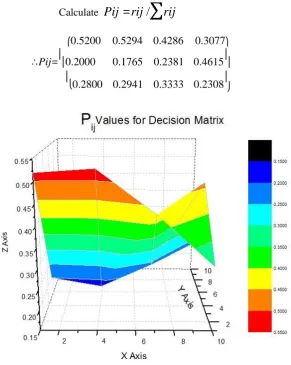
Step1: Calculate pij (the ith schemes jth indicators values proportion).
In entropy method, the smaller the indicators entropy value ej is, the bigger the
variation extent of assessment value of indicators is, the more the amount of information provided, the greater the role of the indicator in the comprehensive evaluation, the higher its weight should be.
3. Supplier Selection Problem–SAW Method: Numerical Illustration with Sensitivity Analysis We assume an MADM problem that has three alternatives and four attributes where in attributes C1, C4 are cost type and attributes C2,C3
are of profit type (the weight of attributes found out from the methods of entropy, Eigen vector, linmap or weighted least square which are suitable). wt = (0.4,0.2,0.3,0.1)
C C C C
1
23
4
A
1
⎡
13 9 9 8
⎤
A
2
⎢
⎢
5 3 5 12
⎥
⎥
A
3
⎢⎣
7 5 7 6
⎥⎦
METHOD-1: SAW METHOD STEP1:
C1 and
C
4
=> Cost,C2 and
C
3
=> Profit andwt
= (0.4, 0.2, 0.3, 0.1)C C C C
12
3
4
A
1⎡
13 9 9 8
⎤
D A
=
2⎢⎢
5 3 5 12
⎥⎥
A
3⎢
⎣7 5 7 6
⎥⎦
d
ij
d
r
=
for benefit and for costwe have,
r
=
ij
⎣⎢
0.71 0.56 0.78 1⎥⎦
Figure 1. Normalized Matrix for the given Decision matrix
ij
ij
max d
j
dminj
Normalized Matrix is
⎡
0.38 1
⎢
1
0.3
3
⎢
1 0.75
⎤
0.56
0.50
⎥
Youvaraj et al. 2015 ISSN: 2349 – 4891
Step2:
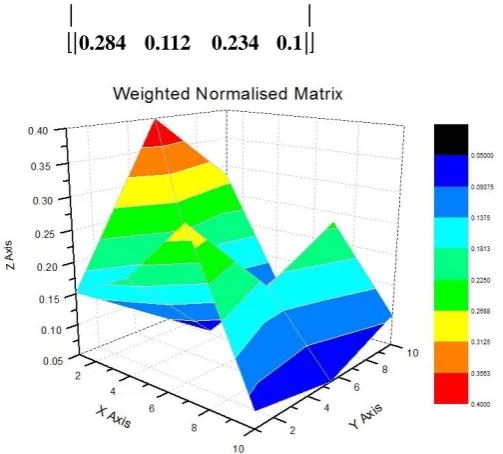
Weighted normalized matrix
⎡0.152 0.2 0.3 0.075 ⎤
⎢
0.4 0.066 0.168 0.05 ⎥
⎢ ⎥
⎣⎢0.284 0.112 0.234 0.1⎥⎦
Figure 2. Weighted Normalized Matrix for the Normalized matrix
STEP3:
Final score is calculated as: k
Pi
=
∑
w rj ij
.,
i
=
1,2,...,
m
j=1 Here m=3 & k = 4
P1 = 0.152 + 0.2+0.3+0.075 = 0.727
P2 = 0.4 + 0.066 + 0.168+ 0.05 = 0.684
P3 = 0.28 + 0.112+ 0.234 + 0.1 = 0.73
The ranking Preference is given as follows: ∴ A3 > A1>A2
METHOD-2: SAW WITH SENSITIVITY ANALYSIS
STEP1: Normalised matrix
⎡0.38 1 1 0.75 ⎤
⎢1 0.33 0.56 0.50
⎥
=
⎢ ⎥
⎢
⎣
0.71 0.56 0.78 1⎥⎦
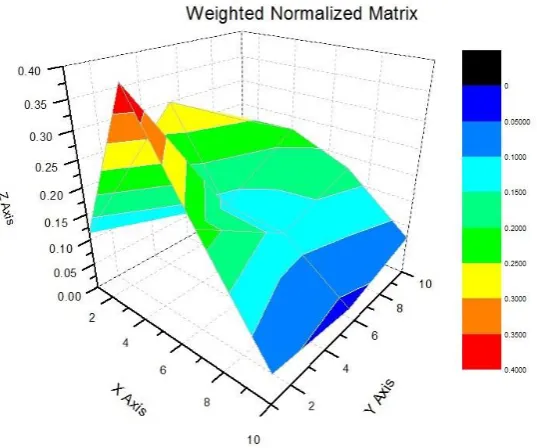
STEP2: Weighted normalised matrix
⎡0.114 0.4 0.225 0.056 ⎤
⎢0.3 0.132 0.126 0.0375
⎥
= ⎢ ⎥
Youvaraj et al. 2015 ISSN: 2349 – 4891
Figure 3. Weighted Normalized Matrix for Sensitivity Analysis
STEP3:
STEP1: Calculate
Pij
=
rij
/
∑
rij
⎛
0.5200 0.5294 0.4286 0.3077
⎞
∴
Pij
=
⎜
⎜
0.2000
0.1765 0.2381 0.4615
⎟
⎟
⎜
⎝
0.2800 0.2941 0.3333 0.2308
⎟
⎠
Figure 4. Pij Value Matrix
STEP2:
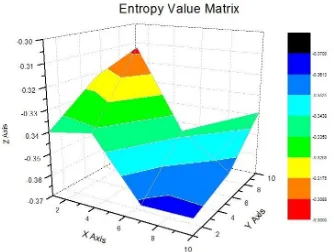
Calculate entropy value using,
ej =−
k
∑
mPij 牋ln(Pij ),
i=1
k
⎛−
0.3400
=⎜⎜−
0.3218
⎜
−
0.3564
⎝
−
0.3367
−
0.3061
−
0.3599
−
0.3631
−
0.3417
−
0.3662
−
0.3627
⎞
⎟
−
0.3569
⎟
Youvaraj et al. 2015 ISSN: 2349 – 4891
Figure 5. Entropy Value Matrix from Pij Value Matrix
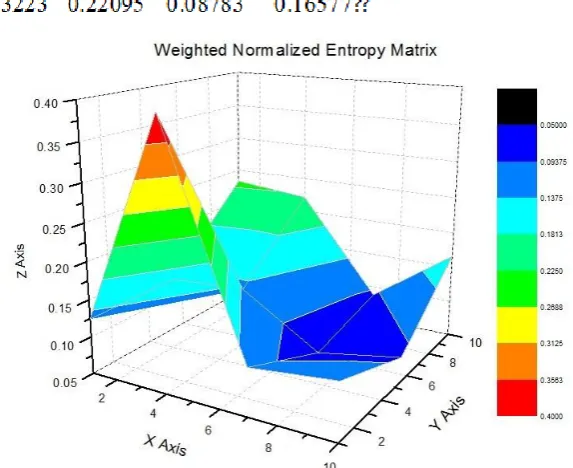
Figure 6. Weighted Normalized Entropy Value Matrix
STEP4:
Youvaraj et al. 2015 ISSN: 2349 – 4891
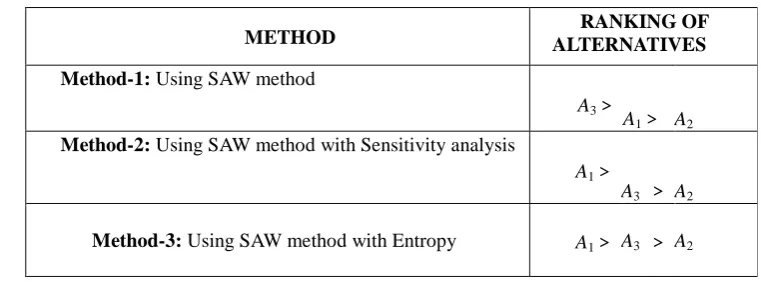
Table 1. Comparison of the three methods
METHOD ALTERNATIVES RANKING OF
Method-1: Using SAW method
A3 >
A1 > A2 Method-2: Using SAW method with Sensitivity analysis
A1 >
A3 > A2
Method-3: Using SAW method with Entropy A1 > A3 > A2
4. Conclusion: Findings and Suggestions
The proposed research work has concentrated on issues and complexities in applying SAW method to real world problems like supplier selection problems in supply chain management. The general SAW method, Sensitivity analysis for SAW method was proposed and new algorithm was proposed for Multiple Attribute Decision Making also with entropy method efficiently. The procedure for a general SAW method is discussed. A case study with the theory of selecting the best supplier in a supply chain management is analyzed with the help of the proposed algorithm of SAW method extended with a sensitivity analysis with changes taking place in weighting vector is presented. A numerical illustration is presented utilizing the SAW method for supplier selection problem.
References
1. Alireza Alinezhad and Abbas Amini, “Sensitivity Analysis of TOPSIS Technique: The results of change in the Weight of one attribute on the Final Ranking of Alternatives”, Journal of Optimization and Industrial Engineering, vol.7, pp.23 – 28, 2011.
2. Chen, T-Y., “Comparitive analysis of SAW and TOPSIS based on interval-valued fuzzy sets: Discussions on score functions and weight constraints”, Expert Systems with Applications, vol.39, no.2, pp.1848-1861, 2012.
3. Gupta, J.N.D., Forgionne, G.A., & Mora, M.T., “Intelligent Decision Making Support Systems: Foundations, Applications & Challenges”, Springer-Verlag, London, 2006.
4. Hwang, C. L., & Yoon, K., “Multiple attribute decision making methods and applications: A state of the art survey”, New York: Springer-Verlag,1981.
5. Kwang H. Lee, “First Course on Fuzzy Theory and its Applications”, Springer,2005.
6. Ketkar, M. & Vaidya, O.S., “Developing Ordering policy based on multiple inventory classification schemes”, Procedia Social and Behavioral Sciences, vol.133, pp.180-188,2014.
7. Liu, P., & Wang, M., “An extended VIKOR method for multiple attribute group decision making based on generalized interval-valued trapezoidal fuzzy numbers”, Scientific Research and Essays, vol.6, no.4, pp.766-776, 2011.
8. Opricovic, S., & Tzeng, G. H., “Multicriteria planning of post-earthquake sustainable reconstruction”, Computer-aided Civil and Infrastructure Engineering,vol.17, pp.211–220,2002.
9. Opricovic, S., & Tzeng, G. H., “Fuzzy multicriteria model for post-earthquake land use planning”, Natural Hazards Review, vol.4, pp.59–64,2003.
10. Opricovic, S., & Tzeng, G. H., “Compromise solution by MCDM methods: A comparative analysis of VIKOR and TOPSIS”, European Journal of Operational Research, vol.156, pp.445–455,2004.
15. Volvaciovas, R., Turskis, Z., Aviza, D., & Mikstiene, R., “Multi-Attribute Selection of Public Buildings Retrofits Strategy”, Procedia Engineering, vol.57, pp.1236-1241, 2013.
16. Zadeh, L.A., “Fuzzy Sets Information and Control”, pp. 338-356,1965.
17. Zavadskas, E. K., Turskis, Z., Dejus, T., & Viteikiene, M., “Sensitivity analysis of a simple additive weight method”, International Journal of Management and Decision Making, vol.8, no.5, pp.555-574,2007.
18. Zeleny, M., “Multiple criteria decision making”, New York: McGraw-Hill,1982.