1 INTERNATIONAL JOURNAL OF ADVANCES IN ENGINEERING RESEARCH
ANDROID AND ARM PROCESSOR BASED LOCATION
TRACKING SYSTEM
*J. Maheswari, #T. Deva Kumar
*PG Scholar, # Assistant Professor (SG) Department of ECE National Engineering College, Kovilpatti, Tuticorin, Tamil Nadu
ABSTRACT
Since the usage of smart phone and the internet service becomes the trend for information development and software applications, so that services for the mobile devices have become common. Nowadays almost all the smart phones from different vendors have GPS based location identifier along with location image as predefined application. Here the image of location is derived from common Google server. In some real-time application it is necessary to monitor location as well as to identify the movement of distant non respond user. Such kind of application is not currently available in present smart phones. The goal of this paper is to create an android based application, which receives information about the location of distant non respond user an d derive the necessary detail about that location at the monitoring end in terms of location image as well as the detail about that location in text. Moreover the paper has explored how to integrate current technologies like Gmap, browser, GPS. Overall, this should serve as a genuinely helpful for monitoring the movement of elderly people as well as for the survey of wild animals.
Index Terms— android, ARM, GSM, GPS, linux kernel, smart phone.
INTRODUCTION
COMPUTING continues to become more “personal”, increasingly accessible anytime, anywhere. At the forefront of this development are handheld devices that are transforming into computing platforms. It is commonly acknowledged that the mobile phones have become more powerful and ubiquitous in our daily life; the applications running on the mobile phones were paid more attention by the people. The usage of Android platform is attracting more and more programmers in mobile computing fields. Android is an operating system for mobile devices such as smart phones and tablet computer. It is developed by Open Handset Alliance led by Google [1].
2 INTERNATIONAL JOURNAL OF ADVANCES IN ENGINEERING RESEARCH
The Android SDK provider powerful tools and API’s necessary to develop applications on Android platform using Java programming language. It is open system architecture with versatile development and debugging environment, which has optimized graphics systems, rich media support and a very powerful browser.
Until now, most of location monitoring systems like Active badge, Cricket, RADAR, Active bat were available for indoor identification only [4,7]. For outdoor, only GPS is used, but it gives undetailed information about the location. Some mobile tour guide systems uses prototype which is to be downloaded on the mobile device or PC, but it’s somewhat complex and may not be reliable [3,5]. So with recent technology smart phone is used for refined information [1-2].
In this paper, it is designed and implemented an Android based location identification system which receives information about the location of distant non respond user and derive the necessary detail about that location at monitoring end in terms of location image as well as detail about the location in text.
This paper is structured as follows the section II explains the architecture of Android, section III presents the requirements for designing, section IV describes how the system has implemented, section V discusses about the results of the system and paper concluded in section VI.
II. ANDROID ARCHITECTURE
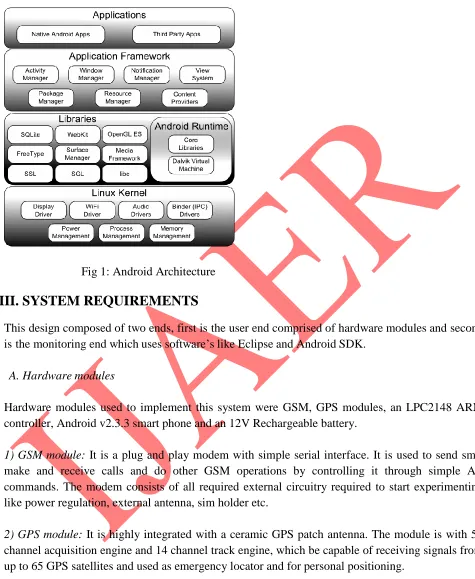
Android is based on Linux V2.6 kernel, its goal is to deploy the mobile phone sector. Android can also be used on other platforms and applications [1].
Android system uses a layered architecture and it has application layer, application framework layer, system runtime library and Linux kernel layer from top to the bottom. Application layer provides a core applications, including email client, SMS programs, calendar, maps, browser, etc. all application are written using the Java. Application framework layer enables and modifies the reuse of components, any application can publish or use other applications.
3 INTERNATIONAL JOURNAL OF ADVANCES IN ENGINEERING RESEARCH
Fig 1: Android Architecture
III. SYSTEM REQUIREMENTS
This design composed of two ends, first is the user end comprised of hardware modules and second is the monitoring end which uses software’s like Eclipse and Android SDK.
A. Hardware modules
Hardware modules used to implement this system were GSM, GPS modules, an LPC2148 ARM controller, Android v2.3.3 smart phone and an 12V Rechargeable battery.
1) GSM module: It is a plug and play modem with simple serial interface. It is used to send sms,
make and receive calls and do other GSM operations by controlling it through simple AT commands. The modem consists of all required external circuitry required to start experimenting like power regulation, external antenna, sim holder etc.
2) GPS module: It is highly integrated with a ceramic GPS patch antenna. The module is with 51
channel acquisition engine and 14 channel track engine, which be capable of receiving signals from up to 65 GPS satellites and used as emergency locator and for personal positioning.
3) ARM controller: ARM processor have merits of high performance, low power consumption, low
4 INTERNATIONAL JOURNAL OF ADVANCES IN ENGINEERING RESEARCH
mobile and embedded electronics market.
4) Android smart phone: The main benefit of using android is unlimited applications can be
downloaded on Android phones. This system uses v2.3.3 smart phone.
5) Rechargeable battery: These are lead-lead dioxide systems. If battery is overcharged, special
one way valves allow the gases to escape to avoid excessive pressure buildup. The battery is completely sealed and is maintenance free, leakage proof and usable in any position.
B. Software modules
1) IAR embedded workbench IDE: IAR is abbreviation of Ingenjörsfirmun Anders Rundgren
which means Anders Rundgren Engineering Company. It is a high performance C/C++ compiler and debugger tool suite for applications based on 8- , 16-, and 32 bit microprocessors. It incorporates a compiler, a linker and a debugger into one integrated development environment (IDE). IAR is advanced and powerful, easy to use and user friendly interface.
2) Eclipse: Eclipse is created by an Open Source community and is used in several different areas
especially as a development environment for Java or Android applications. It is multi language software development environment comprising a workspace and an extensible plug in system.
3) Android SDK: It is downloaded in a simple zipped package. The bulk of Android SDK, in
5 INTERNATIONAL JOURNAL OF ADVANCES IN ENGINEERING RESEARCH
IV. IMPLEMENTATION
A. User end
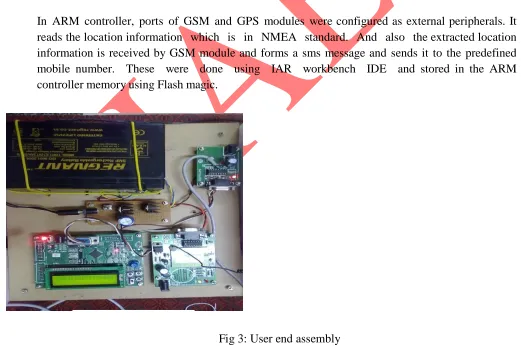
The system is assembled as per the fig 2. In the user end, the receiver in GPS module calculates its position by the signals that include time and satellite position at time of message transmission. The retrieved information will be in NMEA (National Marine Electronics Association) standard.
In ARM controller, ports of GSM and GPS modules were configured as external peripherals. It reads the location information which is in NMEA standard. And also the extracted location information is received by GSM module and forms a sms message and sends it to the predefined mobile number. These were done using IAR workbench IDE and stored in the ARM controller memory using Flash magic.
6 INTERNATIONAL JOURNAL OF ADVANCES IN ENGINEERING RESEARCH
B. Monitoring end
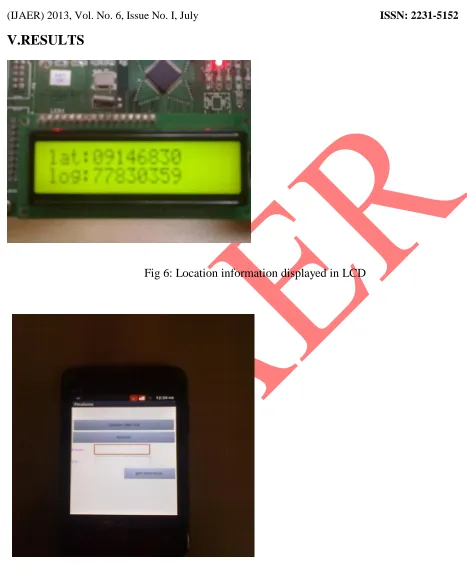
In Monitoring end, the Android based application is developed for that a smart phone is programmed to receive and identify the specific message. After identifying it reads and extracts the information. It displays the map image of extracted location information from common Google server as well as the detail about that location in text on user interface.
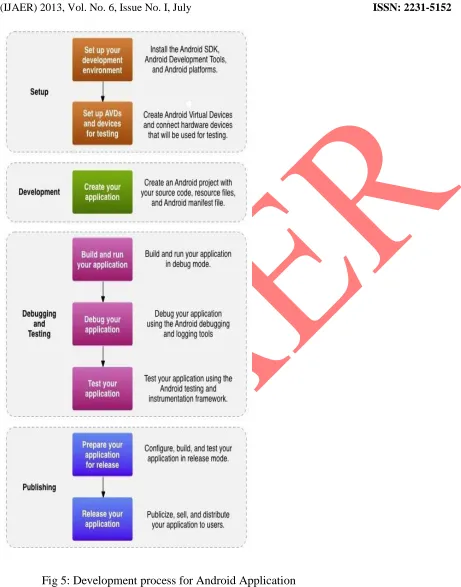
To develop application for Android devices, we used a set of tools that are included in the Android SDK. Once SDK is installed, the tools can be directly accessed from Eclipse IDE.
(IJAER) 2013, Vol. No. 6, Issue No. I, July ISSN: 2231-5152
7 INTERNATIONAL JOURNAL OF ADVANCES IN ENGINEERING RESEARCH
V. RESULTS
8 INTERNATIONAL JOURNAL OF ADVANCES IN ENGINEERING RESEARCH
V.RESULTS
Fig 6: Location information displayed in LCD
(IJAER) 2013, Vol. No. 6, Issue No. I, July ISSN: 2231-5152
9 INTERNATIONAL JOURNAL OF ADVANCES IN ENGINEERING RESEARCH
VI. CONCLUSION AND FUTURE WORK
In this paper, we designed and implemented a location monitoring system which is based on Android system. This concept can be extended to vehicle management system and also to monitor the mobility of children and elderly persons those who are not having respond devices like mobile phone with them. In addition to location information the user interface may be designed to acquire specific information about that location like historical significant and restaurant availability in that particular location. This work is considered as future extended work.
REFERENCES
[1] Li Liu, Yanfang Jing, “Android City Tour Guide System Based on Web Service”, on IEEE conference publications on CECNet, pg no: 3118-3121, 2012.
[2] Yuichiro Mori, Hideharu Kojima, Eitaro Kohno, Shinji Inoue, Tomoyuki Ohta and Yoshiaki Kakuda, “ A Self- Configurable New Generation Children Tracking System Based on Mobile Ad Hoc Networks Consisting of Android Mobile Terminals”, proceedings on IEEE International Symposium on Automous Decentralized Systems, 2011.
[3] Michael Kenteris, Damianos Gavalas, Daphne Economou, “An Innovative Mobile Electronic Tourist Guide Application”, in pervasive ubiquitous computing, Springer-Verlag London,
2009.
[4] Nigel Davies, Keith Cheverst, Keith Mitchell, Alon Efrat, “Using and Determining Location in a Context-Sensitive Tour Guide”, on journal computer published by IEEE Computer Society, pg no: 35-41, 2001.
[5] Ma Chang-jie, Fang Jin-yun, “Location-Based Mobile Tour Guide Services Towards Digital Dunhuang”, on the International Archives of the Photogrammetry, remote sensing and spatial information sciences, Beijing, 2008.
[6] Jeffery Hightower, Gaetano Borriello,” Location Systems for Ubiquitous Computing”, on journal computer published by IEEE Computer Society, pg no:57-66, 2001.
[7] Mike Hazas, James Scott, John Krumm,” Location-Aware Computing Comes of Age”, on IEEE transaction on invisible computing.
10 INTERNATIONAL JOURNAL OF ADVANCES IN ENGINEERING RESEARCH
map based mobile services, pg no:193-209, Springer Berlin Heidelberg.