The Impact of Learning and Market Orientation on Product Development:The Mediating Effect of Innovation Capability
Khawar Naheed
[email protected] Assistant Professor
Department of Commerce, Bahauddin Zakaryia University, Multan
Muhammad Arif Nawaz
[email protected] Ph. D Scholar
Department of Commerce, Bahauddin Zakariya University, Multan-Pakistan
&
Badar Latif
[email protected] MS Research Scholar
Department of Commerce, Bahauddin Zakaryia University, Multan
Abstract
Keywords: Learning orientation, Market orientation, Innovation capability,
Product development, Business performance
Introduction
In current business environment, easy and frequent availability of new products forced the market to develop new product which may decrease the time period of existing product life cycle. Product life cycle has a great significance in the product development because it enables firm to reduce the product-related costs, improves the activity of product development, and provides a way to overcome problems with the use and support of existing products and the development of new products.1 The complex nature of business environment required high demand for new product development. In order to fulfill the market demand, scholars and practitioners are looking for further research on this structural phenomenon which includes product development. Product development is the first and the most important phase of organizational strategy in which new ideas are generated, new products are shaped and commercialized to increase the market share.2 Product development is the process in which new product and service has introduced in the market. This process includes idea generation, market research and analysis including marketing strategies regarding innovation capability to develop a particular product. The organization depends on its innovation capability to generate a new idea and conducting market analysis. However, the product development process also requires techniques such as high expertise and supportive management system.3
Innovation capability of an organization is assessed through organization ability to develop new strategies, goals, directions, and resolved other issues of organization.4 It is well argued that not only innovation capability other factors such as organization's learning orientation and market orientation is directly associated with firm innovativeness to develop new products. The concept of firm innovativeness has taken the attention and focus
1 Stark, J., Product lifecycle management, In Product Lifecycle Management Volume 1,
Springer, Cham, 2015, pp. 1-29.
2Ulrich, K. T. & Eppinger. S. D.. Product Design and Development, 4th ed. McGraw-Hill,
New York, 2007.
3 Koufteros, X. A., Vonderembse, M. A., & Doll, W. J., Integrated product development
practices and competitive capabilities: the effects of uncertainty, equivocality, and platform strategy, Journal of Operations Management, 2002 , pp. 331-355.
4Han, J. K., Kim, N., &Srivastava, R. K.,Market orientation and organizational performance:
of researchers because firm innovativeness helps organization to gain competitive advantage and improve business performance.5 Previous studies have recognized the importance of innovation capability, therefore, management need to focus on the improvement of this particular capability in order to increase their performance.6
Like other business organization, SME's are facing the challenges of increased growth particularly in product development because of shorter lifecycle of their product, inefficient technology, and competitive environment. The ability of the organization to move according to the changing environment through accepting innovation can grow two times faster than their competitive organizations. Among the important factor that can contribute to organization process of product development, learning orientation and market orientation are also important factors. These factors are crucial as it requires a proper planning. In addition to market orientation, learning orientation that indicates organizational learning capability creates better value helps to carry employee’s behavior which in turn helps to attain the competitive advantage through its organizational, human, and social capital in order to peruse radical innovative capability7. Organizational capital absolutely effects incremental innovative capability, human capital and social capital influence radical innovative capability.
It is well argued that product development has significant effect on product growth and is an essential element for successful organization through improved performance.8 9 10 Extant research has focused on the factors that
5Dadfar, H., Dahlgaard, J. J., Brege, S., & Alamirhoor, A. Linkage between organizational
innovation capability, product platform development and performance: The case of pharmaceutical small and medium enterprises in Iran. Total Quality Management & Business Excellence, 2013, pp. 247-8, 819-834.
6Kalmuk, G., & Acar, A. Z., The Mediating Role of Organizational Learning Capability on
the Relationship between Innovation and Firm's Performance: A Conceptual Framework. Procedia-Social and Behavioral Sciences, 210, 2015, pp. 164-169.
7
Wan, J., Zhang, D., Zhao, S., Yang, L., & Lloret, J., Context-aware vehicular cyber-physical systems with cloud support: architecture, challenges, and solutions. IEEE Communications Magazine, 528, 2014, pp. 106-113.
8Chen, Y. C., Li, P. C., Evans, K. R., & Arnold, T. J., Interaction Orientation and Product
Development Performance for Taiwanese Electronics Firms: The Mediating Role of Market‐Relating Capabilities. Journal of Product Innovation Management, 2017, pp. 341, 13-34.
9
help organization in the development of new products. However, there is a lack of studies that have focused and devoted their attention on new product development in Small and Medium Enterprises (SME).11 Innovation practices are less dignified and less implicit by the SME’s managers. However, there are
many SMEs that are strongly innovative in their practices and creating a variety of new products that can be enhanced through focusing on the antecedents that promote the innovative capability in developing new products in SMEs.12
Keeping in view this importance, this research described the model that helps SME's to adopt the practices of large organizations to improve their product development process by emphasizing on innovation capability as a mediator in this process. Among the antecedents that increase the innovation capability, marketing orientation and learning orientation has significant effect on product development and organizational growth. Emphasizing on marketing orientation and organizational learning, the organization is able to improve its performance not only on new product development but also on innovation capability. This is a critical issue for managers because it better informs them about organizational traits that influence marketplace performance. The primary contribution of this research is to highlight the role of innovation capability on product development and highlighted the factors which supported innovation capability. This study developed the following research questions:
RQ: Does learning orientation effect on product development?
RQ: Does market orientation effect on product development?
RQ: Does learning orientation effect on innovation capability?
RQ: Does market orientation effect on innovation capability?
RQ: Does innovation capability effect on product development?
10 Tidd, J., Bessant, J. R., & Pavitt, K., Managing innovation: integrating technological,
market and organizational change Vol. 4. Chichester: Wiley 1997.
11
Chapman, R. L., O’Mara, C. E., Ronchi, S., &Corso, M., Continuous product innovation: A comparison of key elements across different contingency sets. Measuring Business Excellence, 53, 200, pp.16-23.
12
RQ: Does innovation capability mediate the relationship of learning
orientation and product development?
RQ: Does innovation capability mediate the relationship of market orientation
and product development?
Based on the above-mentioned research questions, the main objective of this research is to extend the literature review about the antecedent’s namely marketing orientation and learning orientation, and innovation capability on product development. This research has examined the direct impact of marketing orientation and organizational learning on product development and also indirect effect of innovation capability on product development through learning orientation and market orientation.
Literature Review
Schumpeter Theory of Innovation
Schumpeter13 has introduced the concept of innovation that played a vital role in economic growth of a country. Schumpeter argued that “entrepreneurship is.... the key motive force in creating innovations, which are responsible for the economic growth". His theory explained that innovation capability leads to the product development that in turn increases the profitability of a firm14. Therefore, Schumpeter theory emphasized that the process of new product development is highly important for an organization particularly the factors that increase the innovation capability which in turn lead to new product development.
Resource based theory
Resource base theory (RBT) has explained that organizational resources and organizational internal capabilities essential for gaining the competitive advantage and increasing the performance of organization in the form of high profitability.1516 17 These internal capabilities can be explained
13
Schumpeter, J. A. The theory of economic development: An inquiry into profits, capital, credit, interest, and the business cycle Vol. 55. Transaction publishers, 1934.
14Roberts, P. W. Product innovation, product-market competition and persistent profitability
in the US pharmaceutical industry, Strategic Management Journal, 1999, pp. 655-670.
15
Baker, W. E., &Sinkula, J. M., Learning orientation, market orientation, and innovation: Integrating and extending models of organizational performance. Journal of market-focused management, 44, 1999, pp. 295-308.
16Penrose, E. T. 1959. The theory of the growth of the firm. New York: Sharpe.
17Peteraf, M. A., The cornerstones of competitive advantage: a resource‐based view. Strategic
and enhanced through learning orientation and market orientation and role of innovation in organizational management.18
Hurley and Hult Theory (HKS)
This paper extends the results of two separate studies into an integrative model of learning and market orientation, product innovation and organizational performance. HKS found that innovation is a function of market orientation. More specifically, HKS theoretically relates the market orientation and learning orientation to organizational innovativeness and ultimately competitive advantage. The study of Sinkula 19 found empirical evidence of the relationship between learning, development and innovation, but did not include a measure of market orientation or a complete measure of learning orientation. HKS found empirical support for a model that asserted the effect of market orientation on performance is mediated by organizational innovation. However, this study inculcates learning orientation in the conceptualization of HKS theory. The integrative model in this research is important because it provides insights into the relative importance of both market orientation and learning orientation for the development of products within an organization.
Market Orientation
“Market Orientation is the strategy that emphasized customers and market needs. It effectively satisfied the customers through customer orientation, competitor orientation, and inter-functional coordination.”20 Wren et al 21 explained that there are two different concepts; marketing orientation and market orientation, but there is some similarity in these both concepts. Marketing orientation created after customer demand because organization wants to satisfy the customer needs. Market orientation has covered overall
18Schroeder, R. G., Bates, K. A., & Junttila, M. A., .A resource‐based view of manufacturing
strategy and the relationship to manufacturing performance. Strategic Management Journal, 232, 2002, pp. 105-117.
19 Sinkula, J. M., Baker, W. E., & Noordewier, T., A framework for market-based
organizational learning: Linking values, knowledge, and behavior. Journal of The Academy of Marketing Science, 1997, pp. 254, 305.
20Narver, J. C., & Slater, S. F., The effect of a market orientation on business profitability.
The Journal of Marketing, 1990, pp. 20-35.
21
course and elements of market, included competitor. The concept of market orientation has taken the interest of scholars and researcher last 20 years.22 23
These researchers observed that among the other factors, market orientation increases the product development process, especially in a strategic context. Market orientation encourages organizations for the development and management of strategic plans which in turn add value to their customers. Extant literature evidenced that many organizations increase their performance in the form of increased profitability through the development of their strategic plans24. In addition, these studies described that market orientation is an effective and efficient factor that add value to the customers and organizational performance.
The study of Farrell and Mavondo, 25 described that market orientation as a part of an organization’s culture elaborates true meaning because market orientation describes employee's personal behavior, attitudes, values and beliefs. The study of McKitterick26 described market orientation as one of the business concepts that emphasizes marketing, especially for customers. It was the integration of marketing elements to make a profit. The study found a positive relationship between the effectiveness of an organization and market orientation behavior. The studies described that the market orientation is the ability of the market to support the organizational competition capability. Under the market orientation behavior, an organization would emphasize the analysis of the target market's demands and effectively satisfied customers demand to gain initiative over its competitors. There are studies that pointed out that market orientation adopted a marketing philosophy to establish a culture that affected processes and new product development 27 28 29 insisted
22Min, S., &Mentzer, J. T., The role of marketing in supply chain management, International
Journal of Physical Distribution & Logistics Management, 309, 2000, pp. 765-787.
23Nakata, E., Hunter, N., Mason, K., Fan, Z., Ang, K. K., & Milas, L., C225 antiepidermal
growth factor receptor antibody enhances the efficacy of docetaxel chemoradiotherapy, International Journal of Radiation Oncology• Biology• Physics, 594, 2004. Pp. 1163-1173.
24Olavarrieta, J. R. Estudios clínicos controlados en técnica quirúrgica. Revista de la Facultad
de Medicina, 282, 2005, pp.146-154.
25
Farrell, M., & Mavondo, F. T. The effect of downsizing strategy and reorientation strategy on a learning orientation. Personnel Review, 334, 2004, pp. 383-402.
26McKitterick, J. B. What is the marketing management concept. Chicago, IL, 1957. 27
that market orientation with an emphasis on the customer and thecompetitor’s leads to success.
The concept of market orientation can be divided into two concepts of studies. One was from 30 who described that market orientation, consisted of three types of orientation which are included customer, competitor, and inter-functional co-ordination orientation. The second one was from 31 who described that market orientation consisted of generation, dissemination, and responsiveness intelligence. However, Kohli & Jaworski 1993 put more emphasis on the customer and Narver and Slater 1990 stressed on organizational culture particularly on market orientation. Narver and Slater 1990 emphasized on the market orientation as an organizational culture particularly on customer and the competitors. Therefore, the study by Narver & Slater 1990 related to this research as it conceptualized as an important variable market orientation for innovative capability and product development. Market orientation is further divided into three categories; market orientation, competitor orientation and inter-functional co-ordination.
Customer Market Orientation
“Customer orientation explains the activities of the organization, especially on satisfying customers' demand by utilizing a value-added strategy to gain initiative. It had an effective systematical customer feedback assessment after sales service”. The authors described that the customer’s need could be better achieved by the customer orientation. There were two ways of adding value to customers. First, the value addition can be achieved through fixing are reasonable price. Second, it can be achieved through reducing the customer payment while providing the same benefits. Matti (2006) pointed out that customer orientation is a process that focused oncustomer’s demand and
28 Chiang, M. L., Lee, P. C., & Chang, R. C. Using data clustering to improve cleaning
performance for flash memory. Software-Practice & Experience, 293, 1999, pp. 267-290.
29
Heiens, R. A. Market orientation: toward an integrated framework., Academy of Marketing Science Review, 2000.
30Narver, J. C., & Slater, S. F. The effect of a market orientation on business profitability, The
Journal Of Marketing, 1990, pp. 20-35.
31 Jaworski, B. J., & Kohli, A. K. Market orientation: antecedents and consequences, The
their satisfaction. Deshpandé et al 32 define customer orientation as set of believes that could create customer interest. It is the ability of organization to define, analyze, understand and respond to a customer’s demand. Therefore, it is necessary for an organization to understand the limitation of their customers so it could accurately approach the customer.
Competitor Market Orientation
“Competitor orientation was the strategy that analyzed competitors‟ strengths and weaknesses and adapted a strategy against the competitors' weakness. Sales personnel lead in competition and define target groups for the organization.”33 34 He describes competitor orientation as the ability of organization to understand the existing and anticipated capabilities of the competitors, such as strengths, weaknesses, capabilities, and strategies. The strategy should include why customers are interested in competitor's products. Moreover, it could describe how to gain initiative over competitors in term of activities, space, and products. The empirical study of 34 examined customer orientation that includes competitor’stechnology and ability in order to satisfy their customer. The studies supported the concept of 34 that customer orientation and competitor orientation are the elements of market orientation.
Inter-functional Market Coordination
“Inter-functional coordination related to the sharing of resources among departments inside the organization to satisfy the target market. This included the sharing of customers‟ information inside the organization, keeping in touch with recent customers and prospective future customers, and sharing product and service information with suppliers” 34. The authors described inter-functional coordination as the usage of internal sources to maximizing quality of products and services, which also included customer orientation and competitor orientation. The coordination depended on sub-units. Sub-units needed to understand their role and encourage mutual support in the organization. Gatignon and Xuereb, 34 defined inter-functional
32Deshpandé, R., Farley, J. U., & Webster Jr, F. E. Corporate culture, customer orientation,
and innovativeness in Japanese firms: a quadrad analysis. The Journal of Marketing, 1993, pp. 23-37.
33Narver, J. C., & Slater, S. F. The effect of a market orientation on business profitability. The
Journal of Marketing, 1990, pp. 20-35.
34 Gatignon, H., & Xuereb, J. M. Strategic orientation of the firm and new product
coordination as a particular structure that provides fluent communication among sub-units in an organization. The coordination among sub-units increased information sharing among units. For example, in the development of new products, process played an important role. Hence, inter-functional coordination is important dimension of market orientation that influences innovation and product development. This process is explained that coordination among the units of an organization increases the overall performance of the organizational activities. The capability of management and coordination could reduce costs and add more value to the product delivery.
The studies of market orientation showed that inter-function coordination influenced higher organizational performance. Johnson et al
35
suggest that organization should put more emphasis on inter-functional coordination than customer and competitor orientation.
Organization might use two strategies, depending on the company’s goals and business circumstances. The study examined and found that market orientation affects the new product development of small companies in Malaysia. In addition, described that when an organization applied market orientation, it has positive effect on its product development. The elements that could impact company activities were market orientation that is further divided in to three elements namely customer, competitor and inter-functional orientation. These three elements help organization in the process of new product development, brand loyalty, and achieve high performance. Based on the above discussion, it can be hypothesized that market orientation has positive relationship with new product development.
Learning Orientation
Learning orientation explains the organizations willingness and knows how to be a learning organization. The organization's visions for learning needed to be precise and encourage all personnel to improve their knowledge, shared vision, and accept the opinions of others. 36 The rapid development in
35 Johnson, A. J., Dibrell, C. C., & Hansen, E. Market orientation, innovativeness, and
performance of food companies, The Journal of Agribusiness, 271/2, 2009, pp. 85-106.
36
technology influenced globalization, competition and business environment. Learning is an important for organizations in order in order to respond to uncertain circumstances faced by the organization to survive in competitive environment. In addition, the world’s trends are complicated, so individuals need improve their learning for understanding these complications. The leader ability to command and control the processes on organization depend on its learning. Learning increases the knowledge ofemployee’swhich the source of competitive advantage is. The imitation of new product development requires the learning capability. Therefore, learning orientation is one of the most important factors for new product development and innovation capability. The learning of an organization is an important factor that can let organization be successful in its organizational learning process and for positive outcomes.
Learning orientation is an important concept of organizational knowledge. Learning orientation explains organizational learning ability.37 This important concept includes all activities involve in the creation and application, collection and sharing of knowledge to take initiative such as customer demands, market changes, competitors' activities, as well as development of higher technology and new product development which increase their competitive ability.38 39 40
Huber41 defined learning orientation as one of organizational culture relating to organizational potential that affected individual behavior. Rhee 42 described that learning orientation was organizational culture prioritization that affect individual behavior. The learning orientation was a human process which consisted of skills, knowledge, and attitudes and these readily influence changing behavior. Learning orientation was the outcome of activities, such as
37 Hult, G. T. M., Ketchen, D. J., & Nichols, E. L. Organizational learning as a strategic
resource in supply management, Journal of Operations Management, 215, 2003, pp. 541-556.
38Hurley, R. F., & Hult, G. T. M. Innovation, market orientation, and organizational learning:
an integration and empirical examination. The Journal of Marketing, 1998, pp. 42-54.
39 Moorman, C., & Miner, A. S. Organizational improvisation and organizational memory.
Academy of management Review, 234, 1998, pp. 698-723.
40 Amabile, T. M., Conti, R., Coon, H., Lazenby, J., & Herron, M. Assessing the work
environment for creativity. Academy of management journal, 395, 1996, pp. 1154-1184.
41 Huber, G. P. Organizational learning: The contributing processes and the literatures,
Organization science, 21, 1991, pp. 88-115.
42
learning by doing, learning from mistakes, learning from market competitors, and learning from technology. Gong43 described that learning orientation was the commitment of an organization to improve performance and knowledge. Yu 44 described that learning orientation was compulsory tasks which were from particular circumstances and conditions. It could be described into three meanings. Firstly, learning orientation consisted of learning activities in the workplace and daily learning activities. Secondly, workplace environment was an important factor to create learning in the job and for individuals. Finally, learning orientation was from the individual learning and society context, such as employees learning from each other. Therefore, learning orientation is a learning process of individuals through the organization, consisting of knowledge, skills, and attitudes in particular circumstances in order to improve its organizational performance.
This research defined learning orientation as an organization that understood and was willing to develop its ability to be organizational learning. An organization needed to have a precise vision and accurate objectives in learning and encourage personnel to develop their individual learning commitment, shared vision and open mindedness.
(1) “Commitment to Learning was an environment where everyone knows that learning is important and they are willing to learn and invest in learning”
(2) “Shared vision was to let personnel understand the organization vision and let personnel have their own vision in accordance with the organization's vision. Therefore, all personnel are involved in planning, sharing and driving the organization in the same direction”
(3)“Open Mindedness is the acceptance of the customer's opinion. All personnel should utilize the customer's opinion as key words to improve themselves”
43 Gong, Y., Huang, J. C., & Farh, J. L. Employee learning orientation, transformational
leadership, and employee creativity: The mediating role of employee creative self-efficacy. Academy of management Journal, 524, 2009, pp. 765-778.
44Yu, S., Wang, C., Ren, K., & Lou, W. March. Achieving secure, scalable, and fine-grained
Innovation Capability
“The introduction or implementation of a new or significantly improved good or service; operational process; organizational /managerial process; or marketing method”45. Innovation plays a central role in organizations to develop advance products, organization procedure. The innovative capability of organization is important to capture and alters market, technology and sustain in competitive market.46 Besides this, organization performance depends on its innovation capability.47 It is well argued that innovation capability enhanced business performance. Innovation capability provides continuous opportunities for new products, innovative thoughts and create value proposition. So, the process of innovation capability explained as which switched opportunities into innovative products adoption of these innovative ideas into the organization.48 The main advantage for adoption of innovative capability is to run the organization in a successful way.49
In organization, the micro level of organization is concerned with innovation in products and goods which further explained a new thing for the organization or for the consumer. This division is significant for exploit the new thing, and from whose point of view it is innovative. In packages organization, the innovation most frequently is at the micro-level which is advance thing for organization. The organizational innovation improves organizational performance. Innovations brought all the ideas and information, which were the cause of actions by improving technology or service, and trying to reduce costs in production and materials. DeGraff 50 described organizational innovation as the commitment to improve work procedures, i.e.
45Australia, Y. B. 2008. Australian Bureau of Statistics. Canberra, Australia. 46
Dougherty, D., & Hardy, C. Sustained product innovation in large, mature organizations: Overcoming innovation-to-organization problems. Academy of management journal, 395, 1996, pp. 1120-1153.
47Dhewanto, W., Prasetio, E. A., Ratnaningtyas, S., Herliana, S., Chaerudin, R., Aina, Q., &
Rachmawaty, E. Moderating effect of cluster on firm's innovation capability and business performance: A conceptual framework. Procedia, Social and Behavioral Sciences, 65, 2012 pp. 867-872.
48Dadfar, H., Dahlgaard, J. J., Brege, S., & Alamirhoor, A. Linkage between organizational
innovation capability, product platform development and performance: The case of pharmaceutical small and medium enterprises in Iran. Total Quality Management & Business Excellence, 247-8, 2013, pp. 819-834.
49 Lee, W. N., & Tse, D. K. Changing media consumption in a new home: Acculturation
patterns among Hong Kong immigrants to Canada. Journal of Advertising, 231, 1994, pp.57-70.
ideas, design, production, etc., by developing a deep understanding of all levels. Innovation was the next step which developed creative thinking to real execution. It was introduced to the processes and the production and then sold to the market. Finally, the successful innovation would be imitated.
Product Development
Many organizations adopt innovation capability to increase product development, fulfill customer needs; utilized resources with minimized cost in shorter time span. Researchers use innovation capability approach to enhance their product development process in order to fulfill their customer needs. A product is a set of elements that best describe the customer needs and various market demands. Therefore, the concept of product development is defined as “a set of subsystems and interfaces that form a common structure from which
a stream of derivative products can be cost effectively developed and produced”. There are various approaches which are associated with product development. The authors explain three products: product plan, Differentiation plan, and Commonality plan. Product plan consisted on the plans which described the product to offer, differentiation plan consisted on the plans which described the product will be differentiated and commonality plan consisted on the plans which described the components will be shared.
The previous studies also included top-down approach and bottom-up approach. The top-down approach indicated the company products, its derivatives of products, manage and developed the products and the bottom up approach indicated the company group of products and their standardized elements. According to 51 the product development has two possible derivatives: (1) First derivatives consisted on the early effort of development; there is no further opportunity to produce a new product; (2) The second phase included the opportunity in which development of their product derivative is needed.
51Ulrich, K. T., Eppinger. S. D. Product Design and Development, 4th ed. McGraw-Hill, New
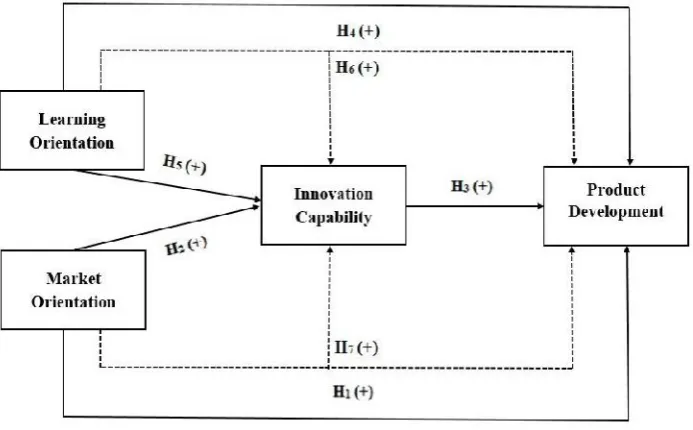
Figure 1. Theoretical Model
Hypothesis Development
H1: Learning orientation is positively related with innovation capability. H2: Learning orientation is positively related with product development. H3: Market orientation is positively related with innovation capability. H4: Market orientation is positively related with product development. H5: Innovation capability is positively related with product development. H6: Innovation capability mediates the relationship between learning
orientation and product development
H7: Innovation capability mediates the relationship between market orientation and product development.
Methodology of the Study
Exchange commission of Pakistan. The study obtained 302 questionnaires from the respondents.
This study tested four variables namely learning orientation, market orientation, innovation capability, and product development. In order to measure the variables, Market orientation measures through three elements: customer orientation, competitor orientation and inter functional organization. Five-point Likert scale is used which vary from strongly agree to strongly disagree in order to measure the construct. The Likert scale indicates the extent to which the respondents are agree or disagree with the statement representing the construct.
The data was analyzed by using PLS-SEM 3.2 which is considered as soft modeling and most commonly used technique. Both the results of structural and measurement model were reported in this study.
Data Analysis and Results
Table 1 Demographic Characteristic of Respondents
Respondent Profile Frequency Percentage %
Gender
Male 291 96.4%
Female 11 3.6
Age
26-30 69 22.8%
31-35 128 42.4%
36-40 65 21.5%
Above 40 40 13.2%
Education
Intermediate 109 36.1%
Bachelor 152 50.3%
Masters 41 13.6%
Table 1 showed the demographic information o f this study. Most of the respondents of this study are male that represent 96.4%. 42.4% of the respondent belongs to middle age group and only 13.2% are above 40 years old. 50% of the respondents are graduate degree holders.
Main Analysis
Measurement Model Results
Table 2 explains the factor loading of constructs measures, average variance extracted (AVE), construct reliability (CR) and Cronbach Alpha.
Construct/Indicat
or VIF
Weig ht
Loadin
g CR AVE
Cronbach's Alpha Learning Orientation LO2 LO3 LO5 LO6 LO7 LO9 LO10 1.00 0 0.294 0.250 0.205 0.174 0.209 0.212 0.211 0.665 0.677 0.629 0.639 0.642 0.622 0.613 0.83 0 0.411 0.764 Market Orientation MO1 MO2 MO3 MO4 MO5 1.75 3 0.323 0.373 0.322 0.241 0.241 0.642 0.754 0.664 0.601 0.634 0.79 4 0.437 0.680 Innovation Capability IC1 IC2 IC3 IC4 IC5 IC6 1.75 3 0.231 0.232 0.230 0.212 0.249 0.285 0.706 0.685 0.670 0.676 0.725 0.702 0.84 8 0.482 0.785 Product Development PD1 PD2 PD3 PD4 PD5 PD6 0.239 0.258 0.250 0.282 0.259 0.215 0.663 0.691 0.681 0.737 0.669 0.522 0.82 4 0.441 0.742
In the measurement model, the indicators meet the criteria of the reliability and validity. The results showed outer loadings of the indictors are greater than 0.60 that indicate that individual item reliability was adequate52. The result showed that all the reflective constructs fulfilled the construct reliability requirement as their composite reliabilities were higher than 0.7 53. Moreover, the results for latent variables achieved the convergent validity
52
Carmines, E. G., & Zeller, R. A. Reliability and validity assessment Vol. 17. Sage publications, 1979.
requirement because average variance extracted are greater than 0.40 which indicated that the acceptable criteria for convergent validity.
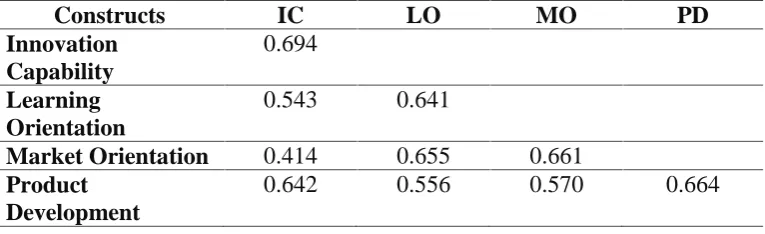
Multicollinearity occurs when independent variables are highly correlated to each other. A high degree of multicollinearity makes it difficult to get reliable estimates for each measure. 54 Variance inflation factor (VIF) assesses the collinearity issue. 55 Thus, the researcher examined multicollinearity through VIF in Smart PLS 3. VIF was estimated by (1/ (1-R2) with p< 0.05. The researcher assessed following set of predictors for collinearity. There is no issue of VIF as all the values are greater than the threshold value of 5 56. Thus, it was concluded that collinearity among predictors has little effect on the result interpretation. This measurement model is evaluated with respect to reliability and validity. 57 All constructs revealed acceptable level of Cronbach’s alpha ranging from 0.689 to 0.785. Further composite reliability 58 was also used to assess internal consistency because Henseler et al59 argued: “Cronbach’s alpha tends to provide a sever underestimation of the internal consistency reliability of latent variable in PLS path model”. The composite reliability results also indicated that the measures are robust in the terms of internal consistency reliability. The indexes of composite reliability showed satisfactory level, ranging from 0.794 to 0.848. Table 3. Discriminant Validity (Fornell-Larcker Criterion)
Constructs IC LO MO PD
Innovation Capability
0.694
Learning Orientation
0.543 0.641
Market Orientation 0.414 0.655 0.661
Product Development
0.642 0.556 0.570 0.664
54Hair, JF, Black, WC, Babin, BJ & Anderson, RE. Multivariate data analysis, Prentice Hall
Upper Saddle River, NJ. 2009.
55
Hair, JF, Hult, GTM, Ringle, CM & Sarstedt, M.A primer on partial least squares structural equation modelling PLS-SEM, SAGE Publications, Thousand Oaks, CA, 2014.
56Hair, op, cit.
57 Hair, JF, Ringle, CM & Sarstedt, M, 'PLS-SEM: Indeed a silver bullet', Journal of
Marketing Theory and Practice, vol. 19, no. 2, 2011, pp. 139-51.
58 Wertz, D. H., & Allinger, N. L. Conformational analysis—CI: The gauche-hydrogen
interaction as the basis of conformational analysis. Tetrahedron, 3012, 1974, pp. 1579-1586.
59Henseler, J, Ringle, C & Sinkovics, R. 'The use of partial least squares path modeling in
Fornell-Larcker test measures discriminant validity on the construct level.60 This test posits that a construct should share more variance with its own measures than it shares with other constructs in the given model. Thus, the correlation of a construct with its own indicators (square root of AVE) must be greater than the correlation between the construct and any other construct operationalized in the study. 61Further, the correlations between the coefficients should not exceed than 0.8.62
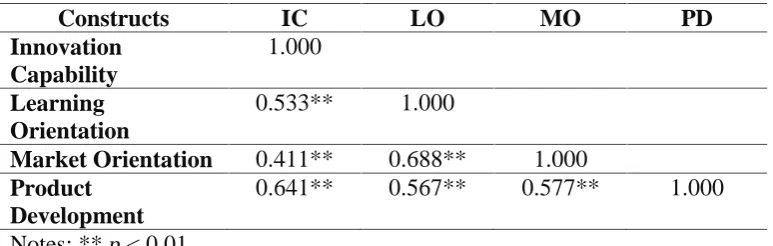
Table 4. Latent Variable Correlations
Constructs IC LO MO PD
Innovation Capability
1.000
Learning Orientation
0.533** 1.000
Market Orientation 0.411** 0.688** 1.000
Product Development
0.641** 0.567** 0.577** 1.000 Notes: ** p < 0.01
As the purpose of this study is to find relationship between market oriented, learning orientation, Innovation capability and Product development, the researchers used correlation analysis to find the relationship between these variables. Table 4 shows the correlation between variables. Each factor of market orientation and learning orientation has been found an insignificant correlation with innovation capability and product development.
Table 5. Coefficient of Determination (R2)
R2 is a measure of predictive accuracy and its magnitude describes a combined effect of exogenous latent variables on each endogenous variable. In PLS-SEM, R2 value is the most commonly used criterion to describe the
60Fornell, C., & Larcker, D. F. Structural equation models with unobservable variables and
measurement error: Algebra and statistics. Journal of marketing research, 1981, pp. 382-388.
61Chin, WW. 'How to write up and report PLS analyses', in VE Vinzi, W Chin, J Henseler &
H Wang , Handbook of partial least squares: concepts, methods and applications, Springer, Berlin, 2010, pp. 655-90.
62 Bagozzi, R. P., Yi, Y., & Phillips, L. W. Assessing construct validity in organizational
research. Administrative science quarterly, 1991, pp. 421-458.
Constructs R2
Innovation Capability 0.289
predictive accuracy of the model. The value of R2 ranges from 0 to 1 and higher value indicates greater predictive accuracy.63
Structural Model Results
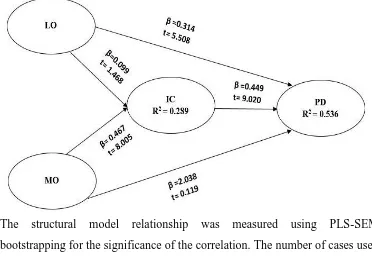
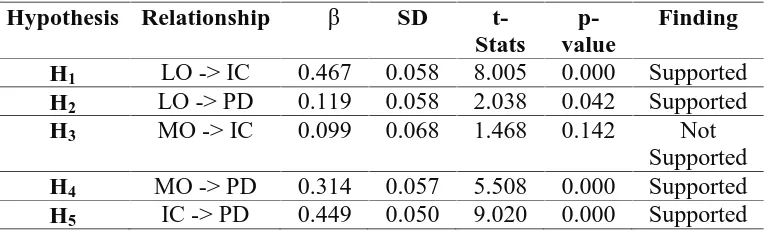
The structural model relationship was measured using PLS-SEM bootstrapping for the significance of the correlation. The number of cases used was 5000 sample for bootstrapping producer. 64 65The result in table 6 shows the relationship between the exogenous variables and endogenous variable of the PLS-SEM analysis. The outcomes of the structural model indicate the positive relationship between learning orientation and innovation capability (β
= 0.099, t = 1.468, p-value = 0.000). Therefore, hypothesis one strongly supported. Hypothesis two predicted that market orientation and innovation capability (β = 0.467, t = 8.005, p-value = 0.142) hypothesis three innovation capability and product development indicates the positive relationship (β =
0.449, t = 9.020, p = 0.000). Hypothesis four learning orientation positive relationship between product development (β = 0.314, t= 5.508, p = 0.042) and the last hypothesis show a positive relationship between market orientation and product development (β = 2.038, t = 0.119, p = 0.000)
Table 6. Structural model Results
63Hair, JF, Hult, GTM, Ringle, CM & Sarstedt, M A primer on partial least squares structural
equation modeling PLS-SEM, SAGE Publications, Thousand Oaks, CA, 2014.
64 Hair, JF, Ringle, CM & Sarstedt, M. 'PLS-SEM: Indeed a silver bullet', Journal of
Marketing Theory and Practice, vol. 19, no. 2, 2011, pp. 139-51.
65
Hypothesis Relationship β SD t-Stats
p-value
Finding
H1 LO -> IC 0.467 0.058 8.005 0.000 Supported H2 LO -> PD 0.119 0.058 2.038 0.042 Supported H3 MO -> IC 0.099 0.068 1.468 0.142 Not
Supported
H4 MO -> PD 0.314 0.057 5.508 0.000 Supported H5 IC -> PD 0.449 0.050 9.020 0.000 Supported
Mediation Test
To measure the mediation effect of the innovation capability, this study follow the condition of mediation recommended by the study of66. This study hypothesized that innovation capability mediates the relationship between learning orientation and product development. The result As showed in Table 7 indicated that innovation capability did not mediate between learning orientation and product development as VAF value is 12.4%. However, innovation capability mediated between the relationship of market orientation and product development as VAF values 40%. In testing the strength of mediation effect the study used variance accounted for (VAF) in line with Hair et al. (2013) who classified VAF value less than 20% indicates that there is no mediation while the values greater than 20% and less than 80 indicates partial mediation.
Table 7. Mediation effect of innovation capability
Relationship Indirect Total VAF Assessment
LO→ IC → PD 0.209683 0.523683
40.0% Partial Mediation MO→ IC → PD 0.044451 0.358451 12.4% No Mediation
Discussion
The HI in this study proposed a positive relationship between learning orientation and innovation capability. The relationship between these two variables is tested by PLS-SEM. The result of the H1 indicated that there is a positive and significant relationship between these two variables (beta = 0.467, t = 8.005). The result indicated that the organization is willing to develop its ability as learning organization. In packages industries, the organization
66
encourages its employees to develop their individual learning commitment, shared vision and open mindedness. The results of this study showed that learning orientation enhance the process of product development and especially with respect to organization strategic context.
The H2 in this study proposed a positive relationship between learning orientation and product development. The relationship between these two variables is tested by using PLS-SEM. The analysis results of these two variables described that there is a positive and significant relationship between these two variables (beta = 0.119, t = 2.038). The result showed that the rapid development in technology influenced globalization, competition and business environment. Learning is an important for organizations in order in order to respond to uncertain circumstances faced by the organization to survive in competitive environment. Employees working within an organization need to learn and apply job specific knowledge which is considered as important resource for an organization.67
The H3 hypothesis proposed a positive relationship between market orientation and innovation capability. The relationship between these two variables is tested by PLS-SEM. The analysis results of these two variables are described that there is not a significant positive relationship between these two variables (beta = 0.099, t = 2.468). The result showed that the market orientation that the organization are not following the changes required by the organization to bring change according to their market need and desire. Under the behavior of the market orientation, the organization is not emphasizing on the target market demand of product with the help of innovation capability, the organization effectively satisfy their customer and gain attention of the market over its competitors. The not-supported hypothesis is due to fewer resources possessed by SME's as compare to established organizations.
The H4 hypothesis proposed a positive relationship between market orientation and product development. The analysis results of these two variables are described that there are positive and significant relationship between these two variables (beta = 0.314, t = 5.508). The result showed that market orientation enhanced the development, management strategies and
67Yu, S., Wang, C., Ren, K., & Lou, W. March. Achieving secure, scalable, and fine-grained
plans of managements which pursue to facilitate the customer through their product. Market orientation creates value creation which generates more profits, increase profitability and developed strategic plans for the organization
68 69 70
. In addition, this study described that the market orientation is the essential factor which promote the product and create value for the customer and enhanced the product effectively and effectively.
The H5 proposed a positive relationship between innovation capability and product development is positive. The relationship between these two variables is tested by PLS-SEM. The analysis results of these two variables are described that there are positive and significant relationship between these two variables (beta = 0.449, t = 9.020). The results of this study are aligned by Schumpeter Theory of Innovation, Resource Based Theory and Hurley and Hult Theory. In organization, the micro level of organization is concerned with innovation in products and goods which further explained a new thing for the organization or for the consumer. This division is significant for exploit the new thing, and from whose point of view it is innovative. In packages organization, the innovation most frequently is at the micro-level which is advance thing for organization. Jones and Tilley71 argued that organizational innovation improves organizational performance. Innovations brought all the ideas and information, which were the cause of actions by improving technology or service and trying to reduce costs in production and materials.
The H6 and H7 proposed the partial mediation of innovation capability of learning and market orientation with product development. The result showed that innovation capability partially mediates between learning orientation and product development. However, the result does not support the mediation of innovation capability between market orientation and product development. In SME's packages firms, due to regional target market, the firms are not conscious about external market challenges in order to develop
68Narver, J. C., & Slater, S. F. The effect of a market orientation on business profitability. The
Journal of Marketing, 1990, pp. 20-35.
69
Jaworski, B. J., & Kohli, A. K. Market orientation: antecedents and consequences, The Journal of marketing, 1993, pp. 53-70.
70Olavarrieta, J. R. Estudios clínicos controlados en técnica quirúrgica, Revista de la Facultad
de Medicina, 282, 2005, pp. 146-154.
71Jones, O., & Tilley, F. Eds.. Competitive advantage in SMEs: organizing for innovation and
their strategies about the customer and market needs. This indicated that these firms should focus on their customer focused strategies in order to enhance their product development process.
Implications of the Study
The results of this study suggest to the management of organization to emphasize on the importance of learning and market orientation on innovation capability. When an organization strengthens its innovation capability, it helps organization to minimize the overlapping, inefficient and waste of resources that affect the product of any organization. The study helps the management to emphasis on the importance of market orientation for innovation capabilities that are lacked in small and medium enterprises particularly packages. A better management and an individual reasonability can appreciate and understand this fiction for the improvement. In previous studies, market orientation got competitive advantage for the innovative organization for the success but this cycle has changed with the passage of time and organizations faces challenges after changes external environmental change. This study has described the indicator for the management to improve their product development process. Innovation capability developed a knowledge sharing way through learning orientation for the organization in order to improve the challenge of product development issue. The reason of innovation capability implication is that the activity of learning orientation is highly maturity but activity of market orientation need to be focused in SME sector. Highly maturity level need by SME sector that enable organizations to cope with external challenges. So, the activity of innovation capability and the role of learning orientation and market orientation get organization high level maturity and this high-level maturity includes development in organizational product.
Limitations of the Study