www.geosci-model-dev.net/8/1383/2015/ doi:10.5194/gmd-8-1383-2015
© Author(s) 2015. CC Attribution 3.0 License.
Development and evaluation of the Screening Trajectory Ozone
Prediction System (STOPS, version 1.0)
B. H. Czader1, P. Percell1, D. Byun1,†, S. Kim1,*, and Y. Choi1
1Department of Earth and Atmospheric Sciences, University of Houston, Houston, USA *currently at: Ajou University, Suwon, South Korea
†deceased
Correspondence to: B. H. Czader ([email protected])
Received: 10 September 2014 – Published in Geosci. Model Dev. Discuss.: 13 November 2014 Revised: 22 March 2015 – Accepted: 23 March 2015 – Published: 13 May 2015
Abstract. A hybrid Lagrangian–Eulerian based modeling tool has been developed using the Eulerian framework of the Community Multiscale Air Quality (CMAQ) model. It is a moving nest that utilizes saved original CMAQ simu-lation results to provide boundary conditions, initial condi-tions, as well as emissions and meteorological parameters necessary for a simulation. Given that these files are avail-able, this tool can run independently of the CMAQ whole domain simulation, and it is designed to simulate source– receptor relationships upon changes in emissions. In this tool, the original CMAQ’s horizontal domain is reduced to a small sub-domain that follows a trajectory defined by the mean mixed-layer wind. It has the same vertical structure and physical and chemical interactions as CMAQ except ad-vection calculation. The advantage of this tool compared to other Lagrangian models is its capability of utilizing real-istic boundary conditions that change with space and time as well as detailed chemistry treatment. The correctness of the algorithms and the overall performance was evaluated against CMAQ simulation results. Its performance depends on the atmospheric conditions occurring during the simu-lation period, with the comparisons being most similar to CMAQ results under uniform wind conditions. The mean bias for surface ozone mixing ratios varies between −0.03 and −0.78 ppbV and the slope is between 0.99 and 1.01 for different analyzed cases. For complicated meteorological conditions, such as wind circulation, the simulated mixing ra-tios deviate from CMAQ values as a result of the Lagrangian approach of using mean wind for its movement, but are still close, with the mean bias for ozone varying between 0.07 and
−4.29 ppbV and the slope varying between 0.95 and 1.06 for
different analyzed cases. For historical reasons, this hybrid Lagrangian–Eulerian based tool is named the Screening Tra-jectory Ozone Prediction System (STOPS), but its use is not limited to ozone prediction as, similarly to CMAQ, it can simulate concentrations of many species, including particu-late matter and some toxic compounds, such as formaldehyde and 1,3-butadiene.
1 Introduction
Air pollution modeling is used to predict concentrations of pollutants and to understand physical and chemical processes involved as well as to develop necessary control strategies to improve air quality. Air pollution can be numerically simu-lated by several techniques that, based on the frame of refer-ence, are generally divided into two categories: Eulerian and Lagrangian.
In the Eulerian approach, the observer adopts a fixed frame of reference, which is usually the surface of the earth, with the modeling domain divided into many grid cells. This en-ables easy representation of pollutants’ production and trans-formation processes. Most Eulerian models account for at-mospheric dynamics (horizontal and vertical advection and diffusion), emissions sources, and chemical production and destruction. They are often used to forecast air quality. A widely used Eulerian type model is the Community Multi-scale Air Quality (CMAQ) model developed by the US En-vironmental Protection Agency (Byun and Schere, 2006).
chemical reactions stated in terms of moving coordinates. The observer adopts moving coordinates that follow sets of hypothetical air parcels. The air parcels move along with the prevailing winds (being advected); there is no mass exchange between parcels and the surroundings except emissions of pollutants that are accounted for when the air parcels pass over source regions. Lagrangian models have much shorter run times, and are therefore more computationally efficient than their Eulerian chemical transport counterparts. How-ever, often they do not account for chemical transformations, as the chemistry is modeled as first-order decay of pollutants; in such cases, they are unable to adequately predict the atmo-spheric concentrations of species with short lifetimes, such as fast-reacting ozone-forming volatile organic compounds (VOCs) and air toxins, an example of which is 1,3-butadiene. An ideal air pollution model would combine the com-putational efficiency of a dispersion model with the chem-istry details of a chemical transport model. In other words, it would be a hybrid system merging a chemical transport model with a Lagrangian movement. This paper presents the development, validation and an example of application of a hybrid modeling approach that utilizes a Lagrangian advec-tion scheme in an Eulerian modeling framework. This hy-brid Eulerian–Lagrangian based modeling tool was designed to re-simulate only a part of a CMAQ modeling domain that is of interest. This makes it a computationally efficient tool to study a source–receptor relationship, such as the effect of emission events on the ozone concentration. In addition, it can quickly perform the analysis of physical and chemical processes, so-called process analysis, which is very time con-suming to perform using the full-domain Eulerian air qual-ity grid model. Compared to Lagrangian column models, our approach has advantages of using detailed chemistry and dynamic boundary conditions. To ensure the correctness of the algorithm’s implementation, the results were thoroughly evaluated and compared with the CMAQ simulation results.
Currently, many institutions perform air quality ing. When implemented in the real-time air quality forecast-ing, this Eulerian–Lagrangian based hybrid tool can be used for a time-efficient re-simulation utilizing the same inputs as already prepared for the forecasting. As an emission source can be directly added to this tool, it can simulate effects of additional (non-routine) emission releases that are not in-cluded in the standard inventory, for example “upset” emis-sions from industrial facilities or wild fire emisemis-sions. Another application could be a simulation of plumes from chemical industry upon hurricane damage or upon a release of chem-ical or biologchem-ical agents. It can also be utilized to provide detailed process analysis information (a contribution of phys-ical and chemphys-ical processes to a simulated mixing ratio) for a moving window domain to capture chemical evolution of plumes. Since performing process analysis is very time con-suming, it is not used in the air quality forecasting applica-tions.
A hybrid modeling approach was previously used to simu-late concentrations of benzene in Houston (Stein et al., 2007). It consisted of CMAQ, the Hybrid Single Particle Lagrangian Integrated Trajectory (HYSPLIT) model, and the AMS/EPA Regulatory Model (AERMOD), where CMAQ was used to provide background concentrations. Although it successfully predicted benzene concentrations, it has limitations in AER-MOD being a steady-state plume dispersion model, which does not consider chemistry and, therefore, is not suitable for simulations of more reactive species or secondary (not emitted) species. Lagrangian approaches were also devel-oped for the purpose of detailed analysis of chemical interac-tions inside a plume. For example, Kimura et al. (2008) im-plemented algorithms that allow tracking of a plume inside the grid model (Lagrangian approach) and provided details of chemical transformations inside a plume. However, this tool does not operate independently of the host model, making simulation time consuming. Henderson et al. (2011) re-ported a pseudo-Lagrangian post-processing tool, which can be used outside the grid model to analyze its outputs in or-der to identify plumes and perform process analysis of the plume. In contrast, our tool can be run independently of the whole domain simulations of grid models and is designed to simulate effects upon emissions changes.
2 Development of a hybrid Eulerian–Lagrangian based modeling approach
A hybrid Eulerian–Lagrangian based modeling tool is de-rived from the CMAQ model in which the original CMAQ’s horizontal domain is reduced to a small sub-domain that can move along a specific trajectory (Fig. 1). Although not rigor-ously correct, as there is in- and out-flow through the domain boundaries that is in contrast to Lagrangian ideas, it was in-spired by Lagrangian methods while taking advantage of the existing simulation machinery in CMAQ. Initially developed for ozone pollution applications, it was named the Screening Trajectory Ozone Prediction System (STOPS). Although it is not limited to ozone prediction, but similarly to CMAQ it can simulate concentrations of many species, including particu-late matter and some toxic compounds, such as formaldehyde and 1,3-butadiene; for historical reasons, we continue to use the name STOPS.
struc-
t=t0
t=tn
movement of STOPS inside CMAQ domain
Inject IC and BC from CMAQ grid model
Figure 1. The conceptual model of STOPS and its movement inside
the CMAQ domain.
ture and the physical and chemical processes in STOPS are the same as in the full domain CMAQ model, except that advection fluxes are obtained by utilizing the difference be-tween a cell horizontal wind velocity and the averaged ve-locity of STOPS. At its starting position, the STOPS grid is aligned with the CMAQ grid, but as it moves with wind, its grid may not necessarily align with CMAQ grids (see Fig. 1). The initial location of the STOPS domain can be defined by choosing the position of the domain middle cell in terms of latitude and longitude coordinates or in terms of the column and row number in the CMAQ full domain. STOPS uses ini-tial conditions and the dynamic boundary conditions from saved original CMAQ simulation results as well as emission and meteorological parameters as prepared for CMAQ. Be-cause of that, STOPS movement is limited by CMAQ domain boundaries.
Usually, CMAQ input and output files have hourly val-ues. However, the calculation of science processes in CMAQ as well as in STOPS is based on a so-called synchroniza-tion time step, which is in a range of seconds to minutes and is determined by the model to satisfy the Courant con-dition safe advection time step. Both CMAQ and STOPS perform temporal interpolation of hourly values (initial con-ditions, boundary concon-ditions, emissions, and meteorological parameters) to obtain a value at a smaller calculation time step. In STOPS, in addition to temporal interpolation, we also added spatial interpolation. It was needed for cases where the STOPS grid cells do not align with the grid cells of CMAQ input files.
The trajectory for STOPS movement is calculated based on the mean wind in the middle column (hereafter mwind) that is averaged from the surface layer up to the planetary boundary layer (PBL) height and weighted by differences in pressure in each layer. The uandv components of wind (m s−1) were calculated according to the following equa-tions:
eu=
1
PPBL
L=11σF(L) PBL
X
L=1
uL·1σF(L) (1)
ev=
1
PPBL
L=11σF(L) PBL
X
L=1
vL·1σF(L), (2)
whereσF =1−σ andσ (unitless) is a scaled atmospheric pressure in a sigma coordinate system defined as follows: σ= (p−pt)
(ps−pt)
, (3)
wherepis a pressure at the current level,ptis a model top pressure, andpsis a surface pressure.
The trajectory can also be determined based on the aver-aged wind in all columns inside the STOPS domain (here-after awind) as opposed to the trajectory based on winds in the middle column value of STOPS domain.
The implementation of STOPS required modifications of the CMAQ source code, which included the following.
– A Fortran-90 module, STOPS_MODLUE, was created to hold the additional data structure related to STOPS and subroutines associated with a coordinate conver-sion, position and velocity along the trajectory.
– The SUBHFILE subroutine was modified. This sub-routine determines the spatial relationship between the CMAQ grid and grids of input data; e.g., inputs with emission or meteorological data may have different hor-izontal domains than the CMAQ domain. The SUBH-FILE subroutine was enhanced to support a moving hor-izontal sub-domain, whose grid points do not necessar-ily coincide with grid points of the input data, and which may have different locations at every synchronization time step.
– The boundary subroutine, RDBCON, was modified to support a boundary thickness of three cells and to get boundary values for changing locations directly from the CMAQ full-grid concentration file.
– The netCDF output file, CONC, saves only STOPS grid concentrations. In addition, an ASCII output file is gen-erated that holds trajectory information: this is the lat-itude and longlat-itude of the middle point of the STOPS domain for each output time step, along with the cor-responding column and row numbers of a full CMAQ domain.
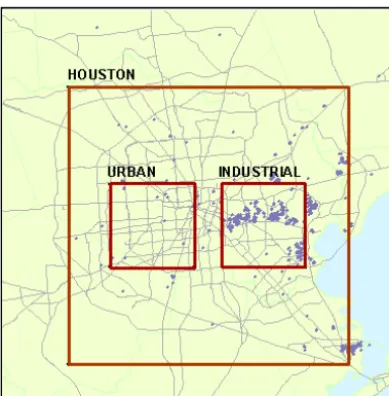
Figure 2. Starting locations of STOPS domains. Points indicate
lo-cations of emission point sources in Houston.
of emission release, starting and ending times, and the amount need to be specified by the user in the STOPS run script.
– Given that STOPS is based on the CMAQ source code and uses the same input files, its results shall closely ap-proximate those obtained with the 3-D CMAQ model. For the purpose of comparing STOPS results against CMAQ results, the post-processing program was devel-oped and incorporated into the STOPS build and run scripts. With this, an additional file, HCONC, is gener-ated from the STOPS simulations. It holds CMAQ con-centrations from grid cells that correspond to the current location of STOPS.
The advantage of STOPS compared to other Lagrangian models is the capability of utilizing realistic boundary con-ditions that change with space and time. Because of that, STOPS takes into account flow in and out of a domain, al-lowing for an exchange of mass between a moving domain and surroundings. This allows for simulations of conditions when a wind shear occurs for which Lagrangian models are usually not suitable. On the other hand, in the case of sig-nificant deviations in a wind speed and direction, some mass may be blown out of the STOPS simulation domain. A 1×1 STOPS domain is possible, but is more likely to quickly lose the effect from a perturbation in the domain, like modified emissions; thus, it is not likely to be used in practice and we did not perform tests on that domain.
3 Verification of STOPS performance
CMAQ has been found to be a reliable modeling tool whose performance has been evaluated in many studies (Smyth et
al., 2006; Eder and Yu, 2006; Arnold and Dennis, 2006; Byun et al., 2007; Appel et al., 2012). As a moving nest, which uses the same inputs as CMAQ and utilizes CMAQ’s simula-tion results as dynamic boundary condisimula-tions and initial con-ditions, the STOPS performance is expected to be close to the results of the original CMAQ model; therefore, the code implementation was verified by comparing its simulation re-sults with those obtained using CMAQ.
The following statistical parameters were calculated for performance evaluation:
Number of data set N=NCOL·NROW·NTSTEP, (4) Mean of host concentration H¯ = 1
N N
X
i=1
Hi, (5)
Mean of STOPS concentration S¯= 1
N N
X
i=1
Si, (6)
Mean bias MB= 1
N N
X
i=1
(Hi−Si), (7)
Mean absolute error MAE= 1
N N
X
i=1
|Hi−Si|, (8) Root mean square error
RMSE=
"
1 N
N
X
i=1
(Hi−Si)2
#12
, (9)
whereHi andSi correspond to instantaneous mixing ratios obtained with CMAQ and STOPS, respectively. NCOL and NROW are the numbers of STOPS columns and rows, re-spectively, and NTSTEP is the number of output time steps.
Daily ozone maximum values from CMAQ and STOPS simulations were also calculated and are indicated as HMAX and SMAX, respectively.
We performed verification for three cases: (1) a case when the STOPS domain does not move, which was performed to test an effect of boundary conditions on STOPS results; (2) cases with STOPS moving along different trajectories performed to test STOPS performance for different atmo-spheric conditions as well as an effect of different ways of trajectory calculation on STOPS results; and (3) cases with different STOPS domain sizes to test an effect of domain size on the STOPS results.
3.1 Effect of boundary conditions
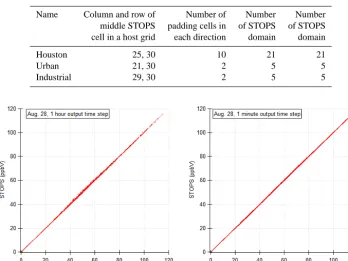
Table 1. Specifications of STOPS domains.
Name Column and row of Number of Number Number
middle STOPS padding cells in of STOPS of STOPS cell in a host grid each direction domain domain
Houston 25, 30 10 21 21
Urban 21, 30 2 5 5
Industrial 29, 30 2 5 5
Figure 3. Comparison of CMAQ and static STOPS simulation results for 28 August for 1 h (left) and 1 min (right) output time steps. Both
graphs correspond to the simulation from the Houston domain.
boundary values. The simulations were performed for three domains, differing in size and starting positions as presented in Fig. 2: the “Houston” domain, the “urban” domain that sits in the urban area and the “industrial” domain that is over the industrial region. The size of a domain is defined by the number of padding cells around the middle cell. The location of the middle column in each STOPS domain relative to the CMAQ (host) grid, the number of padding cells in each di-rection around the STOPS middle column, and a number of total STOPS columns and rows are presented in Table 1.
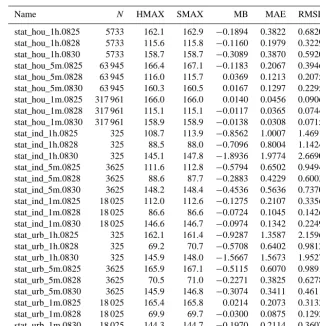
Since CMAQ boundary conditions as well as other input and output files have hourly values but calculations are per-formed at much smaller time intervals; therefore, the bound-ary values are interpolated from two corresponding hourly values to match a specific computation time step. This is also the case for STOPS. For the comparison of STOPS results with CMAQ values, we used CMAQ concentrations from the grid cells corresponding to cells in the STOPS domain. These grid cells in CMAQ are not at the domain boundaries, but are inside the domain; therefore, in these grid cells, advection is calculated based on values from adjacent cells at every syn-chronization time step. In STOPS, these cells are at the do-main boundary and hourly boundary values are interpolated for advection calculation. Because of that, we expect some differences between STOPS and CMAQ calculated mixing ratios. To justify them, CMAQ and STOPS simulations were performed for different output time steps, which were set to
1 h, 5 min, and 1 min. This allows one to obtain CMAQ con-centrations that are used as STOPS boundary conditions at small time steps, which is close to the synchronization time step, forcing CMAQ and STOPS to use the same values for advection calculation.
Table 2. Summary of statistical parameters for STOPS and CMAQ predicted ozone mixing ratios, when STOPS was used in the stationary
mode. “hou” indicates results from the Houston domain, “ind” from the industrial domain, and “urb” from the urban domain.
Name N HMAX SMAX MB MAE RMSE
stat_hou_1h.0825 5733 162.1 162.9 −0.1894 0.3822 0.6820 stat_hou_1h.0828 5733 115.6 115.8 −0.1160 0.1979 0.3229 stat_hou_1h.0830 5733 158.7 158.7 −0.3089 0.3870 0.5920 stat_hou_5m.0825 63 945 166.4 167.1 −0.1183 0.2067 0.3946 stat_hou_5m.0828 63 945 116.0 115.7 0.0369 0.1213 0.2075 stat_hou_5m.0830 63 945 160.3 160.5 0.0167 0.1297 0.2295 stat_hou_1m.0825 317 961 166.0 166.0 0.0140 0.0456 0.0906 stat_hou_1m.0828 317 961 115.1 115.1 −0.0117 0.0365 0.0744 stat_hou_1m.0830 317 961 158.9 158.9 −0.0138 0.0308 0.0715
stat_ind_1h.0825 325 108.7 113.9 −0.8562 1.0007 1.4691
stat_ind_1h.0828 325 88.5 88.0 −0.7096 0.8004 1.1424
stat_ind_1h.0830 325 145.1 147.8 −1.8936 1.9774 2.6690
stat_ind_5m.0825 3625 111.6 112.8 −0.5794 0.6502 0.9494
stat_ind_5m.0828 3625 88.6 87.7 −0.2883 0.4229 0.6003
stat_ind_5m.0830 3625 148.2 148.4 −0.4536 0.5636 0.7370 stat_ind_1m.0825 18 025 112.0 112.6 −0.1275 0.2107 0.3356 stat_ind_1m.0828 18 025 86.6 86.6 −0.0724 0.1045 0.1426 stat_ind_1m.0830 18 025 146.6 146.7 −0.0974 0.1342 0.2249
stat_urb_1h.0825 325 162.1 161.4 −0.9287 1.3587 2.1596
stat_urb_1h.0828 325 69.2 70.7 −0.5708 0.6402 0.9812
stat_urb_1h.0830 325 145.9 148.0 −1.5667 1.5673 1.9527
stat_urb_5m.0825 3625 165.9 167.1 −0.5115 0.6070 0.9891
stat_urb_5m.0828 3625 70.5 71.0 −0.2271 0.3825 0.6278
stat_urb_5m.0830 3625 145.9 146.8 −0.3074 0.3411 0.4611 stat_urb_1m.0825 18 025 165.4 165.8 0.0214 0.2073 0.3132 stat_urb_1m.0828 18 025 69.9 69.7 −0.0300 0.0875 0.1292 stat_urb_1m.0830 18 025 144.3 144.7 −0.1970 0.2114 0.3607
3.2 Uncertainties related to movement of STOPS
The next step in the STOPS verification was to analyze un-certainties related to the movement of a STOPS domain. A direct comparison between CMAQ and STOPS results was complicated due to the fact that, when STOPS travels with wind, its grid cells do not necessarily align with CMAQ grid cells. For the purpose of comparing STOPS values with CMAQ ones we utilized two approaches that were performed after STOPS finished its calculations. In the first approach, we aligned the STOPS grid cells with the closest CMAQ grid cells (shifted the STOPS domain) and compared the corre-sponding values. In the second approach, we performed spa-tial interpolation by calculating the weighted average from several CMAQ grid cells that overlap the STOPS grid cell. The performance evaluation was tested for these two ap-proaches.
There are two options in STOPS that can be used for a trajectory calculation. A trajectory can be determined either based on the wind in the middle column of the STOPS do-main as described by Eq. (1) (mwind) or based on the av-eraged value from the whole STOPS domain (awind). Two smaller sub-domains shown in Fig. 2, which are urban and
b) a)
August 25
August 28
August 30
Figure 4. (a) STOPS trajectories starting from the industrial
sub-domain. Trajectories determined based on the winds in the STOPS middle column are indicated by filled circles, and those determined based on the average winds in the whole STOPS domain with open circles. Trajectories for 25 August are indicated with red dots, those for 28 August with blue dots, and those for 30 August with green dots. Numbers next to dots show UTC time (b) details of the trajec-tory on 25 August.
industrial, were selected for STOPS simulations in the mov-ing mode with the two options for trajectory calculation be-ing tested.
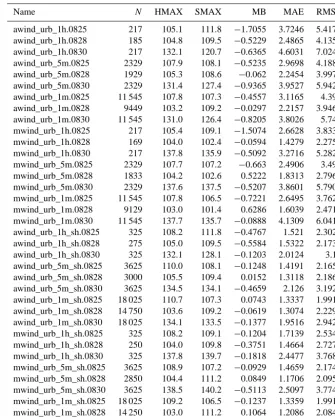
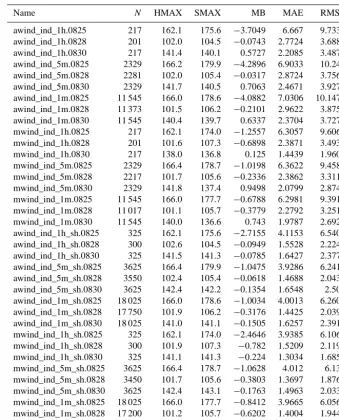
pat-Table 3. Summary of statistical parameters for STOPS–CMAQ concentrations, when STOPS was used in the moving mode, with the starting
position in the urban sub-domain.
Name N HMAX SMAX MB MAE RMSE
awind_urb_1h.0825 217 105.1 111.8 −1.7055 3.7246 5.4175
awind_urb_1h.0828 185 104.8 109.5 −0.5229 2.4865 4.1357
awind_urb_1h.0830 217 132.1 120.7 −0.6365 4.6031 7.0249
awind_urb_5m.0825 2329 107.9 108.1 −0.5235 2.9698 4.1889
awind_urb_5m.0828 1929 105.3 108.6 −0.062 2.2454 3.9979
awind_urb_5m.0830 2329 131.4 127.4 −0.9365 3.9527 5.9425
awind_urb_1m.0825 11 545 107.8 107.3 −0.4557 3.1165 4.394
awind_urb_1m.0828 9449 103.2 109.2 −0.0297 2.2157 3.9464
awind_urb_1m.0830 11 545 131.0 126.4 −0.8205 3.8026 5.743
mwind_urb_1h.0825 217 105.4 109.1 −1.5074 2.6628 3.8337
mwind_urb_1h.0828 169 104.0 102.4 −0.0594 1.4279 2.2759
mwind_urb_1h.0830 217 137.8 135.9 −0.5092 3.2716 5.2829
mwind_urb_5m.0825 2329 107.7 107.2 −0.663 2.4906 3.493
mwind_urb_5m.0828 1833 104.2 102.6 0.5222 1.8313 2.7969
mwind_urb_5m.0830 2329 137.6 137.5 −0.5207 3.8601 5.7908
mwind_urb_1m.0825 11 545 107.8 106.5 −0.7221 2.6495 3.7622
mwind_urb_1m.0828 9129 103.0 101.4 0.6286 1.6039 2.4716
mwind_urb_1m.0830 11 545 137.7 135.7 −0.0888 4.1309 6.0413
awind_urb_1h_sh.0825 325 108.2 111.8 −0.4767 1.521 2.3025
awind_urb_1h_sh.0828 275 105.0 109.5 −0.5584 1.5322 2.1738
awind_urb_1h_sh.0830 325 132.1 128.1 −0.1203 2.0124 3.16
awind_urb_5m_sh.0825 3625 110.0 108.1 −0.1248 1.4191 2.1658
awind_urb_5m_sh.0828 3000 105.5 109.4 0.0152 1.3118 2.1861
awind_urb_5m_sh.0830 3625 134.5 134.1 −0.4659 2.126 3.1923
awind_urb_1m_sh.0825 18 025 110.7 107.3 0.0743 1.3337 1.9913 awind_urb_1m_sh.0828 14 750 103.6 109.2 −0.0619 1.3074 2.2298 awind_urb_1m_sh.0830 18 025 134.1 133.5 −0.1377 1.9516 2.9423
mwind_urb_1h_sh.0825 325 108.2 109.1 −0.1204 1.7139 2.5346
mwind_urb_1h_sh.0828 250 104.0 109.8 −0.3751 1.4664 2.7279
mwind_urb_1h_sh.0830 325 137.8 139.7 −0.1818 2.4477 3.7688
mwind_urb_5m_sh.0825 3625 108.9 107.2 −0.0929 1.4659 2.1744
mwind_urb_5m_sh.0828 2850 104.4 111.2 0.0849 1.1706 2.0956
mwind_urb_5m_sh.0830 3625 138.5 140.2 −0.5113 2.5097 3.7741 mwind_urb_1m_sh.0825 18 025 109.2 106.5 −0.1237 1.3359 1.9914 mwind_urb_1m_sh.0828 14 250 103.0 111.2 0.1064 1.2086 2.0841 mwind_urb_1m_sh.0830 18 025 138.4 138.5 −0.4413 2.4165 3.5173
terns; on 28 August 2000, strong but uniform southerly winds were observed, and on 30 August, a change in winds from southeasterly to southwesterly was observed in the early af-ternoon hours. STOPS trajectories for these 3 days, with the starting position at the location of the industrial sub-domain, are presented in Fig. 4. Trajectories determined based on the winds in the STOPS middle column are indicated by filled circles, and those determined based on the average winds in the whole STOPS domain with open circles. All trajectories start at 12:00 UTC and end the next day at 00:00 UTC, ex-cept trajectories on 28 August that ended at 23:00 UTC due to the subdomain reaching the boundaries of the CMAQ do-main earlier as an effect of strong winds on that day. On 28 and 30 August, trajectories determined by the two different methods are similar. However, as can be seen from Fig. 4b,
there are differences in trajectories for 25 August, especially during the first couple of hours of simulations. Both trajec-tories move south between 12:00 and 13:00 UTC. After that, the trajectory determined by the winds in the middle column moves east until 15:00 UTC and then west, making a circular pattern; at 17:00 UTC, it comes back to the close proximity of the starting position. On the contrary, the trajectory deter-mined by the winds averaged in the whole STOPS domain initially moves south for a couple of hours and then continu-ously moves west.
Table 4. Summary of statistical parameters for STOPS–CMAQ concentrations, when STOPS was used in the moving mode, with the starting
position in the industrial sub-domain.
Name N HMAX SMAX MB MAE RMSE
awind_ind_1h.0825 217 162.1 175.6 −3.7049 6.667 9.7334
awind_ind_1h.0828 201 102.0 104.5 −0.0743 2.7724 3.6884
awind_ind_1h.0830 217 141.4 140.1 0.5727 2.2085 3.4874
awind_ind_5m.0825 2329 166.2 179.9 −4.2896 6.9033 10.246
awind_ind_5m.0828 2281 102.0 105.4 −0.0317 2.8724 3.7569
awind_ind_5m.0830 2329 141.7 140.5 0.7063 2.4671 3.9274
awind_ind_1m.0825 11 545 166.0 178.6 −4.0882 7.0306 10.1471
awind_ind_1m.0828 11 373 101.5 106.2 −0.2101 2.9622 3.8751
awind_ind_1m.0830 11 545 140.4 139.7 0.6337 2.3704 3.7275
mwind_ind_1h.0825 217 162.1 174.0 −1.2557 6.3057 9.6064
mwind_ind_1h.0828 201 101.6 107.3 −0.6898 2.3871 3.4938
mwind_ind_1h.0830 217 138.0 136.8 0.125 1.4439 1.9605
mwind_ind_5m.0825 2329 166.4 178.7 −1.0198 6.3622 9.4587
mwind_ind_5m.0828 2217 101.7 105.6 −0.2336 2.3862 3.3116
mwind_ind_5m.0830 2329 141.8 137.4 0.9498 2.0799 2.8743
mwind_ind_1m.0825 11 545 166.0 177.7 −0.6788 6.2981 9.3914
mwind_ind_1m.0828 11 017 101.1 105.7 −0.3779 2.2792 3.2517
mwind_ind_1m.0830 11 545 140.0 136.6 0.743 1.9787 2.6921
awind_ind_1h_sh.0825 325 162.1 175.6 −2.7155 4.1153 6.5406
awind_ind_1h_sh.0828 300 102.6 104.5 −0.0949 1.5528 2.2241
awind_ind_1h_sh.0830 325 141.5 141.3 −0.0785 1.6427 2.3778
awind_ind_5m_sh.0825 3625 166.4 179.9 −1.0475 3.9286 6.2411
awind_ind_5m_sh.0828 3550 102.4 105.4 −0.0618 1.4688 2.0437
awind_ind_5m_sh.0830 3625 142.4 142.2 −0.1354 1.6548 2.502
awind_ind_1m_sh.0825 18 025 166.0 178.6 −1.0034 4.0013 6.2608 awind_ind_1m_sh.0828 17 750 101.9 106.2 −0.3176 1.4425 2.0392 awind_ind_1m_sh.0830 18 025 141.0 141.1 −0.1505 1.6257 2.3916
mwind_ind_1h_sh.0825 325 162.1 174.0 −2.4646 3.9385 6.1064
mwind_ind_1h_sh.0828 300 101.9 107.3 −0.782 1.5209 2.1193
mwind_ind_1h_sh.0830 325 141.1 141.3 −0.224 1.3034 1.6851
mwind_ind_5m_sh.0825 3625 166.4 178.7 −1.0628 4.012 6.134
mwind_ind_5m_sh.0828 3450 101.7 105.6 −0.3803 1.3697 1.8761
mwind_ind_5m_sh.0830 3625 142.4 143.1 −0.1763 1.4963 2.0331
mwind_ind_1m_sh.0825 18 025 166.0 177.7 −0.8412 3.9665 6.0567 mwind_ind_1m_sh.0828 17 200 101.2 105.7 −0.6202 1.4004 1.9443 mwind_ind_1m_sh.0830 18 025 140.8 141.6 −0.355 1.4364 1.9099
Table 5. Statistical parameters of simulations with different STOPS domain sizes. In each case, only nine inner cells were taken for the
analysis. The results correspond to the stationary case.
Case N HMAX SMAX MB MAE RMSE RMSE avg
3×3 117 162.1 158.5 −1.0496 1.9374 3.1827 2.4100
5×5 117 162.1 161.4 −0.9025 1.3159 2.1476 1.7210
7×7 117 162.1 159.0 −0.2914 1.0090 1.7355 1.4075
9×9 117 162.1 160.4 −0.1232 0.6343 1.2566 0.9400
15×15 117 162.1 160.8 0.0818 0.2696 0.4597 0.2346
21×21 117 162.1 162.8 −0.0315 0.2634 0.4579 0.3491
and the averaged winds in the whole STOPS domain (awind). The simulation results when the STOPS domain was shifted for the purpose of aligning its grids with CMAQ grids are
es-
Figure 5. Comparison of ozone concentrations obtained with STOPS and CMAQ for 25, 28, and 30 August for the STOPS starting position
in the urban sub-domain (left figures) and the industrial sub-domain (right figures). Red triangles correspond to the trajectory determined from winds in the middle column (mwind), blue crosses to the trajectory from average winds in the whole STOPS domain (awind). Compared are values from each cell in the first model layer, at every output time step. Note: the scale is adjusted to the maximum ozone concentration on a given day.
timated based on the averaged winds in the whole STOPS domain, the trajectory starting position was the urban sub-domain, the model output time step was set to 1 h, the simu-lation was performed for 25 August, and the STOPS domain was shifted to be aligned with the host domain grid for com-parison purposes. The case “awind_ urb_1h.0825” means the same as above, except that CMAQ concentrations were spa-tially interpolated to be compared with STOPS mixing ratios.
August 28, 2000
12 UTC
15 UTC
21 UTC
18 UTC 12 UTC
15 UTC
18 UTC
21 UTC
August 25, 2000 August 30, 2000
12 UTC
15 UTC
21 UTC 18 UTC
Figure 6. Snapshots of ozone mixing ratios as simulated by STOPS along trajectories on 25 (left), 28 (middle), and 30 August (right) when
the STOPS simulation started from the industrial sub-domain.
Table 6. Statistical parameters for simulations with different STOPS domain sizes, where only nine inner cells were chosen for the analysis.
The results correspond to the moving case, when the trajectory starting position corresponds to the 21 and 30 CMAQ column and row, respectively.
Case N HMAX SMAX MB MAE RMSE RMSE avg
3×3 117 105.4 106.4 −0.3768 1.6632 2.5934 1.7774
5×5 117 105.4 105.2 −0.2481 1.4438 2.2264 1.3617
7×7 117 105.4 105.1 −0.3131 1.4116 2.1408 1.2725
9×9 108 105.4 104.7 −0.4253 1.2482 1.8741 1.0929
15×15 99 105.4 104.3 −0.1542 1.0885 1.5237 0.6736
21×21 81 84.4 84.4 −0.3360 1.1220 1.7900 0.8787
Figure 5 shows scatter plots comparing CMAQ and STOPS concentrations of ozone for 25, 28, and 30 August for the STOPS starting position in the urban sub-domain (left graphs) and industrial sub-domain (right graphs). Triangles correspond to values calculated with STOPS when its trajec-tory was determined based on the winds in the middle col-umn (mwind), crosses to the trajectory obtained from the av-erage winds in the whole STOPS domain (awind). Plotted are ozone mixing ratios from all cells in the first model layer,
Table 7. As above but with different starting positions corresponding to the 25 and 30 CMAQ column and row, respectively.
Case N HMAX SMAX MB MAE RMSE RMSE avg
3×3 117 143.0 138.1 −1.1138 3.2706 4.9511 3.3688
5×5 117 143.0 133.7 −0.3396 3.0431 4.7310 3.1896
7×7 117 143.0 133.4 −0.1603 2.9672 4.6991 3.2204
9×9 117 143.0 134.0 −0.0864 2.9405 4.6791 3.2066
15×15 108 143.0 134.2 −0.0661 3.0548 4.8358 3.3063
21×21 99 143.0 133.8 0.2430 3.0527 5.1374 3.7556
0.00 0.01 0.02 0.03 0.04 0.05
6 7 8 9 10 11 12 13 14 15 16 17 18
time (CST) O3
(
ppm
)
per
7560 g
V
O
C
add
ed
ETHENE HCHO P ROP ENE B UTE1 B UTE2T I_B UTA
12 13 14 15 16 17 18 19 20 21 22 23 00
Time (UTC)
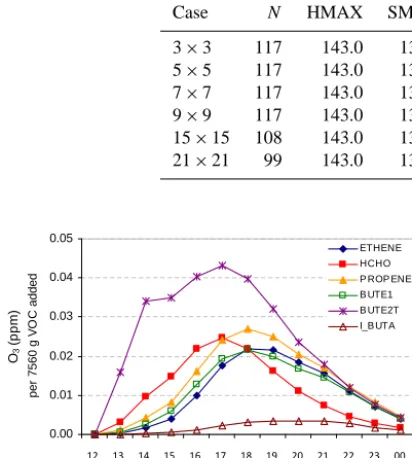
Figure 7. Changes in ozone mixing ratios due to emission spikes of
different individual VOCs simulated with STOPS along the trajec-tory on 25 August. The values are integrated over the grid cells in the surface layer of the STOPS domain.
3.3 Effect of a domain size
Simulation results obtained with the STOPS system were validated against CMAQ calculated concentration fields for various STOPS domain sizes. The area of interest was always the same and consisted of nine inner cells in the STOPS do-main. Therefore, by changing the STOPS domain size, the number of boundary layers around the area of interest dif-fers.
Six different simulations with different domain sizes of 3×3,5×5,7×7,9×9,15×15, and 21×21 cells were per-formed. In each case, the starting position was the same, with the middle column of the STOPS domain corresponding to the twenty-first column and thirtieth row in the CMAQ do-main (urban sub-dodo-main). Although the STOPS simulations were performed for the different domains, the final analy-sis was carried out based on the concentrations in the inner nine cells of the first layer. Additional analysis, based on the averaged concentration in the area of interest, was also per-formed. The averaging eliminates concentration differences caused by uncertainties in the horizontal transport. All sim-ulations were carried out for 25 August 2000, for the sta-tionary and moving modes. In the case of the moving mode, the STOPS trajectory was determined based on the wind in the middle column. For the purpose of the CMAQ–STOPS comparison, the STOPS grid was shifted to coincide with the CMAQ grid.
Statistical parameters of the CMAQ–STOPS ozone mix-ing ratios from simulations with different domain sizes are shown in Table 5 for the stationary case and in Tables 6 and 7 for the moving cases. It can be seen that increasing the number of boundary layers around the domain of interest im-proves the correlation between CMAQ and stationary STOPS results. In the case of the moving mode, the simulations with bigger domains reached the boundary of the CMAQ domain earlier than the intended simulation ending time; therefore, it is not very practical.
4 Example of application
Here, we present an example of STOPS application for a source–receptor relationship analysis. Many industrial petro-chemical and petro-chemical manufacturing facilities are located in the Houston Ship Channel. In addition to emissions as-sociated with regular operations, they frequently release ad-ditional, so-called “upset emissions” (Murphy and Allen, 2005). Such emission releases can dominate local emissions and result in very high ozone concentrations (Zhang et al., 2004; Nam et al., 2006). The impact of such releases can be simulated by STOPS.
high reactivity, has the potential to increase the ozone mix-ing ratio locally, close to the emission source, and with higher magnitude.
5 Summary
A hybrid Lagrangian–Eulerian based modeling tool (called STOPS) was developed as a computationally efficient 3-D grid sub-model for the purpose of evaluations of the source– receptor relationship upon release of new emissions. It is suitable for tracking a pollutant plume emitted in the morn-ing, which then undergoes physical and chemical transforma-tions in the well-mixed convective conditransforma-tions. The correct-ness of its algorithms and the overall performance were eval-uated against CMAQ simulation results and it was shown that STOPS is capable of predicting ozone mixing ratios in close agreement with CMAQ predictions. Its performance however depends on the trajectory calculations and the atmospheric conditions occurring during the simulation period. Better agreement between CMAQ–STOPS concentration pairs was found when the STOPS trajectory was calculated based on the winds in the middle column as compared to calculation based on the value averaged in the whole STOPS domain. Under some atmospheric conditions, such as uniform winds on 28 August, its performance was very satisfactory, with the mean bias for ozone mixing ratios varying between −0.03 and −0.78 ppbV and the slope between 0.99 and 1.01 for different analyzed cases. However, for complicated meteo-rological conditions, such as on 25 August, when recircu-lation of air occurred, its predictions deviated from CMAQ simulated values, with mean bias varying between 0.07 and
−4.29 ppbV and slope varying between 0.95 and 1.06 for dif-ferent analyzed cases for ozone surface mixing ratio. Averag-ing the surface concentration values over a STOPS domain resulted in the smaller bias between STOPS and CMAQ re-sults. This technique is appropriate since STOPS is designed to be used for the chemical analysis rather than an analysis of individual cells in which concentration values are strongly affected by fine uncertainties in the horizontal transport. The limitation of STOPS is due to the Lagrangian movement when applied for non-uniform winds for which the plume might be dispersed outside of the STOPS domain. This is a limitation of every Lagrangian approach. The advantages of STOPS compared to Lagrangian type models are usage of re-alistic boundary conditions at every simulation time step as well as usage of detailed chemistry.
Code availability
The STOPS source code can be obtained by contacting the leading author at [email protected].
Acknowledgements. This work is dedicated to the memory of Daewon Byun (1956–2011), whose pursuit of scientific excellence as a developer of the CMAQ model continues to inspire us.
Edited by: P. Jöckel
References
Appel, K., Chemel, C., Roselle, S. J., Francis, X. V., Hu, R.-M., Sokhi, R. S., Rao, S. T., and Galmarini, S.: Examination of the Community Multiscale Air Quality (CMAQ) model performance over the North American and European domains, Atmos. Envi-ron., 53, 142–155, 2012.
Arnold, J. R. and Dennis, R. L.: Testing CMAQ chemistry sensi-tivities in base case and emissions control runs at SEARCH and SOS99 surface sites in the southeastern US, Atmos. Environ., 40, 5027–5040, 2006.
Byun, D. and Schere, K. L.: Review of the Governing Equa-tions, Computational Algorithms, and Other Components of the Models-3 Community Multiscale Air Quality (CMAQ) Model-ing System, Appl. Mech. Rev., 59, 51–77, 2006.
Byun, D. W., Kim, S.-T., and Kim, S.-B.: Evaluation of air quality models for the simulation of a high ozone episode in the Houston metropolitan area, Atmos. Environ., 41, 837–853, 2007. Czader, B. H., Byun, D. W., Kim, S.-T., and Carter, W. P. L.: A study
of VOC reactivity in the Houston-Galveston air mixture utilizing an extended version of SAPRC-99 chemical mechanism, Atmos. Environ., 42, 5733–5742, 2008.
Eder, B. and Yu, S.: A performance evaluation of the 2004 release of Models-3 CMAQ, Atmos. Environ., 40, 4811–4824, 2006. Henderson, B. H., Kimura, Y., McDonald-Buller, E., Allen, D. T.,
and Vizuete, W.: Comparison of Lagrangian process analysis tools for Eulerian air quality models, Atmos. Environ., 45, 5200– 5211, 2011.
Kimura, Y., McDonald-Buller, E., Vizuete, W., and Allen, D. T.: Application of a Lagrangian process analysis tool to characterize ozone formation in Southeast Texas, Atmos. Environ., 42, 5743– 5759, 2008.
Murphy, C. F. and Allen, D. T.: Hydrocarbon emissions from indus-trial release events in the Houston-Galveston area and their im-pact on ozone formation, Atmos. Environ., 39, 3785–3798, 2005. Nam, J., Kimura, Y., Vizuete, W., Murphy, C., and Allen, D. T.: Modeling the impacts of emission events on ozone formation in Houston, Texas, Atmos. Environ., 40, 5329–5341, 2006. Smyth, S. C., Jiang, W., Yin, S., Roth, H., and Giroux, E.:
Evalu-ation of CMAQ O3 and PM2.5 performance using Pacific 2001 measurement data, Atmos. Environ., 40, 2735–2749, 2006. Stein, A. F., Isakov, V., Godowitch, J., and Draxler, R. R.: A
hy-brid modeling approach to resolve pollutant concentrations in an urban area, Atmos. Environ., 41, 9410–9426, 2007.