www.geosci-model-dev.net/8/1979/2015/ doi:10.5194/gmd-8-1979-2015
© Author(s) 2015. CC Attribution 3.0 License.
Non-singular spherical harmonic expressions of geomagnetic vector
and gradient tensor fields in the local north-oriented reference frame
J. Du1,2,3, C. Chen1, V. Lesur2, and L. Wang1,3
1Hubei Subsurface Multi-scale Imaging Key Laboratory, Institute of Geophysics & Geomatics, China University of Geosciences, Wuhan 430074, China
2Helmholtz Centre Potsdam, GFZ German Research Centre for Geosciences, Telegrafenberg 14473, Potsdam, Germany 3State Key Laboratory of Geodesy and Earth’s Dynamics, Chinese Academy of Sciences, Wuhan 430077, China
Correspondence to: J. Du ([email protected])
Received: 27 October 2014 – Published in Geosci. Model Dev. Discuss.: 05 December 2014 Revised: 23 May 2015 – Accepted: 15 June 2015 – Published: 07 July 2015
Abstract. General expressions of magnetic vector (MV) and magnetic gradient tensor (MGT) in terms of the first- and second-order derivatives of spherical harmonics at differ-ent degrees/orders are relatively complicated and singular at the poles. In this paper, we derived alternative non-singular expressions for the MV, the MGT and also the third-order partial derivatives of the magnetic potential field in the lo-cal north-oriented reference frame. Using our newly derived formulae, the magnetic potential, vector and gradient ten-sor fields and also the third-order partial derivatives of the magnetic potential field at an altitude of 300 km are calcu-lated based on a global lithospheric magnetic field model GRIMM_L120 (GFZ Reference Internal Magnetic Model, version 0.0) with spherical harmonic degrees 16–90. The cor-responding results at the poles are discussed and the validity of the derived formulas is verified using the Laplace equation of the magnetic potential field.
1 Introduction
Compared to the magnetic vector and scalar measurements, magnetic gradients lead to more robust models of the litho-spheric magnetic field. The ongoing Swarm mission of the European Space Agency (ESA) provides measurements not only of the vector and scalar data but also an estimate of their east–west gradients (e.g., Olsen et al., 2004, 2015; Friis-Christensen et al., 2006). Kotsiaros and Olsen (2012, 2014) proposed to recover the lithospheric magnetic field through magnetic space gradiometry in the same way that has been
done for modeling the gravitational potential field from the satellite gravity gradient tensor measurements by the Gravity field and steady-state Ocean Circulation Explorer (GOCE). Purucker (2005), Purucker et al. (2007), Sabaka et al. (2015) and Kotsiaros et al. (2015) also reported efforts to model the lithospheric magnetic field using magnetic gradient infor-mation from the satellite constellation. Their results showed that, by using gradient data, the modeled lithospheric mag-netic anomaly field has enhanced shorter wavelength content and a much higher quality compared to models built from vector field data. This is because the gradient data can re-move the highly time-dependent contributions of the mag-netosphere and ionosphere that are correlated between two side-by-side satellites.
gradient to interpret the satellite-altitude magnetic anomaly data. Therefore, both the magnetic field modeling and also the geological interpretations require the calculation for the partial derivatives of the magnetic field, possibly at the poles for specific systems of coordinates. Spherical harmonic anal-ysis, established originally by Gauss (1839), is generally used to model the global magnetic internal fields of Earth and other terrestrial planets (e.g., Maus et al., 2008; Langlais et al., 2010; Thébault et al., 2010; Finlay et al., 2010; Lesur et al., 2013; Sabaka et al., 2013; Olsen et al., 2014). Series of spherical harmonic functions themselves made of Schmidt semi-normalized associated Legendre functions (SSALFs) (e.g., Blakely, 1995; Langel and Hinze, 1998) are fitted by least squares to magnetic measurements, giving the spherical harmonic coefficients (i.e., the Gaussian coefficients) defin-ing the model. Kotsiaros and Olsen (2012, 2014) presented the MV (magnetic vector) and the MGT (magnetic gradi-ent tensor) using a spherical harmonic represgradi-entation and, of course, their expressions are singular as they approach the poles. Even if there are satellite data gaps around the poles, it is advisable to use non-singular spherical harmonic expres-sions for the MV and the MGT in case airborne or shipborne magnetic data are utilized (e.g., Golynsky et al., 2013; Maus, 2010). A rotation of the coordinate system is always possible to avoid the polar singularity, but this solution is very inef-fective for large data sets.
In this paper, following Petrovskaya and Vershkov (2006) and Eshagh (2008, 2009) for the gravitational gradient ten-sor in the local north-oriented, orbital reference and geocen-tric spherical frames, the non-singular expressions in terms of spherical harmonics for the MV, the MGT and the third-order derivatives of the magnetic potential field in the spe-cially defined local-north-oriented reference frame (LNORF) are presented. In the next section, the traditional expressions of the MV and the MGT are first stated, some necessary propositions are then proved and, lastly, new non-singular expressions are derived. In Sect. 3, the new formulae are tested using the global lithospheric magnetic field model GRIMM_L120 (GFZ Reference Internal Magnetic Model, version 0.0) (Lesur et al., 2013) and compared with the re-sults by traditional formulae. Finally, some conclusions are drawn and further applications are also discussed.
2 Methodology
In this section, the traditional expressions of MV and MGT are presented and their numerical problems are stated. Then, based on some necessary mathematical derivations, new ex-pressions are given.
2.1 Traditional expressions
The scalar potentialV of Earth’s magnetic field in a source-free region can be expanded in the truncated series of
spher-ical harmonics at the pointP (r,θ,ϕ) with the geocentric distancer, co-latitudeθand longitudeϕ(e.g., Backus et al., 1996):
V (r, θ, φ)=a
L X l=1
l X m=0
(a r)
l+1
glmcosmφ+hml sinmφPelm(cosθ ) , (1)
wherea=6371.2 km is the radius of Earth’s magnetic ref-erence sphere;Pelm(cosθ )(or Pelm for simplification) is the
SSALF of degreel and orderm;Lis the maximum spher-ical harmonic degree; andglm andhml are the geomagnetic harmonic coefficients describing Earth’s internal sources.
If considered in the LNORF{x, y, z}(e.g., Olsen et al., 2010), where thezaxis points downward in the geocentric radial direction, thexaxis points to the north, and theyaxis towards the east (that is, a right-handed system). At the poles, we define that thexaxis points to the meridian of 180◦E (or 180◦W) at the North Pole and of 0◦at the South Pole, which will be discussed in Sect. 3. Therefore, the three components of the MV can be expressed as
Bx(r, θ, φ)= −1r∂(−∂θ )V (r, θ, φ)
=
L P l=1
l P m=0
(ar)l+2
gml cosmφ+hml sinmφ
h
d
dθPelm(cosθ ) i
,
(2a)
By(r, θ, φ)= −rsin1θ∂φ∂ V (r, θ, φ)
=
L P l=1
l P m=0
(ar)l+2m
gml sinmφ−hml cosmφhsin1θPelm(cosθ ) i
,
(2b)
Bz(r, θ, φ)= −∂(−∂r)V (r, θ, φ)
= −
L P l=1
l P m=0
(l+1) (ar)l+2
gml cosmφ+hml sinmφPelm(cosθ ) .
(2c)
The MGT can be written as (e.g., Kotsiaros and Olsen, 2012)
∇B=
Bxx Bxy Bxz
Byx Byy Byz
Bzx Bzy Bzz
=
∂Bx/∂x ∂Bx/∂y ∂Bx/∂z
∂By/∂x ∂By/∂y ∂By/∂z
∂Bz/∂x ∂Bz/∂y ∂Bz/∂z
, (3)
where nine elements are expressed respectively as
Bxx=1a L P l=1
l P m=0
(ar)l+3 glmcosmφ+hml sinmφ ×h−d2
dθ2Pelm(cosθ )+(l+1)Pelm(cosθ ) i
,
Bxy=Byx=1a L P l=1 l P m=0
(ar)l+3 m glmsinmφ−hml cosmφ ×
h
− 1
sinθ
d
dθPelm(cosθ )+cosθ
sin2θPelm(cosθ ) i
,
(4b)
Bxz=Bzx=
1 a L X l=1 l X m=0 (a r) l+3
(l+2) gml cosmφ+hml sinmφ d
dθPe
m l (cosθ )
, (4c)
Byy=1a L P l=1 l P m=0
(ar)l+3 gml cosmφ+hml sinmφ ×h(l+1)Pelm(cosθ )+ m
2
sin2θPelm(cosθ ) −cosθ
sinθ
d
dθPelm(cosθ ) i
,
(4d)
Byz=Bzy=
1 a L X l=1 l X m=0 (a r) l+3
(l+2) m glmsinmφ−hml cosmφ
1
sinθPe
m l (cosθ )
, (4e)
Bzz= −
1 a L X l=1 l X m=0 (a r)
l+3(l+1)
(l+2) gml cosmφ+hlmsinmφPelm(cosθ ) . (4f)
The expressions forV,BzandBzzcan be calculated stably
even for very high spherical harmonic degrees and orders by using the Holmes and Featherstone (2002a) scheme. How-ever, there exist the singular terms of 1/sinθ and 1/sin2θin Eqs. (2b), (4b), (4d) and (4e) when the computing point ap-proaches to the poles. Moreover, some expressions contain the terms of first- and second-order derivatives of SSALFs, such as Eqs. (2a) and (4a)–(4d). Nevertheless, the up to second-order derivatives for very high degrees and orders of SSALFs can be recursively calculated by the Horner algo-rithm (Holmes and Featherstone, 2002b). These algoalgo-rithms are relatively complicated and thus we want to use alterna-tive expressions to avoid the singular terms and also the par-tial derivatives of SSALFs. It should be stated that our work differs from those presented by Petrovskaya and Vershkov (2006) and Eshagh (2009) in the LNORF and also the asso-ciated Legendre functions (ALFs). Nonetheless, the follow-ing mathematical derivations are carried out based on their studies on gravity fields.
2.2 Mathematical derivations
To deal with the singular terms and first- and second-order derivatives of the SSALFs, some useful mathematical deriva-tions are introduced and proved in the following.
1. Derivation of dPelm/dθ
Based on Eq. (Z.1.44) in Ilk (1983), dPlm/dθ=
0.5h(l+m) (l−m+1) Plm−1−Plm+1
i
, (5) and the relation between the ALFs and the SSALFs is
e
Plm=pCm(l−m)!/ (l+m)!Plm; (6)
thus, the first-order derivative of the SSALFs can be de-duced as
dPelm/dθ=al,mPelm−1+bl,mPelm+1, (7a)
al,m=0.5
√ l+m
√
l−m+1pCm/Cm−1, (7b)
bl,m= −0.5
√
l+m+1 √
l−mpCm/Cm+1, (7c) where
Cm=2−δm,0=
1, m=0 2, m6=0, andδis the Kronecker delta. 2. Derivation of d2Pelm/dθ2
According to Eq. (23) in Eshagh (2008), d2Plm/dθ2=0.25(l+m) (l−m+1)
(l+m−1) (l−m+2) Plm−2
−0.25 [(l+m) (l−m+1)+(l−m) (l+m+1)]Plm +0.25Plm+2.
(8) The second-order derivative of the SSALFs can be writ-ten as
d2Pelm/dθ2=cl,mPelm−2+dl,mPelm
+el,mPelm+2, (9a)
cl,m=0.25
√ l+m
√
l+m−1 √
l−m+2 √
l−m+1pCm/Cm−2, (9b)
dl,m= −0.25 [(l+m) (l−m+1)+
(l−m) (l+m+1)], (9c) el,m=0.25
√
l+m+2 √
l+m+1 √
l−m √
l−m−1pCm/Cm+2. (9d)
3. Derivation ofPelm/sinθ
Using Eq. (Z.1.42) in Ilk (1983),
Plm/sinθ=0.5h(l+m) (l+m−1) Plm−1−1 +Plm−1+1
i
/m, m≥1, (10) and using Eq. (6) we can obtain that
e
Plm/sinθ=fl,mPelm−1−1+gl,mPelm−1+1, m≥1, (11a)
fl,m=0.5
√ l+m
√
l+m−1
p
Cm/Cm−1/m, m≥1, (11b)
gl,m=0.5
√ l−m
√
l−m−1
p
4. Derivation ofPelm/sin2θ
Employing Eq. (31) in Eshagh (2008), Plm/sin2θ= {(l+m) (l+m−1)
(l−m+1) (l−m+2) / (m−1) Plm−2 +[(l+m) (l+m−1)
/ (m−1)+(l−m) (l−m−1) / (m+1)
Plm
+1/ (m+1) Plm+2o/ (4m) ,
, m≥2,
(12) and using Eq. (6) we have
e
Plm/sin2θ=hl,mPelm−2+kl,mPelm
+nl,mPelm+2, m≥2, (13a)
hl,m=0.25
√ l+m
√
l+m−1 √
l−m+1 √
l−m+2pCm/Cm−2/[m (m−1)], m≥2, (13b)
kl,m=0.25
(l+m) (l+m−1) / (m−1)+
(l−m) (l−m−1) / (m+1)/m, m≥2, (13c) nl,m=0.25
√ l−m
√
l−m−1 √
l+m+2 √
l+m+1
p
Cm/Cm+2/[m (m+1)], m≥1. (13d) 5. Derivation of dPelm/ (sinθdθ )
Using Eq. (36) in Eshagh (2008),
dPlm/ (sinθdθ )=0.25{(l+m) (l+m−1) (l+m−2) (l−m+1) / (m−1) Pl−m−12
+
(l+m) (l−m+1) / (m−1)−(l+m+1) (l+m) / (m+1)Pm
l−1
−1/ (m+1) Pl−m+12 o
,
m≥2,
(14) and using Eq. (6) we can derive
dPelm/ (sinθdθ )=ol,mPelm−1−2+ql,mPelm−1
+xl,mPelm−1+2, m≥2, (15a)
ol,m=0.25
√ l+m
√
l+m−1 √
l+m−2 √
l−m+1pCm/Cm−2/ (m−1) , m≥2, (15b)
ql,m=0.25
√ l−m
√
l+m(l−m+1) / (m−1) −(l+m+1) / (m+1), m≥2, (15c) xl,m= −0.25
p
(l+m+1) √
l−m √
l−m−1 √
l−m−2pCm/Cm+2/ (m+1) . (15d) 6. Derivation of dPelm/ (sinθdθ )−Pelmcosθ/sin2θ
According to Petrovskaya and Vershkov (2006) and Es-hagh (2009) we can write
dPlm/ (sinθdθ )−Plmcosθ/sin2θ
=0.5h(m−1) (l+m) (l−m+1) Plm−1 /sinθ−(m+1) Plm+1/sinθi/m,
m≥1,
(16) and using Eq. (36) in Eshagh (2008) we can obtain
Plm−1/sinθ=0.5 [(l−m+2) (l−m+3)
Plm+1−2+Plm+1i/ (m−1) , m≥2, (17a) Plm+1/sinθ=0.5 [(l−m) (l−m+1)
Plm+1+Plm+1+2
i
/ (m+1) . (17b)
Substituting Eq. (17) into the right-hand side of Eq. (16), and after simplification, we can derive
dPlm/ (sinθdθ )−Plmcosθ/sin2θ =0.25 [(l+m) (l−m+1) (l−m+2)
(l−m+3) Plm+1−2
+2m (l−m+1) Plm+1−Plm+1+2i/m,
m≥1. (18)
And combining Eq. (6) we obtain that dPelm/ (sinθdθ )−Pelmcosθ/sin2θ
=0.25 √
l+m √
l−m+1 √
l−m+2 √
l−m+3 √
Cm/Cm−2Pelm+1−2
+2m√l−m+1√l+m+1Pelm+1 −
√
l+m+1 √
l+m+2 √
l+m+3√l−m√Cm/Cm+2Pelm+1+2 i
/m, m≥1.
(19) 7. Derivation of (l+1)sin2θPelm+m2Pelm−
sinθcosθdPelm/dθ
/sin2θ
Based on lemma 3 in Eshagh (2009),
sinθcosθdPlm/dθ=mPlm+(l+1)sin2θ Plm
−sinθ Plm+1+1 (20)
and we can derive
(l+1)sin2θ Plm+m2Plm−sinθcosθdPlm/dθ/sin2θ =m (m−1) Plm/sin2θ+Plm++11/sinθ.
(21) According to Eq. (10) we can write
Plm+1+1/sinθ=0.5 [(l+m+2) (l+m+1)
Plm+Plm+2i/ (m+1) . (22) Inserting Eqs. (12) and (22) into Eq. (21), and after some simplifications, we obtain that
(l+1)sin2θ Pm l +m2P
m
l −sinθcosθdP m l /dθ
/sin2θ
=0.25(l+m) (l+m−1) (l−m+1) (l−m+2) Plm−2
+0.25
(l+m) (l+m−1)+(l−m) (l−m−1) (m−1) / (m+1)
(23) And combining with Eq. (6) we can derive
(l+1)sin2θPelm+m2Pelm−sinθcosθdPelm/dθ
/sin2θ =0.25
√ l+m
√
l+m−1 √
l−m+1√l−m+2√Cm/Cm−2Pem −2 l
+0.25 [(l+m) (l+m−1)+(l−m) (l−m−1) (m−1) / (m+1)
+2(l+m+2) (l+m+1) / (m+1) e
Plm +0.25√l+m+1√l+m+2
√ l−m
√
l−m−1√Cm/Cm+2Pem +2 l .
(24) 2.3 New expressions
Inserting the corresponding mathematical derivations in the last section into Eqs. (2) and (4), and after some simplifica-tions, the new expressions for MV and MGT can be written as
Bx= L X l=1 l X m=0 (a r)
l+2 gm
l cosmφ+h m l sinmφ
axl,mPelm−1+bxl,mPelm+1
, (25a)
By= L X l=1 l X m=0 (a r)
l+2 gm
l sinmφ−hml cosmφ
ayl,mPelm−1−1+b y l,mPelm−1+1
, (25b)
Bz(r, φ, λ)= L X l=1 l X m=0 (a r)
l+2 gm
l cosmλ+h m l sinmλ
azl.mPelm
, (25c)
Bxx=
1 a L X l=1 l X m=0 (a r)
l+3 gm
l cosmφ+hml sinmφ
axxl,mPem
−2
l +b
xx
l,mPelm+cl,mxxPem
+2
l
, (26a)
Bxy=
1 a L X l=1 l X m=0 (a r)
l+3 gm
l sinmφ−h m l cosmφ
axyl,mPelm+1−2+b xy
l,mPelm+1+c xy l,mPelm+1+2
, (26b)
Bxz=
1 a L X l=1 l X m=0 (a r)
l+3 gm
l cosmφ+hml sinmφ
axzl,mPelm−1+bxzl,mPelm+1
, (26c)
Byy=
1 a L X l=1 l X m=0 (a r)
l+3 gm
l cosmφ+hml sinmφ
ayyl,mPelm−2+b yy l,mPelm+c
yy l,mPelm+2
, (26d)
Byz=
1 a L X l=1 l X m=0 (a r)
l+3 gm
l sinmλ−hml cosmλ
al,myzPelm−1−1+b yz l,mPelm−1+1
, (26e)
Bzz=
1 a L X l=1 l X m=0 (a r) l+3
glmcosmλ+hml sinmφal,mzz Pelm, (26f)
where the corresponding coefficients of the SSALFs are given as follows:
ax l,m=0.5
√ l+m
√
l−m+1√Cm/Cm−1 bxl,m= −0.5
√
l+m+1 √
l−m√Cm/Cm+1,
(27a)
ay l,m=0.5
√ l+m
√
l+m−1√Cm/Cm−1 byl,m=0.5
√ l−m
√
l−m−1√Cm/Cm+1,
(27b)
al,mz = −(l+1) , (27c)
al,mxx = −0.25 √
l+m √
l+m−1 √
l−m+2 √
l−m+1√Cm/Cm−2 bxxl,m=0.25 [(l+m) (l−m+1)
+(l−m) (l+m+1)]+(l+1) cl,mxx = −0.25
√
l+m+2 √
l+m+1 √
l−m √
l−m−1√Cm/Cm+2,
(27d)
al,mxy = −0.25 √
l+m √
l−m+1 √
l−m+2√l−m+3√Cm/Cm−2 bxyl,m= −0.5m
√
l−m+1 √
l+m+1 cl,mxy =0.25
√
l+m+1 √
l+m+2 √
l+m+3 √
l−m√Cm/Cm+2,
(27e)
al,mxz =0.5(l+2) √
l+m √
l−m+1√Cm/Cm−1=(l+2) al,mx
bxzl,m= −0.5(l+2) √
l+m+1 √
l−m√Cm/Cm+1=(l+2) bxl,m,
(27f)
al,myy =0.25 √
l+m √
l+m−1 √
l−m+1 √
l−m+2√Cm/Cm−2 byyl,m=0.25 [(l+m) (l+m−1)+
(l−m) (l−m−1) (m−1) / (m+1) +2(l+m+2) (l+m+1) / (m+1)
cl,myy =0.25 √
l+m+1 √
l+m+2] √
l−m √
l−m−1√Cm/Cm+2,
(27g)
al,myz =0.5(l+2) √
l+m √
l+m−1√Cm/Cm−1=(l+2) al,my byzl,m=0.5(l+2)
√ l−m
√
l−m−1 √
Cm/Cm+1=(l+2) bl,my ,
(27h)
al,mzz = −(l+1) (l+2)=(l+2) al,mz . (27i)
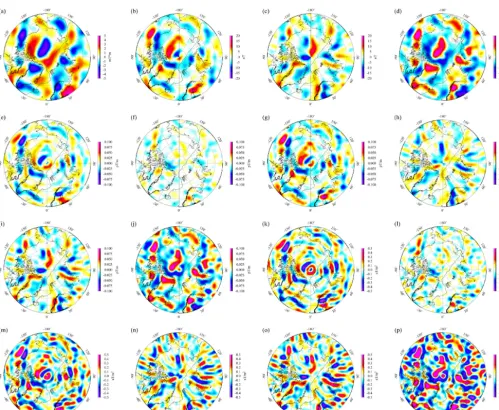
Figure 1. Lithospheric magnetic potential, magnetic vector and its gradient fields and third-order partial derivatives of the magnetic potential field around the North Pole (0◦≤θ≤30◦) at the altitude of 300 km as defined by the lithospheric magnetic field model GRIMM_L120 (version 0.0) (Lesur et al., 2013) for spherical harmonic degrees 16–90. (a) is magnetic potential (V ); (b), (c) and (d) are three components (Bx,ByandBz)of the magnetic vector; (e), (f), (g), (h), (i) and (j) are six elements (Bxx,Bxy,Bxz,Byy,Byz andBzz)of the magnetic gradient tensor; (k), (l), (m), (n), (o) and (p) are six elements (Bxxz,Bxyz,Bxzz,Byyz,ByzzandBzzz)of third-order partial derivatives of the magnetic potential field, respectively. The dark green lines are the plate boundaries by Bird (2003). All maps are shown in polar stereographic projections.
we also give the third-order partial derivatives of the mag-netic potential field as
Bxxz=∂Bxx
∂z = ∂2Bx
∂x∂z = ∂2Bx
∂z∂x
= 1 a2
L
P
l=1 l
P
m=0
(ar)l+4 glmcosmφ+hml sinmφ
axxzl,mPem −2 l +b
xxz
l,mPelm+cxxzl,mPem +2 l
,
(28a)
Bxyz= ∂Bxy
∂z = ∂Byx
∂z = ∂2Bx
∂y∂z= ∂2Bx
∂z∂y = ∂2By
∂x∂z = ∂2By
∂z∂x
= 1 a2
L
P
l=1 l
P
m=0
(ar)l+4 glmsinmφ−hml cosmφ
al,mxyzPe
m−2 l+1 +b
xyz l,mPelm+1+c
xyz l,mPe
m+2 l+1
,
(28b)
Bxzz=∂Bxz
∂z = ∂Bzx
∂z = ∂2Bx
∂z2 =
∂2B z
∂x∂z = ∂2B
z
∂z∂x
= 1 a2
L
P
l=1 l
P
m=0
(ra)l+4 glmcosmφ+hml sinmφ
al,mxzzPe
m−1 l +b
xzz l,mPe
m+1 l
,
Table 1. Statistics of the magnetic potential, MV, MGT and third-order partial derivatives of the magnetic potential field around the North Pole (0◦≤θ≤30◦) at the altitude of 300 km using the lithospheric magnetic field model GRIMM_L120 (version 0.0) (Lesur et al., 2013) for spherical harmonic degrees 16–90.
Magnetic effects Minimum Maximum Mean Standard deviation
V (mT×m) −5.1554771 +4.7867519 +0.0828017 ±1.7377648
Bx(nT) -14.7389250 +17.6917740 -0.0890689 ±4.9797007
By(nT) −15.1297000 +13.6053000 +0.0010738 ±4.8239313
Bz(nT) −19.8715270 +25.3666030 −0.1988485 ±6.7066701
Bxx(pT m−1) −0.1054684 +0.0621351 +0.0001872 ±0.0215871
Bxy(pT m−1) −0.0410371 +0.0491030 +0.0000003 ±0.0115018
Bxz(pT m−1) −0.0929498 +0.1082861 +0.0006867 ±0.0247522
Byy(pT m−1) −0.0726248 +0.0505990 −0.0004789 ±0.0186580
Byz(pT m−1) −0.0868184 +0.0826627 +0.0000058 ±0.0228174
Bzz(pT m−1) −0.1015986 +0.1511038 +0.0002917 ±0.0336965
Bxx+Byy+Bzz(pT m−1) −2.012×10⁻¹⁵ +2.026×10⁻¹⁵ +8.085×10⁻¹⁹ ±5.101×10⁻¹⁶
Bxxz(aT m−2) −0.7589853 +0.4794999 +0.0002436 ±0.1537058
Bxyz(aT m−2) −0.2628265 +0.3734132 −0.0000004 ±0.0734794
Bxzz(aT m−2) −0.7067652 +0.8470055 +0.0140820 ±0.1752880
Byyz(aT m−2) −0.5259662 +0.4076568 −0.0134321 ±0.1370902
Byzz(aT m−2) −0.6058631 +0.6396412 +0.0000341 ±0.1448002
Bzzz(aT m−2) −0.7609268 +1.1697371 +0.0131885 ±0.2421663
Byyz= ∂Byy
∂z = ∂2By
∂y∂z = ∂2By
∂z∂y
= 1 a2
L
P
l=1 l
P
m=0
(ar)l+4 glmcosmφ+hml sinmφ
ayyzl,mPem −2 l +b
yyz l,mPelm+c
yyz l,mPem
+2 l
,
(28d)
Byzz= ∂Byz
∂z = ∂Bzy
∂z = ∂2By
∂z2 =
∂2Bz
∂y∂z= ∂2Bz
∂z∂y
= 1 a2
L
P
l=1 l
P
m=0
(ar)l+4 glmsinmλ−hml cosmλ
ayzzl,mPem −1 l−1 +b
yzz l,mPem
+1 l−1
,
(28e)
Bzzz=∂
2B z
∂z2
= 1 a2
L
P
l=1 l
P
m=0 (ar)l+4
glmcosmφ+hml sinmφ
al,mzzzPelm,
(28f)
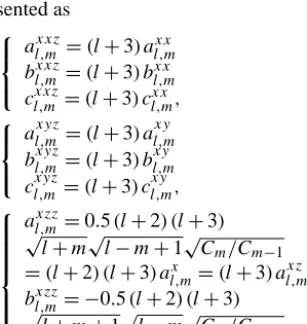
where the corresponding coefficients of the SSALFs are pre-sented as
al,mxxz=(l+3) axxl,m bxxzl,m =(l+3) bl,mxx cxxzl,m =(l+3) cxxl,m,
(29a)
al,mxyz=(l+3) al,mxy bxyzl,m =(l+3) bxyl,m cxyzl,m =(l+3) cl,mxy,
(29b)
al,mxzz=0.5(l+2) (l+3) √
l+m √
l−m+1√Cm/Cm−1 =(l+2) (l+3) axl,m=(l+3) al,mxz bxzzl,m= −0.5(l+2) (l+3) √
l+m+1 √
l−m√Cm/Cm+1 =(l+2) (l+3) bxl,m=(l+3) bl,mxz,
(29c)
al,myyz=(l+3) ayyl,m byyzl,m =(l+3) byyl,m cl,myyz=(l+3) cyyl,m,
(29d)
al,myzz=0.5(l+2) (l+3) √
l+m √
l+m−1√Cm/Cm−1 =(l+2) (l+3) ayl,m=(l+3) al,myz
byzzl,m=0.5(l+2) (l+3) √
l−m √
l−m−1√Cm/Cm+1 =(l+2) (l+3) byl,m=(l+3) bl,myz ,
(29e) al,mzzz= −(l+1) (l+2) (l+3)=(l+3) al,mzz
=(l+2) (l+3) al,mz . (29f)
In this way, we avoid computing recursively the SSALFs with singular terms, their first- and second-order derivatives as in the traditional formulae. The cost is only to calculate two additional degrees and orders for the SSALFs at most. It should be noted that, in this study, we use the conventional form of SSALF that ifm <0, thenPelm=(−1)|m|Pe
|m|
l and if
m > l, thenPelm=0.
3 Numerical investigation and discussion
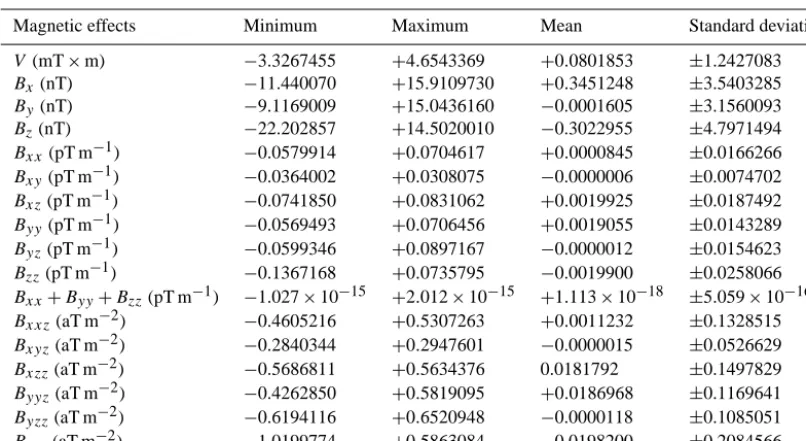
Table 2. Statistics of the magnetic potential, MV, MGT and third-order partial derivatives of the magnetic potential field around the South Pole (150◦≤θ≤180◦) at the altitude of 300 km using the lithospheric magnetic field model GRIMM_L120 (version 0.0) (Lesur et al., 2013) for spherical harmonic degrees 16–90.
Magnetic effects Minimum Maximum Mean Standard deviation
V (mT×m) −3.3267455 +4.6543369 +0.0801853 ±1.2427083
Bx(nT) −11.440070 +15.9109730 +0.3451248 ±3.5403285
By(nT) −9.1169009 +15.0436160 −0.0001605 ±3.1560093
Bz(nT) −22.202857 +14.5020010 −0.3022955 ±4.7971494
Bxx(pT m−1) −0.0579914 +0.0704617 +0.0000845 ±0.0166266
Bxy(pT m−1) −0.0364002 +0.0308075 −0.0000006 ±0.0074702
Bxz(pT m−1) −0.0741850 +0.0831062 +0.0019925 ±0.0187492
Byy(pT m−1) −0.0569493 +0.0706456 +0.0019055 ±0.0143289
Byz(pT m−1) −0.0599346 +0.0897167 −0.0000012 ±0.0154623
Bzz(pT m−1) −0.1367168 +0.0735795 −0.0019900 ±0.0258066
Bxx+Byy+Bzz(pT m−1) −1.027×10⁻¹⁵ +2.012×10⁻¹⁵ +1.113×10⁻¹⁸ ±5.059×10⁻¹⁶
Bxxz(aT m−2) −0.4605216 +0.5307263 +0.0011232 ±0.1328515
Bxyz(aT m−2) −0.2840344 +0.2947601 −0.0000015 ±0.0526629
Bxzz(aT m−2) −0.5686811 +0.5634376 0.0181792 ±0.1497829
Byyz(aT m−2) −0.4262850 +0.5819095 +0.0186968 ±0.1169641
Byzz(aT m−2) −0.6194116 +0.6520948 −0.0000118 ±0.1085051
Bzzz(aT m−2) −1.0199774 +0.5863084 −0.0198200 ±0.2084566
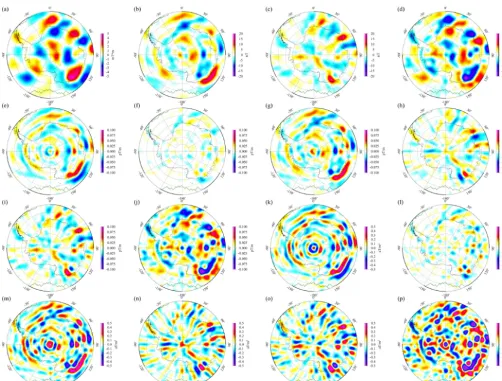
by Lesur et al. (2013). The magnetic potential, MV, MGT and the third-order partial derivatives of the magnetic po-tential field in the two polar regions mapped by the litho-spheric field model with litho-spherical harmonic degrees 16–90 are shown in Fig. 1 and Fig. 2, respectively. The correspond-ing statistics around the North Pole and South Pole are, re-spectively, presented in Tables 1 and 2. A simple test is that the MGT meets Laplace’s equation of the potential field; that is, the trace of the MGT should be equal to zero. Our nu-merical results show that the amplitudes ofBxx+Byy+Bzz
in the North Pole and South Pole regions are in the range of [−2.012×10⁻¹⁵pT m−1 to +2.026×10⁻¹⁵pT m−1] (1 Tesla =103mT=109 nT=1012 pT=1018aT), respec-tively. The relative error is almost equal to the machine’s accuracy. Therefore, this feature proves the validity of our derived formulae. In addition, as shown in Figs. 1 and 2, it is obvious that the MGT and also the third-order partial derivatives of the magnetic potential field enhance the lin-eation and contacts at the satellite altitude. It also reveals some small-scale anomalies, which is very helpful for further geological interpretation. A core field model with spherical harmonic degrees/orders 1–15 is also used for testing and the results, not shown here, indicate the correctness of the formu-lae in the full range of the spherical harmonic degrees/orders, where the computational stability of the Legendre function with ultrahigh-order is not considered.
Furthermore, the computed magnetic fields are smooth near the poles and do not have the singularities, but some components have the dependence on the direction of the ref-erence frame at the poles. As shown in Fig. 3, the magnetic potential V, the Bz,Bzz andBzzz components at the poles
are independent of the direction of thexPandyPaxes; while changing with the direction of thexPandyPaxes at the poles, theBx,By,Bxz,Byz,BxzzandByzzcomponents have a
pe-riod of 360◦ and theBxx,Bxy, Byy, Bxxz,Bxyz and Byyz
components have a period of 180◦. These variations can be accurately described by a sine or cosine function relating to the horizontal rotation of the reference frame and the dif-ferences among these magnetic effects are magnitude, pe-riod and initial phase. Therefore, theBx,By,Bxz,Byz,Bxx,
Bxy,Byy,Bxzz,ByzzBxxz,BxyzandByyzcomponents are not
smooth at/across the poles. Moreover, to determine the sin-gle value at the poles (Figs. 1, 2) we specially define that the x axis points to the meridian of 180◦E (or 180◦W) at the North Pole and of 0◦at the South Pole, that is, the LNORF moving from Greenwich meridian to the poles.
Figure 2. Lithospheric magnetic potential, magnetic vector and its gradient fields and third-order partial derivatives of the magnetic potential field around the South Pole (150◦≤θ≤180◦) at the altitude of 300 km as defined by the lithospheric magnetic field model GRIMM_L120 (version 0.0) (Lesur et al., 2013) for spherical harmonic degrees 16–90. (a) is magnetic potential (V ), (b), (c) and (d) are three components (Bx,By andBz)of the magnetic vector; (e), (f), (g), (h), (i) and (j) are six elements (Bxx,Bxy,Bxz,Byy,ByzandBzz)of the magnetic gradient tensor; (k), (l), (m), (n), (o) and (p) are six elements (Bxxz,Bxyz,Bxzz,Byyz,ByzzandBzzz)of third-order partial derivatives of the magnetic potential field, respectively. The dark green lines are the plate boundaries by Bird (2003). All maps are shown in polar stereographic projections.
of the three components Bx, By and Bz are at a level of
[−3×10⁻¹¹nT to+3×10⁻¹¹nT].
4 Conclusions
We develop in this paper the new expressions for the MV, the MGT and the third-order partial derivatives of the mag-netic potential field in terms of spherical harmonics. The tra-ditional expressions have complicated forms involving first-and second-order derivatives of the SSALFs first-and are singu-lar when approaching the poles. Our newly derived formulae do not contain the first- and second-order derivatives of the SSALFs and remove the singularities at the poles. However,
Figure 3. Limit values of the magnetic potential (V ), magnetic vector (Bx,ByandBz)and its gradients (Bxx,Bxy,Bxz,Byy,ByzandBzz) and third-order partial derivatives of the magnetic potential field (Bxxz,Bxyz,Bxzz,Byyz,ByzzandBzzz)at the poles when the local reference frames vary from different meridians (the direction ofxPaxes changing from different meridians to the poles). Red and blue lines indicate
the magnetic effects at the North Pole and at the South Pole, respectively. The reference frame is specially defined that thexPaxis points
to the meridian of 180◦E (or 180◦W) at the North Pole and 0f 0◦at the South Pole and theyPaxis points to the meridian of 90◦E at both
poles. The values at both poles shown by black dashed arrows are used to plot the maps in Figs. 1 and 2.
Code availability
Supplementary software implementation is performed with the programming language C/C++. The source code and in-put data presented in this paper can be obtained by contact-ing the correspondcontact-ing author via email or download from the Supplement related to the online version of this article.
The Supplement related to this article is available online at doi:10.5194/gmd-8-1979-2015-supplement.
Acknowledgements. This study is supported by the International
of Geosciences, Wuhan) (grant no. SMIL-2015-06) and State Key Laboratory of Geodesy and Earth’s Dynamics (Institute of Geodesy and Geophysics, CAS) (grant no. SKLGED2015-5-5-EZ). Jinsong Du is sponsored by the China Scholarship Council (CSC). We would like to thank Mehdi Eshagh and another anonymous reviewer for their constructive comments. All projected figures are drawn using the Generic Mapping Tools (GMT) (Wessel and Smith, 1991).
The article processing charges for this open-access publication were covered by a Research
Centre of the Helmholtz Association.
Edited by: L. Gross
References
Backus, G. E., Parker, R., and Constable, C.: Foundations of Geo-magnetism, Cambridge University Press, Cambridge, 1996. Bird, P.: An updated digital model of plate boundaries, Geochem.
Geophys. Geosyst., 4, 1027, doi:10.1029/2001GC000252, 2003. Blakely, R. G.: Potential Theory in Gravity and Magnetic
Applica-tions, Cambridge University Press, New York, 1995.
Blakely, R. J. and Simpson, R. W.: Approximating edges of source bodies from magnetic or gravity anomalies, Geophysics, 51, 1494–1498, 1986.
Eshagh, M.: Non-singular expressions for the vector and gradient tensor of gravitation in a geocentric spherical frame, Comput. Geosci., 34, 1762–1768, 2008.
Eshagh, M.: Alternative expressions for gravity gradients in local north-oriented frame and tensor spherical harmonics, Acta Geo-phys., 58, 215–243, 2009.
Finlay, C. C., Maus, S., Beggan, C. D., Bondar, T. N., Chambodut, A., Chernova, T. A., Chulliat, A., Golovkov, V. P., Hamilton, B., Hamoudi, M., Holme, R., Hulot, G., Kuang, W., Langlais, B., Lesur, V., Lowes, F. J., Lühr, H., Macmillan, S., Mandea, M., McLean, S., Manoj, C., Menvielle, M., Michaelis, I., Olsen, N., Rauberg, J., Rother, M., Sabaka, T. J., Tangborn, A., Tøffner-Clausen, L., Thébault, E., Thomson, A. W. P., Wardinski, I., Wei, Z., and Zvereva, T. I.: International Geomagnetic Reference Field: the eleventh generation, Geophys. J. Int., 183, 1216–1230, 2010.
Friis-Christensen, E., Lühr, H., and Hulot, G.: Swarm: A constella-tion to study the Earth’s magnetic field, Earth Planet. Space, 58, 351–358, 2006.
Gauss, C. F.: Allgemeine Theorie des Erdmagnetismus, in: Resul-tate aus den Beobachtungen des magnetischen vereins im Jahre 1838, edited by: Gauss, C. F. and Weber, W., (Leipzig, 1839), 1–57, 1838.
Golynsky, A., Bell, R., Blankenship, D., Damaske, D., Ferracci-oli, F., Finn, C., Golynsky, D., Ivanov, S., Jokat, W., Masolov, V., Riedel, S., von Frese, R., Young, D., and ADMAP Working Group: Air and shipborne magnetic surveys of the Antarctic into the 21st century, Tectonophysics, 585, 3–12, 2013.
Harrison, C. and Southam, J.: Magnetic field gradients and their uses in the study of the Earth’s magnetic field, J. Geomagn. Geo-electr., 43, 485–599, 1991.
Holmes, S. A. and Featherstone, W. E.: A unified approach to the Clenshaw summation and the recursive computation of very high
degree and order normalized associated Legendre functions, J. Geodynam., 76, 279–299, 2002a.
Holmes, S. A. and Featherstone, W. E.: SHORT NOTES: extending simplified high-degree synthesis methods to second latitudinal derivatives of geopotential, J. Geodynam., 76, 447–450, 2002b. Hsu, S. K., Sibuet, J. C., and Shyu, C. T.: High-resolution
detec-tion of geologic boundaries from potential-field anomalies: An enhanced analytic signal technique, Geophysics, 61, 373–386, 1996.
Ilk, K. H.: Ein eitrag zur Dynamik ausgedehnter Körper-Gravitationswechselwirkung, Deutsche Geodätische Kommis-sion. Reihe C, Heft Nr. 288, München, 1983.
Kotsiaros, S. and Olsen, N.: The geomagnetic field gradient tensor: Properties and parametrization in terms of spherical harmonics, Int. J. Geomath., 3, 297–314, 2012.
Kotsiaros, S. and Olsen, N.: End-to-End simulation study of a full magnetic gradiometry mission, Geophys. J. Int., 196, 100–110, 2014.
Kotsiaros, S., Finlay, C. C., and Olsen, N.: Use of along-track mag-netic field differences in lithospheric field modelling, Geophys. J. Int., 200, 878–887, 2015.
Langel, R. A. and Hinze, W. J.: The Magnetic Field of the Earth’s Lithosphere: The Satellite Perspective, Cambridge University Press, Cambridge, United Kingdom, 1998.
Langlais, B., Lesur, V., Purucker, M. E., Connerney, J. E. P., and Mandea, M.: Crustal Magnetic Fields of Terrestrial Planets, Space Sci. Rev., 152, 223–249, 2010.
Lesur, V., Rother, M., Vervelidou, F., Hamoudi, M., and Thébault, E.: Post-processing scheme for modelling the lithospheric mag-netic field, Solid Earth, 4, 105–118, doi:10.5194/se-4-105-2013, 2013.
Maus, S.: An ellipsoidal harmonic representation of Earth’s litho-spheric magnetic field to degree and order 720, Geochem. Geo-phys. Geosyst., 11, Q06015, doi:10.1029/2010GC003026, 2010. Maus, S., Yin, F., Lühr, H., Manoj, C., Rother, M., Rauberg, J., Michaelis, I., Stolle, C., and Müller, R. D.: Resolution of di-rection of oceanic magnetic lineations by the sixth-generation lithospheric magnetic field model from CHAMP satellite mag-netic measurements, Geochem. Geophys. Geosyst., 9, Q07021, doi:10.1029/2008GC001949, 2008.
Olsen, N. and the Swarm End-to-End Consortium: Swarm-End-to-End mission performance simulator study, ESA contract No. 17263/02/NL/CB, DSRI Report 1/2004, Danish Space Research Institute, Copenhagen, 2004.
Olsen, N., Hulot, G., and Sabaka, T. J.: Sources of the Geomagnetic Field and the Modern Data That Enable Their Investigation, in: Handbook of Geomathematics, edited by: Freeden, W., Nashed, M. Z., and Sonar, T., Springer, Netherlands, 106–124, 2010. Olsen, N., Lühr, H., Finlay, C. C., Sabaka, T. J., Michaelis, I.,
Rauberg, J., and Tøffner-Clausen, L.: The CHAOS-4 geomag-netic field model, Geophys. J. Int., 197: 815–827, 2014. Olsen, N., Hulot, G., Lesur, V., Finlay, C. C., Beggan, C., Chulliat,
Pedersen, L. B. and Rasmussen, T. M.: The gradient tensor of po-tential field anomalies: Some implications on data collection and data processing of maps, Geophysics, 55, 1558–1566, 1990. Petrovskaya, M. S. and Vershkov, A. N.: Non-singular expressions
for the gravity gradients in the local north-oriented and orbital reference frames, J. Geodynam., 80, 117–127, 2006.
Purucker, M., Sabaka, T., Le, G., Slavin, J. A., Strangeway, R. J., and Busby, C.: Magnetic field gradients from the ST-5 constella-tion: Improving magnetic and thermal models of the lithosphere, Geophys. Res. Lett., 34, L24306, doi:10.1029/2007GL031739, 2007.
Purucker, M. and Whaler, K.: Crustal magnetism, in: Treatise on Geophysics, vol. 5, Geomagnetism, edited by: Kono, M., Else-vier, Amsterdam, 195–237, 2007.
Purucker, M. E.: Lithospheric studies using gradients from close encounters of Ørsted, CHAMP and SAC-C, Earth Planet. Space, 57, 1–7, 2005.
Ravat, D.: Interpretation of Mars southern highlands high amplitude magnetic field with total gradient and fractal source modeling: New insights into the magnetic mystery of Mars, Icarus, 214, 400–412, 2011.
Ravat, D., Wang, B., Wildermuth, E., and Taylor, P. T.: Gradients in the interpretation of satellite-altitude magnetic data: an example from central Africa, J. Geodynam., 33, 131–142, 2002.
Sabaka, T. J., Tøffner-Clausen, L., and Olsen, N.: Use of the Com-prehensive Inversion method for Swarm satellite data analysis, Earth Planet. Space, 65, 1201–1222, 2013.
Sabaka, T. J., Olsen, N., Tyler, R. H., and Kuvshinov, A.: CM5, a pre-Swarm comprehensive magnetic field model derived from over 12 years of CHAMP, Ørsted, SAC-C and observatory data, Geophys. J. Int., 200, 1596–1626, 2015.
Schmidt, P. and Clark, D.: Advantages of measuring the magnetic gradient tensor, Preview, 85, 26–30, 2000.
Schmidt, P. and Clark, D.: The magnetic gradient tensor: its proper-ties and uses in source characterization, The Leading Edge, 25, 75–78, 2006.
Taylor, P. T., Kis, K. I., and Wittmann, G.: Satellite-altitude horizontal magnetic gradient anomalies used to define the Kursk magnetic anomaly, J. Appl. Geophys., 109, 133–139, doi:10.1016/j/jappgeo.2014.07.018, 2014.
Thébault, E., Purucker, M., Whaler, K. A., Langlais, B., and Sabaka, T. J.: The Magnetic Field of Earth’s Lithosphere, Space Sci. Rev., 155, 95–127, 2010.