Copyright © 2004, American Society for Microbiology. All Rights Reserved.
Multilocus Sequence Typing of
Streptococcus pyogenes
Representing
Most Known
emm
Types and Distinctions among Subpopulation
Genetic Structures
Karen F. McGregor,
1Brian G. Spratt,
1Awdhesh Kalia,
2,3Alicia Bennett,
3Nicole Bilek,
1Bernard Beall,
4and Debra E. Bessen
3,5*
Department of Infectious Disease Epidemiology, Imperial College London, London, United Kingdom1; Department of Molecular Microbiology, Washington University School of Medicine, St. Louis, Missouri2; Department of Ecology
and Evolutionary Biology, Yale University, New Haven, Connecticut3; Respiratory Diseases Branch, Centers for Disease Control and Prevention, Atlanta, Georgia4; and Department
of Microbiology and Immunology, New York Medical College, Valhalla, New York5
Received 17 December 2003/Accepted 1 April 2004
A long-term goal is to characterize the full range of genetic diversity withinStreptococcus pyogenesas it exists in the world today. Since theemmlocus is subject to strong diversifying selection,emmtype was used as a guide for identifying a genetically diverse set of strains. This report contains a description of multilocus sequence typing based on seven housekeeping loci for 495 isolates representing 158 emmtypes, yielding 238 unique combinations of sequence type andemmtype. A genotypic marker for tissue site preference (emmpattern) revealed that only 17% of theemmtypes displayed the marker representing strong preference for infection at the throat and that 39% ofemmtypes had the marker for skin tropism, whereas 41% ofemmtypes harbored the marker for no obvious tissue site preference. As a group, theemmtypes bearing theemmpattern marker indicative of no obvious tissue site preference were far less likely to have two distinctemmtypes associated with the same sequence type than either of the two subpopulations having markers for strong tissue tropisms (P< 0.002). In addition, all genetic diversification events clearly ascribed to a recombinational mechanism involved strains of only two of the emm pattern-defined subpopulations, those representing skin specialists and generalists. The findings suggest that the population genetic structure differs for the tissue-defined subpopu-lations ofS. pyogenes. The observed differences may partly reflect differential host immune selection pressures.
Streptococcus pyogenes, also known as group A beta-hemo-lytic streptococcus (GAS), is among the most highly prevalent bacterial pathogens and has a worldwide distribution. Humans are the only known biological host. Although these organisms can cause severe invasive disease or give rise to an asymptom-atic carrier state, most often they cause mild disease by infect-ing the upper respiratory tract or skin, resultinfect-ing in pharyngitis or impetigo, respectively (7). The relative incidence of GAS disease varies throughout the world, in accordance with both season and locale. In the temperate regions of North America and Europe, pharyngitis is highly prevalent during the winter months and impetigo (although less common) is most often encountered during warmer weather. In many tropical regions, GAS impetigo is far more common than pharyngeal infection (4), and there may be no discrete seasonal peaks in incidence of disease (30).
Numerous typing schemes have been used to characterize and measure the genetic diversity among isolates of S. pyo-genes. Perhaps the most common tool used today isemmtyping (3, 13), which is based on sequence at the 5⬘ end of a locus (emm) that is present in all isolates. The targeted region of
emm displays the highest level of sequence polymorphism
known for a widely distributedS. pyogenes gene;⬎150emm
types have been described to date (B. Beall, http://www.cdc .gov/ncidod/biotech/strep/emmtypes.htm).emmencodes the M protein, which forms the basis of a serological typing scheme (28). For many M proteins, the type-specific epitopes elicit strong host protective immunity (23).
There are four major subfamilies ofemmgenes, which are defined by sequence differences within the 3⬘end, encoding the peptidoglycan-spanning domain (22). The chromosomal ar-rangement of emm subfamily genes reveals five major emm
patterns, denotedemmpatterns A through E (6); strains with patterns B and C are rare and are currently grouped withemm
pattern A strains (referred to as pattern A-C strains). A given isolate ofS. pyogeneshas one, two, or threeemmgenes lying in tandem on the chromosome, and each gene differs in sequence from the others. In strains having threeemmgenes, the deter-minants ofemmtype lie within the centralemmlocus.
The emm pattern A-C strains are usually recovered from cases of pharyngitis, whereasemmpattern D strains are most often isolated from impetigo lesions (4, 6, 10). As a group,
emmpattern E strains are readily found at both primary tissue sites. For example, in tropical Australia, 84% of isolates recov-ered by population-based surveillance of an aboriginal com-munity experiencing high rates of streptococcal impetigo and no cases of pharyngitis were eitheremmpattern D or E (4). In Rome, 98% of pharyngitis isolates were ofemmtypes associ-ated withemmpattern A-C or E (10). Thus,emmpattern can * Corresponding author. Mailing address: New York Medical
Col-lege, Department of Microbiology & Immunology, Valhalla, NY 10595. Phone: (914) 594-4193. Fax: (914) 594-4176. E-mail: debra [email protected].
4285
on May 25, 2017 by guest
http://jb.asm.org/
serve as a genotypic marker for tissue site preferences among
S. pyogenesstrains.
Multilocus sequence typing (MLST) is a relatively new tool for molecular typing of bacteria (8, 33). A principal advantage of MLST over gel-based methods is that the sequence data, which are generated for several neutral housekeeping loci, are unambiguous, electronically portable, and readily queried via the Internet (www.mlst.net). In this report, MLST andemm
pattern determination are performed for many previously un-testedemm types ofS. pyogenes. When these data are com-bined with data from previous reports (10, 12, 31), it is found that the large majority of known emmtypes (http://www.cdc .gov/ncidod/biotech/strep/emmtypes.htm) are represented. An analysis of the relationships among emmtype, emmpattern, and the genetic relatedness defined by MLST is presented.
MATERIALS AND METHODS
Bacteria.The 107 new GAS isolates under study are listed in Table 1. Selec-tion of bacterial isolates for this study was largely guided by knowledge of
previously determinedemmtypes, for the purpose of assembling a strain set
having maximal diversity inemmtype. Some new isolates were selected in order
to ascertainemmpattern for more than one isolate of a givenemmtype. Strains
designated SS followed by a string of three or four numerals are part of the Centers for Disease Control and Prevention (CDC) strain collection; strains designated with two, three, or four numerals followed by a hyphen and then two additional numerals, where the last two numerals in the series represent year of acquisition, are also part of the CDC strain collection; additional epidemiological information is posted at http://www.cdc.gov/ncidod/biotech/strep/emmtypes.htm for many strains. All other isolates from Australia were provided by K. Sri-prakash and B. Currie. Strain CT95-201 was obtained from the State of Con-necticut Department of Health (18). All other strains were obtained from the Lancefield collection (The Rockefeller University, New York, N.Y.).
Of the 495 isolates, the tissue site of isolation was unknown for 73 (15%), 183 (37%) were derived from impetigo lesions, 136 (27%) were recovered from normally sterile tissue sites, and 103 (21%) were from the upper respiratory tract. Of the upper respiratory tract isolates, 23 (22%) were known to be recovered from subjects with no disease symptoms, whereas 54 (52%) were definitively associated with disease. Isolates from impetigo lesions and normally sterile sites are, by definition, disease associated.
emmsequence typing.emmtype, which closely corresponds to M serotype, was ascertained by nucleotide sequence determination as previously described (3, 12,
29); a uniqueemmtype is defined as having⬍95% sequence identity to any other
known type over the first 160 bp of sequence, allowing for small indels. A
complete and current listing of GAS emm types is posted at ftp://ftp.cdc
.gov/pub/infectious_diseases/biotech/emmsequ/ and http://www.cdc.gov/ncidod
/biotech/strep/emmtypes.htm).emmpattern was determined by a PCR-based
method, as previously described (4).
MLST.Internal fragments of seven housekeeping genes (gki,gtr,murI,mutS,
recP,xpt, andyqiL) were amplified and sequenced with primers and under
conditions described previously (12). For each locus, distinct allele numbers were assigned to each unique sequence, generating a seven-integer allelic profile for each isolate. Isolates with identical allelic profiles were assigned to the same sequence type (ST). A complete database of alleles, allele sequences, and STs is maintained on the Internet at www.mlst.net.
Additional nucleotide sequence determination.Using bacterial DNA as a template, PCR amplification products were generated (annealing temperature,
50 or 55°C) with the following oligonucleotide primers: for thecpalocus, 5⬘
-GGA TAT GAG ATT GCC GAA CCT ATT ACT TTT AAA G-3⬘(forward)
and 5⬘-GGA GCC TGT TTA TCT TCC ATT CGA ATA ATA TCC AC-3⬘
(reverse) (product size,⬃600 bp); for theprtF1locus, 5⬘-TGC GCG GGT TCT
ATC GGT TTT GGT CAA GTA-3⬘(forward) and 5⬘-AAT TAG TTT T(T/C)T
CA(G/A) (T/A)GC (T/C)TC ACG CAT TAA-3⬘(reverse) (product size,⬃360
bp). The same primers were used for nucleotide sequence determination.
Computational analysis.Sequence (nucleotide and amino acid) alignments and percent sequence identity calculations were performed with Clustal W (DNAStar; version 5.05). The eBURST algorithm was applied with software available at http://eburst.mlst.net (15). Average distances between STs was cal-culated by the START-distance matrix method (www.mlst.net). For tests for independence, Fisher’s two-tailed exact test was used (DnaSP; version 3.99).
Nucleotide sequence accession numbers.The new housekeeping allele se-quences generated as part of this report were submitted to GenBank and as-signed accession numbers AY520918 through AY521006. The new allele
se-quences associated with thecpaandprtF1loci were submitted to GenBank and
assigned accession numbers AY579608 through AY579635.
RESULTS
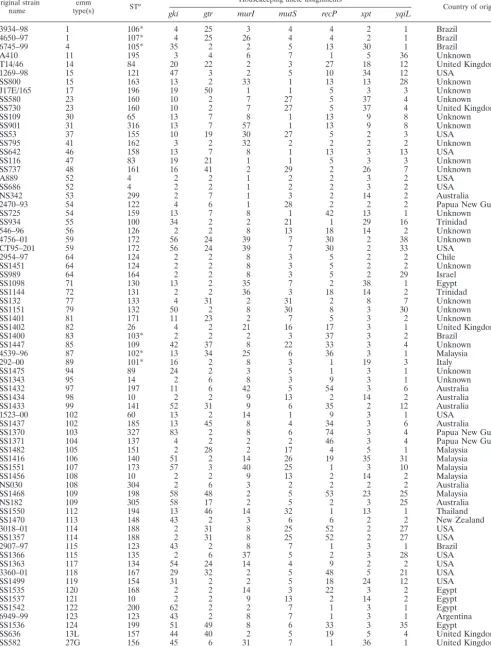
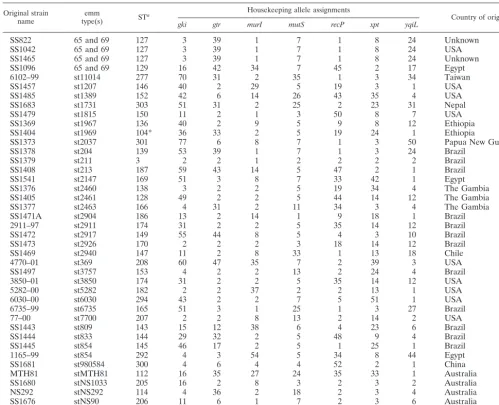
MLST of GAS.Allelic profiles at seven housekeeping loci were determined for 107 isolates of GAS (Table 1). The ma-jority of isolates (75%) represent emm types not previously reported on for MLST. When these data were combined with previously reported data on 388 GAS isolates, 220 STs were recognized (10, 12, 31) (www.mlst.net). The total number of alleles at each housekeeping locus ranged from 36 (mutS) to 66 (gki). Collectively, 158 distinctemmtypes are included in the set of 495 isolates and 238 uniqueemmtype-ST combinations can be defined. These 158emmtypes represent the large ma-jority of knownemmtypes found in GAS, as defined by ftp: //ftp.cdc.gov/pub/infectious_diseases/biotech/emmsequ/ and http: //www.cdc.gov/ncidod/biotech/strep/emmtypes.htm.
Markers for tissue site preference.emmpattern serves as a useful genotypic marker for tissue site preferences of individ-ual strains and clones. Of the 158 emm types represented within the complete set of 495 isolates, emmpattern was es-tablished for one or more isolates of 156emmtypes (Table 2). Of the 76emmtypes for whichemmpattern was determined for two or more isolates, 74 (97%) of theemmtypes included isolates belonging to a singleemmpattern group (i.e., A-C, D, or E). Only two emm types (54 and st854) were found in association with twoemmpattern groups. Therefore, isolates of a givenemmtype usually have the sameemmpattern group-ing.
The classical throat strains (emmpattern A-C) displayed the least diversity inemmtype, accounting for only 17% of the 156
emmtypes that could be assigned anemmpattern (Table 2).
emmtypes associated with patterns D and E were most abun-dant, representing 39 and 41%, respectively, of the totalemm
types. Two of the emmtypes (st1815 and st211) had a rear-rangedemmregion. The data show thatemmpattern D and E strains display the most diversity inemmtype, whereas pattern A-C strains display the least.
The relationship betweenemmpattern subpopulations and genetic diversity, as defined by MLST, was also evaluated. Of the 220 STs resolved by MLST,emmpattern was determined for at least one representative of 202 STs. The classical throat strains (emmpattern A-C) displayed the least genetic diversity in their allelic profiles, accounting for only 18% of the 202 STs examined. STs associated with patterns D and E were most abundant, representing 36 and 47%, respectively, of the total number of STs. The data show thatemmpattern E strains, as a group, display the most diversity in ST, whereas pattern A-C strains display the least. Pattern D strains are intermediate in their overall diversity of STs.
Relationships among STs. Of the 220 STs of GAS, the average distance from an ST to all other STs was 6.21 house-keeping alleles, calculated by the START-distance matrix method. The mean distance of an ST to the ST with the most similar allelic profile was 2.35 housekeeping alleles. Thus, many STs are distally related to all others.
eBURST is an algorithm that can be used to subdivide
4286 MCGREGOR ET AL. J. BACTERIOL.
on May 25, 2017 by guest
http://jb.asm.org/
Original strain
name type(s)emm STa
Housekeeping allele assignments
Country of originb
gki gtr murI mutS recP xpt yqiL
3934–98 1 106* 4 25 3 4 4 2 1 Brazil
4650–97 1 107* 4 25 26 4 4 2 1 Brazil
6745–99 4 105* 35 2 2 5 13 30 1 Brazil
A410 11 195 3 4 6 7 1 5 36 Unknown
T14/46 14 84 20 22 2 3 27 18 12 United Kingdom
1269–98 15 121 47 3 2 5 10 34 12 USA
SS800 15 163 13 2 33 1 13 13 28 Unknown
J17E/165 17 196 19 50 1 1 5 3 3 Unknown
SS580 23 160 10 2 7 27 5 37 4 Unknown
SS730 23 160 10 2 7 27 5 37 4 United Kingdom
SS109 30 65 13 7 8 1 13 9 8 Unknown
SS901 31 316 13 7 57 1 13 9 8 Unknown
SS53 37 155 10 19 30 27 5 2 3 USA
SS795 41 162 3 2 32 2 2 2 2 Unknown
SS642 46 158 13 7 8 1 13 3 13 USA
SS116 47 83 19 21 1 1 5 3 3 Unknown
SS737 48 161 16 41 2 29 2 26 7 Unknown
A889 52 4 2 2 1 2 2 3 2 USA
SS686 52 4 2 2 1 2 2 3 2 USA
NS342 53 299 2 7 1 3 2 14 2 Australia
2470–93 54 122 4 6 1 28 2 2 2 Papua New Guinea
SS725 54 159 13 7 8 1 42 13 1 Unknown
SS934 55 100 34 2 2 21 1 29 16 Trinidad
546–96 56 126 2 2 8 13 18 14 2 Unknown
4756–01 59 172 56 24 39 7 30 2 38 Unknown
CT95–201 59 172 56 24 39 7 30 2 33 USA
2954–97 64 124 2 2 8 3 5 2 2 Chile
SS1451 64 124 2 2 8 3 5 2 2 Unknown
SS989 64 164 2 2 8 3 5 2 29 Israel
SS1098 71 130 13 2 35 7 2 38 1 Egypt
SS1144 72 131 2 2 36 3 18 14 2 Trinidad
SS132 77 133 4 31 2 31 2 8 7 Unknown
SS1151 79 132 50 2 8 30 8 3 30 Unknown
SS1401 81 171 11 23 2 7 5 3 2 Unknown
SS1402 82 26 4 2 21 16 17 3 1 United Kingdom
SS1400 83 103* 2 2 2 3 37 3 2 Brazil
SS1447 85 109 42 37 8 22 33 3 4 Unknown
4539–96 87 102* 13 34 25 6 36 3 1 Malaysia
292–00 89 101* 16 2 8 3 1 19 3 Italy
SS1475 94 89 24 2 3 5 1 3 1 Unknown
SS1343 95 14 2 6 8 3 9 3 1 Unknown
SS1432 97 197 11 6 42 5 54 3 6 Australia
SS1434 98 10 2 2 9 13 2 14 2 Australia
SS1433 99 141 52 31 9 6 35 2 12 Australia
1523–00 102 60 13 2 14 1 9 3 1 USA
SS1437 102 185 13 45 8 4 34 3 6 Australia
SS1370 103 327 83 2 8 6 74 3 4 Papua New Guinea
SS1371 104 137 4 2 2 2 46 3 4 Papua New Guinea
SS1482 105 151 2 28 2 17 4 5 1 Malaysia
SS1416 106 140 51 2 14 26 19 35 31 Malaysia
SS1551 107 173 57 3 40 25 1 3 10 Malaysia
SS1456 108 10 2 2 9 13 2 14 2 Malaysia
NS030 108 304 2 6 3 2 2 2 2 Australia
SS1468 109 198 58 48 2 5 53 23 25 Malaysia
NS182 109 305 58 17 2 5 2 3 25 Australia
SS1550 112 194 13 46 14 32 1 13 1 Thailand
SS1470 113 148 43 2 3 6 6 2 2 New Zealand
3018–01 114 188 2 31 8 25 52 2 27 USA
SS1357 114 188 2 31 8 25 52 2 27 USA
2907–97 115 123 43 2 8 7 1 3 1 Brazil
SS1366 115 135 2 6 37 5 2 3 28 USA
SS1363 117 134 54 24 14 4 9 2 2 USA
3360–01 118 167 29 32 2 5 48 5 21 USA
SS1499 119 154 31 2 2 5 18 24 12 USA
SS1535 120 168 2 2 14 3 22 3 2 Egypt
SS1537 121 10 2 2 9 13 2 14 2 Egypt
SS1542 122 200 62 2 2 7 1 3 1 Egypt
6949–99 123 123 43 2 8 7 1 3 1 Argentina
SS1536 124 199 51 49 8 6 33 3 35 Egypt
SS636 13L 157 44 40 2 5 19 5 4 United Kingdom
SS582 27G 156 45 6 31 7 1 36 1 United Kingdom
SS875 44 and 61 31 4 10 3 6 14 10 4 USA
SS951 50 and 62 2 1 2 20 5 35 3 4 USA
Continued on following page
4287
on May 25, 2017 by guest
http://jb.asm.org/
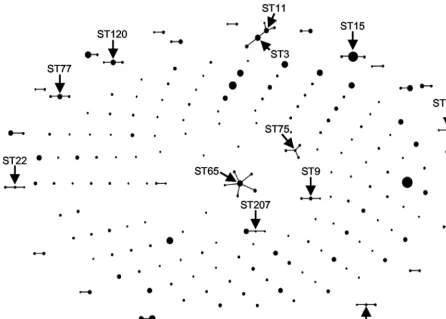
MLST data into nonoverlapping groups of STs with a user-defined level of similarity in their allelic profiles (15). The most stringent definition of an eBURST group, where all STs as-signed to the same group must share alleles at at least six of the seven MLST loci with at least one other ST in the group, identifies clusters of closely related genotypes that are consid-ered to be descended from the same founder and that are defined as clonal complexes (15). To obtain a population snap-shot, the group definition is set at zero of seven shared house-keeping alleles. Thirty-one clonal complexes were observed among the 220 STs with eBURST, and most of these were small clusters of two or three linked STs (Fig. 1). eBURST identifies the most likely founder of a clonal complex and provides bootstrap support for the assignment. For the 220 GAS STs, a founder ST was assigned in only 11 of the 31 clonal complexes; 65% of the clonal complexes were doublets where the direction of evolution is unknown. However, the bootstrap support was⬍70% for all founder STs, except for ST65 (99%
confidence). For each of the 31 clonal complexes, all STs had
emmtypes belonging to the sameemmpattern group (Table 2).
The relative contributions of point mutation and recombi-nation to the initial stages of clonal diversification can be assessed from MLST data, by identifying those STs that are very closely related, differing at only one of the seven MLST loci (single-locus variants [SLVs]). The sequences of the alleles at the single altered locus are then analyzed to distinguish whether the change in the housekeeping gene has occurred by recombination or by mutation (14, 16). The criteria for assign-ing an allelic change as resultassign-ing from mutation or recombi-nation used by Feil et al. (16) are based on the identification of the founder ST and its associated SLVs within a clonal com-plex. Within the GAS data set there are 48 pairs of STs that differ at a single locus, but founders cannot be confidently predicted in the majority of cases. In this study, the assignment of the allelic change in SLV pairs as the result of mutation or TABLE 1—Continued
Original strain
name type(s)emm STa
Housekeeping allele assignments
Country of originb
gki gtr murI mutS recP xpt yqiL
SS822 65 and 69 127 3 39 1 7 1 8 24 Unknown
SS1042 65 and 69 127 3 39 1 7 1 8 24 USA
SS1465 65 and 69 127 3 39 1 7 1 8 24 Unknown
SS1096 65 and 69 129 16 42 34 7 45 2 17 Egypt
6102–99 st11014 277 70 31 2 35 1 3 34 Taiwan
SS1457 st1207 146 40 2 29 5 19 3 1 USA
SS1485 st1389 152 42 6 14 26 43 35 4 USA
SS1683 st1731 303 51 31 2 25 2 23 31 Nepal
SS1479 st1815 150 11 2 1 3 50 8 7 USA
SS1369 st1967 136 40 2 9 5 9 8 12 Ethiopia
SS1404 st1969 104* 36 33 2 5 19 24 1 Ethiopia
SS1373 st2037 301 77 6 8 7 1 3 50 Papua New Guinea
SS1378 st204 139 53 39 1 7 1 3 24 Brazil
SS1379 st211 3 2 2 1 2 2 2 2 Brazil
SS1408 st213 187 59 43 14 5 47 2 1 Brazil
SS1541 st2147 169 51 3 8 7 33 42 1 Egypt
SS1376 st2460 138 3 2 2 5 19 34 4 The Gambia
SS1405 st2461 128 49 2 2 5 44 14 12 The Gambia
SS1377 st2463 166 4 31 2 11 34 3 4 The Gambia
SS1471A st2904 186 13 2 14 1 9 18 1 Brazil
2911–97 st2911 174 31 2 2 5 35 14 12 Brazil
SS1472 st2917 149 55 44 8 5 4 3 10 Brazil
SS1473 st2926 170 2 2 2 3 18 14 12 Brazil
SS1469 st2940 147 11 2 8 33 1 13 18 Chile
4770–01 st369 208 60 47 35 7 2 39 3 USA
SS1497 st3757 153 4 2 2 13 2 24 4 Brazil
3850–01 st3850 174 31 2 2 5 35 14 12 USA
5282–00 st5282 182 2 2 37 2 2 13 1 USA
6030–00 st6030 294 43 2 2 7 5 51 1 USA
6735–99 st6735 165 51 3 1 25 1 3 27 Brazil
77–00 st7700 207 2 2 8 13 2 14 2 USA
SS1443 st809 143 15 12 38 6 4 23 6 Brazil
SS1444 st833 144 29 32 2 5 48 9 4 Brazil
SS1445 st854 145 46 17 2 5 1 25 1 Brazil
1165–99 st854 292 4 3 54 5 34 8 44 Egypt
SS1681 st980584 300 4 6 4 4 52 2 1 China
MTH81 stMTH81 112 16 35 27 24 35 33 1 Australia
SS1680 stNS1033 205 16 2 8 3 2 3 2 Australia
NS292 stNS292 114 4 36 2 18 2 3 4 Australia
SS1676 stNS90 206 11 6 1 7 2 3 6 Australia
SS1578 sts104 39 5 11 8 5 15 2 1 Taiwan
aAsterisks indicated newly analyzed STs previously posted at www.mlst.net by B. Beall.
bUSA, United States; Trinidad, Trinidad and Tobago.
4288 MCGREGOR ET AL. J. BACTERIOL.
on May 25, 2017 by guest
http://jb.asm.org/
recombination was therefore based on the following assump-tions. If there are multiple (more than one) nucleotide differ-ences among the alleles at the locus that differs among SLVs, a recombinational event is assumed to have occurred, because the probability of multiple independent point mutations at one locus with none at any of the other six loci is low. If there is only a single nucleotide difference, assignment of the variant as the result of mutation or recombination is more complicated (16). A random point mutation is expected to produce a novel allele restricted to the SLV in which it arises; however, alleles introduced by recombination should be present in other strains in the population and most may be present in a large MLST database. In this study, where both alleles at the variant locus of the SLV pair were found in distantly related STs, we assume that the allelic change was due to recombination. The remain-ing alleles that differ at a sremain-ingle site will probably still include some that arose by recombination from a donor allele that is absent from the data set, and thus this procedure provides a minimum estimate of the extent of recombination compared to point mutation.
Among the 48 SLV pairs identified by eBURST among the 220 STs (Fig. 1), 20 allelic changes were designated recombi-nation events, based on multiple nucleotide differences among alleles at the variant locus (data not shown). The remaining 28 SLV pairs had a single nucleotide difference among the alleles. Of these, in eight cases both alleles of the SLV pair were present in one or more distantly related STs. Thus, 28 of the allelic changes were considered to be due to recombination and ⱕ20 were considered to be due to point mutation, and housekeeping loci in GAS are estimated to change by recom-bination at least 1.4 times more frequently than by point mu-tation.
Of the 28 allelic changes classified as recombination events, all involved emm pattern D or E strains (16 and 12 genetic events, respectively). Further studies are required to obtain a more precise estimate of the ratio of recombination to muta-tion and to firmly establish whether recombinamuta-tion is a more
common mode of evolutionary change at housekeeping loci in
emmpattern D and E strains than in pattern A-C strains.
Association of multiple emmtypes with a single ST. The great majority of STs were found in association with a single
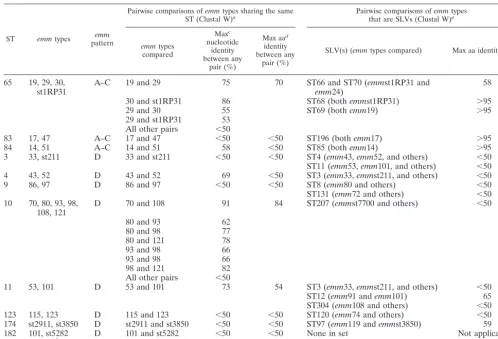
emmtype (208 of 220; 95%). Only 12 STs included isolates of two or more differentemmtypes (Table 3); these are referred to as emm-variable STs. However, the 12 emm-variable STs involved a disproportionately large fraction of the total num-ber ofemmtypes (30 of 158, 19%). Threeemm-variable STs were associated with emm pattern A-C strains, eight were associated with pattern D strains, and only one was associated with pattern E strains. None of the STs were associated with
emmtypes corresponding to differentemmpattern groups. Eight (28%) of the 29emmtypes associated withemmpattern A-C strains (Table 2) were found among emm-variable STs (ST65, -83, and -84; Table 3). Similarly, for emm pattern D strains, 20 of the 63emmtypes (32%) were associated withemm -variable STs (ST3, -4, -9, -10, -11, -123, -174, and -182). In sharp contrast, only 2 of the 64 pattern Eemmtypes (3%) were asso-ciated with anemm-variable ST (ST39). Thus, unlike theemm
types characteristic ofemmpattern A-C and D strains, the STs of
emmpattern E isolates rarely include isolates with more than one
emmtype (P⬍0.002; Fisher’s exact test, two-tailed).
The extent of similarity between theemmsequences of those isolates that have the same ST but differentemm types was examined, as this may distinguish variation inemmtype that has arisen by the accumulation of point mutations from that arising by horizontal gene transfer. For many of these emm -variable STs, the differentemmtypes have⬍50% nucleotide sequence identity, and, for allemmtypes associated with the same ST, the emm type sequences were ⱕ91% identical in nucleotide sequence andⱕ84% identical in the corresponding amino acid sequence of the M protein (Table 3). However, close examination of sequence alignments suggests thatemm
type st1RP31 arose fromemmtype 30 via intragenic recombi-nation resulting in small deletions; both strains are ST65. Fur-thermore,emmtype sts104 appears to have arisen via fusion of TABLE 2. emmtypes according toemmpattern marker for tissue site preference
emmpattern Tissue site preference No. oftypesemm
represented emmtype(s)
a
A–C Throat (pharyngitis) 29 1, 3, 5, 6, 12, 14, 17, 18, 19, 23, 24, 26, 29, 30, 37, 38/40, 39, 46, 47, 51, 54, 55, 57, st1RP31, st3765, st854, st980584 (stHK), stCK401, stNS90
D Skin (impetigo) 63 32, 33, 34, 36, 41, 42, 43, 52, 53, 54, 56, 59, 64, 65/69, 67, 70, 71, 72, 74, 80, 81, 83, 85, 86, 91, 93, 95, 97, 98, 99, 100, 101, 105, 108, 111, 115, 116, 119, 120, 121, 122, 123, st1967, st2037, st204, st2461, st2911, st2917, st2926, st2940, st369, st3757, st3850, st5282, st6030, st7700, st809, st854, stCK249, stD432, stD631, stD633, stNS1033
E No obvious preference 64 2, 4, 8, 9, 11, 15, 22, 25, 28, 44/61, 48, 49, 50/62, 58, 60, 63, 66, 68, 73, 75, 76, 77, 78, 79, 82, 84, 87, 88, 89, 90, 92, 94, 96, 102, 103, 104, 106, 107, 109, 110, 112, 113, 114, 117, 118, 124, 13L, 27G, st11041, st1207, st1389, st1731, st213, st2147, st2460, st2463, st2904, st6735, st833, stDYD, stMTH81, stNS292, stNS554, sts104
Rearranged 2 st1815, st211
Uncertainb 1 31
Not donec 1 st1969
a54 and st854 (underlined) are associated with A–C and D,sof-positive pattern D strains were observed foremmtypes 59, 65/69, 81, and 85.
bDifficulty distinguishing between patterns D and E, which may reflect rearrangedemmregion.
cst1969 underwent MLST, but notemmpattern determination.
on May 25, 2017 by guest
http://jb.asm.org/
the leader-coding region of emm4 with a downstream emm
gene (enn4), on an ST39 genetic background, although the
emmtype sts104 strain was successfully mapped asemm pat-tern E. Aside from the two exceptions noted, the large number of sequence differences betweenemmtypes strongly suggests that horizontal transfer ofemmfollowed by intergenomic re-combination is the primary mechanism underlyingemm -vari-able STs, rather than intragenomic recombination or diver-gence by point mutation.
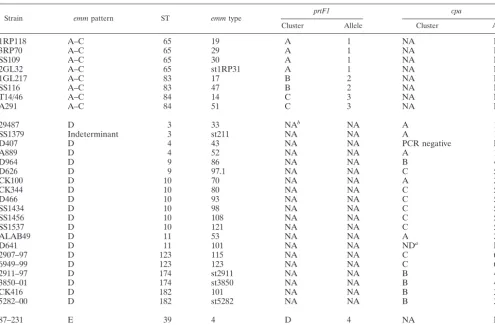
Analysis of other adaptive loci inemm-variable STs.If re-combinational replacement ofemmtype is a recent event, then other loci distant from emm on the genome should display little or no sequence variation among isolates that have the same ST but which differ inemmtype. The FCT (fibronectin-collagen-T antigen) region of the GAS genome encodes sur-face proteins that bind host extracellular matrix proteins (fi-bronectin and collagen). The FCT region displays high overall levels of genetic diversity and lies ⬃300 kb from the emm
region (5, 17, 27, 32). Two FCT region genes,prtF1andcpa, were examined for sequence diversity in GAS isolates sharing the same ST but differing inemmtype (Table 4).
For 10 isolates possessing theprtF1locus (emmpatterns A-C and E) and representing four STs and 10 emm types, four
major sequence clusters of partialprtF1genes, corresponding to the 5⬘ end region, were identified (Table 4). The percent nucleotide sequence identity among alleles belonging to dif-ferentprtF1sequence clusters ranged from 62 to 69%, whereas the amino acid sequence identity among different clusters ranged from 46 to 58%, suggestive of a history of strong di-versifying selection at theprtF1locus. However, in each case, all isolates with the same ST but differentemmtypes also had identicalprtF1alleles. The lack of variation amongprtF1alleles withinemm-variable STs adds further support to the idea that recombinational replacements that lead to variation in the
emm type of isolates of a single ST are recent evolutionary events inemmpattern A-C strains.
Manyemmpattern D strains harbor acpagene, rather than the
prtF1gene, within their FCT regions. Of 20 pattern D isolates, belonging to eight STs and representing 20 differentemmtypes, the nucleotide sequence was determined for an internal portion (5⬘ end region) of thecpa gene for 18 strains (Table 4). The partialcpa genes formed three discrete sequence clusters, with two alleles in each major cluster. The percent nucleotide se-quence identity among cpa alleles belonging to the same se-quence cluster was high (⬎99%). However, the percent nucleo-tide sequence identity among alleles belonging to differentcpa
FIG. 1. Population snapshot by eBURST. The entireS. pyogenesdatabase of 495 isolates is displayed as a single eBURST diagram, by setting the group definition to zero of seven shared alleles, which places all isolates in a single group. Each dot represents an ST, and the size of the dot reflects the number of GAS isolates in each ST for the set of 495 isolates under study. STs that differ by a single locus are linked with a solid line; clusters of linked isolates correspond to clonal complexes. Founder STs are labeled (arrows), although, except for ST65, the bootstrap support for the founders was low. The distribution and spacing of unlinked STs and clonal complexes in a population snapshot are not relational and provide no information about the genetic distances between them.
4290 MCGREGOR ET AL. J. BACTERIOL.
on May 25, 2017 by guest
http://jb.asm.org/
sequence clusters was much lower, ranging from 62 to 68%; the amino acid sequence identity among different clusters ranged from 49 to 60%. The sequence data suggest that, likeprtF1, the
cpa locus has a history of being subject to strong diversifying selection.
In contrast to what was found forprtF1, strains having dis-tinctemmtypes but the same ST were not necessarily uniform in theircpagenes (Table 4). Although four of the sevenemm -variable STs examined had identicalcpaalleles in strains with different emm types (ST3, -123, -174, and -182), two emm -variable STs hadcpagenes belonging to distant sequence clus-ters (ST9 and -11); in a third (ST4), thecpafragment could not be amplified from one of the two strains with thecpaprimers. These findings suggest that, for theemmpattern D subpopu-lation, the emergence of strains of the same ST, but with differentemmtypes, may in some cases be more complex than a one-step recombinational replacement ofemm.
DISCUSSION
The findings presented in this report are part of a long-term effort to gain a comprehensive understanding of the genetic
diversity present within this medically important bacterial spe-cies.emmtypes are commonly used to characterize GAS, and at least one representative strain of the large majority of cur-rently knownemmtypes was examined for both ST (based on housekeeping genes) and a genetic marker for tissue site pref-erence (based on emm pattern). The lower level of genetic diversity, for bothemmtype and ST, that was observed among the throat strain group (emm pattern A-C) may reflect its lower prevalence among the world’s human host population: The majority of human hosts inhabit tropical and semitropical regions of the developing world, in which the incidence of streptococcal skin infection is generally high and the incidence of streptococcal pharyngitis is often moderate to low.
At least 58% (28 of 48) of the recent changes at housekeep-ing loci in GAS appear to be due to recombination, and this value may be substantially greater, since many alleles among SLVs that differ at a single nucleotide site may have arisen by recombination involving a very similar donor allele rather than by point mutation. The best estimate at present is that recom-bination changes alleles of housekeeping loci at least 1.4 times more commonly than point mutation. The major contribution TABLE 3. STs associated with more than oneemmtype
ST emmtypes patternemm
Pairwise comparisons ofemmtypes sharing the same
ST (Clustal W)a Pairwise comparisons ofthat are SLVs (Clustal W)emmtypesa
emmtypes
compared
Maxc
nucleotide identity between any
pair (%)
Max aad
identity between any
pair (%)
SLV(s) (emmtypes compared) Max aa identity (%)
65 19, 29, 30,
st1RP31 A–C 19 and 29 75 70 ST66 and ST70 (emm24) emmst1RP31 and 58
30 and st1RP31 86 ST68 (bothemmst1RP31) ⬎95
29 and 30 55 ST69 (bothemm19) ⬎95
29 and st1RP31 53 All other pairs ⬍50
83 17, 47 A–C 17 and 47 ⬍50 ⬍50 ST196 (bothemm17) ⬎95
84 14, 51 A–C 14 and 51 58 ⬍50 ST85 (bothemm14) ⬎95
3 33, st211 D 33 and st211 ⬍50 ⬍50 ST4 (emm43,emm52, and others) ⬍50
ST11 (emm53,emm101, and others) ⬍50
4 43, 52 D 43 and 52 69 ⬍50 ST3 (emm33,emmst211, and others) ⬍50
9 86, 97 D 86 and 97 ⬍50 ⬍50 ST8 (emm80 and others) ⬍50
ST131 (emm72 and others) ⬍50 10 70, 80, 93, 98,
108, 121 D 70 and 108 91 84 ST207 (emmst7700 and others) ⬍50
80 and 93 62
80 and 98 77
80 and 121 78
93 and 98 66
93 and 98 66
98 and 121 82
All other pairs ⬍50
11 53, 101 D 53 and 101 73 54 ST3 (emm33,emmst211, and others) ⬍50
ST12 (emm91 andemm101) 65
ST304 (emm108 and others) ⬍50
123 115, 123 D 115 and 123 ⬍50 ⬍50 ST120 (emm74 and others) ⬍50
174 st2911, st3850 D st2911 and st3850 ⬍50 ⬍50 ST97 (emm119 andemmst3850) 59
182 101, st5282 D 101 and st5282 ⬍50 ⬍50 None in set Not applicable
39 4, st104b E 4 and st104 ⬍50 ⬍50 ST38 (bothemm4) ⬎95
aAlignments of 240 bp, whereby the (putative) signal peptidase cleavage site lies between amino acid residues 21 and 22 (nucleotide positions 63 and 64) for all
alignments, except for ST65 (between amino acid residues 19 and 20) and ST83 and ST84 (between amino acid residues 22 and 23).
bst104 appears to be a fusion between anemm4-like leader-coding region and the downstreamenn4(SF3emm) gene, although this strain was scored asemmpattern
E (i.e., evidence for three tandememmloci). Also of potential relevance, theemmst104 isolate has asof4allele, which is often characteristic of anemmtype 4 genetic
background.
cMax, maximal.
daa, amino acid.
on May 25, 2017 by guest
http://jb.asm.org/
of recombination to allelic change is consistent with previous findings that demonstrated a complete absence of congruence among the gene tree topologies for the seven MLST loci, for GAS genotypes representing allemmpattern groups (14). The lack of congruency between loci suggests that, in the long term, recombination has eliminated all phylogenetic signal from gene trees. This finding is further supported by a lack of strong bootstrap support in a phylogenetic tree based on concate-nated housekeeping alleles (25).
Theemmpattern A-C subpopulation (throat specialists) of
S. pyogenesmay differ from the skin specialists (emmpattern D) and generalists (emmpattern E) in the relative impact of recombination compared to point mutation in genetic diversi-fication at housekeeping loci. Those recombinational changes at MLST loci that can clearly be discerned appear to have been much more common in emmpattern group D and E strains than in pattern A-C strains. This trend was also observed in an analysis of congruence among housekeeping gene tree topol-ogies, where 5, 0, and 1 of the 42 possible pairwise tree com-parisons were significantly congruent for theemmpattern A-C, D, and E subpopulations, respectively (25). Although allelic changes by recombination were less readily detected among theemmpattern A-C strains using eBURST, it is important to emphasize that recombination was observed in all of theemm
pattern-defined subpopulations according to several analytic methods (25).
The total number of STs within each clonal complex iden-tified by eBURST was rather low and probably reflects our sampling strategy. In general, eBURST may identify few clonal complexes, and few large clonal complexes, in populations where sampling has largely been designed to uncover the ge-netic diversity within the species (11, 16, 34), as in this work, where a small number of isolates or a single isolate of most
emmtypes was examined. Thus, a more optimal sampling of GAS will be required for identifying many additional clonal complexes, for defining their founding genotypes, and for ex-ploring the patterns of descent, in order to provide a better assessment of the impact of recombination and mutation.
The data suggest that a significant proportion ofemm pat-tern A-C and D strains, but not patpat-tern E strains, have a recent history of recombinational replacement ofemmtype, yielding STs that are associated with multiple, divergent emmtypes. These events may be relatively recent, as no variation in a gene that is believed to be under diversifying selection (prtF1) was detected in isolates of theemm-variable STs ofemmpattern A-C. Pattern D strains generally lackprtF1but instead harbor
cpa, which is located at the same approximate position within the genome (5, 32). Not all pattern D strains sharing the same ST and harboring divergentemmtypes had the samecpaallele; distant sequence clusters ofcpagenes were observed on the same ST background in association with differentemmtypes. Thus, in some cases, diversification at the rapidly evolvingcpa
TABLE 4. Genetic diversity at other adapative loci for isolates of differingemmtypes sharing an ST
Strain emmpattern ST emmtype prtF1 cpa
Cluster Allele Cluster Allele
1RP118 A–C 65 19 A 1 NA NA
3RP70 A–C 65 29 A 1 NA NA
SS109 A–C 65 30 A 1 NA NA
2GL32 A–C 65 st1RP31 A 1 NA NA
1GL217 A–C 83 17 B 2 NA NA
SS116 A–C 83 47 B 2 NA NA
T14/46 A–C 84 14 C 3 NA NA
A291 A–C 84 51 C 3 NA NA
29487 D 3 33 NAb NA A 1
SS1379 Indeterminant 3 st211 NA NA A 1
D407 D 4 43 NA NA PCR negative Null
A889 D 4 52 NA NA A 1
D964 D 9 86 NA NA B 4
D626 D 9 97.1 NA NA C 5
CK100 D 10 70 NA NA A 2
CK344 D 10 80 NA NA C 5
D466 D 10 93 NA NA C 5
SS1434 D 10 98 NA NA C 5
SS1456 D 10 108 NA NA C 5
SS1537 D 10 121 NA NA C 5
ALAB49 D 11 53 NA NA A 2
D641 D 11 101 NA NA NDa NA
2907–97 D 123 115 NA NA C 6
6949–99 D 123 123 NA NA C 6
2911–97 D 174 st2911 NA NA B 4
3850–01 D 174 st3850 NA NA B 4
CK416 D 182 101 NA NA B 3
5282–00 D 182 st5282 NA NA B 3
87–231 E 39 4 D 4 NA NA
SS1578 E 39 sts104 D 4 NA NA
aND, could not obtain a clean sequence after multiple attempts.
bNA, not applicable.
4292 MCGREGOR ET AL. J. BACTERIOL.
on May 25, 2017 by guest
http://jb.asm.org/
locus may have occurred subsequent to the recombinational replacement of theemmgene. Analysis of additional loci may aid in obtaining a more complete understanding of the recent evolutionary history of these strains.
Recombinational replacement ofemmtype, which may oc-cur during coinfection of a single host tissue site by multiple GAS strains, can potentially provide an avenue for immune escape. The ability of a strain to successfully be transmitted to a new human host diminishes as protective immunity arising from infection gradually builds among the host population (1, 19, 20). For many GAS strains, the type-specific epitopes of the M protein elicit strong protective immunity (2, 9, 23, 24, 28). If theemmtype of a parent (recipient) strain is replaced with a newemmtype from an unrelated donor strain, the new geno-type may have a strong selective advantage if the host popu-lation is largely nonimmune to the emm type of the donor strain and immune to theemmtype of the parent strain. The ability to recover multiple emm types in association with a single ST through epidemiologic sampling, as shown in this report, may reflect past strain-to-strain competition mediated through herd immunity. Patients with impetigo often differ from those with pharyngitis in their immune response to spe-cificS. pyogenesantigens (26). This may be the result of fun-damental differences in the host immune response to infection at these two tissue sites, which in turn, may provide a basis for differential selection pressures on the subpopulations of strains. Examination of the relationships between alleles at neutral (housekeeping) and adaptive (e.g., emm, prtF1, and
cpa) loci of GAS may allow one to make reasonable predic-tions on the strength of host immune selection acting on each adaptive locus.
Of the 48 SLV pairs identified by eBURST, 17 pairs were represented by an ST that was also a recipient for recombina-tional replacement ofemmtype. In fact, all except 1 of the 12
emm-variable STs (ST182) were represented among the clonal complexes identified by eBURST. Among the 17 SLV pairs represented by anemm-variable ST, nine (53%) of the genetic diversification events at housekeeping loci were attributed to recombination; however, in most cases, it remained unclear as to whether theemm-variable ST was the likely ancestral ST. Frequent acquisition of genes via horizontal transfer could be due to high prevalence of the recipient strain within the human host population, with increased opportunities to be present within mixed infections, or, alternatively, could be due to in-trinsic properties that render certain STs highly efficient as recipients of recombinational and/or lateral gene transfer events. It is perhaps of relevance here that some strains ofS. pyogenes appear to be naturally transformable and that, fur-thermore, the locus (sil) that confers the competence pheno-type has a limited distribution among strains (21). Generalized transduction may be an important mechanism for horizontal transfer leading to homologous recombination inS. pyogenes. A comprehensive catalogue of STs andemmpatterns for the majority of known emm types of GAS, as presented in this report, provides a foundation for addressing questions on the population substructure of this biologically diverse bacterial pathogen.emmpattern D and E strains account for⬎80% of
emm types, and therefore, from a global standpoint, these strains are of medical importance. The STs ofemmpattern E isolates are rarely associated with one or more emm types;
divergentemmtypes associated with the same ST were a far more common feature of pattern A-C and Demmtypes; how-ever, the genetic mechanisms underlying the emergence of population structures of the emm pattern A-C versus emm
pattern D subpopulations seem to be distinct. Genetic diver-sification by recombination appeared to be the dominant mechanism inemmpattern D and E strains but was less readily detectable among pattern A-C strains. When genetic diversi-fication is combined with differential effects of host immune selection on each of theemmpattern-defined subpopulations, distinct population substructures can emerge.
ACKNOWLEDGMENTS
We thank the many investigators worldwide who provided GAS strains to the CDC and the investigators who provided strains to D.E.B.
This work was supported by the National Institutes of Health (GM60793, to D.E.B. and B.G.S.; AI053826, to D.E.B.), the American Heart Association (grant-in-aid, to D.E.B.), and the Wellcome Trust (to B.G.S.). B.G.S. is a Wellcome Trust Principal Research Fellow.
REFERENCES
1. Anderson, R. M.1998. Analytic theory of epidemics, p. 23–50.InR. M. Krause (ed.), Emerging infections. Academic Press, New York, N.Y. 2. Beachey, E. H., J. M. Seyer, J. B. Dale, W. A. Simpson, and A. H. Kang.1981.
Type-specific protective immunity evoked by synthetic peptide of
Streptococ-cus pyogenesM protein. Nature292:457–459.
3. Beall, B., R. Facklam, and T. Thompson.1996. Sequencingemm-specific PCR products for routine and accurate typing of group A streptococci.
J. Clin. Microbiol.34:953–958.
4. Bessen, D. E., J. R. Carapetis, B. Beall, R. Katz, M. Hibble, B. J. Currie, T. Collingridge, M. W. Izzo, D. A. Scaramuzzino, and K. S. Sriprakash.2000. Contrasting molecular epidemiology of group A streptococci causing tropical
and non-tropical infections of the skin and throat. J. Infect. Dis.182:1109–
1116.
5. Bessen, D. E., and A. Kalia.2002. Genomic localization of a T-serotype locus to a recombinatorial zone encoding extracellular matrix-binding proteins in
Streptococcus pyogenes. Infect. Immun.70:1159–1167.
6. Bessen, D. E., C. M. Sotir, T. L. Readdy, and S. K. Hollingshead.1996. Genetic correlates of throat and skin isolates of group A streptococci. J.
In-fect. Dis.173:896–900.
7. Bisno, A. L., and D. Stevens.2000.Streptococcus pyogenes(including
strep-tococcal toxic shock syndrome and necrotizing fasciitis), p. 2101–2117.In
G. L. Mandell, R. G. Douglas, and R. Dolin (ed.), Principles and practice of infectious diseases, 5th ed., vol. 2. Churchill Livingstone, Philadelphia, Pa. 8. Chan, M. S., M. C. Maiden, and B. G. Spratt.2001. Database-driven multi
locus sequence typing (MLST) of bacterial pathogens. Bioinformatics17:
1077–1083.
9. Dale, J. B., and E. H. Beachey.1986. Localization of protective epitopes of
the amino terminus of type 5 streptococcal M protein. J. Exp. Med.163:
1191–1202.
10. Dicuonzo, G., G. Gherardi, G. Lorino, S. Angeletti, M. DeCesaris, E. Fis-carelli, D. E. Bessen, and B. Beall.2001. Group A streptococcal genotypes
from pediatric throat isolates in Rome, Italy. J. Clin. Microbiol.39:1687–
1690.
11. Enright, M. C., D. A. Robinson, G. Randle, E. J. Feil, H. Grundmann, and B. G. Spratt.2002. The evolutionary history of methicillin-resistant Staphy-lococcus aureus(MRSA). Proc. Natl. Acad. Sci. USA99:7687–7692. 12. Enright, M. C., B. G. Spratt, A. Kalia, J. H. Cross, and D. E. Bessen.2001.
Multilocus sequence typing ofStreptococcus pyogenesand the relationship
betweenemmtype and clone. Infect. Immun.69:2416–2427.
13. Facklam, R. F., D. R. Martin, M. Lovgren, D. R. Johnson, A. Efstratiou, T. A. Thompson, S. Gowan, P. Kriz, G. J. Tyrrell, E. Kaplan, and B. Beall.2002. Extension of the Lancefield classification for group A streptococci by addi-tion of 22 new M protein gene sequence types from clinical isolates: emm103
to emm124. Clin. Infect. Dis.34:28–38.
14. Feil, E. J., E. C. Holmes, D. E. Bessen, M.-S. Chan, N. P. J. Day, M. C. Enright, R. Goldstein, D. Hood, A. Kalia, C. E. Moore, J. Zhou, and B. G. Spratt.2001. Recombination within natural populations of pathogenic bac-teria: short-term empirical estimates and long-term phylogenetic
conse-quences. Proc. Natl. Acad. Sci. USA98:182–187.
15. Feil, E. J., B. C. Li, D. M. Aanensen, W. P. Hanage, and B. G. Spratt.2004. eBURST: inferring patterns of evolutionary descent among clusters of re-lated bacterial genotypes from multilocus sequence typing data. J. Bacteriol.
186:1518–1530.
on May 25, 2017 by guest
http://jb.asm.org/
16. Feil, E. J., J. M. Smith, M. C. Enright, and B. G. Spratt.2000. Estimating
recombinational parameters inStreptococcus pneumoniaefrom multilocus
sequence typing data. Genetics154:1439–1450.
17. Ferretti, J. J., W. M. McShan, D. Ajdic, D. J. Savic, G. Savic, K. Lyon, C. Primeaux, S. Sezate, A. N. Suvorov, S. Kenton, H. S. Lai, S. P. Lin, Y. Qian, H. G. Jia, F. Z. Najar, Q. Ren, H. Zhu, L. Song, J. White, X. Yuan, S. W. Clifton, B. A. Roe, and R. McLaughlin.2001. Complete genome sequence of
an M1 strain ofStreptococcus pyogenes. Proc. Natl. Acad. Sci. USA98:4658–
4663.
18. Fiorentino, T. R., B. Beall, P. Mshar, and D. E. Bessen.1997. A genetic-based evaluation of principal tissue reservoir for group A streptococci
iso-lated from normally sterile sites. J. Infect. Dis.176:177–182.
19. Gupta, S., and R. Anderson.1999. Population structure of pathogens: the
role of immune selection. Parasitol. Today15:497–501.
20. Gupta, S., M. C. J. Maiden, I. M. Feavers, S. Nee, R. M. May, and R. M. Anderson.1996. The maintenance of strain structure in populations of
re-combining infectious agents. Nat. Med.2:437–442.
21. Hidalgo-Grass, C., M. Ravins, M. Dan-Goor, J. Jaffe, A. E. Moses, and E. Hanski.2002. A locus of group AStreptococcusinvolved in invasive disease
and DNA transfer. Mol. Microbiol.46:87–99.
22. Hollingshead, S. K., T. L. Readdy, D. L. Yung, and D. E. Bessen.1993.
Structural heterogeneity of theemmgene cluster in group A streptococci.
Mol. Microbiol.8:707–717.
23. Hu, M. C., M. A. Walls, S. D. Stroop, M. A. Reddish, B. Beall, and J. B. Dale.
2002. Immunogenicity of a 26-valent group A streptococcal vaccine. Infect.
Immun.70:2171–2177.
24. Jones, K. F., B. N. Manjula, K. H. Johnston, S. K. Hollingshead, J. R. Scott, and V. A. Fischetti.1985. Location of variable and conserved epitopes among
the multiple serotypes of streptococcal M protein. J. Exp. Med.161:623–628.
25. Kalia, A., B. G. Spratt, M. C. Enright, and D. E. Bessen.2002. Influence of
recombination and niche separation on the population genetic structure of
the pathogenStreptococcus pyogenes. Infect. Immun.70:1971–1983.
26. Kaplan, E., B. Anthony, S. Chapman, E. Ayoub, and L. Wannamaker.1970. The influence of the site of infection on the immune response to group A
streptococci. J. Clin. Investig.49:1405–1414.
27. Kreikemeyer, B., K. S. McIver, and A. Podbielski.2003. Virulence factor
regulation and regulatory networks inStreptococcus pyogenesand their
im-pact on pathogen-host interactions. Trends Microbiol.11:224–232.
28. Lancefield, R. C.1962. Current knowledge of the type specific M antigens of
group A streptococci. J. Immunol.89:307–313.
29. Li, Z. Y., V. Sakota, D. Jackson, A. R. Franklin, B. Beall, and the Active Bacterial Core Surveillance/Emerging Infections Program Network.2003. Array of M protein gene subtypes in 1064 recent invasive group A strepto-coccus isolates recovered from the active bacterial core surveillance. J.
In-fect. Dis.188:1587–1592.
30. Martin, D. R., and K. S. Sriprakash.1996. Epidemiology of group A
strep-tococcal disease in Australia and New Zealand. Rec. Adv. Microbiol.4:1–40.
31. McGregor, K., N. Bilek, A. Bennett, A. Kalia, B. Beall, J. Carapetis, B. Currie, K. Sriprakash, B. Spratt, and D. Bessen.2004. Group A streptococci from a remote community have novel multilocus genotypes but share
emm-types and housekeeping alleles. J. Infect. Dis.189:717–723.
32. Podbielski, A., M. Woischnik, B. A. B. Leonard, and K.-H. Schmidt.1999.
Characterization ofnra, a global negative regulator gene in group A
strep-tococci. Mol. Microbiol.31:1051–1064.
33. Spratt, B. G.1999. Multilocus sequence typing: molecular typing of bacterial pathogens in an era of rapid DNA sequencing and the Internet. Curr. Opin.
Microbiol.2:312–316.
34. Spratt, B. G., W. P. Hanage, and E. J. Feil.2001. The relative contributions of recombination and point mutation to the diversification of bacterial
clones. Curr. Opin. Microbiol.4:602–606.
4294 MCGREGOR ET AL. J. BACTERIOL.