DEMOGRAPHIC RESEARCH
VOLUME 34, ARTICLE 15, PAGES 421
−
450
PUBLISHED 3 MARCH 2016
http://www.demographic-research.org/Volumes/Vol34/15/ DOI: 10.4054/DemRes.2016.34.15
Research Article
First union formation in urban Burkina Faso:
Competing relationship transitions to marriage
or cohabitation
Anne-Emmanuèle Calvès
©2016 Anne-Emmanuèle Calvès.
This open-access work is published under the terms of the Creative Commons Attribution NonCommercial License 2.0 Germany, which permits use, reproduction & distribution in any medium for non-commercial purposes, provided the original author(s) and source are given credit.
1 Introduction 422
2 Background and hypotheses 423
2.1 Rising unmarried cohabitation in urban Africa 423 2.2 Factors affecting the choice between marriage and unmarried
cohabitation
425
3 Data and analytical approach 429
4 Results 433
4.1 Relationship transitions to first union in Ouagadougou 433 4.2 Determinants of relationship transitions to marriage or cohabitation 434
5 Discussion 438
6 Acknowledgements 441
First union formation in urban Burkina Faso:
Competing relationship transitions to marriage or cohabitation
Anne-Emmanuèle Calvès1
Abstract
BACKGROUND
In several African cities the prevalence of unmarried cohabitation among youth has risen considerably. Because of its potentially negative implications for women and their children, in some countries cohabitation has even become a matter of heated public debate and policy concern. In contrast to industrialized countries, however, the choice between marriage and cohabitation in the region has attracted little attention.
OBJECTIVES
The purpose of the study is to explore the rising phenomenon of young, unmarried, cohabiting couples in Ouagadougou, the capital city of Burkina Faso, and to evaluate how characteristics of both partners involved in a dating relationship affect the choice between marriage and non-marital cohabitation when forming a first union.
METHODS
Based on life history data including unique relationship biographies, the study takes a competing risks approach to examine relationship transitions to a first marriage or unmarried cohabitation.
RESULTS
A long spell of unmarried cohabitation is common among youth in Ouagadougou today, and children’s exposure to cohabitation is high. While occupation, especially male occupation, is a crucial determinant of entry into union – having a similar effect on marriage and cohabitation risks – partners’ educational attainment, ethnic endogamy, and religion significantly affect the choice between marriage and cohabitation.
CONCLUSIONS
Ideational changes rather than economic ones motivate youth to choose cohabitation instead of marriage. Cohabitation in Ouagadougou has not become the “poor man’s wedding”, as Oppenheimer’s hypothesis would suggest, but rather the preferred choice of dating couples who are more willing and able to distance themselves from familial expectations and marital norms.
1. Introduction
Although marriage remains almost universal in sub-Saharan Africa, there have been widespread and profound changes in the transition to marriage across the region over the last few decades (Lloyd 2005; Marcoux and Antoine 2014). Even in West Africa, where a large proportion of women still marry early, in most countries the median age of first marriage among women and, to a lesser extent, among men has consistently risen since the end of the 1970s, especially in urban areas (Hertrich 2007; Tabutin and Schoumaker 2004). Not only are first marriages postponed, but the process of union formation is also changing in many African cities, including Ouagadougou. One of the noticeable changes in the Burkinabè capital city is the rising prevalence of consensual unions among youth, who choose to cohabit with a partner without performing any marriage ceremony (Calvès, Kobiané, and Martel 2007; Legrand and Younoussi 2009). Today, unmarried cohabitation seems less stigmatized than in the past, and what used to be commonly regarded by Burkinabè city dwellers as a clear “transgression of the rules” is increasingly emerging as a tolerated form of “intermediary conjugal union” (Attané 2007).
Despite the growing popularity of unmarried cohabitation among youth in several African cities, and even though the rise of cohabitating unions has become a policy issue and the subject of heated public debate in some countries (Mokomane 2005a; Posel, Rudwick, and Casale 2011; Bocquier and Khasakhala 2009), cohabitation behavior is rarely studied in sub-Saharan Africa and the choice between marriage and cohabitation in the region still attracts little attention whencompared to other parts of the world. In fact, unmarried cohabitation and marriage are still often treated as synonymous by Africanist demographers, who tend to group cohabiting and married women under the general label “women in union”. This lack of distinction is problematic, however, as the increasing prevalence of unmarried cohabitation, even as a prelude to formal marriage, may reflect not only larger social changes such as the emergence of new values and expectations among the young generation of African city dwellers with respect to partnership and family (Werner 2006; Cole and Thomas 2009) but may also have important implications for women and their children.
evidence suggests that an increasing number of young fathers in Burkinabè cities fail to do so (Mazzocchetti 2007; Carle and Bonnet 2009).
In such a context, exploring the rising phenomenon of young unmarried cohabiting couples and factors affecting the choice between marriage and unmarried cohabitation among urban youth becomes all the more salient. Based on unique life history data, including biographies of relationships recently collected among young adults, the study takes a competing risks approach to examine relationship transitions to a first marriage or an unmarried cohabitating union in Ouagadougou, the capital city of Burkina Faso. The nature of the data allows us to go beyond the traditional one-sided analysis of union formation, focusing on either men or women, and evaluate how characteristics of both partners involved in a dating relationship affect the choice between marriage and non-marital cohabitation when forming a first union.
2. Background and hypotheses
2.1 Rising unmarried cohabitation in urban Africa
ceremonies’ to encourage unmarried cohabitants to make their unions official (Tambenkongho 2010).
In Burkina Faso, while unmarried cohabitation has not yet become a matter of public debate, existing evidence suggests that a growing number of young urban men and women also commence living together as husband and wife without formalizing their union (Calvès, Kobiané, and Martel 2007; Legrand and Younoussi 2009). In Ouagadougou and Bobo-dioulasso, the two largest cities of the country, it has been reported that in 2000 more than a quarter (27%) of young women aged 15–24 initiated their first union by living with their partner without any marital ceremony, compared to less than 5% among those of the same age in 1980 (Calvès, Kobiané, and Martel 2007). Although childbearing remains strongly associated with marriage in Burkina Faso, a growing number of young urban men and women are also becoming parents within informal sexual unions (Calvès, Kobiané, and Martel 2007; Rossier, Sawadogo, and Soubeïga 2013). Recent anthropological evidence from urban Burkina Faso confirms that whereas in the past living informally with a partner was socially condemned and seen as a show of disrespect for elders, today such unions appear to be increasingly tolerated (Attané 2007). This greater tolerance vis-à-vis cohabiting sexual unions has to be understood within the larger context of the rising rate of premarital sexual activity among Burkinabè youth, resulting from a postponement of first marriage and a relatively stable age of sexual initiation, especially in urban areas (Mensch, Grant, and Blanc 2006). As in other African cities (Clark, Kabiru, and Mathur 2010; Longfield 2004; Luke 2003; Poulin 2007), unmarried youth in contemporary Ouagadougou are often engaged in a number of premarital sexual relationships, either sequentially or simultaneously, with various underlying logics (Rossier, Sawadogo, and Soubeïga 2013). These relationships can be casual or long-lasting, and vary in terms of stability.
her own family (Lewis and Calvès 2011). The social pressure to marry increases with age and for young women, even those who are educated and live in the capital city, singlehood after the age of 30 is a source of shame and disrespect (Mazochetti 2010; Traoré 2005). Besides social recognition, a woman’s economic security in Burkina Faso is still very much dependent on her being formally married. As in other patriarchal West African countries, Burkinabè women are highly dependent on marriage for access to land, capital, housing, and income, and even women who have their own source of income cannot forgo marriage without experiencing significant material losses (Cooper 2012; Attané 2007). Unlike women living in cohabitation, married women can also rely on traditional familial mediation and support mechanisms during conjugal conflicts, such as failure on the part of the husband to fulfil his financial obligations during marriage or after separation or widowhood. Contrary to their cohabitating counterparts, women who are legally married can also turn to state services or legal justice in exercising their rights (Cavin 1999; Bertho 2012). In addition, children born within cohabitating unions are at risk of social and economic marginalization. In Burkina Faso, customary marriage and bridewealth payments determine the affiliation of children who, as in all patrilineal societies, belong to the lineage of the husband even if he is not the biological father (Badini 1994; Lallemand 1977). The lineage affiliation of children born to cohabiting women, on the other hand, very much depends on the willingness of the woman’s partner to acknowledge paternity. Scattered evidence suggests, however, that some young men in Burkinabè cities fail to recognize some of their biological children, and/or do not always assume the financial and social responsibilities associated with fatherhood (Mazzocchetti 2007; Carle and Bonnet 2009). Since paternal recognition remains crucial in establishing children's economic status, their access to wealth and inheritance, and their social identity, the lack of paternal recognition and support (even temporary) is likely to have long-term and detrimental socio-economic consequences for unrecognized children. Unsurprisingly, in such a context the number of conflicts surrounding the establishment of the paternity of children born outside customary or legal marriages is believed to be increasing in African cities (Cavin 1999; Bertho 2012).
2.2 Factors affecting the choice between marriage and unmarried cohabitation
hypotheses emerge implicitly from the existing literature. The first views the recent rise of unmarried cohabitation as essentially a result of deteriorating economic conditions and the urban employment crisis that characterized most African cities from the end of the 1980s until recently. This perspective is in line with Oppenheimer’s hypothesis (Oppenheimer 2003), which has been verified in the United States and in Europe (Clarkberg 1999; Kravdal 1999; Kalmijn 2011). According to Oppenheimer’s theory on marriage timing, young men’s unemployment and unstable and low status jobs impede assortative mating and therefore delay union formation (Oppenheimer 1988, 2000). The negative effect of men’s poor economic conditions on marriage is especially pronounced in countries where the man is the primary breadwinner and where gender roles are less symmetrical (Kalmijn 2011). However, while men’s unemployment and low earnings may negatively affect the formation of both cohabiting and marital union, Oppenheimer’s further argues that one would not expect the same magnitude of effects on the two types of union. According to her, cohabitation should be less sensitive to men’s economic position than marriage, as uncertainty about a young man’s economic prospect is more tolerable during the less stable, short-term cohabitating stage than it is in a long-term commitment to marriage. In fact, because marriage requires a “stronger economic underpinning” (Kravdal 1999) and more occupational stability from the male, unmarried cohabitation may be viewed as an attractive alternative family-formation strategy by some disadvantaged groups who lack the necessary economic well-being in time of economic uncertainty (Clarkberg 1999), and may become “the poor man’s marriage” (Kalmijn 2011: 288).
While Oppenheimer’s hypothesis has not been formally tested in the African context, quantitative data from Botswana, where cohabitation rates are among the highest on the continent, reveal that cohabitation is actually significantly higher among the less educated and the unemployed fringe of the male population (Mokomane 2005a). Qualitative data collected among unmarried cohabitants further confirm the centrality of economic or financial considerations in their decision to start living together. The high cost of living in cities and unemployment were the most frequently mentioned reasons for cohabitation among young urban women, and the prohibitive costs of bridewealth and wedding expenditures were cited by male cohabitants (especially uneducated and unemployed ones) as primary motives for cohabitation (Mokomane 2005b). The inability of young urban men to bear the rising costs of marriage is also presented in popular discourse and the media in Kenya and Cameroon as the driving force behind ‘Come-we-stay’ relationships (Chigiti 2012; Mureithi 2013;
have significantly delayed young men’s transition to first marriage in several cities such as Ouagadougou (Calvès 2007), Dakar (Antoine, Djiré, and Laplante 1995), and Bamako (Marcoux and Piché 1998), whether a man’s economic position has a weaker effect on cohabitation than on marriage, as Oppenheimer’s hypothesis would suggest, remains an empirical question to be addressed.
from the same ethnic groups (Maïga and Baya 2014). In such a context, dating partners who do make socially acceptable ‘ethnic matches’ may have less chance of receiving familial approval to get married and may perceive cohabitation as an attractive alternative to marriage (Attané 2007; Maïga and Baya 2014). Existing quantitative evidence actually confirms that inter-cultural couples are significantly less likely to have formalized their union by a marital ceremony and are more likely to live in unmarried cohabitation instead (Maïga and Baya 2014).
extend their economic activities in the informal sector and, for many urban girls and young women, unpaid familial activities also seem to have increasingly turned into paid employment (Dijkman and Van Dijk 1993; Jacquemin 2009). The growing contribution of women to household incomes often moves far beyond the supplementing of small daily expenditures (Adjamagbo et al. 2006; Antoine and Dial 2005) and today female employment is perceived by city dwellers, especially younger generations, as a necessity (Kobiané, Kaboré, and Gnoumou Thombiano 2012). In fact, more and more young working women seem reluctant, at least in the short-term, to abandon their economic activity to get married (Adjamagbo et al. 2006; Isiugo-Abanihe, Ebigbola, and Adewuyi 1993).
In the literature other important factors likely to affect the choice between marriage and cohabitation have been identified besides those related to the Oppenheimer and individualization hypotheses. In previous studies, including those on Burkina Faso, religion has also been found to affect union formation behavior. Consistent with the emphasis of Christian ideology on conjugal bonds, and alongside the importance of premarital chastity among Muslims, Christian women have been reported as being more likely than their Muslim counterparts to escape from the traditional early and arranged marriages and more likely to live in a non-marital consensual union (Calvès and Meekers 1999; Gage-Brandon 1993; Legrand and Younoussi 2009). The existing evidence from Western countries also suggests that unmarried conception and the birth of a child is an important factor in the analysis of the choice between marriage and cohabitation. Previous research shows that pregnancy and childbearing precipitate both marriage and cohabitation and that the effect is more pronounced in the transition to marriage, especially in countries or among social groups where the pressure to give birth within marriage is strong (Brien, Lillard, and Waite 1999; Gabrielli and Hoem 2010; Hoem and Kostova 2008; Agadjanian and Dommaraju 2011; Pereiro, Pace, and Didonna 2014). In Burkina Faso, although conception and birth outside formal unions are on the rise in urban areas, childbearing remains strongly associated with marriage plans (Calvès and Gnoumou Thiombiano 2014). Thus one might expect premarital pregnancy and births to accelerate the transition to marriage and, to a lesser extent, to cohabitation.
3. Data and analytical approach
Because it focuses on first parenthood, the survey is well suited to the study of the transition from an unmarried relationship to a first marriage or first cohabitation. In fact, in order to place the reproductive behavior of youth within the context in which it occurs, the survey collected (besides complete birth histories) a detailed history of each respondent’s sexual relationships. While several life history calendar surveys have taken into account the complexity and diversity of matrimonial unions in Africa, life history calendars capturing the dynamic processes of unmarried youth’s romantic and sexual life histories have rarely been collected (Calvès 2002; Clark, Kabiru, and Mathur 2010). The fourth section of our questionnaire goes beyond a typical matrimonial calendar (recording dates of traditional, religious, and civil matrimonial ceremonies) to collect information on all ‘significant’ relationships, meaning relationships lasting longer than six months. For each relationship, respondents were asked the date the relationship had started, whether it had led to a traditional, religious, and/or civil marriage or unmarried cohabitation, and whether it had ended. The dates of each of these events were collected. In total, information was collected on 2,945 significant relationships, of which 588 had led directly to a marriage and 472 to an unmarried cohabitation.
To account for time-varying variables, we constructed a survival-time data file where each observation records a span of time (in months) over which the relationship was observed. Since all relationships considered lasted at least six months, time at risk begins six months after the onset of the unmarried relationship and ends at the first marriage or first unmarried cohabitation or at time of censoring (at the date of the survey or relationship rupture), whichever occurs first. Because time-varying covariates that may change in value over the course of the observation period are included in the data set, there are often multiple records per relationship (5,197 records for 2,945 relationships).
transition cumulative incidence is defined as the cumulative probability that one type of union formation occurs over time in the presence of the other competing union choice. The Fine and Gray method models subdistribution hazards (subhazards) rather than hazard functions, where the subhazard for a failure to cause m (e.g., marriage) is defined as the instantaneous probability of failure from cause m at time t, given either no failure before t or failure from another cause before t (e.g., cohabitation) (Cleves, Gould, and Guttierez 2010). Technically, it consists of keeping competing risks observations in the risk set with diminishing weights, rather than considering them as censored (Pintilie 2011).Thus, contrary to other models often mobilized in research on cohabitation and marriage choice such as multinomial discrete time logistic or Cox hazard models, the Fine and Gray model does not need to make the assumption that the two competing events – cohabitation and marriage – are independent of each other. This feature is a main advantage of the model since, as pointed out by researchers, assuming such independence can be problematic, as in the case of union formation analyses (Clarkberg 1999; Kalmijn 2011). The effects of covariates estimated in the Fine and Gray model are called subhazard ratios (SHR) and are interpreted in a similar fashion to a hazard ratio in a Cox regression. For instance, if the estimated subhazard ratio for a covariate is greater than one when predicting whether a relationship will end in marriage, this suggests a higher risk of marriage, controlling for other covariates and that cohabitation can also occur. As in Cox models, the effects of the covariates are assumed to be proportional, and models can accommodate time-varying covariates.
time-varying covariate variable reflecting whether or not the conception of a first birth has occurred.
4. Results
4.1 Relationship transitions to first union in Ouagadougou
Figure 1 shows the cumulative incidence curves of marriage and unmarried cohabitation.
Figure 1: Cumulative incidence curves of marriage and cohabitation
all first unions are formed through unmarried cohabitation rather than direct marriage. Figure 1 also indicates that while the incidence curve of cohabitation rises slowly over time, the incidence of marriage rises sharply within the first seven months of the relationship and more slowly thereafter. Some of the marriages that occurred early in the relationship are likely to be arranged marriages, which are less prevalent in the capital city but which still exist (Calvès and Gnoumou Thiombiano 2014).
4.2 Determinants of relationship transitions to marriage or cohabitation
Table 1 presents the results of the competing analysis of relationship transitions to marriage or cohabitation. The first column (Model I) shows the subhazard ratios (SHR) of the risk of marriage compared to on-going relationship for each covariate, with cohabitation as a competing risk. The second column (Model II) provides the same information for cohabitation, with marriage as an alternative event.
Table 1: Competing risks regressions: subhazard ratios for the competing risks of relationship transitions to marriage and cohabitation
Model I Marriage
Model II Cohabitation
Female partner’s characteristics
Age at relationship onset 0.94*** 0.98
Educational attainment tv
(No formal schooling)
Primary 0.75** 1.07
Secondary and higher 0.65** 1.14*
Enrollment status tv
(Out of school) In school 0.47*** 0.35***
Employment tv
(Not working) Working for pay 0.74** 0.69**
Male partner’s characteristics
Age at relationship onset 1.06*** 1.03**
Educational attainment tv
(No formal schooling)
Primary 0.67*** 1.82***
Secondary and higher 0.54*** 1.88***
Enrollment status tv
(Out of school) In school 0.35*** 0.55*
Employment tv
(Not working)
Working for pay, informal sector 1.60** 1.69**
Working for pay, formal sector 1.96*** 2.09***
Relationship’s characteristics
Ethnic endogamy
(Different ethnic group)
Partners from same ethnic group 2.00*** 1.09
Child conception tv
(No conception) conception 1.62*** 6.24***
Respondent’s religion
(Non-Muslim) Muslim 1.50*** 0.75**
N = 5,197 5,197
Event of interest (failures) 588 472
Prob > chi2 *** ***
Unsurprisingly, male and female school enrollment postpones first union formation, and cohabitation and marriage subhazards both decrease for relationships involving female and male partners who still attend school. The analysis also shows that female employment negatively affects the likelihood of both marital and non-marital first unions. Economic independence gained by young women in the labor market does not favor entry into unconventional types of union (i.e., cohabitating), however, and employed women seem equally reluctant to enter a cohabitating union or a marriage (SHR around .70 in both cases) when compared to their non-working counterparts. As for the effect of male employment on the transition to marriage and cohabitation, the results do not provide support for the Oppenheimer hypothesis in the context of Ouagadougou. Male paid employment is associated with significantly higher subhazards of both marriage and cohabitation and the positive effect is equally strong for both types of union, suggesting that unemployment is not less incompatible with cohabitation than with marriage. Quality of male employment also matters, and employment in the more lucrative formal sector of the economy facilitates transition to both marriage and cohabitation even more readily than the man holding an informal sector job. Relationships involving young men working in the formal sector are about four times as likely to end in a marriage than those formed by unemployed male respondents, and about five times as likely to become a cohabiting union. Table 1 further shows that age at the onset of the relationship has an opposite effect for male and female partners. Relationships involving very young female partners are more likely to develop into marriage, while the female’s age at the onset of the relationship does not affect the risk of subsequent unmarried cohabitation. As for male partners, the subhazards of both marriage and cohabitation slowly increase with their ages at the beginning of the relationship (SHR=1.06 and 1.03, respectively).
cohabitation. As is shown in Table 1, the likelihood that a relationship will lead to a marriage almost doubles after the conception of a first child and the subhazards of cohabitation are seven times higher2.
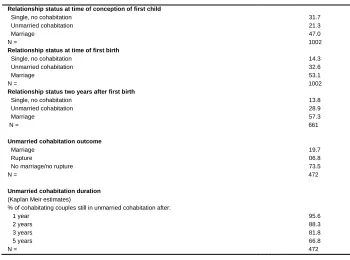
To further explore the link between first birth, cohabitation, marriage, and the nature of unmarried cohabitation, Table 2 presents the marital status of the relationship at time of conception, first childbirth, and two years after the birth of a first child where relevant, as well as the outcomes of cohabitating unions and the duration of such unions.
Table 2: Relationship status at conception, childbirth, and two years after the birth of the first child, and unmarried cohabitation outcome and duration
Relationship status at time of conception of first child
Single, no cohabitation 31.7
Unmarried cohabitation 21.3
Marriage 47.0
N = 1002
Relationship status at time of first birth
Single, no cohabitation 14.3
Unmarried cohabitation 32.6
Marriage 53.1
N = 1002
Relationship status two years after first birth
Single, no cohabitation 13.8
Unmarried cohabitation 28.9
Marriage 57.3
N = 661
Unmarried cohabitation outcome
Marriage 19.7
Rupture 06.8
No marriage/no rupture 73.5
N = 472
Unmarried cohabitation duration
(Kaplan Meir estimates)
% of cohabitating couples still in unmarried cohabitation after:
1 year 95.6
2 years 88.3
3 years 81.8
5 years 66.8
N = 472
2 Cross-sectional logistic analysis among relationships that led to a union, modeling the effect of the
Table 2 also shows that the majority of first children were conceived outside formal marriage in Ouagadougou. In fact, at the time of conception the majority of future parents are either single (32%) or living in unmarried cohabitation (21%). By the time of birth, however, most unmarried conceptions have been legitimized by a wedding or have led to an unmarried cohabitation, and most first-time parents live in either marital (53%) or non-marital (33%) unions. Importantly, Table 2 confirms that unmarried pregnancy encourages cohabitation more than marriage does. In fact, 20% of first children conceived to unmarried non-cohabitating parents were born within marriage, and 39% of them within an unmarried cohabitating union. The process of legitimization continues after birth. Interestingly, while only a few parents are still single and not cohabitating two years after the birth of their first child (14%), a non-negligible proportion (29%) are still cohabitating without any marital ceremony having been performed at that time. Overall, a long spell of unmarried cohabitation is not unusual among youth in Ouagadougou today. As can be seen in Table 2, at the time of the survey only 20% of all unmarried cohabitations had been formalized by a wedding, 7% had ended in a rupture, and 73% were still on-going cohabitating unions. To examine the duration of cohabitation we estimated the survival function of unmarried cohabitating unions using Kaplan Meier estimates. As can be seen in Table 2, a year after the onset of cohabitation a very large majority of unmarried cohabitating unions (96%) had still not resulted in a marriage or a rupture. While the proportion of unmarried cohabitations declines over time, our data suggest that the transition from unmarried cohabitation to marriage is slow. In fact, five years after the beginning of the union, 67% of cohabiting youth were still living together in a consensual union.
5. Discussion
evidence (Calvès, Kobiané, and Martel 2007; Rossier, Sawadogo, and Soubeïga 2013), the analysis further shows that children’s exposure to cohabitation is relatively high in Ouagadougou: births to cohabitating parents represent more than a third of all first births and childrearing within non-marital unions is also common. In fact, the unexpectedly positive and strong effect of the conception of a child on the transition to unmarried cohabitation in the competing risks model confirms that the social pressure to give birth within marriage has declined and that cohabitation is becoming an essential feature of the childbearing and childrearing context in the city.
female employment appear to provide incentives for young working women in Ouagadougou to postpone marriage or settling down in a cohabiting union.
Overall, the study thus suggests that while male and female economic characteristics are important determinants of the timing of entry into a first union (regardless of the marital status of the union), ideational changes and cultural factors rather than economic ones motivate youth to choose cohabitation instead of marriage. Dating couples who are willing and able to distance themselves from familial expectations and marital norms are indeed less likely to marry and more likely to cohabit. Thus, the study shows that, net of school enrollment, educational attainment, especially male partner’s level of education, favors cohabitation while it discourages marriage. The results also provide support for the idea that young people in Burkina Faso may sometimes use cohabitation to impose a priori ‘unsuitable’ marriage candidates upon their families (Attané 2007; Maïga and Baya 2014). In fact, respecting marital norms regarding ethnic endogamy strongly favors marriage, but has no significant effect on cohabitation. Consistent with previous findings (Calvès and Meekers 1999; Gage-Brandon 1993; Legrand and Younouissi 2009) and with the emphasis on premarital chastity among Muslims, the results also show that Muslim couples clearly favor marriage over cohabitation when forming a first union.
6. Acknowledgements
References
Adjamagbo, A., Antoine, P., Béguy, D., Dial, F.B. (2006). Comment les femmes concilient-elles mariage et travail à Lomé et à Dakar? Paris: DIAL.
Agadjanian, V. and Dommaraju, P. (2011). Culture, modernization, and politics: Ethnic differences in union formation in Kyrgyzstan. European Journal of Population/Revue européenne de Démographie 27(1): 79–101.
Antoine, P., Djiré, M. and Laplante, B. (1995). Les Déterminants socioéconomiques de la sortie du célibat à Dakar. Population 50(1): 95–117. doi:10.2307/1533794. Antoine, P. and Dial, F. B. (2005). Mariage, divorce et remariage à Dakar et Lomé. In:
Vignikin, K. and Vimard, P. (eds.). Familles au Nord, Familles au Sud. Louvain-la-Neuve: Academia-Bruylant: 205–232.
Antoine, P., Razafindrakoto, M., and Roubaud, F. (2001). Contraints de rester jeunes? Évolution de l'insertion dans trois capitales africaines: Dakar, Yaoundé, Antananarivo. Autrepart 18: 17–36. doi:10.3917/autr.018.0017.
Attané, A. (2007). Choix matrimoniaux: le poids des générations. L’exemple du Burkina Faso. In: Antoine, P. (éd.). Les relations intergénérationnelles en Afrique: approche plurielle. Nogent-sur-Marne: CEPED: 167–195.
Badini, A. (1994). Naître et grandir chez les Moosé traditionnels. Paris: SEPIA-A.D.D. Bardem, I. and Gobatto, I. (1995). Maux d’amour, vies de femmes: sexualité et
prévention du sida en milieu urbain africain (Ouagadougou). Paris: L’Harmathan.
Bertho, B. (2012). Trajectoires et revendications féminines dans le règlement des différends conjugaux autour de deux études de cas en milieu Mossi (Burkina Faso). Autrepart (2): 99–115. doi:10.3917/autr.061.0099.
Bledsoe, C.H. and Cohen, B. (1993). Social Dynamics of Adolescent Fertility in Sub-Saharan African Washington, D.C. National Academy Press.
Bocquier, P. and Khasakhala, A. (2009). Factors influencing union formation in Nairobi, Kenya. Journal of biosocial science 41(4): 433–455.
doi:10.1017/S0021932009003319.
Calvès, A. E. (2002). Abortion risk and abortion decision making among youth in urban Cameroon. Studies in Family Planning 33(3): 249–260.
doi:10.1111/j.1728-4465.2002.00249.x.
Calvès, A. E. (2007). Too Poor to Marry? Urban Employment Crisis and Men’s First Entry into Union in Burkina Faso. Population (62): 293–311.
doi:10.3917/pope.702.0293.
Calvès, A.E. and Meekers, D. (1999). The advantages of having many children for women in formal and informal unions in Cameroon. Journal of Comparative Family Studies 30(4): 617–639.
Calvès, A.E. and Schoumaker, B. (2004). Crise économique et évolution de l’emploi des jeunes citadins au Burkina Faso. African Population Studies 19(1): 35–58. Calvès, A.E., Kobiané, J.F., and Martel, E. (2007). Changing transition to adulthood in
urban Burkina-Faso. Journal of comparative family studies 38(2): 265–283.
Calvès, A.E. and Gnoumou Thiombiano, B.(2014). Quand les jeunes célibataires se mettent en couple: scolarisation féminine et choix des partenaires à Ouagadougou. In: Marcoux, R. and Antoine, P. (eds.). Le mariage en Afrique. Pluralité des formes et des modèles matrimoniaux. Québec: Presses de l'Université du Québec: 266–287.
Capron, J. and Kohler, J.M. (1978). De quelques caractéristiques de la pratique matrimoniale mossi contemporaine. In: Oppong C., Abada G., Bekombo-Priso M., and Mogley J. (eds.). Marriage, fertility and parenthood in West Africa. Canberra: The Australian National University: 187–223.
Carle, J. and Bonnet, D. (2009). Identité et question des origines dans l’abandon d’enfants au Burkina Faso. Anthropologie et sociétés 33(1): 141–155.
doi:10.7202/037817ar.
Cavin, A.C. (1999). Droit de la famille burkinabé: le code et ses pratiques à Ouagadougou. Paris: L’Harmattan.
Chigiti, J. (2012). The controversial Come-We-Stay Marriages [electronic resource]. Nairobi: The Star. http://allafrica.com/stories/201211150189.html.
Clarkberg, M. (1999). The price of partnering: The role of economic well-being in young adults’ first union experiences. Social Forces 77(3): 945–968.
Clark, S., Kabiru, C. and Mathur, R. (2010). Relationship Transitions Among Youth in Urban Kenya. Journal of Marriage and Family 72 (1): 73–88.
doi:10.1111/j.1741-3737.2009.00684.x.
Cleves, M., Gould, W., and Guttierez, R. (2010). An Introduction to Survival Analysis Using Stata. Second Edition. Texas: Stata Press.
Cole, J. and Thomas, L.M. (2009). Love in Africa. Chicago: University of Chicago Press. doi:10.7208/chicago/9780226113555.001.0001.
Cooper, E. (2012). Women and Inheritance in Sub‐Saharan Africa: What Can Change? Development Policy Review 30(5): 641–657. doi:10.1111/j.1467-7679.2012. 00592.x.
Cox, D.R. (1972). Regression models and life-tables (with discussion). Journal of the American Statistical Association (Series B): 187–222.
Dijkman, H. and Van Dijk, M.P. (1993). Female entrepreneurs in the informal sector of Ouagadougou. Development Policy Review 11(3): 273–88.
doi:10.1111/j.1467-7679.1993.tb00042.x.
Fine, J.P. and Gray, R.J. (1999). A proportional hazards model for the subdistribution of a competing risk. Journal of the American Statistical Association 94: 496– 509. doi:10.1080/01621459.1999.10474144.
Gage-Brandon, A. (1993). The formation and stability of informal unions in Côte d'Ivoire. Journal of Comparative Family Studies 24(2): 219–233.
Gabrielli, G. and Hoem, J.M. (2010). Italy’s non-negligible cohabitational unions. European Journal of Population/Revue européenne de Démographie 26(1): 33– 46.
Garcia, M. and Fares, J. (2008). Transitions to Working Life for Africa’s Youth. In: Garcia M. and Fares, J. (eds.). Youth in Africa’s Labor Market. Washington D.C.: World Bank:15–26. doi:10.1596/978-0-8213-6884-8_ch2.
Herrera, J. and Torelli, C. (2013). Domestic Work and Employment in Africa: What Is the Trade-Off for Women? In: De Vreyer, P. and Roubaud, F. (eds.). Urban Labor Markets in Sub-Saharan Africa. Washington D.C.: World Bank: 221–249.
doi:10.1596/9780821397817_ch07.
Hoem, J.M. and Kostova, D. (2008). Early traces of the Second Demographic Transition in Bulgaria: A joint analysis of marital and non-marital union formation, 1960–2004. Population Studies 62(3): 259–271. doi:10.1080/00
324720802313256.
Isiugo-Abanihe, U.C., Ebigbola, A.J., and Adewuyi, A.A. (1993). Urban nuptiality patterns and marital fertility in Nigeria. Journal of Biosocial Science 25: 483– 498. doi:10.1017/S0021932000021866.
Jacquemin, M. (2009). « Petites nièces» et «petites bonnes» à Abidjan. Travail, genre et
sociétés (2): 53–74.
Kalmijn, M. (2011). The influence of men’s income and employment on marriage and cohabitation: Testing Oppenheimer’s theory in Europe. European Journal of Population/Revue européenne de Démographie 27(3): 269–293.
Kobiané, J.-F., Kaboré, I., Gnoumou Thiombiano, B. (2012). Étude qualitative sur genre et décisions économiques au Burkina Faso. Ouagadougou: ISSP.
Kolev, A. and Sirven, N. (2010). Gender disparities in Africa’s labor market: a cross-country comparison using standardized survey data. In: Saba Abache, J., Kolev, A., and Filipiak, E. (eds.). Gender disparities in Africa’s labor market. Washington DC: World Bank: 23–54.
Kravdal, Ø. (1999). Does marriage require a stronger economic underpinning than informal cohabitation? Population Studies 53(1): 63–80. doi:10.1080/0032472
0308067.
Lallemand, S. (1977). Une famille mossi Paris. C.N.R.S.
Laurent, P.-J. (2013). Système de mariages et terminologie de parenté chez les Mossi (Burkina Faso). Contribution à l’approche de la terminologie omaha. L’Homme 2(206): 59–87.
Le Bourdais, C., Mongeau, J., and Neill, G. (2001). Effet de la précarité économique sur la formation d’une première union au Canada. Cahiers Québécois de Démographie 30(1): 3–28. doi:10.7202/010297ar.
Legrand, T.K. and Younoussi, Z. (2009). Consensual Unions in Burkina Faso: Trends and Determinants. Canadian Studies in Population 36(3–4): 267–294.
Lewis, M.-J. and Calvès, A.-E. (2011). L’encadrement par les aînées de l’entrée en maternité des jeunes femmes à Ouagadougou: Continuités et changements. In: Leblanc M-N. and M. Gomez (eds.). L’Afrique des générations. Entre tensions et renégociations. Paris: Karthala: 645–678.
Lloyd, C.B. (2005). Growing up Global. The changing transitions to adulthood in developing countries. Washington. DC: The National Academies Press.
Longfield, K. (2004). Rich fools, spare tyres and boyfriends: partner categories, relationship dynamics and Ivorian women’s risk for STIs and HIV. Culture, Health and Sexuality 6 (6): 483–500. doi:10.1080/13691050410001701920. Luke, N. (2003). Age and economic asymmetries in the sexual relationships of
adolescent girls in Sub-Saharan Africa. Studies in Family Planning 34(2): 67– 86. doi:10.1111/j.1728-4465.2003.00067.x.
Maïga, A. and Baya, B. (2014). Au-delà des normes de formation des couples au Burkina Faso: quand les cultures s’épousent. In: Marcoux, R. and Antoine, P.
(eds.). Le mariage en Afrique. Pluralité des formes et des modèles
matrimoniaux. Québec: Presses de lUniversité du Québec: 61–82.
Manning, W.D., Longmore, M.A., and Giordano, P.C. (2007). The changing institution of marriage: Adolescents’ expectations to cohabit and to marry. Journal of Marriage and Family 69: 559–575. doi:10.1111/j.1741-3737.2007.00392.x. Manting, D. (1996). The changing meaning of cohabitation and marriage. European
sociological review 12(1): 53–65. doi:10.1093/oxfordjournals.esr.a018177. Marcoux, R. and Piché, V. (1998). Crise, pauvreté et nuptialité à Bamako (Mali). In:
Gendreau, F. (ed.). Crises, pauvreté et changements démographiques dans les pays du Sud. AUPELF-UREF: Paris: 219–236.
Marcoux, R. and Antoine, P. (2014). Le mariage en Afrique. Pluralité des formes et des modèles matrimoniaux. Québec: Presses de l’Université du Québec.
Mazzocchetti, J. (2007). De l’autorité à l’affect: transformation des paternités au sein de la jeunesse ouagalaise scolarisée (Burkina Faso). Recherches sociologiques et anthropologiques (38–2): 47–64.
Meekers, D. (1992). The Process of Marriage in African Societies: a Multiple Indicator Approach. Population and Development Review 18(1): 61–78. doi:10.2307/
1971859.
Meekers, D. (1995). Freedom of partner choice in Togo. Journal of Comparative Family Studies 26(2): 163–178.
Mensch, B., Grant, M.J., and Blanc, A. (2006). The Changing context of sexual initiation in sub-Saharan Africa. Population Development Review 32(4): 699– 727. doi:10.1111/j.1728-4457.2006.00147.x.
Mokomane, Z. (2005a). A demographic and socio-economic portrait of cohabitation in Botswana. Societies in Transition 36 (1): 57–73. doi:10.1080/21528586.2005.
10419128.
Mokomane, Z. (2005b). Formation of cohabiting unions in Botswana: A qualitative study. Journal of Contemporary African Studies 23(2): 193–214. doi:10.1080/
02589000500176081.
Mureithi, F. (2013). Marriage Bill Set for the House today [electronic resource]. Nairobi: The Star. http://www.the-star.co.ke/article/marriage-bill-set-house-today#sthash.RqRd2f2r.dpbs.
Nazio, T. and Blossfeld, H.P. (2003). The diffusion of cohabitation among young women in West Germany, East Germany and Italy. European Journal of Population/Revue européenne de démographie 19(1): 47–82.
Oppenheimer, V.K. (1988). A theory of marriage timing. American Journal of Sociology: 563–591. doi:10.1086/229030.
Oppenheimer, V.K. (2000). The continuing importance of men’s economic position in marriage formation. In: Waite, L., Bachrach, C., Hindin, M., Thomson, E. and Thornton, A. (eds.). Ties that bind: Perspectives on marriage and cohabitation Hawthorne. Aldine de Gruyter: 283–301.
Oppenheimer, V.K. (2003). Cohabiting and marriage during young men’s career development process. Demography 40(1): 127–149. doi:10.1353/dem.2003. 0006.
Pintilie, M. (2011). An Introduction to Competing Risks Analysis. Revista Española de Cardiología (English Edition) 64(7): 599–605. doi:10.1016/j.recesp.2011.03. 017.
Posel, D., Rudwick, S., and Casale, D. (2011). Is marriage a dying institution in South Africa? Exploring changes in marriage in the context of ilobolo payments. Agenda 25(1): 102–111.
Poulin, M. (2007). Sex, money, and premarital partnerships in southern Malawi. Social Science and Medicine 65: 2383–2393. doi:10.1016/j.socscimed.2007.05.030. Rossier, C. (2007). Attitudes towards abortion and contraception in rural and urban
Burkina Faso. Demographic Research 17(2): 23–58. doi:10.4054/DemRes.2007. 17.2.
Rossier, C., Sawadogo, N., and Soubeiga, A. (2013). Sexualités prénuptiales, rapports de genre et grossesses non prévues à Ouagadougou. Population 68(1): 97–122.
doi:10.3917/popu.1301.0097.
Roth, C. (2010). Les relations intergénérationnelles sous pression au Burkina Faso. Autrepart 53(1): 95–110. doi:10.3917/autr.053.0095.
Schröder, C. (2006). Cohabitation in Italy: Do parents matter? Genus: 53–85.
Spronk, R. (2005). Female sexuality in Nairobi: Flawed or favoured? Culture, health and sexuality 7(3): 267–277. doi:10.1080/13691050410001731107.
Tabutin, D. and Schoumaker, B. (2004). La démographie de l’Afrique au sud du Sahara des années 1950 aux années 2000. Synthèse des changements et bilan statistique. Population 59 (3–4): 521–621. doi:10.2307/3654994.
Tambenkongho, E. (2010). Douala, 80 Marriages celebrated with display [electronic resource]. Yaoundé: Cameroon Tribune. https://www.cameroon- tribune.cm/index.php?option=com_content&view=article&id=62556:douala-80-marriages-celebrated-with-display&catid=4:societe&Itemid=3.
Thiriat, M.P. (1999). Les unions libres en Afrique subsaharienne. Cahiers Québécois de Démographie 28 (1–2): 81–115. doi:10.7202/010260ar.
Thomson, E. and Bernhardt, E. (2010). Education, values, and cohabitation in Sweden. Marriage & Family Review 46(1–2): 1–21. doi:10.1080/01494921003648431. Thornton, A., Axinn, W.G., and Hill, D.H. (1992). Reciprocal effects of religiosity,
cohabitation, and marriage. American Journal of Sociology: 628–651.
Traoré, S. (2005). Mariage et célibat à Ouagadougou. Paris: L’Harmattan.
Van de Kaa, D.J. (1987). Europe’s Second Demographic Transition. Population Bulletin 42 (1): 1–57.
Vinel, V. (2005). Des femmes et des lignages: ethnologie des relations féminines au Burkina Faso (Moose, Sikoomse). Paris: L’Harmattan.