VOLUME 38, ARTICLE 26, PAGES 691
,
726
PUBLISHED 22 FEBRUARY 2018
http://www.demographic-research.org/Volumes/Vol38/26/ DOI: 10.4054/DemRes.2018.38.26
Research Article
Not a zero-sum game: Migration and child
well-being in contemporary China
Duoduo Xu
Xiaogang Wu
Zhuoni Zhang
Jaap Dronkers
© 2018 Duoduo Xu, Xiaogang Wu, Zhuoni Zhang & Jaap Dronkers.
This open-access work is published under the terms of the Creative Commons Attribution 3.0 Germany (CC BY 3.0 DE), which permits use, reproduction, and distribution in any medium, provided the original author(s) and source are given credit.
1 Introduction 692
2 Analytical framework and research hypotheses 694
2.1 Impact of parental migration: Hypothesis 1 696
2.2 Impact of child migration: Hypothesis 2 697
2.3 Impact of hukou conversion: Hypothesis 3 698
2.4 Comparing the two migration strategies: Hypothesis 4 699
3 Data, variables, and methods 700
3.1 Data 700
3.2 Variables 701
3.3 Methods 704
4 Results 705
4.1 Matching 705
4.2 Causal impacts of migration processes on child development 708 4.2.1 Does being left behind in the countryside hurt children’s
well-being?
708 4.2.2 Does moving to cities benefit rural-to-urban migrant children? 709
4.2.3 Does local hukou pay off? 709
4.2.4 To go or not to go? 710
5 Conclusion and discussion 711
6 Acknowledgements 713
References 714
Not a zero-sum game:
Migration and child well-being in contemporary China
Duoduo Xu1
Xiaogang Wu2 Zhuoni Zhang3
Jaap Dronkers4
Abstract
BACKGROUND
The complex impact of migration on children’s development has received extensive attention in both developed and developing countries. In China, more than 100 million children are directly affected by the massive internal migration.
OBJECTIVE
This study investigates the impact of different migration processes (parental migration, child migration, andhukou conversion) on Chinese children’s developmental outcomes, measured by their cognitive abilities, school engagement, school attachment, physical and mental health, educational aspirations, and confidence about the future.
METHODS
We analyze the data from a nationally representative, school-based survey covering approximately 20,000 children aged 12 to 16 in both rural and urban areas. We employ the propensity score matching method to ensure different groups of children are intrinsically comparable to each other.
RESULTS
Migration both brings benefits and imposes costs on children. Bringing rural children to cities significantly improves their school performance and physical health but also reduces their educational aspirations and increases their anxiety toward the future.
1 Division of Social Science, Institute for Advanced Study, Hong Kong University of Science and
Technology, Hong Kong SAR, China. Email:[email protected].
2 Division of Social Science, Center for Applied Social and Economic Research (CASER), Hong Kong
University of Science and Technology, Hong Kong SAR, China.
3 Department of Applied Social Sciences, City University of Hong Kong, Hong Kong SAR, China.
4 Research Center for Education and the Labour Market, Maastricht University, The Netherlands. Deceased
Leaving children behind in the countryside, while sparing them from potential social exclusion in cities, results in a negative impact on their physical and mental health. Gaining local urban hukou status improves rural-origin children’s academic achievements but has no effect on the other well-being indicators.
CONCLUSIONS
These results reveal that the current migration processes and China’s hukou system have generated both opportunities and challenges for the children involved.
CONTRIBUTION
The conceptual framework set out in this paper enables researchers to obtain a more comprehensive picture of migration’s impact on children’s well-being rather than looking at small fragments of the larger story.
1. Introduction
Globally, population migration has reached an unprecedented scale during the past few decades. The number of international migrant children exceeded 31 million in 2015, with that of internal migrant children several times larger (UNICEF 2016). In many developing countries in Asia, a disproportionate number of children are left behind by migrant parents (Graham and Jordan 2011; Jordan and Graham 2012). The impact of migration on child well-being has thus received considerable attention from academics and policy-makers alike, covering a range of outcomes, such as education, health, psychological feelings, attitudes, and behaviors.
children with them (hereafter ‘child migration’), keeps the family intact but exposes the children to a new community with the possibility of social exclusion and discrimination (Lu and Zhou 2013; Xiong 2015; Xu and Wu 2016). These migrant children can be subdivided into two groups depending on whether or not they have obtained local citizenship (hereafter ‘citizenship conversion’). For example, international migrant children comprise those who have been documented with official entry permits to be eligible for various forms of welfare and insurance and the undocumented entitled to few (Donato and Armenta 2011; Massey 1987). In sum, parental migration, child migration, and citizenship conversion are different but interrelated processes that lead to different implications and outcomes for children.
The large-scale, rural-to-urban internal migration in China is a living laboratory that enables comparison of the effects of parental migration, child migration, and citizenship conversion. First, the well-being of Chinese children affected by migration has recently come under the national spotlight. Since the 1990s, hundreds of millions of parents have moved from rural to urban areas for better work opportunities and life prospects, either leaving their children behind in the villages or taking their children with them to the cities. According to the 2010 population census, more than 61 million children were reportedly left behind in the countryside by migrant parents, half of which were left behind by both parents, and around 36 million rural migrant children had moved to live in cities (ACWF 2013). Second, due to the current household registration (hukou) system, rural-to-urban migrants can be reclassified as permanent and temporary migrants, analogous to the documented and undocumented migrants in the literature (Chan and Buckingham 2008; Solinger 1999). Hukou conversion, or obtaining a local hukou in a Chinese city, is intrinsically equivalent to obtaining legal citizenship in a western context. While it is difficult to compare international migrants to their counterparts in countries of origin, internal rural-to-urban migration in China provides an ideal opportunity for studying the impacts of migration.
In this paper, we develop a comprehensive analytical framework to examine the effects of parental migration, child migration, and hukou conversion on child well-being in China using a nationally representative, school-based survey on junior high school students in both rural and urban areas (China Education Panel Survey, CEPS). The targets of our analysis are children born in rural areas (hereafter ‘rural-origin children’); they are thus at risk of rural-to-urban migration problems. Recent evidence has pointed to the many complicated and multi-faceted impacts of migration on child outcomes (Xu and Xie 2015). This study examines a broad range of indicators of child well-being, including school performance, physical and mental health, and future aspirations.5 We used a propensity score matching method to ensure the comparability
5 Future aspirations refer to educational aspirations and confidence about the future in this paper. Studies have
of observed characteristics of different groups of rural-origin children. The findings are related to the broader literature on migration, as the migration processes examined herein are common in other social contexts. Policy implications will be discussed in relation to the results of the study.
2. Analytical framework and research hypotheses
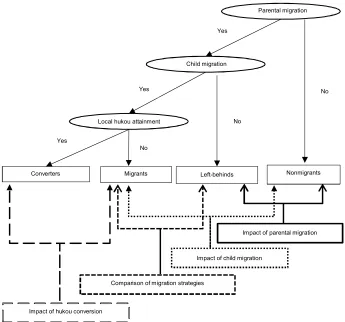
Figure 1 summarizes the sequential migration processes and the classification of rural-origin children in China. Based on parental migration, child migration, and hukou conversion, the rural-origin children are classified into four subgroups: (1) nonmigrants, namely children living in the countryside with their parents; (2) left-behinds, namely children living in the countryside whose parents have migrated; (3) migrants, namely children living in cities with nonlocal hukou; and (4) hukou converters, namely children living in cities who have successfully obtained local hukou.
As illustrated in Figure 1, a comparison between left-behind children and nonmigrant children who both live in rural areas reveals the potential impact of parental migration; a comparison between migrant children in cities and nonmigrant children in the countryside demonstrates the impact of child migration; and a comparison between hukou converters in cities who currently hold a local urban hukou and migrant children who do not show the impact of obtaining a local hukou. Moreover, this study further compares migrant children with left-behind children to evaluate the relative benefits (or costs) of the two migration strategies, i.e., bringing children along to cities vs. leaving them behind in the countryside. Figure 1 shows that rural-to-urban migration in China is complicated and consists of several processes, and it is necessary to differentiate such processes to gain a more comprehensive understanding of migration consequences.
Figure 1: Migration processes and typology of rural-origin children
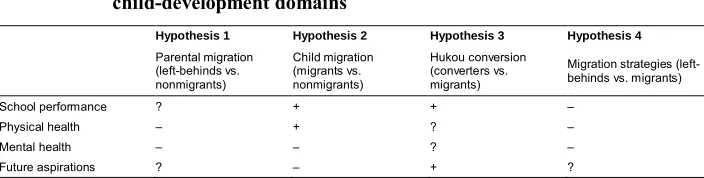
Table 1 demonstrates the hypothetical benefits and costs of the three migration processes for children’s school performance, physical health, mental health, and future aspirations.6 A comparison of migration strategies, i.e., whether to take the children or
leave them behind, is also presented in the table. Plus signs indicate the positive
6 Although we present the conceptual framework as if children’s developmental outcomes were independent
of each other, it is seldom the case in reality. For example, poor physical and mental health can impede school performance, and better academic achievement can reinforce high educational aspirations. However, following the principle of parsimony, we do not consider these inter-correlations among child outcomes in this paper.
Parental migration
Child migration
Nonmigrants Yes
No
Left-behinds Yes
No Local hukou attainment
Migrants Converters
No Yes
Impact of child migration
Impact of hukou conversion
Impact of parental migration
impacts, and minus signs indicate the negative impacts. We introduce the hypotheses below.
Table 1: Hypothetical benefits and costs of the migration process on selected child-development domains
Hypothesis 1 Hypothesis 2 Hypothesis 3 Hypothesis 4
Parental migration (left-behinds vs. nonmigrants)
Child migration (migrants vs. nonmigrants)
Hukou conversion (converters vs. migrants)
Migration strategies (left-behinds vs. migrants)
School performance ? + + –
Physical health – + ? –
Mental health – – ? –
Future aspirations ? – + ?
2.1 Impact of parental migration: Hypothesis 1
The impact of parental migration is examined by comparing left-behind children with nonmigrant children in the countryside. The two groups are comparable as both live in rural areas, except that the former experience parent-child separation.
The enormous number of left-behind children in rural areas of China has led to widespread concern among the public about their livelihood and psychological states. Some studies have found that parent-child separation renders left-behind children more vulnerable, resulting in lower educational achievements (Hu 2012; Lu 2012; Zhao et al. 2014), poorer physical health and health-related behavior (Gao et al. 2010; Li, Liu, and Zang 2015; Smeekens et al. 2012; Wen and Lin 2012), and psychological and developmental problems (Graham and Jordan 2011; Jia and Tian 2010; Liu, Li, and Ge 2009; Wu, Lu, and Kang 2015). Other studies, however, provide mixed opinions about its overall impact (Chen et al. 2009; Jordan and Graham 2012; Ren and Treiman 2016; Wen et al. 2015; Xu and Xie 2015). These inconsistent findings may be due to different measurements, data, and comparison strategies.
lead to poorer performance at school, but the remittances that migrant parents send back home can provide left-behind children with more material and financial resources to improve their human capital (Hu 2012; Mu and Brauw 2015; Tang 2017). Similarly, the impact of parental migration on children’s future aspirations may also be mixed. Improvements in families’ financial situations will allow children to pursue further education and more promising futures; but parental absence may negatively affect children’s educational aspirations (Park 2008) and self-efficacy (Gao et al. 2013), and parents’ migration may encourage children to migrate in search of employment themselves, reducing their motivation to stay in school (Kandel and Kao 2001). Therefore, we expect parental migration to have disruptive effects on left-behind children’s physical and mental health, but we do not propose hypotheses about school performance and future aspirations.
Hypothesis 1: Compared to nonmigrant children, left-behind children in rural areas are disadvantaged in terms of physical and mental health.
2.2 Impact of child migration: Hypothesis 2
The impact of child migration is examined by comparing migrant children in cities with nonmigrant children in rural areas. Children in both groups live together with their parent(s) and only differ in terms of where they live.
The rural-urban divide in China has encouraged many migrant parents to bring their children with them to urban areas, where educational resources and health care facilities are superior to those available in their home villages. Xu and Xie (2015) found that rural-to-urban migration benefit migrant children in life domains such as cognitive abilities and physical health. Recent studies from western European countries also suggest that the educational attainment of low-class migrants is higher than that of their counterparts in their hometowns (Zuccotti et al. 2017).
second-class citizens may also create feelings of relative deprivation, reducing their subjective wellbeing (Tian 2017). A study has shown that Chinese migrants adopt an urban frame of reference, resulting in a higher level of perceived deprivation and a lower level of happiness as compared to both urban and rural nonmigrants (Jin 2016). Second, as has been often suggested, the migration process per se causes its own unique stress (Stevens and Vollebergh 2008). Migration is almost always accompanied by the loss of support from family and friends and exposure to familiar customs and surroundings, and the pressure to adapt to new environments. Migrant children thus suffer from extensive psychological distress and may exhibit greater anxiety in terms of their prospects (Chen, Wang, and Wang 2009; Lu and Zhou 2013; Xiong 2015). For instance, Xiong (2015) demonstrated that in Shanghai, most migrant children give up their educational aspirations after realizing their chances of upward mobility are severely limited.
In sum, better educational resources and health care facilities in destination cities should theoretically benefit migrant children, but institutional segregation and discrimination, and the migration experience per se, could generate an extra psychological burden for migrant children and dash their hopes for the future. Thus, we expect:
Hypothesis 2: Compared to nonmigrant children in rural areas, rural-to-urban migrant children in cities are advantaged in terms of school performance and physical health but disadvantaged in terms of mental health and future aspirations.
2.3 Impact of hukou conversion: Hypothesis 3
The impact of hukou conversion is examined by comparing hukou converters with rural-to-urban migrant children in cities. The two groups both moved from rural to urban areas, but only the hukou converters have successfully obtained an urban local hukou.
A distinct feature of China’s internal migration is that the hukou system implicitly acts as an invisible barrier hindering the assimilation process of migrants (Chan and Buckingham 2008; Chan and Zhang 1999; Jordan, Ren, and Falkingham 2014; Xu and Wu 2016). For example, entrance examinations of senior high schools and colleges must be taken in the locality of the hukou registration rather than the locality of residence, which means that migrant children must return to their hometowns if they wish to pursue further studies.
Liberation Army) or when cities expand and their villages are absorbed into urban areas (Wu and Zheng 2017; Zhang and Treiman 2013). These hukou converters, with urban local hukou statuses, are thus qualified for various forms of welfare and support entitled to local citizens, while the rural-to-urban migrants without local hukou still experience social exclusion and discrimination. The impacts of hukou conversion on rural-origin children’s well-being have seldom been empirically examined. One exception, Liang and Chen (2007), found that permanent migrant children with a local hukou have higher school enrollment rates than temporary migrant children without a local hukou.
Given hukou’s crucial role in access to educational resources, we expect rural-origin children who are able to obtain a local urban hukou status to perform better at school and to have higher future aspirations than those who are unable to convert their hukou statuses. However, regardless of legal citizenships, both hukou converters and migrant children share similar experiences of leaving familiar surroundings and moving into unfamiliar ones and are thus subject to the stresses and strains associated with migration. In addition, since access to medical resources is less dependent on hukou status in many cities, we expect insignificant differences in physical health between these two groups of children. Therefore, we do not propose any hypotheses about the difference in physical and mental health between the two groups of children.
Hypothesis 3: Compared to rural-to-urban migrant children without a local hukou, hukou converters are advantaged in terms of school performance and future aspirations.
2.4 Comparing the two migration strategies: Hypothesis 4
Over the past decades, millions of migrant parents in China have faced the difficult decision of whether to take their children with them or to leave them behind. The serious rural-urban inequalities in resource distribution provide motivation for migrant parents to bring their children to cities for better education and health care, but the hukou system and associated social exclusions in cities have created substantial institutional barriers against the adaption and assimilation of migrant families, and forced the majority to leave their children behind in the countryside (Chan and Buckingham 2008; Chan and Zhang 1999; Jordan et al. 2014; Xu and Wu 2016).
indicator of development, it is not sufficient to gain a comprehensive understanding of the relative costs and benefits of the two migration strategies. This study compares the two common migration strategies by examining a range of child outcomes to determine which strategy offers more benefits for rural children. We expect that left-behind children in rural areas are disadvantaged in terms of objective indicators, such as school performance and physical health, due to the huge rural/urban gap in resource allocation in schools and medical units. Both left-behinds and migrants are likely to suffer from psychological distress, yet we expect the former to be more vulnerable because parent-child separation plays a crucial role in determining parent-children’s mental health (Rutter 1971). The future aspirations of left-behind children may be low due to the lack of parental guidance. The same may be said about migrant children, but in their case it is due to institutional/social exclusions in cities. We do not propose a hypothesis about future aspirations, as it is difficult to anticipate which group is more pessimistic given the different challenges they faced.
Hypothesis 4: Compared to rural-to-urban migrants in cities, left-behind children in rural areas are disadvantaged in terms of school performance and physical/mental health.
3. Data, variables, and methods
3.1 Data
2015), this group tends to be positively selected in our sample. This limitation will be explained in more detail later in this paper.
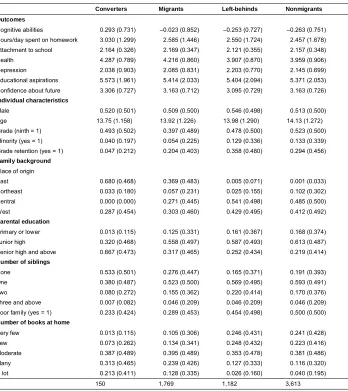
As mentioned above, our analytic sample consists of four groups of rural-origin children: rural-to-urban migrants, hukou converters, left-behinds, and nonmigrants. We define rural-to-urban migrant children (N = 1,769) as those who currently live in urban areas while holding a nonlocal rural hukou (excluding those moving across district boundaries within a city); we define hukou converters (N = 150) as those born with nonlocal rural hukou but currently hold a local urban hukou. Both left-behind children (N = 1,182) and nonmigrant children (N = 3,613) are local rural hukou holders in rural areas, but left-behind children have one or both absent parent(s) who are engaged in nonfarm work.7,8 Any other children who do not fall into any of these four categories
are excluded from our sample.
3.2 Variables
Considering the complex and interrelated influences of migration on children’s well-being, we analyze a variety of child developmental outcomes. School performance is known to be one of the most important aspects of a child’s development. We developed three related measures for this outcome. First, cognitive abilities are measured by standardized scores used in a fifteen-minute in-class assessment of students’ learned reasoning abilities in three areas most strongly linked to academic success in school: verbal, numerical, and graphical. Second, school engagement is measured by the number of hours that students spend on homework in an average day (including weekdays and weekends). Third, school attachment is measured by scores derived from a twelve-item scale used in the survey asking about students’ feelings and experiences of school life. We measure physical health based on a five-point Likert scale of students’ self-rated health status and measure mental health using a standard five-item depression scale, which is widely used by other scholars. We also adopt two additional measures to capture the influence of migration on rural children’s future aspirations:
7 The survey does not ask the specific reason for parental absence nor their current place of residence, so we
can only use the occupations of absent parents (i.e., nonfarm worker) as an alternative measure for parental migration.
8 We also try to adopt a stricter definition of left-behinds by reclassifying children with only one migrant
their educational aspirations and perceived confidence about the future.9 Both are
treated as continuous variables.
We also consider a number of sociodemographic characteristics as control variables. Individual characteristics include four dummy variables: students’ gender (male = 1), grade level (ninth grade = 1), ethnicity (minority = 1), and prior achievement (repeated a grade at least once during primary school = 1). In addition, age is coded into five categories (12, 13, 14, 15, and 16). The model also includes several variables on family background. Place of origin is coded into four categories (east, northeast, central, and west). Parental education refers to the highest level of education attained by either parent, and it is coded into three categories (primary or lower, junior high, and senior high or above). Number of siblings is coded into four categories (0, 1, 2, and 3 or above). Family economic status before primary school is a dummy variable (poor = 1). Family cultural capital is measured by the number of books at home, which was an ordinal variable (very few, few, moderate, many, and a lot).
Table 2 illustrates the descriptive statistics on the aforementioned variables by migration status. As shown in the table, hukou converters outperform the other three groups of rural-origin children on most of the well-being domains, particularly cognitive abilities. However, their family backgrounds are also significantly better than those of other groups, so it is not clear whether or not hukou conversion has a net advantage, after controlling for other factors. Apart from this highly selected group, rural migrant children appear to be better off than their counterparts back home, particularly in terms of school performance and physical health. There seems to be no systematic differences between left-behind children and nonmigrant children in rural areas in terms of either their outcomes or family backgrounds. Nevertheless, we note that left-behind children have the worst physical and mental health among all four groups of children.
9 For educational aspirations, students are asked to indicate the highest level of education that they hope to
Table 2: Descriptive statistics on selected variables by migration status
Converters Migrants Left-behinds Nonmigrants
Outcomes
Cognitive abilities 0.293 (0.731) –0.023 (0.852) –0.253 (0.727) –0.263 (0.751) Hours/day spent on homework 3.030 (1.299) 2.585 (1.446) 2.550 (1.724) 2.457 (1.678) Attachment to school 2.164 (0.326) 2.169 (0.347) 2.121 (0.355) 2.157 (0.348) Health 4.287 (0.789) 4.216 (0.860) 3.907 (0.870) 3.959 (0.906) Depression 2.038 (0.903) 2.085 (0.831) 2.203 (0.770) 2.145 (0.699) Educational aspirations 5.573 (1.961) 5.414 (2.033) 5.404 (2.094) 5.371 (2.053) Confidence about future 3.306 (0.727) 3.163 (0.712) 3.095 (0.729) 3.163 (0.726)
Individual characteristics
Male 0.520 (0.501) 0.509 (0.500) 0.546 (0.498) 0.513 (0.500) Age 13.75 (1.158) 13.92 (1.226) 13.98 (1.290) 14.13 (1.272) Grade (ninth = 1) 0.493 (0.502) 0.397 (0.489) 0.478 (0.500) 0.523 (0.500) Minority (yes = 1) 0.040 (0.197) 0.054 (0.225) 0.129 (0.336) 0.133 (0.339) Grade retention (yes = 1) 0.047 (0.212) 0.204 (0.403) 0.358 (0.480) 0.294 (0.456)
Family background
Place of origin
East 0.680 (0.468) 0.369 (0.483) 0.005 (0.071) 0.001 (0.033) Northeast 0.033 (0.180) 0.057 (0.231) 0.025 (0.155) 0.102 (0.302) Central 0.000 (0.000) 0.271 (0.445) 0.541 (0.498) 0.485 (0.500) West 0.287 (0.454) 0.303 (0.460) 0.429 (0.495) 0.412 (0.492)
Parental education
Primary or lower 0.013 (0.115) 0.125 (0.331) 0.161 (0.367) 0.168 (0.374) Junior high 0.320 (0.468) 0.558 (0.497) 0.587 (0.493) 0.613 (0.487) Senior high and above 0.667 (0.473) 0.317 (0.465) 0.252 (0.434) 0.219 (0.414)
Number of siblings
None 0.533 (0.501) 0.276 (0.447) 0.165 (0.371) 0.191 (0.393) One 0.380 (0.487) 0.523 (0.500) 0.569 (0.495) 0.593 (0.491) Two 0.080 (0.272) 0.155 (0.362) 0.220 (0.414) 0.170 (0.376) Three and above 0.007 (0.082) 0.046 (0.209) 0.046 (0.209) 0.046 (0.209) Poor family (yes = 1) 0.233 (0.424) 0.289 (0.453) 0.454 (0.498) 0.500 (0.500)
Number of books at home
Very few 0.013 (0.115) 0.105 (0.306) 0.246 (0.431) 0.241 (0.428) Few 0.073 (0.262) 0.134 (0.341) 0.248 (0.432) 0.223 (0.416) Moderate 0.387 (0.489) 0.395 (0.489) 0.353 (0.478) 0.381 (0.486) Many 0.313 (0.465) 0.239 (0.426) 0.127 (0.333) 0.116 (0.320) A lot 0.213 (0.411) 0.128 (0.335) 0.026 (0.160) 0.040 (0.195)
N 150 1,769 1,182 3,613
3.3 Methods
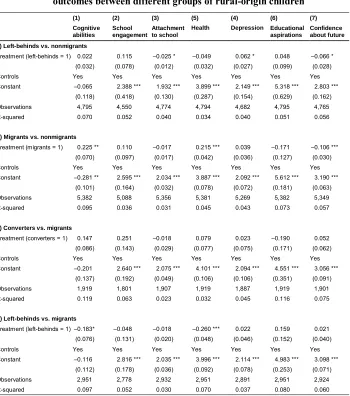
Any migration decision is selective in essence (Borjas 1987). The four study groups of rural-origin children are not directly comparable, as their developmental outcomes can be simultaneously affected by migration statuses and other demographics or family characteristics. For instance, rural families with better economic resources or social capital are often more likely to overcome institutional obstacles and are able to send their children to higher-quality urban schools. Therefore, it is not clear whether the better educational outcomes of migrant children are due to migration per se or due to family resources. Reverse causality could also be a problem, considering that some migrant parents may have strategically chosen to bring smarter (or healthier) children with them to cities for better educational opportunities and leave the not-so-smart (or not-so-healthy) behind to reduce costs. To address these endogeneity concerns, scholars can take either the instrumental variable approach (Hu 2012; Zhao et al. 2014) or the propensity score matching approach (Chen et al. 2009; Xu and Xie 2015). In this study, we use the latter. We also conduct naïve OLS regression analyses, and the results are reported in the Appendix (Table A-1).
All of the individual and family characteristics mentioned in the previous subsection are incorporated into the propensity score matching analyses as matching covariates. After estimating the propensity scores, we match the treatment group and the control group. We specifically choose the optimal (full) matching method over other matching methods, as it has two desirable features.
First, most matching algorithms involve a series of small iterative decisions made one at a time without reconsidering earlier decisions (Rosenbaum 2002). This process makes the final results sensitive to researchers’ arbitrary decisions and the order in which treated subjects are matched. By applying network flow theory, this issue can be avoided in optimal matching by taking into account the overall set of matches when choosing individual matches. Specifically, optimal matching aims to develop matched sets in ways that the matching can optimize or minimize the total distance of propensity scores (Guo and Fraser 2014). For optimal full matching, each treated case is matched to one or more control, and similarly each control case is matched to one or more treated subjects.
subjects falling outside the range of the common support region or use a trimming strategy to discard sparse subjects with extreme propensity scores.
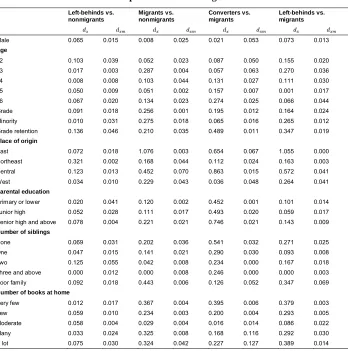
To evaluate the effectiveness of such matching methods, Haviland, Nagin, and Rosenbaum (2007) suggest that the level of bias reduction can be calculated by comparing the absolute standardized differences in covariate means before and after optimal matching. The imbalance on covariate X is measured by before matching and by after matching. The specific formulas are presented in the Appendix.
4. Results
4.1 Matching
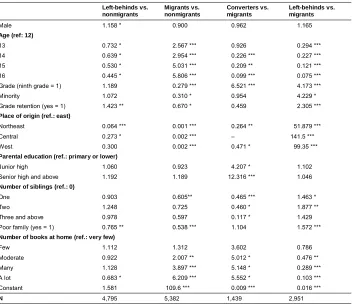
First, we compare left-behind children with nonmigrant children to examine the effects of parental migration (with left-behind children being the treatment group). We then compare migrant children with nonmigrant children to examine the effects of child migration (with migrant children being the treatment group). Next, we compare hukou converters with other rural-migrant children without a local hukou to examine the benefits of hukou conversion (with hukou converters being the treatment group). Finally, we compare left-behind children with migrant children to examine the consequences of leaving children behind (with left-behind children being the treatment group).
migration.10 Children with siblings are more likely to be left behind, probably because
older siblings can look after younger ones. A family’s financial situation is also an essential factor. Poor families tend to leave their children at home, as they cannot afford the extra costs of bringing them to cities.
Table 3: Logistic regression models predicting propensity scores
Note: Coefficients are odds ratios; robust standard errors adjusted for the clustering effect on schools are not reported; *** p<0.001, ** p<0.01, * p<0.05.
10 However, we do observe a significant positive effect of parental educational attainment on hukou
conversion. This is consistent with the common wisdom that tertiary education is probably one of the most important pathways for obtaining a local urban hukou.
Left-behinds vs. nonmigrants
Migrants vs. nonmigrants
Converters vs. migrants
Left-behinds vs. migrants
Male 1.158 * 0.900 0.962 1.165
Age (ref: 12)
13 0.732 * 2.567 *** 0.926 0.294 ***
14 0.639 * 2.954 *** 0.226 *** 0.227 ***
15 0.530 * 5.031 *** 0.209 ** 0.121 ***
16 0.445 * 5.806 *** 0.099 *** 0.075 ***
Grade (ninth grade = 1) 1.189 0.279 *** 6.521 *** 4.173 ***
Minority 1.072 0.310 * 0.954 4.229 *
Grade retention (yes = 1) 1.423 ** 0.670 * 0.459 2.305 ***
Place of origin (ref.: east)
Northeast 0.064 *** 0.001 *** 0.264 ** 51.879 ***
Central 0.273 * 0.002 *** – 141.5 ***
West 0.300 0.002 *** 0.471 * 99.35 ***
Parental education (ref.: primary or lower)
Junior high 1.060 0.923 4.207 * 1.102
Senior high and above 1.192 1.189 12.316 *** 1.046
Number of siblings (ref.: 0)
One 0.903 0.605** 0.465 *** 1.463 *
Two 1.248 0.725 0.460 * 1.877 **
Three and above 0.978 0.597 0.117 * 1.429
Poor family (yes = 1) 0.765 ** 0.538 *** 1.104 1.572 ***
Number of books at home (ref.: very few)
Few 1.112 1.312 3.602 0.786
Moderate 0.922 2.007 ** 5.012 * 0.476 **
Many 1.128 3.897 *** 5.148 * 0.289 ***
A lot 0.683 * 6.209 *** 5.552 * 0.103 ***
Constant 1.581 109.6 *** 0.009 *** 0.016 ***
As Table 4 shows, the covariate imbalances are greatly reduced for almost all of the variables, suggesting that optimal full matching worked reasonably well and efficiently balanced the treated and control samples. Taking the poor family indicator in the comparison between left-behinds and migrants as an example, the treatment and control groups differ in this variable by more than 34% of a standard deviation before matching, whereas the standard bias is reduced to only 6.9% after full matching. Table 4: Covariate imbalance check between treatment and control groups,
before and after optimal full matching
Left-behinds vs. nonmigrants
Migrants vs. nonmigrants
Converters vs. migrants
Left-behinds vs. migrants
Male 0.065 0.015 0.008 0.025 0.021 0.053 0.073 0.013
Age
12 0.103 0.039 0.052 0.023 0.087 0.050 0.155 0.020
13 0.017 0.003 0.287 0.004 0.057 0.063 0.270 0.036
14 0.008 0.008 0.103 0.044 0.131 0.027 0.111 0.030
15 0.050 0.009 0.051 0.002 0.157 0.007 0.001 0.017
16 0.067 0.020 0.134 0.023 0.274 0.025 0.066 0.044
Grade 0.091 0.018 0.256 0.001 0.195 0.012 0.164 0.024
Minority 0.010 0.031 0.275 0.018 0.065 0.016 0.265 0.012 Grade retention 0.136 0.046 0.210 0.035 0.489 0.011 0.347 0.019
Place of origin
East 0.072 0.018 1.076 0.003 0.654 0.067 1.055 0.000
Northeast 0.321 0.002 0.168 0.044 0.112 0.024 0.163 0.003
Central 0.123 0.013 0.452 0.070 0.863 0.015 0.572 0.041
West 0.034 0.010 0.229 0.043 0.036 0.048 0.264 0.041
Parental education
Primary or lower 0.020 0.041 0.120 0.002 0.452 0.001 0.101 0.014 Junior high 0.052 0.028 0.111 0.017 0.493 0.020 0.059 0.017 Senior high and above 0.078 0.004 0.221 0.021 0.746 0.021 0.143 0.009
Number of siblings
None 0.069 0.031 0.202 0.036 0.541 0.032 0.271 0.025
One 0.047 0.015 0.141 0.021 0.290 0.030 0.093 0.008
Two 0.125 0.055 0.042 0.008 0.234 0.000 0.167 0.018
Three and above 0.000 0.012 0.000 0.008 0.246 0.000 0.000 0.003 Poor family 0.092 0.018 0.443 0.006 0.126 0.052 0.347 0.069
Number of books at home
Very few 0.012 0.017 0.367 0.004 0.395 0.006 0.379 0.003
Few 0.059 0.010 0.234 0.003 0.200 0.004 0.293 0.005
Moderate 0.058 0.004 0.029 0.004 0.016 0.014 0.086 0.022
Many 0.033 0.024 0.325 0.008 0.168 0.116 0.292 0.030
A lot 0.075 0.030 0.324 0.042 0.227 0.127 0.389 0.014
4.2 Causal impacts of migration processes on child development
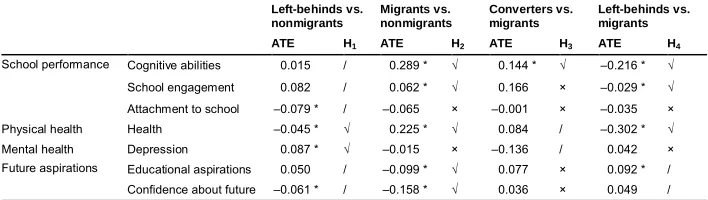
When X is the outcome variable of interest, is recognized as the average treatment effect (ATE) after optimal matching. The significance of the ATE is revealed by performing the Hodges-Lehmann aligned rank test (Lehmann and D’Abrera 2006). Table 5 summarizes the estimated treatment effects on child developmental outcomes after optimal full matching.
Table 5: Estimated treatment effects on various outcomes after optimal full matching
Left-behinds vs. nonmigrants
Migrants vs. nonmigrants
Converters vs. migrants
Left-behinds vs. migrants
ATE H1 ATE H2 ATE H3 ATE H4
School performance Cognitive abilities 0.015 / 0.289 * √ 0.144 * √ –0.216 * √
School engagement 0.082 / 0.062 * √ 0.166 × –0.029 * √ Attachment to school –0.079 * / –0.065 × –0.001 × –0.035 × Physical health Health –0.045 * √ 0.225 * √ 0.084 / –0.302 * √ Mental health Depression 0.087 * √ –0.015 × –0.136 / 0.042 × Future aspirations Educational aspirations 0.050 / –0.099 * √ 0.077 × 0.092 * /
Confidence about future –0.061 * / –0.158 * √ 0.036 × 0.049 /
Note: * p<0.05, the P-values are derived from the Hodges-Lehmann aligned rank tests (one-tailed). ATEs are standardized mean differences between the treatment group and the control group after matching. √ denotes empirical results support previous research hypotheses (as listed in Table 1), × denotes empirical results failed to support previous research hypotheses, and / denotes that our research hypotheses do not predict specific signs for the results.
4.2.1 Does being left behind in the countryside hurt children’s well-being?
With regard to the effects of parental migration on the well-being of those left behind, previous literature argues for both negative effects resulting from parent-child separation (Gao et al 2010; Wu et al. 2015) and positive effects resulting from remittances (Hu 2012; Mu and Brauw 2015). However, based on our empirical evidence, money cannot fully compensate for parental affection.
These results suggest that even if remittances could benefit rural children, they cannot compensate for the adverse effects of family separation. Among left-behind children, the level of depression is significantly higher by 8.7% of a standard deviation and the physical health is also worse by 4.5% of a standard deviation, which support Hypothesis 1. Interestingly, even though left-behind children are not directly exposed to migration experience themselves, they also show lower confidence about the future like migrant children, albeit to a less extent (by about 6% of a standard deviation).
4.2.2 Does moving to cities benefit rural-to-urban migrant children?
As shown in Table 5 as as expected, moving from the countryside to cities generates certain beneficial outcomes for rural children. Their cognitive ability test scores were higher than those of nonmigrants by close to 29% of a standard deviation; their time spent on homework is longer by 6.2% of a standard deviation; and their health is better by more than 22% of a standard deviation.
However, these benefits come with a price. Being treated as outsiders and inferior, migrant children in cities often face major challenges in local school systems, such as admission discrimination (Goodburn 2009; Wu and Zhang 2015), counter-school culture (Xiong 2015), and loneliness (Lu and Zhou 2013). A study examining the same dataset (Xu and Wu 2016) showed that hukou-based school segregation has driven migrant children to substandard schools and exposed them to various negative peer influences. The results further confirm that these factors could have adverse impacts on migrant children’s future aspirations once they realize they have fewer opportunities for upward mobility. Their educational aspirations are lower than those of nonmigrants by approximately 10% of a standard deviation, and their confidence about the future is lower by about 16% of a standard deviation. These findings are in line with Hypothesis 2. Most people migrate for better life chances, yet ironically they may end up even more worried about their future because migrants face extreme social and institutional exclusion in cities.
4.2.3 Does local hukou pay off?
future aspirations for the former group because those children face far fewer institutional obstacles in cities. However, the propensity score matching results in Table 5 show that, except for some advantages (14.4% of a standard deviation) in terms of cognitive abilities for hukou converters (arguably due to their greater chances of getting into high-quality, local public schools), these two groups do not differ significantly in most well-being measures (although the signs of the effects are in line with our prediction). In other words, Hypothesis 3 is only partly supported.
The relatively small sample size is a limitation, but the other plausible explanation is that these converters are a fairly heterogeneous group, consisting of both children with very successful parents and those originating from ordinary rural families who were simply fortunate enough to obtain a local urban hukou through village incorporation (Wu and Zheng 2017). Whatever the explanation is for the few differences between hukou converters and nonconverters, the implication is that the formal acquisition of a local urban hukou can only partially compensate for the problems associated with migrating from rural to urban areas in China.
4.2.4 To go or not to go?
Millions of Chinese migrant parents face the dilemma of whether to bring their children with them to cities or to leave them behind in the countryside. Which of the two migration strategies would benefit their children more? The results in Table 5 reveal that it is not a simple zero-sum game for rural families. Using rural-origin migrant children as the comparison group, those who are left behind show significant and nontrivial disadvantages in terms of school performance. They score approximately 22% of a standard deviation lower in cognitive ability tests and spend close to 3% of a standard deviation less effort on homework. These findings are not surprising, considering that the education resources and quality of schools in cities are much better than those in rural areas. Similarly, we also observed a sizable gap in physical health between left-behind children and migrant children by more than 30% of a standard deviation. Better health care facilities in cities and more care and supervision from parents could both contribute to migrant children’s superior health conditions. These findings largely lend support to our Hypothesis 4.
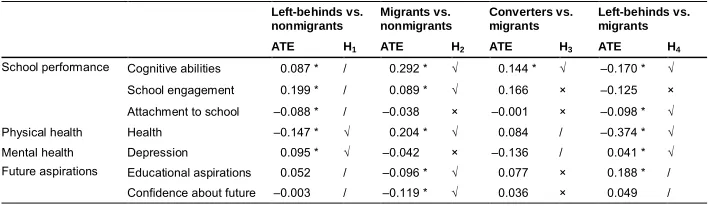
with both parents absent, they are much more depressed and much less attached to schools (refer to Table A-2).
5. Conclusion and discussion
An important argument for migrating is that it will bring better prospects for one’s children. However, whether children actually benefit from this migration experience remains debatable. China’s internal migration is ideal for studying this issue because other factors often related to migration such as ethnicity, language, and cultural differences are to a large extent irrelevant. With one-sixth of its population on the move and two-fifths of its children being directly affected, China’s internal migration is continually shaping the country’s future in a quiet but irreversible manner. The well-being and life prospects of these rural-origin children have become important public issues for scholars and policy-makers.
Based on a nationally representative survey of Chinese junior high students in both rural and urban areas, we develop a comprehensive analytical framework to investigate the impacts of migration. Specifically, we identify three different migration processes: parental migration, child migration, and hukou conversion. We then classify four groups of rural-origin children accordingly: hukou converters and migrants who live in cities and left-behinds and nonmigrants who live in the countryside. Results after propensity score matching demonstrate that both benefits and costs are involved in the migration process.
converters. By successfully converting their hukou statuses, this group of rural-origin migrant children does not face institutional discrimination when entering high-quality, local schools, resulting in better academic achievement. In fact, we would even expect significantly higher enrollment rates for hukou converters than for other rural migrants.
As pointed out earlier, a major limitation of the CEPS dataset is that only officially enrolled children were sampled in this school-based survey. As informed by other research using census data (Liang and Chen 2007; Wu and Zhang 2015), the dropout rate is significantly higher for migrant children than left-behind children. Using a recent school-based survey in Shanghai (the Program for International Student Assessment, PISA), Xu and Dronkers (2016) suggest that hukou regulations in school admission lead to a positively selected migrant children group in urban schools. In other words, the outperformance of migrant children (especially those who have acquired local hukou) in urban schools could at least partially be attributed to positive selection. In addition, propensity score matching cannot adjust for selection on unobservables. We thus replicate our analysis using the Heckman treatment effect model as it has proven to be robust against hidden bias (Guo and Fraser 2014, Chapter 8).11 Results from the
treatment effect analysis are consistent with our main findings, except that hukou converters have significantly worse physical health and lower educational aspirations than other migrant children. We suspect that hukou converters are likely to be positively selected on unobservable characteristics, and matching results regarding this group should be interpreted with caution. We also acknowledge that, despite our desire to provide a comprehensive examination of migration’s impact on children’s well-being, many other interesting questions remain unanswered in this paper either due to data constraint or space limitation. For instance, how does the length and timing of children’s or parents’ migration affect the outcomes? What is the difference between the impacts of mother’s migration and father’s migration? Do boys and girls respond differently to the influence of migration? We therefore call for more detailed data to be collected and more in-depth research to be performed on this topic. The conceptual framework proposed here serves as a foundation for further studies.
To conclude, although leaving their children behind appears to be a less wise choice for migrant parents, there are also many uncertainties and risks pertaining to the migration process and various institutional barriers posed by the hukou system in destination cities. Obtaining a local urban hukou may promote rural-origin children’s assimilation into local societies by offering them better educational opportunities, but it does not shield them from the other negative side-effects of the migration experience.
11 Researchers typically conduct Rosenbaum’s sensitivity analysis (Rosenbaum 2002, Chapter 4) after
The migration process poses both opportunities and challenges for rural families, and trade-offs are inevitable in the various migration decisions. There are no simple answers to the complicated questions involved. Hence, in the assessment of the positive and negative effects of migration on rural children’s well-being, any overgeneralized conclusions should be avoided.
6. Acknowledgements
References
ACWF (2013). Woguo nongcun liushou ertong, chengxiang liudong ertong zhuangkuang yanjiu baogao [Research report on the situation of rural left-behind China, rural-urban migration children in China] [electronic resource]. Beijing: All-China Women’s Federation.
http://acwf.people.com.cn/n/2013/0510/c99013-21437965.html.
Borjas, G.J. (1987). Self-selection and the earnings of immigrants. The American Economic Review 77(4): 531–553.doi:10.2307/1814529.
Chan, K.W. and Buckingham, W. (2008). Is China abolishing the hukou system? The China Quarterly 195: 582–606.
Chan, K.W. and Zhang, L. (1999). The hukou system and rural-urban migration in China: Processes and changes.The China Quarterly 160: 818–855.doi:10.1017/
S0305741000001351.
Chen, X., Huang, Q., Rozelle, S., Shi, Y., and Zhang, L. (2009). Effect of migration on children’s educational performance in rural China. Comparative Economic Studies 51(3): 323.doi:10.1057/ces.2008.44.
Chen, X., Wang, L., and Wang, Z. (2009). Shyness-sensitivity and social, school, and psychological adjustment in rural migrant and urban children in China. Child Development 80(5): 1499–1513.doi:10.1111/j.1467-8624.2009.01347.x. Donato, K.M. and Armenta, A. (2011). What we know about unauthorized migration.
Annual Review of Sociology 37: 529–543.
doi:10.1146/annurev-soc-081309-150216.
Feliciano, C. (2005). Educational selectivity in U.S. immigration: How do immigrants compare to those left behind? Demography 42(1): 131–152. doi:10.1353/dem.
2005.0001.
Gao, Y., Li, L., Chan, E.Y.Y., Lau, J., and Griffiths, S.M. (2013). Parental migration, self-efficacy and cigarette smoking among rural adolescents in south China.
PLoS ONE 8(3): e57569.doi:10.1371/journal.pone.0057569.
Gao, Y., Li, L., Kim, J.H., Congdon, N., Lau, J., and Griffiths, S. (2010). The impact of parental migration on health status and health behaviours among left behind adolescent school children in China. BMC Public Health 10: 56. doi:10.1186/
Goodburn, C. (2009). Learning from migrant education: A case study of the schooling of rural migrant children in Beijing. International Journal of Educational Development 29(5): 495–504.doi:10.1016/j.ijedudev.2009.04.005.
Graham, E. and Jordan, L.P. (2011). Migrant parents and the psychological well-being of left-behind children in southeast Asia.Journal of Marriage and Family 73(4): 763–787.doi:10.1111/j.1741-3737.2011.00844.x.
Guo, S. and Fraser, M.W. (2014). Propensity score analysis: Statistical methods and applications. Thousand Oaks: Sage.
Haviland, A., Nagin, D.D., and Rosenbaum, P.R. (2007). Combining propensity score matching and group-based trajectory analysis in an observational study.
Psychological Methods 12(3): 247–267.doi:10.1037/1082-989X.12.3.247. Heckman, J.J., Ichimura, H., and Todd, P.E. (1997). Matching as an econometric
evaluation estimator: Evidence from evaluating a job training programme.
Review of Economic Studies 64(4): 605–654.doi:10.2307/2971733.
Hu, F. (2012). Migration, remittances, and children’s high school attendance: The case of rural China. International Journal of Educational Development 32(3): 401–
411.doi:10.1016/j.ijedudev.2011.08.001.
Jia, Z. and Tian, W. (2010). Loneliness of left-behind children: A cross-sectional survey in a sample of rural China. Child: Care, Health and Development 36(6): 812–
817.doi:10.1111/j.1365-2214.2010.01110.x.
Jin, L. (2016). Migration, relative deprivation, and psychological well-being in China.
American Behavioral Scientist 60(5–6): 750–770. doi:10.1177/00027642166
32826.
Jordan, L.P., Ren, Q., and Falkingham, J. (2014). Youth education and learning in 21th
-century China: Disentangling the impacts of migration, residence, and hukou.
Chinese Sociological Review 47(1): 57–83.
Jordan, P. and Graham, E. (2012). Resilience and well-being among children of migrant parents in south-east Asia. Child Development 83(5): 1672–1688.doi:10.1111/
j.1467-8624.2012.01810.x.
Kandel, W. and Kao, G. (2001). The impact of temporary labor migration on Mexican children’s educational aspirations and performance. International Migration Review 35(4): 1205–1231.doi:10.1111/j.1747-7379.2001.tb00058.x.
Li, Q., Liu, G., and Zang, W. (2015). The health of left-behind children in rural China.
China Economic Review 36: 367–376.doi:10.1016/j.chieco.2015.04.004. Liang, Z. and Chen, Y.P. (2007). The educational consequences of migration for
children in China. Social Science Research 36(1): 28–47. doi:10.1016/j.ssresea
rch.2005.09.003.
Liang, Z., Guo, L., and Duan, C. (2008). Migration and the well-being of children in China.The Yale-China Health Journal 5: 25–46.
Liu, Z., Li, X., and Ge, X. (2009). Left too early: The effects of age at separation from parents on Chinese rural children’s symptoms of anxiety and depression. The American Journal of Public Health 99(11): 2049. doi:10.2105/AJPH.2008.
150474.
Lu, Y. (2012). Education of children left behind in rural China. Journal of Marriage and Family 74(2): 328–341.doi:10.1111/j.1741-3737.2011.00951.x.
Lu, Y. and Zhou, H. (2013). Academic achievement and loneliness of migrant children in China: School segregation and segmented assimilation. Comparative Education Review 57(1): 85.doi:10.1086/667790.
Massey, D.S. (1987). Do undocumented migrants earn lower wages than legal immigrants? New evidence from Mexico.International Migration Review 21(2): 236–274.doi:10.2307/2546315.
Mu, R. and Brauw, A. (2015). Migration and young child nutrition: Evidence from rural China. Journal of Population Economics 28(3): 631–657.
doi:10.1007/s00148-015-0550-3.
Park, H. (2008). Effects of single parenthood on educational aspiration and student disengagement in Korea.Demographic Research 18(13): 377–408.doi:10.4054/
DemRes.2008.18.13.
Portes, A. and Zhou, M. (1993). The new second generation: Segmented assimilation and its variants. The Annals of the American Academy of Political and Social Science 530: 74–96.doi:10.1177/0002716293530001006.
Ren, Q. and Treiman, D.J. (2016). The consequences of parental labor migration in China for children’s emotional wellbeing. Social Science Research 58: 46–67.
doi:10.1016/j.ssresearch.2016.03.003.
Rosenbaum, P.R. (2002).Observational studies. New York: Springer.
Rutter, M. (1971). Parent-child separation: Psychological effects on the children.
Journal of Child Psychology and Psychiatry 12(4): 233–260. doi:10.1111/
j.1469-7610.1971.tb01086.x.
Smeekens, C., Stroebe, M.S., and Abakoumkin, G. (2012). The impact of migratory separation from parents on the health of adolescents in the Philippines. Social Science and Medicine 75(12): 2250–2257. doi:10.1016/j.socscimed.2012.08.
025.
Solinger, D.J. (1999). Citizenship issues in China’s internal migration: Comparisons with Germany and Japan.Political Science Quarterly 114(3): 455–478.doi:10.2
307/2658206.
South, S.J., Haynie, D.L., and Bose, S. (2007). Student mobility and school dropout.
Social Science Research 36(1): 68–94.doi:10.1016/j.ssresearch.2005.10.001. Stevens, G.W.J.M. and Vollebergh, W.A.M. (2008). Mental health in migrant children.
Journal of Child Psychology and Psychiatry 49(3): 276–294. doi:10.1111/
j.1469-7610.2007.01848.x.
Tang, Z. (2017). What makes a difference to children’s health in rural China? Parental migration, remittances, and social support. Chinese Sociological Review 49(2): 89–109.doi:10.1080/21620555.2016.1230469.
Tian, X. (2017). Immediate context, life experiences, and perception: How do rural migrants in urban China perceive an unfair policy?Chinese Sociological Review
49(2): 138–161.doi:10.1080/21620555.2016.1214820.
UNICEF (2016). Uprooted: The growing crisis for refugee and migrant children [electronic resource]. New York: United Nations Children’s Fund.
https://www.unicef.org/publications/files/Uprooted_growing_crisis_for_refugee
_and_migrant_children.pdf.
Wen, M. and Lin, D. (2012). Child development in rural China: Children left behind by their migrant parents and children of nonmigrant families. Child Development
83(1): 120–136.doi:10.1111/j.1467-8624.2011.01698.x.
Wen, M., Su, S., Li, X., and Lin, D. (2015). Positive youth development in rural China: The role of parental migration. Social Science and Medicine 132: 261–269.
doi:10.1016/j.socscimed.2014.07.051.
Wu, X. and Treiman, D.J. (2004). The household registration system and social stratification in China: 1955–1996. Demography 41(2): 363–384. doi:10.1353/
dem.2004.0010.
Wu, X. and Zhang, Z. (2015). Population migration and children’s school enrollments in China, 1990–2005. Social Science Research 53: 177–190. doi:10.1016/
j.ssresearch.2015.05.007.
Wu, X. and Zheng, B. (2017). Household registration, urban status attainment, and social stratification in contemporary urban China. Research in Social Stratification and Mobility 53: 40–49.doi:10.1016/j.rssm.2017.11.002.
Xiang, B. (2007). How far are the left-behind left behind? A preliminary study in rural China.Population, Space and Place 13(3): 179–191.doi:10.1002/psp.437. Xiong, Y. (2015). The broken ladder: Why education provides no upward mobility for
migrant children in China. The China Quarterly 221: 161–184. doi:10.1017/
S0305741015000016.
Xu, D. and Dronkers, J. (2016). Migrant children in Shanghai: A research note on the PISA–Shanghai controversy. Chinese Sociological Review 48(3): 271–295.
doi:10.1080/21620555.2016.1165605.
Xu, D. and Wu, X. (2017). The rise of the second generation: Aspirations, motivations and academic success of Chinese immigrants’ children in Hong Kong. Journal of Ethnic and Migration Studies 43(7): 1164–1189. doi:10.1080/1369183X.
2016.1245132.
Xu, H. and Xie, Y. (2015). The causal effects of rural-to-urban migration on Children’s well-being in China. European Sociological Review 31(4): 502–519. doi:10.10
93/esr/jcv009.
Zhang, Z. (2014). Contingent transition to triumph: Socioeconomic attainments of Chinese immigrants’ children in Hong Kong. Chinese Sociological Review
46(4): 68–88.doi:10.2753/CSA2162-0555460404.
Zhang, Z. and Treiman, D.J. (2013). Social origins, hukou conversion, and the wellbeing of urban residents in contemporary China. Social Science Research
42(1): 71–89.doi:10.1016/j.ssresearch.2012.08.004.
Zhou, M. (1997). Growing up American: The challenge confronting immigrant children and children of immigrants.Annual Review of Sociology 23: 63–95.doi:10.1146/
annurev.soc.23.1.63.
Zuccotti, C.V., Ganzeboom, H.B.G., and Guveli, A. (2017). Has migration been beneficial for migrants and their children? International Migration Review
Appendix
The formulae for calculating and are
= −
( + ) 2⁄
= | |
( )⁄ ,
Table A-1: Naïve OLS regression models predicting differences in various outcomes between different groups of rural-origin children
(1) (2) (3) (5) (4) (6) (7)
Cognitive abilities
School engagement
Attachment to school
Health Depression Educational aspirations
Confidence about future
a) Left-behinds vs. nonmigrants
Treatment (left-behinds = 1) 0.022 0.115 –0.025 * –0.049 0.062 * 0.048 –0.066 * (0.032) (0.078) (0.012) (0.032) (0.027) (0.099) (0.028)
Controls Yes Yes Yes Yes Yes Yes Yes
Constant –0.065 2.388 *** 1.932 *** 3.899 *** 2.149 *** 5.318 *** 2.803 *** (0.118) (0.418) (0.130) (0.287) (0.154) (0.629) (0.162)
Observations 4,795 4,550 4,774 4,794 4,682 4,795 4,765
R-squared 0.070 0.052 0.040 0.034 0.040 0.051 0.056
b) Migrants vs. nonmigrants
Treatment (migrants = 1) 0.225 ** 0.110 –0.017 0.215 *** 0.039 –0.171 –0.106 *** (0.070) (0.097) (0.017) (0.042) (0.036) (0.127) (0.030)
Controls Yes Yes Yes Yes Yes Yes Yes
Constant –0.281 ** 2.595 *** 2.034 *** 3.887 *** 2.092 *** 5.612 *** 3.190 *** (0.101) (0.164) (0.032) (0.078) (0.072) (0.181) (0.063)
Observations 5,382 5,088 5,356 5,381 5,269 5,382 5,349
R-squared 0.095 0.036 0.031 0.045 0.043 0.073 0.057
c) Converters vs. migrants
Treatment (converters = 1) 0.147 0.251 –0.018 0.079 0.023 –0.190 0.052 (0.086) (0.143) (0.029) (0.077) (0.075) (0.171) (0.062)
Controls Yes Yes Yes Yes Yes Yes Yes
Constant –0.201 2.640 *** 2.075 *** 4.101 *** 2.094 *** 4.551 *** 3.056 *** (0.137) (0.192) (0.049) (0.106) (0.106) (0.351) (0.091)
Observations 1,919 1,801 1,907 1,919 1,887 1,919 1,901
R-squared 0.119 0.063 0.023 0.032 0.045 0.116 0.075
d) Left-behinds vs. migrants
Treatment (left-behinds = 1) –0.183* –0.048 –0.018 –0.260 *** 0.022 0.159 0.021 (0.076) (0.131) (0.020) (0.048) (0.046) (0.152) (0.040)
Controls Yes Yes Yes Yes Yes Yes Yes
Constant –0.116 2.816 *** 2.035 *** 3.996 *** 2.114 *** 4.983 *** 3.098 *** (0.112) (0.178) (0.036) (0.092) (0.078) (0.253) (0.071)
Observations 2,951 2,778 2,932 2,951 2,891 2,951 2,924
R-squared 0.097 0.052 0.030 0.070 0.037 0.080 0.060
Table A-2: Estimated treatment effects on various outcomes after optimal full matching (alternative classification of left-behinds)
Left-behinds vs. nonmigrants
Migrants vs. nonmigrants
Converters vs. migrants
Left-behinds vs. migrants
ATE H1 ATE H2 ATE H3 ATE H4
School performance Cognitive abilities 0.087 * / 0.292 * √ 0.144 * √ –0.170 * √
School engagement 0.199 * / 0.089 * √ 0.166 × –0.125 × Attachment to school –0.088 * / –0.038 × –0.001 × –0.098 * √ Physical health Health –0.147 * √ 0.204 * √ 0.084 / –0.374 * √ Mental health Depression 0.095 * √ –0.042 × –0.136 / 0.041 * √ Future aspirations Educational aspirations 0.052 / –0.096 * √ 0.077 × 0.188 * /
Confidence about future –0.003 / –0.119 * √ 0.036 × 0.049 /
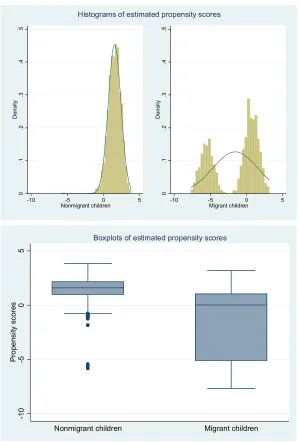
Figure A-1: Histograms and boxplots of estimated propensity scores for migrant children and nonmigrant children
0
.1
.2
.3
.4
.5
D
e
n
si
ty
-10 -5 0 5
Nonmigrant children
0
.1
.2
.3
.4
.5
D
e
n
si
ty
-10 -5 0 5
Migrant children
Histograms of estimated propensity scores
-1
0
-5
0
5
P
ro
pe
ns
ity
sc
or
es
Nonmigrant children Migrant children
Figure A-2: Histograms and boxplots of estimated propensity scores for hukou converters and migrant children
0
.1
.2
.3
.4
.5
D
e
n
si
ty
0 2 4 6 8 10
Migrant children
0
.1
.2
.3
.4
.5
D
e
n
si
ty
0 2 4 6 8 10
Hukou converters
Histograms of estimated propensity scores
0
2
4
6
8
1
0
P
ro
pe
ns
ity
sc
or
es
Migrant children Hukou converters
Figure A-3: Histograms and boxplots of estimated propensity scores for left-behind children and nonmigrant children
0
.5
1
1
.5
D
e
n
si
ty
-1 0 1 2 3
Nonmigrant children
0
.5
1
1
.5
D
e
n
si
ty
-1 0 1 2 3
Left-behind children
Histograms of estimated propensity scores
-1
0
1
2
3
P
ro
pe
ns
ity
sc
or
es
Nonmigrant children Left-behind children
Figure A-4: Histograms and boxplots of estimated propensity scores for left-behind children and migrant children
0
.2
.4
.6
D
e
n
si
ty
-5 0 5 10
Migrant children
0
.2
.4
.6
D
e
n
si
ty
-5 0 5 10
Left-behind children
Histograms of estimated propensity scores
-5
0
5
1
0
P
ro
pe
ns
ity
sc
or
es
Migrant children Left-behind children