VOLUME 38, ARTICLE 31, PAGES 855
,
878
PUBLISHED 6 MARCH 2018
http://www.demographic-research.org/Volumes/Vol38/31/ DOI: 10.4054/DemRes.2018.38.31
Research Article
Indian paradox: Rising education, declining
women’s employment
Esha Chatterjee
Sonalde Desai
Reeve Vanneman
© 2018 Esha Chatterjee, Sonalde Desai & Reeve Vanneman.
This open-access work is published under the terms of the Creative Commons Attribution 3.0 Germany (CC BY 3.0 DE), which permits use, reproduction, and distribution in any medium, provided the original author(s) and source are given credit.
1 Introduction 856
2 Literature review 858
2.1 Education 858
2.2 Other family income 859
2.3 Other factors 859
3 Why IHDS? 860
4 Hypotheses 861
5 Data and variables 862
6 Analysis 864
6.1 Descriptive statistics 864
6.2 Logistic regressions of labor force participation 866
6.3 Types of work 870
7 Discussion and conclusion 872
Indian paradox:
Rising education, declining women’s employment
Esha Chatterjee1 Sonalde Desai2 Reeve Vanneman2
Abstract
BACKGROUND
Theories of human capital would suggest that with more education, women acquire greater skills and their earnings increase, resulting in higher labor force participation. However, it has been long known that in India, women’s education has a U-shaped relationship with labor force participation. Part of the decline at moderate levels of education may be due to an income effect whereby women with more education marry into richer families that enable them to withdraw from the labor force.
OBJECTIVE
The paper uses the first comprehensive Indian income data to evaluate whether the other family income effect explains the negative relationship between moderate women’s education and their labor force participation.
METHODS
Using two waves of the India Human Development Survey, a comprehensive measure of labor force participation is regressed on educational levels for currently married women aged 25–59.
RESULTS
We find a strong other family income effect that explains some but not all of the U-shape education relationship. Further analyses suggest the importance of a lack of suitable employment opportunities for moderately educated women.
CONCLUSION
Other factors need to be identified to explain the paradoxical U-shape relationship. We suggest the importance of occupational sex segregation, which excludes moderately educated Indian women from clerical and sales jobs.
1. Introduction
The low rates of Indian women’s labor force participation have long been a magnet for academic inquiry. Most recent studies have noted the generally J-shaped or U-shaped relationship of women’s education with their labor force participation (Reddy 1979; Sathar and Desai 2000; Das and Desai 2003; Kingdon and Unni 2001; Das 2006; Klasen and Pieters 2015). As national participation rates have continued to decline over the last few decades (Abraham 2013; Chatterjee, Murgai, and Rama 2015), cohort shifts out of low levels of education to intermediate and secondary education have been blamed for much of this decline (Afridi, Dinkelman, and Mahajan 2016).
Nevertheless, the curvilinear relationship itself has received surprisingly little direct research attention. Most studies note the U-shaped relationship, but they usually fail to take the next step of trying to explain it empirically. This is especially surprising since the downward sloping part of the curve is so counter-theoretical. Neoclassical theory predicts that increases in women’s education should usually lead to a rise in women’s labor force participation rate. More education makes you more productive, so your potential earnings rise, creating a greater incentive to join the labor force and substitute employment for leisure or home labor.
India is unusual but not unique for having lower rates of labor force participation among adult women with secondary education. Among 71 countries with appropriate census data in the IPUMS-I data archive (Minnesota Population Center 2017), only 14 countries have lower rates of labor force participation for adult women with secondary education than for women who complete less than primary school. India has the second largest gap (19% vs. 35%), exceeded only by Rwanda (72% vs. 92%). But several other countries also show lower rates of labor force participation for secondary educated women (e.g., Indonesia, 47% vs. 63%; Turkey, 34% vs. 46%; and Ghana, 76% vs. 84%). So, this counter-theoretical result deserves more research attention than it has been given.
Past studies have suggested that both cultural factors, such as norms restricting the mobility of women, and structural factors, such as a lack of appropriate job opportunities for educated women, play important roles in determining the U-shaped relationship between women’s education and labor force participation in India (Das and Desai 2003; Das 2006). But these cultural and structural explanations are more often asserted than tested.
work, encouraging them to devote more time to leisure or home work. In addition, and more importantly, educated women tend to marry educated men with higher incomes, so the higher (unearned) family incomes would further discourage women’s participation in the labor market. Combined with a cultural norm that confers higher status on women at home, other family income can act as a powerful deterrent to educated women’s labor force participation. Where patriarchal norms are less dominant, the substitution effect should overshadow the income effect (Brinton, Lee, and Parish 1995). But in India, we would expect the income effect to be especially strong.
However, most past studies in India have used National Sample Survey data in which it is not possible to separate other family members’ income from a woman’s own earnings, thus making it difficult to distinguish income and substitution effects. The present study uses the India Human Development Surveys (IHDS), which measure both a woman’s own earnings and other household income, thus permitting a better separation of income and substitution effects for educated women. While the results confirm a strong negative effect of other family income on women’s labor force participation, they again find a U-shaped relationship between women’s education and her labor force participation, even after taking into account other family income. The other family income controls make the negative sloping part of the curve flatter and the positively sloping part steeper, but the relationship remains curvilinear rather than uniformly positive.
A further analysis examines the relationship between women’s education and three different categories of work: salaried positions paid monthly, casual wage work, and work in family farms or businesses. For salary work, the expected positive linear relationship is observed: the more education she has, the more likely she is to work in a salaried position. However, for women employed in their family farms and businesses, or as wage labor, the relationship is also linear but negative. The observed U-curve is a resolution of these separate linear relationships.
2. Literature review
While “economic factors largely determine male participation in employment, the factors that influence a woman’s participation in work are varied and include reproductive, demographic, social, religious and cultural factors” (Srivastava and Srivastava 2010). Of these, education and family income are especially important because of their prominent role in labor supply theory.
2.1 Education
Theories of human capital predict that an increase in skills would provide women a greater opportunity to earn higher wages, and this in turn would increase women’s labor force participation (Smith and Ward 1985; Goldin 1990; England,Garcia-Beaulieu, and Ross 2004). In most developed countries, increases in education cause an increase in women’s labor force participation (Cain 1966; Tienda, Donato, and Cordero-Guzman 1992; England, Gornick, and Shafer 2012). Interestingly, however, the story is often quite different in the low and middle-income countries. InPeru, King (1990) reported that while education was associated with a decline in women’s labor force participation, it did increase the proportion of women in paid employment. On the other hand, in Ecuador, Jakubson and Psacharopoulos (1992) find that schooling has a positive effect on women’s labor force participation, even though the effect is small. The predicted probability of labor force participation of a woman with 16 years of schooling (other traits unchanged) is 11 percentage points higher than for a woman with no schooling.
Reports from South Asia have often highlighted a generally negative relation between increased levels of education and decreases in women’s workforce participation rate, noting that illiterate women are more likely to be employed than educated women (Sathar and Desai 2000; Das and Desai 2003). Other studies with more educational detail (e.g., Reddy 1979) find a J-shaped relationship between women’s education and their labor force participation with increases only at the highest educational levels. Others (Mathur 1994; Kingdon and Unni 2001; Das 2006) find a U-shaped relationship with schooling beyond the junior/middle level enhances women’s wage work participation.
educated women. But it is difficult to test these explanations empirically with existing data.
2.2 Other family income
Increases in women’s labor force participation as education increases (as predicted by human capital theory) could be depressed somewhat due to the income effect of other family income. More educated women are likely to marry more educated men with higher incomes. If family income is high, women would have less incentive to work (Goldin 1990; England, Gornick, and Shafer 2012). Abraham (2013) argues that the rising incomes of Indian households have enabled Indian women to withdraw from the labor market and focus on their role in ‘status production.’ As with the United States at the turn of the century, one of the markers of the household having attained a middle-class status may be to ensure that women from these burgeoning middle middle-classes do not have to work (Treas 1987). Using unit level data from the National Employment Survey in urban areas of India, Klasen and Pieters (2015) have confirmed that rising levels of household income play an important role in declining rates of women’s labor force participation.
2.3 Other factors
It has always been more socially acceptable for women of lower castes (such as Adivasis, Dalits, and Other Backward Classes) to be in the labor market (Kingdon and Unni 2001). Women from the higher castes tend to face greater restrictions on their mobility.However, women from families of the middle and lower castes with improved social standing also prefer to stay at home as an effort at ‘Sanskritization’ (Srinivas 1966; Chen and Dreze 1995), an attempt to follow a more Brahminical way of life.The greater the seclusion for the woman, the greater would be the prestige for the family (Chen 1995).
Caste also has an impact on the educational opportunities women face (Dunn 1993). Thus, part of the higher rates of labor force participation among illiterate women may be a result of their lower caste status. Similarly, some of the decline in labor force participation with more education may result from the higher concentrations of higher-status Forward Castes (such as Brahmins, Kayasthas, Kshatriyas, etc.) among moderately educated women.
Consequently, women’s labor force participation has always been higher for rural then urban areas. Few women have been employed in the modern sector, where educational credentials are more important. India is one of the exceptional countries where the modern sector has experienced a fall in women’s work force participation despite women’s rising education (World Bank 1991; Swaminathan 1994).
A slow shift in the industrial structure out of agriculture (Abraham 2013) has been a leading cause of recent declines in women’s labor force participation (Mehrotra and Perida 2017). Critics of India’s Structural Adjustment Program, introduced in 1991, have argued that these policies also led to a decline in women’s employment because of declines in the unorganized sector (Mundle 1992). Others (e.g., Papola 1994), on the other hand, proposed that a newly restructured economy could favor the unorganized sector. where wages were low and working conditions poor, perhaps having a favorable impact on women’s employment. In India, the growth in the female share of employment in industries and services is behind other South and Southeast Asian countries (other than Nepal), although declines in female employment have long been theorized to follow the early stages of development (Boserup 1970). Pampel and Tanaka (1986) andMammen and Paxson (2000), for instance, observe the expected U-shaped relationship between women’s labor force participation and GDP per capita. All of these studies point to the importance of the type of jobs available as a central moderating influence on the relationship between education and women’s labor force participation.
3. Why IHDS?
household consumption levels for urban households, a result that we suspect is driven by the additional women’s income in high consumption households. In the IHDS measure, the relationship is consistently linear and negative, as theory would predict.
Klasen and Pieters (2015) measure total other household earnings in their NSS data but try to avoid problems of self-employed incomes by restricting their sample to urban areas and imputing self-employed earnings based on earnings of similar employees (“a fairly rough approximation”). The IHDS has a more direct measure of self-employed incomes and also has several additional measures of unearned income (e.g., remittances, rents, pensions). According to the two waves of IHDS, about 45% of households are engaged in own farm work and 20% have at least one nonfarm business (29% in urban areas). Moreover, 46% of households report some type of unearned income. Thus, it is difficult to measure the impact of other household income effects if these income sources are ignored.
4. Hypotheses
The present study uses the IHDS data to test the following hypotheses:
Hypothesis 1: More women’s education is associated with a decline in women’s labor force participation rate (LFPR) up to secondary education, with a slight uptick for postsecondary education.
Hypothesis 1 restates the often-observed relationship between Indian women’s labor force participation and education as U-shaped. The next hypotheses evaluate two theories that could explain the U-shaped relationship. While Hypothesis 2 evaluates the ‘income effect,’ Hypothesis 3 examines a labor market hypothesis.
Hypothesis 2a: Higher levels of other family income are associated with a decline in women’s LFPR.
Hypothesis 2b: Women with more education live in households with higher levels of other family income, and those higher income levels explain the initial declines in their labor force participation.
Hypothesis 3a: An increase in education is associated with an increase in women’s employment in salaried jobs.
Hypothesis 3b: An increase in education is associated with a decline in women’s employment in their own family farms and businesses.
Hypothesis 3c: An increase in education is associated with a decline in women’s employment in agricultural and nonagricultural wage work.
It is difficult for women with little education to get high-quality salaried jobs. With postsecondary school education better quality jobs become more accessible, so the higher returns to a better-quality job and the increase in social status associated with it lead to more employment. On the other hand, educated women would not want to work in outside jobs perceived to be below their educational level, as it lowers their social status. Therefore, employment in manual labor or even household enterprises would decline.
Hypotheses 3a to 3c explain the U-shaped relationship only when different types of work are aggregated together. While on one hand there will be a steady increase in demand for white-collar jobs among educated women, these jobs would be available only to women with the highest levels of education. Because there is a limited supply of such jobs, women with moderate levels of education are left out of the labor market.
5. Data and variables
The present study uses data from the two waves of IHDS (India Human Development Survey 2016a). IHDS1 is a nationally representative sample of 41,554 households in 2004–2005, spread across all the states and union territories of India (except for the small territories of Andaman Nicobar and Lakshadweep). The sample covers 384 districts, 1503 villages and 971 urban blocks. These 41,554 households include 215,754 individuals. In 2011–2012 a second wave reinterviewed the same households with an 83% recontact rate. The IHDS2 sample was augmented slightly to adjust for higher attrition in urban areas. The analysis sample is restricted to married women ages 25–59. Many women below 25 are still enrolled in an educational institution, and women above the age of 59 would be likely to retire.
by the head of the household or by someone who had sufficient knowledge about the income, expenditure, and employment status of household members.
Measuring women’s employment can be especially challenging because often women are involved in part-time or seasonal jobs, or they could work from home, or they may participate in the labor market only in times of a family crisis (Benería 1982; Folbre 1995; Hirway 2002; Das 2006). As noted above, the IHDS measure of workforce participation is more detailed than for other surveys. Unlike the NSS, which asks for a woman’s principal and secondary status activities, the IHDS has separate modules for different types of work (e.g., on the household farm, wage labor, in household nonfarm businesses) and asks which household members participated in each type of work during the previous year. In the present study anyone who worked for at least 240 hours in the previous year across all types of work is considered to be in the labor force. Caring for household animals, collection of firewood or other fuels, and fetching water from public sources were not included as labor force participation as these are usually regarded as normal household chores in India.
In addition to the overall measure of labor force participation, the analysis also disaggregates work participation into three types: self-employment in own farm and nonfarm businesses, salaried work (defined as monthly remuneration), and casual agricultural and nonagricultural wage labor paid daily. For each category of work, if the woman works for more than 0 hours per year in that type of work and for greater than 240 hours per year in any kind of work, they are considered to be working in that work category. It should be noted that women can be considered employed in multiple work categories.
Women’s education is divided into six categories: illiterate, preprimary (0–4 years), primary and postprimary (5–9 years), secondary (10–11 years), higher secondary (12+ years with no degree), and college graduate or higher.
The analysis also includes controls for years of husband’s education (a continuous variable ranging from 0 to 15); the number of children under six and six to fifteen in the household; the number of married women in the household; age in five-year categories; four caste groups (Forward Castes, Other Backward Castes, Scheduled Castes – SCs or Dalits – and Scheduled Tribes – STs or Adivasis); three religious groups (Hindus, Muslims, and other minority religions); urban or rural residence; and dummy variables for state fixed effects.
6. Analysis
6.1 Descriptive statistics
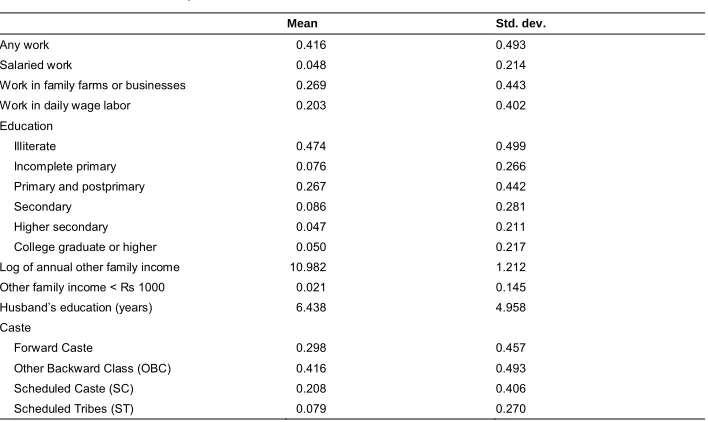
Table 1 gives descriptive statistics of all variables for the sample of 72,620 currently married women aged 25–59. Of these, 41.6% are employed in some kind of work for at least 240 hours in the preceding 12 months: 4.8% are employed in salaried work, 26.9% work in family farms or businesses, and 20.3% in agricultural and nonagricultural wage work. In the sample, 47.4% of women are illiterate, 26.7% have completed primary school education, and only 5% are college graduates.
Table 1: Summary statistics
Mean Std. dev.
Any work 0.416 0.493
Salaried work 0.048 0.214 Work in family farms or businesses 0.269 0.443 Work in daily wage labor 0.203 0.402 Education
Illiterate 0.474 0.499 Incomplete primary 0.076 0.266 Primary and postprimary 0.267 0.442 Secondary 0.086 0.281 Higher secondary 0.047 0.211 College graduate or higher 0.050 0.217 Log of annual other family income 10.982 1.212 Other family income < Rs 1000 0.021 0.145 Husband’s education (years) 6.438 4.958 Caste
Table 1: (Continued)
Mean Std. dev.
Religion
Hindu 0.828 0.377
Muslim 0.113 0.317
Other religion 0.059 0.235
Urban 0.319 0.466
Number of children, ages 0–5 0.646 0.963 Number of children, ages 6–15 1.281 1.338 Number of married women 1.815 0.974 Age
25–30 0.249 0.432
31–35 0.173 0.378
36–40 0.177 0.381
40–45 0.143 0.350
46–50 0.124 0.330
51–55 0.094 0.291
56–59 0.041 0.198
Survey (=1 for IHDS2, =0 for IHDS1) 0.561 0.496
Source: IHDS1 and IHDS2.
Note: N = 72,620.
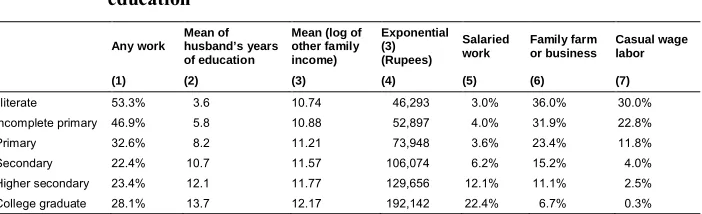
The bivariate relationship between women’s LFP and their education is J-shaped, as has been found in most previous research. Table 2 shows that increases in education from none to completed secondary school are associated with a steady, steep decline in women’s labor force participation from 53.3% to 22.4%. There is a slight increase in women’s labor force participation thereafter; 28.1% of women who are college graduates are employed.
Table 2: Labor force participation and other family income by women’s education
Any work Mean of husband’s years of education
Mean (log of other family income) Exponential (3) (Rupees) Salaried work Family farm or business Casual wage labor
(1) (2) (3) (4) (5) (6) (7)
Illiterate 53.3% 3.6 10.74 46,293 3.0% 36.0% 30.0% Incomplete primary 46.9% 5.8 10.88 52,897 4.0% 31.9% 22.8% Primary 32.6% 8.2 11.21 73,948 3.6% 23.4% 11.8% Secondary 22.4% 10.7 11.57 106,074 6.2% 15.2% 4.0% Higher secondary 23.4% 12.1 11.77 129,656 12.1% 11.1% 2.5% College graduate 28.1% 13.7 12.17 192,142 22.4% 6.7% 0.3%
Source: IHDS1 and IHDS2.
As expected, a married woman’s education is also closely related to her husband’s education and, thus, the income of her family. Column 2 reports the close relationship between wives’ and husbands’ education – the familiar fact of marriage homogamy. Partly as a result of this homogamy, column 3 reports the quite linear relationship with the logarithm of other family income. Each year of a woman’s education is associated with a similar proportional increase of her family’s income. For convenience, column 4 translates those annual averages to rupees at 2012 prices. The bivariate association of other family income with women’s labor force participation is also predictably negative and linear (results not shown). Of women whose families have less than Rs 8000 income, 62.2% are in the labor force; for women in families with over Rs150,000 income, only 21.5% are in the labor force. The research question is whether these other family income relationships are sufficient to explain the steep decline of women’s labor force participation in column 1. We address that question in the next section.
Finally, columns 5 through 7 show the bivariate relationships of a woman’s education with the three types of employment: salaried work, family enterprises (farm or nonfarm), and casual wage labor. Each of these is a fairly linear relationship. With rising education, employment in salaried work increases steadily, falls dramatically for casual wage labor, and falls more gradually for work in family farms and businesses. What is important here is that whereas each relationship is quite linear, aggregated together the relationship becomes the familiar curvilinear J-shape (column 1).
6.2 Logistic regressions of labor force participation
Table 3: Logistic regressions of women’s labor force participation
Model 1 Model 2 Model 3
Education (reference=illiterate)
Incomplete primary –0.278 *** –0.196 *** –0.064 (0.040) (0.041) (0.048) Primary –0.874 *** –0.677 *** –0.452 ***
(0.028) (0.029) (0.037) Secondary –1.403 *** –1.038 *** –0.652 ***
(0.042) (0.044) (0.056) Higher secondary –1.321 *** –0.858 *** –0.313 ***
(0.061) (0.061) (0.075) College graduate –1.066 *** –0.389 *** 0.530 ***
(0.046) (0.051) (0.068) Log of other family income –0.507 *** –0.426 ***
(0.013) (0.017) Negative or very low other family income –1.233 *** –1.045 ***
(0.101) (0.118) Husband’s education (years) –0.031 ***
(0.004) Caste (reference=Forward Castes)
Scheduled Caste (SC) 0.406 *** (0.038) Scheduled Tribes (ST) 0.785 ***
(0.055) Other Backward Caste (OBC) 0.259 ***
(0.033) Religion (reference=Hindu)
Muslim –0.547 ***
(0.046)
Other religion –0.005
(0.057)
Urban –1.224 ***
(0.029) Number of children, ages 0–5 –0.048**
(0.016) Number of children, ages 6–15 0.096 ***
(0.011) Number of married women 0.000
(0.015) Age (reference=25–30)
Age 31–35 0.288 ***
(0.041)
Age 36–40 0.415 ***
(0.041)
Age 40–45 0.398 ***
(0.048)
Age 46–50 0.326 ***
(0.048)
Age 51–55 0.047
(0.056)
Age 56–59 –0.383 ***
(0.083) Survey (=1 for 2012) 0.273 ***
(0.026) Constant 0.125 *** 5.551 *** 4.735 ***
(0.016) (0.146) (0.184) State fixed effects Yes Yes Yes
Source: IHDS1 and IHDS2.
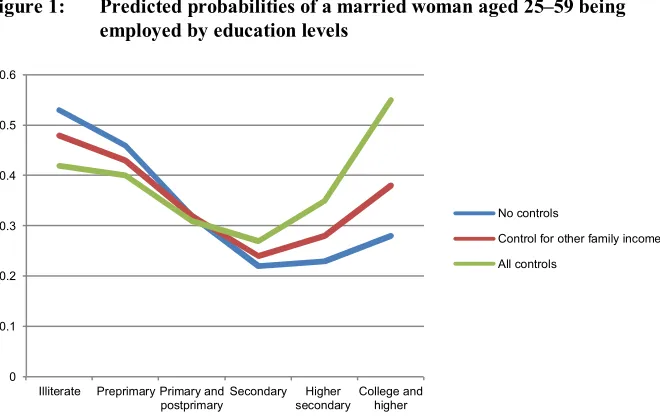
The second model adds other family income to the education categories. Not surprisingly, the estimated effect is quite large: a doubling of other family income (a little more than half a standard deviation) would reduce the average woman’s labor force participation rate from 41.6% to 33.4%. Our interest, however, is mainly in the consequences for the education estimates. The estimated decline in the log odds of employment from illiteracy to completed secondary schooling is reduced from –1.403 in Model 1 to –1.038 in Model 2. The estimate is still sharply negative, however; controlling for the income effect does not transform the education association into the expected positive linear relationship (i.e., Hypothesis 2b is not supported). A more noticeable change can be seen for the observed uptick among women with higher secondary education and college diplomas. The log odds for college graduates being in the labor force are 0.65 greater than those with secondary education after controls for other family income as compared to only 0.34 in Model 1.
The third model adds basic control variables: husband’s education, wife’s age, number of children under 6 and under 16, number of married women in the household, religion, caste, area of residence, and dummy variables for state fixed effects. Several of these relationships are quite strong. Dalits and especially Adivasis are much more likely to be in the labor force than Forward Castes, even at the same levels of education and other family income. Because Dalit and Adivasi women are clustered at lower levels of education, some of the steep negative relationship at lower levels of education is a consequence of these disadvantaged caste backgrounds, not educational levels. Similarly, the Forward Caste concentration among college graduates masks some of the positive effects of higher education on labor force participation. With controls, the education relationship assumes a clear U-shape so that college graduates are now the group most likely to be in the labor force, other factors being equal.
Figure 1: Predicted probabilities of a married woman aged 25–59 being employed by education levels
Even though the income effect does explain a part of the paradoxical relationship between a woman’s LFPR and her educational level, it doesn’t explain it fully. Secondary school matriculates are still less likely to be in the labor force than the uneducated despite their higher human capital that should make employment more attractive.
Urban residence has a powerful negative effect on women’s labor force participation, but, interestingly, a similar U-shape relationship with education is observed in both urban and rural areas (results not reported). In both rural and urban areas, women with completed secondary school have the lowest levels of labor force participation, which rise with postsecondary education in both rural and urban areas (slightly stronger in urban areas) and decline from no education in both rural and urban areas (slightly stronger in rural areas). The strong but mostly additive effect of urban location suggests that to understand the U-shape curve, it may be necessary to observe the different kinds of jobs that educated women perform compared to the jobs of illiterate women.
0 0.1 0.2 0.3 0.4 0.5 0.6
Illiterate Preprimary Primary and
postprimarySecondary secondaryHigher College andhigher
No controls
6.3 Types of work
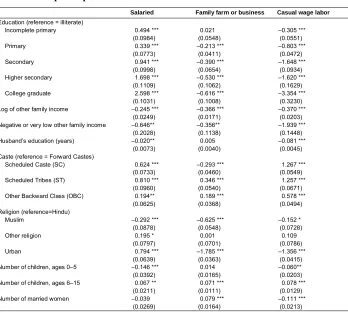
Table 2 above on the types of jobs held by working women shows that less educated women more often work on the family farm or as wage laborers; college graduates more likely are found in the more secure (and prestigious) salaried positions. As a next step, the study evaluates the role of job types by estimating three multivariate logistic regression equations to predict the log odds of a woman being employed in each type of work. Each equation controls for the same variables as Model 3 of Table 3 for overall work. Table 4 shows the results of the three logistic regressions. Again, calculating predicted probabilities for each educational level provides a more accessible picture of the education relationships (see Figure 2).
Table 4: Logistic regressions of three types of women’s labor force participation
Salaried Family farm or business Casual wage labor
Education (reference = illiterate)
Incomplete primary 0.494 *** 0.021 –0.305 *** (0.0984) (0.0548) (0.0551) Primary 0.339 *** –0.213 *** –0.803 ***
(0.0773) (0.0411) (0.0472) Secondary 0.941 *** –0.390 *** –1.648 ***
(0.0998) (0.0654) (0.0934) Higher secondary 1.698 *** –0.530 *** –1.620 ***
(0.1109) (0.1062) (0.1629) College graduate 2.598 *** –0.616 *** –3.354 ***
(0.1031) (0.1008) (0.3230) Log of other family income –0.245 *** –0.366 *** –0.370 ***
(0.0249) (0.0171) (0.0203) Negative or very low other family income –0.646** –0.356** –1.939 ***
(0.2028) (0.1138) (0.1448) Husband’s education (years) –0.020** 0.005 –0.081 ***
(0.0073) (0.0040) (0.0045) Caste (reference = Forward Castes)
Scheduled Caste (SC) 0.624 *** –0.293 *** 1.267 *** (0.0733) (0.0460) (0.0549) Scheduled Tribes (ST) 0.810 *** 0.346 *** 1.257 ***
(0.0960) (0.0540) (0.0671) Other Backward Class (OBC) 0.194** 0.189 *** 0.578 ***
(0.0625) (0.0368) (0.0494) Religion (reference=Hindu)
Muslim –0.292 *** –0.625 *** –0.152 * (0.0878) (0.0548) (0.0728) Other religion 0.195 * 0.001 0.109
(0.0797) (0.0701) (0.0786) Urban 0.794 *** –1.785 *** –1.356 ***
(0.0639) (0.0363) (0.0415) Number of children, ages 0–5 –0.146 *** 0.014 –0.060** (0.0392) (0.0165) (0.0203) Number of children, ages 6–15 0.067 ** 0.071 *** 0.078 ***
(0.0211) (0.0111) (0.0129) Number of married women –0.039 0.079 *** –0.111 ***
Table 4: (Continued)
Salaried Family farm or business Casual wage labor
Age (reference = 25–30)
Age 31–35 0.306 *** 0.265 *** 0.084 (0.0751) (0.0478) (0.0518) Age 36–40 0.419 *** 0.447 *** 0.077
(0.0766) (0.0475) (0.0543) Age 40–45 0.317 *** 0.551 *** –0.090
(0.0826) (0.0524) (0.0587) Age 46–50 0.234 ** 0.552 *** –0.229 ***
(0.0909) (0.0535) (0.0623) Age 51–55 –0.020 0.313 *** –0.519 ***
(0.0964) (0.0603) (0.0704) Age 56–59 –0.184 0.043 –1.100 ***
(0.1450) (0.0865) (0.1181) Survey (=1 for 2012) 0.166 *** 0.218 *** 0.559 ***
(0.0462) (0.0287) (0.0339) Constant –1.526 *** 2.253 *** 3.805 ***
(0.2781) (0.1997) (0.2203) State fixed effects Yes Yes Yes Source: IHDS1 and IHDS2.
Note: Robust standard errors in parentheses; *** p<0.001, ** p<0.01, * p<0.05; N = 72,620.
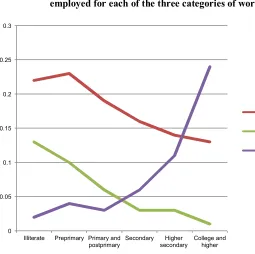
Figure 2: Predicted probabilities of a married woman aged 25–59 being employed for each of the three categories of work by education levels
0 0.05 0.1 0.15 0.2 0.25 0.3
Illiterate Preprimary Primary and
postprimary Secondary secondaryHigher College andhigher
Work in family farms or businesses
For salaried positions, more education has the expected positive relationship with a greater likelihood of work. The predicted probability of a currently married woman aged 25–59 being employed in a salaried position increases from 0.02 to 0.24 as her education level increases from being illiterate to being a college graduate. On the other hand, all other kinds of work show declining probabilities as her education level increases. The predicted probability of her being employed in a family farm or business decreases from 0.22 to 0.13; and in agricultural or nonagricultural wage labor from 0.13 to 0.01.
These results are consistent with an explanation of women’s labor force participation that educated women look mainly for better quality jobs, especially salaried work. The inference might be that if all or most available jobs were salaried, Indian women would show the usual positive relationship of higher rates of employment with more education. However, such jobs are limited and are accessible mainly with higher levels of education. If appropriate jobs were available for women with intermediate levels of education, we might expect higher levels of their labor force participation. The answers to the remaining paradoxical U-shape relationship should best be sought in the demand side of the Indian labor market.
7. Discussion and conclusion
The present study examined the often-observed J-shaped relationship between education and Indian women’s labor force participation. This relationship, especially the strong decline from illiteracy to secondary completion, is contrary to what would be predicted by most human capital theory. Secondary school graduates have more skills and human capital than those with only primary education; and those with completed primary schooling have some literacy and numeracy compared to those without any education. These skills should make them more productive workers with higher earnings and thus more likely to be in the labor force. But the opposite is the case for Indian women.
lower participation rates of secondary school graduates are attenuated after the controls, they do not disappear. However, after controls, education beyond secondary levels does lead to a much steeper increase in the predicted probabilities of being a part of the labor force.
Further analysis points to the kinds of work available and the lack of demand for moderately educated women’s more skilled labor as the main suspect for explaining the declining segment of the U-curve. For salaried work, the probability of being employed steadily increases as a woman’s education increases, whereas for casual wage labor and for work in family farms and businesses, women’s LFPR decreases with an increase in education. Once they attain moderate levels of education, women do not work in manual labor. The decline in women’s LFPR with more education is greatest for agricultural and nonagricultural wage work, even more than for work in family enterprises. It is especially manual work outside the household that is perceived to be below one’s educational attainment. The preference for salaried jobs as women attain moderate education could reverse the downward part of the U-curve, but such jobs are limited for women.
The lack of demand in India, despite economic growth, has been noted by other researchers (Klasen and Pieters 2015). But why economic growth has not generated these jobs remains mostly an unanswered question. One place to look for answers that has not been sufficiently appreciated would be the high levels of occupational segregation. In India, as everywhere, a major employer of moderately educated workers is white-collar employment in clerical and sales jobs. But in India, these jobs are still reserved for men. The 2001 census reports that 87.3% of office clerks and 93.1% of sales jobs are held by men (Census 2001). It is not so much the lack of adequate jobs for moderate levels of education but the exclusion of women from these jobs that explains the low rates of labor force participation for these women.
In contrast, skilled work in education and health sectors is not nearly so gender segregated, perhaps in part because this type of work conforms better with gender stereotypes of women’s nurturing roles. But much of this work requires education beyond secondary school, so the weaker sex segregation in these jobs results in a greater demand for educated female labor and the observed rise in labor force participation among female graduates. Over three-quarters of teachers, for instance, have education above secondary level, and over one-third, 36.8%, are women.
research attention. The observed difference between illiterate women and women with some secondary education in fact exceeds the over time decline, but has not inspired the same level of research attention. This lack of interest is all the more surprising given its discrepancy with most labor supply theory. Explanations in the literature often cite restrictive gender norms or the lack of ‘suitable’ work for educated women, but a lack of adequate data means that these explanations usually go untested. And the role of occupational segregation and the possibility of discrimination and exclusion of women from white-collar work is almost absent from this literature.
References
Abraham, V. (2013). Missing labour or consistent de-feminisation? Economic and Political Weekly 48(31): 99–108.
Afridi, F., Dinkelman, T., and Mahajan, K. (2016). Why are fewer married women joining the work force in India? A decomposition analysis over two decades. Bonn: Institute for Labor Study (IZA Discussion Paper 9722).
Andres, L.A., Dasgupta, B., Joseph, G., Abraham, V., and Correia, M. (2017). Precarious drop: Reassessing patterns of female labor force participation in India. Washington, D.C.: World Bank (World Bank Policy Research Working Paper 8024).
Benería, L. (1982). Accounting for women’s work. In: Benería, L. (ed.). Women and development: The sexual division of labor in rural societies. New York: Praeger. Boserup, E. (1970).Woman’s role in economic development. New York: St. Martin’s. Brinton, M.C., Lee, Y., and Parish, W.L. (1995). Married women’s employment in
rapidly industrializing societies: Examples from East Asia.American Journal of Sociology 100(5): 1099–1130.doi:10.1086/230633.
Cain, G.G. (1966).Married women in the labor force. Chicago: University of Chicago Press.
Census of India (2001). Provisional population totals. Census of India Series, 1. Office of the Registrar General and Census Commissioner, New Delhi, India.
Chatterjee, U., Murgai, R., and Rama, M. (2015). Job opportunities along the rural -urban gradation and female labor force participation in India. Washington, D.C.: World Bank (Policy Research Working Paper 7412). doi:10.1596/1813-9450-7412.
Chen, M. (1995). A matter of survival: Women’s right to employment in India and Bangladesh. In: Nussbaum, M. and Glover, J. (eds.). Women, culture and development. Oxford: Clarendon.doi:10.1093/0198289642.003.0002.
Chen, M. and Dreze, J. (1995). Recent research on widows in India: Workshop and conference report.Economic and Political Weekly 30(39): 2435–2450.
Das, M.B. and Desai, S. (2003). Are educated women less likely to be employed in India? Washington, D.C.: World Bank (Social Protection Discussion Paper No. 313).
Dunn, D. (1993). Gender inequality in education and employment in the scheduled castes and tribes of India.Population Research and Policy Review 12(1): 53–70. doi:10.1007/BF01074509.
England, P., Garcia-Beaulieu, C., and Ross, M. (2004). Women’s employment among blacks, whites, and three groups of Latinas: Do more privileged women have higher employment? Gender and Society 18(4): 494–509. doi:10.1177/08912 43204265632.
England, P., Gornick, J., and Shafer, E.F. (2012). Women’s employment, education, and the gender gap in 17 countries.Monthly Labor Review 135(4): 3–12. Folbre, N. (1995). Engendering economics: New perspectives on women, work and
demographic change. In: Bruno, M. and Pleskovic, M. (eds.).Annual world bank conference on development economics. Washington, D.C.: World Bank: 127– 153.
Goldin, C.J. (1990).Understanding the gender gap: An economic history of American women. New York: Oxford University Press.
Hirway, I. (2002). Employment and unemployment situation in 1990s: How good are NSS data?Economic and Political Weekly 37(21): 2027–2036.
India Human Development Survey (2016a). Data and documentation [electronic resource]. College Park: University of Maryland. http://ihds.info/data-documentation.
India Human Development Survey (2016b). Data and documentation [electronic resource]. College Park: University of Maryland.http://ihds.info/income.
Jakubson, G. and Psacharopoulos, G. (1992). The effect of education on female labor force participation and earnings in Ecuador. In: Psacharopoulos, G. and Tzannatos, Z. (eds.). Women’s employment and pay in Latin America: Country case studies. Washington, D.C.: World Bank: 255–271.
King, E.M. (1990). Does education pay in the labor market? The labor force participation, occupation and earnings of Peruvian women. Washington, D.C.: World Bank (Living Standards Measurement Study Working Paper 67).
Klasen, S. and Pieters, J. (2015). What explains the stagnation of female labor force participation in urban India? World Bank Economic Review 29(3): 449–478. doi:10.1093/wber/lhv003.
Mammen, K. and Paxon, C. (2000). Women’s work and economic development.
Journal of Economic Perspectives 14(4): 141–164.doi:10.1257/jep.14.4.141. Mathur, A. (1994). Work participation, gender and economic development: A
quantitative anatomy of the Indian scenario.The Journal of Development Studies
30(2): 466–504.doi:10.1080/00220389408422324.
Mehrotra, S. and Parida, J.K. (2017). Why is the labor force participation of women declining in India? World Development 98: 360–380. doi:10.1016/j.worlddev. 2017.05.003.
Minnesota Population Center (2017). Integrated public use microdata series, international: Version 6.5 [electronic resource]. Minneapolis: University of Minnesota.https://international.ipums.org/international/.
Mundle, S. (1992). The employment effects of stabilisation and related policy changes in India, 1991–92 to 1993–94.Indian Journal of Labour Economics 35(2): 227– 237.
Nath, K. (1968). Women in the working force in India.Economic and Political Weekly
3(31): 1205–1213.
Pampel, F.C. and Tanaka, K. (1986). Economic development and female labor force participation: A reconsideration.Social Forces 64(3): 599–619.doi:10.1093/sf/ 64.3.599.
Papola, T.S. (1994). Structural adjustment, labour market flexibility and employment.
Indian Journal of Labour Economics 37(1): 3–16.
Reddy, D.N. (1979). Female work participation in India: Facts, problems, and policies.
Indian Journal of Industrial Relations 15(2): 197–212.
Sathar, Z. and Desai, S. (2000). Class and gender in rural Pakistan: Differentials in economic activity. In: Garcia, B. (ed.) Women, poverty and demographic
change.Oxford: Oxford University Press: 175–192.
Smith, J.P. and Ward, M.P. (1985). Time-series growth in the female labor force.
Journal of Labor Economics 3(1): S59–S90.doi:10.1086/298076.
Srivastava, N. and Srivastava, R. (2010). Women, work, and employment outcomes in rural India.Economic and Political Weekly 45(28): 49–63.
Swaminathan, P. (1994). Development experience(s) in India: Gendered perspectives on industrial growth, employment and education. Social Scientist 22(3/4): 60– 92.doi:10.2307/3517623.
Tienda, M., Donato, K.M., and Cordero-Guzman, H. (1992). Schooling, color, and the labor force activity of women.Social Forces 71(2): 365–395.doi:10.1093/sf/71. 2.365.
Treas, J. (1987) The effect of women’s labor force participation on the distribution of income in the United States. Annual Review of Sociology 13: 259–288.doi:10. 1146/annurev.so.13.080187.001355.