doi:10.3926/jiem.2011.v4n2.p231-257 JIEM, 2011 – 4(2): 231-257 – Online ISSN: 2013-0953 Print ISSN: 2013-8423
Barriers to implement green supply chain management in
automobile industry using interpretive structural modeling
technique-An Indian perspective
Sunil Luthra
1, Vinod Kumar
1, Sanjay Kumar
2, Abid Haleem
31
Thapar University (INDIA);
2C.B.S Group of Institutions (INDIA);
3Jamia Millia Islamia
(INDIA)
;
;
;
[email protected]
Received September 2010
Accepted March 2011
Abstract:
Purpose:
Green Supply Chain Management (GSCM) has received growing attention
in the last few years. Most of the automobile industries are setting up their own
manufacturing plants in competitive Indian market. Due to public awareness,
economic, environmental or legislative reasons, the requirement of GSCM has
increased. In this
context
, this study aims to develop a structural model of the barriers
to implement GSCM in Indian automobile industry.
Design/methodology/approach
: We have identified various barriers and contextual
relationships among the identified barriers. Classification of barriers has been carried
out
based
upon dependence and driving power with the help of MICMAC analysis. In
addition to this, a structural model of barriers to implement GSCM in Indian
automobile industry has also been put forward using Interpretive Structural Modeling
(ISM) technique.
doi:10.3926/jiem.2011.v4n2.p231-257 JIEM, 2011 – 4(2): 231-257 – Online ISSN: 2013-0953 Print ISSN: 2013-8423
been identified as the linkage variables. No barrier has been identified as autonomous
variable. Four barriers have been identified as top level barriers and one bottom level
barrier. Removal of these barriers has also been discussed.
Research limitations/implications:
A hypothetical model of these barriers has been
developed based upon experts’ opinions. The conclusions so drawn may be further
modified to apply in real situation problem.
Practical implications:
Clear understanding of these barriers will help organizations
to prioritize better and manage their resources in an efficient and effective way.
Originality/value:
Through this paper we contribute to identify the barriers to
implement GSCM in Indian automobile industry and to prioritize them. The
structured model developed will help to understand interdependence of the barriers.
This paper also suggests the removal of these barriers.
Keywords:
green supply chain management, barriers to implement GSCM, interpretive
structural modeling
1 Introduction
doi:10.3926/jiem.2011.v4n2.p231-257 JIEM, 2011 – 4(2): 231-257 – Online ISSN: 2013-0953 Print ISSN: 2013-8423
The objective of this paper is to identify various barriers to implement GSCM in Indian automobile industry, to indentify further the contextual relationship among the identified barriers to implement GSCM, to classify these barriers depending upon their driving and dependence power and finally to develop ISM based model of these barriers. ISM is a well established methodology for identifying relationship among specific item which define problem or an issue (Sage, 1977).
Section 2 consists of literature review of GSCM. Barriers to implement GSCM relevant to Indian automobile industry have been identified and described in section 3. Step wise elaborated procedure of interpretive structural modeling of these barriers to implement in Indian automobile industry follows in section 4. Section 5 will help the readers to deal with these above said barriers to implement GSCM in Indian automobile industry efficiently and effectively. Conclusions, limitations of the study and scope of the future work have been discussed in subsequent sections.
2 Green supply chain management (GSCM): literature review
Green supply chain management (GSCM) involves traditional supply chain management practices integrating environmental criteria or concerns into organizational purchasing decision and long term relationships with suppliers (Gilbert, 2000). A green supply chains aims at confining the wastes within the industrial system in order to conserve energy and prevent the dissipation of dangerous materials into the environment (Torres, Nones, Morques, & Evgenio, 2004). It recognizes the disproportionate environmental impact of supply chain processes within an organization. It recognizes the disproportionate environmental impact of supply chain processes within an organization. GSCM is the summing up of green purchasing, green manufacturing, green packing, green distribution and marketing. GSCM is to eliminate or minimize waste in the form of energy, emission, hazardous, chemical and solid waste (Olugu, Wong, & Shaharoun, 2010).
doi:10.3926/jiem.2011.v4n2.p231-257 JIEM, 2011 – 4(2): 231-257 – Online ISSN: 2013-0953 Print ISSN: 2013-8423
barriers are identified (Ravi & Shankar, 2005) GSCM practices adopted by the electrical and electronic industry in Taiwan were investigated, which was dominated by original equipment manufacturing and original designing and manufacturing. The data was analyzed by using statistical package and the structural equation modeling (Chien & Shih, 2007). Factors influencing to adopt green innovations for logistics service providers were described. The data generated from the questionnaire survey on logistics companies in Taiwan were used for modeling (Yu Lin & Hui Ho, 2008). A proactive GSCM approach was suggested for improving environmental performance of processes and products in accordance with the requirements of environment regulations. This study examined the consistency approaches for factor analysis that determines the adoption and implementation of GSCM (Hsu & Hu, 2008).
An increased attention for developing environmental management (EM) strategies for the supply chain was suggested. This study analyzed the interaction of criteria that was used to select the green suppliers based upon the environmental performance using ISM and Analytic Hierarchy Process (Kannan, Noorul Haq, Sasikumar, & Arrununchchalam, 2008). ISM based model for greening the supply chain in Indian manufacturing industries was explained. Fifteen enablers were identified. A questionnaire based survey was conducted to rank these enablers. They found contextual relationships among enablers and developed hierarchy based model for the enablers by using ISM (Mudgal, Shankar, Talib, & Raj, 2009). ISM based model for modeling the barriers of green supply chain Practices in Indian manufacturing industries was put forward. They suggested green businesses practices are not easy to adopt and implement due to the presence of many barriers. A questionnaire based survey was conducted to analyze and rank these barriers. Fifteen barriers were identified. ISM approach has been used to model and analyze key barriers (Mudgal, Shankar, Talib, & Raj, 2010). Importance of GSCM and factors important to implement GSCM in Indian automobile industry was identified and described (Luthra, Manju, Kumar, & Haleem, 2010).
2.1 GSCM Vs conventional SCM
doi:10.3926/jiem.2011.v4n2.p231-257 JIEM, 2011 – 4(2): 231-257 – Online ISSN: 2013-0953 Print ISSN: 2013-8423
ecologically optimized, while Conventional SCM does not take into consideration human toxicological effects (Beamon, 1999; Gilbert, 2000; Ho Johnny, Shalishali, Maurice, Tseng, & Ang, 2009). Conventional SCM concentrates more on controlling the final product; no matter harmful its effects are to the environment during production and distribution. Ecological requirements are key criteria for products and productions and at the same time the company must assure its economic sustainability by staying competitive and profitable (Ho Johnny, Shalishali, Maurice, Tseng, & Ang, 2009). Differences between GSCM and SCM are summarized in Table 1.
S.
N. Characteristics Green Supply Chain
Management
Conventional Supply
Chain Management Researcher’s
1 Objectives Ecological and
Economic Economic Beamon (1999)
Gilbert (2000)
Ho Johnny et al. (2009)
2 Ecological
Optimization High Ecological Impacts Integrated Approach Low ecological impacts 3 Supplier Selection
criteria Eco logical Aspects Long Term relationship
Price Switching suppliers quickly
Short term relationship
4 Cost Pressure High Low
5 Flexibility Low High
6 Speed low High
Table 1. “Difference between the Green Supply Chain Management and Conventional Supply Chain Management”.
3 Barriers to implement GSCM in Indian automobile industry
According to world statistics, the automobile industry is world’s largest single manufacturing sector (Lettice, Wyatt, & Evans, 2010).The growth in the world’s population has also heightened the demand for the vehicles (Olugu, Wong, & Shaharoun, 2010). Increasing trend of demand of automobiles such as cars, bikes and commercial vehicles in India has been noticed in last few years, therefore leading international and domestic automobile manufacturers (like Maruti Suzuki, Hyundai, Tata Motors, General Motors, Honda, Fiat, Bajaj Auto, Hero Honda etc.) are either setting up their new manufacturing plants or increasing their production capacity in their existing plants in India.
doi:10.3926/jiem.2011.v4n2.p231-257 JIEM, 2011 – 4(2): 231-257 – Online ISSN: 2013-0953 Print ISSN: 2013-8423
Economics, environmental or legislative reasons have increased the requirement of GSCM in Indian Automobile industry.
We have identified various barriers to implement GSCM in Indian automobile industry from the literature reviews and expert opinions. Literature was reviewed to identify barriers to implement GSCM in Indian automobile industry. We conducted a workshop, in which different experts from academia and industry were invited. Four were from industry and two were from academia. Brainstorming session was conducted and eleven barriers relevant to Indian automobile industry were identified. These barriers to implementation of GSCM in Indian Automobile industry are: Lack of IT Implementation; Resistance to Technology Advancement Adoption; Lack of Organization Encouragement; Poor Quality of Human Resources; Market Competition and Uncertainty; Lack of Government Support System; Lack of Implementing Green Practices; Lack of Top Management Commitment; Cost Implications; Supplier Reluctance to Change towards GSCM and Unawareness of customers. Again brainstorming session was conducted to reach consensuses about the contextual relationships (pair wise) to form a structural self interaction matrix (elaborated in section 4). The above said identified barriers are explained as:
3.1 Lack of IT implementation
doi:10.3926/jiem.2011.v4n2.p231-257 JIEM, 2011 – 4(2): 231-257 – Online ISSN: 2013-0953 Print ISSN: 2013-8423
3.2 Resistance to technology advancement adoption
Technology is a kind of knowledge. An organization with rich experiences in the application and adoption of related technologies will have higher ability in technological innovation (Gant, 1996). An organization will have higher innovative capability when knowledge can be shared more easily within the organization (TSai & Ghoshal, 1999). Technological advancement can be achieved with higher transferability. It is easy to share technological transfer or share technological knowledge with higher explicitness (Cooper, 1994). Innovation and technology incorporate the innovation into corporate culture, encouraging new ideas and processes and solutions by all the employees of the firm (Digalwar & Metri, 2004). Resistance of organizations to technology advancement adoption is the resistance to change. An organizational barrier means difficulty of implementing fundamental change in the organization. This is especially true when there are changes in the core features of organizations like organizational goals, forms of authority, core technology, operational strategy and market strategy (AlKhidir & Zailani, 2009). Therefore, resistance to technology advancement adoption is important barrier to implement GSCM in automobile industry.
3.3 Lack of organizational encouragement
Informal linkages and improved communication help the organizations to adopt Green’s practices (Yu Lin & Hui Ho, 2008). Training and education are the prime requirements for achieving successful implementation of GSCM in any organization (Ravi & Shankar, 2005). Management may encourage employees to learn green information. Organizations may provide rewards for green employees. Employees may be helped when they face green problems and may be provided support to learn green information (Hsu & Hu, 2008).
3.4 Poor quality of human resources
doi:10.3926/jiem.2011.v4n2.p231-257 JIEM, 2011 – 4(2): 231-257 – Online ISSN: 2013-0953 Print ISSN: 2013-8423
human resources is barrier. Therefore poor quality of human resources is an important barrier to implement GSCM in Indian automobile industry.
3.5 Market competition and uncertainty
In today’s scenario market uncertainty is very high due to global competitiveness, and customer’s requirements (Yu Lin, 2007). Research and benchmarked global competitors develop and deploy strategies. The external environment in which a firm conducts its business will also influence the innovative capability as well as intention to adopt innovations (Hosseini, 2007). We assume that market competition and uncertainty is most important barrier to achieve GSCM in Indian automobile industry.
3.6 Lack of Government support systems
Government regulation can encourage or discourage the adoption of innovation, as Government sets the environmental regulations for industry (Scupola, 2003). Time consuming regulatory requirements, fees or levies may discourage smaller firms. Tax structures that distort incentives can discourage industry to implement GSCM. Government institutions are considered as barriers to development in the environmental management in the sense that institutional process for implementing GSCM are going on but very limited institutional support is given for new ideas to implement GSCM. The tendency of government to encourage old practices is major barrier (AlKhidir & Zailani, 2009).Therefore lack of government support systems is a barrier to implement efficient GSCM in Indian automobile industry.
3.7 Lack of implementing green practices
doi:10.3926/jiem.2011.v4n2.p231-257 JIEM, 2011 – 4(2): 231-257 – Online ISSN: 2013-0953 Print ISSN: 2013-8423
constraints also lead to resistance to implementing green practices (Ravi & Shankar, 2005).From the above discussion; we expect that lack of implementation of green practices is the most important barrier to implement efficient GSCM in Indian automobile industry.
3.8 Lack of top management commitment
Top management support and commitment is necessary for any strategic program success (Hamel & Prahalad, 1989; Zhu & Sarkis, 2007). Top Management support is especially useful for environmental practices such as GSCM. Top management has significant ability to influence, support actual formation and implementation of green initiatives across the organization (Sarkis, 2009).Top management provides continuous support for GSCM in the strategic plans and action plans for successfully implementing them (Ravi & Shankar, 2005). Therefore, we assume that lack of top management commitment is one of the barriers to implement of GSCM in Indian automobile industry.
3.9 Cost implications
Historically, cost has been used as the prime performance measure. Usually, high cost is a big pressure in GSCM as compared to conventional SCM. The initial investment requirement by green methodologies such as green design, green manufacturing, green labeling of packing etc. are too high. Engaging in environmental management involves two types of costs, direct cost and transaction cost. Both types of costs are likely to constitute significant barrier to implement GSCM (AlKhidir & Zailani, 2009). IT enablement, Technology advancement adoption, hiring good quality of employees, motivating and training of employees towards GSCM will require high initial investment. Therefore, cost implication is a major barrier among the barriers to implement efficient GSCM in Indian automobile industry.
3.10 Supplier reluctance to change towards GSCM
doi:10.3926/jiem.2011.v4n2.p231-257 JIEM, 2011 – 4(2): 231-257 – Online ISSN: 2013-0953 Print ISSN: 2013-8423
interests being different from those of the total network (Mudgal et al., 2010). Supplier manufacturer relationships are considered most important for developing competitive advantage for the manufacturer. Large automobile industries have normally 2000 to 3000 suppliers. The manufacturers cannot produce green products unless they work together with suppliers. Suppliers need to meet the requirement of buyers to maintain business relationship. So we can say that Supplier reluctance to change towards GSCM is a very important barrier to implement GSCM in Indian automobile industry.
3.11 Unawareness of customers
A major barrier of GSCM seen in Indian automobile industry is lack of awareness of customers about the benefits of green products. Customer demands become most crucial type of external pressure. Customer’s awareness means if customer demands green products; the company has to change technology and organization for innovative green products. But in Indian automobile market, due to unawareness of customers towards green product benefits, automobile producers are producing non green products. In U.S.A., an estimated 75% of consumers claim that their purchases are influenced by reputation and 80% would be willing to pay more for environment friendly products (Lamming & Hmapson, 1996). Thus, we can say that unawareness of customers is a major barrier to implement GSCM in Indian automobile industry.
Above said barriers to implement GSCM in Indian automobile industry have been summarized in Table 2.
4 Interpretive structural modeling applied to barriers to implement of GSCM in Indian automobile industry
doi:10.3926/jiem.2011.v4n2.p231-257 JIEM, 2011 – 4(2): 231-257 – Online ISSN: 2013-0953 Print ISSN: 2013-8423
S.N. Barrier to Implement GSCM
Description Researcher’s
1 Lack of IT
Implementation Lack of IT Implementation means non implementation Information Technology resources like computers, internet etc. Slow, ineffective and improper
communication is due to lack of IT Implementation.
Rogers et al. (1998); Wu et al. (2009); Ravi et al. (2005); AlKhidir et al. (2009); Mclaren et al. (2004).
2 Resistance to Technology Advancement Adoption
Resistance to Technology
advancement adoption is not doing advancements in machinery and equipments to improve the products.
Hosseini (2007); Cooper (1994); Hsu et al. (2008); Digalwar et al. (2004); Gant (1996); TSai et al. (1999); AlKhidir et al. (2009).
3 Lack of Organization Encouragement
Lack of Organization
Encouragement is not motivating the employees towards GSCM.
Yu Lin (2007); Yu Lin et al. (2008); Hsu et al. (2008); Chien et al. (2007); Ravi et al. (2005). 4 Lack of Quality of
Human Resources Lack of Quality of human resources means not recruiting well qualified and professionals.
Yu Lin (2007); Yu Lin et al. (2008); Hsu et al. (2008); Chien et al. (2007).
5 Market
Competition and Uncertainty
Market Competition and Uncertainty is very high due to global competitiveness, and varying customer’s requirements
Hosseini (2007); Yu Lin (2007); Mudgal et al. (2010).
6 Lack of Government Support systems
Lack of Government support systems means Government not making industry friendly policies toward GSCM and not giving special benefits to those
organizations implementing GSCM.
Hosseini (2007); Yu Lin et al. (2008); Hsu et al. (2008); Mudgal et al. (2009); Mudgal et al. (2010); Scupola (2003); Srivastva (2007).
7 Lack of Implementing Green Practices
Lack of Innovative Green Practices means not taking consideration of practices like hazardous solid waste disposal, energy
conservation, reusing and recycling materials etc.
Yu Lin et al. (2008); Hsu et al. (2008); Mudgal et al. (2009); Ravi et al. (2005).
8 Lack of Top Management Commitment
Lack of Top Management Commitment means that top management not showing interests in green practices.
Digalwar et al. (2004); Hamel et al. (1989); Sarkis (2009); Mudgal et al. (2009); Mudgal et al. (2010); Ravi V. et al. (2005); Zhu (2007).
9 Cost Implications The high investment requirement by green Methodologies such as green design, green
manufacturing, green labeling of packing etc.
Hosseini (2007); Mudgal et al. (2009); Ravi et al. (2005); AlKhidir et al. (2009).
10 Supplier Reluctance to change towards GSCM
Supplier reluctance to change towards GSCM means not involvement of the suppliers in design process and technology, which affects overall performance of whole chain.
Hsu et al. (2008); Kannan et al. (2008); Lettice et al. (2010); Ravi et al. (2005); Srivastva (2007); Sarkar et al. (2006).
11 Unawareness of
customers Unawareness of Customers means that customers do not know about green products and their benefits.
Lamming et al. (1996); Mudgal et al. (2009); Ravi et al. (2005); Zhu et al. (2004); Zhu et al. (2007); Zhu et al. (2008).
doi:10.3926/jiem.2011.v4n2.p231-257 JIEM, 2011 – 4(2): 231-257 – Online ISSN: 2013-0953 Print ISSN: 2013-8423
• Step 1:- Variables affecting the system are listed; in our research work
barriers to implement GSCM in Indian automobile industry have been identified as variables.
• Step 2:- From the variables identified in step 1, contextual relationship
among the variables with respect to which pairs of variables are examined.
• Step 3:- A Structural Self-Interaction Matrix (SSIM) is developed for
variables, which indicates pair wise relationship among variables of the system under consideration.
• Step 4:- A reachability matrix is developed from the SSIM and the matrix is
checked for transitivity. The transitivity of the contextual relationships is a basic assumption made in ISM. It states that if variable A is related to variable B and variable B is related to variable C, then variable A is necessarily related to variable C.
• Step 5:- The reachability matrix obtained in Step 4 is partitioned into
different levels.
• Step 6:- Based on the contextual relationships in the reachability matrix, a
directed graph is drawn and the transitive links are removed.
• Step 7:- The resultant diagraph is converted into an Interpretive Structural
Model by replacing variable nodes with statements.
4.1 Data gathering methodology and structural self-interaction matrix
As discussed in section 3, experts from industry and the academia were consulted during the workshop conducted to identify the nature of contextual relationships among the barriers to implement GSCM in Indian automobile industry. In developing SSIM, following four symbols have been used to denote the direction of relationship between two barriers i and j.
V- Barrier i will lead to barrier j;
A- Barrier j will lead to barrier i;
doi:10.3926/jiem.2011.v4n2.p231-257 JIEM, 2011 – 4(2): 231-257 – Online ISSN: 2013-0953 Print ISSN: 2013-8423
O- Barrier i and j are unrelated
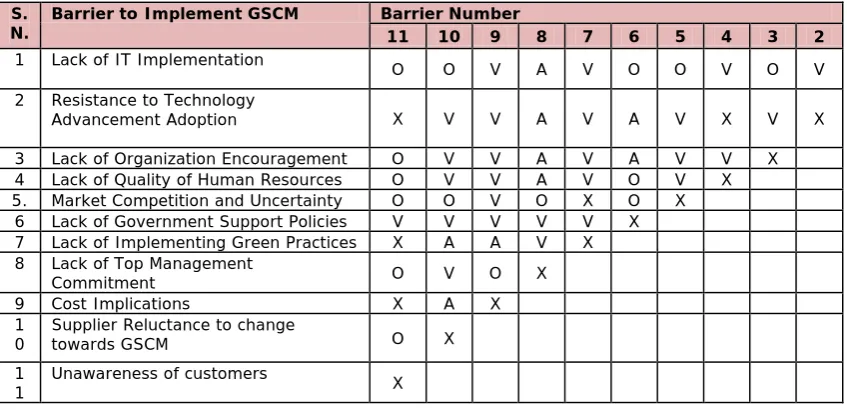
Based on the contextual relationships, the SSIM has been developed (Table 3). Barrier 1 leads to barrier 7 so symbol ‘V’ has been given in the cell (1,7); barrier 2 leads to barrier 8 so symbol ‘A’ has been given in the cell (2, 8); barrier 5 and 7 lead to each other so symbol ‘X’ has been given in the cell (2,8); barrier 3 and 11 do not lead to each other so symbol ‘O’ has been given in the cell (3,11) and so on. The number of pair wise comparison question addressed for developing the SSIM are ((N)* (N-1)/2), where N is the number of barriers.
S.
N. Barrier to Implement GSCM Barrier Number 11 10 9 8 7 6 5 4 3 2
1 Lack of IT Implementation O O V A V O O V O V
2 Resistance to Technology
Advancement Adoption X V V A V A V X V X
3 Lack of Organization Encouragement O V V A V A V V X 4 Lack of Quality of Human Resources O V V A V O V X 5. Market Competition and Uncertainty O O V O X O X
6 Lack of Government Support Policies V V V V V X 7 Lack of Implementing Green Practices X A A V X 8 Lack of Top Management
Commitment O V O X
9 Cost Implications X A X
1
0 Supplier Reluctance to change towards GSCM O X 1
1 Unawareness of customers X
Table 3. “Structured Self Intersection Matrix (SSIM) for Barriers to Implement GSCM in Indian Automobile Industry”.
4.2 Reachability matrix
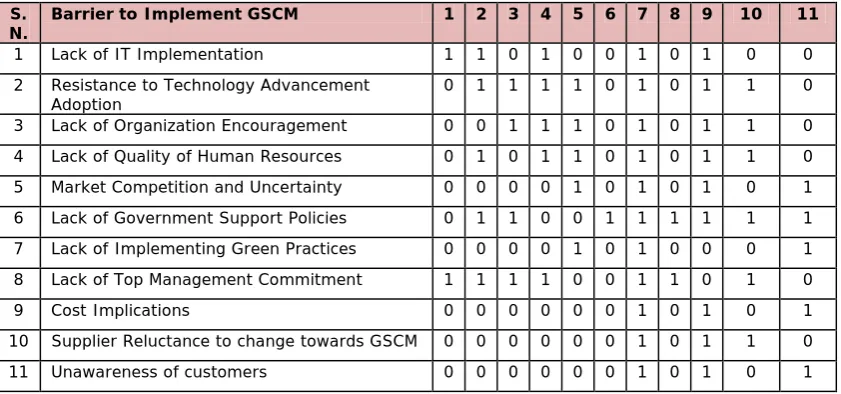
The SSIM has been converted in to a binary matrix, named Initial Reachability Matrix by substituting V, A, X, O by 1 or 0 applying following rules:
• If (i, j) value in the SSIM is V, (i, j) value in the reachability matrix will be 1
and (j, i) value will be 0;for V(1,7) in SSIM, ‘1’ has been given in cell(1,7) and ‘0’ in cell(7,1) in initial reachability matrix.
• If (i, j) value in the SSIM is A, (i, j) value in the reachability matrix will be 0
doi:10.3926/jiem.2011.v4n2.p231-257 JIEM, 2011 – 4(2): 231-257 – Online ISSN: 2013-0953 Print ISSN: 2013-8423
S.
N. Barrier to Implement GSCM 1 2 3 4 5 6 7 8 9 10 11
1 Lack of IT Implementation 1 1 0 1 0 0 1 0 1 0 0 2 Resistance to Technology Advancement
Adoption 0 1 1 1 1 0 1 0 1 1 0
3 Lack of Organization Encouragement 0 0 1 1 1 0 1 0 1 1 0 4 Lack of Quality of Human Resources 0 1 0 1 1 0 1 0 1 1 0 5 Market Competition and Uncertainty 0 0 0 0 1 0 1 0 1 0 1 6 Lack of Government Support Policies 0 1 1 0 0 1 1 1 1 1 1 7 Lack of Implementing Green Practices 0 0 0 0 1 0 1 0 0 0 1 8 Lack of Top Management Commitment 1 1 1 1 0 0 1 1 0 1 0
9 Cost Implications 0 0 0 0 0 0 1 0 1 0 1
10 Supplier Reluctance to change towards GSCM 0 0 0 0 0 0 1 0 1 1 0 11 Unawareness of customers 0 0 0 0 0 0 1 0 1 0 1
Table 4. “Initial Reachability Matrix for Barriers to Implement GSCM in Indian Automobile Industry”.
S.
N. Barrier to Implement GSCM 1 2 3 4 5 6 7 8 9 10 11 Driving power
1 Lack of IT
Implementation 1 1 1* 1 1* 0 1 0 1 1* 1* 09 2 Resistance to
Technology
Advancement Adoption
0 1 1 1 1 0 1 0 1 1 1* 08
3 Lack of Organization
Encouragement 0 1 1 1 1 0 1 0 1 1 1* 08
4 Lack of Quality of Human
Resources 0 1 1 1 1 0 1 0 1 1 1* 08
5 Market Competition and
Uncertainty 0 0 0 0 1 0 1 0 1 0 1 04
6 Lack of Government
Support Policies 1* 1 1 1* 1* 1 1 1 1 1 1 11 7 Lack of Implementing
Green Practices 0 0 0 0 1 0 1 0 1* 0 1 04
8 Lack of Top Management
Commitment 1 1 1 1 1* 0 1 1 1* 1 1* 10
9 Cost Implications 0 0 0 0 1* 0 1 0 1 0 1 04
10 Supplier Reluctance to
change towards GSCM 0 0 0 0 1* 0 1 0 1* 1 1 05
11 Unawareness of
customers 0 0 0 0 1* 0 1 0 1 0 1 04
Dependence Power 03 06 06 06 11 01 11 02 11 07 11 75/75
*means value after applying transitivity
doi:10.3926/jiem.2011.v4n2.p231-257 JIEM, 2011 – 4(2): 231-257 – Online ISSN: 2013-0953 Print ISSN: 2013-8423
• If (i, j) value in the SSIM is X, (i, j) value in the reachability matrix will be 1
and (j, i) value will also be 1;for X(5,7) in SSIM, ‘1’ has been given in cell(5,7) and ‘1’ in cell(7,5) also in initial reachability matrix.
• If (i, j) value in the SSIM is O, (i, j) value in the reachability matrix will be 0
and (j, i) value will also be 0;for O(3,11) in SSIM, ‘0’ has been given in cell(3,11) and ‘0’ in cell(11,3) also in initial reachability matrix.
By applying these rules, an initial reachability matrix for the barriers to implement GSCM has been obtained (Table 4). The final reachabilty matrix has been obtained by adding transitivity as explained in Step 4 earlier (Table 5).The driving power and the dependence power of each barrier have also been shown in the Table 5.
4.3 Partitioning of levels
Barrier
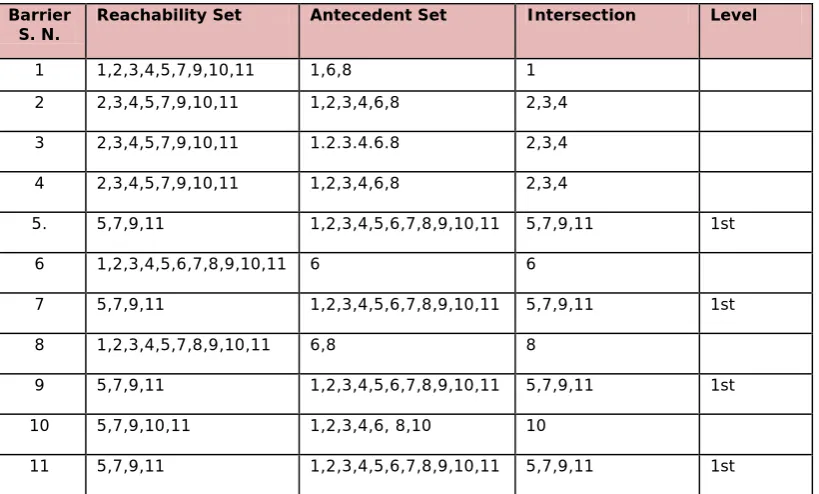
S. N. Reachability Set Antecedent Set Intersection Level
1 1,2,3,4,5,7,9,10,11 1,6,8 1
2 2,3,4,5,7,9,10,11 1,2,3,4,6,8 2,3,4
3 2,3,4,5,7,9,10,11 1.2.3.4.6.8 2,3,4
4 2,3,4,5,7,9,10,11 1,2,3,4,6,8 2,3,4
5. 5,7,9,11 1,2,3,4,5,6,7,8,9,10,11 5,7,9,11 1st
6 1,2,3,4,5,6,7,8,9,10,11 6 6
7 5,7,9,11 1,2,3,4,5,6,7,8,9,10,11 5,7,9,11 1st
8 1,2,3,4,5,7,8,9,10,11 6,8 8
9 5,7,9,11 1,2,3,4,5,6,7,8,9,10,11 5,7,9,11 1st
10 5,7,9,10,11 1,2,3,4,6, 8,10 10
11 5,7,9,11 1,2,3,4,5,6,7,8,9,10,11 5,7,9,11 1st
Table 6. “First Iteration to FIND LEVELS of Barriers to Implement GSCM in Indian Automobile Industry”.
doi:10.3926/jiem.2011.v4n2.p231-257 JIEM, 2011 – 4(2): 231-257 – Online ISSN: 2013-0953 Print ISSN: 2013-8423
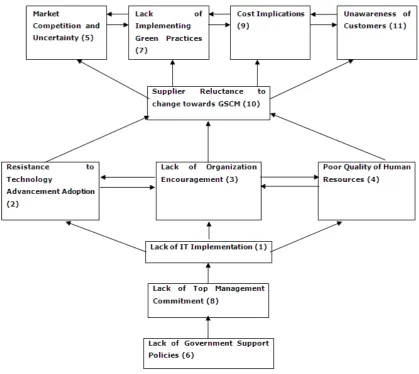
barriers. Barrier having same reachability set and the intersection set is assigned as top level barrier in the ISM hierarchy or Level 1 is shown in Table 6.After finding Level 1 , it is then discarded for finding further Levels. The iterative procedure is continued until Level of each barrier is found. We have indentified six levels in our study. Market competition and uncertainty; Lack of implementing Green Practices; Cost implications; Unawareness of customers have been identified as top level barriers and Lack of government support systems has been identified as most important Bottom level barrier.
4.4 Barriers classification
doi:10.3926/jiem.2011.v4n2.p231-257 JIEM, 2011 – 4(2): 231-257 – Online ISSN: 2013-0953 Print ISSN: 2013-8423
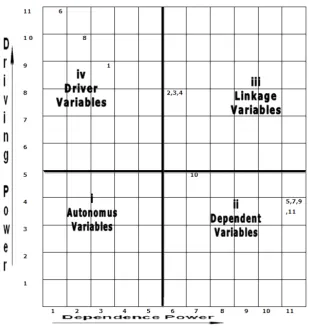
Figure 1. “Cluster of Barriers to Implement GSCM in Indian Automobile industry”.
The objective of this study is to analyze the driving power and the dependency power of barriers (Jharkharia & Shankar, 2005).Higher dependence values for a factor means a large number of barriers to be addressed before its removal and high driving value of a barrier means a large number of barriers that could be removed by its removal
4.5 ISM model formulation
doi:10.3926/jiem.2011.v4n2.p231-257 JIEM, 2011 – 4(2): 231-257 – Online ISSN: 2013-0953 Print ISSN: 2013-8423
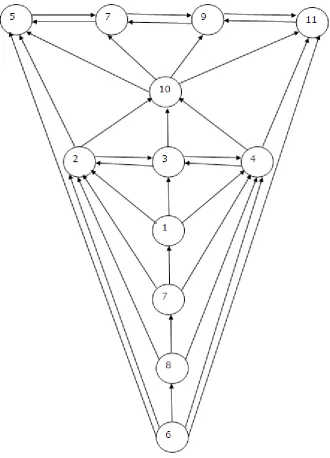
barrier is autonomous variable. From the final reachability matrix (Table 4), the structural model is generated by vertices and edges (Jharkharia & Shankar, 2005).This graph is called digraph as shown in Figure 2. After removing the transitivity’s as described in the ISM methodology, ISM Model has been made as shown in Figure 3. Market competition and uncertainty; Lack of implementing Green Practices, Cost implications, Unawareness of customers are found top level barriers and Lack of government support systems is found bottom level barrier.
doi:10.3926/jiem.2011.v4n2.p231-257 JIEM, 2011 – 4(2): 231-257 – Online ISSN: 2013-0953 Print ISSN: 2013-8423
S. N. Level No. Importance of factors important to implement GSCM
1 1st Market Competition and Uncertainty Lack of Implementing Green Practices Cost Implications
Unawareness of customers
2 2nd Supplier Reluctance to change towards GSCM 3 3rd Resistant to Technology Advancement Adoption
Lack of Organization Encouragement Poor Quality of Human Resources
4 4th Lack of IT Implementation
5 5th Lack of Top Management Commitment 6 6th Lack of Government Support Policies
doi:10.3926/jiem.2011.v4n2.p231-257 JIEM, 2011 – 4(2): 231-257 – Online ISSN: 2013-0953 Print ISSN: 2013-8423
5 Eliminating completely or making barriers less intense: proposed
solutions
doi:10.3926/jiem.2011.v4n2.p231-257 JIEM, 2011 – 4(2): 231-257 – Online ISSN: 2013-0953 Print ISSN: 2013-8423
doi:10.3926/jiem.2011.v4n2.p231-257 JIEM, 2011 – 4(2): 231-257 – Online ISSN: 2013-0953 Print ISSN: 2013-8423
6 Conclusions
Green supply Chain Management (GSCM) has been identified as an approach for improving performance of the processes and products according to the requirements of environmental regulations. Eleven barriers to implement GSCM in Indian automobile industry have been identified. Interpretive Structural Modeling (ISM) methodology has been used for finding contextual relationships among various barriers to implement GSCM in Indian automobile industry. A Model has been developed from ISM methodology. Market Competition and Uncertainty; Lack of Implementing Green Practices; Cost Implications; Unawareness of Customers and Supplier Reluctance to Change Towards GSCM have been identified as dependent variables. Lack of Government Support Systems; Lack of Top Management Commitment and Lack of IT Implementation have been identified as the driver variables. Resistance to Technology Advancement Adoption; Lack of Organization Encouragement and Poor Quality of Human Resources have been identified as the linkage variables. No barrier has been identified as autonomous variable. Market Competition and Uncertainty; Lack of Implementing Green Practices; Cost Implications; Unawareness of Customers have been identified as top level barriers and Lack of Government Support Systems as most important bottom level barrier. Removal of these barriers will be help in implementing GSCM in Indian automobile industry.
7 Limitations of the study
We have developed a hypothetical model of barriers to implement GSCM in Indian automobile industry based upon experts’ opinions. The model may be tested in real world setting to check that the barriers are complete and their relationship exists as in the literature. The results of model may vary in real world setting. The barriers may be incomplete or their relationships may be different from the derived model.
8 Scope of the future work
doi:10.3926/jiem.2011.v4n2.p231-257 JIEM, 2011 – 4(2): 231-257 – Online ISSN: 2013-0953 Print ISSN: 2013-8423
Modeling (SEM) may be used to test the validity of this hypothetical model. We have developed ISM model for the implementation of GSCM in Indian automobile industry. The ISM model for the implementation of GSCM in some other types of industry like electronics and electrical industry may be developed. Industry wise comparison may be made by using some different methodologies like Analytical Hierarchy Process (AHP) and Analytical Network Process (ANP).
References
AlKhidir, T., & Zailani, S. (2009). Going Green in supply chain towards Environmental Sustainability. Global Journal of Environmental Research, 3(3), 246-251.
Beamon, B.M. (1999). Designing the Green Supply Chain. Logistics Information Management, 12(4), 332-342.
Borade, A.B., & Bansod, S.V. (2007). Domain of Supply Chain Management –A state of Art. Journal of Technology Management and Innovation, 2(4), 109-121. ISSN: 0718-2724 (http://www.jotmi.org).
Chien, M.K., & Shih, L.H. (2007). An empirical study of the Implementation of Green Supply Chain Management Practices in the Electrical and Electronics industries and their relation to organizational behavior. International Journal of Science and Technology, 4(3), 383-394. ISSN: 1735-1472.
Chien, M.K., & Shih, L.H. (2007). Relationship between Management Practice and Organization Performance under European union directives such as ROHS, a case study on the Electrical and Electronics industry in Taiwan. African journal of Environmental Science and Technology, 1(3), 37-48. ISSN: 1996-0786.
Cooper, J. (1994). Green logistics, European logistics: markets, management and strategy. Oxford: Blackwell Business.
doi:10.3926/jiem.2011.v4n2.p231-257 JIEM, 2011 – 4(2): 231-257 – Online ISSN: 2013-0953 Print ISSN: 2013-8423
Gant, R. M. (1996). Prospering in dynamically-competitive environments: Organizational capability as knowledge integration. Organizational Science, 7(4), 375-387.
doi:10.1287/orsc.7.4.375
Gilbert, S. (2000). Greening supply chain: Enhancing competitiveness through green productivity. Report of the Top Forum on Enhancing Competitiveness through Green Productivity held in the Republic of China, 25-27 May, 2000. ISBN: 92-833-2290-8.
Hamel, G., & Prahalad, C.K (1989). Strategic Intent. Harvard Business Review, 67, 63-76.
Ho, Johnny C., Shalishali, Maurice K., Tseng T. Liang, & Ang David, S. (2009). Opportunities in Green Supply Chain Management. The Coastal Business Journal, 8(1), 18-31. Electronic copy available at: www.coastal.edu/business/cbj/pdfs/art
Hosseini, A. (2007). Identification of Green Management of system’s factors: - A Conceptualized Model. International Journal of Management Science and Engineering Management, 2(3), 221-228. ISSN 1746-7233, England, UK.
Hsu, C.W., & Hu, A.H. (2008). Green Supply Chain Management in the Electronic Industry. International Journal of Science and Technology, 5(2), 205-216. ISSN: 1735-1472.
Jharkharia S., & Shankar, R. (2005). IT enablement of supply chains: understanding the barriers. Journal of Enterprise Information Management, 18(1), 11-27.
http://dx.doi.org/10.1108/17410390610658432
Kannan, G., Noorul Haq, A., Sasikumar, P., & Arrununchchalam, S. (2008). Analysis and Selection of green suppliers using interpretive structural modeling and analytic hierarchy process. International Journal of Management and Decision Making, 9(2), 163-182.
doi:10.3926/jiem.2011.v4n2.p231-257 JIEM, 2011 – 4(2): 231-257 – Online ISSN: 2013-0953 Print ISSN: 2013-8423
Lamming, R., & Hamapson, J. (1996). The environmental as a Supply Chain Management issue. British Journal of Management, 7(March Special Issue), 45-62.
Lettice, F., Wyatt, C., & Evan, S. (2010). Buyer-supplier partnerships during product design and development in the global automotive sector: who invests in what and when? International journal of Production Economics, 127(2), 309-319.
doi:10.1016/j.ijpe.2009.08.007
Luthra, S., Manju, Kumar S., & Haleem A. (2010). Suggested Implementation of the Green Supply Chain Management in Automobile Industry of India: A Review. Proceedings of National Conference on ‘Advancements and Futuristic Trends of Mechanical and Industrial Engineering, GITM, Bilaspur (INDIA), 12-13 Nov., 2010.
Mandal, A., & Deshmukh, S.G. (1994). Vendor selection using interpretive structural modeling(ISM). International Journal of Operations and Production Management, 14(6), 52-59.
doi:10.1108/01443579410062086
Mclaren, Tim S., Head, Milena M., & Yuan, Yufei (2004). Supply Chain Management Information System Capabilities: An Exploratory Study of Electronics Manufactures. Information systems and E-business management, 2(3), 207-222.
doi:10.1007/s10257-004-0035-5
Mudgal, R.K., Shankar, R., Talib, P., & Raj, T. (2009). Greening the supply chain practices: an Indian perspective of enablers’ relationship. Int. Journal of Advanced Operations Management, 1(2 and 3), 151-176.
doi:10.1504/IJAOM.2009.030671
Mudgal, R.K., Shankar, R., Talib, P., & Raj, T. (2010). Modeling the barriers of green supply chain practices: an Indian perspective. Int. Journal of Logistics Systems and Management, 7, 1, 81-107. Electronic copy available at: http://inderscience.metapress.com/link.asp?id=8343t48231372825
Olugu, E.U., Wong, K.Y., & Shaharoun, A.M. (2010). A Comprehensive Approach in Assessing the Performance of an Automobile closed loop Supply Chain. Sustainability, 2, 871-879.
doi:10.3926/jiem.2011.v4n2.p231-257 JIEM, 2011 – 4(2): 231-257 – Online ISSN: 2013-0953 Print ISSN: 2013-8423
Ravi, V., & Shankar R. (2005). Analysis of interactions among the barriers of reverse logistics. International Journal of Technological Forecasting & Social change, 72(8), 1011-1029.
Rogers, D.S., & R.S. (1998). Tibben- lembke, Going Backwards: Reverse Logistics Trends and Practices. Reverse Logistics Executive Council, Pittsburgh, PA.
Sage, A. (1977). Interpretive Structural Modeling: Methodology for Large scale Systems (pp. 91-164). New York: McGraw-Hill.
Sarkar, A., & Mohapatra, P.K. (2006). Evaluation of supplier capability and performance: A method for supply base reduction. Journal of Purchase supply Management, 12, 148-163.
Sarkis, J. (2009). A Boundaries and Flows Perspective of Green Supply Chain Management. GPMI working papers. No-7, October 2009.
Scupola, A. (2003).The adoption of internet commerce by SMEs in the South of Italy: an environmental, technological and organizational perspective. Journal of Global Information Technology Management, 6(1), 52-71.
Srivastva, S. (2007). Green supply State of the art Literature Review. International Journal of Management Review, 9(1), 53-80.
doi:10.1111/j.1468-2370.2007.00202.x
Torres, B., Nones, S., Morques, S., & Evgenio, R. (2004). A Theoretical Approach for Green Supply Chain Management. Federal University DO RIO GRANDE, Industrial Engineering Program, NATAL-BRAZIL, Janaury-2004.
Tsai, W., & Ghoshal, S. (1998). Social capital and value creation: the role of intra firm networks. Academy of Management Journal, 41(4), 464-476. Electronic copy available at: http://www.jstor.org/stable/257085.
Warfield, J.W. (1974). Developing interconnected matrices in Structural modeling. IEEE Transcript on Systems, Men and Cybernetics, 4(1), 51-81.
doi:10.3926/jiem.2011.v4n2.p231-257 JIEM, 2011 – 4(2): 231-257 – Online ISSN: 2013-0953 Print ISSN: 2013-8423
Business Management, 4(1), 44-48, Accepted 03 November 2009. ISSN: 1993-8233.
Yu Lin, C. (2007). Adoption of green supply in Taiwan logistic industry. Journal of management study, 90-98. Electronic copy available at: www.jimsjournal.org/10%2520Chieh-Yu%2
Yu Lin, C., & Hui Ho, Y. (2008). An Empirical Study on Logistics services provider, intention to adopt Green Innovations. Journal of Technology, Management and Innovation, 3(1), 17-26. Electronic copy available at: www.redalyc.uaemex.mx/pdf/847/84730103.pdf
Zhu, Q., & Sarkis, J. (2004). Relationship between Operational practices and Performance among Early Adopters of Green Supply Chain Management Practices in Chinese Manufacturing Enterprises. Operations Management, 22, 265-289.
Electronic copy available at: http://www.sciencedirect.com/science/journal/02726963
Zhu, Q., & Sarkis, J. (2007). The moderating effects of institutional pressures on emergent green supply chain practices and performance. Electronic copy available at: http://ssrn.com/abstract=973416.
Zhu, Q., Sarkis, J. & Lai, K. (2007). Green Supply Management: Pressures, Practices and Performance within the Chinese Automobile Industry. Journal of Cleaner Production, 15(11-12), 1041-1052. Electronic copy available at: www.sciencedirect.com
Zhu, Q., Sarkis, J. & Lai, K. (2008). Green supply chain management implications for “closing the loop”. Transport Research Part E, 44(1), 1-18.
Journal of Industrial Engineering and Management, 2011 (www.jiem.org)
Article's contents are provided on a Attribution-Non Commercial 3.0 Creative commons license. Readers are allowed to copy, distribute and communicate article's contents, provided the author's and Journal of Industrial Engineering and Management's names are included. It must not be used for commercial purposes. To see the complete