16
Implementation paper for the Collaborative
Filtering of log Files
Bharti Solanki
1, Prof. Roshni Dubey
2 1,2Department of Computer Science and Engineering, Shri Ram Institute of Technology Jabalpur (M.P)
ABSTRACT
The web is a rich source of information and knowledge. The web mining is a technique to extract the useful knowledge from the large amount of information from the web. In order to extract different kind of data, web mining technique is divided into three domains, i.e., web usage mining, web content mining and web structure mining. The utilization of the recommender system frequently performed on the e-commerce websites, for suggesting a product according to the user behaviour. The proposed recommender system uses the web access log data as an input, which is defined in web usage mining. Due to the lack of optimized recommendations, an optimization technique, i.e., PSO algorithm will be used in our proposed work. And as an output the most fitted URL is predicted as recommendation for the user. The proposed system is implemented using the java technology and their performance is evaluated in terms of space and time complexity and .This method can also be helpful for enhancing the user experience in web by implementing with the pre-fetching and caching of the web pages, developing the web cache replacement policy and other similar application.
Keywords: Recommender System, Particle Swarm Optimization (PSO) Technique, K-Means Clustering, Web Usage Access Log, Web Usage Mining.
I. INTRODUCTION
With the evolution of networks, the information on the internet has been increasing day by day, a lot of books and journals are published, newspaper articles are written, several web pages are posted online, office documents are prepared, photos are taken, and movies are created. This over-abundance of information contributes to the reasons, why we can get hundreds or even thousands of results for a simple search; this problem is commonly referred to as information overload. Retrieving useful information from a large amount of information has become a key technology in the information area. Recommender systems aim to assist users in handling the information overload problem. Two of the many approaches to build recommender systems include collaborative filtering (CF) and swarm intelligence (SI), both built on the collaboration of users. Based on the assumption that users with similar past behaviors, i.e., rating, browsing, or purchase history.
Web is a rich source of information, where different kinds of information are available in the form of data. The web access data is managed on the web servers. This kind of data is much sensitive and private because, it contains the entire user navigational data and access of web information, such kind of information is available as the web access log files. This web access log file contains the each user request and their response from the web server. The web access log file is used to extract the user behaviour information evaluation which is frequently used for recommendation system design. On the other hand the extraction and analysis of this for finding the essential patterns over data is known as web mining techniques. According to the kind of data analysis the web mining is categorized according to the web usage mining, web structure mining and web content mining. In our proposed work, web usage mining is focused for study.
17 of on-line retailer suggestions about what they might like to buy based on their past history of purchases and/or product searches.
Recommendation systems use a number of different technologies, which can be classified these systems into two broad groups, i.e., is a content-based systems, which is defined as, the recommend items similar to the ones the user preferred in past. For instance, if a Netflix user has watched many cowboy movies, then recommend a movie classified in the database as having the cowboy genre and collaborative filtering system, which is defined as, the recommend items based on similarity measures between users and/or items. The items recommended to a user are those preferred by similar users [3].
In order to design personalized web recommendation system, a clustering algorithm is desired to implement, which produces a personalized user data. Cluster is a group of objects that belong to the same class. In other words the similar object are grouped in one cluster and dissimilar are grouped in other cluster [11]. In our proposed we are going to investigate the k-means clustering algorithm. While doing the cluster analysis, we first partition the set of data into groups based on data similarity and then assign the label to the groups.
For optimization we are going to used PSO algorithm in our proposed work. Particle swarm optimization might sound complicated, but it's a very simple algorithm [3]. Over a number of iterations, a group of variables have their values adjusted closer to the member whose value is closest to the target at any given moment. Imagine a flock of birds circling over an area where they can smell a hidden source of food. The one who is closest to the food chirps the loudest and the other birds swing around in his direction. If any of the other circling birds comes closer to the target than the first, it chirps louder and the others were over toward him. This tightening pattern continues until one of the birds happens upon the food. It's an algorithm that's simple and easy to implement [4]. This paper focuses on designing and implementation of a recommender system approach, which includes the optimization technique, i.e., PSO algorithm for recommendation of a best fitted web URL from web access log data. The remainder of this paper organized as follows. Section 2 outlines literature review of the paper. Section 3 describes process and algorithm of the proposed system. Implementation of the system describes in section 4.experimental analysis is explained in section 5. Finally a conclusion and the future work are presented in section 6.
II. LITERATURE REVIEW
The literature review provides the understanding of the existing technology and their literatures by different developers with which a new enhanced application can be developed. In this section we provide the study of recently developed recommender system that helps to improve the existing systems.
A hybrid recommendation system has been presented by Paula Cristina Vaz et al [15], to help readers to decide which book to read next. They study book and author recommendation in a hybrid recommendation setting and test approach in the litrec data set. Given hybrid book recommendation approach purposed combines two item-based collaborative filtering algorithms to predict books and authors that the user will like. Author predictions are expanded in to a booklist that is subsequently aggregated with the former list generated through the initial collaborative recommender. Finally, the resulting book list is used to yield the top-n book recommendations. By means of various experiments, author demonstrates that author recommendation can improve overall book recommendation.
18 In order to solve the lack of personalized recommendation system on the semantic information processing, this paper built the Semantic Recommendation System model, which can descript the semantic sense in user’s interest information. Xiangwei Mu et al [22] also proposed a kind of recommendation algorithm to calculate the relationship between users and resource. Description logic was used to apply the model in a special domain; author also introduces two rules to achieve the ability of transmission between different level of semantic concepts both in user profiles and resource profiles. The experiment shows that semantic recommendation system model could produce more related results for particular user than classic methods, it can discovery more new interest which is implicated in the interest concepts.
Two tier architecture has been designed by Dipa Dixit and Jayant Gadge [1] for their recommender system design process, which contains the structured according to an offline and an online component. The offline component analyses the past user activity and Online component build active user sessions which are then classified according to generated model. Step wise results are performed with 5000 web log records from De Paul University dataset (CTI dataset). The practical implementation of proposed architecture and algorithms shows that accuracy of user intuition capturing improves up to 85 percent for Live Session Window size of two, if numbers of page views having maximum weights are more in the navigation patterns of the user.
Existing route recommendation systems have two main weaknesses. First, they usually recommend the same route for all users and cannot help control traffic jam. Second, they do not take full advantage of real-time traffic to recommend the best routes. To address these two problems, Henan Wang et al [19] developed real-time route recommendation system, called R3, aiming to provide users with the real-time-traffic-aware routes.R3 recommends diverse routes for different users to alleviate the traffic pressure. R3 utilizes historical taxi driving data and real-time traffic data and integrates them together to provide users with real-time route recommendation.
Supiya Ujjin and Peter J [24] describes a new recommender system, which employs a particle swarm optimization (PSO) algorithm to learn personal preferences of users and provide tailored suggestions The system described in this paper is based on a collaborative filtering approach, building up profiles of users and then using an algorithm to find profiles similar to the current user. In this research, the Movie Lens dataset was used for initial experiments. It contains details of 943 users, each with many parameters or features. Demographic information such as age, gender and occupation is collected when a new user registers on the system. Every time a vote is submitted by a user, it is recorded in the database with a timestamp. This work has shown how particle swarm optimization can be employed to fine-tune a profile-matching algorithm within a recommender system, tailoring it to the preferences of individual users. Experiments demonstrated that the PSO system outperformed a non-adaptive approach and obtained higher prediction accuracy than the Pearson algorithm in most cases.
There are certain challenges in recommender system design in the area of particle swarm optimization based recommender system. Those are as follows:
Exploration of Web Personalization Techniques: We have investigated related and challenging problems by exploring different algorithms, i.e., reducing information overload by providing guidance to the users on websites and services, typically by using web personalization techniques, such as recommender systems. Recommender systems aim to recommend URL that will be frequently used by user.
19 Design and Development of Efficient Recommender System: To support reducing online information overload, we designed a recommender system, which consumes the techniques of cluster analysis and the optimization algorithm, which is PSO; to predict the interests of users, in particular focusing on collaborative filtering or social recommender systems.
Performance Analysis of Designed Recommender System: After implementation of the proposed recommendation system the performance evaluation of the system performed under different performance parameters. Performance evaluated in terms of time complexity (build time and recommendation time) and space complexity (memory consumed).
We have proposed PSO optimization based recommender system, which has several advantages. The key advantages of the proposed data model are as follows; the key advantage of the data model is that, it is not only evaluating the current user’s pattern but also evaluate the similar pattern of different users. Secondly, the proposed technique not only predicts the user navigated web pages but also includes different web pages which are not used by the recommending user. And accuracy of the model is improved by comparing its results with other available techniques.
The proposed model accurate and also can used for different applications, but it also having some limitations such as, The PSO evaluates all the attributes and also generates a random set of population, which consumes additional time during the pattern examination. Secondly, the algorithm does not preserves any trained model due to this it always varies according to the time. Therefore, for each change the entire computations are required to perform from the start, again and again.
3. PARTICLE SWARM OPTIMIZATION BASED RECOMMENDER ENGINE
The key objective of the PSO optimization based recommender engine design, is intended to design the collaborative recommendation filter with the PSO optimized results. The detailed process and its algorithm are discussed in following subsection.
Process
With the emergence and evolution of networks, the information on the internet has increased greatly. Retrieving useful information from a large amount of information has become a key technology in the information area. The application of personalized recommendation in the internet effectively improved its service, especially the service of e-commerce. Traditional search engine do not take different user’s interest into consideration, so the result they retrieved cannot satisfy user’s specified needs. In order to effectively solve the problem, we have proposed a personalized recommender system with optimization technique, i.e., particle swarm optimization technique.
In the proposed work, the web usage mining based recommendation system with PSO optimization has been investigated and designed. Therefore, the experimental web access log file has been used, in order to analyze the web access log file, firstly we have pre-processed the log file and the targeted data is extracted which is temporarily stored in a relational database. The database information is grouped according to the available IP address. The individual user IP based recommendation system needs to find similar data as the targeted user navigation. Thus, for finding the similar pattern from the database the K-mean clustering is implemented that find the similar accessed data pattern from different users.
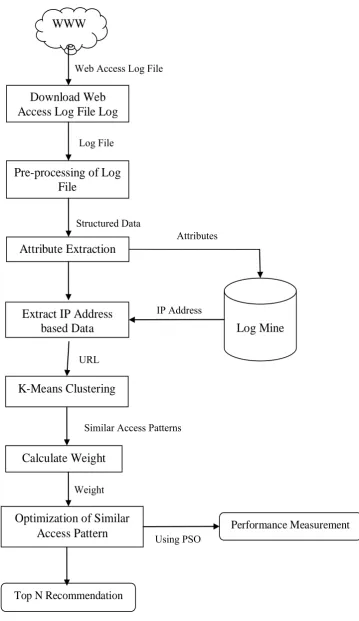
The user data and similar access pattern data is used for computing the weights for the user accessed URLs and this data is provided to the PSO algorithm. The PSO algorithm finds the most fitted URL, which can be the next visiting web page for the user. This section provides the formal introduction of the proposed system the next section provides the computation of the proposed data model for recommendation engine design. In order to understand the process of the proposed working recommendation system the figure 1 helps.
20
WWW
Download Web
Access Log File Log
e
Pre-processing of Log
File
Attribute Extraction
Extract IP Address
based Data
K-Means Clustering
Calculate Weight
Optimization of Similar
Access Pattern
Top N Recommendation
Log Mine
Performance Measurement
Figure 1: Particle Swarm Optimization based Recommender Engine
21 Attribute Extraction: In this phase, some of the attributes from the web log access file, which are going to be used in our proposed work, will be extracted for further process. Those attributes are user accessed IP address, Time stamp, requested URLs, response URL and methods
Log Mines Database: The extracted information from web access log file is required to use further, thus a separate relational database is prepared to store the extracted log information.
Extract IP Address Based Data: In this phase, again the database information is used and the user IP based data is extracted and grouped. This IP based information contains the entire URL accessed by a selected IP address.
K-Mean Clustering: In this phase, the k-mean clustering algorithm is used to find the similar data access pattern. This information contains the similar URLs accessed by different users. In this algorithm, the particular IP address data navigation sequences and the URLs are extracted, which are navigated in similar manner of the selected user IP address.
Weight Computation: In this phase, the user based IP address, accessed URLs and the similar web data accessed by the users are used for computing the weights of the user navigated URLs.
Optimization of Similar Access Pattern: The computed weights and the URLs are produced as an input to the PSO algorithm. The algorithm utilizes the URL data and their probability to optimize the recommender system.
Top N Recommendation: In this phase, finally the next user sequence of best fitted web URL is predicted by the system.
Performance Measurement: As the system predict the URL for next navigation of user, at the same time the algorithm’s performance is evaluated in terms of time complexity, i.e., build time and recommendation time and space complexity, i.e., memory consumption.
This section introduces the proposed model and the next section provides the algorithm steps of the proposed concept.
Proposed Algorithm
Recommender system is a personalization technique, which help users to personalize the web data according to his/her past browsing history. In our proposed system, we have use web access log data as an input. Web access log data is managed on the web server. Then, we preprocessed the log data for extracting meaningful attributes. Then, the preprocessed data is stored in data base for further use. After that, the web access log data is personalized through the IP address. Now, the extraction and grouping the entire data using clustering is done with the help of k-mean clustering. That result which is extracted from the K-mean clustering is used to develop a weight matrix. This weight matrix will be use in optimization technique, i.e., PSO algorithm. And finally, the most fitted URL is predicted as recommendation for the user and then, system performance will be measured as memory consumed, build time and recommendation time.
This section provides the detailed discussion about the proposed algorithm steps:
[1] Input web access log data.
[2] Pre-process the web access data with using web usage mining technique. [3] Store data in a temp table from the database.
[4] Select distinct IP address from the table data.
[5] Select entire data from table where IP address is selected IP address. [6] Create the sequence of navigated data selected from the database. [7] Apply K-mean to find group of similar navigation pattern users. [8] Compute the User Personalized URL sequence as:
𝑈𝑠𝑒𝑟 𝐴𝑐𝑐𝑒𝑠𝑠 𝑃𝑟𝑜𝑏𝑒𝑏𝑖𝑙𝑖𝑡𝑦 = 𝑇𝑒 𝑛𝑢𝑚𝑏𝑒𝑟 𝑡𝑖𝑚𝑒𝑠 𝑎 𝑈𝑅𝐿 𝑎𝑐𝑐𝑒𝑠𝑠𝑒𝑑 𝑏𝑦 𝑢𝑠𝑒𝑟
𝑇𝑜𝑡𝑎𝑙 𝑛𝑢𝑚𝑏𝑒𝑟 𝑜𝑓 𝑎𝑐𝑐𝑒𝑠𝑠 𝑈𝑅𝐿 𝑏𝑦 𝑎 𝑢𝑠𝑒𝑟 [9] Compute the Probability of a URL Access as:
𝑈𝑅𝐿 𝐴𝑐𝑐𝑒𝑠𝑠𝑖𝑛𝑔 𝑃𝑟𝑜𝑏𝑒𝑏𝑖𝑙𝑖𝑡𝑦 =𝑇𝑒 𝑛𝑢𝑚𝑏𝑒𝑟 𝑜𝑓 𝑡𝑖𝑚𝑒𝑠 𝑎 𝑈𝑅𝐿 𝑎𝑐𝑐𝑒𝑠𝑠𝑒𝑑 𝑏𝑦 𝑢𝑠𝑒𝑟𝑠
𝑇𝑜𝑡𝑎𝑙 𝑛𝑢𝑚𝑏𝑒𝑟 𝑜𝑓 𝑈𝑅𝐿 𝑒𝑥𝑖𝑠𝑡 𝑖𝑛 𝑑𝑎𝑡𝑎𝑏𝑎𝑠𝑒 [10] Compute the Weight Matrix as:
22 [12] Return highly fit URL as recommendation among all the data.
[13] After highly recommended URL, the system complexity in terms of performance is evaluated as
memory consumed, build time and recommendation time.
4. IMPLEMENTATION
The implementation of the proposed recommendation system is performed using java technology. Net Beans IDE has been used, which provides the tools and graphical interface for developing windows and web solutions at basic and enterprise level. The net beans project comprises of an open source integrated development environment (IDE), written in the java programming language and an application platform, which can be used as a generic structure to build any kind of application .At the time of implementation the web access log data is used as input. This web access log file contains the each user request and their response from the web server. The web access log file is used to extract the user behaviour information evaluation which is frequently used for recommendation system design. In our proposed system, 123loganalyser.com web access log has been used for the experimental analysis. It’s an experimental web access log file which is available for academician for their experimental purpose. This section describing the reference classes and libraries, implemented classes with their designed function and methods.
Reference Classes
This section contains the reference classes and information, which is utilized for implementation of the system.
java.util.ArrayList: The java.util.ArrayList class provides resizable-array and implements the list interface. Following are the important points about array list, it implements all optional list operations and it also permits all elements, includes null. It provides methods to manipulate the size of the array, which is used internally to store the list. The constant factor is low as compared to that with the linked list implementation.
java.util.HashMap: Hash table based implementation of the map interface. This implementation provides all of the optional map operations, and permits null values and the null key.
java.sql.*: Provides the application program interface (API) for accessing and processing data stored in a data source (usually a relational database).
java.util.Random: In order to guarantee this property, particular algorithms are specified for the class Random. Java implementations must use all the algorithms shown here for the class random, for the sake of absolute portability of java code. However, subclasses of class random are permitted to use other algorithms, so long as they adhere to the general contracts for all the methods.
java.io.File: The java.io.File class is an abstract representation of file and directory pathnames. Instances may or may not denote an actual file-system object such as a file or a directory. If it does denote such an object then that object resides in a partition. A partition is an operating system-specific portion of storage for a file system.
java.awt.image.BufferedImage: The Buffered Image subclass describes an image with an accessible buffer of image data. A buffered image is comprised of a color model and a raster of image data. The number and types of bands in the sample model of the raster must match the number and types required by the color model to represent its color and alpha components.
javax.swing.JTable: The JTable is used to display and edit regular two-dimensional tables of cells.
Implemented Classes
This section describes the classes, which are implementing in order to find the solution of the proposed issues in recommendation system.
LogAnalyser1: It is a simple GUI implementation, which first analyzes the web server log file then pre-processes it and preserved into the database for further use.
23 LogAnalyser3: That is a simple class implementation, which includes the intermediate computation of recommendation engine design.
Main Menu: This class is an implementation of the MDI (multiple document interfaces), that include the main menu to navigate the project documents.
Results: This class is a GUI based class which includes the techniques to visualize the performance outcomes of the implemented system.
Clustering: This class is an implemented K-mean clustering methods and functions. That clusters the data according to the user IP address. So in the proposed system, this class provides the group of clusters according to the user IP address
PSO: The given class is a kind of utility class, which contains the methods and functions for processing the weight matrix to find fittest URL as recommendation.
Methods and Signatures
This section includes the essential methods and functions that are implemented to execute desired task in implemented system.
GetVelocity (): This function is used to compute, the velocity of particles during the PSO algorithm execution.
Updateparticles (): This function is basically PSO based function, which is used to update the velocity of particles.
LoadData (): This function is used to load database information into the designed GUI.
Clust (): This function is used to compute the data clusters according to the IP address during the execution of clustering algorithm.
Getconnect (): This function is used to prepare the connection among database and GUI front end.
Getper: This function is used to compute the probability of a URL for occurring in a sequence.
Median: The given function is used to find median of the data array from the clustering algorithm.
5. EXPERIMENTAL ANALYSIS
In our experiment analysis, the web access log data is utilized for experimentation, the web access log file contains the each user request and their response from the web server. The web access log file is used to extract the user behaviour information evaluation, which is frequently used for recommendation system design. This data is much sensitive and private because it contains the entire user navigational data and access of web information. Therefore, due to confidentiality and security issues, these kinds of web access log files are publically not issued for experimentation purpose.
But some of the web access files are available on web for academic experimental purpose, which can be downloaded from w3c.com, 123loganalyzer.com and http://ita.ee.lbl.gov/html/traces.html. In our proposed system, 123loganalyser web access log has been used for the experimental analysis. In this section the proposed recommendation system is evaluated in different performance parameters. Additionally their performance is justified using the brief description of these parameters, which are memory consumed, build time and recommendation time.
Memory Consumption
24 .
Figure 2: Memory Consumption
Build Time
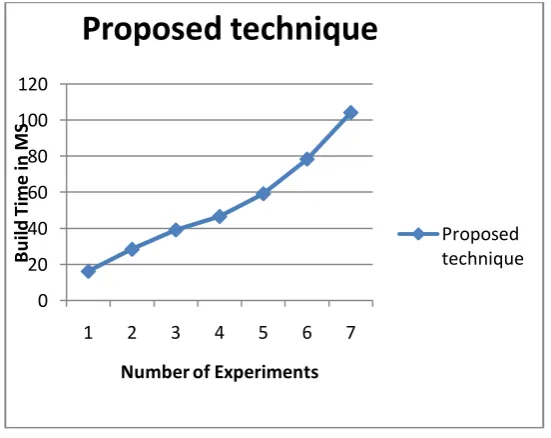
The amount of time required to learn patterns from the raw data is termed as the build time of the system. The evaluation of the build time is performed using, by finding the time difference between initialization of learning and completion of the learning. The evaluated build time during different experimentation is reported using Figure 3. In this figure the X axis shows the different number of instances as input during the training and the Y axis shows the respective build time in milliseconds. According to the obtained results the build time is increases as the number of instances for learning is increases. Additionally the performance of the algorithm shows the proposed algorithm consumes less time
Figure 3: Build Time
Recommendation Time
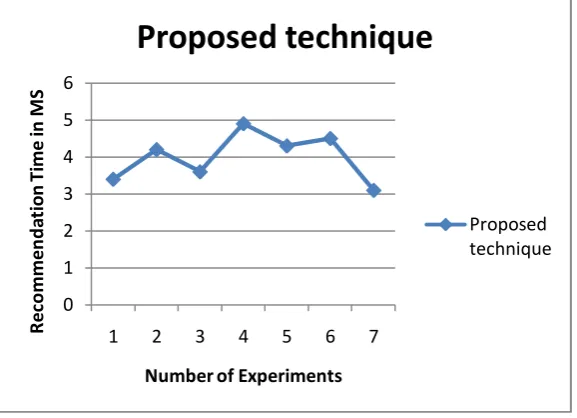
The total amount of time for predicting a URL for recommendation system is known as the recommendation time of the system. The recommendation time of the system during different experiments is reported using Figure 4. In this figure the X axis shows the different number of instances as input during the training and the Y axis shows the respective recommendation time in milliseconds. According to the obtained results the recommendation time is not much affected by the instances for learning and time required learning. That is found more nearer most of the time.
0 5000 10000 15000 20000 25000 30000 35000 40000 45000
1 2 3 4 5 6 7
M
em
o
r
y
In
K
B
Number of Experiments
Proposed technique
0 20 40 60 80 100 120
1 2 3 4 5 6 7
B
u
ild
T
im
e
in
M
S
Number of Experiments
Proposed technique
25 Figure 4: Recommendation Time
CONCLUSION AND FUTURE WORK
The key objective of the proposed recommendation engine design is implemented successfully and their performance is also evaluated. According to their experimental evaluation and their observational facts are provided as the conclusion of work and their limitations are given as future extension of the work. Recommendation system is a kind of program which analyzes the behaviour of the web access of any user and predicts their pattern of web navigation. In order to predict the user navigation patterns there are two kinds of model exist first statically technique and second is predictive technique. In this presented work a predictive technique is prepared using PSO algorithm. And for personalize the user behaviour the user IP based clustering technique is followed. Therefore, the proposed technique involves the k-mean clustering algorithm and the PSO algorithm for recommendation system design.
Table 6 Performance Summary
The demonstrated results show the performance of the proposed algorithm . The proposed model is efficient and provides accurate prediction and it is also producing most nearer recommendations with less resource consumption. In near future the limitations of the proposed work is required to investigate and some additional features are also required to add by investing the real world applications and recommendation will be extended with social networking and other real world data processing applications. There are lots of challenges in web mining to manage big data of the server and we need to solve them by apply different techniques on big log data .Our future work includes the suggestions on big data also. We have planned to work on implementing a dynamic recommender system by using some dynamic algorithms too.
REFERENCES
[1]. D. Dixit and J. Gadge, “Automatic Recommendation for Online Users Using Web Usage Mining”, Thadomal Shahani Engineering College, Bandra.
[2]. E. Saka and O. Nasraoui, “A Recommender System Based on the Collaborative Behavior of Bird Flocks”, National Science Foundation CAREER Award IlS-0133948.
[3]. M. Sajwan, K. Acharya and S. Bhargava, “Swarm Intelligence Based Optimization for Web Usage Mining in Recommender System”, International Journal of Computer Applications Technology and Research Volume 3– Issue 2, 119 - 124, 2014.
[4]. D. Prabha and R Rathipriya, “A Study on Swarm Intelligence Techniques in Recommender System”, International Conference on Research Trends in Computer Technologies (ICRTCT - 2013) Proceedings published in International Journal of Computer Applications® (IJCA) (0975 – 8887).
[5]. Personalization: Collaborative Filtering v/s Prediction Based on Benefit Theory, November 05, 2007,http://myshoppal.typepad.com/blog/2007/11/personalization.html.
[6]. M.P. Eirinak, “New Approaches to Web Personalization”, Ph.D. Thesis, Athens University of Economics and Business Dept. of Informatics May 2006.
[7]. “Recommendation Systems”, http://infolab.stanford.edu/~ullman/mmds/ch9.pdf.
[8]. B. Birla and S. Patel, “An Implementation on Web Log Mining”, International Journal of Advanced Research in Computer Science and Software Engineering, Volume 4, Issue 2, February 2014.
0 1 2 3 4 5 6
1 2 3 4 5 6 7
R
ec
o
m
m
en
d
at
io
n
T
im
e
in
M
S
Number of Experiments
Proposed technique
26 [9]. V.R.R. Nagarjuna, A. Ratnababu and M. Markandeyulu, A.S.K. Ratnam, “Web Mining: Methodologies, Algorithms and Applications”, International Journal of Soft Computing and Engineering (IJSCE), ISSN: 2231-2307, Volume-2, Issue-3, July 2012.
[10]. S. Chouhan, M. Shrivastava and K. Deshmukh, “A Noble Approach of Web Log Mining”, VSRD-IJCSIT, Vol. 2 (7), 2012, 590-596.
[11]. J. Wang and X. longsu,” An improved K-Means clustering algorithm” 978-1-61284-486-2/111$26.00 ©2011 IEEE. [12]. P.C. Vaz, D. Martins de Matos, B. Martins, P. Calado, “Improving an Hybrid Literary Book Recommendation System
through Author Ranking”, Proceedings of the 12th ACM/IEEE-CS joint conference on Digital Libraries, Pages 387-388, ACM New York, NY, USA ©2012.
[13]. S. Gong, “Learning User Interest Model for Content-based Filtering in Personalized Recommendation System”, International Journal of Digital Content Technology and its Applications (JDCTA) Volume6, Number11, June 2012. [14]. S. S. Suresh, M. M. Naidu and S. AshaKiran, “Design Pattern Recommendation System (Methodology, Data Model
and Algorithms)”, International Conference on Computational Techniques and Artificial Intelligence (ICCTAI'2011). [15]. W.Husain and Lam YihDih, “A Framework of a Personalized Location-based Traveler Recommendation System in
Mobile Application”, International Journal of Multimedia and Ubiquitous Engineering Vol. 7, No. 3, July, 2012. [16]. H. Wang, G. Li, H. Hu, S. Chen, B. Shen, H. Wu, W.S. Li and K.L Tan, “R3: A Real-Time Route Recommendation
System”, Proceedings of the VLDB Endowment, Vol. 7, No. 13Copyright 2014 VLDB Endowment 2150-8097/14/08. [17]. P. Brusilovsky, D.N. Chin, “Preface to the Special Issue on Personalization in Social Web systems”, Received: 5
November 2012 © Springer Science Business Media Dordrecht 2012.
[18]. H. Xu, R. Zhang, C. Lin, W. Gan, “Construction of E-commerce Recommendation System Based on Semantic Annotation of Ontology and User Preference”, Telkomnika Indonesian Journal of Electrical Engineering, Vol.12, No.3, March 2014, pp. 2028 ~ 2035.
[19]. X. Mu, Y. Chen, Y. Cao, Y. Lin, “Personalized Recommendation System Modeling in Semantic Web”, Advances in information Sciences and Service Sciences (AISS) Volume5, Number2, Jan 2013.
[20]. Mele, “Web Usage Mining for Enhancing Search-Result Delivery and Helping Users to Find Interesting Web Content”, WSDM’13, February 4–8, 2013, Rome, Italy. Copyright 2013 ACM 978-1-4503-1869-3/13/02.
[21]. D. Yang, D. Zhang, Z. Yu and Z .Wang, “A Sentiment-Enhanced Personalized Location Recommendation System”, 24th ACM Conference on Hypertext and Social Media1–3 May 2013, Paris, France Copyright 2013 ACM 978-1-4503-1967-6/13/05.
[22]. S. Ujjin and P.J. on “Particle Swarm Optimization technique in a Recommender System” Ujjin, S and Bentley, P. J. 2002. Learning User Preferences Using Evolution. In Proceedings of the 4th Asia-Pacific Conference on Simulated Evolution and Learning. Singapore.
[23]. S.K. Sharma and U. Suman, “A Trust-based Architectural Framework for Collaborative Filtering Recommender Systems,” International Journal of Business Information Systems (IJBIS), Inderscience publications, Switzerland, ISSN: 1746-0972, Vol.16, No.2, pp. 134-153, 2014.