INTRODUCTION
The dynamic development of the motor tech-nology, among others, showed that lubrication in its classic sense (plain bearings) is not recom-mended or even impossible, particularly at high and low temperatures.
Elimination of lubricants greatly improves the design and cuts the operating costs, for in-stance, improved operating conditions of a piston group help to reduce the fuel consumption and environment pollution (Posmyk, 2013; Wieleba et al., 2016).
In sliding pairs, especially those using even very poor lubricants, plastic wears far more than its metal counterpart. The wear mechanism and intensity of plastics are also highly dependent on the temperature, a function of pressures, sliding velocities, and friction coefficients in a given fric -tion center (Wieleba, 2013). At lower velocities, the wear intensity of plastics in friction is more dependent on pressure than on velocity, whereas the dependence is reversed at greater velocities. In practice, this means that the fillers mitigating
friction and wear processes should be used in ma-terial compositions and the mama-terials should be tested on friction and wear stands that provide for maximum approximation to the operating condi-tions of real friction pairs.
The materials displaying low friction resis-tances when operating with metals (PTFE, graph-ite, BN, MoS2, and the like) cannot be employed in their pure forms, chiefly due to their low co -hesive strength (low shear strength) (Wieleba, 2002). The attempts at reinforcing them with granular (metal, mineral, and organic) and fibrous (including organic and ceramic) fillers have im -proved their cohesion, yet also raised their fric-tion resistances by several to a dozen per cent, which exacerbates the thermal conditions in the friction spaces and reduces the resistance to the friction wear and load capacity. The attempts at reinforcing composites with the matrices of ther-mo- and chether-mo-setting or thermoplastic polymers (Choromański and Kowara, 2013) have improved the load capacity and resistance to friction wear, although the load capacities of such compos-ites continue to be limited to p×v ≤ 6 MPa×m/s.
New Polymer Composites Including a Phenol-Formaldehyde
Resin Binder Designed for Self-Lubricating Sliding Pair Elements
Sylwester Stawarz
1*, Magdalena Stawarz
1, Wojciech Kucharczyk
1,
Wojciech Żurowski
1,
Agnieszka Różycka
11 Kazimierz Pulaski University of Technology and Humanities in Radom, Faculty of Mechanical Engineering, ul. Stasieckiego 54B, 26-600 Radom, Poland
* Corresponding author’s e-mail: [email protected]
ABSTRACT
The paper presents the test results of composites used in self-lubricating sliding pairs where resol phenol-form-aldehyde (AW-1, FDP), novolak phenol-formphenol-form-aldehyde, and anthracene-phenol resins were applied as binders. Thermal resistance, load capacity, friction resistances, wear values, and formation of top layers of friction-coupled elements were studied. A model composite with 9 MPa×m/s load capacity and friction wear resistance greater than of the composites available in the domestic and international markets, comparable friction resistances, and lower production costs was developed.
Keywords: quality improvement, means of transport, composites, self-lubricating sliding pairs.
Volume 13, Issue 4, December 2019, pages 223–229 https://doi.org/10.12913/22998624/113089
Research Journal
Accepted: 2019.10.28Additionally, the production costs (energy con-sumption) of the composites are relatively high (Adam, 1999).
Our review of literature indicated a few stud-ies on the application of thermo-setting resins, e.g. phenol-formaldehyde resins, to such com-posites, successfully used in frictional composites that operate under extremely difficult conditions (Frost and Sullivan, 2002; Mindur, 2004; Stryc-zek, 2015; Mindur, 2008; Capanidis et al., 2014).
DESIGN OF EXPERIMENTAL TESTING
A thermo-setting resin reinforced with a fi -brous filler and high-slip substances, namely, PTFE including a solid lubricant (graphite) ad-dition, was adopted as a matrix (support) for our solution.
Specialist literature fails to offer any unam -biguous methods of producing the desirable tri-bological characteristics of composites as early as the stage of developing composition. There are no methods of choosing an optimum matrix of in-gredients and fillers, reasonable selection of types and proportions of composite ingredients. This requires persistent and arduous experimentation to select composite ingredients in order to arrive at the desirable friction and wear characteristics.
Thus, only a final tribological experiment with a finished sliding composite allows determining the real tribological characteristics.
Considering certain specific physicochemi -cal properties, e.g. type of friction electrification, technological and performance characteristics, e.g. processability, production costs or com-ponent availability, and based on the authors’ preliminary testing (Sierpacka et al., 2004), re-sol phenol-formaldehyde (AW-1, FDP), novolak phenol-formaldehyde, and anthracene-phenol resins were applied as binders, while the types and quantities of the modifiers were selected for the purposes of analysis. Linters cotton fiber served as the filler.
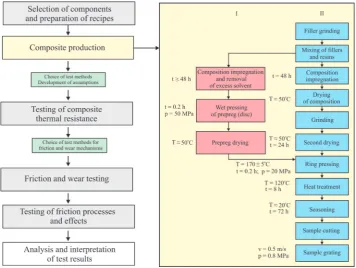
The design of experimental testing and meth-ods of composite production are illustrated in Figure 1.
Since major ingredients of the experimental composite varieties (Table 1) came as solid pow-ders (novolak phenols and anthracene- phenol tarflen suspensions), fibers (Linters), and liquids (AW1, FDP resins, PTFE water dispersions), ver-sions I and II of the test samples were produced. It was assumed that the mechanical and ther-mal load capacities and wear resistance of such a composite can be increased while maintaining the friction resistances at the existing levels.
TESTING OF THERMAL RESISTANCE
Since composites can be employed as part of the friction pairs operating under high loads and heightened temperatures, the thermal degradation of the composite was tested.
The choice, mounting, and lubrication of a bearing are the basic conditions affecting its cor -rect and long-term operation without seizure. The temperatures of properly mounted and lubricated bearings should not excess 70°C and stabilise at a lower level during operation (Wierzcholski, 2015).
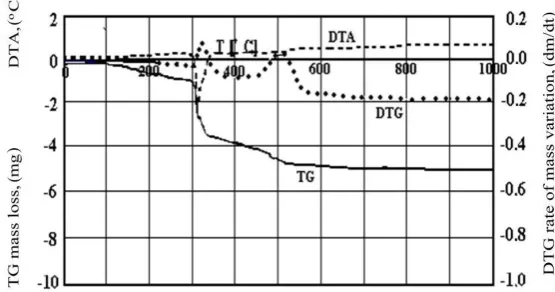
Differential thermal analysis supplies much information about the behaviour of polymers, plastics containing foreign ingredients, and poly-mer mixtures. A T-3427 type derivatograph was used for the analysis. The degradation processes of the composite structure under the impact of temperature correspond to the endothermal ef-fects on the DTA curve. The oxidation process is recorded as an exothermal effect.
These parameters were determined on the basis of TG (mass change) and auxiliary DTG (mass change derivative) curves. The tempera-ture at which the TG curve begins its inflection is
assumed to be the thermal stability temperature. Mass loss is treated as the characteristic quantity of the polymer degradation process. The initial mass change observed by means of the derivato-graph method that takes place at the initial degra-dation temperature (Tp) proves the thermal resis-tance of the material; therefore, this temperature was adopted as the parameter defining thermal resistance of the composite. The temperature up to which mass is not lost (temperature of thermal stability Tst, °C) was treated as the thermal resis-tance boundary.
Testing of thermal resistance demonstrated a maximum resistance of AW1 phenol-formalde-hyde resin (K1 – Figure 2) and FDP phenol-form -aldehyde resin (K4). A lower resistance was noted for the composite including an anthracene (K2) Novolak phenol-formaldehyde (K3) matrix. The composites based on the anthracene resin exhibit-ed a minimum thermal resistance; therefore, they are not recommended for high temperature ap-plications. The analysis of the test results pointed to the beneficial effects of phenol-formaldehyde resin matrix. The results are presented in Table 2.
Table 1. Composite ingredients
Ingredient Composite contents, (weight %)
K1 K2 K3 K4 KO
1 Phenol-formaldehyde resin AW 1 25 – – –
Production reference composite 85PTFE + 15%
graphite
2 Phenol-formaldehyde resin FDP – – – 25
3 Novolak resin – 25 – –
4 Anthracene resin – – 25 –
5 Linters cotton fibres 20 20 20 20
6 PTFE – water emulsion 44 44 44 44
7 Graphite 10 10 10 10
8 Silicone oil 1 1 1 1
TRIBOLOGICAL TESTING
Following the thermal resistance assessment, the composites with AW1 and FDP phenol-form-aldehyde resin matrices were selected for tribo-logical testing.
The tribological properties (friction coef-ficient and temperature, wear properties) were evaluated in a pair containing 49HRC steel using T-05 tester at the following friction parameters::
• Pressure range of 1.25÷10 MPa;
• Velocity of 0.5 m/s;
• Technically dry friction.
A satisfactory evaluation with no decohesion in the friction process under a load p·v ≥ 6 MPa·m/s along the path s = 104 m and friction temperature below 120oC, 2 mm deep from the surface was adopted as the criterion of the composite’s me-chanical and thermal properties.
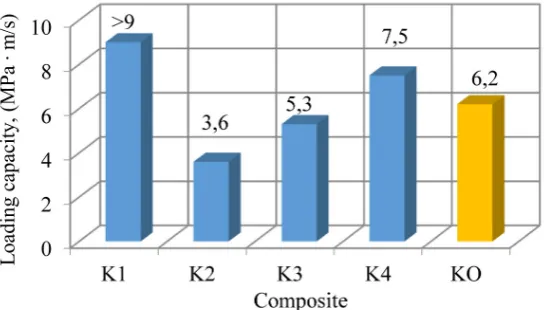
The tested composites attained the as-sumed loading capacities: production composite KO ~ 6.2 MPa×m/s, composite K4 ~ 7.5 MPa×m/s, and composite K1 > 9 MPa×m/s – Figure 3.
Further testing proved that the K1 composite (AW1 resin matrix), comparing to the K4 composite (FDP resin matrix), displayed a higher friction coefficient, especially under greater pressures
(mśr = 0.072 and 0.07, respectively) and similar wear intensity (Z = 32 and 27 mm/103 m). The KO production composite was subject to decohesion at a pressure of approx. 6 MPa – Figure 4.
The wear intensity was determined in weight and linear terms by means of T-05. Weight was converted to linear wear. Average wear inten-sities expressed in mm/103m are illustrated in Figure 5, which shows an averaged value of a full test cycle along the path of ~4×10⁴ m under a pressure above 1.25 ÷ 10 MPa.
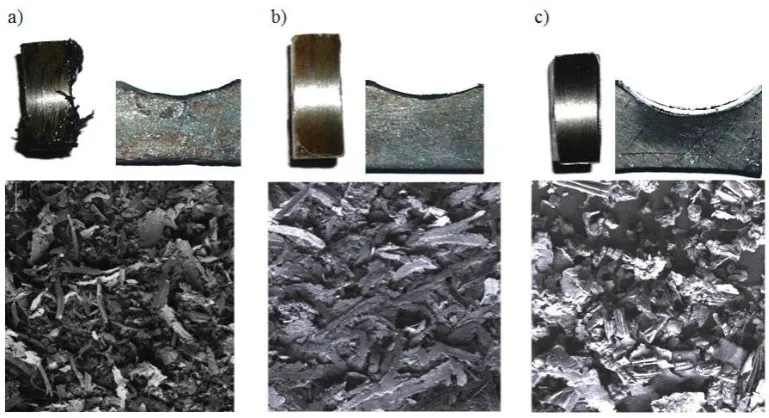
The wear mechanism of the composite in-cluding a phenol-formaldehyde resin matrix is essentially different from that of the production composite. The former is chiefly worn by remov -ing the cotton fibers impregnated with resin and PTFE (Figure 6a), with finer wear products in the case of AW1 resin matrix (Figure 6b). As far as the reference composite is concerned, the wear occurs by slicing and shearing of the filler (the wear products are of irregular and flake shapes) – Figure 6c. In addition, the plastic flow of the pro -duction composite and absence of flow traces for the composites including the phenol-formalde-hyde resin matrix were observed.
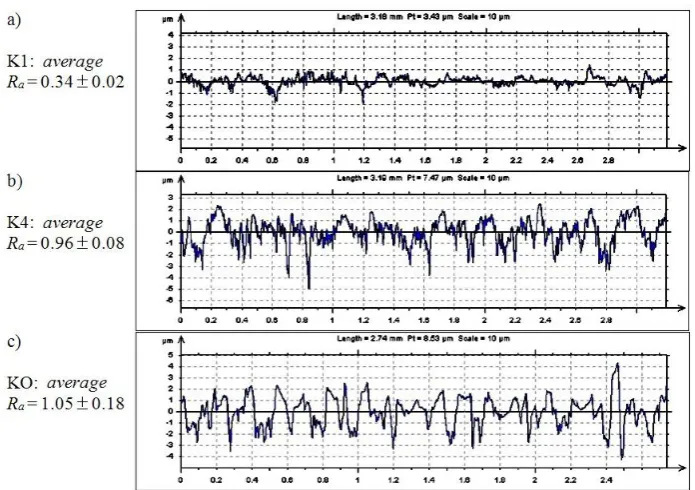
Roughness of the friction surfaces of the K1 and K4 composite pair elements, of the optimum tribological properties among the tested com-posites, and of the production composite, were measured.
The friction surface roughness of both the composite and its metal partner was minimum for the K1 composite (including AW1 phenol-form -aldehyde resin matrix) – Figure 7. As the surface roughness of composite BS 11 is lower than that of the K4 composite, the share of the molecular component in friction resistances can be expected to be greater with regard to AW1 resin matrix com-posite than for the FDP resin matrix comcom-posite.
Table 2. Results of derivatographic testing of com-posite thermal degradation
Sample name
Thermal resistance,
Tp (°C)
End of degradation temperature, Tk
(°C)
Mass loss,
m
∆
(%)K1 280 1000 23
K2 230 550 40
K3 220 600 38
K4 270 920 32
Fig. 4. Friction coefficient and temperature and wear intensity dependent on pressure
(v = 0.5 m/s) as produced by T-05 tester
Fig. 5. Average intensity of composite wear following a full testing programme with T-05 tester
Fig. 6. Observation of macrosamples, friction micro-surfaces, wear products, and SEM microstructures for wear traces following tribological tests of the composites:
RESULTS AND DISCUSSION
a) Thermal stability of the composites is in the temperature range of 220–280°C.
b) Total mass loss on thermal degradation of the composite (up to 1000°C) is within 18–42%, with approx. 53% for the FDP resin only.
c) The assumed loading capacity of ≥ 6 MPa×m/s was only attained by three composites test-ed: the KO production composite reached ~ 6.2 MPa×m/s, the K4 FDP phenol-formalde -hyde resin matrix composite ~ 7.5 MPa×m/s. The loading capacity of AW1 phenol-form-aldehyde composite was maximum, above 9 MPa×m/s;
d) The assumed friction coefficient (0.1 ± 0.05) was achieved by both phenol-formaldehyde resin matrix composites (under a pressure > 6.25 MPa). The friction coefficients of the tested and production composites were compa-rable for pressures < 6 MPa.
e) Wear in the entire programmed test cycle was somewhat lower for the K1AW1 phenol-form -aldehyde composite, slightly higher for the K4 FDP resin matrix composite, and multiple times greater for the production (reference, KO) composite.
CONCLUSIONS
With regard to all the evaluation indicators: thermal resistance, loading capacity, friction re-sistances, wear, and surface layer formation of friction paired elements, the resol phenol-formal-dehyde resin matrix composites (AW1 and FDP) produced the best results.
1. The better results of the resol phenol (liquid) resins when compared to the novolak (sol-id) presentations are likely to arise from an improved wettability of filler particles with a liquid matrix as a composition is prepared for pressing – Figure 1.
2. The slightly poorer results for the FDP resin matrix composites than for the AW1 resin ma-trix composites are likely to stem from a bet-ter dispersion of the PTFE particles across the matrix (PTFE and AW1 resin particles were suspensions and water solutions, respectively, in the process of homogenisation).
3. The wear mechanisms were found to vary for the different matrices, as demonstrated not only by surface roughness, but also the analysis of friction wear products.
4. A composite model was generated with an en-hanced loading capacity of 9 MPa×m/s and resistance to friction wear that is significantly
greater than of domestic and international com-posites available in the market, comparable friction resistances and lower production costs.
REFERENCES
1. Adam A., Grunthaler K. H. Self-lubricating bear -ing material and friction bear-ing made of such a materials. TriboTest Journal, 3, 1999.
2. Capanidis D., Wieleba W., Kowalewski P. Effect of
certain lubricative exploational preparations on the tribological properties of selected PTFE composites during friction with steel. 20th International Sym-posium on Surfactants in Solution. SIS, 533, 2014. 3. Choromański W., Kowara J. Personal rapid transit
vehicle with polyurethane wheels – modelling and simulation issues. The Archives Of Transport, 3–4, 2013, 71–79.
4. Frost & Sullivan. Analysis of the European com-mercial vehicle telematics market. Frost & Sulli-van Report, B042, 2002.
5. Mindur L. Współczesne technologie transportowe.
Radom, Wydawnictwo Politechniki Radomskiej, 2004.
6. Mindur L. Technologie transportowe XXI w.
Ra-dom: Wydawnictwo Instytutu Technologii Eksp-loatacji, 2008.
7. Posmyk A. Wpływ nowych technologii i materiałów na poprawę jakości transportu. Zeszy
-ty Naukowe Politechniki Śląskiej, Transport, 1882/78, 2013, 109–115.
8. Sierpacka B., Szumniak J., Stawarz S. Load-car-rying ability of polymeric composite designed for sliding bearings working on dry friction.
Tribolo-gia, 4, 2004, 195–202.
9. Stryczek J. Modelowe elementy hydrauliczne z tworzyw sztucznych. Hydraulika i Pneumatyka,
35/2, 2015, 5–8.
10. Wieleba W., Leśniewski T., Elemes D. A. Friction
processes of selected polymers sliding on steel and duralumin in a lubricant environment. Tribologia,
4, 2016, 201–210.
11. Wieleba W. Analiza procesów tribologicznych
zachodzących podczas współpracy kompozytów PTFE ze stalą. Wrocław: Wydawnictwo Politech
-niki Wrocławskiej, 2002.
12. Wieleba W. Bezobsługowe łożyska ślizgowe z po
-limerów termoplastycznych. Wrocław: Wydawnic
-two Politechniki Wrocławskiej, 2013.
13. Wierzcholski K. Probabilistic studies for
(slide&rolling) bearing seizure determination.