IJEEE, Volume 2, Issue 4 (August, 2015) e-ISSN: 1694-2310 | p-ISSN: 1694-2426
CONTROL STRATEGY FOR REACTIVE
POWER USING FC-TCR BY
MATLAB SIMULINK
Jitendra Kumar Dash
Electrical Engineering, Indira Gandhi Institute of Technology, Sarang, India
Abstract- The Electricity generation has been changing with the development of new techniques. Reactive Power compensation is required to change the natural electrical characteristics of the transmission line to make it more compatible with the prevailing load demand. The purpose of this paper presents the modeling and simulation of Static Var Compensator (SVC) in power system studies by MATLAB. SVC is basically a shunt connected static var generator whose output is adjusted to exchange capacitive or inductive current so as to maintain or control specific power variable. For this a Single Machine Infinite Bus (SMIB) system is modeled. In this paper, simple circuit model of Fixed Capacitor Thyristor Controlled Reactor is modeled and simulated. The simulation results are presented. The current drawn by the FC-TCR varies with the variation in the firing angle. The
Index Terms- FACTS, FC-TCR, SVC, SIMULINK, TCR
I. INTRODUCTION
The power system is an interconnection of generating units to load centers through high voltage electric transmission lines and in general is mechanically controlled. With the ongoing expansion and growth of electric utility industry, including deregulation in many areas, numerous changes are continuously developed. Also expansion of transmission system is always not possible. Due to these restrictions the whole power system is working to their maximum capacity which can lead to instability and blackouts under any severe fault conditions. To provide stable, secure, controlled, high quality electric power on today’s environment and to do better utilization of available power system capacities Flexible AC transmission systems (FACTS) controllers are employed to enhance power system stability in addition to their main function of power flow control. The dynamic behaviour of industrial loads requires the use of compensator that can be adapted to load changes. Unfortunately, the techniques frequently used for compensation are based on circuit controllers that alter the waveform of the signal subjected to control. Such is the case of the static compensator [1], [2], which must perform harmonic cancellation, reactive power compensation, power factor correction, and energy saving. Although the static compensator is commonly used and studied under sinusoidal voltage conditions, waveforms corresponding to the controlled current present high harmonic content [9]. This paper focuses on microprocessor based approach to
The voltage control and dynamic performance of power transmission system using SVC has been analyzed [4] and comparison of FACTS devices for power system stability enhancement Power System stability enhancement using FACTS controllers [5]-[[8]. A SIMULINK based approach of interactive Object-Oriented Simulation of Interconnected Power Systems [11] has been also done.
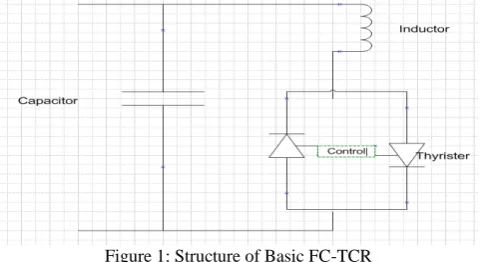
II. DESIGN & MODELLING OF FC-TCR In steady state, the SVC will provide some steady- state control of the voltage to maintain it the highest voltage bus at the pre-defined level. If the voltage bus begins fall below its set point range, the SVC will inject reactive power (Q net) into the system (within its control limits), thereby increasing the bus voltage back to its desired voltage level. If bus voltage increases, the SVC will inject less (or TCR will absorb more) reactive power (within its control limits), and the result will be to achieve the desired bus voltage. The Fixed Capacitor Thyristor-Controlled Reactor (FC-TCR) is a var generator arrangement using a fixed (permanently connected) capacitance with a thyristor controlled reactor as shown in Fig1.
Figure 1: Structure of Basic FC-TCR
thyristor controlled reactor, to yield the total VAR output (Q) required. At the maximum capacitive VAR output, the thyristor-controlled reactor is off (α= 90 degree). To decrease the capacitive output, decreasing delay angle α. At zero VAR output increases the current in the reactor, the capacitive and inductive current becomes equal and thus the capacitive and inductive VARs cancel out. With a further decrease of angle α, the inductive current becomes larger than the capacitive current, resulting in a net inductive VAR output. At zero delay angles, the thyristor-controlled reactor conducts current over the full 180degree interval, resulting in maximum inductive VAR output that is equal to the difference between the VARs generated by the capacitor and those absorbed by the fully conducting reactor.
Figure 2.Var Demand Vs Var output characteristics
Figure 3. V-I characteristics of the FC-TCR type VAR Generator
In Fig.3 the voltage defines the V-I operating area of the FC-TCR VAR generator and current rating of the major power components. To decrease the capacitive output, the current in the reactor is increased by decreasing delay angle α. At zero var output, the capacitive and inductive currents become equal and thus both the vars cancels out. With further decrease of angle α, the inductive current becomes larger than the capacitive current, resulting in a net inductive output.
OPERATING PRINCIPLES AND MODELING OF FC-TCR
The control of thyristor –controlled reactor in the FC-TCR type var generator needs to provide four basic functions as shown in figure 4. One function is Synchronizing timing. This function is usually provided by a phase locked loop circuit that runs in synchronism with ac system voltage and generates appropriate timing pulses with respect to peak voltage. The second function is the reactive (or admittance ) to firing angle conversion. This can be provided by a real time implementation of the mathematical relationship between the amplitude of TCR current (α) and the delay α.
The third function is the computation of the required fundamental reactor current IFL , from the requested total
output current Iq (sum total of the fixed capacitor and the
TCR currents)defined by the amplitude reference input IQRef
to the var generator control.
The fourth function is the thyristor firing pulse generation. This is accomplished by the firing pulse generator (gate drive) circuit which produces the necessary gate current pulse for thyristors to turn on in response to the output signal provided by the reactive current to firing angle converter.
The current in the reactor can be controlled from maximum (SCR closed) to zero (SCR open) by the method of firing delay angle control. That is, the SCR conduction delayed with respect to the peak of the applied voltage in each half-cycle, and thus the duration of the current conduction interval is controlled.
Figure 4: Basic Firing angle control of FC-TCR
When α =0, the SCR closes at the crest of the applied voltage and evidently the resulting current in the reactor will be the same as that obtained in steady state with a permanently closed switch. When the gating of the SCR is delayed by an angle α (0 ≤ α ≤ /2) with respect to the crest of the voltage, the current in the reactor can be expressed as follows
V (t) = V cos ωt (1)
il=1𝐿 𝑉 𝑡 =𝛼𝑤𝑡 𝑤𝑙𝑣 sin( 𝑤𝑡 − sin 𝛼) (2)
Since the SCR, by definition, opens as the current reaches
zero, is valid for the interval α ≤ ωt ≤ –α. For subsequent negative half-cycle intervals, the sign of the terms in equation (1) becomes opposite. In the above equation (1) the term (V/ωL) sin α = 0 is offset which is shifted down for positive and up for negative current half-cycles obtained at α = 0, as illustrated in Fig.3. Since the SCRs automatically turns off at the instant of current zero crossing of SCR this process actually controls the conduction intervals (or angle) of the SCR. That is, the delay angle α defines defines the prevailing conduction angle σ (σ -2α). Thus, as the delay angle α increases, the corresponding increasing offset results in the reduction of the conduction angle σ of the SCR, and the consequent reduction of the reactor current. At the maximum delay of α
expression related to the TCR can be found both in terms of α and σ.
It is evident that the magnitude of the current in the reactor varied continuously by delay angle control from maximum (α=0) to zero (α /2) shown in Fig.5, where the reactor current (α) together with its fundamental component (α) are shown at various delay angles α.
Fig 5.Operating Wave
The amplitude (α) of the fundamental reactor current (α) can be expressed as a function of angle α.
(α) =𝑤𝐿1 1 − 2 𝛼 −П1sin 2𝛼 (3) TCR can control the fundamental current continuously from zero (SCR open) to a maximum (SCR closed) as if it was a variable reactive admittance. Thus, an effective reactance admittance, , for the TCR can be defined. This admittance, as a function of angle α is obtained as:
=1
𝑤𝐿 (1 (
2
) ) (4)
III. REACTIVE POWER CONTROL USING FC-TCR
The compensation process should be carried out without important alteration of source signal quality due to the detrimental effects of non-linear loads. Some benefits are expected using compensation reduction of losses in distribution lines, harmonic content minoration, and power factor improvement. The dynamic behavior of industrial loads requires the use of compensator that can be adapted to load changes. Unfortunately, the techniques frequently used for compensation are based on circuit controllers that alter the waveform of the signal subjected to control. Such is the case of the static compensator which must perform harmonic cancellation, reactive power compensation, power factor correction, and energy saving.
Compensation with TCR consists of controlling the current in the reactor L from a maximum (thyristor valve closed) to zero (thyristor valve open) by the method of firing delay angle control. The fixed capacitor (FC) and TCR constitute a basic VAR-generator arrangement (FCTCR
Step By Step Algorithm
Step 1: Obtain the schematic structure of practical bus system (Sources, Transmission Lines, FACTS Devices and Load) using Simulink block set.
Step 2: Obtain the switching sequence of the FACTS Devices through Pulse Width Modulation scheme when operating between the active regions of the firing angles from 90degrees to 180degrees.
Step 3: Run the simulation and study the impact of FCTCR with normal conditions.
Step4: Obtain the voltage and reactive power quantities by connecting the above FACTS devices at different load nodes.
Step 5: Demonstrate the impact of FC-TCR device when subjected to vulnerable condition such as nonlinear load fault conditions.
IV.SIMULATION & RESULT
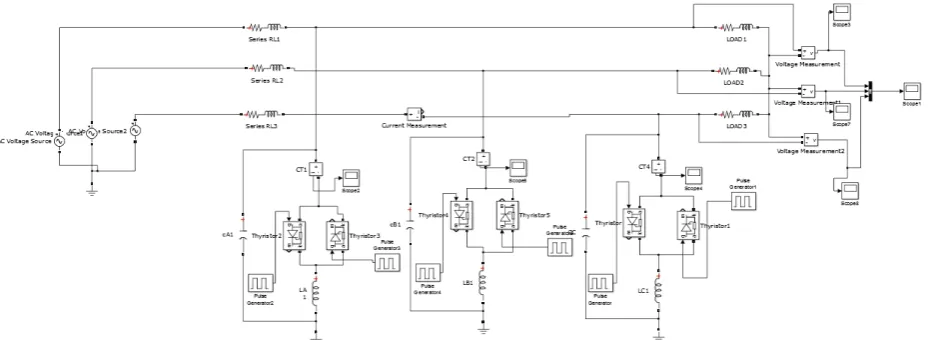
For simulation, the three phase AC voltage source is of 33KV, 50 Hz is taken. The parameters like local Load of 5 kW, Load of 10kW is taken with R= 0.01273 & L=50mH. The real power and reactive power in the load is measured using the Active & Reactive Power measurement Block. By different firing angle different Load Characteristics has been studied.
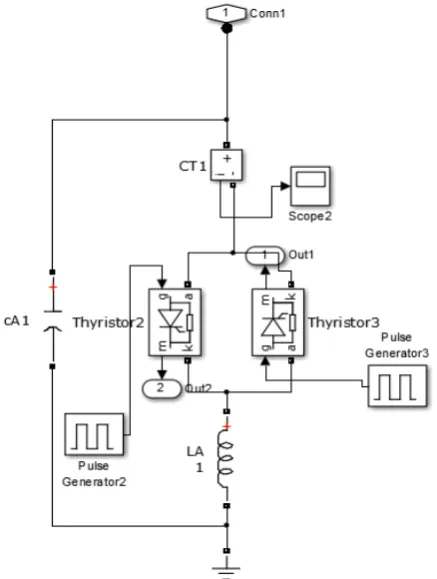
Figure 7: MATLAB simulink model of FC-TCR
Figure 8 : Current in phase A during fault
Figure 9: Current in A after fault clearing
Figure 10: Line Voltage before fault
Figure 11: Line Voltage after fault
Figure 12: Reactive power during fault
Figure 14: Model to study Variation of Firing angle and Inductance with Reactive Power
Table 1: Capacitor Constant & Inductance varying C in (microfarad) L in (mH) Q in (VAR)
100 100 33400
100 150 33445
100 250 33467
100 300 33510
Table 2: Variation of TCR Current and Reactive Power for different firing angles
Firing Angle (degree)
Current through TCR
Q in (VAR)
36 90 33430
72 68 33467
144 8 33520
V. CONCLUSION & FUTURE SCOPE
Hence it is concluded that SVC (Static VAR Compensator) will successfully control the dynamic performance of power system and voltage regulation of the power system. The variation of reactive power with the variation in the firing angle is studied. The range of reactive power control can be increased by using the combination of Thyristor-controlled reactor and fixed capacitor system. The circuit model for FCTCR is obtained and the same is used for simulation using MATLAB Simulink. From the simulation studies it is observed that the reactive power variation is smoother by using FC TCR system. Reactive power drawn by the load increases with FC-TCR, since the bus voltage increases. The simulation results are almost similar to the theoretical results. The control of reactive power in 8 bus system using FC-TCR is analyzed. The variation of reactive power with the variation in the firing angle is studied. The range of reactive power control can be increased by using the combination of thyristor controlled reactor and fixed Capacitor system. The circuit model for FC-TCR is obtained and the same is used for simulation using MATLAB Simulink. From the simulation studies it is observed that the reactive power variation is smoother by using FC TCR system. The simulation results are in line with the predictions.
REFERENCES
[1]S. Y. Lee, S. Bhattacharya, T. Lejonberg, A. Hammad, and S. Lefebvre, "Detailed modeling of static VAR compensators
using the electromagnetic transients program (EMTP)," IEEE Trans. on Power Delivery, vol. 7, no. 2, pp. 836-847, Apr. 1992.
[2] G. G. Karady, "Continuous regulation of capacitive reactive power ,"IEEE Trans. on power Delivery, vol. 7, no. 3, pp. 1466-73, Jul. 1992
[3] A. Gomez, F. Gonzalez, C. Lzquierdo, T. Gonzalez, and F. Pozo,"Microprocessor based control of an SVC for optimal load Compensation," IEEE Trans. on power Delivery, vol. 7, no. 2, pp. 706-712, Apr. 1992.
[4] Narain G. Hingorani, Laszlo Gyugi “ Understanding FACTS” IEEE press.
[5] Nang Sabai, and Thida Win “Voltage control and dynamic
performance of power transmission system using SVC”
World Academy of Science, Engineering and Technology,2008, Pp. 425-429.
[6] D. Murali ,”Comparison of FACTS devices for power system stability enhancement“.International Journal of Computer Applications (0975 – 8887) Volume 8– No.4,2010, Pp. 30-35.
[7] M.A Abibo, “Power System stability enhancement using
FACTS controllers” TheArabian Journal for Science and
Engineering Volume 34, Pp. 153-161.
[8] R. M. Mathur and R. K. Varma, “Thyristor Based FACTS Controller for Electrical Transmission System”, IEEE Press,
2002.
[9] F. Z. Gherbi, S. Hadjeri, and F. Ghezal, "Modeling and simulation of static varcompensator with Matlab," in Proc. 4th Int. Conf. on Computer Integrated Manufacturing,CIP’2007.
[10] T.Vijayakumar, .A.Nirmalkumar, “Harmonics Analysis of
Thyristor controlled Reactorcircuits”, International Journal of
Computer and Electrical Engineering, Vol. 2, No. 1, February,2010.
[11] Eric Allen, NielsLaWhite, Yong Yoon, Jeffrey Chapman,
and MarijaIlic´,”Interactive Object-Oriented Simulation of
Interconnected Power Systems Using SIMULINK “,IEEE
Transactionson Education,vol. 44, no.1, Feb.2001.
AUTHOR
Jitendra Kumar Dash – is currently studying M.tech in Indira Gandhi Institute of Technology, Sarang, Odisha. He received B.Tech degree in Electrical and Electronics from Silicon Institute of Technology, Bhubaneswar, India in 2013. His current research interests include Power system Protection and control.