http://dx.doi.org/10.9717/jmis.2015.2.1.187
187
I. INTRODUCTION
The importance of early education of software cannot be emphasized too much. However, in recently, it has not been adopted in the regular class and there is reduced uptake.
We have proceeded with a course similar to the one conducted before, a short-term computer information and technological communication course by using Arduino with selected outstanding students in the field of computer [1].
This course was implemented by one main instructor and three assistant instructors for 10 hours. Students who participated in this program completed 96 percent out of ten projects and the results of the educational curriculum were analyzed and provided direction for further research. In order to recognize the importance of software for youth, a short-term course was implemented at KAIST Creative Learning Center with a support of the minister of Science, ICT and Future Planning, and short term courses were developed, implemented, and analyzed for these students.
The course information is noted below [2].
Table 1. Information of Education
List Information Title Software Winter Camp
Participants Student between the ages of 12~15 from throughout the nation
Schedule 20~21, January, 2014
Place KAIST Creative Learning Center
Organizer Minister of Science, ICT and Future Planning
Supervisor Korea Foundation for the Advancement of Science and Creativity and App Center
Purpose Let student realize the importance of software and educate App Inventor and Arduino
The following are the three main objectives of the course. 1. Student can directly experience ITC(HW, SW, Network) convergence through education utilized smart phone and Arduino, and gain related interest.
2. Make student formulate and produce the work by educating Arduino easily and with fun.
3. Stimulate students’ curiosity and improve creativity.
A Short Course Development and Analysis to Recognize Importance
of Software for Youth using Arduino and App Inventor
Jooeun Shim
1,*, Jooyoung Ko
2, and Jaechang Shim
3Abstract
The aim of this study was to develop and analyze a short course educating App Inventor and Arduino that showed the importance of software for youth. The course consists of a total of 10 missions for a 4 hour course divided into 2 parts, each 2 hours respectively. We conducted a basic course of Arduino for hardware and software, Processing for server programming, and App Inventor for programming for smartphones. The final mission was to send a signal to a server with a smartphone and to control light connected to a relay which passes Arduino connected with a server and serial communication. Participants completed 95% of missions, and we found the course had an educational effect for improving creativity and realization of software importance.
Key Words: IT Education, Educational Technology, Arduino, Processing, App Inventor, Creativity.
Manuscript received March 30, 2015; Revised April 30, 2015; Accepted May 9, 2015. (ID No. JMIS-2015-0009)
Corresponding Author(*): Jooeun Shim , Graduate School of Education, University of Pennsylvania, Philadelphia, PA, USA, E-mail: [email protected]
2
Department of Multimedia, Andong National University, Andong, Korea, E-mail: [email protected]
3
188 The course contents consist of using Arduino,
Processing, and App Inventor.
1. [Arduino] Using Micom, learn LED manipulate temperature sensor, reading analog from illumination sensor, serial communication. Produce a light their own and control light by using relay.
2. [Processing] Control light with a wiring program. 3. [App Inventor] Manipulate the light by making a smartphone application.
A survey was conducted before and after the education through Google Survey.
II. COMPOSITION OF SHORT TERM
SOFTWARE EDUCATION
Various activities are conducted from both within and out of school student to recognize the importance of software and increase the students’ creativity, and among them the computer education area which took center stage. Especially, the programming course achieved recognition on its effectiveness, since it is effective for improving creativity and applicable in many areas [3]. Recently, ‘Scratch, Robot kit’ is a study which is effective in increasing problem solving skills and diffuse thinking, it is also effective in increasing creativity[4], yet it involves an inadequacy from a ‘fusion’ and ‘combination’ of SW, HW, Network point of view. In this study, we sought to enhance teenager software awareness with respect to ICT (Information and Communication Technology) and educational method for creativity. We sought to arouse interest and improve creativity through short term creativity ICT educational program for teenager. Consequently, the course was composed of 2 hours in 2 parts.
2.1. Arduino I (2 hours)
This course is a practice about understanding microcomputer hardware based simple Arduino [5] and writing program to manipulate light. The following table is time assignment and contents of course.
[Experiment 1] Practice input-output Arduino digital and analog serial communication.
Mission Time Contents
15 Course introduction (Arduino, bread board, resistance, light sensor, temperature sensor)
5 Achievement pretest:
http://goo.gl/b9MKRa
Expectation pretest: http://goo.gl/5LwAl0
1 10 Bilking LED and controlling speed
2 10 Turning on and off LED depending on the brightness
3 10 Reading temperature and printing on computer monitor with serial port
[Experiment 2] Controlling light with Arduino
Mission Time Contents
10 Component introduction (Principle of manipulating light, relay, light sensor, safety education).
4 20 Making 220V socket, switch and
light by hand
5 10 Turning on and off the light with relay connected to Arduino
6 10 Turning on and off light depending on the brightness
2.2. Wireless Arduino II (2 hours)
This course placed emphasis on developing an application with App Inventor [6] and controlling it in the wireless.
[Experience 3] Learning Processing [7], making server and printing signal from application on a screen.
Mission Time Contents
20 Processing introduction and practice 7 10 Turning on and off the light with
processing serial
8 10 Turning on and off the light using relay with processing sketch
10 Making processing server
[Experience 4] Controlling light with smart phone (Programming App Inventor)
Mission Time Contents
20 Introduction of App Inventor2
Practice basis of App Inventor (TalkToMe, Draw)
9 10 Changing ellipse color of server computer when press ON, OFF button
10 10 Turning on and off light with App Inventor
Organize 10 Wrapping up
Achievement posttest: http://goo.gl/58b1fo
http://dx.doi.org/10.9717/jmis.2015.2.1.187
189
III. EDUCATIONAL EQUIPMENT AND
IMPLEMENTATION
Before the education, we developed 50 pages of guidebook for the 4 hour course and education plan including 10 missions for the youths.
The educational team consists of one instructor, one doctor assistant instructor, and six assistants. Before the class, assistants were trained about the contents of the course and educational support for 30 minutes. This education were implemented using computer and internet in KAIST. However, since internet WiFi on many computers were not well connected due to the school security, there were some difficulties with processing the last mission. The following pictures are Arduino board and electronic components used in the course.
See Table 2 for the list of components used in the course.
Table 2. Components used in the course.
Number Component
1 Arduino board
1 USB cable
2 LED
1 Resistance 220 ohm
1 Resistance 10K ohm
1 PTC temperature sensor 1 Illumination sensor
1 Relay
1 220V light set (outlet-wire-socket-light)
1 Android smartphone
In order to prepare for the course, the following programs were installed in each practice computer.
1. Install Arduino http://arduino.cc 2. Install Processing http://processing.org 3. Install App Inventor http://appinventor.mit.edu 4. Install Chrome browser http://www.google.com/chrome
Assistants checked various environments of the class room.
1. Is internet connected? OK
2. Is smartphone connected with WiFi? 1/2 operation error 3. Does student have http://gmail.com ID?
4. Teaching material: Can student access to Naver Cafe?
Google Survey was used for the survey. The survey was not compulsory; only students who had an interest were asked to answer the questionnaire.
IV. EDUCATION RESULT ANALYSIS
To analyze the educational effect of the study, the survey was conducted among 50 students who participated in the educational program using Arduino for creativity improvement. Except for 8 non-responses and dishonest responses, 42 participants were finally chosen for the evaluation. Among the participants, 20 students had experience of robot or programming education before and 22 students had not.
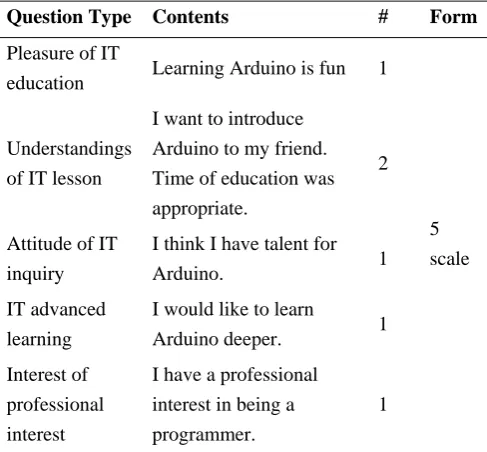
Table 3. Questionnaire item composition
Question Type Contents # Form
Pleasure of IT
education Learning Arduino is fun 1
5 scale Understandings
of IT lesson
I want to introduce Arduino to my friend. Time of education was appropriate.
2
Attitude of IT inquiry
I think I have talent for
Arduino. 1
IT advanced learning
I would like to learn
Arduino deeper. 1
Interest of professional interest
I have a professional interest in being a programmer.
190 Questionnaire items are on a one to five scale and
reconstituted satisfaction items from A Study on Training Courses Development and Analysis for Improving Creativity using Arduino. This evaluation consist of items selected from each element to measure pleasure, understanding, inquiry, advanced learning, and professional interest and by considering that the participants are teenage students and the survey’s available time. Items are a 5 point Likert scale and for further information, participants were asked to describe the reason for the answer.
In order to assess the difference between pretest and posttest, we performed a matching sample t test. There were significant differences on pleasure of IT education, attitude of IT inquiry, IT advanced learning, and interest of professional interest. The results for each question type are listed in Table 2.
While scores increased on item number 5 measuring ‘Attitude of IT inquiry’ were lower than other question types, it showed a significant difference (t=-5.83, df=41, p=.00). Analyzing subjects’ comments, it can be seen that what the students learned was still not enough and they solved problems with some of the instructors’ help. However, subjects also commented that although they were not proficient in Arduino, subjects thought they could do much better in the future, since learning Arduino is fun and entertaining. These findings could be viewed as subjects will learn more at a later date, and they will gain confidence and positive attitude.
Our findings revealed a significant difference on IT advanced learning (t=-.66, df=41, p=.00). This finding suggests the curriculum changed the students’ desire for advanced learning positively. This is supportive for achieving the goal of stimulating intellectual curiosity in IT.
For ‘Pleasure of IT education’, there was a significant difference (t=-5.71, df=41, p=.00). Especially, students’ felt more interested in manipulating Arduino on their own and it operate by the students’ order. This finding suggested that overall cognizance of IT education was positive and well maintained throughout the class.
V. CONCLUSION
In the present study, we developed short course for youth using Arduino and App Inventor. 50 students were asked to participate in the survey. Among 10 missions, 9 missions were completed 100%. However, having trouble with the WiFi, only half of the students completed the last mission.
Overall, the results from the learner satisfaction improved and showed a significant difference except for
the item number 2. Therefore, the short course developed in the present study is meaningfully effective for providing interest in software and recognition of importance of software. The next step for future studies would be to plan a course including zigbee and wireless network following on from the present course.
Table 4. Matching sample t test.
Question Type # period M SD df t p
Pleasure of IT education 3
pre 3.14 1.20
41 -5.71 .00 post 4.09 .95
Understandings of IT lesson
2 pre 3.42 1.06 41 -.38 .70 post 3.50 .96
7 pre 1.28 1.28 41 -6.45 .00 post 4.00 1.03
Attitude of IT
study 5
pre 2.45 .83
41 -5.83 .00 post 3.27 .94
IT advanced learning 4
pre 2.97 1.02
41 -6.66 .00 post 3.95 1.05
Interest of professional
interest
6
pre 2.73 1.21
41 -4.41 .00 post 3.47 1.21
REFERENCES
[1] J. E. Shim, J. Ko, J. C. Shim, “A Study on Training Courses Development and Analysis for Improving the Creativity using Arduino”, Proceedings of the Korea Multimedia Society Conference, vol. 1, 2014.
[2] Software Education Corps http://swkorea.org/
[3] S. Shin, P. Park, "Development of Program Model for Enhancing Creativity through SRD Program", Journal of Korea Contents Association, vol. 12, no. 9, pp.522-533, September 2012.
[4]J. Song, S. Cho, and T. Lee, “The Effect of Learning Scratch Programming on Students' Motivation and Problem Solving Ability”, Journal of Korean Institute of Information Scientists and Engineers, vol. 12, no. 3, pp. 323-332, March 2008.
[5] J Arduino, http://arduino.cc, IDE, 2013.
[6] App Inventor, http://appinventor.mit.edu, MIT & Google, 2014.
http://dx.doi.org/10.9717/jmis.2015.2.1.187
191
A
UTHORSJooeun Shim received the B. Ed. degree from Andong National University, Korea in 2014. Since 2015, she has been a student at the Graduate School of Education, University of Pennsylvania, USA. She received the best paper award from Korea Multimedia Society for course development of Arduino in 2014. Her major research interests include educational technologies, learning sciences, IT education, and creativity.
JooyoungKo received the B. S. degree in 1989 from Catholic University of Daegu and Ph.D. degree in 2010 from Andong National University, Korea. Since 2000, she has been a Lecturer of the Andong National University, Korea. Her research interests include smart clothing, multimedia applications, IoT.
192