PhD Dissertation
ICT International Doctoral School
Department of Information Engineering and Computer Science
UNIVERSITY OFTRENTO
Efficient Reasoning with
Constrained Goal Models
C
HIM
AIN
GUYENAdvisor:
Prof. Roberto Sebastiani
UNIVERSITY OFTRENTO
Co-Advisor:
Prof. John Mylopoulos
UNIVERSITY OFTRENTO
ABSTRACT
G
OALmodels have been widely used in Computer Science to represent softwarerequirements, business objectives, and design qualities. Existing goal modelling techniques, however, have shown limitations of expressiveness and/or tractability in coping with complex real-world problems.
In this work, we exploit advances in automated reasoning technologies, notably
Satisfiability and Optimization Modulo Theories (SMT/OMT), and we propose and formalize:
(i) an extended modelling language for goals, namely the Constrained Goal Model (CGM), which makes explicit the notion of goal refinements and of domain as-sumptions, allows for expressingpreferencesbetween goals and refinements, and allows for associatingnumerical attributesto goals and refinements for defining
constraintsandoptimization goalsover multipleobjective functions, refinements and their numerical attributes;
(i) a novel set of automated reasoning functionalities over CGMs, allowing for au-tomatically generating suitablerealization of input CGMs, under user-specified assumptions and constraints, that also maximize preferences and optimize given objective functions.
We are also interested in supportingsoftware evolutioncaused by changing require-ments and/or changes in the operational environment of a software system. For example, users of a system may want new functionalities or performance enhancements to cope with growing user population (requirements evolution). Alternatively, vendors of a sys-tem may want to minimize costs in implementing requirements changes (evolution requirements).
We propose to use CGMs to represent the requirements of a system and capture requirements changes in terms of incremental operations on a goal model. Evolution requirements are then represented as optimization goals that minimize implementation costs or customer value. We can then exploit reasoning techniques to derive optimal new specifications for an evolving software system.
ACKNOWLEDGEMENTS
Undertaking this Ph.D. has been a truly precious experience for me and I owe
my thanks to many people, without whose support and guidance, it would not
have been possible.
∗ ∗?∗ ∗
F
IRSTand foremost, I would like to express my special appreciation and thanks tomy advisor Professor Roberto Sebastiani who has been a tremendous mentor for me. I would like to thank him for his patience, motivation, and for the continuous support and encouragement he gave me over the past five years and beyond. Without his guidance and constant feedback, this Ph.D. would not have been achievable. I could not have imagined having a better advisor and mentor for my Ph.D. study.
Many thanks also to my co-advisor Professor John Mylopoulous for his support, insightful comments, patience, motivation, and immense knowledge. His courses“Requirements Engineering and Conceptual Modelling”has provided me the essential background in this work.
I would especially like to thank Professor Paolo Giorgini, who co-authored the article which is an essential part of my dissertation. I appreciate his precious guidance in the evaluation part of this project, his support in building the tool, and invaluable comments, discussions since the very first days of my Ph.D., as well as his time spending as my thesis committee member.
My sincere thanks also go to the rest of my thesis committee: Professor Tacchella Armando, Professor Fabiano Dalpiaz for taking their time serving as my committee members.
I would also like to thanks the staffs Anna Broll, Michela Angeli, Andrea Stenico, and Francesca Belton for helping me with administrative works so that I could channel my time into my research.
Many thanks to all of my friends who supported me in writing, and incented me to strive towards my goal, as well as for the pleasure and nice time which make up my social life. My deepest thanks go to my family. Words cannot express how grateful I am to my parents for all the sacrifices that they have made on my behalf. Last but not least, I would like to express appreciation to my beloved husband Thanh Binh Cao, who spent sleepless nights with and was always my support.
TABLE OF
CONTENTS
Page
List of Tables ix
List of Figures xi
Abbreviations xiii
1 Introduction 1
1.1 Contributions . . . 4
1.2 Structure of the Dissertation . . . 5
1.3 Publications . . . 6
I State of The Art and Research Baselines
7
2 State of the Art 9 2.1 KAOS . . . 92.2 Qualitative Goal Models . . . 10
2.3 I∗and Tropos . . . 12
2.4 Techne and Liaskos . . . 12
2.5 Feature Models and Search-Based Software Engineering . . . 13
3 Research Baselines 15 3.1 Goal Models . . . 15
3.2 Satisfiability Modulo Theories and Optimization Modulo Theories . . . 17
3.2.1 Satisfiability Modulo Theories . . . 17
II Contributions
21
4 Constrained Goal Models (CGMs) 23
4.1 The Backbone: Goals, Refinements, and Domain Assumptions . . . 23
4.2 Boolean Constraints: Relation Edges, Boolean Formulas and User Asser-tions. . . 25
4.2.1 Relation Edges . . . 25
4.2.2 Boolean Formulas . . . 26
4.2.3 User Assertion . . . 26
4.3 Arithmetical Constraints: Numerical Attributes and SMT(L RA) Formulas 27 4.3.1 Numerical Attributes . . . 27
4.3.2 SMT(L RA) Formulas . . . 28
4.4 Realization of a CGM . . . 29
4.5 Preferences in a CGM . . . 30
4.5.1 Preferences via Penalties/Rewards . . . 30
4.5.2 Preferences via Multiple Objectives . . . 31
4.5.3 Preferences via Binary Preference Relations . . . 32
4.6 UNSAT core . . . 34
5 Abstract Syntax and Semantics of CGM 45 5.1 Abstract Syntax . . . 45
5.2 Semantics . . . 51
6 Automated Reasoning with Constrained Goal Models 55 6.1 Encoding of CGMs . . . 56
6.2 Automated Reasoning on CGMs . . . 57
7 Requirements Evolution and Evolution Requirements with Constrained Goal Models 59 7.1 Motivation . . . 59
7.2 Requirements Evolution . . . 60
7.3 Evolution Requirements . . . 61
7.3.1 Recomputing realizations . . . 61
7.3.2 Maximizing familiarity . . . 62
7.3.3 Minimizing change effort . . . 63
7.3.4 Combining familiarity or change effort with other objectives . . . . 65
TABLE OF CONTENTS
7.4.1 Evolution Requirements . . . 65
7.4.2 Comparison wrt. previous approaches . . . 67
III Implementation and Evaluation
75
8 Implementation 77 8.1 CGM-Tool . . . 778.2 An example . . . 79
9 Empirical Experiments 93 9.1 Empirical Experiment . . . 93
9.2 Experiment Setup . . . 94
9.3 Experiment Evaluation . . . 95
10 User-Oriented Evaluation 121 10.1 Evaluation Objectives . . . 121
10.2 Experiment Design . . . 123
10.3 Experiment Procedure . . . 124
10.3.1 Study with Master Students . . . 125
10.3.2 Study with Doctoral Students . . . 126
10.4 Evaluation Result . . . 127
10.4.1 Training phase . . . 127
10.4.2 Application phase . . . 129
10.5 Result Analysis . . . 131
10.6 Threats to Validity . . . 133
11 Conclusions 135
L
IST OF
TABLES
TABLE Page
5.1 Summary of Goal Model Structure . . . 46
9.1 First group of experiments, summary of experimental data. . . 96
9.2 Second group of experiments, summary of experimental data. . . 97
9.3 First group of experiments,k=2: median time over solved instances. . . 98
9.4 First group of experiments,k=4: median time over solved instances. . . 99
9.5 First group of experiments,k=5: median time over solved instances. . . 100
9.6 First group of experiments,k=8: median time over solved instances. . . 101
LIST OF
F
IGURES
FIGURE Page
3.1 A Qualitative Goal Graph Example. . . 16
3.2 Another Qualitative Goal Graph Example. . . 16
4.1 Elements of a CGM. . . 36
4.2 Refinements in a CGM. . . 37
4.3 Relations in a CGM. . . 38
4.4 An example of a CGM with Boolean formula. . . 39
4.5 An example of a CGM with numerical attributes and arithmetic constraints. 40 4.6 An example of a CGM with one of its realizations. . . 41
4.7 An example of a CGM with an optimal realization. . . 42
4.8 An example of a CGM with a lexicographic optimal realization. . . 43
5.1 Traditional Goal Model and its CGM translation . . . 48
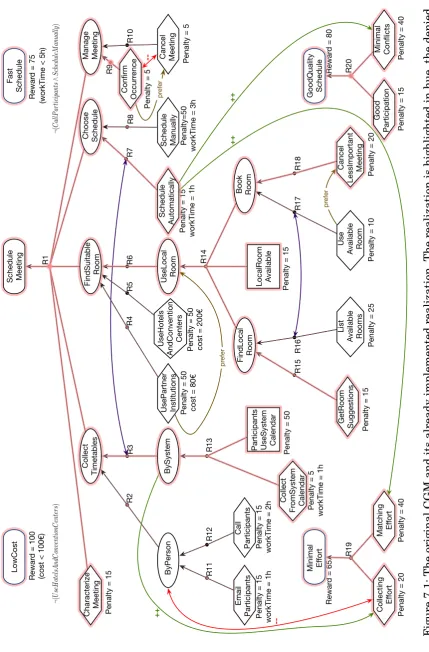
7.1 A Constrained Goal Model. . . 69
7.2 Requirements Evolution in a CGM. . . 70
7.3 Evolution Requirements in a CGM: optimizing realization. . . 71
7.4 Evolution Requirements in a CGM: maximizing familiarity. . . 72
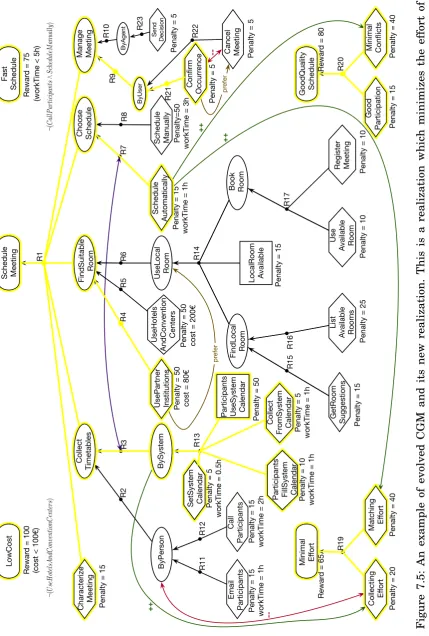
7.5 Evolution Requirements in a CGM: minimizing effort. . . 73
8.1 CGM-Tool: Component View . . . 78
8.2 CGM-Tool: How to create a new diagram . . . 82
8.3 CGM-Tool: Graphical User Interface . . . 83
8.4 CGM-Tool: Goal Graph Graphical Presentation Summary . . . 84
8.5 CGM-Tool: Elements . . . 85
8.6 CGM-Tool: Numerical Attributes . . . 85
8.7 CGM-Tool: Numerical Attributes Value . . . 86
8.9 CGM-Tool: Global Constraints . . . 87
8.10 CGM-Tool: Optimization Setting . . . 87
8.11 CGM-Tool: Well-formedness Analysis . . . 88
8.12 CGM-Tool: Scenario . . . 88
8.13 CGM-Tool: Open Scenario . . . 89
8.14 CGM-Tool: User’s Assertions . . . 89
8.15 CGM-Tool: Generate Realization . . . 90
8.16 CGM-Tool: Realization Presentation . . . 90
8.17 CGM-Tool: Results Analysis . . . 91
9.1 First group of experiments: overall median CPU times . . . 106
9.2 Second group of experiments: overall median CPU times . . . 107
9.3 First group of experiments,k=2 . . . 108
9.4 First group of experiments,k=4 . . . 109
9.5 First group of experiments,k=5 . . . 110
9.6 First group of experiments,k=8 . . . 111
9.7 Second Group of Experiment Result, k=2, p=6 . . . 112
9.8 Second Group of Experiment Result, k=2, p=8 . . . 113
9.9 Second Group of Experiment Result, k=2, p=12 . . . 114
9.10 Experimental Median Runtime Comparison: Cost Optimization . . . 115
9.11 Experimental Median Runtime Comparison: Time Optimization . . . 116
9.12 Experimental Median Runtime Comparison: Weight Optimization . . . 117
9.13 Experimental Median Runtime Comparison: Cost/Time/Weight Lex-Order Optimization . . . 118
9.14 Experimental Median Runtime Comparison: Weight/Time/Cost Lex-Order Optimization . . . 119
9.15 Percentage of unrealizable instances, both groups of experiments. . . 120
ABREVIATIONS
CGM Constrained Goal Model.
DAG Directed Acyclic Graph.
ISO International Organization for Standardization.
LTL Linear Temporal Logic.
OMT Optimization Modulo Theories.
RCP Rich Client Platform.
RE Requirements Engineering.
SMT Satisfiability Modulo Theories.
C
H
A
P
T
E
R
1
INTRODUCTION
This chapter presents the motivation of this dissertation as well as summarizes
the major contributions of this work. It also describes the structure of this
dissertation.
∗ ∗?∗ ∗
The concept of goal has long been used as a useful abstraction in many areas of com-puter science, like for example, artificial intelligence planning, agent-based system, and knowledge management. More recently, software engineering has also been using goals to model requirements for a software system, business objectives for enterprises, and design qualities [Ant96, AP98, DvLF93, VL01, GMNS04].
Goal-oriented Requirements Engineering (RE) approaches have gained popularity for a number of significant benefits in conceptualizing and analyzing requirements [VL01]. Goal models provide a broader system engineering perspective compared to traditional requirements engineering methods, a precise criterion for completeness of the requirements analysis process, and rationale for requirements specification, as well as automated support for early requirements analysis. Moreover, goal models are useful in explaining requirements to stakeholders, and goal refinements offer an accessible level of abstraction for validating choices among alternative designs.
KAOS offers a very expressive modelling language but the reasoning is undecidable and unscalable. I*, on the other hand, is missing constructs such as preferences, priorities, and optimization goals. Although more recent proposals, such as Techne [JBEM10, LMSM10] offer expressive extensions to goal models, they still lack some features of our proposal, notably optimization goals, and also lack scalable reasoning facilities.
As a result of these deficiencies, no goal modelling framework can express goals such as“Select which new requirements to implement for the next release, such as to optimize customer value while maintaining costs below some threshold”and be able to reason about it and generate a specification/solution for it. As another example, consider a situation where a goal model changes and a new specification/solution needs to be generated for the new goal model. In this case, the new specification/solution may be required to fulfil the evolution goal “Minimize implementation effort”or“Maximize user familiarity by changing as little as possible the new functionality of the system relative to the old one”. In both cases, we are dealing with requirements that are beyond the state-of-the-art for goal modelling and reasoning. As we will discuss in chapter 4, our proposal can accommodate such requirements both with respect to modelling and scalable reasoning.
We are interested in advancing the state-of-the-art in goal models and reasoning by proposing a more expressive modelling language that encompasses many of the modelling constructs proposed in the literature, and at the same time offers sound, complete, and tractable reasoning facilities. We are aiming for a goal modelling in the spirit of the qualitative goal model introduced in [SGM04], rather than a social dependency modelling language, such as i*. To accomplish this, we exploit advances in automated reasoning technologies, notablySatisfiability Modulo Theories (SMT)[BSST09] andOptimization Modulo Theories (OMT)[ST15a], to propose and formalize an extended notion of goal model, namelyConstrained Goal Models (CGMs).
CGMs treat (AND/OR) refinements as first class citizens, allowing associated con-straints, such as Boolean formulas or SMT/OMT formulas. For instance, when modelling a meeting scheduling system, we may want to express the fact that, to fulfil the nice-to-haverequirements of keeping the scheduling fast enough (e.g., strictly less than 5 hours) we cannot afford both the time-consuming tasks of performing the schedule manually (3 hours) and of calling the participants on-by-one by phone (2 hours). CGMs provide user-friendly constructs by which we can encode constraints like this, either by adding Boolean formulas on the propositions which label such requirements and tasks (e.g.,
FastSchedule,ScheduleManually, andCallParticipants), or by associating to those
mixed Boolean-arithmetical constraints on those variables and propositions (See chap-ter 4). To the best of our knowledge, this was not possible with previous goal modelling techniques, including that in [SGM04].
Moreover, we are living in an ever-changing world where the only constant is change. Changes need to be accommodated by any system that lives and/or operates in that world, biological and/or engineered. For software system, this is a well-known problem referred to as software evolution. There has been much work and interest on this prob-lem since Lehman’s seminal proposal for laws of software evolution [Leh80]. However, the problem of effectively supporting software evolution still accounts for more than 50% of total cost in a software’s lifecycle. We are only interested in software evolution caused by changing requirements and/or environmental conditions. We propose to model requirements changes through changes to a CGM model, and evolution requirements as optimization goals, such as“Minimize costs while implementing new functionalities”.
Taking advantage of CGMs’ formal semantics and the expressiveness and efficiency of current SMT and OMT solvers, we also provide a set of automated reasoning function-alities on CGMs. Especially, on a given CGM, our approach allows for:
(a) the automatic check of the CGM’s realizability (i.e. check if the goal model has any solution);
(b) the interactive/automatic search for realizations (i.e., specification/solution) of the CGM;
(c) the automatic search for“best”realization in term of penalties/rewards and/or of user-defined preferences;
(d) the automatic search for the realization(s) which optimize given objective functions;
(e) the automatic extraction of theUNSAT core(i.e., the self-contradictory part) of a unrealizable CGM (i.e., a goal model that does not have solution);
(f) the automatic search for realization(s) which optimize given evolution require-ments.
[ST15a, ST15c, ST15b], which is built on top of the SMT solver MATHSAT5 [CGSS13], as automated reasoning backend.1Our CGM-Tool can cope with goal models an order of magnitude beyond what has been reported in the literature in most cases. In some cases involving optimization goals, e.g.,“minimize development costs for the next release of software product S”, the CGM-Tool performs more modestly, but can still handle models of size in the hundreds of elements as reported in chapter 9.
1.1
Contributions
The main contributions of this work include:
I. An integration within one modelling framework of constructs that have been pro-posed in the literature in a piecemeal fashion, specifically,
(i) Allow for explicit labelling of goal refinements with Boolean propositions that can be interactively/automatically reasoned upon;
(ii) Provide an explicit representation of domain assumptions to represent precon-ditions to goals;
(iii) Allow for Boolean constraints over goals, domain assumptions and refinements; (iv) Provide a representation of preferences over goals and their refinements, by distinguishing between mandatory and nice-to-have requirements and by assigning preference weights (i.e., penalties/rewards) to goals and domain assumptions. Alternatively, preferences can be expressed explicitly by setting binary preference relations between pairs of goals or pairs of refinements; (v) Assign numerical attributes (e.g., resources like cost, worktime, and room)
to goals and/or refinements and define constraints and multiple objective functions over goals, refinements and their numerical attributes.
(vi) Define optimization goals over numerical attributes, such as cost or customer value;
II. Fully support automated reasoning over CGMs that is both sound and complete, i.e., returns only solutions that are consistent with CGM semantics, and all such solutions;
1The OMT solver OptiMathSAT can be used also as an SMT solver if no objective function is set: in
1.2. STRUCTURE OF THE DISSERTATION
III. Establish that reasoning with CGM models is scalable with models including thousands of elements.
IV. A proposal for modelling changing requirements in terms of changes to a CGM model.
V. The identification of a new class of evolution requirements, expressed as optimiza-tion goals in CGM.
VI. Fully support automated reasoning over changed goal models and evolution require-ments.
VII. A full experiment for evaluating the usability of CGM and CGM-Tool using enquiry evaluation method.
1.2
Structure of the Dissertation
Besides motivation and conclusion, the dissertation is organised into three main parts.
• chapter 1 presents the motivation of this project and summarizes the main contri-bution of the dissertation.
The first part of the dissertation, which focuses on the introduction of the state of the art and research baselines of the project, consists in the following chapters:
• chapter 2 gives overview of the state of the art and related work
• chapter 3 provides a succinct account of necessary background on goal modelling and on SMT/OMT;
The second part of the dissertation presents the main contributions of the dissertation, which are conveyed in the following chapters:
• chapter 4 introduces the notion of CGM through an example;
• chapter 5 introduces the syntax and semantics of CGMs;
• chapter 7 introduces the notion of evolution requirements and requirements evolu-tion through a working example, as well as formalizes the problem of automatically handling CGM evolutions and evolution requirements for CGMs;
The third part shows how the framework proposed in the dissertation is implemented and evaluated. This part consists of the following chapters:
• chapter 8 gives a quick overview of our tool based on the presented approach; • chapter 9 provides an experimental evaluation of the performances of our tool on
large CGMs, showing that the approach scales well with respect to CGM size. • chapter 10 presents the user-oriented evaluation on the CGM-Tool.
Finally, chapter 11 presents conclusions and future research challenges.
1.3
Publications
A significant part of the content of this dissertation has been published in
• Chi Mai Nguyen, Roberto Sebastiani, Paolo Giorgini, and John Mylopoulos. Multi-objective reasoning with constrained goal models.
Requirements Engineering Journal, pages 1–37, 2016
• Chi Mai Nguyen, Roberto Sebastiani, Paolo Giorgini, and John Mylopoulos. Requirements Evolution and Evolution Requirements with Constrained Goal Mod-els.
InProceedings of the 37nd International Conference on Conceptual Modeling, LNCS. Springer, 2016
• Chi Mai Nguyen, Roberto Sebastiani, Paolo Giorgini, and John Mylopoulos. Modeling and reasoning on requirements evolution with constrained goal models.
Software Engineering and Formal Method, 15th International Conference, SEFM
Part I
State of The Art and Research
C
H
A
P
T
E
R
2
S
TATE OF THE
ART
Past studies always have impacts on present works. This chapter gives a
quick overview of, and a brief comparison with, some of the state-of-the-art
goal-oriented modelling languages.
∗ ∗?∗ ∗
In this chapter, we will present a brief summary of the literature on goal-oriented modelling languages. [Lap05], [JMF08], and [BDHM13] provide better and deeper debates on the requirements modelling languages and the goal-oriented approach, their advantages and limitations.
2.1
KAOS
KAOS stands forKnowledge Acquisition in Automated Specification [DvLF93] orKeep All Objectives Satisfied [LL04]. "The overall approach taken in KAOS has three components: (i) a conceptual model for acquiring and structuring requirements models, with an associated acquisition language, (ii) a set of strategies for elaborating requirements models in this framework, and (ii) an automated assistant to provide guidance in the acquisition process according to such strategies." [DvLF93]
obstacle, requisite, requirement, assumption, scenario), and a process for eliciting goals, refining them, etc. (for example, specialization, refinement, conflict, operationalization, concern, and so on) [DvLF93, vLLD98, vLL00, LL04]. KAOS also came with a rich logical sublanguage including Linear Temporal Logic (LTL) for describing the elements of a KAOS model formally. KAOS, in other words, is a requirement engineering methodology which is defined on top of LTL. In KAOS framework, goals are refined into requirements. A KAOS specification is a collection of the three core models:
• Goal Model:represented goals and their assigned agents.
• Object Model: a UML model that refer to objects and their properties, which can
be derived from formal specifications of goals.
• Operation Model: defines various services to be provided by a software agent.
In summary, KAOS supports a rich ontology for requirements that goes well beyond goals, as well as an LTL-grounded formal language for constraints. This language is coupled with a concrete methodology for capturing and analyzing requirements problems. KAOS supports a number of analysis techniques including obstacle, inconsistency, and probabilistic goal analysis. Overall, KAOS is a well-developed methodology with a solid formal framework. KAOS, however, is undecidable, quite‘static’, and cannot efficiently cope with the possibility of requirements changing during the process. Moreover, unlike our proposal, KAOS does not support nice-to-have requirements and preferences, nor does it exploit SMT/OMT solver technologies for scalability.
2.2
Qualitative Goal Models
Qualitative goal model is introduced in [MCN92]. It is a modelling language that supports qualitative (strong and weak) evidence both in favour and against propositional goal. In [GMNS04], the model is formalized by replacing each proposition g, standing for a goal, by four propositions (F Sg,P Sg,P Dg, F Dg) representing full (and partial) evidence for the satisfied (and denial) faction of g. A traditional implication such as
p∧q→r is then translated into a series of implications connecting these new symbols, includingF Sp∧F Sq→F Sr,P Sp∧P Sq→P Sr, as well asF Dp→F Dr,F Dq→F Dr, etc.
The conflict betweenaand b is captured by axioms of the formF Sa→F Db, and it is
2.2. QUALITATIVE GOAL MODELS
inconsistency that can cause the whole model to be inferred. In fact, a predicate gcan be assigned a subset of truth values {F S,P S,F D,P D}.
[SGM04] extended the approach further by including axioms for avoiding conflicts of the form F Sa∧F Da. The approach recognized the need to formalize goal models so as to automatically evaluate the satisfaction of goals. The goal models are defined as AND/OR graphs, in which nodes are goals, and a number of relations is provided to indicate if the interaction is positive or negative, as well as to specify the strength of the interaction. These goal models, however, do not incorporate the notion of conflict as inconsistency, they do not include concepts other than goals, cannot distinguish optional from mandatory requirements and have no notion of a robust solution, i.e. solution without "conflict", where a goal can not be (full or partial) denied and (full or partial) satisfied at the same time.
In summary, this approach does support scalable reasoning using SAT-solving tech-niques. Our proposal subsumes this work in many ways, including a more expressive language and much more advanced SMT/OMT-solving technology.
There is one construct of [SGM04, GMNS04] that was left our of the CGM language:
+and−contributions from goals to goals. There are several reasons for this decision. In (un-constrained) goal models, formalizing (+,−) contributions requires a 4-value logic (fully/partially satisfied/denied). In principle our CGM framework could be extended to such a logic, with the following drawbacks:
(a) The size of the Boolean search space would extend from 2N to 4N. Given that reasoning functionality in this dissertation are much more sophisticated and compu-tationally more demanding than those in [SGM04, GMNS04], this might drastically reduce the efficiency of the approach.
(b) Unlike standard 2-value logic, which allows us to give a clear semantics of “realiza-tion”, without any vagueness, it is not obvious to us what a “realization” could be in 4-value logic. (E.g, should realization admit partially satisfied/denied tasks/ require-ments/assumptions? If yes, how should a user interpret a partially-satisfied/denied requirement/task/assumption in a realization returned by the system? In which sense a realization involving partial values can be considered “optimal" or “optimum”?)
constraints can be added. This DAG is such that a non-leaf goal is equivalent to the disjunction (“or”) of its refinements, and each refinement is equivalent to the conjunction (“and”) of its source goals. Relation edges, constraints and assertions further constrain this structure.
2.3
I
∗and Tropos
I∗is introduced in [Yu97].I∗is a modelling language that focuses on the interdependen-cies of actors within a socio-technical system. Ini∗, a goal is related to the organization context. I∗ provides two models: the Actor Strategic Dependency Model (SD model) and the actor Strategic Rationale Model (SR model). Typically, SD models are used to analyze the changes in the structure due to the introduction of the system-to-be, whilst SR models are used to explore the rationale behind the processes in the system and organizations.
One of i∗significant advantages is its ability to communicate with the stakeholders thanks to its easy to learn non-formal character. I∗, however, has no notion of conflict. I∗
does not provide the concepts to capture preferences, mandatory / optional requirements either. In short, I∗ is a lightweight modelling language, intended for early stages of
requirements analysis, and did not support formal reasoning until recent thesis work by [Hor12].
Tropos [CKM02] is a requirements-driven agent-oriented development methodology that usesi∗modelling framework as the base. In the development of agent-based system., the Tropos methodology can be used from the early requirements analysis through architectural design and requirements and detailed design to the implementation. I∗
modelling framework is used to model and reason about requirements and system configuration choices. Formal Tropos [FLM+04] is a formal specification language that adds constraints, invariants, pre- and post-conditions to Tropos. Tropos and Formal Tropos model can be validated by model-checking. The main deficiency of this work relative to our proposal is that Formal Tropos is expressive but not scalable.
2.4
Techne and Liaskos
2.5. FEATURE MODELS AND SEARCH-BASED SOFTWARE ENGINEERING
constitutes a first attempt to reason with nice-to-have requirements (aka preferences). The scalability experiments conducted used the SAT solver of Sebastiani et al. [SGM04] and added local search algorithms to deal with preferences. All experiments were con-ducted on a model with about 500 elements and the search algorithms returned maximal consistent solution but also near-solutions. [EBJ11] focuses on finding new solutions for a goal model that has changed (new goals were added/removed), such that the change minimizes development effort (EvoR1) or maximizes familiarity (EvoR2). Notice that EvoR1, EvoR2 are evolution requirements. The paper uses a Truth-Maintenance System (TMS) and builds algorithms on top for finding solutions to EvoR1, EvoR2 that “repair” the previous solution and construct a new one. The search algorithms would need to be redone if we used different evolution algorithms, unlike the CGM tool where you can formally express EvoR1, EvoR2 or variants, and search is handled by the backend OMT/SMT solver. [EBMJ12, EBJM14] continue the study of reasoning with Techne models and use SAT solvers and hand-crafted search algorithms to establish scalability for models size O(1K). Nevertheless, the resulting tools from this work still can’t handle quantitative optimization problems and other features of CGMs.
Liaskos [LMSM10, Lia12] has proposed extensions to qualitative goal models to support nice-to-have goals and preferences, as well as decision-theoretic concepts such as utility. This proposal is comparable to our proposal in this paper, but uses AI reasoners for reasoning (AI planners and GOLOG) and, consequently, does not scale very well relative to our proposal.
2.5
Feature Models and Search-Based Software
Engineering
Feature models[CBH11] share many similarities with goal models: they are
hierarchi-cally structured, with AND/OR refinements, constraints, and attributes. However, each feature represents a bundle of functionality or quality and as such, feature models are models of software configurations, not requirements. Moreover, reasoning techniques for feature models are limited relative to their goal model cousins.
Search-Based Software Engineering.Scalable reasoning for optimization problems
C
H
A
P
T
E
R
3
RESEARCH
BASELINES
This chapter provides some preliminary background of this dissertation. As
prerequisite knowledge, we assume that the reader is familiar with the syntax
and semantics of standard Boolean logic and of linear arithmetic over the
rationals.
∗ ∗?∗ ∗
Our research baseline consists of our previous work on qualitative goal models and of Satisfiability and Optimization Modulo Theories (SMT and OMT respectively). The aim of this chapter is to introduce the necessary background notions on these topics.
3.1
Goal Models
Qualitative goal models are introduced in [MCN92], where the concept of goal is used to represent respectively a functional and non-functional requirement in terms of a proposition. A goal can be refined by means of AND/OR refinement relationships and qualitative evidence (strong and weak) for/against the fulfilment of a goal is provided by contribution links labelled +,−etc. An example of the approach goal graph is showed in Figure 3.1. In [GMNS04], goal models are formalized by replacing each proposition
Figure 3.1: A performance goal graph of qualitative goal model as showed in [MCN92].
3.2. SATISFIABILITY MODULO THEORIES AND OPTIMIZATION MODULO THEORIES
(p∧q)→r is then translated into a series of implications connecting these new symbols, including (F Sp∧F Sq)→F Sr, (P Sp∧P Sq)→P Sr, as well asF Dp→F Dr,F Dq→F Dr,
etc. The conflict between goalsaandb is captured by axioms of the formF Sa→F Db, and it is consistent to have bothF Sa andF Da evaluated to true at the same time. As a result, even though the semantics of a goal model is a classical propositional theory, inconsistency does not result in everything being true. In fact, a predicate g can be assigned a subset of truth values {F S,P S,F D,P D}. An example of this approach goal model is showed in Figure 3.2.
[SGM04] extended the approach further by including axioms for avoiding conflicts of the form F Sa∧F Da. The approach recognized the need to formalize goal models so as to automatically evaluate the satisfiability of goals. These goal models, however, do not incorporate the notion of conflict as inconsistency, they do not include concepts other than goals, cannot distinguish “nice-to-have” from mandatory requirements and have no notion of a robust solution, i.e. solution without "conflict", where a goal can not be (fully or partially) denied and (respectively, fully or partially) satisfied at the same time.
3.2
Satisfiability Modulo Theories and Optimization
Modulo Theories
3.2.1
Satisfiability Modulo Theories
Satisfiability Modulo Theories (SMT) is the problem of deciding the satisfiability of a quantifier-free first-order formula Φ with respect to some decidable theory T (see [Seb07, BSST09]). In this paper, we focus on the theory of linear arithmetic over the rationals,L RA: SMT(L RA) is the problem of checking the satisfiability of a formula
Φ consisting in atomic propositions A1,A2, ... and linear-arithmetic constraints over rational variables like “(2.1x1−3.4x2+3.2x3 ≤4.2)”, combined by means of Boolean operators ¬,∧,∨,→,↔. (Notice that a Boolean formula is also a SMT(L RA) formula, but not vice versa.) AnL RA-interpretationµis a function which assigns truth values to Boolean atoms and rational values to numerical variables; µ satisfies Φ inL RA, written “µ|=Φ” –aka,µis asolutionforΦinL RA– iffµmakes the formulaΦevaluate to true;ΦisL RA-satisfiable iff it has at least oneL RA-interpretationµs.t.µ|=Φ.
Below is an example of SMT problem in SMT-LIBv2 format.
SMT-LIBv2 Example
(declare-fun x () Int)
(declare-fun y1 () Int)
(declare-fun y2 () Int)
(declare-fun z () Int)
(assert (= x y1))
(assert (not (= y1 z)))
(assert (= x y2))
(assert (and (> y2 0) (< y2 5)))
(check-sat)
(get-value (x z)
Here, four integer variables x, y1, y2 and zwere declared. Four SMT constraints were formulated: (x=y1),¬(y1=z), (x=y2), and (y2>0)∧(y2<5). The last two rows of code asks for the satisfiability of the problem and return the values ofx andzvariable in case of SAT. In other words, our SMT problem is to find if the formula
(x=y1)∧ ¬(y1=z)∧(x=y2)∧((y2>0)∧(y2<5)
satisfiable (x, y1, y1, zare integer) and in case of SAT, find the value of the variable x
and variablez. One possible result of the problem is (x=2) and (z=10).
3.2.2
Optimization Modulo Theories
AnOptimization Modulo Theories overL RA (OMT(L RA))problem〈Φ,〈ob j1, ...,ob jk〉〉
is the problem of finding solution(s) to an SMT(L RA) formulaΦwhich optimize the rational-valued objective functionsob j1, ...,ob jk, either singularly or lexicographically [NO06, ST12, ST15a, ST15c]). A solutionoptimizes lexicographically〈ob j1, ...,ob jk〉 if it optimizes ob j1 and, if more than one such ob j1-optimum solutions exists, it also optimizesob j2,..., and so on.
3.2. SATISFIABILITY MODULO THEORIES AND OPTIMIZATION MODULO THEORIES
solver OptiMathSAT [ST15a, ST15b] was able to handle optimization problems with up to thousands Boolean/rational variables in less than 10 minutes each.
Below is an example of OMT problem in SMT-LIBv2 format.
SMT-LIBv2 Example
(declare-fun x () Int)
(declare-fun y1 () Int)
(declare-fun y2 () Int)
(declare-fun z () Int)
(assert (= x y1))
(assert (not (= y1 z)))
(assert (= x y2))
(assert (and (> y2 0) (< y2 5)))
(minimize (+ x z))
(check-sat)
(get-value (x z))
Part II
C
H
A
P
T
E
R
4
CONSTRAINED
GOAL
MODELS
(CGMS)
One main contribution of this dissertation is the formalization of the
Con-strained Goal Models (CGMs). This chapter introduces the main ideas of
CGMs and the main functionalities of our CGM-Tool through a meeting
scheduling example.
∗ ∗?∗ ∗
In this chapter, we introduce the notions of constrained goal model (CGM), and of realization of a CGM; we also present the automated-reasoning functionalities of our CGM-Tool through a meeting scheduling example (Figure 4.5), without getting into the formal details yet. The formal semantics and reasoning of CGM will be presented in chapter 5 and chapter 6.
4.1
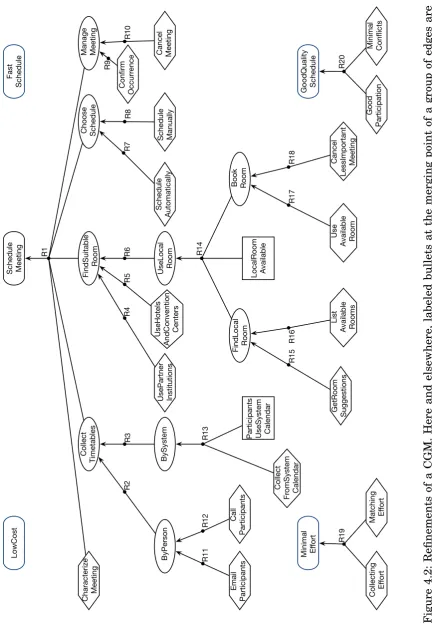
The Backbone: Goals, Refinements, and Domain
Assumptions
We model the requirements for a meeting scheduling system, including the functional requirementScheduleMeeting, as well as non-functional/quality requirementsLowCost,
FastSchedule, MinimalEffort and GoodQualitySchedule. They are represented as
Notationally, round-corner rectangles (e.g., ScheduleMeeting) are root goals, rep-resenting stakeholderrequirements; ovals (e.g.CollectTimetables) areintermediate goals;hexagons(e.g.CharacteriseMeeting) aretasks, i.e. non-root leaf goals; rectangles (e.g.,ParticipantsUseSystemCalendar) aredomain assumptions. We callelementsboth goals and domain assumptions.
Figure 4.1 shows all the elements of the Schedule Meeting CGM.
Labeled bullets at the merging point of the edges connecting a group of source ele-ments to a target element, as showed in Figure 4.2, are refinements
(e.g., (GoodParticipation,MinimalConflict)−−→R20 GoodQualitySchedule), while the
Ris denote their labels.
Remark 1. Unlike previous goal modelling proposals, refinements are explicitly labeled,
so that stakeholders can refer to them in relations, constraints and preferences. (This fact
will be eventually discussed with more details.) The label of a refinement can be omitted
when there is no need to refer to it explicitly.
Intuitively, requirements represent desired states of affairs we want the system-to-be to achieve (either mandatorily or preferably); they are progressively refined into intermediate goals, until the process produces actionable goals (tasks) that need no further decomposition and can be executed; domain assumptions are propositions about the domain that need to hold for a goal refinement to work. Refinements are used to represent alternatives of how to achieve a non-leaf element, i.e., a refinement of an element represents one of the alternative of sub-elements that are necessary to achieve it.
The principal aim of the CGM in Figure 4.2 is to achieve the requirement
ScheduleMeeting, which is mandatory. (A requirement is set to be mandatory by
means of user assertions, see below.) ScheduleMeeting has only one candidate re-finementR1, consisting in five sub-goals:CharacteriseMeeting,CollectTimetables,
FindASuitableRoom, ChooseSchedule, and ManageMeeting. Since R1 is the only
re-finement of the requirement, all these sub-goals must be satisfied in order to satisfy it. There may be more than one way to refine an element; e.g.,CollectTimetablesis further refined either by R10 into the single goal ByPerson or by R2 into the single
goalBySystem. Similarly,FindASuitableRoomandChooseSchedulehave three and two
4.2. BOOLEAN CONSTRAINTS: RELATION EDGES, BOOLEAN FORMULAS AND USER ASSERTIONS.
The requirements that are not set to be mandatory are “nice-to-have” ones, like
LowCost,MinimalEffort,FastSchedule, andGoodQualitySchedule(in blue in all
men-tioned above figures). They are requirements that we would like to fulfil with our solution, provided they do not conflict with other requirements.
4.2
Boolean Constraints: Relation Edges, Boolean
Formulas and User Assertions.
Importantly, in a CGM, elements and refinements are enriched by user-definedBoolean constraints, which can be expressed either graphically asrelation edges, or textually as
Boolean or SMT(L RA)formulas, or asuser assertions.
4.2.1
Relation Edges
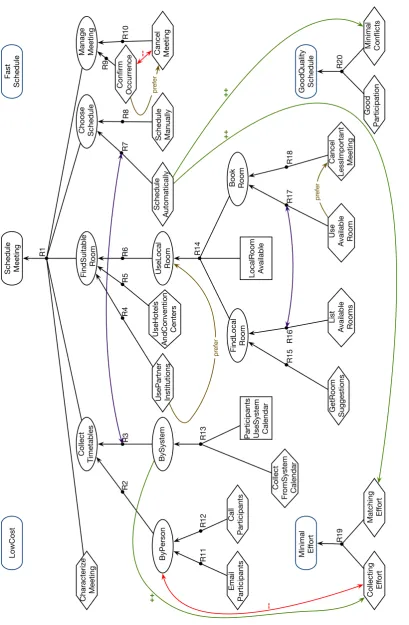
As showed in Figure 4.3, we have four kinds of relation edges.
• Contribution edges “Ei−−→++ Ej” between elements (in green in Figure 4.3), like
“ScheduleAutomatically−−→++ MinimalConflicts”, mean that if the source
ele-mentEi is satisfied, then also the target elementEj must be satisfied (but not vice versa).
• Conflict edges “Ei←→−− Ej” between elements (in red), like “ConfirmOccurrence←→−−
CancelMeeting”, mean that Ei andEj cannot be both satisfied.
• Refinement bindings “Ri←→Rj” between two refinements (in purple), like “R2←→R7”, are used to state that, if the target elements Ei and Ej of the two
refinementsRi and Rj, respectively, are both satisfied, thenEi is refined byRi if
and only if Ej is refined byRj. Intuitively, this means that the two refinements are bound, as if they were two different instances of the same global choice. For instance, in Figure 4.3, the refinements R2 andR7 are bound because such binding reflects a global choice between a manual approach and an automated one.
• Preferred edges “Ei º Ej” between elements (in light brown), like
“UsePartnerInstitutionsºUseLocalRoom”, mean that we would prefer a solution
4.2.2
Boolean Formulas
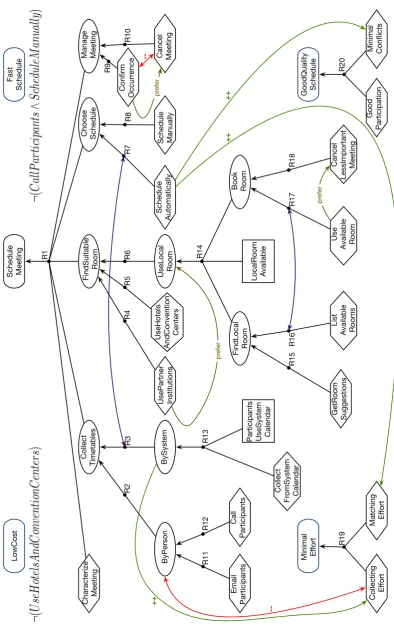
It is possible to enrich CGMs with Boolean formulas, representing arbitrary constraints on elements and refinements, as showed in Figure 4.4. Such constraints can be either
globalorlocal to elements or to refinements, that is, each goalGcan be tagged with a pair ofprerequisiteformulas©
φ+
G,φ−G
ª
–calledpositiveandnegativeprerequisite formulas respectively– so thatφ+G[resp.φ−G] must be satisfied whenG is satisfied [resp. denied]. (The same holds for each requirementR.)
For example, to require that, as a prerequisite forFastSchedule,ScheduleManually
andCallParticipantscannot be both satisfied, one can add a constraint to the positive
prerequisite formula ofFastSchedule:
φ+
FastSchedule def
= ...∧ ¬(ScheduleManually∧CallParticipants),
(4.1)
or, equivalently, add globally to the CGM the following Boolean formula:
FastSchedule → ¬(ScheduleManually∧CallParticipants).
(4.2)
Notice that there is no way we can express (4.1) or (4.2) with the relation edges above.
4.2.3
User Assertion
With CGM-Tool, one can interactively mark [or unmark] requirements as satisfied (true), thus making them mandatory (if unmarked, they are nice-to-have ones). In our example
ScheduleMeetingis asserted as true to make it mandatory, which is equivalent to add
globally to the CGM the unary Boolean constraint:
(ScheduleMeeting).
(4.3)
Similarly, one can interactively mark/unmark (effortful) tasks as denied (false). More generally, one can mark as satisfied or denied every goal or domain assumption. We call these marksuser assertions, because they correspond to asserting that an element must be true, i.e., it is part of the solutions we are interested in, or false, i.e., we are interested in solutions that do not include it.
Notice that the process of marking/unmarking elements is conceived to be more
4.3. ARITHMETICAL CONSTRAINTS: NUMERICAL ATTRIBUTES AND SMT(L RA) FORMULAS
4.3
Arithmetical Constraints: Numerical Attributes
and SMT
(
L RA
)
Formulas
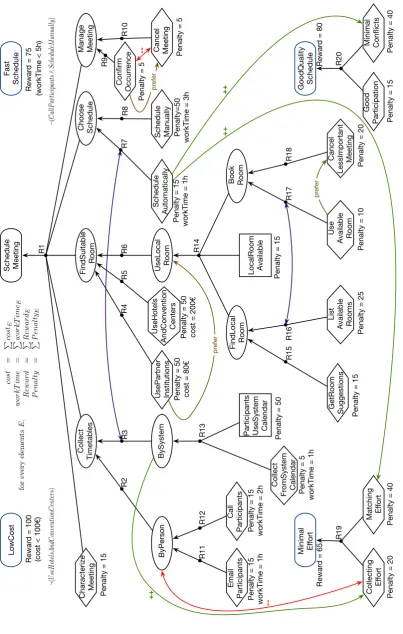
In addition to Boolean constraints, it is also possible to use numerical variables to express different numerical attributes of elements (such as cost, worktime, space, fuel, etc.) and to add arithmetical constraints in the form of SMT(L RA) formulas over such numerical variables, as showed in Figure 4.5.
4.3.1
Numerical Attributes
For example, suppose we estimate that fulfilling UsePartnerInstitutionscosts 80e, whereas fulfilling UseHotelsAndConventionCenterscosts 200e. With CGM-Tool one can express these facts straightforwardly by adding a global numerical variablecostto the model;
then, for every elementEin the CGM, CGM-Tool automatically generates a numerical variablecostErepresenting the attributecostof the element E, it adds the following defaultglobal constraint and prerequisite formulas:
(cost=X
E
costE),
(4.4)
for every elementE, φ+Edef=...∧(costE=0) (4.5)
φ−
E def
=...∧(costE=0),
(4.6)
that set the default value 0 for each costE. (Notice that (4.4) is a default global con-straint: the user is free to define his/her own objective functions.) Eventually, for the elements E of interest, one can set a new value for costE in case E is satisfied: e.g.,
costUsePartnerInstitutions:=80e and costUseHotelsAndConventionCenters:=200e. When so, CGM-Tool automatically updates the values in the positive prerequisite formulas (4.5), e.g.:
φ+
UsePartnerInstitutions def
= ...∧(costUsePartnerInstitutions=80) (4.7)
φ+
UseHotelsAndConventionCenters def
= ...∧(costUseHotelsAndConventionCenters=200), whereas the corresponding constraint (4.6) is not changed. Similarly, one can set a new value forcostEin case Eis denied by updating the values in the negative prerequisite formulas (4.6).
Remark 2. Notationally, we use variables and formulas indexed by the element they
attribute variables and formulas of the elements in an object-oriented notation (like,
e.g., UsePartnerInstitutions.cost and UsePartnerInstitutions.φ+) because they are more suitable to be used within the SMT(L RA)encodings .
4.3.2
SMT
(
L RA
)
Formulas
Suppose that, in order to achieve the nice-to-have requirement LowCost, we need to have a total cost smaller than 100e. This can be expressed by adding toLowCostthe prerequisite formula:
φ+
LowCost=. . .∧(cost<100). (4.8)
Hence, e.g., due to (4.4)-(4.8),LowCostandUseHotelsAndConventionCenterscannot be both satisfied, matching the intuition that the latter is too expensive to comply to the nice-to-haveLowCostrequirement.
Similarly tocost, one can introduce, e.g., another global numerical attributeworkTime
to reason on working time, and estimate, e.g., that the total working time for
ScheduleManually,ScheduleAutomatically,EmailParticipants,CallParticipants,
CollectFromSystemCalendarare 3, 1, 1, 2, and 1 hour(s), respectively, and state that
the nice-to-have requirementFastSchedulemust require a global time smaller than 5 hours. As a result of this process, the system will produce the following constraints.
(workTime=X
E
workTimeE)
(4.9)
φ+
FastSchedule def
= ...∧(workTime<5)
(4.10)
φ+
ScheduleManually def
= ...∧(workTimeScheduleManually=3)
(4.11)
φ+
ScheduleAutomatically def
= ...∧(workTimeScheduleAutomatically=1)
φ+
EmailParticipants def
= ...∧(workTimeEmailParticipants=1)
φ+
CallParticipants def
= ...∧(workTimeCallParticipants=2)
φ+
CollectFromSystemCalendar def
= ...∧(workTimeCollectFromSystemCalendar=1),
plus the corresponding negative prerequisite formula, which force the corresponding numerical attributes to be zero.
As with the previous case, e.g., the arithmetic constraints make the combination of
ScheduleManuallyandCallParticipantsincompatible with the nice-to-have
4.4. REALIZATION OF A CGM
Notice that one can build combinations of numerical attributes. E.g., if labor cost is 35e/hour, then one can redefinecostas (cost=P
EcostE+35·workTime), or introduce
a new global variabletotalCostas (totalCost=cost+35·workTime).
Remark 3. Although the nice-to-have requirements LowCost andFastSchedule look
isolated in Figure 4.5, they are implicitly linked to the rest of the CGM by means of
arithmetic constraints on the numerical variablescostandworkTimerespectively, which
implicitly imply Boolean constraints like:
LowCost → ¬UseHotelsAndConventionCenters
(4.12)
FastSchedule → ¬(ScheduleManually∧CallParticipants)
(4.13)
FastSchedule → ¬
ScheduleManually∧
EmailParticipants∧
CollectFromSystemCalendar
(4.14)
...
Nevertheless, there is no need for stakeholders to consider these implicit constraints, since
they are automatically handled by the internal OMT(L RA)reasoning capabilities of CGM-Tool.
4.4
Realization of a CGM
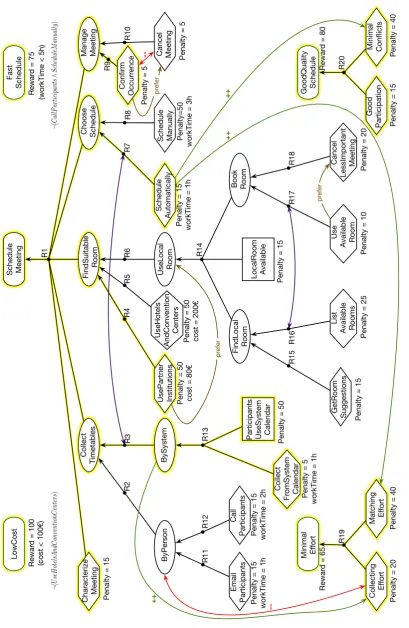
We suppose now thatScheduleMeetingis marked satisfied by means of an user assertion (i.e. it is mandatory) and that no other element is marked. Then the CGM in Figure 4.5 has more than 20 possiblerealizations. The sub-graph which is highlighted in yellow in Figure 4.6 describes one of them.
Apart from the mandatory requirement, the realization in Figure 4.6 allows to achieve also the nice-to-have requirementsLowCost,GoodQualitySchedule, andFastSchedule,
andMinimalEffort; in order to do this, it requires accomplishing the tasks:
CharacteriseMeeting,
CollectFromSystemCalendar,
UsePartnerInstitutions,
ScheduleAutomatically,
ConfirmOccurrence,
GoodParticipation,
MinimalConflicts,
CollectingEffort,
MatchingEffort,
and it requires the domain assumption
ParticipantsUseSystemCalendar.
4.5
Preferences in a CGM
In general, a CGM under given user assertions has many possible realizations. To distin-guish among them, stakeholders may want to expresspreferenceson the requirements to achieve, on the tasks to accomplish, and on elements and refinements to choose. The CGM-Tool provides various methods to express preferences:
• attributepenalties and rewardsfor tasks and requirements;
• introducenumerical objectivesto optimize;
• introducebinary preference relationsbetween elements and between refinements.
These methods, which are described in what follows, can also be combined.
4.5.1
Preferences via Penalties/Rewards
4.5. PREFERENCES IN A CGM
the total difference between the penalties and rewards. (This can be defined as a global constraint: (Weight=Penalty−Rewards).) When a model represents preferences, an OMT solver will look for a realization that minimizes its global weight. For instance, one minimum-weight realization of the example CGM, as shown in Figure 4.7, achieves all the nice-to-have requirements except MinimalEffort, with a total weight of −65, which is the minimum which can be achieved with this CGM. Such realization requires accomplishing the tasks:
CharacteriseMeeting,
EmailParticipants,
UsePartnerInstitutions,
ScheduleManually,
ConfirmOccurrence,
GoodParticipation, and
MinimalConflicts,
and requires no domain assumption. (This was found automatically by our CGM-Tool in 0.008 seconds on an Apple MacBook Air laptop.)
4.5.2
Preferences via Multiple Objectives
Stakeholders may define rational-valuedobjectivesob j1, ...,ob jkto optimize (i.e.,
maxi-mize or minimaxi-mize) as functions of Boolean and numerical variables —e.g.,cost,workTime,
totalCost can be suitable objectives— and ask the tool to automatically generate
realization(s) which optimize one objective, or some combination of more objectives (like totalCost), or which optimizes lexicographically an ordered list of objectives
〈ob j1,ob j2, ...〉. (We recall that a solution optimizes lexicographically an ordered list of objectives〈ob j1,ob j2, ...〉if it makesob j1optimum and, if more than one such solution exists, it makes alsoob j2optimum, ..., etc.) Notice that lexicographic optimization allows for defining objective functions in a very fine-grained way and for preventing ties: if the stakeholder wants to prevent tie solutions on objective ob j1, he/she can define one further preference criterion ob j2in case of tie onob j1, and so on.
Importantly, our CGM-Tool provides some pre-defined objectives of frequent usage.
Weight (see last paragraph) is one of them. Other examples of pre-defined objectives
• numUnsatRequirements: the number of nice-to-have requirements which are not included in the realization;
• numSatTasks: the number of tasks which are included in the realization;
• numUnsatPrefs: the number of user-defined binary preference relations which are
not fulfilled by the realization (see later).
For example, the previously-mentioned optimum-weight realization of Figure 4.7 is such that Weight= −65, workTime=4 and cost=80. Our CGM has many different minimum-weight realizations s.t. Weight= −65, with different values of cost and
workTime. Among them, it is possible to search, e.g., for the realizations with minimum
workTime, and among these for those with minimum cost, by setting lexicographic
minimization with order〈Weight,workTime,cost〉. This results into one realization with
Weight= −65,workTime=2 andcost=0 achieving all the nice-to-have requirements,
as shown in Figure 4.8, which requires accomplishing the tasks:
CharacteriseMeeting,
CollectFromSystemCalendar,
GetRoomSuggestions,
CancelLessImportantMeeting,
ScheduleAutomatically,
ConfirmOccurrence,
GoodParticipation,
MinimalConflicts,
CollectionEffort,
MatchingEffort,
and it requires two domain assumptions:
ParticipantsUseSystemCalendar, and
LocalRoomAvailable.
(This was found automatically by our CGM-Tool in 0.016 seconds on an Apple Mac-Book Air laptop.)
4.5.3
Preferences via Binary Preference Relations
4.5. PREFERENCES IN A CGM
stakeholders to express their preferences in a more direct way by stating explicitly a list of binary preference relations, denoted as “P1ºP2”, between pairs of elements of the same kind (e.g. pair of requirements, of tasks, of domain assumptions) or pairs of refinements. “P1ºP2” means that one prefers to haveP1 satisfied thanP2satisfied, that is, that he/she would rather avoid havingP1denied andP2satisfied. In the latter case, we say that a preference is unsatisfied. Notice thatP1ºP2 allows for having bothP1
andP2satisfied or both denied.
Remark 4. These are binary preferences, so that they say nothing on the fact that
each Pi is singularly desirable or not, which in case must be stated separately (e.g., by penalties/rewards.)
Thus, the fact that a binary preferenceP1ºP2allows for having bothP1andP2
de-nied should not be a surprise: if both{P1=f alse,P2=true}and{P1=f alse,P2=f alse}
violated P1ºP2, thenP2would play no role in the preference, so that it would reduce to
theunarypreference “I’d rather haveP1than not have it.” A dual argument holds for the fact thatP1ºP2allows for having both P1andP2satisfied.
Also, this choice is a very general one, since it implements the case in which〈P1,P2〉 are both desirable/rewarding (“I prefer winning the Turing Award than winning at the
lottery.”) like the preference between two requirements, as well as the opposite case in
which they are both undesirable/expensive (“I prefer being shot than being hanged.”) like
the preference between two tasks, plus obviously the trivial case in which P1is desirable
and P2 is undesirable. If this choice is considered too general, then the stakeholder can
add mutual-exclusion constraints, or combine it lexicographically with penalty/rewards,
or directly use penalty/rewards instead.
With CGM-Tool, binary preference relations can be expressed either graphically, via a “prefer” arc “P1prefer−→ P2”, or via and ad-hoc menu window. Once a list of binary preference relations is set, the system can be asked to consider the number of unsatisfied preference relations as a pre-defined objective (namelynumUnsatPrefs), and it searches for a real-ization which minimizes it. It is also possible to combine such objective lexicographically with the other objectives.
For example, suppose we want to minimize the total weight of our example goal model. As previously mentioned, there is more than one realization with minimum weight−65. Unlike the previous example, as a secondary choice we disregardworkTimeandcost; rather, we express also the following binary preferences:
ConfirmOccurrenceºCancelMeeting,
(4.15)
UsePartnerInstitutionsºUseLocalRoom,
UseAvailableRoomºCancelLessImportantMeeting.
(Notice that the goal preferences in (4.15) are pairwise equivalent to the following refinement preferences:
R9ºR10, R4ºR6, andR17ºR18 (4.16)
because the refinements in (4.16) are all single-source ones, whose sources are pairwise the goals in (4.15).)
Then we setnumUnsatPrefsas secondary objective to minimize after Weight, that is, we set the lexicographic order〈Weight,numUnsatPrefs〉. Then our tool returned the same realization of Figure 4.7 instead of that in Figure 4.8. (This solution was found in 0.018 seconds on an Apple MacBook Air laptop.)
4.6
UNSAT core
It is possible that a CGM is over-constrained, therefore, it is unrealizable, in other words, unsatisfiable. In such case, we can extract the UNSAT-core, i.e., the internal conflicts that cause the CGM to be unrealizable. For example, considered the CGM showed in Fig-ure 4.5, if the domain assumptionParticipantsUseSystemCalendarcannot be achieved, we cannot EmailParticipantsfor some reason, and we want to have FastSchedule, then clearly this model is over-constrained and unrealizable. The problem is because we will need to add three more constraints to the global constraints:
Φdef=. . .¬ParticipantsUseSystemCalendar∧ ¬EmailParticipants∧FastSchedule.
Such constraints will cause conflicts in the model.
4.6. UNSAT CORE
can only be obtained by using the refinementR2 as the result. This means ByPerson must be true. As the refinement R3is unachievable, this lead us to unable to use the refinement R7to refine the goalChooseSchedule. This is because the two refinements are bonding. Therefore, the goal ChooseSchedule can only be obtained by using R8. This means that the taskScheduleManuallymust be true. SinceEmailParticipantsis false,ByPersoncan only be refined byR12. This means that the taskCallParticipants
must be true. However, the requirementsFastSchedulecannot be satisfied when both
CallParticipantsandScheduleManuallyare true (as stated in Equation 4.13). Hence,
the UNSAT core of the CGM is:
(i) the mandatory requirementScheduleMeeting, (i) the constraint (FastSchedule),
(i) the constraint¬(ParticipantUseSystemCarlendar), (i) the constraint¬(EmailParticipants),
(i) the constraint (FastSchedule→ ¬(CallParticipants∧ScheduleManually)),
(i) the refinement bonding R3←→R7, (i) the refinementR1ofScheduleMeeting,
(i) the refinementR2and R3 ofCollectTimetables,
LowCost Schedule Meeting Fast Schedule Characterize Meeting Collect Timetables FindSuitable Room Choose Schedule Manage Meeting ByPerson BySystem UsePartner Institutions UseHotels AndConvention Centers UseLocal Room Schedule Manually Schedule Automatically Confirm Occurr ence Cancel Meeting Email Participants Call Participants
Participants UseSystem Calendar
Collect Fr omSystem Calendar FindLocal Room LocalRoom A vailable Book Room
Minimal Eff
4.6. UNSAT CORE R1 R2 R4 R5 R6 R7 R10 R9 R11 R12 R13 R14 R15 R18 R19 R20 R3 R8 R16 R17 LowCost Schedule Meeting Fast Schedule Characterize Meeting Collect Timetables FindSuitable Room Choose Schedule Manage Meeting ByPerson BySystem UsePartner Institutions UseHotels AndConvention Centers UseLocal Room Schedule Manually Schedule Automatically Confirm Occurr ence Cancel Meeting Email Participants Call Participants
Participants UseSystem Calendar
Collect Fr omSystem Calendar FindLocal Room LocalRoom A vailable Book Room
Minimal Eff
R1 R2 R4 R5 R6 R7 R10 R9 R11 R12 R13 R14 R15 R18 R19 R20 R3 R8 R16 R17 LowCost Schedule Meeting Fast Schedule Characterize Meeting Collect Timetables FindSuitable Room Choose Schedule Manage Meeting ByPerson BySystem UsePartner Institutions UseHotels AndConvention Centers UseLocal Room Schedule Manually Schedule Automatically Confirm Occurr ence Cancel Meeting Email Participants Call Participants
Participants UseSystem Calendar
Collect Fr omSystem Calendar FindLocal Room LocalRoom A vailable Book Room
Minimal Eff
4.6. UNSAT CORE R1 R2 R4 R5 R6 R7 R10 R9 R11 R12 R13 R14 R15 R18 R19 R20 R3 R8 R16 R17 LowCost Schedule Meeting Fast Schedule Characterize Meeting Collect Timetables FindSuitable Room Choose Schedule Manage Meeting ByPerson BySystem UsePartner Institutions UseHotels AndConvention Centers UseLocal Room Schedule Manually Schedule Automatically Confirm Occurr ence Cancel Meeting Email Participants Call Participants
Participants UseSystem Calendar
Collect Fr omSystem Calendar FindLocal Room LocalRoom A vailable Book Room
Minimal Eff
R1 R2 R4 R5 R6 R7 R10 R9 R11 R12 R13 R14 R15 R18 R19 R20 R3 R8 R16 R17 LowCost Schedule Meeting Fast Schedule Characterize Meeting Collect Timetables FindSuitable Room Choose Schedule Manage Meeting ByPerson BySystem UsePartner Institutions UseHotels AndConvention Centers UseLocal Room Schedule Manually Schedule Automatically Confirm Occurr ence Cancel Meeting Email Participants Call Participants
Participants UseSystem Calendar
Collect Fr omSystem Calendar FindLocal Room LocalRoom A vailable Book Room
Minimal Eff
ort GoodQuality Schedule Collecting E ff ort Matching E ff ort GetRoom Suggestions List A vailable Rooms Use A vailable Room Cancel LessImportant Meeting Good Participation Minimal Conflicts --++ ++ ++ ¬ ( U se H ot el sAn dC on ve nt io nC en te rs ) ¬ ( Ca llP ar ti ci pa nt s ^ Sc he du le M an ua lly ) Rewar
d = 100
Rewar
d = 75
Penalty = 15 Penalty = 15
workTime = 1h
Penalty = 15 workTime = 2h
Penalty = 5
workTime = 1h
Penalty = 50
Penalty = 50 cost = 80
€
Penalty = 50 cost = 200
€
Penalty = 20
Penalty = 40
Penalty = 15
Penalty = 40
Rewar
d = 65
Rewar
d = 80
Penalty = 15 workTime = 1h
Penalty=50
workTime = 3h
Penalty = 5
Penalty = 5
Penalty = 15
Penalty = 25
Penalty = 15
Penalty = 10
Penalty = 20
(cost < 100
€
)
(workTime < 5h)
4.6. UNSAT CORE R1 R2 R4 R5 R6 R7 R10 R9 R11 R12 R13 R14 R15 R18 R19 R20 R3 R8 R16 R17 LowCost Schedule Meeting Fast Schedule Characterize Meeting Collect Timetables FindSuitable Room Choose Schedule Manage Meeting ByPerson BySystem UsePartner Institutions UseHotels AndConvention Centers UseLocal Room Schedule Manually Schedule Automatically Confirm Occurr ence Cancel Meeting Email Participants Call Participants
Participants UseSystem Calendar
Collect Fr omSystem Calendar FindLocal Room LocalRoom A vailable Book Room
Minimal Eff
ort GoodQuality Schedule Collecting E ff ort Matching E ff ort GetRoom Suggestions List A vailable Rooms Use A vailable Room Cancel LessImportant Meeting Good Participation Minimal Conflicts --++ ++ ++ ¬ ( U se H ot el sAn dC on ve nt io nC en te rs ) ¬ ( Ca llP ar ti ci pa nt s ^ Sc he du le M an ua lly ) Rewar
d = 100
Rewar
d = 75
Penalty = 15 Penalty = 15
workTime = 1h
Penalty = 15 workTime = 2h
Penalty = 5
workTime = 1h
Penalty = 50
Penalty = 50 cost = 80
€
Penalty = 50 cost = 200
€
Penalty = 20
Penalty = 40
Penalty = 15
Penalty = 40
Rewar
d = 65
Rewar
d = 80
Penalty = 15 workTime = 1h
Penalty=50
workTime = 3h
Penalty = 5
Penalty = 5
Penalty = 15
Penalty = 25
Penalty = 15
Penalty = 10
Penalty = 20
(cost < 100
€
)
(workTime < 5h)
R1 R2 R4 R5 R6 R7 R10 R9 R11 R12 R13 R14 R15 R18 R19 R20 R3 R8 R16 R17 LowCost Schedule Meeting Fast Schedule Characterize Meeting Collect Timetables FindSuitable Room Choose Schedule Manage Meeting ByPerson BySystem UsePartner Institutions UseHotels AndConvention Centers UseLocal Room Schedule Manually Schedule Automatically Confirm Occurr ence Cancel Meeting Email Participants Call Participants
Participants UseSystem Calendar
Collect Fr omSystem Calendar FindLocal Room LocalRoom A vailable Book Room
Minimal Eff
ort GoodQuality Schedule Collecting E ff ort Matching E ff ort GetRoom Suggestions List A vailable Rooms Use A vailable Room Cancel LessImportant Meeting Good Participation Minimal Conflicts --++ ++ ++ ¬ ( U se H ot el sAn dC on ve nt io nC en te rs ) ¬ ( Ca llP ar ti ci pa nt s ^ Sc he du le M an ua lly ) Rewar
d = 100
Rewar
d = 75
Penalty = 15 Penalty = 15
workTime = 1h
Penalty = 15 workTime = 2h
Penalty = 5
workTime = 1h
Penalty = 50
Penalty = 50 cost = 80
€
Penalty = 50 cost = 200
€
Penalty = 20
Penalty = 40
Penalty = 15
Penalty = 40
Rewar
d = 65
Rewar
d = 80
Penalty = 15 workTime = 1h
Penalty=50
workTime = 3h
Penalty = 5
Penalty = 5
Penalty = 15
Penalty = 25
Penalty = 15
Penalty = 10
Penalty = 20
(cost < 100
€
)
(workTime < 5h)
4.6. UNSAT CORE R1 R2 R4 R5 R6 R7 R10 R9 R11 R12 R13 R14 R15 R18 R19 R20 R3 R8 R16 R17 LowCost Schedule Meeting Fast Schedule Characterize Meeting Collect Timetables FindSuitable Room Choose Schedule Manage Meeting ByPerson BySystem UsePartner Institutions UseHotels AndConvention Centers UseLocal Room Schedule
![Figure 3.1: A performance goal graph of qualitative goal model as showed in [MCN92].](https://thumb-us.123doks.com/thumbv2/123dok_us/532162.2053115/32.595.142.426.423.707/figure-performance-goal-graph-qualitative-goal-model-showed.webp)