Facilitators and barriers to the effective
implementation of the individual
maternal near-miss case reviews in low/
middle-income countries: a systematic
review of qualitative studies
Marzia Lazzerini,1 Margherita Ciuch,1 Silvia Rusconi,2 Benedetta Covi1
To cite: Lazzerini M, Ciuch M,
Rusconi S, et al. Facilitators and barriers to the effective implementation of the individual maternal near-miss case reviews in low/middle-income countries: a systematic review of qualitative studies. BMJ Open 2018;8:e021281. doi:10.1136/ bmjopen-2017-021281
►Prepublication history and additional material for this paper are available online. To view these files, please visit the journal online (http:// dx. doi. org/ 10. 1136/ bmjopen- 2017- 021281).
Received 21 December 2017 Revised 19 April 2018 Accepted 20 April 2018
1WHO Collaborating Centre for Maternal and Child Health, Institute for Maternal and Child Health IRCCS Burlo Garofolo, Trieste, Italy
2Department of Obstetrics and Gynecology, Hospital of Padova, Padova, Italy
Correspondence to Dr Marzia Lazzerini; marzia. lazzerini@ burlo. trieste. it
AbstrACt
background The maternal near-miss cases review (NMCR), a type of clinical audit, proved to be effective in improving quality of care and decreasing maternal mortality in low/middle-income countries (LMICs). However, challenges in its implementation have been described.
Objectives Synthesising the evidence on facilitators and barriers to the effective implementation of NMCR in LMICs.
Design Systematic review of qualitative studies.
Data sources MEDLINE, LILACS, Global Health Library, SCI-EXPANDED, SSCI, Cochrane library and Embase were searched in December 2017.
Eligibility criteria for selecting studies Qualitative studies exploring facilitators and/or barriers of implementing NMCR in LMIC were included.
Data extraction and synthesis Two independent reviewers extracted data, performed thematic analysis and assessed risk of bias.
results Out of 25 361 papers retrieved, 9 studies from Benin, Brazil, Burkina Faso, Cote D'Ivoire, Ghana, Malawi, Morocco, Tanzania, Uganda could be included in the review. The most frequently reported barriers to NMCR implementation were the following: absence of national guidelines and local protocols; insufficient training on how to perform the audit; lack of leadership, coordination, monitoring and supervision; lack of resources and work overload; fear of blame and punishment; poor knowledge of evidenced-based medicine; hierarchical differences among staff and poor understating of the benefits of the NMCR. Major facilitators to NMCR implementation included: good leadership and coordination; training of all key staff; a good cultural environment; clear staff’s perception on the benefits of conducting audit; patient empowerment and the availability of external support.
Conclusions In planning the NMCR implementation in LMICs, policy-makers should consider actions to prevent and mitigate common challenges to successful NMCR implementation. Future studies should aim at documenting facilitators and barriers to NMCR outside the African Region.
bACkgrOunD
Ensuring adequate quality of healthcare is a primary objective of the WHO Global Strategy for Women’s, Children’s and
Adoles-cent’s Health 2016–2030.1 Quality in
health-care is recognised as essential for the health and well-being of the population and as a
basic aspect of human rights.2 3
Among different approaches aiming at improving quality of care in maternity services, the maternal near-miss cases review (NMCR) approach was promoted by WHO and partners since 2004 within the strategy
Beyond the Numbers.4 A maternal near-miss
case is defined as a woman who nearly died but survived a complication that occurred during pregnancy, childbirth or within
6 weeks after pregnancy.5 The facility-based
individual NMCR cycle is defined as a type of criterion-based audit seeking to improve maternal and perinatal healthcare and
strengths and limitations of this study
► This review fills a gap in evidence synthesis by systematically reporting scientific literature on fa-cilitators and barriers to effective implementation of near-miss cases review (NMCR) in low/middle-in-come countries (LMICs).
► Findings of this review are limited by the paucity of existing scientific reports: although the NMCR ap-proach has been used in many countries (such as in Europe, Central Asia, South East Asia, Latin America and the Caribbean), there has been relatively few formal studies exploring facilitators and barriers to effective NMCR implementation.
► Despite the above-described limitation, this review retrieved an appreciable number of good-quality studies from the African Region and provides a list of recommendations relevant for both researchers and policy-makers for facilitating effective NMCR implementation in LMICs.
on September 22, 2020 by guest. Protected by copyright.
http://bmjopen.bmj.com/
outcomes by conducting a review, at hospital level, of the
care provided to maternal near-miss cases.5 Based on the
findings of the case review, actions for improving quality
of care are proposed and agreed by hospital staff.5 Beside
reviewing clinical management, the NMCR can cover other domains involved with care delivery, including avail-ability of essential equipment, staffing, training, policies
and organisation of services.5 The bottom-up approach of
the NMCR aims at ensuring local ownership and at
facili-tating team-building dynamics.5
The NMCR have been promoted in the last 20 years as a way to audit case management more acceptable for
health workers than mortality audits.4–6 In most facilities,
the number of maternal deaths is usually insufficient or not representative enough to allow reliable policy
guidance.4 Near-miss cases occur more frequently than
maternal deaths and their review can inform on both strengths and weaknesses in the process of care. More-over, discussing cases of deaths may have legal implication
and may be perceived as challenging by hospital staff,4
while the review of near-miss cases has showed an overall
higher acceptability.4–6
A systematic review highlighted that the implemen-tation of the NMCR cycle may significantly decrease maternal mortality (OR 0.77, 95% CI 0.61 to 0.98) in high burden countries and can improve quality of
care when measured against predefined standards.7
However, a number of challenges hampering successful
implementation of the NMCR were also reported.7
Knowledge on factors affecting the successful NMCR implementation can help policy-makers and devel-opment partners in better planning the intervention. Given the lack of other reviews exploring this question, the objective of this paper was to systematically synthe-sise the evidence on facilitators and barriers to effective NMCR implementation in low/middle-income coun-tries (LMICs).
MEthODs
search strategy and eligibility criteria
In conducting this review, we followed the guidelines reported in the PRISMA (Preferred Reporting Items for
Systematic Reviews and Meta-Analyses)8 and ENTREQ
statement to enhance transparency in reporting of
qualitative evidence synthesis9 (see online
supplemen-tary appendices 1 and 2). A protocol including detailed methods of the review was developed before starting the review.
We searched up to December 2017 the following data-bases, with no language restrictions: MEDLINE through PubMed (from 1956); LILACS through the Virtual Health Library (no date restrictions); Global Health Library (WHO website, no date restrictions); Science Citation Index Expanded (SCI-EXPANDED) and Social Sciences Citation Index (SSCI) through Web of Science (no date restrictions); Cochrane library (no date restrictions) and Embase through OVID (from 1996). The search strategy
is reported in box 1. Manual searches of reference lists
were also performed.
Studies were eligible for inclusion if they explored facilitators and/or barriers of implementing the NMCR, either by collecting personal views of hospital staff or of patients, in an LMIC (defined as for the World Bank
definition10 at the time when the study was conducted).
Both studies using the most recent WHO definition of
a maternal near-miss case11 developed in year 2011,
or locally adapted definitions (such as locally devel-oped disease-specific definitions) were considered for inclusion. Studies reporting facilitators and barriers to effective NMCR implementation merely as the author’s opinion (eg, in the section Discussion) and not as a result of a dedicated analysis were excluded. Abstracts and unpublished technical reports were also not eligible for inclusion. Studies on newborn near-miss cases were not included.
Data collection and analysis
Studies were selected for inclusion by two independent researchers. The full text of all eligible citations was examined in detail. Two researchers extracted data from included studies, using a prepiloted data extraction form. Any disagreement was solved via discussion between the two researchers and consensus sought through a third researcher.
box 1 search strategy
PubMed, Date: 1 December 2017, total retrieved: 5661
“near miss” OR (audit AND (obstetric* OR matern* OR pregnan* OR woman OR women))
Lilacs, Date: 1 December 2017, total retrieved: 231
(TW:near miss OR MH:near miss) OR ((TW:audit OR MH:audit OR TW:auditoria OR MH:auditoria OR auditoría) AND (gravid$ OR pregnan$ OR enceint$ OR embarazad$ OR obstetr$ OR mulher$ OR mujer$ OR femme$ OR woman OR women OR matern$))
global Idex Medicus Date: 1 December 2017, total retrieved: 7876
(TW:near miss OR MH:near miss) OR ((TW:audit OR MH:audit OR TW:auditoria OR MH:auditoria OR auditoría) AND (gravid$ OR pregnan$ OR enceint$ OR embarazad$ OR obstetr$ OR mulher$ OR mujer$ OR femme$ OR woman OR women OR matern$))
Web of science Date: 1 December 2017, total retrieved: 5322
TS= “near miss” OR (TS=audit AND TS=(gravid* OR pregnan* OR ob-stetr* OR woman OR women OR matern*))
Cochrane Library Date: 1 December 2017, total retrieved: 344
“near miss” OR (audit AND (gravid* or pregnan* or obstetr* or woman or women or matern*))
EMbAsE Date: 1 December 2017, total retrieved: 5927
1. (“near miss” or audit).ab. (34259)
2. (obstetric* or matern* or pregnan* or woman or women).ab. (1057153)
3. 1 and 2 (4764)
4. (“near miss” or audit).ti. (13725)
5. (obstetric* or matern* or pregnan* or woman or women).ti. (325314) 6. 4 and 5 (724)
7. 3 or 6 (4962)
on September 22, 2020 by guest. Protected by copyright.
Two authors independently extracted information regarding the study setting, the study sample, methods and tools used for data collection and data analysis. Two authors independently created a spreadsheet with all facil-itators and barriers reported in included studies and used thematic analysis methods to conduct initial open coding on each relevant text unit. In the initial round of coding, main emerging themes were synthesised and these were intentionally very broad in order to capture the overar-ching core themes. As a second step, each theme was further analysed to develop the axial coding scheme. Axial coding is widely accepted in qualitative literature as a sufficient method to disaggregate core themes during
qualitative analysis.12–14 Two researchers independently
applied the axial codes systematically to the data by hand-sorting the text units into themes and subthemes. Any disagreement on thematic analysis was solved by discus-sion between the two authors and consensus sought through a third author. Final results are reported in a table, providing the first-order, second-order and third-order themes. Excel and Word were used as software of data extraction.
The quality of studies was evaluated by two authors inde-pendently using the Critical Appraisal Skills Programme
(CASP) assessment tool for qualitative studies.15
Three authors inferred barriers and facilitators reported in the included studies and captured by the descriptive themes, and developed key recommendations
for effective NMCR implementation, in line with methods
used by previous reviews.14 This process was performed
first independently by each author and then as a group until consensus was reached.
Patient and public involvement
Patients were not directly involved in this study. However, the development of the research question and outcome measures was informed by patient experience, as
previ-ously reported in literature.2–5 For example, in revising
studies, we evaluated whether patient views were consid-ered, and the general attitude of service providers towards patients.
rEsuLts
Characteristics of the studies
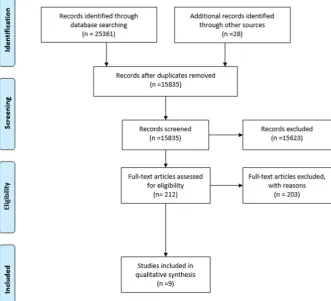
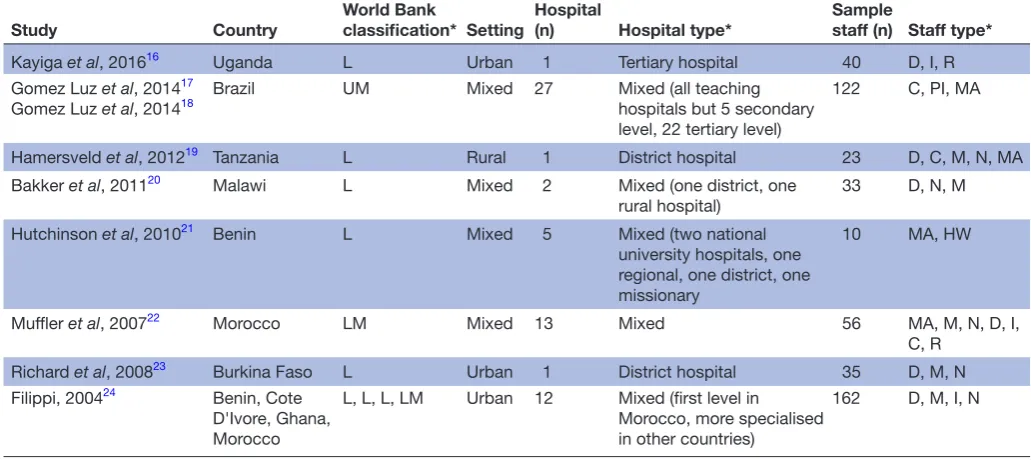
The systematic search yielded a total of 25 361 records (figure 1). Overall, nine studies16–24 met the inclusion
criteria (table 1). Of these, seven studies were held in
countries in the African Region: Benin,21 24 Burkina
Faso,24 Cote D'Ivore,24 Ghana,24 Malawi,20 Morocco,22 24
Tanzania19 and Uganda.16 Two reports contributed on
one study from Brazil.17 18
Most studies were conducted in low-income coun-tries, with the exception of the studies in Morocco and Brazil (middle-income countries). Three studies were
conducted in an urban setting,16 23 24 one in a rural
Figure 1 Study flow diagram.
on September 22, 2020 by guest. Protected by copyright.
http://bmjopen.bmj.com/
area,19 four in a mixed setting17 20–22 and one not
clari-fied this information. Overall, there were four large-to-middle-sized studies including a conspicuous number
of hospitals: 27 maternities in the Brazilian study17 18; 13
facilities in a study in Morocco22; 12 hospitals in a
multi-country study24 and 5 in a study from Benin.21 One study
in Malawi included two hospitals,20 while the remaining
three studies included one single facility.16 19 23 Number
of staff interviewed (and/or included in the focus group)
varied from a maximum of 162 people24 to a minimum of
10.21 All studies collected the views of hospital staff, while
none reported the views of patients.
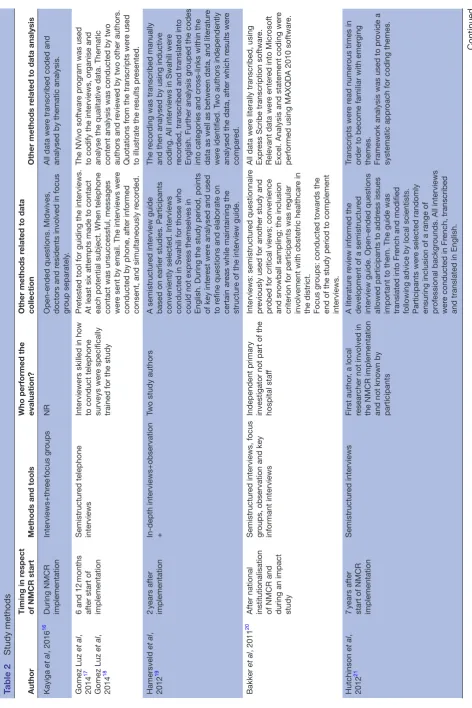
In terms of methodology (table 2), most studies were
conducted 1–2 years after the start of the NMCR
imple-mentation, with only two studies21 22 being performed
several years after. All studies used interviews as the main tool for data collection. In addition, two evaluations used
focus group discussion,16 20 three used direct observation
of the NMCR session19 20 24 and two evaluated notes from
the NMCR sessions and other related documents.23 24
Five studies explicitly stated that the investigation was conducted by a researcher who was external from the
study context,17 20 21 23 24 while the others did not fully
clarify the relationship between the interviewer and the participants. Other methods related to data collection
and analyses are reported in table 2.
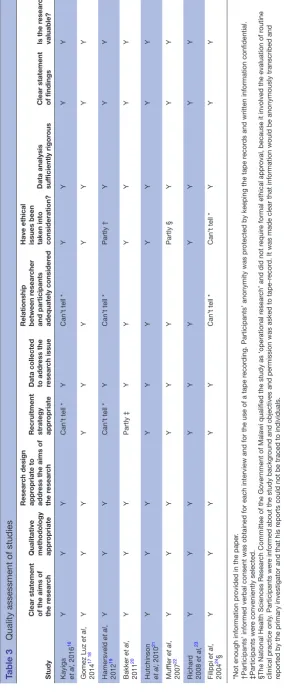
Quality of the studies according to the CASP criteria
is reported in table 3. Three studies matched all criteria
for quality and were rated as ‘high quality’,17 21 23 while
the remaining studies were rated as of moderate
quality.16 19 20 22 24
barriers and facilitators
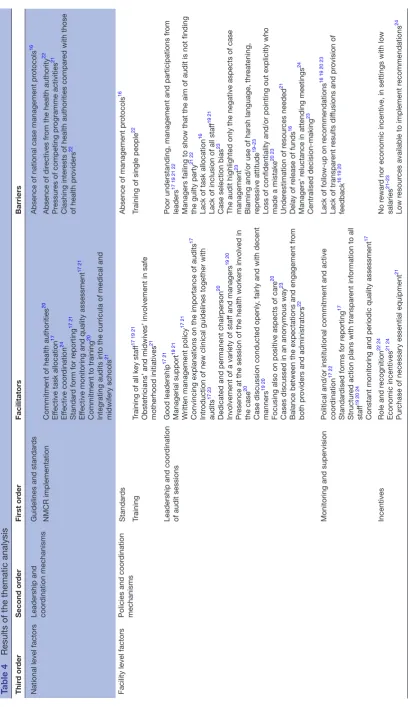
Table 4 synthesises the first-order, second-order and third-order themes identified. Factors were divided into national-level factors, facility-level factors and external partners factors.
National level factors National standards
Absence of national case management protocols16 was
reported as a barrier to the effective implementation of NMCR.
Leadership and coordination mechanisms
Facilitators of effective NMCR implementation described by health workers included general
commit-ment of health authorities20 and the establishment of
effective coordination mechanisms, such as effective
task allocation,17 networking support among facilities,24
availability of a standard form for reporting,21 effective
monitoring and quality assessment.17 21 Commitment
to training20 and integration of audits into medical
and midwifery school curricula21 were also reported as
facilitators.
Barriers to effective NMCR implementation included
absence of directives from health authority22 and pressure
from competing programme activities or interests.21 22
Facility level factors
National guidelines and standards
Absence of case management protocols16 at facility level
was reported as key barrier in implementing the NMCR.16
Table 1 Study context and population
Study Country World Bankclassification* Setting Hospital (n) Hospital type* Samplestaff (n) Staff type* Kayiga et al, 201616 Uganda L Urban 1 Tertiary hospital 40 D, I, R Gomez Luz et al, 201417
Gomez Luz et al, 201418 Brazil UM Mixed 27 Mixed (all teaching hospitals but 5 secondary level, 22 tertiary level)
122 C, PI, MA
Hamersveld et al, 201219 Tanzania L Rural 1 District hospital 23 D, C, M, N, MA Bakker et al, 201120 Malawi L Mixed 2 Mixed (one district, one
rural hospital) 33 D, N, M Hutchinson et al, 201021 Benin L Mixed 5 Mixed (two national
university hospitals, one regional, one district, one missionary
10 MA, HW
Muffler et al, 200722 Morocco LM Mixed 13 Mixed 56 MA, M, N, D, I, C, R
Richard et al, 200823 Burkina Faso L Urban 1 District hospital 35 D, M, N Filippi, 200424 Benin, Cote
D'Ivore, Ghana, Morocco
L, L, L, LM Urban 12 Mixed (first level in Morocco, more specialised in other countries)
162 D, M, I, N
*L, low income; LM, lower middle income; UM, upper middle income (countries are classified based on the years when the study was performed).
C, coordinator, D, doctors, I, in charge; HW, health workers; I, investigators; M, midwives; MA, manager; n, nurses; PI, principal investigator; R,resident.
on September 22, 2020 by guest. Protected by copyright.
Table 2
Study methods
Author
Timing in r
espect
of NMCR start
Methods and tools
Who performed the evaluation?
Other methods r
elated to data
collection
Other methods r
elated to data analysis
Kayiga
et al
, 2016
16
During NMCR implementation
Interviews+thr ee focus gr oups NR
Open-ended questions. Midwives, doctors and r
esidents involved in focus
gr
oup separately
.
All data wer
e transcribed coded and
analysed by thematic analysis.
Gomez Luz et al , 2014 17 Gomez Luz et al , 2014 18
6 and 12
months
after start of implementation
Semistructur
ed telephone
interviews
Interviewers skilled in how to conduct telephone surveys wer
e specifically
trained for the study
Pr
etested tool for guiding the interviews.
At least six attempts made to contact each potential subject. When telephone contact was unsuccessful, messages wer
e sent by email. The interviews wer
e
conducted by phone, after informed consent, and simultaneously r
ecor
ded.
The NVivo softwar
e pr
ogram was used
to codify the interviews, or
ganise and
analyse the qualitative data. Thematic content analysis was conducted by two authors and r
eviewed by two other authors.
Quotations fr
om the transcripts wer
e used
to illustrate the r
esults pr esented. Hamersveld et al , 2012 19 2 years after implementation
In-depth interviews+observation +
Two study authors
A semistructur
ed interview guide
based on earlier studies. Participants conveniently selected. Interviews conducted in Swahili for those who could not expr
ess themselves in
English. During the study period, points of key inter
est wer
e analysed and used
to r
efine questions and elaborate on
certain ar
eas while maintaining the
structur
e of the interview guide.
The r
ecor
ding was transcribed manually
and then analysed by using inductive coding. All interviews in Swahili wer
e
recor
ded, transcribed and translated into
English. Further analysis gr
ouped the codes
into categories and cr
oss-links within the
data as well as between data, and literatur
e
wer
e identified. T
wo authors independently
analysed the data, after which r
esults wer e compar ed. Bakker et al , 2011 20
After national institutionalisation of NMCR and during an impact study
Semistructur
ed interviews, focus
gr
oups, observation and key
informant interviews
Independent primary investigator not part of the hospital staf
f
Interviews: semistructur
ed questionnair
e
pr
eviously used for another study and
pr
obed for critical views; convenience
and snowball sampling; the inclusion criterion for participants was r
egular
involvement with obstetric healthcar
e in
the district. Focus gr
oups: conducted towar
ds the
end of the study period to complement interviews.
All data wer
e literally transcribed, using
Expr
ess Scribe transcription softwar
e.
Relevant data wer
e enter
ed into Micr
osoft
Excel. Analysis and statement coding wer
e
performed using MAXQDA 2010 softwar
e. Hutchinson et al , 2012 21 7 years after
start of NMCR implementation
Semistructur
ed interviews
First author
, a local
resear
cher not involved in
the NMCR implementation and not known by participants
A literatur
e r
eview informed the
development of a semistructur
ed
interview guide. Open-ended questions allowed participants to addr
ess issues
important to them. The guide was translated into Fr
ench and modified
following advice by local scientists. Participants wer
e selected randomly
ensuring inclusion of a range of professional backgr
ounds. All interviews
wer
e conducted in Fr
ench, transcribed
and translated in English.
Transcripts wer
e r
ead numer
ous times in
or
der to become familiar with emer
ging
themes. Framework analysis was used to pr
ovide a
systematic appr
oach for coding themes.
Continued
on September 22, 2020 by guest. Protected by copyright.
http://bmjopen.bmj.com/
Author
Timing in r
espect
of NMCR start
Methods and tools
Who performed the evaluation?
Other methods r
elated to data
collection
Other methods r
elated to data analysis
Muf
fler
et al
, 2007
22
About
10–12
years
after start of implementation
Self-administer
ed
questionnair
e+semistructur
ed
interviews
NR
A self-administer
ed questionnair
e
was sent to 84 public mater
nities
to identify those implementing the audits. All but one mater
nity units wer
e
visited. Semistructur
ed interviews wer
e
conducted individually
. In addition,
locally available data on audit activity was gather
ed fr
om audit r
eports and
overviews wer
e systematically r
eviewed
and compar
ed with data gather
ed in the
interviews.
Interview data wer
e analysed using
systematic content analysis.
Richar
d
et al
, 2008
23
About
1
year
after start of the implementation
Questionnair
e+r
eviews
of
notes
fr
om audit sessions
Resear
ch midwife, not part
of the hospital staf
f
A pr
etested questionnair
e was used.
It contained closed and open-ended questions, and it was administrated face to face by a single interviewer
.
Data wer
e analysed using a qualitative and
quantitative appr
oach. Answers fr
om
open-ended questions wer
e coded. Answers
wer
e then gr
ouped accor
ding to themes to
build tables. T
wo authors conducted the
analysis.
Filippi
et al
, 2004
24
Few years after start of implementation
Interviews+observation
of
sessions+
documents
review
Local r
esear
chers,
exter
nally supported by
inter
national team
NR
NR
NMCR, near
-miss case r
eview; NR, not
further r
eported.
Table 2
Continued
on September 22, 2020 by guest. Protected by copyright.
Table 3
Quality assessment of studies
Study
Clear statement of the aims of the r
esear
ch
Qualitative methodology appr
opriate
Resear
ch design
appr
opriate to
addr
ess the aims of
the r
esear
ch
Recruitment strategy appr
opriate
Data collected to addr
ess the
resear
ch issue
Relationship between r
esear
cher
and participants adequately consider
ed
Have ethical issues been taken into consideration? Data analysis suf
ficiently rigor
ous
Clear statement of findings
Is the r
esear
ch
valuable?
Kayiga et al
, 2016
16
Y
Y
Y
Can’
t tell *
Y
Can’
t tell *
Y
Y
Y
Y
Gomez Luz
et al
,
2014
17 18
Y
Y
Y
Y
Y
Y
Y
Y
Y
Y
Hamersveld
et al
,
2012
19
Y
Y
Y
Can’
t tell *
Y
Can’
t tell *
Partly †
Y
Y
Y
Bakker
et al
,
2011
20
Y
Y
Y
Partly ‡
Y
Y
Y
Y
Y
Y
Hutchinson et al
, 2010
21
Y
Y
Y
Y
Y
Y
Y
Y
Y
Y
Muf
fler
et al
,
2007
22
Y
Y
Y
Y
Y
Y
Partly §
Y
Y
Y
Richar
d
2008
et al,
23
Y
Y
Y
Y
Y
Y
Y
Y
Y
Y
Filippi
et al
,
2004
24§
Y
Y
Y
Y
Y
Can’
t tell *
Can’
t tell *
Y
Y
Y
*Not enough information pr
ovided in the paper
.
†Participants’ informed verbal consent was obtained for each interview and for the
use of a tape r
ecor
ding. Participants’ anonymity was pr
otected by keeping the tape r
ecor
ds and written information confidential.
‡Participants wer
e conveniently selected.
§The National Health Sciences Resear
ch Committee of the Gover
nment of Malawi qualified the study as ‘operational r
esear
ch’ and did not r
equir
e formal ethical appr
oval, because it involved the evaluation of r
outine
clinical practice only
. Participants wer
e informed about the study backgr
ound and objectives and permission was asked to tape-r
ecor
d. It was made clear that information would be anonymously transcribed and
reported by the primary investigator and that his r
eports could not be traced to individuals.
on September 22, 2020 by guest. Protected by copyright.
http://bmjopen.bmj.com/
Table 4
Results of the thematic analysis
Thir
d or
der
Second or
der
First or
der
Facilitators
Barriers
National level factors
Leadership and coor
dination mechanisms
Guidelines and standar
ds
Absence of national case management pr
otocols
16
NMCR implementation
Commitment of health authorities
20
Ef
fective task allocation
17
Ef
fective coor
dination
24
Standar
d form for r
eporting
17 21
Ef
fective monitoring and quality assessment
17 21
Commitment to training
20
Integrating audits into the curricula of medical and midwifery schools
21
Absence of dir
ectives fr
om the health authority
22
Pr
essur
es of competing pr
ogramme activities
21
Clashing inter
ests of health authorities compar
ed with those
of health pr
oviders
22
Facility level factors
Policies and coor
dination
mechanisms
Standar
ds
Absence of management pr
otocols
16
Training
Training of all key staf
f
17 19 21
Obstetricians’ and midwives’ involvement in safe motherhood initiatives
21
Training of single people
22
Leadership and coor
dination
of audit sessions
Good leadership
17 21
Managerial support
19 21
W
ritten management policy
17 21
Convincing explanations on the importance of audits
17
Intr
oduction of new clinical guidelines together with
audits
17 23
Dedicated and permanent chairperson
20
Involvement of a variety of staf
f and managers
19 20
Pr
esence at the session of the health workers involved in
the case
20
Case discussion conducted openly
, fairly and with decent
manners
19 20
Focusing also on positive aspects of car
e
20
Cases discussed in an anonymous way
23
Balance between the expectations and engagement fr
om
both pr
oviders and administrators
22
Poor understanding, management and participations fr
om
leaders
17 19 21 22
Managers failing to show that the aim of audit is not finding the guilty party
21 22
Lack of task allocation
16
Lack of inclusion of all staf
f
19 21
Case selection bias
23
The audit highlighted only the negative aspects of case management
23
Blaming and/or use of harsh language, thr
eatening,
repr
essive attitude
19–23
Loss of confidentiality and/or pointing out explicitly who made a mistake
20 23
Under
estimation of r
esour
ces needed
21
Delay of r
elease of funds
16
Managers’ r
eluctance in attending meetings
24
Centralised decision-making
23
Monitoring and supervision
Political and/or institutional commitment and active coor
dination
17 22
Standar
dised forms for r
eporting
17
Structur
ed action plans with transpar
ent information to all
staf
f
19 20 24
Constant monitoring and periodic quality assessment
17
Lack of follow-up on r
ecommendations
16 19 20 23
Lack of transpar
ent r
esults dif
fusions and pr
ovision of
feedback
16 19 20
Incentives
Role and r
ecognition
22 24
Economic incentives
21 24
Pur
chase of necessary essential equipment
21
No r
ewar
d nor economic incentive, in settings with low
salaries
21–23
Low r
esour
ces available to implement r
ecommendations
24
Continued
on September 22, 2020 by guest. Protected by copyright.
Thir
d or
der
Second or
der
First or
der
Facilitators
Barriers
Resour
ce availability
Human r
esour
ces, essentials
equipment and supplies
Adequate human and material r
esour
ces
19 22
Pr
oper documentation
19
High patient workload, shortage of staf
f
16 17 19–22 24
Staf
f absenteeism
19 20
and/or high staf
f tur
nover
21
Shortage of equipment and supplies, including stationery
16 19 23
Insuf
ficient r
ecor
d-keeping
17 19
Under
estimation of r
esour
ces needed
21
Low morale among staf
f desiring to leave work
16
Sociocultural envir
onment
Cultur
e and practice of
quality impr
ovement
Blame-fr
ee envir
onment
19
Attitude towar
ds self-criticism
22
Positive attitude towar
ds audit and feedback
20
Being a teaching hospital associated with r
esear
ch
17
Health staf
f willingness to impr
ove quality of car
e
23
Good case notes per
ceived as helpful in pr
otecting staf
f in a
legal context
22
Cultur
e of blaming, fear and individual punishment
16 19–22
Lack of knowledge on principles and methods of audits
17 22
Audit not per
ceived as part of duties
17 21
Audits per
ceived as a way of contr
olling staf
f
23
Lack of knowledge and/or inter
est in quality impr
ovement
17
Inadequate knowledge of evidenced-based medicine
17 19 22
Dif
ficulty fr
om staf
f to feel questioned about own work
17 19 23
Attitude in finding excuses and not r
evealing the truth
19 21
Hierar
chy
, cultural norms
among health staf
f and
interpersonal r
elationship
Good practices of communication and cooperation between staf
f
19 22
Possibility to challenge staf
f of higher grade
19
Hierar
chical dif
fer
ences
16
Nurses, midwives and doctors working separately
16
Doctors behaving as superior
16 22
Lack of assertiveness among mid-level staf
f
17 19 20
Personnel not being used to speak in public, fear of people higher in rank
17 19
Disr
espectable manners towar
ds lower level staf
f
20
Pr
eviously existing conflicts at interpersonal level
22
Lack of exter
nal support to facilitate dynamics
22
Attitude towar
ds patients
Empower
ed patients
16
Health staf
f passion and an attitude of caring for
patients
16 17
Dif
ficulty of accepting pr
ofessional r
esponsibility
22
Poor attention low priority given to some conditions (eg, obstructed labour)
16
Low commitment to serve/work
16
Outputs and outcomes
Audit impacts
Positive impact of audits on quality of car
e
21
Positive impact of audits on health staf
f
20–22 24
Lack of evidence or clarity about what the audit is and on its effectiveness
19 22
Exter
nal factors
Sustained support
A
vailability
Exter
nal body pr
oviding technical support and/or r
equir
ed
resour
ces
21 22 24
NMCR, near
-miss case r
eview
.
Table 4
Continued
on September 22, 2020 by guest. Protected by copyright.
http://bmjopen.bmj.com/
Training
Training of all key staff and managers on the principles,
importance and methodology of the NMCR17 19 21 was
reported as key factor facilitating their implementation. In addition, programmes to strengthen involvement of obstetricians and midwives in safe motherhood
initia-tives21 were reported as useful.
On the other side, however, training a limited number of people (most often, only the local coordinator/facili-tator) meant there was a risk of the process to be entirely
dependent on the availability of that single person22 and
this was noted as a barrier.
Leadership and coordination of audit sessions
A list of factors related to leadership and coordination was reported as facilitators to case reviews: good
leader-ship17 21; managerial support19 21; existence of a written
management policy17 21; clear and convincing
explana-tion on the importance of audits17; leadership for the
introduction of new clinical guidelines as opposed to
audits only17 23; availability of a dedicated and
perma-nent chairperson20; involvement of a variety of staff
and managers in all stages of audit, with unrestricted
admission to sessions19 20; attendance to the session of
the health workers who had been involved in the case
management20; case discussion conducted openly and
fairly with participants maintaining respect and good
manners towards each other19 20; focus also on
posi-tive aspects of care20; case discussion conducted in an
anonymous way23 and finally a balance between the
expectations and engagement from both providers and
administrators.22
Similarly, a list of barriers related to leadership and coordination was reported, such as poor understanding from leaders of the NMCR process; poor leadership and
lack of involvement of directors17 19 21 22; failure from
managers in recognising that the NMCR aim is not
finding who is guilty, but rather improving services21 22;
lack of task allocation16 ; lack of inclusion of all types of
staff (eg, midwives, laboratory services) and poor partici-pation of certain type of staff (eg, doctors or low-level staff
not attending or attending irregularly)19 21; case selection
bias (eg, selecting only cases where mid-level staff, but
not doctors, committed mistakes)23; highlighting only
the negative aspects of case management23; blaming
and/or using harsh language or bossing attitude19–23; loss
of confidentiality during the sessions23; managers
reluc-tance to attend meetings for fear of requests they cannot
fulfil.24 Other barriers included delay in releasing funds16
and centralised human resources management and
deci-sion-making inhibiting initiatives by the clinicians.23
Monitoring and supervision
Political and/or institutional commitment in moni-toring and supervision, active coordination of
account-ability mechanisms,17 22 together with the availability of
standardised forms for reporting,17 structured action
plans to implement the NMCR recommendations with
transparent information to all staff members,19 20 24
effective monitoring, periodic quality assessment and networking of local teams to a central coordinating
centre17 were reported by staff as facilitators of the
NMCR implementation.
On the other side, lack of follow-up on
recommenda-tions16 19 20 23 and lack of transparent results dissemination
and provision of feedback16 19 20 were cited as barriers.
Incentives
Incentives such as appointing a role22 24 or providing
some form of recognition such as economic incentives
for participating in the audit sessions,21 24 and purchasing
necessary essential equipment as recommended from the
case reviews21 were observed as important factors to allow
NMCR sustainability over time.
On the contrary, the absence of a reward or of an economic incentive, even if minimal, in setting with low
salaries and high inflation,21–23 together with the low
resources available to implement recommendations24
were perceived as key barriers.
Resource availability
Adequate human and material resources19 22 and proper
documentation19 were reported as essentials to carry
forward the NMCR.
On the other side, high patients workload, shortage
of staff,16 17 19–22 24 staff absenteeism19 20 and/or high staff
turnover,21 together with shortage of equipment and
supplies, including stationery,16 19 23 insufficient
record-keeping17 19 and underestimation of resources needed21
were all perceived as barriers, associated with low morale
among staff and desire to leave work.16
Culture and practice of quality improvement
A long list of sociocultural factors was reported as being either a facilitator or a barrier to effective implemen-tation of NMCR. Factors perceived as facilitators were
the following: a blame-free environment19; a culture of
self-reflection among health workers and a general
posi-tive attitude towards audit and feedback20 22; being a
teaching hospital associated with research,17 motivational
factors such as a desire to improve quality among
health-care personnel.23 Finally, staff’s understanding that good
quality in case management and appropriate documen-tation can help protect them in the case of a legal
litiga-tion22 was also reported as a facilitator.
The list of sociocultural barriers included: a culture of
blaming, fear and individual punishment16 19–22; lack of
knowledge on the principles and methods of audits17 22;
the fact that NMCRs were not perceived as being part of
regular duties17 21 or that they were perceived as a way
of controlling staff23; lack of knowledge and/or interest
in quality improvement17; and inadequate knowledge
on principles, methods and contents of evidence-based
medicine.17 19 22 These factors were reported as being
associated with difficulties from staff when questioned
about their own work,17 19 23 and an attitude of making up
on September 22, 2020 by guest. Protected by copyright.
excuses and not withholding the truth about what
actu-ally happened during the care of near-miss cases.19 21
Hierarchy, cultural norms among health staff and interpersonal relationships
Good practices of communication and cooperation
between different cadres of health workers19 22 and the
possibility of challenging a higher-level staff19 were
reported as facilitators of the NMCR implementation. On the other side, barriers were perceived as following:
the existence of hierarchical differences16; nurses,
midwives and doctors working separately as opposed to
acting as part of a team16; doctors’ feeling/behaving as
superior compared with other levels of staffing16 22;
disre-spectful manners towards lower-level staff20; lack of
asser-tiveness among mid-level staff17 19 20; staff not being used
to speak in public, fear of talking in presence of staff in a
higher rank17 19; previously existing conflicts at
interper-sonal level22 as well as lack of external support to facilitate
these dynamics.22
Attitude towards patients and medical conditions
The existence of a sufficient degree of empowerment among patients, patients having a recognised status and
being respected,16 together with a caring attitude from
the staff16 17 were reported as facilitators of the NMCR
implementation.
On the other side, difficulty of accepting professional
responsibility,22 poor attention and low priority given to
some clinical conditions possibly leading to complications
(eg, obstructed labour),16 together with a low commitment
to serve/work16 were reported as barriers.
Outputs and outcomes
Several studies reported that sustainability of audits also depended on their perceived effects. Where healthcare staff perceived that audits had a positive impact on quality of care—such as maternal or perinatal outcomes, respect for women’s rights during childbirth, availability of
equip-ment and organisation of care—21 and/or a positive
impact on healthcare staff dynamics—such as improved communication and coordination, improved acceptance of responsibilities, increased awareness of problems,
improved knowledge and skills20–22 24 — these factors
facilitated the NMCR implementation over time.
On the other side, a lack of evidence or clarity about
what the NMCR was, and on its effectiveness19 22 was
perceived as a barrier to sustain the case reviews.
External partners factors Sustained support
The existence of an external body or organisation able to provide technical support, and if needed additional
required resources21 22 24 were reported as a key factor
to ensure effective NMCR implementation in different settings.
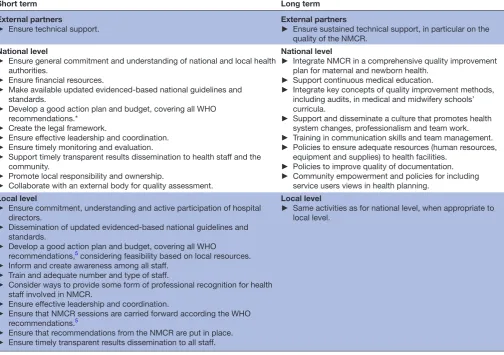
Key recommendations
Table 5 synthesises key recommendations for effective NMCR implementation. Actions are divided in those that
may be implemented in the short term and those needing a longer time for the implementation but that may result in a longer-term impact.
DIsCussIOn
This review fills a gap in evidence synthesis on facilitators and barriers to effective implementation of NMCR. Find-ings of the review suggest that the effective implementation of NMCR in maternity hospitals is a complex interven-tion that can be challenged by a number of barriers at different levels (national, facility, external partner level), including technical aspects (such as leadership and coor-dination mechanisms), resource availability (adequate human resources to manage workload and essential supplies), sociocultural factors (such as existing cultural norms, hierarchy among healthcare staff and patients’ empowerment) and the lack of external support. On the other side, a number of facilitating factors were identi-fied. Findings from this systematic review suggest a list of
practical recommendations (table 5), which can be used
by policy-makers and managers to prevent and mitigate common challenges to successful NMCR implementation.
This review was conducted according to the PRISMA8
and the ENTREQ9 standards. A broad search strategy in
a large number of electronic databases was used. The key limitation of the review is the paucity of existing relevant scientific reports: although the NMCR approach has been used in many countries, there has been relatively few formal studies exploring facilitators and barriers to effec-tive NMCR implementation. Despite the above-described limitation, this review retrieved an appreciable number of good-quality studies from the African Region. Findings of the review are therefore mostly generalisable to this setting.
Outside the African Region, we retrieved several informal evaluations reporting on enablers and barriers to effective NMCR implementation in Europe, Central Asia, South East Asia, Latin America and the
Carib-bean.25–37 It will be inappropriate to pull together results
of peer-reviewed formal studies with those of unpublished technical reports and informal evaluations. However, it
may be interesting to acknowledge that grey literature25–37
suggests that key factors enabling effective NMCR imple-mentation in countries other than the African Region are similar to those observed in this review, with some pecu-liarities specific to each context. First, the importance of good leadership is a recurrent theme highlighted
virtu-ally in all grey literature.25–37 Second, the crucial role of
a positive cultural environment has been reported as a key determinant of successful NMCR implementation on
a global scale.25–36 For example, a review of experiences
of NMCR implementation supported by the International Federation for Gynecology and Obstetrics in Europe, Asia and Africa identified three independent cultural factors as key determinants for the successful NMCR implemen-tation: (1) individual responsibility and ownership; (2) a proactive institutional ethos, promoting learning as a
on September 22, 2020 by guest. Protected by copyright.
http://bmjopen.bmj.com/
crucial part of improving services and (3) a supportive political and policy environment at both national and local
levels.25 On the other side, identified cultural barriers for
performing NMCR included a culture of blaming, fear and individual punishment, together with a lack of
profes-sionalism.25 Similarly, reports on NMCR implementation
in ex-Soviet countries identified a culture of blaming, fear and individual punishment, and hierarchy among staff as
key barriers for successful NMCR implementation.28–32 In
ex-Soviet countries, the key element in promoting a safe, friendly, confidential environment was the emanation from Ministry of Health of prikazes (national laws) and the commitment of hospital directors to a non-punitive
system.35 36
In line with what has been observed in this review, grey literature reporting experiences of NMCR implementa-tion in LMIC in Europe and Asia deemed as crucial to provide some professional recognition for health staff
involved in the case reviews.25 27 33 In settings with very
low resources, a small financial incentive was reported as essential, since in these contexts any non-paid activity
outside working hours means a serious loss of income.21
Again, similarly to what has been reported in studies
included in this review,19 the importance for staff to
perceive clearly the potential and/or actual benefits of the audits (eg, improvements in quality of care, organ-isation of care, staff knowledge and recognition) was recognised as a key determinant of successful NMCR implementation in a number of reports from different
regions,37 while disillusion from lack of actions following
the reviews was highlighted as a important barrier for
NMCR sustainability.25–28
Lack of knowledge of the evidence-based maternal and perinatal practices was reported as a barrier to NMCR
implementation in the WHO European region,29 as well
in studies in this review. As far as different types of hospi-tals were concerned, reports from both Europe, Latin America and Africa observed that the implementation of
NMCR was easier in lower level facilities16 24 33 or research
hospitals17 where staff was used to work together, rather
than in large maternity units dominated by ‘academic
tradition’ difficult to challenge33 or where there was high
staff turnover.16 Poor patient empowerment and
insuf-ficient inclusion of service user views were reported as
Table 5 Key recommendations for effective NMCR implementation
Short term Long term
External partners
► Ensure technical support.
External partners
► Ensure sustained technical support, in particular on the quality of the NMCR.
National level
► Ensure general commitment and understanding of national and local health authorities.
► Ensure financial resources.
► Make available updated evidenced-based national guidelines and standards.
► Develop a good action plan and budget, covering all WHO recommendations.*
► Create the legal framework.
► Ensure effective leadership and coordination.
► Ensure timely monitoring and evaluation.
► Support timely transparent results dissemination to health staff and the community.
► Promote local responsibility and ownership.
► Collaborate with an external body for quality assessment.
National level
► Integrate NMCR in a comprehensive quality improvement plan for maternal and newborn health.
► Support continuous medical education.
► Integrate key concepts of quality improvement methods, including audits, in medical and midwifery schools’ curricula.
► Support and disseminate a culture that promotes health system changes, professionalism and team work.
► Training in communication skills and team management.
► Policies to ensure adequate resources (human resources, equipment and supplies) to health facilities.
► Policies to improve quality of documentation.
► Community empowerment and policies for including service users views in health planning.
Local level
► Ensure commitment, understanding and active participation of hospital directors.
► Dissemination of updated evidenced-based national guidelines and standards.
► Develop a good action plan and budget, covering all WHO recommendations,5 considering feasibility based on local resources. ► Inform and create awareness among all staff.
► Train and adequate number and type of staff.
► Consider ways to provide some form of professional recognition for health staff involved in NMCR.
► Ensure effective leadership and coordination.
► Ensure that NMCR sessions are carried forward according the WHO recommendations.5
► Ensure that recommendations from the NMCR are put in place.
► Ensure timely transparent results dissemination to all staff.
Local level
► Same activities as for national level, when appropriate to local level.
*See the WHO manual: WHO. Regional Office for Europe. Conducting a maternal near-miss case review cycle at the hospital level’ manual with practical tools. Available at http://www.euro.who.int/en/health-topics/Life-stages/maternal-and-newborn-health/publications/2016/ conducting-a-maternal-near-miss-case-review-cycle-at-hospital-level-2016
NMCR, near-miss case review.
on September 22, 2020 by guest. Protected by copyright.
barriers to successful NMCR implementation in Europe,
Asia and Africa.25 27 33 Finally, the availability of an external
partner/organisation capable of providing sustained technical support (and, if needed, the resources to put in place the quality improvement recommendations) was a key factor mentioned in many reports from different
countries.25 27–30 32 35 36
This review contributes to the current debate on quality improvement interventions and on the knowledge of potential challenges to their implementation. When compared with other systematic reviews of facilitators and barriers of effective implementation of other quality
improvement interventions,38 39 it appears that, not
surprising, many barriers, such as the lack of coordination and leadership or lack of knowledge of evidence-based practices, are common to different quality improvement interventions. More research should be conducted to test strategies aiming at facilitating successful implementa-tion for NMCR as well as for other quality improvement interventions.
COnCLusIOns
Studies suggest that the effective implementation of NMCR at facility level is a complex intervention that can be challenged by a number of barriers at different levels (national, facility level, external partner level). Policy-makers, in planning the NMCR implementa-tion, should consider the lessons learnt from previous studies as synthesised in this paper and should carefully plan actions to prevent and mitigate common chal-lenges to successful NMCR implementation. Future studies should aim at documenting better facilita-tors and barriers to successful implementation of the facility-based individual NMCR, especially outside the African region, as well as exploring facilitators and barriers for other quality improvement interventions, and in testing strategies aiming at facilitating successful implementation.
Acknowledgements We thank Sonia Richardson for having reviewed the English
language of this manuscript.
Contributors ML conceived the papers, extracted data, analysed data, drafted the
first version of this paper and finalised the final version. SR screened the studies and revised the first draft. BC and MC extracted data, analysed data and revised the first draft.
Funding This review was funded by a grant from the GREAT Network, Canadian
Institutes of Health Research, St. Michael's Hospital, Toronto.
Competing interests None declared.
Patient consent Not required.
Provenance and peer review Not commissioned; externally peer reviewed.
Data sharing statement All key data are provided in the paper. Additional details
can be provided by the contact author on request.
Open access This is an open access article distributed in accordance with the
Creative Commons Attribution Non Commercial (CC BY-NC 4.0) license, which permits others to distribute, remix, adapt, build upon this work non-commercially, and license their derivative works on different terms, provided the original work is properly cited and the use is non-commercial. See: http:// creativecommons. org/ licenses/ by- nc/ 4. 0/
© Article author(s) (or their employer(s) unless otherwise stated in the text of the article) 2018. All rights reserved. No commercial use is permitted unless otherwise expressly granted.
rEFErEnCEs
1. World Health Organization. Global Strategy for Women's, Children's and Adolescent's Health 2016-2030. http://www. who. int/ life- course/ partners/ global- strategy/ global- strategy- 2016- 2030/ en/ (accessed 15 Sep 2016).
2. Tunçalp Ӧ, Were WM, MacLennan C, et al. Quality of care
for pregnant women and newborns-the WHO vision. BJOG
2015;122:1045–9.
3. World Health Organization (WHO). The prevention and elimination of
disrespect and abuse during facility-based childbirth. Geneva: World Health Organization, 2014.
4. World Health Organization. Beyond the numbers: Reviewing maternal
deaths and complications to make pregnancy safer. Geneva: World Health Organization, 2004.
5. World Health Organization. Regional Office for Europe. Conducting a maternal near-miss case review cycle at the hospital level” manual with practical tools. http://www. euro. who. int/ en/ health- topics/ Life- stages/ maternal- and- newborn- health/ publications/ 2016/ conducting- a- maternal- near- miss- case- review- cycle- at- hospital- level- 2016 (accessed 29 Nov 2016).
6. Tunçalp O, Hindin MJ, Souza JP, et al. The prevalence of maternal
near miss: a systematic review. BJOG 2012;119:653–61.
7. Lazzerini M, Richardson S, Ciardelli V, et al. Effectiveness of the
facility-based maternal near-miss case reviews in improving maternal and newborn quality of care in low-income and
middle-income countries: a systematic review. BMJ Open
2018;8:e019787.
8. Liberati A, Altman DG, Tetzlaff J, et al. The PRISMA statement for
reporting systematic reviews and meta-analyses of studies that
evaluate health care interventions: explanation and elaboration. PLoS
Med 2009;6:e1000100.
9. Tong A, Flemming K, McInnes E, et al. Enhancing transparency in
reporting the synthesis of qualitative research: ENTREQ. BMC Med
Res Methodol 2012;12:181.
10. The World Bank. Country and Lending Groups. Historical classification. 2014 https:// datahelpdesk. worldbank. org/ knowledgebase/ articles/ 906519 (accessed 2 Nov 2017).
11. World Health Organization. Evaluating the quality of care for severe
pregnancy complications: the WHO near-miss approach for maternal health. Geneva: World Health Organization, 2011.
12. Thomas J, Harden A. Methods for the thematic synthesis of
qualitative research in systematic reviews. BMC Med Res Methodol
2008;8:45.
13. Bohren MA, Hunter EC, Munthe-Kaas HM, et al. Facilitators and
barriers to facility-based delivery in low- and middle-income
countries: a qualitative evidence synthesis. Reprod Health
2014;11:71.
14. Glenton C, Colvin CJ, Carlsen B, et al. Barriers and facilitators to
the implementation of lay health worker programmes to improve access to maternal and child health: qualitative evidence synthesis.
Cochrane Database Syst Rev 2013;10:CD010414.
15. Critical Appraisal Skills Programme (CASP). Quality-assessment tool for qualitative studies. http://www. casp- uk. net/#! casp- tools- checklists/ c18f8 (accessed on 26 Jan 2015).
16. Kayiga H, Ajeani J, Kiondo P, et al. Improving the quality of obstetric
care for women with obstructed labour in the national referral
hospital in Uganda: lessons learnt from criteria based audit. BMC
Pregnancy Childbirth 2016;16:152.
17. Luz AG, Osis MJ, Ribeiro M, et al. Impact of a nationwide study for
surveillance of maternal near-miss on the quality of care provided by
participating centers: a quantitative and qualitative approach. BMC
Pregnancy Childbirth 2014;14:122.
18. Luz AG, Osis MJ, Ribeiro M, et al. Perspectives of professionals
participating in the Brazilian Network for the Surveillance of Severe Maternal Morbidity regarding the implementation of routine
surveillance: a qualitative study. Reprod Health 2014;11:29.
19. van Hamersveld KT, den Bakker E, Nyamtema AS, et al. Barriers
to conducting effective obstetric audit in Ifakara: a qualitative
assessment in an under-resourced setting in Tanzania. Trop Med Int
Health 2012;17:652–7.
20. Bakker W, van den Akker T, Mwagomba B, et al. Health workers'
perceptions of obstetric critical incident audit in Thyolo District,
Malawi. Trop Med Int Health 2011;16:1243–50.
on September 22, 2020 by guest. Protected by copyright.
http://bmjopen.bmj.com/
21. Hutchinson C, Lange I, Kanhonou L, et al. Exploring the sustainability of obstetric near-miss case reviews: a qualitative study in the South
of Benin. Midwifery 2010;26:537–43.
22. Muffler N, Trabelssi MH, De Brouwere V. Scaling up clinical audits of
obstetric cases in Morocco. Trop Med Int Health 2007;12:1248–57.
23. Richard F, Ouédraogo C, Zongo V, et al. The difficulty of questioning
clinical practice: experience of facility-based case reviews in
Ouagadougou, Burkina Faso. BJOG 2009;116:38–44.
24. Filippi V, Brugha R, Browne E, et al. Obstetric audit in resource-poor
settings: lessons from a multi-country project auditing 'near miss'
obstetrical emergencies. Health Policy Plan 2004;19:57–66.
25. Lewis G. The cultural environment behind successful maternal death
and morbidity reviews. BJOG 2014;121(Suppl 4):24–31.
26. Lewis G. Emerging lessons from the FIGO LOGIC initiative on
maternal death and near-miss reviews. Int J Gynaecol Obstet
2014;127(Suppl 1):S17–20.
27. Bacci A, Lewis G, Baltag V, et al. The introduction of confidential
enquiries into maternal deaths and near-miss case reviews in the
WHO European Region. Reprod Health Matters 2007;15:145–52.
28. Bacci A, Hodorogea S, Khachatryan H, et al. What is the quality of
the maternal near-miss case reviews in WHO European Region? Cross-sectional study in Armenia, Georgia, Latvia, Republic of
Moldova and Uzbekistan. BMJ Open 2018;8:e017696.
29. World Health Organization. Regional Office for Europe. Multi-Country
review meeting on maternal mortality and morbidity audit “Beyond the Numbers”, Report of a WHO meeting, Charvak, Uzbekistan 14–17 June 2010. Copenhagen: WHO Regional Office for Europe, 2010.
30. World Health Organization. Regional Office for Europe. The impact
of implementation of 'Beyond the numbers' approach in improving maternal and perinatal health. Bishkek, Kyrgyzstan. Copenhagen: WHO Regional Office for Europe, 2014.
31. WHO Regional Office for Europe Making Pregnancy Safer in Uzbekistan. Maternal mortality and morbidity audit Activities Report 2002-2008. http://www. euro. who. int/__ data/ assets/ pdf_ file/ 0004/ 98797/ MPS_ UZB. pdf (accessed 8 Nov 2016).
32. Sukhanberdiyev K, Ayazbekov A, Issina A, et al. Initial experience
of Near Miss Case Review: improving the management of
haemorrhage. Entre Nous 2011;74:18–19.
33. Baltag V, Filippi V, Bacci A. Putting theory into practice: the introduction of obstetric near-miss case reviews in the Republic of
Moldova. Int J Qual Health Care 2012;24:182–8.
34. Borchert M, Goufodji S, Alihonou E, et al. Can hospital audit teams
identify case management problems, analyse their causes, identify and implement improvements? A cross-sectional process evaluation
of obstetric near-miss case reviews in Benin. BMC Pregnancy
Childbirth 2012;12:109.
35. Hodorogea S. Piloting near miss case reviews in Kazakhstan:
improving quality of maternal care. Entre Nous 2010;70:28–9.
36. Yadgarova K, Fazilova F. Implementation of near miss case reviews in
Uzbekistan: the role of prikazes. Entre Nous 2010;70:26–7.
37. Bailey PE, Binh HT, Bang HT. Promoting accountability in obstetric
care: use of criteria-based audit in Viet Nam. Glob Public Health
2010;5:62–74.
38. Stokes T, Shaw EJ, Camosso-Stefinovic J, et al. Barriers and
enablers to guideline implementation strategies to improve obstetric care practice in low- and middle-income countries: a
systematic review of qualitative evidence. Implement Sci
2016;11:144.
39. Allanson ER, Tunçalp Ö, Vogel JP, et al. Implementation of
effective practices in health facilities: a systematic review of
cluster randomised trials. BMJ Glob Health
2017;2:e000266.
on September 22, 2020 by guest. Protected by copyright.