5 (4), Winter 2014, Ser. 73/4 ISSN: 2008-8191. pp. 111-138
Interfaces of Macro and Microstructure in Academic Writing: The Case of Research Article Abstracts
M. Tofigh ∗∗∗∗ M.A., TEFL
Islamic Azad University, Maragheh Branch email: [email protected]
D. Kuhi
Assistant Professor, TEFL Islamic Azad University, Maragheh Branch
email: [email protected]
Abstract
Although flourishing research has been devoted to research on article abstracts, more studies are needed to unpack the relationship between rhetorical moves and their associated linguistic and rhetorical features (e.g., meta-discourse). To underpin this relationship, the current study analyzed a total of 60 research article abstracts written in English by two cultural groups in three disciplines. The first stage identified the rhetorical structure of the abstracts based on Hyland’s (2000) move pattern. Then, the meta-discourse features prototypical of each move were determined, following Hyland’s (2005a) interpersonal model. We found diverse move patterns in both cultural groups. In the Anglo-American group, the abstracts tend to be more compatible with Hyland’s (2000) move structure, whereas the Iranians prefer to omit some of those moves. The results also revealed that there was a close relationship between the communicative function of moves and meta-discourse choices per move. This finding suggests that meta-discourse features can be manipulated effectively to fulfill the communicative intentions of moves. This study has rewarding pedagogical implications for ESP/EAP context, especially in writing courses.
Keywords: move structure, meta-discourse, rhetorical moves, rhetorical features
1. Introduction
With the advent of genre-inspired approaches to the analysis of written and spoken discourses, scholars (e.g., Bhatia, 1993; Swales, 1990, 2004) generally came to appreciate a certain avenue that the study of genres has
offered in the arena of applied linguistics, particularly in the EAP/ESP context. Due to the immense pedagogical implications of genre studies in the world of academic discourse, recent years have seen a flourishing appeal to various genres in divergent disciplines and languages. Of these genres, a great deal of research has been undertaken on the overall structure of research articles or their particular sections, largely abstracts. Not surprisingly, because publishing is promotional channels wherein academics achieve considerable credibility and climb the professional ladder (Hyland, 2011), research articles in general and abstracts in particular have often been regarded as an ideal area of research.
It is worth pausing here to note that genre practitioners have put forth the assumption that texts are similar or different and can be categorized as one genre or another. In an attempt to organize these classifications, scholars have outlined typical rhetorical and linguistic features of the particular genres (Hyland, 2005a). In so doing, Bhatia (1990) affirms that it is imperative to focus on describing the rhetorical structures of these genres in terms of their regular sequence of moves or stages. Accordingly, researchers have endeavored to disclose how genres can be distinguished by their specific rhetorical features. One such feature is meta-discourse. In general, the concept of meta-discourse elicits the social, interpersonal, interactive, evaluative, and rhetorical dimensions of a discourse (Hyland, 2005a; Hyland & Tse, 2004).
(Martin-Martin, 2003; Melander, Swales, & Fredrickson, 1997; Van Bonn & Swales, 2007).
A quick inspection of these studies shows that the bulk of research has focused on schematic structure of research article abstracts, notwithstanding little research has sought to address the linkage between rhetorical moves and their intentional linguistic and rhetorical features (e.g., meta-discourse). In addition, a great deal of research on abstracts has focused on social sciences and soft fields, whereas the hard disciplines have bypassed by researchers. The present study is an attempt to address these gaps. Thus, what has moved us to do the current research were the following purposes:
First, to identify the relationship between rhetorical moves of abstracts and their linguistic realizations in terms of meta-discourse in three disciplines of Physics, Mechanical engineering and Electronic engineering.
Second, to discover whether there is any difference or similarity in the rhetorical practices of Iranian and Anglo-American (English, hereafter) writers in their English published research article abstracts.
To our impression, such a study is a rewarding area of research for several reasons: First, because publishing is a way to lend a hand with a wider discourse community, authors are compelled to persuade their audiences (Swales, 1990). To achieve such a goal, authors should be equipped with knowledge of rhetorical structures and other key rhetorical features (e.g., meta-discourse) that create a successful abstract (Martin-Martin, 2003). Second, it is assumed that the high rejection of Iranian writers' articles in leading journals could be traced in language problems (Abdi, Rizi, Tavakoli, 2010). Thus, as pressures on Iranian academics to publish in English enhances, it is imperative to gain insights into the Iranian writers' practices in fulfilling the rhetorical goals of their abstracts persuasively. Third, academic writing is based on discipline-specific modes of arguments (Bhatia, 2004; Hyland, 2000, 2011). Accordingly, such a move-based analysis can corroborate Iranian writers to master the macro and micro conventions of their disciplines (Bhatia, 1993; Flowerdew, 1993; Swales, 1990).
2. Literature Review
purposes. Swales (1990) provide a detailed definition of genre within the field of English for specific purposes (ESP):
“Genre comprises a class of communicative events, the members of which share some of set of communicative purposes. These purposes are recognized by the expert members for the genre. This rationale shapes the schematic structure of discourse and influences and constrains choice of content and style.The genre names inherited and produced by discourse communities are imported by other constitute valuable ethnographic communication, but typically need further validation.’’(Swales, 1990, p.58).
In a similar fashion, Bhatia (2004) proclaims that genres are socially grounded and maneuvered by social practices. Elaborating on this concept, to borrow Bhatia’s (2004) terms, genres can be regarded as media through which members of discourse communities negotiate with each other. More specifically, as Berkenkotter and Huckin (1995) state, genres are closely associated with a discipline's norms, values, and ideology.
It is widely acknowledged that genre realizes the purpose in texts at the most overt level and this constitutes a central focus in various studies. In conjunction with an analysis of genre, meta-discourse analysis provides insights into another level of purpose, one which is concerned with the informational and persuasive goals of the writer and how the discourse is organized with the reader’s needs in mind.
exploiting a rich repertoire of rhetorical features on the writer’s part to persuade and gain ratification from certain audiences. At present, paramount attention (e.g., Crismore et al., 1993; Hyland, 1998, 2004, 2005a; Vande Kopple, 1985) is given to the features that elicit this interpersonal and evaluative dimension of academic texts.
In this study, our point of departure is the linkage between rhetorical moves and their intentional linguistic and rhetorical features (e.g., meta-discourse). Indeed, as significant rhetorical section, the abstract conveys the first impression of a whole article, intended to motivate the audience to read the paper (Hartley, 2003; Salager-Meyer, 1990). These filtering devices, as Swales (1990) states, “can potentially be highly revealing of disciplinary discourse communities, particularly when the abstracts comprise the evidence on which gate keeping decisions are made” (p.181). While appreciating the communicative purpose of abstracts, Bhatia (1993) also illuminates that a “research article abstract is a recognized genre and has emerged as a result of a well-defined and mutually-understood communicative purpose that most abstracts fulfill” (p.77). In a similar way, Santos (1996) accentuates the view that “abstracts are important site for the visibility of scientific endeavor in so far as they make the research widely known, more discussed and more influential” (p.483).
3. Method 3.1 Description of the corpus
This study capitalized on a corpus of 60 published research article abstracts written in English by English and Iranian academics in three hard science disciplines: Physics, Electronic engineering, and Mechanical engineering (see Hyland (2000) for a classification of hard vs. soft sciences). As noted earlier, a great deal of research on abstracts has focused on social sciences and soft fields, whereas the hard disciplines have been bypassed by researchers. We analyzed 20 abstracts in each discipline, comprising 10 natives and 10 Iranian per discipline. The full bibliographical information of abstracts and their respective disciplines appear in Appendix A. Also, the abstracts were randomly selected from high-referred and leading journals recommended by Hyland (1999) as a reliable source of high status journals in disciplines (see Appendix B for a full account of the journals). Normally, the native vs. non-native issue was judged by the names and affiliations of the authors (Abdi et al., 2010).
predominant view, the researchers culled from the abstracts published between 2005 and 2010. Second, taking into account the fact that there is a distinction between rhetorical structures and linguistic features of empirical papers and those of theoretical ones (Pho, 2008), only abstracts which faithfully pertained to empirical research articles were picked and chosen in our corpora. Third, we share Hunston and Sinclair’s (2000) belief that small corpora are not necessarily unsatisfactory; in some occasions, a small scale data is even the right choice.
3.2 Data analysis procedure for the macro rhetorical structure of abstracts
To gain insights into macro the rhetorical structure of abstracts, our starting point was move analysis. A close glimpse of analytical frameworks in literature revealed that there is a division between scholars who see the move pattern as comprising four moves (Bhatia, 1993; Salager-Meyer, 1992; Samraj, 2005) and those who prefer a five move pattern (Hyland, 2000; Santos, 1996). From this repository, we opted for Hyland's (2000) abstract move pattern building on five moves (see Table1) for several reasons: First, the delicate distinction between introduction and purpose in Hyland's framework indicates a tangible picture of the rhetorical structures of abstracts chosen in such a corpus. Second, the patterns of five moves seem to be more comprehensive than those of four moves (Pho, 2008), and third, Hyland’s impactful abstract move pattern has been widely utilized to capture abstract moves in various disciplines.
Table 1: Hyland's (2000) framework for abstracts
Moves Function Question asked
1.Introduction(M1) 2. Purpose (M2) 3. Method (M3) 4. Product (M4) 5.Conclusion (M5)
Establishing the context of the paper
Stating the purpose of the study Describing the data, design, procedures...
Reporting main findings of the study
Interpreting results, giving applications/implications
What is the background of the study?
What is the study about? How was the research done? What did you find?
What do the results mean? So what?
3.3 Analytical framework for micro rhetorical features of moves
The analysis of the data was carried out in two stages. In the first stage, the macro rhetorical structure or move analysis of the abstracts was identified following Hyland's (2000) move pattern. In the second phase, the meta-discourse items as representative of the micro rhetorical features were analyzed in detail. Scrutinizing several met-discourse schemes (Adel, 2006; Crismore et al., 1993; Vande Kopple, 1985, etc.), this research adopted Hyland's (2005a) interpersonal model of meta-discourse for analysis. Most commonly, this model can be appreciated for its robust theoretical underpinning and practical advantages. Hyland postulates that meta-discourse outweighs reader’s knowledge, textual experience, processing constraints and thus provides writers with a rich repertoire of rhetorical appeals to achieve the intended goals (Hyland & Tse, 2004). His proposed model entails two categories for meta-discourse - interactive and interactional (see Table 2). The former concerned with ways of organizing discourse to anticipate the reader's knowledge and reflect the writer's assessment of what needs to be made explicit to constrain and guide what can be recovered from the text. The metaphor of signpost is common for this dimension (Hyland & Tse, 2004). The latter concerned with the writer's efforts to control the level of personality in a text and establish a suitable relationship to his or her data, argument and audience, marking the degree of intimacy, the expression of attitude, the communication of commitment, and the extent of reader involvement (Hyland, 2004, p.138). We took heed of the following principles during the data analysis:
1. As it is widely acknowledged that no comprehensive list of meta-discourse items could be provided due to the fuzzy and open-ended nature of meta-discourse, the researchers identified meta-discourse items manually and functionally throughout the whole corpora. 2. In assigning meta-discourse function to textual items, internal and
many items can realize either interpersonal or propositional purposes depending on their context. Internal relations connected events in the account, whereas external relations referred to those situations themselves connecting activities in the world outside the text. Following Hyland and Tse (2004) and Hyland (2005a), only internal relations were assigned to meta-discourse.
3. Special attention was paid to the fact that one linguistic realization could fulfill more than a single function; in such cases, the dominant functions were favored.
Table2. An interpersonal model of metadiscourse (Hyland, 2005a) Category Function Example Interactive Help to guide the reader
through the text
Resources Transitions express relations between
main clauses
in addition; but; thus; and
Frame markers refer to discourse acts, sequences or stages
finally; to conclude; my purpose
Endophoric markers refer to information in other
parts of the text
noted above; see Fig;
Evidentials refer to information from
other text
according to X; Z states
Code glosses elaborate propositional
meanings
namely; e.g. ; such as
Interactional Involves the reader in the text
Resources Hedges withhold commitment and
open dialogue
might; perhaps; possible;
Boosters emphasize certainty or close
dialogue
in fact; definitely; it is clear
Attitude markers express writer’s attitude to
proposition
unfortunately; I agree; surprisingly
Self-mentionsexplicit reference to author (s) I ; we; my; me; our
Engagement markers explicitly build relationship
with reader
consider; note; you can see that
4. Results and Discussion
4.1 The macrostructure of abstracts based on Hyland’s (2000) move analysis
4.1.1 Move frequency and move pattern
moves were found. As appears in Table 3, purpose moves (100%) were the most frequent and obligatory rhetorical moves in both groups in all the disciplines, indicating that both the Iranian and English writers endeavor to open their abstracts with this move.
Likewise, product moves and method moves were also utilized with much greater frequency as a common practice in both cultural groups. Similar findings in Santos’ (1996) and Pho’s (2008) studies also provide the evidence that the purpose move and the method move occurred the most usually in all abstracts.
Table3. Frequency of occurrence of moves in whole corpus
Move Physics Mechanical engineering Electronic engineering
1. Introduction 2. Purpose 3. Method 4. Product 5. Conclusion Iranian 1 (10%) 10 (100%) 8 (80%) 9 (90%) 2 (20%) English 7 (70%) 10 (100%) 8 (80%) 9 (90%) 6 (60%) Iranian 2 (20%) 10 (100%) 10 (100%) 10 (100%) 4 (40%) English 7 (70%) 10 (100%) 8 (80%) 8 (80%) 5 (50%) Iranian 3 (30%) 10 (100%) 10 (100%) 10 (100%) 3 (30%) English 5 (50%) 10 (100%) 8 (80%) 9 (90%) 6 (60%)
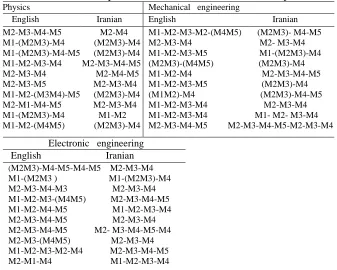
Conversely, as regards introduction and conclusion moves, the immediate variations were found in the sense that the English authors outnumbered the Iranians. The rhetorical choices corroborated in both groups across disciplines elicit that the majority of the abstracts in the native English group deemed to overwhelmingly favor M1-M2-M3-M4-M5 as the common pattern, whereas the conventional pattern emerging in Iranian counterpart peers was M2-M3-M4. On this basis, the impression one might get from these findings, among other things, is that both groups of writers have different understandings about the function of introduction and conclusion moves. In plain words, the English writers have a strong flavor for tailoring contextual and background information in introduction moves aligned with specific interpretations, applications, and implications of findings in conclusion moves to vie in English market-driven academy (Soler-Monreal, Carbonell-Olivares & Gilsalom, 2011). To put it simply, they reflect greater concern for persuasive writing for promotional purposes (Hyland, 2000; Hyland & Tse, 2005; Van Bonn & Swales, 2007), whereas the Iranian writers, most tellingly, from sociological standpoint are less inclined to compete for research space and adhere to presenting only the work. Accordingly, little attention is given to promotional function of introduction and conclusion moves. The overall move structure of the 60 abstracts is summarized in Table 4.
because they all are representative of the hard fields that are grounded in common institutional and community-recognized norms and rhetorically sanctioned discursive practices (Hyland, 1998, 2000, 2005a).
Table 4. Move pattern of 60 abstracts from whole corpus
Physics Mechanical engineering
English Iranian English Iranian
M2-M3-M4-M5 M2-M4 M1-(M2M3)-M4 (M2M3)-M4 M1-(M2M3)-M4-M5 (M2M3)-M4 M1-M2-M3-M4 M2-M3-M4-M5 M2-M3-M4 M2-M4-M5 M2-M3-M5 M2-M3-M4 M1-M2-(M3M4)-M5 (M2M3)-M4 M2-M1-M4-M5 M2-M3-M4 M1-(M2M3)-M4 M1-M2 M1-M2-(M4M5) (M2M3)-M4
M1-M2-M3-M2-(M4M5) (M2M3)- M4-M5 M2-M3-M4 M2- M3-M4 M1-M2-M3-M5 M1-(M2M3)-M4 (M2M3)-(M4M5) (M2M3)-M4 M1-M2-M4 M2-M3-M4-M5 M1-M2-M3-M5 (M2M3)-M4 (M1M2)-M4 (M2M3)-M4-M5 M1-M2-M3-M4 M2-M3-M4 M1-M2-M3-M4 M1- M2- M3-M4 M2-M3-M4-M5 M2-M3-M4-M5-M2-M3-M4
Electronic engineering English Iranian
(M2M3)-M4-M5-M4-M5 M2-M3-M4
M1-(M2M3 ) M1-(M2M3)-M4 M2-M3-M4-M3 M2-M3-M4 M1-M2-M3-(M4M5) M2-M3-M4-M5 M1-M2-M4-M5 M1-M2-M3-M4 M2-M3-M4-M5 M2-M3-M4 M2-M3-M4-M5 M2- M3-M4-M5-M4 M2-M3-(M4M5) M2-M3-M4 M1-M2-M3-M2-M4 M2-M3-M4-M5 M2-M1-M4 M1-M2-M3-M4
(…) indicates a move embedded within another move.
4.1.2 Move embedding
One intriguing aspect of our analysis was a dramatic number of move embedding. On some occasions, a move partially or totally merged with other moves leading to embedding. The metaphor of “hybrid move” is prevalent for embedded moves (Santos, 1996). All in all, such phenomena were projected with much greater closeness in term of pattern and frequency of embedding in both corpora across the disciplines. Notably, as Table 4 depicts, move embedding often occurred with both the method and conclusion moves. Take, for instance,
The method move here was embedded within purpose move. In a similar vein, Santos (1996) found that the methodology move most usually merged within other moves. In the meantime, similar findings in Pho (2008)’s study that “Describing the methodology” move was embedded in either the “Presenting the research” move or the “Summarizing the findings move” (p.238) reinforce our findings as well.
Additionally, we had other instances of embedded moves which occurred in mechanical engineering with M2 embedded within M1, and in physics M4 merged within M3.
It is often claimed that embedding phenomena might be associated with the condensed structure of abstracts. Besides, another possible reason may be that writers vie for the attention of busy audiences and presumably motivate and engage their readers in the first statements (Santos, 1996). 4.1.3 Move cycles
More generally, the majority of the moves in the abstracts followed an ordered sequence of moves (see Table 4). It seems reasonable to assume that writers privilege, as Soler-Monreal and her associates (2011) state, ‘a straightforward way of arranging information’ (p.16). However, there were also move cycles observed in two instances of abstracts in our corpora. It is widely acknowledged that cyclicity is virtually the recurrent sequence of moves that produce what Swales (1990) refers to as “cycling configurations” (p.158). To cite an example, the following abstract from electronic engineering had an interesting move cycles with the cycle M4M5 occurring twice:
2. (Purpose) In this paper, the degradation of hydrogenated amorphous silicon thin film transistors under a self-heating stress (SHS) condition is investigated (Method) by analyzing the capacitance–voltage
characteristics of gate-to-drain capacitance (Cgd) and gate-to-source
capacitance (Cgs). (Product) The very different characteristics of Cgd–Vg
and Cgs–Vg show different stress-induced density... (Conclusion) In a
long channel device, the Cgd and Cgs characteristics could be explained
by the deep states profile ... (Product)The capacitance-voltage and current-voltage curves agreed well with the measured data ...
(Conclusion) This was interpreted in terms of a significant contribution of the non-uniform temperature distribution, caused by stress-induced self-heating effect ... (N1)
frequency and the nature of such a distribution in both groups. Some preferences are particularly salient in the rhetorical practices of the writers: The highest frequency of meta-discourse features appeared in the Product moves of both groups. The lowest frequency of meta-discourse in the English and Iranians occurred in the Method move and Introduction move, respectively. We have come to recognize this trend of distribution as a common practice in all the disciplines as well.
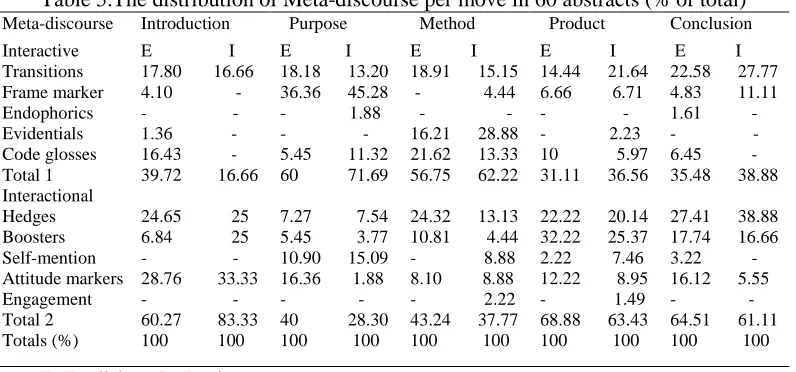
In general, it is also noticeable that interactional meta-discourse resources were overwhelmingly used in three moves of introduction, product, and conclusion; whereas the interactive meta-discourse strategies were predominantly corroborated in the purpose and method moves in both sets of abstracts across the disciplines (see Table 5). The perceived differences, among other things, might be attributable to different rhetorical effects of meta-discourse features in refashioning arguments (Moreno, 2004) in order to fulfill the communicative purposes of moves. That is to say, interactional choices are deployed to project writers’ personal voice, identity and standing as a competent member of discourse community motivated by crafting more persuasive arguments in introduction, product, and conclusion (Charles, 2003; Crismore & Farnsworth, 1990; Hyland, 1998, 2005a; Lim, 2006; Thompson, 2001; Vande Kopple, 1985) marked with interpersonal relationships, whereas interactive meta-discourse resources are greatly resorted in order to suggest a clear audience orientation through knitting a more comprehensible and persuasive text with sober recognition of processing needs and rhetorical expectations of readers on the part of writers (Hyland, 2005a , 2007; Vande Kopple, 1985). As is evident, the findings convey the impression that the use of meta-discourse features varies according to communicative function of moves in abstracts (Lim, 2006; Salager-Meyer, 1992; Santos, 1996).
In order to spotlight the relationship between the distributions of the meta-discourse features and the communicative function of each move, we discuss the findings of per move in detail below.
4.2.1 Meta-discourse distribution in move 1- Introduction
frame markers. However, the Iranian writers tended to mainly omit introduction moves.
In its broadest sense, each move serves to fulfill a specific determined function (Salager-Meyer, 1992). In so doing, the writers opted for various rhetorical strategies, for example, meta-discourse resources in the sense that they tacitly manipulate these rhetorical features to accomplish intended functions forcefully and persuasively. As Swales (1990) rightly points out, “the typical introduction is a crafted rhetorical artifact, at the published textual level the introduction is a manifestation of the rhetorical maneuver” (p.157).
Obviously, indicating a gap which coincides with the second Swalesian introduction move “establishing a niche” (Samraj, 2005) fulfills a main function in Introductions. As such, in terms of the persuasive function, it serves as a motivation for the study because it is implied that the gap needs to be filled (Conner & Mauranen, 1999). Undeniably, the creation of a gap is a pivotal rhetorical strategy signified by presence of interactive meta-discourse―transitions. This was a common practice for creating a gap in both groups of writers. The following example shows how a transition mapped onto the Introduction move to indicate a gap:
3. The secondary instantaneous centers of velocity for two-degree-of-freedom planar linkages must lie on straight lines. For many of these linkages, however, some of these lines cannot be obtained by a direct application of the Aronhold–Kennedy theorem. (N13)
The writers here strategically make specific recourse to rhetorical strategy of the transition (however) to highlight the immediate need for the filling gap.
Generally, writers in Introduction moves attempt to justify the need for conducting research by deploying various rhetorical devices to underscore significance, novelty, and uniqueness of their work (Afros & Schryer, 2009; Moreno, 2004). One such rhetorical device is the use of attitudinal language, especially attitude markers. Indeed, attitude markers as a main feature of interactional meta-discourse are perceived as the writer’s personal attitude to proposition serving an evaluative function (Hyland, 2005a). For instance: 4. Despite the significant role of sleepers in railway track mechanical
behavior, no thorough mechanistic approach has been presented for the development of the loading pattern they experience (NN19).
(no thorough). Accordingly, they skillfully merged both strategies to justify the need for study.
Some abstracts begin with a centrality claim, a term labeled by Swales (1990) in the first move of his CARS model as “establishing the territory”. He believes that writers affirm and promote the importance of topic of the study. One of meta-discourse features prototypical of centrality claims can be regarded as attitude markers because language resources can be exploited for promotional purposes in Introduction moves (Hyland, 2002a, 2004).See the following example:
5. Surgical techniques for extraction of a cataract and implantation of a replacement intraocular lens (IOL) into the eye have improved dramatically in recent years. (N15)
The word dramatically is employed to serve several functions: a) to instill greater noteworthiness of the topic for a wider discourse community and simultaneously b) to present background knowledge to readers c) to make the abstract more accessible to readers and ultimately d) to contextualize the study.
The statement of problem which is a common rhetorical practice in most Introduction moves assumed to be more intentional (Salager-Meyer, 1992). In other words, writers can accentuate that the existing works in literature suffer from some limitations conveying problems in real world. In so doing, writers resort to boosters. In fact, boosters provide an opportunity for writers to highlight a strong tone of certainty and confidence in their claims (Hyland, 2005a; Hu & Cao, 2011). The following example from the corpus illustrates the point:
Table 5.The distribution of Meta-discourse per move in 60 abstracts (% of total)
E=English I= Iranian
Commonly, writers also posit a problem (problem-raising) in prior research tradition and strive to challenge the efficiency of previous works, though, by means of a cautious language (hedges). As the main feature of the interactional meta-discourse, hedges are extremely crucial in academic argumentation (Dafouz-Milne, 2008; Hyland, 1996). Hedges are assumed to be the symbol of caution, modesty and decency on the part of writers for the world of academia and are tacitly manipulated to convey the impression of respect for maneuvering alternative viewpoints, thereby spotlighting the social nature of knowledge construction for interpersonal reasons (Hyland, 1996, 1998), as is clear in the following example:
7. Composite materials of epoxy resins reinforced by carbon fibers are increasingly being used in the construction of aircraft. In these applications, the material may be thermally damaged and weakened by jet blast and accidental fires (N27)
At the rhetorical level, frame markers are slightly used to perform several functions in introduction moves: a) to sequence parts of the text, b) to label text stages, c) to announce discourse goals, and d) to indicate topic shifts (Hyland, 2005a).Consider the following example:
8. We present a new pulse sequence ... However; it differs in several respects from existing methods that use oscillating diffusion gradients for this purpose. First, a wait time is inserted between neighboring pairs...; second, consecutive pulse pairs may be applied along orthogonal axes; and finally, the diffusion-attenuated signal... (N28)
Meta-discourse Introduction Purpose Method Product Conclusion
Interactive Transitions Frame marker Endophorics Evidentials Code glosses Total 1 Interactional Hedges Boosters Self-mention Attitude markers Engagement Total 2 Totals (%)
E I 17.80 16.66 4.10 - - - 1.36 - 16.43 - 39.72 16.66
24.65 25 6.84 25 - - 28.76 33.33 - - 60.27 83.33 100 100
E I 18.18 13.20 36.36 45.28 - 1.88 - - 5.45 11.32 60 71.69
7.27 7.54 5.45 3.77 10.90 15.09 16.36 1.88 - - 40 28.30 100 100
E I 18.91 15.15 - 4.44 - - 16.21 28.88 21.62 13.33 56.75 62.22
24.32 13.13 10.81 4.44 - 8.88 8.10 8.88 - 2.22 43.24 37.77 100 100
E I 14.44 21.64 6.66 6.71 - - - 2.23 10 5.97 31.11 36.56
22.22 20.14 32.22 25.37 2.22 7.46 12.22 8.95 - 1.49 68.88 63.43 100 100
E I 22.58 27.77 4.83 11.11 1.61 - - - 6.45 - 35.48 38.88
In example (8), the authors tacitly utilized frame markers (first, second,
finally) to arrange their argument string about the noteworthiness of the
study (over established previous works in literature) in order to warrant a justification for immediate research on this topic in a more persuasive way.
Sometimes introductions begin with topic generalizations (Swales, 1990), that is, inclusion of general statements. The contribution of code glosses for such goals is noticeable. Basically, code glosses are devices concerned with “clarification of writer’s communicative purposes to facilitate reader’s understanding” (Hyland, 2007, p.3). For example:
9. Conversion of low-grade heat to high-quality energy such as electricity using the Rankin cycle poses serious challenges ... (N18)
The code gloss (such as) is employed here a) to supply additional information by elaborating and clarifying the proposition, b) to help readers unpack the writers’ intended meaning, and c) to convey the writers’ audience sensitivity and relationship to the message (Hyland, 2007).
4.2.2 Meta-discourse distribution in move 2- Purpose
Meta-discourse features predominantly exploited in purpose moves were frame markers, transitions, code glosses, attitude markers, self-mentions, hedges, and boosters, in both cultural groups (see Table 5). Especially striking in purpose moves was that the writers tactfully manipulated the rhetorical options that best fitted their communicative purposes (e.g., highlighting the aim or objective of the study); for instance, frame markers were exploited to announce discourse goals and objectives. As Table 5 shows, an appreciable number of frame markers were utilized in both groups. The following examples are culled from our corpora:
10.In this article, an ultra-high-speed multiply-accumulate (MAC) structure is proposed. (NN6)
11.In this paper, we present the design of a fully integrated CMOS low noise amplifier (LNA) with ... (NN7)
As is clear, the writers put forward the goal of their studies overtly by means of the frame markers (in this article, in this paper).
intrusion into text whereby assuring an impression of personal standing, authority, and credibility (Hyland, 2001, 2002a, 2008). This view brilliantly echoed in Mur Dueñas’ (2007) words, “scholars step into the discourse by means of self-mentions” (p.1). For example:
12.We introduce a new communication model consisting of two interfering broadcast channels with one cognitive transmitter ... (NN3)
In the above instance, the authors through rhetorical choice of the self-mention (we) tended to exhibit a personal voice as knowledgeable contributors of the field. Of course, the writers on some occasions favored passive voices in stating their purpose in our corpora. Take, for instance, the following excerpt:
13.In this paper, a new method for the time-domain analysis of a PHEMT transistor… is presented (NN4).
The preference for passive voices could be traced in a philosophical movement which is deeply rooted in the theoretical underpinning of the positivist assumption (Hyland, 2001, 2002a, 2002b) in the sense that academic writing is merely empirical and objective. In other words, in the traditional standpoint, as Hyland (2001) eloquently comments, “eradication of the self is seen as demonstrating a grasp of scholarly persuasion as it allows the research to speak directly to the reader in an unmediated way” (p.208). In this light, it is fair to infer that the writers in the above excerpt prefer to adhere to positivist recommendations and disguise their personal portrayal in purpose moves with the use of passives.
As noted earlier, writers appeal to code glosses to assure propositional embellishment so that they foreground readers’ processing constraints through definitions, reformulations, and exemplifications (Hyland, 2007). 14.Three distinctive regimes resulting from oblique impact depending on
the obliquity, namely simple ricochet, critical ricochet and target perforation, were investigated in detail.
The word namely contributes readers to digest the writers’ intended purposes in the above example.
In general, transitions are widely resorted to in order to let readers uncover causative relationships between propositions that might be viewed as a sign of a writer- responsible rhetoric (Hinds, 1987) in which English authors show great concern for textual clues so that readers can easily make sense of the texts. Seen this way, these rhetorical choices pave the way for writers to justify their purposes more persuasively:
The transition (therefore) created a cohesive text by showing causative relationships between the propositions mentioned in the Introduction move and the Purpose move.
To foster justifications put forward for a study, the authors made use of attitude markers in purpose moves. Unluckily, the Iranian writers paid scant consideration to attitudinal language in purpose moves compared to their native peers (1.88 vs. 16.36). This point also captured the attention of Abdollahzade (2011) in his comparative study of interactional metadiscourse. One striking example is as follows:
16.As part of General Motors (GM) ongoing effort in engineering the next generation energy storage systems for future electric vehicles, this paper presents many of the key system and vehicle level issues that GM has found to be relevant or unique to the use of Li-ion batteries in vehicle applications. (N17)
The attitude marker unique here spotlights on the writers’ own personal assessment, that is, doing research in this area is really rewarding and merits special consideration in real world.
In some occasions, writers in purpose moves prefer boosters coupled by the use of self-mention to convey a sense of great confidence and certainty on the part of authors:
17.We show that the ill-conditioned nature of such analysis gives rise to a range of solutions for every method resulting in uncertainty in the spectral solution. (N30)
Interestingly, in the purpose move below, a more elaborate set of strategies are used: self-mention (we), code gloss (such as), and attitude marker (important). Taken together, affectively, all these rhetorical devices were corroborated in serving the rhetorical function of this move more persuasively:
18.We introduce a new method of calculation of amplitudes of continuous-time quantum walk on some rather important graphs, such as line, cycle…., where all are connected with orthogonal polynomials such as Hermite, Laguerre, Tchebichef, and other orthogonal polynomials. (NN23)
4.2.3 Meta-discourse distribution in move 3- Method
the work (Lim, 2006). In so doing, doubtless, specific citations to mainstream methodological decisions in prior research are assumed to be the best solution in highlighting acceptability of the method. Thus, as Abdi et al. (2010) stated forcefully, evidentials “bestow credibility on writer’s propositions and arguments” (p.1674). For example:
19.The nonlinear kinematic hardening theory of plasticity based on the Armstrong–Fredrick model and isotropic damage was used to evaluate the cyclic loading … (NN11)
In the above example, the writers are more likely to believe that justification of their work could be accomplished by referring to previous research Methods because these have been tested and proven before.
In the process of method description (e.g., sample, variable, procedure, etc.), meticulous writers make appealing resort to code glosses to give detailed accounts of the overall methodology normally to ratify credibility of work. Thus, it is understandable that clarification and exemplification of the steps taken in research are an inevitable part of the work:
20.The case study of analysis of bite- and muscle-forces in the articulated jaws of members ... In particular, with the subclass of cable actuated parallel MBS (including redundancy in actuation and unidirectional nature of actuation forces) (N12).
Aside from the description of Methodology, writers simultaneously attempt to highlight the study through positive evaluation of their work to spotlight the superiority of their methods over foregoing ones:
21.…Relaxed strain energy function in conjunction with Green’s strain and perfectly flexible assumptions … (NN11)
22.The procedure is demonstrated using experimental data obtained from a series…determined to possess an effective anisotropy ... (N24).
The evaluative aspects of attitude markers (perfectly, effectively) here are seemingly pertained to the self-promotional function.
In addition, in delineating the method move, writers also make conscious rhetorical choices in terms of exhibiting or disguising their personal projection into texts. As Lim (2006) points out, active verbs coupled by first-person pronouns refer to writers’ presence, whereas a passive voice preceded by a subject manifests the method under study: 23.Structures of the ANFIS are developed and trained in MATLAB 7.0.4
program. We have used real hardware data for training the ANFIS network ... (NN9)
laboratory activity as impersonal and objective (Hyland, 1999). Also, another possible reason can be related to face-threatening acts (Brown & Levinson, 1987; Mur Duenas, 2007; Myers, 1989). Further, the extremely low occurrence of attitude markers fosters the impersonality of the method moves. Taken together, these views would lead us to infer that authors in hard field abstracts show great leanings for being impersonal in method moves.
4.2.4 Meta-discourse distribution in move 4- Product
In contrast to the previous moves, boosters were the most leading meta-discourse in both sets of data. The appreciably high incidence of boosters in Product moves can suggest a strong tone of assertions, full commitment, and more confident voice of writers (Abdi et al., 2010; Crismore et al., 1993; Hu & Cao, 2011; Hyland, 1998, 2005a). As Salager-Meyer (1992) found writers in result moves capitalize on hard facts or crude generalizations with an assertive tone displaying only the most striking results. In other words, writers accentuate the certainty of their findings with plain assertions while suppressing alternative views fostering the results of their study with more conviction. Also open to interpretation is that the overuse of boosters might be ascribed to the partial influence by Grice’s maxim (Grice, 1975) suggesting the sufficient evidence for stating truth propositions (Abdi et al., 2010). Salient instances of boosters found in product moves are given below:
24.By varying X and N we confirm experimentally the existence and stability of the two-ground-state system within a narrow transition region. (N22)
25.These comparisons prove the numerical accuracy of solutions to calculate the in-plane and out-of-plane modes ... (NN11)
Notably, in product moves, as Chen (2011) tacitly argued, attitude markers indicate writers appreciation of results together with positive social values rooted in the institutional and community-recognized conventions and norms. In fact, attitude markers serve several key rhetorical functions in this move: first, a keen assessment of the findings personally; second, highlighting the important findings of the research (Abdollahzadeh, 2011); and finally, the act of persuasion by means of evaluative words (Stotesbury, 2003). The clear example is given below:
26.Most notable is the absence of antiferromagnetic susceptibility maxima down to 1.6 K from x=0.10 to 0.95. For x=0.05 a susceptibility maximum appears ... (N25)
27.The low-computational-complexity of the ensuing quasi-static models makes them well-suited both for: (a)iterative/parametric studies of the roles of geometry... as well as (b) implementing online inverse … (N12) 28.It is shown that the intertwined potentials are closely connected to the
integral curves of the Killing vector fields. Two problems are considered as applications of the formalism presented in the paper. The first one is the problem of Hamiltonians …and the second one is the problem … (NN 21)
When it comes to self-mentions, we found less reliance on the personal standings of the English writers in the Results moves, albeit high projection of self-representation was observed in the Iranian group. It is possible to deduce that self-mentions exhibit scholarly identity of writers, promote their contributions to discourse community, and reinforce their credibility (Hyland, 2001, 2002b; Kuo, 1999; Sheldon, 2009). For example:
29.Our construction is free from the problems associated with charge-super selection rule that complicated the previous studies ... (NN22)
The writers here resorted to self-mentions because as Rodman (1994) rightly states, (we) is a rhetorical device that highlights the writer’s role regarding the ownership of the findings.
The following example is the manifestation of several rhetorical strategies served to perform the rhetorical function of the product move effectively:
30.It was found that there was no obvious systematic trend in contact resistance over time. An average contact resistance of 2.5 omegas was recorded; however, values as low as 1.0 omega were also found. The assembled rotary switch demonstrated an excellent RF performance. (N6)
4.2.5 Meta-discourse distribution in move 5- Conclusion
might be yet another possible reason for hedging like writers’ attempt to soften their assertions due to face-threatening acts (Chen, 2011; Hu &Coa, 2011; Vassileva, 2001). That is to say, hedging is a politeness strategy that delicately mitigates authorial certainty, confidence, and force of the claim conveyed therein. Accordingly, it seems safe to claim that writers tend to be more tentative and cautious in their final conclusions but more assertive and confident in the results. Let’s probe into following examples from our examined corpora:
31.The noted differences between experimental results and theory could also be attributed to impeded slug motion from shear … (N23)
32.This suggests that NMR measurements of proton T1ρmay be used for
non-destructive evaluation of carbon fiber-epoxy composites. (N27) As shown in the above examples, it could again be assumed as Salager-Meyer (1992) posits, the scientists here are reluctant to make absolute commitments in their statements because they are aware of the fact that their interpretation may not be the only one
Most commonly, we also found that the writers tended to interpret the uniqueness of their results in the light of real world applications and implications through attitude markers. The use of such evaluative devices provides opportunity for readers to not only understand the propositional content, but also the stance of writers towards propositions. As a result, attitude markers are essential in persuasive writing otherwise a text would be dry and impersonal (Heng &Tan, 2010). For example:
33.Still, the unique characteristics deriving from quantum mechanical tunneling make such devices an interesting playground for innovative ... (N5).
Again, transitions are widely used to serve the function of making the text more clear and comprehensible to audience because the rhetorical devices minimize the processing load of the message making it more accessible for readers (Abdi et al., 2010). For example:
34.The advantages over the conventional single-bipolar approach were found to increase with decreasing diffusion time, and thus represent a significant step toward making accurate surface-to-volume measurements ... (N28)
5. Conclusion
found that the rhetorical strategies (meta-discourse) realized in each move are nearly similar between both sets of corpora across the disciplines. Of course, there were some marginal discrepancies in terms of the frequency of these rhetorical features. Overall, we may conclude that similarities between two groups outshine the differences.
References
Abdi, R., Rizi, M.T., Tavakoli, M., (2010). The cooperative principle in discourse communities and genres: A framework for the use of metadiscourse. Journal of Pragmatics, 42, 1669-1679.
Abdollahzadeh, E. (2011). Poring over the findings: Interpersonal authorial engagement in applied linguistics papers. Journal of Pragmatics, 43, 288-297.
Ackland, G. M. (2009). A discourse analysis of English and French researc
h article abstracts in linguistics and economics. San Diego, CA:
Montezuma Publishing.
Adel, A. (2006). Meta-discourse in L1 and L2 English. Philadelphia: John Benjamins.
Afros, E., & F. Schryer. C.(2009). Promotional (meta) discourse in research articles in language and literary studies. English for Specific Purposes,
28, 58-68.
Anderson, K., &Maclean, J., (1997). A genre analysis study of 80 medical abstracts. Edinburgh Working, Papers in Applied Linguistics, 8, 1–23. Berkenkotter, C. & Huckin, T. (1995).Genre knowledge in disciplinary
communication. Hillsdale, NJ: Lawrence Erlbaum.
Bhatia, V. K. (1993). Analyzing genre: Language use in professional
settings. London: Longman.
Bhatia, V. K. (2004). Worlds of written discourse: A genre-based view. London and New York: Continuum.
Brown, P., & Levinson, S. (1987). Politeness: Some universals in language
usage. Cambridge: Cambridge University Press.
Busch-Lauer, I-A. (1995a). Abstracts in German medical journals: A linguistic analysis, Information Processing & Management, 31(5), 769-776.
Charles, M. (2003). This mystery…: A corpus-based study of the use of nouns to construct stance in theses from two contrasting disciplines.
Journal of English for Academic Purposes, 24, 313-326.
Chen, M., (2011).Functions of perspective metadiscourse in reporting in literature reviews. Journal of Cambridge Studies, 6(1) 93-106.
Cheng, X., & Steffensen, M. (1996). Metadiscourse: A technique for improving student writing. Research in the Teaching of English,
30(2), 149-81.
Conner, U. (1999).Contrastive rhetoric: Cross-cultural aspects of second
language writing. Cambridge University Press: USA
Crismore, A. & Farnsworth, R. (1990). Metadiscourse in popular and professional science discourse. In W.Nash (Ed.). The writing scholar:
studies in academic discourse (pp.118-36). Newbury Park, CA: Sage.
Crismore, A., Markkanen, R., & Steffensen, M. (1993). Metadiscourse in persuasive writing: A study of texts written by American and Finnish university students .Written Communication, 10(1), 39-71.
Dafouz-Milne, E. (2008). The pragmatic role of textual and interpersonal Metadiscourse markers in the Construction and attainment of persuasion: Across-linguistic study of newspaper discourse. Journal of
Pragmatics, 40, 95-113.
Flowerdew, J. (1993). An educational or process approach to the teaching of professional genres. ELT Journal, 47(4) 305-316.
Graetz, N., (1985). Teaching EFL students to extract structural information from abstracts. In J.M. Ulijn & A.K. Pugh (Eds.). Reading for
professional purposes: Studies and practices in native and Foreign Languages (pp. 123–35). London: Heinemann Educational Books.
Grice, H. P. (1975). Logic and conversation. In Cole, P., Morgan, J. (Eds.).
Speech Acts (pp.45-58). Academic Press: New York.
Halliday, M. A. K. (1994). An introduction to functional grammar. London: Edward Arnold.
Hartley, J. (2003). Improving the clarity of journal abstracts in psychology: The case for structure. Science Communication, 24(3), 366-79.
Heng, S., & Tan, H. (2010). Extracting and comparing the intricacies of metadiscourse of two written persuasive corpora. International
Journal of Education and Development Using Information and Communication Technology. 6(3), 124-146.
Hinds, J. (1987). Reader versus writer responsibility: A new typology. In U. Conner, R.B. Kaplan (Eds.). Writing across languages: Analysis of L2
texts, (pp.141-152). Addison-Wesley: Reading M.A.
Hu, G., & Cao, F. (2011). Hedging and boosting in abstracts of applied linguistics articles: A comparative study of English-and Chinese-medium journals. Journal of pragmatics,43, 2795-2809.
Hunston, S. (1994). Evaluation and organization in a sample of written academic discourse. In Coulthard, M. (Eds.). Advances in written text
analysis. (pp.191-218), London: Routledge.
Hunston, S., & Sinclair, J.(2000). A local grammar of evaluation. In S. Hunston & G. Thompson (Eds.). Evaluation in text: Authorial stance
and the construction of discourse (pp. 54-68). Oxford: Oxford
University Press.
Hyland, K. (I998). Persuasion and context: The pragmatics of academic metadiscourse. Journal of Pragmatics, 30, 437-55.
Hyland, K. (I999). Disciplinary discourses: Writer stance in research articles. In C. Candlin & K. Hyland (Eds.). Writing: texts, processes
and practice (pp. 99-121). London: Longman.
Hyland, K. (2000). Disciplinary discourses: Social interactions in academic
writing. London: Longman.
Hyland, K. (2001). Humble servants of the discipline? Self-mention in research articles. English for Specific Purposes, 20 (3), 207-226. Hyland, K. (2002a). Authority and invisibility: Authorial identity in
academic writing. Journal of Pragmatics, 34(8), 1091-1112.
Hyland, K. (2002b). Options of identity in academic writing. ELT Journal,
56(4), 351‐358.
Hyland, K. (2004). Disciplinary interactions: Meta-discourse in L2 postgraduate writing. Journal of Second Language Writing, 13, 133-51.
Hyland, K. (2005a). Meta-discourse continuum. London: New York
Hyland, K. (2007). Applying a glass: Exemplifying and reformation in academic discourse. Applied Linguistics, 28(2), 266-285.
Hyland, K. (2008). Persuasion, interaction, and the construction of knowledge. International Journal English Studies, 8, 1-23.
Hyland, K. (2011). Academic discourse. In K. Hyland & B. Paltridge (Eds.). Companion to discourse analysis (pp.171-184). London: Continuum Press.
Hyland, K., & Tse, P. (2004). Met-discourse in academic writing: a reappraisal. Applied Linguistics, 25(2), 156-77.
Hyland, K., & Tse, P. (2005). Evaluative that construction: Signaling stance in research abstracts. Functions of Language, 12(1), 39–63.
Ifantidou, E. (2005). The semantics and pragmatics of metadiscourse.
Journal of Pragmatics, 37, 1325-1353.
Ivanic, R. (1998).Writing and identity: The discoursal construction of
identity in academic writing. Amsterdam: Benjamins.
Kuo, C.-H. (1999).The use of personal pronouns: Role relationships in scientific journal articles. English for Specific Purposes, 18(2), 121-38.
Leech, G. (1983). Principles of pragmatics. London: Longman.
Lim, J. M. H. (2006). Method sections of management research articles: A p edagogically motivated qualitative study. English for Specific
Purposes, 25(3), 282‐309.
Martin‐Martin, P. (2003). A genre analysis of English and Spanish research paper abstracts inexperimental social sciences. English for Specific Pu
rpose, 22(1), 25‐43.
Melander, B., Swales, J. M., & Fredrickson, K. M. (1997). Journal abstracts from three academic fields in TheUnited States and Sweden: National or disciplinary proclivities? In A. Duszak (Ed.). Culture and style of a
cademic discourse (pp. 251‐272). New York, NY: Mouton de Gruyter. Moreno, A. (2004). Retrospective labeling in premise-conclusion meta-text: An English-Spanish contrastive study of research articles on business and economies. Journal of English for Academic Purposes, 3(4), 321-40.
Mur Dueñas, P. (2007). I/we focus on: A cross-cultural analysis of self-mentions in business management research articles. Journal of
English for Academic Purposes, 6, 143-162.
Myers, G. (1989). The pragmatics of politeness in scientific articles.
Applied Linguistics, 10, 1–35.
Pho, P. D. (2008). Research article abstracts in applied linguistics and educat ional technology: A study of linguistic realizations of rhetorical struct ure and authorial stance. Discourse Studies, 10(2), 231‐250.
Rodman, L. (1994).The active voice in scientific articles: Frequency and discourse functions. Journal of Technical Writing and Communication, 24 (3), 309-331.
Salager-Meyer, F. (1990). Discoursal flaws in medical English abstracts: A genre analysis per research-and text-type. Text, 10 (4), 365–84.
Salager‐Meyer, F. (1992). A text‐type and move analysis study of verb tense and modality Distribution in medical English abstracts.
English for Specific Purposes, 11(2), 93‐113.
Samraj, B. (2005). An exploration of a genre set: Research article abstracts and introductions in two disciplines. English for Specific Purposes,
24,141-156.
Santos, M. B. D. (1996). The textual organization of research paper abstracts in applied linguistics. Text, 16(4), 481‐499.
Shaw, P. (2003). Evaluation and promotion across languages. Journal of
English for Academic Purposes, 2(4), 343-357.
Sheldon, E. (2009). From one I to another: Discursive construction of self-representation in English and Castilian Spanish research articles.
English for Specific Purposes, 28(4), 251-265.
Stotesbury, H. (2003). Evaluation in research article abstracts in the narrative and hard sciences. Journal of English for Academic
Purposes, 2(4), 327-41.
Swales, J. (1990).Genre analysis: English in academic and research
Settings. Cambridge: Cambridge University Press.
Swales, J. (1998).Other Floors, other Voices: A textography of a small
university building. Mahwah, NJ: Lawrence Erlbaum.
Swales, J. (2004). Research genres. Cambridge: Cambridge University Press.
Swales, J. U. K. Ahmad, Y-Y. Chang, D. Chavez, D. F., & Dressen Seymour, R. (1998). Consider this: The role of imperatives in scholarly writing. Applied Linguistics, 19, 97-121.
Tardy, C.M., (2011).Genre analysis .In K. Hyland & B. Paltridge (Eds.).
Companion to discourse analysis (pp. 54-68). London: Continuum
Press.
Thompson, G. (2001). Interaction in academic writing: Learning to argue with the reader. Applied Linguistics, 22(1), 58-78.
Tibbo, H. (1992).Abstracting across the disciplines: A content analysis of abstracts from the natural sciences, the social sciences, and the humanities with implications for abstracting standards and online information retrieval. LISR, 14, 31-56.
Van Bonn, S., & Swales, J. M. (2007). English and French journal abstracts in the language sciences: Three exploratory studies. Journal of
English for Academic Purpose, 6(2), 93‐108.
Vande Kopple, W. (1985). Some exploratory discourse on metadiscourse.
College Composition and Communication, 36, 82-93.