Analysis of Power Usage Performance For Routing
Protocols in Wireless Sensor Network
Deepti Sharma#1, Ankush Goyal*2
#1
M-Tech Student #2Assit. Prof. & Department of CSE & Shri Ram College of Engg. & Mgmt Palwal, Haryana, India
Abstract— Due to the low-power energy nodes utilized in a network, energy plays a important role in the wireless sensor networks (WSNs) lifetime. This study works on a routing mechanism featured with optimum energy consumption in wireless sensor networks. Various routing protocols with high energy efficiency (Director Diffusion, LEACH, PEGASIS, Gossiping and EESR) were analyzed. We also looked several schemes of the protocol for WSNs i.e. routing, data aggregation and clustering, different node role assignments, and data-center mechanisms. The routing protocols were compared in terms of variety of metrics affecting needs of the particular application and WSNs in general.
Keywords: Wireless Sensor Network, Routing Protocol, Energy Consumption, LEACH, Directed Diffusion, Gossiping, EESR, PEGASIS
I. INTRODUCTION
A lot of sensing elements capable of restricted-range radio communication and restricted energy source builds wireless sensor networks (WSNs). The networks fulfill many current requirements and hold high promises for future application. Implementation of current and potential functions of WSNs implies with highly ad advanced effective communication protocols. Therefore, as with various imaginable applications, there are several of needs to satisfy. Latency, Scalability, throughput, data aggregation, resource awareness, optimal routing overhead are to name but a few. Whatever the application, though, increasing lifetime of the network and reducing the energy consumption of the network as whole, required to be of the greatest priorities in comparison with other factors.
II. RELATED WORK
Various applications call for several algorithms for routing problems in WSNs
LEACH Protocol
LEACH (Low-Energy Adaptive Clustering Hierarchy) protocol first presented by Heinzelman et al. [1, 12[ is a network with enough of sensor with similar nodes that describe their data to a sink node; the nodes have restricted energy source. The suggestion is featured with TDMA-based (Time division multiple access) MAC protocol combined with
a simple routing protocol and clustering. In LEACH protocol, nodes are categorized into clusters and there is a cluster head (a node) in charge of generating and maintaining a TDMA schedule; on the other side, the left nodes are described as member bodes. All member nodes have an access to allocated TDMA slots to be utilized for transfer of data between the cluster head and member nodes, while no peer-peer communication occurs. The function of the cluster head is to combine the data from the members before routing the data to the sink node. Cluster heads takes high energy as it is on through the operation and attempts long-range transmission. The reason for presenting of LEACH was to cover the drawbacks of utilizing much energy of the flat-architecture protocol [2]. The data from the nodes is combined into meaningful and compressed data by the cluster head (CH) before routing to the sink node. This characteristic preserves more energy. As size of data and distance of transmission are factors of level of energy consumption, the LEACH takes short distances for transmission in fewer times. Accordingly, the primary challenge with LEACH is that CH directly routes data to the sink node, especially what the distance between the sink and CHs is high.
Directed Diffusion
Directed Diffusion collects information and distributes it to WSNs, as a data-centric routing protocol [14]. The primary objective is to preserve the energy and increase the lifetime of the network. To this end, the protocol tracks communication- transfer of message between the nodes positioned in a restricted network region. These localized communications enable direct diffusion to hold a reliable multipath delivery while utilizing a minimum subset of network routes. Along with ability of the nodes to combined responses to queries, the iconic characteristic of the protocol preserve the energy considerably. Interests, data message, gradient, and supports are the main elements of Direct Diffusion. Public-and-subscribe information model utilized by the protocol enables the interrogatot to signal an interest by the manner of attribute-value pair.
Gossiping Protocol
Similar to flooding, Gossiping [14] apply a straight forwarding rule that requires no costly configuration maintenance or complicated route-discovery algorithms. In Gossiping, in spite of flooding which is featured with
broadcasting data packet to all neighbouring nodes, every node routes the obtained packet to a arbitrarily chosen neighbour. When a packet is obtained, the receiver takes other neighbouring nodes arbitrarily and routes the packet to them. This process goes on until the delivery to the aimed receiver or iteration increases the highest hop count. Through enforcing restriction on the number of the packets routed by every node (one copy), the gossiping figures out the implosion problem. One feature of large network is suitable latency of delivery.
Energy-Efficient Sensor-Routing Protocol
The main aim for presentation of the Energy- Efficient Sensor-Routing (EESR) protocol [9] was to lessen the mean delay and power consumption and to provide scalability in WSN. The main elements of the protocol are the base station, gateway, sensor nodes and manager nodes [10].
The Algorithm
The base station flows direction information and sector ill of every node when the nodes are distributed, later on every node creates its EESR table. Upon discovering an even, the node search through the sector ill of all neighbouring nodes in one hop in the EESR For discovering the adjacent node, following three steps are considered:
• The manager node is the adjacent hop if it is positioned in one-hop distance;
• existence of a normal node within one hop and in the same sector - as the adjacent hop- will be examined when there is no manager node,
• In other cases, the node attempts to discover another node as the adjacent hop outside the sector as close as possible to the base station, Nodes in the same sector are selected at any rate, Power-Efficient Gathering in Sensor Information Systems (PEGASIS)
Considering only the energy consumption combines one more dimension to the problems of data aggregation, though the simulated latency up to the sink node is another challenge to be related about. Power-Efficient Gathering in Sensor Information System (PEGASIS) is particularly introduced to cover with these to concerns [11]. As a scenario, consider a similar network of sensor nods and a sink node that gathers local measurements data from each node once per round. It is possible to combine the evaluated data with whatever algebraic aggregation function. The nodes know about their global location, have power control, and some fitted with CDMA-capable radio transceivers, Attaining a coverage cast structure with suitable energy consumption, shorter delay that balances consumption of energy between the sensor nodes are the primary objectives, This indicates the benefits of the suggested protocol we require to show energy consumption and period of time needed for collecting data at every round.
III. COMPARISON OF EXPLORED ROUTING PROTOCOL
Various routing protocols i.e. EESR, Directed diffusion, PEGASIS, Gossiping, and LEACH are different in several ways. Gossiping, in comparison with other protocols, is highly
restricted and featured with high latency so that it fails to support network with suitable lifetime, furthermore, the protocol provide support to high connectivity as a node knows about its neighboring nodes for sending and routing packets, The general idea of Gossiping protocol is flooding protocol that need sending packets arbitrarily to the neighboring node and they in turn discover another arbitrary node, Noticeable is that the next node might be chosen from those sent a packet before. Therefore, Gossiping protocol, comparing with th PEGASIS, LEACH, Directed Diffusion, and EESR protocols, has mean energy consumption.
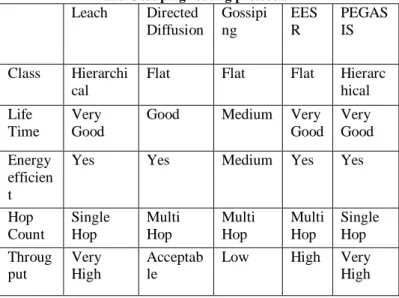
Table I: Comparison between the LEACH, Directed Diffusion, and Gossiping routing protocols
Leach Directed Diffusion Gossipi ng EES R PEGAS IS Class Hierarchi cal
Flat Flat Flat Hierarc
hical Life
Time
Very Good
Good Medium Very
Good Very Good Energy efficien t
Yes Yes Medium Yes Yes
Hop Count Single Hop Multi Hop Multi Hop Multi Hop Single Hop Throug put Very High Acceptab le
Low High Very
High
IV. SIMULATION
Two different types of simulation were made. One was comparing performance of Directed Diffusion, LEACH , EESR, PEGASIS, and Gossiping. (Table 2).
Table 2. The simulation parameters
Parameter Value
Network 50*50 m2
Number of sensors 200
Initial energy 0.25 J
Data packet size 4000 bits
Control packet size 32 bits
As displayed in figure 1, EESR described the best performance in comparison of others. To beam more light, results of performance in another graph with different initial energies are displayed in figure 2 To beam more light, results
of performance in another graph with different initial energies are described in figure 2
Figure 1 Performance results for a 50 x 50 m network with initial energy of 0.25 J/node
To beam more light, results of performance in another graph with different initial energies are displayed in figure 2
Figure 2 Performance results for a 200 x 200m network with initial energy 0.5 J/node
The other simulation was comparing energy consumption, hops count, live nodes, packet drop, and obtained packets between Directed Diffusion, LEACH, EESR, and Gossiping. (Table 3)
Energy Model
The simulation depend on the assumption that energy model is similar with that of the LEACH. The relation of the energy model in the simulation is:
Total amount of energy consumption in every round is displayed in figure 3.
Figure 3 Total energy consumed per round
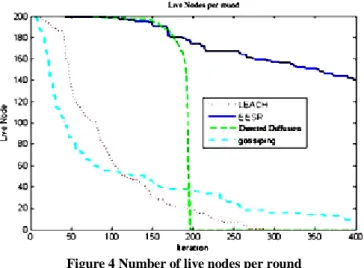
The number of live nodes in every round is displayed in figure 4. Clearly, all nodes die at 200th iterations in Directed Diffusion while highest number of live nodes left in EESR.
Figure 4 Number of live nodes per round
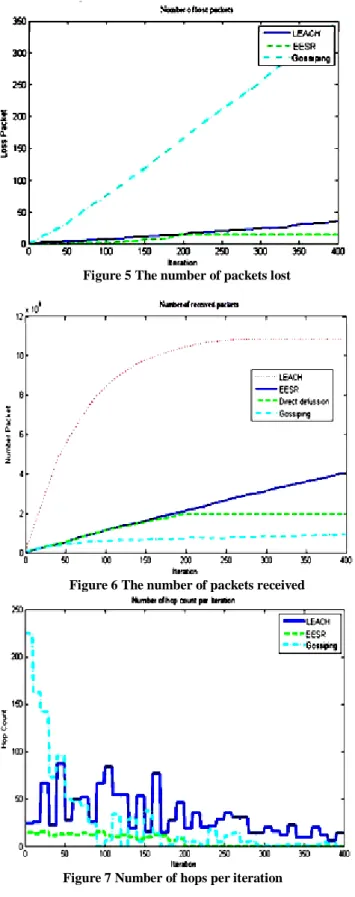
Figures 5 and 6 show the amount of packets drop and obtained during the simulation.
Figure 5 The number of packets lost
Figure 6 The number of packets received
Figure 7 Number of hops per iteration
CONCLUSION
For powering WSNs, batteries with certain capacity are utilized. Configuration of network may change dynamically
These characteristics mean extra issues to communication protocols. Operation of routing protocols with effective energy consumption (LEACH, Directed Diffusion, Gossiping, PEGASIS, and EESR) was studied and the factors influencing energy consumption were talked about. The results of comparisons of various parameters were shown in graphs. The comparison displayed that Gossiping consumes a medium amount of energy and best performance was received by LEACH and PEGASIS. Future studies may work out on the Green Network Project. A new routing protocol with optimized energy consumption and bandwidth was suggested in Green Wireless Networks.
REFERENCES
[I] W. Heinzelman, A. Chandrakasan and H. Balakrishnan, "Energy-Efficient Communication Protocol for Wireless Microsensor Networks," Proceedings of the 33rd Annual International Conference on System Sciences, Vol. 2, Maui, 4-7 January 2000.
[2] J. Zheng and A. Jamalipour, "Wireless Sensor Networks: A Networking Perspective," John Wiley & Sons, Hobo- ken, 2009.
[3] W. Heinzelman, A. Chandrakasan and H. Balakrishnan, "An Application-Specific Protocol Architecture for Wire- less Microsensor Networks," IEEE Transactions on Wire- less Communications, Vol. 1, No. 4, 2002, pp. 660-670. doi: 1O.1109/TWC.2002.804190
[4] X. N. Fan and Y. L. Song, "Improvement on LEACH Protocol of Wireless Sensor Network," International Conference on Sensor Technologies and Application, Val en- cia, 14-20 October 2007, pp. 260-264.
[5] C. Intanagonwiwat, R. Govindan and D. Estrin, "Directed Diffusion: A Scalable and Robust Communication Para- digm for Sensor Networks," Proceedings of the 6th An- nual International Conference on Mobile Computing and Networking, Boston, 6-11 August 2000, pp. 56-67.
[6] Y. H. Lee, K. O. Lee, H. J. Lee and A. Kusdaryono, "CBERP: Cluster Based Energy Efficient Routing Protocol for Wireless Sensor Network," Proceedings of 12th Interna- tional Conference on Networking, VLSI and Signal Proc- essing, Cambridge, 20-22 February 2010, pp. 24- 28.
[7] I. Akyildiz and M. Canvuran, "Wireless Sensor
Networks," Wiley, London, 2010. doi:
10.1002/9780470515181
[8] W. Yen, C.-W. Chen and c.-H. Yang, "Single Gossiping with Directional Flooding Routing Protocol in Wireless Sensor Networks," 3rd iEEE Conference on Industrial
Electronics and Applications, Singapore, 3-5 June 2008, pp. 1604-1609. doi: 10.1109/ICIEA.2008.4582790
[9] A. Norouzi, M. Dabbaghian, A. Hatamizadeh and B. Berk Ustundag, "An Improved ELGossiping Data Distribution Technique with Emphasis on Reliability and Resource Constraints in Wireless Sensor Network," iEEE interna- tional , Kuala Lumpur, 7-10 May 2010, pp. 179-183.
[10] H. Oh and K. Chae, "An Energy-Efficient Sensor Routing with Low Latency, Scalabilit in Wireless Sensor Networks," IEEE International Conference on Multimedia and Ubiq- uitous Engineering, Seoul, 26-28 April 2007, pp. 147-152
[11] S. Lindsey and K. M. Sivalingam. Data Gathering Algorithms in Sensor Networks Using Energy Metrics. iEEE Transactions on Parallel and Distributed Systems, 13(9): 924-934, 2002.
[12] Protocols and Architectures for Wireless Sensor Networks. Holger Karl and Andreas Willig,2005 John Wiley & Sons, Ltd.
[13] A. Norouzi, F. Babamir and A. Zaim, "A Novel Energy Efficient Routing Protocol in Wireless Sensor Networks," Wireless Sensor Network, Vol. 3 No. 10, 2011, pp. 341-350. doi: 1O.4236/wsn.2011.310038.
[14] K.SOHRABY,D.MINOLI,T.zNATI" WIRELESS
SENSOR NETWORKS,Technology, Protocols, and
Applications" Published by John Wiley & Sons, Inc., Hoboken, New Jersey. 2007
[15] M. H. Khodashahi, A. Norouzi, F. Amiri and M. Dabbaghian, "A Novel Optimal Routing Algorithm by
Creating Concentrically Sectors in Wireless Sensor
Networks," 8th iEEE Annual Communication Networks and Services Research Conference, Montreal, 11-14 May 2010, pp. 168- 173 15