c
BEYOND TOPIC-BASED REPRESENTATIONS FOR TEXT MINING
BY
SEAN ALEXANDER MASSUNG
DISSERTATION
Submitted in partial fulfillment of the requirements
for the degree of Doctor of Philosophy in Computer Science
in the Graduate College of the
University of Illinois at Urbana-Champaign, 2017
Urbana, Illinois
Doctoral Committee:
Professor ChengXiang Zhai, Chair
Associate Professor Julia Hockenmaier
Professor Dan Roth
Professor Steve LaValle
ABSTRACT
A massive amount of online information is natural language text: newspapers, blog articles, forum posts and comments, tweets, scientific literature, government documents, and more. While in general, all kinds of online information is useful, textual information is especially important—it is the most natural, most common, and most expressive form of information.
Text representation plays a critical role in application tasks like classification or information retrieval since the quality of the underlying feature space directly impacts each task’s performance. Because of this importance, many different approaches have been developed for generating text representations. By far, the most common way to generate features is to segment text into words and record theirn-grams. While simple term features perform relatively well in topic-based tasks, not all downstream applications are of a topical nature and can be captured by words alone. For example, determining the native language of an English essay writer will depend on more than just word choice. Competing methods to topic-based representations (such as neural networks) are often not interpretable or rely on massive amounts of training data. This thesis proposes three novel contributions to generate and analyze a large space of non-topicalfeatures.
First, structural parse tree features are solely based on structural properties of a parse tree by ignoring all of the syntactic categories in the tree. An important advantage of these “skeletons” over regular syn-tactic features is that they can capture global tree structures without causing problems of data sparseness or overfitting.
Second, SYNTACTICDIFFexplicitly captures differences in a text document with respect to a reference corpus, creating features that are easily explained as weighted word edit differences. These edit fea-tures are especially useful since they are derived from information not present in the current document, capturing a type of comparative feature.
Third, Cross-Context Lexical Analysis is a general framework for analyzing similarities and differences in both term meaning and representation with respect to different, potentially overlapping partitions of a text collection. The representations analyzed by CCLA are not limited to topic-based features.
ACKNOWLEDGMENTS
I am most grateful to my advisor, Professor ChengXiang Zhai. He is an excellent mentor, and without his help and supportive guidance, this thesis would not be what it is today. It is with his generous time and wise insight that I was able to complete the work that appears in this thesis. I’m particularly appreciative of Cheng’s consistent positive manner and his ability to see the “big picture” and potential impact of all ideas.
I would also like to thank my committee members: Professor Julia Hockenmaier, Professor Dan Roth, Professor Steve LaValle, and Professor Qiaozhu Mei. I had the pleasure of taking four semesters of Julia’s classes in a row—most of my interest in natural language processing and machine learning stems from them. Dan also sparked my early interest in machine learning when I took classes from him at the Data Sciences Summer Institute, and he greatly helped in my graduate school application to UIUC. I was assigned Steve as my undergraduate mentor during sophomore year and have received guidance from him over a period of almost seven years. I’m thankful for his unique perspective while serving on my committee. I’ve significantly benefited from Qiaozhu’s accessibility during the last year of my thesis; he has offered much practical advice for both work and school. Most of my research is inspired by his work in contextual text mining.
Members of UIUC and industry have also positively impacted not only my research, but also my aca-demic life. A very sincere thanks to Dr. Cinda Heeren, Professor Hari Sundaram, Dr. Jeff Ludwig, Tod Courtney, and Dr. Nate Nichols.
My friends in graduate school have also generously shared motivation, encouragement, and fruitful discussion. Special thanks to Jason Cho, Chase Geigle, Urvashi Khandelwal, and Chase Duncan, among many others. Interacting with you was the key to success in grad school.
Finally, I’d like to extend my gratitude towards my family, especially my wife, Kai Nemoto. This thesis is dedicated to my parents.
TABLE OF CONTENTS
LIST OF TABLES . . . vii
LIST OF FIGURES . . . ix
CHAPTER 1 MOTIVATION AND IMPACT . . . 1
1.1 Text Data . . . 1
1.2 Text Representation . . . 2
1.3 Organization of this Thesis . . . 5
CHAPTER 2 TEXT REPRESENTATION . . . 7
2.1 Feature Types . . . 7
2.2 Using Extracted Features . . . 12
CHAPTER 3 CASE STUDY: NON-NATIVE TEXT MINING . . . 17
3.1 Introduction . . . 17
3.2 Native Language Identification . . . 18
3.3 Non-Native Grammatical Error Correction . . . 20
3.4 Fluency Scoring . . . 24
3.5 Text Simplification . . . 27
CHAPTER 4 STRUCTURAL PARSE TREE FEATURES . . . 30
4.1 Motivation . . . 30
4.2 Related Work . . . 31
4.3 Model . . . 33
4.4 Experiments . . . 36
4.5 Discussion . . . 39
4.6 Contributions and Future Work . . . 43
CHAPTER 5 SYNTACTICDIFF . . . 45 5.1 Motivation . . . 45 5.2 Related Work . . . 48 5.3 Model . . . 49 5.4 Experiments . . . 53 5.5 Discussion . . . 61
CHAPTER 6 CROSS-CONTEXT LEXICAL ANALYSIS . . . 65
6.1 Motivation . . . 65
6.2 Model . . . 67
6.3 Analysis of Semantic Change . . . 68
6.4 Comparative Lexical Analysis over Context . . . 72
6.5 Comparing Word Annotations . . . 76
6.6 CCLA for Text Representation . . . 80
6.7 Related Work . . . 81
6.8 Conclusions and Future Work . . . 82
CHAPTER 7 APPLICATION SYNTHESIS: META . . . 84
7.1 A Unified Framework . . . 84
7.2 Usability . . . 87
7.3 Experiments . . . 89
7.4 Contributions from this Thesis . . . 92
7.5 Conclusions and Future Work . . . 94
CHAPTER 8 CONCLUSIONS AND OPEN QUESTIONS . . . 95
LIST OF TABLES
2.1 Text representation and enabled analysis. More sophisticated representation generally enables more intelligent text analysis applications, but also tends to be less robust.
(Reproduced from Zhai and Massung (2016)) . . . 11 3.1 Summary of NLI results listed in Brooke and Hirst for the ICLE corpus; accuracies added
to chart.∗indicates feature-based methods and+indicates likelihood-based methods. . . 20 3.2 Comparison of GEC strategies.∗indicates targeted approaches and+indicates general
approaches. . . 24 4.1 Comparison of single and combined features across corpora. SC, RR, Skel, and ASkel
refer to Syntactic Category, Rewrite Rules, Skeleton, and Annotated Skeleton.
Combi-nation methods and all parameters were chosen via tuning on development set. . . 37 4.2 Adding tree features to the best-performing single features changes F1 andκscores
across the three data sets. . . 40 4.3 Samples of the highest ranked features for each language as selected by the correlation
coefficient metric. Note that the words are stemmed. . . 41 5.1 Grammar correction task: the table shows whether edit weights are used, whether
insertions are done based on perplexity, how many final candidate sentences are un-changed (no-ops), precision, recall, F1 score, and runtime in seconds. This system
would place 7thin the CoNLL shared task. . . 54 5.2 Summarization task: different tokenization methods for 16 topics on the ICNALE
smok-ing corpus. Displayed are vocabulary size, average document length, LDA inference
iteration time, and the time for 500 iterations for comparison. . . 57 5.3 Summarization task: 5 of 16 topics learned from the ICNALE smoking corpus with
three tokenization methods. Then-gram methods capture writing themes while SYN -TACTICDIFFcaptures similar errors. Note thats(·)refers to the
substitute
functionfor brevity. . . 58 5.4 Classification task: comparison between the three methods on the ICNALE essays.
Dis-played are vocabulary size, average document length,F1score, and accuracy.∗Combined results are significantly higher withp<0.001. Each experiment completed in less than
10 seconds. . . 59 5.5 Classification task: confusion matrix of combined features on the ICNALE corpus.
Overall accuracy of 85.9%. Percentages have been rounded for readability. Each (r ow,column) index represents the fraction of timesr owis labeled ascolumn; thus
all rows sum to 100%. . . 59 5.6 Classification task: edit features selected via information gain for 5 of the 11 classes in
6.1 Comparing methods to find the most-changed words between 1900 and 1990. Each method operates on a type of word representation (PPMI, SVD, or SGNS). We follow the conventions of Hamilton et al. (2016) in bolding terms the authors agree to be clearly correct after consulting a dictionary, underlining borderline cases, and leaving
incorrect terms unmarked. . . 71
6.2 Example words that changed dramatically during the 20th century. The examples were chosen from the top-20 most-changed lists from words in Table 6.1. . . 71
6.3 Using embedding annotation similarity to discover the top positive, negative, and am-biguous terms for IMDB and Yelp. Each corpus treated independently as a separate CCLA problem. . . 72
6.4 Usage samples of the five most ambiguous words (all actors and actresses) in the IMDB dataset. In some cases, the same person is discussed in different ways; in others, people share the same name, leading to ambiguity. . . 73
6.5 Using embedding annotations to compare term contexts between IMDB and Yelp. Cross-corpus lists show words that are used similarly in both collections. Corpus-specific lists show words that are used differently given a particular collection. . . 74
6.6 We compare the effect of stability (low vs. high) using analogy and word similarity benchmarks. While stability does not seem to indicate performance differences across embedding methods, it does suggest that a higher stability indicates higher perfor-mance within-method. . . 78
7.1 Toolkit feature comparison. Citations for all toolkits may be found in their respective comparison sections. . . 85
7.2 (NLP) Training/testing performance for the shift-reduce constituency parsers. All mod-els were trained for 40 iterations on the standard training split of the Penn Treebank. Accuracy is reported as labeledF1from
evalb
on section 23. . . 887.3 (NLP) Part-of-speech tagging token-level accuracies. “Extra data” implies the use of large amounts of extra unlabeled data (e.g. for distributional similarity features). . . 89
7.4 (IR) The two TREC datasets used. Uncleaned versions of blog06 and gov2 were 89 GB and 426 GB respectively. . . 89
7.5 (IR) Indexing speed. . . 90
7.6 (IR) Index size. . . 90
7.7 (IR) Query speed. . . 91
7.8 (IR) Query performance via Mean Average Precision and Precision at 10 documents. . . . 91
7.9 (ML) Datasets used fork-class categorization. . . . 92
7.10 (ML) Accuracy and speed classification results. Reported time is to both train and test the model. For all except Webspam, this excludes IO. . . 92
LIST OF FIGURES
2.1 An example grammatical parse tree of the sentenceA dog is chasing a boy on the playground. 9 3.1 Dichotomy of non-native text mining as part of the general text mining and NLP domains. 18 4.1 An example grammatical parse tree of the sentenceThey have many theoretical ideas. . . . 33 4.2 Example rewrite rule grammatical parse tree features of the sentenceThey have many
theoretical ideas. . . . 34 4.3 Example skeleton grammatical parse tree features of the sentenceThey have many
the-oretical ideas. . . . 35 4.4 Example annotated skeleton grammatical parse tree features of the sentenceThey have
many theoretical ideas. . . . 35 4.5 Representative phrases for a top feature from each L1. . . 42 6.1 The effect of thekparameter in cosine similarity of top-ksimilarity scores. . . 69 6.2 Using NDCG of nearest-neighbor lists to measure the stability of GloVe and SGNS by
CHAPTER 1
MOTIVATION AND IMPACT
In this chapter, we motivate and declare the thesis topic. We start with a broad, general view of text data mining before focusing on specific contributions and main research questions. The organization of the thesis then follows.
1.1
Text Data
A massive amount of online information is natural language text: newspapers, blog articles, forum posts and comments, tweets, scientific literature, government documents, and more. While in general, all kinds of online information is useful, textual information plays an especially important role—it is the most natural, most common, and most expressive form of information for the following reasons (Zhai and Massung, 2016).
1. Text—transcribed human language—is themost naturalway of encoding knowledge. As a result, most human insight is encoded in the form of text data. For example, scientific knowledge almost exclusively exists in scientific literature, while technical manuals contain detailed explanations of how to operate devices.
2. Text is by far themost commontype of information encountered by people. Indeed, most of the information a person produces and consumes daily is in text form.
3. Text is themost expressiveform of information in the sense that it can be used to describe other media such as video or images. Indeed, image search engines such as those supported by Google and Bing often rely on matching companion text of images to retrieve “matching” images to a user’s keyword query.
In contrast to structured data, which conform to well-defined schemas and are thus relatively easy for computers to handle, text has less explicit structure, so the development of intelligent software tools to understand content encoded in text is a necessity. The explosive growth of online text information has
created a strong demand for the following two related services to help people manage and exploit big text data.
First, is text retrieval. The rapid growth of online text information means that no one can possibly digest all the new information created on a daily basis. Thus there is an urgent need for developing intelligent text retrieval systems to help people get access to relevant information quickly and accurately, leading to the recent growth of the Web search industry. Web search engines like Google and Bing are now an essential part of our daily life, servingbillionsof queries each day1.
Second, is text mining. Due to the fact that text data are produced by humans for communication pur-poses, they are generally rich in semantic content and often contain valuable knowledge, information, opinions, and preferences. As such, they offer great opportunity for discovering various kinds of knowl-edge useful for many applications. For example, it is now the norm for people to tap into opinionated text data such as product reviews, forum discussions, and social media text to obtain opinions about topics interesting to them and optimize various decision-making tasks. Once again, due to the overwhelming amount of information, people need intelligent software tools to help discover relevant knowledge.
1.2
Text Representation
Text representation plays a critical role in these downstream tasks since the quality of the underlying feature space directly impacts each task’s performance. Because of this importance, many different ap-proaches have been developed for generating text representations.
We can represent text by a set of extracted features, often stored in a feature vector. The simplest fea-tures can be the words in the text—e.g., delimited by whitespace. Text representation is a fundamental issue in all text retrieval and text mining applications such as Web search, text clustering, and text cate-gorization. Text representation is also critical for generating useful features to be used in many machine learning algorithms to support natural language processing applications.
In other words, virtually all text mining applications operate on feature vectors of text. The quality and generality of these feature vectors directly impacts the performance of downstream applications. Even the most sophisticated machine learning algorithm will achieve poor results if the feature vectors it operates on are not a sufficient representation of the knowledge encoded in the original text data.
The issue of text representation is complicated because different tasks tend to require a somewhat different perspective of representation—thus a different feature set. For example, while function words (such aswhile,throughout, anddespite) are generally not useful for topic categorization, they may be useful for an authorship attribution categorization task, which may also benefit from features capturing
1
sentence length and structure. It is therefore important to develop a rich set of potential features that can represent text from orthogonal perspectives and to understand what kind of features are most effective for which tasks.
By far, the most common way to generate features is to segment text into words and record their n-grams; indeed, unigram words are a common baseline for information retrieval and text classification applications. Competing methods will challenge the performance and assumptions made by baselines liken-gram words.
Other feature types rely on natural language processing, such as part-of-speech tags or grammatical parse tree features. Using topic models like LDA (Blei et al., 2003) or its many variants can be used to represent documents in a lower-dimensional topical space by looking at word co-occurrence statistics. As we use more sophisticated NLP methods to represent text (such as named entity recognition or semantic role labeling), we obtain more informative and often discriminative features, but at a higher cost of introducing errors into the pipeline. On the other hand, shallow features like n-gram words are very robust, but may not be able to capture sufficiently characteristic properties. Thus, developing general, robust, and discriminative features is a difficult and important open research problem.
Recently, representation learning—deep learning—as described by Bengio et al. (2013) has become a powerful way to compose features in new dimensions. Deep learning has increased performance in many areas of computer science, such as speech recognition, vision, and even NLP (Collobert et al., 2011). Representations such as paragraph vectors (Le and Mikolov, 2014) and skip-thought vectors (Kiros et al., 2015) can represent entire documents or phrases in a low-dimensional space. Both are built on top of word embeddings such asWORD2VEC(Mikolov et al., 2013b), though these particular word embeddings are not strictly “deep learning” (Levy and Goldberg, 2014).
While intriguing, these deep document representations suffer from a few issues. First, they require much larger amounts of training data compared to more basic methods. Second, due to their complexity, they require very long training times that are usually measured in weeks. Lastly, neural networks are the ultimate black box of decision making. Today, we do not completely understand how they work or how to interpret their results. Bengio et al. (2013) list ten points that make a representation good; unfortunately,interpretabilityis not one of them. In other words, a useful feature representation should be “mineable”.
As educators, how can we teach students to write better essays if our autograder is not interpretable? This doesn’t solve the workload scaling problem if the instructor or TA still needs to individually meet with each student to explain the results. As members of industry, how can we explain to our bosses that the AI we use won’t take over humanity2? Understandingwhya document was ranked higher than
another orwhya group of documents share a topic is just as important as the search results or topics themselves. Ribeiro et al. (2016) emphasize the importance of human understanding in text mining applications. As a medical practitioner or government agent fighting terrorism, understanding exactly why some models behave the ways they do is critical to their effectiveness and utility in decision making and causal analysis (e.g. Zhao et al. (2017)).
It is therefore important to develop a rich set of potential features that can represent text from orthog-onal perspectives. These different perspectives allow us to understand what kind of features are most effective for which tasks, and enable mining knowledge in the underlying datasets that would otherwise be lost in more complicated and less transparent features.
While there is some considerable work in “explaining” existing features (Baehrens et al., 2010; Bansal et al., 2014; Ribeiro et al., 2016), there is less of a focus on designing interpretable, orthogonal features ton-gram words in the first place. Ribeiro et al. (2016) introduce methods to explain predictions of clas-sifiers and regressors as well as algorithms to select representative members of each class. They examine text representation with bag-of-words features. While a classifier obtained 94% accuracy on newsgroup categorization, examining highly-weighted unigram word features showed a serious overfitting problem. These are the types of issues that we wish to find through interpretable and understandable features.
To address the limitations of existing work on text representation, this thesis proposes three novel contributions to generate a large space ofnon-topicalfeatures from text data in a general, interpretable, and efficient way.
Structural parse tree features (Massung et al., 2013) are one such contribution. These features are solely based on structural properties of a parse tree by ignoring all of the syntactic categories in the tree. An important advantage of these “skeletons” over regular syntactic features is that they can capture global tree structures without causing problems of data sparseness or overfitting. Because of the focus on pure structures, even relatively large skeletons can be observed multiple times in a set of text articles; in contrast, if we were to attach the syntactic categories, we would end up having far more specialized features that may not be observed multiple times in the corpus. When combined with unigram words, skeleton features increased the classification accuracy on two different tasks. Skeletons also provide visual clues as to why they are important for certain classes.
SYNTACTICDIFF(Massung and Zhai, 2015) explicitly captures differences in a text document with re-spect to a reference corpus, creating features that are easily explained as weighted word edit differences. These edit features are especially useful since they are derived from information not present in the current document, capturing a type of comparative feature. As with our previous work, we used non-native text mining (Massung and Zhai, 2016) as a source of example downstream applications. SYNTACTICDIFF’s edit features improved native language identification and were able to be directly used for grammatical
error correction (without a specific, heavily-tuned pipeline). In an essay-grading setting, we grouped stu-dents together by the types of mistakes they made (realized as edit features). For example, one cluster of students made many article errors while another overused certain word types.
Cross-Context Lexical Analysis (Massung et al., 2017) directly addresses the issue that good features should be interpretable. We propose a general framework for analyzing similarities and differences in both term meaning and representation with respect to different, potentially overlapping partitions of a text collection. We apply our framework to three different tasks: semantic change detection (discovering words whose meanings changed over time), comparative lexical analysis over context (finding context-sensitive and context-incontext-sensitive terms), and word representation comparison (investigating randomness inherent in word embeddings).
In summary, text representation is critical to all text mining applications to avoid overfitting and enable potential causal analysis. This thesis contributes approaches to generate and analyze non-topical features from text data. Novel features (Massung et al., 2013; Massung and Zhai, 2015) are shown to help improve performance for various tasks while simultaneously enabling interesting feature analysis and mining. A novel framework for feature analysis (Massung et al., 2017) that supports non-topical features helps explore and explain text representations, including some that are inherently difficult to analyze, such as word embeddings.
1.3
Organization of this Thesis
This thesis is organized as follows:Chapter 2 explains and motivates the importance of text data management and analysis (Zhai and Massung, 2016). We explain how text is transformed from a raw string into meaningful features that can be used in downstream applications.
Chapter 3 examines and surveys a subfield of text mining named non-native text analysis (Massung and Zhai, 2016). We see how text mining and representation play a crucial role and have the ability to affect billions of language learners around the world.
Chapter 4 details structural parse tree features for text representation (Massung et al., 2013). We examine these features from a classification perspective and compare representative features conditioned on class labels for native language identification.
Chapter 5 introduces SYNTACTICDIFF(Massung and Zhai, 2015), an operator-based comparative text mining algorithm. We demonstrate SYNTACTICDIFF’s performance in three tasks—grammatical error cor-rection, summarization, and classification.
analyzing similarities and differences in both term meaning and representation with respect to different, potentially overlapping partitions of a text collection.
Chapter 7 explains how the previous methods are all open source and available online as part of the META toolkit (Massung et al., 2016).
CHAPTER 2
TEXT REPRESENTATION
This chapter gives a very broad, general introduction and literature survey to text representation tech-niques. Organization and content is an expanded version of section 3.3 from Zhai and Massung (2016).
2.1
Feature Types
Techniques from natural language processing allow us to design many different types of informative features for text objects. Let’s take a look at the example sentence:
A dog is chasing a boy on the playground.
We can represent this sentence in many different ways. First, we can always represent such a sentence as a string of characters—this is true for every language. This is perhaps the most general way of repre-senting text since we can always use this approach. Unfortunately, the downside to this representation is that it can’t allow us to perform semantic analysis, which is often needed for many applications of text mining. We’re not even recognizing words, which are the basic units of meaning for any language. (Of course, there are some situations where characters are useful, but that is not the general case.)
The next version of text representation is performing word segmentation to obtain a sequence of words. In the example sentence, we get features likedogandchasing. With this level of representation, we suddenly have much more freedom. By identifying words, we can (for example), easily discover the most frequent words in this document or the whole collection. These words can then be used to form topics. Therefore, representing text data as a sequence of words opens up a lot of interesting analysis possibilities.
This level of representation is slightly less general than a string of characters. In some languages— such as Chinese—it’s actually not that easy to identify all the word boundaries since that language’s text is a sequence of characters with no spaces in between words. To solve this problem, we have to rely on some special techniques to identify words and perform more advanced segmentation that isn’t only based on whitespace (which isn’t always 100% accurate). So, the sequence of words representation is
not as robust as the string of characters representation. In English, it’s very easy to obtain this level of representation so we can use this all the time.
Below, we additionally show three modifications to the whitespace tokenization:
• Lowercasing changes capital letters to lowercase ones in order to reduce the total number of unique words and ensure that words likeCatandcatare counted as the same.
• Stemmingreduces each word to its root form. This results in a further reduction of unique words and ensures that words likerunsandrunningare counted the same asrun.
• Stopword removal gets rid of non-content bearing words, which usually do not provide useful information to the downstream task.
These modifications do not greatly change the token-based representation of text. Instead, they slightly adjust the representation in attempts to circumvent its limitations.
A, dog, is, chasing, a, boy, on, the, playground, . (tokenized) a, dog, is, chasing, a, boy, on, the, playground, . (+lowercased) a, dog, is, chase, a, boy, on, the, playground, . (+stemmed) dog, chase, boy, playground (+no stopwords)
If we go further into natural language processing techniques, we can add part-of-speech (POS) tags to the words. This allows us to count, for example, the most frequent nouns; or, we could determine what kind of nouns are associated with what kind of verbs. This opens up more interesting opportunities for further analysis.
ADT dogN N isV BZchasingV BGaDT boyN N onI N theDT playgroundN N ..
Note that as we add more advanced features, we don’t necessarily replace the original word sequence or prior features. Instead, we add this as an additional way of representing the text data. Representing text as both words and POS tags enriches the representation of text data, enabling a deeper, more principled analysis. We will see this theme continued throughout this thesis.
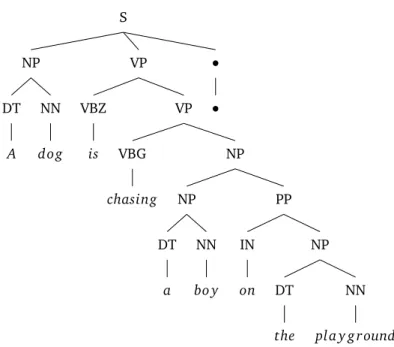
If we go further, then we can apply a grammatical parser to the sentence, obtaining a syntactic structure and productions displayed in Figure 2.1. Again, this further opens up more interesting analysis of (e.g.) writing style or grammatical error correction depending on how features are extracted from the tree and aggregated across sentences.
Going further still into semantic analysis, we might be able to recognizedogas an animal. We also can recognizeboyas a person, andplaygroundas a location and analyze their relations. One deduction could be that the dog was chasing the boy, and the boy is on the playground. This will add more entities and
S NP DT A NN d o g VP VBZ is VP VBG chasing NP NP DT a NN bo y PP IN on NP DT the NN pl a y g r ound • •
Figure 2.1: An example grammatical parse tree of the sentenceA dog is chasing a boy on the playground.
relations, through entity-relation recreation. Now, we can count the most frequent person that appears in this whole collection of news articles. Or, whenever this person is mentioned, we discover that we also tend to see mentions of another person or object. These types of repeated pattens can potentially make very good features.
A dog | {z } Animal →chase a boy | {z } Person
→on the playground
| {z }
Locat ion
Such a high-level representation is even less robust than the sequence of words or POS tags. It’s not always easy to identify all the entities with the right types and we might make mistakes. Relations are even harder to find; again, we might make mistakes. The level of representation is less robust, yet it’s very useful. If we move further to a logic representation, then we have predicates and inference rules. With inference rules we can infer interesting derived facts from the text. As one would imagine, we can’t do that all the time for all kinds of sentences since it may take significant computation time or a large amount of training data.
Finally, speech acts would add a yet another level of representation of the intent of this sentence. In this example, it might be a request. Knowing that would allow us to analyze even more interesting things about the observer or the author of this sentence. What’s the intention of saying that? What scenarios
or what kinds of actions will occur?
Such advanced techniques would require more human effort as well, and they are generally less robust since they attempt to solve a much more difficult problem. If we analyze our text at levels that represent deeper analysis of language, then we have to tolerate potential errors. That also means it’s still necessary to combine such deep analysis with shallow analysis based on (e.g.) sequences of words. Despite this, the advanced techniques achieve a representation of text is closer to the knowledge representation in our mind.
Clearly, there is a tradeoff here between doing deeper analysis that might have errors but would give us direct knowledge that can be extracted from text. Doing shadow analysis (which is more robust) wouldn’t give us the necessary deeper representation of knowledge.
A further issue is feature sparsity—using individual words to represent meaning results in a very sparse feature space. For example, a typical text corpus may have a vocabulary size of over 100, 000 unique terms. Lowercasing, stemming, and stopword removal were shown as ways to attempt to alleviate this issue, but they will never completely solve the problem. For example, the words “dog” and “canine” will never be the same (or similar) feature in a unigram words representation even though they have an almost identical meaning.
A way to address this sparsity issue is to transform the one-hot|V|-sized space into a lower-dimensional dense space. After removing stopwords, our sentence could look like the following:
dog chasing boy playground
0.0540 0.0137 0.0188 .. . −0.0377 0.9897 −0.1163 0.0568 0.1330 .. . 0.5839 0.0400 0.1514 −0.0390 0.0354 .. . −0.0173 −0.3011 −0.0138 0.0972 0.0164 .. . 0.1104 −0.0011
Now, (ideally) words such as “dog” and “canine” have higher similarity than “dog” and “banana” by using cosine similarity between their embeddings.
Methods to induce word embeddings have seen some resurgence in popularity recently (Mikolov et al., 2013b; Pennington et al., 2014), but older techniques such as Brown clustering (Brown et al., 1992) have existed for many years. We investigate some different word embeddings methods in section 6.5.
Still, using individual word embeddings to represent an entire document is an issue. Simply aver-aging each dimension together is a baseline, but combining them in more structured ways is an area of active research (Le and Mikolov, 2014; Kiros et al., 2015; Kenter et al., 2016). Alternatively, jointly
Representation Generality Enabled Analysis Application Example
String ? ? ?? string and character
processing
compression
Words ? ? ? word relations, topic
and sentiment analysis
thesaurus discovery and opinion mining +Syntactic structure ?? syntactic graph
analysis
stylistic analysis and structure-based feature extraction
+Entities/Relations ? knowledge graph
analysis, information network analysis
knowledge/opinion discovery for specific entities
+Logic predicates ? integrative analysis of
scattered knowledge; logic inference
knowledge assistant for biologists
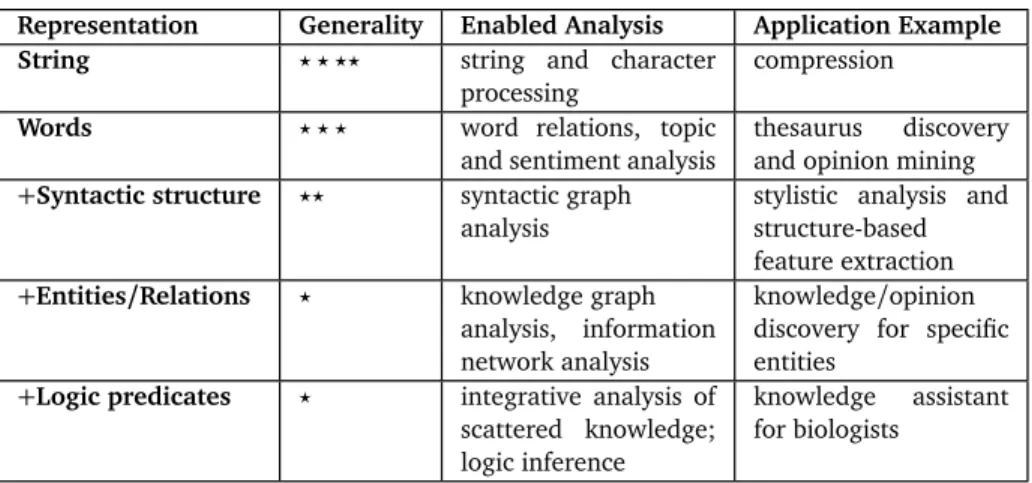
Table 2.1: Text representation and enabled analysis. More sophisticated representation generally enables more intelligent text analysis applications, but also tends to be less robust. (Reproduced from Zhai and Massung (2016))
learning embeddings along with some neural network task is a possibility, as demonstrated (in one case) by Collobert et al. (2011).
Text data are generated by humans and are meant to be consumed by humans. As a result, in text data analysis and text mining, humans play a very important role. They are always in the loop, meaning that we should optimize for a collaboration between humans and computers. In that sense, it’s okay that computers may not be able to have a completely accurate representation of text data. Patterns that are extracted from text data can be interpreted by humans, and then humans can guide the computers to do more accurate analysis by annotating more data, guiding machine learning programs to make them work more effectively.
Different text representation tends to enable different analyses as shown in Table 2.1. In particular, we can gradually add more and more deeper analysis results to represent text data that would open up more interesting representation opportunities and analysis capabilities. The table summarizes what we have just seen; the first column shows the type of text representation while the second visualizes the generality of such a representation. By generality, we mean whether we can do this kind of representation accurately for all the text data (very general; more stars) or only some of them (not very general; fewer stars). The third column shows the enabled analysis techniques and the final column shows some examples of applications that can be achieved with a particular level of representation.
As a sequence of characters, text can only be processed by stream processing algorithms. They are very robust and general. In a compression application, we don’t need to know word boundaries (although knowing word boundaries might actually help). Sequences of words—as opposed to characters—afford a very important level of representation; it’s quite general and relatively robust, indicating that it supports
many analysis techniques such as word relation analysis, topic analysis, and sentiment analysis. As you may expect, many applications can be enabled by these kinds of analysis. For example, thesaurus discov-ery has to do with discovering related words, and topic- and opinion-related applications are enabled. People might be interested in knowing major topics covered in the collection of text, where a topic is represented as a distribution over words.
Moving down, we’ll see we can gradually add additional representations. By adding syntactic struc-tures, we can enable syntactic graph analysis; we can use graph mining algorithms to analyze these syntactic graphs. For example, stylistic analysis generally requires syntactical structure representation. We can also generate structure-based features that might help us classify the text objects into different categories by looking at their different syntactic structures. If you want to classify articles into different categories corresponding to different authors, then you generally need to look at syntactic structures. When we add entities and relations, then we can enable other techniques such as knowledge graphs or information networks. Using these more advanced feature representations allow applications that deal with entities.
Finally, when we add logical predicates, we can integrate analysis of scattered knowledge. For example, we can add an ontology on top of extracted information from text to make inferences. A good example of an application enabled by this level of representation is a knowledge assistant for biologists. This system is able to manage all the relevant knowledge from literature about a research problem such as understanding gene functions. The computer can make inferences about some of the hypotheses that a biologist might be interested in. For example, it could determine whether a gene has a certain function by reading literature to extract relevant facts. It could use a logic system to track answers to researchers’ questions about what genes are related to what functions. In order to support this level of application, we need to go as far as logical representation.
2.2
Using Extracted Features
Consider the following movie review from IMDB1:I also am utterly bemused to see so many negative comments on this show. For those who seem to think the show is about pointing out the improved morals of the 21st century, or don’t catch the story lines as being evolved enough, or think the characters shallow—I’m afraid you’re missing the picture completely.
Is it positive or negative?
Next, consider the following snippet from an essay (Ishikawa, 2013):
I agree this opinion that part-time job is important for college school students, because I studied a lot of thing with my part-time job. At first, the communication skill is necessary to work.
Was this essay written by a Chinese, Japanese, or English student?
These are examples of categorization problems in text mining. In the first snippet, we want to perform sentiment analysis; that is, we want to determine if the review is positive or negative. This particular review is challenging because it is a positive review about the TV showMad Men, but it is very negative towards the other reviewers. Thus, the sentiment target is critical to capture.
The second snippet—the native language identification task—has its own set of challenges. All the essays are written about similar topics, so “job” and “college” frequently occur given any native language. Perhaps modeling grammatical errors or colloquialisms could better capture information that a classifier can use to separate the classes.
Despite these differences in downstream tasks (and most other tasks), the unigram words represen-tation remains an important baseline to compare against for the same reasons mentioned in chapter 1. Unigram words are effective and interpretable since they can sufficiently capture topical ideas from text (e.g., a document about sports is more likely to contain the wordscorethan a document about food). Unigram words are efficient since the representation is achieved by simply splitting on whitespace or fol-lowing some simple tokenization rules, such as separatingcan’tintocanand’t. The generality of words is also clear, since it can be applied to any text document.
The downside here is that due to its great generality, unigram words fail to capture deeper meaning from documents such as the sentiment target. Even more unsatisfactory is the loss of any word order under this model: the sentences“They have many theoretical ideas”and“many They theoretical have ideas” would be represented in exactly the same way. This is where the need for research into different text representations arises.
Now that we have examined the different types of features, how exactly are they used? Downstream applications make use of document representations (i.e., extracted features) in three main ways: feature vector similarity, feature presence and absence, and feature sequences.
2.2.1
Feature Vector Similarity
Feature vector similarity is crucial in information retrieval and clustering. For example, consider a doc-umentdifrom a large collectionD. In the vector space model of information retrieval, we assume that relevance can be modeled by similarity. That is, the most similar documents to a given query are the
ones that should be returned by a search engine. Consider the following:
sim(di,q)>sim(dj,q).
Here,diis found to be more similar (i.e., relevant) to the queryq, so it would be rewarded with a higher position on the search engine results page thandj. Note that both the similarity function and feature representation are user- or algorithm-defined.
A basic similarity algorithm is cosine similarity, which measures the cosine of the angle between two vectors in a high-dimensional feature space,
simcosine(a,b) = a·b ||a|| ||b||= Pn i=0aibi qPn i=0a 2 i qPn i=0b 2 i ,
but many others exist that are tailored towards information retrieval, such as Okapi BM25 (Robertson et al., 1994).
Clustering also uses similarity measures to assign documents into coherent groups (i.e., clusters) that may be inspected by the user for exploratory analysis or knowledge discovery. Multiple variations of clustering exist. Two simple methods are hierarchical agglomerative clustering and divisive clustering.
Hierarchical agglomerative clustering uses a similarity measure to incrementally group documents together until there is only one large group. The merges that lead up to the single cluster form a dendro-gram (cluster tree) that may be traversed or partitioned as desired. Nodes near the root of the tree are more general; as one traverses down the tree, the nodes represent smaller and more specific clusters.
A divisive clustering calledK-means uses the expectation maximization framework to optimally parti-tion groups of elements intoKclusters, each represented with a cluster centroid. Here, we minimize the distance (i.e., maximize the similarity) between each element and its centroid.
In both clustering cases, the choice of features determines the meaning of the uncovered clusters. For example, using unigram words may find topical clusters while grammatical features may find clusters that are more stylistically-oriented. For a more in-depth discussion of feature usage in information retrieval and clustering, please consult Zhai and Massung (2016) or Han et al. (2011).
2.2.2
Feature presence, absence, and co-occurrence
Feature presence, absence, and co-occurrence is crucial in topic modeling and frequent pattern mining. Topic modeling is a text mining tool that is used to discover latent themes in a collection of documents. A topic is a distribution of words; additionally, each document is imagined to have some mixture of topics. For instance, a news article could be about both finance and entertainment. The generative process to
write one word in a document is as follows: select a topicz ∼ M ul t inomial(θ); then, select a word w∼M ul t inomial(φ). Typically,θ andφwill have Dirichlet priors.
Latent Dirichlet allocation (Blei et al., 2003) is a well-known topic modeling algorithm. It and similar algorithms learn theθ andφparameters through some form of smoothed counting. In this framework, frequently co-occurring words are likely to become part of a topic.
An important aspect of topic modeling is that the basic units of meaning do not necessarily have to be words—any “bag-of-features” may be used. For example, when clustering student essays, it may be beneficial to represent essays as a collection of grammatical errors. Thus, a topic in this corpus is frequently co-occurring errors or idiosyncrasies, and documents are some mixture of common errors.
Frequent pattern mining (or association rule learning) is a knowledge discovery technique for common sets of unordered items. A standard example is the grocery store purchase history over thousands of customers. It could be discovered that beer, nuts, and diapers are often bought together. This fact can be used to strategically place products in the store in close proximity, encouraging their joint purchase.
Agrawal and Srikant (1994) describe a pattern mining algorithm that generates candidate sets of length k given previously-discovered sets of lengthk−1. This refinement is continued until some confidence threshold is broken, and the user is left with the largest frequent patterns that satisfy some probability constraints. In an alternate approach focused on efficiency, Han et al. (2000) recursively prune a prefix tree of connected items to find the frequent patterns.
Again, if these pattern mining algorithms are run over a text collection, the types of features used to represent the contents of each document will directly impact the meaning of the output.
2.2.3
Sequences of features
Sequences of features are also used in pattern mining as well as NLP tools such as parsers.
In contrast to frequent pattern mining, sequential pattern mining finds ordered sequences of items. These items may be actions, events, or other time-based occurrences. If we consider a document as a sequence of features over time, we could use sequential pattern mining to find common phrases or even consecutive topic mentions (e.g., a news reporter may frequently use the ordered transitionspor ts→ mone y→pol i t ics).
Pei et al. (2001) is one example of a sequential pattern mining algorithm that focuses on efficiently finding long sequences by using prefix-projection to reduce the number of candidates generated. Such an algorithm that focuses on long sequences could be used (e.g.) to mine characters in streams of text. Focusing on characters instead of words is more robust to word misspellings and other grammatical errors Tsur and Rappoport (2007).
Pattern mining itself can even be thought of as feature generation, as frequent patterns can be used to represent documents in a corpus and fed into a classifier.
Discriminative models for part-of-speech tagging like conditional random fields (Lafferty et al., 2001) allow arbitrary features to be encoded into the model. Thus, features for a current tokenwicould have specific dependencies onwi−1andwi+1. These features could be vary from “the previous word ended inly” to “the word after this word is a stop word”. Clearly, feature choice for these types of models can have a huge impact on performance. Such engineered features are often critical to the performance of NLP tools that perform semantic role labeling or constituency and dependency parsering.
The examples above are just a few of the many potential applications that depend on a meaningful feature representation. Despite this, most cases will fit into one of the three broad categories of feature vector similarity; feature presence, absence, and co-occurrence; and feature sequences. Most of the work presented in this thesis uses applications from the first two categories, but it is natural to extend the feature representations for use in any of the three groups.
CHAPTER 3
CASE STUDY: NON-NATIVE TEXT MINING
In contrast to chapter 2, this chapter explores a particular subfield of text mining that benefits from advances in text representation. The narrative in this chapter is heavily based on Massung and Zhai (2016).
3.1
Introduction
By the year 2020, Robson (2014) estimates that there will be two billion English language learners— already, it is spoken by one quarter of the Earth’s population. Some learn in the classroom; some learn online. Some may even learn through their phone or in an online class. Regardless of the medium, com-putational tools to enhance this educational experience will be valuable. Automatic scoring of essays— not only for grammar, but also fluency—would contribute greatly to second-language learners’ under-standing. User personalization for online services (including search engines and social networks) would benefit from improved user profiling. More relevant books or news articles could be recommended if the user’s background and competency of English were known.
Due to these many motivating examples, research innon-native text mininghas prospered. This field encompasses any textual task that deals with words written in a language other than the writer’s native tongue. We call the native language L1 and the second, learned language L2. Throughout this thesis, we will usually assume that L2 is English, though most (but not all) techniques mentioned here are general and could function with any pair of L1 and L2.
We provide a brief survey of existing work on non-native text mining. First, we discuss non-native grammatical error correction—finding and modifying text to fix errors or to make it sound more fluent. Second, an introduction to native language identification: determining the native language of an author based on text in the second language. Then, we take a brief look at two emerging fields: native fluency scoring and text simplification for non-native speakers. This concludes the literature review component of this thesis.
Text Mining and NLP
Grammar Correction Essay Grading
Author Profiling Summarization
Non-Native GEC Fluency Scoring
NLI Simplification
Non-Native Text Mining
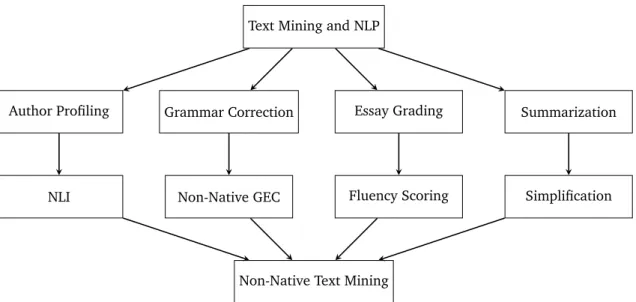
Figure 3.1: Dichotomy of non-native text mining as part of the general text mining and NLP domains.
1. Native language identification(NLI): classifying L1 based on text written in L2. Techniques can be categorized intofeature-based(using a classifier) orlikelihood-based(using a probabilistic model of language).
2. Non-native Grammatical Error Correction(GEC): detecting and correcting grammatical errors in L2 text. Techniques can be categorized into targeted(correcting specific errors) or general (correcting all errors).
3. Fluency Scoring: given L2 text, how close to native does it appear?
4. Text simplification: providing a better experience for users interacting with text in their L2. Tech-niques are much more varied in this field.
These four areas can be regarded as special cases of four more general categories of text mining and NLP as shown in Figure 3.1.
3.2
Native Language Identification
NLI usually relies on classification, but also consists of other components that are able to capture a deeper syntactic meaning (such as dependencies or language modeling). NLI is usually the first step in any second language error correction or author profiling system. Identifying the native language of an anonymous text was first popularized by Koppel et al. (2005). Brooke and Hirst (2012) do an extensive survey of NLI feature efficacy, and develop a robust model that works well when used across corpora.
NLI tasks are most commonly evaluated solely on a small learner corpus usually consisting of student essays. It was previously thought that lexical features would be biased or overfit towards essay topics, but a cross-corpus evaluation showed that this was not the case (Brooke and Hirst, 2012).
For an in-depth discussion of the related task of authorship attribution, we recommend the reader consult Stamatatos (2009). Many techniques common to authorship attribution and author profiling are also relevant to NLI.
Tsur and Rappoport (2007) found that incredibly simple top two hundred frequent bigram character features fed to SVM led to 66% accuracy on the five native languages. They claimed that word choice of non-native speakers is influenced by the phonology of their native language (as evidenced by the effective-ness of the character features). This approach is compared to a unigram words baseline which achieved only 47% accuracy. They finally hypothesized that using a spoken-language corpus would achieve even stronger results favoring character bigrams. Their reasoning was that much less conscious effort is put into speaking than writing. For analyzing transcripts of spoken words, the ICNALE corpus (Ishikawa, 2013) may be applicable.
NLI has also been approached through contrastive analysis (Wong and Dras, 2009): the idea that errors in text are influenced by the native language of the author. They investigated three error types as features: subject-verb disagreement, noun-number disagreement, and determiner misuse. These error types are then used as “stylistic markers” for NLI features with an SVM classifier. To find these errors in text, they used an open source grammar checker1, as opposed to professionally edited text. Interestingly,
ANOVA showed that the features had a measurable effect, but after combining their contrastive features with existing methods, they were not able to significantly increase the classification accuracy from Koppel et al. (2005).
Wong and Dras (2011) follow their work on contrastive analysis, attempting to amend its shortcomings. Instead of error types, they use two different features obtained from grammatical parse trees: horizontal slices (production rules) and parse rerankings. They claim these are the first pure syntactic features used in NLI. For the production rules, they immediately applied information gain dimensionality reduction. The reranking features are those contained in the Charniak parser2and Stanford Parser3trained on the Wall Street Journal. Unlike the previous two attempts, the authors found MaxEnt to outperform SVM as the classifier. Additionally, five-fold cross validation was performed (as opposed to ten-fold), which means the accuracies cannot be precisely compared with previous work. In any event, they report a final accuracy of 80%, which was the highest reported as of 2012.
Johnson et al. (2006) explore adaptor grammars to generate features. Simply, adaptor grammars are
1http://queequeg.sourceforge.net/index-e.html 2http://cs.brown.edu/~ec/
Paper Method Accuracy Tsur and Rappoport (2007) charactern-grams∗ 66%
Wong and Dras (2009) syntactic errors∗ 74%
Wong and Dras (2011) syntactic rules∗ 80%
Wong et al. (2012) adaptor grammars∗+ 76%
Swanson and Charniak (2012) tree substitution grammars∗ 78%
Table 3.1: Summary of NLI results listed in Brooke and Hirst for the ICLE corpus; accuracies added to chart.∗indicates feature-based methods and+indicates likelihood-based methods.
a non-parametric extension to PCFGs (probabilistic context free grammars). They can learn arbitrary-length word sequences (collocations); for example,gradient descentandcost functionwere learned as phrases in a machine learning topic. These adaptor grammars are used in two ways: in the first, col-locations are used as features in a MaxEnt classifier. In the second, the grammar is trained on each class (representing native language). At test time, the most probable grammar to have generated the text is selected. For both tasks, the authors use five-fold cross validation on seven native languages. In the feature-based classification, they achieved 76%; in the language model-based classification, they achieved only 50%, a performance similar to the unigram word baseline from Tsur and Rappoport (2007). Swanson and Charniak (2012) made use of tree substitution grammars (TSGs) Blunsom and Cohn (2010). TSGs are a tree-rewriting formalism that defines operations on partial (parse) tree objects. For example, subtrees may be added or removed from a base tree. Benefits of using this method are priors which prefer smaller production rules and the ability to capture long-range dependencies. Various induction methods are compared to generate features, and five-fold cross validation on seven native languages is performed. All TSG features outperformed the CFG baseline (at 73%). The highest TSG induction method was Bayesian induction at 78%.
In summary, Table 3.1 lists the comparable accuracies from experiments run on the ICLE subset of five European languages. In general though, accuracies between 70% to 80% are standard for a wide variety of techniques and corpora.
3.3
Non-Native Grammatical Error Correction
An excellent overview of grammatical error correction with a focus on non-native learners can be found in Leacock et al. (2014). This short book is a concise collection on the topic and consists of many recent advances since 2010. If the reader wishes to delve into more detail in this subtopic, we suggest refer-encing their work, whereas this thesis features a broader outline and is thus not able to go into as much depth in one particular area.
Lee and Seneff (2006) train a trigram language model on a lattice of alternatives, where “alterna-tives” are prepositions, articles, and auxiliaries that may or may not occur between words in the original text. For example, the sentenceI want flight Mondaycan be corrected by inserting two tokens as such: I want a flight on Monday. Their algorithm first strips all such alternatives from the original sentence. So far, this is not much different from the article and preposition corrections. However, they addition-ally change each remaining word in the input sentence to be a set of related words to the base form: want → {want,wants,want ed,want ing}. Their language model then outputs thek-best candidates. Next, these candidates are given to a PCFG and reranked. The final output is the top-ranked sentence from the PCFG. Across all experiments, they found that reranking the language model candidates signif-icantly increased theF measure.
West et al. (2011) use bilingual random walks between L1 and L2 word senses. For example, on one side of a bipartite graph are L1 words. There are connections from a wordw∈L1 to a wordw0 ∈L2 if awcould be translated intow0. wcould be the English wordhead, and be translated into a physical head, head of an organization, or the verbto head. This model was used to correct non-native sounding phrases such asentire strangerto the more naturalcomplete stranger. This bipartite graph was combined with a language model to correct non-native sentences. In these experiments, the native language was Korean. Evaluation was performed with Amazon Mechanical Turk4where workers chose between the corrected sentence and the original sentence. Results were not strongly positive, since sometimes the corrected errors changed the meaning of the sentence or made it ungrammatical. In future work the authors suggest using a richer probabilistic model such as a PCFG.
Dahlmeier and Ng (2011b) use the NUCLE corpus to find and correct collocation errors via machine translation. Here, a collocation is a phrase commonly used by native speakers. The authors propose that when a writer mentally translates from L1 to L2, some unnatural phrases result due to word choice. They give an example, “I like to look movies” that might be written by a native Chinese speaker sincewatchand lookare very similar in the L1. It would be possible to correct this to the more grammatical “I like to look at movies”, but it still does not sound natural. Instead,lookis replaced bywatch, resulting in the more fluent collocationwatch movies. For their experiments, they assume the unnatural collocations have already been identified; this mimics a system where a user may ask for improvement suggestions for a snippet of writing. They train a statistical machine translation model on a parallel Chinese-English corpus to correct collocation errors in the NUCLE corpus. A log-linear model was used to score the candidate phrases which allows additional spelling, homophone, and synonym features to be incorporated. They evaluated their method as a retrieval task, where they returned the topksuggestions to fix each collocation error. Two native-English speakers judged results from five hundred corrections with good rater agreement. Finally,
they performed an analysis of errors and found that the main reason top-ranked phrases were not correct was due to out-of-vocabulary words.
Dahlmeier and Ng (2011a) introduce an alternating structure optimization (ASO) approach to GEC. In short, ASO is able to leverage a common structure between multiple related problems. In this case, the related problems are selection (find features from native text) and correction (fix the errors in non-native text). Targets were article and preposition errors, again using the NUCLE corpus. It was shown that ASO significantly outperformed a simple linear classifier as well as two unnamed commercial grammar checkers. Features included part-of-speech tags, hypernyms from WordNet, named entities, and shallow parsing tags.
Gamon (2010) combined a language model and classifier into a “meta-classifier” that detected errors in both article and preposition use. Additionally, they investigated how much more training data is needed for the individual methods to approach the accuracy of the meta-classifier. Features for the classifier were a window of six tokens to the right and left of errors, POS tags, and lexical head features. The classifier was actually split into two steps: first, determine the likely presence of a preposition or article. Then, determinewhicharticle or preposition should be chosen. The language model is trained on LDC’s Gigawordcorpus and log-likelihood was used (normalized by sentence length). The meta-classifier uses features generated from the two primary models such as ratio of likelihood scores from the language model and classifier decisions. As expected, the meta-classifier outperformed the two simpler models. Prepositions were harder to classify than articles and they required more training data to reach a specific level of accuracy. Future work would be including more primary models to feed features into the meta-classifier.
Madnani et al. (2012) applied “round-trip” machine translation to correct generic errors in L2 text. A round-trip translation used the Google Translate API5to translate the candidate text from L2 to eight different languages and back again to L2. Since it is not guaranteed that the translations will preserve the meaning of the sentence, they assert that using a language model to select the most fluent choice is not acceptable. Instead, they combined alignments between the source and each round trip translation to create the final answer. This method had a better likelihood of maintaining the sentence’s original meaning. In order to evaluate their system, they had human graders check whether the fixes were fluent as well as retaining the original meaning.
The next two papers we discuss consider alternatives to standard acquisition of training data for GEC. Usually, a dataset annotated corrections is used, but these papers create or acquire their own non-native errors.
Instead of training directly on non-native text, Rozovskaya and Roth (2010) took native text and
tentionally inserted article errors. In order to create a realistic error distribution, they generated the article errors with the same observed distribution as the non-native corpora. Advantages to training data generation in this style are avoiding expensive data annotation, circumventing small corpus sizes, and tailoring the classifier to a particular language. Most of all, their method was shown to be superior to only training a classifier on purely native data. One final note they make is that previous baselines used in the literature are not always appropriate; baselines mentioned before are simply the majority class. While this is acceptable for a selection task, this ignores the actual error rate in the data. Usually, the er-ror rate is much lower (shown to be about 10% in their experiments) than the majority class. Therefore, they argue, a more fair comparison would be theerror reduction, and this is indeed the measure they use to report their results. They reduced the error detection in native Chinese, Czech, and Russian text by 10%, 5%, and 11% respectively.
Cahill et al. (2013) obtained their grammatical errors from Wikipedia revisions. They filtered the article revisions dataset looking for single-word changes that corresponded to correcting article and preposition errors. Using this method, they obtained over one million corrections. They compared their mined corpus with standard error correction corpora as well as artificially-inserted errors like Rozovskaya and Roth’s approach. They found that the larger “somewhat clean” Wikipedia edits were much better in increasing theF1of the grammar corrector as opposed to other common datasets, including a smaller “more clean” version of their Wikipedia data. Furthermore, they found that artificial error insertion methods trained on their Wikipedia revisions data increased system accuracy compared to training on smaller corpora, and even generalized across datasets.
In sharp contrast to NLI evaluation, Chodorow et al. (2012) describe many issues regarding evaluation for grammatical error correction, with a focus on non-native sentences. This is a valuable paper for those engaging in any GEC task. Their main issue is the “three-way contingency” between the original sentence, the human correction, and the system output (let alone the evaluation scripts themselves). Mentioned later by Rozovskaya and Roth (2013), this report also emphasizes the significance of the relatively low error rates in non-native sentences—this phenomenon suggests using more interpretable measures such as true and false positives and negatives. Furthermore, how is the severity of an error taken into account? For example, most native English speakers often misusewho andwhom. Their conclusion from these observations is to develop a robust evaluation system based on raw error type counts. This allows bias and error skewness to be perceived by the reader while simultaneously permitting the reader or other evaluator to map the raw error data into another form such as precision, accuracy, prevalence, or bias.
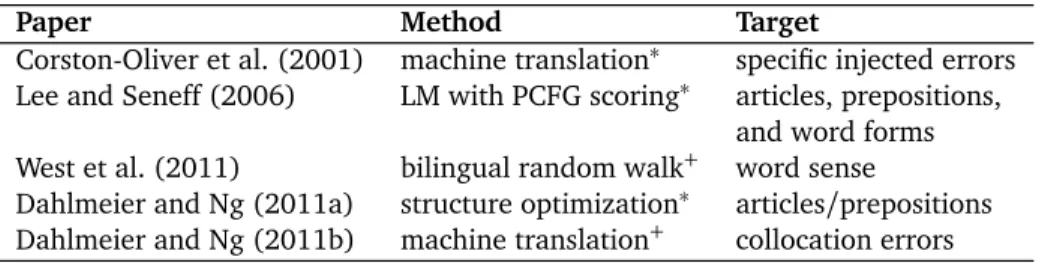
Correcting machine translated text is a related issue, but we do not discuss it here; instead, please see Corston-Oliver et al. (2001) or Gamon et al. (2005b). Table 3.2 compares the different methods discussed in this section.
Paper Method Target
Corston-Oliver et al. (2001) machine translation∗ specific injected errors Lee and Seneff (2006) LM with PCFG scoring∗ articles, prepositions,
and word forms West et al. (2011) bilingual random walk+ word sense
Dahlmeier and Ng (2011a) structure optimization∗ articles/prepositions Dahlmeier and Ng (2011b) machine translation+ collocation errors
Table 3.2: Comparison of GEC strategies. ∗indicates targeted approaches and+ indicates general approaches.
Some grammar correction methods are targeted towards a very specific subset of errors, often catego-rized by the corpus; others attempt to solve more general errors concerning word sense or collocations. Evaluation for grammar correction is much more varied and unstandardized in comparison to the con-figurations from NLI as we will see in the next section. Which non-native corpus is used also dictates the types of errors that can be corrected.
3.4
Fluency Scoring
Which of the two following sentences sounds more natural?
1. “If there are unexpected expenses, material for their lesson, for example, they may not be able to pay money to it only with monthly allowance.”
2. “If there are unexpected expenses—school materials, for example—they may not be able to afford them with only a monthly allowance.”
Most readers would probably agree that the second sentence sounds much more fluent than the first, even though the first sentence has only very minor grammatical errors. Fluency scoring is thus related to GEC in this way. However, as evidenced above, a lack of grammatical errors does not necessarily mean that a sentence sounds native.
In this section, we will discuss directly approaching fluency scoring in addition to three indirect meth-ods: essay grading, machine translation evaluation, and native vs. non-native sentence classification.
Direct fluency scoringfocuses on both the “nativeness”, grammaticality, and correct colloquialisms used at an individual sentence level. For example, the following sentence would not be considered totally fluentEnglish despite the lack of grammatical errors:They may not be able to pay money for it.Of course, grammar does play a very important role in fluency evaluation, but it is not the sole contributor to the final score.
Rabinovich et al. (2016) examine the similarities between native, non-native, and translated texts. They found that non-native and translated texts were much more similar to one another compared to native text. They investigate several features that are particularly indicative of the text source. While they don’t use these features directly to measure fluency, it would be straightforward to encode the