Rethinking Antivirus: Executable Analysis in the Network Cloud
Jon Oberheide, Evan Cooke, Farnam Jahanian
Electrical Engineering and Computer Science Department
University of Michigan, Ann Arbor, MI 48109
{
jonojono, emcooke, farnam
}
@umich.edu
A
BSTRACTAntivirus software installed on each end host in an or-ganization has become the de-facto security mechanism used to defend against unwanted executables. We argue that the executable analysis currently provided by host-based antivirus software can be more efficiently and ef-fectively provided as an in-cloud network service. In-stead of running complex analysis software on every end host, we suggest that each end host run a lightweight pro-cess to acquire executables entering a system, send them into the network for analysis, and then run or quarantine them based on a threat report returned by the network service. An executable analysis service run inside an en-terprise network or by a service provider could integrate antivirus software, behavioral simulation, and other anal-ysis engines from multiple vendors providing better de-tection of malware and simplify client software enabling deployment on a broader range of devices. To explore this idea we construct a prototype composed of a Win-dows based host agent and an in-cloud analysis service and evaluate it using a diverse dataset of 5066 unique malicious executables. By correlating information be-tween multiple detection engines, our system provides over 98% detection coverage of the malicious executa-bles using eight antivirus engines and two behavioral en-gines compared to a 54% to 86% detection rate using the latest commercial antivirus products.
1
I
NTRODUCTIONDetecting malicious software has become an increas-ingly challenging problem. While a single antivirus en-gine may be able to detect many types of malware, 0-day threats and other obfuscated attacks [12] can frequently evade a single engine. We argue that the executable anal-ysis service currently provided by host-based antivirus software can be more efficiently and effectively provided as anin-cloud network service. Instead of running com-plex analysis software on every end host, we suggest that each end host run a lightweight process to acquire exe-cutables entering a system, send them to a network ser-vice for analysis, and then run or quarantine them based on a threat report returned by the network service.
Centralizing the analysis of suspicious software as a network service has several advantages over existing
host-based antivirus software.
1. More is better: A network service can employ a cluster of servers to quickly analyze executables ing multiple techniques. For example, instead of us-ing a sus-ingle antivirus engine, a network service can run a wide range of antivirus engines in parallel while also performing behavioral analysis [3, 8]. Additional detection engines can easily be inte-grated into a network service, allowing for consider-able extensibility. Such comprehensive analysis can significantly increase the detection coverage of ma-licious software.
2. Keep it simple stupid: By significantly lowering the complexity of host-based monitoring software, a number of advantages are realized. Clients no longer need to continually update their local signa-ture database, reducing administrative cost. Simpli-fying the client software also decreases the chance that it could contain exploitable vulnerabilities [5, 13]. Finally, lightweight client software allows the service to be extended to mobile and resource-limited devices that lack sufficient processing power but remain an enticing target for malware.
3. Sharing is caring: Correlating information be-tween engines is enabled when multiple engines are run within a network service and can be beneficial to detection coverage. For example, if a behavioral system finds that the behavior of an unknown exe-cutable has similar behavior to an exeexe-cutable pre-viously classified as malicious by antivirus engines, the unknown executable can be quarantined. This paper investigates how to design a network ser-vice for executable analysis. We construct a prototype composed of a Windows-based host agent and an in-cloud network service. Using a recent dataset of 5066 unique malicious executables [7], we demonstrate how the system detects 98% of the samples using eight an-tivirus engines and two behavioral engines in parallel, compared to a 54% to 86% detection rate using the lat-est commercial antivirus products. We also show that the average time to analyze a legitimate or malicious
exe-cutable, including network latencies, is less than a sec-ond.
2
A
PPROACHThe use of traditional signature-based approaches for the problem of detecting malicious software in the network and on the host has become increasingly difficult. The elevating sophistication of modern malicious software poses a significant challenge for any single vendor to de-velop signatures for every new piece of malicious soft-ware. Indeed, a recent Microsoft survey found more than 45,000 new variants of backdoors, trojans, and bots dur-ing the second half of 2006 [6].
In response, a new generation of systems has been developed to monitor the behavior of suspicious appli-cations to identify malicious binaries. Sandbox services such as Norman [8] and CWSandbox [3] enable the anal-ysis of suspicious binaries and produce a detailed report of a binary’s actions in a simulated environment. In addi-tion, virtual machines have been used to analyze malware and track malicious behavior [1, 10, 14]. While behav-ioral and VM-based detection techniques improve our ability to detect malicious software, they can be resource intensive and are not designed to protect every end host. In this paper, we explore how to improve the detection of malicious software by providing executable analysis as an in-cloud network service. We envision a vendor-agnostic service that is deployed in a high-speed, low-latency network such as inside an enterprise or by a ser-vice provider. Such a centralized serser-vice would integrate detection engines from many vendors and include an end host component for the automated acquisition of bina-ries. The network service is similar to other in-cloud pro-tection mechanisms such as email [2, 4] and HTTP [11] filtering, except that we use a dedicated end host agent which enables our system to protect against executables that arrive using different protocols and devices.
3
A
RCHITECTUREPerforming the analysis of executables using a network service is not a simple task. Suspicious executables must be acquired and isolated so that they can be sent to an up-stream analysis service. The analysis service must be ef-ficient, and the execution of malicious executables must be prevented.
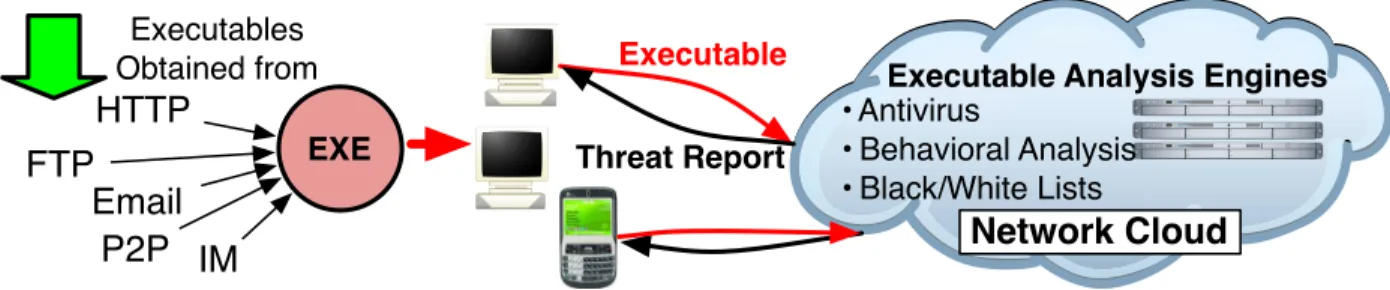
To solve these problems we envision an architecture that includes two major components. The first host-based component acquires executables and sends them to the network service, and the second network-based compo-nent identifies malicious executables and returns a threat report to the end host. Figure 1 shows a high level de-sign of the system architecture. It is important to point out that we do not see our system replacing existing an-tivirus or intrusion detection solutions. Rather, our
mal-ware analysis service runs as an additional layer of pro-tection to augment existing security systems inside an or-ganizational network such as an enterprise.
3.1
Executable Identification and Acquisition
Malicious executables can enter an organization using a range of different techniques. For example, mobile de-vices (e.g., a USB stick), email attachments, downloads (wanted or unwanted), and vulnerable network services are all common entry points. Due to the broad range of entry vectors our system includes a lightweight exe-cutable acquisition system that is run on each end host.Just like existing antivirus software, the client module runs on each host and inspects each executable. The exe-cution of any binary is trapped and diverted to a handling routine first. The handling routine begins by hashing the binary and checking the hash against a local and remote whitelist and blacklist. If the hash does not match in the whitelist or blacklist, the entire binary is sent securely to the in-cloud service for analysis.
To minimize the time between when a user downloads an executable and receives a response from the network service, the architecture provides a method to send a bi-nary for analysis as soon as it is written or changed on the end host system (e.g., via file-copy, installation, or down-load). Doing so amortizes the transmission and analysis cost over the time elapsed between binary creation and user-initiated execution.
3.2
In-Cloud Executable Analysis
The second major component of the system is the net-work service responsible for malware analysis. The job of the analysis service is to receive an executable and re-turn a threat report with information about whether the executable is safe to run.
3.2.1
Executable Analysis
Rather then choosing one single technique to detect mali-cious executables, we suggest that a network service run multiple engines in parallel. Unlike host-based analysis systems that must meet relatively tight storage and com-putational constraints, a network service can easily scale to meet the demand of multiple analysis engines.
While the specific backend analysis techniques used are independent of the proposed architecture, two gen-eral classes seem particularly well-suited to the proposed approach.
• Antivirus Engines: There is a wide range of an-tivirus products commercially available today, and as we will show, they differ significantly in their de-tection coverage. By analyzing each candidate exe-cutable with multiple antivirus engines, the network service is able to provide better detection of mali-cious software.
P2P
FTP
IM
EXEHTTP
ExecutablesObtained from Executable
Threat Report
Executable Analysis Engines
• Antivirus
• Behavioral Analysis • Black/White Lists
Network Cloud
Figure 1: Architectural approach for in-cloud executable analysis.
• Behavioral Analyzers:A second major method of testing executables is behavioral analysis. A behav-ioral system executes suspicious executables in a sandboxed environment [3, 8] or virtual machine [1] and records host state changes and network activity. While performing analysis in parallel is far more effi-cient then serial execution, delay can still exist between when an executable is submitted and when the result is returned. The architecture employs a caching mechanism to better deal with associated latencies.
The caching mechanism is simply a whitelist/blacklist database of hashes of previously analyzed binaries. The idea is that executables run in an organization will fre-quently be similar across different hosts so keeping a cache of previously analyzed binaries can significantly improve system performance. A cache hit in either the whitelist or blacklist would therefore result in an imme-diate server response indicating whether the client should execute the binary.
3.2.2
Executable Threat Report
The results from the executable analysis engines are syn-thesized into a threat report returned to the client over a secure and authenticated channel. The report includes three distinct sections.
• Execution Directive:a boolean indicating whether the executable should be run. The formula used to set this value is customizable as described above but the simplest mode is to set the execution directive to “do not run” if any detection engine classifies an executable as malware.
• Family/Variant Labels:a list of family/variant la-bels assigned to the malware by the different analy-sis engines.
• Behavioral Analysis:a list of host and network be-haviors observed during simulation. This may in-clude information about processes spawned, files and registry keys modified, network activity, and other state changes.
When the client receives the threat report, it will either begin execution of the binary or prevent execution and present the report to the user. This, of course, assumes that the client module has not been compromised. Just as with antivirus software, we assume that integrity of the client is maintained as a trusted module.
4
I
MPLEMENTATION ANDE
VALUATIONWe constructed a prototype implementation of the pro-posed architecture that includes an executable acquisi-tion system for the Windows platform and an in-cloud network service for analysis. This section describes how we implemented the prototype and explores the detection capabilities and performance of the system.
4.1
System Implementation
4.1.1
Client Module
We implemented a lightweight client module to detect executables written to disk and then send them to the network service for analysis. The notification for file sys-tem writes is provided by theReadDirectoryChangesW
Win32 API call, a mechanism similar to inotify on Linux. Each file written is scanned for a valid Portable Executable (PE) header to verify whether it is an exe-cutable. The executable is then hashed using the SHA-1 algorithm and compared to both the local and remote whitelist and blacklist. Local whitelists are seeded with hashes of the default set of executables included with common Microsoft Windows installations to reduce re-mote whitelist lookups.
The client module also prevents the execution of bi-naries that have been identified as malicious. By hooking theCreateProcessWin32 API call, we interpose on the creation of new processes and halt the execution of un-wanted code.
4.1.2
Network Service
The second component of the prototype is a network ser-vice responsible for analyzing executables using multiple detection engines and returning a comprehensive threat report on each executable. Incoming executables from
AV Vendor Version Signatures Detection Results Avast 4.7.1001 000740-0 84.7% ClamAV 0.90.2 3224 59.7% F-Prot 6.0.7.0 4.3.3 79.9% F-Secure 7.01.128 N/A 86.6% Kaspersky 6.0.2.621 N/A 85.3% McAfee 5100.0194 5027.0000 54.9% Symantec 14.0.3.3 N/A 81.9% Trend Micro 15.00.1433 4.459.00 82.0%
Table 1: The antivirus protection engines, the versions used in the pro-totype, and the percentage of malware samples detected.
end hosts are assigned to a request broker which is re-sponsible for delivering the executable to each analysis engine, collecting the results, and returning the threat re-port back to the client.
We use eight antivirus and two behavioral engines in our prototype. The eight antivirus engines are listed in Table 1, and the behavioral analyzers include Norman Sandbox Analyzer [8] and the behavioral profiling sys-tem described in [1]. The detection engines are run in parallel in virtualized environments.
Our prototype also includes an optimization aimed at reducing the latency perceived by end users when run-ning newly obtained executables. We implemented a work stream sensor that promiscuously monitors a net-work tap (e.g., a switch span port) to acquire executables. By deploying such a component, executables can be ex-tracted out of network transmissions on the fly and ana-lyzed by the in-cloud network service before even reach-ing the destination end host. Clearly this approach does not speed up the analysis of all executables as network traffic can be encrypted and the sensor currently handles only a handful of common network protocols.
4.2
Deployment and Results
4.2.1
Detection Coverage
To evaluate the detection capabilities of the prototype we obtained over 5000 malware executables from Ar-bor Network’s ArAr-bor Malware Library (AML) [7]. The AML contains malware which has been captured in the wild with a variety of techniques such as honeypot vul-nerability emulation, spam traps, and honeymonkey spi-dering. The dataset consists of 5066 unique executables spanning an eight month collection period from Septem-ber 2006 to May 2007.
We first measured the detection rates of each antivirus engine individually across the entire malware dataset. The antivirus signatures were all updated on the same date, May 9th, for consistency, and their respective ver-sions are listed in Table 1. The results of using each en-gine individually are listed in the last column of Table 1. The single engine detection rates vary from as low as 54% up to 86%.
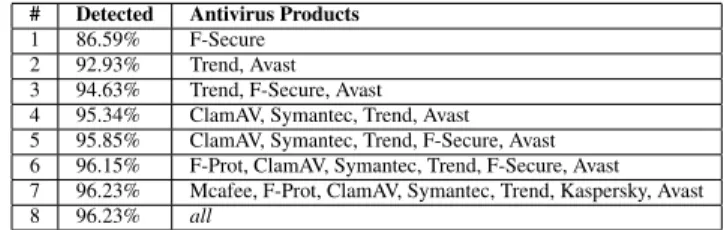
We then looked at the benefit of using multiple an-tivirus engines to analyze the same set of malware. Ta-ble 2 summarizes the results. Using all eight antivirus
# Detected Antivirus Products 1 86.59% F-Secure 2 92.93% Trend, Avast 3 94.63% Trend, F-Secure, Avast 4 95.34% ClamAV, Symantec, Trend, Avast 5 95.85% ClamAV, Symantec, Trend, F-Secure, Avast 6 96.15% F-Prot, ClamAV, Symantec, Trend, F-Secure, Avast 7 96.23% Mcafee, F-Prot, ClamAV, Symantec, Trend, Kaspersky, Avast 8 96.23% all
Table 2: Detection coverage of the malware samples using between one and eight antivirus products.
engines in our network service, we were able to detect 4875 executables as malicious, resulting in a detection rate over 96%. The dataset used in the paper only in-cludes known malicious executables and so exploration of false positives is an open research question.
While the eight antivirus engines were able to iden-tify 96% of the executables as malicious, 191 executa-bles were not flagged. This last 4% is arguably the most difficult for current detection systems to identify. For-tunately, the prototype also includes behavioral analy-sis and the capability to share information between de-tection engines. Behavioral reports on the 191 executa-bles revealed that 92 had similar behavior to known ma-licious binaries already identified by the antivirus soft-ware. Such information could be used to classify those 92 binaries as malicious resulting in a detection rate of over 98%, potentially extending the coverage to polymorphic and 0-day malware that have evaded the antivirus gines. Such sharing of information between detection en-gines illustrates one interesting advantage of combining heterogeneous detection systems into one service.
4.2.2
Performance
By moving analysis into the network, we incur the net-work latency of sending the binary to the service and the latency of using a multiple engines to analyze the binary. In this subsection, we show that this latency is small on average and is acceptable for clients con-nected to the high-speed, low-latency (<100ms) local networks common to organizations. We also show that the caching mechanism can actually increase the perfor-mance in many cases.
To evaluate analysis time, we collected a set of legiti-mate executables from a default install of Microsoft Win-dows XP. This set was about 84 MB and consisted of 472 executables with an average size of 183 KB. We pro-cessed them with the prototype network service and the average analysis time per executable for the antivirus en-gines was 0.05 seconds, with ClamAV being the slowest with an average time of 0.14 seconds. We did not eval-uate the analysis times for the behavioral engines as the runtime is a configurable parameter. Thus, for this legit-imate dataset the average analysis time and network la-tency on a local network is well under a second.
mal-ware samples. The average size of the samples was 366 KB and the average analysis time per executable for the antivirus engines was 0.48 seconds. Symantec was the slowest taking 0.91 seconds per executable on average. Again, the analysis times and executable sizes indicate perceived execution latencies of a second or two.
Thus far we have assumed that the executable under analysis has never been observed before. Our prototype includes both a local and remote cache of threat reports of previously analyzed executables to significantly speed up execution of previously analyzed binaries. While we do not have data in this paper on the frequency of legit-imate executables used in an organization, it would be logical that many employees within an organization use a similar set of applications making caching an impor-tant performance enhancement. We were able to obtain data from the mwcollect Alliance [9] on the frequency of malicious executables. Over a two month period on a /18 network they observed 213 distinct executables over 2.5 million times. Of the 213 executables, 164 of them (77%) were seen multiple times i.e., 49 were only ob-served once. Given the vast number of duplicate encoun-tered, a blacklist cache for these 213 executables would have a cache hit rate of over 99.99%, resulting in a near-instant response from the service.
5
D
ISCUSSIONThis paper has presented a vision for moving from a host-centric antivirus paradigm to providing executable anal-ysis as an in-cloud network service. We constructed a prototype and our initial results show potential for a sig-nificant improvement in the detection of real malicious software. However, there are several areas that require further investigation.
First and foremost is the question of disconnected op-eration. When a mobile user is not connected to the net-work, has a high-latency, low-bandwidth connection, or is the victim of a denial of service attack, sending ex-ecutables to the network service may not be feasible. While certain organizations may select a policy requir-ing that users wait for network connectivity before run-ning new applications, others may desire more flexibility. One solution is to have mobile users also run traditional antivirus software as a fail-over backup. Therefore, in the disconnected state, users will have at least the same de-tection coverage as today.
Another issue is that malicious software comes in many forms. While our prototype currently operates only on Win32 Portable Executables, we are working on ex-tending it to handle external DLLs, interpreted scripting languages, malicious web content, and other file types. Although our system cannot detect shellcode injected into memory, such shellcode often fetches an executable which can be detected.
Finally, since our system integrates other detection engines, it also shares their limitations. For example, a behavioral profiler might not detect malware that de-lays exhibiting behavior. However, since the architecture is modular, improved detection engines are easily inte-grated into the system.
We are currently working to refine our prototype and are collaborating with different enterprises and service providers to collect information on executable usage and further evaluate our approach.
A
CKNOWLEDGMENTSThis work was supported in part by the Department of Home-land Security (DHS) under contract number NBCHC060090 and by the National Science Foundation (NSF) under contract number CNS 0627445. We would like to thank Jose Nazario from Arbor Networks and Georg Wicherski from the mwcol-lect Alliance.
R
EFERENCES[1] Michael Bailey, Jon Oberheide, Jon Andersen, Z. Morley Mao, Farnam Jahanian, and Jose Nazario. Automated classification and analysis of internet malware. To appear inProceedings of the 10th International Symposium on Recent Advances in Intrusion Detection (RAID’07).
[2] Barracuda Networks. Barracuda spam firewall. http://www. barracudanetworks.com, 2007.
[3] Carsten Willems and Thorsten Holz. Cwsandbox.http://www. cwsandbox.org/, 2007.
[4] Cloudmark. Cloudmark authority anti-virus. http://www. cloudmark.com, 2007.
[5] Abhishek Kumar, Vern Paxson, and Nicholas Weaver. Exploit-ing underlyExploit-ing structure for detailed reconstruction of an internet-scale event.Proceedings of the USENIX/ACM Internet Measure-ment Conference, October 2005.
[6] Microsoft. Microsoft security intelligence report: July-december 2006. http://www.microsoft.com/technet/security/ default.mspx, May 2007.
[7] Arbor Networks. Arbor malware library (AML). http://www. arbornetworks.com, 2007.
[8] Norman Solutions. Norman sandbox whitepaper.
http://download.norman.no/whitepapers/whitepaper_ Norman_SandBox.pdf, 2003.
[9] Paul Bacher and Markus Kotter and Georg Wicherski. The mw-collect alliance.http://www.mwcollect.org, 2007.
[10] Honeynet Project. Know Your Enemy: Learning with VMware. 2003.
[11] Niels Provos. Spybye. http://www.monkey.org/˜provos/ spybye, 2007.
[12] Paul Royal, Mitch Halpin, David Dagon, Robert Edmonds, and Wenke Lee. PolyUnpack: Automating the Hidden-Code Extrac-tion of Unpack-Executing Malware. InThe 22th Annual Com-puter Security Applications Conference (ACSAC 2006), Miami Beach, FL, December 2006.
[13] Symantec Corporation. Symantec security advisory (sym06-010). http://www.symantec.com/avcenter/security/ Content/2006.05.25.html, 2006.
[14] Michael Vrable, Justin Ma, Jay Chen, David Moore, Erik Van-dekieft, Alex C. Snoeren, Geoffrey M. Voelker, and Stefan Sav-age. Scalability, fidelity and containment in the Potemkin virtual honeyfarm. InProceedings of the 20th ACM Symposium on Op-erating System Principles (SOSP), Brighton, UK, October 2005.