Rochester Institute of Technology
RIT Scholar Works
Theses
12-14-2018
Automatic Modulation Classification Using Cyclic
Features via Compressed Sensing
Andrew J. Ramsey
[email protected]Follow this and additional works at:https://scholarworks.rit.edu/theses
This Thesis is brought to you for free and open access by RIT Scholar Works. It has been accepted for inclusion in Theses by an authorized administrator of RIT Scholar Works. For more information, please [email protected].
Recommended Citation
Ramsey, Andrew J., "Automatic Modulation Classification Using Cyclic Features via Compressed Sensing" (2018). Thesis. Rochester Institute of Technology. Accessed from
Automatic Modulation Classification Using Cyclic
Features via Compressed Sensing
Automatic Modulation Classification Using Cyclic
Features via Compressed Sensing
Andrew J. Ramsey December 14, 2018
A Thesis Submitted in Partial Fulfillment of the Requirements for the Degree of Master of Science
in Computer Engineering
Automatic Modulation Classification Using Cyclic
Features via Compressed Sensing
Andrew J. Ramsey
Committee Approval:
Dr. Andrés KwasinskiAdvisor Date
Department of Computer Engineering
Dr. Marcin Łukowiak Date
Department of Computer Engineering
Dr. Panos Markopoulos Date
Abstract
Cognitive Radios (CRs) are designed to operate with minimal interference to the Primary User (PU), the incumbent to a radio spectrum band. To ensure that the interference generated does not exceed a specific level, an estimate of the Signal to Interference plus Noise Ratio (SINR) for the PU’s channel is required. This can be accomplished through determining the modulation scheme in use, as it is directly correlated with the SINR. To this end, an Automatic Modulation Classification (AMC) scheme is developed via cyclic feature detection that is successful even with signal bandwidths that exceed the sampling rate of the CR. In order to accomplish this, Compressed Sensing (CS) is applied, allowing for reconstruction, even with very few samples. The use of CS in spectrum sensing and interpretation is becoming necessary for a growing number of scenarios where the radio spectrum band of interest cannot be fully measured, such as low cost sensor networks, or high bandwidth radio localization services.
In order to be able to classify a wide range of modulation types, cumulants were chosen as the feature to use. They are robust to noise and provide adequate discrimination between different types of modulation, even those that are fairly similar, such as 16-QAM and 64-QAM. By fusing cumulants and CS, a novel method of classification was developed which inherited the noise resilience of cumulants, and the low sample requirements of CS. Comparisons are drawn between the proposed method and existing ones, both in terms of accuracy and resource usages. The proposed method is shown to perform similarly when many samples are gathered, and shows improvement over existing methods at lower sample counts. It also uses less resources, and is able to produce an estimate faster than the current systems.
Contents
Signature Sheet i Dedication ii Abstract iii Table of Contents iv List of Figures viList of Tables viii
Acronyms ix
Symbols xii
1 Introduction 1
1.1 Motivation . . . 1
1.2 Automatic Modulation Classification . . . 2
1.3 Compressed Sensing . . . 3
1.4 Contribution of this Thesis . . . 3
2 Background 5 2.1 Supporting Work . . . 5 2.2 Cognitive Radios . . . 6 2.3 Modulation . . . 7 2.4 Adaptive Modulation . . . 11 2.5 Cyclostationarity . . . 12
3 Techniques for Modulation Classification 14 3.1 Fraction-of-Time Probability . . . 14
3.2 Second-Order Cyclostationarity . . . 15
3.3 Higher-Order Cyclostationarity . . . 18
4 Techniques for Undersampling 25 4.1 Orthogonal Matching Pursuit . . . 27
CONTENTS
5 Using Cumulants to Classify Modulation Schemes 29
5.1 Methods of Estimation . . . 29
5.2 Method of Decision . . . 32
5.3 Approach . . . 33
6 Results and Analysis 35 6.1 Distributions and Variances . . . 35
6.2 Classification without Signal Impairments . . . 37
6.3 Classification with Noise . . . 42
6.4 Frequency and Phase Shifts . . . 44
6.5 Computational Efficiency . . . 46
6.5.1 Fourth-Order Cumulants by the Direct Method . . . 47
6.5.2 Eighth-Order Cumulants by the Direct Method . . . 47
6.5.3 Fourth-Order OMP . . . 49
6.5.4 Pipelining . . . 49
7 Conclusion 52
List of Figures
2.1 Amplitute Modulation . . . 7
2.2 Frequency Modulation . . . 8
2.3 On Off Keying . . . 9
2.4 Symbol constellations . . . 9
2.5 Quadrature Phase-Shift Keying (QPSK) symbol constellation . . . . 10
2.6 Quadrature Amplitute Modulation (QAM) symbol constellations . . . 11
2.7 Throughput as a function of SINR for WiFi modulation schemes . . . 12
3.1 Cyclic Autocorrelation Function for Binary Phase-Shift Keying (BPSK) without pulse shaping . . . 16
3.2 Spectral Correlation Function for BPSK without pulse shaping . . . . 17
3.3 Region of support for the Spectral Correlation Function . . . 18
3.4 Spectral Correlation Function for QPSK . . . 19
4.1 Visual representation of CS using colored matrices . . . 25
5.1 Estimation of the 4th-order cumulant value . . . 30
5.2 Estimation of the 4th-order cumulant value using Fast Fourier Trans-forms (FFTs) . . . 30
5.3 Block diagram of the modulation classifier . . . 33
6.1 Distribution of cumulant estimates using the direct method . . . 36
6.2 C40 versusC80 as a function of sample count . . . 38
6.3 C40 with FFT versus direct as a function of sample count . . . 38
6.4 C40 with ideal reconstruction versus greedy method . . . 39
6.5 C20 for BPSK versus QPSK classification . . . 40
6.6 Variances of 10 sample estimates . . . 41
6.7 C40 with standard Orthogonal Matching Pursuit (OMP) versus opti-mized OMP as a function of sample count . . . 41
6.8 C40 with direct versus greedy method . . . 42
6.9 C40 versusC80 as a function of SINR . . . 43
6.10 Direct versus OMP as a function of SINR . . . 44
6.11 Cˆ40 versusCˆ80 as a function of Carrier Frequency Offset (CFO) . . . 45
6.12 Distributions of cumulant estimates after frequency shift . . . 45
LIST OF FIGURES
6.14 Estimation of the 8th-order cumulant value . . . 48
6.15 Cumulant estimation using OMP . . . 49
List of Tables
3.1 Second-order cumulants of QPSK . . . 23
3.2 Theoretical cumulant values for selected modulation schemes . . . 24
6.1 Powers of BPSK and QPSK . . . 39
6.2 Confusion matrices for OMP reconstructions . . . 40
6.3 Confusion matrix for a -0.0005Hz CFO . . . 44
Acronyms
AMC
Automatic Modulation Classification ASIC
Application Specific Integrated Circuit
BER
Bit Error Rate BPSK
Binary Phase-Shift Keying
CAF
Cyclic Autocorrelation Function CFO
Carrier Frequency Offset CR
Cognitive Radio CS
Compressed Sensing
DCT
Acronyms
DSA
Dynamic Spectrum Access
FFT
Fast Fourier Transform FOT
Fraction-of-Time FPGA
Field Programmable Gate Array
OFDM
Orthogonal Frequency Division Multiplexing OMP
Orthogonal Matching Pursuit OOK
On Off Keying
PSD
Power Spectral Density PU
Primary User
QAM
Acronyms
QPSK
Quadrature Phase-Shift Keying
SCF
Spectral Correlation Function SDR
Software Defined Radio SINR
Signal to Interference plus Noise Ratio SU
Secondary User
UWB
Symbols
Cα
x(τ)n
nth-order Cyclic Temporal Cumulant Function
Cx(t,τ)n
nth-order Temporal Cumulant Function
Etβ{z(t)}
Sine Wave Extraction Operator
Lx(t,τ)n
nth-order Lag Product
Rα
x(τ)
Cyclic Autocorrelation Function
Rα
x(t,τ)n
nth-order Cyclic Temporal Moment Function
Rx(t,τ)n
nth-order Temporal Moment Function
Sα
x(f)
Chapter 1
Introduction
1.1
Motivation
An ever increasing demand for data has driven the need for higher bandwidth devices. However, most of the spectrum is already allocated for specific uses. Cognitive radio seeks to address both of these issues by detecting and using available parts of the spectrum. However, before Cognitive Radios (CRs) are feasible, several challenges must be addressed, one of which is the ability to determine whether they are causing interference to the Primary User (PU). CRs can estimate the Signal to Interference plus Noise Ratio (SINR) of the channel, without requiring communication to or from the PU, but only when the PU uses adaptive modulation [1]. Adaptive modulation results in a change of modulation type when the SINR goes outside of a specified range, and is used to maximize throughput. It can be found in many modern systems such as WiFi and LTE. Performing modulation detection is known as Automatic Modulation Classification (AMC) and can be done via cyclic feature detection, which has been shown to be successful in both blind and non-blind classification [2]. However,
it is computationally expensive, which is most notably a problem in the 3.1 GHzto
10.6 GHz band, where the FCC has allowed for Ultra-Wideband (UWB) radios and
5G services to operate [3]. Another section of spectrum that will benefit from AMC is
CHAPTER 1. INTRODUCTION
wide [4]. This band is currently used for radar, but now allows operators to offer 5G services without a license, so Dynamic Spectrum Access (DSA) is critically important. Signal bandwidth is growing, which increases the hardware requirements to perform AMC, if Nyquist sampling is performed.
1.2
Automatic Modulation Classification
Cognitive radios are usually designed to be Secondary Users (SUs) of the channel. In order to limit the changes required to current hardware, a SU should not require information from the PU. This means that the CR must determine whether its transmissions are interfering with the PU’s ability to communicate. Since many systems vary their modulation scheme based on the SINR of the channel, AMC provides the possibility to indirectly gain information about the PU. There are two main approaches to AMC: likelihood-based and feature-based. Likelihood-based relies on decision trees, which requires a priori knowledge of statistical characteristics of the signal(s) in question. At each node of the tree, the algorithm must compare the statistical characteristics of the received signal with those of known signals. While this approach provides the theoretical best performance, the number of parameters required for such performance quickly becomes unwieldy. In contrast, feature-based classifiers operate on details characterizing the signals, such as cyclic cumulants, phase variation, and the variance of the zero-crossing intervals. These algorithms, which include cyclic feature detection, tend to be simpler to implement, and still provide reasonable results. One of the primary benefits of cyclic feature detection, in comparison to some of the other feature-based classifiers, is that it is robust to noise, as well as carrier frequency offset and phase jitter in some cases [5]. Despite the comparatively simpler algorithm, cyclic feature detection is still expensive to implement in hardware, especially with UWB signals. In order to overcome this limitation, sub-Nyquist sampling has been suggested.
CHAPTER 1. INTRODUCTION
1.3
Compressed Sensing
To avoid sampling at the Nyquist rate, Compressed Sensing (CS) can be performed [6]. While the Nyquist rate guarantees perfect reconstruction of the signal, it is not necessary if perfection is not required. For example, JPEG makes use of the Discrete Cosine Transform (DCT) to separate the lower frequencies in the image, which are noticeable to humans, from the higher frequencies, which are not. The higher frequencies can then be thrown away with minimal loss to the image quality.
CS uses a similar procedure, where it first transforms the signal into a domain
where it is sparse. A signal is said to be k-sparse if it consists primarily of samples
equal to zero, with k non-zero elements, where k is small [7]. However, the advantage
of CS is that the signal can be perfectly reconstructed if at least klogn samples are
collected correctly, where n is the number of samples [8]. Naturally, this is a large
improvement on Nyquist sampling, but requiring perfect sparsity excludes many real world signals. Fortunately, if the original signal can be approximated by a sparse signal, the reconstruction will still be successful, with minimal loss in quality.
1.4
Contribution of this Thesis
Performing AMC with narrowband signals is well documented, but as UWB signals become prevalent for applications like distance estimation and short range commu-nications, a need for methods to classify those signals will grow. The aim of this work is to determine how best to implement AMC for such signals. CS algorithms appear to be the most promising for this, as they are capable of recovering a signal from incomplete data, and sense a broad bandwidth within a reasonable timeframe. Some work has been done to incorporate CS methods into modulation classification, especially for lower-order classifiers, but there has not been a comprehensive study performed. This work is often performed with modulation schemes that are relatively
CHAPTER 1. INTRODUCTION
easy to distinguish, leading to results that may not be possible in a real world system. To mitigate this issue, the modulation schemes used in WiFi were selected for this work. In order to provide an accurate comparison, two existing modulation classifiers, known as cumulants, were used, and compared against one another. Little work has been done on the use of cumulants in a CS framework, so a comprehensive walkthrough of how this was performed is provided. Beyond the implementation and testing of several modulation classification schemes, the computational efficiency of each scheme was derived. This allows for a high level comparison of the methods that is not possible when only specific implementation results are provided. As the nature of CS is well suited for low-power devices, like sensor arrays, this also provides information about the tradeoff between accuracy and power that is inherent in such a system. For posterity, the implementation will be made freely available.
Chapter 2
Background
2.1
Supporting Work
Implementations of CRs have been increasingly popular subjects of research in recent years. Beginning with the seminal paper by Mitola [9], Software Defined Radios (SDRs) have become the platform for CR communications research. With their ease of reconfigurability and high bandwidth, they make an ideal hardware platform for prototyping. In comparison to Application Specific Integrated Circuits (ASICs), Field Programmable Gate Array (FPGA) designs are cheaper and faster to develop, so they are often used in low cost systems that have intensive computing requirements beyond what a typical processor could offer. In the past, the FPGA inside the SDR has been configured to perform spectrum hole detection [10], energy-based spectrum sensing [11], as well as a complete CR system [12].
Cyclic feature detection has long been used to determine the type of modulation being performed [13], but it is only in recent years that CRs have begun to take advantage of this type of classification [14]. It was shown to be capable of classifying BPSK, QPSK, MSK, and FSK with an accuracy of at least 95% if the SINR was
greater than 1dB. Furthermore, when combined with fourth-order cumulants, QAM
signals were able to be detected.
CHAPTER 2. BACKGROUND
[15]. Both energy detection and power-spectral density were shown to be inferior to cyclic feature detection for simple spectrum sensing, even when CS was used with cyclic feature detection, especially at low SINRs [16]. Because CRs do not need to reconstruct the original signal from the PU precisely, CS is an excellent way to reduce the computing power required, especially for spectrum sensing. When applied to AMC,
the accuracy is greatly decreased [17]. For a 0 dB signal which has been compressed
by a factor of 10, QAM, ASK, and PSK, were only able to be correctly identified 40% of the time.
2.2
Cognitive Radios
To improve on the design of traditional radios systems, the radios are programmed to learn and autonomously make “intelligent” decisions, like reducing the transmit power to avoid wasting battery, which leads to the name Cognitive Radio (CR) [9]. Another key component of CRs is DSA, which determines how they use and reuse spectrum. Most bands of the spectrum are allocated by the Federal Communications Commission [18], meaning that only licensed users may transmit on those bands. As the need for the radio spectrum increases, limiting the bands to a single user becomes unrealistic. Radios must instead find a way to effectively share the spectrum without interfering with each other’s communications. Normally, this is done with a Medium Access Control scheme, like Time Division Multiple Access or Frequency Division Multiple Access.
Part of the goal of CRs is to ensure that the licensed user, or PU can continue to operate without knowing about the presence of another radio. Thus different access schemes for CR are needed, known as DSA. Three types of DSA have been proposed: Interweave, Overlay, and Underlay [19]. Interweave involves finding spectrum holes, which are times when a channel is not in use, and transmitting during those holes. Overlay requires the CR to have knowledge about the PU’s transmissions, and be
CHAPTER 2. BACKGROUND
able to decode them. Using this knowledge, the CR can transmit such that it does not interfere with the original message. Finally, underlay DSA provides the CR opportunities to take advantage of extra power in the PU’s transmission. Here, a CR is allowed to transmit, so long as the PU’s SINR remains above a threshold. In this manner, CRs are able to transmit for much longer periods of time without interruption, as compared to interweave, and do not need to know as much about the PU’s messages. However, underlay requires an estimate of the SINR of the PU.
2.3
Modulation
In order to transmit data over the air, radios modulate the information. Modulation modifies the spectral characteristics of the data, improving the chance of recovery by the receiver [20]. This usually involves shifting the data to a higher frequency,
like 2.4 GHz in the case of WiFi, or around 90 MHz for FM radio. The simplest
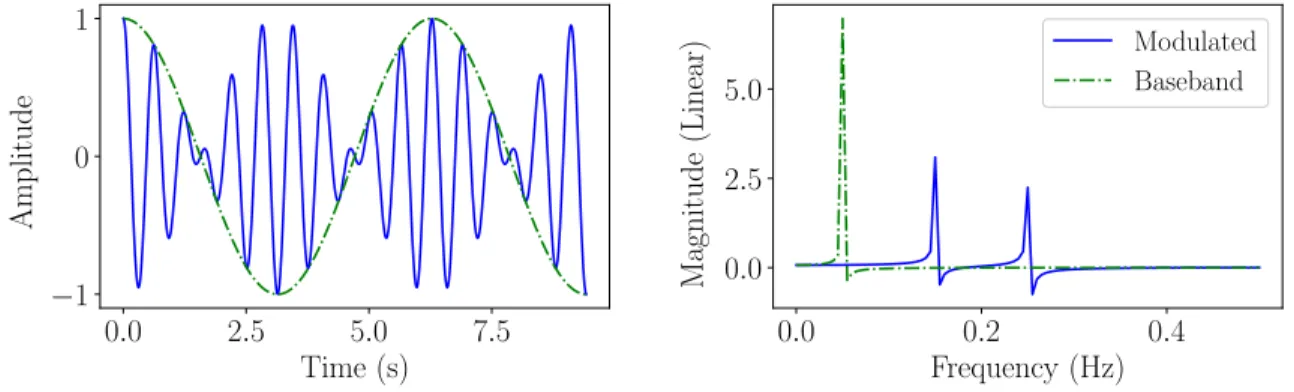
form of modulation is amplitude modulation, where the data signal is multiplied by a higher frequency sine wave, also known as a carrier. The resulting time and frequency domain signals are show in Figure 2.1, when the data signal is also a sine wave. A
sampling rate of 1 Hz is assumed to simply the scale and draw a stronger connection
to the Nyquist bandwidth. While simple, amplitude modulation is inefficient. It uses twice the spectrum required by the original signal, also known as the baseband signal,
0.0 2.5 5.0 7.5 Time (s) −1 0 1 A m p lit u d e 0.0 0.2 0.4 Frequency (Hz) 0.0 2.5 5.0 M ag n it u d e (L in ea r) Modulated Baseband
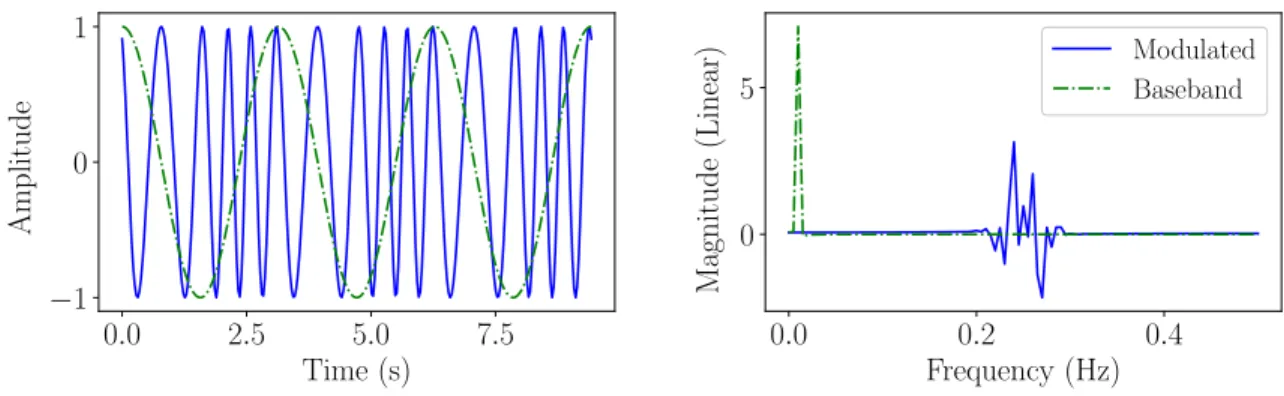
CHAPTER 2. BACKGROUND 0.0 2.5 5.0 7.5 Time (s) −1 0 1 A m p lit u d e 0.0 0.2 0.4 Frequency (Hz) 0 5 M ag n it u d e (L in ea r) Modulated Baseband
Figure 2.2: Frequency Modulation
and is not easy to demodulate. Improvements have been made, but it no longer sees widespread use for analog signals.
Frequency modulation, whose time and frequency domain outputs can be seen in Figure 2.2, is a more popular choice for analog signals. Instead of changing the amplitude of the carrier wave, frequency modulation varies the frequency. This results in increased spectrum use, but is more power efficient and is more noise resilient than amplitude modulation [20]. It continues to enjoy widespread use in FM radio broadcasts, as well as voice communication via two-way radio.
In order to modulate digital signals, bits must first be converted to symbols. The symbols are vectors in the complex plane, having both an in-phase part and a quadrature part. To reduce the bandwidth, a pulse shaping function is used. Finally, the shaped symbols are shifted up to the carrier frequency using a mixer, much like amplitude modulation, expressed as
s(t) = sI(t)cos(2πfct)−sQ(t)sin(2πfct). (2.1)
s(t) is the transmitted signal, sI(t) and sQ(t) are the real and imaginary parts of the
symbol vector respectively, and fc is the carrier frequency.
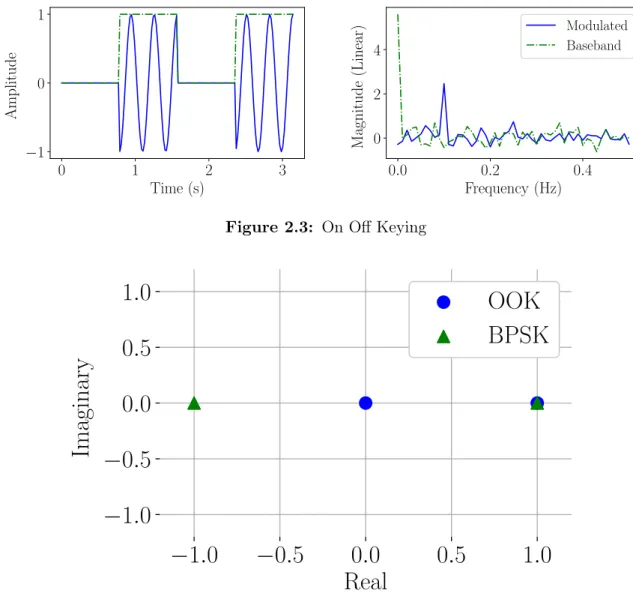
Generally, a modulation scheme will be referenced based on how it converts the bits to symbols. Perhaps the simplest example of this is On Off Keying (OOK). The
CHAPTER 2. BACKGROUND 0 1 2 3 Time (s) −1 0 1 A m p lit u d e 0.0 0.2 0.4 Frequency (Hz) 0 2 4 M ag n it u d e (L in ea r) Modulated Baseband
Figure 2.3: On Off Keying
−
1
.
0
−
0
.
5
0
.
0
0
.
5
1
.
0
Real
−
1
.
0
−
0
.
5
0
.
0
0
.
5
1
.
0
Im
ag
in
ar
y
OOK
BPSK
Figure 2.4: Symbol constellations
symbols are the same as the bits, meaning that ifb[k]is the bit at samplek,sI[k] =b[k]
and sQ[k] = 0. A time and frequency domain example is show in Figure 2.3. While easy, it requires infinite bandwidth in the theoretical case, and cannot encode more than one bit. Additionally, it has a DC offset before it is mixed with the carrier signal.
A better version of OOK is Binary Phase-Shift Keying (BPSK). To better un-derstand the improvement that BPSK offers over OOK, it is useful to look at the locations of the symbols on the complex plane. Figure 2.4 shows this type of plot, known as a symbol constellation.
CHAPTER 2. BACKGROUND
−
1
.
0
−
0
.
5
0
.
0
0
.
5
1
.
0
Real
−
1
.
0
−
0
.
5
0
.
0
0
.
5
1
.
0
Im
ag
in
ar
y
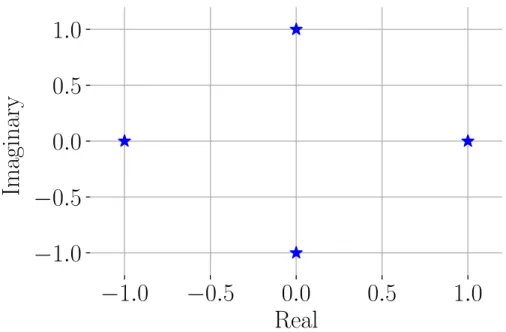
Figure 2.5: QPSK symbol constellation
Because the symbols will be affected by additive noise during transmission, they are unlikely to remain in the same position in the constellation plot after reception, but instead shift around randomly. The magnitude of the shift is related to the noise power, so the further distance between the symbols in BPSK means that it is more resilient.
Naturally, these are not the only two possibilities. Another option is Quadrature Phase-Shift Keying (QPSK), whose symbol constellation is given in Figure 2.5. Since there are four possible symbols, two bits can be encoded together, resulting in a doubling of the bit rate, assuming that everything else remains equal. However, this comes at a cost, since the symbols are closer together. This leads to an increased Bit Error Rate (BER) for the same SINR, where the BER is defined to be the number of bits per unit time that are incorrect [20]. Naturally, incorrect bits do not provide useful information, and thus do not increase the throughput. Ignoring any error correction, the system cannot be sure of which bit, or bits, was transmitted, so a retransmission is required, which further reduces the throughput. For this reason, QPSK is best used in systems with a somewhat high SINR.
CHAPTER 2. BACKGROUND −1.0 −0.5 0.0 0.5 1.0 Real −1.0 −0.5 0.0 0.5 1.0 Im ag in ar y (a) 16-QAM −1.0 −0.5 0.0 0.5 1.0 Real −1.0 −0.5 0.0 0.5 1.0 Im ag in ar y (b) 64-QAM
Figure 2.6: QAM symbol constellations
Both BPSK and QPSK use phase shifts to separate the symbols. This produces constellations with good separation up through four symbols, but beyond that, better schemes are possible. The most popular of these other schemes is Quadrature Amplitute Modulation (QAM), where the symbols are placed on a grid, which is centered around the origin. Constellations for 16-QAM and 64-QAM are shown in Figure 2.6.
Since their separation is less than that of QPSK, they require even better SINR to achieve a low BER. For this reason, many systems, including WiFi, use adaptive modulation to send data quickly when possible, but still maintain communication when the noise power increases [21]. The modulation scheme chosen directly correlates with the SINR of the system, providing a method to gather information about the PU’s SINR without any interaction or possibility of interference, which is critical for underlay DSA.
2.4
Adaptive Modulation
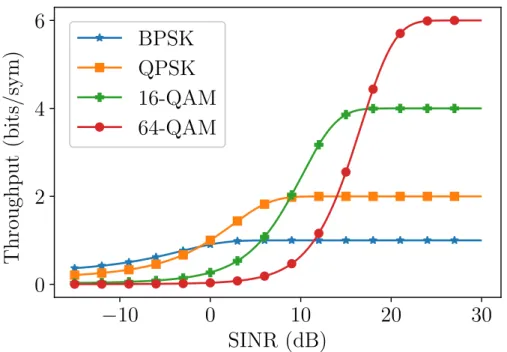
Since different modulation schemes have higher throughputs at different SINRs, systems change, or adaptive their modulation scheme to fit the current SINR. The differing throughput values can be attributed to a combination of the maximum possible throughput and the BER at a specific SINR. At low SINRs, they use BPSK, as it is the most noise resilient, followed by QPSK, then 16-QAM, and finally 64-QAM.
CHAPTER 2. BACKGROUND
−
10
0
10
20
30
SINR (dB)
0
2
4
6
T
h
ro
u
gh
p
u
t
(b
it
s/
sy
m
)
BPSK
QPSK
16-QAM
64-QAM
Figure 2.7: Throughput as a function of SINR for WiFi modulation schemes
A possible throughput curve for WiFi is given in Figure 2.7. Notice that the maximum throughput levels off for brief periods. During this time, the current modulation scheme is able to be decoded with a very small error rate, but switching to a higher modulation would result in an increased number of errors, so the change is not done. It is clear that knowing the modulation scheme provides a rough estimate of the PU’s SINR. If the SU is allowed to send tones with a specific power, it can observe how the modulation scheme changes to get a finer resolution SINR estimate.
2.5
Cyclostationarity
Signals in communications are often said to be wide sense stationary, meaning that some of their statistical properties do not vary with time, meaning that
E[x] =E[x(t)], Rx(τ) =Rx(t, τ).
CHAPTER 2. BACKGROUND
The mean does not rely on the time, and the autocorrelation only changes when
the time shift, τ, is varied [20]. Perhaps the most popular signal with this model is
Additive White Gaussian Noise, whose mean is zero, and whose variance is related to the power of the noise, which is assumed to remain constant. However, not all signals fall so nicely into this category. Consider, for example, the moving average of a sine wave, where the averaging window is less than a period. The average will change over time, but will still be periodic, and thus can be modeled using a cyclostationary process. More formally, a process whose properties, such as mean and autocorrelation, vary periodically with time is known as a cyclostationary process [22]. Mathematically, this is expressed as
E[x(t)] =E[x(t+T0)], Rx(t, τ) = Rx(t+T0, τ).
While similar to the stationary definitions, these still rely on t, since periodicity
Chapter 3
Techniques for Modulation Classification
3.1
Fraction-of-Time Probability
Traditional probability theory is based on stochastic processes and in order to model data, samples of these processes must be taken from a population. This is reasonable, if the data in question are dice rolls, and the population is simply the six faces of a die. However, when no such population exists, as is the case in many of the real world signals that communications employ, this model does not work as well. Nevertheless, because of the prevalence of the stochastic model, engineers often choose to represent the data as a sample path of a stochastic process.
An alternative to this approach is to consider the Fraction-of-Time (FOT) proba-bility model. This model is based on the idea that the data to be modeled are derived from some process whose statistical parameters remain the same over a very long time period. By working with the infinite time series of the data, similar statistics, such as mean and variance can be calculated. These calculations are analogous to those in the stochastic framework, where an infinite amount of samples are instead required [23].
The expectation operator of the FOT framework is
Etβ{z(t)}, lim T→∞ 1 T Z T /2 −T /2 z(t−u)ei2πβudu. (3.1)
CHAPTER 3. TECHNIQUES FOR MODULATION CLASSIFICATION
center frequency isβ [24]. In other words, it extracts a single sine wave from the input
signal, z(t), much like the expectation operator can be used to find a single value in
an ensemble. Whenβ is set to zero, the sine wave extraction operator instead extracts
the average value from the data set, which is equivalent to finding the expected value. Because of this duality, the calculation of traditional statistics such as mean, variance, and other moments using FOT is mathematically valid [25].
3.2
Second-Order Cyclostationarity
Given the signal, x(t), the mathematical definition of autocorrelation is
Rxx(τ) =
Z ∞
−∞
x(t)x(t−τ)dt (3.2)
assuming that the signal is stationary [20]. This can also be viewed as an expected value,
Rxx(t1, t2) = E[x(t1)x∗(t2)], (3.3)
which is more helpful for statistical signal processing. Here, no such assumption about stationarity is made, as time continues to be present in the arguments to the
autocorrelation function. After defining t= (t1+t2)/2 and τ =t1−t2,
Rxx(t, τ) =E[x(t+τ /2)x∗(t−τ /2)]. (3.4)
This form is particularly useful because its Fourier coefficients make up the Cyclic Autocorrelation Function (CAF) [22], given by
Rα x(τ) = lim T→∞ 1 T Z T /2 −T /2 x(t+τ /2)x∗(t−τ /2)e−i2παtdt. (3.5)
CHAPTER 3. TECHNIQUES FOR MODULATION CLASSIFICATION τ −15 −10 −5 0 5 10 15 α (Hz) 0.0 0.2 0.4 0.6 0.8 1.0 M agn it ud e (L in ea r) 0.0 0.2 0.4 0.6 0.8 1.0
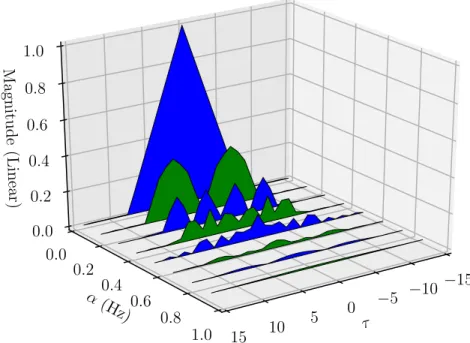
Figure 3.1: Cyclic Autocorrelation Function for BPSK without pulse shaping
This form once again shows the connection between the two statistical frameworks, as
this could also be viewed as the sine wave extraction operator for x(t)x(t−τ). In fact,
this view is quite reasonable, as the goal of the CAF is to find the cycle frequencies,
or α values which are non-zero. Each α value corresponds to a particular Fourier
coefficient, which means that α gives the frequency at which the autocorrelation
function contains some power. These values will arise from sine waves which are the naturally occurring product of two first order cyclostationary functions [25].
The CAF for a BPSK wave with no pulse shaping is shown in Figure 3.1. Note
that when α= 0 this is the traditional autocorrelation function, scaled by a factor.
This scaling factor results from the fact that the waveform contains power in other
cycle frequencies besidesα = 0.
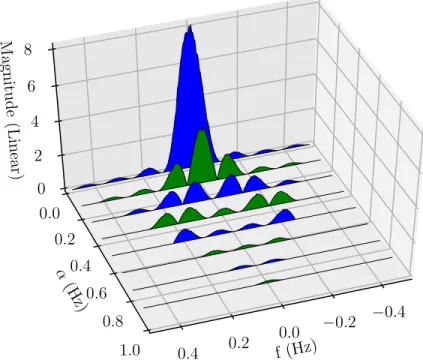
CHAPTER 3. TECHNIQUES FOR MODULATION CLASSIFICATION f (Hz) −0.4 −0.2 0.0 0.2 0.4 α (H z) 0.0 0.2 0.4 0.6 0.8 1.0 M agn it ud e (L in ea r) 0 2 4 6 8
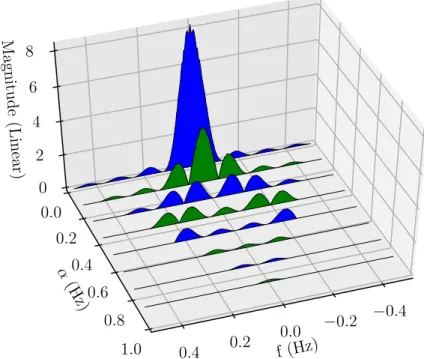
Figure 3.2: Spectral Correlation Function for BPSK without pulse shaping
Function (SCF), where Sα x(f) = Z ∞ −∞ Rα x(τ)e −i2πf τdτ. (3.6)
When the value of α is set to be zero, this gives the Wiener-Khinchin Theorem for
stationary processes [20]. The theorem states that the Power Spectral Density (PSD) for a stationary signal is equal to the Fourier Transform of the autocorrelation function. The same BPSK wave as in Figure 3.1 was used to create the SCF shown in
Figure 3.2. α = 0 is the PSD of the signal. Other non-zero values are present at
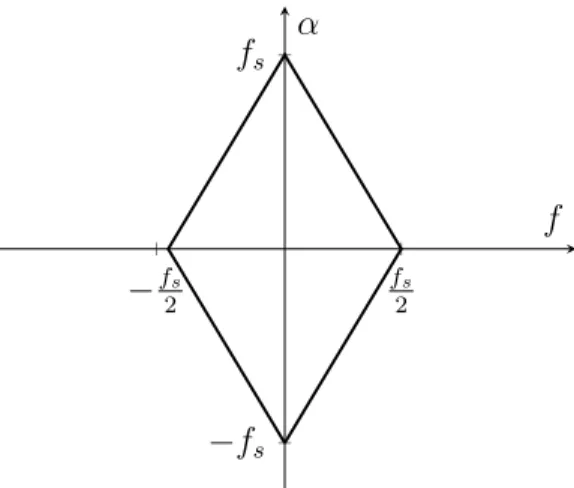
various cycle frequencies. Note that the region of support for the SCF is limited to
the region shown in Figure 3.3 [26]. fs represents the sampling frequency. This region
follows from the Nyquist bandwidth, since it limits the bandwidth of the signal to be
±fs/2 along the f-axis. By rewriting (3.6) as
Sα x(f) = lim T→∞Zlim→∞ 1 T Z Z Z/2 −Z/2 XT(t, f +α/2)XT∗(t, f −α/2)dt, (3.7)
CHAPTER 3. TECHNIQUES FOR MODULATION CLASSIFICATION −fs 2 fs 2 −fs fs f α
Figure 3.3: Region of support for the Spectral Correlation Function
the limits of theα-axis are made clear [13]. XT is the Fourier transform of x(t)and is
given by
XT(t, f) =
Z t+T /2
t−T /2
x(u)e−i2πf udu. (3.8)
Since α is the frequency shift, and is divided by two, shifting more than α is not
possible, as that would exceed the bandwidth of the sampled signal. It is also worth
noting that the SCF is symmetric about thef axis, meaning that it contains the same
values forα and −α. This was exploited in [15] to reduce the number of calculations
required.
3.3
Higher-Order Cyclostationarity
Not all modulation schemes are distinguishable using the CAF, or the SCF. For example, compare Figure 3.2, showing the SCF of BPSK, with Figure 3.4, showing the SCF of QPSK. Despite using two different modulation schemes, they are not easily distinguishable. Thus, higher-order statistics, such as moments and cumulants, are required to determine the type of modulation in use. The lag product, defined as
Lx(t,τ)n= n
Y
j=1
CHAPTER 3. TECHNIQUES FOR MODULATION CLASSIFICATION f (Hz) −0.4 −0.2 0.0 0.2 0.4 α (H z) 0.0 0.2 0.4 0.6 0.8 1.0 M agn it ud e (L in ea r) 0 2 4 6 8
Figure 3.4: Spectral Correlation Function for QPSK
is simply the time delayed product of x(t). The notation (∗) indicates that the
conjugation is optional. An nth-order statistic may have up to n/2 conjugations,
where different conjugations will produce different values, leading to multiple outcomes for the same order. Taking the expected value of the lag product yields the Temporal Moment Function, given by
Rx(t,τ)n=E[Lx(t,τ)n]. (3.10)
This corresponds to the nth-order autocorrelation function, which when evaluated
with n = 2, is equal to (3.3). Similarly, the Cyclic Temporal Moment Function is
Rα x(t,τ)n = lim T→∞ 1 T Z T /2 −T /2 Rx(t,τ)ne−i2παtdt, (3.11)
and generalizes the CAF given in (3.5). Since the integration limits approach infinity,
CHAPTER 3. TECHNIQUES FOR MODULATION CLASSIFICATION
While moments could be used for classification, better alternatives exist, especially when the radio scene has multiple signals [27]. This led to the use of cumulants, which are robust to noise and have the superposition property, like voltage sources in a circuit. The moments do not have this useful property [25]. The Temporal Cumulant Function is Cx(t,τ)n = X P " (−1)p−1(p−1)! p Y j=1 Rx(t,τvj)|vj| # , (3.12)
and is calculated using lower-order moments. Alternatively, it can be written as
Cx(t,τ)n =Rx(t,τ)n− X P,p6=1 " p Y j=1 Cx(t,τvj)|vj| # , (3.13)
which instead uses lower-order cumulants [28]. The summation is performed over P,
which is the set of all possible partitions of the set {1,2, ..., n}, the counting numbers
up to n. For n = 3, the set to be partitioned is {1,2,3}, and P is
P ={{1,2,3},
{{1},{2,3}},
{{1,3},{2}},
{{1,2},{3}}}
{{1},{2},{3}}}.
Each row is a different partition, meaning that it contains each element of the original
set in one and only one of the subsets. For example, the second partition,{{1},{2,3}},
has two subsets containing either 1, or 2 and 3. Compare this to the first partition,
{1,2,3}, where all three values are in the same subset. These variations are important
because they affect p, the number of subsets in each partition. For the prior P,
p={1,2,2,2,3}. Note that multiple partitions may have the same value of p, such
CHAPTER 3. TECHNIQUES FOR MODULATION CLASSIFICATION
summation. In (3.13), p= 1 is skipped because it is equal to the first term on the
right hand side. Finally, j indexes each partition, iterating through all of its subsets.
When the current partition is {{1},{2,3}}, j = 1 indicates the set {1}, and j = 2
references {2,3}. |vj| simply means the number of elements in the subset indexed by
j, being 1 and 2 for the previous example, representatively.
A 4th-order example is given next to clarify. For simplicity, the number of
conjugations is set to zero. Since it has been shown that odd order moments for most communication signals are zero [25], they will be ignored for the analysis, meaning that partitions containing sets with one or three elements are not included. One
such partition like this is {{1},{2,3,4}}. The first subset, where j = 1, has only one
element, so |vj| is also one. This results in the inclusion of Rx(t, τ1)1 in the product,
but this is no different than the mean of the signal, shifted by τ. The mean of the
possible symbol values, when all symbols are considered, for the modulation schemes discussed in Section 2.3, excluding OOK, is zero. If the symbol constellations are viewed as probability distributions, and each symbol is equiprobable, the mean for each can be calculated. For example, in QPSK, the possible symbol values, or probabilistic
outcomes, are ±i and ±1, so the mean is 14((1) + (−1) + (i) + (−i)) = 0. Because
the mean is zero, the product containing this moment will also be zero, and is thus ignored. Similar logic can be applied for the third-order moments, leaving only the
second and fourth-order moments. P is then:
P ={{1,2,3,4},
{{1,2},{3,4}},
{{1,3},{2,4}},
{{1,4},{2,3}}}.
CHAPTER 3. TECHNIQUES FOR MODULATION CLASSIFICATION
has only one subset, so p will equal one for this iteration. The other three partitions
all have two subsets, sop will be two in those iterations. Additionally, sincepis either
one or two, (p−1)! is always one, and can be ignored. For clarify, the contribution of
each partition will be analyzed separately, and i will be used to indexP, the partition
list. For the four possible values of i, the contributions are:
i= 1 : (−1)1−1Rx(t, {τ1, τ2, τ3, τ4})4 i= 2 : (−1)2−1Rx(t,{τ 1, τ2})2Rx(t,{τ3, τ4})2 i= 3 : (−1)2−1Rx(t, {τ1, τ3})2Rx(t,{τ2, τ4})2 i= 4 : (−1)2−1Rx(t,{τ1, τ4})2Rx(t,{τ2, τ3})2.
The values of τ in each of the moments of a contribution correspond to the values in
that partition ofP. The second partition consists of two subsets: {1,2} and {3,4},
and thus two second-order moments. For the first moment, the τ values are {τ1, τ2}
and{τ3, τ4}for the second. This ensures that all possible combinations of the τ vector
are considered. For simplicity,τ is set to zero. The fourth-order cumulant resolves to
Cx(t,0)4 =Rx(t,0)4−3 (Rx(t,0)2) 2
.
This form is not yet useful, as it changes with time. By using the FOT expectation operation, the Cyclic Temporal Cumulant Function or cyclic cumulant, given by
Cα x(τ)n= lim T→∞ 1 T Z T /2 −T /2 Cx(t,τ)ne−i2παtdt, (3.14)
can be calculated [28], and is the form that is used for modulation classification. Here,
α serves the same function that it does in the CAF, and is zero unless otherwise noted
for this work. Since this notation does not convey the number of conjugations, the
CHAPTER 3. TECHNIQUES FOR MODULATION CLASSIFICATION
Table 3.1: Second-order cumulants of QPSK x x2 xx∗ 1 1 1 -1 1 1 i -1 1 −i -1 1 Sum 0 4
the number of conjugations. Notation with a hat, shown as Cnqˆ , denotes when the
cumulant is an estimate, instead of an exact value.
The importance of q, the number of conjugations, can be seen by considering a toy
example involving C20 and C21 of QPSK. Table 3.1 shows the outcomes of calculating
the two cumulants in question with and without the optional conjugation. Dividing
the sum ofx2 andxx∗ by four produces the theoretical value ofC
20andC21 for QPSK,
respectively.
As an alternative to these representations of moments and cumulants, they can be calculated from their deriving functions, given as
ΦX(ω) = Z ∞ −∞ fX(u)eiωudu, MX =E[Xn] = ∂n ∂ωnΦX(ω) ω=0 , (3.15) CX = ∂ n ∂ωnln (ΦX(ω)) ω=0 . (3.16)
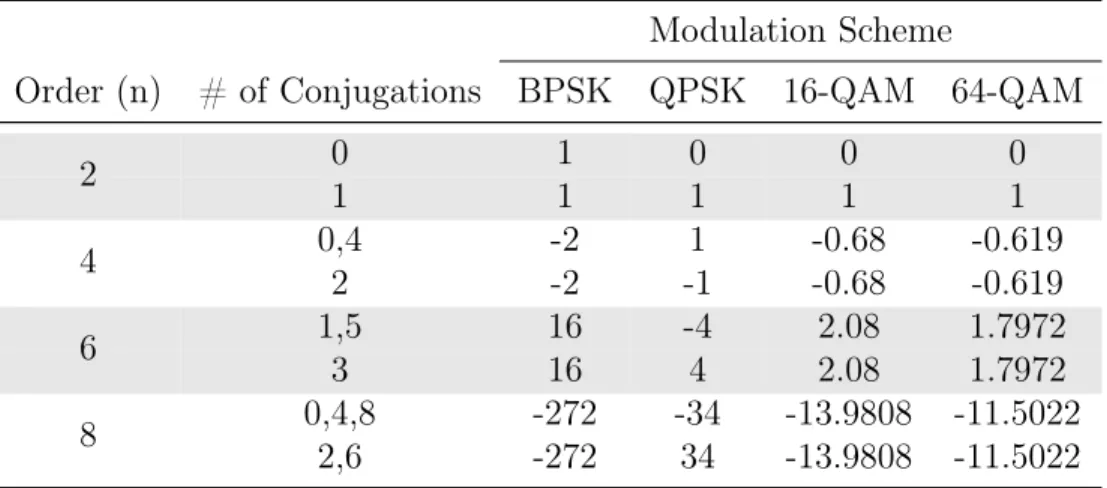
While not helpful for calculating the cumulant of a sample path, this form demonstrates why the value of a cumulant for a given probability distribution, or modulation scheme, is constant. The results of several such calculations are shown in Table 3.2 [29]. All calculations are done using a constellation of unit variance, which is reflected in the second row of the table. Since the symbols are normalized, the power of the signal is always one, which is equivalent to the second-order cumulant with one conjugation, as
CHAPTER 3. TECHNIQUES FOR MODULATION CLASSIFICATION
Table 3.2: Theoretical cumulant values for selected modulation schemes
Modulation Scheme
Order (n) # of Conjugations BPSK QPSK 16-QAM 64-QAM
0 1 0 0 0 2 1 1 1 1 1 0,4 -2 1 -0.68 -0.619 4 2 -2 -1 -0.68 -0.619 1,5 16 -4 2.08 1.7972 6 3 16 4 2.08 1.7972 0,4,8 -272 -34 -13.9808 -11.5022 8 2,6 -272 34 -13.9808 -11.5022
Chapter 4
Techniques for Undersampling
In order to undersample a signal, it must be sparse in some domain. This sparsity means that less samples are required to extract enough meaningful data from the signal in order to reconstruct it. An example of the compression process is given in
Figure 4.1. The x vector, or original signal, is sparse, as seen by the white squares.
At the output z, the signal is no longer sparse, having been compressed. The signal
is also in in the “dark” domain, having been both compressed and transformed by
Ψ
x
y
=
CHAPTER 4. TECHNIQUES FOR UNDERSAMPLING
the Φmatrix. For clarity, Φ is sometimes represented as AΨ, where Aperforms the
compression, and Ψ is the transformation matrix. Here, the compression matrix will
refer to the identity matrix with rows removed, but other options, such as Bernoulli or Gaussian matrices are possible [8]. Since the signal is no longer sparse, it can be efficiently sampled. The transformation performed is often the Fourier transform, but can also be a wavelet transform, or the DCT. Note that lowercase bold letter denote vectors, and upper case bold letters indicate matrices.
For the reconstruction to work, the sampling matrix, Φmust fulfill the Restricted
Isometry Property. This property is stated as
(1−δS)||c||22 ≤ ||ΦSc||22 ≤(1 +δS)||c|| 2
2, (4.1)
and was first introduced in [30]. Here, ΦS is an S-large subset of the columns of Φ, c
is any real vector with length S, and || · ||2 takes the`2 vector norm of the argument.
As the constant δS approaches zero, the system begins to behave like an orthonormal
system, from which recovery is a straightforward task. In general, two forms are possible for the recovery equation. The traditional approach, in which sparsity is an afterthought, is given as,
arg min
x ||z−Φx||
2
2+λ||x||1. (4.2)
The sparsity constraint is enforced by the second term, and λ determines the level of
sparsity. The alternative method, known as basis pursuit, uses only the `1 norm, and
is shown as
arg min
x ||x||1 subject to Φx≈z. (4.3)
This method can be easily approximated using a greedy algorithm, as shown in Section 4.1, making it much faster to solve than (4.2).
CHAPTER 4. TECHNIQUES FOR UNDERSAMPLING
Algorithm 4.1 Orthogonal Matching Pursuit
Input: Dictionary D, signalz, target sparsity K or target error
1: I ← {}
2: r ←z
3: x←0
4: while stopping criterion not met do 5: kˆ←arg maxˆkhDˆk,ri
6: I ←(I,kˆ)
7: x←D†Iz
8: r ←z−DIx
Output: x
4.1
Orthogonal Matching Pursuit
Orthogonal Matching Pursuit (OMP) is one such greedy algorithm. Originally derived in [31], OMP enforces sparsity by adding values one at a time until either a desired sparsity level is reached, or the residual falls below a specified threshold. Algorithm 4.1 details the implementation of OMP. In order to reduce the residual as fast as possible,
the inner product, denoted h·,·i, is taken between the residual and the dictionary.
The maximum value of the inner product is produced by the basis vector that is most
in line with the current residual. The index of this basis vector is denoted ˆk, and
added to I. I is then used to index D, whose pseudoinverse is multiplied with the
input signal z, giving the current reconstruction. This reconstruction is then tested
against the signal to determine if the error stopping criteria has been met. While the pseudoinverse can be computationally difficult, here it is fairly efficient, due to the fact that each iteration only adds a column, so the previous pseudoinverse can be applied to speed up the computation [32].
In the specific case of cumulant reconstruction, the calculation of the pseudoinverse can be further optimized to increase the amount of possible preprocessing. The first, and most important, optimization is the removal of the loop. In order to justify this,
CHAPTER 4. TECHNIQUES FOR UNDERSAMPLING
z, occurs in the first column more than 98% of the time. To take advantage of this,kˆ
was set to 1. Additional iterations are not required, as only one cycle frequency is needed to perform the classification.
Without knowing the number of iterations, or which columns would be selected,
2n−1pseudoinverses would be required, where n is the number of columns in D. If
the columns ofDare considered a set, there are 2npossible subsets, but a column will
always be selected, so the empty set can be ignored. In the single iteration case, DI
will contain a single column, so n pseudoinverses have to be precomputed. However,
because ˆk = 1, only one pseudoinverse needs to be found. Thus, the optimization
removes almost all of the complexity associated with the precomputation of the pseudoinverse(s).
These pseudoinverses are fairly straightforward to calculate, but require a division operation, which can be quite expensive. However, this operation can be eliminated by considering the Moore-Penrose pseudoinverse, given by
D†I = (DI∗DI)−1D∗I, (4.4)
when DI is a single column. D∗ denotes the Hermitian, or conjugate, transpose of
the matrix. DI is only one column wide, so
D∗D=||DI||22, (4.5)
whose inverse is simply the multiplicative inverse. The pseudoinverse then collapses to DI†= D ∗ I ||DI||22 , (4.6)
which is simply a row vector. Reconstruction is performed by multiplying DI† with z,
which is the same as the dot product between D†I
T
Chapter 5
Using Cumulants to Classify Modulation Schemes
5.1
Methods of Estimation
Three primary methods were chosen for cumulant estimation: direct, Fourier Transform,
and CS. An estimator of the n-th order moment is given in Equation (5.1), which is
required for the direct method equations given as
ˆ Mn= 1 N N X i=1 zn[i], (5.1) ˆ C40= ˆM4−3 ˆM22, (5.2) ˆ C80= ˆM8−28 ˆM6Mˆ2−35 ˆM42+ 420 ˆM4Mˆ22+ ˆM 4 2. (5.3)
In order to simplify the design of the CS estimator, only the cumulants without conjugations were calculated. This has been done in the past and shown to produce a successful classifier [33].
A visual representation of the Cˆ40 estimator is shown in Figure 5.1. Note that this
process is iterative and the estimate improves as more samples are obtained. Once the desired number of samples is obtained, the iteration stops, and the final estimate is calculated. The only computations that need to be performed after all of the samples are obtained are a squaring operation, multiplication by a constant, and one addition.
CHAPTER 5. USING CUMULANTS TO CLASSIFY MODULATION SCHEMES zi (·)2 (·)2 + N−1 + N−1 (·)2 −3 + ˆ C40 ˆ C20
Figure 5.1: Estimation of the 4th-order cumulant value
z (·)2 (·)2 FFT FFT (·)2 −3 + Cˆα 40 ˆ C20
Figure 5.2: Estimation of the 4th-order cumulant value using FFTs
(FFT) and is outlined in Figure 5.2 for Cˆα
40. Because an FFT is used, the entire
sample path must be obtained before calculations can start. Notice also, that all
Fourier coefficients, as indicated by the α, are calculated, instead of the singular
coefficient in the case of the direct method. These extra coefficients are seldom used for classification and are discarded in this method.
Although the Fourier Transform approach calculates extraneous information, it is a building block for the CS method. If the transform is performed using a matrix, the cumulant can be estimated by
ˆ
C40α =F[[z]] 4
−3[[F[[z]]2]]2. (5.4)
[[·]]n indicates the element-wise power operation and F is the Fourier Transform
matrix. Since the first row of this matrix has all elements equal to N1, the first element
of Cˆα
CHAPTER 5. USING CUMULANTS TO CLASSIFY MODULATION SCHEMES
were some inconsistencies, so the full derivation of the CS method is shown. First, the incoming samples are compressed via
z=Ax, (5.5)
where A is an M×N compression matrix discussed in Chapter 4.
DefiningR[[x]] to be the autocorrelation matrix, also given byE[xxH], even powers
of the samples can be found, such as:
[[x]]4 =diag R[[x]]2
=Pxvec R[[x]]2
. (5.6)
A row selection matrix, Px ∈ {0,1}N×N
2
, removes the unneeded autocorrelation
matrix entries, and the vec(·)operation stacks the columns of the argument to form
an N2×1 vector. Other variants of P are also required, such as P
z, which is an
M ×M2 matrix that performs the same function.
The relationship between the compressed and non-compressed autocorrelation
matrices, which requires removing the rows and columns not present in z, is given as,
R[[z]]2 =AR[[x]]2AT. (5.7)
Because theP matrix acts upon vectors, instead of matrices, the vectorizing operation
is performed, which when combined with the identity that states vec(ABC) =
(CT ⊗A)vec(B), where⊗ denotes the Kronecker product, produces
vec R[[z]]2
= (A⊗A)vec R[[x]]2
CHAPTER 5. USING CUMULANTS TO CLASSIFY MODULATION SCHEMES
Combining Equations (5.4) through (5.8) leads to:
ˆ Cα 40 =F Pxvec R[[x]]2 −3PFxvec RF[[x]]2 , =F Pxvec R[[x]]2−3PF xvec F R[[x]]2F T , = [F Px−3PFx(F ⊗F)]vec R[[x]]2 . (5.9)
Finally, the matrix inside the brackets is inverted, and (5.8) applied to produce
[[z]]4 =P
z(A⊗A) [F Px−3PFx(F ⊗F)]
† ˆ
Cα
40. (5.10)
This matches the traditional CS problem when only [[z]]4 is known and Φis equal to
Pz(A⊗A) [F Px−3PFx(F ⊗F)]
† .
5.2
Method of Decision
A Bayesian hypothesis test was performed to determine which of the modulation schemes the unknown signal was using. To simplify the decision making process, only the two cumulants whose theoretical values were closest to the estimate were considered. This reduced the problem to a binary hypothesis test, and allowed the application of P(x|w1) P(x|w2) w1 ≷ w2 P(w2) P(w1) . (5.11)
Finding P(x|w1) was done empirically by plotting the values of the cumulants to
determine which distribution was most appropriate. If the variance was required for the selected distribution, e.g. Gaussian, it was estimated using
σ2 z = 1 N −1 N X i=1 (zi−µz)2. (5.12)
CHAPTER 5. USING CUMULANTS TO CLASSIFY MODULATION SCHEMES z(t) ADC Cumulant Estimator Preliminary Modulation Selector Final Modulation Selector Prediction
Figure 5.3: Block diagram of the modulation classifier
The a priori probabilitiesP(w1)andP(w2)were both assumed to be 0.5, as no further
information was estimated to influence them. The output of this decision was then used as the prediction of the detector, which was compared against ground truth to determine if it had decided correctly. Figure 5.3 shows the complete system. The preliminary selector performs the conversion to a binary hypothesis test, while the final selector uses the Bayesian hypothesis test to determine the output.
5.3
Approach
In order to determine the most promising way to implement modulation classification using cumulants, each method was implemented and tested using simulations. First, comparisons between two different orders, 4 and 8, were performed. There has been an increasing amount of research in recent years regarding higher order cumulants [35] [36] [37]. This is because they have been shown to be more discriminating, especially with higher order modulation schemes such as 16-QAM and 64-QAM or even 256-QAM, as is made clear by Table 3.2.
Two cumulants, Cˆ40 and Cˆ80 were chosen for the initial investigation. Their
performance in different scenarios, such as number of samples, SINR, carrier offset,
and phase shift, were considered. In addition to the probability of deteection (PD) each
cumulant achieved, a metric was added for Cˆ80 to determine how often it successfully
classified a set of samples thatCˆ40 did not. This provided insight into the performance
gain that was achievable using 8th-order cumulants that could not be obtained with the 4th-order ones.
CHAPTER 5. USING CUMULANTS TO CLASSIFY MODULATION SCHEMES
Having selected Cˆ40, the analysis continued by comparing the direct and FFT
approaches. Finally, the CS approach was included. For the CS approach, two methods of reconstruction were considered, convex optimization and OMP. Initially, these two methods were pit against one another, and then the better algorithm was tested against the direct method of cumulant calculation.
Chapter 6
Results and Analysis
WiFi was chosen as the target networking standard for this research. It is very prolific, meaning that there are plenty of opportunities for spectrum reuse, as well as being well documented, for ease of development. However, it also presents a few challenges. Most notably is the use of Orthogonal Frequency Division Multiplexing (OFDM), which divides the channel bandwidth into many smaller bandwidth channels.
Individual channels then send low rate symbols independently and in parallel, and those symbols are then placed back into a serial stream by the receiver. This presents many advantages in terms of throughput and bit error rate, but makes AMC more difficult by masking which modulation scheme is in use. Fortunately, it is possible to extract a single channel from the OFDM signal [38] [39]. This step is not covered, however the effects of doing so, such as a phase shift or carrier frequency offset were investigated. The four modulation schemes considered were BPSK, QPSK, 16-QAM, and 64-QAM. A listing of their cumulants is given in Table 3.2.
6.1
Distributions and Variances
In order to determine the distribution of the cumulant estimates, 10000 estimates of random inputs were found and plotted after being scaled to be a Probability Density Function. One such plot can be seen using the direct method in Figure 6.1. The distributions appear to be normal, supporting the proof given in [40], so that was
CHAPTER 6. RESULTS AND ANALYSIS −4 −3 −2 −1 0 0.0 0.2 0.4 0.6 σ2= 0.35158 BPSK 0.8 0.9 1.0 1.1 0 5 10 15 20 σ2= 0.00080 QPSK −0.9 −0.8 −0.7 −0.6 −0.5 −0.4 0 2 4 6 σ2= 0.00377 16-QAM −0.8 −0.6 −0.4 0 2 4 6 σ2= 0.00490 64-QAM
Best fit Gaussian Estimates
Figure 6.1: Distribution of cumulant estimates using the direct method
chosen as the distribution to use in Equation (5.11).
While the variances are not equal, the 16-QAM variance is smaller. This means that using Equation (5.11) with the experimental variances would result in an increase in the number of errors associated with 16-QAM, and a decrease in the 64-QAM errors. This shift is undesirable in the application of underlay DSA as described in Chapter 2. A misclassification of 16-QAM as 64-QAM would inform the system that the PU is performing better than it really is, which may cause the SU to raise its transmit power above an acceptable level. More generally, the BER of a system remains approximately constant when using adaptive modulation, but the throughput varies with the SINR. Increasing the SINR of the channel forces the system to lower its throughput in order to maintain an acceptable BER without increasing transmit power. In the underlay DSA situation, this SINR increase comes from the SU’s transmissions. A smaller SINR increase, which would come from misclassifying 64-QAM as 16-QAM, would affect the BER less, and thus lead to a smaller, or nonexistent, drop in PU throughput.
CHAPTER 6. RESULTS AND ANALYSIS
Naturally, this is also not desirable, but it is a better outcome than the first case. For this reason, it was assumed that the variances were equal for all modulation schemes across all cases. The theoretical values of BPSK and QPSK are too far away to factor into this issue. As will be shown, they are rarely misclassified, even at low SINRs or sample sizes.
6.2
Classification without Signal Impairments
The performance of the estimators was first assessed when there was no phase shift, carrier frequency offset, or noise. Instead, the number of samples was varied to determine how well the estimators would work when they undersampled the signal.
Note that true compression, where N samples are gathered and only M are used
(N > M), was not performed. Because the estimators do not improve if multiple samples of the same symbol are provided, the number of symbols input to the estimator was simply decreased. Nevertheless, the standard compression ratios are still useful. This work uses 1000 samples as a compression ratio of 1.
The first comparison was between the direct methods for Cˆ40 andCˆ80, as shown in
Figure 6.2. The two lines near the top represent the estimators raw performance. On
the bottom is a line with starred markers that shows the cases where Cˆ80 successfully
classified the modulation scheme, but Cˆ40 did not. This indicates the improvement
ˆ
C80 offers above Cˆ40, which is quite minimal for this case. More precisely, Cˆ80 offers
no improvement over Cˆ40 in the case of 16-QAM, and only a 2% increase in accuracy
when classifying 64-QAM.
The FFT and direct method for Cˆ40 were then compared, and the plots shown in
Figure 6.3. As expected, there is no difference between the two methods, so the extra overhead of calculating the various frequencies is not required.
The effectiveness of the two methods of reconstruction, convex optimization and OMP is shown in Figure 6.4. Both methods fail to classify BPSK, as they are only
CHAPTER 6. RESULTS AND ANALYSIS 0 2500 5000 7500 10000 0.00 0.25 0.50 0.75 1.00 PD BPSK 0 2500 5000 7500 10000 0.00 0.25 0.50 0.75 1.00 QPSK 0 2500 5000 7500 10000 0.00 0.25 0.50 0.75 1.00 PD 16-QAM 0 2500 5000 7500 10000 0.00 0.25 0.50 0.75 1.00 64-QAM Sample Count Sample Count C40 C80 C80only
Figure 6.2: C40 versusC80 as a function of sample count
0 2500 5000 7500 10000 0.00 0.25 0.50 0.75 1.00 PD BPSK 0 2500 5000 7500 10000 0.00 0.25 0.50 0.75 1.00 QPSK 0 2500 5000 7500 10000 0.00 0.25 0.50 0.75 1.00 PD 16-QAM 0 2500 5000 7500 10000 0.00 0.25 0.50 0.75 1.00 64-QAM Sample Count Sample Count No FFT FFT FFT only
CHAPTER 6. RESULTS AND ANALYSIS 0 200 400 0.00 0.25 0.50 0.75 1.00 PD BPSK 0 200 400 0.00 0.25 0.50 0.75 1.00 QPSK 0 200 400 0.00 0.25 0.50 0.75 1.00 PD 16-QAM 0 200 400 0.00 0.25 0.50 0.75 1.00 64-QAM Sample Count Sample Count OMP Comp Comp only
Figure 6.4: C40 with ideal reconstruction versus greedy method
Table 6.1: Powers of BPSK and QPSK
Symbol x2 x4
-1 1 1
1 1 1
-i -1 1
i -1 1
provided with x4, which is indistinguishable from QPSK, as shown in Table 6.1. There
is no difference in BPSK and QPSK when they are raised to the fourth power. To
overcome this, Cˆ20 was used, and its output is shown in Figure 6.5. This is very
successful, even at lower sample counts, as was the OMP reconstruction method. The performance in the 64-QAM case for the OMP method is best explained with the confusion matrices shown in Table 6.2. Across the top of the table are the correct modulation schemes, and the side labels indicate which scheme was predicted. This means that in the 10 sample case, the classifier predicts 64-QAM for both 16-QAM and 64-QAM, with little regard for the true modulation scheme. Unfortunately, this is
CHAPTER 6. RESULTS AND ANALYSIS 20 40 60 80 100 0.00 0.25 0.50 0.75 1.00 PD BPSK 20 40 60 80 100 0.00 0.25 0.50 0.75 1.00 QPSK Sample Count C20
Figure 6.5: C20for BPSK versus QPSK classification
Table 6.2: Confusion matrices for OMP reconstructions
(a)10 samples BPSK QPSK 16-QAM 64-QAM BPSK 0.004 0 0.283 0.206 QPSK 0.996 1 0.015 0.004 16-QAM 0 0 0.015 0.024 64-QAM 0 0 0.687 0.766 (b) 512 samples BPSK QPSK 16-QAM 64-QAM BPSK 0 0 0 0 QPSK 1 1 0 0 16-QAM 0 0 0.819 0.337 64-QAM 0 0 0.181 0.663
not correctable by modifying the thresholds, as shown by Figure 6.6. Because 64-QAM is correct half of the time, this leads to better than expected performance. At 512 samples, this is not the case, and the classifier is behaving much more reasonably.
The single column optimization, described in Section 4.1, was then tested against the standard OMP method to ensure that the computational optimization did not reduce the accuracy. Figure 6.7 shows the difference. This change results in comparable performance for all cases except 64-QAM at extremely low sample counts, but those estimates were not reliable to start.
CHAPTER 6. RESULTS AND ANALYSIS 2.5 5.0 7.5 10.0 12.5 0.0 0.5 1.0 1.5 σ2= 3.41713 BPSK 2.5 5.0 7.5 10.0 12.5 0.00 0.25 0.50 0.75 1.00 1.25 σ2= 0.66641 QPSK −10.0 −7.5 −5.0 −2.5 0.0 0.0 0.5 1.0 1.5 σ2= 1.22423 16-QAM −10.0 −7.5 −5.0 −2.5 0.0 2.5 0.0 0.5 1.0 1.5 σ2= 1.14145 64-QAM
Best fit Gaussian Estimates
Figure 6.6: Variances of 10 sample estimates
0 200 400 0.00 0.25 0.50 0.75 1.00 PD BPSK 0 200 400 0.00 0.25 0.50 0.75 1.00 QPSK 0 200 400 0.00 0.25 0.50 0.75 1.00 PD 16-QAM 0 200 400 0.00 0.25 0.50 0.75 1.00 64-QAM Sample Count Sample Count Zero Freq. Largest Corr. Largest Corr. only
CHAPTER 6. RESULTS AND ANALYSIS 0 200 400 0.00 0.25 0.50 0.75 1.00 PD BPSK 0 200 400 0.00 0.25 0.50 0.75 1.00 QPSK 0 200 400 0.00 0.25 0.50 0.75 1.00 PD 16-QAM 0 200 400 0.00 0.25 0.50 0.75 1.00 64-QAM Sample Count Sample Count Direct OMP OMP only
Figure 6.8: C40 with direct versus greedy method
Figure 6.8. As expected, the OMP method fails to classify the BPSK. However, it performs the same in QPSK, and offers a significant improvement in the 16-QAM case.
6.3
Classification with Noise
Using 500 samples, which corresponds to approximately 75% accuracy in the noiseless case, the performance of the two methods was compared across a range of SINR values
from 0 dB to 30 dB. This range was chosen to match the SINR range over which
WiFi is specified to operate [21]. Figure 6.9 compares the performance of Cˆ40 against
ˆ
C80. Similar to the noiseless case, Cˆ80 offers little improvement over Cˆ40. This was
expected, since cumulants are generally considered to be resilient to noise.
Having shown that the FFT method and the convex optimization reconstruction are not useful using the samples test, they were not evaluated further. OMP was then tested against the direct method, once again using 500 samples, and the results are
CHAPTER 6. RESULTS AND ANALYSIS 0 10 20 30 0.00 0.25 0.50 0.75 1.00 PD BPSK 0 10 20 30 0.00 0.25 0.50 0.75 1.00 QPSK 0 10 20 30 0.00 0.25 0.50 0.75 1.00 PD 16-QAM 0 10 20 30 0.00 0.25 0.50 0.75 1.00 64-QAM SINR (dB) SINR (dB) C40 C80 C80only
Figure 6.9: C40 versusC80 as a function of SINR
given in Figure 6.10. As was the case with Cˆ80, no change in performance was noted
CHAPTER 6. RESULTS AND ANALYSIS 0 10 20 30 0.00 0.25 0.50 0.75 1.00 PD BPSK 0 10 20 30 0.00 0.25 0.50 0.75 1.00 QPSK 0 10 20 30 0.00 0.25 0.50 0.75 1.00 PD 16-QAM 0 10 20 30 0.00 0.25 0.50 0.75 1.00 64-QAM SINR (dB) SINR (dB) Direct OMP OMP only
Figure 6.10: Direct versus OMP as a function of SINR
6.4
Frequency and Phase Shifts
Traditional modulation estimation schemes rely on preprocessing steps to remove Carrier Frequency Offset (CFO) and phase shifts [41]. Since the estimators considered do not have any preprocessing, the predictions are poor, as seen by the results in Figure 6.11 and Figure 6.13. The excellent classification of 64-QAM is only because the system guesses 64-QAM nearly every time, as seen by Table 6.3. To understand why this occurs, it is helpful to see the distribution of the cumulant estimates, as shown in Figure 6.12. This behavior stems from the fact that a frequency shift is also
Table 6.3: Confusion matrix for a -0.0005 HzCFO
BPSK QPSK 16-QAM 64-QAM
BPSK 0 0 0 0
QPSK 0 0 0 0
16-QAM 0 0 0 0
CHAPTER 6. RESULTS AND ANALYSIS −0.0010−0.0005 0.0000 0.0005 0.0010 0.00 0.25 0.50 0.75 1.00 PD BPSK −0.0010−0.0005 0.0000 0.0005 0.0010 0.00 0.25 0.50 0.75 1.00 QPSK −0.0010−0.0005 0.0000 0.0005 0.0010 0.00 0.25 0.50 0.75 1.00 PD 16-QAM −0.0010−0.0005 0.0000 0.0005 0.0010 0.00 0.25 0.50 0.75 1.00 64-QAM Frequency (Hz) Frequency (Hz) C40 C80 C80only
Figure 6.11: C40ˆ versusC80ˆ as a function of CFO
−4 −2 0 2 4 ×10⁻⁶ 0 100000 200000 300000 σ2= 0.00000 BPSK −1.0 −0.5 0.0 0.5 1.0 ×10⁻⁶ 0 1000000 2000000 σ 2= 0.00000 QPSK −0.1 0.0 0.1 0 2 4 6 8 σ2= 0.00255 16-QAM −0.1 0.0 0.1 0.2 0 2 4 6 σ2= 0.00369 64-QAM
Best fit Gaussian Estimates
CHAPTER 6. RESULTS AND ANALYSIS 0 π/4 π/2 0.00 0.25 0.50 0.75 1.00 PD BPSK 0 π/4 π/2 0.00 0.25 0.50 0.75 1.00 QPSK 0 π/4 π/2 0.00 0.25 0.50 0.75 1.00 PD 16-QAM 0 π/4 π/2 0.00 0.25 0.50 0.75 1.00 64-QAM Phase Phase C40 C80 C80only
Figure 6.13: Cˆ40 versusCˆ80 as a function of phase shifts
a phase shift by a continuously varying amount. Each symbol in BPSK is rotated a little further than the previous, leading to a constellation that does not have any repeated symbols, which means that it is uniform. Furthermore, this distribution is approximately circular, so the zero-valued cumulants are expected [42]. Of the four cumulant values listed in Table 3.2, 64-QAM at -0.619 is closest to zero, so it is selected.
A simple phase rotation is also considered, and the results are shown in Figure 6.13.
Once again, the results are not good. Although the Cˆ80 produces better results, it
is in no way a reliable classifier, and it would be better to simply perform the phase correction before attempting to determine the modulation scheme.
6.5
Computational Efficiency
The accuracy of the different methods is naturally important, but the computing cost to execute the different algorithms should also be considered when selecting one for
CHAPTER 6. RESULTS AND ANALYSIS
use. When such algorithms are implemented in hardware, e.g. an FPGA or an ASIC, the more complex ones will take more area, driving up cost and energy consumption. Additionally, a complex algorithm takes more time to run, so results are delayed, which means that the cognitive radio cannot make decisions as quickly.
In order to help inform a decision about which algorithm to choose, the Cˆ40
direct,Cˆ80 direct, and OMP methods were analyzed to determine their computational
efficiency. The metrics considered were required number of resources, such as adders and multipliers, memory, and latency after receiving the last sample. Additionally, possible parallel operations are noted, and the reduction in latency foun