A Quadrupole-Orbitrap Hybrid Mass
Spectrometer Offers Highest Benchtop
Performance for In-Depth Analysis of
Complex Proteomes
Zhiqi Hao1, Yi Zhang1, Shannon Eliuk1, Justin Blethrow1, Dave Horn1, Vlad Zabrouskov1, Markus Kellmann2,
and Andreas F. Huhmer1
1Thermo Fisher Scientific, San Jose, CA, USA; 2Thermo Fisher Scientific, Bremen, Germany
Ap p lic ation Not e 552
Key Words
Q Exactive, Orbitrap, TripleTOF 5600, Protein ID, Yeast
Goal
To evaluate the performance of a Q Exactive mass spectrometer for peptide identification, particularly its ability to access low-abundance proteins in a complex proteome.
Introduction
Mass spectrometry has become a widely used powerful tool for high-throughput analysis of complex proteomes1,2.
Recent advances in mass spectrometry have made it possible to identify several thousand proteins and their modifications in complex proteomes in a single LC-MS experiment3,4.
However, for routine analysis of extremely complex biological mixtures, two major challenges remain: sample complexity and range of protein abundance that often exceeds the capability of many currently available
instruments. The Thermo Scientific Orbitrap mass analyzer, which was first described in 20005, has now become a
mainstream analyzer because of its high sensitivity, high resolution and accurate-mass capabilities. In complex matrices, a single MS survey spectrum can contain hundreds of different, co-eluting molecular species of which only a fraction are often selected for identification by data-dependent MS/MS. Adding to the challenge is the need to detect very low-abundance species in the presence of highly abundant ones. Consequently, a wide dynamic range in the survey scan, a fast sampling rate for MS/MS generation with improved sensitivity, and efficient fragmentation that produces high-quality spectra for low-abundance species are required for identification of very low-abundance proteins, which are often of particular biological interest due to their importance in cellular regulatory pathways6.
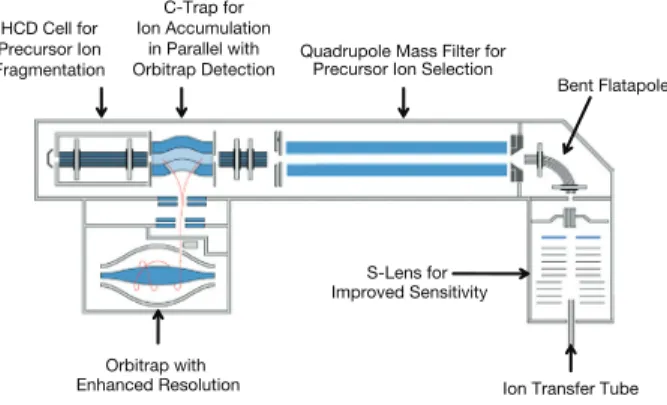
Here we introduce the newly developed Thermo Scientific Q Exactive hybrid quadrupole-Orbitrap mass spectrometer (Figure 1). Coupling a quadrupole as a front-end mass filter to an Orbitrap™ mass analyzer, the Q Exactive™ instrument
is capable of precursor ion selection for both selected ion monitoring (SIM) and data-dependent MS/MS experiments. The quadrupole mass filter allows transfer of ions of only a specified mass range into the c-trap for accumulation, thus improving sensitivity for both SIM and MS/MS experiments. In addition to the common features of an Orbitrap mass
analyzer such as high mass accuracy, large inter- and intra-scan dynamic range, and low detection limits, the Q Exactive instrument’s advanced signal processing provides ultra-high resolution of 140,000 FWHM at m/z 200 and higher scan speeds at all resolution settings. In addition, parallel ion filling / fragmentation and Orbitrap detection improves practical acquisition rates, allowing up to 12 high-quality MS/MS events per second. The multiplexing scan function, which performs a single Orbitrap detection for multiple precursors isolated individually, greatly improves throughput and detection limits for targeted analyses7.
Finally, the S-lens increases the transmission of ions into the Q Exactive instrument, increasing the scan rate by reducing the ion injection time or increasing sensitivity by injecting more ions in those instances when the ion injection time has reached its maximum (max ion time).
In this study, a Q Exactive MS was evaluated for peptide identification from a yeast total cell lysate. The Q Exactive instrument’s ability to access low-abundance proteins in a complex proteome was investigated. The performance of the Q Exactive instrument was benchmarked against a
TripleTOF™ 5600 mass spectrometer (AB Sciex).
Ion Transfer Tube S-Lens for
Improved Sensitivity
Bent Flatapole Quadrupole Mass Filter for
Orbitrap with Enhanced Resolution HCD Cell for Precursor Ion Fragmentation C-Trap for Ion Accumulation in Parallel with
Orbitrap Detection Precursor Ion Selection
Figure 1. Schematic representation of the Q Exactive quadrupole mass spectrometer
2
Experimental
Sample Preparation
Yeast (Saccharomyces cerevisiae) cell lysate tryptic digest was a courtesy of Professor Steve Gygi at Harvard University.
Liquid Chromatography
A Thermo Scientific Easy-nLC II HPLC system was used in a single-column configuration for all Q Exactive MS
experiments. A 75-μm x 15-cm, 3-μm particle C18 packed-tip nano-LC column was used with a 110-minute gradient. A Thermo Scientific Acclaim PepMap C18 column (75-μm x 15-cm, 3-µm particle size) with a 75-minute gradient was used with both the Q Exactive MS and TripleTOF 5600 MS for the benchmark study.
Mass Spectrometry
The Q Exactive instrument was operated using a data-dependent top-10 experiment with 70K resolution for the full MS scans, 17.5K resolution for high energy collisional dissociation (HCD) MS/MS scans and a dynamic exclusion of 30 seconds. Detailed instrument parameters are listed in Table 1. The TripleTOF 5600 was run by a skilled operator in a core lab according to the manufacturer’s
recommendations for this type of analysis. The instrument was operated using a data-dependent top-20 experiment with 30K resolution and 250-ms beam time for the full MS, and 15K resolution and 50-ms beam time for the MS/MS. The instrument was externally calibrated every 4 hours using a dedicated LC/MS run.
Data Analysis
Thermo Scientific Proteome Discoverer software version 1.3 with the MASCOT™ and/or the SEQUEST® search engine
was used for all searches of the yeast database. Raw files generated by the Q Exactive instrument were searched directly using a 10-ppm precursor mass tolerance and a 20-mmu fragment mass tolerance. Raw files from the TripleTOF 5600 were processed into .mgf files using ProteinPilot 4.0 software and searched with MASCOT against the yeast database using a 10-ppm precursor mass tolerance and a 50-mmu fragment mass tolerance. Ion injection times for each of the full-MS and MS/MS scans of an entire Q Exactive LC-MS/MS run were generated using RawMeat software (Vast Scientific) version 2.0.
Results and Discussion
Protein abundance levels were previously experimentally determined for the entire yeast proteome of more than 4000 proteins through genome-wide tagging experiments8. Since
then, yeast tryptic digests have been used routinely as a standard complex mixture for research purposes as well as for benchmarking instrument performance by several leading proteomics research groups9,10,11. Traditionally, for in-depth
analysis of whole-cell lysates, protein and/or peptide fractionation is employed prior to LC-MS/MS. In the past few years, the resolution, mass accuracy and MS/MS scan rate of mass spectrometers have improved significantly, often allowing for in-depth proteome analysis without extensive sample fractionation12,13. Here we used a single-dimension
LC-MS/MS experiment to investigate the performance of the Q Exactive instrument for profiling the yeast proteome.
Evaluation of Q Exactive Performance for Protein Identification
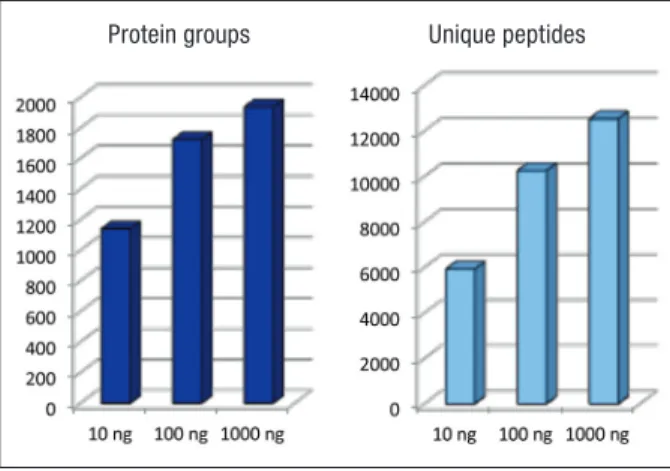
As shown in Figure 2, nearly 2000 protein groups and over 12,000 unique peptides were identified at 1% FDR from 1 µg of yeast digest using an online one-dimensional separation LC-MS/MS run with 110-minute on-column chromatographic separation time. Combining results of two replicate experiments produced 2180 protein groups and over 15,000 unique peptides (Table 2). When the amount of sample loaded on the column was reduced to 10 ng of yeast digest, more than 1000 protein groups and 6000 unique peptides were still identified (Figure 2).
The MS/MS success rate (percentage of MS/MS scans that resulted in confident identifications) for the Q Exactive instrument was approximately 50% for the 1-µg sample load (Table 2). The high success rate is attributed to the high quality of the MS/MS scans.
Table 1. Q Exactive method parameters
Parameters Settings
Full MS scan range 400-2000
MS/MS fixed first mass 100
AGC 5e4, MS/MS1e6, full MS Max injection time
(ms)
2, full MS 60, MS/MS
Isolation width (m/z) 2.0
NCE 27
Under fill ratio 1%
Dynamic Exclusion 30 sec
Figure 2. Number of proteins and peptides identified from varying amounts of yeast whole-cell lysate digests on the Q Exactive MS
3
MS/MS sensitivity
The higher sensitivity of the MS/MS scans on the Q Exactive instrument is achieved via the incorporation of an S-lens, which provides higher transmission of all ions into the mass spectrometer. The increase in ion flux both 1) improves the duty cycle/scan rate by lowering the parent ion injection time for high intensity ions and 2) increases the sensitivity for low-intensity ions by increasing the number of precursor ions in the Orbitrap mass analyzer for a given maximum ion injection time.
Analysis of the raw data files indicated that the average ion injection times in full MS and MS/MS were only 0.5 msec and 36 msec, respectively, when 1 µg of yeast digest was analyzed. With all Thermo Scientific ion trap and Orbitrap instruments, ion injection time is automatically adjusted depending on the ion flux using the patented automatic gain control (AGC) technique. This dynamic control of ion accumulation, unlike the fixed beam time on Q-TOF instruments, allows the ion accumulation time to be inversely proportional to parent ion abundance. This means that the quality of the MS/MS spectra is the same for low-abundance ions as high-abundance ions and that the spectra usually look similar at the bottom of the chromatographic peak as they do at the top of the chromatographic peak.
Dynamic range
The AGC function allows the Q Exactive instrument to effectively identify peptides from complex samples with a large dynamic range of abundances. As a result, a dynamic range of >100,000 was achieved for precursor intensity of identified peptides from yeast digests when 1 µg of sample was analyzed (Figure 3). With 10 ng of yeast digest, the Q Exactive instrument reached a dynamic range of over 4 orders of magnitude for peptide precursor intensity. Mass accuracy
Characteristic of Orbitrap mass analyzers, the data generated by the Q Exactive mass spectrometer has very high mass accuracy. As shown in Figure 4, the calculated root mean square (RMS) of delta mass between the theoretical and experimental masses for all of the peptides identified at a 1% FDR in 10 ng of yeast digest was 1.63 ppm. This high mass accuracy ensured confident identification of peptides.
Table 2. Number of identifications and MS/MS success rate from 1000 ng of yeast digest using two search engines
Figure 4. Distribution of mass error of peptides identified at 1% FDR in 10 ng of yeast digest by the Q Exactive MS. The graph was generated by Proteome Discoverer™ software version 1.3. Calculated RMS is 1.63 ppm.
Figure 3. The Q Exactive mass spectrometer achieved 4 orders and 5.5 orders of inter-scan dynamic range at 10-ng and 1000-ng sample loads, respectively. Data in this figure spreads out in the Y-axis direction over normalized MASCOT ion score.
File Search engine # MS/MS spectra PSMs* Protein groups peptidesUnique Success rate, %
1000 ng yeast digest_01 SEQUEST 33022 17597 1898 12340 53.3 Mascot 33022 16805 1846 11878 51.0 Combined 66044 34402 1945 12612 52.1 1000 ng yeast digest_02 SEQUEST 33257 17236 1906 12204 51.8 Mascot 33257 16435 1847 11726 49.4 Combined 66514 33671 1930 12466 50.6 Combined (All 4 searches) Combined 132558 68073 2180 15270 51.3 -15 -10 -5 0 5 10 15 Delta Mass [ppm] 0 20 40 60 80 100 120 140 Ion Score
RMS = 1.63 PPM
*PSM (peptide spectrum match) is the number of spectra that resulted in 1% FDR identification.Performance comparison of Q Exactive and TripleTOF 5600 instruments
To further benchmark the Q Exactive MS for protein identification, especially in identifying low-abundance proteins, a series of carefully controlled comparison experiments was conducted using the Q Exactive instrument in our lab and a TripleTOF 5600 run by a skilled operator in a core lab. The LC separation time in this study was 75 minutes for both instruments (described in the Experimental section). To ensure a fair and unbiased comparison of the instrument performance, exactly the same sample, LC column, and LC conditions were used for the analyses on the two platforms. Both the Q Exactive instrument and the TripleTOF 5600 were operated under the conditions that were optimum for this type of study based on manufacturer recommendations. The results of this comparison are shown in Figures 6, 7 and 8.
Data acquisition rate
Another significant feature of the Q Exactive instrument is its advanced signal processing which leads to 1.8-fold improvement in resolution for a given acquisition speed. This allows for scan rates of up to 12 Hz at 17.5K resolution. In addition, Orbitrap detection and ion injection into the C-trap for the next detection cycle are performed concurrently. Thus, the practical duty cycle is only limited by the duration of the Orbitrap detection.
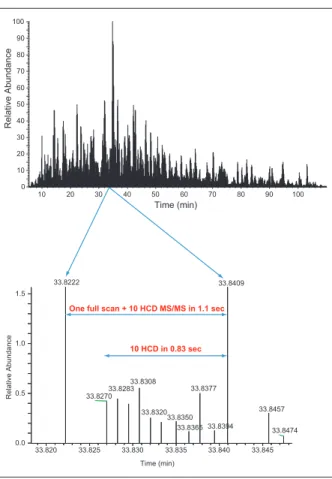
Figure 5 shows the actual duty cycle of the data-dependent top-10 HCD method that was used for this study. A cycle including 1 full MS scan at 70K resolution and 10 data-dependent HCD MS/MS scans at 17.5K resolution was completed in 1.1 sec. The 10 HCD MS/MS spectra were acquired in only 0.83 seconds of this 1.1 sec total cycle time. Most importantly, the fast HCD MS/MS generated
extremely high quality spectra that resulted in confident identification of low-abundance peptides.
The improved scan speed and sensitivity combined with the other benefits of the Orbitrap mass analyzer provide the basis of the Q Exactive instrument’s outstanding performance for protein identification.
4
Figure 5. Practical duty cycle of Q Exactive mass spectrometer for peptide identification from whole cell lysate. Top: base peak LC-MS/MS chromatograph of 1000 ng of yeast digest. Bottom: stick view of scan events showing time window of a complete cycle of one full scan and 10 HCD scans.
Figure 6. Numbers of protein and peptide identifications from various amounts of yeast whole cell lysate digests using the Q Exactive MS and TripleTOF 5600 MS
Figure 7. Comparison of inter-scan dynamic range of identified precursor abundances between the Q Exactive instrument and the TripleTOF 5600. Data in this figure spreads out in the Y-axis direction over normalized MASCOT ion score.
33.820 33.825 33.830 33.835 33.840 33.845 Time (min) 0.0 0.5 1.0 1.5 Relative Abundanc e 33.8409 33.8222 33.8308 33.8377 33.8283 33.8270 33.8457 33.8320 33.8350 33.8394 33.8365 33.8474
One full scan + 10 HCD MS/MS in 1.1 sec
10 HCD in 0.83 sec 10 20 30 40 50 60 70 80 90 100 Time (min) 0 10 20 30 40 50 60 70 80 90 100 Relative Abundanc e
Peptide and protein ID comparison
As shown in Figure 6, the Q Exactive mass spectrometer consistently identified significantly more proteins and peptides in 10-ng, 100-ng and 1000-ng loads of yeast digest. The difference in the number of identifications was largest for the lowest sample load. This is due to the ability of the Q Exactive instrument to accumulate low-
abundance ions and will be most profoundly evident when the amounts of peptides are at relatively low levels. From 10 ng of yeast digest, the Q Exactive instrument identified 691 proteins and 2540 unique peptides, nearly twice as many as were identified by the TripleTOF 5600. The Q Exactive instrument required less than 100 ng to identify the same number of proteins identified by the TripleTOF 5600 in 1000 ng.
The Q Exactive mass spectrometer also demonstrated a much higher MS/MS success rate than the TripleTOF 5600. At 1 µg of sample load, 50% of the MS/MS spectra generated by the Q Exactive instrument resulted in a 1% FDR identification while only 24% of the TripleTOF 5600 MS/MS spectra resulted in confident identifications. The TripleTOF 5600 achieved a 7-ppm RMS mass accuracy for the identified peptides in both MS and MS/MS scans, suggesting that mass accuracy is not the limiting factor in the performance of this instrument.
Dynamic range comparison
As shown in Figure 7, the dynamic range of precursor intensity for peptides identified by the Q Exactive mass spectrometer is at least one order of magnitude larger than that generated by the TripleTOF 5600. This suggests that, compared to TripleTOF 5600, the Q Exactive instrument not only has lower detection limits in full-scan MS thus giving access to more low-abundance precursors, but also has higher sensitivity MS/MS, generating higher quality fragmentation spectra from those precursors.
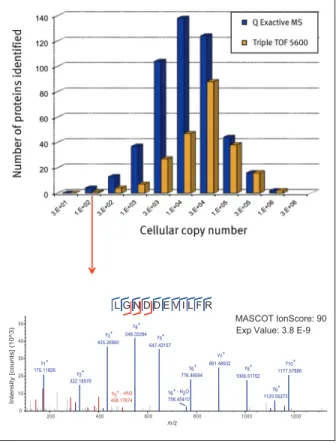
Identification of low-abundance proteins comparison The largest performance difference between the Q Exactive mass spectrometer and the TripleTOF 5600 in protein identification experiments was on the lower end of the range of cellular protein abundance (Figure 8). While both instruments identified about the same number of high-abundance proteins, the Q Exactive instrument identified four times more proteins that were below 10,000 copies per cell (Figure 8, top). The bottom panel of Figure 8 shows a Q Exactive MS/MS spectrum of a peptide that belongs to the YOR020C protein; a protein with an experimentally determined cellular copy number of 149.8
This high quality spectrum, acquired from 10 ng of the yeast digest, contains every ion in the y ion series and three additional b ions. This demonstrates the ability of the Q Exactive MS to confidently identify low-abundance proteins from minute sample loads of complex mixtures.
Conclusions
The performance of the Q Exactive hybrid mass spectrometer was evaluated for bottom-up protein identification in complex mixtures. In discovery experiments, the Q Exactive instrument demonstrated a practical acquisition speed of up to 12 high-quality MS/MS scans per second at 17,500 resolution. With 110-minute, single-column LC-MS/MS experiments, the Q Exactive instrument identified more than 1,000 protein groups and 6,000 unique peptides from 10 ng of yeast digest, and 2,000 protein groups and more than 12,000 unique peptides from 1 µg of yeast digest. Data generated by the Q Exactive MS achieved an average mass accuracy of <2 ppm RMS. The Q Exactive instrument also provided more than 5 orders of inter-scan dynamic range of identified peptides, which was at least one order of magnitude better than the dynamic range provided by the TripleTOF 5600 mass spectrometer used for comparison. Results from our carefully conducted comparison not only indicated that the Q Exactive instrument significantly out-performed the TripleTOF 5600 for identification of proteins in complex samples but, also revealed that the performance difference between the two instruments lies in the Q Exactive instrument’s far superior ability to identify low-abundance proteins. The advantages of the Orbitrap mass analyzer such as high resolution, accurate mass and large dynamic range, combined with the increased sensitivity and acquisition rate, enable the Q Exactive MS to deliver more information to researchers looking to understand important processes in complex biological mixtures.
5
Figure 8. Comparison of sequencing depth between the Q Exactive mass spectrometer and the TripleTOF 5600 using 10 ng of yeast digest. Top: Distribution of identified proteins over cellular copy number. Bottom: Spectrum of a peptide of yeast protein YOR020C, with estimated 149 copies per cell, identified from 10-ng yeast digest using the Q Exactive instrument.
498.17874 758.45410 1120.55273 322.18576 776.46594 1006.51752 1177.57886 y1+ 175.11826 891.48932 647.42157 435.26990 548.35284 200 400 600 800 1000 1200 m/z 0 10 20 30 40 50 Intensity [counts] (10^3) L G N D D E V I L F R MASCOT IonScore: 90 Exp Value: 3.8 E-9
y2+ y3+ y4+ y5+ y6+ y7+ y8+ y9+ y10+ y6+ - H2O b5+ - HN3
Thermo Fisher Scientific, San Jose, CA USA is ISO Certified.
www.thermoscientific.com
© 2012 Thermo Fisher Scientific Inc. All rights reserved. TripleTOF is a registered trademark of AB Sciex PTE. LTD. Mascot is a trademark of Matrix Science Ltd. SEQUEST is a registered trademark of the University of Washington. All other trademarks are the property of Thermo Fisher Scientific and its subsidiaries. Specifications, terms and pricing are subject to change. Not all products are available in all countries. Please consult your local sales representative for details. Africa-Other +27 11 570 1840 Australia +61 2 8844 9500 Austria +43 1 333 50 34 0 Belgium +32 53 73 42 41 Canada +1 800 530 8447 China +86 10 8419 3588 Denmark +45 70 23 62 60 Europe-Other +43 1 333 50 34 0 Finland /Norway/Sweden +46 8 556 468 00 France +33 1 60 92 48 00 Germany +49 6103 408 1014 India +91 22 6742 9434 Italy +39 02 950 591 Japan +81 45 453 9100 LatinAmerica +1 608 276 5659 Middle East +43 1 333 50 34 0 Netherlands +31 76 579 55 55 South Africa +27 11 570 1840 Spain +34 914 845 965 Switzerland +41 61 716 77 00 UK +44 1442 233555 USA +1 800 532 4752 AN63515_E 04/12S Ap p lic ation Not e 552
References
1. Hilger, M.; Bonaldi, T.; Gnad, F.; Mann, M.
Systems-wide analysis of a phosphatase knock-down by quantitative proteomics and phosphoproteomics.
Mol. Cell. Proteomics2009, 8,1908-1920.
2. Dephoure, N.; Zhou, C.; Villén, J.; Beausoleilm S.A.; Bakalarski, C.E.; Elledge, S.J.; Gygi, S.P.
A quantitative atlas of mitotic phosphorylation. Proc. Natl. Acad. Sci. USA2008, 105, 10762–10767. 3. de Godoy, L.M.; Olsen, J.V.; Cox, J.; Nielsen, M.L.;
Hubner, N.C.; Fröhlich, F.; Walther, T.C.; Mann, M. Comprehensive mass-spectrometry-based proteome quantification of haploid versus diploid yeast. Nature
2008, 455, 1251–1254.
4. Merrihew, G.E.; Davis, C.; Ewing, B.; Williams, G.; Käll, L.; Frewen, B.E.; Noble, W.S.; Green, P.; Thomas, J.H.; MacCoss, M.J. Use of shotgun proteomics for the identification, confirmation, and correction of
C. elegans gene annotations. Genome Res2008,
18,1660–1669.
5. Makarov, A. Electrostatic axially harmonic orbital trapping: A high performance technique of mass analysis. Anal. Chem. 2000, 72, 1156-1162. 6. Mann, M. and Kelleher, N.L. Precision proteomics:
The case for high resolution and high mass accuracy.
Proc. Natl. Acad. Sci. USA.2008, 105, 18132-18138. 7. Zhang, Y.; Hao, Z.; Kellmann, M. and Huhmer, A.
HR/AM targeted peptide quantification on Q Exactive: A unique combination of high selectivity, high sensitivity and high throughput. Thermo Fisher Scientific Application Note to be published.
8. Ghaemmaghami, S.; Huh, W.K.; Bower, K.; Howson, R.W.; Belle, A.; Dephoure, N.; O’Shea, E.K.;
Weissman, J.S. Global analysis of protein expression in yeast. Nature2003, 16, 737–7341.
9. de Godoy, L. M.; Olsen, J. V.; Cox, J.; Nielsen, M. L.; Hubner, N. C.; Frohlich, F.; Walther, T. C.; and Mann, M. Comprehensive mass-spectrometry-based
proteome quantification of haploid versus diploid yeast. Nature 2008,455, 1251-1254.
10. Michalski, A.; Damoc, E.; Hauschild, J.P.; Lange, O.; Wieghaus, A.; Makarov, A.; Nagaraj, N.; Cox, J.; Mann, M.; Horning, S. Mass spectrometry-based proteomics using Q Exactive, a high-performance benchtop quadrupole Orbitrap mass spectrometer.
Mol Cell Proteomics. 2011, 10, M111.011015. 11. Washburn, M.P.; Wolters, D.; Yates, J.R. 3rd.
Large-scale analysis of the yeast proteome by
multidimensional protein identification technology. Nat Biotechnol, 2001, 19, 242-247.
12. Domon, B. and Aebersold, R. Mass spectrometry and protein analysis. Science, 2006, 312, 212-217. 13. Lange, O.; Hauschild, J.P.; Makarov, A.; Fröhlich, U.;
Crone, C.; Xuan, Y.; Kellmann, M.; Wieghaus, A.