_ _____
___________________
WsLP
PiO
o
POl.ICY RESEARCH WORKING
PAPER
2003
Thailand's
Corporate
Weaknesses in corporategovernance and the fragile
Financing and Governance
financial structure of manyStructures
corporations contributed to,Structures
and deepened Thailand'srecent financial crisis. Large
Pedro
Alba
corporations need to reduceStijni Claessenis their vulnerability to economic
Simeon Dj'aniko shocks and improve corporate
governance; smaller firms should achieve a more stable funding structure.
The World Bank
Finance, Private Sector, and Infrastructure Network
Economic Policy Unit
Public Disclosure Authorized
Public Disclosure Authorized
Public Disclosure Authorized
POLICY RESEARCH WORKING PAPER 2003
Summary findings
Alba, Claessens, and Djankov assess Thailand's policy related lending limits, violation of which contributed options for reducing large corporations' vulnerability to poor intermediation and the recent crisis.
economic shocks and improving their corporate * Improving disclosure and accounting practices. Self-governance - and for providing smaller firms a more regulatory agencies may need to play more of a role,
stable funding structure. possibly with more legal power to discipline violators. Using data for firms listed on Thailand's stock * Better enforcement of corporate governance rules. exchange, they empirically assess the relative importance The formal structure for corporate governance is of various factors determining the cost of capital, the standard but enforcement is weak.
availability of financing, and policies and distortions that * Facilitation of equity infusions. Investors
-affect corporate governance in nonfinancial firms. The especially minority shareholders - may need to play a empirical findings highlight weaknesses in corporate more direct role in monitoring and disciplining
governance and the inherent risks in Thailand's managers. To attract new infusions of equity, new equity corporate financing structures. owners may need more-than-proportional representation They conclude that the most important task in on the board of directors until other investor protection improving the structure of corporate financing and the mechanisms are strengthened.
framework for corporate governance is to change * Improving the framework for corporate governance. incentives. This will involve: A broad public discussion of corporate governance,
- Accelerating legal reform, including reform of similar to recent discussions in the United Kingdom and bankruptcy and foreclosure laws. elsewhere, may be needed to clarify the distribution of
* Improving bank monitoring of enterprise control in the economy's real sector.
management and encouraging banks to develop more * Strengthening institutions responsible for gathering arm's-length relationships with firms. This will require and analyzing data on firms of all sizes and for
greater transparency and disclosure of ownership monitoring firm performance and behavior. relationships and stricter enforcement of insider and
This paper - a product of the Economic Policy Unit, Finance, Private Sector, and Infrastructure Network - is part of a larger effort in the network to study the performance and financing structures of East Asian corporations. The paper. Copies of the paper are available free from the World Bank, 1818 H Street NW, Washington, DC 20433. Please contact Rose Vo, room MC10-628, telephone 202-473-3722, fax 202-522-2031, Internet address [email protected]. Stijn Claessens may be contacted at [email protected]. November 1998. (27 pages)
The Policy Research Working Paper Series disseminates the findings of work in progress to encourage the exchange of ideas about development issues. An objective of the series is to get the findings out quickly, even if the presentations are less than fully polished. The papers carry the names of the authors and should be cited accordingly. The findings, interpretations, and conclusions expressed in this paper are entirely those of the authors. They do not necessarily represent the view of the World Bank, its Exectutive Directors, or the
Thailand's Corporate Financing and Governance Structures
Pedro Alba, Stijn Claessens and Simeon Djankov World Bank'
JEL code: G32, G38.
Keywords: Corporate finance, corporate governance, Thailand.
' We would like to thank Chintay Shih, Dong-Sung Cho, Akira Goto, Tawee Butsuntorn, Francis Colaco and Johanna de Witte for useful comments and Michelle Barnes for research assistance.
Thailand's Corporate Financing and Governance Structures
1. INTRODUCTION
The corporate finance structure in Thailand has not served the country as well as it could. Many corporates' financial structure was very fragile in 1997, which contributed to the depth and length of the financial crisis. In general, firms found themselves very exposed to the changes in economic environment following the financial crisis. Long term funds from local sources for every type of firm were scarce-due to the lack of institutional investors and the excessive reliance on bank financing. Both contributed to overextended offshore borrowing by Thai corporates. Small and medium enterprises (SMEs) in Thailand have had relatively little access to formal financing, as lending was skewed to large firms, and the cost of any financing for these firms has been high, with resulting constraints on SME growth. In addition to a lack of creditworthiness, poor information and high administrative costs, this is due to the limited forms of collateral that can be used or pledged and the insufficient skills of borrowers.
The recent financial crisis and the slower economic growth in recent years relative to the level of investment have shown that the allocation of savings in Thailand has not been efficient, particularly for the larger non-financial firms. It was also geared towards too risky activities. Our contention is that the financing and corporate governance structure of large corporates has led to inefficient investment, with excessive diversification and declines in profitability over the past few years. Looking forward, large corporates need to reduce their financial vulnerability to econormic shocks, and corporate governance needs to be improved to enhance the efficiency of investment. SMEs need to have better access to financing and a more stable funding structure.
This study assesses the various policy options to achieve these outcomes. To do so, the study analyzes the financial structure of firms in Thailand, draws lessons from the intemational experience, and suggests possible improvements. It reviews the framework for corporate financing in Thailand, using interviews with financial and large non-financial firms and reviews of the legal and regulatory framework. The study assesses empirically the relative importance of various factors determining the cost of capital, the availability of financing, and the different policies and distortions affecting the corporate governance framework for non-financial firms. Using data for firms listed on the Stock Exchange of Thailand (SET), the structure of financing, the efficiency of investments, and the effectiveness of current corporate governance mechanisms are analyzed and compared with that in other economies. The empirical findings highlight the weaknesses in corporate governance and the risky corporate financing structures.
The outline of the paper is as follows. Section 2 describes corporate performance and corporate financing pattems in Thailand during the 1994-97 period. The paper then reviews international experience with different financial structures and corporate governance mechanisms in section 3. It proceeds with reviewing the institutional framework for financing and corporate governance in Thailand in section 4. In section 5, some specific hypotheses are tested for Thailand
regarding the links between corporate governance, corporate financing and firm behavior. Section
6 reviews medium-term areas of possible policy action.2
2. CORPORATE PERFORMANCE AND CORPORATE FINANCING PATTERNS IN
RECENT YEARS
The recent financial crisis in Thailand revealed some of the weaknesses of the corporate
sector.3 While the magnitude and severity of the crisis was unexpected, there were signs of
deterioration in corporate performance before July 1997. This becomes clear once we consider the evidence on the performance of Thai corporates in the years before the crisis. Productivity growth slowed down starting in 1995, and leverage, already high by international comparison, increased significantly as early as 1995.
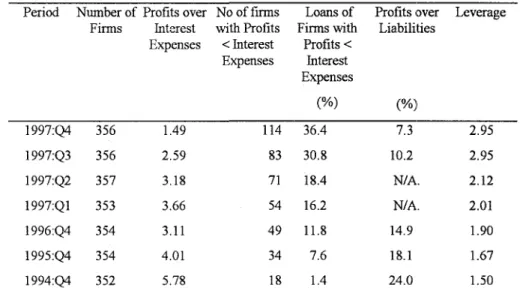
Using data for all firms listed on the Thailand Stock Exchange for which financial statements are available, we can show that the deterioration in corporate performance started in 1994 using four indicators of enterprise performance (Table 1). First, we review the time series of the profits over interest expense ratios in 1994-97. In 1994, profits were 5.78 times higher than interest expenses for the average SET firm. By the end of 1995, this ratio fell to 4.01, by end-1996 to 3.11, and was then further reduced by half (to 1.49) in 1997. In other words, by the end of the period, two-thirds of all profits of Thai listed firns went to cover interest expenses.
Table 1: Deteriorating Corporate Performance
Period Number of Profits over No of firms Loans of Profits over Leverage Firms Interest with Profits Firms with Liabilities
Expenses < Interest Profits < Expenses Interest Expenses (%) (%) 1997:Q4 356 1.49 114 36.4 7.3 2.95 1997:Q3 356 2.59 83 30.8 10.2 2.95 1997:Q2 357 3.18 71 18.4 N/A. 2.12 1997:Q1 353 3.66 54 16.2 N/A. 2.01 1996:Q4 354 3.11 49 11.8 14.9 1.90 1995:Q4 354 4.01 34 7.6 18.1 1.67 1994:Q4 352 5.78 18 1.4 24.0 1.50
Notes: Profit is defined as earnings before interest, taxes, depreciation, and amortization (EBITDA) Leverage is debt over equity.
Source: SET database.
2 While the analysis is made in reference to Thailand's recent financial crisis, the paper does not discuss
the issues of short-run (or medium-term) exchange and interest rate management that might be relevant for corporate financing developments. For this we refer to Dwor-Frecaut et al., 1998.
3 While the focus of the paper is on corporate governance in non-financial institutions, much of the
The number of firms with interest expenses exceeding
profits increased six-fold-from 18
to 114-during this same period. The reduction in profitability meant that for more than a third of
all outstanding
loans (36.4%), firms could not cover interest expenses in full, up from only 1.4% in
1994. The ratio of profits to liabilities also went down from 24.0% to 7.3%. Finally, leverage
increased to an average of 2.95-twice as high as the 1994 value. The situation became
particularly worrisome in the construction sector, which has now the highest leverage (5.25).
Not just the listed firms, but also smaller Thai firms have seen a decline in financial
profitability in the last few years. According
to a survey of 842 firms, average firm profits have
declined from 17% of capital in 1994 to 4% in 1996 (Dollar and Hallward-Driemeier,
1998).
There also has been a sharp rise in leverage, especially of short-term foreign borrowings. The
average debt-to-equity
ratio in the survey sample is 200%, with almost three-quarters of liabilities
short-term. While larger firms tend to have higher debt-equity
ratios, smaller firms are thus also
quite leveraged.
The financial crisis has revealed these weaknesses.
As is typical during a financial crisis,
many Thai firms are- now complaining about the high cost of funds and the limited access to
financing. The survey performed in the last quarter of 1997 and the first quarter of 1998, sheds
some light on the nature of this credit crunch (Dollar and Hallward-Driemeier,
1998). In the
responses, access to finance was mentioned
more often in the first quarter of 1998 than six months
earlier as a bottleneck facing firms. More larger firms than smaller firms reported problems with
access to financing according to the survey, but firms of all sizes mentioned
the cost of finance as a
worry. Local firms mention cost as a worry more often than foreign firms in Thailand, but there is
little difference between the two types of firms regarding their access to capital. The difference
between exporters and non-exporters
is more striking: access to capital is mentioned
as a problem
by non-exporters
three times as often than by exporters, while costs of financing is mentioned two
times as often.
The survey also finds that SMEs were generally less likely than larger firms to mention
access to finance as an obstacle to growth from a longer run perspective. This may be because
SMEs received little external financing in the past and have been better able to adjust to tight
liquidity conditions. This does not obfuscate the need for better financing of SMEs, of course,
because they are likely to be the growth-engine
in Thailand as they have been in other countries.
Hence, both as a short-run and as a longer term development
goal, particularly in an environment
where firms are trying to expand, finance is an issue that needs addressing.
One may wonder why some corrective measures were not taken prior to the financial
crisis. While we discuss this issue at length in the coming sections, we would like to highlight two
reasons. First, businessmen and financiers alike were likely blinded by the success of Thai
corporates over the last decades that produced impressive economic growth rates. In spite of the
recognition of some of the underlying fundamental
weaknesses, most investors did not view the
crisis as inevitable. Second, the significant concentration of ownership in the hands of family
groups and the lack of counter-balancing
forces-professional management,
for example-reduced
the corporates' ability to change their behavior and more generally
their willingness
to improve on
some of the recognized
weaknesses.
Looking forward, it is important to identify the fundamental weaknesses of the Thai
corporate sector that triggered this deterioration in performance.
We discuss the weaknesses in
corporate governance and corporate financing in section 4, while in section 5, we try to quantify
the impact. First, however, we review the international
experience with corporate governance and
corporate financing.
3.
THE INTERNATIONAL EXPERIENCE ON CORPORATE GOVERNANCE AND CORPORATE FINANCINGThe debate of the "model"
The financing and governance of firms depends importantly on the institutional structure of the financial sector. International discussions regarding the "optimal" financial structure have often contrasted two models: bank-centered versus market-centered (see Prowse, 1994 and 1998). The former is typically associated with Japan and Germany (main-bank systems); the latter with the US and the UK. The differences between the two models center on the main agent who
monitors the activities of the firm and takes the lead in disciplining management.4 Under the
bank-centered model, banks play the lead role in the monitoring of firms. Under the market-based system, a broader range of investors plays this role through the pricing, trading and buying of the firm's securities. In both models, the monitoring activities of financial institutions or financial markets are complemented by those of many other agents: other firms (through competition, suppliers and buyers' contracts), labor, the government, etc. (see further Shleifer and Vishny, 1997 for a review).
Bank-centered systems may have advantages in resolving informational asymmetries, and thus lead to less liquidity constraints in firms, particularly at times of distress (see, for example, Aoki and Patrick, 1994). There is some empirical evidence supporting the view that main-bank
monitoring mitigates information problems in financial markets.5 Since information asymmetries
are more likely prevalent at lower-income levels, bank-based systems may have advantages at early stages of development. Thailand can be characterized as a bank-centered financial system, given its high ratio of bank credit to the stock market capitalization. A priori, the bank-based system may thus remain appropriate for Thailand.
There is no easy empirical answer to the question what type of financial system is associated with consistently higher economic growth.' Even for stable developed countries with well-defined financial systems, it has been difficult to "rank" the different governance systems that are in use now or have been in use in (recent) history in terms of their impact on the economy (see, among others, Allen and Gale 1995, Walter 1993, and Saunders and Walter 1994). The debate on whether there is a unique financial structure optimally suited to monitor and govern firms in a given country is therefore perhaps not very useful. There might simply not be any ideal system applicable to a specific country, since in practice the functions and effects of any financial system depend on a host of country-specific circumstances, including legal, social, cultural, and other factors.
4 Three types of monitoring and related disciplining actions can be distinguished (see Aoki, in Aoki and Patrick, 1994): ex-ante, when investment decisions by the borrower are being reviewed; interim, during the life of the investment or in the day-to-day operations of the borrower; and ex-post, during periods of financial distress and possible bankruptcy.
5 Hoshy, Kashyap and Scharfstein (1990) compare the strength of the relationship between investment and measures
of internal finance, such as cash flow, for Japanese firms who have strong relationship with banks against firns without such ties. They find that cash flow is a more important determinant of investment for independent firms than for those firms who are members of a keiretsu group with a main bank. Hoshi, Kashyap and Scharfstein (1995) find that keiretsu firms which weakened their ties to banks by raising money directly from capital markets became more liquidity constrained than before.
6 In part this is because it is hard to characterize a financial system or a reform model adequately. Many countries
However, there is recent evidence that bank-centered systems may be more likely to lead to non-market based lending. Basically, as corporates mature, their needs for outside finance for investment purposes decline as they can rely more on internally generated finance (Jensen, 1986). As "free" cash flow builds up in corporates, banks lose their disciplining influence over firms and firms are more likely to engage in inefficient investment and excessive diversification. The once favorable reviews of the Japanese and German bank-based system are being revised in light of recent experiences given excessive diversification of some German firms and the poor recent performance of corporates (and banks) in Japan. Bank-centered countries like Germany have begun to make the switch to a more open, market-based system, but this has not been without pain and has been a process underway for a decade. Japan is still in the early stages of its
transformation process and has had several years of low growth and a weakening banking system.7
The issue of an optimal financial system may thus rather be better put as: is the system able to adapt to new circumstances in the real and financial sector?
In summary, there may not be a preferred financial structure and mix between banks and capital markets for Thailand to aim at. Across the globe, there is growing evidence that banks and
capital markets do not substitute but rather complement one another (Demirgu9c-Kunt and Levine,
1996). In the short-run, Thailand's circumstances may well continue to favor banks over capital markets. Banks are relatively well developed, are closer to enterprises, as they have more information than capital markets do, and can perform a useful function in the necessary enterprise restructuring in Thailand. Capital markets, on the other hand, depend on corporate law, civil code, and institutions such as courts that are generally perceived as weak in Thailand. Some time will thus be needed before capital markets can play a stronger role in corporate governance. But, as noted, there is the risk of slower adaptation, and in the currently globally financially integrated world, the time to adjust has become more compressed. It is therefore all the more important to move quickly towards a flexible system that includes both well functioning capital markets and banks. Such market-based financial systems tend to have greater flexibility in adapting and provide greater risk sharing. Internationally, market-based financial systems with a greater role of capital markets in the governance and financing of firms have been the general aim.
Financing structures
The starting point for discussing financial structures should be how a financial sector develops for a typical country. Low-income countries are characterized by reliance on informal finance: lending for small investments is secured through a network of social relationships and peer-group monitoring, which often is linked to trading and agriculture and mainly involves advances for trade from one firm to another. Foreign banks may play a large role in financing foreign trade, but much less so in domestic trade. As the economy develops and urbanizes, some of these networks formalize themselves into neighborhood lending associations or banks. This process of more formal financial intermediation is often accelerated when there are major new developments in the economy, for example, opening up of new trading opportunities or new industrial enterprises, which generate concentrated wealth. During most of this process, financial intermediation is dominated by banks. Capital markets only come to play a role in the later stages of development, when legal systems and reputational capital are established and people have enough confidence to trade pieces of papers which just represent promises to pay.
7 Fukao, 1998, draws attention to the relationship between poor corporate governance of banks and corporates, and
This pattem of financial development at the macro country-level mirrors in many ways the financial life cycle of a typical firm. For example, a firm may start as a family-owned business, using the family's own resources as well as savings collected through a network of social contacts. It will then typically grow from its retained earnings and funding from its suppliers. Risk-capital will thus mainly come from outside the formal financial system. At some point, when it has established a sufficient business record, it may be able to get a loan-often only on a highly secured basis-from a local bank. As it grows and expands its relationships, it will typically be able to attract funds from a wider circle of financial intermediaries, including other banks, venture capital and leasing companies. Over time, it may be able to go to the capital markets, first to the private placement markets; and later to organized, publicly traded bond and equity markets. This process can be hastened by improving the accuracy and reliability of information, reducing the costs of contract enforcement, and encouraging greater transparency. Also, reducing uncertainty at the macro level, such as by encouraging govemments to maintain credible and consistent policies, and at the micro level, by encouraging more stable industry regulation, will bolster the evolution of firms along this 'life cycle'.
Building in part on these insights, part of the literature investigates (both analytically and
empirically) the "optimal" liability structure for firms. Rather than try to summarize this
literature, which mainly focuses on developed countries, we refer to the review by Harris and Raviv, 1991. We wish to highlight two aspects stressed by recent literature: the liability structure of a particular firm is endogenous to its characteristics; and the importance of the liability structure in disciplining management. The optimal debt to equity ratio, for example, is not just a function of the risk characteristics of a particular firm, but also of the difficulty outsiders have in controlling the behavior of managers. Debt, for example, can be a disciplining device for firms with few investment opportunities, but with good profitability (e.g., firms with so-called free cash flow). In other words, corporate financing structures perform important corporate governance functions. The empirical literature on developed countries has indeed found evidence of many relationships between the liability structure and the behavior of managers.
Empirical work for developing countries on liability structures on non-financial institutions is sparse. Important contributions are Demirgu-Kunt and Maksimovic, 1994, Glen and Pinto, 1994, Singh and Hamid, 1992, and Singh, 1995. These authors have found that firms in developing countries make more use of external financing than firms in developed countries (this somewhat surprising finding may reflect the fact that the firms investigated in developing countries are typically both larger and "younger" than firms in developed countries, and may thus have relatively easier access to and rely more on outside financing).
More detailed analysis suggests, however, that firm financing in developing countries is not that different from that in developed countries once one corrects for a number of factors. These include the sector in which the firm operates, its riskiness, years of existence, etc. Importantly, one needs to control for the institutional development (for example, quality of the legal framework and the enforcement of laws and regulations), the level of financial development and other macro factors in each country which matter importantly for financing pattems.
It has also been found that when more extemal financing, including from stock markets, is available, firms grow faster (Demirgiiu-Kunt and Maksimovic, 1994). Firms in developing countries use generally much less long-term financing than comparable firms in developed countries (Caprio and Demirgui,-Kunt, 1997). At the same time, increased long-term finance and
financing from active stock markets is associated with higher productivity in both developing and
developed countries.
These findings suggest some government
intervention
to stimulate long-term debt financing
and financing from equity markets. It has been found, for example, that subsidies and directed
credit do not benefit smaller firms, even in developed countries, and while they can lengthen the
maturity of loans, they do not necessarily lead to more efficient investment,
or higher productivity
growth. Indeed in most cases, subsidies are associated with lower productivity
growth
(Demirguei-Kunt and Maksimovic,
1996).
Diversification
The high degree of diversification of Thai firms raises specific questions regarding the
benefits and costs of diversification. The effect of diversification
on enterprise performance has
been a long studied subject for developed
countries. An increasingly
skeptical view has developed
about the efficiency of diversified conglomerates. There is much evidence
that diversified groups
in developed countries tend to trade at a discount relative to a portfolio of independent
firms in
related industries; have on average lower market to book values (Tobin's Q). Moreover, they tend
to be broken up, and their share price significantly
increases when that occurs (for a review, see
Rajan and Zingales, 1997).8 The leading explanations
for such underperformance
have focused on
the agency conflict between investors and empire-building
managers (Jensen, 1986). More
recently, some authors have argued that poor internal management, including power conflicts,
forces inefficient
redistribution
of resources to less performing
divisions (Lang and Stulz, 1994).
In contrast, industrial-financial
groups persist and often prosper in many developing
countries (see, for example, Khana, Tarun and Palepu, 1996), where private sector activity is often
dominated by diversified business groups. Theoretical rationales for such corporate structures
have pointed to the incentive to resolve scarcity in the capital and the intermediate
product markets
in emerging markets. The emergence of such groups may also be a function of the weak
institutional environment
in these economies. In countries with weak law enforcement,
unstable
regulatory system and widespread corruption, groups may have extensive governance functions.
They may support internal trade, ensure close monitoring
of management
decisions and manage a
privileged access to political favors, such as subsidized credit, favorable regulation and licensing,
and access to strategic resources. In conclusion,
groups may emerge to capture scarcity rents or
compensate
for lack of markets, or both.
A recent paper (Fan and Lang, 1998) distinguishes
between two types of diversification:
related diversification - for example, joint procurement of inputs, the sharing of marketing and
distribution services, or integrating vertically; and unrelated diversification - when the newly
acquired or developed business is run separately and does not complement the already existing
segments of the corporation. For a sample of US corporates, they find that diversification into
8 Studies include the following: Scharfstein (1997) studies investment patterns across divisions in conglomerate
firms, and conclude that they appear to practice some form of suboptimal "socialist" reallocation of resources across divisions, moving funds from profitable firms in high Q industries to support investment in lower Q sectors. Rajan, Servaes, and Zingales (1997) find that diversified firms misallocate investment funds; the extent of mis-allocation is positively related to the diversity of investment opportunities across divisions; and the discount at which these diversified firms trade is positively related to the extent of the investment mis-allocation and the diversity of the investment opportunities across divisions. Lang and Stulz (1994), and Doukas and Lang (1998) find that corporate diversification through mergers and acquisitions and direct investments reduces performance for US firms.
related industries is associated with increased corporate value. The authors hypothesize, however, that in times of financial crises unrelated diversification may be more value-enhancing since
different segmnents are affected differently by the financial crunch and the collapse of demand.
It is clear, nevertheless, because of the many cross-ownership and other relationships among members (including banks) of a conglomerate in developing countries, that the normally assumed disciplinary role of corporate debt is likely to be much weaker. The effect might even be perverse for family-controlled firms, i.e., more debt may lead to more risk-taking. Moreover, any positive view on the benefits of conglomerates in emerging markets has to be balanced with the potential cost in terms of slower adaptation of a financial system to new circumstances when insiders dominate.
Investor Protection
An important factor influencing external financing patterns is the degree of protection from abuse by corporate insiders, provided by legal and regulatory mechanisms to outside providers of funds. Securities have rights attached that protect investors: equity shares give investors the right to dismiss management if performance is not satisfactory, while debt gives creditors the right to repossess collateral or more generally drive a company into bankruptcy if debt obligations are not met. The legal and regulatory frameworks will determine to what extent these rights can be exercised and investors protected from potential abuse.
There is growing international evidence that the quality and efficacy of these protection mechanisms influence whether and at what cost outside investors are willing to fund corporations, and hence, the development of capital markets. La Porta, Lopez-de-Silanes, Shleifer, and Vishny (1998) find that there is a strong negative correlation between ownership concentration and the quality of investor protection mechanisms. Ownership concentration substitutes for poor investor protection by reducing the agency problem in corporations, but also has costs that are discussed further below. In another paper, La Porta et al. (1997) suggest that poor protection mechanisms will limit the availability of external finance for firms, as well as raise the cost of funds to compensate for increased risk of expropriation. Based on a sample of 49 developing and industrial countries, they show that countries with poor investor protection tend to have smaller and narrower debt and equity markets, which is consistent with this hypothesis.
The quality of protection mechanisms depends on a wide variety of factors such as the treatment of investor rights in company, bankruptcy and securities legislation, the efficacy of legal enforcement, and the content and enforcement of capital market regulations, including listing rules and disclosure. On the equity side, these protection mechanisms include provisions regarding the duties of insiders (directors and corporate officers), the rights and remedies of shareholders, disclosure and use of information by insiders, and takeovers and new issues (La Porta et al., 1998; Asian Development Bank and World Bank, 1998).9 For creditors, the most basic are rights to
9 These mechanisms are directed at achieving the following objectives: (1) directly prevent abusive behavior by insiders (e.g., prohibition of loans to directors, rules regarding insider trading); (2) limit the discretion of insiders in key corporate matters (e.g., mandatory shareholder approval of fundamental decisions); (3) ensure adequate disclosure and transmission of information (e.g., mandatory disclosure of connected interests of board members); (4) facilitate shareholder control and monitoring (e.g., permitting proxy voting, including by mail); and (5) options for "oppressed" minority shareholders, such as judicial remedies to a broad class of persons regarding corporate decisions that are unfairly prejudicial, or that unfairly disregard the interests of shareholders, and the entitlement for dissenting shareholders to be bought out of the company at a fair appraised value.
repossess collateral and to participate in key decisions such as filing for creditor protection and
management
during reorganization
(Baird, 1993). Strong disclosure
and accounting standards and
practices are essential for both equity and debt investors to monitor corporate performance. Legal
and regulatory enforcement is also essential, of course, for these rules to have real content.
International experience suggests, however, that countries do not compensate weak investor
protection legislation by improving the quality of legal enforcement. Indeed, countries with weak
investor protection rules also tend to be those with weak enforcement
(La Porta et al., 1998), other
factors remaining equal.'
0Overall, the most important determinant of the quality of legal
enforcement is the amount of resources allocated to the judiciary, including for creating legal
infrastructure such as land and securities' registries (e.g., Posner, 1998).
Concentrated Ownership
The fundamental benefit of concentrated ownership is that it solves the agency problem
since large shareholders
are able to more easily assert control over a firm and limit management
inefficiency and abuse. Indeed, except for certain industrial countries, high ownership
concentration, including controlling ownership, is common. For example, the share of the three
largest shareholders
in the 10 largest publicly traded private companies averaged 46% in a sarnple
of 45 developed and developing countries (La Porta et al., 1998). Table 2 shows ownership
concentration
in several Asian and Latin American countries. Shleifer and Vishny (1997) discuss
several examples of the benefits for corporate governance of concentrated ownership in industrial
countries. In particular, large shareholders
have been associated with high turnover of directors
and managers, and with the increased likelihood
of takeovers, which in turn has enhanced firms'
efficiency
of operations and investment.
Regarding the pursuit of non-profit maximizing objectives, Morck, Shleifer and Vishny
(1988) and other authors find evidence
of an inverted "U" shape relationship
between the degree of
ownership concentration and profitability. Intuitively, as ownership concentration rises, agency
costs decrease and hence profitability rises in the upward sloping part of the curve; but as owners
gain control and wealth, they pursue empire building strategies and other private benefits of
control. Controlling ownership may also lead to increased risk taking behavior since other
stakeholders such as creditors and employees share in the downside risks but not to the same
degree in the benefits. The potential for this type of behavior is greater if there are ownership
and/or family inter-relationships
between banks and corporations, bank incentives are skewed
towards risk taking, and bank supervision
is inadequate.
Several studies in the empirical literature on corporate governance make the point of
possible negative effects of the dominance
of family control. Johnson et al. (1985), for example,
study the effect on share prices of sudden deaths of executives-in plane crashes or from heart
attacks-and associated transfer of control to other managers. They find increasing prices
following the death announcement, particularly for large conglomerates whose founders built
diversified businesses. The authors interpret the evidence
to suggest that changes in management
can be useful as they can serve to induce more efficient management.
The evidence
also shows that
family control can lead to loss of value.
Table 2: Ownership
Concentration
in the Ten Largest Firms (1)
All Firms (2) Private (3) All Firms (2) Private (3)
Asia Latin America
India 38% 40% Argentina 50% 53%
idonesia 53% 58% Brazil 31% 57%
Korea 23% 20% Chile 41% 45%
Malaysia 46% 20% Colombia 63% 63%
Pakistan 26% 54% Mexico 64% 64%
Philippines 56% 37% Venezuela N/A. 51%
SriLanka 60% 60%
Thailand 44% 47%
(1) The average percentage of common shares owned by the three largest shareholders in the ten largest non-financial firms. The percentages are not corrected for shareholder affiliation and cross-shareholding between firms.
(2) Excluding the public share.
(3) Largest 10 firms with no public ownership.
Source: La Porta et al. (1998).
Both the benefits and costs of ownership concentration are exacerbated in developing countries. Stylized facts regarding the legal and institutional frameworks in developing countries--for example, weaker disclosure and property rights and underdeveloped legal encountries--forcement--suggest that the potential for abuse by managers is higher than in industrial countries. Indeed, as noted above, high agency costs are an important explanatory factor of concentrated ownership. At the same time, however, these same institutional weaknesses also facilitate the abuse of minority shareholders. Similarly, financial systems are more likely to be weak and inadequately supervised,
and relationships between corporates and banks more common."1 Concentrated ownership is,
hence, likely to lead to increased risk taking behavior in developing countries. Finally, in developing countries, high ownership concentration also reflects the fact that most businesses are relatively young, and still managed by their founders or their direct descendants. While family management may be appropriate during the earlier stages of development, more professional management may be better suited as the economy and firms mature. Presumably, this process of professionalization should be faster in the larger and more complex businesses.
In sum, high ownership concentration is typically both a symptom and a cause of weak corporate governance. Ownership concentration is symptomatic of weak corporate governance because it is a means for investors to monitor and control management when protection systems are weak. It is a cause because it may lead to more risk-taking behavior and to the abuse of minority investors. In addition, controlling shareholders are a potential source of pressure to delay improvements in disclosure and governance, as these improvements may erode their corporate control and insider benefits.
11 For example, it is more likely that governments in developing countries offer guarantees to financial institutions and that banks are undercapitalized.
In the next section, we discuss some issues related to the specificity of corporate governance in Thailand.
4. CORPORATE GOVERNANCE IN THAILAND
While Thailand made rapid and substantial progress in developing its capital--and especially equity--markets during the 1990s, both corporate governance and disclosure systems were still weak and capital markets played a limited role in the governance of firms. Perverse connections between lenders and borrowers were not uncommon and facilitated excessive expansion and diversification of firms, financing of prestige projects and other "white elephants." There have been five interrelated problems: concentrated ownership; high level of diversification; weak incentives; poor protection of minority shareholders; and weak information standards. But most of these problems were not more severe in Thailand than in the rest of East Asia and indeed in many developing countries.
Concentrated Ownership
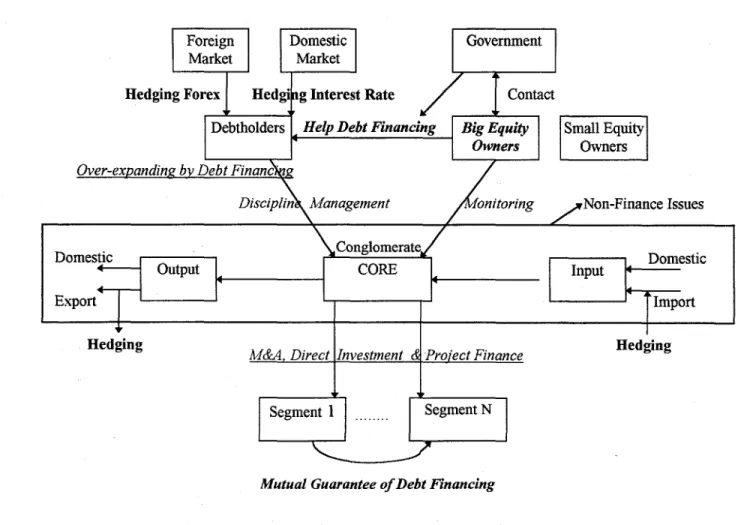
The organizational chart in Figure I can describe the salient features of large corporates in Thailand. Compared to the typical organization in developed countries, corporates in Thailand have two distinct features. First, the most influential organizational form in Thailand is the diversified conglomerate that is controlled by large corporations and, most importantly, family. Second, those conglomerates have large debt, much of which is from local financial institutions. Before the 1997 crisis, these large conglomerates used debt financing to expand aggressively-through mergers and acquisitions, direct investment and project finance-while undertaking little hedging against foreign exchange and interest rate changes.
One of the most important features of the corporate sector in Thailand is the dominance of family control over business operations. Thai firms are generally closely held and managed by majority - often family - interests. As shown in Table 2, the three largest shareholders own between 44%-46% of the shares of the ten largest non-financial private firms. These numbers do not take into account shareholder affiliation and cross-shareholding between firms, and the former is believed to be particularly important in Thailand. Many shares are held in nominee accounts, which make it difficult to determine shareholder affiliation. However, based on Siam Business Information (1995), a relatively limited number of families controls many of the corporates listed on the SET.
Figure 1: The Organizational
Chart of a Typical Thai Conglomerate
Sgomest Govenment
Market Market
Hedging Frex Hedg ng Itrest Rate /Cntact
Debtholders Zep Debt Finacn
| Small Equity|
I I~~ O"ers
Owners
Over-expandinu bG Debt Financing
This.characteristicae \Comsnfgome r outof 's orporate7s The
Domestnc y hnt one Domestic
4 t0tu
Input=
<CRExportT[__tIpr
Hedging M&A, Direct Investment d Proectr Finance
Hedging
Mutual Guarantee ofoDebt Financing
This characten'stic largely comes from the relative youth of Thailand's corporates. The largest Thai-owned non-bank companies date back only to the 1940s and 1950s and many of their founders are still alive. These founders still play a very active role in day-to-day business. Their children usually hold senior management positions in the company. Such companies rarely recruit exterWally for senior management positions. This patten of goverance limits the aspirations of
middle management that do not belong to the founding fa tily. The significance of family ties is
re-enforced by the practice of inviting other families to share ownership when setting up new ventures. These help cement existing business relationships, but in the process may encourage the
creation of entry barriers and extend the importance of fanmily groups in the corporate sector.
While, as discussed in section 3, concentration of ownership is common in developing countries, and there are both pros and cons to such concentration, on balance it may be excessive in Thailand. First, ownership concentration may impede the development of professional managers that are required as economies and firms mature and become more complex. Second, it may have led to increased risk taking behavior by firms, in particular given the inter-relationships between financial institutions and banks, and the supervisory weaknesses and perverse incentives prevalent in the Thai financial system during the 1990s. In addition, in order not lose control, large shareholders may have diluted market pressures for improved disclosure and protection for minority shareholders, and are reportedly an impediment today to corporate workouts.
The weaknesses in corporate governance are confirmed by the results of a survey of 202 firms listed on the SET in mid-1996 (Price Waterhouse, 1997). The survey revealed that about 70% of senior management felt that considerable improvements should be made on corporate governance issues in Thailand, with the majority stating that they would prefer an approach which involved both the SET and a system of self-regulation by the listed companies themselves. Financial and institutional advisors felt that improved corporate governance practices would give added benefits to the Thai capital markets relative to other markets in the region.
Weak Market Incentives
The incentives to improve disclosure and governance, either at the individual firm level or at the country level, were not strong in Thailand during the early 1990s. Many firms had comfortable relations with banks and other financial intermediaries and were easily able to raise equity through new stock issues. With ample liquidity and weak market discipline, firms and insiders had little to gain from improving disclosure and corporate governance. This lack of market discipline appears to have been due to five factors.
* First, and probably most important, the rapid and large increase in stock prices in the early 1990s in Thailand and throughout Asia, and the resulting boom type mentality, may have reduced the sensitivity of equity investors to company disclosure and governance.
* Second, as mentioned above, there may have been interlocking ownership and other inter-relationships between financial intermediaries and corporates, as in Chile during the early 1980s. Korea is an another example of how interrelationships between banks and corporates can reduce market discipline.
* Third, the relatively heavy presence of government in capital markets, at least compared to industrial country markets, as well as government ownership and contingent government support (e.g., in large infrastructure projects) may have also comforted investors.
* Fourth, domestic institutional investors, in particular pension funds, that are playing an increasing important role in corporate governance in industrial countries, are still developing in Thailand. For example, while the Thai mutual fund industry compares well to those in other developing countries in the region, it is still small; in 1996, trading by mutual funds in the SET
only represented 6.8% of total trading."2 Pension funds are perhaps even weaker in Thailand.
Until recently, they have been constrained by the lack of formal institutional pension arrangements as well as by restrictive asset allocation regulations. Provident funds for government workers and workers in public enterprises have only been established recently and are still largely restricted to government paper and cash.
* Fifth, market and regulatory institutions that play a key role in industrial countries in facilitating and creating incentives for market discipline are not yet fully developed in Thailand. For example, Thailand's single credit rating agency (TRIS) was only established in the 1990s and is still considered by the market to be developing expertise. The nascent regulatory framework further aggravated this lack of market institutions. A modem legislative regulatory framework was only promulgated in 1992, at the same time that the Securities and Exchange Commission was established. Although by 1997, Thailand has built the legal and regulatory basis for modern capital markets, this process has been gradual. During this
transition period, capital markets did not necessarily adequately perform their signaling and monitoring functions."3
Protecting Minority Shareholders
The legal anu regula* ory systems of many countries in Asia include a relatively wide set of provisions to protect shareholders from abuse by insiders. Table 3 compares the investor and creditor protection in East Asia with other regions and benchmarks from industrial countries. The table shows that shareholders are better protected in Asia than in Latin America and legal protection mechanisms lor creditors are also stronger in Asia than in Latin America. With regard to judicial enforcement (of property rights) however, the region, especially Indonesia and the Philippines, scores much below Latin America. Compared to industrial countries, the differences are even more striking. The,e weak enforcement capacities mean shareholders can not fully use protecting mechanisms. Furthermore, weak disclosure means shareholders often do not have the information to judge corporate performance and insider behavior.
In Thailand, like in many other countries in East Asia, the enforcement of minority shareholder and creditor rights is being undermined by a weak judicial system. As shown in Table 3, the quality of judicial enforcement is weaker in Thailand than in Malaysia, India and in four out of six Latin American countries included in the table. For example, according to one of the legal sub-indices reported by La Porta et al. (1998), the efficiency of the financial system in Thailand is
the second worse among the 49 countries in their sample. 14 The speed of foreclosing on collateral
(reportedly up two to three years for mortgages) as a result of slow court procedures and lack of registries is among the critical issues that may undermine Thailand's Financial Restructuring Authorities' sale of assets of the closed finance companies.
13 One particular aspect of concern are disclosure rules. Regarding what to disclose, while in most developed markets
rely on market practice and due diligence obligations to ensure disclosure of all material information, in developing countries, it is prudent for the auilorities to be more proactive. In several East Asian countries, however, markets were still struggling to define more precisely what this meant in practical terms. Disclosure systems were also weak in how information was disseminated through public repositories and mandated requirements for publicly held firms. This weakened market incentives, particularly for financial intermediaries and for firms issuing short-term paper.
14 An assessment of the "efficiency and integrity of the legal environment as it affects business" as reported by
Table 3: Investor Protection
in Asia and Latin America
Investor Creditor Judicial Investor Creditor Judicial
Protection Protection Enforce- Protection Protection Enforce
(1) (2) ment (3) (1) (2) -ment (1) (2) (1) (2)
~~~~~~~~~~~~~~~~(3)
India 2 4 6.1 Argentina 4 1 5.6 Indonesia 2 4 4.4 Brazil 4 1 6.5 Malaysia 4 4 7.7 Chile 4 2 6.8 Pakistan 5 4 4.3 Colombia I 0 5.7 Philippines 4 0 4.1 Mexico 0 0 6.0 Sri Lanka 2 3 5.0 Venezuela 1 NA 6.2 Thailand 3 3 5.9 Average 2.2 0.8 6.1 Average 3.1 3.1 5.4(1) An index of how well the legal framework protects equity investors. It will equal six when (1) shareholders are allowed to vote by mail; (2) shareholders are not required to deposit share in advance of a meeting; (3) cumulative voting is allowed; (4) when the minimum percentage of share capital required to call a meeting is less than 10%; (5) an oppressed minority mechanism is in place; and (6) when legislation mandates one vote per share for all shares (or equivalent).
(2) An index of how well the legal framework protects secured creditors. It will equal four when: (1) there are minimum restrictions, e.g., creditors' consent, for firms to file for reorganization; (2) there is no automatic stay on collateral; (3) debtor looses control of the finm during a reorganization; and (4) secured creditors are given priority during a reorganization.
(3) An index measuring the quality of judicial enforcement ranging from I to 10 (best) equal to the average of five sub-indexes measuring: (1) efficiency of the judicial system; (2) rule of law, (3) corruption; (4) risk of expropriation; and (5) risk of contract repudiation.
Source: La Porta et al. (1997 and 1998).
Accounting Standards and Practices
According to the International Financial Reporting Index constructed by the Center for International Analysis and Research, several countries in the East Asia region, including Malaysia and Thailand, have made strong efforts duiing the 1990s to improve accounting and reporting
standards.'5 But while many of the accounting and auditing standards in Thailand, and in the
region more generally, are generally consistent with those issued by the International Accounting
Standards Committee, several need further improvement."6 In Thailand, the standards that need to
be reinforced or created include standards for financial statement disclosures, asset classification, marketable securities, loss recognition and debt restructuring and impairment of assets. In the long run, the need to create an independent standard setting body that includes representation from all stakeholders is more important to help ensure conditions relevance and quality of accounting standards.
15 The Center for Intemational Analysis and Research is an investment advisor located in the United States. The index is based on the reporting practices of major domestic corporates with regard to 85 disclosure variables.
16 Malaysia, for instance, has adopted 24 of the 31 intemational accounting standards without alteration, while the
There is strong anecdotal evidence that accounting and auditing practices in Thailand are
not yet up to intemational standards. First, compliance with accounting rules, certification, and
enforcement of a code of ethics has been hampered by weaknesses in industry self-regulatory
organizations. The lack of strong self- regulatory organizations in the auditing and accounting
profession is common in many countries in South East Asia. In Indonesia, for instance, in the
absence of strong professional associations, BAPEPAM (the official capital market regulatory
agency) licenses legal and accounting professionals
to work in the securities areas. Currently, in
Thailand three official agencies share regulatory authority. An additional problem in Thailand has
been a shortage of well-qualified
accountants and auditors together with unnecessary statutory and
mandatory requirements. In particular, 300,000 partnerships and inactive limited companies need
to be audited every year. The impact of this shortage of well-qualified accountants has been
compounded, as in many other countries in East Asia (e.g., Indonesia), by restrictions on the
activities of foreign accounting
firms.
5. EMPIRICAL TESTS
In this section, we study the various relationships between ownership concentration,
leverage, and corporate performance. In particular, we investigate
three related hypotheses. First,
on a cross-sectional
basis, we expect that firms with more tightly held ownership display a higher
level of productivity
and profitability. We expect, however, that these firms may be less flexible
over time in changing their corporate governance, and hence may experience a deterioration in
financial performance. Second, firms with concentrated ownership-and associated links to the
banking system-may have had easier access to debt financing and may have disproportionately
increased their leverage, thus creating greater exposure to adverse shocks. Finally, if financing
was indeed not made available on an arms-length basis, firms with rapidly deteriorating
performance
may have been able to finance their losses, rather than being forced to adjust. If this
hypothesis is true, firms with worse profitability may, over time, have had more rather than less
access to extemal finance as compared
to firms with better financial performance.
Ownership Concentration and Corporate Performance
High ownership in the hands of a few holders may lead to slower response to changing
market conditions. To test this hypothesis, we investigate
some relationships for the firms listed on
the SET (see Annex 1 for a description of the data). First, we regress 1992 profitability on 1992
ownership concentration. Our prior is that more profitable firms will have higher concentration of
ownership for two reasons: there will be a bias of more profitable firms attracting more
concentrated owners; and there will be better monitoring
when ownership is concentrated, leading
to more profitable firms. Second, we regress 1996 profitability on 1992 ownership concentration.
We hypothesize
here that the more concentrated
ownership
is, the less likely it is that management
has made the necessary changes in corporate behavior over the period 1992-96, leading to a
deteriorating profitability. The results for both regressions are reported in Table 4 and are also
depicted in Figure 2.
Table 4: Ownership
Concentration
and Profitability
PROFIT92 PROFIT96 Ownership Concentration 1992 0.202* -0.063
(0.084) (-0. 090)
Sector Dunmmies Included Yes Yes
Size Dummies Included Yes Yes
Observations 236 236
R 2 0.176 0.163
Notes: Profitability is defined as EBIT over sales. Ownership
concentration is the share of top 5 owners. Standard errors in parentheses.
Ownership concentration is positively (and significantly) related to profitability in 1992. This association, however, turns negative by 1996 (albeit not significant). Since we have the same sample of firms in both periods, the results suggest that firms with concentrated ownership show a deteriorating performance relative to firms with less concentrated ownership. This may be for a number of reasons, as argued in the previous paragraphs, one of them being the aspiration of owners to extend their business, frequently beyond efficient levels.
Figure 2: Ownership Concentration and Level of Profitability (1992 versus 1996)
25 20
0 .5
-5
less than 20% 20%.40% 40%60% 60%80% mnore than 80%
Note: The vertical axis depicts the level of profitability while the horizontal axis shows the concentration of top five owners. The left bars are for 1992 and the right bars are for 1996.
Ownership Concentration and Leverage
Another negative consequence of concentrated ownership, particularly ownership in the hands of families that have controlling interests in banks, is the possibility of easy borrowing and the resulting increase in leverage. We illustrate this possibility by regressing leverage on initial ownership concentration for 1992 and 1996 (Table 5 and Figure 3). The effect is present in both years: firms with more concentrated ownership have higher leverage, even when we adjust for cross-sector differences. This effect almost doubles in magnitude between 1992 and 1996. Figure
3 confirmns
this relationship between initial ownership concentration and changes in leverage.
Firms where top-five owners' concentration is 60-80% have the highest increase in leverage
between 1992 and 1996 - an average of 53%. In contrast, firms with dispersed ownership (below
40% of shares belonging to the top five owners) show an increase in leverage of only 17% on
average.
Table 5: Ownership Concentration
and Leverage
Leverage92 Leverage96
Ownership Concentration 1992 0.151* 0.287* (0.044) (0.072) Sector Dummies Included Yes Yes Size Dummies Included Yes Yes Observations 236 236 0.265 0.322 Notes: Leverage is defined as debt over equity. Ownership
concentration is the share of top 5 owners. Standard errors in parentheses.
Figure 3: Ownership
Concentration
and Changes in Leverage
(1992 versus 1996)
60 50 40 30 20 I0 0less than 20% 200,-4% 400,660% 600,6.80% more than 80%
Note: The vertical axis is the percent change in leverage 1992-96, the horizontal axis is the top-five owners' concentration.
By including sector and size dummies, we control both for cross-sector variation and for
size within-sector
variation. The possibility
that large firms have on average (increasingly)
higher
leverage is controlled for by the inclusion of size dummies in the regressions. We constructed the
size dummies
by ranking all companies in a particular sector by employment,
and then constructing
dummnies
for each quartile of firms. Thus the largest 25% of firms in a given sector are dummied
out separately; the second largest 25% form another group, etc. The correlation between ownership
structure and leverage may nevertheless
be spurious if firms with high ownership concentration
also display some distinguishing
characteristics
other than cross-sector variation and size that are
not included in the regressions.
Leverage and Profitability
We then study the contemporaneous
correlation between corporate financing patterns and
corporate performance in Thailand. One possible contributing factor to the financial crisis in
Thailand may be related to the non market-based access to outside financing, especially from
commercial
banks. Firms which experience deteriorating
performance
may have been tempted to
get involved in projects with possibly high returns, but high risk. To undertake such projects
would have required extra outside financing. If the bank-corporate
links have been less than
arms-length, financing may have gone towards riskier projects at the expense of firms which required
financing for less risky projects, but whose performance
was stable.
We find no apparent correlation between leverage in 1993 and corporate profitability in
1992. In contrast, higher leverage in 1996 is associated with lower profitability in the previous
year. This pattern lends some support to our hypothesis: firms with relatively worse performance
got a disproportionately
large share of financing in the period immediately
preceding the crisis.
This likely exacerbated
the severity of the crisis.
The simple associations demonstrated
in this section give some credence to the problem
areas identified in the previous section regarding Thailand's corporate governance and finance.
There are, unfortunately, no quick fixes to these problems as they arise endogenously
from the
structure and incentives
of the Thai corporate sector, and they may require deep changes in the way
the ownership of the real and financial sector of Thai economy is distributed. We do believe,
however, that some change is possible and suggest some specific options for policy actions in the
concluding section.
Table 6: Leverage and Profitability
Leverage93 Leverage96Profitability92 0.063
(0.108)
Profitability95 -0.071*
(-0.033)
Sector Dummies hicluded Yes Yes
Size Dummniies Included Yes Yes
Observations 236 236
R 2 0.089 0.208
Notes: Leverage is defined as debt over equity. Profitability is defined as EBIT over sales. Standard errors in parentheses.
6.
OPTIONS
FOR ACTION
The main lesson from the international
experience
is that it is important to take an integrated
approach to the issue of corporate govemance and corporate financing. There are strong links
between corporate governance and corporate financing on the one hand and the legal framework,
competition policies, the evolution of the real sector, etc. on the other hand. Consequently,
policy
recommendations
on corporate governance and corporate financing can not focus on one aspect
only. To assure, for example, that the objective of lowering the leverage of firms is consistent with
the overall financial sector evolution, one would have to ensure that there is enough equity
available, either in the domestic system as a whole, or from foreign sources. Equally, to ensure
that incentives are not skewed towards continued lending to the largest firms, it will often be
important to restructure the banking system. Otherwise, undercapitalized
banks may continue to
lend to firms which are "too big to fail." The quality and effectiveness
of commercial
laws will in
turn partly determiine
the extent to which all types of creditors can play a role in corporate
governance.
Another important lesson is that improving the framework for corporate govemance and
corporate financing takes time and requires considerable
changes in attitudes. Only countries that
have gone through extreme crises have been able to alter the form of governance
and distribution of
control of the real and financial sector in a short period of time.'
7We do not expect that the
corporate govemance structure, and the related corporate financing structure, will change
dramatically in Thailand in the near-term through some major "stock" changes. We rather expect
changes on a "flow" basis, where the financial pressures under which many firms currently operate
will be the main driving force for corporate restructuring and changes in corporate govemance.
Near-terrn policies should aim at making the necessary restructuring, de-leveraging
of firms
(through divestiture
or sale of assets; the stream-lining
of business units; operational restructuring,
etc.) and new equity infusion most efficient. They should aim at ensuring that the least amount of
going concern value and goodwill
is lost and the smallest number of viable, but over-indebted
firms
are pushed into bankruptcy. This requires a number of changes in tax and regulatory policies to
assure a more smooth enterprise restructuring
process. In the case of Thailand, the most important
policies are: to expand the role of foreigners in the enterprise sector, to review tax rules that may
discourage debt restructuring, debt-equity
swaps and mergers and acquisitions, and to review the
bankruptcy legislation so as not to discourage
new money to firms in financial distress. It will also
be important to take initial steps in the governance and disclosure areas to assure new outside
investors of the long-term commitment of the regulatory authorities and domestic market
participants to the reform process.
To improve the structure of corporate financing and the framework for corporate govemance,
the most urgent task now will be to change incentives
such that the overall system allows for better
outcomes over time. This will involve, inter alia, accelerating
planned legal reforms, including the
bankruptcy and foreclosure laws. In addition, six areas of specific importance for changing the
corporate govemance and corporate financing are:
1.
Enhancing Enterprise Monitoring
The role of commercial banks in enterprise
monitoring and corporate govemance will have to be enhanced through a comprehensive
program
of bank restructuring and institutional development. Banks, which in the short-run will dominate
Thailand's financial sector, need to become more effective monitors of firms' management, in an
ex-ante, interim and ex-post sense. At the same time, banks need to develop more arms-length
relationships with firms. This will require stricter enforcement
of insider and connected lending
limits, violation of which has contributed
to the recent financial crisis and poor intermediation. In
17 Chile is an example of a country that achieved a significant ownership and control transformation of its economy
following its financial crisis of the early 1 980s. The transformation involved a reduced role for conglomerates, the privatization of state enterprises, a fally funded pension system, and various other tools. Many transition economies have also been able to achieve a rapid transformation (see World Bank, 1996).
those cases where banks and firms are effectively controlled by the same shareholders,
increased
transparency is required (which could take the form of increased disclosure or the requirement
of a
formal ownership relationship, such as through a holding company). Other financial institutions
and agents involved in disciplining
firms should be encouraged
to enhance their role. For example,
over time, bond investors can play an important role in disciplining
managers, but this requires
some changes in the commercial codes. Foreign investors' role in corporate governance and
corporate financing will benefit from the removal of some impediments
in the legal framework,
including in the Alien Business Law.
2. Improving Disclosure and Accounting Practices The disclosure of information and the
accounting practices in Thailand should be improved. While disclosure and accounting rules are
becoming increasingly consistent with international standards, the application of these rules
appears to be hindered by the limited role of the self-regulatory agencies (SROs) in raising