CONTRACTOR DEVELOPMENT THROUGH VUK’UPHILE
LEARNERSHIP PROGRAMME IN THE EASTERN CAPE DEPARTMENT OF ROADS AND PUBLIC WORKS
By
Sheila Kubayi
A Research Report Submitted to the Faculty of Commerce, Law and Management in the University of Witwatersrand, Johannesburg in partial fulfillment of the requirement for the degree of Masters of Management in
Public and Development Management (P&DM).
i
ABSTRACT
Vuk’uphile Learnership programme is a contractor development programme by the Government of South Africa aimed at developing emerging contractors into fully fledged contractors able to execute labour intensive projects.
Despite government’s commitment to emerging contractor empowerment there are reports of poor performance by emerging contractors under the learnership, this includes contractor turnover, some of the projects undertaken had been abandoned, and some of the contractors or entities who participated in the programme were not in the construction industry anymore. This study examines progress of Vuk’uphile 2, whether it is achieving its intended objectives in the Eastern Cape or not.
This study followed a qualitative approach, semi structured interviews and documentary analysis was used for collecting data.
The findings indicate that the programme has a potential of utilizing infrastructure development projects to develop sustainable enterprises and draw significant numbers of people into meaningful participation in the construction industry. Of the contractors who completed the prescripts of the programme turned to be successful even after learnership.
The study recommends that systems of selecting learners, trainers and mentors be strengthened and should be inducted on their respective roles in Vuk’uphile. Mentors should be afforded constant performance evaluation.
ii
DECLARATION
I, Sheila Halcyon Kubayi declare that this research report is my own unaided work. It is submitted in partial fulfillment of the requirement for the degree of Master of Management in the field of Public and Development Management in the University of Witwatersrand, Johannesburg. It has not been submitted for any other degree in this, or any other, University.
__________________ Sheila Halcyon Kubayi
iii
DEDICATION
This Research is dedicated to the Memory of My Grandparents Mark William and Grace Favasi Shope
iv
ACKNOWLEDGEMENTS
I would like to thank God Almighty for blessing me with the opportunity to carry out this research.
I wish to thank Dr. Horacio Zandamela for his unwavering support, encouragement and tenacity that he has shown me during the course of carrying out the work of this research.
I want to extend my sincere gratitude to my children and siblings for understanding, patience and encouragement that they have shown during the course of my studies.
I also extend thanks to my colleagues at NDPW Mr. Thembani. Mackaukau, Mr. Ignatius Ariyo, Ms. Ronette Boshoff, Mr. Siyanda Seti. Thank you for the support.
A special thank you for the encouragement and support to Mr. Albert Uriyo, Mr. Gamelihle Sibanda.
This study would not have been possible without the consent of NDPW and the Eastern Cape Roads in Amathole District. I hereby extend my gratitude to the project managers of Vuk’uphile 2 in the Eastern Cape Department of Public Works and Roads.
v
ACRONYMS AND ABBREVIATIONS
AADT Average Annual Daily Traffic
ASAQS Association of South African Quantity Surveyors CETA Construction Education and Training Authority CIDB Construction Industry Development Board CLO Community Liaison Officer
COSATU Congress of South African Trade Unions DoRA Division of Revenue Act
ECDP Emerging Contractor Development Programme ECSA Engineering Council of South Africa
ECRPW Eastern Cape Roads and Public Works EPWP Expanded Public Works Programme GDS Growth and Development Strategy HDI’s Historically Disadvantaged Individuals HREC Human Resources Ethics Committee
IECDM Integrated Emerging Contractor Development Model ILO International Labour Organization
IYCB Improver Your Construction Business LIC Labour Intensive Construction
NDPW National Department of Public Works PDI’s Previously Disadvantaged Individuals PMBOK Project Management Body of Knowledge
PWP Public Works Programmes
RAMP Road Asset Management Plan ROMAR Road Maintenance and Regravelling
vi
SAFCEC South African federation of Civil Engineering Contractors SACPCMP South African Council for Project and Construction
Management Professions
SACAP South African Council for Architectural Profession SCDP Small Contractor Development Programme SETA Sector Education and Training Authority SOE State Owned Enterprise
SoNA State of the Nation Address Stats SA Statistics South Africa
vii
TABLE OF CONTENTS
ABSTRACT…. ... i DECLARATION ... ii DEDICATION.. ... iii ACKNOWLEDGEMENTS ... ivACRONYMS AND ABBREVIATIONS ... v
TABLE OF CONTENTS ... vii
TABLE OF FIGURES ... xii
CHAPTER ONE ... 1
INTRODUCTION ... 1
1.1 Introduction ... 1
1.2 Background to Expanded Public Works Programme in South Africa ... 2
1.2.1 Changes in the South African economy ... 2
1.2.2 Unemployment in South Africa ... 2
1.2.3 Cyclical unemployment ... 3
1.2.4 Structural unemployment ... 4
1.3 Policy and Legislative Framework to Support Small Contractors ... 5
1.3.1 Reconstruction and Development Programme (RDP) ... 5
1.3.2 Construction Industry Development Board (CIDB) Act 38 of 2000 ... 5
1.3.3 Broad Based Black Economic Empowerment (BBBEE) and Preferential Procurement Policy ... 6
1.3.4 The Framework Agreement for Labour Intensive Agreement 1993 ... 7
1.4 Institutional Frameworks ... 7
viii
1.4.2 Training ... 8
1.4.3 Finance ... 9
1.5 Monitoring and Evaluation ... 9
1.6 EPWP Phase 1 ... 10
1.6.1 Goals and objectives ... 10
1.6.2 Implementation methodology and targets ... 11
1.6.3 Infrastructure sector ... 12
1.7 Vuk’uphile Learnership Programme ... 14
1.7.1 Background ... 14
1.7.2 The objectives and outcomes of the programme ... 14
1.7.3 Implementation methodology ... 15 1.8 Vuk’uphile 2 ... 21 1.9 Problem Statement ... 23 1.91 Problem ... 23 1.9.2 Knowledge Gap ... 23 1.9.3 Context ... 24 1.9.4 Research need ... 24 1.10 Purpose Statement ... 25 1.11 Research Question ... 25 1.12 Significance ... 25
1.13 Structure of the Report ... 26
CHAPTER TWO ... 28
LITERATURE REVIEW ... 28
2.1 Introduction ... Error! Bookmark not defined. 2.2 History Small Contractor development in Sub Saharan Africa ... 28
2.3 Overview of some past programmes ... 30
2.3.1 Ghana’s Experience... 30
ix
2.4 Small contractor development in Public Works programmes (PWP) in
South Africa ... 32
2.5 Authors on Small Contractor Development ... 33
2.5.1 Selection of Programme Participants ... 34
2.5.2 Skills development ... 35
2.5.3 Mentorship ... 40
2.5.4 Economic Considerations... 41
2.5.5 Challenges ... 42
2.5.6 Evaluation ... 45
2.5.7 The Contractor Development Framework ... 46
2.6 Contractor Development Models ... 47
2.6.1 Integrated Emerging Contractor Development Model (IECDM) ... 47
2.7 Building a Road Construction Industry ... 48
2.8 Summary ... 49 CHAPTER THREE ... 52 RESEARCH METHODOLOGY ... 52 3.1 Introduction ... 52 3.2 Research Approach ... 52 3.3 Research Design ... 53 3.4 Data Collection ... 54 3.4.1 Primary Data ... 54 3.4.2 Secondary Data ... 55 3.4.3 Sampling ... 55 3.5 Data Analysis ... 56
3.6 Validity and Reliability... 56
3.7 Limitations ... 57
3.8 Ethical Considerations ... 58
x
CHAPTER FOUR ... 60
DATA PRESENTATION ... 60
4.1 Introduction ... 60
4.2 Documentary Analysis ... 61
4.2.1 Programme implementation in Eastern Cape ... 61
4.2.2 Mentorship ... 63
4.2.3 Classroom Training ... 64
4.2.4 NDPW involvement ... 64
4.2.5 Eastern Cape Roads Involvement ... 65
4.2.6 Nature of Projects ... 65
4.2.7 Labour ... 66
4.3 Interviews with Emerging Contractors ... 67
4.3.1 Reasons for enrolling into Vuk’uphile ... 67
4.3.2 Learnership Services ... 69
4.3.3 Problems experienced during Learnership ... 70
4.3.4 Scope of Projects trained on ... 72
4.3.5 Tendering outside Learnership ... 72
4.3.6 Financial Assistance ... 73
4.3.7 Mentor Contribution to success ... 73
4.3.8 Experience Post Learnership Programme ... 75
4.4 Exit Phase ... 78
4.4.1 Rehabilitation of R72 from Peddie to Bira (Exit Project)... 78
4.4.2 Infrastructure Provision ... 80
4.5 Summary ... 83
CHAPTER FIVE ... 84
xi
5.1 Introduction ... 84
5.2 Selection of programme participants ... 84
5.3 Vuk’uphile learnership programme services ... 86
5.3.1 Access to finance ... 86
5.3.2 Training ... 87
5.3.3 Mentorship ... 89
5.4 Nature of Projects ... 91
5.5 Small Contractor’s perspective of the programme ... 92
5.6 Summary of analysis ... 92
CHAPTER SIX ... 94
CONCLUSIONS AND RECOMMENDATIONS ... 94
6.1 Introduction ... 94
6.2 Conclusions ... 95
6.2.1 Selection of programme participants... 95
6.2.2 Programme Services ... 96
6.2.3 Final conclusions ... 98
6.3 Recommendations ... 99
6.4 Further Study ... 100
xii
TABLE OF FIGURES
Figure 1-1 Vuk’uphile stakeholder roles and relationships …………...18
Figure 1-2 Vuk’uphile learnership model ……….20
Figure 1-3 Motivation for enrolling into Vuk’uphile ………...68
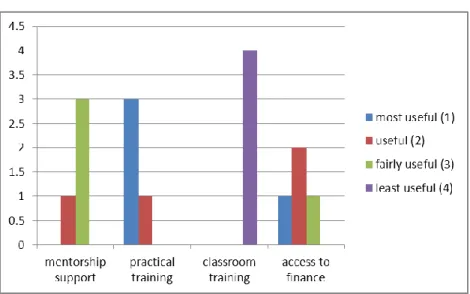
Figure 1-4 Importance of services offered by Vuk’uphile ………70
Figure 1-5 Relevance of classroom curricula ………...71
Figure 1-6 Success of company in obtaining tender ………..73
Figure 1-7 Mentor input to contractor skills development ………...74
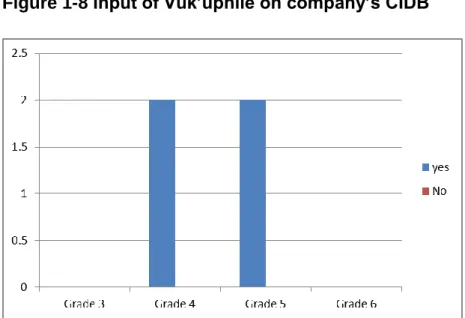
Figure 1-8 Input of Vuk’uphile to company’s CIDB ……….76
Figure 1-9 Job creation ……….77
Figure 1-10 Ability to source finance for projects………78
Figure 1-11 Work opportunities created for local labour ………...79
Figure 1-12 Skills transfer to local labour ………80
1
CHAPTER ONE
INTRODUCTION
1.1 Introduction
The SMME sector has been identified as the main driver in the advancement of entrepreneurship in South Africa as a means towards creating wealth and job opportunities.
Vuk’uphile is a programme within the Expanded Public Works Programme (EPWP) of the South African Government. The EPWP is a nationwide programme covering all spheres of Government and State Owned Enterprises. It aims to draw significant numbers of unemployed people into productive work accompanied by training so that they increase their capacity to earn an income. EPWP has created an opportunity for small business in construction, there is therefore a need for a sound and comprehensive strategy to develop and bring small contractors into the industry. The Government had the dilemma of empowerment and employment of historically marginalized groups and on the other hand, needs to ensure the delivery of quality infrastructure.
The Eastern Cape Department of Public Works and Roads have put in place a contractor development programme which is being implemented under Vuk’uphile learnership programme. The department aims at developing and improving the competitiveness and the sustainability of local enterprises in the construction sector, thereby redistributing wealth and creating jobs by having contractors who are engaged in the delivery of infrastructure through government tenders.
2
Research findings indicate that emerging contractors cannot sustain their business. This is reiterated by an extract from a speech by the Minister of Trade and Industry (2013) “In South Africa five out of seven small businesses that are established will close in the first year”. It is well recognized that Small and Medium Enterprises have a high potential of creating jobs, and can contribute significantly to economic growth, however these contractors find themselves being constrained by their capacity to execute works, financial challenges, technical and managerial capacity, to mention but a few.
1.2 Background to Expanded Public Works Programme in South Africa
The background presented in this section relates to issues that justifies the need and relevance of expanded Public Works Programmes and contractor development programmes in South Africa.
This section aims to provide historical background to place specific discussions of poverty and inequality in South Africa. The historical circumstances have shaped the present configuration of poverty and opportunities along racial lines in South Africa. Disadvantaged groups were systematically left with relatively little in the way of means of production, not afforded education of quality compared to that of white people.
1.2.1 Changes in the South African Economy
In 1960, 30% of South Africa’s economic activity was made up of primary sector activities, namely agriculture and mining, and another 24% consisted of secondary sector activities, mainly manufacturing and construction while services made up the balance of 46%. The contribution of mining and agriculture has dropped below 10% and the share of mining has fallen from 22% in 1960 to 5.5% in 2003 (S.A. Reserve Bank, 2004).
1.2.2 Unemployment in South Africa
The magnitude of South Africa unemployment is such that in September 2003 a number of 4.6 million people were unemployed in terms of strict definition
3
and a number of 8.3 million in terms of board definition. High and growing rates of unemployment are a consequence of dynamics on both the demand and the supply side of the labour market. On the supply side increasing rates of labour force participation have significantly expanded the number of job seekers. On the demand side there has been some growth of employment, but has not been sufficient to absorb new entrants into the market, or those people that have lost their jobs due to shrinking demand for labour. The unemployment rate has been growing by 1 to 2 percent annually reaching 24.9 % at the 4th Quarter of 2012 (Quarterly Labour Force Survey, Quarter 4, 2012). The Government has a target of halving unemployment by 2014 and to reach it 546,000 new jobs have to be created each year. The urgent need to address spiraling unemployment levels in South Africa made the EPWP relevant and high priority in the implementation list of Government.
Unemployment rate can be defined by either the national definition or the International Labour Organization (ILO) harmonized definition. For this study, the researcher will use the ILO definition. As defined by the International Labour Organization, unemployed people are those who are currently not working but are willing and able to work for pay, currently available to work, and have actively searched for work (International Labour Organization, 1966).
There are several reasons of unemployment; however for the purpose of this study two reasons will be discussed.
1.2.3 Cyclical Unemployment
This kind of unemployment is related to the general strength and vitality of the economy. If the economy is in recession the demands for goods and services tends to grow at a slower rate, the producers need fewer means of production, including labour, to meet lower level of consumer demand. The opposite holds true when the economy recovers, more labour will be required to meet growing demand of goods and services. South Africa has
4
experienced persistent unemployment, irrespective of economic growth (Malikane, 2010).
1.2.4 Structural Unemployment
Structural unemployment in South Africa has been a result of two processes, that is, the country’s history of colonialism and Apartheid, and secondly, the changes in the macroeconomic environment and the emergence of globalization.
Structural unemployment occurs when there is a significant gap between education, skills and expertise etc. required for a job on one hand and on the other hand qualified workers to fill the posts.
Structural unemployment also refers to the situation that arises when jobs change or simply no longer exist because the structure or composition of the economy has changed (Roux, 2005).
The 2001 census included a question on the highest educational achievements of people aged 20 years or older. Almost 18% indicated that they have no education whatsoever while 22% had primary education; this means that 40% of adults in South Africa have at most grade 7 educational background. Some 20.4% had matric and 8.4%had a higher education qualification.
This implies that a large proportion of the South Africa working age population is simply not employable in an economic environment in which manual labour is becoming less important and appropriate skills more sought after. This is aggravated by the fact that it is difficult in a technologically driven world to teach people skills if they lack a solid educational background. At the very least they need to be able to read and write with a comfortable degree of fluency.
5
The causes of unemployment in South Africa are manifold and complex. The discussions of the debate around unemployment are beyond the scope of the study. However it is important to note that there is consensus amongst researchers that the causes are structural rather than cyclical (Roux, 2005).
1.3 Policy and Legislative Framework to Support Small Contractors
There is a growing interest across many countries in enhancing the role of public procurement in national economic development (Watermeyer, 2000a). Procurement provides business and employment opportunities and depending on how it is structured and conducted, can be used as an instrument of government policy to facilitate social and economic development (Watermeyer, 2002).
The South African Government has provided a friendly legislative environment to support and encourage the development of SMME’s. The following are the legislative initiatives taken by government in order to create an enabling environment for emerging contractors.
1.3.1 Reconstruction and Development Programme (RDP)
The RDP is an integrated coherent and socio-economic policy framework. It seeks to mobilize all the people of South Africa and its resources towards a final eradication of Apartheid and the building of a nonracial, nonsexist future (African National Congress, 1994). The RDP paves the way for the development of programmes that facilitate the distribution of wealth, alleviation of poverty and inequality, amongst other policies the RDP has a bearing on the conceptualization of EPWP and contractor development in particular.
1.3.2 Construction Industry Development Board (CIDB) Act 38 of 2000
This act provides strategic direction and develops effective partnerships for growth, and improvement of the construction sector. Furthermore, it promotes sustainable growth of the construction industry and the sustainable
6
participation of the emerging contractor. The CIDB appropriates grading for development of contractors. Vuk’uphile contractors are graded from scale of 1-4 and are graded accordingly as they progress in their development. A CIDB grading is important in that it categorizes the contractor’s capabilities thereby assuring a client when a contractor is engaged.
1.3.3 Broad Based Black Economic Empowerment (BBBEE) and Preferential Procurement Policy
In 2000, the Preferential Procurement Act No 5 was enacted to provide a framework for preferencing and for the transformation of the country’s procurement regime (Republic of South Africa, 2000). The mechanism that was applied to permit procurement to be used as an instrument of social policy was that of targeted procurement, which specified that any organ of state must determine a preferential procurement policy. Targeted procurement provides employment and business opportunities for marginalized or disadvantaged individuals and communities and enables social objectives to be linked to procurement in a fair, transparent, equitable and cost effective manner (Govender and Watermeyer, 2001).
Government initiatives are further supported by the Broad Based Black Economic Empowerment (BBBEE) Act no 53 of 2003 (BBBEE, 2003:2) that states its intention as follows: “to establish a legislative framework for the promotion of black economic empowerment; to empower the Minister to issue codes of good practice and to publish transformation charters; to establish the black economic empowerment advisory council and provide for matters connected herewith”. Preferential procurement assists in the selection of enterprises owned by previously disadvantaged individuals, thus impacts on the redistribution of wealth and skills. This is used to select black owned companies to participate in Vuk’uphile.
7
1.3.4 The Framework Agreement for Labour Intensive Agreement 1993
The framework agreement for Public Works programmes using LIC was born out of the realization that greater use of labour intensive methods could alleviate unemployment by generating work opportunities. These labour intensive systems proposals were formulated in the early 1990s during the transition from the Apartheid Era (McCutcheon and Taylor Parkins, 2003). South Africa has strong Trade Unions which actively campaign for a minimum wage, pension and other employee benefits, these Unions had to buy into the idea of Public Works projects that would create temporary employment and hence the need to negotiate some of the privileges that they have won over from employers.
A draft framework agreement document was signed as early as 1993 through engagements between Government, Trade Unions and the Construction Industry representatives. The draft document sought to maximize the use of labour intensive methods of construction within Public Works Programmes, with due regards to economics (McCutcheon and Taylor Parkins, 2003). The core principles of the framework agreement have been used in Public Works without formal adoption until they were written into a Code of Good practice for Special Public Works Programmes (and a related Ministerial Determination), which was formally gazette by the Department of Labour in 2002, and after consultation with the National Economic Development and Labour Council (NEDLAC) (Phillips, 2004: McCutcheon and Taylor Parkins, 2003).
1.4 Institutional Frameworks
The success of Public Works Programmes could not be realized without a coordinated approach from the different stakeholders. Government through NDPW saw the need for the creation of a separate unit within the Department to champion EPWP. The EPWP unit has the responsibility to drive the
8
implementation of PWP’s within all spheres of Government. It therefore interacts with the various levels of Government and State Owned Enterprises (SOE’s) implementing EPWP.
The National EPWP Framework also provides that EPWP projects and programmes must be identified within each government and department and SOE that it can be implemented using labour intensive or community based service delivery methods with predetermined key deliverables over a given time frame in the infrastructure, environmental social and non-state sectors (NDPW, 2012).
1.4.1 EPWP Guidelines
A guideline framework for the implementation of labour intensive projects within EPWP was developed in 2004 and revised in 2005. The document provides parameters on the implementation of labour intensive projects within the guidelines, the government department or agency appoints a consultant to design the work and to administer the contract. Most of the designs are expected to be labour intensive where it is economically and technically feasible in order to tie in with the job creation aspects of EPWP, therefore special clauses to give effect to this requirement are factored into the guidelines (EPWP, 2005).
1.4.2 Training
The EPWP Unit works with the CETA SAQA, Department of Higher Education and CIDB in order to facilitate capacity building of labour intensive construction methods within projects undertaken by Public Bodies. It should be noted that EPWP does not implement any project but rather ensures that adequate expert knowledge and skills development is garnered and offered as support to implementing bodies. CETA is responsible for conducting quality assurance evaluations on training offered to programme participants, the Department of Higher Education through the national skills fund funds training programmes.
9
1.4.3 Finance
The EPWP Unit is not responsible for financing any projects undertaken by Public Bodies and SOE’s as the money comes from the National Treasury. The EPWP plays a coordinating and supportive role; it identifies best practice among the implementing bodies and advocate for its replication in other similar public bodies. Projects implemented under the EPWP are funded from the Medium Term Expenditure Framework (MTEF) mainly under Provincial Roads Maintenance Grant (PRMG) for Provincial Departments and Municipal Infrastructure Grant (MIG) for Municipalities.
Another source of funding comes through the Division of Revenue Act, Government created an incentive grant which is managed by Public Works to incentivize public bodies which reach and or exceed their job creation targets as allocated through PRMG and MIG.
For Provincial departments the grant is meant to incentivize provincial departments to expand work creation efforts through the use of labour intensive delivery methods in the following identified focus areas, in compliance with the EPWP guidelines: Road maintenance and the maintenance of buildings, low traffic volume roads and rural roads and other economic and social infrastructure (DoRA, 2013).
1.5 Monitoring and Evaluation
The NDPW is responsible for overall monitoring and evaluation of EPWP projects. Monitoring and evaluation forms an integral part to any programme success as the information generated builds on a body of knowledge that will ensure success and replication of best practice in projects. The information is collated and conveyed to Public Bodies and the Presidency (EPWP, 2012). This informs government on whether to continue to implement and fund EPWP of not and if to fund, in which sectors to exert more funding, this is done in consideration of Government Priorities.
10
The evaluation framework has focused on monitoring the impact of the programme as part of reporting on the purposes of the goals of the programme. Departments are expected to report quarterly on the output detailed in a logical framework called the Integrated Reporting System. Data collected from implementing bodies is consolidated and reported in the form of quarterly reports (EPWP, 2005).
The monitoring indicators of the EPWP have been integrated into other existing reporting structures. In addition, Government reached an agreement with Stats SA that the EPWP indicators are to be included in both the Labour Force Survey and the General House Hold Survey (Phillips, 2004): such incorporation essentially provides the ideal platform on which the targets of EPWP can be monitored and evaluated. The surveys conducted by Stats SA target the number of people employed skills levels social benefits etc. to produce a measuring instrument on the turnaround strategy of government to create jobs, alleviate poverty and inequality.
1.6 EPWP Phase 1
1.6.1 Goals and objectives
The Goal of EPWP Phase 1 was to create 1 million temporary work opportunities coupled with training over the first five years (2004-2009) with at least 40% women 30% youth and 2% disabled. To achieve this goal, the Government would: create temporary work opportunities and income for at least 1 million unemployed people, provide needed public goods and services using labour intensive methods at acceptable standards, through mainly public sector resources and public and private sector implementing capacity; and increase the potential of participants to earn a future income by providing work experience, training and information related to local work opportunities, further education and training and SMME development (EPWP, 2005).
11
• Facilitate training and skills development of all EPWP participants; • Create work opportunities in the Public Sector;
• Development of Small Medium and Micro Enterprises through learnership and incubation programmes; and
• Utilizing general government expenditure on goods and services to provide the work experience component (EPWP, www.epwp.gov.za)
1.6.2 Implementation methodology and targets
EPWP runs in four sectors, that is, infrastructure, economic, environmental and the social sectors. The Vuk’uphile programme is a sub-programme in the infrastructure sector.
The EPWP is implemented through Provinces and Municipalities as these are the main delivery arms of government. The National Government departments are responsible for sector coordination of EPWP. The success of the programme as spelt out of its inception is highly depended on cooperative governance. All levels of government and SOE’s are expected to provide temporary employment opportunities which target unskilled and unemployed persons. The developmental programmes should ensure that apart from providing employment; the beneficiaries are adequately trained thereby allowing them to gain skills that can be used for their empowerment. These guidelines are spelt in the National EPWP Framework.
The EPWP was designed to allow a wide diversity of existing best practice Public Works programmes to expand. Work opportunities were expected to be created in the following ways:
• Infrastructure sector – increasing labour intensity of government funded infrastructure projects.
12
• Environmental Sector – creating work opportunities in public environmental programmes (e.g. working for water, working for fire, waste management)
• Social Sector – creating work opportunities in public social programmes (e.g. community –based health and social welfare care and early childhood development)
• Economic sector – developing small businesses and cooperatives including utilizing general government expenditure on goods and services to provide work experience component of small enterprise learnership /or incubation programmes.
For the purposes of this research a brief description shall only be outlined for the infrastructure sector as it is the focus of this research. Any further information on the other sectors can be readily sourced from National Department of Public Works.
1.6.3 Infrastructure sector
This sector aims to increase labour intensity on government funded infrastructure projects. Suitable projects within government sectors and SOE’s are identified, designed and implemented using labour intensive Methods (EPWP, www.epwp.gov.za).
As detailed in the literature review in chapter 2 local and international evidence suggest that machines can be replaced with labour in many of the construction activities associated with civil infrastructure without compromising quality or cost of the project deliverables in projects such as low volume roads, municipal water and sanitation pipelines, as well as storm water drains (McCutcheon and Taylor Parkins, 2003). This body of knowledge informs a wide application within the infrastructure sector to create employment within the EPWP. It is in the light of the above that special
13
learner ships have been set up within this sector of the EPWP; one such as Vuk’uphile which is being examined in this research.
In All EPWP projects the project manager’s contractors and supervisors should all be trained in the requisite skill and knowledge for implementing labour intensive projects. NQF 7 for consultants designing the infrastructure NQF 5 for managers NQF4 for contractors and supervisors. Participants and other stakeholders such as CETA CIDB and Public body work together under the coordination of the National Department of Public Works to deliver on the goals and objectives as set out in the EPWP. Within the Infrastructure sector as specified under the EPWP Guidelines for labour intensive construction are only given preference where they are technically and economically feasible. This ensures the quality of the deliverable, and the project outcome is not compromised.
The implementation of labour intensive projects in EPWP can be summarized as follows: using labour intensive construction methods to provide work opportunities to local unemployed people and providing training or skills development to those local workers; and building cost effective quality assets. The first phase of the Expanded Public Works Programme achieved its 1 million work opportunities targets a year ahead of schedule. This indicated the possibility of expanding the programme significantly and to improve its quality (SoNA, 2009).
The EPWP phase 2 draws from the successes and lessons of phase 1 and seeks the creation of longer term, more stable work opportunities in Provinces and municipalities and non-governmental organizations. The target for Phase 2 is to create 4.5 million work opportunities for poor and unemployed people in South Africa so as to contribute to halving unemployment by 2014, through the delivery of public and community services (EPWP, 2009).
14
1.7 Vuk’uphile Learnership Programme 1.7.1 Background
Vuk’uphile learnership programme was initiated by the department of Public Works in coordination with CETA. The programme seeks to develop capacity among emerging contractors to execute labour intensive projects carried out in the EPWP, (EPWP, 2006). The programme is linked to the contractor grading system of the CIDB thereby encouraging and supporting continuous development of emerging contractors into medium sized entities The Vuk’uphile Learnership Programme is intended to develop emerging contractors into fully-fledged contractors able to execute labour-intensive projects. The emphasis of the programme is to develop entrepreneurial, business, and technical skills (Vuk’uphile, 2010).
1.7.2 The objectives and outcomes of the programme
The objectives of the programme is to increase capacity in the Labour Intensive Construction sector to support EPWP implementation at Implementing Body level (municipal and Provincial), furthermore to provide a contracting entity that is able to operate locally and wider, is able to sustain itself in the open market after the two year Learnership, and increased capacity in LIC sector to support EPWP (EPWP, 2006).
The objectives can be summed up as follows:
• Increase capacity in LIC sector to support EPWP.
• To provide a contracting entity that is able to operate locally and wider.
• Provide a contracting entity that is able to sustain itself in the open market after the two year Learnership.
15
• Skills transfer with contractors and supervisors to emerge with: recognized qualification, project track record, financial track record, relationships with a bank and CIDB Ranking of Grade 3 to 4.
1.7.3 Implementation methodology
As with other EPWP programmes and projects Vuk’uphile is implemented through provinces and municipalities as these are the main delivery spheres of Government. The implementing body is to provide the requisite training platform in a form of a project within a work environment from which a learner can gain experience and at the same time perform on expected deliverables. Vuk’uphile is implemented in partnership with various stakeholders whom agreements are entered into. The programme is focuses on emerging contractors that are able to implement projects in the region of R2million as part of onsite training component of the learnership (Vuk’uphile 2010).The programme is composed of various stakeholders with specific roles namely:
NDPW: The National Department of Public Works is responsible for the overall coordination of the Vuk’uphile learnership. It formulates guidelines appoints mentors and monitors quality assurance within the scope of the learnership.
Public Body: The implementing body is responsible for the provision of projects that the learners carry out. It is up to the implementing body to identify suitable projects within their areas of jurisdiction which can be carried out labour intensively. The Public body as the provider of the project budget acts as the employer and appoints a consultant engineer as project manager.
Learner: the learner contractor and supervisor must be available to be trained through the learnership. They must possess a registered company and must comply with all EPWP guidelines specific to training as well as other requirements within the scope of Vuk’uphile learnership programme.
16
Community facilitator: the community facilitator is appointed by the implementing body to inform the community of the planned projects, which enables the establishment of community forums made up of local representatives. This ensures buy in from the local people. The community forum also provides a platform for local people who form part of EPWP target to be incorporated within the programme (source for EPWP beneficiaries).
Financial service provider: the financial service provider ensures bridging finance for the emerging contractors, and gives information and advice as regards to financial and credit record of prospective contractors. The service provider also provides financial training to the contractors as well as monitoring cash flow of the contracting entity.
Training provider: the training provider is responsible for the provision of theoretical training assessing learner progress both within the classroom and on site. The training provider is expected to compile assessment reports on evaluation, which must be availed to other stakeholders so that the learner’s performance can be tracked.
CETA: ensures that the training being provided is accredited with SAQA in terms of the National Qualifications Framework levels (NQF). It also monitors that an adequate budget has been set aside for training and evaluates theoretical training offered to the learners periodically (quality assurance). CETA is also involved in the appointment of training providers for the programme.
CSIR: works with NDPW to develop monitoring and evaluation tools for continuous evaluation of the programme focusing on learner development.
Mentor: Mentorship is one of the critical support areas to enhance the success of the emerging contractor development. Mentors are required to be trusted associates responsible for guiding and advising learners during the
17
implementation of the project on site. The responsibilities of the mentors are listed below:
• Provide advice aimed at improving business systems within the emerging contracting entity;
• Offer guidance and advice during project implementation;
• Ensure through assessments that each learner has structured development plan;
• Offer guidance and advice to contractors in areas which need improvement;
• Co-signatory to the emerging contractor’s bank account;
• Develop the learner skills in the following: technical, administrative, contractual, managerial and entrepreneurial (Vuk’uphile implementation guidelines, 2010).
To ensure that the mentors are able to impart the necessary expertise to the learner contractor, the mentor must possess the following: onsite experience within the construction industry totaling more than ten years, previously gained exposure and experience in the developing of emerging contractors, be registered as a professional with a built environment statutory body, sign and declare adherence to the council for project and construction management professionals (SACPCMP) code of ethics for mentors (Vuk’uphile implementation guidelines, 2010).The success of the programme is highly depended on cooperation of stakeholders.
18
Figure 1-1 Vuk’uphile Stakeholder roles and relationships
Source: Vuk’uphile, 2010
The above figure show the different roles and partnerships between stakeholders, but for these relationships to work agreements must be entered into.
There stakeholders enter into agreements to ensure the smooth implementation of the programme. The first agreement is entered into by the Department of Public Works, Construction Education and Training Authority and the Public Body that is providing the project.
An agreement is entered into between a bank and the DPW; this is to facilitate the availability of seed capital to the contractor. A learnership agreement is also entered into between the CETA, the learner and training
19
provider. Several contracts are entered into between several stakeholders these include a contract of employment between public body and learner contracting company this contract is meant to bind the service provider which is the contractor into implementing the project which the public body will avail and to bind the Public Body to make necessary payments upon implementation of the project. A contract is signed between learner and supervisor. Lastly a contract is signed between the Public Body and consulting engineers. (Vuk’uphile implementation guidelines, 2010).
The learnership for research purposes consist of four levels namely: Classroom training, practical training, mentorship support, access to finance. The NDPW in partnership with the bank CETA and Public body after signing memorandum of agreement are tasked with the appointment of training providers and mentors, selection of learners and training. This is carried out in the series of the following steps: advertisement of Vuk’uphile learnership programme, Briefing sessions, prescreening applicants, shortlisting for written assessments, shortlisting for interviews, financial screening, interviews, and then final selection.
20
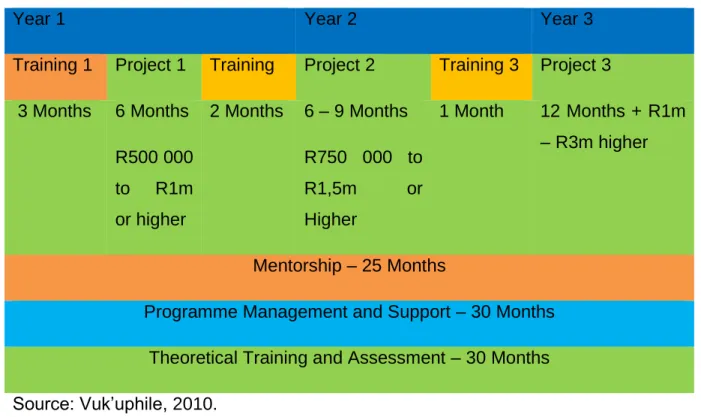
Figure 1-2 Vuk’uphile Learnership Model
Year 1 Year 2 Year 3
Training 1 Project 1 Training Project 2 Training 3 Project 3 3 Months 6 Months R500 000 to R1m or higher 2 Months 6 – 9 Months R750 000 to R1,5m or Higher 1 Month 12 Months + R1m – R3m higher Mentorship – 25 Months
Programme Management and Support – 30 Months Theoretical Training and Assessment – 30 Months Source: Vuk’uphile, 2010.
Figure 1-2 shows the learnership model as it is implemented for a period of two years. The training budgets are determined as follows: mentorship is provided in a 1:10 mentor- learner entity ratio. The first project for practical implementation is valued between R500, 000 to R1000 000, the second between R750 000 to R1 500 000and the third R1 000 000 to R3000 000. For a contractor to have fully completed the learnership should have earned 254 credits for contractors and 218 credits for supervisor. On completion of the learnership the learners are given an opportunity to tender for an exit project. The programme exit strategy is supported by the economic sector of the EPWP. However various opportunities are potentially available to exiting contractors such as: secure contract with new client, further education and training, qualified contractor with track record and, improved CIDB grading. Monitoring and evaluation is supported by existing reporting structures. Within Vuk’uphile monitoring and reporting is supported by the integrated reporting
21
system. EPWP indicators have been identified for assessment on ongoing basis and every quarter of the year reports are produced. The indicators are based on the key result areas which are financial whose indicators include budget, expenditure, and source of funding. Job opportunities which involves the number of jobs created, duration of the job and cost of the job. Demographics which involve women, youth and people with disabilities and lastly training which involves number of people trained, duration of training and training budget.
Vuk’uphile 1 from 2005 to 2010 registered achieved a total of 1493 learnership registered, 492 SME’s registered with CIDB, 3 and Grade 6, this means that enterprises progressed from 3 to 6. The expected outcome was at least a CIDB grade of 3 but others surpassed this expectation to reach grade 6. A total of 34 public bodies implemented Vuk’uphile and awarded 1387 projects. This created 55058 work opportunities for locals within project area, of the 492 SME s 89 were from the Eastern Cape that is 18% of all the learners (Vuk’uphile, 2010). The total budget of Vuk’uphile was R1.3 billion worth of projects and R230 million for training and mentoring (Vuk’uphile 2010).
1.8 Vuk’uphile 2
Phase I Experience resulted in evaluation of the Learnership Programme. The following were recognized as means to increase and affirm programme’s credibility:
Selection Criteria: CIDB Register is used as means to select contractors; emerging contractors applying to be enrolled in Vuk’uphile must be registered as this proves that they are continuously participating in the construction industry.
22
Contractor: Supervisor Ratio: In phase one the ratio was 1 contractor is to 2 supervisors this has been changed as it was expensive for government and it resulted in infighting for the leadership of emerging company.
Qualifications: It is recommended that the mentors and supervisor should have a technical background.
Disciplinary Code: In phase 1 the disciplinary code of Vuk’uphile was not used as required however in phase 2 the code was invoked and its stringent implementation recommended.
CETA Role: The role of CETA remained that of quality assurance on the training.
MOA between Implementing Body and NDPW includes a project list: an MOA between Public Works and the implementing Public body is entered into and a project list given to Public works to assist in the selection of suitable projects for the emerging contractors, these should be LIC compliant.
Mentorship shared responsibility: In phase 1 Public Works took full responsibility for the mentorship. In phase 2 mentorship expense is shared between DPW and The Public body in a ratio of 70:30 with Public Works carrying the bigger part of the expense.
LIC Infrastructure type, Guidelines used for Implementation: projects to be identified and selected for implementation should be designed for LIC and EPWP guidelines used in the implementation.
Total Quality Management by CSIR: CSIR responsibility of ensuring total quality management and uniformity of standards in the implementation of programme was emphasized.
23
The lessons learned and the revised model of Vuk’uphile has taken into consideration issues and performance areas that have been identified and recommended by various authors in the literature review.
1.9 Problem Statement 1.91 Problem
The potential of small and medium construction businesses to contribute significantly to employment creation and economic growth is well recognized; however emerging contractors remain weak and operate in a manner that is unsustainable (Lazarus, 2007).
Vuk’uphile phase one experienced successes and challenges some of the challenges was that the implementation approach was not the same across the nine provinces, Mentor managers were lenient on mentor firms and this resulted in mentors performing poorly. The financial services provider delayed in approving overdrafts and these delayed projects. Learners waited for many months in between projects because implementing bodies did not avail projects in time. Mentor management team did not have sufficient capacity (Vuk’uphile, 2009). This has led to the revision of the implementation model to Vuk’uphile 2.
The research identifies and examines the progress and challenges experienced in the implementation of Vuk’uphile 2 learnership in the Eastern Cape. This development programme is meant to provide training, learnership and skills development to ensure that contractors deliver quality service in infrastructure provision (EPWP, 2005).
1.9.2 Knowledge Gap
It has been widely accepted that the success of the past and current contractor initiatives has been quite modest. However significant lessons can be drawn from these initiatives. The lessons have shown the need to inform
24
policy and research agendas by promoting the participation of emerging contractors (Thwala and Phaladi, 2009).
There is abundant evidence from studies by Croswell and McCutcheon (2001), Dlungwana and Rwelamila (2003), Milne and Atkins (1996), and Lazarus (2007) on contractor development issues on selection of contractors for development, mentorship, access to finance, skills development and the development of integrated contractor development model that includes total quality management and project management. However, there is no study that examines progress in the Eastern Cape since the implementation of Vuk’uphile phase 2.
1.9.3 Context
This study was conducted in the Eastern Cape where contractor development programmes have been implemented since 2006, (2006, EPWP). In 2009, the Vuk’uphile programme was reviewed with the aim of eliminating and/or alleviating the challenges that were being experienced during implementation of the programme (EPWP, 2009). The study will focus on Vuk’uphile learnership on roads projects, because: 1. there are projects currently under implementation 2. Rural roads have high potential to be developed using labour intensive construction methods and thus optimizing job creation.
1.9.4 Research Need
The EPWP monitoring and evaluation framework specifies the need for cross sectional as well as longitudinal studies to evaluate its programmes (EPWP, 2005). The identified need for continuous checking to ensure programme balance is important as it informs intervention when necessary. This research will offer an independent examination of progress of the Vuk’uphile learnership phase 2 in the Eastern Cape. The problem to be addressed by this study is the examination of progress made by Vuk’uphile learnership phase 2 towards integrated skills development for emerging contractors in the roads sector.
25
1.10 Purpose statement
This study is a descriptive research with a purpose to examine the progress in terms of performance of the learnership, to find out whether it is achieving its intended purpose in the Eastern Cape, and establish recommendations for strengthening the programme.
1.11 Research question
The research was guided by the following main question
What is the progress on contractor development objectives brought about by implementing Vuk’uphile learnership phase 2 with regards to its intended objectives of developing sustainable, self-reliant labour intensive emerging contractors in the Eastern Cape roads?
The following sub questions are used to address the main question:
a) Since the implementation of a revised Vuk’uphile are the learner contractors completing the prescripts of the programme and exiting officially?
b) Of the exited contractors, are they still participating in the construction sector?
c) Are the enterprises sustainable enterprises and self-reliant in terms of finding work?
d) At what level is their CIDB grading?
e) Are the recommended systems for implementation of the programme adhered to and if not what are the deviations and why?
1.12 Significance
The Vuk’uphile Learnership Program offers a new impetus into the development of emerging contractors in South Africa. It is in the light of the above that the researcher has chosen to examine emerging contractor development within Vuk’uphile but specific to Eastern Cape Department of
26
Public Works and Roads as described in the limitations. Cognizance is taken that emerging contractor development has been struck by the same problems since 1970s (Croswell and McCutcheon, 2001) the structure, drive and support of Vuk’uphile within EPWP promotes room for examination of the programme. Vuk’uphile is now in its second phase it becomes more relevant to examine its progress.
Furthermore labour intensive methods of construction offer infrastructure provision and increased potential for job opportunity creation thus changing the socio economic status of people. Small contractor development is an integral part of labour intensive construction methods. It is therefore of paramount importance that a review of its implementation is done continuously so that improved implementation strategies for the programme are developed.
1.13 Structure of the Report Chapter 1: Introduction
This chapter gives background information on the progress of emerging contractor development programmes in South Africa. It draws on the contexts within which emerging contractors operate, and how South Africa implements the Contractor Development Programme under the umbrella of EPWP. It further contextualizes the South African situation, considering its history and environment currently. It outlines the research problem and outlines the objectives of the research.
Chapter 2: Literature review
This chapter reviews research on emerging contractor development in the construction sector. The scope is on past programmes in the Southern African Development Community (SADC) region. The chapter focuses on literature on skills development, mentoring, financing and the selection of
27
participating contractors to development programmes. Challenges and progress made, is also discussed.
Chapter 3: Research methodology
This chapter will outline the research selected method, namely qualitative analysis. The research designs used will be discussed and their strengths and weaknesses analyzed.
Chapter 4: Data presentation
An overview of EPWP and its mandate will be given, in the context of unemployment poverty, job creation and redistribution of wealth in South Africa. It introduces Vuk’uphile 2 as one of the solutions to the challenges South Africa is facing. The Vuk’uphile 2 model will be discussed and the monitoring and evaluation tools will be discussed.
Chapter 5: Data Analysis
In this section, research data will be analyzed and evaluated against the programme objectives. Comparisons of outcomes to related literature as reviewed in chapter 2 will be drawn.
Chapter 6: Conclusions and Recommendations
This chapter summarizes findings of the research and provides conclusions on the evaluation of Vuk’uphile 2 in the Eastern Cape Public Works and Roads. The section will provide recommendations based on the research conclusions.
28
CHAPTER TWO
LITERATURE REVIEW
2.1 Introduction
The literature review offer historical insight into small contractor development programmes internationally and an overview of the South African small contractor development programmes to date it analyses what other authors have covered on the topic and therefore offer a base of body of knowledge for the examination of the current Vuk’uphile Learnership Programme.
This chapter reviews relevant literature relevant to small contractor development; it refers to past programmes in Africa. It reviews literature on selection of candidates, training, mentoring, financing, legislative support as well as review the challenges faced within small contractor development.
2.2 History Small Contractor Development in Sub Saharan Africa
Development of small contractors for the construction industry has been advocated and explored in two different contexts in Sub-Saharan Africa. Since the 1970s, it has been advocated in relation to the construction industry as a whole, and since the late 1980s, it has been pursued in relation to the employment intensive construction and maintenance of infrastructure, particularly low cost, low volume, rural roads and other civil infrastructure (Croswell and McCutcheon, 2001). The main aim of contractor in the construction industry as a whole has been the establishment of profit making firms. By contrast with small contractor development in the construction industry as a whole, throughout the past 30 years the main objective of labour intensive work has been poverty alleviation through employment generation during the construction, maintenance of public infrastructure (Croswell and
29
McCutcheon, 2001). Vuk’uphile aims at both these objectives including producing quality infrastructure.
Small, medium and micro Enterprises represent an important vehicle to address the challenge of job creation, economic growth and equity in South Africa. Within the overall record of the developing world, South Africa emerges as one of the most innovative examples of applying a targeted procurement approach towards stimulating the small, medium and micro enterprises (SMME) economy in the roads construction sector (Rogerson, 2001).
Throughout the world, it is found that SMMEs are playing a critical role in absorbing labour, penetrating new markets and generally expanding economies in creative and innovative ways. It is the view of the South African government that with the appropriate, enabling environment, SMMEs in this country can follow these examples and make an incredible mark on the economy (DBSA, 1998).
Croswell and McCutcheon (2003:295) point out that small contractor development and employment intensive implementation has not been easy.” Changing the way things are conventionally done is not easy. There are reasons why things are as they are.” Employment –intensive methods of construction were looked down on; hence there was need for the industry reeducation on the opportunities that were not being exploited.
The relationship between employment intensive methods and contractor development has created an essential link between infrastructure provision and long term development programmes. Successful employment intensive programmes in countries such as Kenya, Botswana, Lesotho, Malawi and Ghana on large scale programmes have given a base for other sub-Saharan countries to embark on such programmes.
30
2.3 Overview of Some Past Programmes
This section of the literature review gives insight of what has been written of programmes in Lesotho and Ghana.
2.3.1 Ghana’s experience
The objectives of the programme in Ghana were three fold: to improve rural accessibility, increase contracting capacity, and to create rural employment. The programme has trained 100 contractors under the scheme to work on labour based road rehabilitation and maintenance contracts. It was mainly funded by UNDP and the World Bank and has resulted in the rehabilitation of 1400KM of rural roads at a cost of 14 million US dollars (Ofori, 1985).
The programme is promoted to contractors by a newspaper advertisement campaign and selection is based on education, previous experience and loyalty of business. There are 3 stages to the training process which addresses the needs of both contractors and the Department of Feeder roads staff:
Stage 1. 20 weeks of classroom and field work training
Stage 2. 4 months of trial contract of 5KM carried out under supervision
Stage 3. 4 year development with onsite training undertaking a 20Km per annum
Following their period of initial training (stage 1) the contractors are provided with a set of equipment, 2 tractors, 4 trailers, 1 water browsers and 2 pedestrian vibrating rollers. The equipment is worth 150,000 dollars and it is financed through a bank loan which is repaid over the following 4 year period. In order to ensure that contractors are able to pay the loan the department guarantees contracts will be awarded for the first 4 years after training. Each contract lasts approximately one year and has a value of $240 000. The project attempted to operate these contracts under a competitive tendering
31
system; however the formation of cartels forced the department to adopt a scheme of rates for the initial 4 year period. Following the repayment of the equipment loan contractors compete for work through competitive tendering in an open market (Ofori, 1985).
2.3.2 The Lesotho’s experience
The Lesotho Government developed a 30 month programme in 1992 to train local contractors to maintain the road network. The World Bank sponsored the enterprise Development for labour based road maintenance contractors’ project which was managed by the Labour Construction Unit (LCU), with technical input from ILO.
The programme focused heavily on the training issues both in terms of the technical and managerial skills of the contractors and also the retaining of the LCU staff for their new contract supervisor role. The contractor training programme combined on the job training with classroom work to meet the needs of the contractors, for the technical training aspects the programme developed the road maintenance and gravelling package (Larcher 2001). Series of three handbooks and workbooks which were designed to meet the business training needs of small scale contractors.
During the training period all costs were met by the project. The six month trail contract period consisted of two contracts commencing with a maintenance contract awarded at a fixed price, followed by a regravelling contract.
The contractors were given basic set of hand tools worth $66TO at the beginning of their trail contracts, which were paid for during the trial contract period, and offered the opportunity of hire purchase agreements on pedestrian vibrating rollers. They were expected to hire any further equipment which was readily available or buy equipment using a lease financing arrangement set up with a national bank (Larcher, 2001).
32
The LCU was primarily responsible for the maintenance and development of the earth and gravel network. In 1992 the World Bank funded a developmental project on labour based methods of construction which was supervised by LCU, had technical support from the ILO and this led to the birth of small contractor development in Lesotho. Larcher (2001) highlights that the contractor development was mainly focused on training on: technical skills, managerial skills and, supervisory skills.
The training focused on practical as well as classroom training, so as to equip contractors with the requisite skills. The programme curriculum also extended top small business management so as to develop the contract entities. The training duration was 30 months and all costs were catered for within the programme. On completion of the training the contractors were awarded 6 months trail contracts. The equipment for the projects was available for the contractors to hire or on lease to buy arrangement. The programme was done with the involvement of the national bank.
The successful programmes in Ghana and Lesotho were developed around suitable contractor development programme. These programmes offer significant insight on which to model and develop small contractor development programmes.
2.4 Small Contractor Development in Public Works Programmes (PWP) in South Africa
Since the inception of the procurement reform process in 1995 the Department of Public Works has been actively involved in the conceptualizing and implementing programmes to promote emerging contractors in the built environment. These programmes included; targeted procurement and emerging contractor development (ECDP) the latter is the focus of this research report. These programmes have resulted in increased participation
33
in the mainstream economy by previously disadvantaged individuals (PDIs) (DPW, 2007).
According to McCutcheon and Taylor Parkins (2003:46), Phillips (1995) and Thwala (2001) billions of Rands have been spent on implementation of employment intensive programmes including contractor development in South Africa. To date progress and Success have been achieved in some programmes which include Gundo Lashu in Limpopo Province and Sakha Sizwe in the Eastern Cape.
The success of Gundo Lashu has led to the South African government’s plans of setting learnership programmes country wide. In September 2004 the department of Public Works (DPW) invited applications from construction contractors to enter contractor development programme. This was a government initiative to promote the sustainable development of small to medium sized contracting businesses that can demonstrate the potential to perform on contracts ranging from R1-million to R30-million. The programme focused on mentorship, training, and support to ensure that contractors became suitable contracting enterprises (EPWP, 2005).
The success of past programmes, although localized, has created an inception model from which to involve small contractor development within the PWP. Phillips 2004 argues that labour intensive construction within PWPs can only be supported with an effective contractor development programme. He cites Gundo Lashu Programme where emphasis was placed on developing the management and supervision capacity that is required in the order for highly labour intensive methods to be cost effective and to result in good quality infrastructure.
2.5 Authors on Small Contractor Development
There exists a large body of literature on small contractor development: this research articulates the views of authors who provide input relevant to the