Dynamics in Platform Ecosystems
Evidence from Crowdfunding
Vom Fachbereich Rechts- und Wirtschaftswissenschaften der Technischen Universität
Darmstadt zur Erlangung des akademischen Grades
Doctor rerum politicarum (Dr. rer. pol.)
genehmigte
Dissertation
von
Ferdinand Thies, M.Sc.
geboren am 13.02.1986 in Starnberg
Erstgutachter: Prof. Dr. Alexander Benlian
Zweitgutachter: Prof. Dr. Dirk Schiereck
Tag der Einreichung: 6.12.2016
Tag der mündlichen Prüfung: 26.01.2017
Hochschulkennziffer: D17
Erscheinungsort: Darmstadt
Erscheinungsjahr: 2017
Abstract
Platform business models are gaining rapid traction in today’s world. As of 2016, the four most valuable companies—Apple, Google, Amazon and Microsoft—have been using this business model. So do some of the most promising start-ups, including Uber and AirBnB. These providers of multi-sided platforms have a common goal, which is to match producers and consumers in order to create value through their interactions. The evolving ecosystems around a platform business are characterized by network effects among the groups of stakeholders, as each market side is influenced by the other side of the platform. A goal of the platform owner is to create and exploit as many monetization opportunities as possible. As the main revenue source, usu-ally, is based on the interactions on or access to the platform, managing the demand and the supply side is at the core of platform management.
One example of an uprising area of business that leverages a platform business model is crowd-funding platforms. These multi-sided markets try to facilitate the interaction of individuals who seek funding for a specific project, with a crowd of people that is willing to invest in the idea. The idea behind the model has been around for a long time, but due to reduced transaction cost is now available on a global scale. As of November 2016, Kickstarter, one of the most famous players in the business of reward-based crowdfunding, has already raised 2.7 billion USD in total pledges and has funded over 114,000 projects.
This dissertation tries to shed light on the dynamics that are at work in a platform ecosystem by investigating distinct behaviors of platform participants and observing the impact on other stakeholders and the platform ecosystem as a whole. Each of the papers included in this disser-tation focuses on a certain participant or dynamic of the platform ecosystem.
With the first article, the theoretical basis of asymmetric information between consumers and producers in a crowdfunding environment is established. Furthermore, it shows that the opinion expressed in the form of electronic Word-of-Mouth (eWOM) and the observable popularity in-formation (e.g. decision-making of other participants) serve as credible quality signals, subse-quently influencing consumers’ decision-making. Also, popularity information and eWOM differ significantly in terms of effectiveness over time. Both factors, eWOM and popularity infor-mation, can therefore be seen as means to reduce information asymmetries in platform ecosys-tems.
Since the importance of popularity information and eWOM is known to producers, an incentive to manipulate these performance indicators can be deducted. We therefore suspected that pro-ducers might establish non-genuine indicators of eWOM or popularity information. Article 2 then identifies a manipulation strategy of project creators on Kickstarter, who illegally alter the number of Facebook Shares their campaign supposedly has. After identifying the fraudulent campaigns, we were able to observe the resulting effects of non-genuine social information on consumer decision-making over time, showing that a short-term gain can be achieved, whereas the total effect is indeed harmful to the campaign.
Contrary to the deliberately fake social information sent by the producers, the third article then concerns non-explicit campaign characteristics in the form of personality traits of producers. Here we were able to extract the Big Five personality traits of a project creator from the cam-paign description and the included video and to analyze their effectiveness for influencing po-tential consumers. The influence was measured by means of project adoption by the crowd and diffusion on Facebook.
Finally, article 4 investigates a governance decision made by the platform provider. Under the condition of a natural experiment, we were able to observe and analyze how a policy change by the platform owner with regard to their gatekeeping strategy can influence a platform eco-system as a whole, as well as certain participants in particular. The policy change, made by Kickstarter in 2014, lowered the barrier for entering the platform for project creators, resulting in a shift in average quality, number of projects and platform revenue.
Implications for future research and practice are discussed in depth for each article and sum-marized in the final chapter.
Zusammenfassung
Plattformbasierte Geschäftsmodelle verbreiten sich immer mehr in der heutigen Geschäftswelt. 2016 bauen bereits die vier wertvollsten Firmen weltweit – Apple, Google, Amazon und Micro-soft – auf diesem Geschäftsmodell auf. Gleiches gilt für äußerst erfolgversprechende Start-ups wie zum Beispiel Uber und AirBnB. Diese Anbieter von mehrseitigen Plattformen haben ein gemeinsames Ziel. Sie wollen Produzenten und Konsumenten auf einer Plattform vereinen, um durch deren Interaktion Nutzen zu generieren. Das sich daraus entwickelnde Ökosystem ist deshalb durch starke Netzeffekte zwischen den verschiedenen Teilnehmern gekennzeichnet, da jede Gruppe durch das Verhalten der anderen beeinflusst wird. Ein Ziel der Betreiber ist natür-lich letztnatür-lich auch, diese Interaktion zu monetarisieren. Da die Haupteinnahmequelle übnatür-licher- üblicher-weise eine Transaktionsgebühr darstellt, ist das Management der Angebots- und Nachfrageseite das Kerngeschäft eines Plattformbetreibers.
Ein Beispiel für einen sich sehr stark entwickelnden Industriezweig, der auf plattformbasierten Geschäftsmodellen fußt, sind Crowdfunding- oder sogenannte Schwarmfinanzierungs-Plattfor-men. Diese Betreiber mehrseitiger Märkte versuchen, die Interaktion zwischen Individuen, die auf der Suche nach finanzieller Unterstützung für ein Projekt sind, und einer Masse an Unter-stützern, die bereit ist, relativ kleine Beträge zu investieren, zu ermöglichen. Die Idee hinter diesem Geschäftsmodell existiert schon sehr lange, jedoch ermöglichen es die stark gesunkenen Transaktionskosten der letzten Jahre, diese Idee auf ein globales Level zu bringen. Kickstarter, eine der bekanntesten Plattformen, konnte in weniger als acht Jahren seit ihrer Gründung be-reits über 2,7 Milliarden US-Dollar für über 114.000 verschiedene Projekte einsammeln. Motiviert durch die theoretischen Aspekte von Plattformökonomien und das aufstrebende Ge-schäftsmodell des Crowdfunding sollen in dieser Dissertation Dynamiken auf Plattformen be-leuchtet werden. Hierfür werden bestimmte Verhaltensweisen der Teilnehmer untersucht und entsprechende Folgen und deren Einfluss auf andere Teilnehmer oder das gesamte Ökosystem analysiert. Jedes der enthaltenen Papiere fokussiert sich dabei auf einen bestimmten Teilneh-mer oder einen bestimmten Mechanismus innerhalb des Plattformökosystems.
Der erste Artikel etabliert hierfür das Konzept der asymmetrischen Information zwischen Kon-sumenten und Produzenten im Umfeld des Crowdfunding. Der Artikel zeigt, dass KonKon-sumenten sowohl durch die geäußerte Meinung in der Form von elektronischer Mundpropaganda als auch durch das Beobachten der Entscheidung anderer Teilnehmer sehr stark in ihrer Entscheidungs-findung beeinflusst werden. Beide Faktoren können dazu führen, dass die Informationsasym-metrien zwischen Konsumenten und Produzenten verringert werden und eine Transaktion zu-stande kommt.
Mit der Etablierung von Mundpropaganda als Indikator für Qualität und Entscheidungshilfe ist es naheliegend, dass Produzenten einen Anreiz haben, diesen zu manipulieren. Artikel 2 iden-tifiziert eine eben solche Manipulationsstrategie von Erstellern von Crowdfunding-Kampagnen. Diese Strategie beinhaltet einen illegalen Zukauf von „Gefällt mir“-Angaben auf Facebook, die
auf der Webseite der Kampagne angezeigt werden. Nach der Identifizierung solcher Kampag-nen konnten die resultierenden Effekte beobachtet werden. Hierbei stellte sich heraus, dass manipulierte Mundpropaganda durchaus kurzweilige positive Effekte erzeugen kann, jedoch einen negativen Gesamteffekt nach sich zieht.
Im Gegensatz zu den mutwillig gesendeten manipulierten Signalen aus Artikel 2 beschäftigt sich der dritte Artikel mit impliziten Signalen in der Form von Persönlichkeitsmerkmalen. Hier-für wurden die fünf Hauptdimensionen der Persönlichkeit (Big Five) des Kampagnenerstellers aus der Kampagnenbeschreibung und dem Kampagnenvideo extrahiert. Darauffolgend konnte der Einfluss jeder einzelnen Persönlichkeitseigenschaft auf potentielle Kunden gemessen und analysiert werden.
Der letzte Artikel dieser Dissertation beschäftigt sich dann mit dem Plattformbetreiber und einer fundamentalen strategischen Entscheidung. Unter den Bedingungen eines natürlichen Experi-ments konnte beobachtet werden, wie eine Lockerung der Zulassungsbeschränkung auf der An-gebotsseite das gesamte Ökosystem nachhaltig beeinflusst hat.
Praktische und theoretische Implikationen werden in jedem Artikel tiefgehend diskutiert und im letzten Kapitel zusammengefasst.
Table of Contents
Abstract ... iii
Zusammenfassung ... v
Table of Contents ... vii
List of Figures ... x
List of Tables ... xi
List of Abbreviations ... xii
1 Introduction ... 1
1.1 Motivation & Research Question ... 1
1.2 Structure of the Thesis ... 2
2 Theoretical Background ... 7
2.1 Platform Economics ... 7
2.2 Information Asymmetries & Quality Signals ... 8
2.3 Platform Governance ... 9
2.4 Conceptual Foundations of Crowdfunding ... 10
3 Social Interaction on Platforms ... 13
3.1 Introduction ... 14
3.2 Theoretical Background ... 16
3.2.1 Dynamics on Reward-based Crowdfunding Platforms ... 16
3.2.2 Electronic Word-of-Mouth ... 18
3.2.3 Popularity Information and Informational Cascades ... 19
3.3 Research Model and Hypotheses Development ... 21
3.3.1 Effects of Crowdfunding-Related eWOM ... 21
3.3.2 Informational Cascades on Crowdfunding Platforms ... 23
3.4 Research Methodology ... 25
3.4.1 Dataset and Descriptive Statistics ... 25
3.4.2 PVAR Model Specification ... 27
3.5 Results ... 30
3.5.1 Test for Stationarity in Time Series and Granger-Causality... 30
3.5.2 PVAR Model Results ... 31
3.5.4 Post-hoc Subsample Analysis ... 35
3.6 Discussion ... 36
3.6.1 Implications for Theory and Research ... 36
3.6.2 Practical Implications ... 38
3.7 Limitations, Future Research, and Conclusion ... 38
4 Fake Social Information on Platforms ... 40
4.1 Introduction ... 41
4.2 Theoretical Background and Prior Research ... 42
4.2.1 Information Asymmetry and Signaling ... 42
4.2.2 Fake Social Information as a Signal of Product and Service Quality ... 43
4.2.3 Campaign and Platform Characteristics in Reward-Based Crowdfunding . 46 4.3 Research Methodology ... 47
4.3.1 Dataset and Identification of Campaigns with Fake Likes ... 48
4.3.2 Model ... 48
4.3.3 Variables ... 49
4.3.4 Robustness Checks ... 50
4.4 Results ... 50
4.4.1 Descriptive Evidence ... 51
4.4.2 Effects of Fake Facebook Likes on the Decision-Making of Backers ... 53
4.4.3 Effects of Platform and Campaign Characteristics on the Likelihood of Fake Facebook Likes ... 54
4.5 Discussion and Implications ... 56
4.6 Limitations, Further Research, and Conclusion ... 57
5 Signaling Personality Traits in Platform Ecosystems ... 58
5.1 Introduction ... 59
5.2 Theoretical Background and Prior Research ... 61
5.2.1 Personality and the Five-Factor Model ... 61
5.2.2 Information Asymmetries in Reward-Based Crowdfunding... 63
5.3 Research Methodology ... 65
5.3.1 Dataset ... 65
5.3.2 Measuring Personality Traits ... 66
5.3.3 Variables ... 67
5.3.4 Model ... 68
5.4 Results ... 69
5.5 Discussion and Contributions ... 73
5.6 Limitations, Future Research, and Conclusion ... 74
6 Relinquishing Control in Platform Ecosystems ... 76
6.1 Introduction ... 77
6.2 Theoretical Background ... 79
6.2.1 Governance and Control in Platform Ecosystems ... 79
6.2.2 Crowdfunding ... 81
6.3 Research Context ... 82
6.3.1 Economics of Reward-based Crowdfunding ... 82
6.3.1.1 Goals of the Platform Provider, Project Creators, and Backers .... 82
6.3.1.2 Drivers of Campaign Success ... 83
6.3.2 Policy Change on Kickstarter ... 84
6.4 Data and Methodology ... 86
6.4.1 Descriptive Evidence ... 86 6.4.2 Econometric Evidence ... 90 6.4.3 Robustness Checks ... 93 6.5 Discussion ... 94 6.5.1 Theoretical Contributions ... 95 6.5.2 Practical Implications ... 96
6.5.2.1 Providers of Platform Ecosystems... 96
6.5.2.2 Project Creators ... 96
6.5.2.3 Backers ... 97
6.6 Limitations, Future Research, and Conclusion ... 97
7 Conclusion and Contributions ... 99
7.1 Theoretical Contributions ... 99
7.2 Practical Contributions ... 100
References ... 102
List of Figures
Figure 1: Platform Ecosystems ... 2
Figure 2: Thesis Overview ... 3
Figure 3: Campaign Page on Kickstarter ... 12
Figure 4: Research Model ... 21
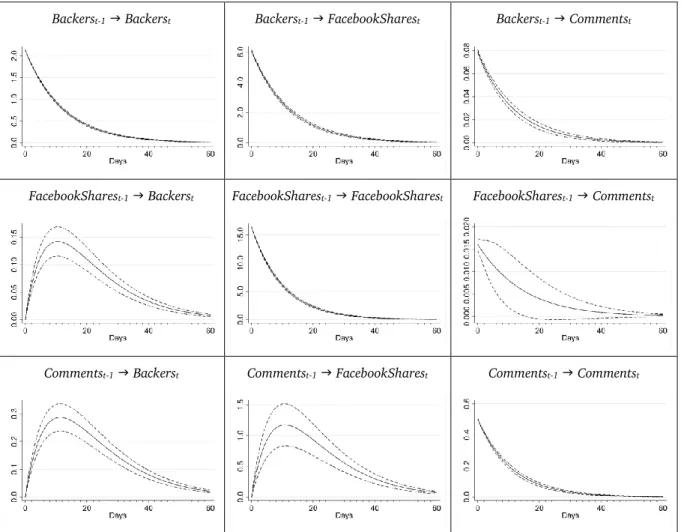
Figure 5: Impulse Response Functions (Impulse Response) ... 33
Figure 6: Percentage of Campaigns in the Distinct Categories on Indiegogo and Kickstarter that Received Non-genuine Facebook Likes During the Campaign Life Cycle ... 52
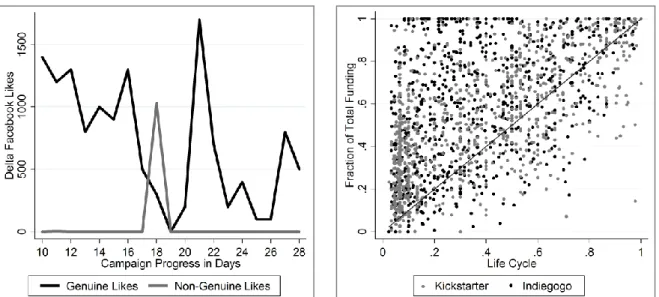
Figure 7: Example of Genuine and Non-genuine Peaks in Facebook Likes ... 53
Figure 8: Timing of Unnatural Peaks with Respect to Funding and Life Cycle ... 53
Figure 9: Effects of the Policy Change on Count and Revenue of Campaigns... 89
Figure 10: Effects of the Policy Change on Platform Revenue ... 90
List of Tables
Table 1: Additional Articles ... 6
Table 2: Summary Statistics ... 27
Table 3: Granger Causality Tests ... 30
Table 4: PVAR Model Results for Main Analysis ... 31
Table 5: Timing and Effect Intensity on Backers ... 34
Table 6: PVAR Model Results for Sub-Sample Analyses ... 35
Table 7: Summary Statistics for the Complete Dataset and for Campaigns that Received Fake Likes ... 51
Table 8: Results from Fixed Effects Negative Binominal Regression ... 54
Table 9: Results from the Probit Regression ... 55
Table 10: Big Five Personality Traits and the Associated Characteristics (McCrae and Costa Jr, 1999; Lampe, 2004) ... 62
Table 11: Example Text and the Output by Personality Insights. ... 67
Table 12: Summary Statistics and Correlations ... 71
Table 13: Results of the Probit and OLS regression. ... 72
Table 14: Summary Statistics ... 88
Table 15: Pairwise Correlations for Numerical Variables ... 91
Table 16: Negative Binominal Regression on Campaign Backing ... 92
Table 17: Electronic Word-of-Mouth and Popularity Information ... 119
Table 18: eWOM Sentiment Analysis ... 120
Table 19: Phillips-Perron Unit Root Test ... 121
Table 20: GFEVD for Backers ... 122
Table 21: GFEVD for FacebookShares ... 122
List of Abbreviations
AON All-or-Nothing
API Application programming interface(s)
DV Dependent variable
eWOM Electronic word-of-mouth
HHI Herfindahl–Hirschman index
IRF Impulse response function(s)
IS Information systems
LIWC Linguistic Inquiry and Word Count
PC Policy change
PI Popularity information
RQ Research question(s)
1
Introduction
1.1
Motivation & Research Question
An emerging business model has gained rapid traction in the last few years. New companies such as Uber, AirBnB and Twitter were formed less than 10 years ago and have reached aston-ishing market valuations, while employing very few traditional resources. Paralleling their de-velopment, companies such as Google, Apple and Amazon have also experienced rapid growth and have become some of the most highly valued companies in the world. These companies appear to leverage different means to create value for themselves and their customers, as the traditional mechanics that drive business scale apparently do not apply to them (Choudary, 2015). Many of the biggest and most highly valued companies in the world, including Alibaba, Google, AirBnB, Microsoft or Visa, are what are referred to as multi-sided platforms. This means that these businesses connect members of one group with people from another group. For ex-ample, AirBnB connects people who are looking for accommodation with people who happen to offer their apartment for short-term rent. The biggest retailer worldwide, Alibaba, digitally connects buyers and sellers on their platform, without maintaining a warehouse.
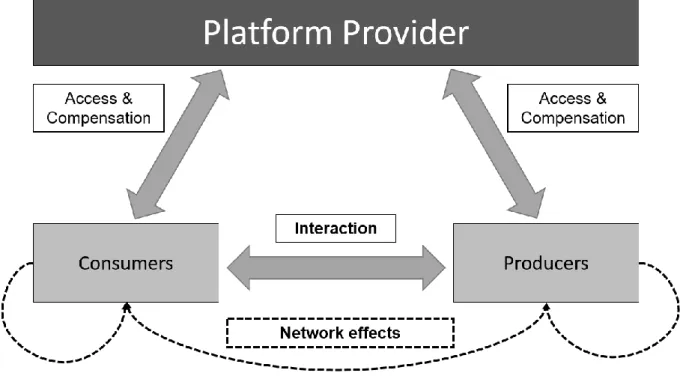
These companies and business models are very different from traditional businesses that oper-ate with a linear value chain. For instance, traditional manufacturing businesses buy raw ma-terials, make products and sell them to their customers. The raw material of multi-sided plat-forms, on the other hand, is the different groups of customers that they bring together in order to facilitate their interactions (Evans et al., 2011). Multi-sided platforms therefore coordinate the demand of customer groups. Vendors of operating systems provide software that users, developers and hardware providers can use together and enable the interaction between the groups (Schmalensee and Evans, 2007). This leads to the conclusion that the purpose of the operating system vendor or the platform is shifting towards enabling efficient social and busi-ness interaction, mediated by software. In this new design, where a company is no longer the producer of value, but the enabler of interaction, two specific roles are performed by multi-sided platforms: first, they provide an open, participative infrastructure for producers and con-sumer to interact with each other. Second, they curate and govern the participants in order to guarantee frictionless interaction (Choudary, 2015). Despite the importance of the provider, an ecosystem evolving around a platform is also heavily dependent on the network effects among the distinct groups of stakeholders, as each participant experiences externalities (Bakos and Katsamakas, 2004; Benlian et al., 2015). This leads to a dynamic system with interdependencies between all participants. Illustrating a simple and generic platform ecosystem, Figure 1 depicts the basic components and interactions between the participants. While producers and consumer seek access to the platform in order to interact with the other side of the market, the platform provider orchestrates all participants and transactions. Deepening the understanding of the dy-namics and mechanisms that are at work in these platform ecosystems is crucial for providers, producers, consumers and investors alike.
Figure 1: Platform Ecosystems
This dissertation tries to enhance current knowledge and open up new research avenues that are relevant for the academic discourse as well as applications in real-life settings. This thesis is therefore guided by the following overarching research question:
How do the actions of participants affect each other and their platform ecosystem as a whole? In order to answer this question, the research context of crowdfunding was chosen. Crowdfund-ing evolved from the concept of crowdsourcCrowdfund-ing (Bayus, 2013). The neologism “crowdsourcCrowdfund-ing” is defined as the act of outsourcing a task that used to be performed internally to a large, un-defined and external group of people in the form of an open call (Howe, 2008). Hence, crowd-funding allows individuals or organizations to fund a project by receiving financial contributions from a large number of individuals through an open call (Schwienbacher and Larralde, 2012). Here, the crowdfunding platform acts as an intermediary between project creators and backers of the projects. The main task of the provider is therefore to orchestrate the interaction between the participants. Given that participation in crowdfunding is mostly open to the public, this research context provides ample opportunities to observe the distinct actions of owners, con-sumers and producers. This data transparency and traceability over time enables researchers to investigate the consequences and dynamics for the distinct platform participants as well as the ecosystems as a whole.
1.2
Structure of the Thesis
In order to address the different aspects of the proposed research question, this thesis is subdi-vided into seven chapters. The motivation for the overarching research question is given in the introductory chapter. Chapter 2 then provides the theoretical foundations and establishes a common understanding of the research context. Chapter 3 to 6 consist of the four peer-reviewed
and published articles that constitute the core of this cumulative dissertation. The final chapter then summarizes and recaptures the main theoretical and practical contributions.
Summaries, contributions and the articles are written from the first-person-plural point of view (i.e., we) in order to express that the studies were conducted with co-authors and therefore also reflect their opinions. The four articles included in this dissertation and their respective publi-cation outlets and dates are:
Thies, F., Wessel, M., and Benlian, A. (2016) “Effects of Social Interaction Dynamics on
Plat-forms”
In: Journal of Management Information Systems 33(3). VHB: A
Wessel, M., Thies, F., Benlian, A. (2015) “A Lie Never Lives to Be Old: The Effects of Fake
So-cial Information on Consumer Decision-Making in Crowdfunding”
In: 23rd European Conference on Information Systems, Münster, Germany. VHB: B
Thies, F.; Wessel, M; Rudolph, J.; Benlian, A. (2016) “Personality Matters: How Signaling
Personality Traits Can Influence the Adoption and Diffusion of Crowdfunding Campaigns” In: 24th European Conference on Information Systems (ECIS), Istanbul, Turkey. VHB: B Wessel, Michael and Thies, Ferdinand and Benlian, Alexander (2015) “The Effects of
Relin-quishing Control in Platform Ecosystems: Implications from a Policy Change on Kickstarter” In: International Conference on Information Systems (ICIS), Fort Worth, USA. VHB: A
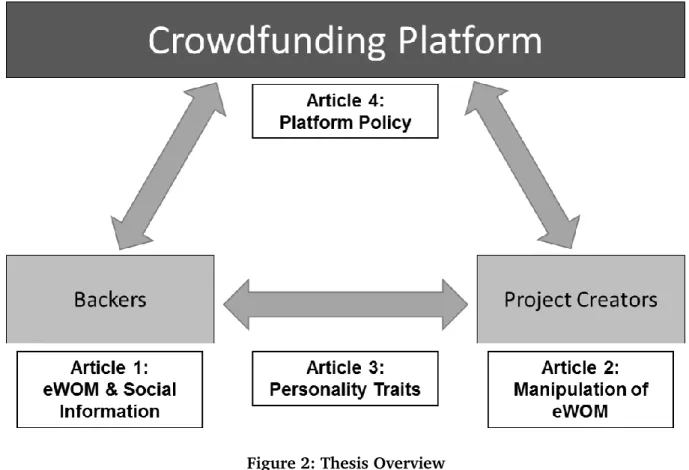
Each article addresses a different aspect of the general research question and has undergone a slight editorial revision in order to provide a consistent layout throughout this dissertation. An overview of how each article aligns with the general platform framework is given in Figure 2.
In the following, each article is summarized shortly and the main findings in relation to the overarching research question are presented.
Article 1 (chapter 3) establishes the importance of asymmetric information between project backers and creators. Furthermore, it provides evidence of how and to what extent popularity information and electronic Word-of-Mouth (eWOM) influence the decision-making of project backers under uncertainty. The results are based on a panel vector autoregressive analysis with a dataset consisting of approximately 23.000 crowdfunding campaigns that ran on the platform Indiegogo between November 2013 and June 2014. The study contributes to the extant litera-ture by providing a better understanding of the dynamic effects of opinion-based and action-based social interactions, showing that social interactions are perceived as quality indicators on crowdfunding platforms. The first paper therefore addresses how the actions and opinions of consumers influence the decision-making of other potential consumers.
Building on the importance of eWOM and the growing success of social media, a strong pres-ence of social information, such as customer product reviews and product ratings in electronic markets, incentivizes producers to game the system by creating fake data. Article 2 (chapter 4) identifies such a manipulation strategy of producers and the resulting effects of fake social in-formation on consumer decision-making. Analyzing over 80,000 campaigns that ran on Kick-starter and Indiegogo from November 15th 2013 to August 18th 2014 with over 1.85 million data points, we were able to show that a positive and significant short-term effect can be in-duced by a manipulation of social information. However, the total effect of a manipulation strategy is harmful for the funding outcome. This shows that consumers are aware of the strat-egies and abandon the respective projects. With regard to the initial research question, this chapter provides evidence of how the actions of producers prevent consumers from adopting a project.
With the aforementioned information asymmetries in mind, potential investors face uncertain-ties not only concerning the quality of the projects but also the characteristics and behavioral intentions of the project creators. Article 3 (chapter 5) therefore looks into the influence of a creator’s personality traits that are signaled via the respective campaign description and video on the decision-making of consumers. Here our final dataset consisted of 33,420 campaigns, with over 3.5 million backers and approximately $324,300,000 in pledges. We were then able to demonstrate that the personality traits openness and agreeableness conveyed by the descrip-tion and the video are favorable to the funding success of a project. Showing signs of neuroti-cism, on the other hand, significantly reduces the funding probability. Our findings demonstrate that potential investors pay close attention to the way project creators present themselves and their projects on crowdfunding platforms. Concerning the research question, this paper again focuses on the actions of producers and shows how their characteristics play an important role in the decision-making process of consumers.
So far, the articles have focused on the actions, behaviors and characteristics of producers and consumers in a platform ecosystem. However, platform providers naturally preside over the
platform and their actions are highly influential. Hence, article 4 (chapter 6) examines a gov-ernance decision of the platform provider and how it affected the ecosystem as a whole and participants in particular. The decision in question was a policy change regarding the gatekeep-ing process of the platform. After the policy change, it was much easier to access the platform as a project creator. By analyzing over 67,000 Kickstarter campaigns under the conditions of a natural experiment over a one-year period, we were able to show that loosening the control mechanisms led to a general decline in project quality and funding. On the other hand, platform indicators suggest that the policy change has indeed increased platform revenue, as the larger number of campaigns compensated for the lower average revenue per campaign. Producers are therefore confronted with a higher level of competition, while consumers face greater uncer-tainties about campaign quality, but also more offerings to choose from. Concluding the thesis, the fourth article addresses the final aspect of the initial research question by demonstrating how the platform provider’s actions can fundamentally alter the dynamics of a platform ecosys-tem.
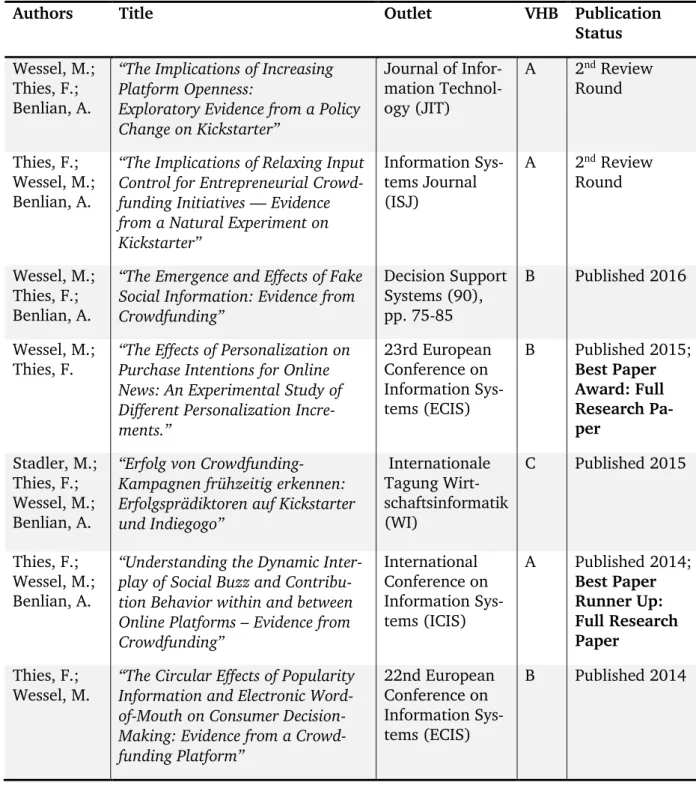
In addition to the articles included in the thesis, the following articles (Table 1) were also pub-lished or are still under review during my time as a PhD candidate. They are, however, not part of this dissertation:
Table 1: Additional Articles
Authors Title Outlet VHB Publication
Status Wessel, M.;
Thies, F.; Benlian, A.
“The Implications of Increasing Platform Openness:
Exploratory Evidence from a Policy Change on Kickstarter” Journal of Infor-mation Technol-ogy (JIT) A 2nd Review Round Thies, F.; Wessel, M.; Benlian, A.
“The Implications of Relaxing Input Control for Entrepreneurial Crowd-funding Initiatives — Evidence from a Natural Experiment on Kickstarter” Information Sys-tems Journal (ISJ) A 2nd Review Round Wessel, M.; Thies, F.; Benlian, A.
“The Emergence and Effects of Fake Social Information: Evidence from Crowdfunding” Decision Support Systems (90), pp. 75-85 B Published 2016 Wessel, M.; Thies, F.
“The Effects of Personalization on Purchase Intentions for Online News: An Experimental Study of Different Personalization Incre-ments.” 23rd European Conference on Information Sys-tems (ECIS) B Published 2015; Best Paper Award: Full Research Pa-per Stadler, M.; Thies, F.; Wessel, M.; Benlian, A.
“Erfolg von Crowdfunding- Kampagnen frühzeitig erkennen: Erfolgsprädiktoren auf Kickstarter und Indiegogo” Internationale Tagung Wirt-schaftsinformatik (WI) C Published 2015 Thies, F.; Wessel, M.; Benlian, A.
“Understanding the Dynamic Inter-play of Social Buzz and Contribu-tion Behavior within and between Online Platforms – Evidence from Crowdfunding” International Conference on Information Sys-tems (ICIS) A Published 2014; Best Paper Runner Up: Full Research Paper Thies, F.; Wessel, M.
“The Circular Effects of Popularity Information and Electronic Word-of-Mouth on Consumer Decision-Making: Evidence from a Crowd-funding Platform” 22nd European Conference on Information Sys-tems (ECIS) B Published 2014
2
Theoretical Background
The theoretical foundation of this dissertation consists of three main aspects that will briefly be presented in the following sections and put into perspective with the research context. First, an introduction to platform economics is given, detailing the dynamics and mechanism of plat-form-based business and their impact on industries as well as consumers. Second, platform governance mechanisms that can be used by the owner are introduced, which can be summa-rized under the term of platform control. Third, information asymmetries and quality signals are presented in the light of interactions in platform ecosystems. Finally, the aforementioned theoretical foundations are applied in the research context of crowdfunding platforms.
2.1
Platform Economics
Platforms have become a ubiquitous phenomenon in today’s world, and the business model associated with them has turned whole industries upside down.
Two-sided platforms were first identified by Jean Charles Rochet and Jean Tirole in 2001. Their subsequent pioneering work attracted scholars and practitioners alike, leading to a significant theoretical and empirical literature.
While a platform is generally defined as “a set of stable components that supports variety and evolvability in a system by constraining the linkages among the other components” (Baldwin and Woodard, 2009, p. 19), in the context of this thesis the established view is that platforms are defined as all “products and services that bring together groups of users in two-sided net-works” (Eisenmann et al., 2006, p. 2). Evans and Schmalensee (2016) add to the definition by calling multi-sided platforms “matchmakers that connect one group of customers with another group of customers.”
An ecosystem evolving around a platform can therefore be characterized by network effects among the distinct groups of stakeholders, as each side derives positive externalities from the participation of the other side (Bakos and Katsamakas, 2004; Benlian et al., 2015). In this re-gard, the success of a platform ecosystem strongly correlates with the availability of compelling products that attract a sufficiently high number of interested consumers. However, comple-mentors will only be willing to contribute products if the platform provides sufficient incentives to do so, such as a reasonable commission on profit and a sufficient number of potential cus-tomers (Rochet and Tirole, 2003). Creating favorable conditions for these network effects to emerge is thus at the core of platform management.
For the sake of clarity, some intuitions of the economics of two-sided platforms shall be ex-plained with the help of an example: a heterosexual, single-oriented club. A club or a bar pro-vides men and women with the opportunity of meeting and dating by giving them a common platform for interaction. The owner of the club needs to get the two groups of customers on board in order to provide the promised possibility to interact and create value in the process. However, the balance of men and women matters a great deal to each party. A bar with very
few women will not attract men and vice versa. Here, pricing is a common mechanism to bal-ance the number of men and women. A club might offer lower entrbal-ance fees or free drinks if women are in short supply. More popular clubs with queues outside can adjust their door policy and hand-pick the participants to get the balance right. Here, typically women are picked out disproportionally (Evans et al., 2011).
2.2
Information Asymmetries & Quality Signals
Even though the goal of the platform provider is to create favorable conditions for the exchange of services and goods, the quality is often difficult to ascertain. Digital platforms lack physical contact, which prevents consumers from touching, smelling or tasting a product in order to evaluate its quality (Mavlanova et al., 2012). This results in a situation where a consumer can only learn about the true quality after the delivery of the service or good. Therefore, only the producer knows about the quality of the product beforehand. This difference in information allocation between producers and consumers is known as information asymmetry and can lead to an adverse selection problem where consumers make buying decisions based on limited in-formation, such as price (Akerlof, 1970). In platform ecosystems or online purchases, infor-mation asymmetry can be intensified, as the producer alone controls the flow of inforinfor-mation towards the consumer and is thus able to overstate quality or withhold information (Mavlanova et al., 2012).
Even though physical search costs on the internet are extremely low, search costs may still arise due to the difficulty of evaluating service quality. Therefore, other forms of information sources might gain more attention. This phenomenon was, for example, confirmed for brand equity in services (Krishnan and Hartline, 2001).
However, alternative sources of information might not always be available. Whereas established products are often extensively reviewed and tested, innovative and new products or firms make it harder for potential customers to gather information on the true quality. Therefore, the con-sumer can draw inferences about the true quality from credible signals sent by the comple-mentor (Biswas and Biswas, 2004). Extensive research has been conducted on what is collec-tively referred to as signaling theory, to understand which signals might be reliable and could thus be relevant for the consumer in buying situations (Spence, 2002). Prior research has shown that businesses are able to signal product quality through, for example, advertising, pricing or product warranties, even though those aspects are detached from product quality itself (Kirmani and Rao, 2000; Yen, 2006). However, these quality signals might become even more credible to customers when sent by other customers instead of businesses. Platforms usually allow or even encourage their consumers to exchange opinions and recommendations on a large scale through social information, such as online customer product ratings and voting. This form of scaling quality is often termed social curation and—from a provider’s perspective—provides a very efficient way of controlling product quality (Choudary, 2015).
Going back to the nightclub example, signaling quality is crucial before interactions take place. Here, both groups of customers try to present themselves as favorable as possible. These efforts might include dressing up or excessive spending. One might even refer to signaling as a way of showing off. Whether these signals constitute true quality remains to be seen.
2.3
Platform Governance
Operators of platforms face the enduring challenge of aligning their own objectives with those of the main stakeholders within the platform ecosystem. Platform governance, which can gen-erally be defined as “who makes what decisions about a platform” (Tiwana et al., 2010, p. 679), plays a crucial role for platform owners. The need to involve and engage platform participants requires them to make deliberate choices about decision rights, ownership and control. Platform governance is closely aligned with controlling the stakeholders of a platform ecosystem. Classi-cal literature circumscribes control as mechanisms that are used by controllers in the attempt to influence controlees so that they act and behave in accordance with the controller’s objectives (Kirsch, 1997; Ouchi, 1979). Here, two main categories of control have been distinguished, namely formal and informal control (e.g., Kirsch, 1996), which are further subdivided into dif-ferent modes. In the category of formal control, two distinct approaches have been identified, namely output (also referred to as outcome) and process (also referred to as behavior) control (e.g., Eisenhardt, 1985; Ouchi, 1979).
Output control refers to a set of rules where the controlee is required to reach a certain goal or objective given by the controller in order to be rewarded. Process control, on the other hand, obligates the controlee to adhere to specified procedures and routines during the process. In contrast, informal control modes do not require specific incentives to align the goals of control-ler and controlee, as norms and values are shared among both parties (Kirsch et al., 2002). Within informal control, the literature distinguishes self- and clan control (e.g., Kirsch, 1996; Ouchi, 1979). Self-control exists when controlees define and monitor their own goal achieve-ment and reward or punish themselves accordingly. Clan control is closely related to self-control with the distinction that a group of controlees, rather than an individual controlee, embrace shared values and commit to achieving common goals (Kirsch et al., 2002).
Originating from organizational theory, the concept of control has drawn considerable attention among scholars of information systems (e.g., Kirsch et al., 2002; Kirsch, 1997; Tiwana and Keil, 2009). However, it was only applied in the context of digital platforms quite recently (e.g., Ghazawneh and Henfridsson, 2013; Wareham et al., 2014; Goldbach et al., 2014). This is not surprising, as the aforementioned transformation of business models towards platforms is still ongoing. Still, the relevance of the formal and informal control mechanisms mentioned is de-creasing in platform contexts due to redundancy and costliness (Tiwana, 2015).
More precisely, process control is often obsolete, due to the fact that platform owners are ulti-mately only interested in the final complement (e.g., mobile apps, crowdfunding projects or a ride on Uber).
Costs that have to be borne by the complementors to deliver the product are of very little con-cern to the platform provider, as their relationship is not a classical principal-agent relationship, where a complementor is hired by a provider. Also, in order to establish an effective clan control mechanism, a relatively stable ecosystem with frequent interactions is required. Following this line of argument, it can be concluded that formal and informal control mechanisms are “less viable in loosely coupled organizational structures” (Tiwana, 2015, p. 4).
In an ecosystem with high fluctuations in terms of complementors, providers therefore focus their efforts towards input control mechanisms. Input control is a formal control mechanism that can be defined by the degree to which platform providers use a predefined set of rules and guidelines to decide whether a participant should be allowed into the platform (Cardinal et al., 2004; Tiwana et al., 2010).
Once again, referring back to the example of the nightclub above, this mechanism is fairly well mirrored in the door policy of an establishment, where a gatekeeper decides who may enter the club and who may not, based on a set of rules, such as the attire or looks.
In a platform setting the purpose of input control is therefore to ensure that complementors abide by the rules and standards set by the provider in order to guarantee that the values and goals of the participants are closely aligned (Maurer and Tiwana, 2012). However, too much alignment might backfire. First, especially in nascent markets where consumer preferences are not yet settled, forcing producers to comply with established rules could hinder innovation (Claussen et al., 2013). Second, input control poses upfront costs for the screening process that could become unbearable for the provider if the number of complementors rises disproportion-ally due to triggered network effects and exponential growth. Still, research has shown that the mere perception of an established input control mechanism will induce complementors to pay more attention to the rules (Aghion and Tirole, 1997). This implies that “greater use of input control can by itself reduce its need” (Tiwana, 2015, p. 6).
This arising trade-off between retaining and relinquishing control has received increasing at-tention among scholars and practitioners alike, where the apparent differences in input control exercised by the platform owner are often coined as the degree of platform openness (e.g., Boudreau, 2010; Cusumano, 2010; Benlian et al., 2015; Ondrus et al., 2015; Wareham et al., 2014).
2.4
Conceptual Foundations of Crowdfunding
Crowdfunding builds on the broader concept of crowdsourcing (Bayus, 2013) as it allows indi-viduals or organizations to fund a project by receiving small financial contributions from a large number of individuals through an open call—mostly on the Internet (Schwienbacher and
Larralde, 2012). This is contrary to the traditional approach of funding where large contribu-tions from a small number of investors are received.
The reasons project creators opt for crowdfunding instead of traditional funding methods are not limited to financial aspects. First, the success of the campaign also validates that there is a market for the respective product or service. Second, the campaigns themselves can also serve as a marketing tool to draw attention to the proposed product idea (Burtch et al., 2013; Mollick, 2014).
This thesis focuses on reward-based crowdfunding. Unlike with equity-based and lending-based crowdfunding, where backers can generate revenue through private equity in the respective company or through interest on the amount invested, no financial benefits are offered in this case. Instead, backers can expect to receive a tangible benefit from their investment (e.g., early and discounted purchase of the product or service). These rewards, however, have a high level of uncertainty, as backers cannot judge the quality when making their investment decision. Additionally, further conditions must be met before rewards can be delivered to the backers of a campaign. One fundamental condition is that the campaign is successful, meaning that enough funds are raised within the pre-arranged campaign runtime to bring the project to life. Depending on the different crowdfunding platforms, project creators receive the pledged funds regardless of whether their funding goal is reached (e.g. Indiegogo), or the funds are only paid out if the funding goal is reached. The latter is commonly called the “All-or-Nothing” (AoN) funding model and is prominently used by Kickstarter. Also, an investment in a crowdfunding campaign cannot be equated to a purchase, since there is usually no legal obligation for the creator to produce and deliver the reward (Mollick, 2014). In sum, backers can be less certain that they will receive any return on their investment and have very little information about the promised reward compared to a regular buying situation, in which a product can be inspected thoroughly. Still, previous research has shown that rewards are a central reason for backers to participate in reward-based crowdfunding (Kuppuswamy and Bayus, 2014). The resulting in-formation asymmetries need to be mitigated by the project creator in order to convince potential backers of the project quality. The methods to do so usually consist of the textual campaign description the creator publishes on the platform and often includes a short video, showing the creator, possibly a prototype, the finished product or other important aspects of the campaign. Due to the possibility for consumers to exchange opinions and recommendations on a large scale, social curation is expected to play an important role in ensuring project quality and re-ducing information asymmetries (Choudary, 2015).
For the purpose of illustrating the information a potential backer has before deciding to back a campaign, a typical campaign homepage is shown in Figure 3. The page is dominated by the video (1) in the center accompanied by the textual description (2) of the project below. Other aforementioned features such as a quantitative measure of eWOM (3), for example in the form of Facebook Shares or on-site comments, are placed around the center. Popularity information (4), including the number of backers and the funding volume, is also prominently shown on
the upper right side. Furthermore, short information on the creator (5) is given on the right, and the promised rewards (6) are described on the bottom right, including the required pledge for each reward.
Figure 3: Campaign Page on Kickstarter
As creators usually do not launch multiple projects, a crowdfunding campaign is most often a one-off process and the platform can be regarded as a loosely coupled organizational structure (Tiwana, 2014), where input control mechanisms are highly relevant. This means that the gate-keeping process and the decision who may enter the platform as a creator should be of great importance. In sum, crowdfunding provides extremely fruitful grounds for investigating the dynamics of platform ecosystems under the lenses of information asymmetries, social interac-tions and platform governance. In the context of crowdfunding and this dissertation, the terms project creator, producer and complementor are used interchangeably. The same applies to backers, consumers and funders.
With the basic theoretical background established, the following chapters 3 to 6 consist of the aforementioned articles. Each chapter is concerned with a different aspect of the dynamics of a platform ecosystem.
3
Social Interaction on Platforms
Title: Effects of Social Interaction Dynamics on Platforms (2016)
Authors: Thies, Ferdinand
Wessel, Michael Benlian, Alexander
Published in: Journal of Management Information Systems, 33 (3)
Abstract
Despite the increasing relevance of online social interactions on platforms, there is still little research on the temporal dynamics between electronic word-of-mouth (a form of opinion-based social inter-action), popularity information (a form of action-based social interinter-action), and consumer decision-making. Drawing on a panel dataset of more than 23,300 crowdfunding campaigns from Indie-gogo, we investigate the dynamic effects of these social interactions on consumers’ funding decisions using the panel vector autoregressive methodology. Our analysis shows that both electronic word-of-mouth and popularity information are critical influencing mechanisms in crowdfunding. How-ever, our overarching finding is that electronic word-of-mouth surrounding crowdfunding cam-paigns on Indiegogo or Facebook has a significant yet substantially weaker predictive power than popularity information. We also find that whereas popularity information has a more immediate effect on consumers’ funding behavior, its effectiveness decays rather quickly, while the impact of electronic word-of-mouth recedes more slowly. This study contributes to the extant literature by (1) providing a more nuanced understanding of the dynamic effects of opinion-based and action-based social interactions, (2) unraveling both within-platform and cross-platform dynamics, and (3) showing that social interactions are perceived as quality indicators on crowdfunding platforms that help consumers reduce risks associated with their investment decisions. The key practical implica-tion is that a more nuanced understanding of the dynamic impact of social interacimplica-tions within and across platforms can help platform providers and complementors to stimulate contribution behavior and increase platform prosperity overall.
Keywords: electronic word-of-mouth, popularity information, informational cascades, reward-based crowdfunding, panel vector autoregression
3.1
Introduction
Consumers tend to consider other people’s opinions and actions when they make buying deci-sions. For instance, a person might choose to visit a restaurant based on a friend’s recommen-dation or its observable popularity (Becker, 1991). Given that online transactions restrict con-sumers’ ability to assess a product’s quality due to the lack of direct interaction with product and seller, these social interactions play a particularly critical role in electronic markets and have become a vital quality indication for consumers to use for decision support (Dellarocas, 2003; Godes et al., 2005).
Social interactions have been generally defined as “actions […] taken by an individual not ac-tively engaged in selling the product or service and that impact others’ expected utility for that product or service” (Godes et al., 2005, p. 416-417). Previous research distinguished between two distinct types of social interactions that have been shown to be particularly relevant in an online context, namely opinion-based or preference-based and action-based or behavior-based social interactions (e.g., (Chen et al., 2011; Cheung et al., 2014; Tucker and Zhang, 2011)). The former type is often referred to as electronic word-of-mouth (eWOM) communication in an online context and can be described as a statement by potential, actual, or former customers about a product or company (Hennig-Thurau et al., 2004). The latter type, often facilitated through popularity information (PI), becomes relevant in situations in which individuals who face identical decisions under uncertainty can observe the actions of other consumers (e.g., in the form of aggregated statistics displaying the number of downloads or purchases of a product) who faced the same decisions earlier on, but not the motivation behind their actions (Bikhchandani et al., 1992; Bikhchandani et al., 1998). These situations can lead to informa-tional cascades, an information-based explanation for herd behavior that occurs when individ-uals who face a certain decision choose to follow the actions of others instead of taking a deci-sion based on their own private information (Bikhchandani et al., 1992; Tucker and Zhang, 2011; Bikhchandani et al., 1998; Duan et al., 2009).
The Internet offers consumers various opportunities to engage in online social interactions with their peers and other consumers via, for example, online review platforms, social networking websites, blogs, and online forums. These interactions help them to overcome the information asymmetry for products and services whose quality is difficult to ascertain before purchase. E-commerce vendors have also recognized the critical role of social interactions among consumers to influence their purchasing decisions and platforms provide informational cues in order to facilitate these interactions. Amazon.com, for example, facilitates the dissemination of eWOM by encouraging consumers to publish product reviews, but also depicts popularity information by showing sales rankings and by highlighting top selling products in each product category. Motivated by the practical relevance of online social interactions, researchers dedicated a num-ber of important studies to the phenomenon. For example, Luo and Zhang (2013) have shown that consumer buzz and firm value not only affect one another over time, but that consumer
buzz also has autoregressive carry-over effects so that past buzz influences current buzz, high-lighting the self-reinforcing nature of opinion-based social interactions. Duan et al. (2009) em-pirically demonstrated the existence of complex informational cascades between other users’ software download behavior (as indicated by popularity information) and subsequent software downloads, revealing dynamic co-movements between user actions on platforms.
While previous research examined the effects of the two types of online social interactions sep-arately in various settings (e.g., (Duan et al., 2008; Duan et al., 2009; Forman et al., 2008; Liu, 2006)), only a few studies, such as Chen et al. (2011) and Cheung et al. (2014), considered both types simultaneously and examined their relative impact on consumer decision-making. However, there is still little understanding of how dynamic these effects are and how quickly or slowly they unfold and evolve. Such an assessment is crucial in order to understand at which point in time online social interactions have the biggest effect on consumer decision-making, given the fast-paced speed of decisions in the online world. Thus, there is a clear need to exam-ine how these mechanisms weigh up in their predictive ability as well as how they differentially affect one another over time. This study attempts to fill this research gap, guided by the follow-ing research question:
RQ: What are the effects of opinion-based and action-based online social interactions on
consumer decision-making and how do these effects build up and decay over time?
To answer our research question, we focus on crowdfunding, a context in which social interac-tions play a particularly important role. Crowdfunding allows individuals or organizainterac-tions to raise funds for diverse projects by receiving small financial contributions from a large number of individual investors (Mollick, 2014). As investments in crowdfunding campaigns can be con-sidered risky for the investors due to limited information about the projects and uncertain out-comes, it becomes optimal for investors to infer the quality of campaigns from the opinions and actions of other consumers.
We collected daily project-level data from Indiegogo, one of the largest reward-based crowd-funding platforms. Since its launch in 2008, more than 400,000 campaigns have run on Indie-gogo and millions of dollars have been distributed to campaign creators (Mearian, 2016). We complemented this dataset with corresponding eWOM data gathered from Facebook and Indi-egogo itself. Using daily data on more than 23,300 crowdfunding campaigns that ran between November 2013 and June 2014, we analyze the dynamic effects of eWOM and PI on subsequent campaign funding decisions using the panel vector autoregressive (PVAR) methodology. Our findings provide noteworthy contributions to theory and practice. First, we contribute to the software platform and social media literature by providing a more nuanced understanding of eWOM’s and PI’s dynamic impact. By examining buildup and decay effects (Little, 1979), we show that PI has a more immediate predictive relationship with consumers’ funding behavior than eWOM. However, while the effects of PI diminish rather quickly, the effects of eWOM persist longer. Although previous studies also explored the differential effects of early versus
late eWOM (e.g., (Godes and Mayzlin, 2004; Luo, 2009)), ours is among the first to disentangle and compare the dynamic relationships of opinion-based (eWOM) as well as action-based (PI) online social interactions over time. Second, our study also contributes to the burgeoning soft-ware platform literature because we unravel both within-platform and cross-platform dynamics (i.e., between crowdfunding and social media platforms). With rare exceptions (e.g., (Chen et al., 2015; Dewan and Ramaprasad, 2014; Luo and Zhang, 2013)), previous research studied the dynamic effects of eWOM and/or PI on a single platform, overlooking the increasing rele-vance of cross-platform effects. By addressing these effects, we respond to calls in prior research that emphasize the importance of capturing and unpacking the evolution and interrelationships of multiple time series across information systems and platforms in an increasingly intercon-nected IT world (Adomavicius et al., 2012). Third, our study contributes to the emerging crowd-funding literature (Agrawal et al., 2015; Belleflamme et al., 2014; Burtch et al., 2013; Mollick, 2014) by showing that both eWOM and previous funding behavior by the crowdfunding com-munity (as indicated by PI) are perceived as quality indicators that allow potential backers to reduce their own risk in the face of uncertainty. Finally, understanding the relative predictive value of eWOM and PI concerning the effect on critical consumer decisions over time can help platform providers and third-party complementors to monitor and analyze the echo of changes in eWOM and previous contribution behavior. They can then adapt their project campaign and communication with prospective consumers accordingly.
3.2
Theoretical Background
3.2.1
Dynamics on Reward-based Crowdfunding Platforms
Crowdfunding, which builds on the broader concept of crowdsourcing (e.g., (Bayus, 2013)), allows individuals or organizations to reach a monetary (project) goal by receiving small finan-cial contributions from a large number of individuals instead of choosing the traditional ap-proach and receiving large contributions from a small number of investors. Crowdfunding ena-bles project creators (the fundraisers) to collect contributions (hereafter also referred to as backing or funding a campaign) from a large number of project backers (the funders) through an open call—mostly on the Internet (Schwienbacher and Larralde, 2012). The reasons project creators choose crowdfunding are not limited to financial aspects, as the success of the cam-paign also validates that there is a market for the respective product and the camcam-paigns them-selves can also have a certain marketing effect (Burtch et al., 2013; Mollick, 2014).
Unlike equity-based and lending-based crowdfunding platforms, where backers can generate revenue through private equity in the respective company or through interest on the amount invested, reward-based crowdfunding platforms do not offer backers any financial benefits. In-stead, they can expect to receive a “reward”—a non-financial tangible benefit for their invest-ment (e.g., early and discounted purchase of the product or service). Rewards have a high level of uncertainty as specific conditions have to be met before backers receive their reward. A fun-damental condition is that sufficient funds are raised within the pre-arranged campaign
runtime. Even though project creators on most reward-based crowdfunding platforms (such as Indiegogo) receive funds regardless of whether the funding goal is reached, not collecting enough funds will make it difficult for most creators to implement their project ideas and deliver the rewards. Furthermore, the backer’s investment cannot be equated to a purchase, since there is usually no legal obligation for the creator to produce and deliver the reward (Mollick, 2014). Backers can therefore be less certain that they will receive the return on their investment and have less information about the object they are investing in compared to a regular buying situ-ation, in which the product or service already exists, and can be inspected thoroughly. Previous research has found these rewards to be a central reason for backers to participate in reward-based crowdfunding (Kuppuswamy and Bayus, 2014).
The primary source of information for a potential backer to use for decision support is the cam-paign description the creator published on the platform. This often includes a short video, show-ing the creator, possibly a prototype, the finished product, or other important aspects of the campaign. Even though this content allows the backer to develop an attitude towards the cam-paign and the offered rewards, this quality assessment is potentially biased because all infor-mation stems from a single source (the project creator). This means that the quality of the campaign is often relatively vague at the time prospective backers decide whether to pledge. Other evidence concerning the trustworthiness and quality of a campaign therefore becomes increasingly important for potential backers’ evaluation. The two most prominent and salient quality criteria that are increasingly available on these platforms are social information, mostly in the form of eWOM cues (e.g., social plugins that display the number of shares the campaign receives on Facebook or the number of direct consumer comments) and popularity information such as prior contribution behavior (e.g., the number of consumers who backed a project is prominently placed on each campaign’s dashboard), allowing consumers to observe other con-sumers’ actions (e.g., (Luo and Zhang, 2013; Shi and Whinston, 2013; Duan et al., 2009)). While previous studies examined the effects of online social interactions on consumer decision-making in settings where the products share characteristics with rewards in reward-based crowdfunding (e.g., the utility of the product is difficult to ascertain before purchase), the con-cept of reward-based crowdfunding offers unique characteristics that make studying the effects of online social interactions in this setting particularly interesting. First, in other settings, the decision-making processes of consumers are often sequential in that consumers buy, experience, and review products and then influence other consumers. However, in reward-based crowd-funding, experiencing the product is a downstream process that occurs long after the campaign has ended. Therefore, backers influence potential backers with their opinions and actions with-out having any additional information abwith-out the reward. Second, many online platforms such as online auction websites encourage sellers to build and maintain a reputation on the platform as a quality indicator for subsequent buyers. As a crowdfunding campaign is most often a
one-off process for the project creators1, similar reputation mechanisms cannot be found on crowd-funding platforms, which increases the relevance of online social interactions in this setting.
3.2.2
Electronic Word-of-Mouth
Word-of-mouth (WOM) is opinion-based or preference-based social interaction between not commercially affiliated consumers about commercial content such as brands, products, or ser-vices (Arndt, 1967; Chen et al., 2011). Previous research found a significant influence of WOM on consumers’ information search, evaluation, and decision-making, as it “influences attitudes during the pre-choice evaluation of alternative service providers” (Buttle, 1998, p. 242). Further-more, it has been shown that WOM can be more relevant than traditional marketing channels, such as advertising, in raising awareness about innovation and in convincing the receiver to try out new products (Buttle, 1998). One of the central reasons for the success of WOM is increased perceived reliability, credibility, and trustworthiness compared to communication initiated by organizations themselves (Brown et al., 2007; Arndt, 1967).
The Internet drastically increased consumers’ options for exchanging opinions about products and services and offers them a large array of possibilities to engage in a specific form of WOM called electronic word-of-mouth (eWOM). While the Internet allows eWOM to spread in an unprecedented speed and scale compared to traditional (face-to-face) WOM, it brings new chal-lenges, such as “the volatile nature of online identities and near complete absence of contextual cues” (Jensen et al., 2013, p. 295; Dellarocas, 2003). Still, it has been argued that the consumer motives that have been identified as relevant for traditional WOM are also relevant for eWOM (Hennig-Thurau et al., 2004). According to Hennig-Thurau et al. (2004, p. 39), eWOM is “any positive or negative statement made by potential, actual, or former customers about a product or company, which is made available to a multitude of people and institutions via the Internet”. The opportunities that are available for consumers to share their opinions, preferences, or experi-ences online are manifold and a multitude of possible channels such as product review websites, blogs, and online communities are available. Due to their constant presence and accessibility, social networking websites such as Facebook in particular have been used to generate massive amounts of eWOM messages.
The response of an individual to an eWOM message received via these channels depends on two sequential cognitive processes, namely awareness and persuasiveness. The awareness effect can be explained by the sheer volume of eWOM, making it more likely for a receiver to be informed about the content (Liu, 2006). Only after the receiver is aware of the content, a cog-nitive process starts evaluating the message’s credibility by examining its valence and the re-ceiver’s social ties with the sender. Several studies have shown that eWOM volume, rather than
1 In our dataset, less than 7% of creators had set up more than two campaigns in the past. Out of the top 20 Indiegogo campaigns, 17 were from first-time creators.
valence, is significantly associated with product sales (e.g., (Davis and Khazanchi, 2008; Duan et al., 2008)).
Given the findings on the effects of eWOM on a firm’s equity value (Luo and Zhang, 2013; Luo et al., 2013) and on the decision-making of consumers in different contexts such as movies (Liu, 2006), books (Chevalier and Mayzlin, 2006), and video games (Zhu and Zhang, 2010), and taking into account the relatively high risk when investing in crowdfunding campaigns, eWOM can be expected to be of great importance for the success of a crowdfunding campaign. Spread-ing the word in social media raises awareness for the respective crowdfundSpread-ing campaign with-out requiring financial investments and can be central in persuading prospective backers to invest. Without eWOM, the campaign description remains the central source of information for the backer who might be uncertain about the utility of the proposed project and its rewards. Although eWOM and its contagious effect on consumer decision-making have been extensively investigated in online environments (e.g., (Jabr and Zheng, 2014)), previous research paid only little attention to the fact that eWOM does not unfold in a vacuum. But it may be presumed to occur with parallel observational mechanisms on platforms—that is, besides spreading the word around crowdfunding campaigns, prospective backers can increasingly observe the dynamics of real funding behavior from other backers on the platform.
3.2.3
Popularity Information and Informational Cascades
Compared to eWOM, which is focused on the exchange of information in the form of opinions among consumers, PI facilitates action-based or behavior-based social interactions (Chen et al., 2011; Godes et al., 2005). Many e-commerce vendors use PI cues as an indicator of the choices earlier adopters made by displaying sales rankings or absolute sales in order to influence con-sumers’ choices and behavior. Such observable actions can help consumers to learn what the most appropriate response is in a given situation, because people, in part, “determine what is correct by finding out what other people think is correct” (Cialdini, 2009, p. 152). A possible outcome of such behavior is that many individuals start to behave identically. Ultimately, this behavior can lead to informational cascades, an information-based explanation for herd behav-ior (Bikhchandani et al., 1998; Huck and Oechssler, 2000). Informational cascades occur when individuals who face identical decisions under uncertainty, can observe the actions of other individuals who faced the same decisions earlier on, but not the motivation behind their actions (Bikhchandani et al., 1992; Bikhchandani et al., 1998). In these situations, individuals will con-sider their own private information as well as the inferences drawn from observing predeces-sors’ decisions. As soon as individuals consider the decisions of other individuals as more in-formative than their own private information, they will most likely disregard their own infor-mation and imitate predecessors’ actions in order to overcome uncertainty and to avoid blame from others for making a particular choice (Sun, 2013). Any immediate successors will have even more reasons to disregard their own private information.