råá
p
=
==
=
=
=====
=råáîÉêëáíó=çÑ=pìêêÉó
Discussion Papers in Economics
Department of Economics
University of Surrey
Guildford
Surrey GU2 7XH, UK
Telephone +44 (0)1483 689380
Facsimile +44 (0)1483 689548
Web
www.econ.surrey.ac.uk
ISSN: 1749-5075
T
HEI
MPLEMENTATION OFIMF
P
ROGRAMS:
A
C
ONCEPTUALF
RAMEWORKBy
Graham Bird
(University of Surrey)
THE IMPLEMENTATION OF IMF PROGRAMS: A CONCEPTUAL FRAMEWORK
Graham Bird
Surrey Centre for International Economic Studies University of Surrey Guildford Surrey GU2 7XH Abstract
IMF supported programs have conventionally been assessed by examining their effects on intermediate variables and final outcomes. More recently greater attention has been paid to implementation on the assumption that in order to work programs need to be implemented. Empirical studies have begun to include political economy variables in an attempt to explain implementation. They have used the concept of ‘ownership’ to provide a theoretical foundation. This paper provides an alternative conceptual framework based on the marginal benefits and costs of implementation. It goes on to discuss policies that might be expected to improve implementation based on this framework.
JEL: F32, F33 Key words: IMF
ACKNOWLEDGEMENT
I am indebted to Dane Rowlands and Tom Willett for helpful comments on an earlier version of this paper. Financial support from the British Academy is also acknowledged although I alone carry responsibility for the arguments and errors made. I should also acknowledge that I have acted as an adviser to the Independent Evaluation Office of the IMF and have been a Visiting Scholar in the Fund’s Research Department.
1. INTRODUCTION
The International Monetary Fund exercises a pervasive influence over economic policy in many developing and emerging economies. The influence is at its greatest when governments turn to the Fund for direct financial assistance. This may be forthcoming under different lending facilities but will be conditional on the agreement and then the implementation of a program of policy reform.1 There is a large literature
examining the design and impact of IMF conditionality and, as one might anticipate, considerable debate about the extent to which Fund-backed programs work.2
However, a more recent trend in the literature has been to examine the circumstances under which programs are or are not implemented. 3
This concern over implementation is apposite. In order for IMF programs to exert a beneficial influence over economic performance one might suppose that two conditions have to be met. First, they have to be well-designed. Second, they have to be implemented. 4 While early research on conditionality focused on the economic
design of programs and their impact on intermediate policy variables and ultimate economic outcomes, there was little or no attempt to distinguish between those programs that were carried through to completion and those that were not. This is a important shortcoming, especially when evidence suggests that a large number of programs remain uncompleted (Mussa and Savastano, 2000). A logical next step is therefore to try and understand what factors determine the degree of implementation.
Early on, the Fund attributed poor implementation to a 'lack of political will' on behalf of the governments concerned. But, from a policy point of view, this does not get us very far unless we also understand what factors determine political will. Other studies were therefore critical of the lack of precision and attempted to analyse why governments might sign an agreement but then fail to implement it (Bird, 1998, 2002). They did this by examining the evolution of the costs and benefits involved. At the margin, a government may rationally discontinue a program where the costs of continuing to implement it are perceived to outweigh the benefits. The costs and benefits will have a political dimension and implementation therefore needs to be viewed in the context of domestic political economy.
Meanwhile, similar ideas found expression in the concept of 'ownership'.
5
Governments are more likely to implement programs that they own, and are more likely to abandon programs that they feel have been imposed upon them and which they have been coerced to follow by their immediate needs for external finance.
However 'ownership', rather like 'political will', is difficult to measure and impossible to quantity with any precision. It is necessary, therefore, to look behind ownership and examine the variables that influence a government's commitment to a particular program of policy reform and its ability to implement it within an evolving domestic political environment.
The purpose of this paper is to provide a conceptual framework within which the determinants of implementation may be analysed. The framework suggested differs from that offered elsewhere which focuses on ownership and the role of conditionality in constraining those opposed to economic reform. Indeed, the analysis in this paper
suggests that there is an important distinction to be made between ownership and implementation. Since a policy objective is to increase the degree to which programs supported by the IMF are implemented by the governments that sign up to them, the paper also explores the implications of the conceptual framework for policy.
The layout of the paper is as follows. Section 2 examines alternative ways of measuring implementation. It briefly investigates the record on implementation and assesses the extent to which the failure to implement programs is a problem that policy needs to address. Section 3 briefly examines the literature on implementation, much of which is empirical in nature. Section 4 constructs a conceptual framework within which implementation may be analysed. Section 5 builds on this framework to examine the implications for the design of IMF programs. Finally, Section 6 offers some concluding remarks that place the proposals in the context of current reform within the IMF.
2. IMPLEMENTATION: MEASUREMENT AND RECORD
Measuring implementation
Measuring the implementation of IMF-backed programs is far from straightforward. The most convenient and widely used measure is the proportion of committed resources that are disbursed, or the rate of completion (Killick, 1995, Mussa and Savastano, 2000, and Bird 2002). An advantage of this approach is that it provides continuous data. However, there are problems with it. Resources may not always be drawn on in spite of the fact that economic policy reform is undertaken. Indeed, a 'failure' to complete a program in terms of the disbursement of resources may reflect
economic 'success' in the sense that finance from the IMF is no longer required. Some programs agreed with the Fund will be precautionary or will turn precautionary and in these cases there is no intention to draw resources from the Fund; it would therefore be inappropriate to evaluate them in terms of disbursements relative to commitments. In contrast, a program may be completed in the sense of using all the agreed resources in spite of a government failing to fully implement all the conditions originally laid down. The IMF may feel that substantial progress has been made and may allow modest deviations from targets to be accommodated through the use of waivers or modifications to the initial program.
Since the beginning of the 1990s another measure of implementation has become feasible as the IMF has collected data in the form of its MONA database (Monitoring Fund Arrangements) on the extent to which both the macroeconomic and structural conditions stipulated within programs are implemented. This allows an index of implementation to be constructed. However, there are again problems with this measure; it only covers programs that come up for review by the Executive Board and therefore excludes those that are cancelled permanently or interrupted. Since it may be assumed that it will be in these programs that implementation is likely to be at its weakest, the MONA data will have an upward bias towards implementation. Moreover, there is only a limited amount of data as yet.
Other measures of implementation focus on whether programs are interrupted either reversibly or irreversibly. Reversible interruption is where a review of a program is delayed, perhaps by three months in the case of stand-bys or six months in the case of Extended Fund Facility and Poverty Reduction and Growth Facility credits, but the
program is subsequently revived. Irreversible interruption is where scheduled reviews are not completed or, even if they are, the instalments of the arrangement are not approved. This measure of implementation does not, however, tell us whether an interrupted program is replaced by another one. Moreover, it does not provide continuous data and only allows programs to be classified as uninterrupted, reversibly interrupted or irreversibly interrupted. Even so, it does usefully complement the implementation index based on the MONA database by capturing cases where programs are interrupted and, as a result, not subject to further review by the Executive Board.
Although these four measures of implementation have been found to be significantly mutually correlated with one another (Ivanova, Mayer, Mourmouras and Anayiatos, 2003) the correlation coefficients tend not to be very high, suggesting that the measures are picking up different dimensions of implementation. This needs to be borne in mind when comparing studies that use different measures.
What is the record on implementation?
Data presented by Mussa and Savastano (2000) provide information about the completion rate of IMF programs or the ratio of disbursements to commitments. Throughout 1973-1997 only about 35 per cent of arrangements were fully disbursed.
Using the interruption measure, Ivanova et al (2003) report that in the period between 1992 and 1998, 44 per cent of all programs experienced an irreversible interruption, while 70 per cent experienced either a major or a minor interruption. They also report that the average implementation index for programs based on the MONA data was 76
per cent, with the macro implementation index at 80 per cent being significantly higher than the structural implementation index at 67 per cent. Nsouli, Atoian and Mourmouras (2004) update the information provided by Ivanova et al (2003) to cover the period 1992-2002. Although, according to this more recent data, the interruption rate appears to have fallen slightly and the disbursement rate to have risen, the more recent sample contains more stand-by arrangements which tend to have fewer interruptions than EFF and PRGF programs. In any event, and according to all the measures, the failure to fully implement programs is quite widespread. To what extent is this a cause for concern?
Implementation will be important if it is via conditionality that the beneficial economic effects of IMF programs are derived. It would be difficult to justify conditionality and the related costs of negotiating it, in circumstances where it made little difference whether or not it was implemented. Indeed, in these circumstances the size of the loan and the signal transmitted by the size of IMF lending might appear to be more important aspects of IMF programs.6 But, if it is the announcement rather
than the implementation of programs that appears to have a beneficial effect on capital flows, it is reasonable to question whether such announcement effects reflect a belief that programs will be implemented. If so, then, in the long run, positive announcement effects are unlikely to survive a record of poor implementation.
What does the evidence say about the importance of implementation? It is mixed (Killick, 1995, Conway, 1994, Mercer-Blackman and Unigovskoya, 2000, Ivanova et al, 2003, Baqir et al, 2003, Chen and Thomas, 2003, Nsouli et al, 2004, and Dreher, 2004). Focusing on some of the more recent studies, Nsouli, Atoian and Mourmouras
(2004) discover that implementation exerts an independent influence over macroeconomic outcomes especially over shorter time horizons. They claim that better implemented programs are associated with lower inflation, and with initially weaker but then stronger balance of payments and fiscal outcomes. They find no statistically significant impact of implementation on economic growth. Chen and Thomas (2003) find that programs that are stopped are associated with faster inflation and larger budget deficits. They also find that completed programs exert a marginal positive effect on economic growth but not until three years after the programs have ended. Still focusing on economic growth, Dreher (2004) finds that IMF programs are generally associated with reduced rates of economic growth, but he also finds weak evidence that compliance with conditionality mitigates this effect. In a later paper (Dreher, 2005) he finds that implementation has some positive effect on monetary and fiscal policy. In any event, it can hardly be the case that the IMF negotiates conditionality believing that its implementation is irrelevant. If the Fund has decided to stick with conditionality as a modality for encouraging economic reform, it must also concern itself with the implementation of conditionality and with ways of improving the record reported above. In order to design policy to improve implementation we initially need to understand the factors that influence it. A subsequent section therefore goes on to provide an informal conceptual framework within which the determinants of implementation may be identified and discussed. But first, we briefly review the existing empirical literature on implementation.
3. A REVIEW OF THE LITERATURE ON IMPLEMENTATION
The literature on the implementation of IMF-supported programs is currently quite sparse. Most of it attempts to identify factors that are statistically significant in large sample econometric exercises, although there are also case studies that attempt to tease out more nuanced accounts of implementation. Relatively few contributions analyse implementation from a theoretical perspective (exceptions include Mayer and Mourmouras, 2002, 2005, Drazen, 2002, and Khan and Sharma, 2001). Those that do, commonly adopt a game theoretic approach in which IMF conditionality is used to constrain or influence ‘veto players’ who are in a position to disrupt the process of economic reform. The implication is that, with powerful opposition forces aligned against them, governments will find it more difficult to implement reform than where the opposition is weak. This suggests that implementation is a political economy phenomenon. A useful review of IMF conditionality and implementation in the context of the theory of special interest politics may be found in Mayer and Mourmouras (2005).
To date perhaps the most comprehensive single study of the implementation of IMF programs has been conducted by Ivanova et al (2003). They analyse the implementation of 170 programs approved between 1992 and 1998, using multiple measures of implementation in the form of reversible interruptions, irreversible interruptions, an overall index of implementation derived from the MONA database,
and the ratio of disbursements to commitments. They econometrically test the effects on implementation of political conditions in the borrowing country, IMF effort, conditionality and initial and external conditions by using Probit and Tobit models, instrumenting for other variables.
They summarise their findings as follows: 'on the one hand, the implementation of IMF-supported programs is strongly influenced by recipient countries' domestic political economy. Strong special interests, lack of political cohesion, inefficient bureaucracies, and ethno-linguistic divisions are strongly associated with weak program implementation. The strong association between program implementation and political economy variables is robust across different econometric specifications. On the other hand, initial economic conditions, IMF effort and the breadth and depth of conditionality do not seem to materially influence program prospects when they are properly instrumented for.' (Ivanova et al, 2003, p4). In a more recent study Nsouli et al (2004) confirm the link between a country’s institutional and political environment and its implementation record.
In stressing the overall significance of political economy variables, this research builds on and confirms earlier work which examined the success of World Bank programs, (Dollar and Svensson, 2000). In a similar vein, and based on a study of major interruptions in the context of 36 ESAF programs with the IMF, Mecagni (1999) discovers that they often depend on 'political disruptions serious enough to call into question the continuing authority of the government… the nature of political upheavals and the intensity of political and ethnic turmoil varied, but all cases were characterised by a severe reduction of the authorities' ability to commit credibly to and implement adjustment policies.’ (p9). Mecagni also finds some statistical
evidence to support the suggestion that the poor implementation of programs may be linked to external shocks such as export shortfalls or shortfalls in external financing; something also found by Killick (1995).
While all these studies share the common theme that political variables are important when seeking to explain implementation, there are differences between them in terms of the precise nature of the relationships. For example, there are differences over the impact of a government’s length of tenure on implementation as well as on whether a democratic orientation makes any difference. While Ivanova et al (2003) find no statistical link, in another study of IMF program interruptions Thomas (2002) discovers that autocratic regimes have a better record of implementation. On the other hand, Joyce (2003) finds that democracy helps and that politically more open regimes have a superior record of implementation. Using various measures of special interests within government, and unlike Ivanova et al, Joyce finds no statistically significant connection between them and implementation, nor does he find a link between the cohesion of the executive and legislative branches of government, and implementation. He does find that regimes that have been in power for longer are less likely to complete programs, and that recently elected governments are more likely to complete them. His results also suggest that open economies are more likely to complete programs, which he claims could suggest that proximity to the Fund's underlying economic paradigm is relevant. Finally he discovers that private capital inflows discourage implementation.
There are some resonances between the findings reported by Joyce who examined 77 programs over the period 1975-99, and those discovered by Dreher (2003) who examines program completion across 104 countries over the period 1975-98. Dreher
finds 'no robustly significant coefficients' when he tests for political explanations in terms of government fractionalisation, the political leaning of the chief executive's party, the existence of autonomous regions, the political power of the leader, the degree of political cohesion and various other political variables. He does, however, find some not completely robust evidence that IMF programs are more likely to be interrupted prior to elections, and that, while democratic regimes are generally associated with less compliance, the increase in the probability of interruption at election times is less severe in democracies. He also finds that initial economic conditions in the form of government consumption relative to GDP, short- term debt relative to GDP and GDP per capita exert a statistically significant effect on implementation. Interruptions appear to vary positively with the first two of these variables and negatively with the third. Ivanova et al (2003) also find some evidence based on bivariate correlations that implementation is affected by the severity of some initial conditions but, as noted earlier, this relationship loses statistical significance once political variables are included. Earlier research by Killick (1995) suggested that the degree to which programs are completed is positively related to the amount of finance provided by the Fund in relation to the size of the initial current account deficit, although Ivanova et al do not find a similar relationship when the size of the loan is expressed in relation to the borrowing country's quota.
In addition to the econometric research, the literature contains a number of case studies that have a bearing on implementation. Some of these have been conducted by the Fund’s Policy Development and Review Department in the context of reviewing IMF conditionality (IMF, 2001). Others have been undertaken by the Independent Evaluation Office as part of its study of the prolonged use of IMF resources (IEO,
2002). Still others have been undertaken by outside academics; a good example being Stone’s analysis of the IMF’s involvement in countries in transition during the 1990s (Stone, 2002).
While acknowledging the conventional methodological weaknesses of case studies, the mounting case study evidence does point to a range of factors as being potentially significant in explaining implementation, or the lack of it. These include: the severity of initial conditions, over ambition in terms of what programs might realistically be expected to achieve, the gap between the policy preferences of the country’s authorities and the IMF, the occurrence of unanticipated shocks, and political economy variables such as the involvement of the political leadership, the political strength of those opposed to reform, political stability, the quality of the bureaucracy and institutions, and the stage of the electoral cycle. Political scientists have, of course, long recognised the importance of political variables in the process of economic reform (see, for example, Nelson, 1990, Haggard and Kaufman, 1992, and Williamson, 1993).
Although the empirical studies available exhibit some ambiguities and inconsistencies they all imply that political variables are important in terms of understanding the implementation of IMF conditionality. How then will governments reach a decision as to whether or not to implement the programs that they have agreed with the Fund?
4. A CONCEPTUAL FRAMEWORK
General discussion
Governments, it may be assumed, want to retain power. How can they best achieve this and how can involvement with the IMF help? Ultimately a government will stand a better chance of staying in office if it oversees a steady improvement in the national standard of living. To this end it will be anxious to encourage economic growth and avoid recession and unemployment. It will also be aware of distributional issues and will want to keep supporters on side and reduce the influence of powerful opposition groups.
Faced with balance of payments deficits that are unsustainable because capital inflows are insufficient to finance current account deficits and because reserves are limited, governments will have to change policy. In such a situation supply-side adjustment may be insufficiently quick-acting; structural adjustment takes time to have its effects. Governments facing ebbing capital inflows and depleting international reserves will therefore be confronted with the prospect of exchange rate depreciation and contractionary fiscal and monetary policy to reduce aggregate domestic demand. These are likely to be politically unpopular measures. The whole scenario may be magnified to crisis proportions where the outflow of capital is rapid. Governments may therefore be persuaded to turn to the IMF as a source of external capital and as a
means of crisis resolution. The Fund will to some extent provide resources itself, but, in principle, may also catalyse others to lend by endorsing an internationally acceptable program of economic reform. Additional capital inflows will enable governments to finance relatively larger current account deficits than would have been possible otherwise. In other words, in the short term, domestic living standards can be maintained at a higher level with IMF support than without it. Those disadvantaged by reform can be financially compensated, and the influence of powerful domestic opposition groups may be negated by involving the IMF.7
Why then do all governments not rush to borrow from the IMF? The thing is that there are perceived political costs as well. First, there is the loss of national sovereignty over the design of economic policy. By turning to the IMF governments that have been elected to run an economy are in effect ceding power to an unelected international agency. Second, involving the IMF is equivalent to an acknowledgement that previous policies have failed, and governments will surely be reluctant to welcome indicators of their own economic mismanagement. Third, governments may somewhat irrationally tend to compare the policies supported by the IMF and designed to correct balance of payments deficits with their own previous policies (rather than the policies that they would have to had implemented in the Fund’s absence). Fourth, even where they accept the binding nature of the balance of payments constraint and the need to strengthen the current account, governments may have preferred to opt for a different portfolio of policies than that favored by the Fund. They may, for example, have opted for protectionist commercial policy and for controls on capital outflows rather than for fiscal contraction and exchange rate devaluation.
In deciding whether or not to turn to the Fund, governments will therefore weigh up the benefits and costs as they perceive them. Rationally they will embark on a program only where the former outweigh the latter. Perceptions are crucial here since neither the benefits nor the costs can be measured in an objective and definitive way. What is the political pay-off to the government from being able to resolve an economic crisis? What is the political cost of ceding national sovereignty over the design of economic policy? These are impossible to quantify precisely. The important thing is what the government believes them to be.
But it may also be quite rational from a government’s point of view to discontinue an IMF program that it willingly signed. Simply put, the reality of the benefits and costs may turn out to be different from those envisaged by the government at the outset of the program. Perceptions may prove inaccurate. Governments will only opt to continue with a program for as long as the perceived benefits of so doing at the margin exceed the costs. And perceptions will now be affected by experience with the program up to that point. While the Fund may encourage a government to stick with a program because, as the IMF sees it, full implementation will generate economic benefits, the government, concerned as it is with the domestic political consequences of the program, may view abandonment as a superior course of action given its own welfare function.
It may also in principle be the case that the government envisaged discontinuing the program even at the moment of signing it. Reality may have matched perceptions. But the perception was that the benefits of the program would be derived quite quickly
and largely as a consequence of is announcement, while the perceived costs in terms of unpopular individual policies could be postponed until late in the program. The ex ante intent of non-implementation would then appear quite rational from the government’s viewpoint and it will renege on its commitments.
In the conceptual framework developed in the rest of this section, the benefit from implementing an IMF program is the continuing access to IMF and related finance that in turn facilitates a less adjustment-intensive balance of payments strategy than would otherwise be available. The costs are related to conditionality, and take the form either of the sub-optimal design of individual policies as perceived by governments, or the loss of sovereignty over policy design.
The benefits of implementation
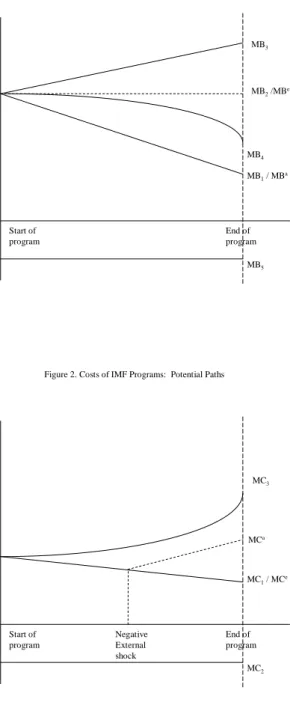
As illustrated in Figure 1 the benefit from negotiating a program with the Fund comes via the additional financial resources to which it gives rise, the less adjustment-intensive balance of payments strategy that is facilitated, and the ability to compensate losers. Either these extra resources may be supplied directly by the Fund or they may come from the signalling effect of the program and its impact on other capital flows. The value of the benefit depends on the availability and cost of alternative sources of finance in the absence of the Fund program. Finance from the IMF becomes more valuable as the availability of finance from elsewhere declines. Since the first instalment of a loan from the Fund will be paid out at the outset of the program, the MB schedule in Figure 1 starts some way up the vertical axis. The shape of MB then depends on how the marginal benefit of the program changes over time
and with the degree of implementation; is this constant or does it rise or fall, and at what rate does it rise or fall? If, for example, the loan is front-end loaded, and if the catalytic effect is a function of the announcement of the program rather than its implementation, the MB schedule will have the features illustrated by MB1 in Figure
1, starting relatively high up the vertical axis.
FIGURE 1 ABOUT HERE
The relationship between the slope of MB and the size of the catalytic effect warrants further discussion. As noted above, the marginal benefit of a Fund program relates to the extent to which it generates additional financial flows. But what is the value added by or the marginal return to the IMF program? It is possible that the MB schedule could decline either in circumstances where the catalytic effect is absent, or where it is strong but depends only on the announcement of the program rather than its implementation. Where the strength of the catalytic effect depends on the degree of program implementation the MB schedule will be flatter (MB2) or may be upward
sloping (MB3).
Similar arguments to these may be expressed in a slightly different way. Countries turn to the IMF because their balance of payments has become a binding constraint upon their ability to achieve other objectives. The benefit of an IMF program is that this constraint is relaxed. The size of the benefit over time therefore depends on the extent to which the constraint is relaxed; it may be expressed in terms of the ability to better achieve other policy objectives. A balance of payments constraint is likely to be most effective in the midst of a BoP crisis when foreign exchange carries a high
shadow price. As the crisis eases, so the BoP constraint also eases. Given this pattern, the marginal benefit from an IMF program will be at its highest at the outset of the program; it will gradually decline over time as balance of payments problems are overcome. Again the MB schedule may be expected to be downward sloping, and may even decline at an increasing rate, (MB4).
Three other observations may be made about the MB schedule at this point. First, governments may sometimes worry that turning to the IMF for assistance will have an adverse effect on their market access because a negative signal is transmitted suggesting that the economy is in difficulty. The catalytic effect may be negative. A government that still has some access to private markets may believe that the resulting reduction in capital flows will exceed the additional credit coming from the IMF. Although some adjustment will need to be made for the terms associated with the alternative types of capital, the end result may be that the government believes that the net result of announcing a program with the IMF on capital inflows will be negative. In these circumstances the MB schedule will start at a point below the horizontal axis in Figure 1 (such as MB5). The benefits will be negative. Unless the
government also believes that the implementation of the program will nonetheless have a strong positive effect on private capital inflows, there would be little point in entering into an agreement with the Fund, since the expectation would be that the short run external financing constraint would become more binding as a result.
Second, since IMF loans are disbursed in instalments, technically the MB schedule will decline in a stepwise fashion with the benefits falling after the receipt of each tranche of the loan. The benefit from further implementation then remains in part the
option of drawing on subsequent instalments. This would of course not be the case for the final tranche, implying that the marginal benefit of implementation following the final tranche falls to zero if we abstract from the catalytic effect. This has policy implications to which we return when we examine replacement programs.
Third, it is important to emphasise the uncertainty surrounding the trajectory of economic performance, let alone the political returns to enhanced economic performance. Ex post benefits from agreeing to a program with the IMF may fail to match ex ante expectations. For example, at the time a program is negotiated it may be expected that its implementation will have a positive effect on other capital flows. If this effect is not forthcoming, or is muted, the actual MB schedule (MBa) will lie
below the expected MB schedule (MBe). 8
The costs of implementation
Let us now turn to the marginal costs of an IMF program as illustrated by the MC schedules in Figure 2. The cost of an IMF program, as perceived by the government that negotiates it, may be seen in terms of the conditionality involved. Governments would generally prefer unconditional financial support. It may be assumed that there will be a discrepancy between the policies preferred by the government and those preferred by the IMF; their objective functions will differ. A government will be aiming to stay in power and may want to protect the near-term standard of living as much as possible; it will be seeking to minimise the consumption costs of adjustment and may be concerned about the distributional effects of policies. The IMF, on the other hand, will be seeking to achieve near-term balance of payments adjustment and
may be expected to emphasise macroeconomic stabilisation. In a sense, the balance of payments is a constraint on achieving other objectives as far as a government is concerned but is an objective in itself for the IMF. The Fund will tend to be much less concerned about the domestic political repercussions of policies. Either as a consequence of its own institutionally preferred economic paradigm, based perhaps on a scientific evaluation of the evidence, or its agency role, representing the interests of its principal shareholders, the IMF may prefer policies of economic liberalisation and openness that do not necessarily accord with governmental preferences. The bigger the gap between the policy preferences of the government and those of the Fund, the bigger the cost of IMF conditionality from the government’s view point. Since pre-conditions will have to have been implemented at the outset of the program the MC schedule will also start some way up the vertical axis. The greater the government's reluctance to pursue these policies, the higher up the vertical axis the MC schedule will begin. 9
FIGURE 2 ABOUT HERE
However, there may be circumstances in which a government, or at least parts of a non-unitary government, actually wants to pursue the policies favored by the Fund on economic grounds but is concerned about domestic political opposition to them and the political costs of pursuing them. The government may then choose to involve the IMF as a way of reducing the political damage that it would encounter if it were to pursue the policies independently. Here the Fund is being used as a scapegoat or to tip the balance in favor of reform. IMF conditionality is reducing the influence of powerful opposition groups whether inside or outside the government. The costs of
conditionality are negative and the MC schedule begins below and may remain below the horizontal axis, (MC2 in Figure 2). 10
As already noted, in assessing the costs of IMF conditionality two comparators exist. The first involves the policies that had previously been pursued within the country. These will probably have contributed to the economic situation in which the country is now turning to the Fund, and there may be expected to be a significant gap between these policies and those favored by the IMF. The second comparator is represented by the policies that the government would have had to pursue contemporaneously if IMF assistance were to be unavailable. With less external financing, these would be yet more adjustment intensive than those favored by the Fund. To the extent that governments turning to the Fund have revealed a tendency to underestimate the extent to which BoP constraints exist, they may also have a tendency to overestimate the costs of IMF conditionality in relation to the relevant comparator, which is the policies that would need to be pursued in the absence of the Fund. These may differ from those supported by the Fund, but they may also have had to secure a larger correction in the current account.
The perceived costs of conditionality may not only, however, depend on the nature of the policies incorporated in IMF programs. Even where governments favor similar policies, they may not favor having them imposed by the Fund. In this respect, the cost of conditionality is the loss of sovereignty over the design of economic policy. Other things equal, the greater the value attached by a government to sovereignty the higher up the vertical axis the MC schedule will begin.
The shape of the MC schedule then depends on how the costs of conditionality change over time and with the degree of implementation. Assuming that the sovereignty costs do not change, costs may fall if it becomes progressively easier to implement the later stages of a program. Adjustment may have been front-end loaded. In contrast to this, where the policies that are least palatable to the government have been deferred until later in the program the MC schedule will slope upwards, possibly at an increasing rate, as shown by MC3. These deferred elements are likely to be the
ones to which there will be the greatest political resistance.
Just as with the benefits, the costs of implementing an IMF program may turn out to be different from those that were expected at the outset. This could be because the economic effects are different or perhaps because political opposition to the policies incorporated within the program turns out to greater or less than anticipated. As a consequence the actual MC schedule may have a different slope or a different location. Furthermore, economic shocks may be another reason why the actual MC schedule differs from the expected one. Over time the MC schedule may shift. Economic shocks could be either negative or positive. An export shortfall would, for example, increase the extent to which imports need to fall in order to achieve a specific current account balance of payments target. Meanwhile, the related decline in economic growth would tend to reduce tax revenue below the expected level and this would imply additional cuts in government expenditure in order to meet targets relating to the fiscal balance. Compare for example, MCe with MCa.
Marginal benefits and costs together
The MB and MC schedules plotted out in Figures 1 and 2 are combined in Figures 3 and 4. Figure 3 shows that governments will embark on IMF programs if the benefits that arise from the reduced adjustment intensity allowed by the extra finance associated with the program are perceived by them to exceed the conditionality costs. Figures 3 and 4 also show why programs may not be fully implemented. There are two possibilities. In the first case, illustrated by MB1 and MC1 in Figure 3, the
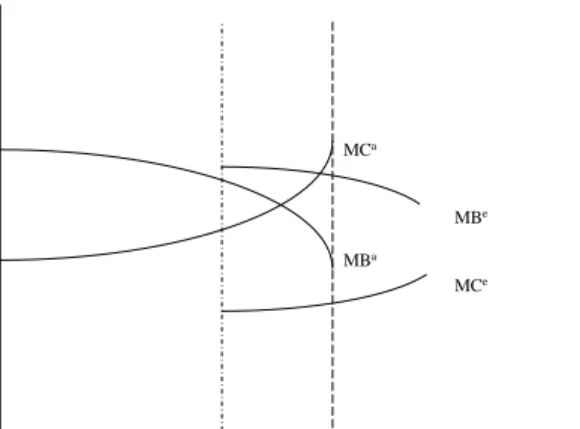
government never intends to implement the program fully but only up to point A where, at the margin, the costs of further implementation exceed the benefits. It will have promised more reform than it intended to deliver in order to persuade the IMF to agree to the loan. By contrast, in the second case, illustrated in Figure 4, the government intends to fully implement the program at its outset, only to discover that the marginal benefits are less than expected or that the marginal costs are greater than expected, such that it becomes rational for it to abort the program before it is completed, as illustrated by the intersection between MBa and MCa, reflecting the
actual outcome.
Replacement programmes
But what happens if a government fails to fully implement the program to which it has agreed; does this affect future access to IMF resources and how does this affect the probability that the current program will be implemented? Where future access to IMF resources depends on the extent to which past programs have been completed, implementation carries with it the option value of future access to Fund finance. There is then an additional benefit associated with implementation and, other things being equal, this will increase the degree of implementation. Where future access does not depend on current implementation, the probability of current implementation will be adversely affected. Indeed, it may be quite rational for governments to abort current programs if they believe that they can renegotiate another program with a more advantageous configuration of benefits and costs as shown by the sequence of programs in Figure 5. Here a program will be abandoned by a government if it believes that the net benefits of negotiating a new program exceed those of continuing to implement the existing one.
FIGURE 5 ABOUT HERE
Implementation and ownership
From the conceptual framework developed in this section it is possible to identify a range of factors that are likely to influence the degree to which IMF programs are implemented. The framework can also be used to analyse the notions of commitment and ownership that have begun to feature in the literature on implementation. Poor implementation has often been attributed to a lack of commitment or a lack of
ownership. These concepts are related but are not identical. Ownership implies that governments, or indeed societies as a whole, are persuaded that the policies being pursued within the context of an IMF program are appropriate or even optimal. Leaving to one side the question of sovereignty, which may be fundamentally inconsistent with conditionality, the degree of ownership will be reflected by how far up the vertical axis the MC schedule begins. Where Fund-backed policies are deemed reasonably appropriate by the country (widely defined), the ownership will be strong and the MC schedule will begin relatively close to the origin.11 Although it no doubt
helps, implementation does not require ownership. In the context of the conceptual framework developed in this section, implementation depends on the extent to which the marginal benefit of the program exceeds the marginal cost. A government will have an incentive to implement programs where there are large net benefits. This interpretation allows us to show how implementation may wane during the course of a program if actual marginal benefits decline and actual marginal costs rise. A similar expected net benefit from a program will be associated with greater ownership where the perceived costs are lower. Figure 6 illustrates some possible scenarios.
FIGURE 6 ABOUT HERE
5. POLICY IMPLICATIONS
Not only does the conceptual framework developed in the previous section allow us to consider the factors that influence the extent to which IMF programs are implemented, it also allows us to identify policies that may improve implementation. The initial assumption is, of course, that it is a good thing to improve implementation. This presupposes that IMF programs are well designed and are, in some sense,
welfare enhancing. Should they be badly designed and have welfare reducing effects, as some critics claim, then failing to implement then will be beneficial. We do not get into this debate here but assume that the policy objective is to improve implementation.
More significant in the context of this paper is the point that policies regarded as good by a national government may not be so regarded by the IMF. This follows from the observation that governments and the Fund will have different objective functions. Part of the purpose of the IMF as an international organisation is to dissuade governments from pursuing policies that may be ‘destructive of international prosperity’. Domestically designed policies have externalities and the role of the IMF is to minimise the external costs of domestically focused economic policy. Against this background our assumption is that the Fund – for good reason - is looking to improve the implementation rate of its programs.
The analysis in section 4 suggests ways in which the Fund could manipulate its operations to induce superior implementation. In effect it should be looking for reforms that will shift upwards the MB schedule and/or reduce its downward slope, and at the same time shift downwards the MC schedule, and/or reduce its upward slope.
The MB schedule could be shifted up by increasing the amount of finance provided by the IMF or by seeking to increase the strength of the catalytic effect associated with announcing an IMF program on other capital inflows. Any downward slope of the MB schedule could be reduced by strengthening the catalytic effect of
implementing (as compared to announcing) policy reform, and by modifying the structure of instalments such that implementation could be improved by switching completely to exante conditionality. IMF resources would become conditional on full
ex ante implementation. But the problem here is that ex ante conditionality runs
counter to the idea of IMF support being used to cushion adjustment; allowing it to be spread out over a longer time period than would otherwise be the case. See also Thomas (2002).
The MC schedule could be shifted down and its slope reduced by seeking to close the gap between the policy preferences of the government concerned and the IMF. This might be achieved in part by the IMF making greater effort to persuade governments, and more broadly civil society, of the wisdom of its preferred policies relative to the alternatives. But a downward shift could also be assisted by the Fund showing a greater awareness of the political environment within which governments are operating. This could mean the Fund being prepared to make concessions in terms of the technical design of programs in order to accommodate domestic political constraints. The notion here is not to provide unconditional support, which opens up moral hazard problems, but rather to allow governments to have more discretion in designing the conditions upon which they will be judged (constrained by what the IMF deems acceptable). Perhaps it is better to implement a program that the Fund regards as satisfactory on economic grounds rather than fail to implement one that it regards as economically optimal.
Again in terms of the MC schedule, discrete upward shifts associated with adverse external shocks could be offset by arranging equivalent upward shifts in MB (i.e.
additional resources) or by modifying conditionality in such a way as to shift MC downwards in a counterbalancing fashion. Implementation could be improved by ‘shock proofing’ programs in these ways.
An additional incentive to complete programs could be created by being more selective in the allocation of replacement programs. A benefit of full implementation could be that of keeping open the option of future loans from the IMF. Lapsed implementation on the other hand could be used as a justification for removing this option at least over a certain future period of time. Governments anxious to retain the option of borrowing from the IMF would therefore be under an incentive to complete contemporary programs; this might have the added advantage of minimising the probability that the option on future IMF loans would need to be exercised. It could help mitigate the prolonged use of IMF resources.
The basic policy point is simple and straightforward. Governments are political and make choices about economic policies based on both economic and political factors. They will rationally continue to implement policies supported by the IMF for as long as there is a net benefit to them in terms of their own objective function. The IMF has the ability to influence some of the factors that impinge on the extent to which a government is able to achieve what it sets out to achieve. By manipulating these factors the IMF is able to affect the domestic choice of policy and thereby the extent to which programs agreed with the IMF are implemented. It is not a passive participant.
6. CONCLUDING REMARKS
Evidence drawn from the 1990s suggested that many IMF programs were not fully implemented. This was hardly a satisfactory state of affairs even for those who had reservations about the design of conditionality. For those who believed that programs were basically well designed, poor implementation was of even greater concern. It reduced the effectiveness of IMF programs.
In the early 2000s the IMF adopted a policy of ‘streamlining’ conditionality. The rationale was that implementation was poor because of a lack of ownership, and there was a lack of ownership because conditionality was excessive. At the same time as IMF policy evolved in this way a number of studies began to emerge that examined implementation from both a theoretical and empirical point of view. These studies frequently emphasised the political environment in which governments sought to implement programs. Political economy variables could frustrate implementation.
This paper has adopted a similar political economy approach. It has provided a conceptual framework within which the decisions of governments may be considered. The message is a simple one. Governments will agree to and will implement programs for as long as they perceive the benefits as outweighing the costs. The benefits largely flow from the additional resources that IMF programs are expected to bring with them, while the costs are associated with the loss of sole control over economic
policy. However, the perceived benefits and costs of IMF programs change over time and the changing configuration explains why programs may be discontinued. To improve implementation the IMF needs to consider the structure of incentives faced by governments and re-orientate them in a way that encourages the completion of programs. While streamlining is in principle a step on the right direction, it may be too short a step. Moreover, it may conflate ownership and implementation when the two concepts are in fact separate. Further reforms may be necessary if implementation is to be significantly improved; and without a strong record of implementation what is the point of conditionality?
REFERENCES
Baqir Reza, Rodney Ramcharan and Ratna Sahay (2003) 'IMF Programme Design and Growth: What Is the Link?' mimeographed, Washington DC, IMF.
Bird, Graham (1998) ‘The Effectiveness of Conditionality and the Political Economy of Policy Reform: Is It Simply a Matter of Political Will?’ Journal of Policy
Reform,1, 89-113
Bird, Graham (2002) 'The Completion Rate of IMF Programmes: What We Know, Don’t Know and Need to Know', The World Economy, Vol 25, No 6, June, 8
Bird, Graham (2001a) 'IMF Programs: Do They Work? Can They Be Made to Work Better?' World Development 29 (11): 1849-1865.
Bird, Graham (2001b) 'IMF Programmes: Is There a Conditionality Laffer Curve?'
World Economics 2 (2): 29-49
Bird Graham and Dane Rowlands (2002) 'Do IMF Programmes Have a Catalytic Effect on Other International Capital Flows?' Oxford Development Studies, 20,3, 229-249.
Boughton, James M. and Alex Mourmouras (2002) 'Is Policy Ownership An Operational Concept?' IMF Working Paper No. 02/72.
Chen, Chuling and Alun Thomas (2003) ‘ Evaluating Fund-supported Programs in the 1990s: the Importance of Taking Explicit Account of Stoppages,’ paper presented at the Western Economic Association International Annual Meeting, Denver, July,2003
Conway Patrick (1994) 'IMF Lending Programs: Participation and Impact', Journal of
Development Economics 45 (2): 355-391
Dollar, David and Jakob Svensson (2000). 'What Explains the Success or Failure of Bank-Supported Adjustment Programs?' Economic Journal 110 (446): 894-917.
Drazen, Allan (2002). 'Conditionality and Ownership in IMF Lending: A Political Economy Approach', IMF Staff Papers, 49 ( Special Issue), 36-67.
Dreher, Axel (2002) 'The Influence of Elections on IMF Programme Interruptions,' mimeographed, forthcoming in Journal of Development Studies.
Dreher, Axel (2004) ‘The IMF and Economic Growth: the Effects of Programs, Loans and Compliance with Conditionality,’ mimeographed, University of Exeter.
Dreher, Axel (2005) ‘Does the IMF Influence Fiscal and Monetary Policy?’ Journal
of Policy Reform, 8, 225-238.
Goldstein, Morris (2000) 'IMF Structural Programmes,' forthcoming in Martin Feldstein, ed, Economic and Financial Crisis in Emerging Market Economies,
Haggard, S. and R. K. Kaufman, eds, (1992), The Politics of Economic Adjustment,
Princeton N.J. Princeton University Press.
Haque, Nadeem UI and Mohsin S. Khan (1998). 'Do IMF supported Programs Work? A Survey of the Cross-Country Empirical Evidence,' IMF Working Paper No. 98/169.
IMF (2000) 'Review of Fund Facilities- Preliminary Considerations' paper prepared by Policy Development and Review Department, mimeographed, Washington DC. IMF
Independent Evaluation Office, IMF (2002) 'Evaluation of the Prolonged Use of IMF Resources, Volume II: Report of the Case Studies,' Washington DC, IMF.
International Monetary Fund (2001) 'Conditionality in Fund-Supported Programmes: Overview,' mimeographed, and other papers cited therein.
International Monetary Fund (2001). 'Strengthening Country Ownership of Fund -Supported Programs' (December 5). Available at
http://www.imf.org/external/np/pdr/2001/eng/strengt/120501.htm.
Ivanova, Anna, Wolfgang Mayer, Alex Mourmouras and George Anayiotos (2003), 'What Determines the Success or Failure of Fund-Supported Programs.' IMF Working
Joyce, Joseph P (2003) 'Promises Made, Promises Broken: A Model of IMF Programme Implementation,' Wellesley College Department of Economics Working
Paper, 2003-03.
Khan, Mohsin S and Sunil Sharma (2001), ' IMF Conditionality and Country Ownership of Programmes,' IMF Working Paper, No 01/142.
Killick, Tony (1995). IMF Programmes in Developing Countries. London: Routledge,
Killick, Tony (1998) Aid and the Political Economy of Policy Change, London ODI/Routledge.
Mayer, Wolfgang and Alex Mourmouras (2002). 'Vested Interests in a Political Theory of IFI Conditionality,’ IMF Working Paper, No. 02/73.
Mayer, Wolfgang and Alex Mourmouras (2005) ‘ IMF Conditionality: An Approach Based on the Theory of Special Interest Politics,’ mimeographed, Washington DC, International Monetary Fund.
Mecagni, Mauro (1999) 'The Causes of Program Interruptions,' in Hugh Bredenkamp and Susan Schadler (eds.), Economic Adjustment and Reform in Low-Income
Mercer-Blackman, Valerie and Anna Unigovskaya (2000). 'Compliance with IMF Program Indicators and Growth in Transition Economies'. IMF Working Paper, No 00/47.
Mussa, Michael and Miguel Savastano (2000). 'The IMF Approach to Economic Stabilization,' in Ben S. Bernanke and Julio J. Rotemberg (eds.), NBER
Macroeconomics Annual 1999. Cambridge. MA: MIT Press, 79-122.
Nelson, J. M. ed, (1990) Economic Crisis and Policy Choice: The Politics of
Adjustment in the Third World, Princeton N.J. Princeton University Press.
Nsouli, Saleh, Rouben Atoian and Alex Mourmouras (2004) ‘ Institutions, Program Implementation and Macroeconomic Performance,’ IMF Working Paper, Washington DC, International Monetary Fund.
Stone, Randall W. (2002) Lending Credibility: The International Monetary Fund and
the Post-Communist Transition. Princeton: Princeton University Press.
Thomas, A (2002) 'Do Prior Actions Achieve Their Objectives? An Evaluation Based on Active Programmes Over the 1992-98 Period,’ IMF Working Paper, Washington DC, IMF, February.
Vreeland, James Raymond (2003) The IMF and Economic Development, Cambridge, Cambridge University Press.
Williamson, John, ed (1993) The Political Economy of Policy Reform, Washington DC, Institute for International Economics.
Marginal Benefits
Figure 1. Benefits from IMF Programs: Potential Paths MB3 MB2/MBe MB4 MB1/ MBa + - Start of program End of program Time / Degree of implementation MB5 Marginal Costs
Figure 2. Costs of IMF Programs: Potential Paths MC3 MCa MC1/ MCe + - Start of program End of program Time / Degree of implementation MC2 Negative External shock
Marginal Benefits and Costs
Figure 3. Premature Suspension or Cancellation of IMF Programs: Planned by Government MC1 MB1 Start of program Scheduled End of program Time / Degree of implementation Program Suspended / Cancelled A Marginal Benefits and Costs
Figure 4. Premature Suspension or Cancellation of IMF Programs: Unplanned by Government
MCa MBa Start of program Scheduled End of program Time / Degree of implementation Program Suspended / Cancelled MBe MCe
Marginal Benefits and Costs
Figure 5. Implementation and Subsequent Programs MCa MBe Time / Degree of implementation MBa MCe I III II I – start of first program
II – scheduled end of first program
III – first program cancelled since actual costs exceed actual benefits at the margin. Second program started with expected benefits exceeding expected costs
Marginal Benefits and Costs
Figure 6. Ownership, Commitment and Implementation MB2 MB1 Time / Degree of implementation MC1 MC2
(1) MB1/ MC1: reasonably strong ownership and commitment
(2) MB2/ MC2: weaker ownership but stronger commitment
(3) MB2/ MC1: similar ownership to (1) above but stronger commitment
Scheduled End of program
1
For a summary of the Fund's facilities see IMF (2000).
2
For reviews of this literature see, for example, Killick (1995) and ul Haque and Khan (1998). Bird (2001) examines the extent to which the evidence justifies the claim made by ul Haque and Khan that IMF programs on balance work. He concludes that a case may be made that they work only in a fairly limited way. They may strengthen the balance of payments but do not appear to have a significant beneficial effect on inflation and economic growth. Other factors such as the poor record on completion, the tendency towards IMF recidivism and the lack of a catalytic effect on other financial flows suggest that judged against many of their own objectives IMF programs frequently do no work.
3
See, for example, Ivanova, Mayer, Mourmouras and Anayiotas (2001). However, as the authors acknowledge, their study builds on earlier research directed towards explaining the success or failure of World Bank programs (Dollar and Svensson, 2000). These studies are examined in some length in what follows.
4
Of course if programs are badly designed, not implementing them could be a good thing. A pressing question for future research is the extent to which the success of programs in terms of final economic outcomes or the future evolution of policy variables such as fiscal deficits, monetary expansion and the real exchange rate depends on implementation. If it does, the focus of attention needs to be on improving the rate of implementation. If not, rather more fundamental questions may be asked about the design of conditionality and the rationale of IMF programs. What is the purpose of conditionality if it has no significant impact on economic performance? Some of the relevant literature is referred to later in the paper.
5
For an excellent early review of the concept and dimensions of ownership see Killick (1998). More recent reviews include IMF (2001) and Boughton and Mourmouras (2002). Drazen (2001) presents a theoretical analysis of conditionality and ownership that provides rigorous support for what are in many ways intuitively appealing propositions. Other useful discussions of the theory behind ownership include Mayer and Mourmouras (2002) and Khan and Sharma (2001).
6
In this paper we do not include a full discussion of the roles of conditionality. Fortunately such reviews are fairly widely available in the literature, see for example, Bird (2001b). The focus here is much more on the extent to which conditionality is implemented. None of its various roles will be performed if it is poorly implemented.
7
Either IMF support may be used to ‘tip the balance’ in favor of reform with the government publicly endorsing the policies advocated by the Fund, or the IMF may be used as a scapegoat for unpopular policies with the government deliberately distancing itself from ‘IMF policies.’ See Vreeland (2003) for a further discussion of the scapegoat role of the IMF.
8
Bird and Rowlands (2002) provide a review of the theory behind catalysis and an empirical investigation of its quantitative importance. Although on its web site the IMF claims that the catalytic effect is significant and a key part of its overall institutional role, studies have generally failed to find strong empirical evidence of its existence.
9
A countervailing point is that in the middle of a crisis and with a binding BoP constraint, whatever their preferences governments may be forced to prioritise policies designed to strengthen the balance of payments, and at the outset of IMF programs this could reduce the marginal cost of IMF conditionality, shifting the vertical intercept of the MC schedule back down towards the origin.
10
Similar negative costs of conditionality could exist where certain elements within government, such as the leader or the finance ministry want to tip the balance in their favor in an internal debate about policy. The Fund's involvement may 'strengthen the hand of reformers'; thus to some parts of the government IMF conditionality would have a negative cost while to others it might still be perceived as having a more regular cost.
11
Conditionality will have a diminished role where there is strong ownership although it may still retain a signalling function and provide a way of dealing with the time-consistency problem. As noted earlier conditionality may have a more powerful role where the government is a fragile coalition of disparate factions. Note also that conditionality will be an ineffective mechanism for overcoming time inconsistency and reducing the perceived chance of governments reneging on policy promises if its implementation is poor. For similar reasons poor implementation will weaken the signalling role of conditionality that underpins its supposed catalytic effect on other capital flows.