Dissertations UMSL Graduate Works
4-12-2018
Teacher Autonomy in a Site-Managed Charter
School: Views of Autonomy, Autonomy Support,
and their Educational Impact
Kristen Levin
Follow this and additional works at:https://irl.umsl.edu/dissertation
Part of theEducational Leadership Commons
This Dissertation is brought to you for free and open access by the UMSL Graduate Works at IRL @ UMSL. It has been accepted for inclusion in Dissertations by an authorized administrator of IRL @ UMSL. For more information, please [email protected].
Recommended Citation
Levin, Kristen, "Teacher Autonomy in a Site-Managed Charter School: Views of Autonomy, Autonomy Support, and their Educational Impact" (2018).Dissertations. 735.
TEACHER AUTONOMY IN A SITE-MANAGED CHARTER SCHOOL: VIEWS OF AUTONOMY, AUTONOMY SUPPORT, AND THEIR EDUCATIONAL IMPACT
By
KRISTEN W. LEVIN
BS, Loyola University, New Orleans MEd, University of Missouri- St. Louis
DISSERTATION
Submitted in partial fulfillment of the requirements for the degree of Doctor of Philosophy in Education
in the Graduate School of the University of Missouri-St. Louis
May, 2018
Dissertation Committee: Gayle Wilkinson, EdD, Chair
Wolfgang Althof, PhD Carl Hoagland, PhD William Kyle, PhD
Abstract
The purpose of this study was to discover how pre-service teachers (PSTs), classroom teachers, and administrators in an urban charter school perceive their own levels of professional autonomy and administrative support by the school, and how the balance of autonomy and support impact their instructional practices. In my aim to construct a deep understanding of the many viewpoints, I designed and implemented this research as a single case study of Highland Charter School (a pseudonym), in a
Midwestern U.S. city. This study involved seven elementary and middle school teachers, three pre-service teachers completing the student teaching component prior to college graduation, six building administrators, and one administrator at a local university. In this project, the case is an independent charter school serving mainly students of low socioeconomic backgrounds, from Kindergarten through Eighth-Grade. Originally intended to focus on instructional technology, I began the study with an open online survey and unstructured interviews. The iterative data collection and analysis process I followed allowed me to quickly identify weak areas within the original protocol and helped me to redesign the work as a much broader case study, focused on all areas of teaching innovation as effected by teacher autonomy and administrative support. At the beginning, the interviews were loosely structured and informed by classroom
observations. As I became familiar with the different teachers, the interview questions became more focused but remained open-ended. Constant comparison of participants’ approaches and their reflections helped to reveal their own beliefs about student engagement and the importance of teacher autonomy in meeting student needs. By
developing partnerships with these teachers, employing several data sources, and leaving a clear audit trail, I worked to establish and maintain reliability within the project.
There were many lessons to be learned throughout this endeavor. First,
Highland’s leaders had cultivated an environment which balanced professional autonomy with administrative support. However, the autonomy was defined differently by each player, depending on his or her role in the school. Overall, teachers felt empowered and supported by the school administration, but they desired more direct guidance in terms of classroom technology and preservice teacher training. Teachers were encouraged to explore creative teaching strategies to meet the needs of their exceptionally diverse
student body, and the Common Core was viewed by all as merely a supportive document
to help teachers develop learning objectives for their children. Teacher agency extended to their use of technology, and was generally seen as a tool for learning rather than a centerpiece. Finally, instructional planning was deeply impacted by the personnel’s shared commitment to character education, and their endeavor to meet student needs through project-based learning.
Table of Contents
Abstract……….... 2
List of Tables and Figures………... 10
Acknowledgements………... 11
Chapter 1: Introduction………... 13
The Common Core State Standards………... 14
Charter Schools in Public Education………. 15
The effectiveness of charter schools……… 16
Character Education in the Schools………... 17
Integrating ICT in the Classroom………... 18
ICT implementation in the urban classroom……… 19
Social Constructivism in the Classroom ………... 20
The Problem: Teacher Autonomy and Its Impact on Instruction in a Charter School 21 Purpose of this Study………. 21
Research Questions……… 22
Theoretical Framework……….. 22
Introduction……….. 22
Self-determination theory (SDT)………. 23
TPACK………. 25
Limitations and Delimitations of the Study………... 26
Significance of this Study……….. 28
Summary……… 29
Abbreviations and Terminology……….. 31
Chapter 2: Review of the Literature……… 32
Introduction……… 32
Theoretical Foundations: Self-Determination Theory and the Importance of Autonomy………... 36
SDT as a predictor for motivation……… 37
Connection between SDT and teacher autonomy……… 38
Theoretical Foundations: TPACK, a Framework for Understanding Educational Technology………. 39
Theoretical Foundations: Social Constructivism and Learning………. 41
Vygotsky and social constructivism in education……… 41
Bruner's view on society and learning………. 43
The Unique Challenger of Teaching in Urban Schools………. 44
Teacher turnover……….. 45
Urban education is not simply a single story………... 46
The digital divide………. 48
The digital divide in the classroom……….. 50
Charter Schools as a Tool for School Reform………... 53
Beginnings………... 53
Teacher autonomy in charter schools……….. 54
Character Education as a Means for Reform………. 55
Challenges in the Student Teaching Experience……… 58
Multiple players, different perspectives……….. 59
Struggles cooperating teachers (mentors) face in training PSTs………. 60
Active participation of the cooperating teacher in the student teaching experience……… 61
Partnering within the student teaching context………. 62
Prior mentoring experience……….. 64
The preservice teacher's dual roles……….. 64
Influence of mentoring on the PST……….. 65
Why Technology... 66
Technology can improve classroom collaboration……….. 67
Learning in the "Knowledge Age": Adding relevance to learning……….. 70
Factors that Influence the Integration of ICT………. 74
Resources………. 74
Professional development/training and experience of school staff……….. 76
Support by school leadership………... 78
Teacher attitudes and perceptions……… 79
Summary……… 80
Chapter 3: Methodology……….. 82
Research Design ……… 85
Sampling Procedures……….. 88
Population and Sample……….. 90
Data Collection Procedures……… 92
Beginning the project with interviews………. 92
Data collection and analysis as concurrent processes……….. 93
Classroom observations………... 94
Semi-structured interviews……….. 95
Open-ended survey……….. 96
Multiple data sources and triangulation………... 96
Data Analysis………. 97
Data analysis using a constant comparative approach………. 97
Constant comparisons……….. 98
Coding the data……….. 99
Documentation………... 101
Enhancing trustworthiness………. 104
Summary……… 106
Chapter 4: Results……… 108
Setting and Participants………... 109
The School………. 109
The Participants………. 112
Data Collection and Data Analysis………. 114
Data Collection……….. 114
Data Analysis………. 116
Results ………. 117
Introduction to the Four Categories……….. 118
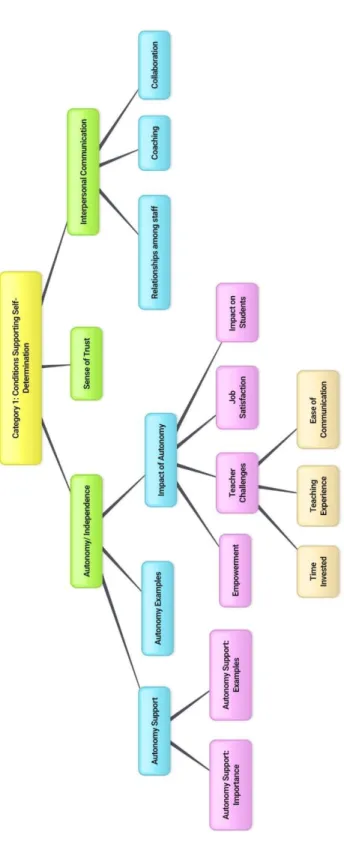
Category 1: Conditions Supporting Self-Determination……….. 118
Subcategory: autonomy/ independence………... 120
Autonomy examples (1st level property)……… 120
Autonomy support (1st level property)………... 124
Autonomy support: importance (2nd level property)……… 124
Autonomy support: examples (2nd level property)………... 125
Impact of autonomy (1st level property)……… 126
Empowerment (2nd level property)……….. 127
Job satisfaction (2nd level property)………. 128
Impact on students (2nd level property)……… 128
Teacher challenges (2nd level property)………... 128
Time invested (3rd level property)……… 129
Teaching experience (3rd level property)………. 129
Ease of communication (3rd level property)……… 129
Subcategory: sense of trust……….. 130
Subcategory: interpersonal communication………. 131
Relationships among staff (1st level property)………... 132
Coaching (1st level property)……….. 133
Collaboration (1st level property)………... 134
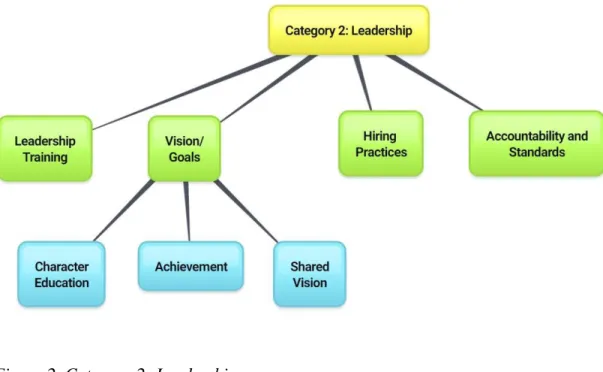
Category 2: Leadership……….. 135
Subcategory: leadership training……….. 136
Subcategory: vision……….. 138
Character education (1st level property)………. 138
Achievement (1st level property)……… 140
Shared vision (1st level property)………... 142
Subcategory: hiring processes……….. 143
Subcategory: professional development……….. 146
P.D. focus (1st level property)……… 147
New teacher training (1st level property)………... 149
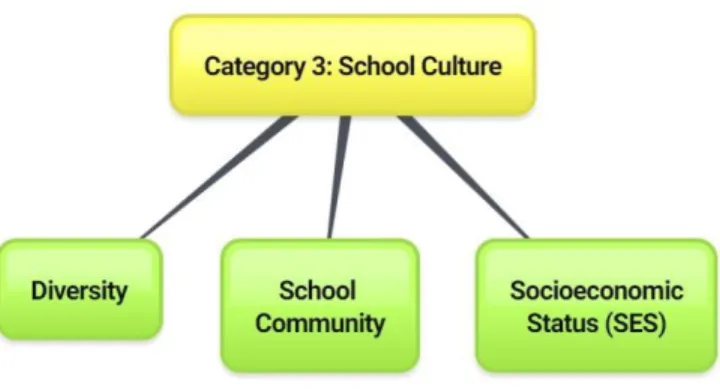
Category 3: School Culture……… 153
Subcategory: diversity……….. 153
Subcategory: school community……….. 157
Subcategory: Socioeconomic status (SES)……….. 162
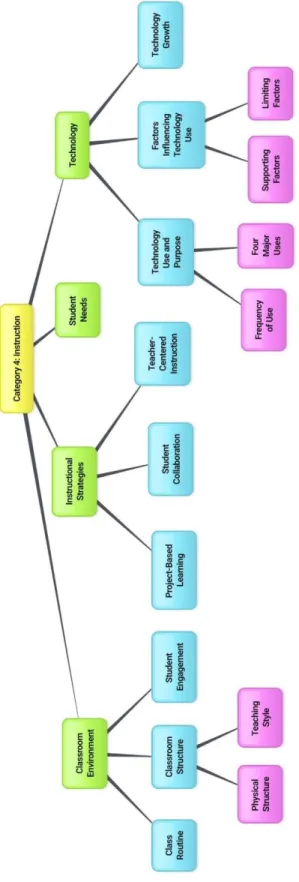
Category 4: Instruction……….. 163
Subcategory: classroom environment……….. 166
Class routine (1st level property)……… 166
Classroom structure (1st level property)………. 167
Physical structure (2nd level property)………. 168
Teaching styles (2nd level property)………. 168
Student engagement (1st level property)……… 169
Subcategory: instructional strategies………... 175
Project-based learning (1st level property)………. 176
Student collaboration (1st level property)………... 177
Teacher-centered instruction (1st level property)………... 178
Subcategory: student needs……….. 178
Subcategory: technology……….. 188
Technology use and purpose (1st level property)………... 188
Frequency of use (2nd level property)……….. 188
Four major uses (2nd level property)……… 190
Factors influencing technology use (1st level property)………. 192
Supporting factors (2nd level property)……… 192
Limiting factors (2nd level property)……… 196
Technology growth (1st level property)………. 196
Summary……… 199
Chapter 5: Discussion and Conclusions……….. 201
Introduction………. 201
Purpose of the Study……….. 201
Setting and Participants in the Study……….. 203
Setting……… 203
Participants………. 203
Data Collection and Analysis……….. 204
Data Collection……….. 204
Data Analysis………. 205
Discussion………. 207
Definition of "autonomy"………. 207
Different roles led to different meanings of "autonomy"………. 208
Administrative support of professional autonomy ……….. 211
Not always enough support……….. 214
Major findings and connections to the literature……….. 215
Varied definitions of "autonomy"……….. 216
Administrative support and necessary limitations………. 219
Research Question 2: Perceived Impact of Autonomy on Instruction and Achievement………. 223
More freedom in meeting student needs……….. 224
Teaching practices……… 226
Major findings and connections to the literature……….. 227
Freedom to meet students' needs……… 228
Teaching practices……….. 230
Research Question 3: The Effect of the Common Core on the Teachers' Autonomy… 233 Major findings and connections to the literature……….. 233
Research Question 4: Classroom Technology Use and Teacher Autonomy at Highland………... 235
Autonomous use of ICT in the classroom ………... 236
Administrative support of ICT use………. 236
Other limitations to technology-related autonomy……… 237
Purposeful ICT integration………... 238
Reasons for ICT use in classrooms……… 239
Major uses of ICT at Highland………... 240
Student projects and research………... 240
Demonstrations and teacher presentations………... 241
Classroom administrative tasks……… 242
Major findings and connections to the literature ………. 242
Autonomous use of classroom technology……… 242
The need for additional professional development……… 243
Other limitations to ICT use in the classroom………... 245
Purposeful use of ICT in the classroom………. 246
ICT as a tool for student engagement……….. 246
ICT as a tool for lesson relevance……… 246
ICT as a tool for teaching transferrable skills……….. 247
Major uses of technology in Highland classrooms……… 248
Research Question 5: Additional Factors that Impact Instructional Decision-Making 248 Highland's vision for character education……… 249
Diverse student population………... 252
Differentiation……….. 253
Multiple measures of achievement………... 254
Major findings and connections to the literature……….. 255
Character education at Highland Charter School………. 255
Project-based learning……….. 257
Diverse student population………... 258
Conclusions………..… 259
Implications……… 259
Recommendations for Future Research………. 259
Concluding Remarks……….. 261
References……… 264
Appendices………... 283
Appendix A: Consent Form………... 283
Appendix B: Code Book……… 287
Appendix C: Classroom Arrangement………... 301
Appendix D: Room Arrangement and Classroom Activity………... 303
Appendix E: Researcher-Perceived Levels of Student Engagement during Classroom Visits………... 307
List of Tables and Figures
Table 1. Comparison of Student Demographics at "Highland Charter School" and the Surrounding School District, 2015-2016 School
Year... 110
Table 2. Demographics of “Highland Charter School”, Other Charters in the Area, and the Neighboring School District (TPS) (2015 Data)... 110
Table 3. Participants Included in this Case Study 112 Figure 1. Category 1: Conditions Supporting Self-Determination... 119
Figure 2. Category 2: Leadership... 136
Figure 3. Category 3: School Culture... 153
Acknowledgements
I am so grateful for the help of so many people, without whose guidance and persistent patience I would never have completed this endeavor. Thank you so much for climbing this mountain with me, and for not giving up on me, when giving up would have been the easier (and perhaps wiser?) choice.
First, a huge “thank you” to my committee: Dr. Wilkinson, Dr. Althof, Dr. Hoagland, and Dr. Kyle. I am ever so appreciative of the advice, encouragement, and indispensable feedback you provided. An especially huge thank you goes to Dr. Wilkinson and Dr. Althof. I have no idea how I would have managed this without your guidance. I will be eternally grateful.
Of course, none of this would be possible without the generosity of my participants. You made me feel so welcome and allowed me to invade your classrooms with a moment’s notice. Thank you! Your dedication, talent, and love for your craft are inspiring.
I want to thank Dr. Marvin Berkowitz, Ms. Stephanie Koscielski, and Mr. William Mendelsohn for their insight into character education, PST training, and charter schools, respectively. Your help was incredibly valuable, and I appreciate it more than you know.
I have so much gratitude for my own school leaders, Mrs. Sherry Blough and Mrs. Debbie Stair, as well as my wonderful co-workers, including (but not limited to) Kristin Hoekzema, Julie Cordray, Matt Pannkuk, Heather Sartin, Traci Runge, Tracy Bommell, Laura Quinn, Eric Wildermuth, and Crystal Barnes. Thank you so much for your encouragement and support!
Finally, and certainly the closest to my heart, my own family will forever have my love, admiration, and deepest gratitude. My husband Shawn, who is certainly my better half, often had to take on the role as single dad while I shut myself in the library. My beautiful children Connor, Kerrigan, and Kenna have spent far too many weekends
without their mom. And thank you so much to my parents Linda and Bob Woodstuff, and parents-in-law, Valerie and David Levin, for moral support and for caring for our
Chapter 1 Introduction
The goal of this case study was to investigate teachers', administrators', and pre-service teachers' perceptions of professional autonomy in an urban, site-managed charter school. In this project, I examined the school's commitment to character education, the administrators' support of educator development, and teachers' technology use; my aim was to understand how these factors interplayed and impacted professional agency and instructional decision making. In the current standards-based educational climate, I wanted to determine the extent to which these educators, working with a largely low-income student population and outside of the traditional public school model, believed their autonomy was encouraged and supported by school leadership.
Since the 1980s, the United States has experienced an ever-changing education climate. After the 1983 release of the U.S. Department of Education’s report A Nation at Risk, there was suddenly national attention on the failings of our educational system. The report claimed that we were rapidly losing our status as a world economic power as student achievement in competing countries was surpassing ours. These statements had a lasting impact on the U.S. education system. Since the first national set of standards was published in 1989 by the National Council of Teachers of Mathematics, the United States education system has seen an evolution of standards reform and corresponding
accountability programs.
The No Child Left Behind Actof 2001(NCLB) was the federal government’s first
directive addressing nationwide improvement of the educational system. This federal law mandated specific steps that all states had to take in order to improve instruction and
student achievement. With NCLB came the birth of widespread standardized testing which ensured that all school systems were held accountable for student progress. This also fore-fronted the topic of national standards and eventually led to the idea of a common set of educational standards (Barton, 2009).
The Common Core State Standards
The Common Core State Standards Initiative was a joint effort driven by the National Governors Association’s Center for Best Practices and the Council of Chief
State School Officers. The resulting document, The Common Core State Standards, was
created with the cooperation of a large network of teachers, educational researchers, and educational administrators.
The intent of the document was to guide educational reform so that all students will complete the twelfth grade ready to either enter the workforce or to enter accredited colleges (Common core, 2012). Written to integrate learning of English Language Arts and Math across the curriculum, the “standards [were] designed to be robust and relevant to the real world, reflecting the knowledge and skills that our young people need for success in college and careers. With American students fully prepared for the future, our communities will be best positioned to compete successfully in the global economy” (Common core, 2012, Mission Statement section, para. 1).
The CCSS directly address the nation’s concerns that awakened with the release of The Nation at Risk. In order to prepare high school graduates to enter the workforce or to further their education, the standards:
Are aligned with college and work expectations;
Include rigorous content and application of knowledge through high-order skills;
Build upon strengths and lessons of current state standards;
Are informed by other top performing countries, so that all students are prepared to succeed in our global economy and society; and
Are evidence-based (Common core, 2012, About the Standards section, para. 4).
At this time, the CCSS has been voluntarily adopted by forty- two states, the District of Columbia, four U.S. territories, and the Department of Defense (NGA & CCSSO, 2016).
Charter Schools in Public Education
Charter schools first emerged in the 1990s, offering an alternative to traditional public schools, and less strenuously regulated by states' legislatures. Charters are publicly-funded schools which are governed by an authorizing agency, or sponsor, and are under less governance from public school districts than traditional public schools (Ni, 2012). Students enroll into charter schools by choice, rather than being placed there by the school district.
The original intent of the charter school model was twofold: to create publicly-funded schools with less direct regulation, thereby allowing for more agency in instruction; and supporting the creation of innovative teaching methods that would improve education across all public school arenas. As of the 2014-2015 School Year, there were over 6600 charter schools across the United States, in 40 states, serving over 2.6 billion students (National, 2016). During that year, 501 new charter schools opened their doors across the country (National, 2016). That year, 42 states had laws allowing for
charter schools, and 40 states had charter schools operating in their school systems (National, 2016).
Though charter schools must follow fewer guidelines than their traditional public schools (TPSs), they are held to the same accountability standards that govern all public schools. For example, the state prepares an Annual Performance Report (APR) for all public schools; the APR data is the result of student achievement, attendance rates, student growth, and graduation rates. The major difference between charter schools’ APRs and those of TPSs is the fact that charter schools do not attain accreditation through the state. Instead, the APR is used solely for reporting purposes (B. Metsker, personal communication, March 9, 2016).
This does not mean that achievement scores have no lasting impact on charter schools in the state. Like TPS, charter schools are evaluated through the state's School Improvement Program and must be evaluated every five years. The extent to which a charter school meets the state standards will have direct bearing on whether the school has its charter renewed (B. Metsker, personal communication, March 9, 2016).
The effectiveness of charter schools. Research studies have reported mixed results when comparing student achievement data between TPSs and charter schools (Carruthers, 2012; Flaker, 2014; Ni & Rorrer, 2012; Xiang & Tarasawa, 2015; Zimmer, Gill, Booker, Lavertu, & Witte, 2012). In 2010, the U.S. Department of Education concluded that the charter middle schools serving low-income, low-performing students displayed significant improvement in math scores, while charters serving higher income students saw a decline in math achievement scores; in reading, there were no significant
impacts on students from low-income communities, and a decline in scores for students in higher-income communities (Gleason, Clark, Tuttle, & Dwoyer, 2010).
Though charter schools are less bound by state regulations than TPSs, research has shown that the amount of professional autonomy afforded to teachers may not be higher than in TPSs (Crawford, 2001; Ni, 2012). Ni (2012) discovered that teachers working in charter schools supported by districts perceived more decision-making power within their schools than those teachers working in charter schools supported by other organizations. This may suggest that school districts often provide administrative resources and may offer additional support to charter school personnel than their private counterparts (Ni, 2012). Dee, Henkin, and Pell (2002) discovered that teachers working in independently managed (site-based managed) charter schools experienced enhanced levels of autonomy and were often encouraged to participate in decision making.
Character Education in the Schools
Character education is "the set of psychological characteristics that motivate and enable one to function as a moral agent, to perform optimally, to effectively pursue knowledge and intellectual following, and to be an effective member of society" (Berkowitz, Bier, & McCauley, 2016). Though it is not a "new" quest in education, character education became a renewed quest in public education in the 1990s. The year 1992 saw the emergence of Character Counts, a training program used to teach character education in schools, and Character Education Partnership (CEP, or Character.org), a nonprofit organization dedicated to facilitating character education in U.S. schools. The development of these organizations resulted in "character education [that] was broadened to include a wider range of pedagogical and psychological perspectives" (Althof &
Berkowitz, 2006, p 498). Today, character education includes a "very wide range of outcome goals, pedagogical strategies, and philosophical orientations" (Althof & Berkowitz, 2006, p 498).
Character.org celebrates those schools which have demonstrated a persistent commitment to fostering character education in its students. National Schools of
Character that have completed a rigorous evaluation, proving that character education has had a profound impact on academics, student behavior, and school environment. The "National School of Character" title is held for a five year period, after which it must be renewed (Character.org, 2016b).
Integrating ICT in the Urban Classroom
Information and communications technology (ICT) is a term which includes all digital and multimedia tools used to enhance the acquisition, understanding, and manipulation of information. Research has suggested that ICT, when integrated seamlessly into classroom instruction, adds relevance and coherence to the learning experience; incorporating technology tends to encourage students to invest personally in their learning (Craft et al., 2008) and aids the learners in identifying and solving problems (Morphew, 2012). Gilbert (2007) emphasizedtechnology’s role in encouraging students to become creators of “new knowledge”, rather than simply consuming extant
information (p. 121).
Prior to the 1990s, the presence of classroom technology was considered highly novel, with few teachers having the technology skills to integrate digital tools
meaningfully in instruction (Trilling & Hood, 1999). Presently, computers and digital technologies are considered integral to teaching and learning. Access to digital tools and
networking systems is an essential part of the U.S. national standards movement, as
evidenced by the Common Core State Standards (CCSS, 2011) and the International
Society for Technology in Education (ISTE) Standards (2012a, 2012b).
The importance of using ICT as an effective tool for student collaboration has been well documented (Brindley, Walti, & Blashke, 2009; Gilbert, 2007; Ligorio, Talamo, & Pontecorvo, 2005). When students use technology to work on realistic issues and become co-creators of new information, the relevance of classroom learning is greatly enhanced (Craft, Chappell, & Twining, 2008; Gilbert, 2007). The vast majority of adolescents today are steeped in technology outside of the school setting, but there is a significant segment of student population who have limited access to the same digital tools and technological skills of their affluent classmates (U.S. Department of Education, 2013). This may influence the efficacy of ICT use in urban schools.
ICT implementation in the urban classroom. The extant literature has cited several factors that influence the extent to which teachers integrate technology into their students’ learning. Some of these factors include access to digital resources; teachers’ training in using ICT effectively; the amount of support for ICT-related instruction by administrators; teachers’ perceptions of technology’s benefits on student learning; and the existence of a district or building technology plan (Brinkerhoff, 2006; Miranda &
Russell, 2011).
Research also suggested that schools serving students from low socioeconomic status (SES) often do not have equal access to meaningful digital resources when compared to schools with populations from higher SES (Hohlfeld, Ritzhaupt, Barron, & Kemker, 2008; Staples, Pugach, & Himes, 2005). Mouza (2011) discovered that the less
funded urban schools provided fewer technological resources in the classroom. Furthermore, Warschauer, Knobel, and Stone (2004) suggested that low-SES schools often use technology more frequently for remedial work in literacy and math, and do not tend to rely on technology as a tool for research and innovation.
Van Dijk (2006) defined the “digital divide” as “the gap between those who do and those who do not have access to new forms of informational technology” (pp. 221-222). Though the term seems straightforward, Van Dijk (2005) and Van Dijk and Hacker (2003) warned that the term itself is misleading and may cause several misconceptions to occur. Van Dijk (2005) claimed that the term “digital divide” implied a static situation in which two clearly divided groups of people (those who had access and those who did not) were separated by the situation, and that the gap was difficult to bridge; in reality, he argued, the groups were dynamic rather than static, and they were not divided neatly into two separate groups. Instead, people have had varying amounts of access to current technologies. According to Van Dijk (2006), the inequality of access to technology led to much more than simply unequal access to resources. He claimed that people with less access to current technology also developed fewer skills; achieved lower degrees of social power; and experienced fewer opportunities to participate in society.
Social Constructivism in the Classroom
The importance of meaningful technology integration across the curriculum may be explained by the social constructivism communicated in the works of both Lev Vygotsky and Jerome Bruner. Vygotsky (1930/1980) and Bruner (1971) claimed that learning is primarily a social activity, highly dependent upon cultural context. In other words, a person is unable to fully escape the influence of other people, and his or her
understanding of the world is impacted by their interactions with others. Learning cannot take place within a social vacuum. Vygotsky’s (1930/1980) study of human language development and Bruner’s (1971, 1977) investigation of the learning process each revealed the integral role of other people on a learner’s cognitive growth.
The Problem: Teacher Autonomy and its Impact on Instruction in a Charter School
As I mentioned, there have been ample studies that reveal variations in teacher autonomy within charter schools; also represented are reports that describe the complex issues that greatly impact classroom instruction in highly dense, low income urban communities. What is missing are the varied points of view of pre-service teachers, classroom teachers, and administrators regarding the professional autonomy each
experiences in a single charter school. Uncovering the diverse reflections around teacher autonomy and administrative support, and the impact of the autonomy-support balance on instructional practices, would lead to a deeper understanding of how autonomy and support can be best structured to enhance teaching and learning in a diverse urban
classroom. In this study, I investigate how one urban charter school deliberately balances instructional support and teachers’ independence in classroom teaching.
Purpose of this Study
The purpose of this case study is to examine how the instructional strategies of PSTs, classroom teachers, and administrators, working in an urban charter school, are shaped by their perceived professional autonomy and the support provided to them by the school. The bounded system, and the case itself, in this project is Highland Charter School (a pseudonym) situated within an urban community in a Midwestern metropolitan area. Examining the teachers’ views on autonomy and their approaches to instruction
may lead to greater insight of how established teacher autonomy can improve instruction in classrooms serving students from lower socioeconomic (SES) backgrounds.
Research Questions
This study was intended to answer the following questions.
1. How are teacher autonomy and autonomy support by school leadership perceived
by (a) classroom teachers, (b) preservice teachers, and (c) administrators at Highland Charter School?
2. To what degree do teachers at Highland Charter School believe professional autonomy impacts their teaching practices; and how do they feel this impacts student achievement?
3. How do teachers at Highland Charter School view their own autonomy in the face
of the Common Core State Standards?
4. To what degree do the teachers believe classroom technology, and their perceived autonomy in using technology, impact their teaching styles?
5. What factors, other than teacher autonomy, do the participants believe have the greatest impacts on classroom instruction and teachers' decision-making?
Theoretical Framework
Introduction. This study is oriented to consider how Deci and Ryan’s self-determination theory (SDT) can explain teachers' decision making and classroom instruction in a locally-managed charter school. SDT claims that human motivation is driven by three innate psychological needs: competence, autonomy, and relatedness; furthermore, it provides a framework for predicting the social contexts which enhance or
diminish a person’s motivation and maintains that an individual’s sense of autonomy is a vital component in this theory (Deci & Ryan, 2000).
Mishra and Koehler’s 2006 TPACK model illustrates the complex interaction between the teacher’s pedagogical knowledge, content understanding, and technological knowledge. Instead of considering these three components as separate entities, the TPACK model emphasizes the connections between them and their united impact on teaching.
The works of Lev Vygotsky (1930/1980) and Jerome Bruner (1971, 1977) emphasized the social component of learning. In this research, I use their writings as a foundation to explain the necessity of human interaction in all arenas of education.
Self-determination theory (SDT). Developed by Deci and Ryan (1985), SDT
asserts that human motivation is primarily driven by three innate, universal psychological needs: competence, autonomy, and relatedness. According to this model, the extent to which these three needs are met by an activity directly impacts a person’s motivation to pursue a goal (Deci & Ryan, 2000). Ryan and Deci (2008) defined competence as the “efficacy with respect to autonomously selected goals or areas of growth” (p. 189), while autonomy was identified as the feelings of “self-organization and self-regulation of actions and experiences” (p. 188). Finally, relatedness refers to the “sense of being cared for and connected with (other people)” (Ryan & Deci, 2008, p. 189). In order for a person to be highly motivated in accomplishing a task, all three of these psychological needs must be met in the activity (Deci & Ryan, 2000, 2008; Ryan & Deci, 2008).
Failure to meet these needs has a negative impact on an individual’s motivation: “To the degree that these organismic processes are hindered by nonfavorable
conditions-specifically when one’s context is excessively controlling, overchallenging, or rejecting-they will, to that degree, be supplanted by alternative, often defensive or self-protective processes” (Deci & Ryan, 2000, p. 229).
SDT identifies four different types of motivation, placing them on a continuum based on the degree to which the person’s actions are self-governing. If a person feels coerced or pressured into a certain action, the motivation is called external regulation. Secondly, if the behavior is driven by feelings of guilt or by the need to attain approval from others, the motivation is labeled as introjection. If the individual identifies his or her own goals and chooses to work towards attaining them, then he or she is guided by integrated regulation, assuming that the goals are consistent with the person’s values. Finally, the motivation is intrinsic when the person’s actions reflect a deep interest or curiosity in the outcome of the action (Ryan & Deci, 2008). According to Ryan and Deci (2008), a higher degree of autonomy reflected in a person’s motives typically leads to a higher engagement and greater success.
According to Deci and Ryan (2008), the greatest number of published SDT studies has focused on its application in various fields, including education. Aelterman, Vansteenkiste, Van Keer, and Haerens (2016) successfully used SDT to predict physical education teachers’ changed beliefs regarding a new teaching approach and their
intention to implement the approach in future classes. According to their study, the degree to which the teachers’ needs (competence, autonomy, and relatedness) were met during school-sponsored professional development correlated to their acceptance of the teaching strategy and their intentions to apply the strategy (Aelterman et al., 2016). According to the authors, “The more PE teachers reported their psychological needs for
autonomy, competence, and relatedness to be fulfilled during the training, the larger the change in their effectiveness and feasibility beliefs” (Aelterman et al., 2016, p. 70).
Gagné and Forest (2008) applied SDT to study the effect of tangible rewards on motivation in the workplace. Interestingly, they discovered that introducing tangible rewards for autonomous behavior ultimately lowered motivation for success; however, verbal rewards had a positive impact. Additionally, rewards given simply for engaging in the behavior (regardless of the level of performance) had a greater negative effect than performance-contingent rewards (Gagné & Forest, 2008).
TPACK. Mishra and Koehler (2006) proposed a framework for ICT integration
in instruction. Their model, called technological pedagogical content knowledge, or TPACK, was designed to provide a structure from which teachers can understand the complex interactions between pedagogy, technology, and content knowledge. Based upon the work of Schulman (1986), TPACK asserts that ICT integration is highly contextual and is dependent upon several factors: content knowledge (CK), or the actual discipline taught within the class; pedagogical knowledge (PK), or the understanding of how teaching strategies promote learning; technical knowledge (TK), or the skills needed to operate digital resources; technological content knowledge (TCK), or the
understanding of how technology can impact learning; and pedagogical content knowledge (PCK), or the understanding of which teaching strategies best support learning within the discipline (Mishra & Koehler, 2006).
A sophisticated understanding of how pedagogy, technology, and content interact in the learning process allows the teacher to more effectively develop instruction to enhance student learning in the classroom. Mishra and Koehler (2006) argued that too
often, teachers merely rely on technology and do not understand that the impact of ICT is greatly dependent on the context in which it is being used; they claimed that “merely introducing technology to the educational process is not enough” (p. 1018).
Limitations and Delimitations of the Study
Limitations to this research project included rigid time constraints, a modest number of participants within the single site, potential researcher bias, and limited member checking of data. These factors could not be minimalized and may have had some impact on the findings in this study.
Data collection for this study took place during the spring semester, 2016, and spanned from January through May. This limited time frame allowed me to examine only the immediate impacts of autonomy on teacher behavior rather than any possible long term effects. Further studies observing the influences of professional autonomy on teachers' identity development would provide a more complete understanding.
The research was a single case study of one particular school site. As inherent to a study involving one school, the pool of participants was fairly limited. This particular school was staffed primarily by “newer” teachers, with the average classroom experience at seven years. Therefore, five of the seven teachers included in this study had five years’ or fewer teaching experience. Four teachers were tasked with guiding pre-service
teachers through their student teaching as well.
The teachers at Highland were accustomed to having visitors in and out of their classrooms, so my presence as a researcher did not appear to affect the teachers’ or the students’ activity. There was no apparent concern or hesitation of any informant in welcoming me as a silent observer in the classrooms. My freedom to enter the classroom
at my will ensured that I was able to observe a variety of lessons and teaching strategies in each classroom. I feel this afforded me a clearer vision of the teachers’ approaches and enhanced the less-than-obvious diversity among the participants in this project.
Though my presence probably had minimal impact on the teachers' actions, I cannot ignore the possibility of my own researcher bias. Though my role in this case was purely etic, it is possible that my past teaching experiences may have influenced my own perceptions. Prior to this study, I had taught in high school and middle school science classrooms for ten years, and I had taught for several semesters in a teacher education program, preparing college students to enter their professional internships. Therefore, I cannot claim to be 100% impartial, as I carry my own professional experiences. My own prior teaching experiences, educational philosophy, and experiences in training PSTs likely impacted the interpretation to some extent. At the time of data collection, I had briefly stepped away from my own teaching, but I reentered the middle school classroom while still steeped in data analyses. Therefore, my perception evolved from that of a researcher to a practitioner as I finalized this report.
With my reentry into the classroom, the writing process was stretched over the course of a year. Therefore, all member checking took place shortly after I had completed my data collection. Since I left the site in May, near the conclusion of the 2015-2016 school year, I was only able to send my participants a summary of the analysis that I had derived at that point. I did not send subsequent iterations of my study until the report was finalized. At that point, I emailed a PDF copy of the completed dissertation to the
Delimitations to this study include a narrow focus on teacher behavior in a highly situational context, thus limiting the generalizability of my findings. My focus was to understand how the different players reflected on the workings of the school in terms of teacher agency and support. My hope is that the reader will find some aspects of the research that may be applied to different situations, but I do not expect the findings to be highly generalizable to a broad range of contexts. The research did uncover some individual patterns that may echo the workings of other urban schools in the United States and therefore can be identified as an instrumental case study, as described by Stake (1995).
Significance of this Study
By studying the differing perspectives of PSTs, classroom teachers, and administrators regarding effective teaching, autonomy, and professional support in a shared urban school setting, I hoped to construct a deeper understanding of how these factors interact to contribute to meaningful instruction in this charter school. Though this case is unique, my goal was to uncover factors that led to student success in a school serving a large number of children from low SES backgrounds and diverse cultures. My aspiration was to add to a general understanding of ways teachers and administrators can collaborate to enhance classroom learning. I hoped to inform charter schools and other independent local education agencies (LEAs) on ways administrators can balance teacher autonomy and professional guidance to improve classroom instruction.
Summary
The purpose of this study was to gain a deeper understanding of how the teaching and administrative staff at Highland Charter School perceive the level of individual autonomy experienced by the teaching staff; and how they believe teacher autonomy and professional support help to shape their instructional practices. Understanding the different perspectives of PSTs, classroom teachers, and administrators, within a shared school setting, helped to reveal ways autonomy and support can be balanced to enhance teacher effectiveness in a low SES, highly diverse, urban charter school. Through an iterative data collection and analysis process, I was able to systematically uncover relationships among these variables and to construct an understanding of the perceived importance of autonomy by these teachers and their supervisors. I hope this study can add to the general knowledge of how urban schools can empower their teachers to meet the needs of a diverse student body in a low SES community.
The following chapters will present this project in depth. My intent was to use narrative to guide the reader through my research process. Chapter Two will review the extant literature and theoretical foundation on which this case study was designed. Chapter Three details the methodology I followed, including the overall research design, sample selection, and concurrent data collection and analyses. Chapter Four
communicates my findings in terms of the four main categories which emerged from the data. Chapter Five answers my five research questions and discusses their relevance, connections to extant literature, and their implications.
Abbreviations and Terminology
Chapter 2: Review of the Literature
Introduction
When planning this study, I oriented this research around the social determination theory of Edward Deci and Richard Ryan. This work is a psychological macrotheory that
Abbreviation Meaning
APR Annual progress report (measures performance of a public
school)
CCSS Common Core State Standards
CT Cooperating teacher (classroom teacher who is supervising or
guiding a pre-service teacher)
ICT Information and communications technology (any form of
technology used in classroom instruction, either by the student or by the teacher)
LDI Leadership Development Institute
LEA Local education agency (an independently governed education
entity)
SIP School improvement program
PD Professional development (ongoing training of teachers and
professional staff)
PST Pre-service teacher (a college student completing their teacher
training, working as an apprentice under the cooperating teacher)
SDT Self-determination theory (a theory originally developed by
Edward Deci and Richard Ryan, explaining how people are motivated by three innate psychological needs: autonomy, competence, and relatedness)
SES Socio-economic Status
TEP Teacher education program (through the university)
TPACK Technology, pedagogy, and content knowledge (model
established by Mishra and Koehler, 2006).
TPS Traditional public school (a public school under the governance
of a public school district)
ZPD Zone of proximal development (theory first proposed by L.S.
explains human motivation from the standpoint of satisfying three distinct but related innate needs: autonomy, competence, and relatedness. Though all three of these needs greatly impact one another and affect an individual’s motivation to accomplish goals, I will focus my investigation on educators’ need for autonomy in their professional practice. I begin this chapter with an explanation of the major tenants of the theory and how it can be used to understand teachers' instructional decision making.
Though a small portion of this study, this research considers ICT as a tool for enhancing student learning in the classroom, and how the interplay between teacher autonomy and support from school administrators helps to shape how ICT is incorporated into classroom instruction in this urban charter school. Therefore, it is essential to discuss the complex connections between these factors. Mishra and Koehler’s (2006) TPACK model explains the interplay between the teacher’s technological know-how, their understanding of pedagogy, and their fluency within their specific content areas. Instead of considering these three factors as separate entities, Mishra and Koehler insist that they are all intertwined and form one general professional competency (2006).
Teachers working in low-SES urban schools face unique challenges. Research has stated that these school districts often experience high teacher turnover due to lower teacher salaries, lower support from administrators, and more frequent student behavior problems (Ingersoll, 2004; Warschauer et al., 2004; Warschauer, Matuchniak, Pinkard, & Gadsden, 2010). In addition, students may experience inequitable access to digital resources or technology skills; according to data collected in the 2010 Current Population Study, there were significant differences in home Internet usage along racial and
Charter schools have become a tool for reform in forty states (National, 2016). By providing an alternative means for publicly-funded education, with less state-mandated governance, charter schools promise opportunities to meet student needs in creative ways (Preston, Goldring, Berends, & Cannatta, 2012). In addition to increased school
autonomy and self-rule, charter schools are intended to create a financially competitive environment, thus prodding TPSs to improve their educational programs (Imberman, 2011). However, there has been debate over how successful charter schools have been in improving teacher autonomy and support, and in students’ academic achievements (Carruthers, 2012; Crawford, 2001; Dee et al., 2002; Imberman, 2011; Ni, 2012; Preston et al., 2012; Quinn & Ethridge, 2006).
The particular charter school in this study was committed to infusing character education in all educational practices and inner workings of the school. In 2009, it earned its original designation as a National School of Character, awarded through the nonprofit organization Character.org. In order to achieve this award, a school must demonstrate a consistent dedication to fostering character education in its students. The "National School of Character" title is held for a five year period, after which it must be renewed (Character.org, 2016).
Student teaching, though a highly individual experience, often presents a common set of challenges for PSTs. Often, the complex relationships between the PST, his or her cooperating teacher, and university supervisors lead to differing visions on the outcome of the training experience (Valencia, Martin, Place, & Grossman, 2009). Often, the mentor may lack understanding of the university’s requirements for its PSTs and mentors and may not be afforded the training needed to meet the unique needs of his or her PST
(Anderson & Stillman, 2013; Roehrig, Bohn, Turner, & Pressley, 2007; Russell & Russell, 2011; Schwille, 2008; Sim, 2011). However, the training’s level of success can be enhanced by cooperation among the different players in the situation; employing motivated cooperating teachers who are committed to helping their PSTs develop
professionally; maintaining open and honest communication between PSTs and mentors; and providing support and training to the mentors (Anderson & Stillman, 2010; Orzulak, 2012; Roehrig et al., 2007; Russell & Russell, 2011; Schwille, 2008; Valencia et al., 2009).
An abundance of extant literature has prescribed ICT as a collaboration tool in the classroom and insists that the effective use of digital tools enhances the relevance of learning within schools (Brindley et al., 2009; Craft, 2012; Craft et al., 2008; Ligorio et al., 2005; Trilling & Hood, 1999). Technology use in research is a prominent feature
across the Common Core State Standards, which compels school systems to integrate
ICT across the English Language Arts (ELA) and Mathematics curricula (NGA & CCSSO, 2016). When students are engaged in relevant, purposeful learning experiences, they often become deeply engaged in the content (Cooper, 2012).
Though survey data suggested that the vast majority of American teenagers are regularly accessing the Internet, other data sources revealed that there is a significant number of adolescents who have diminished access to digital tools and the skills necessary to become co-creators of novel information (ERIC, 2011; Gilbert, 2007; Ritzhaupt, Liu, Dawson, & Barron, 2013; Sipior, Ward, & Connolly, 2011; Staples et al., 2005; U.S. Department of Education, 2013; Van Dijk, 2006; Warschauer et al., 2010). In addition, economic limitations in urban school districts may limit ICT-related
professional training available to classroom teachers (Hughes & Ooms, 2004).
Greenhow, Walker, and Kim (2009); and Warschauer et al. (2004) reported that low-SES classrooms frequently required students to use ICT in terms of remediation and low-level research while classrooms in affluent communities assigned ICT-related tasks which employed critical thinking.
The term “digital divide” describes the inequity of technology access experienced among socioeconomic and different cultural groups in society. However, the term is misleading; it does not simply delineate people into two clear-cut groups: those who have technology, and those who do not. That is a misconception. Instead, it describes a
dynamic situation in which different groups of people have varying access to
technological tools and skills needed to perform meaningful tasks (Van Dijk, 2006). In order to support students in low-SES schools, it is imperative that ICT is used to support higher order thinking skills.
ICT is used to varying degrees within individual classrooms. There are many factors that determine the extent to which digital tools are utilized. In this paper, I focus on four general determinants: the availability of resources; professional development training offered to school staff; the amount of support of teachers by school leaders; and teacher attitudes toward technology. Extant literature has revealed that pre-service teachers’ use of classroom ICT is often influenced by the mentoring relationships shared with their cooperating teachers; by the perceived useful of the technology by the PST; and the by the PST’s perceived skill level in technology (Grove, Strudler, & Odell, 2004; Sadaf, Newby, & Ertmer, 2012).
Theoretical Foundations: Self-Determination Theory and the Importance of Autonomy
Self-determination theory is a framework claiming that human motivation is dependent upon the satisfaction of three innate psychological needs: a person’s need for autonomy, competence and relatedness (Deci & Ryan, 2000). In other words: “SDT suggests that it is part of the adaptive design of the human organism to engage interesting activities, to exercise capacities, to pursue connectedness in social groups, and to
integrate intrapsychic and interpersonal experiences into a relative unity” (Deci & Ryan, 2000, p. 229). This model declares that all three of these needs are essential in a person’s psychological development and if one of the needs are neglected, the individual
experiences negative consequences (Deci & Ryan, 2000). Though designed as an explanation to understand human psychological development, SDT also addresses the needs in terms of goal development and the motivation to attain those goals and explains the influence of social context on motivation and behavior (Deci & Ryan, 2008).
The three needs are interrelated and not easily separated. For example, autonomy refers to self-organized activity and self-regulation of experiences; in order to feel
competent, a person must feel as if he or she was successful in attaining an autonomously chosen goal or aspiration (Ryan & Deci, 2008). Relatedness, or the feeling of connection with other people, enhances the person’s feelings of being competent, while the trust the person shares with people in a social context boosts the individual’s ability to make decisions and thus maintain a level of personal autonomy (Ryan & Deci, 2008). Deci and Ryan (2000) claimed:
To the degree that these organismic processes are hindered
that degree, be supplanted by ...defensive or self-protective processes, which...would include...the tendency to withdraw concern for others and focus on oneself (p. 229).
SDT as a predictor for motivation. This model is helpful in categorizing the types of motivation which stimulate human action. Ryan and Deci (2008) labeled four types of motivation, according to the degree of autonomy that compels each: First, if a person is motivated strictly by external factors and feels forced into action, the motivation is called external regulation; this is occurring in a highly mechanistic context in which the individual has little opportunity to make his or her own decisions. Secondly, if a person feels obligated to act a certain way or is motivated by feelings of guilt, this is labeled introjection; in this case, there is only a slight degree of decision making by the person. Third, if the person agrees to a certain behavior because he or she agrees with the goals, the motivation is called integrated regulation; the person has autonomy in making the ultimate decision. Finally, if the person’s actions are driven by his or her inquisitiveness, and the motivation is strictly from the person’s curiosity, the motivation is intrinsic. In this situation, the person has complete autonomy in determining his or her own behavior.
Connection between SDT and teacher autonomy. As described in the four
categories of motivation, SDT distinguishes sources of intrinsic motivation from the extrinsic (Gagné & Forest, 2008). When a person is exercising full autonomy, then he or she is motivated to engage in an activity for the activity’s sake, simply because of the individual’s interest in the action. Gagné and Forest (2008) discovered that often
extrinsic rewards can thwart a person’s goal attainment: If a physical reward if offered to a person for completing an autonomous task, the person’s motivation can be negatively
impacted; obtaining the reward simply for engaging in the action, without considering the level of performance, had a much stronger negative influence than obtaining the reward based on the person’s success. Furthermore, verbal rewards for autonomous activity enhanced motivation (Gagné & Forest, 2008).
Gagné and Forest’s study can be applied to the workplace; they called attention to the fact that clear guidelines have been established through research on the most effective ways to engage employees in taking on leadership roles, but the types of reward systems that enhance the effects of the guidelines are not well-known.
A recent study involving physical education teachers clearly illustrated how teachers’ need satisfaction during a professional development regime regarding an instructional approach led to their intent to implement the approach with their students (Aelterman et al., 2016). The research team concluded that even teachers with a well-established teaching repertoire are willing to embrace change when their needs for
competence, autonomy, and relatedness are met during the training process (Aelterman et al., 2016). Guay, Ratelle, and Chanal (2008) discovered a similar trend in student
performance; their study revealed enhanced autonomous motivation for learning
activities led to improved grades, deeper learning, and greater satisfaction with school.
Theoretical Foundations: TPACK, a Framework for Understanding Educational Technology.
The TPACK model, proposed by Mishra and Koehler (2006), is rooted in
Shulman’s (1986) conception of pedagogical content knowledge (PCK). Shulman (1986) insisted that the common notion that content knowledge and pedagogy are separate entities was ineffective. At the time, the most common school of thought was to prioritize either content knowledge or pedagogy, so that one took precedence over the other; he
argued that both aspects of teaching were instead intertwined and that effective teachers considered both simultaneously. Shulman (1986) insisted that PCK includes “an
understanding of what makes the learning of specific topics easy or difficult: the conceptions and preconceptions that students (…) bring with them to the learning of those most taught topics and lessons” (p. 9).
Mishra and Koehler (2006) created TPCK, now known as TPACK (Mouza, 2011;
Schmidt et al., 2009) in response to the common practice of considering technology as separate from PCK. They argued that considering only the technology, and not its actual use, creates problems in classroom instruction. Instead, the relationships between
technology, content, and pedagogy are complex and are bound within the context of the classroom (Mishra & Koehler, 2006). Understanding the relationships between them allows educators to make effective instructional decisions and impacts student learning (Mishra & Koehler, 2006).
The framework considers the relationships among pedagogy, content, and technology in separate dyads: pedagogical content knowledge (PCK), technological content knowledge (TCK), and technological pedagogical knowledge (TPK); the
framework’s creators believed that an understanding of the separate relationships leads to the grasp of the TPACK model (Mishra & Koehler, 2006).
Content Knowledge (CK), according to this model, refers to the discipline or subject matter to be taught; pedagogical knowledge (PK) is the general understanding of learning processes and effective teaching strategies which are common in all disciplines; combined, PCK is the understanding of which strategies are the most effective in the
subject area, and how to implement them for more effective instruction (Shulman, 1986; Mishra & Koehler, 2006).
Technological knowledge (TK) is general knowledge on how to use different technologies in general; when combined with CK, it becomes technological content knowledge (TCK), which is highly contextual. TCK is the knowledge on the most effective ways to use technology to teach subject matter and the ability to learn and implement newer and more advanced technologies meaningfully within the discipline (Mishra & Koehler, 2006).
The combination of TK and PK is technological pedagogical knowledge (TPK), the understanding of how different technologies impact the learning process, and how students’ comprehension may be heightened with the implementation of different technologies (Mishra & Koehler, 2006). TPACK, which combines all of these components into an intricate web:
Is the basis of good teaching with technology and requires an understanding of the representation of concepts using technologies;
pedagogical techniques that use technologies in constructive ways to teach content; knowledge of what makes concepts difficult or easy to learn and how technology can help redress some of the problems that students face; knowledge of students’ prior knowledge and theories of epistemology; and knowledge of how technologies can be used to build on existing
knowledge and to develop new epistemologies or strengthen old ones (Mishra & Koehler, 2006, p. 1029).
Theoretical Foundations: Social Constructivism and Learning
Vygotsky and social constructivism in education. The study of Soviet psychologist Lev Vygotsky on social interactions and their impact on development has provided the foundation for social constructivism in education. According to Vygotsky (1930/1980), all learning takes place within a social context; he claimed that human development is “deeply rooted in the links between individual and social history” (p. 30). Both memory and learning concepts start out as observable and external to the child, and they gradually evolve to become internalized. The ability to remember originates when the young child interacts with the people and objects within sight.
Vygotsky (1930/1980) described development in terms of a cyclical or spiraling process, in which the learner’s understanding of the same content grows deeper and more sophisticated as he or she develops. “Development, as often happens, proceeds here not in a circle but in a spiral, passing through the same point at each new revolution while advancing to a higher level” (p. 56). The thought process that he described appears to be the basis for Bruner’s spiral curriculum, as described later in this chapter. However, Vygotsky never used the term within the text.
Vygotsky (1930/ 1980) defined learning as a process in which the learner’s dependence upon others gradually decreases. The child’s actual developmental level is the degree to which the development of a particular skill has been completed at a specific time. However, this is not a complete description of the child’s capability; instead, Vygotsky argued that the child’s potential developmental level must be taken into consideration. The difference between the child’s potential development and actual development comprises the skills that are in the process of maturation; Vygotsky (1930/
1980) labeled this as the individual’s “zone of proximal development” (p. 86). According to this model, the learner is dependent upon others in order to progress towards the end point of the zone of proximal development, or ZPD. Gradually, his or her dependence on other people lessens until the skill is finally mastered. Throughout this process, the ZPD is actually moving along a continuum of increasing complexity (Vygotsky 1930/ 1980). Bruner’s view on society and learning. Cognitive psychologist Jerome
Bruner’s social constructivist views were largely inspired by the work of Vygotsky, as explained in Actual Minds, Possible Worlds (Bruner, 1986). His understanding of language, thought, and culture as permanently intertwined was rooted in Vygotsky’s notion that reality is deeply influenced by culture and history (Bruner, 1986; Vygotsky, 1962). Bruner (1986) cited Vygotsky’s ZPD as an instrumental concept in his own work, as it describes how society provides concepts and ideas upon which the learner builds his or her understanding of the world. In other words, the involvement of others is key components in helping the child develop cognitively.
Bruner claimed that society is a key component in understanding our world. Language is a reflection of a society itself: Meaning making involves negotiating a common working definition to be shared among the members within the society and is accomplished through the sharing of ideas (Bruner, 1986). Therefore, learning and development take place within a social context. This is in stark contrast to past
educational theory, which described the child as an “active scientist”, a “rather isolated being, working alone at her problem-solving” (Bruner & Haste, 1987, p. 1).
Bruner’s (1977) and Vygotsky’s (1930/ 1980) views agreed that learning, though a separate process from development, does not have to take place after a person reaches a
certain level of development. Instead, Vygotsky (1930/ 1980) argued that learning and development drive each other: As a person develops cognitively, learning is taking place. The learning then drives the person’s development even further, and so on. Bruner (1971, 1977) argued that all people are able to learn any given subject at some level, regardless of their development. He claimed “for any knowledge or empowering skill that exists in the culture there is a corresponding form that is within the grasp of a young learner at the stage of development where one finds him” (Bruner, 1971, p. 17). In order for the child to learn the subject matter, it must be taught to them at their own level of readiness, or developmental level; this learning will help to drive their development, so that the subject matter can eventually be reintroduced at a deeper and more complex level (Bruner, 1977). In fact, Bruner (1977) argued, it is to the child’s advantage to be introduced to more complex ideas at a younger age; if the child encounters the concept or aspect of the concept at a younger age, then he is more likely to master the subject later on. The introduction and reintroduction of the same subject at increasing degrees of complexity is what Bruner termed spiral curriculum (Bruner, 1977).
Bruner’s spiral curriculum is the underlying premise for the structure of the CCSS
(2012). Both the English Language Arts (ELA) and the Mathematics components of this standards document are designed so that the same core skills are introduced and
reintroduced over and over again, with a gradual increase in complexity. By structuring the standards in this way, the goal is to cultivate college and career readiness in all U.S. students by the time they have completed the twelfth grade (CCSS, 2012). An example is the use of technology for research and writing, which is required at all grade levels,