
ARE DEVALUATIONS CONTRACTIONARY?
Sebastian Edwards
Working Paper No. 1676
NATIONAL BUREAU OF ECONOMIC RESEARCH 1050 Massachusetts Avenue
Cambridge, MA 02138 August 1985
I have benefitted from discussions with Sweder van Wijnbergen. All errors, however, are my own. Financial support from the National Science Foundation, Grant SES 84-19932, is gratefully acknowledged. The research reported here is part of the NBER's research program in International Studies. Any opinions expressed are those of the author and not those of the National Bureau of Economic Research.
Are Devaluations Contractionary?
AB ST PACT
Recently a number of authors have criticized the role of devaluations in traditional stabilization programs. It has been argued that, contrary to the traditional view, devaluations are contractionary, and generate a decline in aggregate output. In spite of the renewed theoretical interest in the possible contractionary effects of devaluations, the empirical evidence on the
subject has been quite sketchy. In this paper the Khan and Knight (1981) model is extended to empirically address the issue of contractionary
devaluations. The extended model considers the effect of money surprises, fiscal factors, terms of trade changes and devaluations on the level of real output. The results obtained, using a variance components procedure on data for 12 developing countries, provide some support to the short—run contrac— tionary devaluation hypothesis; the results obtained indicate that in the short run a devaluation will generate a decline in aggregate output. It is also found that after one year a devaluation will have an expansionary effect on output. The evidence suggests that in the long run, devaluations will have
no effect on output.
Sebastian Edwards
Department of Economics
University of California, Los Angeles Los Angeles, CA 90024
I.
IntroductionDevaluations are usually an important component of orthodox
stabilization programs. 1/ According to the traditional theory it is expected that a devaluation will result in expenditure switching, increased production of tradables, higher exports, and in an improvement of the external position of the country in question. 2/ Recently, however, traditional stabilization packages, and especially their devaluation component, have come under attack by a number of authors. Even though some of the reservations regarding the role of devaluations as a stabilization policy tool are not new -— and date
back, at least, to the elasticity pessimism controversy -•-
they
haveencountered new acceptance among some economists and policymakers. 3/
The main thrust of this new critique to devaluation has been subsumed
under the term contractionary
devaluation.
There are several theoretical reasons why, contrary to the traditional view, a devaluation can be contrac—tioriary, and generate a decline in real activity. First, a devaluation will result in a higher price level, generating a negative real balance (or Pigou) effect. This, in turn, will result in lower aggregate demand and output. '4/ Second, a devaluation can generate a redistribution of income from groups with a low marginal propensity to save to groups with a high marginal propensity to save, resulting in a decline in aggregate demand and output. (See, for
example, Diaz—Alejandro, 1965. See also Krugman and Taylor, 1978.) Third, if the price elasticities of imports and exports are sufficiently low, the trade balance expressed in domestic currency may worsen, generating a recessionary effect. And fourth, in addition to these demand-related effects, there are a
number of supply-side channels through which devaluations can be contrac-tionary, For example, van Wijnbergen (1985) has recently developed a model with intermediate goods and informal (curb) financial markets where under certain conditions a devaluation can result In an upward
(recessionary) shift
of the aggregate supply. 5/
In spite of the renewed theoretical interest on the possible
contractionary effects of devaluations, the empirical analysis has been some-what sketchy. Gylfason and Schmidt (1983), for example, have constructed a small macro model with intermediate goods, where devaluations have two conflicting effects: On one hand they generate an expansion
through aggregate demand; on the other hand, a devaluation results, through its effect on the cost of imported intermediate inputs, in an upward shift in the aggregate supply schedule. They then establish the conditions required for the
contractionary effect to dominate. The implications of the model are analyzed by imputing plausible values to the corresponding parameters for a group of five developed countries and five developing countries. With the exceptions of the U.K. and Brazil these results suggest
that, as postulated by the traditional theory, devaluations have a positive effect on aggregate output.
Connolly (1983) considered a group of 22 countries and regressed the change in the rate of real growth on the change in the nominal
exchange
rate. The coefficient obtained was positive and
marginally significant, providing some support to the hypothesis of expansionary devaluations. However, as Connolly himself acknowledges, his results are subject to a selectivity bias, since typically countries that devalue do so after having entered into a recession. Gylfasori and Risager (1984) developed a model for a small country, which stresses the effects of devaluations on interest payments
on the foreign debt. Using imputed parameter data Gylfasori and
Risager suggest that while devaluations are generally expansionary in
developed countries, in developing countries they are likely to be
contractionary.
Other authors have constructed country—specific simulation models to analyze, among other things, the effectiveness of devaluations as
stabilization policy tools. Branson (1985), for example, has recently constructed a small simulation model for Kenya to investigate these issues. His results suggest that, contrary to the traditional view, a devaluation will have important contractionary effects in the Kenyan economy. Lance Taylor and
Jeffrey Rosensweig (19814), on the other hand, built a fairly large computable
general equilibrium model for Thailand, and simulated the effects of a number of policy measures, including a devaluation, on the Thai economy. Their results suggest that a devaluation of the baht of 10 percent will have an expansionary effect and will generate an increase in real GDP of 3.3 percent.
Other studies have discussed the output effects of devaluations in a less formal way. Cooper (1971a), in his well-known study, analyzed 214
devaluations that took place between 1953 and 1966. After looking at the behavior of the principal components of aggregate demand he concluded that
'tdevaluat.iori itself often initially tends to depress economic activity in the
devaluing country, contrary to what has normally been expected" (p. 5014). Krueger (1978) analyzed output behavior during the periods surrounding major devaluation episodes in the countries considered in the NBER project on trade liberalization. She found that in most cases devaluations had been associated with expansions in the level of real activity. 6/ Edwards (1985) investigated the effects of 30 major devaluations in 22 developing countries. He found
devaluation.
L-{owever, when rates of growth of real GDP wereconsidered, a slightly
different
picture emerged; it was found that in the periodimmediately following the devaluation the rate of real growth
dropped in 10 out of 30 cases. In sum, then, the existing evidence
regarding the effect of devaluations on real economic activity is mixed; while some studies suggest that devaluations have an expansionary effect,
others indicate that they generate a contraction in the economy.
Most studies that have investigated the effects of devaluations on economic activity suffer from at least one of the two
following
shortcomings: First, they use a "before" and "after" approach where they compare the performance of the economy around the devaluation
period, without taking into account the behavior of other variables like
monetary policy,
fiscal policy, and external disturbances. Second, in orderto investigate the effects of devaluations on growth and
output, they perform "indirect" tests, using simulation models with imputed parameter values obtained from other studies. The purpose of the present
paper is to empirically analyze the contractionary devaluation issue using a procedure that is not subject to the above mentioned criticisms. In particular, in
this paper the approach taken by Khan and Knight (1981) is extended to investigate the effect of
devaluations on real output growth. The paper is organized in the following form. In Section II the model being tested is briefly presented. In Section III the results obtained using annual data
on 12 developing countries f or
1965-80 are
reported
and discussed. Finally, in Section IV the main points of the paper are summarized and some directions for future research are
IL
The
ModelIn their recent analysis of the effects of stabilization programs on aggregate production in developing countries Khan and Knight (1981) argued that the level of economic activity In these countries will be affected by a number of variables, including the existing disequilibrium in the money market, and the level of fiscal expenditure. In the present paper, the Khan and Knight (1981) formulation is modified in various respects. First, in accordance with the recent rational expectations literature their
excess money supply term is replaced by a money surprise or unexpected money growth
term. 7/ Second, the possible role of terms of trade changes on the level of activity are explicitly incorporated into the picture. And third, an exchange rate term is added into the regression analysis to
explicitly investigate the effect of devaluations on real aggregate output.
An essential element in the traditional view of devaluations is the assumption that nominal devaluations generate an improvement in the domestic relative price of tradables to nontradables. That is, it is assumed that nominal devaluations result in real devaluations. It is indeed this relative price change that, according to this view, generates the process of
expenditure-switching, balance-of-payments improvement and economic
expansion. In this paper this assumption is not challenged and, as some of the existing evidence suggests, it is assumed that this is indeed the
case. 8/ Consequently, the exchange rate term incorporated into the real output, reduced-form equation is a real
exchange
rate index. 9/The modified, reduced-form equation for real output considered in
log y
+I1time
+81lo(GE/Y)+
82CA log M — Alog MeJ
+
83 log +
8log
e+c
(1)where y Is aggregate real output. Parameter I captures the trend rate of growth of real output; (GE/Y) is the ratio of government expenditure to nominal income; A log M is the actual rate of growth of nominal
money, A log Me is the expected rate of growth of nominal
money, and it is assumed that expectations are formed rationally and
conditional on all
available information. CA log M - A log Me] then, is the unexpected rate of growth of money. On the other hand, t
is
the terms of trade, defined as the ratio of export prices to import prices. e is the real exchange rate defined as the relative price of tradables to nontradables. 10/ An
increase in e, then,
represents a real devaluation. Finally c is an error term. Equation (1) can in fact be considered as an open economy extension of
the equation estimated by Barro (1978) in his influential paper on the role of
monetary policy in the
U.S.
In the estimation of (1) it Is expected that 8i>O. To the extent that the rational expectations approach is correct 82 will also be positive. The terms of trade coefficient
(83) is also expected to be positive. 11/ The
coefficient captures the effect of (real) devaluations on real output growth and is the primary interest of this study. If devaluations are
contractionary, as suggested by the neo—structurallst critique, 8 will be significantly negative, indicating that, with other things given, a (real) devaluation will result in a decline in aggregate real output. On the other hand if, as indicated by the more traditional approach, devaluations are
however, that since this is a reduced—form equation the
8 coefficient will
be
picking
up the total effect of devaluations on growth1 without allowing us to establish whether there are indeed conflicting forces (i.e.,contractionary and expansionary) as suggested by some models.
In equation (1) only contemporaneous values of the independent variables have been included. In the estimation, however, and in order to analyze whether there are differences between short- and
long-term effects, lagged values were also introduced. For
the
case of the real exchange rate the inclusion of lagged values is important since some authors have argued that the contractionary effects of devaluations will be a short-run phenomenon[i.e., Cooper (1971a)].
III. Results
Equation (1) was
estimated
using a variance-components procedure on data for 12 developing countries for 1965-80. The countries included are: India, Malaysia, Philippines, Sri Lanka, Thailand, Greece, Israel, Brazil, Colombia, El Salvador, South Africa and Yugoslavia. These countries were
chosen
because of data availability: They were the
only developing countries
that
had long enough time series for all the variables of interest. Allof these countrieshave
experienced important real exchange rate changes (i.e., real devaluations and appreciations) during the period under consideration, and all but El Salvador had also
gone through episodes of major nominal devaluations. For the exact definition and sources
of
the data, see the Appendix.Before
estimating the real output equation (1) it is necessary toIn
this paper, as in a number of other studies on the subject, thisunexpected
money growth term was constructed,
for
each individual country, as the difference between actual money growth andthe
estimated rate of growth of money obtained ff'om a money creation equation. 12/ In principle, the equation used to generate the expected rate of growth of money should include variables that indeed convey information to the different economic agents about the central bank behavior. In a number of developing countries money creation is an important source of fiscal deficit financing [Edwards (1983)]. For this reason, in the money creation equations used in this study the ratio of the fiscal deficit to lagged high-powered money was used as an explanatoryvariable. Additionally lagged values of log M were also included in this
equation.
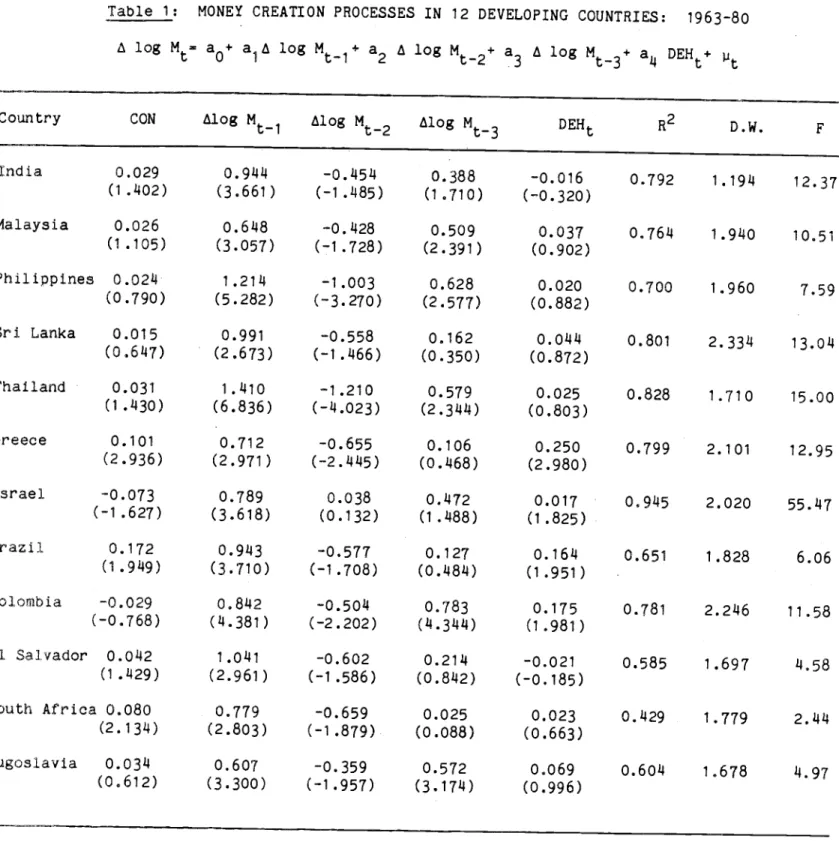
For each individual country, then, the following money creation equation was estimated:
slog
Mt= a0+a1Alog M 1+a2log
M 2a log M3+aDEH+1J,
(2)
where Mt
is broadly defined 042) nominal money, DEH is the fiscal deficit term and is a white noise term. The results obtained from the estimation of (2) for the twelve countries considered in this study for 1963-80 arereported in Table 1. As can be seen in all cases the fits are
quite
good. In ten of the twelve cases the coefficients of the fiscal deficit term DEHt are positive as expected. However, in only four cases --Greece,
Israel, Brazilarid Colombia --
this
coefficient is significant at conventional levels. Forall the countries the F-statistics indicate that
these regressions do provide
important information about the money creation process. In all cases the
residuals were closely examined in order to make sure that they were white
noise, and consequently qualified as proxies for money surprises in the
estimation of the growth equation (2). Notice that while tIeoutput equation was estimated for 1965—80, the money creation equations were estimated for
1963-80. This was done in order to allow for the inclusion
of lagged money surprises in the real output growth equation.
Equations equivalent to (2) were also estimated for alternative definitions of nominal liquidity (high—powered
money, domestic credit and Ml). Surprises series obtained as residuals of
these equations were also used in the estimation of the real output equations.
Broadly speaking, the results obtained under these alternative definitions of
unexpected liquidity growth were very similar to those reported here. 13/
The following output equation was actually estimated, where n=1,...12 refers to the twelve countries and where t=1965, ..., 1980:
log I time +
81lo(GE/Y)
2 + Z log M — log Me] 1=0 •)1n,
Z831log Tfl,_1+o B1log e,_1+ v+ C
This
equation differs from (2) by the inclusion of lagged values ofthe money surprises, the terms of trade and the real exchange rate terms. In this way the possibility of a different short- and long—run effect of these variables on real output is allowed. If, for example, devaluations only have a temporary contractionary effect
will be significantly negative with the coefficient of the lagged value of e being zero or positive. 1'4/ Notice also that in the estimation of equation (3) the I coefficient was allowed to differ across countries.
Table 1: MONEY CREATION PROCESSES IN 12 DEVELOPING COUNTRIES: 1963-80 log Mt= a0+ a1 log Mt_i+ a2 log Mt2+ a3 log Mt3+ a14 DEHt+
--.-.-. -. ..--Country CON slog Mt_i
slog Mt2 slog Mt3
DEHt R2 D.W. FIndia 0.029 0.91414 —0.11514 0.388 —0.016 0.792 1.1914 12.37 (1.1402) (3.661) (—1.1485) (1.710) (—0.320) Malaysia 0.026 0.6148 —0.1428 0.509 0.037 0.7614 1.9140 10.51 (1.105) (3.057) (—1 .728) (2.391) (0.902) Philippines 0.0214- 1.2114 —1.003 0.628 0.020 0.700 1.960 7.59 (0.790) (5.282) (—3.270) (2.577) (0.882) Sri Lanka 0.015 0.991 —0.558 0.162 0.0)414 0.801 2.3314 13.014 (0.6147)
-(2.673)
(—1.1466) (0.350) (0.872) Thailand - 0.031 1.1410 —1.210 0.579 0.025 0.828 1.710 15.00 (1 .1430) (6.836) (—14.023) (2.314)4) (0.803) Greece 0.101 0.712 -0.655 0.106 0.250 0.799 -2.101 12.95 (2.936) (2.971) (—2.1445) (0.1468) (2.980) Israel -0.073 0.789 0.038 0.1472 0.017 0.9)45 2.020 55.147(—1.627)
(3.618) (0.132) (1.1488) (1.825) Brazil 0.172 0.9143 —0.577 0.127 0.16i 0.651 1.828 6.06 (1.9149)(3.710)
(—1.708) (0.148)4)(1.951)
Colombia -0.029 0.8142 -0.5014 0.783 0.175 0.781 2.2146 11.58 (—0.768) (14.381) (—2.202) (14.31414)(1.981)
El Salvador 0.0142 1.0141 -0.602 O.21i4 -0.021 0.585 1.697 4.58 (1.1429) (2.961) (—1.586) (0.8)42) (—0.185) South Africa 0.080 0.779 —0.659 0.025 0.023 0.1429 1.779 2.144 (2.13)4) (2.803) (—1.879)- (0.088) (0.663) Yugoslavia 0.034 0.607 -0.359 0.572 0.069 0.6014 1.678 14.97(0.612)
(3.300) (—1.957) (3.17)4)Note: Numbers
in parentheses refer to t—statistics, R2 is the coefficient of determination,D.W.
is
the Durbin—Watson statistic and F is the F-statistic for eachThe results obtained from the estimation of the B coefficients in equation (3), and of some of its variants, are presented in Table 2. On the other hand, the country—specific l's obtained in each of these cases are given in Table 3. First, regarding Table 2, as expected, the coefficients of the money surprises are positive. Moreover, lagged money surprises turned out to be significantly positive. This result suggests that, according to the
implications of the rational expectations hypothesis, unanticipated money growth has had a significant effect on these developing countries' level of real activity. Moreover, when the money surprises terms were replaced by the
actual rate of growth of money the resulting coefficients were small and insignificant, confirming the idea that money surprises only affect real activity in these countries.
As can be seen from Table 2, the coefficient of (GE/Y) was
significantly positive in all equations where it was included, indicating that with other things given, higher government consumption has a positive impact on output. Regarding the coefficients of t
the
results show that according to previous findings [Barro (1978), Edwards (1983)], changes in the terms oftrade have no perceptive effect on real output in the developing countries. 15/
In equations (3.1), (3.2), (3.3) and (3,14) a contemporaneous and a
lagged real exchange rate term were included. The results obtained are quite Interesting. In all cases the coefficient of the contemporaneous real
exchange rate term are negative as suggested by the coritractiortary devaluation
view; moreover, in all cases this coefficient turned out to be significantly different from zero at conventional levels (5 percent and/or 10 percent). Interestingly enough, the coefficient of the once lagged real exchange rate term is positive and in all cases it Is significantly different from zero at the 5 percent level.
These
results provide statistical support to the view that in tneshort run
devaluations
have a contractionary effect on aggregate output. Thatis,
they support the short-run version of the contractionary devaluation
hypothesis.
Also, these
findings indicatethat this short-run contractionary
effect
is later reversed, with after one year the devaluation having anexpansionary influence on output. 16/ Moreover, according to these results the contemporaneous
and lagged effects of the (real) devaluation cancel
themselves.
Indeed a formaltest on the equality (with opposite sign) of
these
two coefficients indicates that the null hypothesis of equality cannot be rejected. This means that in the long runin
these countries (real) devaluations have had no effect on output. 17/The equations presented in Table 2 were also estimated with the rate of change of the real exchange rate instead
of log e as an independent
variable. The results obtained basically confirmed those reported in
Table 2;in
most cases the coefficient of the contemporaneous devaluation term
was
negative. The coefficient of the one-year lagged real devaluation
waspositive
and in a number of the regressions significant at the conventionallevels. These results, as well as the data set, are available from the author
upon request.
A potential problem with the results reported in Table 2 is that the real exchange rate (RER) may not be a completely exogenous variable. In fact, it has been argued by a number
of
authors that higher growth will generally result in a real appreciation of the domestic currency (Balassa 1964). In order to take this potential simultaneity problem intoaccount, equation (3)
was
also estimated using a two—stages least squares variance Component
Table 2: REAL OUTPUT GROWTH AND DEVALUATIONS IN 12 DEVELOPING COUNTRIES: 1965-80 , Equation Number (3.1) (3.2)
(3.3)
(3.14)[loM —
logM]
0.102 (1.146) 0.093 (1.057) 0.112 (1.300) 0.083 (0.913) E&logM_1— logM1J
0.210 (2.331) 0.181 (1.998) 0.222 (2.1473) 0.170 (1.961) log(GE/y) . 0.112 (3.023) -— —— 0.101 (2.780) —— —-log TOTt . 0.011k (1.1151) --—— --—— 0.027 (0.886) log TOTe_i 0.008 (—0.265) --—— ---— —0.009 (—0.2714) log RERt -0.083 (—2.103) -0.067 (—1.682) —0.077 (—1.966) —0.070 (—1.738) log RERt_i 0.069 (2.086) 0.072 (2.123) 0.070 (2.127) 0.071 (2.100)2
0.998
0.998
0.998
0.998
SEE0.038
0.038
0.038
0.039
N 192 192 192Note: The numbers in parentheses are t-statistics. SEE is the standard error of the regression, 2 is the adjusted R2, and N refers to the number of
Table 3:
ESTIMATES OF COUNTRY-SPECIFIC l's Equation Number (3.
14)Brazil
0.081 0.080 0.081 0.080 Colombia 0.052 0.056 0.0514 0.057 El Salvador 0.037 0.0142 0.039 0.0143 Greece 0.053 0.055 0.053 0.055 India0.036
0.036
0.035
0.036
Israel
0.058
0.061
0.058
0.062
Malaysia
0.080
0.080
0.080
0.080
Philippines
0.058 0.056 0.0560.057
South
Africa 0.037 0.038 0.036 0.039 Sri Lanka 0.061 0.0514 0.059 0.055 Thailand 0.069 0.069 0.068 0.069 Yugoslavia 0.057 0.057 0.057 0.059Note: The numbers in parentheses are t-statistjcs,
SEE Is the standard error of the regression, 2 Is the adjusted R2, arid N refers to the number of
from the analysis of Table 2. For example, when equation (3.1) was reestimated using the two—stages technique the following result was
obtained: 18/
log tm =
0.100[log
Mt - M.ogM] +
0.214l4[log
Mt_i -slog
M13
(1.109) (2.14914) + 0.121
lo(GE/Y) -
0.169
loRER
(3.129) (1.7147) +0.119
loRER1
+0.050
lot
(1.953) (1.590) 2 —0.008
lot1
R =
0.998
(—0.2143) SEE 0.038To sum up, the evidence presented here is quite favorable to the contractionary devaluation hypothesis. It indicates that once other important
variables are accounted f or, (real) devaluations have a significantly negative
effect on real output in the short run. The regression results also indicate that in the longer run devaluations have an expansionary effect on output, as the traditional view suggests. The results reported here have been obtained using a real exchange rate index as the relevant exchange rate variable. However, equation (3)
was
also run replacing e by the nominal exchange rate. In that case in all regressions the coefficients of the nominal exchange rate variable were not significantly different from zero. This, of course, is not surprising since, as discussed, most modern theories of nominal devaluation recognize that for a devaluation to have an effect on real activity, it has to generate a change in relative prices.It is important to remember
that
the results reported here wereobtained using annual data. It is possible that If quarterly data were used a
richer
pattern of dynamic response of
output growth toreal devaluations would
be found. 19/
IV. Concluding Remarks
In this paper the effect of (real) exchange rate
changes on real
output growth have been analyzed using annual data for a group of twelve
developing countries during 1965-80. Specifically this paper tried to provide
some empirical
content to the recent controversy on whether devaluations arecontractionary or expansionary. The empirical analysis was
based on the
estimation
of areduced-form, real-output equation that included as RHS
variables money growth surprises, government expenditure, terms of
trade and
real exchange rates. The results were quite favorable to the short-run
contractionary
devaluations hypothesis. After one year, however, the evidencesuggests that real devaluations do have an expansionary effect on output growth. In the long run devaluations will have no effect onoutput. Since the analysis was done using annual data it is not possible to investigate what the intra-year dynamic effects of devaluations on output are.
1/ Most IMF
stabilization
programs, for example, rely heavily ondeval uat I ons.
2/ See, for example, the account of the effect of a devaluation inany
traditional
textbook Strictly speaking a nominal devaluation will result
in higher output only if there is unutilized capacity. If this is not the
case, the nominal devaluation will be translated into an equiproportiona3.
increase in prices, and the real exchange rate will not change. On this
see
Johnson (1976). Inthis paper, however, we concentrate on the case
where
nominal devaluations areactually
translated into real devaluations. 3/ See, for example, Taylor (1983), Katseli (1983) and Buffie (198i4). Seealso Hanson (1983).
ki
Paradoxically,
perhaps, the real balance effect is also acentral element
of the monetary approach to devaluations. See Frenkel and Johnson (1976).
5/
See also Gylfason and Schmidt (1983). It should be noted that most theoretical models on contractionary devaluations have used a framework withoutcapital accumulation or growth.
6/ Also the numerous studies that have investigated the effects of IMF
stabilization
programs on output have looked at real activity behavior before and after major devaluations. See,for example, the discussion in Gylfason(1983).
7/
On the effect of money surpriseson:output
in developing countries see, for example, Hanson (1980). Clements and
Jonson
(1979), however, have shownthat under certain circumstances the excess supply term used
by Khan
8/ On empirical analyses of nominal devaluations and
real
devaluations see, for example, Krueger (1978) and Edwards
(1985).
9/ The importance of real devaluations in the adjustment process is stressed in most modern analyses of the subject. See, for example, Dornbusch
(1980). Obviously if a nominal devaluation results in an equiproportjonaj. increase in the price of nontradables, the real exchange rate will not change, and there will be no effect on production or expenditure. In fact, according to Johnson (1976), if output is at its full employment level a nominal devaluation will affect prices in an equiproportionate way, without altering the real exchange rate or outputs. The evidence presented in Cooper (1971a,b), Krueger (1978) and Edwards (1985), among others, indicates that in most major nominal devaluations the real exchange rate has also been devalued. The analysis was also performed using the nominal exchange rate in equation (2). See the discussion
below.
10/ It is important to emphasize that both from an analytical and empirical perspective, e and t
are
different variables. This point is stressed by WillIamson (1983) andKatseli
(i984).11/ See, for example, Barro (1979) and Edwards (1983).
12/ See, for example, Barro (1977), Hanson (1980) and Edwards (1983). Barro (1977) disOusses the assumptions implicit in the use of residuals as proxies for money growth surprises,
13/ These results are available from the author on request.
1/ t'Iote that some authors [i.e., McCallum (1980)J have argued that in a rational expectations setting only contemporaneous surprises should be included in the output growth equation. Barro (1977), however, has argued in favor of incorporating lagged values of Ut
anticipated
money.15/ Equation (i4) was also estimated using the rate of change of the terms of trade instead of their level. No siificant changes in the results .ere
obtained.
16/ These results
correspond
exactly to what Cooper (197th) suggested almostfifteen years ago.
17/ When additional lags of RER were incorporated, their coefficient was nonsignificant.
18/ The following instruments were used: All the exogenous variables in (3.1) plus twice-lagged money surprises, terms of trade, real exchange rate; and contemporary, lagged and twice—lagged changes in domestic credit.
19/ This suggests that further studies on the effects of devaluations on real
activity
coul ric')ncer1tr
e :)fl how parti cular sectors (1 .e., manufacturingsector
and so
on), f orwhich there are quarterly data, react to (real)
exchange
ratechanges. In
some sense, however, this is not a very satisfactoryway to
proceed,since even if
devaluationshave an overall
DATA APPENDIX
Ctp ):
Wasdefined as real GD?,
and the
data were taken from line
99b.p of the IFS.
Nominal Money (M): A
broad definition (M2) of money
wasused. Average yearly
values
constructed from data obtained from IFS were used.Fiscal Deficit: Data from line 80 of IFS were used. Terms of Trade: Defined as the relative price of
exports to imports; taken from the IFS supplement on international trade statistics.
Real Exchange Rate: Defined as the relative price of tradables to
nontradables. This variable was proxiect by a real exchange rate index constructed as the nominal exchange rate with respect to the US. dollar times the ratio of the U.S. WPI index to the domestic CPI
index. A number of authors have recently adopted this index as the best proxy for the relative price of tradables to nontradables. In the present paper on the real exchange rate, indexes were also used as possible proxies for this relative price. The
results, however, were not affected.
Government Expenditure: Defined as government current
expenditure and taken
REFE HEN CES
Balassa, Bela. "A Reappraisal of the Purchasing Power Parity Doctrine." Journal of Political Economy (19614).
Barro, Robert. "Unanticipated Money Growth and
Employment
in the United-
States
."American
Economic Review 67(1977), PP. 101-15.
__________
"Unanticipated
Money, Output, and the Price Level in the UnitedStates." Journal
of
Political Economy86(14) (1978).
__________ "Money and
Output
in Mexico, Colaiibia andBrazil"
in J. Behrmanand J. Hanson
(eds.), Short-Term
Macroeconomic Policy in Latin America. [CityJ: Ballinger, 1979.
Branson, William H. "Stabilization, Stagflation and Investment Incentives:
The
Case of Kenya 1975-80" in Sebastian Edwards and Liaquat Ahamed (eds.) Economic Adjustment and Exchange Hates in DevelopingCountries. Forthcoming, 1985.
Buffie, Edward. "The Macroeconomics of Trade Liberalization." Journal of
International Economics 17 (August 19814), pp. 212-38.
Clements,
Kenneth W,
and Peter D. Jorison. "Unanticipated Money,'Disequilibrium'
Modelling and Rational Expectations." Economics
Letters 2 (1979), pp. 303-08.
Cooper, Richard. "Currency Devaluation in Developing countries" in
G.Renis
(ed.) Government and_Economic_Development. New Haven, Conn.: Yale
University Press, 1971a.
__________
"Currency
Depreciation in Developing Countries." Princeton
Essays
in International Finance 86 (1971b).Diaz—Alejandro,
Carlos F. Exchange Rate Devaluation in a Semi-Industrialized Economy:The Experience of Argentina 1955—61.
Cambridge, Mass.:Dornbusch,
Rudiger. OpeflEconomyMacroeconomjc New York: Basic Books,1 980.
Edwards,
Sebastian.
"The Short-Run Relation between Inflation and Growthin
Latin America: Comment." American
Economic Review
(June 1983).
_________
"Exchange Rates in Developing Countries." U.C.L.A.: unpublishedmanuscript, 1985.
Frenkel,
Jacob and Harry G, Johnson. The Monetary Approach to the Balance of Toronto: University of Toronto Press, 1976.Gylfason. T.
"Credit Policy and Economic Activity in Developing Countries: An Evaluation of Stabilization Programs
Supported by the IMF
1977-79."
lIES Sinar Paper268,
University of Stockholm (1983). Gylfason, T. and
M. Schmid. "Does Devaluation Cause Stagflation?"
Canadian
Journal of Economics (1983).
Gylfason, T. and 0. Rislaer. "Does Devaluation Improve the
Current
Account." European Economic Review 25 (1984),
pp. 37—5)4
Hanson, James. "The Short-Run Relation between Growth
and Inflation in Latin
America." American
EconomicReviw 80
(1980), op. 972-89. "ContractionaryDevaluation, Substitution in Production and
Consumption, and the Role of the Labor Market." Journal
of
International Economics 1
(February1983), pp. 179—89.
Johnson, Harry G. "Elasticity, Absorption,
Keynesian Multiplier, Keynesian
Policy and Monetary Approach to Devaluation Theory." American
Economic
Review 60 (1976),pp.
448—52.Katseli,
Louka T. "Devaluation: A Critical Appraisal of the IMF's PolicyPrescriptions." American Economic Review Papers and
Proceedings 73(2) (May 1983) pp. 359-614.
__________
"Real
Exchange Rates in the 1970s" in R. Marston and J. Bilson (eds.) ExchangeRate
Theory and Policy. Chicago: University of Chicago Press, 1984.Khan, Mohsin S. and Malcolm D. Knight. "Stabilization Programs in Developing Countries: A Formal Framework." Staff Papers 28 (March 1981), pp.
1—53.
Krueger, A.O, Liberalization Attempts and Consequences. Boston: Ballinger,
1978.
Krugrnan, P. and L. Taylor. "Contractionary Effects of Devaluation." Journal
of International Economies 8 (August 1978), pp. 14)45—56.
MeCallum, B.T. "On the Observational Equivalence of Classical and Keynesian Models." Journal of Political Economy 87 (1979), pp. 399-1402.
Taylor, Lance and Jeffrey Rosensweig. "Devaluation, Capital Flows and Crowding Out: A CGE Model with Portfolio Choice for Thailand." Working
Paper, The World Bank, 198)4.
Van Wijnbergen, Sweder. "Exchange Rate Management and Stabilization Policies in Developing Countries" in S. Edwards and L. Ahamed (eds.) Economic Adjustment and Exchange Rates in Developing Countries (forthcoming,
1985).
Williamson, John. The Exchange Rate System. Cambridge, Mass.: MIT Press f or the Institute of International Economics, 1983.
![Table 2: REAL OUTPUT GROWTH AND DEVALUATIONS IN 12 DEVELOPING COUNTRIES: 1965-80 , Equation Number (3.1) (3.2) (3.3) (3.14) [loM — logM] 0.102 (1.146) 0.093 (1.057) 0.112 (1.300) 0.083 (0.913) E&logM_1 — logM1J 0.210 (2.331) 0.181 (1.998) 0.222 (2.1473](https://thumb-us.123doks.com/thumbv2/123dok_us/1255079.2668912/15.921.103.836.116.781/table-output-growth-devaluations-developing-countries-equation-number.webp)

