THE EFFECTIVENESS OF SCHOOL-WIDE POSITIVE BEHAVIOR PROGRAMS IN GEORGIA MIDDLE SCHOOLS
by Kristy Arnold Liberty University
A Dissertation Presented in Partial Fulfillment of the Requirements for the Degree
Doctor of Education
Liberty University March, 2012
THE EFFECTIVENESS OF SCHOOL-WIDE POSITIVE BEHAVIOR PROGRAMS IN GEORGIA MIDDLE SCHOOLS
By Kristy Arnold
A Dissertation Presented in Partial Fulfillment Of the Requirements for the Degree
Doctor of Education
Liberty University, Lynchburg, VA March, 2012
APPROVED BY: Dr. Margaret Ackerman, Chair Date: March 23, 2012 Dr. Donna Joy, Committee Date: March 23, 2012 Dr. Melissa Williams, Committee Date: March 23, 2012
ABSTRACT
Kristy Arnold. THE EFFECTIVENESS OF SCHOOL-WIDE POSITIVE BEHAVIOR PROGRAMS IN GEORGIA MIDDLE SCHOOLS. (under the direction of Dr.
Ackerman) School of Education, Liberty University, February, 2012.
Discipline issues and inappropriate student behavior in the classroom are issues that administrators and teachers throughout the country deal with on a daily basis and often lead to a loss of instructional time. This causal comparative study examined school-wide discipline programs and compared the behavior of students in schools using school-wide positive behavior management systems to the behavior of students in schools that do not implement school-wide programs based on the numbers of office referrals at each level of behavior. Three middle schools in one northwest county in Georgia were compared based on the presence of School-Wide Positive Behavior Interventions and Supports (SWPBIS). The Findings suggest that middle schools utilizing this universal discipline approach had significantly fewer serious, or level three behavior problems than non-SWPBIS schools.
Descriptors: School-Wide Positive Behavior Interventions and Supports (SWPBIS),
discipline referrals, reinforcements, discipline levels
ii
DEDICATION
This study is dedicated to my parents Charles and Peggy Rutland, who have always supported me in every aspect of my life. I have not always followed the straight and narrow path, but through their patient guidance and unlimited encouragement, I have been able to maneuver the twists and turns to a life filled with love and happiness! Thank you dad for believing in me and helping me to become strong and independent and mom for helping me to see that asking for help when you need it is not a weakness! I love you both!
I also want to dedicate this study to my wonderful husband, Jason, who without his love and support I would have given up a long time ago! He has been my biggest supporter and I can never thank him for all his encouragement! Thank you for being the love of my life! It is also dedicated to my two amazing children, Noah and Kendall who suffered “quietly” through all the hours mom spent in the office or kitchen working on the “paper!” It’s finally here, mom is finished, and we are going Disney World!
iii
ACKNOWLEDGMENTS
There are so many people who have helped to make this a successful journey! First, my family, Jason, Noah, and Kendall! Your patience, encouragement and love have provided me with the inspiration to keep pressing forward and never give up! You are all the best part of me!
I would like to thank the entire community of Liberty University! From the receptionist and registrars that answer the phone to the professors and administrators who help guide instruction. It is obvious that Liberty University is committed to providing a rigorous curriculum that is grounded in a Christian worldview. I am proud to be part of such a fine institution!
I have been blessed with an amazing dissertation committee! To Dr. Beth Ackerman, my dissertation chair, your patience, commitment, and advice has been especially appreciated throughout this process. I am especially grateful for your availability and constant encouragement! To Dr. Joy and Dr. Williams, thank you for your honest feedback to help make improvements to the dissertation.
To my editor, Dr. Toni Flanagan, thank you for not only being a great editor, but for helping me with all the details! I would also like to mention Dr. Jennifer Priestley at Kennesaw State University who helped support the statistical analysis in the study.
And finally, this journey would not have even begun if it were not for my traveling buddies! Thank you, Venita, Evie, Susan, Sharron, and Johnnie for holding my hand as we jumped off the cliff together! And most of all, thanks for never letting go – for your constant encouragement, feedback, and faithfulness! I love you all!
iv
Table of Contents
DEDICATION ... ii
ACKNOWLEDGEMENTS ... iii
LIST OF TABLES ... vii
LIST OF FIGURES ... ix LIST OF ABBREVIATIONS ... xi CHAPTER 1: INTRODUCTION ...1 Background ...1 Problem Statement ...3 Purpose Statement ...3
Significance of the Study ...4
Research Question ...5
Research Hypotheses ...5
Identification of Variables ...6
Assumptions and Limitations ...8
Research Plan ...10
CHAPTER 2: LITERATURE REVIEW ...13
Introduction………13 Theoretical Framework ...14 Summary ...39 CHAPTER 3: METHODOLOGY ...41 Introduction ...41 Research Design...42
v Participants ...43 Setting ...45 Instrumentation ...50 Procedures ...53 Data Analysis ...55 CHAPTER 4: RESULTS ...59 Overview of Problem ...59 Restatement of Purpose ...59 Instrumentation ...60 Descriptive Analysis ...61
Chi Square Analysis ...79
Summary...94
CHAPTER 5: DISCUSSION ...96
Summary of Findings ...96
Research Questions and Hypotheses ...96
Discussion ...100
Implications of the Findings ...102
Limitations ...107
Implications for Future Research ...108
Summary ...109
REFERENCES ...112
APPENDIX A: School-wide Evaluation Tool (SET) ...125
vi
APPENDIX C: Permission to Use School-wide Evaluation Tool (SET) ...127
APPENDIX D: Table 4.1 Unduplicated Discipline Referrals at School C ...129
APPENDIX E: Table 4.2 Total Incidents at School C by Year...130
APPENDIX F: Table 4.3 Student Referrals by Year and Ethnicity at School C ...131
APPENDIX G: Table 4.4 Student Referrals by Year and Gender at School C ...132
APPENDIX H: Table 4.5 Student Referrals by Meal Eligibility at School C ...133
APPENDIX I: Table 4.6 Unduplicated Student Discipline Referrals at School A ...134
APPENDIX J: Table 4.7 Total Incidents at School A by Year ...135
APPENDIX K: Table 4.8 Student Referrals by Year and Ethnicity at School A ...136
APPENDIX L: Table 4.9 Student Referrals by Year and Gender at School A ...137
APPENDIX M: Table 4.10 Student Referrals by Meal Eligibility at School A ...138
APPENDIX N: Table 4.11 Unduplicated Student Discipline Referrals at School B ...139
APPENDIX O: Table 4.12 Total Incidents at School B by Year ...140
APPENDIX P: Table 4.13 Student Referrals by Year and Ethnicity at School B ...141
APPENDIX Q: Table 4.14 Student Referrals by Year and Gender at School B ...142
APPENDIX R: Table 4.15 Student Referrals by Meal Eligibility at School B ...143
APPENDIX S: School A & B Discipline Referral Form ...144
vii
LIST OF TABLES
Table 3.1: School Demographic Profile...44 Table 3.2: Discipline Referral Frequency ...54 Table 3.3: SET Scores...55 Table 4.1: Unduplicated Student Referrals by Year at School C ... Appendix D Table 4.2: Total Incident Events by Year at School C ... Appendix E Table 4.3: Student Referrals by Year and Ethnicity at School C ... Appendix F Table 4.4: Student Referrals by Year and Gender at School C ... Appendix G Table 4.5: Student Referrals by Year and Meal Eligibility at School C ... Appendix H Table 4.6: Unduplicated Student Referrals by Year at School A ... Appendix I Table 4.7: Total Incidents at School A by Year ... Appendix J Table 4.8: Student Referrals by Year and Ethnicity at School A ... Appendix K Table 4.9: Student Referrals by Year and Gender at School A ... Appendix L Table 4.10: Student Referrals by Year and Meal Eligibility at School A... Appendix M Table 4.11: Unduplicated Student Discipline Referrals at School B ... Appendix N Table 4.12: Total Incidents at school A by Year ... Appendix O Table 4.13: Student Referrals by Year and Ethnicity at School A ...Appendix P Table 4.14: Student Referrals by Year and Gender at School B ... Appendix Q Table 4.15: Student Referrals by Year and Meal Eligibility at School B ... Appendix R Table 4.16: Observed Counts of Student Referrals by SWPBIS Participation ...80
Table 4.17: Table of Observed and Expected Counts of Discipline for SWPBIS Participation ...81
Table 4.18: 2009 v .2010 Observed and Expected Discipline Counts at School C ...83 Table 4.19: 2010 v. 2011 Observed and Expected Discipline Counts at School C ...83
viii
Table 4.20: 2009 v. 2011 Observed and Expected Discipline Counts at School C ...84
Table 4.21: 2009 v .2010 Observed and Expected Discipline Counts at School A ...85
Table 4.22: 2010 v. 2011 Observed and Expected Discipline Counts at School A ...86
Table 4.23: 2009 v. 2011 Observed and Expected Discipline Counts at School A ...87
Table 4.24: 2009 v .2010 Observed and Expected Discipline Counts at School B ...88
Table 4.25: 2010 v. 2011 Observed and Expected Discipline Counts at School B ...88
Table 4.26: 2009 v. 2011 Observed and Expected Discipline Counts at School B ...89
Table 4.27: Significance of Discipline Referrals within Each School ...90
Table 4.28: Set Score by School ...92
Table 4.29: Table of Percentage of Discipline Referrals by SWPBIS ...93
ix
LIST OF FIGURES
Figure 2.1: Pyramid of Intervention ...30
Figure 2.2: Continuum of School-Wide Instructional & Positive Behavior Support ...37
Figure 3.1: Discipline Infractions ...46
Figure 3.2: Discipline Consequences ...47
Figure 3.3: Characteristics of SWPBIS and non-SWPBIS ...50
Figure 4.1: Variables and Descriptions ...61
Figure 4.2: Population of Middle School C by Year ...62
Figure 4.3: Unduplicated Student Referrals at School C ...63
Figure 4.4: Total Incidents at school C by Year ...64
Figure 4.5: Percent of Student Referral Levels by Ethnicity ...66
Figure 4.6: Percent of Student Referral Levels by Gender ...67
Figure 4.7: Percent of Student Referral Levels by Meal Eligibility for School C ...68
Figure 4.8: Population of school A by Year ...69
Figure 4.9: Unduplicated Student Referrals at School A ...70
Figure 4.10: Total Incidents at school A by Year ...71
Figure 4.11: Percent of Student Referrals by Ethnicity at School A ...72
Figure 4.12: Percent of Student Referrals by Gender at School A ...73
Figure 4.13: Percent of Student Referral Levels by Meal Eligibility for School A...74
Figure 4.14: Population of School B by Year ...74
Figure 4.15: Unduplicated Student Referrals at School B ...75
Figure 4.16: Total Incidents at School B by Year ...76
x
Figure 4.18: Percent of student Referrals by Gender at School B ...78 Figure 4.19: Percent of Student Referral levels by Meal Eligibility for School B ...79 Figure 4.20: Percentage of student Referrals by SWPBIS ...81
xi
LIST OF ABBREVIATIONS Adequate Yearly Progress (AYP)
Center for Effective Collaboration and Practice (CEPA) Differential Reinforcement of Incompatible behavior (DRI) Economically Disadvantaged (ED)
Georgia Department of Education (GADOE)
Gun Free Schools Act (GFSA)
Individuals with Disabilities Act (IDEA)
In-School Suspension (ISS) Limited English Proficient (LEP)
National Association of School Psychologist (NASP) National Center on Response to Intervention (NCRTI)
No Child Left Behind (NCLB)
Out-of-School Suspension (OSS) Response to Intervention (RTI) School-wide Evaluation Tool (SET)
1
CHAPTER ONE: INTRODUCTION
Student behavior problems are a challenge that many schools face, and they continue to remain a concern for school personnel (McIntosh, Campbell, Carte, & Zumbo, 2009). Discipline problems in school range from minor infractions such as chewing gum or refusing to complete homework to more serious behaviors including bullying, fighting, or destroying property (Muscott, et al., 2004). Dealing with the most minor of problems can consume up to “80% of a teacher’s time in the classroom,” (Scott, 2001, p. 88) leading to loss of instruction for the students. Faced with this dilemma, schools are searching for ways to decrease the number of problem behaviors and
influence students to make better choices so they remain in the classroom and maximize instructional time.
Background
Since the 1960s, researchers have conducted studies to examine effective classroom management strategies in order to provide teachers the skills necessary to address classroom behavior problems (Gable, Hester, Rock, & Hughes, 2009). Recently, many of these researched strategies have been utilized by educational leaders to meet the requirements of legislative mandates placed on schools. The implementation of the No
Child Left Behind Act (NCLB) in 2001 placed a rigorous set of accountability standards
on public schools calling for an increase in the academic achievement of all students. This law mandated that by the year 2014 every child would be proficient in the areas of reading and math. In 2004, the Individuals with Disabilities Education Act (IDEA), added additional pressure to identify research based strategies to increase academic achievement and improve student behavior (George, White, & Schlaffer, 2007). In order
2
to adhere to these federal mandates, educational leaders at both the school and school system levels have been exploring school improvement strategies to implement in the areas of classroom management and student instruction to effectively meet these demands.
One shift that has been identified in the research on effective classroom management strategies is that of proactive management as opposed to reactive management (Gable et al., 2009). Traditionally, discipline in school has often been reactionary followed by a negative consequence; however, many schools today are recognizing the value of establishing preventive positive behavior interventions in the classroom environment and teaching behavioral expectations (Gable, Bullock, & Evans, 2006). Scott (2001) suggested that the key to reducing student discipline problems is the use of prevention in the form of a school-wide positive behavior management system. School-wide Positive Behavior Interventions and Support (SWPBIS) is one approach being proposed to reduce problematic behavior in schools. These proactive systems rely on teachers and staff members to establish and follow universal norms for student
behaviors in all areas of the school, to explicitly teach and reward the expected behaviors, and to follow consistent consequences for student misbehavior. While SWPBIS is not a specific curriculum or program, it is a systematic approach to teaching and rewarding appropriate behavior, reducing negative student behaviors, and assessing the
effectiveness of the school’s interventions.
Social learning theory offers that behavior can be learned through observation or imitation of people, watching electronic media, or even reading books and is closely related to what we think of when we hear the term “behaviorism” (Miller, 2011, p.235).
3
Social learning theory supports the framework that schools can positively affect students’ behavior by providing explicit examples of correct behavior and offering students
sufficient time to practice these behaviors. An important part of behavior management is providing feedback so that the learner ascertains whether or not the behavior was
appropriate. This feedback may also be referred to as a reinforcer, which in a school setting may be either tangible such as a piece of candy or a “token,” or intangible which could be in the form of verbal praise (Wheatley, West, Charlton, Smith, & Taylor, 2009).
Problem Statement
Classroom teachers and school administrators continue to deal with disruptive student behaviors that lead to lost instructional time in the classroom. Current research suggests that schools following SWPBIS reduce the number of total discipline referrals in the school; however, there are few studies that examine which types of behaviors are reduced as a result of implementing a positive behavior management system.
Additionally, there are few studies that compare similar schools that use SWPBIS to those that do not. Most studies identified in research have compared baseline data prior to beginning the program to the same school data after implementation (Irvin, Tobin, Sprague, Sugai, & Vincent, 2004).
Purpose Statement
The purpose of this study was to examine methods in effective school-wide positive behavioral interventions and determine if there was a statistical difference in the types of behavior infractions for students in middle schools implementing SWPBIS to those that did not use these universal systems. The goal of this study was to add to the existing body of research on this topic and to provide new information that addresses the
4
specific types of behaviors that may be improved as a result of implementing school-wide positive behavior management systems at the middle school level.
Significance of the Study
The results of this study may benefit administrators and school improvement teams that wish to improve the overall school climate and culture of their building. Many schools rely on informal measures to determine the effectiveness of programs centered on improving student behavior (McIntosh et al., 2009). The results of this study may be used to help schools identify effective strategies in increasing positive student behaviors and help teachers use these strategies with more confidence. As positive student behaviors increase, more time is available for instruction. Research suggests schools that
implement SWPBS over a two-year period show a decrease in office referrals and significant increases in student academic achievement on standardized state tests (Sailor, Zuna, Jeong-Hoon, Thomas, & McCart, 2006).
Additionally, research indicates that schools are still hesitant to adopt school-wide policies to address student discipline despite the promising results (Lohrmann, Forman, Martin, & Palmieri, 2008). The results of this research may support schools in their decisions to adopt school-wide positive behavior management plans and identify specific strategies for implementation that address specific discipline problems. Parker, Nelson, and Burns (2010) suggest the need for further studies in positive school-wide behavioral management systems that address specific types of behaviors using office referrals to measure “the effects of the intervention on low-incidence, high-impact behaviors” (p.825). These data could then be used to determine the effectiveness of specific
5
serve schools wishing to employ research-based strategies to improve student behavior in the school setting through the development and implementation of a school-wide positive behavior management system.
Research Question
Current research identifies the need for additional studies that address specific behaviors affected by school-wide positive behavior management plans as well as identifying the effects of these management systems on rural settings (Parker et al., 2010). This study analyzed discipline referrals in three rural school settings to determine if there was a significant difference in the types of student behaviors in schools with and without school-wide positive behavior management systems. This causal comparative research study addressed the following questions:
Research question 1: Is there a significant difference in the percentage of
students referred for level one, two, and three discipline referrals between SWPBIS and
non-SWPBIS schools?
Research Question 2: Is there a significant difference in the total number of
discipline referrals each year within each participating school?
Research Question 3: Is there a difference between schools SET scores and the
percentage of discipline referrals in SWPBIS schools and non-SWPBIS schools?
Hypotheses The following null hypotheses were tested:
Null hypothesis 1: There are no statistical differences in the total number of
6
Null hypothesis 2: There is no statistical difference between the total numbers of
discipline referrals each year within the same school.
Null hypothesis 3: There is no difference in the SET scores and the number of
office discipline referrals between SWPBIS and non-SWPBIS schools. Identification of Variables
In this study, several key variables existed as follows: Independent Variable
The independent variables under investigation were the school management systems in three middle schools in a school system; SWPBIS and non-SWPBIS. The two middle schools implementing SWPBIS were purposefully selected due to the similarities in staff development, design, and implementation of the plan. Both schools modeled their school-wide plan based on the Positive Behavior Instructional Support (PBIS) program that was developed by the Institute on Violence and Destructive Behavior at the University of Oregon’s Center for Effective Collaboration and Practice (CECP) (CECP, 2010). The third school does not utilize SWPBIS. This school employs traditional approaches to managing student behavior and does not follow a universal system to teach student expectations and consequences. All three schools are located in the same north Georgia school system and are required to adhere to the same Student Code of Conduct where student behavior levels have been defined (BCSS, 2010). Within-school
demographic data as well as between-school data was collected and analyzed as part of this study to increase internal validity.
Dependent Variable
7
referrals recorded for each school. A discipline referral is an instrument used to record a student’s misbehavior in school and may be given to students for one of three levels of misconduct. A level one behavior is considered minor and may be issued to a student for a chronic behavior such as being late to class, talking out of turn, chewing gum, or a dress code violation. Level one behaviors are not considered serious or dangerous behaviors; however, they are distracting to the class and interrupt the learning environment. These behaviors include talking out of turn, failure to follow directions, running in the halls, tardy to class, or not bringing materials to class. Often these behaviors are handled at the classroom level. These behaviors result in consequences such as after-school detention, parent conference, silent lunch, change in seating arrangement, or other loss of privileges. Chronic level one behaviors will often lead to an office discipline referral that will result in a level two consequence. Level two behaviors are considered to be more serious in nature, and some could be considered dangerous. These generally result in an immediate office referral and may include fighting, destruction of property, inappropriate language, disrespect toward staff members or skipping class. Level two behaviors often carry the consequence of in-school suspension (ISS), or short term out-of school suspension (OSS). In-school suspension occurs in a designated time-out area in the school where students report to complete class work for an assigned period of time. This time frame could be from one class period to several days depending on the infraction and the accumulated office referrals for a particular student. Level three office referrals are received when a student has been involved in a behavior that is dangerous to self or others. These are usually criminal behaviors that include the possession or use of illegal drugs or weapons, vandalism, assault, threats, and even bullying or gang behavior.
8
Consequences for these behaviors usually result in a long-term suspension from school and possible criminal charges through the Office of Juvenile Justice. Data were collected on the number and levels of office referrals reported at each school that resulted in a consequence of ISS or OSS.
Data were also collected on a second dependent variable to assess features that were in place at each school for establishing expectations for student behavior, as well as which conditions for student behavior warranted an office referral. The School-wide Evaluation Tool (SET) was administered to the staff at all three schools to examine discipline procedures in classroom settings, non-classroom settings, school-wide settings, and for individual students in need of individualized plans (Algozzine et al., 2010). These scores were used to determine the presence of a systems approach to school-wide
behavior support in each school and whether a difference existed between each school’s SET scores and the number of discipline referrals recorded at each school The SET survey has a Cronbach’s alpha of .77, indicating an adequate reliability (Lassen, Steele, and Sailor, 2006).
Assumptions and Limitations Assumptions
The researcher first assumed that students respond to positive interventions rather than to negative consequences, and ultimately want to do what is expected of them. Combining clear expectations with a positive reinforcement should lead to a reduction of behaviors that result in disciplinary action. The researcher also assumed that the schools in the study would have comparable discipline referral forms and similar behavior expectations for level one, two and three behaviors. Finally, the researcher assumed that
9
each school would be willing to participate in the study. Limitations
In any causal comparative design, there are inherent limitations. First, the researcher had no control over the independent variable, as the school-wide positive discipline systems had already been established in the school settings. To control for this limitation, matching was used in order to identify two schools that used a management plan modeled after the same SWPBIS program. According to Gall, Gall, and Borg (2007), matching can be used “to equate two groups on one or more extraneous variables so that these extraneous variables do not confound the study of causal relationships involving the variables of primary interest” (p. 313). Not only was it important to match two schools that used the SWPBIS program, but the comparison school also needed to be matched for population demographics in order to increase the reliability of the study’s findings. While matching the population demographics of the school increased the reliability of the study on the effects of the positive school-wide behavior management system, it limited the ability of the researcher to generalize the results for all middle school settings.
A second limitation of the study was experimenter effect, or the differences in the teachers or administrators in each school. This study did not take into account the
training in classroom management that the teachers in the control schools experienced or the number of years of teaching experience. It is possible that more experienced teachers had less discipline problems in their classroom than first year teachers. To address this potential problem, the researcher provided information regarding teachers’ years of experience, as well as recorded numbers of discipline referrals for each school in the
10 study.
An additional limitation of this study was instrumentation validity. While data were collected from all schools regarding office referrals, the schools may have used a different instrument for recording student discipline infractions. This could have added an additional level of experimenter effect because if the referral reports were different, teachers and administrators may not have judged behaviors in the same manner. To address this issue, the researcher used discipline information that was entered into the student information systems for each school. Administrators in the state of Georgia enter state codes that identify specified behaviors, and all student information systems in the state are required to use the same reporting codes for recording student discipline
infractions (GADOE, 2010). Additionally, the researcher addressed how the teachers and administrators in the study used and issued office referrals. Irvin et al. (2004) suggested that the validity of using office referrals increases when a school implements discipline procedures in a more standardized manner. Data collected from the SET survey provided a measurement for evaluation of the consistency and effectiveness of the school-wide system in place at each school, and both within-schools scores and between-school scores were compared.
Research Plan
This quantitative study employed a causal comparative design to determine whether there was a difference in the types of discipline behaviors at each grade level in middle schools with and without positive school-wide behavior management plans, by examining the number of discipline referrals at each school. The purpose of the study was to identify a cause-and-effect relationship based on differences in dependent
11
variables where only one group was exposed to the independent variable (Gall, Gall, & Borg, 2007, p.306). The researcher sought to determine if there was a difference in the types of behaviors: level one, level two, and level three, and the total number of negative student behaviors in SWPBIS schools and non-SWPBIS schools. This design was justified because the researcher was not able to manipulate the independent variable in the study because the schools under study had already implemented the school-wide positive behavior management plan. Archived student discipline data was used for analysis.
The researcher collected and analyzed student discipline data each year, beginning with the baseline year from the two SWPBIS schools. These were then compared to the traditional non-SWPBIS school that did not follow a preventative universal plan. Data were collected yearly and recorded in an Excel spread sheet, identifying the number of discipline referrals for each school and the level of the
discipline infraction. For the purposes of this study, only discipline referrals that resulted in ISS or OSS were collected because these data are required for state reporting. A Chi-Square test was used for this study to determine if the level of student referrals and participation in SWPBIS were related. A Chi-Square test is a nonparametric test to determine whether “data in the form of frequency counts are distributed differently for different samples” (Gall, Gall, & Borg, 2007, p.325). The two independent variables under study were the SWPBIS schools and the non-SWPBIS school. The categories that were considered in this study included the three levels of discipline referrals at each school. Contingency tables of observed and expected frequencies were constructed and an analysis was conducted to determine if a statistical difference existed between the
12
comparison schools on levels of discipline referrals, as well as a descriptive analysis to determine differences in SET scores.
Definition of Core Terms
Definitions of core terms used throughout this study are provided for clarity:
Discipline Referral: A form documenting a student’s inappropriate behavior that
requires an administrative consequence.
Expulsion: Consequence of a student being expelled from a public school beyond
the current school semester or term.
In School Suspension (ISS): Consequence of exclusion of a student for a minimum
of one class period in an alternative learning setting.
Out of School Suspension (OSS): Consequence of student being removed from the
public school setting for a prescribed amount of time not to exceed more than 10 days.
Non-SWPBIS: Refers to schools that do not implement School-wide Positive
Behavioral Interventions and Supports.
SWPBIS: Refers to schools that implement School-wide Positive Behavioral
Interventions and Supports. SWPBIS provides a framework to teach and encourage positive skills and behaviors to students by implementing a system that focuses on teaching, practicing, and encouraging pro-social skills and behaviors (PBIS, 2011).
13
CHAPTER TWO: LITERATURE REVIEW
The development of school improvement practices and procedures have been part of the educational process throughout the history of public schools, and educators
continue to search for strategies that improve the learning environment. Parents as well as teachers expect their schools to be safe, orderly environments in which children
successfully learn how to apply academic and social skills. According to Maslow, before students can focus on academics, their safety needs must first be met (Henze, Kathz, Noret, Sather, & Walker, 2002). Educational leaders are mandated to meet the safety needs of children, which includes identifying strategies and programs to help them meet those demands.
The purpose of this quantitative study was to examine methods in effective positive school-wide behavioral interventions and determine if there was a difference in the types of behavior problems exhibited in middle school students as a result of these behavioral intervention strategies. This was accomplished by determining if there was a significant statistical difference between the types of student discipline behaviors
between two schools that implemented school-wide positive management behavior systems and one school that did not use these school-wide methods.
This chapter outlines the theoretical framework supporting this study and examines the historical background of discipline in schools. Current trends and issues that have led to the development of positive behavior interventions in schools to help maintain a safe and orderly learning environment for students will also be identified and discussed. These school-wide positive behavior interventions and supports are
14
on classroom disruptions and positive behavior interventions are examined to determine their effects on school culture and improvements in student behavior. The review of literature concludes with a discussion of implications for educational leaders employing strategies to reduce student discipline problems in a school-wide setting.
Theoretical Framework
Theoretical frameworks are critical in both deductive and exploratory studies (Gall, Gall, & Borg, 2007). Research studies in social and behavioral sciences require a rationale, or a conceptual model, for how one makes “logical sense of the relationships among several factors that have been identified as important to the problem”
(Radhakrishna, Yoder, & Ewing, 2007, p. 692). Social learning theory provided the theoretical framework for this research study, which describes “the process by which society attempts to teach children to behave like the ideal adults of that society” (Miller, 2011, p. 233). Miller suggested this theory, which was influenced by Bandura during the 1960s and 1970s, is derived from learning theory and is often linked with the terms “behaviorism” or “behavior modification” (p.224).
In 1913, while instructing at Johns Hopkins University, prominent psychologist John Watson made a declaration that “the goal of psychology should be to predict and control overt behavior, not to describe and explain conscious states” (Miller, 2011, p.225). This objective form of psychology became known as behaviorism, where scientists study behavioral responses caused from environmental stimuli in order to explain specific behaviors. Learned behaviors have been traditionally classified into two categories: operant and classical conditioning. Much of Watson’s focus was concerned with classical conditioning and can be attributed to the work of Pavlov’s behavioral
15
studies using dogs (Cooper, 2009). Classical conditioning refers to “the idea that we develop responses to certain stimuli that are not naturally occurring” (Heffner, 2001, para. 3). In Pavlov’s study, an example of a naturally occurring stimulus would be to salivate when food is placed in the mouth, thus creating an unconditioned response to an unconditioned stimulus. He found that when pairing a conditioned stimulus, such as a dinner bell, with an unconditioned stimulus, food, then eventually a conditioned response will occur with a conditioned stimulus. The conditioned response of salivating will eventually occur with the conditioned stimulus of the bell.
Extending to human studies, one of the most famous experiments of classical conditioning to produce a conditioned response with children was conducted by Watson in 1917. The “Little Albert” experiment elicited a conditioned fear of white rats in an 11-month old boy by placing a white rat in front of the child and then producing a painfully loud sound when the child reached for the rat, causing the child to cry. Eventually, the child began to cry at the sight of the rat before the unconditioned stimulus of noise was presented (Miller, 2011). According to Watson (1924), children were moldable like clay as illustrated in his famous quote:
Give me a dozen healthy infants, well-formed, and my own specified world to bring them up in and I’ll guarantee to take any one at random and train him to become any type of specialist I might select – doctor, lawyer, artist, merchant, chief, and yes, even beggar-man and thief, regardless of his talents, penchants, tendencies, abilities, vocations, and race of his ancestor (p.104).
Other behavior learning theorists such as Skinner believed “behavior is the interaction of biology and the environment over time,” (Cautilli, Rosenwasser, &
16
Hantula, 2003, p. 238), and behaviors are shaped by reinforcers which are “anything that completes the function from mastery to control, from tangibles to sensory enjoyment to social praise” (p. 238).). This type of conditioning, known as operant conditioning, refers to individuals behaving in response to reinforcers based on past consequences. While classical conditioning begins with a reflex, operant conditioning is learning due to the natural consequences of one’s actions. These consequences can be determined by positive reinforcements or negative consequences.
Skinner is noted for his research in behavior modification and is considered the most influential psychologist of the 20th century (Haggbloom et al., 2002). Behavior modification is the attempt to change a child’s inappropriate behavior by using a behavior modifier or reinforcement. “A behavior modifier changes the reinforcement
contingencies so that desirable behavior is reinforced and thereby maintained while the undesirable behavior is ignored and thereby weakened” (Miller, 2011, p.299). This method of behavior management, often used by teachers, is called “planned ignoring.” According to Miller (2011), this method is used when a teacher ignores a student’s shout out in class, signaling to the student that the inappropriate behavior will not elicit the desired response from the teacher. Many school-wide management systems follow this approach, and students “caught being good” are given tangible rewards to reinforce desirable behaviors, thus focusing attention on the positive behaviors. Research shows that use of token reinforcements as a means of exchange for something of value to a student is an effective strategy for managing student behavior (Wheatley et al., 2009). In a study of 200 first through fifth-grade students in a rural elementary school, Wheatley et al. concluded that three inappropriate behaviors in the lunchroom were dramatically
17
reduced by using tokens to reinforce appropriate target behaviors of students in the lunchroom: (1) littering decreased by 96%, (2) inappropriate sitting decreased by 65%, and (3) running decreased by 75% . In this study, the teachers observed and recorded the number of targeted behaviors as they occurred prior to implementing the intervention. The students were then taught the appropriate lunchroom behavior and given rewards when the desired behaviors occurred. In this experiment, Wheatley et al. found that even though the rewards were slowly reduced, the desired behaviors of the students continued. Vicarious Reinforcement
While social learning theory is similar to operant conditioning, in that reinforcements are present, it differs somewhat in its approach to the use of
reinforcements. Social learning theorists posit that students will imitate the behaviors of others based on the reinforcements they see others receiving, a process that Bandura called vicarious reinforcement (Miller, 2011). According to Fox and Bailenson (2009) vicarious reinforcement suggests that “individuals need not experience rewards or
punishments themselves in order to learn behaviors; rather, they can observe and interpret the consequences experienced by a model and make inferences to the likelihood of
incurring these outcomes themselves” (p.3). While these behaviors may be the result of observing another child receiving positive reinforcement, the reinforcement itself is not necessary for acquiring specific behavior. Thus, learning occurs simply by observing the behavior of others.
Research exists to support that children often imitate or model behavior, and the likelihood becomes stronger when the model being imitated is admired or the model is similar to the observer (Rudolph & Langford, 1992). This is especially significant to
18
schools that are developing systems for behavior management. Students need strong role models who are providing clear, explicit expectations, as well as opportunities to see appropriate behavior being modeled. Many schools offer peer helpers to new students arriving to the school. The behavior these students model may be a strong indicator of how the new student will perceive they are to act in the same settings. Teachers must be very careful when applying this theory, as there could also be consequences for observing a student who “gets away” with improper behavior as they are “quickly imitated as well” (Miller, 2011, p.234). This planned ignoring of inappropriate behaviors is used by teachers to eliminate the behavior from recurring by sending a message that the student will not elicit the desired response from the teacher (Gable et al., 2009). An example of planned ignoring would be a student shouting out answers in class without raising a hand or being granted permission to answer. The teacher would then call on the student who followed procedures and praise the desired behavior. Current research suggests that teachers who use planned ignoring as a method for reducing negative behavior should do so in conjunction with differential reinforcement of the negative behavior so that the acceptable behavior is increased (Scherermann & Hall, 2008).
Differential Reinforcement
A strategy known as differential reinforcement can also be applied to alleviate incompatible behavior. Differential reinforcement of incompatible behavior (DRI) is a procedure where the behavior “reinforced in the greater amount and more frequently” will become dominant (Rudolph & Langford, 1992, p.115). For example, if talking during reading time is the behavior identified as disruptive, then being on task and reading silently is the desired behavior that should be reinforced. The teacher will then
19
teach and reinforce this behavior, thus increasing the desired behavior and decreasing the negative behavior (Wheatley et al., 2009). In a study conducted by Zaghalwan, Ostrosky, & Al-Khateeb (2007) of third and fourth-grade students from eight different elementary schools, DRI was used to increase the attentive behavior of 60 students who were identified with attention deficit hyperactivity disorder ADHD. These students were randomly assigned to groups and placed in a treatment and control group. The treatment group received smiley faces for appropriate behaviors that were displayed during an instructional lesson and the control group did not receive any reinforcement. The
researchers found that the appropriate behaviors were more prominently displayed in the experimental group, suggesting DRI was an effective intervention for increasing positive behaviors. Teachers armed with this knowledge may be more successful in creating a positive atmosphere in their classrooms and extinguishing negative behaviors. By consistently and continuously teaching and reinforcing behavior expectations for student behavior throughout the school environment, undesired student behaviors may decrease and positive behaviors may increase (Zaghalwan, Ostrosky, & Al-Khateeb, 2007). Wong (1991) acknowledged,
“For a child to unlearn an old behavior and replace it with a new behavior, you need to repeat the new behavior on the average 28 times. Twenty of those times are to eliminate the old behavior and eight of the times are used to learn the new behavior” (p.71).
Social Learning Theory
Because social learning theory explains behavior as an interaction of behavioral, environmental, and cognitive effects, theorists also believe that behavior can be learned
20
not only by imitating the actual observed behavior of others but by other processes such as “other people, books, and electronic media” (Miller, 2011, p. 235). Though teachers can be positive peer models, effective teachers explicitly teach expectations. Not only do they provide clear directions, they provide students with opportunities to practice the desired behaviors. The more familiar students are with rules, procedures, and
consequences, the less likely they are to choose inappropriate behaviors. Whitaker (2004) suggested that effective teachers and programs set expectations that are “clearly established, focus on the future, and are consistently reinforced” (p. 20). While both positive behaviors are rewarded and negative behaviors are met with a consequence, Whitaker suggested implementing practices that place the emphasis on preventing
behaviors before they happen rather than punishing behaviors after the act. Thus students will likely imitate positive behaviors by observing praise and avoid behaviors that they have seen lead to negative consequences.
Social learning theory relates to the development of a school-wide behavior management system, in that both are focused on teaching students acceptable behavior through modeling and providing positive feedback for desirable behaviors. Working together, staff members establish specific guidelines for students to follow and provide time for them to practice correctly and learn these behaviors. In addition to providing practice, students receive immediate feedback on their actions. Correction and
remediation are instantaneous for incorrect behaviors, as well as praise and rewards for acceptable behaviors. Effective school-wide behavior management systems that
encourage strong behavior models, clearly stated expectations with practice, and school-wide reinforcement plans, help shape student behavior in the school setting (Simonsen,
21
Sugai, & Negron, 2008). George et al. (2007) argued that effective school-wide positive behavior management programs follow three basic guidelines supported by social learning theory: (1) adults modeling appropriate behaviors, (2) providing students with the time and opportunities to practice desired behaviors through the school, and (3) ensuring teachers and staff recognize students for appropriate behaviors with verbal praise or other reinforcements.
Issues Surrounding School Discipline
Educators continue to face challenges caused by disruptive student behavior in schools (McIntosh et al., 2009). School safety is considered a primary concern for schools, and serious behavior problems including drugs, violence, and weapons lead to a dangerous and unsafe environment in which to learn. Teachers and administrators deal with a variety of discipline problems in schools ranging from minor infractions such as excessive talking, being tardy for class or chewing gum, to more serious behaviors including fighting, bullying, or possessing drugs and weapons (Muscott et al., 2004). Scott (2001) estimated that these problems can consume up to 80% of an educator’s time in class, which takes away from academic instruction. In addition to lost instructional time in the classroom, students are often removed from the class. Some behaviors warrant in-school suspension, a time-out area within the school setting, or suspension from school altogether. While the intent of suspension is to improve or eliminate the negative
behavior which led to the suspension, Skiba (2002) suggested that suspensions and expulsions from school do not improve student behavior. Sugai and Horner (2006) cited several research studies documenting the “neutralization or elimination of risk factors and enhancing protective factors to prevent occurrence of problem behavior, reduce its
22
incidence and prevalence, and enhance academic gains” (pp. 245, 246) through the effective use of school-wide discipline practices.
History of School Discipline
Traditional approaches to student discipline in school have most often been reactionary methods such as corporal punishment, detention, suspensions, and
expulsions. Although corporal punishment has been a highly debated form of discipline in schools, during the 19th and most of the 20th century it was an accepted form of punishment for unacceptable behavior (Middleton, 2008). Corporal punishment is defined as a physical act to inflict pain such as spanking, paddling, or shaking that act as a punishment for a child’s inappropriate actions (Corporal Punishment in Schools, 2010). Historically, governments, parents, religious leaders and educators have believed that “corporal punishment was righteous and efficient” and “used appropriately, it would secure or restore order, discipline the body, and motivate the mind, imbue religious and moral lessons, and both punish and prevent aberrant behavior” (Axelrod, 2010, p.262).
Scripture also provides validation for the physical discipline of children, warning parents and adults “Foolishness is bound in the heart of a child; but the rod of correction shall drive it far from him” (Proverbs 22:15, New International Version). Recent research from the National Association of School Psychologists (NASP) regarding corporal punishment indicates that many students who have received these types of disciplinary measures have reported problems with depression, fear, and anger, and are often more prone to dropping out of school (NASP, 2006). Research supported by Farmer and Lambright (2008) has also shown that students who have been exposed to physical forms of discipline are more prone to exhibit violence toward their peers, teachers, and family
23
members and consider violence as a legitimate solution for handling problems. The American Civil Liberties Union of Michigan (2010) found that states that frequently use corporal punishment perform worse academically than those states that have banned the practice. In light of this evidence, corporal punishment is still permitted in 21 states, while the others have outlawed this form of discipline and suggest that lack of resources such as training in effective positive discipline interventions is a key component in the continuation of this form of school behavior management (Human Rights Watch, 2008). Furthermore, The National Center for Culturally Responsive Education Systems (2006) found that other reactionary forms of punishment such as detentions, suspensions, or expulsions result in isolating the students from school, thus limiting their ability to learn from experiences that may lead to a positive behavior change. The assumption underlying these traditional discipline approaches is that responding to negative student behavior with “increasingly severe consequences will teach students that their unruly behaviors are unacceptable and will not be tolerated” (Sugai & Horner, 2006, p.246). Liaupsin, Jolivette, & Scott (2005) stated these interventions are “reactive, exclusionary, and ineffective” (p.488) methods for handling student discipline problems in schools. In addition, Turnbull et al. (2002) argued that school discipline problems actually increase in environments where only reactionary discipline policies that lead to punitive
punishments are utilized. Research conducted by McCord (1995) and Shored et al. (1993) indicated that students with the most severe behavior problems were most likely to be unresponsive to these traditional discipline methods and agreed that occurrences of negative behaviors would only increase.
24
It has been estimated that 90% of all teacher disciplinary action in the past consisted of a negative consequence or reprimand (Colvin, Sugai, & Patching, 1993). In more recent years, there has been a shift in classroom management from focusing on punishment, to implementing preventive classroom interventions that identify predictable classroom behavior problems and instruct students in proper classroom behavior (Gable et al., 2010). These strategies are designed to reduce negative student behavior by instructing rather than punishing, which has been shown to increase the amount of student self-regulation and decrease the amount of negative student behavior in the classroom (Van Acker, 2007).
For the past 40 years researchers have studied the effects of how different forms of discipline have impacted classroom environments and student behavior (Gable et al., 2010). The results of these studies have impacted how courses in classroom management have been written and planned in order to prepare current and future teachers in the effective management of student behavior. The latest research studies, along with federal and state guidelines have formed the basis for how educators implement discipline
measures in today’s classrooms. Legal Mandates
Federal and state courts have played a key role in how administrators and teachers discipline students in school since the indoctrination of in loco parentis in the early 1900s (Conte, 2000). In loco parentis, meaning in place of the parent, and derived from English common law, implies that “teachers and administrators have a duty to see that school order is maintained by requiring students to obey reasonable rules and commands, respect the rights of others, and behave in an orderly and safe manner when at school” (Yell &
25
Rozalski, 2008, p.8). This legislation provides local administration with the authority to discipline students in their care at school, but also suggests that students are aware of the expectations for their behavior. In 1975, the Supreme Court ruled in Goss v. Lopez to grant students due process, meaning students must have the opportunity to hear charges against them and be provided with the opportunity to explain their version of the facts before a disciplinary action was enforced (Yell, 2006).
During the 1980s much of the nation’s political climate called for a serious approach to crime and more severe punishments for adult law breakers with specific attention to violent crimes involving drugs and guns (Rice, 2009). In 1994, in response to incidents of deadly school violence, Congress passed the Gun-Free Schools Act (GFSA), which mandated each state develop and pass legislation requiring any student who brings a gun or weapon to school be expelled for no less than one year. The GFSA resulted in a multitude of zero tolerance policies throughout the United States public school systems (Dupper, 2010). Rice (2009) argues that while the federal law bans weapons from schools, several states have expounded on this to include plastic guns, squirt guns and miniature replicas such as key chains, leading to an emphasis on punishment which is “severe and certain” (p.559). According to Rice, zero tolerance policies have contributed to an increase in the number of students expelled from public schools. In addition to zero tolerance for weapons, schools are also including other categories of negative
behaviors in this policy, such as disrespect and insubordination, leading administrators to use zero tolerance as a means to “relinquish responsibility for students with behavior problems” (Martinez, 2009, p. 154). These zero tolerance policies have also been highly criticized by parents and the media, who perceive that educators have taken common
26
sense out of the equation and replaced it with discipline practices that “criminalize student behavior” and create school cultures of fear and social control (Giroux, 2009, p. 67).
While there has been little research to support or refute the effectiveness of these policies on school violence as they were intended, there have been studies to show that the frequent use of suspension does not deter the behavior of students who have been suspended, and the students return to school continuing the same or even more disruptive behaviors leading to additional suspensions (Christle, Nelson, & Jolivette, 2004). Loss of instructional time leads to negative consequences in academic performance, which is strongly correlated to an increased student drop- out rate (Skiba, 2000). Fenning and Bohanon (2006) and Skiba and Rausch (2006) reported that Hispanic and African American students were suspended at three times the rate of white students, contributing to the high number of drop-outs in these minority groups. Martinez (2009) suggested that as an alternative to zero tolerance policies school leaders should develop proactive and preventive interventions for individual classrooms and school-wide implementation that address developing a positive school climate and a graduated system of leveled school discipline. This graduated system for school discipline may involve students receiving a less severe form of punishment for a minor infraction compared to a more serious discipline problem. For example, a student skipping class would receive a less severe punishment than a student who was involved in bullying another student at school.
The No Child Left Behind (NCLB) legislation of 2001 brought about new mandates for schools in the area of both academic success and in character development of students. This federal mandate, with bipartisan support, requires that all students
27
perform at proficient levels as measured by standardized state assessments in the areas of reading and mathematics. This legislation holds schools responsible for closing the achievement gaps in student performance between subgroups in the general school population and subgroups of students with disabilities, minority groups, and those groups that are considered economically disadvantaged. For the first time schools would be judged on “student outcomes rather than educator intentions” (Muhammad, 2009, p. 9).
In addition to closing the academic achievement gap, NCLB includes provisions for increasing student attendance and improving the overall culture and climate of educational facilities. This legislation mandates that states provide parents with the option of transferring their child from a school if it is identified as being persistently dangerous or if the child becomes a victim of a violent crime while in the custody of the school (U.S. Department of Education, 2010). This stipulation of the law, also known as the Unsafe School Choice Option, requires that states define the meaning of dangerous and develop policies for improving student behavior and disciplinary action. While all states have worked to define exactly what constitutes a dangerous school, many of those definitions are ambiguous, and, as a result, several schools that have unusually high rates of violent student behavior fail to offer school choice (Gastic & Gasiewski, 2007).
Since the tragic events that took the lives of 15 students and teachers in Columbine, Colorado in 1999, state and local school systems have been charged with increased responsibilities in educating students not only in academics but also in character development. In April 1999, Georgia Senate Bill 74 was signed and put into law (GADOE, 2010). This act states that schools “shall prepare a school safety plan to help curb the growing incidence of violence in schools, to respond effectively to such
28
incidents, and to provide a safe learning environment for Georgia's children, and teachers, and other school personnel" (GADOE, 2010, p.1). In a study to compare perceptions of school superintendents in Georgia on the topic of violence prevention, Ballard and Brady (2007) found an increase in the number of safety measures implemented in schools, such as cameras in schools and busses, searches by drug dogs, and the implementation of school resource officers. While the superintendents in the study felt safety was still a priority in schools, there were also fewer reports of violent crimes, and the number of gun removals had been drastically reduced since the implementation of the new laws (Ballard & Brady, 2007).
The reauthorization of the Individuals with Disabilities Education Act (IDEA) of 2004 included a new approach for providing interventions for students who were being identified as at risk for academic or behavioral problems. Response to Intervention (RTI), a tiered model utilizing research-based interventions to address specific learning or behavioral problems, was included in the IDEA 2004 as a way to reduce the number of students incorrectly labeled as disabled and to “encourage appropriate use of evidence- based instruction across tiers” to meet the needs of all students (Fuchs & Fuchs, 2006, p. 94). The National Summit on Learning Disabilities in 2001 suggested that RTI was the most promising method for identifying eligibility of students with learning disabilities, and similar recommendations were made by the National Research Council Panel on Minority Overrepresentation and the National Research Center of Learning Disabilities (Shores & Chester, 2009).
The RTI model is founded on two separate research studies that began in 1977. Bergan conducted research in the area of behavior problem solving and is primarily
29
responsible for the Problem Solving Model of RTI, and Deno and Mirkin’s study focused on students who were academically at risk, which produced the Standard Protocol Model (as cited in Shores & Chester, 2009). In Deno and Mirkin’s study, students who were identified as academically at risk for reading problems were assessed to identify a specific learning problem. Once the problem was identified, a plan was created, and specific measurable goals were created to address the problem. Strategies that included research-based instructional strategies were implemented in a small group or independent setting, and then frequent assessments were provided to measure progress. Teachers assessed whether the learner was responding to the interventions, and then made decisions whether to continue the current intervention or to move up the tier for more intensive interventions (Shores & Chester, 2009).
In Bergan’s study, a behavioral problem solving process was utilized by observing and measuring inappropriate behaviors of students in the classroom setting. The student’s behavior was observed in class, and then a team was assembled to target specified behavioral goals. The team implemented a plan with specified expectations for student behavior, and then improvements in behavior were measured by comparing current behavior to the stated goals (Shores & Chester, 2009).
While these RTI models are different in origination of the problem under study, both are acceptable forms of planning for intervention and use the three-tiered approach. The National Center on Response to Intervention (NCRTI) uses the following definition for RTI:
Response to intervention integrates assessment and intervention within a multilevel system to maximize student achievement and to reduce behavior
30
problems. With RTI, schools identify students at risk for poor learning outcomes, monitor student progress, provide evidence-based interventions and adjust the intensity and nature of those interventions depending on a student’s
responsiveness, and identify students with learning disabilities. (NCRTI, 2010, p. 2)
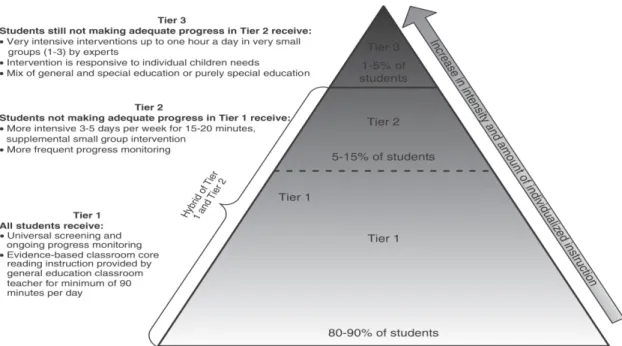
The RTI model is often called a pyramid of intervention and Figure 2.1 provides a visual model of the pyramid with the flow of suggested interventions in each level (Shores & Chester, 2009, p.7).
Figure 2.1. Pyramid of Response to Intervention
The first level, or base, of the pyramid represents interventions that are used for all students in the building. This is the instruction that all students receive in the regular classroom setting. An RTI behavior model at Tier 1 would focus on a behavior set that allows for all students to be successful in the general curriculum (Shores & Chester, 2009). In this setting, all students would be taught the behavior expectations that are expected throughout the school, as well as the system for rewards of appropriate behavior
31
and consequences for negative behavior (Barnett et al., 2006). Ideally, this base level should apply to approximately 80% of the students in the building (Sandomierski et al., 2007).
Students who have difficulty following the set rules and guidelines that have been explicitly taught to all students are identified and carefully examined as to their specific behavior patterns and difficulties. These students are recommended for the second tier of intervention. Generally, these behaviors are identified by teacher observations, classroom discipline checklists, office discipline referrals, and by studying the behavior patterns of students. Noting the time, setting, location, frequency, and consequence can help to identify successful interventions (Shores & Chester, 2009). Once patterns have been established, teachers can discuss a plan of action that may involve groups of students, one-on-one intervention, or an “embedded” set of “classroom procedures in for individuals or groups of children” (p. 26). Often these students are monitored by a teacher checklist or individual behavior cards. The teachers check the cards at regular intervals to determine if the strategies are successful based on short and long term goals (Fairbanks, Sugai, Guardino, & Lathrop, 2007). According to Tidwell et al. (2003) these interventions are expected to influence 10-20% of the students positively. In a study to investigate the effects of a Tier 2 intervention to target specific discipline problems in a small group, Sherrod, Getch, & Ziomek-Daigle (2009) found a decrease in negative behaviors of students who participated in the small group intervention.
Continuing the RTI model, Tier 2 students who do not show improvement in academics or behavior are often placed at the next level, Tier 3, of the intervention process. While many of the Tier 2 interventions may still be utilized, more specific
32
checklists are generated to target individualized plans and monitoring happens more frequently to collect data and check for progress (GADOE, 2010). A recent study to investigate individualized plans to improve student behavior revealed significant improvements in behavior in nine out of ten students and suggested that when the individualized goals are agreed upon by both teacher and student, the outcomes are particularly successful (Thompson & Webber, 2010).
Teacher Perceptions
Marzano (2003) conducted a meta-analysis of educational research on effective instructional practices that indicated the number one factor affecting student learning is the teacher in the classroom. This research suggests the importance of investigating teacher perspectives and views regarding school practices in order to “maximize the learning experience of all students” (Sutherland, 1994, p. 3). A study conducted on school climate in 20 Chicago schools revealed that 59% of teachers surveyed reported climate and discipline were problems, and they faulted organizational structures within the school (Davidson as cited by Sutherland, 1994). In a separate study related to teacher burnout, researchers suggested “contextual factors such as the school’s organizational climate or the level of disorder within the school” contribute to low teacher efficacy and negative school climate (Pas, Bradshaw, Hershfeldt, & Leaf, 2010, p. 13) and suggested restructuring of organizational services and management practices to improve teacher effectiveness and the school environment.
Though the implementation of these strategies suggests positive results such as a decrease in discipline referrals and an increased amount of instructional time, many teachers are reluctant to adopt new school-wide programs regardless of the results. A
33
study conducted to examine resistance to school-wide positive behavior supports found teacher resistance was attributed to four conditions: (a) lack of administrative support, (b) skepticism of need, (c) hopelessness of change, and (d) philosophical differences
(Lohrmann, Forman, Martin & Palmieri, 2008). Since teachers work directly with
students and carry out the daily operations of the school, their views, voices, and attitudes have a direct impact on the successful implementation of school programs. Tillery et al. (2010) suggested that “understanding teachers’ perspectives about behavior is an essential element of implementing prevention focused initiatives because their perspectives likely influence their choice of behavior management strategy” (p. 87).
Thus, a teacher’s belief about whether a child’s behavior is predetermined or that environment influences the development of behavior may influence how a teacher handles situations in the classroom. Teachers who believe that environment plays a role in behavior may be more likely to employ methods for changing behavior or actions of children in the classroom and take responsibility for establishing effective management procedures (Tillery et al., 2010). Other teachers, however, may view a child’s behavior as being derived from nature rather than nurture, thus limiting the influence a teacher can have on changing negative behaviors. This belief, coupled with limited training in the area of classroom management in many teacher preparation programs, leads to ineffective classroom and school policies that contribute to negative student behaviors (Alvarez, 2007).
School Culture
A school’s culture refers to “a set of norms, values and beliefs, rituals and ceremonies, symbols and stories” that make up the character of the school (Cromwell as