DOI: 10.15575/jpi.v3i1.987 http://journal.uinsgd.ac.id/index.php/jpi
e-ISSN: 2460-8149
THE INFLUENCE OF PARENTING TOWARD RELIGIOUS BEHAVIOR AND STUDY RESULT
Yulisna
Universitas Pendidikan Indonesia (UPI) Bandung
Jl. Setiabudi No. 229, Bandung, Jawa Barat, Indonesia, 40154 Email: [email protected]
Hadi Arbianto
Universitas Pendidikan Indonesia (UPI) Bandung
Jl. Setiabudi No. 229, Bandung, Jawa Barat, Indonesia, 40154 Email:[email protected]
Munawar Rahmat
Universitas Pendidikan Indonesia (UPI) Bandung
Jl. Setiabudi No. 229, Bandung, Jawa Barat, Indonesia, 40154 Email: [email protected]
Received; November 2016; accepted: June 2017; published June 2017 ABSTRACT
The aim of this article is to present the results of research concerning empirical description of the parenting and its influences on religious behavior and students’ study results in the subject of PAI (Pendidikan Agama Islam/Islamic Education). The research method used is qualitative and quantitative methods. The population of the research is all students and their parents in the fifth grade of elementary school in one group of Pulau Kijang, in Reteh Subdistrict, Indragiri Hilir, Riau. The sampling used the technique of cluster sampling for 80 students and 80 parents. The results of the research show that the parenting determines the height and low of students’ religious behavior and PAI study results. Students who have high and average religious behavior are educated by the parents having the authoritative parenting, while the students having low religious behavior are those who are educated by authoritarian, authoritative, permissive, authoritarian-authoritative combination, and authoritative-permissive combination parentings. Meanwhile, students who have the high study results are educated by the parents having the authoritative parenting, while the students whose study results are average are educated by the authoritarian, authoritative, permissive, authoritarian-authoritative combination, and authoritative-permissive combination parentings.
Keywords: Parenting, Students’ Study Results, Students’ Religious Behavior ABSTRAK
Makalah ini bertujuan untuk memaparkan hasil penelitian tentang gambaran empirik pola asuh orang tua dan pengaruhnya terhadap perilaku beragama dan hasil belajar siswa pada Mata Pelajaran PAI. Metode penelitian yang digunakan adalah metode kuantitatif dan kualitatif. Populasi pada penelitian adalah seluruh siswa beserta orang tua siswa di kelas V Sekolah Dasar se-Gugus Pulau Kijang Kecamatan Reteh, Indragiri Hilir, Riau. Pengambilan sampel menggunakan teknik cluster sampling sebanyak 80 siswa dan 80 orang tua. Hasil penelitian menunjukkan bahwa pola asuh orang tua menentukan tinggi rendahnya perilaku beragama dan hasil belajar PAI siswa. Siswa yang berperilaku agama tinggi dan sedang dididik oleh orang tua yang berpola asuh otoritatif, sedangkan siswa yang perilaku beragama rendah adalah mereka yang dididik dengan pola asuh otoriter, otoritatif, permisif, gabungan otoriter-otoritatif dan gabungan otoritatif-permisif. Sementara itu, siswa yang mempunyai hasil belajar tinggi dididik oleh orang tua yang berpola asuh otoritatif, sedangkan siswa yang hasil belajarnya sedang dididik dengan pola asuh otoriter, otoritatif, permisif, gabungan otoriter-otoritatif, dan gabungan otoritatif-permisif.
INTRODUCTION
Education is an important thing for human life. It makes someone more progressive and better. It aims to increase the quality of human resources. The Law No. 20 Year 2003 about National Education System says that education is an aware and planned attempt to embody the study circumstances and the learning process so that the students actively develop their potencies to possess the power of religious spirituality, self-control, personality, intelligence, noble character, and the skills which are needed by themselves, society, nation, and State (Depdiknas, 2006). By developing self-potency, it is expected that the students have stronger faith, more pious and noble.
Education can be gained in unlimited times and places. For example, process of education can be acquired in family environment. Family becomes the important part in the process of education. Parents, as the leaders in the family, have important roles in children’s education and growth. The parents must give the parenting, education, and guidance to their children started from babies, children, teenagers, and adults until they are ready to be independent and go public. It is parallel to what John Locke conveys that a newborn child is like a clean white empty paper. When babies are born, their mind loads nothing; therefore, here are the parents’ roles in forming the children’s characters (Ladislaus, 2004).
In Islam, it is said that the parents are responsible for family and their children. Allah SWT says: “O’ believers, keep yourselves and your family from hell fire” (QS.At-Tahrīm (66): 6). Meanwhile, in the hadith, it was said that “every child was born in holy condition. Then it was the parents who made or educated their children to be Jew, Christian, and Zoroastrian” (H.R. Bukhari No. 1296).
The verse and hadith above show that the parents are not only responsible for giving birth and taking care of their children but also responsible for educating and bringing up, in the wild meaning until saving them from hell fire. Parents are the first people in educating and giving example in behaving in accordance with religious teachings. Thereby, children will get knowledge, experiences, and examples from their parents. Children will duplicate the parents’ character. Thus, parents must give good examples and guidance toward their children, so that the children will grow and develop until reaching the success in their life.
The building of religious attitude in family environment should be done as early as possible. The influence of family environment on students in early age has strong effects in building the religious attitude because at this time the students will absorb information and process it to be made example or adherence in their daily.
These days, many parents have the wrong parenting; they even act violently against their children. The main cause of the violence on children is because the parents do not understand how to educate their children correctly. As a result, children’s rights are not fulfilled. Many facts regarding the violence on children occurred in public. This needs careful attention (Kementrian Kesehatan RI, 2014). Therefore, this article will present the parenting and its influences on students’ religious behavior and study results especially in the subject of PAI. The parenting in this article encompasses three patterns in accordance with what Sugihartono (2007, p. 31) puts forward, namely: authoritarian, permissive, and authoritative parentings. Authoritarian parenting is the parenting which demands too much, and permissive parenting is giving the freedom broadly to children with low control, while authoritative or democratic parenting is receiving and giving the balanced demands.
METHOD
The method used in this research is descriptive-correlation. Descriptive-correlation is the mixed methods; those are, a quantitative and a qualitative method which are simultaneously combined in a research activity (Sugiyono, 2015, p. 404). The main purpose of
the survey is to find out general description of the characteristics from the population (Sukmadinata, 2013, pp. 54–55). The data have taken place and have existed on respondents without giving any treatments or manipulations(Zaenal A., 2012, p. 22).
The population of the research is all students and their parents in the fifth grade of elementary school in one group of Pulau Kijang, in Reteh Subdistrict. The sampling uses the technique of cluster sampling for 80 students and 80 parents. The instruments used are questionnaire, documentation, interview, and observation. Questionnaire was used to gain the data about parenting and students’ religious behavior. The parenting data refer to the explanation about the influence of parenting style toward students’ behavior according to Baumrind quoted by Yusuf (2006, p. 51). The parenting data were also added from the activities of observation and interview. The data of students’ religious behavior cover faith, worship, and character and the data of students’ study results were gained from report documentation in the even semester, the 2015/2016 Academic Year.
RESULTS AND DISCUSSIONS Types of parenting
Parenting is the way the parents raise their children by fulfilling the children’s needs, giving the protection, educating the children, and affecting children’s behavior in daily life (Respati, Yulianto, & Widiana, 2006, p. 127). According to Mahmud (2013, p. 149), parenting is the way the parents bring up their children in family as embodiment of their affection to their children.
There are many types of parenting. The parenting based on two dimensions (responsiveness and demand) is divided into four types, namely:
1. Authoritative
Authoritative parenting is the parenting which has high demand and responsiveness. The characteristics of the authoritative parenting, according to Baumrind in Casmini (2007, p. 50), are: (a) behaving warm but explicit, (b) giving certain standard so that the children can carry out the education and give the consistent hopes toward children’s needs and abilities, (c) giving children the chances to grow autonomously and being able to direct themselves, but children have to have responsibility toward their behavior, and (d) dealing with children rationally, focusing on problems, giving encouragement in family discussion and explaining the discipline which they give.
According to Sugihartono (Sugihartono et al., 2007) , the authoritative parenting has the characteristics of balance between rights and obligations of parents and children. Thereby, both of them are complementary. Children are trained to be responsible and to determine their own behavior so as to have discipline.
Another opinion is put forward by Bjorklund and Bjorklund (Conny, 1998, p. 207) that the authoritative parenting has the characteristics of the parents’ behavior which control, demand, behave warmly, receptively, rationally, have verbal dialogue, and appreciate discipline, self-confidence, and uniqueness. According to Yusuf (Yusuf, 2006), the authoritative parenting has the characteristics as follows: acceptance and high control, responsive to children’s needs, encouraging children to express opinions or questions, and giving the explanation about the impacts of good and bad deeds.
2. Authoritarian
It is the parenting which has high demand but low responsiveness. According to Baumrind, the characteristics of authoritarian parenting are giving high value to obedience which meets their demands, tending to prefer to punish, being absolute and full of discipline, the parents ask their children to accept everything without questions, rules, and the standards which are consistently given by the parents, and they do not encourage children’s behavior
freely, and they restrict the children (Casmini, 2007). The authoritarian parenting tends to make children less initiative, doubtful, and nervous with ease (Sugihartono et al., 2007).
The characteristics of the authoritarian parenting are: parents’ behavior of giving the control strictly and giving the critical estimation on children’s behavior, having few verbal dialogues, and behaving less warm, and lack of plaiting emotion (Conny, 1998), the acceptance is low but the control is high, tending to punish physically, frequently telling the children to do something without compromise, behaving rigid (tough), tending to be emotional and resistant (Yusuf, 2006). In this type of parenting, the parents determine what should and should not be done by the children (Rahmat, 2009, p. 35).
3. Indulgent
It is the parenting with parents’ attitude of lacks demand but frequently gives responsiveness. The characteristics of indulgent parenting are: accepting their children very much and more passive in discipline, demanding the children very little, giving children the freedom to act without restriction, more pleased to regard themselves as center of attraction for their children without caring whether or not their children pay attention to them (Casmini, 2007).
4. Neglectful
It is the parenting which has the low demand and responsiveness. The neglectful characteristics are the same as indifferent ones, they are: very little time and energy to interact with children, doing everything for their children sufficiently, very little effort to understand children’s activities and existence, not interested in understanding children’s experiences at school or their relationship with their friends, rarely contradict with children and rarely consider children’s opinions when the parents make a decision, and it is the parents who manage the household for their needs and interests (Martinez, Garcia, & Yubero, 2007, p. 106).
The indulgent and neglectful parentings become the permissive parenting with the following characteristics: high acceptance attitude but low control, and giving children the freedom to express their encouragement or wishes (Yusuf, 2006), parents give the big freedom to children, so that it can make children lack responsibility and act at will without parents’ controls (Sugihartono et al., 2007), the parents do not control and put any demand on their children, apply few punishments or rules, use reasoning andbe warm and acceptable (Conny, 1998).
Of the four types of parenting above, the parentings applied by the parents to their children are simplified into: (1) authoritarian parenting, it is the parenting with high demand but low responsiveness, (2) authoritative parenting, it is the parenting with high demand and responsiveness, (3) permissive parenting, it is the parenting with low demand but high responsiveness (Yusuf, 2006).
The Parenting Profile in the Grade V for the Group of Pulau Kijang, Reteh Subdistrict, Indragiri Hilir, Riau
The parenting profile of the 80 students’ parents in the fifth grade of elementary school for Group of Pulau Kijang in Reteh Subdistrict, Indragiri Hilir, Riau, is as follows: six parents (7.5 %) have the authoritarian parenting consisting of five parents having the average authoritarian parenting and one parent having the high authoritarian parenting. 67 parents (83.75%) have the authoritative parenting, consisting of 30 parents belonging to the high authoritative parenting and 37 parents belonging to the average authoritative parenting. There are three parents (3.8%) having permissive parenting, which is the average permissive parenting, three other parents (3.8%) having the combined parenting between authoritarian and authoritative (belonging to the average authoritarian-authoritative), and one parent (1.3%)
having the combined parenting between authoritative and permissive in the average authoritative-permissive parenting. The above results are visualized in the following Figure 1.
Figure 1. Graph of parenting profile in the fifth grade for group of Pulau Kijang in Reteh Subdistrict, Indragiri Hilir, Riau.
The Relationship of Parenting and Students’ Religious Behavior and Study Results 67 parents (83.75 %) who have the authoritative parenting consisting of 30 parents (44.78%) belonging to the high authoritative parenting and 37 parents (55.22%) belonging to the average authoritative parenting, have 10 students (14.93 %) who have high religious behavior, 38 students (56.72%) who have the average category, and 19 students (28.36%) who have the low category. For the study results, there are 15 students (22.39%) who gain the high value, and the rest, 52 students (77.61%) gain the average value.
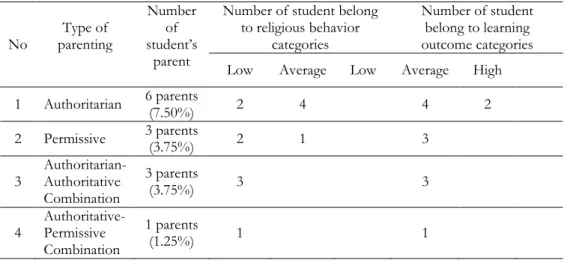
The parents who have authoritative parenting and generate the children whose religious behavior is high and average also generate the children whose study results are high and average too. There are only 13 parents who have different parentings, as shown in the Table 1.
Table 1. Data of Authoritarian, Permissive, Authoritarian-Authoritative Combination, Authoritative-Permissive Combination parentings, Religious Behavior and Study Results.
No parenting Type of
Number of student’s
parent
Number of student belong to religious behavior
categories
Number of student belong to learning outcome categories Low Average Low Average High
1 Authoritarian 6 parents (7.50%) 2 4 4 2 2 Permissive 3 parents (3.75%) 2 1 3 3 Authoritarian-Authoritative Combination 3 parents (3.75%) 3 3 4 Authoritative-Permissive Combination 1 parents (1.25%) 1 1
In general, the parents who have other styles of parentings other than authoritative parenting have children whose religious behavior is low (69%), only a small number of them whose grade is average (30%). For the study results, only two children have the high grade (15%), while others have the average grade (85%).
Results of Interview about Parenting with Students’ Religious Behavior and Study Results
Besides the data gained from questionnaire, the researchers also gain the parenting data through observation and interview of three families whose children have the highest, average, and low religious behavior values and study results. Of the three families, all of them have the authoritative parenting but only has different tendency.
First of all, Mr. Abdul Muis’ family has a child whose religious behavior and study results are high. Mr. Abdul Muis’ family belongs to the family applying the high authoritative parenting. The results of observation and interview show that the functions of family in building the religious behavior and encouraging children in studying go well. Abdul Muis’ family did the following activities:
1. Accepting the child’s ability and putting high control on their child. 2. Behaving responsive to the child’s needs.
3. Listening to the child’s opinions or questions.
4. Giving explanation to the impacts of the good and bad deeds.
Secondly, Mr. Andang Kosara’s family has a child whose religious behavior and study results are average. Mr. Andang Kosara’s family belongs to the family applying the average authoritative parenting which almost tends to be authoritarian, and the functions of family go well and cover the following dimensions:
1. Accepting the child’s ability and putting high control on their child. 2. Behaving responsive to child’s needs.
3. Tending to be emotional and resistant.
Thirdly, Mr. Sasli Nasution’s family has a child whose religious behavior and study results is low and belongs to the high authoritative parenting. However, after observation and interview, the religious behavior tends to be permissive. In religious experiences, parents accept their children’s ability very much, but it is not accompanied by sufficient supervision toward children’s religious activities. In comparison with quantitative data of Mr. Sasli Nasution’s parenting, 54.54% chose the authoritative instrument, 40.90% chose authoritarian, and 4.54% chose permissive instrument. Thereby, the data are a little different from the reality which is found in the field in terms of religious behavior.
Not all the parents who have the authoritative parenting choose the authoritative alternative, and it is absolute to all conditions. For example, in one condition parents have the authoritative parenting, while in another condition they can choose other parenting styles. It is also found in qualitative research. Mr. Abdul Muis’ family tends to have the authoritative parenting by choosing item 14 in high authoritative category, but he consistently chooses the item of another parenting, namely: five authoritarian items and five permissive items. Andang Kosara’s family tends to have the authoritarian parenting by choosing item 11 in average authoritative category, but he consistently chooses the item of other parentings, namely: 10 authoritarian items and three permissive items. Sasli Nasutions’s family has the authoritative parenting by choosing item 14 in high authoritative category, but he consistently chooses the item of other parentings, namely: seven authoritarian items and three permissive items. In accordance with Aisyah’s opinion (2010, p. 1), there are nearly no parents practicing only one style of the parentings . There is a tendency by the parents to use certain type of parenting. Even the parents practice the parentings in eclectic way, by doing parentings to their children conditionally.
Parents who have the authoritative parenting have 10 students whose religious behavior is high, 38 students gain the average value, and 19 others gain the low value. This means not all the parents having the authoritative parenting have children whose religious behavior is high. Likewise with the study results, not all the parents having the authoritative
parenting have children who have high study results. This might be affected by certain factors such as that there are parents whose authoritative parenting is high, but they are authoritative toward the problems which are not related to religious behavior. Therefore, it will be less influential to children’s religious behavior. Likewise with children’s study results, their success is usually affected by the children’s intelligence factor. However, the findings of research prove that all students who have high religious behavior and whose study results are high are those from the family having the authoritative parenting.
The data from 13 parents who do not have authoritative parenting show that there are no children who have high religious behavior. Four students gain the average value, and nine others gain the value of low religious behavior. In the study results or in the subject of PAI, only two students have high value, and 11 others gain the average value.
The results of this research show that on the average, authoritative parenting is used by the grade V of elementary school in one group of Pulau Kijang, Reteh. Authoritative parenting is the parenting which gives children the freedom to express opinion, to interact freely with their peers, and there are clear rules in their family. This is in line with what Martinez stated in Casmini (Casmini, 2007) that authoritative parenting is the parenting whose demand and responsiveness are high. The characteristics of the authoritative parenting, according to Baumrind, are: 1) behaving warm but firmed, 2) giving certain standard so that the children can carry out education and give consistent hope toward children’s needs and abilities, 3) giving children the chances to grow autonomously and being able to direct themselves, but children have to have responsibility toward their own behavior, and 4) dealing with children rationally by focusing on problems and giving encouragement in family discussion and explaining the discipline which they give (Casmini, 2007). In line with what Martinez stated, authoritative parenting is characterized by existence of balance between rights and obligations of parents and children. Thereby, both of them are complementary. Children are trained to be responsible and to decide their own behavior so as to have disciplined (Sugihartono et al., 2007). This is in line with Bjorklund and Bjorklund’s opinion to reinforce Baumrind’s opinion that the authoritative parenting also makes children independent, have self-control, explorative, and full of confidence. However, there is a shortcoming in the authoritative parenting; that is, making children tend to encourage parents’ authority that everything has to be considered between children and parents.
Authoritative parenting or democratic parenting has some excellences: making children individuals who trusts other people, responsible for their action and be honest, not hypocritical. Thereby, the orders which the parents give in religious enforcement are carried out well because the children who are educated by the authoritative parenting tend to have more self-confident than those who are educated by the permissive or authoritarian parentings.
This finding shows that the good or ideal parenting to be applied in family is the authoritative parenting. This is in accordance with the excellences of this parenting according to the experts’ opinion such as Baumrind and Hart. et.al.
Baumrind (Casmini, 2007) states that the ideal parenting for children’s growth is the authoritative parenting. This is because:
1. Authoritative parents balance between restriction and freedom. Parents give chances to develop children’s self-confidence. On the other hand, parents manage standards, restrictions, and clues for children.
2. Authoritative parents are flexible in bringing up children. They form and adapt the demands and the hopes which are in accordance with the changes of the need of the children and children’s competency.
4. Authoritative parents prefer to encourage children in discussion. This can support the intellectual development which is the important basis for social competency development.
5. Discussion in family about decision making, rules, and hopes which are explained can help children understand the social system and social relationship.
6. Authoritative family can give stimulation of thought to children.
7. Authoritative parents combine the control which is balanced with the warmth.
8. Children who grow with parents’ warmth will direct themselves by imitating their parents and then show the same tendency.
9. Children who grow in the authoritative family will also continue practicing the authoritative parenting.
10. Parents will feel comfortable to be around the responsible and free children, so that they treat teenagers in warmer way. On the contrary, the naughty teenagers will make their parents not think over, impatient, and keep distance from their children.
It is also parallel with what Baumrind, Hart et.al (Santrock, 2007, p. 168) state that the authoritative parenting is suitable and ideal to be applied. This is because:
1. Authoritative parents are the precise balance between control and autonomy. The parents will give the chances to children to form the independence and give standard, restriction, and guide which are needed by children.
2. Authoritative parents tend to involve children more in the give-and-take activity verbally and allow children to express their viewpoints.
3. Parents’ warmth and involvement given by authoritative parents make children more able to accept the parents’ influences.
Therefore, it is natural if the authoritative parenting becomes the parenting which is applied by many parents of students in grade V of Elementary School for the group of Pulau Kijang. Several things which support the success of this authoritative parenting are the existence of culture, religious schools, and conductive environment in the application of this authoritative parenting.
This is in line with Willis’ opinion (2015, p. 173) that roles of family in education especially on children’s study vary, both in their behaviors and how they respond to their children. Variety of this attitude is caused by various factors, namely: 1) culture; 2) educational background; 3) interest; 4) environmental influence.
Test of Normality, Test of Correlation, Test of Hypotheses 1. Test of Normality
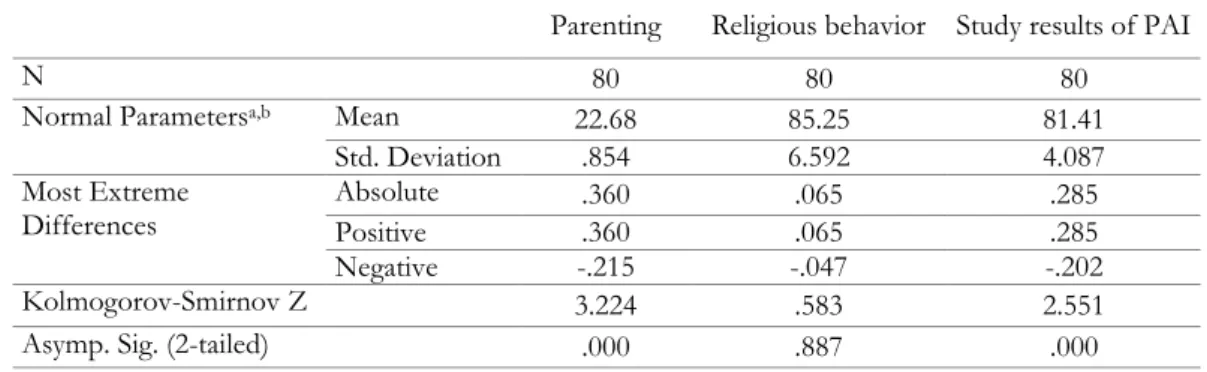
After using descriptive statistic, the results of the survey were also analyzed by using inferential or parametric statistic; that is, the statistical test through the very strict stages – one of them is test of normality. Table 2 show the result from the test of normality on 80 samples.
Table 2. One-Sample Kolmogorov-Smirnov Test.
Parenting Religious behavior Study results of PAI
N 80 80 80
Normal Parametersa,b Mean 22.68 85.25 81.41
Std. Deviation .854 6.592 4.087
Most Extreme
Differences Absolute Positive .360 .360 .065 .065 .285 .285
Negative -.215 -.047 -.202
Kolmogorov-Smirnov Z 3.224 .583 2.551
Asymp. Sig. (2-tailed) .000 .887 .000
a. Test distribution is Normal. b. Calculated from data.
From Table 2 above, it can be explained that the test of normality toward the parenting data, religious behavior, and study results of PAI has normal distribution. This is shown by the Kolmogorov-Smirnov Test, 3.224>0.05 for parenting, 0.583>0.05 for religious behavior, 2.551>0.05 for study results of PAI.
2. Test of Correlation and Anova a. Test of Correlation
Having used the test of normality, test of regression and correlation can be done by using the parametric statistical test. It can be explained that the test of correlation toward parenting, religious behavior, and study results of PAI is as follows.
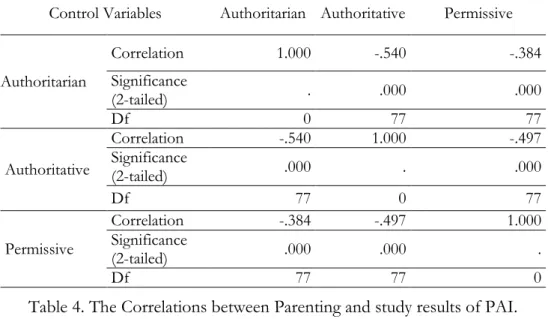
The correlation of parenting toward religious behavior is 0.008<0.05. It means that the parenting has sufficient correlation toward religious behavior and the parenting has negative correlation with the study results. It means that the influence of parenting is less meaningful toward children’s study results. The strongest one is the correlation between religious behavior and study results – that is 0.326>0.05. It means that the good religious behavior generates the good study results. Data of correlation can be seen in Table 3 and Table 4.
Table 3. The Correlations between Parenting and Religious Behavior. Control Variables Authoritarian Authoritative Permissive
Authoritarian Correlation 1.000 -.540 -.384 Significance (2-tailed) . .000 .000 Df 0 77 77 Authoritative Correlation -.540 1.000 -.497 Significance (2-tailed) .000 . .000 Df 77 0 77 Permissive Correlation -.384 -.497 1.000 Significance (2-tailed) .000 .000 . Df 77 77 0
Table 4. The Correlations between Parenting and study results of PAI. Control Variables Authoritarian Authoritative Permissive Authortarian Correlations Significance 1.000 -.515 -.409
(2-tailed) .000 .000 Df 0 77 77 Authoritative Correlation -.515 1.000 -.496 Significance (2-tailed) .000 . .000 Df 77 0 77 Permissive Correlation -.409 -.496 1.000 Significance (2-tailed) .000 .000 . Df 77 77 0
b. Regression Test of ANOVA
Test of ANOVA toward the sample of 80 students concerning the parenting, religious behavior, and study results can be seen in Table 5.
Table 5. Test ANOVA result. Model
Unstandardized
Coefficients Standardized Coefficients
T Sig. B Error Std. Beta
1 (Constant) 83.871 19.843 4.227 .000 parenting .061 .874 .008 .070 .945 a. Dependent Variable: religious behavior
From the Table 5 above, it can be explained that the test of regression for religious behavior parenting is t-table 4.227. Based on the t distribution of the number of samples (80-2) 78 is 2.375. It is because t-table >t- count is 4.227>2.375. It means that the parenting has significantly strong influence on religious behavior.
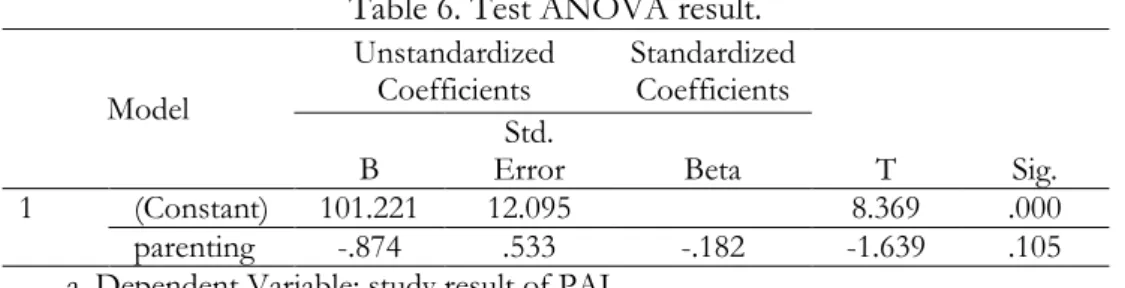
Table 6. Test ANOVA result. Model
Unstandardized
Coefficients Standardized Coefficients
T Sig.
B Error Std. Beta
1 (Constant) 101.221 12.095 8.369 .000 parenting -.874 .533 -.182 -1.639 .105 a. Dependent Variable: study result of PAI
The Table 6 above explains that the parenting test of regression toward study results is t-table 8.369. Based on the t distribution of the number of sample (80-2) 78 is 2.375. It is because t-tabel>t- count is 8.469>2.375. It means that the parenting has significantly strong influence toward study results of PAI.
c. Test of Hypotheses/Chi Square
1) Correlation between Parenting and Religious Behavior
Using IBM SPSS 20.0 in processing the data in deciding the hypotheses of the relationship between parenting and religious behavior shows that the parenting is not significantly influential on religious behavior, as t-count > t-table is 0.527>0.05, so that it can be concluded that parenting is not the influential factor toward children’s religious behavior. When each parenting is partially processed, the result turns out to be the same; that is, t-count > t-table, with the value of 0.140>0.05. This means that the authoritative parenting does not affect the religious behavior.
2) Correlation between Parenting and Study Results
Parenting is not significantly influential on study results because t-count > t-table is 0.917>0.05. It can be concluded that parenting is not the influential factor toward children’s study results. Likewise in the process, authoritative parenting only relates to study results. It can be explained that the t-count>t-table is 0.479>0.05. It means that the authoritative parenting does not affect children’s study results.
3) The Influence of Parenting on Religious Behavior and Study Results
Finally, test of chi-square is done to find out the influence of parenting on religious behavior and study results. The result shows that parenting is not significantly influential on
religious behavior but it is influential on study results. It is because t-count>t-table is 0.089>0.05 and 0.00<0.05.
From data of the influence of parenting on children’s religious behavior and study results, it can be concluded that parenting is not significantly influential but is influential on children’s religious behavior and study results.
CONCLUSION
From the results of spreading questionnaire, interview, and observation, the parenting determines the height and low of students’ religious behavior and study result of PAI. Students having high and average religious behavior are educated by the authoritative parenting, while students having low religious behavior are educated by the authoritarian, authoritative, permissive, authoritarian-authoritative combination, and authoritative-permissive combination parentings. This is similar to the study result of PAI. Students having high study result are educated by the authoritative parenting, while students having average study result are educated by the authoritarian, authoritative, permissive, authoritarian-authoritative combination, and authoritative-permissive combination parentings.
The parenting in the Group of Pulau Kijang in Reteh subdistrict, Inhil Riau is generally authoritative (84%); that is, the type of parenting which does not only accept children’s ability but also give demand to children. Students’ religious behaviors in the Group of Pulau Kijang vary: 13% has high value, 52% has average value, and 35% has low value. The tendency of religious behavior in this group is: (1) believing in Allah by being thankful to Him, (2) performing worship, (3) having patient character, (4) believing in al-Qur’an, (5) being thankful to Allah’s fate, and (6) doing the fasting in Ramadhan. Study results of PAI in the Group of Pulau Kijang in Reteh Subdistrict, Inhil Riau are: 19% having high value and 81% having the average value.
Meanwhile, the results of correlation count with parametric statistic show that the influence of parenting on students’ religious behavior and study results is not significantly influential. Similarly, the result of the partial count from each parenting shows the same result; that is, the form of parenting is not significantly influential on students’ religious behavior and study results.
BIBLIOGRAPHY
Aisyah, S. (2010). Pengaruh pola asuh orang tua terhadap tingkat agresivitas anak. Jurnal Medtek, 2(1), 1–7.
Bukhari, Shahih al-Bukhari, Maktabah Syamilah, Juz. V, Hal. 182, No. Hadits : 1296. Casmini. (2007). Emotional parenting. Yogyakarta: Pidea.
Conny, R. (1998). Perkembangan dan belajar anak. Bandung: Remaja Rosdakarya.
Depdiknas. (2006). Undang-undang Sistem Pendidikan Nasional. Yogyakarta: Pustaka Pelajar. Kementrian Kesehatan RI. (2014). Tingkatkan kerjasama dan kewaspadaan kekerasan pada
anak. Retrieved April 10, 2017, from
http://www.depkes.go.id/article/view/201408140003/tingkatkan-kerjasama-dan-kewaspadaan-kekerasan-pada-anak.html
Ladislaus, N. (2004). Para psikolog terkemuka dunia. Jakarta: Grasindo.
Mahmud, M. S. (2013). Pendidikan agama Islam dalam keluarga. Jakarta: Akademia.
Martinez, I., Garcia, F., & Yubero, S. (2007). Parenting styles and adolescents’ self-esteem in Brazil. IOSR Journal of Humanitis and Social Science, 13(5), 102–106.
Rahmat, M. (2009). Eksistensi peran dan fungsi keluarga di era global. Sosio Religi, 7(2), 29–46. Respati, W. S., Yulianto, A., & Widiana, N. (2006). Perbedaan konsep diri antara remaja akhir yang mempersepsi pola asuh orang tua authorotarian, permissive dan authoritative. Jurnal
Psikologi, 4(2), 127–129.
Santrock, J. W. (2007). Perkembangan anak. Jakarta: Salemba Humanika.
Sugihartono, Fathiyah, K. N., Harahap, F., Setiawati, F. A., & Nurhayati, S. R. (2007). Psikologi
pendidikan. Yogyakarta: UNY Press.
Sugiyono, P. (2015). Metode penelitian kombinasi (mixed methods). Bandung: Alfabeta. Sukmadinata, P. D. (2013). Metode penelitian pendidikan. Bandung: Remaja Rosdakarya. Willis, P. D. (2015). Konseling keluarga. Bandung: Alfabeta.
Yusuf, S. (2006). Psikologi Perkembangan anak dan remaja. Bandung: Remaja Rosdakarya.