econ
stor
Der Open-Access-Publikationsserver der ZBW – Leibniz-Informationszentrum Wirtschaft The Open Access Publication Server of the ZBW – Leibniz Information Centre for Economics
Nutzungsbedingungen:
Die ZBW räumt Ihnen als Nutzerin/Nutzer das unentgeltliche, räumlich unbeschränkte und zeitlich auf die Dauer des Schutzrechts beschränkte einfache Recht ein, das ausgewählte Werk im Rahmen der unter
→ http://www.econstor.eu/dspace/Nutzungsbedingungen nachzulesenden vollständigen Nutzungsbedingungen zu vervielfältigen, mit denen die Nutzerin/der Nutzer sich durch die erste Nutzung einverstanden erklärt.
Terms of use:
The ZBW grants you, the user, the non-exclusive right to use the selected work free of charge, territorially unrestricted and within the time limit of the term of the property rights according to the terms specified at
→ http://www.econstor.eu/dspace/Nutzungsbedingungen By the first use of the selected work the user agrees and declares to comply with these terms of use.
zbw
Leibniz-Informationszentrum WirtschaftChacin, Pablo; Chao, Isaac; Freitag, Felix
Working Paper
Analysis of current middleware used in
peer-to-peer and grid implementations for enhancement by
catallactic mechanisms
Bayreuth reports on information systems management, No. 3
Provided in Cooperation with:
University of Bayreuth, Chair of Information Systems Management
Suggested Citation: Chacin, Pablo; Chao, Isaac; Freitag, Felix (2005) : Analysis of current middleware used in peer-to-peer and grid implementations for enhancement by catallactic mechanisms, Bayreuth reports on information systems management, No. 3, http://nbn-resolving.de/urn:nbn:de:bvb:703-opus-3078
This Version is available at: http://hdl.handle.net/10419/52626
Bayreuther Arbeitspapiere zur Wirtschaftsinformatik
Information Systems Management
Bayreuth Reports on Information Systems Management
2005
Pablo Chacin, Isaac Chao, Felix Freitag
Analysis of current middleware used in peer-to-peer
and grid implementations for enhancement by
catallactic mechanisms
vorläufiger Ergebnisse, die i. d. R. noch für spätere Veröffentlichungen überarbeitet werden. Die Autoren sind deshalb für kritische Hinweise dankbar.
which will usually be revised for subsequent publications. Critical comments would be appreciated by the authors.
Alle Rechte vorbehalten. Insbesondere die der Übersetzung, des Nachdruckes, des Vortrags, der Entnahme von Abbildungen und Tabellen – auch bei nur auszugsweiser Verwertung.
All rights reserved. No part of this report may be reproduced by any means, or translated.
Authors: Information Systems and Management
Working Paper Series Edited by:
Prof. Dr. Torsten Eymann
Managing Assistant and Contact: Raimund Matros
Universität Bayreuth
Lehrstuhl für Wirtschaftsinformatik (BWL VII) Prof. Dr. Torsten Eymann
Universitätsstrasse 30 95447 Bayreuth Germany
Email: [email protected] ISSN
Pablo Chacin, Isaac Chao, Felix Freitag
D3.1
UPC CATNETS WP3
Abstract
CATNETS EU IST-FP6-003769 Project Deliverable D1.1
This deliverable describes the work done in task 3.1, “Middleware analysis: Analysis of current middleware used in peer-to-peer and grid implementations for enhancement by catallactic mechanisms” from work package 3, “Middleware Implementation”. The document is divided in four parts: The introduction with application scenarios and middleware requirements, Catnets middleware architecture, evaluation of existing middleware toolkits, and conclusions
Document Id.
CATNETS/2005/D3.1/v1.0
Project CATNETS EU IST-FP6-003769
Date 03-03-2005
CATNETS Consortium
This document is part of a research project partially funded by the IST Programme of the Commission of the European Communities as project number IST-FP6-003769. The partners in this project are: LS Wirtschaftsinformatik (BWL VII) / University of Bayreuth (coordinator, Germany), Arquitectura de Computadors / Universitat Politecnica de Catalunya (Spain), Information Management and Systems / University of Karlsruhe (TH) (Germany), Dipartimento di Economia / Università delle merche Ancona (Italy), School of Computer Science and the Welsh eScience Centre / University of Cardiff (United Kingdom), Automated Reasoning Systems Division / ITC-irst Trento (Italy)
University of Bayreuth
LS Wirtschaftsinformatik (BWLVII) 95440 Bayreuth
Germany
Tel: +49 921 55-2807, Fax: +49 921 55-2816 Contactperson: Torsten Eymann
E-mail: [email protected]
Universitat Politecnica de Catalunya
Arquitectura de Computadors Jordi Girona, 1-3
08034 Barcelona Spain
Tel: +34 93 4016882, Fax: +34 93 4017055 Contactperson: Felix Freitag
E-mail: [email protected]
University of Karlsruhe
Institute for Information Management and Systems Englerstr. 14 76131 Karlsruhe Germany Tel: +49 721 608 8370, Fax: +49 721 608 8399
Contactperson: Daniel Veit E-mail: [email protected]
Università delle merche Ancona
Dipartimento di Economia Piazzale Martelli 8 60121 Ancona Italy Tel: 39-071- 220.7088 , Fax: +39-071- 220.7102
Contactperson: Mauro Gallegati E-mail: [email protected]
University of Cardiff
School of Computer Science and the Welsh eScience Centre
University of Caradiff, Wales Cardiff CF24 3AA, UK United Kingdom
Tel: +44 (0)2920 875542, Fax: +44 (0)2920 874598
Contactperson: Omer F. Rana E-mail: [email protected]
ITC-irst Trento
Automated Reasoning Systems Division Via Sommarive, 18
38050 Povo – Trento Italy
Tel: +39 0461 314 314, Fax: +39 0461 302 040
Contactperson: Floriano Zini E-mail: [email protected]
Changes
1 Introduction... 6
1.1 Middleware toolkit selection objectives... 6
1.2 Adopted approach... 6
1.3 Application Scenarios... 7
1.3.1 Sample applications... 8
1.3.1.1 Applications for the Grid scenario... 8
1.3.1.2 Applications for Content Distribution... 10
1.3.1.3 Applications for peer-to-peer networks... 11
1.4 Middleware Requirements... 12
1.5 References... 13
2 CATNETS Architecture... 15
2.1 The Need for an Architecture... 15
2.1.1 Architecture Design Process... 16
2.1.2 Architecture Specification... 17
2.2 Architecture Analysis... 17
2.2.1 Architectural requirements... 18
2.2.2 Architecture Design Strategies... 22
2.3 Architecture Design... 24
2.3.1 Proposed Architecture... 25
2.3.2 Related Work... 26
2.4 P2P Agent layer... 27
2.5 References... 31
3 Middleware toolkits evaluation... 36
3.1 Identification of candidate middleware toolkits and evaluation process... 36
3.2 Presentation of the candidates... 38
3.2.1 Introduction... 38
3.2.2 Web Services JAX-RPC implementations (Axis)... 38
3.2.3 WSRF/ OGSA... 39
3.2.4 J2SE... 41
3.2.5 JXTA... 41
3.2.6 JADE... 42
3.2.7 Diet Agents... 43
3.3 Functional view: Mapping middleware toolkits into the architecture... 44
3.4 Technical View... 45
3.5 Development view... 48
3.6 Tests on middleware toolkits integration... 50
3.7 Conclusions... 51
3.7.1 Conclusions on functional, technical and development views... 51
3.7.2 Joint selection of middleware and application... 53
3.8 References... 54
4 Conclusions... 72
4.2 Conclusions on the middleware toolkit selection process... 72
1 Introduction
This deliverable describes the work done in task 3.1, “Middleware analysis: Analysis of current middleware used in peer-to-peer and grid implementations for enhancement by catallactic mechanisms” from work package 3, “Middleware Implementation”. The document is divided in four parts: The introduction with application scenarios and middleware requirements, Catnets middleware architecture, evaluation of existing middleware toolkits, and conclusions.
1.1 Middleware toolkit selection objectives
We recall from the Catnets project proposal [Catn04]:
“The main objective of the project is to provide a significant statement about using ‘free market’ (catallactic) mechanisms in application layer networks. Our conclusions will concern their applicability and implementation possibilities in Grid/P2P middleware, providing a prototype, and performance results and further insight in their behaviour”
The objective of this deliverable D3.1 is the selection of middleware toolkit as the basis for the Catnets prototype implementation. We address various Application Layer Network (ALN) types, like Grid, Peer-to-Peer (P2P) and Content Distribution Networks (CDN). This document should guide the selection of the tools for the design, implementation and evaluation of middleware using Catallaxy[ERA+03] in real ALN scenarios and given a concrete application. This document should be helpful for the design and implementation of a “proof of concept” prototype.
1.2 Adopted approach
“To achieve our objective the project faces the challenge to combine contributions both from computer science and economics to address the features of coming Grid and P2P applications and infrastructures. Catallaxy has been proposed as a model to describe the behaviour of complex and large scale real world economy. However, its results have not yet been transferred to coordinate large and dynamic computer networks” [Catn04]
Considering this issue of transference of research results, we have studied which are the new elements that real Grids and P2P applications bring into the catallactic model, and secondly which is the impact on the previous model used in the Catnet assessment project [Catn03]. We have found that composing a prototype for deploying Catallactic agents into real Grid and P2P scenarios is far more complex than just porting the simulation to some convenient middleware toolkit.
The next sections of this document will describe ongoing work in the identification and exposition of requirements in applications, the design of an architecture that meets the found requirements, and the analysis and testing of existing middleware tools that can be used to implement such architecture in Catnets.
This deliverable is organized as follows: Section 1.3 introduces the problematic of Catalaxy applied to information systems. Its purpose is to introduce the vast problematic of Catalaxy applied to ALNs. Its function is to contextualise the ideas described in other sections of the document. Section 1.4 introduces Catallactic middleware requirements.
Section 2 presents the proposed middleware architecture. Section 3 evaluates six different candidate middleware toolkits regarding the identified functional and non-functional requirements of Catnets. Section 4 exposes the conclusions and indicates next steps.
It is important to note the “layered” structure of this deliverable. The architecture introduced in section 2 offers a solution to the Catnets middleware development from the software engineering point of view. The whole picture is presented, but in the context of this deliverable the focus is on the low level layers of the architecture. Section 2 allows to situate the middleware toolkits analysis and evaluation described in section 3, and to understand the way it can be used in conjunction with the architecture to select middleware toolkit for the Catnets prototype implementation, given an ALN scenario.
1.3 Application Scenarios
Application scenarios of interest in the Catnets project are centred in the concept of “Application Layer Networks” (ALN), which includes generic application classes such as Content Distribution Networks (CDN), Peer-to-Peer Networks (P2P) or Grid. An ALN is a collective entity that provides a certain service using a composition of service elements that cooperate among them, organized as an overlay network.
The rationale for selecting scenarios are those where there may be potential benefit from using a decentralized economic approach, as it was identified in the previous Catnet assessment project. The following are some environments where Catallaxy has potential for success:
• Dynamic: changing environments and the need for adaptation to changes is one of the potential areas where Catallaxy can have a competitive advantage.
• Diverse: requests may have different priorities and responses should be assigned according to them.
• Large: with such number of elements that locality is required to scale. These environments have the following features:
• Partial knowledge: it is not possible to know everything on time because of its high cost. This can be caused by scale issues such as a large number of elements, number of messages, or communication latency (information arrives too late), which requires locality (that leads to scalability).
• Complex: many parameters must be taken into account, many messages. Learning mechanisms are necessary to self-adjust or adapt to changes, and optimal solutions are not easily computable.
• Evolutionary: open to changes which cannot be take into account in the initial set-up, and able to learn and decide with limited information:
neighbours, few parameters that are summarized as a single price value, few historic data, etc.
Taking into account these environments and characteristics, we have selected a few applications representing of certain ALN classes to explore how these applications could be modified to work under the Catallaxy model.
1.3.1 Sample applications
The criteria for selection of these sample applications has been the following: for all potential applications, we have selected applications which are exemplary of their application area, which have a certain degree of popularity, and the source code is available for inspection, modification and experimentation. Ideally, the candidate applications should have been evaluated and characterized in public papers, so we could then compare our results with an external baseline evaluation.
In the next subsections we present three different application scenarios: Grids (Planetlab), CDN (Coral) and P2P file sharing (Bitorrent).
1.3.1.1 Applications for the Grid scenario
In the context of ALN for distributed computing using computing resources across administrative boundaries (Grid computing), we have identified two unique initiatives offering an open infrastructure for the deployment of services and the use of computational resources in the academic or industrial environment. Both are unique in terms of size, availability and relative maturity. They are Planetlab and Globus.
PlanetLab, as described in [BBC+04], is a geographically distributed overlay network designed to support the deployment and evaluation of planetary-scale network services. Two high-level goals shape its design. First, to enable a large research community to share the infrastructure, PlanetLab provides distributed virtualization, whereby each service runs in an isolated slice of PlanetLab’s global resources. Second, to support competition among multiple network services, PlanetLab decouples the operating system running on each node from the network-wide services that define PlanetLab, a principle referred to as unbundled management.
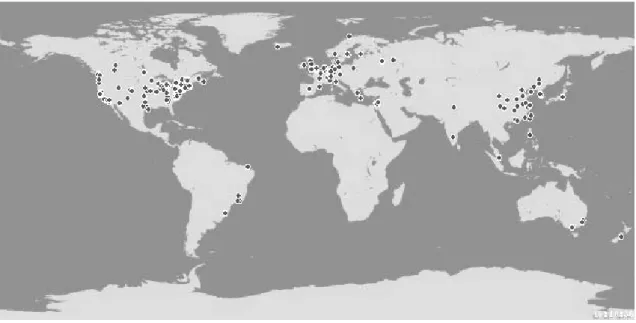
Figure 1.1 Planetlab map of member organizations (as of 2/2005)
PlanetLab currently includes over 500 machines spanning 250 sites (i.e. organizations) and more than 20 countries (figure 1.1). It supports more than 500 research projects which focus on a wide range of services, including file sharing and network embedded storage, content distribution networks, routing and multicast overlays, QoS overlays, scalable object location services, anomaly detection mechanisms, and network measurement tools.
The PlanetLab middleware and API is open and extensible. Distributed applications can use the services offered by the virtualized operating system in each node (currently the Linux API) plus the XML-RPC interface offered by the PlanetLab Central (PLC) administration
The service-resource cycle in PlanetLab is as follows:
• In every node, the node manager is in charge of creating and allocating resources to vservers (virtual machines), and the resource monitor is in charge of tracking node’s availability of resources and informing the central agent about available resources.
• The agent tracks nodes’ free resources, which are advertised to resource brokers and offered as tickets to services interested in acquiring and using resources. This agent is part of PLC (Planet-Lab Central), a centrally-controlled brokerage service that can be decentralized using a delegation mechanism.
• In every service, the resource broker obtains tickets from agents on behalf of service managers, which are in charge of redeeming tickets with node managers to acquire resources, and if resources can be acquired, start the service in that node.
In terms of the Catnets model, people or processes interested in using a given service have the role of Client. They should look for and select a service instance (a Service Copy in the Service Market). All nodes (represented by node managers and resource monitors; acting as Resources), all service instances (represented by resource brokers and service managers; acting as Service Copies), both mediated by the central Agent (PLC) belong to the Resource market.
The Globus toolkit [Glob05] is the reference implementation of the standard Grid protocols and APIs that the Global Grid Forum (GGF) is defining for different aspects of distributed computing, such as security, resource management, data management, and information discovery. The status of this implementation is now on a public version 3.0 release and working on version 4.0. The Globus middleware has been adopted by most of the Grid projects world-wide.
In comparison with the Globus Grid implementation which offers a higher level homogeneous API, Planetlab offers a less coupled and simpler API based on the idea of virtualization. While the grid offers an ample collection of middleware services unified in a single architecture (as exemplified by the Globus, Planetlab offers an API for the basic service for creating slices, and associating people and nodes to them. Slices appear to users as a set of virtual Linux machines (i.e. offering a multiple Linux API instead of a higher level and abstract API: virtualization in contrast to abstraction). Additionally, there may be competing services providing additional functionality that also run using the Planetlab infrastructure (multiplicity in contrast to homogeneity). There is another difference to emphasize: While the grid is primarily interesting in gluing together a modest number of high-performance computing resources connected by high performance networks, Planetlab is focused on scaling less bandwidth and CPU intensive applications offering innovative services across a wider collection of nodes [PACR02]. Finally, both worlds can be combined: There are pilot experiments where Globus based applications are run on top of PlanetLab (in a slice, on several nodes or slivers).
1.3.1.2 Applications for Content Distribution
In the context of content distribution, the selection criteria applies to two academic CDN which by coincidence both run on the PlanetLab infrastructure: Coral [FFM04] and CoDeeN [PWP+03]. CoDeeN is a proxy based CDN with some restrictions and limitations, and in contrast Coral provides the typical service that a CDN does with some very interesting properties, and focusing on redirecting clients requests to the “best” copy in terms of load, locality, proximity, offloading work from web origin servers.
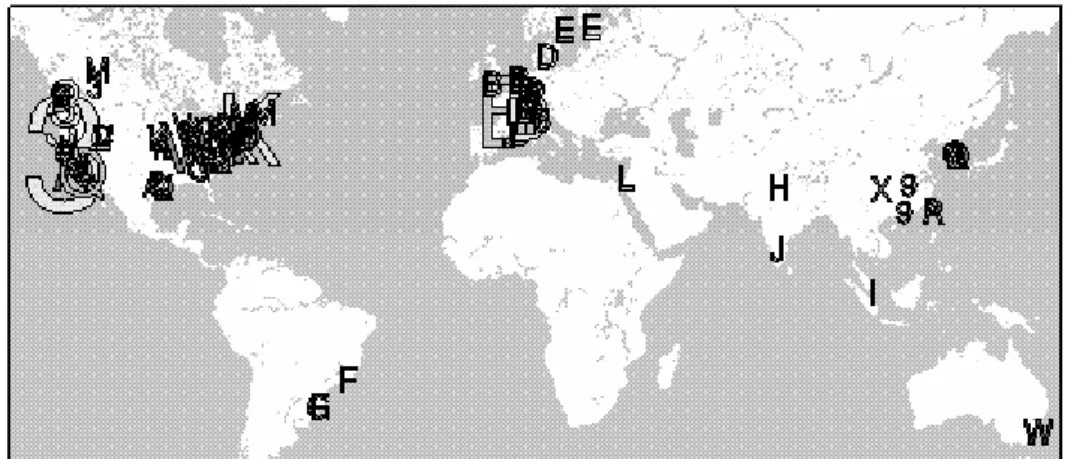
Coral CDN is a decentralized, self-organizing, peer-to-peer web-content distribution network (use illustration in figure 1.2). Coral CDN leverages the aggregate bandwidth of volunteers (typically PlanetLab slivers) running the software to absorb and dissipate most of the traffic of web sites using the system. In doing so, CoralCDN replicates content in proportion to the content’s popularity, regardless of the publisher’s resources, in effect democratizing content publication [FFM04].
Figure 1.2. Coral's deployment and clusters based on network round-trip-time (letter identifies cluster).
To use Coral CDN, a content publisher —or someone posting a link to a high-traffic portal— simply appends “.nyud.net:8090” to the hostname in a URL. Through DNS redirection, oblivious clients with unmodified web browsers are transparently redirected to nearby Coral web caches. These caches cooperate to transfer data from nearby peers whenever possible, minimizing both the load on the origin web server and the end-to-end latency experienced by browsers.
This requires two mechanisms: finding a close peer, finding a close copy of the requested object. The first is achieved by mapping Coral servers and clients into clusters based on latency. The second is done using a locality-aware request routing algorithm or indexing abstraction (also know as a Distributed Sloppy Hash Table or DSHT). Every Coral peer is running three elements: a DNS server, a HTTP proxy and a DSHT element.
The Coral CDN is implemented on top of a very simple middleware based on RPC over UDP, structured in terms of events and callbacks, with a module for clustering nodes, mapping client locations, routing requests by proximity (Coral DSHT), and modified DNS and HTTP proxy servers.
In terms of the Catnets model, people interested in downloading a file, running an unmodified web browser (or one with a Coral plug-in to “coralize” URLs) has the role of a Client. They request a coralized URL, thus going to a Coral DNS server where a response, the IP address of a close-by Coral proxy will be selected among many of
them, based on the location of the client (this is the Service market and the Coral http proxy has the role of Service Copy). The client web browser will contact the http proxy with the given IP address. Then the proxy will look for the requested file in its own store or it will look for a close copy of the file in other peers using the Coral DSHT routing algorithm. Proxies belong to the Resource market, the election in the market is determined by the DSHT algorithm looking for a close copy of a file, and proxies are acting as Resources.
1.3.1.3 Applications for peer-to-peer networks
In the context of peer-to-peer networks, we have selected a P2P protocol which has a clearly specified protocol, that is popular enough, and that is used for clearly useful and legal purposes (some other P2P networks are almost only used for sharing copyrighted content). This protocol is BitTorrent [Bitt05].
With BitTorrent [Cohe03], when multiple people are downloading the same file at the same time, they are also uploading pieces of the file to each other. This redistributes the cost of upload to downloaders, thus making hosting a file with a potentially unlimited number of downloaders affordable.
Following [IUB+04], a torrent consists of a central component, called tracker and all the currently active peers. BitTorrent distinguishes between two kinds of peers depending on their download status: clients that have already a complete copy of the file and continue to serve other peers are called seeds; clients that are still downloading the file are called leechers. The tracker is the only centralized component of the system. The tracker is not involved in the actual distribution of the file; instead, it keeps meta-information about the peers that are currently active and acts as a rendez-vous point for all the clients of the torrent.
A user joins an existing torrent by downloading a torrent file (usually from a Web server), which contains the IP address of the tracker. Generic or specialized web search engines usually lead to pages where a file can be downloaded from one or several trackers. The user has to select one torrent file (and thus the tracker) to start downloading the file which will let him connect to the tracker and an initial seed with a complete copy of the file. In case of multiple trackers available for the same object, statistics about every tracker are published to help the visitor choose the right tracker. To update the tracker’s global view of the system, active clients periodically (every 30 minutes) report their state to the tracker or when joining or leaving the torrent. Upon
joining the torrent, a new client receives from the tracker a list of active peers to connect to.
Typically, the tracker provides 50 peers chosen at random among active peers while the client seeks to maintain connections to 20−40 peers. If ever a client fails to maintain at least 20 connections, it recontacts the tracker to obtain additional peers. The set of peers to which a client is connected is called its peer set.
The clients involved in a torrent cooperate to replicate the file among each other using swarming techniques: the file is broken into equal size chunks (typically 256kB each) and the clients in a peer set exchange chunks with one another. The swarming technique allows the implementation of parallel download where different chunks are simultaneously downloaded from different clients. Each time a client obtains a new chunk, it informs all the peers it is connected with. Interactions between clients are primarily guided by two principles. First, a peer preferentially sends data to peers that reciprocally sent data to him. This “tit-for-tat” strategy is used to encourage cooperation and ban “free-riding”. Second, a peer limits the number of peers being served simultaneously to 4 peers and continuously looks for the 4 best downloaders (in terms of the rate achieved) if it is a seed or the 4 best uploaders if it is a leecher.
In terms of the Catnets model, people interested in downloading a file, running a web browser and a Bittorrent client has the role of Client. They look for a torrent file (a tracker) on a search engine and looking at the statistics of several trackers offering the same file they manually select one tracker (the Service market and the tracker has the role of Service Copy). The tracker joins the client in a swarm of peers exchanging fragments of the file of common interest. All Bittorrent clients in the swarm belong to the Resource market and are acting as Resources.
Bittorrent has monolithic software architecture, not intended to be extensible in the form required for Catnets. Nevertheless, JXTA [Jaxt05] as perhaps the most known middleware for P2P will be evaluated in section 3.
1.4 Middleware Requirements
We start this requirements introduction recalling what is pointed out in the Catnets proposal:
“Compared to the assessment project, the implementation of a real system with Catallactic mechanisms might need a higher complexity of service discovery and management as in the assessment and will thus carry out resource discovery (and also topology maintenance) based on overlay structures like DHTs, and multiple stateful servers. The performance of the system will be measured to evaluate the contribution of using Catallactic mechanisms”
We knew that the “real world” was going to introduce new challenges to the applicability of Catallaxy. We knew as well from our previous experience in distributed systems that key issues like decentralization, resource discovery, scalability, fault-tolerance and computational efficiency are very rarely fully addressed by just one middleware tool. We decided to tackle this complexity by composing the requirements of the ideal middleware for Catnets, regardless if some existent middleware toolkit could fully meet these requirements or not. But these requirements can be used as a guide for the architecture and evaluation of existent middleware toolkits.
• The Functional View considers the required functionalities to implement a distributed platform.
• The Technical View reflects the technical requirements for the middleware toolkit.
• The Development View reflects the properties concerning the ease of development with the middleware toolkit.
The Functional View defines the functions that the Catallactic middleware should provide to support the implementation of Catallaxy. These functions cover the hosting of the agents, the coordination of their execution in a decentralized way and the integration with the underlying platform. Section 2 of this document explores these functionalities in detail, taking into account the identified scenarios and their architectural requirements.
Catallactic systems may be formed by thousands of agents engaged in numerous negotiations that must be completed in a reasonable time. The Technical View evaluates the general requirements to accomplish technical issues in an efficient way under diverse implementation scenarios. One of the principal requirements is the scalability to huge number of software agents and their coordination in a decentralized way. Closely related is the need for handling massive parallel negotiations among those agents. Another set of technical requirements are related to the architectural flexibility to allow the implementation of the Catallactic middleware into different platforms using diverse middleware toolkits, and the openness of these toolkits concerning the interoperability with external applications.
The Development View evaluates to what extend it is feasible to implement the designed architecture using the selected middleware toolkits within the time and resource constrains of the project. Factors like API complexity, documentation, tutorials and support for development are critical to successfully achieve the planned goals. Also the maturity of the platform and the availability of reference implementations are important aspects concerning the Catallactic middleware.
Both Technical and Development Views requirements are used, developed and evaluated in a set of candidate middleware toolkits in of section 3.
1.5 References
[BCC+04] A. Bavier, M. Bowman, B. Chun, D. Culler, S. Karlin, S. Muir, L. Peterson, T. Roscoe, T. Spalink, and M. Wawrzoniak, Operating System Support for Planetary-Scale Network Services. First Symposium on Networked Systems Design and Implementation (NSDI) (March 2004), 253-266
[Bitt05] http://bittorrent.com/ (2005)
[Catn04] CATNETS project (2004),”Annex I - Description of Work”, IST-FP6-003769 [Catn03] CATNET Project (2003), “Catallaxy Simulation Study. Report No. D2”, ITS-2001-34030
[Cohe03] Bram Cohen, Incentives Build Robustness in BitTorrent ( May 2003)
[ERA+03] T. Eymann, M. Reinickke, O. Ardaiz, P. Artigas, F. Freitag, L. Navarro (2003), “Self-organizing resource allocation for autonomic network”, Proceedings. 14th International Workshop on Database and Expert Systems Applications, Germany, 656- 660
[FFM04] Michael J. Freedman, Eric Freudenthal, and David Mazières , Democratizing Content Publication with Coral,. In Proc. 1st USENIX/ACM Symposium on Networked Systems Design and Implementation (NSDI '04) San Francisco, CA, March 2004.
[Glob05] http://www.globus.org/ (2005)
[IUB+04] Mikel Izal, Guillaume Urvoy-Keller, Ernst W. Biersack, Pascal A. Felber, Anwar Al Hamra and Luis Garces-Erice Dissecting BitTorrent: Five Months in a Torrent's Lifetime.. In Proceedings of Passive and Active Measurements (PAM), 2004
[Jaxt05] http://www.jaxta.org (2005)
[PACR02] L. Peterson, T. Anderson, D. Culler, and T. Roscoe A Blueprint for Introducing Disruptive Technology into the Internet.. First Workshop on Hot Topics in Networking (HotNets-I) (October 2002)
[PWP+03] VS Pai, L Wang, K Park, R Pang, L Peterson , The dark side of the web: An open proxy’s view, Proceedings of the 2nd Workshop on Hot Topics in Networking, 2003
2 CATNETS Architecture
“The project will investigate how “Catallactic” mechanisms can be implemented for resource allocation in real application layer networks. This requires a specification of the components that use "Catallactic” mechanisms and how these components can be integrated in the middleware of current Grid and P2P platforms. Their functionality covers resource brokerage, resource discovery, and re-deployment of services. The prototype will be an important result to demonstrate the feasibility and applicability of the approach.”[Catn04]
The main goal of WP3 during this stage of the project is the selection of middleware toolkits and options for the integration of Catallactic Middleware mechanisms in current ALN applications. This requires a specification of the components that use Catallactic mechanisms, which cover resource brokerage, resource discovery, and re-deployment of services, and how these components can be integrated into diverse ALN architectures. In this document we have collected the requirements for the Catallactic Middleware, as well as the potential constraints imposed by diverse deployment scenarios, depending on the ALN architecture. It is clear from the identified heterogeneity that the problem of integration of Catallactic mechanisms and components into current Grid and P2P platforms is far from being a simple one. In fact we face a very complex design problem which needs from a highly structured design approach.
2.1
The Need for an Architecture
“As the size and complexity of software systems increases, the design problem goes beyond the algorithms and data structures of the computation: designing and specifying the overall system structure emerges as a new kind of problem”. [GaS93]
To address this complexity, a different approach for developing is needed. Architecture based development focuses on reasoning about the structural issues of a system. “Structural issues include gross organization and global control structure; protocols for communication, synchronization, and data access; assignment of functionality to design elements; physical distribution; composition of design elements; scaling and performance; and selection among design alternatives” [GaS93]
The importance of the architecture goes far beyond the simple documentation of technical elements. According to [BBC+00], the architecture serves as “the blueprint for both the system and the project developing it” and therefore it helps in the definition of how the work can be organized. Also, the authors state that the architecture “is the carrier of system qualities such as performance, modifiability, and security, none of which can be achieved without a unifying architectural vision”. Finally, it is “a vehicle for early analysis to make sure that the design approach will yield an acceptable system”.
Considering the importance of the architecture and its impact in the overall system and project organization, the main objectives of the architecture design process in CATNETS project can be summarized as:
• Define a set of sound design and implementation principles that assure the quality of the resulting middleware
• Identify key architectural requirements that allow the evaluation of potential implementation options, including the adoption of already existing middleware toolkits and development platforms
• Separate design concerns to facilitate the division of work in the different work packages, giving each group the freedom to experiment with implementation options, but avoiding the risk of incompatibilities
•
Structure the system in a way that allows future experimentation in specific areas like negotiation protocols and basic middleware mechanisms and policies (peer location, resource replication, etcetera) with minimal impact on the rest of the system2.1.1 Architecture Design Process
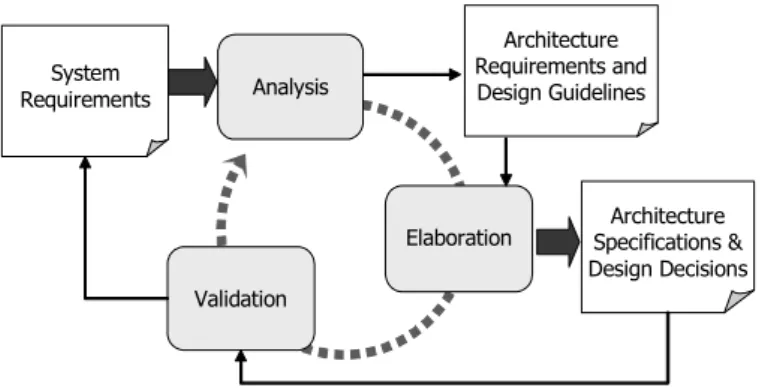
The architecture design process goes from the system’s requirements to the architecture specifications. We have adapted the methodological approaches proposed in [HNS99] and [KaBa99] to define an architecture design process that considers three steps, as shown in figure 2.1.
Analysis
Validation
Elaboration Specifications & Architecture Design Decisions System Requirements Architecture Requirements and Design Guidelines
Figure 2.1. The Architecture Design Process
The Analysis process translates the various systems requirements to architecture requirements. It consists of three main tasks:
• Review the functional requirements (described in usage scenarios) that the architecture must address, along with the nonfunctional requirements (performance, scalability, security) that it must meet.
• Identify the architectural requirements that will constrain the design options
• Define strategies to deal with identified factors and state design guidelines that will guide the elaboration phase.
The Elaboration phase consist in the construction of a set of specifications of the architecture, covering different levels of detail and from diverse perspective, so that the complexity of the system can be properly reflected to different stakeholders (e.g. project managers and developers). One important part of the design process is the
documentation of the design decisions that lead to this architecture, so that future reviewers (architects, developers) can understand the rationale behind those decisions. Finally, the Validation phase consists in the exploration of different usage scenarios to verify the compliance of the architecture with the requirements [KABC96].
This process is iterative and it is expected to continue even when the detailed design of the system is well advanced [KaBa99].
2.1.2 Architecture Specification
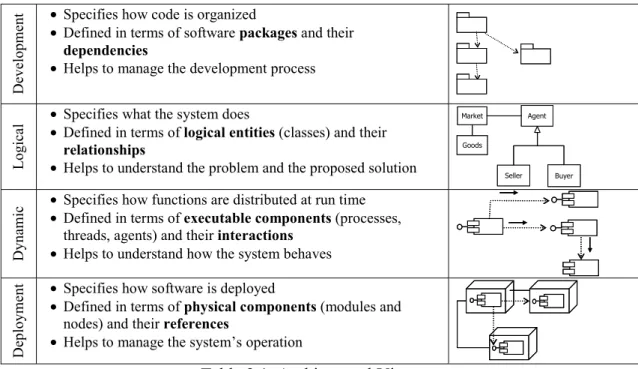
We use a model composed of multiple views or perspectives to describe a software architecture ([Kruc95]), see Table 2.1. Each model covers a set of relevant aspects of the specification from one stake holder’s point of view (for example, project manager or developers) during a stage in the development process (for example, design or implementation). The following table resumes the different architectural views we consider.
Devel
opment
• Specifies how code is organized
• Defined in terms of software packages and their
dependencies
• Helps to manage the development process
Logical
• Specifies what the system does
• Defined in terms of logical entities (classes) and their
relationships
• Helps to understand the problem and the proposed solution
Agent Seller Market Goods Buyer Agent Seller Market Goods Buyer Dynamic
• Specifies how functions are distributed at run time
• Defined in terms of executable components (processes, threads, agents) and their interactions
• Helps to understand how the system behaves
Depl
oyment
• Specifies how software is deployed
• Defined in terms of physical components (modules and nodes) and their references
• Helps to manage the system’s operation
Table 2.1. Architectural Views.
As the initial phase of middleware development focuses on the evaluation of the implementation alternatives, we have delimited the architecture description to the identification of the overall organization (Development View) and the identification of the main functionalities it must cover (a partial Logical View). As we proceed with the project, the remaining views shall also be covered.
2.2 Architecture Analysis
WP3 Middleware Implementation focuses on the technical requirements of ALN middleware. It evaluates the available middleware toolkits used in peer-to-peer and grid implementations, identifies and implements specific components of the infrastructure required for the integration of economic enhanced components developed in WP2.
These additional components will include extensions to the market environment, new and extended components for network agents, and new components for measuring performance of the ALN. A major deliverable of WP3 and a milestone for the project is a “ready-to-use” middleware, which will be used in the prototype application.
The term “application layer networks” (ALN) integrates different overlay network approaches, like Grid and P2P systems, on top of the Internet. Their common characteristic is the redundant, distributed provisioning and access of data, computation or application services, while hiding the heterogeneity of the service network from the user’s view [ERA+03].
The main challenge is therefore to build a middleware architecture that could be adapted to different ALN architectures, what will define aspects like the logical topology used for communication, the characteristics of the nodes and the physical distribution of components.
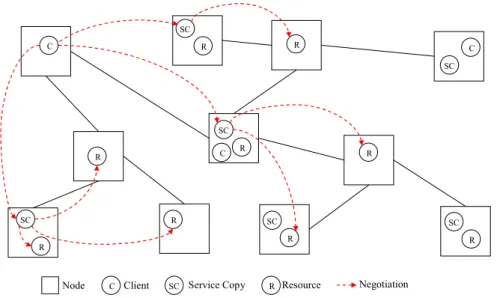
To address this challenge, the Catallactic middleware has been envisioned as a set of economic agents that interact between them and with the software components of the underlying ALN, to coordinate, in a decentralized way and using economic criteria, the assignment of resources, as can be seen in the Figure 2.2.
Figure 2.2 CATNETS as a P2P network of agents.
In that vision, those agents interact under a P2P architecture. The term P2P should be interpreted not as an specific system architecture, but as a general approach for distributed system design ([Pepi03a]) that can be realized under very different architectures and topologies, ranging from unstructured and disperse networks to very centralized systems ([P2p02a], [MKL+02]).
In the following sections we present the specific requirements that the Catallactic Middleware should satisfy and the design principles that guided the process of designing its architecture. We also analyze their impact on the selection of the middleware architecture and implementation options.
2.2.1 Architectural requirements
C SC R SC R SC R R R SC R C SC SC R C R R SC R C• Scalability: The very essence of the CATNETS project is to use Catallactic mechanism to manage the resource allocation in very large ALNs, so the possibility to scale cannot be limited by any design decision. The Catallactic middleware should be able to address scenarios with thousands of nodes in a highly dynamic environment, where nodes enter and leaves the network frequently.
The dynamism in the network configuration implies that information about the system should be maintained at a minimum (avoiding global topological information) and that updates must be easy and efficient. Also, under this scenario, the common assumption that nodes and resources are organized in well known and trusted administrative domains might not apply. So, excessive dependency of existing services on each administrative domain should be avoided. Scale also implies a high level of heterogeneity in applications, the underlying platform, resources, QoS of providers, reliability of any middleware service and availability of nodes (some will be quasi permanent, other will enter and leave).
• Variability of ALN characteristics: One of the objectives of CATNETS is to provide a clear statement of the applicability of the Catallactic mechanism to a wide variety of ANLs.
The characteristics of the resource allocation scenarios being considered might be very variable, with very different usage scenarios like collaborative P2P networks, scientific P2P grids and P2P CDNs. Even when all those systems are P2P, they have a great variability in terms of key characteristics
Table 2.2 summarizes some of those characteristics in an abstract ANL model (based on [Catn03] and [IaFo01]) and evaluates how it could impact the Catallactic middleware.
Characteristic Description Impact on middleware Overlay
topology
Topology of the logical network that ALN components uses to communicate (e.g. random, hierarchical, power law)
Communication mechanisms must adapt to diverse topologies to guarantee an efficient message routing
Configuration Dynamism
to what extend the ALN configuration is maintained in terms of participant nodes and overlay structure.
Information regarding resource location and network topology must be updated frequently Resource
Distribution
Resources in the network might be highly distributed among nodes or concentrated in few nodes
The overlay network architecture and the request forwarding algorithm for centralized resources can be hierarchical, whereas for distributed resources a flooding style might be more efficient (mostly when considered in highly dynamic environments)
Resource Diversity
From commodity resources to highly specialized, unique resources
Commodity resources can be easily located by local broadcasts or DHT-like mechanisms. Unique resources might need efficient network-wide discovery and match making algorithms
Usage Patterns Clients might request same resources recurrently or each request might be unique
Recurrent request might benefit from caching information from previous requests (resource location, for example)
Table 2.2. Characteristics of ANL applications.
It is possible that different policies and algorithms need to be applied to adapt the system to different scenarios. Our vision is a system modular enough to considerer the replacement, following a plug-and-play metaphor, of key components like:
Overlay network management (peer node, topology maintenance and heuristic learning)
Resource discovery
Resource-Request Match making Resource allocation
Request processing/forwarding Negotiation protocols
Message format handling
Security mechanisms (message encryption, agent authentication)
• Compatibility with different base platforms
The design of the middleware should consider a generic design that allows the integration of different base platforms. This might lead to the definition of generic APIs and the definition of very flexible and extensible models to represent the platform’s information (resources, for example). Also, some adaptors would be needed to translate this generic model to the specific model used for each platform. This translation mechanism could harm the
performance of the system if transformations are complex or frequent.
• Allow the self-organization of components
The exact characteristics of the P2P architecture for the Catallactic Middleware will be one of the key issues to be addressed in the design and implementation phases. However, all P2P systems exhibit a set of characteristics that are relevant from the architectural point of view (P2P02b, Pepi03a):
Decentralization: there is no single or centralized coordination nor administration point
Symmetric interaction between peers: all peers are
simultaneously clients and servers requesting service of, and providing service to, their network peers
Non-deterministic topology: At any moment in time, the overall topology of a P2P network is completely unpredictable. The set of nodes that makes up the network varies constantly
Heterogeneity: The devices contributing in P2P applications can differ in many respects, including communication bandwidth,
available memory and the persistence of their network connections.
Dynamic and virtual allocation of communication paths: due to communication paths between peers are created dynamically based on various factors, like network conjunction or intermediate peers state.These characteristics, when considered together, lead to a set of astringent architectural requirements for self-organization. The dynamicity of the network prevents an a priori configuration of the peers or the maintenance of centralized configuration files. Peer need to discover continuously the network
characteristics and adapt accordingly, what requires a distribution of some important system functions like security, resource management, topology management, among other, which have been traditionally reserved to very specialized nodes.
As all the system function should be implemented in all peers and there have heterogeneous properties and configurations, all these self-organization functions should make little assumptions about the underlying platform’s features.
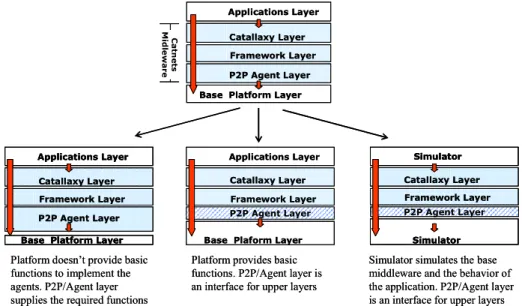
• Support different implementation architectures
The Catallactic mechanisms could be implemented in different platforms and for a diversity of applications, each with its unique architecture regarding the organization of clients, service providers and brokers, as well as with respect to the communication topology.
Therefore, the Catallactic Agents (that implement the behavior of Clients, Services, Service Copies, as described in section 1.3 of this document) and the Catallactic middleware components (that implements supporting functions like resource discovery, resource management, request processing, etcetera) will be deployed under different configurations and will use different communication patterns.
Different architecture will lead to different ways to organize and deploy the Catallactic components. Therefore, each component should not make any assumptions about a specific distribution. Basic functions of the Catallactic middleware should be implemented as independent agents instead of
subroutines into a complex agent. This will facilitate their redistribution across the different components of the underlying platform and the applications that use it.
Different architecture models will lead to different interaction patterns between the base platform, the applications and the Catallactic middleware. Under some scenarios, the applications will make request for resources to the base platform, which will in turn, forward it to the Catallactic middleware (probably, using a component specifically modified to interact with it). In other scenarios, the application will make request directly to the Catallactic middleware (probably, using a component specifically modified to interact with it) which will interact with the base platform to fulfil it.
2.2.2 Architecture Design Strategies
To address the architectural requirements defined in the previous sections, we have defined a series of strategies that allows us to separate the different concerns and manage them individually without missing the coherence of the architecture as a whole. These strategies are summarized as follows:
• Isolate economic agents from the underlying ALN
Agents should relay in its ability to discover other agents and to efficiently communicate with them. However, due to the potential variability of the ALN’s topology as well as the discovery and communication mechanisms, agents should neither be aware of the overlay topology nor make any assumption about its communication mechanisms.
On the other hand, the scalability of CANTNETS will be determined to great extend by the ability of the Catallactic middleware to efficiently handle a huge amount of nodes and resources in very dynamic environments.
Middleware will probably need to implement different algorithms to adapt to different scenarios (for example, adaptation to sudden changes in the network or disruptions). Also, different algorithms could be used simultaneously to search resources, combining strategies and increasing the success. It is therefore expected that discovery will be one of the components more likely to change. However, isolating the economic agents from the agent discovery process should not limit the ability of agents to learn about the best peers to negotiate with, neither should it preclude the integration of agent level information (for example, success ratio of negotiations with other agents) into the adaptation mechanisms used by the middleware.
• Implement middleware using lightweight agents
Scalability, efficiency and flexibility are the main issues to consider when implementing the Catallactic mechanisms. Handling a potentially high number of negotiations simultaneously requires an efficient implementation of
economic agents.
Traditional agent development approach requires sophisticated platforms where key functions like discovery and ontology handing are tightly integrated and difficult to replace or modify. The resulting implementations usually impose a high overhead in terms of memory footprint and CPU consumption [HWBM02]. On the other hand, a “bare java code” will impose the heavy burden of
implementing mechanisms like thread, memory and communication management, which requires a great deal of low level work to obtain the required efficiency. Also, this approach might lead to tightly coupled code, which will result hard to maintain and extend.
Therefore, the Catallactic Middleware requires a minimum platform to handle efficiently low level functions like message routing and thread management without imposing an overhead or limiting the flexibility of the solution.
Using a lightweight agent approach might limit the complexity of the functions and algorithms that could be implemented in the expected time frame of the project and with the estimated resources. Functions such as learning should be
carefully considered and a trade off between feature richness, efficiency and development effort must be established.
• Create complex behaviour by interaction of simple agents
Traditional agent development approaches are based on the implementation of complex agents that exhibit sophisticated capabilities like learning or reasoning. However, this impose some limitations on the protocols and algorithms that can be used in key concerns like agent discovery and negotiation, which are
expected to change during the design and implementation phase of the project, as the requirements are refined.
Instead, we propose that agent behaviour and negotiation algorithms should be expressed in terms of the interaction of multiple simple, specialized and efficient agents. These agents are responsible for basic functions like agent discovery, managing individual negotiations, message routing, message format handling, exception handling and message encryption ([ZaPa04]), [HWBM02], [MKL+01]).
These agents will require a minimum execution platform, it will be easy to be implemented and collective behaviour could be adapted changing interaction patters and including new agents.
Also, designing the system as a set of cooperating agents makes easier to change the distribution of functions among different nodes, either statically at deployment time or dynamically depending on the environment (work-load, requirement patterns), including the possibility of dynamic agent creation and agent migration.
Depending on the capabilities of the implementation platform and the performance issues that the interaction among many agents might generate, some these simple agents could be aggregated as specialized behaviours of one “heavy” agent. However, efficiency must be balanced with the flexibility of the implementation, because the specification of some key functions is expected to change along the implementation phase.
• Allow pluggable mechanisms and strategies
When implementing the Catallactic middleware, it is very probable that different mechanisms, strategies and policies might be considered to adapt the system to very different environments. Those components might even coexists, to allow a dynamic adaptation to the changing conditions. This will allow, for example, using two completely different requests forwarding algorithms to find local and remote peers, and deciding to use one or the other depending on the type of request, past experience or other environmental conditions.
For all major components, like resource discovery, request processing, negotiation and resource allocation, consider the separation of the basic mechanism from the decision making of how (and when) to use them.
The separation of mechanisms from strategies requires a great deal of design in the basic abstractions and interfaces between those two components. Some design patterns [GHJV95] should be considered:
Chain of responsibility (allow more than one object to handle one request, adding functionality dynamically to the process)
Strategy (encapsulate one object’s behaviours as independent, pluggable objects)
Command (encapsulate requests as objects)
Decorator (adds functionality to an object by encapsulating it in a richer interface)
• Use APIs with opaque data types
Many of the APIs for the different Catallactic middleware layers will handle information that will depend on the specific application domain and base platform used for implementation. For example, the resource discovery will return a list of resource descriptions, which depends on the kind of resources used by application: processors for a Grid, bandwidth for a CDN, and so forth. Therefore, we found very restrictive to specify those APIs with concrete data types for their parameters, which will very probably be changed in each implementation scenario, and might require a massive software actualization. This limitation can be overcome using opaque data types in APIs, which can be extended or specialized on each specific implementation. These opaque data types can by language dependent, like abstract parameter objects in Java or can be language neutral, like XML documents.
Abstracts parameters are generic objects capable of introspection, that is, to inform on runtime what their structure is (for example, the list of attributes) and to access the parameter’s content in some “neutral” data type like Strings. These abstracts objects can be specialized to handle the specific parameter’s structures and data types needed by each implementation scenario, allowing their optimization.
XML documents can be considered a kind of abstract parameters, because they offer methods to introspect their structure and access their content. The main difference is that the interface is very standardized in the DOM programming interface and there are many implementations available. Also, they are based on text formats that are platform and language independent.
Language dependent abstract parameters are more efficient but impose interoperability problems. XML is more interoperable but imposes a considerable runtime overhead in the manipulation of data.
2.3 Architecture Design
In this stage of the project we have focused on the definition of the Development View of the architecture, which will allow us a better organization of the work and a clear separation of design and implementation concerns.
We structure the architecture in terms of the separation of two fundamental layers: the Middleware Services and the Framework [Bers96]. A Middleware Service is a general-purpose service that sits between platform and applications and is defined by the APIs and protocols it supports [Emme00].
The framework is a software environment, defined by a set of programming interfaces and tools, designed to simplify application development for a specific application domain.
2.3.1 Proposed Architecture
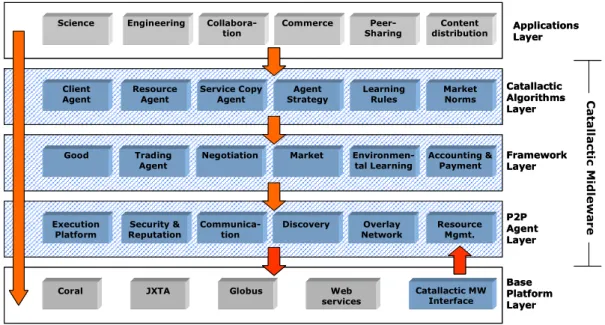
This architecture, shown in figure 2.3, is composed of five different layers:
• Application Layer: is given by the domain specific end user applications like collaboration tools, problem solving environments, and many others. Applications rely on the base platform for functions like communication and platform level resource management. However, applications can have application level resources, like a virtual meeting room in a collaboration tool or a matrix resolution algorithm in a scientific environment.
The interaction model between the application layer and the Catallactic
middleware is application and middleware dependent. Application can interact directly with the Catallactic middleware (becoming Catallactic enabled
applications) to manage their resources or they can interact transparently by means of the base platform they are built on.
• Catallactic Algorithms Layer: Implements economic algorithms for resource allocation. These algorithms should be domain independent and platform independent.
This layer is structured as a set of interacting agents that play the roles of Sellers and Buyers in service and resource markets. Also, in this layer are extensions and specializations of the functionalities provided by the underlying framework, to adapt them to the specific ALN and the resource allocation polices in place.
• Catnets Framework Layer: offers the primitives that supports the implementation of Catalactic algorithms, like find peers agents to negotiate, start negotiation, make a bid, wait for a bid. It is dependent on the agent platform being used, but should be independent of the application domain and the base platform.
This layer is structured in a set of basic entities that model the interaction of trading agents in a market to exchange goods. These abstract entities are the building blocks of the Catallactic algorithms.
• P2P Agent Layer: Platform that hosts the Catallactic agents offering a generic P2P application model with abstractions for the discovery and communication mechanism, and a generic interface with the underlying platform.
This layer offers a rich development environment, covering the basic functions that will be used by all implementations; it is responsible for interfacing with the underlying platform and complementing it when necessary.
• Base Platform Layer: Supports applications and Catallactic middleware. It is (potentially) domain specific.
The model of interaction with the Catallactic middleware depends on the architecture of the base platform, but in general will require the implementation of a connector, which routes the request for resources to the corresponding economic agents. In some cases, this might even require the re-implementation of some core platform components, like the GRAMs (Globus Resource
Allocation Managers) in Globus [FKL+99]
Figure 2.3 Catnets architecture – Development View.
2.3.2 Related Work
Both P2P and economy based resource allocation have received a great deal of attention in the last couple of years. Therefore, there are some projects that have coincidences in their goals with CATNETS and whose architectures can have some similarities.
PEPITO project [Pepi03a, Pepi03b] address the P2P computing model in general, from the formal perspective, the programming paradigms and the middleware services to develop distributed applications under this model. The architecture proposed by this project is based on the vision of a distributed virtual machine. CATNETS, on the other hand, focus on the development of generic middleware components needed for decentralized resource allocation. It makes no special emphasis on P2P application development, because it should adapt to different ALN architectures. However, we expect to take advantage of the results from PEPITO project during the design stage, in areas like the design of DHTs, fault tolerance and mobility.
MMAPPS project (Mmap04a, Mmap04b) aimed to provide a toolkit for the development of P2P applications that uses economic based incentive mechanism that allows the coordination and optimization of these applications. The base architecture considered a set of applications that users employ to access services distributed in a P2P overlay network. These applications and services use a middleware which offers functions like group management, search, service management, security, negotiation, rules and policies enforcement, accounting and pricing. This architecture allows a
Resource Agent Client Agent Service Copy Agent Agent Strategy Learning Rules Market Norms Applications Layer P2P Agent Layer Cata ll ac ti c M id le w a r e Base Platform Layer Catallactic Algorithms Layer
Coral JXTA Globus Web
services
Environmen-tal Learning
Market Accounting &
Payment Negotiation
Trading Agent Good
Science Engineering Commerce
Peer-Sharing Content distribution Collabora-tion Framework Layer Catallactic MW Interface Execution Platform Overlay Network Resource Mgmt. Security & Reputation Communica-tion Discovery Resource Agent Client Agent Service Copy Agent Agent Strategy Learning Rules Market Norms Resource Agent Client Agent Service Copy Agent Agent Strategy Learning Rules Market Norms Applications Layer P2P Agent Layer Cata ll ac ti c M id le w a r e Base Platform Layer Catallactic Algorithms Layer
Coral JXTA Globus Web
services
Environmen-tal Learning
Market Accounting &
Payment Negotiation
Trading Agent Good
Science Engineering Commerce
Peer-Sharing Content distribution Collabora-tion Framework Layer Catallactic MW Interface Execution Platform Overlay Network Resource Mgmt. Security & Reputation Communica-tion Discovery
transparent integration of economic mechanism for service negotiation into the application. MMAPPS considered that all applications and services would be developed using this framework, so integration of already existing applications was not considered (at least explicitly) in the design. This is a fundamental departure from CATNETS approach, where integrability to heterogeneous ALNs is a key design objective. However, we have found MMAPPS’ pluggable rules and policies an interesting approach for handling the adaptation of the Catallaxy market’s rules to different environments and needs, which will be studied in detail during the design stage.
Related to the idea of economic based resource allocation is the GridBus Project ([BuVe04],[VBW05]). However, its strong emphasis on computational intensive grids, (just one of the several ALNs considered by CATNETS) and the hierarchical nature of some of the proposed components, like the Grid Market Directory, diverges from the proposed CATNETS’s architecture, which promote a fully decentralized resource allocation mechanism for diverse ALNs.
2.4 P2P Agent layer
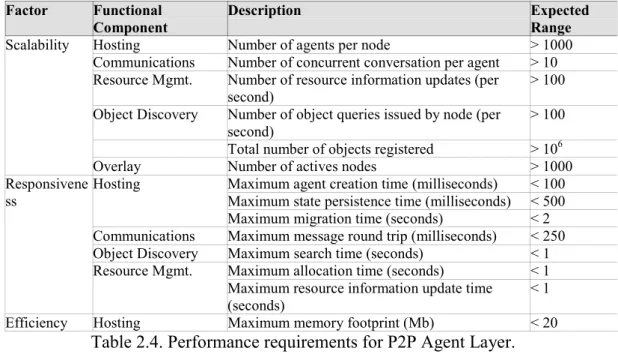
The P2P Agent Layer encompasses the basic functionalities that supports all the Catallactic middleware, providing the basic mechanism that will allow the system to self-organize according to the policies implemented in the upper layers ([EAB+99], [BJM04]). Therefore, this layer has the responsibility to address the critical requirements of interoperability, flexibility and scalability required by the project. In this section we will offer a detailed explanation of this layer, their functionalities and the requirements it should fulfil.
The P2P Agent layer also provides a rich execution interface to speed the implementation of the Catallactic agents, providing a set of common functions and complementing the base middleware when necessary. This layer also isolates the rest of the Catallactic middleware from the particularities of the underlying base middleware, promoting more portable components in the upper layers.
The P2P Agent Layer is built based on the basic abstraction of a set of agents, each of them implementing a basic function within the system, and interacts using a logical topology. It is important to notice that there is no one-to-one correspondence between the trading agents in the Catallactic Algorithms layer (for example, Clients, Service copies and Resources) and the agents in the P2P Agent Layer. Actually, we expect that for each trading agent there will be several agents supporting them, carrying with low level tasks like optimizing the logical topology, handling failures, and many others, as was stated in the section 2.2.2 “Architecture Design Strategies”.
One additional consideration regarding this layer is the need for a great deal of flexibility to allow the experimentation with diverse mechanisms like discovery and agent migration, to explore the adaptation of the Catallactic middleware to different ALNs. Therefore, the architecture should support a pluggable component architecture (BCG04], [BJM0])
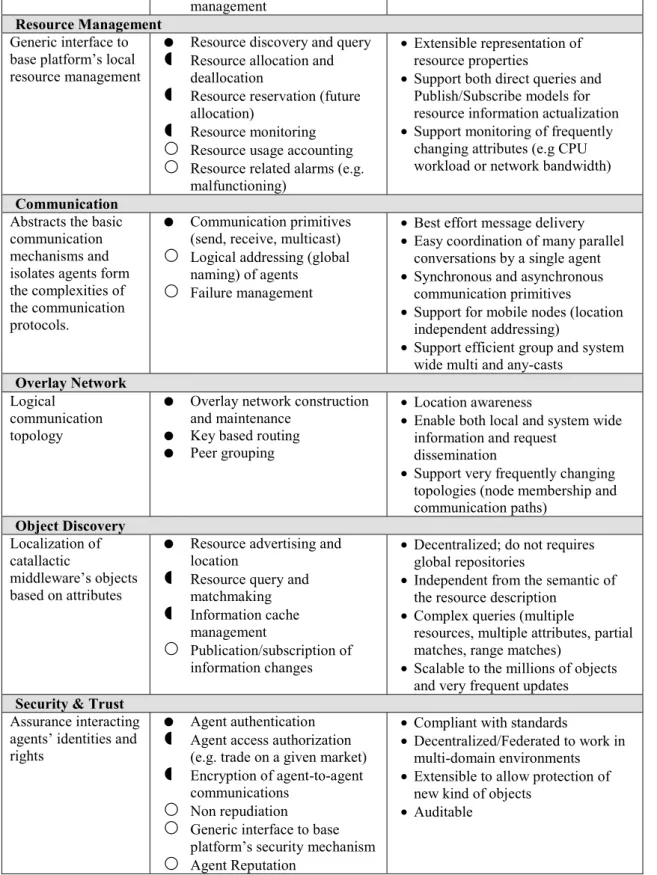
This layer encompasses the following main functional blocks:
• Execution Platform: will provide hosting for the efficient execution of agents. It should permit coexistence of a number of agents on an execution node and facilities the creation, monitoring, scheduling, and management of agents.
Besides, the implementation of agents will be much simplified if such functionality is provided by the platform. In scenarios when node failures are possible, good failure management features are essential and the persistence of agent’s state or even the mobility of agents to other nodes, could be required to increase its availability ([HoB02], [PNC02])
• Resource Management: offers a generic interface to base platform’s local resource management to permit its allocation and de-allocation of resources to requesting agents. In some scenarios, it could be necessary to handle efficiently the assignment of different types of resources in a single location (co-allocation) and the reservation of resources for future usage. Finally, some resource monitoring mechanism is required to control the state of resource allocations for management, auditing, etc. ([ADG+04], [PBC03])
• Communication: abstracts the basic communication mechanisms and isolates agents form the complexities of the communication protocols. Since network topology will be very dynamic and agent location could vary frequently, a logical addressing to distinguish communications among different agents regardless it location is required. In general, we are considering a dynamic scenario where communication and node failures are not just possible, but very likely; therefore communications should be assumed as unreliable and delivery guarantee is not a requirement. Also, a robust failure management is required ([CJK+03])
• Overlay Network: manages the logical communication topology to efficiently communicate cooperating agents regardless of their physical location. The project is considering very large scale and highly dynamic scenarios where logical communication topology can not be maintain in a single server, a hierarchy of servers, and direct discovery of nodes is not feasible. It is required a distributed mechanisms that provides overlay network construction and maintenance. P2P topology construction mechanisms could be optimised for fast location or fast information dissemination. Finally, in such a huge networks of agents, the possibility of grouping them could be appealing to make communication more efficient and management easier. ([GCB+04], [HCW04], [DZD+03])
• Object Discovery: offers mechanism for the location of objects (agents and resources). Catallactic middleware will be used in very large scale and dynamic scenarios where resources, services and the agents which represent them can not be maintained in a table. Therefore it required mechanisms to discover resource and the agents which manage them. Discovery can be performed either by resource advertising or by resource query and matchmaking mechanisms. Besides, information changes can be published and subscribed to. In order to diminish communication cost, some information cache management system could be used. Finally, it might be required mechanism that permit complex queries (multiple resources, multiple attributes, partial matches, range matches), independent of the semantic of the resource description. ([TsRo03], [LCC+02], [BHPW04])
• Security and Trust: We consider an open system where communication attacks are possible, and agents are autonomous agents which could be malicious. Therefore, mechanisms for agent authentication, agent access authorization (e.g. trade on a given market), encryption of agent-to-agent
communications, non-repudiation of settled agreements, are required. Agent reputation mechanisms could also be considered, since they has been proven to diminish fraudulent operations ([FCC+03], [YHF+03]).
One important consideration with respect to the P2
![Table 2.2 summarizes some of those characteristics in an abstract ANL model (based on [Catn03] and [IaFo01]) and evaluates how it could impact the Catallactic middleware](https://thumb-us.123doks.com/thumbv2/123dok_us/561293.2566721/22.892.209.769.712.1132/table-summarizes-characteristics-abstract-evaluates-impact-catallactic-middleware.webp)