DigitalCommons@UNO
DigitalCommons@UNO
Information Systems and Quantitative AnalysisFaculty Publications Department of Information Systems and Quantitative Analysis
2017
Mitigation of Cognitive Bias with a Serious Game: Two
Mitigation of Cognitive Bias with a Serious Game: Two
Experiments Testing Feedback Timing and Source
Experiments Testing Feedback Timing and Source
Norah E. Dunbar Matthew L. Jensen Elena Bessarabova Yu-Hao Lee
Scott N. Wilson
See next page for additional authors
Follow this and additional works at: https://digitalcommons.unomaha.edu/isqafacpub
Bradley J. Adame, Joseph Valacich, Sara Straub, Judee K. Burgoon, Brianna Lane, Cameron W. Piercy, David Wilson, Shawn King, Cindy Vincent, and Ryan Schuetzler
DOI: 10.4018/IJGBL.2017100105
Copyright©2017,IGIGlobal.CopyingordistributinginprintorelectronicformswithoutwrittenpermissionofIGIGlobalisprohibited.
Mitigation of Cognitive Bias
with a Serious Game:
Two Experiments Testing Feedback
Timing and Source
Norah E. Dunbar, University of California Santa Barbara, Department of Communication, Santa Barbara, California Matthew L. Jensen, University of Oklahoma, Price College of Business and Center for Applied Social Research, Norman, Oklahoma
Claude H. Miller, University of Oklahoma, Department of Communication, Norman, Oklahoma Elena Bessarabova, University of Oklahoma, Department of Communication, Norman, Oklahoma Yu-Hao Lee, University of Florida, Department of Telecommunication, Gainesville, Florida Scott N. Wilson, University of Oklahoma, K20 Center, Norman, Oklahoma
Javier Elizondo, University of Oklahoma, K20 Center, Norman, Oklahoma
Bradley J. Adame, Arizona State University, Hugh Downs School of Communication, Tempe, Arizona Joseph Valacich, University of Arizona, Eller College of Management, Tucson, Arizona
Sara Straub, Independent Researcher, Norman, Oklahoma
Judee K. Burgoon, University of Arizona, Eller College of Management, Tucson, Arizona
Brianna Lane, Christopher Newport University, Department of Communication, Newport News, Virginia Cameron W. Piercy, University of Central Missouri, Department of Management, Warrensburg, Missouri
David Wilson, University of Nebraska-Omaha, Department of Information Systems and Quantitative Analysis, Omaha, Nebraska
Shawn King, Independent Researcher, Norman, Oklahoma
Cindy Vincent, Salem State University, Department of Communications, Salem, Massachusetts Ryan M. Schuetzler, University of Arizona, Eller College of Management, Tucson, Arizona
ABSTRACT Oneofthebenefitsofusingdigitalgamesforeducationisthatgamescanprovidefeedbackfor learnerstoassesstheirsituationandcorrecttheirmistakes.Weconductedtwostudiestoexaminethe effectivenessofdifferentfeedbackdesign(timing,duration,repeats,andfeedbacksource)inaserious gamedesignedtoteachlearnersaboutcognitivebiases.Wealsocomparedthedigitalgame-based learningconditiontoaprofessionaltrainingvideo.Overall,thedigitalgamewassignificantlymore effectivethanthevideocondition.Longerdurationsandrepeatsimprovetheeffectsonbias-mitigation. Surprisingly,therewasnosignificantdifferencebetweenjust-in-timefeedbackanddelayedfeedback, andcomputer-generatedfeedbackwasmoreeffectivethanfeedbackfromotherplayers. KEywoRdS
INTRodUCTIoN Proponentsofdigitalgame-basedlearningmaintainthatgamesandsimulationscanfacilitatelearning becausethey(a)catertothedigitalgenerationoflearners(Prensky,2005),(b)allowforimmersive, activelearningincreasingengagementandretention,and(c)encouragenewformsofknowledge interactionunavailableinatraditionalcurricula(e.g.,perspective-taking,slowingdownorspeeding uptimeprocesses,accessinghazardousordistantenvironments(Jackson,2008).Importantly,digital gamesallowforimmediatefeedbackthatcanhelplearnerscorrecttheirmistakesandrewardlearners formakingcorrectdecisions. Theprovisionoffeedbackgenerallyimproveslearning,howeverthereareimportantcaveats regardinghowandwhenfeedbackisgiven.Digitalgamescanprovidefeedbackbasedonlearners’ paceanddecisionmaking(Azevedo&Bernard,1995).Recentstudieshaveexaminedthecostsand benefitsofofferingfeedbackduringinstruction(Hays,Kornell,&Bjork,2010),thetiming(Butler, Karpicke,&Roediger,2007)andthesourceoffeedback(e.g.,ateacher,parent,peer,oracomputer agentinthegame(Goldberg&Cannon-Bowers,2015;Hattie&Timperley,2007).Weaddtothis bodyofresearchbypresentingtwostudiesexploringtheeffectsoffeedbacktiming(immediate vs.delayed)andfeedbacksource(computeragentsvs.humanpartners)inagame-basedlearning environmentdesignedtoteachlearnersaboutthepitfallsofcognitivebiases.Totesttheseeffects,we createdaseriousgamecalledMACBETH(MitigatingAnalystCognitiveBias byEliminatingTask
Heuristics)1,whereinplayersaretaskedwithdetectingandpreventingaseriesofterroristthreats
bygatheringandassessingintelligencedata(forMACBETHdevelopmentseeauthorcitation).The gamefocusesonknowledgeandmitigationofconfirmation bias(CB)andfundamental attribution error(FAE).Thetrainingeffectivenessofthegamewascomparedtoatraditionalinstructionalvideo explainingFAEandCB,whichofcourseexcludedfeedback.
Using Feedback in a Serious Game to Mitigate Cognitive Biases
Biasedinformationprocessingisoftencausedbytheover-relianceonheuristics—definedasmental shortcuts,orsimpledecisionrules—arisingfromconventionalbeliefs.Byprovidingswiftsolutions andminimizingcognitiveeffort,heuristicscanbenefitdecision-making;however,theymayoften alsoleadtoinsufficientconsiderationofrelevant,diagnosticinformation,resultinginincreaseduse ofcognitiveshortcutsassociatedwithpoordecisionsandbiasedinformationprocessing(Tversky& Kahneman,1974).Confirmationbiasharmssystematicinformation-processingbydirectingattention towardevidencethatconfirmsexistingattitudesandbeliefs(Lundgren&Prislin,1998)attheexpense ofweighingandexaminingpertinentavailableevidencethatmightotherwisedisconfirmerroneous assumptions.Similarly,FAEfostersatendencytofocusoninternal,dispositionalexplanationsof others’behaviorsattheexpenseofexternal,situationalfactors(Harvey,Town,&Yarkin,1981) likewisehinderingthedecision-makingprocess. Cognitivebiasesaredifficulttochange:Theyaredeeplyembeddedwithinnaturalcognitive processes,andpeoplerarelyrecognizetheirbiaseddecision-making.Tomitigatebias,peoplemust firstbecomeawareoftheiruseofheuristics(Bornstein&Emler,2001)forwhichfeedbackcanhelp, therebyleadingtobetter-informeddecisions.Feedbackingame-basedlearningcanbeeffectivewhen itprovidesplayersobjectivelearninggoalswithclearcriteriaforsuccess,alongwithmethodsfor improvementtoattaingoals(Erhel&Jamet,2013). Notallfeedbackbenefitslearning:Repeatednegativefeedback,forinstance,canleadtolowered expectations,reducedeffort,andamorenegativeself-image(Krenn,Würth,&Hergovich,2013). Formativeandcorrectiveoutcomefeedbackthroughsuggestionsandguidancecanhelpmodify
thinkingandbehaviorandimprovelearning(Shute,2008).Yet,performancedecrementsarelikely tooccuriftoomuchfeedbackinformationispresented,causingoverload.Thus,bothtimingand quantityoffeedbackiscriticaltolearningandoptimalperformance. Timinghasalsobeenexaminedtodiscerntheadvantagesofimmediateversusdelayedfeedback, andameta-analysishasconcludeddelayedfeedbackisgenerallysuperiorinlaboratorystudies,since studentsareoftenrequiredtoexplicitlyconsiderandrespondtoit,whereasimmediatefeedbacktends tobemoreeffectiveinappliedstudies,suchasclassroomsettings(Kulik&Kulik,1988;vander Kleij,Eggen,Timmers,&Veldkamp,2012).Theamountofa“delay”varieswidelyinthestudies withfeedbackbeingprovidedfollowinganassessment,attheendofaday,oruptoaweekaftertask completion(vanderKleijetal.,2012).Althoughofferingfeedbackduringgameplaycanenhanceits salience,allowingplayerstoadjusttheirdecisions,itcanalsobeadistraction,harmingenjoyment. In-gamefeedbackcanslowgameplay,inhibitinggoalattainment,particularlywhenspeedofplay isabasisforadvancement(Ryan&Pintrich,1997).Ontheotherhand,despiteitspotentialfor slowingplay,detailedfeedbackearlyintheprocesscanleadtofasterlearning(Billings,2010;Tsai, Tsai,&Lin,2015).Becauseplayerscanusein-task“just-in-time”(JIT)feedbacktoimprovetheir performanceandcorrectmistakes,webelieveitcanbemoreeffectivethanfeedbackdelayeduntil aftertaskcompletion.Thus,wehypothesize: H1:JITfeedbackismoreeffectiveatmitigatingCBandFAEthandelayedfeedback. Knowledgeisentwinedwithpractice,andlearningviavideogamesisnoexception(Lave& Wenger,1991).Discoveringhowtoplayanewgametakestime.Noviceuserscanbeoverwhelmed withgamemechanics,losingfocusofthetrainingcomponentsofthegameifspecificguidanceand initialinstructionarenotprovided(Serge,Priest,Durlach,&Johnson,2013).Overtime,players becomemorecomfortablewiththecontrolsandmechanics(Dickey,2011),allowingthemtofocus moreonlearningtactics.InapreviousstudytestingtheeffectsoftheMACBETHgameusingimplicit orexplicitinstruction,repeatedplayandlongerdurationofplayweremoreeffectivethanshorteror non-repeatedgameplay,althoughtheexplicitnessoftheinstructionmoderatedthosefindings(author citation).InreplicatingtheeffectofrepetitionanddurationinmitigatingCBandFAE,wehypothesize: H2:LongerexposuretoMACBETHthrough(a)repeatedor(b)longerdurationofplayismore effectiveatmitigatingCBandFAErelativetoshorterduration. EXPERIMENT 1 METHod Participants Atotalof508participants(57.5%females;age:M=21.30,SD=4.94,range:18-55)whofitour eligibilitycriteria(atleast18yearsold;nativeEnglishspeakers)wererecruitedfromaMidwestern university(n=233)andaSouthwesternUniversity(n=275)intheUnitedStates.Elevenparticipants weredroppedpriortoanalysesforfailingtocompleteallthemeasures,forbeinggivenincorrect measuresbyresearchstaff,orforquittinggameplaybeforetheirtimehadexpired.Overall,411 participants(81%retention)completedthe8-weekfollow-upsurvey.
design and Procedure
A2(feedback:JITvs.delayed)×2(repetition:one-shotvs.repeatedplay)×2(duration:30vs.60 minutes)mixed-modelexperimentwithanoffsetcontrolgroup(whowatchedaninstructionalvideo providedbyourfundingagency)wasconducted.Descriptionsoftheconditionsareprovidedbelow. Wehadnoinputinthedesignoftheinstructionalvideodevelopedbythefundingagencyanddid notseeituntilMACBETHwasnearlycomplete.Studymaterialsandprocedureswereapprovedand
determinedtoposelessthanminimalriskbytheinternalreviewboards(IRBs)ofboththeuniversities andtheDepartmentofDefense. Conditions Feedback ParticipantsplayedeitheraJITordelayedfeedbackversionofMACBETH.TheJITversionhas computermentorsappearingimmediatelyduringgameplayinaboxatthebottomofthescreen conveyingfeedbackontheplayer’sactions.Forexample,iftheplayerbasedadecisionona dispositionalcue,thementorwouldsay:“Notquite.Lookforcluesaboutthesituationnexttime,not dispositionalcuesaboutthesuspect’spersonality”(seeFigure1).Inthedelayedfeedbackcondition, playersreceivedthesamefeedbackbutattheendofthescenario. Duration Playerswererandomlyassignedto30-or60-minuteversionsofthegame,andaplayclockwasvisible onthescreen.Whenthetimeexpired,playersweretoldtheymustsubmittheirfinalhypothesisto endthegame. Repetition Participantsintheexperimentwererandomlyassignedtotworepetitionconditions:eitheraone-shot gamesessioninthelab,orarepeated-playsessioninitiallyinthelab,followedbyareturnsession aweeklater. Thedatawerecollectedintwolaboratorieslocatedinseparateuniversities,withexperimenters ateachlocationfollowingidenticalprocedures.Participantsfirstcompletedanonlinequestionnaire determiningtheireligibility(ageandEnglishrequirements)andprovidingtheirdemographicand personalitydata;then,uponarrivalatthelaboratory,completedpretestmeasuresusingtheQualtrics onlinesurveytool.Participantswererandomlyassignedtoconditionsinblocksandwereaskedto playMACBETHonce,orwatchthevideoonce,orcomefortwoplaysessions(aweekapart)inthe samelaboratory.Thoseinthegameconditionwerealsorandomlyassignedtodurationandfeedback conditions,whichwereheldconstantacrossplaysessionsforrepeatplayers.Afterthegameor Figure 1. Feedback
video,participantscompletedthepost-testmeasuresandwereemailedafollow-upsurvey8weeks followingtheirlabsession.Participantswerecompensated$20foreachlaboratorysessionand$30 forthefollow-upsurvey.
Measurement
Bias Mitigation Measures
WedesignedandtestedanewCBscalemodeledafterRassin’s(2010)TestStrategyScaleinwhich allthepossibleanswersofferedlegitimateconfirminganddisconfirmingquestionsthatwererelevant totheitem’sscenario.SixofthesenewCBmeasuresweredevelopedtomakeuptwoscaleslabeled “NewCB”.Eachofthetwo3-itemscaleswasusedtwice:Theywereusedeveryothertimeperiod (pretest,posttestsafterbothplaysessions,and8-weekfollowup)acrossthefourtestperiods.The NewCBscalescoresrangedfrom0to28(α=.74,.90,.92,and.90inthefourtestperiods).
TomeasuresusceptibilitytoFAE,webeganwiththeRon’s Bad Dayscenario(Riggio&Garcia, (2009)andcreatedadditionalscenariostomeasurethedegreetowhichindividualsrelyonsituational vs.dispositionalattributesforunderstandingothers’behaviors.Participantssawtwoscenarios,one positive(e.g.,Alex’ssuccessfulday)andonenegative(e.g.,Ron’sbadday).Theywereaskedto evaluatewhatfactorscontributedtotheeventsdepictedandtheirscoreswereaveragedacrossfive dispositionalitems(e.g.,personality,skills)andfivesituationalitemsrelatedtothescenario(e.g.,the weather,contingencies).Trainingshouldresultinalowerdispositionalrelativetosituationalscore. TheFAEscoresrangedfrom1to11andwerereliableinthefourtestperiodsforsituations(α=.67, .75,.83,.91),anddispositions(α=.77,.78,.85,.92). Experiment 1 Results Threeseparaterepeated-measuresAnalysisofvariance(ANOVA)wereconductedtotestthe hypotheses.Feedback(delayedvs.JIT),Duration(30-vs.60-minutes),Repetition(one-shotvs. repeat-play)wereenteredasindependentvariablesandthemeasuresforCBandFAE(situation anddispositioncues)wereusedasthreeseparatedependentvariables.Tocomparethevideoand non-repeatgameconditiontotherepeatgamecondition,a“LatestPosttest”variablewascreated usingposttest1forparticipantsinthenon-repeatplayandvideoconditions,andposttest2forrepeat playcondition.Thus,therepeatedmeasuresanalysesincludedthreewithin-subjectmeasuresofbias mitigation:thepretest,thelatestposttest,andthe8-weekposttest.
Confirmation Bias Mitigation Results
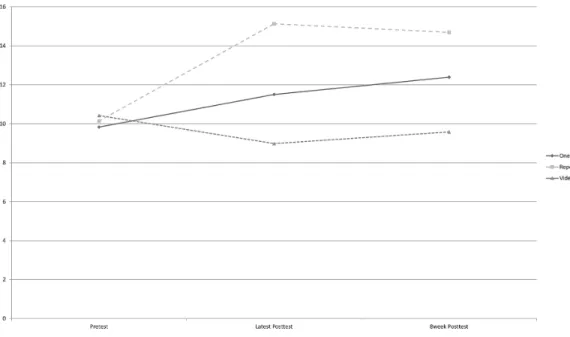
TheCBanalysisshowedthattherewasasignificantmaineffectofTestPeriod,F(1.90,812.25)= 24.07,p<.001,ηp2=.05(Mauchly’sTestofSphericityindicatedthattheassumptionofsphericity hadbeenviolated,thereforeaGreenhouse-Geissercorrectionwasused).Thetrainingimprovedthe participants’CBbiasmitigationability.Pair-wiseBonferronitestshowedasignificantimprovement fromthepretest(M=10.22,SE=.24)tothetwoposttestperiods(latestposttest:M=13.01,SE= .35;8-weekposttest:M=13.10,SE=33),buttherewasnosignificantdifferencebetweenthelatest posttestandthe8-weekposttest. H1whichpredictedthatJITfeedbackimprovesCBmitigationabilityrelativetodelayedfeedback wasnotsupported:TheinteractionbetweenTestPeriodandFeedbackTypewasnotsignificant, F(1.90,812.25)=.34,p=.700,ηp2<.01. H2a,predictingrepeatedplayismoreeffectiveinmitigatingCBthanthesingleplay,wassupported byasignificantinteractionbetweenTestPeriodandRepetition,F(1.90,812.25)=15.41,p<.001, ηp2=.04.Post-hocpairwisecomparisonrevealedtherepeatplayconditions(latestposttest:M= 15.13,SE=.54;8-weekposttest:M=14.68,SE=.55)weresignificantlybetterinCBmitigation thansingleplay(Latestposttest:M=11.50,SE=.38;8-weekposttest:M=12.39,SE=.43)both inthelatestposttestandinthe8-weekposttest(seeFigure2).Inaddition,bothrepeatedandsingle
playweresignificantlymoreeffectiveinCBmitigationthanthevideocondition(latestposttest:M =9.08,SE=1.17;8-weekposttest:M=9.84,SE=1.11). H2bwhichpredictedlongerdurationofgameplaymitigatesCBmoreeffectivelythanshorter durationwasnotsupported.TheinteractionbetweenTestPeriodandDurationwasnotsignificant, F(1.90,812.25)=.01,p=.990,p<.001.Therewasnosignificantdifferencebetweenthelonger 60-minutegameduration(latestposttest:M=13.00,SE=.39;8-weekposttest:M=13.62,SE= .44)andtheshorter30-minutegameduration(latestposttest:M=12.85,SE=.50;8-weekposttest: M=13.47,SE=.49).However,bothlongerandshortergameplayconditionsweresignificantly moreeffectivethanthevideocondition(latestposttest:M=8.98,SE=.87;8-weekposttest:M= 9.58,SE=.91)inCBmitigation.
Fundamental Attribution Error Mitigation Results
Twoseparaterepeated-measuresANOVAwereconductedtoexaminethehypothesesregardingFAE mitigation.Thefirstexaminedwhetherparticipantsdecreasedtheirrelianceondispositionalcues, andthesecondwhetherparticipantsincreasedtheirrelianceonsituationalcuesaftertraining. Fordispositionalcues,resultsshowedasignificantmaineffectforTestPeriods,F(1.90,819.01) =33.95,p<.001,ηp2=.07.Tofurtherinvestigatetheeffect,weperformedapost-hocBonferroni test,whichshowedasignificantreductioninrelianceofdispositionalcuesbetweenthepretest(M= 7.52,SE=.09)andthetwoposttesttestperiods(latestposttest:M=6.64,SE=.12;8-weekposttest: M=6.63,SE=.11).Therewasnosignificantdifferencebetweenlatestand8-weekposttest.Results showedacrossconditionsparticipantsdecreasedtheirrelianceondispositionalcuesafterreceiving thetraining.However,therewasnosignificantinteractioneffectbetweenTestPeriodandFeedback aspositedbyH1(F[1.90,819.01]=2.25,p=.911),TestPeriodandRepetitionaspositedbyH2a (F[1.90,819.01]=.06,p=.940),orTestPeriodandDurationaspositedbyH2b(F[1.90,819.01]= 3.79,p=.217).Theseresultssuggestthat,althoughplayingthegamedecreasedplayers’relianceof
Forsituationalcues,therewasasignificantmaineffectforTestPeriods,F[1.68,724.41]= 14.82,p<.001,ηp2=.03.Post-hocBonferronitestsrevealednosignificantincreaseinrelianceon situationalcuesimmediatelyafterplayingthegame(Pretest:M=7.36,SE=.08,LatestPosttest:M= 7.35,SE=.08).Surprisingly,alltheparticipantssignificantlydecreasedtheirrelianceonsituational cuesaftereightweeks,regardlessofconditions,M=6.80,SE=.10. Concerningsituationalcues,resultsshowedasignificantinteractioneffectbetweenTestPeriod andFeedback(H1)(F[1.68,724.41]=3.64,p=.034,ηp2=.01). However,thedifferencebetweenthetwofeedbackconditionswasnotsignificant(JIT:M= 70.70,SE=1.03;Delayed:M=71.84,SE=.96),andthecontrolvideoconditionwassignificantly higher,M=75.08,SE=2.26).TheinteractionbetweenTestPeriodandRepetitionpositedbyH2a wasnotsignificant(F[1.68,724.41]=.59,p=.526),norwastheinteractionbetweenTestPeriodand DurationpositedbyH2b(F[1.68,724.41]=1.39,p=.250),suggestingneitherFeedback,Repetition, orDurationofgameplayincreasedrelianceonsituationalcues. Experiment 1 discussion WepredictedthatJITfeedbackwouldbemoreeffectivethandelayedfeedbackinreducingCBand FAE(relianceondispositionalcuesandincreaserelianceonsituationalcues).However,wefound littledifferenceinthetimingoffeedbackdelivery,withJITanddelayedfeedbackperformingequally well,andbothoutperformingthetraditionalinstructionalvideointermsofreducingCBanduseof dispositionalcues.Itcouldbethatadvantagesofthefaster,uninterruptedplayofthedelayedcondition andtheimmediatesalientfeedbackoftheJITconditionsoff-seteachother.Itcouldalsobethatthe delayofabout20-40minuteswhiletheplayerwasengagedinthescenariowasnotenoughofadelay tomakeadifference.Playersseemedtopreferthedelayedfeedback,asanecdotalcommentsonopen-endedquestionsinthepostsurveysuggested,theyfoundtheJITfeedback“annoying.” Toaddressthisissue,wemodifiedthefeedbacksystembeforeExperiment2,andtestedanaltered formofJITfeedbackasecondtime.Playersweregivenfewerpositivecommentsfrommentorsand thefeedbackfocusedoncorrectiveactiontoimprovetheirperformancewhentheymadeerrors.The feedbackquoteswerealsoshortenedwhereverpossibleandweaskedourvoiceactorstospeedup theirspeechtoshortenthetimespentlisteningtofeedback. H2apositedrepeatedgameplaywouldbesuperiortosinglegameplay,andthiswaspartially supported,playerswhoplayedthegamemultipletimesshowedgreaterCBmitigationthanplayers whoplayedonlyonce,butthiswasnottrueforFAEmitigation.MACBETHisacomplexstrategy gamewithasteeplearningcurve;playersinshorterdurationconditionswerelikelyconsumedwith learningtonavigategamemechanics,thuspointingtotheefficacyofadditionalrepeatedsession. Playerswithrepeatedexposuretothegamewereprobablyabletomastergamemechanicsandbetter absorbthetraining. H2b,whichpositedincreasedexposuretothegamewouldenhancetraining,wasnotsupported. Longergamedurationprovidednoadvantage;however,bothlongandshortgamedurationsweremore effectivethanthevideocontrolcondition.Comparingeventhe30-minutegamewithoutrepetitionto the30-minutevideo,thegamewasmoreeffectiveatmitigatingCB,butnotFAE.
Experiment 2: Alternative Feedback Sources in the Mitigation of Cognitive Bias
Experiment1revealedthetimingofthefeedbackappearedtomakelittledifferenceinmitigationof CBandFAE,however,itdidnotaddressthesourceofthefeedback,whichmaybeapertinentissue. ResearchershavefoundindividualsoftenexaggerateorunderstateCBwhenmakingdecisionswithin agroup(Kerschreiter,Schulz-Hardt,Mojzisch,&Frey,2008).Tschanetal.(2009)foundthathaving doctorsdisplaymoreexplicitreasoningtoagroupwhenjustifyingtheirdiagnosisdecreasedCB, andGreen(1990)foundthatsimplyhavingtoanswerquestionsaboutone’sdecisionscaneliminate CB.Evenhavingacomputeragentquestionone’sdecisionscanreduceCB(Silverman,1992).A
similarmechanismmayoperateforFAE,althoughweareunawareofanystudieshavingtestedFAE mitigationinsolovsgroupdecision-makingsituations. MichaelandChen(2006)positthatimmersivecollaborativevirtualenvironmentsmayincrease students’understandingofabstractconcepts.Multiplayergamingenvironmentsencourageplayers to“communicateandcollaboratetoachieveindividualandcollectivegoals”(Dickey,2011,p.201), butitisunclearfromtheresearchwhethermultiplayergamesaremoreconducivetolearning,or whetherthegroupdistractsfromanindividual’slearning. Webelieveamultiplayerseriousgamecanbeasuccessfullearningmediumwiththepotential tomitigatebiasmoreeffectivelythansingle-playertraining.Theopportunityforplayerstoconstruct theirownknowledgebyactivelyengagingwithoneanother,beyondsimplyhavingknowledge transmittedfromascreen,shouldleadtohigherlevelsoflearning.Thesuccessofamultiplayer versionshoulddependonhowplayersinteractwithpartners,aswellasthequalityoffeedback.Thus, wecreatedtwoversionsofMACBETH:Oneinwhichplayerstradedintelligencewithanotherplayer (oranartificialintelligencedesignedtobehavelikeahumanplayer,whenanotherplayerwasnot available),andcomparedittothesingle-playergameusedinExperiment1.InadditiontoH3below, were-testedH2toreplicatetheeffectsofrepetitionandduration,andagaincomparedMACBETH totheinstructionalvideo. H3:TheMultiplayerversionofMACBETHissuperiortotheSinglePlayerversionatmitigating CBandFAE. Experiment 2 Method InExperiment2,thekeyvariablewasPlayerType(singlevs.multiplayer).TheuseofJITfeedback washeldconstant,andparticipantsplayedeitherthesameSingle-player-JITversionofMACBETH testedinExperiment1,oramultiplayer-JITversion,inwhichtheyplayedwitheitheranotherhuman participantoracomputeragentwhenanotherhumanplayerwasunavailable.Experiment2followed thesameproceduresasExperiment1exceptasnoted. Participants Participants(N=558)wererecruitedbymassemailsthroughtheuniversityregistraranddepartmental emaillists,andbyclassroomannouncementsatthesametwolargeuniversities.Thesampleof558 participantsusedintheanalysesincluded48%females,andparticipantsrangedfrom18to44years ofage(M=21.61,SD=4.89).Ofthe558initialparticipants,436(78%retention)completedthe 8-weekfollow-upsurvey.Intotal,204participantsplayedthesingle-playergame,and176played themultiplayergame,with56participantswatchingthecontrolvideo.Ofthosewhoplayedthe multiplayerversion,69playedwithanotherhuman,and107playedwithacomputeragent(AI),or amixofhumanandcomputeragent. Conditions
Player Type (Single Vs. Multiplayer)
Participantsplayedeitherthesamesingle-player-JITversionofthegameusedinExperiment1,or themultiplayer-JITversiondescribedabove.Comparisonsbetweenplayerswhoplayedwithahuman orwiththeAIagentwerenotsignificant,thereforethetwoconditionswerecombined.Moreover, qualitativeanalysesoftheplayer’scommentsrevealedtheywereunawaretheAIagentwasnothuman, nordidtheynoticewhenahumanplayerwhoquitwasreplacedbytheAI. Therewereseveralgameplaydifferencesbetweenthemultiplayerandsingleplayerversionsof
otherplayersoneventurns.Theplayer(oragent)receivingtherequesthadtothenprovideintelligence, andwouldreceivepointsfordoingso,aswellasreceivefeedbackfromtheotherplayertheyhelped basedonthetypeofinformationsubmitted. Anotherdifferencewasinthefinalhypothesissection.Inbothversionsofthegame,players eventuallyhavetomakeaguessabouttheperson,place,andweaponusedintheterroristattack.For thesingle-playerversion,whenaplayersubmittedafinalhypothesisheorshegainedpointsbasedon correctitemsandabonusfortheturninwhichitwassubmitted.Iftheplayerdidnothavesufficient evidencetoprovethehypothesis,theywerepenalized.Forthemultiplayerversion,aplayer’sfinal hypothesishadtobeapprovedorrejectedbytheotherplayer(orAI)theywereplayingwith.To rejectahypothesis,aplayerhadtosubmitdisconfirmingintelligence.Ifahypothesiswasapproved, thesubmittingplayerreceivedabonus.Ifahypothesiswasrejected,therejectingplayerreceived pointsandthesubmittingplayerreceivedapenalty.Bothplayerssharedthefinalapprovedhypothesis, playerssharedpointsbasedoncorrectitems.
Duration and Repetition
AsinExperiment1,playerswererandomlyassignedtothe30-or60-minutedurationcondition.The playerswerealsorandomlyassignedtoeitherasingleplayinthelaboratory,repeated-playinthe laboratory,ortheinstructionalvideocondition. Measures ThesamebiasmitigationmeasuresinExperiment1wereusedinExperiment2.ForNewCB, Cronbach’salpharangedfrom.68to.91forthethreetimeperiods.FordispositionalFAE,alpha rangedfrom.85to.93,andforsituationalFAE,itrangedfrom.77to.88. Experiment 2 Results Todeterminethelevelofinterdependencebetweenhuman-humandyads,weconductedaseriesof intraclasscorrelationsbetweenindividuals’posttestbiasscoresandtheirgamingpartner’sposttest biasscoresasrecommendedbyKenny,Kashy,andCook(2006).Resultsrevealednosignificant correlations,indicatingparticipants’posttestbiasscoreswerenotinfluencedbytheirgamingpartner’s scores.Thus,playerswereindependentoftheirpartners,andtheassumptionofindependencein parametricstatisticaltestswasmet. Forallanalysesreportedbelow,weconductedrepeatedmeasuresANOVA,inwhichDuration (30vs.60-min.),Repetition(one-shotvs.repeat-play)andPlayerType(multiplayervs.single-player) servedasbetween-subjectfactors.Tomaintaincomparabilityacrossconditions,thewithin-subjects factor(TestPeriod)hadthreelevels:pretest,latestposttest(posttest2fortherepeatplayers,posttest 1forone-shotandvideoplayers),and8-weekPosttest.
Confirmation Bias Mitigation Results
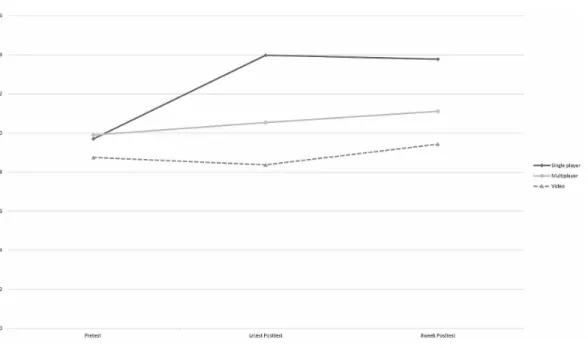
TotesttheoverallCBmitigationeffectacrossthetestperiods,weconductedasinglerepeated-measuresANOVA.TherewasasignificantmaineffectonTestPeriod,F(2,716)=20.99,p<.001, ηp2=.06.PairwiseBonferronicomparisonshowedthatboththelatestposttest(M=12.04,SE= .38)and8-weeksposttest(M=12.32,SE=.37)werehigherthanthepre-testscore(M=9.70,SE =.27),indicating,theoveralltrainingswereeffectiveinmitigatingCB,andthemitigationeffects remainedevenaftereightweeks. Hypothesis3positedplayingwithotherplayerswouldimprovetheeffectivenessofthetrainings onbiasmitigation,andtherepeated-measuresANOVAresultsshowedasignificantinteraction betweenTestPeriodandPlayerType,F(2,716)=9.48,p<.001,ηp2=.03.However,contraryto ourexpectation,thesingle-playergame(M=12.61,SE=.47)wassignificantlymoreeffectivethanthe multiplayergame(M=10.72,SE=.36)andthevideocondition(M=8.85,SE=.73).SeeFigure 3forcomparison.
AsignificantTestPeriod×Repetitioninteraction,F(2,716)=3.08,p=.046,ηp2=.02,was alsofound,suggestingtherepeatcondition(M=12.16,SE=.40)tobemoreeffectivethanthesingle playcondition(M=11.17,SE=.43),whichinturnoutperformedthevideocondition(M=8.85, SE=.73),withnodeclineatthe8-weekPosttest.Therewasalsoasignificantthree-wayTestPeriod ×Repetition×Durationinteraction,F(2,716)=3.76,p=.024,ηp2=.01,indicatingthe60-minute, repeatgameconditiontobemoreeffectivethantheothergameconditions,whichinturnweremore effectivethanthevideo,withnodrop-offfromLatestPosttestto8-weekPosttest.
FAE Scenario Mitigation Results
H3positedthemultiplayerfeedbackdesignwouldbemoreeffectivethanthesingle-playerfeedback inFAEmitigation(i.e.reducerelianceondispositionalcuesandincreaserelianceonsituationalcues). However,resultsshowednosignificantdifferencebetweenthesingle-player(M=6.77,SE=.17) andthemultiplayer(M=6.75,SE=.13)conditions,northevideocondition(M=6.85,SE=.27), F(1.92,688.28)=.21,p=.802fordispositionalcues.Therewasnosignificantinteractioneffect betweenTestPeriodandDuration,F(1.92,688.28)=2.99,p=.053.Therewasalsonosignificant differenceintermsofRepetition(singleplay,repeatplay,video),F(1.92,688.28)=1.10,p=.331. Concerningsituationalcues,thegoalofthestudywastoseeifdifferentfeedbackconditions wouldincreaseparticipants’relianceonsituationalcues.Omnibusresultsforanalysisofrelianceon situationalcuesshowedanon-significantmaineffectforTimePeriod,F(1.82,652.77)=1.07,p= .343.NosignificanteffectsemergedforDuration(30vs.60-min.),F(1.82,652.77)=.70,p=.486, Repetition(single-play,repeat-play,take-home),F(1.82,652.77)=.27,p=.745,orPlayerType (single-playervs.multiplayer),F(1.82,652.77)=1.55,p=.215.Thedatawerenotconsistentwith H3predictingmultiplayertobemoreeffectivethansingle-player. Experiment 2 discussion
thesingle-playerdesignwasmoreeffectivethanthemultiplayerfeedbackdesigninmitigatingCB, althoughnodifferenceswerepresentforFAE.Onepossibleexplanationisthatsingleplayerswere morefocusedontheirtasks.Sinceparticipantsinthemultiplayerversionhadtowaitfortheirpartners torespondtotheirrequests,whereasparticipantsinthesingle-playerconditiondidnot,itcouldbe thatlesswaitingtimeforsingleplayersledtomoreengagementwiththetrainingmaterials. GENERAL dISCUSSIoN Thegoalofthisstudywastoexaminehowdifferentfeedbackdesignsinaseriousgamemayinfluence theeffectivenessoftwotypesofbiasmitigation:confirmationbiasandfundamentalattributionerror. Wealsocomparedthegametoaprofessionallyproducedinstructionalvideoasaseparateassessment ofgamedesigneffectiveness.Sinceseriousgamescanprovidefeedbacktolearnersinawaythata staticinstructionalvideocannot,weexpectedthegameswouldout-performthevideooverall.This studyfurtherexaminediftimingandsourceoffeedbackwouldimprovethegame’seffectiveness. Overall,thegameperformedsignificantlybetterthanthevideointermsofconfirmationbias mitigation,withsomecaveats.InExperiment1,wetestedwhetherthetimingoffeedbackaffected biasmitigationeffectiveness(H1),howeverresultsshowednosignificantdifferencebetweenJITand delayedfeedback,althoughthegamedidreduceCBinbothconditionsequallywellcomparedtothe instructionalvideo.InExperiment2wetestedwhetherthefeedbacksourceaffectedbiasmitigation effectiveness.Specifically,wehypothesizedfeedbackfromanotherplayerwouldbemoreeffective thanfeedbackfromthegame.ContrarytoHypothesis3,theresultsshowedsingleplayerfeedback wassignificantlymoreeffectiveinmitigatingCBthanthemultiplayerfeedbackdesign;perhaps becauseplayersinthemultiplayerconditionhadtowaitfortheirpartnerstorespond,thuswereless engagedinthecontent,andmayhavebeendistractedbytheinteraction. Inbothexperiments,wetestedwhetherlongerdurationofgameplayandrepeatedgameplay improveditseffectivenessinH2aandH2b.Theresultsweremostlyconsistent.Thegamewasmost effectivewhenplayedforalongerduration,andwithrepeatedplay.Oneoftheaffordancesofa seriousgameoveratraditionallecturevideoistheformer’sabilitytoengageplayersforalonger duration,aswellasitspotentialforrepeatplay.Throughlongerdurationandrepeatedengagement, playerscanexperimentwithdifferentsolutionsandobservetheoutcomes,therebypracticingtheir decision-makingskillsrepeatedlywhilelearningtominimizetheirbiases. CoNCLUSIoN Althoughfeedbackisgenerallyconsideredbeneficialforlearning,ourexperimentstestedwhether thetimingandthesourceofthefeedbackcouldaffectitsefficacy.Overall,thevariousgameversions weremoreeffectiveinreducingbiasthanthetrainingvideo.Thetimingofthefeedback—whether justintimeordelayed—appearedtoplaylittleroleinimprovingbiasmitigation.However,thesingle-playerversionshowedgreaterCBmitigationrelativetothemulti-playerversion.Thissuggeststhat incomplexgameswithsteeplearningcurves,likeMACBETH,providingadditionalplayingtime, especiallyintheformofrepeatedlearningsessions,appearstohaveagreatereffectonlearningthan addingplayers,oradjustingthesystemoffeedback.
REFERENCES
Azevedo,R.,&Bernard,R.M.(1995).Ameta-analysisoftheeffectsoffeedbackincomputer-basedinstruction. Journal of Educational Computing Research,13(2),111–127.doi:10.2190/9LMD-3U28-3A0G-FTQT Billings,D.R.(2010).Adaptive feedback in simulation-based training.Unpublisheddoctoraldissertation, UniversityofCentralFloridaOrlando,Florida.
Bornstein,B.H.,&Emler,A.C.(2001).Rationalityinmedicaldecisionmaking:Areviewoftheliteratureon doctorsdecision‐makingbiases.Journal of Evaluation in Clinical Practice,7 (2),97–107.doi:10.1046/j.1365-2753.2001.00284.xPMID:11489035
Butler,A.C.,Karpicke,J.D.,&Roediger,H.L.(2007).Theeffectoftypeandtimingoffeedbackonlearning frommultiple-choicetests.Journal of Experimental Psychology. Applied,13 (4),273–281.doi:10.1037/1076-898X.13.4.273PMID:18194050
Dickey,M.D.(2011).WorldofWarcraftandtheimpactofgamecultureandplayinanundergraduategame designcourse.Computers & Education,56(1),200–209.doi:10.1016/j.compedu.2010.08.005
Erhel,S.,&Jamet,E.(2013).Digitalgame-basedlearning:Impactofinstructionsandfeedbackonmotivation andlearningeffectiveness.Computers & Education,67,156–167.doi:10.1016/j.compedu.2013.02.019 Goldberg,B.,&Cannon-Bowers,J.(2015).Feedbacksourcemodalityeffectsontrainingoutcomesina seriousgame:Pedagogicalagentsmakeadifference.Computers in Human Behavior,52,1–11.doi:10.1016/j. chb.2015.05.008
Green,D.W.(1990).Confirmationbias,problem-solvingandcognitivemodels.Advances in Psychology,68, 553–562.doi:10.1016/S0166-4115(08)61342-4
Harvey,J.H.,Town,J.P.,&Yarkin,K.L.(1981).Howfundamentalisthefundamentalattributionerror?Journal of Personality and Social Psychology,40(2),346–349.doi:10.1037/0022-3514.40.2.346
Hattie,J.,&Timperley,H.(2007).Thepoweroffeedback.Review of Educational Research,77(1),81–112. doi:10.3102/003465430298487
Hays,M.J.,Kornell,N.,&Bjork,R.A.(2010).Thecostsandbenefitsofprovidingfeedbackduringlearning. Psychonomic Bulletin & Review,17(6),797–801.doi:10.3758/PBR.17.6.797PMID:21169571
Jackson,M.(2008).Makingvisible:Usingsimulationandgameenvironmentsacrossdisciplines.InD.Davidson (Ed.),Beyond fun: Serious games and media(pp.18–23).Pittsburgh,PA:ETCPress.
Kenny,D.A.,Kashy,D.A.,&Cook,W.L.(2006).Dyadic data analysis.NewYork:Guilford.
Kerschreiter,R.,Schulz-Hardt,S.,Mojzisch,A.,&Frey,D.(2008).BiasedInformationSearchinHomogeneous Groups:ConfidenceasaModeratorfortheEffectofAnticipatedTaskRequirements.Personality and Social Psychology Bulletin,34(5),679–691.doi:10.1177/0146167207313934PMID:18310314
Krenn,B.,Würth,S.,&Hergovich,A.(2013).Theimpactoffeedbackongoalsettingandtaskperformance: Testingthefeedbackinterventiontheory.Swiss Journal of Psychology/Schweizerische Zeitschrift für Psychologie/ Revue Suisse de Psychologie, 72,79-89.doi:10.1024/1421-0185/a000101
Kulik,J.A.,&Kulik,C.-L.C.(1988).Timingoffeedbackandverballearning.Review of Educational Research, 58(1),79–97.doi:10.3102/00346543058001079
Lave,J.,&Wenger,E.(1991).Situated Learning: Legitimate peripheral participation.Cambridge,UK: CambridgeUniversityPress.doi:10.1017/CBO9780511815355
Lundgren,S.R.,&Prislin,R.(1998).Motivatedcognitiveprocessingandattitudechange.Personality and Social Psychology Bulletin,24(7),715–726.doi:10.1177/0146167298247004
Riggio,H.R.,&Garcia,A.L.(2009).ThePowerofSituations:JonestownandtheFundamentalAttribution Error.Teaching of Psychology,36(2),108–112.doi:10.1080/00986280902739636
Ryan,A.M.,&Pintrich,P.R.(1997).ShouldIaskforhelp?”Theroleofmotivationandattitudesinadolescents helpseekinginmathclass.Journal of Educational Psychology,89(2),329–341.doi:10.1037/0022-0663.89.2.329 Serge,S.R.,Priest,H.A.,Durlach,P.J.,&Johnson,C.I.(2013).Theeffectsofstaticandadaptiveperformance feedback in game-based training.Computers in Human Behavior,29(3), 1150–1158. doi:10.1016/j. chb.2012.10.007
Shute, V. J. (2008). Focus on formative feedback.Review of Educational Research,78(1), 153–189. doi:10.3102/0034654307313795
Silverman,B.G.(1992).Modelingandcritiquingtheconfirmationbiasinhumanreasoning.IEEE Transactions on Systems, Man, and Cybernetics,22(5),972–982.doi:10.1109/21.179837
Tsai,F.-H.,Tsai,C.-C.,&Lin,K.-Y.(2015).Theevaluationofdifferentgamingmodesandfeedbacktypeson game-basedformativeassessmentinanonlinelearningenvironment.Computers & Education,81,259–269. doi:10.1016/j.compedu.2014.10.013
Tschan,F.,Semmer,N.K.,Gurtner,A.,Bizzari,L.,Spychiger,M.,Breuer,M.,&Marsch,S.U.(2009).Explicit Reasoning,ConfirmationBias,andIllusoryTransactiveMemory.Small Group Research,40(3),271–300. doi:10.1177/1046496409332928
Tversky,A.,&Kahneman,D.(1974).JudgmentunderUncertainty:HeuristicsandBiases.Science,185(4157), 1124–1131.doi:10.1126/science.185.4157.1124PMID:17835457
vanderKleij,F.M.,Eggen,T.J.,Timmers,C.F.,&Veldkamp,B.P.(2012).Effectsoffeedbackinacomputer-basedassessmentforlearning.Computers & Education,58(1),263–272.doi:10.1016/j.compedu.2011.07.020
ENdNoTES
Dr. Dunbar is a Professor of Communication at the University of California Santa Barbara. She teaches courses in nonverbal and interpersonal communication, communication theory, and deception detection. She was the Principal Investigator of a $5.4 Million contract from the Intelligence Advanced Research Projects Activity in 2011-2013 and has had her research funded by the National Science Foundation, the Department of Defense, and the Center for Identification Technology Research. She has published over 50 peer-reviewed journal articles and book chapters and has presented over 90 papers at National and International conferences. Her research has appeared in top journals in her discipline including Communication Research, Communication Monographs, and Journal of Computer-Mediated Communication as well as interdisciplinary journals such as Journal of Management Information Systems and Computers in Human Behavior. She has served on the editorial board of six disciplinary journals and as the Chair of the Nonverbal Division of the National Communication Association in 2014-2016. Matthew L. Jensen (Ph.D., University of Arizona, 2007) is an Associate Professor of Management Information Systems and a co-Director of the Center for Applied Social Research at the University of Oklahoma. Professor Jensen’s interests include computer-aided decision making, knowledge management, human-computer interaction, and computer-mediated communication. He is an active member of an interdisciplinary team investigating how people attribute credibility in mediated interactions and how people filter and evaluate information they find online. Elena Bessarabova is an Assistant Professor in the Department of Communication at the University of Oklahoma. She received her PhD in Communication from the University of Maryland, College Park in 2011. Her research foci are in the areas of social influence and cross-cultural communication. Within social influence, she is interested in resistance processes associated with psychological reactance, inoculation, and bias mitigation. She also studies the effects of emotion on resistance and attitude change. In addition, she is interested in deception as a social influence tactic, and her research on this topic focuses specifically on understanding cultural differences in deception. Dr. Yu-Hao Lee (Ph.D., Michigan State University) is an assistant professor in the Department of Telecommunication, University of Florida. His research focuses on media psychology and information processing in interactive media environments, and online collaborations such as social media campaigns and online activism. He has received top-paper awards from the International Communication Association (ICA) and Association for Education in Journalism and Mass Communication (AEJMC). His research has been supported by external grants from the National Science Foundation (NSF), Online News Association (ONA), and AEJMC.
Scott Wilson is the Director of Innovative Technologies at the University of Oklahoma’s K20 Center. This educational research center is dedicated to the research of effective teaching and learning in Kindergarten (K) to graduate (grade 20) educational environments. Dr. Wilson leads a team of researchers, designers, and developers in the application of digital game-based learning to engage learners in authentic learning experiences. He holds a PhD in Instructional Leadership and Academic Curriculum and has served as a designer, producer, and researcher of novel learning experiences and their impact on learning.
Javier Elizondo is the Production Manager for Digital Game Base Learning at the K20 Center in The University of Oklahoma. He oversees the development and implementation of educational gaming environments for educational and experimental purposes. He also manages game development of a university initiative to bring Virtual Learning Environments (VLE) to the classroom. He has extensive experience as producer of multimedia educational materials with an emphasis in educational gaming. In 2013 he produced MACBETH a game to test cognitive bias training under the sponsorship of IARPA, MACBETH went on to win Best Serious Game in bot business category as well as Special emphasis category at the Games Showcase & Challenge, at I/ITSEC 2013. Previous to his current post he served as the Communications Director for Pacific Resources for Education and Learning (PREL) and as director of JUMP Into Reading for Meaning, a Star Schools grant held by PREL that produced Cosmos Chaos! an innovative educational game to assist struggling readers with vocabulary development. Cosmos Chaos! was released on the Nintendo DS platform on the winter of 2010. Javier also served as the director of Pacific Learning Services (PLS) an instructional design company that provided multimedia educational services to a range of governments and institutions including PREL, the World Health Organization, the Asian Development Bank, the International Labor Organization, the Republic of Palau, the Federated States of Micronesia, and American Samoa. Javier Elizondo holds an MA in Communication and broadcasting by Western Illinois University and a BA in Communications Sciences by the Monterrey Institute of Technology
Bradley Adame studies how people respond to communication campaigns designed to promote disaster preparedness in areas of the country that suffer high rates of extreme weather events such as hurricanes, floods and tornados. His goal is to give guidelines for producing the most effective type of messages so that people will pay attention and take steps to protect their families and property. Prepared citizens are better able help themselves and their neighbors, in turn building stronger organizations and communities.
Brianna L. Lane (Ph.D., University of Oklahoma, 2015) is an Assistant Professor in the Department of Communication at Christopher Newport University. Her research and teaching interests include interpersonal communication within electronically mediated contexts. Her main line of research examines impression formation from online identity claims. Additionally, Brianna has conducted research regarding social support on social networking sites and the effects of cell phone use in romantic relationships.
Cameron W. Piercy, (Ph.D., University of Oklahoma, 2017) is an Assistant Professor in the Department of Management at the University of Central Missouri. He researches organizational communication, network dynamics, and computer-mediated communication. His research has been published in Computers in Human Behavior, Communication Research, and in the Proceedings of Lecture Notes in Computer Science.
David W. Wilson is an assistant professor of management information systems (MIS) at the University of Oklahoma. He received his Ph.D. in MIS from the University of Arizona. His research has appeared in MIS Quarterly, the International Journal of Human-Computer Interaction, the Journal of Nonverbal Behavior, and Communications of the AIS. He has presented his work at major IS conferences, including International Conference on Information Systems (ICIS), Americas Conference on Information Systems (AMCIS), and Hawaii International Conference on System Sciences (HICSS). His research interests include information privacy, online identity, personal disclosure, and meta-analysis methodologies.
Cindy Vincent is assistant professor in the Department of Communications at Salem State University. Her education includes a Ph.D. in Communication from the University of Oklahoma, and a M.A. in Communication and B.A. in Journalism from California State University, Sacramento. Her research primarily focuses on class representation in mainstream media and civic media creation as response.
Ryan M. Schuetzler is an Assistant Professor of Information Systems at the University of Nebraska at Omaha. He completed his Ph.D. at the University of Arizona, where he completed his dissertation on the effects of automated conversational agents on human behavior and attitudes in interviews. He earned a BS and Masters of Information Systems Management from Brigham Young University. His research interests include interpersonal deception, nonverbal behavior, intelligent agents, and human-computer interaction. His research has been published in Communications of the Association for Information Systems, Group Decision & Negotiation, and the Journal of Nonverbal Behavior, as well as numerous conferences.